The stock is up not because Jensen is going to make things better and create business value, but because now they know for the next two years the feds have their back as long as they keep Trump’s buddy in charge.
That used to be the case, but many modern tech companies are deliberately set up where shareholders don't get voting rights, or where the founder/insiders have special shares that will always mathematically overrule the shareholders.
Zuckerberg, Musk, Amodei etc. do not answer to their shareholders.
The shareholders (unfortunately just a few) are the ultimate authority.
If the voting structure is 50%+1, then owning that much voting power makes him effectively the board, and the board is purely for show.
and the buyers of the common shares _should_ know that and take it into account when they price it. If they don't, then it's their own fault for buying thinking they'd get more "votes" than they have.
This sort of structure _ought_ to make the share price lower. The fact that it doesn't means the buyers don't care enough, or that they think such a structure gets them more money than the regular type (that of 1 vote per share, no second class shares etc).
I've asked some people that are somewhat into finance why good news and profits make a stock price go up. When the stocks offer no governance (which I don't understand why that would be valuable anyway), no dividends, and no promise of buybacks (although companies are doing that recently somewhat). The only hope is that you'll be able to sucker someone else to buy that bag for more than you did.
Modern IPOs just seem like another farcical way to raise capital, without any requirement to pay it back like a loan or a bond would. If you don't give dividends, why should I care about your stock personally? What methods of profit are there from it aside from selling it to another bag holder?
This is indeed in the shareholders best interests as judged by the movement in the stock on this news.
People overlook that Jensen had decent support of the rank and file. Maybe not 100% but enough that it could cause a serious dent in the company productivity if everyone left, or even stayed but switched to rest&vest mode.
It was even more visible in the OpenAI case, where almost the entire company threatened to quit if the CEO was not reinstated. At that point, if everyone leaves the company ceases to exist.
Their implicit power is immense. But if the shareholders say one thing, firmly, the workers can't override. They can only try to make the shareholders think theybwill lose money.
It's a bit more than just "try to make the shareholders think" if 96% of the company quits.
There would not have been direct legal consequences to the board had they disregarded the desires of the employees and let them all quit.
Certainly plenty of financial, and indirect legal, consequences though.
Secondly, all these employees threatening to quite were all acting as one; almost “in union”, one might say ;-)
So in the default case you can’t really say employees have any power on the basis of this case — which they really don’t in the US, which threatens to be increasingly problematic in coming days.
The board has the power to ignore the workers. They cannot be legally forced to do so.
The workers have the implicit power of walking away and joining a new Jensen company. But this is an entirely theoretical threat.
Altman had 745 out of 770 workers openly supporting him.
They _did_ organize. As a distributed swarm, but still.
Corporations and wealthy individuals have spent mountains of money to persuade us that our only influence on them is through ineffective consumption boycotts, but it's not true. Until they have their own armies, Democratic institutions still matter.
Now, the interests of the state and shareholders are often so aligned that the state won't undermine shareholders, but not always the case. Some popular examples of these tensions: Nexperia in the Netherlands, Credit Suisse / UBS, TikTok divestment, Broadcom/Qualcomm, much of antitrust enforcement, etc.
Good examples of major ventures formed in another state after their preferred choice rejected them: Christopher Columbus's voyage to the Americas (where he approached the monarchs of Portugal, England, and France before Queen Isabella agreed to sponsor him); Morris Chang founded TSMC in Taiwan despite being an executive at American semiconductor companies because his career hit a ceiling here and both VCs and established companies rejected him; Qian Xuesen founded China's space and ballistic missile programs after he was unjustly accused of being a communist spy and later deported during the McCarthy era.
3/5
> "We the People of the United States […] do ordain and establish this Constitution for the United States of America.
After all it was Trump's employees (ie. government agents) that got Jensen Huang fired in the first place. Now the board explicitly says they asked permission to choose a CEO ("the board received input from senior levels of the United States government, and based on that input, the Board is confident that Mr. Huang’s reinstatement poses no national security risk")
I doubt that. Americans are pissed off about high gas prices and their purchasing power going down. They have shown, through repeated elections, that corruption is tolerated as long as expected quality of life is perceived to be attainable.
https://www.cnbc.com/2026/10/23/corruption-midterm-election-...
> Separately, a large majority, 90%, also said that government corruption was a crucial or major factor in their vote.
https://www.bbc.com/news/articles/c39wz0970eypo 6 November 2026
He resigned.
One amongst many articles at the time: https://www.cbsnews.com/news/jensen-huang-nvidia-ceo-return-...
Note the fire is very different from layoff legally. Fire means they need your job done, but you weren't doing it. Layoff means you were fine they just don't need your job. Layoff often comes with severance pay.
You could have Rubio waving solid intel, but if Trump and Co throw enough doubt in there - does it matter?
Some corps -- e.g., Meta -- are structured as notionally public, but with supershares owned by insiders (Zuck) that have massive voting power.
In cases like that, the company is I guess technically under the authority of the shareholders, but it's only the special class of shares that count. It is not possible to buy enough of the publicly available Meta shares, for example, to wrest control from Zuck.
One of the Anthropic shares gets 50.1% of the voting power, or something like that, according to one of the explainer videos I've seen.
A reasonable example of such a circumstance would be a company that purportedly was building world-ending tech and selling it on the open market.
(1) The current US administration seems to be willing to claim "extraordinary circumstances" on days ending in "y"
(2) This whole sector is full of people, from top to bottom, who are openly petitioning about the existential risks to the human species, begging for regulation, and for everyone everywhere to be made to slow down.
Surely even people who think p(doom) is marketing can at least see how a court (and/or a government) might say "yes, these people should clearly not be allowed to do this on the open market".
Just like how this story showed Nvidia's real power lies with shareholders and not nominal leadership structures, this administration's real power lies with tech billionaires and Miriam Adelson and defense contractors. There's no reason to expect them to violate 500 years of capitalist property rights just on the basis that they're "chaotic".
Point #2 has more merit, and we have seen some friction there. But again I think the far more likely outcome is that the friction resolves by the billionaires choosing to continue making money and toning down their rhetoric, rather than the opposite.
The government which has unlimited money printing ability buying 10% of a tech company, which elevates their share's value, surely would make a tech billionaire gleeful. Much to my chagrin.
There's also this, though I'm not from the US and don't know if y'all count Huang as "non-white": https://www.datacenterdynamics.com/en/news/trump-asked-who-t...
And this, though given the details would you count them as "activists"?: https://en.wikipedia.org/wiki/Anthropic–United_States_Depart...
1. People who have no clue or understanding of history.
2. People who have no clue or understanding of US law.
3. People who have no clue about the requirements of nationalization.
Or often people who are doing all three at the same time.
On those notes:
1. Nationalization has been used EXTREMELY rarely in US history and only in very extreme circumstances, and usually done with an eye toward saving a company from bankruptcy rather than forcing it to do something the government wants.
2. Under US law it is extremely difficult to nationalize a corporation even if the US government wanted to unless the corporate owners are also interested in nationalization.
3. In order to nationalize a corporation you would need to buy out the corporation, which means paying fair market value (often with a markup on top) which for mega valuations like Anthropic would be a "handout" of money from the US government on a scale never before seen.
The point is that these preferred voting shares can make it easier to nationalize them.
How do you estimate a value of that share for wealth tax purposes?
Most stock fires in the market don't care much about voting rights in comparison to stock appreciation or profit sharing
So which is it?
The government can still prosecute him and I'm sure he's going to pay big time in civil court. But that's what it means to have rule of law.
If Trump is only protecting him because of corruption (I think it's much more complex than that) then he'll be held accountable very soon regardless
They should have had something that actually showed bad faith if they wanted him out. If this was the best they had, there wasn't any case.
is this true though? The vast majority of shareholders are isolated and removed by pension funds and opaque ETFs that own other ETFs all the way down. Shareholders today are market takers both by design (long-hold of index funds) and new public structure (sell stock without giving up ownership).
Broadly speaking, they’re as vanilla and non-controversial / passive as it gets. They’re agents of capitalism yes; but not activist investors nor voters.
Institutional investors don’t want firms like Blackrock (who are their vendors; really) to be pulling strings on governance.
https://news.bloomberglaw.com/esg/visa-sued-to-reveal-past-b...
Perhaps someone should devise a system of government along these lines.
Are there corporate structures that prevent it? Obviously Facebook has a structure that means shareholders are never sufficiently empowered even if coordinated. Are there other possible structures that make this the case?
Without a government intervention - which they have a lot of incentive to do when it comes to wrangling and consolidating their power and influence within a new and powerful industry (AI), what these company boards have done when they oust CEOs (OpenAI, NVIDIA) when their portfolio and fiduciary duty is at stake simply does not make sense otherwise.
In ousting an CEO for a growth-based company, in a new and relatively growth-based industry, it doesn’t make sense unless a bigger and more-stabilized external force offers a safety net or incentive to do so. And truth be told, I don’t know what that “external force” could be that wouldn’t get them in more trouble - unless it was the US govt.
In terms of the ultimate authority, they clearly state who made the call, and they did not mention shareholders
But companies are not democratic, right?
Typically, the board members hold enough shares to overrule outside input from shareholders.
You can't conclude this from the increase. At best we're sure some opportunistic buyers thought the company was a buy based on the news. Who knows if it was existing shareholders buying more shares or not.
I suspect the board must have felt the heat coming from somewhere. Why would they suddenly backtrack?
If this doesn't go against the nominal governance structure explicitly, it's arguable it does implicitly, considering the board caved on their prior decision.
“Nvidia said on Monday it was reinstating Jensen Huang as CEO, effective immediately, an extraordinary reversal that followed calls from US President Donald Trump for his return after Huang resigned over revelations of extramarital affairs, including one with a woman alleged to have spied for China.”[0]
Which should I hope prove to people that voting really does matter. Whether you agree with this kind of thing or not, people have a lot more at stake over when it comes to their representatives in government than is sometimes let on in our day to day.
[0]: https://www.reuters.com/technology/nvidia-reinstates-jensen-...
Nvidia hired him back so they can all share the same legal team. His defense is now paid by the very company Jensen used to commit crimes that personally earned him billions while setting up shareholders as bag holders. Trump should have google rename North America to North Korea.
If this (board-decision being overturned) happens “once in a million times”, it’s a good thing, only if it happens “all the time” is it questionable
Do we know this is true? Are we sure this didnt go the way the board wanted?
For the most part, yes. He resigned, they accepted, they stated they were NOT reconsidering his return, then they approved his return. So, several actions suggest they wanted him gone, and then his return suggests their judgment was overruled.
Meaningless, both are in service of the share price (uncertainty is bad). It's easy to make and break a promise no-one is holding you to.
Did they? Or did 1 board member state their opinion? Also, their opinion can change prior to a vote without being “overruled”.
Or they changed their mind.
Yes, the board would have looked much less stupid by not trying to remove Huang in the first place.
Everything else is a rationalization that works backwards from the invisible force of money.
Sometimes we can glimpse a peek at how that works in practice, and the sama + Huang debacles are good examples.
Vanilla Sky (2001)
The board is supposed to serve the interests of the shareholders.
The stock is up 30% today last time I checked, so it looks as though the shareholders interests have been properly protected in this case.
Where do you think the tax revenue that funds this system of rules and laws and morals gets the money from? Hint: it isn’t Magic’d out of thin air. If you are outraged at the morality of CEOs having affairs you’re really going to enjoy the morality of an entire society fighting over the pie once it stops growing when it decides to no longer value creating profit.
Machiavelli wrote about this thoroughly and all of his writings
Robert Greene discusses it in the 48 laws of power
Thucydides did a treatment of this thousands of years ago
4/5.
If he dies, I don't think as many will be volunteering to follow him immediately. (Although they would all follow him eventually.)
December 2024, Market Cap $220B. November 2026, $95B
That's a loss of nearly 60% in under 24 months.
They are certainly watching this with some concern for their current strategy. It's a very strong signal in turbulent times.
Also your list line isn't quite accurate "The idea that board members will actually be able to carry out decisions that have massive negative ramifications for major stakeholders turns out to be questionable in practice."
- Im not sure if you looked at the stock price today (which reflects the preferences of shareholders) but the market liked the decision. They did actually take a big move - stocks tanked then reneged on their decision and it popped back up 30%. So they exercised their power then corrected it.
In this case issue is not just about espionage, but about personal integrity and relationship with a subordinate, for such a think once upon a time even POTUS Bill Clinton was not spared.
A large corporations of tens of thousands of employees need to hero worship one person otherwise they feel the whole company will collapse its such a pity. On top of it when such a large corporation is so fragile, its being rewarded by greedy investors who wants larger returns.
I was just reading the story of BSD unix earlier [0] and that makes me so delighted that we as society can build something so amazing that slowly whole world rely on it. Its collective efforts of many individuals not dependent on hero worship with bus factor of one.
[0] https://fosscomics.com/posts/16.%20BSD%20Unix%20Part%206%20-...
You're right, but I see if more of self preservation and the human condition. Top elites, with massive power and influence, personally invested in Nvidia's success saw their personal wealth being impacted so they stepped in and "fixed" it.
It really is insane to think that trillions of dollars of wealth is propped up by 1 company, which is propped up by 1 person. Insanity.
Never did.
And the reality is asshole CEOs propped up by asshole US gov leadership is a form of security I suppose.
Until it isn't. And we go down first.
Absolute insanity pretending this has anything to do with physical reality or intelligent strategic planning.
As for Huang - he was brought back because the Trump admin has no problem selling banned chips to China as long as it benefits Trump and his cronies personally.
This has nothing to do with the board or the shareholders.
With a current P/E of about 427, "far into the future" is doing incredible lifting. We're talking what, 50 years of potential returns?
There's not enough Kool-Aid to drink in the world to justify Tesla's valuation. Robotaxi would have to have to put Uber, Lyft, Waymo, and traditional taxi services out of business worldwide to even get remotely close to justifying their valuation.
2/5
https://www.cnbc.com/2026/11/16/trump-nvidia-stock-trades-je...
What makes you believe Jensen Huang hasn't sworn some private oaths?
Trillionaire oligarchs would never break a pinky promise.
/s
I don't know man? I hope all of this turns out fine, but I got a gut feeling that this is going to end badly for everyone GenZ or later in the US. The collapse of professionalism across the US in its most critical societal operations is concerning. Industry, politics, healthcare, law enforcement, military and so on. How long can we coast on the wealth that previous generations bequeathed us while greed chews away around its edges?
So far so good I suppose. But there's the old adage about saying that while falling off a building. It's not the fall, it's the stop. I just have an uneasy feeling that I'm saying so far, so good during the fall stage.
That's a nice economy you've got there. It'd be a shame if anything happened to it.
There's a SEC investigation already, now this on top. That's not a good sign in any way.
https://truthsocial.com/@realDonaldTrump/posts/1176661418238...
> "The Attorney General of the United States has confirmed that the U.S. Government does not possess evidence that he has engaged in any unlawful conduct."
>"In April 2023, Trump hired Blanche to defend him for concealed hush-money payments to Stormy Daniels and he led Trump's defense in the 2024 criminal trial. Blanche later defended Trump in cases involving federal classified documents and election obstruction. In November 2024, following his victory in the 2024 presidential election, President-elect Donald Trump announced Blanche as his nominee for deputy attorney general. Blanche was confirmed by the Senate in March 2025."
It's got an element of truth too -- falling stockmarket leads to layoffs, which hits working people.
This is less and less true everyday.
Especially since the "stock market" that we're talking about is really just 5-6 companies. The rest of the stock market has already been mediocre to bad.
The overall economy would obviously take a hit if any one of those companies took a stock price hit, but not that much. For one, they're already laying people off in the thousands. As they layoff more and more people, their wealth is just concentrating further and further into the top. They're becoming less and less critical to the rest of the economy. So yes, GDP would plummet and we'd be in a "recession" but most actual people wouldn't notice anything at all.
The shareholders overwhelmingly want Jensen back, they got him back. This is corporate governance working as intended.
...and the politicians involved are already known to directly benefit by trading stock of the company:
https://www.cnbc.com/2026/11/16/trump-nvidia-stock-trades-je...
People are free to cheer or boo this decision all they want for their own financial or team-boosting reasons, but anyone who thinks we still live in a country with a functioning rule of law is just deluding themselves at this point.
There's a quote from Andor, about the evil Empire:
"They have no shame, do they? They don't even bother to lie badly anymore. I suppose that's the final humiliation."
Those of us in the US now live in a country where they usually don't even bother to lie badly, they just perform the corruption out in the open, confident they will get away with it.
So yeah, very much "Russian-style corruption".
or the part where insiders bought stock ahead of time
or the part where the commerce department axed an investigation into nvidia due to his alignment with the administration
or perhaps the part where megaspeed was specifically exempted from export controls by the white house
or perhaps the part where dangerous frontier development was justified by arguing china would continue no matter what while these guys were the ones supplying compute
First, there was never a shareholder vote, so there is actually no way for you or anyone else to know what percentage of shareholders wanted him reinstated or not.
Second, "corporate governance" is not shareholder democracy. A decent definition is:
> Corporate governance is the system of rules, practices, and processes by which a company is directed, controlled, and held accountable.
Jensen Huang had an affair with a woman whose company purchased billions of dollars of Nvidia chips and was the subject of investigations over possible smuggling of them to China in violation of US export controls. She and her husband are suspected of having ties to Chinese state intelligence/security. We now know that Nvidia's top counsel intervened in a Commerce Department investigation of this company.
On top of that, Huang had an affair with a direct report which at most companies is a fire-able offense.
True corporate governance requires that such serious matters be investigated and addressed if necessary. "Doing whatever shareholders want because stock go down" is not corporate governance.
Finally, the statement issued by Nvidia's board of directors indicated that the US government provided "input" on this matter, and just hours prior, you had the president of the country on social media posting that reinstatement of Huang "would be the best thing for the Company, and also, for the U.S.A."
It's quite obvious that the board that unanimously rehired Huang just days after telling investors on an earnings call that there was no intention of rehiring him and that a search firm had been retained was "influenced" by the US government.
It's ridiculous to make a parallel between Russia kleptocracy and a CEO who has consensual private relation with a staffer - or - someone else for that matter.
"ensen Huang had an affair with a woman whose company purchased billions of dollars of Nvidia chips and was the subject of investigations over possible smuggling of them to China in violation of US export controls"
If the government was concerned about it - they would have informed Jensen and asked them to stop selling to Mega Speed.
The government did neither.
It's not Nvidia's job to run a counter espionage unit - it's their job to be compliant, which they were.
"US government provided "input" on thi" ? The US government provides all sorts of input on all sorts of matters and this is not unprecedented. We don't know what that input was, but it was said they were looking for 'assurances' - who knows what those were but that's hard to speculate.
Now, where is the evidence?
According to the western media EVERY Chinese person is a spy.
Nvidia is not accused of doing anything untoward, they followed the regs, they literally even asked US BIS if they could sell to Mega Speed and got the go ahead from gov, and then internally blacklisted them anyhow.
Jensen's personal foibles are a not good - but a separate matter.
Also it is very dangerous to read stock market prices today as a direct result of this - they were up in premarket trading and globally before this news was reported.
I don't really see it.
Bringing them to toe is generally a few oversight hearings where members grandstand and generally nothing but some unpassable token legislation is later proposed.
I just see much of that as performative, rather than ending in any practical policy.
Whether you are for or against AI is almost irrelevant. My point is they were able to impact. There is an agenda, it will be heeded.
The executive has a much heavier hand to lean on here.
Even republicans are having issues with this[0]; investigations were already launched and now this is just throwing fuel on it. Trump is gonna get his as he magically does, but it'll come at the cost of republicans still supporting him having an even worse 2028 and these companies still getting the legislation they keep jumping into bed with trump to try and prevent.
[0] https://thehill.com/homenews/house/6237899-huang-testifies-c...
This ideology is not compatible with democracy
This is some deeply corrupt, nasty stuff.
And long term, the US has been successful because we have tried (if not always successfully) applied the rule of law to all, rather than being a corrupt country where your connections are what count.
This is so abnormal and dodgy-looking. And we will know why in a matter of weeks.
What a profoundly unserious country the USA has become.
What is your meaning here? What examples are there?
What evidence is there of any hint of this?
I think this is a conflation of narratives.
Hey - we may need to 'reign in' some actions but I don't think that's what's going on here.
The Trump Admin has not given any indication that Nvidia actually did something wrong here and is certainly not seeking to curtail Nvidia.
At this point, Congress can investigate the Asian sales situation to its hearts content and they can come to a deliberative and substantive conclusion as opposed to the bizarre OMG JHH must RESIGNSES! nonsense that transpired 2 weeks ago. There are governance and sales issues worth a look here, but not the over the top panic that happened.
Obviously, front page news.
If the NSA and the CIA couldn't make a case (and they couldn't and that's been reported from multiple sources) over the course of the past year, who is the genius that can? Ed Zitron?
It's not unheard-of. Maria Butina comes to mind as another example.
But I have a feeling you're just selectively disregarding reporting based on motivated reasoning, also implied by the random Ed Zitron rhetorical flourish as an appeal to incredulity.
U.S. Tracked Alice Huang's Contacts With China Spy Agency During Nvidia Affair
https://www.nytimes.com/2026/11/22/us/politics/alice-huang-c...
In this case issue is not just about espionage, but about personal integrity and relationship with a subordinate, for such a think once upon a time even POTUS Bill Clinton was not spared.
A large corporations of tens of thousands of employees need to hero worship one person otherwise they feel the whole company will collapse its such a pity. On top of it when such a large corporation is so fragile, its being rewarded by greedy investors who wants larger returns.
I was just reading the story of BSD unix earlier [0] and that makes me so delighted that we as society can build something so amazing that slowly whole world rely on it. Its collective efforts of many individuals not dependent on hero worship with bus factor of one.
[0] https://fosscomics.com/posts/16.%20BSD%20Unix%20Part%206%20-...
If I made a decision that wiped out a third of the value of my company, I imagine that would be enough to at least spark some new discussion.
Is this meant to refer to Huang leaking secrets to a Chinese spy or the board removing him for leaking secrets to a Chinese spy?
2. It's pretty clear from today's stock price which event the market was reacting to
The market is presumably reacting to the White House signaling that they aren't going to prosecute a Trump donor and close ally.
...the fear of the AI bubble popping and erasing trillions of dollars.
For the Admin and their Big Tech backers, the takeaway from the election seems to be to just keep on given 'er, so expect more capricious, arbitrary exercise of power in the next two years. I don't think this will end well for them.
While the board's initial decision was rash, seemingly based on accusations vs evidence, they need to stick to it.
The main purpose of a board is to represent the long term interest of shareholders and hold the CEO accountable.
Note that is not short term interest - even if the stock tanks today, the question they should've asked is who is the better long term leader? And if they believed that was not jensen then stick with it. Board members might get removed at next shareholder mtg but that's how it's supposed to work.
The open ai fiasco could've been explained by at least the odd composition of board, but not this one. The board just caved twice to external pressure and isn't actually doing their duty when it matters. Hopefully the shareholders replace them at the next mtg
Now I'm just as disgusted by the blatant violation of the intent of the ban, and I think there should be congressional hearings. But I also believe in the rule of law, and that we should blame the game (or the people who set the rules of the game, e.g. politicians) and not the player.
So much noise was created over this incident.
I'm glad I avoided most of it and didn't spend too much time getting into the weeds of what happened here, what the implications were, what the future consequences would be, etc.
But many of the youtubers I follow went all in on it like it was the most urgent thing.
I plan to figure out strategies to cut back my social media usage further as a result.
This is a lesson young people should pay attention to. Often when you're young, nobody tells you how an organization really works, and you are left with what you find in terms of written material, which will reflect the formal shape of the org. You might even think that laws are laws if you're naive enough.
When you join a business, try to figure out how it actually works, who really makes the decisions.
Isn't the board's job to represent the interests of the shareholders? Was a bit different for OpenAI, but Nvidia is just a normal public company.
Leave it to HN to overanalyze and over-intellectualize something so blatantly obvious.
There's a general fiduciary duty for the board, but maximising short-term share price is not a duty. In fact the board has a duty to exercise their own independent judgement, and avoid maximising short-term share price, if it's against the long-term interests of the company, and any other stakeholders included in their duties.
In this case the board's overall sequence of actions is looking pretty good for Nvidia's long-term health and for long-term shareholders.
Nobody with a brain thinks removing Jensen is good for nvidia's long term health at this critical point of time.
> The Board of Directors voted unanimously to reinstate Mr. Huang following a series of discussions and meetings with Mr. Huang, after which the Board was satisfied with respect to Mr. Huang’s candor and ability to lead NVIDIA. In the process of reaching its decision, the Board received input from senior levels of the United States government, and based on that input, the Board is confident that Mr. Huang’s reinstatement poses no national security risk.
A governance structure reversing a decision under extreme pressure isn’t the same as it not being valid. This is very different from OpenAI where the board was removed.
I find it interesting that this seems to confirm that the issue was national security risk.
What would the statement say?
Do you think the statement would directly say "And after Trump directly threatened to imprison everyone on the board for their own involvement in the chips that Nvidia has been smuggling to China they all changed their mind."?
This is sometimes called "reading between the lines" but in this sort of situation I think of it as more like asking yourself, if X happened what Y would I see? Then, when you see Y, you think about all the X that would have led to Y as being possible, not just the one that the person making the statement wants you to think is the reason. It is possible, after all, that this was all on the up-and-up and the board really was just concerned about national security and the Trump administration really did simply answer just that question with no thought as to anything else. It is also possible that that was done, but in addition to that, there were other things that were part of the decision as well.
reporter: what kind of stuff would that be sir?
Trump: Well I'm not going to say but for example...(spills beans about everyone on board)
This may end up being one of the biggest scandals in corporate history. But either way, Nvidia is not a serious company anymore. It has been broken like you would a horse or a major New York white shoe law firm.
Stained indelibly. A silent, endless scream of humiliation.
Everything Trump Touches Dies.
The same will happen to Nvidia, which is now a company with less dignity and respect, and whose prosperity has a time limit.
Oracle was a CIA project: https://gizmodo.com/larry-ellisons-oracle-started-as-a-cia-p...
Palantir was likely a CIA project (and received seed funding from the CIA):
TIA Termination: The Total Information Awareness program, led by former National Security Adviser John Poindexter, was a controversial DARPA project aimed at mass data collection. It was shut down in 2003 due to intense public backlash over civil liberties. Palantir's Founding: Palantir was incorporated in May 2003, just months before TIA was officially axed. While not a DARPA program, its founders, including Peter Thiel and Alex Karp, met with Poindexter, who noted similarities between his TIA approach and Palantir’s proposed analytical model.
While the board could stand on its own, a veiled threat from the government that a huge investigation will be coming down on the survivors/remaining leaders would cause them to fold under that threat. They were trying to just do their fiduciary duty within the framework handed to them.
I really hope the board at least got one concession from him to establish a succession plan under a strict timeline.
As for the board: what are they, three-year-olds? How do you fire someone like Jensen and reverse course within a week?
They're either completely inept, or just being pushed back and forth by much greater powers.
The political spectrum in the USA now runs all the way from the President's position to the State Department's position? Are you seriously claiming that Trump's State Department is "extreme left" now, because Hillary Clinton made some comments in support of firing the philanderer who slept with the Chinese "not CEO" of a company he was selling chips to?
Ms Hillary didn’t do no such thing.
I am not sure where did you get all that. Seriously, I don’t follow.
LV Gave explains what I think is happening right now: https://www.youtube.com/watch?v=IiWsLKTC11w&t=11s
He and I might be wrong ofc.
ps. The part that I'm particularly interested though is a sub-issue: I just want accessible open-weight models. I think they're more important to society than NVIDIA, China vs US, etc. It so happens that most of them are Chinese right now, but there could very well be European or American open models anytime soon. Assuming we don't get "regulation" where the regulatory body (as proposed by Amodei) is effectively managed by OpenAI, Anthropic and Alfabet creating a "natural" monopoly, where any small US, EU or Chinese player is out because of "compliance requirements". On this end Jensens has been the most powerful and vocal supporter of open-weight models for obvious, selfish reasons.
(Not the person you are responding to, this is my own position...)
The US state department is indeed "extreme left" by the standards of the median American voter. An election changes the president, and the president chooses the upper layers of management. Everyone below upper management are career bureaucrats who chose to work in the federal government.
The median state department employee thinks Obama was a far-right lunatic. If you doubt this, try living in Montgomery or Fairfax county. Talk to your neighbors. The seething contempt for markets in all forms is the tell that you are dealing with leftists.
The NYT uses pretty specific language. The story in the spring/summer about the relationship was vague. Clearly the NYT found/was given more information since then as they kept digging, and ran it once they confirmed.
> How do you fire someone like Jensen and reverse course within a week?
I agree with you, but I also have never had POTUS put pressure on me to hire someone back I just fired.
So his affair partner was regularly meeting with Chinese Intelligence for over a year. The man she introduced as her husband was also regularly meeting with Chinese intelligence for more than a year. They were smuggling chips to china against US law. But because Trump had put a lot of money in NVIDIA and lost it everything is thrown out the window. Incredible levels of corruption at this point.
US Intelligence knew early on, and did nothing. Then the head of US Intelligence leaked or otherwise reported on it.
They brought it to POTUS, who said ignore it. That's why Rubio put out a memo, so it would be in writing who knew what and when, when the eventual investigations happen.
I feel most people are mistaking what the actual security risk here is. The risk is not spies, the risk is the AI bubble popping and taking trillions of dollars from the market.
No SEC investigations, no Treasury investigations, etc.
While the board could stand on its own, a veiled threat from the government that a huge investigation will be coming down on the survivors/remaining leaders would cause them to fold under that threat. They were trying to just do their fiduciary duety within the framework handed to them.
I really hope the board at least got one concession from him to establish a succession plan under a strict timeline.
I don’t think they had any leverage to do that, and Jensen doesn’t strike me as the kind of guy who would easily humor such a proposition.
https://truthsocial.com/@realDonaldTrump/posts/1176667139506...
Moral standards and ethical values are central to society. The US is losing sight of theirs in favor of technocratic "market value trumps all"-shortsightedness.
Any exposed case, that I’ve heard of in the past century, severe enough to genuinely warrant sacking hundreds of high level decision makers… has never ever been punished. (or even just lightly wrist slapping the thousands of beneficiaries and asking them to compensate all benefits enjoyed falsely)
Many different HN users even bring these up and nobody seems that surprised.
The US Social Security Administration places the 5-year mortality rate of a 63 year old male at 7%. A betting man would have a succession plan in place.
The usual reply is "yep, someone gets that outcome but it's still statistically rare" and that's true. But this isn't the only die anyone's rolling -- we're all rolling a boatload of dice all the time, and with age your odds on each of them get worse. I have no doubt that Huang's wealth can buy him services and expertise that will flatten his health risk curve. And also the underlying risks are still there and continuity planning for an eventuality that's a lot less eventual at 63 is table stakes.
Reasonable people worry about bus factors for key figures a lot younger.
Succession plan might cost you some efficiency in operations - the coveted 60x management fanout for example.
It might be prudent to retain that efficiency in a high growth market segment, and accept the risk of substantial business failure.
We have too many stagnant/stable companies that over-derisked themselves.
I cheered for Jensen because we have very few large companies acting as a total dictatorships and thus able to take the riskiest, but also the most rewarding paths. Consensus building always defuses that risk.
Derisked, NVidia might trade at a market cap of AMD or Intel. Not too shabby, but not the high focused juggernaut it is.
But surely a risk averse company might take the opportunity of a risk catching up to one of these risk-embracing companies and take over its market-share/buy it out if that risk ever comes home to roost - like JPMorgan Chase acquiring Bear Stearns and Washington Mutual after they were caught in the implosion of the mortgage market in 2008
Each win compounds faster than compounding of a loss. A near inverse of the Kelly criterion.
In mature markets (financial services in 2008) the risk is a zero sum game and there is no super-exponential compounding. In fact the opposite holds true - if you have more AUM your ability to extract proportionally more money from the market diminishes.
In the startup world, where you create new markets, Jevons paradox grants you that super-exponential growth.
Nvidia, SpaceX and probably a few others.. are the rare ones that are huge, and yet non-saturated market creators.
Apple is saturated. So is Meta, Netflix, Alphabet, etc.
Microsoft is a wildcard a bit with OpenAI stake, but.. maybe?
Amazon is habitually saturated but actually most adapted to it.
And only some of them had succession plans, some were meant to have a finite lifespan.
Also, remarkably, that’s why CEOs should fraternize with other CEOs of clients and competitors alike - a facsimile of royal marriages being about merging houses.
For one thing, you lived, so it’s not even 1/100000 people dies from this thing. For another, even if it were 100% fatal, that’s a tiny, tiny fraction of things that could add up (or multiply down) to 0.07.
Not to mention Jensen is likely in better health with better access to better medical care than the median person.
63 Isn't that old but, as you say, the mortality risk increases and other risks too. Some people can be very healthy mentally and physically at 75, others are slower, more tired, their brain has declined in function somewhat due to certain kinds of illness or simply not being able to sleep properly.
I’m not really getting that vibe from any of this eras corporate leaders.
In the gilded age when the robber barons got to old age they started building libraries and Universities everywhere. They didn’t work all day trying to make their next trillion(adjust for inflation to whatever it was in their day)
Like I checked what was the biggest charitable donations Jensen has made in the past 5 years and it was 108 million to Coreweave[1] which I don’t trust at all due to the circular financing shenanigans Nvidia has with Coreweave as part of the loop. Then 75 million to Vanderbilt, then 50 million to Oregon State University, 25 million to Trumps Ballroom(lol) and 22.5 to California College of the arts. After that it’s like a million here a million there.
His fund has to donate a lot more than that legally per year because their assets skyrockets based of his original contribution being NVIDIA stock, and it looks like the rest go to DAF funds which are opaque as to where the funds actually end up.
The man doesn’t seem to care about his legacy post death or if he does he’s banking it all on how big the company can get under his leadership.
[1] https://finance.yahoo.com/sectors/technology/articles/nvidia...
Perhaps Jensen does have a plan of succession. And maybe the board couldn't swallow it once it became known to them.
Also no real surprise.
Let’s hope the truth will show itself eventually.
Part of "their fiduciary duty" could be to make sure that the company is in compliance with the actual law-as-written, and not the "law" as wink-wink-implied by particular person(s). Otherwise when the person(s) in question are not around, future investigations could find non-compliance.
yeah, lets require the company to do anything and everything legal or gray to keep that stock pumpin. moral hazards will dissolve naturally.
All duties, including financial ones, are to be done with-in the law. No contract can override what the law says.
This is what another company is now facing under the US Department of Commerce (allegations to still be proven):
> The Applied Materials derivative complaint, a redacted copy of which can be found here,[1] and filed in the Delaware Court of Chancery on October 26, 2026, arises out of the circumstances that led to Applied Materials’ (AMAT) February 11, 2026, agreement to pay a $252.5 million penalty[2] to the U.S. Department of Commerce’s Bureau of Industry and Security (BIS)[3] for allegedly exporting controlled technology to a Chinese company with ties to the Chinese military. The BIS contended that the allegedly illegal sales to SMIC, China’s biggest chipmaker, violated the U.S. government’s express ban on exporting specific equipment – ion implanters classified as “ECCN 3B991” technology – to SMIC because of the “unacceptable risk” that “SMIC would divert that technology to the Chinese military.”
* https://www.dandodiary.com/2026/11/articles/shareholders-der...
The one you guys are talking about (to benefit the shareholders) is not a duty and not something that should motivate a comment thread.
No it doesn't; why would you think that's the case? "Fiduciary duty" doesn't mean "make every decision based on what will yield the most money right now, ignoring possible future consequences".
Maybe, maybe not. What it suggests is that that’s how they want to frame it.
Their job is to follow rules, without rules, a society is meaningless. A fiduciary duty to shareholders doesn't include break laws to protect profits or break rules to give special passes because enforcing rules will affect profits.
>break laws
Which law was knowingly broken? Where is the evidence Jensen or Nvidia knowingly smuggled chips? There's no evidence Nvidia actually smuggled any chips to China.
All we know is that these guys all stood to lose billions like the rest of the share holders, and still chose to make a hard decision, and we should be cautious when judging them without knowing the facts.
It seems like here they got assurances from the administration (maybe Trump himself) that keeping Jensen wouldn't come back to bite them, and they probably calculated that with those assurances it would give investors more confidence to keep Jensen at the helm.
If the stock market results today don't reverse, it looks like they were correct.
Except that the Trump administration isn't in a position to guarantee anything. Huang is going to be spending a lot of time testifying before Congress, which will not be doing his bidding come January, the SEC and Justice Department investigations into Nvidia's dealings aren't going away, and one state (California) has launched its own inquiry into Nvidia.
And now with Trump gloating that "I convinced them" and his communications director making statements that "President Trump was totally involved", it's not surprising that even Republicans are already speaking out about this.
OTOH there are corporate policies against having an affair with a subordinate, with relevant punishments, but the judgment on those can be subjective and not under the purview of the law.
In this country, every employee is legally entitled to not be subject to a hostile working environment.
The consent of the people having sex is not relevant to this - anyone around them has grounds to sue the company for any perception of preferential, quid-pro-quo treatment of the subordinate having the affair.
The fact that the company is more sue-able after someone fucked the CEO than before does not mean laws were broken.
Furthermore, "having grounds" does not mean "slam dunk lawsuit", you'd likely need other conduct on the company's behalf to really make it more than a ambulance chaser type shakedown.
My understanding is that it would be illegal if he made people's position at the company conditional on having sex with him. But just having sex with an employee is not illegal.
I don't know if he did anything illegal when it comes to his sex acts, but so far it doesn't seem that any evidence has come out that he did.
I'm really surprised by the naivete displayed on HN these past two weeks. That training is obviously, obviously not aimed at people like Jensen. Employment ethics (like laws) are not a universal concept. They only apply to you if you don't have the political sway to ignore them.
Not mutual consent or desire.
Not the underling attempting to climb the corporate ladder via the bedroom instead of the boardroom.
But just because we've been told to ignore these things doesn't mean they stopped existing.
Not when the "victim" disagrees. Their feelings and preferences matter more than anyone elses.
> anyone around them has grounds to sue the company for any perception of preferential, quid-pro-quo
No, if those people weren't being pressured into sexual relations they would have no grounds to sue.
Sigh, the amount of puritanical moralism and defensive absolutism is staggering
If you have to take trainings, you are an NPC.
His wife might disagree.
I'll see myself out. :-)
He is not because he is a billionaire
How are you specifically victimized in this matter by such games? If you don't like it, you don't apply to work at NVIDIA or buy the stock, simple as that.
The shareholders are financially in bed with him but no question he is in control.
That said, my comment meant something entirely different than stock ownership: i.e. being a billionaire at his company wouldn’t protect you. Him not being a billionaire all else being equal would still protect him.
He is not being fired, because he is far more important to the company than we are. As evidenced by the shocking loss of shareholder value during the crazypants week where he was hastily fired.
If I got fired, the shareholders wouldn't even hear about it. Someone else can be recruited with close enough skills, and my projects could be covered by some of my peers in the short term.
Huang was reinstated, not because people who sacked him, suddenly realized that this was wrong and Huang was innocent.
No, the reason they had to reinstate Huang is because Huang is The Nvidia man. without him, there is no nVidia
All of those decisions to protect himself instead of the company puts his leadership ability into question.
Right? I could be wrong, but these are the reasons why I wouldn’t chose him.
Peepee tapes all over again. If enough politically aligned people repeat the lie, the in-group starts to believe it.
Blindly following rules leads to injustice. (That's why we have things like pardons.)
If the last ten years have taught us anything, it is that there are no rules and society is meaningless.
We're living in the anarcho-capitalist hellscape we were warned about even as it pretends to be a liberal, democratic society.
Just like the Romans were living in a military dictatorship that pretended to still be the Roman Republic.
we are honestly looking at investigating the board itself
Does this mean "Lil Marco" lost his bid to stake out a China-skeptic position? Any of his competitors in 2028 are going to yoke him to his boss.
Already has for the past year.
Trump is almost certainly talking about Jensen here:
https://youtu.be/m2aC8lAOQbg?si=rqqSliGdLF4_Q663&t=1460
@24:20
Nobody else really makes sense.
Post these events Trump is talking about, Jensen donated $25 million to the ballroom and became Trump's "good friend".
The real question is what happened internally that caused Jensen Huang to be hung out to dry (temporarily) when he was already turned into a yes-man ("Yes, sir" guy, as Trump says). I'm sure there is an interesting story behind that, but no matter how you look at it the whole thing stinks of massive corruption.
> This could be problematic.
It is very problematic.
No, the others were cronyism with decorum
He definitely owes Trump now - Trump literally got him his job back.
Trump literally called into an NVIDIA board meeting and likely berated, and threatened the board to reinstate him. It's been very clear there has been an active pressure campaign to reinstate him.
This is obviously OBVIOUSLY coercion. Firing a ceo is not made lightly so a sudden reinstatement indicates coercion of some sort. But we don’t know how.
It could be that the short term set back triggered certain investors to execute coercion.
What kind of country do you have when one man's whimsy rules it's corporate boards?
Well, they could unanimously vote to reinstate Huang, or be removed. Potato, potato.
But that is often the case I guess?
I have no insight on what might have taken place here. Though, if one can imagine a clash in the While House, the board rubber stamping administration directives under extreme pressure is not unfathomable.
I mean, this is one of those things where even if one is the most blue-haired woke socialist, it is in their best interest too, whether they realize it or not. 2008/2009 was a really bad time for people working retail, new grads, factory workers, etc. While elites and billionaires obviously lost more dollars, most of them could afford to ride it out and eventually recovered and thrived. The same can't be said for the people who lost their retail or manufacturing jobs or who graduated into that job market.
So, I hope that going forward, all people, Trump haters and Trump supporters alike (as well as me, who is neither), can maintain a degree of apolitical self-interest, instead of having illusions that "stick it to the billionaires with a market crash" will improve wealth equality or achieve anything else other than value destruction.
It's a lot like 2008 too, where Bush was a lame duck President, but anyone with a brain should have been rooting for everything his administration was doing to try to stabilize the economy to succeed.
But what else could it have been, really? I know that this is the US and that they have a fixation on sex and morality, but the fact that someone sleeps around is not an indication of their CEO capacities.
notice how the campaign against Huang was all coordinated and fabricated. Everything was fake and none of the allegations were proved. Its was all just media hysteria, and I am looking forward to the actual investigation into who influenced the Board first time and put everyone accountable.
All these rootless unelected influencers must be rooted out
Less than a week ago they literally said we are not reconsidering his reinstatement.If you think national security had anything to do with this, I got a bridge to sell ya.
The other comments are right. This is actually a very good window into who is really in charge of things and it's not the people whose names are on a piece of paper or a website.
Prosecution for what, exactly? Can you name a criminal statute that they would be prosecuted under?
The President of the United States is publicly gloating about how he "convinced" Nvidia to rehire Huang. It is patently obvious at this point that Nvidia's board was pressured by Trump to make this decision.
Gemini summary ...
If investors sold shares based on the board's statement that Huang would not return, and missed out on the subsequent 31%+ stock rebound, plaintiffs or the Securities and Exchange Commission (SEC) typically look at:
Section 10(b) of the Securities Exchange Act of 1934 & SEC Rule 10b-5
Section 18 of the Securities Exchange Act of 1934
Regulation FD
... various others
This is corruption, plain and simple.
We had AI circular deals, now we have AI circular corruption.
"Trump’s accounts traded up to $97.5 million in Nvidia as Huang gained White House access" - https://www.cnbc.com/2026/11/16/trump-nvidia-stock-trades-je...
"Nvidia and Apple Each Gave $25 Million to Trump’s White House Ballroom" - https://finance.yahoo.com/markets/stocks/articles/nvidia-app...
"Trump reportedly suspends Nvidia H20 export ban plan after $1 million dinner with Jensen Huang" - https://www.tomshardware.com/tech-industry/artificial-intell...
Has the investigation really started, or completed? Will the next president continue if Trump killed them? What about Congress, which Trump is going to lose control of in just a couple of months?
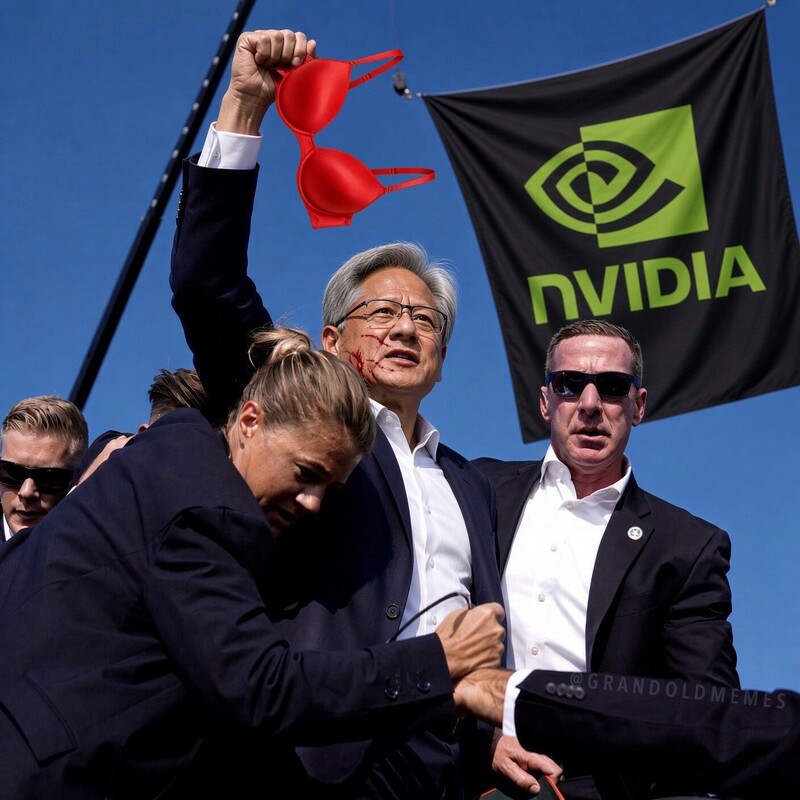
The US Is THE Banana Republic
So not a sole decision from the President.
There was immense pressure to remove him after the NYT article and media campaign saying he was a security + reputation risk.
I would expect every major decision by the board of the 2nd most valuable company in the world is subject to immense, coercive, etc. pressure. There's too much money / power at stake to suggest that any of the decisions are free from ~undue influence in virtually every direction.
From whom? Firing Jensen was a move to protect their company.
> There was immense pressure to remove him after the NYT article and media campaign saying he was a security + reputation risk.
What makes you think that they were reacting to external reporting when they surely knew far more than the New York Times did? The swiftness in which they acted is a clear sign of what the public knows is not even remotely the end of the story.
If what you say is true, Nvidia is about to become deeply dysfunctional and many board-members will start looking for a way out. Put yourself in the shoes of someone on Nvidia's board. You chose to oust Huang after he was caught lying to you. You might have said some tough things and even wagged your finger at the man. You helped choose his successor. Suddenly, Huang's back because you were being threatened with investigation by the most corrupt administration in U.S. history. Huang's a persuasive guy. He's going to tell you things you want to hear like "I forgive you for kicking me out of my own #$%^ing company.". Can you trust him though? You have to recognize that Huang fooled you before and might be fooling you again.
If I'm in those shoes, I look for a new job.
Not sure I agree. If a governance structure can't withstand that pressure, what's the point? Yes, it's good that perhaps that structure can overcome some amount of pressure, and sure, I'll admit that pressure from the US government (especially in the hands of a wannabe dictator / oligarch like Trump) can be excessively strong. But... what's the point of an entity if it gets subverted to the will of another entity?
I suppose we could also kick the can up higher: if it's even possible for the US government to exert this sort of pressure, then the structure/capabilities/lack of checks of the US government itself is the problem. (Which I would agree with.)
classical backfire on the line of "you're not that important" going sideways
BUT, note that most studies on “boards of directors to ensure/improve governance of a firm” find that they certainly have very little effect, and probably no real effect. That includes economic and behavioral outcomes.
So it’s mostly theater, with no proof that it helps substantially on any dimension. The world is filled with these kinds of things that people think are necessary or helpful, but really are not. But try to argue that to most people. It will feel like arguing with people 30 years ago that index funds are better than active management funds.
Those forces are the shareholders. They don't like losing money.
This actually makes me like Anthropic's structure.
The status quo has shown that it doesn't work for mixing business and non-business interests.
PBC + isolated board has more potential than the status quo at this point, so I'm glad they tried something different.
As you say though - remains to be seen if it'll actually work.
Y'know now that I mention it, that would explain a lot of what's happened in the past decade… hmm…
This website's users really can't help but shoehorn "Anthropic bad" into every topic
Short term negative ramifications. Long term I believe Nvidia will be worse off because of this
"The Board believes Jensen is the right person to lead NVIDIA. and that his reinstatement is in the best interests of our stockholders, emplovees, partners and customers"
Note that I am not making any judgement calls here, rather simply explaining why fiduciary duty is the sole mechanism for decision making at the board level.
President Donald Trump said he believes Huang did “nothing wrong” and spoke to the board directly about reinstating Huang. “I believe my intervention was very important,” the president said.
This seems to be a form of socialism. Maybe even a kind of... National socialism?
So it always seems like a cop-out on both sides. If the only signal is line goes up, investors happy, or line goes down, investors mad... the box is too opaque.
Delaware law affords directors making such decisions a set of presumptions—known as the “business judgment rule”—that, so long as a majority of the directors have no conflicting interest (see “duty of loyalty” below) in the decision, their decision will not later be second-guessed by a court if it is undertaken with due care and in good faith.
Are you suggesting they did something they thought was not in the best interest of the company's value, like because Trump threatened to punish the directors personally or something? That seems unlikely. They obviously decided doing what Trump said was in the best interest's of the company vs risking Trump retaliation. Seems reasonable to me as a "good faith" decision to maximize shareholder returns. Being targetted by Trump isn't good for shareholder value is it?
Nvidia is now broken, in the same way Paul, Weiss was broken early in the administration.
The board now implicitly answers to Trump. Jensen Huang now answers very directly to Trump: Trump owns him like he owned Lindsey Graham. And Trump is corrupt.
There is no company in the world that looks at Nvidia as being strengthened by this — it is profoundly weakened. The board know that they have just done the equivalent of accept protection from the Mob.
So they are doing the only thing they can: putting up a giant flag in their statement, to make it as clear as they can without saying it, that they are not really acting on their own volition.
This is a massive, massive scandal.
And he has the means to prevent Nvidia executives from testifying, with this EO from Friday:
https://www.whitehouse.gov/presidential-actions/2026/11/prot...
The title of which sounds positively North Korean.
(Nvidia is a registered federal contractor)
ETTD (Everything Trump Touches Dies) is undefeated.
I have no idea how you could possibly see this as unlikely. Are you confusing Donald Trump with someone else? He routinely punishes people personally for not doing what he wants.
Fiduciary duty just means they have to be trying to make the line go up. If the board went and put their entire personal fortunes on "Yes, Huang will be reinstated" on Kalshi before this vote, then it would probably be a breach of fiduciary duty because they are probably voting to make their bet pay off, not the line go up.
Did they vote?
If not: no, the shareholders did not say that.
"The Board believes Jensen is the right person to lead NVIDIA. and that his reinstatement is in the best interests of our stockholders, employees, partners and customers"
Consider using your real account if you want people to take you seriously.
My investment advisor has a fiduciary duty to me, but there’s very wide latitude on what he can recommend.
Jensen is not the only person that the board could have possibly hired.
(And no, the board doesn’t have to reinstate Huang even if every single shareholder begs on their knees)
https://truthsocial.com/@realDonaldTrump/117666713950631493
Kill me.
One of the few (maybe only) times a company chose to jump in front of a bus for an individual instead of leave them to fend for themselves.
That bus being the US government, of course.
At least nominally, the reason this happened at all wasn't the personal life parts (it sounds like his affairs were pretty well known internally well beforehand) but that his personal life spilled over because one of the people he had an affair with was allegedly funneling chips to places that were not supposed to be getting them. Without taking a stance on whether the sanctions make sense, I would expect that given the rhetoric from Anthropic and friends about models from China that at least some of the motivation was concern of economic backlash from those who would be be happy about the sanctions being skirted.
In a very abstract sense. They can't act maliciously, but they can (and often do) take actions that, for example, prioritize less certain long-term gains over more certain short-term gains (or vice versa). A prime example may be a decision to buy another business or spin off a division, enter or exit a market, and yes, hire or fire a CEO. In all of these cases, shareholders can take a short-term hit or end up worse off in the long haul.
This is not a decision that was unlawful or that they couldn't defend in court. It's just that on second thought, they decided they like money more than they like principles, and the administration concurred.
Based on the public reporting around Huang, I have to imagine firing him would stand up to scrutiny. You could make the reasonable argument that his decision-making is suspect, and that his personal life has already opened Nvidia up to legal scrutiny and potential fines.
The board is made up of individual humans. Individual humans are vulnerable.
This moment in AI is a battle between two great powers on the world stage.
The members of the board likely didn't sign up to be part of a great power struggle.
Thus, how many of them would have the fortitude to override the wishes of Trump and the top powers in the United States government?
Many of us on HN are debating this from an economic and fiduciary context.
The much simpler likelihood is the board members don't want to go against the full might and power of an administration whose executive has been granted expanded authority/immunity by the Supreme Court.
I'm sure the protection of the POTUS is more persuasive in their minds than the relative smallness of a shareholder lawsuit.
Lawsuits might scare you or I, but a shareholder lawsuit is likely the least of their worries right now.
If the government called you today with two alternatives, do what we say and your future is bright (and don't worry, we'll handle any fallout for you), or choose to defy us and your future is bleak... what percentage of humans do you feel would choose the latter?
It's sad. But, I doubt fiduciary duty was at the top of their list of concerns as they reversed their decision to oust Jensen.
I would add Automattic to that list as well.
Im now curious which politicians bought a lot of nvidia at "the dip"
And another interesting takeaway is about HN community, if you also count upvotes from the thread that a lot of comments were moved, then this thread would have more upvotes and comments after 3 hours than Riennmann Hypothesis.
This is true of all governance structures, just look at the way the US Congress has abdicated much of their power to the executive in recent years. Structures don't wield power, people wield power, and people can be incentivized out of wielding their power via things like greed, fear, and apathy.
The company has never existed without them at the helm.
Nvidia is even more peculiar in that it went from 0 to most valuable company in the world under the guidance of a single founder CEO over more than 3 decades. It has never known any other CEO. Nvidia is even more peculiar in that it survived multiple waves of extreme competition (remember 3dFX Voodoo?) and virtually created several major markets in which it operates (e.g. CUDA preceding "deep learning")
It's very reasonable to question the viability of the company under different leadership under those sorts of circumstances.
If Jensen leaked American technology to China, well, who created that technology in the first place? Investors seem to believe Jensen was a major part in creating that technology. Are you willing to destroy the technology to prevent it from being transferred?
If employees get organised and are willing to stop working (go on strike or quit), they hold the ultimate power in almost every company.
Dear Chairman: Boardroom Battles and the Rise of Shareholder Activism by Jefferson Gramm
A good read and somewhat relevant.
https://www.wsj.com/business/how-nvidias-board-made-billions...
"Nvidia's accounting is a focus of US SEC investigation" - https://www.reuters.com/world/us-secs-nvidia-probe-is-examin...
- Jensen resigned. At least officially. - The Board could have kept him out. They have the power to. - There is governance. That he was punted is evidence of that. This is a change of posture. - The back and forth is sketchy but not entirely unreasonable. - This specific board is not very good.
When there is enough dough in the picture, everyone is willing to take off the glove and delve into the mud.
Watch out for the bailout if the house of cards should fall…
Jensen on his own would have to throw nvidia and nvidia employees under the bus to defend himself. Jensen being rehired under a contract that I assume gives him the most protections possible as well as a legal team, means his defense is now the company's defense. Now everyone in the company including the board and cfo gets to collude on their mutual defense. No one will be guilty, they will all have stories that make no one personally responsible. Nvidia will pay out large sums of cash to the government to absolve them of any real punishment.
This will protect the other US tech CEOs that colluded with jensen by buying hardware they did not need. Colluding to raise hardware prices that cost US businesses and consumers billions is a crime on its own, but it is worse when it effectively backs a chinese smuggling ring.
Reconsidering your decision in the light of new facts and influences and making opposite decision can be a normal part of decision process.
The bigger problem in my opinion though, is how concentrated stock ownership is in the wealthiest 10% of the population, and even more so in the top 1% that own half of those trillions. So yes, probably these decisions are biased nowadays.
Tesla has made this obvious for a decade now.
That's not to say that all boards are "captured" to any extent, but its not rare.
Note that I'm not making any judgement about whether Huang or Altman should have been fired. The point is that in both cases, the board members were nominally empowered to make that decision, and did make it, rightly or wrongly. But when the rubber hit the road, it turned out that there were other forces that overruled them.
This means that we should have some skepticism about governance mechanisms that haven't been tested, such as the one that Anthropic has set up. The idea that board members will actually be able to carry out decisions that have massive negative ramifications for major stakeholders turns out to be questionable in practice.