You also need to have the house setup to run off a generator. You don't want the truck power feeding back into the grid. IIRC, that's usually done with a big switch near the main panel.
There is a model of Ford Lightning that has power sharing and now that resale values are way down it just might be a cost effective home battery that you can drive around during non-emergencies....
You can also just plug into the 30A240V bed plug and use the onboard inverter on the lightning or powerboost hybrid f150 with less headache.
For example, Metron sells several: https://eauto.si/metron-shop/product-category/vehicle-to-loa...
Car makers are reluctant to support this. In case of Tesla because of market segmentation.
If there is a major outage most bosses understand that you won't be working normally because you need to deal with the emergency.
There is an entire genre of welding equipment designed for this scenario.
https://bakersgas.com/collections/miller-engine-driven-weldi...
A $80K-100K car that replaces the two isn't some genius purchase.
Sure you can spend all the money you want on a luxury toy, but it's weird trying to justify it as anything but that.
That doesn't mean electric cars shouldn't be considered as power backup, or that buying a nice electric car vs a nice gas car doesn't come with the added benefit of "Don't need a 10k generator anymore".
From redundancy perspective, a genset + car is hands down a better combo. A functional ICE car is cheaper and goes everywhere without any trip planning around charging stations, which is another plus.
I never said EV is not great and it is nice that it is working out for you, but facts are facts. Also, while EV footprint is growing around the globe, there is wide vast world beyond USA where charging issue is still true (and the repair shops).
If you're looking at two $55,000 cars, and one has power interconnect and one does not, it's not like adding a $1000-$10,000 generator on top is somehow immediately better unless you're adding in factors that make it better (like buying a cheaper car). There's 3 or 4 superchargers within a few miles of my house, and every time I've lost power I could easily go charge my car so I never worried about that.
Not everyone lives in that situation or has the same "one or two days without local power but chargers still work" threat model. It just so happens that's been the biggest actual, real, problem that my car could have fixed for me.
The cybertruck costs roughly $82k, which is about 40-50k more than other pickup trucks.
For the same price, you could install 2 1000-gallon propane tanks and enough gasoline to power your backup generator for a year nonstop.
That puts the total setup price to about 10% of a CT-Energy station.
We could start comparing used EVs if we want to.
Personally I never really understood the value of a generator in the first place but that’s just my opinion.
Not a huge deal,I’d siphon/drain at the carb, just wonder if people normally keep the tanks empty or what.
If you live in an area where you can only get ethanol gas, then you definitely don't want it sitting more than 6 months, even with Sta-bil (in my experience). So that means yeah, you gotta cycle through the generator's tank twice a year, which if you live in an area with reliable power, means spending more money than you need to on gas and oil. Also, keep all containers (including fuel tanks) as full as possible, to minimize the amount of air in the container, to minimize the amount of moisture the ethanol can suck out of the air.
Depends on the vehicle of course. But for me at least, my 5-speed Civic for $2500 is way cheaper over its expected lifespan than a $7000 Nissan Leaf (and the Civic is way more flexible, since it can actually go more than 100km every 6 hours in the winter). At $1.50/L and 6L/100km, I can drive about 50,000km before I spend more on gasoline than the price difference between the two. The actual breakeven math (assuming 21kWh/100km) is closer to about 65,000km when factoring in electricity at ~$0.12/kWh. Oil changes are negligible (I do my own maintenance and oil changes), and a used Leaf is going to have just as many problems (if not more) with "the rest of the car" as a gas car (suspension, steering, brakes, tires, electrics, interior components, not to mention battery pack services).
If you buy a nicer EV than the break even point goes even further out. At least where I am, the EV equivalent of any gasoline car has a breakeven point of at least 50k km driven, usually more.
> Then there’s also the potential scenario of “buyer prefers an EV anyway.”
Entirely fair, but I'd still buy a generator and an EV. Because coupling your house power to your car just seems like a bad idea (to rely on it, at least; if you live somewhere that you never need to rely on off-grid power, then who really cares). For instance, my house has a sump pump that must run every ~hour or my basement will flood, and during storms that gets down to about 20 minutes. If my area doesn't have power, then I can't charge an EV anywhere nearby, and if I'm powering the house off the EV, how am I going to recharge it without my basement flooding?
Good grief, what year is that Civic from? LOL. I just bought a 10 year old Corolla for my kid and it was 12 grand. Civics aren't much cheaper.
50km-75km break-even is not a whole lot of kilometers.
You can compare a used first gen leaf’s poor range but in a short amount of time from now the bulk of the used EV market is going to be Teslas and Ioniq 5s that charge fast, are equipped with heat pumps, and get plenty of range.
Not everyone has a sump pump that needs to run every hour. Not everyone even has a basement. If we keep throwing out qualifiers we end up with a scenario that is not relevant to many people.
So for someone who wants an EV (for the convenience, environment, or performance reasons), I think the statement is you can e.g. do so fairly affordably and also get free generator with it. Its a nice perk imo.
In Australia, $10k would buy not only a ton of solar panels but also batteries. The US has decided to make solar and batteries at the home super expensive, unnecessarily.
See, your problem is assuming that the EV is 80-100K. Or that the ICE car is 30K. This is a contrived comparison. An average new car is well over 30K. And I bought a brand new Lightning for 50K. Being able to use 131kWh of battery for things other than driving is a pleasant bonus, and I prefer it to having a gas generator I have to keep maintained and store fuel for.
Or rather, you can take half of the difference in price and install some proper PV + battery system in your house that can be used when there's isn't a catastrophe too.
Sounds like you're desperately searching for a problem where a specific make and model of a car can fit as a solution. That doesn't make the car any better than it is.
Our solar panels kept the fridge running, but we were heating the house with a wood stove (it was very cloudy, so we were getting maybe an hour of sun a day). If we had bidirectional house charging, we could have had warm showers + used the heat pump: We would have been able to fast-charge the car at 100-200kw in town. The house can limp through 20-30 hours on ~ 25kwh, so the charger would charge the house at a few days per hour, including losses from driving to and from town + round tripping through the battery, and also running the house heat pump.
None of the other people around here stayed online. Some propane-dependent people had no electricity for > 2 weeks (with rationing, they managed to keep their generators online for about a week, and PG&E took three weeks to fix their lines).
This was in the outskirts of Silicon Valley, so better-than-puerto-rico infrastructure, but only just.
We are far away from, but slowly approaching, Mad Max levels of institutional failure, and everyone seems to treat it as normal and unavoidable.
Like the storm surge walls at Fukushima, all infrastructure is designed with a certain size of storm or event in mind based on historical averages and outliers.
Climate change is throwing all that to shit.
Your comment says plain and clear you’ve never lived through a “once in 100 years” level event more than once in a decade, and you don’t realize how much it would cost to upgrade what we’ve spent ~100 years building.
It’s trillions, just to get started.
It’s unclear to me how a vehicle battery can be 9-10x the size of a house battery, be used as a house battery, include an highway safe cabin, motors and wheels and only cost 4x what a single home battery costs. Oh, and at least Kia rates their battery warranty based on miles driven, so using it as a home battery does not impact any 10-year capacity guarantees.
AI tells me they are completely different though, so I must be missing something.
They want ~9k for a freaking 13.5kwh pack.
I can buy a UL certified, 16kwh, outdoor rated pack for 3.5k (ex - EG4 allweather)
I can buy just the LFP batteries themselves for the new powerwall 3 LFP version (no BMS, no shell, no certification) for $1116... https://18650battery.com/products/byd-302ah-3-2v-lifepo4-pri...
Powerwall is a scammy product. WAY too expensive for the storage it provides.
---
So the summary is: Cybertruck is using a different battery chemistry, Powerwall is a scam.
(I mean - to be clear, the Cybertruck is also a scam, but it's a different kind of scam not directly related to the battery capacity, since it's hauling around a 123kWh NCMA battery pack)
Propane generators here have the same problem.
That still doesn't explain the price gap. You can literally just get a V2H EV and use it instead of a home battery (or, you could if the ecosystem was more mature).
5kWh of battery cells at the moment run around $500. The rest of the cost of production is in the power electronics (probably around another $500).
It's why you can buy 4kwh worth of battery backups from Amazon for about $2k right now. Yet the same thing sold as a home battery backup costs $5k.
Lack of competition and likely low amount of sells is what's causing the margins to be so high.
The quiter part makes sense, but there are a lot more practical solutions to that too.
Also, I built it myself so the labor costs aren't included but I am about $8k into a system (4kw of panels, 6kw inverter, 15kwH battery).
I personally wouldn't be able to make vehicle cheaper than having no grid tie. I get that the costs are different once you include labor. Also I am on 40acres so the panel set could be ground mounted.
But to make something commensurable with a propane home-powering generator seems a lot more do-able.
I just bought a kit to convert to natural gas though. Most people who've done it are happy to not change bottles all the time. It won't help after an earthquake but the regular PSPS outages I get make natural gas a better fit for the moment.
https://hsph.harvard.edu/news/heat-waves-and-annual-death-ra...
In a traditional house with thick brick/stone walls and large roof overhangs you'd be uncomfortable but a lot less likely to die
This is a common enough occurrence in rural Louisiana, at least. And I think almost everyone I know has a 200gal or larger propane tank in their yard, specifically for multiday outages. My father-in-law doesn't have a single propane appliance, but he does have a 250gal tank, for his generac.
We don't we have a single 100lb tank, but that will run the little AC for 3 or 4 days.
This is important enough to me that I researched slow start AC units ~8 years ago when replacing my AC. I learned that almost any heat pump will do, so that's what I have.
It’s possible to get larger propane tanks and refill them more cheaply (rather than exchanging expensive grill tanks at the store). Some hardware stores will refill tanks directly. You can even get very large tanks (refilled by a truck that comes to your house) if you want weeks of power on tap. But this is probably overkill for most, unless you’re very remote.
A propane generator is a temporary solution but likely is good enough for most folks who just need to keep the fridge cold and maybe charge cell phones. It's not going to be able to run your house AC or anything, though.
Cybertruck was announced first. Then Ford _released_ the F150 Lightning, including the ability to operate as a backup battery for a house. And a dozen or so months later, Cybertruck comes out at a much higher price than F150 Lightning ever was.
As has the F150 lightning. It lost so much money and demand was so low that Ford had to kill it to stop bleeding money.
Eventually F150 Lightning stabilized around 50k to 60k IIRC, but Cybertruck _started_ $100k and even today is $70k-ish. And ONLY if you get incredibly reduced battery packs.
Cybertruck never seriously competed vs F150 Lightning.
First time I’ve been compared to an AI agent.
Most people just plug an extension cord into the onboard inverter. You have to manually flip it on and plug it in, but 240V30A is plenty for an emergency. Doing it this way isn't any different from any other vehicle with an onboard inverter though.
On the other hand there are no tricky rules for an electric truck to have extra power outlets in it.
https://www.tesla.com/powershare/#vehicles
> Powershare allows you to draw power directly from your compatible Tesla vehicle to power your devices, your home or the grid.
> Powershare is currently available for all Cybertruck vehicles, and all new Model 3 and Model Y2 vehicles ordered on October 1, 2026 or later.
> To verify if your vehicle has Powershare, navigate to ‘Software’ > ‘Additional Vehicle Info’ > ‘Powershare Support: Enabled’ on your vehicle touchscreen.
To power a house directly from an EV, the main options now are the EV trucks -- Lightning, Silverado, Cybertruck all can have this ability, 240V 30A typically
> Model 3 provides a maximum draw of 11.5 kW.
You can't run your heating or air conditioning at full tilt, but otherwise that will get you at lot, this is 240V at ~45A.
I don't think the residential power generator is needed anymore if you have an electric car.
Completely missed opportunity. I won't be buying an electric vehicle that doesn't allow powering my house, ever again.
Only available on Tesla models ordered after October 1, 2026
Tesla models older than 6 weeks are SOL (for now? Maybe it just needs some backwards compatibility testing)
It sounds like it will require a hardware retrofit, that isn't being offered to consumers yet: https://www.notateslaapp.com/news/4585/tesla-publishes-vehic...
Don't give the USB consortium any ideas...
We have a 12v port that we can get ~200W out of, so that could power our internet.
But I agree, a real joke to have 150KwH (two EVs) in my garage and no way to even plug in a fridge.
V2H/V2L is a must have in my next EV.
As you probably know, there's a 12 volt battery in these cars. That battery is automatically recharged by the big 100kWh main battery.
Some years back, I bought a 12 volt, 2000W inverter and connected it to this 12 volt battery in the Tesla, ran a couple of extension cords, and powered our refrigerator, extra freezer, and a number of other things with it for many hours. The main battery percentage in the car showed an appropriate drop. This actually wasn't during an outage, it was contingency testing. We already have a natural gas, 3600 watt generator that connects to one of our panels and use that during (unfortunately frequent) outages.
In my 2017, it's a bit of work to get to that battery, but it's quite doable and seemingly quite safe. The obvious, very rough/estimated/simplistic math is the 100kWh main battery divided by 2kW is about 50 hours. Different factors would push that number up and down of course.
I will definitely try this again. If it works, that'd be great.
1) if you're permanently modifying your home or electric panel you're over $1k. (General Motors "Vehicle2House" is ~$10-20k for hardware + installation... an EXTREME investment unless you plan on regular "emergency" usage of it)
2) if you're buying some portable solar panel "battery boom box" you'll likely run out and the folding solar panel it comes with is more gimmick than reliable
3) if you're buying a "real" gas/diesel generator, you have to run it + change the oil every 6 months otherwise it might not start in your emergency situation
...just buy a thing that clips to your car battery and dangles out the front hood of your car!
You already maintain your car every 3-9 months, you already (should) have at least 1/2 tank of gas at all times (especially in a weather / outage situation), you can generally idle your car for at least 2 days off a tank of gas in an emergency, and if this thing can charge your phone/battery packs, keep your fridge running (kindof?), and run a small space heater overnight...
It makes soooo much more sense to buy a $500-$1000 emergency accessory that piggybacks off the car you already maintain than trying to stand up a whole extra distribution mechanism for "survival-ish power, maybe 1-2 times over 3-4 years".
Despite the dealer saying the used one I bought supported it, it turned out to not be available in the trim I got. My fault obviously for believing something a car dealer said.
It sounds amazing. Only thing I wonder if it can even be set up so that it will be like an Uninterruptible Power Supply. So that when there is a blackout, the V2H supplies all the power without any interruption.
I have several computers but no UPS yet. Imagine if I could buy an electric car and when I am not using it, my car is UPS for my whole house including my computers! :D
That's the point of V2H (or a residential battery, which it emulates). Although you still want a UPS for computers. Although "without any interruption" is probably not at the scale of a UPS, and possibly not at the scale a desktop computer will require. So you'd still want UPSes for that. Notably it depends how the grids cuts off, if it cuts off in one shot (like throwing the breaker) the failover should be almost instantaneous, but if it fluctuates before failing the battery might need a lot longer to engage.
$10k amortized over 20 to 30 years is not too bad. But if I buy my first EV and only keep it for 5 to 8 years before replacing it with a different EV then I’m less happy if I also have to replace all of the additional equipment that soon.
V2H is pretty well standardized, there should be ways to avoue any car specific equipment.
If power loss is a regular event you probably want V2H, but if it's just a remote fear or something that happens once every 5~10 then V2L and a few extension cords will do.
As soon as we got the adapter for our Ioniq 5, I sold generator to a neighbor. The car will run what we need for four days, which is longer than the generator and five gallon can of gas is going to last.
If you're after the V2L feature, you can get for much cheaper: for 16% of the price of a Cybertruck, you can get 86% of the battery capacity (about 8 powerwalls) by buying a used Fisker Ocean Extreme (107kWh vs. the cybertrucks 123)
I think this is why these EV trucks don’t do well (ford also cancelled the F150 lightning). For truck things, they aren’t particularly capable (you’d get less than 100 miles towing). For daily driving duty, a car or small suv is much more efficient.
That said if you have a Mall Crawler who's heaviest loads are your monthly Costco run, an electric truck would probably be great for you. I still wouldn't recommend a Cybertruck though.
You can get a special account for home charging that lowers that rate to $.32/kwh, and at my work I can charge my car for $.28/kwh. At those rates, and with gas where it is now (typically $5.50 - $6.00/gal) it makes sense to use electric.
It's just ridiculous, there are no charging stations around here and it's like 50/50 chance they charge you some outragous price and have an annoying app or it's completely free to use.
Yes, but the energy density of the energy storage mechanism in the cybertruck is substantially lower than a gas pickup truck
I am not a fan of the truck, but let’s make some sense here
Not a Cybertruck fan myself, but unless you are going to tow or take many long road trips, an EV truck will work great for anyone who can charge at home. And most people don't tow, or take long road trips, with their trucks.
Except for everyone who owns an RV trailer.
- the Cybertruck uses almost twice as much energy as your Niro EV
- the 40% efficient Prius uses about 2.5x as much energy as your 95% efficient Niro EV.
what seems off?
Little's law is another related phenomenon that is super critical. Measuring things when the units don't match has bitten me more than once.
Actually newtons are just a constant factor (3.6) compared to Wh per km, since there are 3600 seconds in a hour while there are 1000 watts in a kilowatt. For example 144 Wh/km (or 14.4 kWh/100 km) would simply be 518 N. This also means that pushing along a Tesla on the highway at constant speed is roughly as hard as holding a 50 kg weight, giving you an intuitive sense of how "hard" it is to keep things moving.
Of course, in everyday life, since we buy electricity from our utilities in kWh rather than joules, it's more convenient to talk about kWh per km (or per mile).
Actually, I guess the comment you replied to was also not really clear in it's point, so I'll blame that guy for maybe diverging from the topic somewhat :)
(not trying to be negative, really! but my brain is a bit fuzzy from being sick, so thus feeling a bit dimwitted as I ponder comments)
I thought you were autocorrected badly but I guess this is a term people use?
https://pure.manchester.ac.uk/ws/portalfiles/portal/63517838...
I wonder how long it would take for an EV to catch up to a bike all-in (including manufacturing materials) if the cyclist was eating something heavy on carbon footprint like a philly cheesesteak everyday.
Using energy is not bad. Creating excess carbon emissions is bad.
You need to be able to hold two ideas in your head.
All cars just use a ton of power moving a lot of mass. It is actually impressive, it's like 100KW at full tilt. I think i saw someone do the math for how much power transfer you would need to get EV charging as fast as gasoline refuelling: It's in the megawatts.
The only way you could signifigantly reduce power usage of vehicles is to reduce mass dramaticially with a motorcyle or autocycle. The Aptera is an interesting autocycle design based on this line of reasoning, but we are also seeing the emergence of a lot of electric motorcycles.
Also regarding filling up an EV as fast as gasoline, there’s a company in China that has demonstrated charging from 20-80% in 5 minutes. They’re using 3MW charging.
It makes you realize why gasoline has been so popular for so long, you can stop for 5 minutes and dump 500 kWh of energy into your tank. Unfortunately most of that is wasted as heat during the combustion process.
Yeah that's the exact post I saw. I didn't believe the video at the time but I suppose it's possible with enough battery paralellism and cooling.
https://www.thecooldown.com/green-tech/new-ev-technology-cha...
Also, if you factor in the construction, idk what the timeline to pay that off would be.
ICE trucks are equally inefficient for towing. People just don't seem to be able to factor it in.
Imagine a trailer takes 1 unit of energy to move, and ICE truck takes 5 units to move itself, and EV truck takes 1 unit to move itself.
The ICE truck towing it would go from 5 units to 6 units, reducing the range by 16%.
The EV truck would now go from 1 unit to 2 units, reducing the range by 50%.
So the better your efficiency, the worse you are at towing. Ideally EV trucks would have such a huge battery that even when the range is reduced by 50%, it is still as long as a gas truck's range, but modern battery technology is still too sucky to achieve this.
Not so sure about that one, boss. I can fully-load up a Ford Ranger to its 7500lb rated towing capacity and lose ~10% in fuel economy/range while you just dropped something like 30% (from the base power package range of ~240 miles, platinum package at 300 miles you're losing half if you only get 150 miles out.)
To get their equal ranges, a Ford Raptor would have a ~4 gallon tank. The fact that the cybertruck can go so far while not towing is the miracle. How far do you think you're going to get with 4 gallons?
Driving in general uses a lot of energy. It’s the physically moving a 1,000 kg or more object that takes a lot of energy. Orders of magnitude more than a few lights or a phone. Same with flying of course; also moving a heavy object.
I have a lightning and it averages 0.5kwh/mile and my electricity price is $0.15/kwh, so it costs me $0.075/mile to drive. At current gas prices that's pretty much the same as a very efficient hybrid compact car (55mpg @ ~$4/gallon). If I had solar I could probably offset almost all of the lightning fuel cost based on where I live (sunny) but it's so cheap it's not worth it.
Do you mean "much more efficient" in places where electricity rates are significantly higher than the national average? Or only much more efficient when compared to when you're charging at charging stations?
Cybertruck — 2mi/kwh
Model Y — 3.8mi/kwh
Model 3 — 4mi/kwh
Went looking for the campground host and bumped into another camper, who was pissed the power went out. "Don't worry though - if you need to charge something, you can put it in my truck."
Ended up on a phone charging expedition that ended up with me hanging out in a local library for the first time since I was a child.
Came back and met the host: "Sorry about the power last night - some dumbass tried to charge his truck and tripped the breaker to the whole campground."
(I'm sure there's more to the story, and the details aren't important, but if charging a vehicle is tripping breakers for the whole campground there's something wrong.)
Also, a bog standard 14-50 is likely not suited for 80% steady EV usage anyway. They make EV-rated 14-50s now because people keep melting the older ones. And that happens even though the vast majority of chargers won't draw more than 32A on a 14-50 due to the historical popularity of using 40A breakers for a 14-50 receptacle.
Battery's not super useful if you want to put the phone on your handlebars while riding. Screen is a lot more helpful than audio cues. If you can only charge when parked, it's either charge from a battery and have to top up the battery later, or just charge the phone directly.
The friend I did the trip with was on nav for the first part of the trip, but he had to turn back early for family stuff.
It's exhausting reading these kinds of articles from a tech publication none the less. It's just so negative. Here is a summary of paragraphs:
Cybertruck is ceasing production
Here's a mean tweet from some X account with 2,649 followers: "Fuck that shitbox"
The car rusts sometimes
Truck sold very few units
Even with low sales they're still going down
Wildly unpopular with design flaws
Mention embarrassing demo from 7 years ago
It just goes on, truly exhausting.
https://www.roadandtrack.com/car-culture/a36715409/why-does-...
It’s niche just because natural disasters are thankfully relatively rare, but I still think having good contingencies is worth it.
Fuck being seen in a cybertruck though.
Electric vehicles won't, ever, be prioritized over bringing up residential, commercial and emergency services. The fact that even on a super charger it's 20+ minutes to charge a Cybertruck means the two or three at the local gas station will just end up with 12+ hour lines. Even now generators are fueled before private vehicles.
Bringing up power after disasters is super dangerous as is. A lot of systems that hadn't been turned off in years do a cold start, and sparks fly. It's why the power company and fire departments coordinate very very closely on grid work.
You know someone's going to try and bypass any safeties and circuit breakers and end up taking down their house when they try to restore power after a flood or something. People already regularly die from running their generator in the garage and most of these aren't wired directly into house mains.
> Most of the disasters I'm aware of people either get their power back in a short enough amount of time that they can use a normal generator for the gap
TBF an EV car has an absolutely massive battery relative to the electric consumption of a house, unless you're using resistive heating all around. Especially if you ration use.
My Ioniq 5 has been a godsend. No, it can't power the house without dorking around with my electrical panel. But we can run the fridge, dishwasher, a few standing lights and keep phones and computers full charged.
I used a similar setup to Alex's but with the outlet in the rear seat instead of the V2X connector. I will probably by the V2X connector since it supposedly hanldles higher power draw.
Also, since when are electric water heaters common in the USA? Every home I’ve ever lived in here has used gas for heating water.
But if it's hooked up to hot water, add in the 4 gallons of water it used and the 1.5 kWh to heat that.
The difference is mostly to use as little water as possible - just enough to wet the surface of the dishes not to soak them, and heat only the wash water not the 2 sets of rinse water or the prewash water.
There are some neat tricks to do this - for example there is no water level sensor - you aren't aiming to fill the bottom of the machine - instead you run the pump at full speed and keep adding water slowly till the pump electrically feels like it doesn't have many air bubbles in it.
You're probably right about that. A lot of people grew up without dishwashers and don't have a way to economically install one outside of a major kitchen remodel even if they have the space which many in cities don't have. They're also not the, for lack of a better term, necessities that washers, stoves, and ovens are. And, of course, dishwashers don't eliminate the need for any handwashing and if you aren't cooking or doing a lot of entertaining a lot, they may not be all that useful. I do cook but still probably only run my dishwasher 2 or 3 times per week.
I have a rule that every single item in the kitchen goes into the dishwasher. If it doesn’t survive oh well - survival of the fittest.
The only thing exception outside of size that I can think of are the fancy knives. But we have an everyday set I don’t mind dulling and just sharpening once a month with a basic sharpener.
Everything used immediately goes into the dishwasher during the day, then before bed it gets ran full or not. Dishes put away with morning coffee and the cycle repeats. No dirty dishes cluttering up the kitchen, and no wasteful (water and time) hand washing required.
Source: I did that dishwashing job in school, to pay for my lunches.
Don’t get me wrong, I love a good dishwasher. But we need to recognize the difference in the jobs here.
And bad dishwashers? Well, let me just say that we will never, ever have another Bosch dishwasher in our house.
Anyway I agree that in emergency conditions it can go a looong way for a house.
It's 30kW for one hour.
(Or 1.25kW for 24 hours, or however you prefer).
30kW is a rate.
30kWh is a measure of energy, about 100MJ.
30kWh/day is a rate again, 100MJ/day.
It seems clunky, but it's a way energy usage in a house is typically measured.
I said the time period matters when you're talking about it relative to generation. 30kWh over the course of a day is very different to 30kWh over ten minutes.
Except that GP (pmontra) had asked "Is that 30 kW each hour of the day?"
Clearly someone asking that doesn't understand what kWh/day means, and since you were backing GP, it seemed reasonable to guess that you might not understand either.
If you want a "better than nothing" but imperfect analogy, Wh is how much water you have in a bottle, and W is how quickly you can get the water out.
This discussion seems super silly, considering he's just using the measurement that the industry adopted decades ago...
Are y'all just coming out of a time travel device from the 70s or something?
I'll put aside the two-bit attitude and that you don't know that power (W) and energy (Wh) were measured in the exact same way in the "70s or something" (just ask your grandparents).
> the world decided to use kWh as the thing to measure
> kw per day, kw per week, kw per month, kw per year.
You switched between units from one sentence to the next? The indeed world measures kWh per day, not kW per day. There is no such thing as "kw per day". The wrong usage is common because a lot of people don't understand the concepts and just parrot a common mistake. When they say "kW per day" what they should actually say is "kWh per day". It's where the unintuitive part comes in, they omit the "hour" or assume it's kW/h, like km/h, instead of kW times h.
> This discussion seems super silly, considering he's just using the measurement that the industry adopted decades ago...
The industry adopted the correct measurement units decades before your grandparents were born. You just have a hard time understanding because it's easier to do cheap snark.
Unlike those people from the 70s or something, you live in a world with all the information you could want at your fingertips, you even have machines (AI) that digest it for you, and you even had me bothering to give an explanation a kid could process. To be unapologetically ignorant today is the same as being intellectually incompetent.
30kWh is 1.25kW for 24 hours or 30kW for one hour.
30kW every hour means 720kWh per day. 30kW all day is also 720kWh per day.
The comment is nonsense.
The only way you can steel man it is by saying he isn't concerned about the 1.25kW, he is concerned by the swings, but the said 30kW twice for two different time spans so that can't be it either.
That’s why whole-home generators are typically sized at 24kW, unless there are some circuits you’re not going to power while you are operating on generator.
Now, most homes don’t use that much power 24x7. Most homes use a lot less than that. But, they need to provide that much power, in case all the electric devices inside the house are all running at the same time. And in Texas, newer homes usually come with 200 amp service, because HVAC draws so much, plus electric hot water, electric cooktops, etc….
So, to get a real idea of the amount of power you need from batteries, you need to look at how much power your house actually requires on those critical circuits, on the worst day. If you can’t deliver that much peak power, then you need to increase the size of your inverter stack, or you need to reduce the number of critical circuits you’re powering. Most battery solutions for powering a house will give you some options here, and then combine all the output power from each stack into a smart breaker box.
Then you also need to look at how much total power you pull over a full day. That’s your minimum kWh rating that you need from the battery pack. And again, most whole-home type battery solutions will give you multiple options here. These are companies like Bluetti, Anker, EcoFlow, etc….
For example, the Anker SOLIX E10 Power Dock can do a max of 7.6kW sustained and 10kW turbo output with 12kWh-90kWh storage, depending on how many battery units you connect to that inverter. But to get 20kW total turbo output, you’d need two inverter stacks, each with their own chain of batteries. And you would need their Smart Power Dock to combine those two stacks. Each power dock can handle a total of three input stacks, for a total maximum of 22.8kW combined max sustained output, with 30kW combined turbo output. That gets you their 200-amp equivalent service.
In comparison a Tesla Powerwall does about 11.5kW maximum output for one unit, but has much less battery capacity per unit (only 13.5kWh). And you would either need to trim down your critical loads to get under that 11.5kW maximum output, or have a pair of such units that each talk to their gateway device. And the Tesla Powerwall doesn’t have any additional battery units that I know of that you can connect to that same inverter. So, you would end up buying a lot more inverters if you want longer runtimes with Tesla.
Either way, you can pair these with solar panels on your roof, to get either total or partial fill of these units from the sun, and the rest from the grid. The same is true for all of the major whole-house battery backup units I know of.
Now, if the batteries in your car can sustain 100kWh of power, and you’re using 30kWh per day, that would last you just over three days before you’re completely drained. Then you would have to look at the maximum amount of instantaneous power that the vehicle can provide. Is that just 10kW? Can it do 20kW? 30kW? Note that this number is usually a lot lower than the rate that the vehicle can charge at, when it is at a supercharger facility. Usually, they can suck down the power a lot faster than they can push it up. And many BEVs today are still pretty slow at being charged up.
I look forward to the day when all BEVs can charge quickly at high voltage, and also discharge V2L and V2H at high rates of speed, with large battery capacities. But I think it’s going to be a while before we get there.
Meanwhile, I feel like I need to have the power service at my house upgraded to 200 amp, before I can realistically buy a BEV. We just don’t have the spare power capacity available to us to be able to charge the vehicle at reasonable speeds, which would require a level 2 charger at home.
The value of the same, repurposed to a "powerwall" - $10k per 10 KWh
The value of it once attached to a "movable powerwall" - :) add a few more zeros
Clearly, I am in the wrong business...
When we got solar we asked for quotes, but ‘No Tesla’. The sales rep said ‘We get that a lot’.
I wasn’t interested in hearing any advantages of a Tesla Powerwall, that brand is toxic to me now.
There’s plenty of good alternatives that don’t fund criminals like Tommy Robinson and Russell Brand.
We have Sigenergy. Are they better than Teslas? Unsure, but at least I have no idea what the owner(s) think.
I want a system that doesn't need to be connected to the cloud.
It was also really hard to work with them to even get the bid.
It was quite the premium.
If you have a string inverter setup, I’m not aware of anything good that is cheaper. If you have micro inverters then sure, but otherwise you have additional hardware cost.
Best practice would be to build a separate structure and physically separate the battery from your house.
And you got a budget opensorce powerwall
But it is still cheaper to stockpile some generators and gas than stockpile a cybertruck. If there's an EV charging station up within a 1 hr drive, gas stations are also going to be up.
Not really. Some areas in California have multiple PSPS outages during fire season. Many people have gotten gas generators or powerwalls to deal with it, but using your EV would be ideal.
Generators have solved this problem. My family used to lose electricity anytime there was a semi serious snow storm. We got a gasoline generator after the second time and it was always sufficient. We never needed to siphon gas from the car either. We later transitioned to a natural gas generator. The lines are all underground and tie into the existing system for the stove and dryer. No car involved.
If you are concerned about that, you get solar panels and a battery. You still do not have to worry about losing your means of transportation.
> This seems like an awfully niche case, no?
A Cybertruck has nearly 10x the battery capacity of a single Powerwall, and to buy that much Powerwall capacity would cost at least as much as a Cybertruck. Even a Tesla Model 3 (which now supports home backup) is over 5x Powerwalls.
You still have to pay to install home backup support on your home’s breaker (at least $10k), but you don’t need anywhere near the amount of very expensive supplemental home batteries.
Also, even an EV with a 120V outlet and no home backup support could be very useful for recharging a portable battery bank.
Regardless, the thing that’s really great for cost effectiveness is that the same large battery can be used everyday for driving and also used rarely for emergency home backup systems.
10% to pay for their costs - materials and labour
90% to pay for their new Cybertruck financing
$10,000 to install a socket, a breaker, and a transfer switch?
Surely not.
Electricians like their transfer switches because they are right sized and everything, but the interlock approach actually gives you more control because every breaker is allowed (a transfer switch will only expose some small subset of all your breakers usually), you just have to manage the power supply yourself.
No. It's like a generator except way more power and mobile. Rechargable via solar. So basically just a much better generator.
So there's that to consider. Or don't.
Doesn't make sense for what they are charging for it. But still!
It has other downsides, obviously. But the notion of "emergency power for your house" is kinda moot.
My experience with power outages (after big summer storms, not a hurricane thank goodness) has been that my neighborhood is impacted, but that places nearby have power. They tend to restore commercial first, so the supercharger near me is up and running before my house.
And that's assuming they are sunny days.
It takes about a day to charge my Leaf on a small solar install.
But yes, it needs to be sunny.
And yet nothing prevents you from driving daily.
I'm 100% off grid on solar in the middle of nowhere. My panels could burn up, get hit by hail, get searched by law enforcement, flooded out, eaten by mice, stolen by miscreants, abducted by aliens or buried in snow. And of course in the event of a volcano they are probably not gonna function well.
So they are of course totally unworkable in events when the power grid is down.
But I like using them and they've been reliable so far...
There are practical issues with it, but it's possible. The question is EROI or Energy Return on Investment. Do you get more energy from it than it took to make it, which unfortunately is not there yet. Shrinking it down to fit into your backyard is an exercise left for the reader.
And are regularly rotating that stockpile, because gasoline has a shelf life measured in months
Somewhat simplified: As long as the feedback loop demands an injector duty cycle that is within predetermined limits, it can compensate for and run reasonably well on gas that burns relatively poorly (for whatever reason it does) by simply sending more fuel into the holes.
Conditions that produce pinging are further sought to be thwarted by using a knock sensor for additional feedback.
A Corolla has a lot of stuff going for it that can help deal with fuel variations and issues in ways that a majority of small engines are completely incapable of.
It tends to resolve to: Climb in, turn key, engine starts easily, and car drives fine -- just like it has done thousands of times before.
I drained the old fuel out and replaced with fresh, and it fired up on the first subsequent half-assed pull of the starter rope.
(Which reminds me: It's been six months again already. Time to see if it still works.)
You have to put in in the tank and run it for a bit to make sure that the carbs don't have untreated fuel inside.
Simpler gas equipment like mowers and generators don't have enough compression to really care about anything but ancient gas, and if you run any vehicle that is multi-fuel capable it can detect and adjust compression based on a fuel's capabilities.
Ive been repairing and fixing junkers of cars, mowers, ATVs, generators, and more for 30 years and not once has bad gas stopped something from running. I only remove it if it was clearly having water raining into the tank. In every other case where I couldn't start something after sitting around for 5+ years, it was from the gas gumming up in the carb or the shitty diaphragm pump, which generally means there is little to no gas left to start with.
I wouldn't even suspect gas of ever being bad unless it was atleast a few years old. If the tank was open it could have evaporated, if the tank was closed it probably ain't great gas but I bet it would still run in anything but a high compression application.
Spark, not compression.
The term was always called spark adjustment, never compression. Compression is the thing you work about when milling the heads or exchanging oscillating components (rods, pistons) due to changing the physical geometry of the combustion chamber.
So yes, adjusting the spark timing does technically adjust how compressed the air/fuel mixture is at the moment of ignition. But the term used to describe it has always been "adjusting spark" or "adjusting spark timing" or "adjusting timing". Nobody ever refers to that as "adjusting compression" because the term compression is used to refer to something else.
In places where long power outages are common (hurricane areas), many gas stations have their own generators (they also have a convenient source of fuel to run them!)
"The generator was called the Electric Power Pak. From 1969 to 1972, Ford offered a 2,500-watt underhood generator, mostly on the Contractor’s Special, though it could be special ordered on other trucks. It also wasn’t driven off the engine’s belt. It was a separate Onan generator with its own 5.5 hp air-cooled single-cylinder engine, feeding an outlet in the bed. It sat on the driver’s side splash pan. The package the commenter calls a “Rancher” is likely the Farm & Ranch Special, which is one of the trucks that came with it.
The chainsaw was real. Ford sold Ford-blue chainsaws from 1970 to about 1976. They were rebadged Ohlsson & Rice saws: the Eagle I/II and the smaller Hawk. A mount was also sold that held the saw on the F-250’s driver’s side inner fender"
https://www.fordification.com/tech/images/onan_brochure-phot... https://images.squarespace-cdn.com/content/v1/5601f99be4b059... https://www.fordification.com/tech/onan.htm
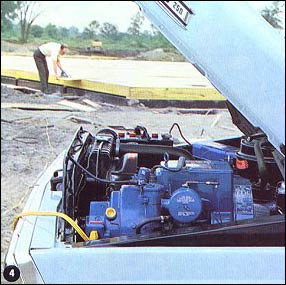

When I was shopping in 2025, this was the only truck with that kind of output.
You would need to add an accessory generator (which probably won't for under the hood) and possibly upgrade the cooling system.
As an electrical generator, it's really not very good. The alternator is rated at 120 Amps (bigger than many, smaller than others).
At 13.8v, that's only 1,656 Watts -- on a good day, with the engine wound up. But the engine won't be wound up. It will instead be idling. The output will be less than 1656 Watts.
It burns right around 0.6 gallons of gasoline per hour (ie 22kW!) while idling and doing ~nothing else. It holds 21 gallons of gas.
So the unachievable best-case of idling-and-doing-no-real-work means that if it starts with a full tank of fuel, it will run out in 35 hours.
And in the real world, it will be doing work since that's the whole point of the exercise. It will therefore use somewhat more than its do-nothing 0.6 gallons per hour idle consumption.
We can ignore the longevity issues of treating a gas-fired vehicle as a stationary generator (these are expensive parts getting abnormally heat-soaked) because this is a temporary solution to a temporary problem, but as a practical matter: I'll still need to fill it up with gas, however I do that, about every day.
And, sure: That can be a way to solve some problems. With a decent inverter stashed out of the weather, connected with appropriately-big cables, I can probably use it to run the gas-fired furnace, the fridge and freezer, some lights, and some digital entertainment. Maybe it can't run all of that at the same time, but I'm smart and I'll manage.
The gas-fired car probably is useful, as long as I can drive somewhere and fill it back up[1].
---
Or: I could just plug stuff into an appropriate EV. It can sit there quietly being the giant battery that it is, and I can drive it out every couple/three days, or maybe just once per week as some suggest, to fill it back up.
It won't have an idle baseload of anywhere near the equivalent of 0.6 gallons of gasoline and it will therefore respond well to intermittent, dynamic loads like heat and refrigeration.
The EV is probably more-useful, as long as I can drive somewhere and charge it back up.
---
[1]: Sure, sure. I can carry a large quantity of gasoline to make the trips more-worthwhile. I can even store some locally (it's a pain to keep it fresh, but do-able).
If I were into that kind of prepping then what would be my practical limit? An extra 40 gallons, for ~60 overall? Great! Now I can run the car/house combo for 3 days before heading back out, and the EV still probably wins on this metric.
That'd be a great option to explore!
Regular cars are very inefficient at the job. Mine maths out to somewhere around 7% efficiency from fuel-to-electrical-power, as a best case (and without yet involving the necessary inverter).
But for generating electrical power, PHEVs have very different tricks than a typical-and-pedestrian sleepy belt-driven alternator has.
Any pointers on a candidate model, or range of models, that include this function as a built-in intent?
---
I was tempted to get into the maths of using a regular gas-fired car intermittently to charge batteries. Maybe with something like an Anker Solix that has enough surge capacity to start a normal-ish furnace blower or fridge compressor, and can accept ~800W of power from a running car's 12v system for charging and/or output.
The temptation persists to write further about that kind of concept at some point, but the previous comment was getting long-enough that people tend to tune out anyway.
---
Except, as an aside: After the 2012 derecho where my neighborhood was without power for a couple of weeks, a neighbor down the block from me parked a minty-looking John Deere tractor in his driveway. This was connected, via PTO, to a rather beefy generator.
That combination (a tractor with a PTO is meant to do stationary-engine duty while doing significant work) sure did look expensive to keep going.
But it was still humming along every time I went past, so it must have been working for him.
(And during that outage, the big corpo gas station just a few blocks further out grew a genset the size of a shipping container that powered their operation. After they got that going, which took a couple of days from the start of the blackout, they were running very normally. IIRC it took them more days to get it disconnected and shut down than to get it delivered and set up, but it worked, and we all had fuel nearby.)
But for the other 99.99% of humanity, there are certainly more cost-effective ways. A portable power station and solar panels are probably the better move unless you have some really massive power needs.
(Admittedly, a nuclear winter reduces the effectiveness of those solar panels somewhat)
Are you telling us that you are not planning to buy Tesla Roadster? But what about the situation when there will be huge snow storm and humongous tree will fall across the road, and you will be like really hungry and you could just to fly over it and not starve to death?
If you can choose between a truck that can’t power your house and a truck that can, prepper mentality is to choose the one that can.
You can stockpile diesel for a generator. That's what actual prepping looks like.
Take it from a Ukrainian.
Much easier to just buy some solar panels to recharge the electric truck.
>Much easier to just buy some solar panels to recharge the electric truck.
Much easier to use it in your diesel-powered vehicle.
And then you have much, much energy in your stockpile.
In colder climates, heating your apartment with energy you collect from solar batteries in the middle of winter is a suboptimal strategy.
Is this thread being astroturfed? This defence for the Cybertruck ITT is one of the least rational threads I've seen on HN in the past few years and if the CT was actually valuable tech it wouldn't be one of the worst selling vehicles of all time.
And the additional value of Cybertruck in this question is about $1000 - $1500. $1k of additional value for $60k purchase is still a selling point, but marginally small selling point.
Take it from a Ukrainian.
PS: my dual-fuel gasoline/LPG Renault Twingo in Poland will outrun any Cybertruck on the continent.
And, unlike electricity, you can stockpile gasoline.
Source: I've mucked up multiple small engines with bad stored gas.
Propane, sure, but now you're talking about something fairly exotic, at least in terms of vehicles you can buy "off the shelf."
In any case, you can't produce propane yourself. You can "produce" electrons with a solar panel.
But for conversations sake, if we're talking about diesel trucks, and specifically an old mechanical diesel like a 7.3 ford or a 12 valve cummins, and we're talking about stored diesel, ideally a class D died diesel with a high sulfer content, then you'll get considerably more lifetime out of it than the recommended 18-24 months.
Additionally, you can burn about anything, old motor oil, fry oil, diesel with algee in it if you treat it and change your filters. A good, mechanical, not very picky diesel will burn fuel that is 20+ years old. Not forever, and you'll go through some filters and maybe injectors. By the time you get to fuel sources that can't be burned in a machine like that, or you've burned it up past your parts and ability to repair. you'll probably have a lot of other problems.
If we're talking generators, you can get off the shelf propane generators and propane stores well.
If you have a vehicle that runs on gasoline, you don't have to store gasoline for a long time to have a stockpile.
The cost of a few empty canisters is by far smaller than the cost of solar batteries, and putting gas into a vehicle in case of an emergency within a span of seconds rather than hours is a huge asset.
Not to mention: not everyone has space for solar. City dwellers are particularly constrained (as in: people who live in apartment complexes).
Finding space for a solar battery installation is a bit harder.
Not to mention: your Cybertruck isn't going to power your 7th floor apartment. You can probably figure out why.
Where I'm located, in most cases when there is an outage, neighboring areas do have power.
Specifically for my model 3, I've been considering tapping into the HV system manually to keep my Ecoflow battery topped up, but I wish there was a way to directly connect it.
1. America is huge. Comparing it to places in Europe is like comparing it to New Hampshire.
2. American has imported tons of people who are incapable of sustaining a high standard of living on their own. It only takes a few percent shift in GDP/person to change how much infrastructure you can build and maintain unless you are truly willing to let all the folks with less than a high school education and no special job skills live in favelas.
Iceland (part of Europe) is the size of Florida with 2/3 the population of Wyoming. 20% of Iceland’s population are 1st generation immigrants. Neither of those facts prevents Iceland from filling in, upgrading, and maintaining their infrastructure. The two week power blackout which GP’s friend experienced is unheard of in Iceland. And every population center, no matter how remote and low population (we are talking fewer then 100) still gets broadband internet via traditional infrastructure.
I also want to note that I did not compare America with Europe, you did that. And it is a determent to your argument (as if your racism didn’t do that already).
You know that Helene was a category 4 hurricane that crossed six states, affected tens of millions of people and cause $78 billion dollars in damage. It was a major event like nothing that has ever happened in Iceland. That level of event in Iceland would remove it as a going concern.
It is. Education has been an excuse for discrimination for a long time. When you describe a whole demographic as being uneducated you are applying exactly the kind of rhetoric which white Rhodesians used to excuse their discrimination[1].
> You know that Helene was a category 4 hurricane that crossed six states.
A Volcano erupted in the town of Grindavík, the main line which connected the town to it’s power plant, went under lava. The town was out of power for a maximum of 2 or 3 days.
But in any case, 2 week long blackouts are extremely common in the USA regardless of the severity of the natural disaster. When I first moved to the Seattle area in 2016 a common snow storm caused a blackout which lasted for 2 weeks in some areas outside of Seattle. The reason for the length of the blackouts in the USA is simply due to the quality and maintenance of the infrastructure and any lack of action plans to fix them when they break.
I've lived in the Seattle area since 2007. There has not been any power outage that affected 3000+ homes that has lasted longer than a day.
Additionally, Seattle area does not have common snow storms. It has extremely infrequent snow storms and thus has no reason to have lots of cold weather equipment. What we do have is frequent wind storms and lots and lots of trees (orders of magnitude more trees than all of Iceland, for example) and the wind often knocks trees into power lines and those are fixed in less than a day. In terms of neglect, that's not a problem. The longest outage I've ever had in the suburbs is 18 hours.
The real reason for the long duration blackouts is not failure to maintain infrastructure, it's because of natural disasters that damage and destroy entire swaths of infrastructure in a single event over thousands of sq km.
I agree. One can judge America’s lousy infrastructure and lack of action plan on its own merits. There is no reason to bring Europe into this. All I am saying is, America’s sparse population, nor the education level of immigrants is not an excuse.
The EU invested about 9% more relative to GDP, while the U.S. invested more dollars per resident because its economy is much richer.
American infrastructure is bad, the boomers in charge have no idea how to get anything done anymore, with California being the case study of nimbyism.
Modern Zimbabwe is not particularly known for having reliable electric infrastructure, even by the low standards of sub-Saharan Africa. This is not a good argument against the parent commenter's point.
the thing all american states have in common is their american ideology, their american political economy, and their population of americans. it just so happens that these are almost always found, coincidentally or not, alongside extremely outdated and poorly-maintained infrastructure, and a class of ultra-rich parasites hoarding many of the resources. drawing connections between any of these phenomena is left as an exercise to the reader
And there's actually a good chance that PG&E is not being paid: most of the big tech companies have large solar installations covering the parking lot which power all the EV chargers, so they cut PG&E out of it entirely and produce their own power.
PG&E has special tariffs for meters that are used only for powering commercial EV chargers ("BEV1" and "BEV2"). They're about half of what a residential consumer would pay for an EV-only meter (the "EV-B" tariff).
But it's not bad to ride out the first couple of days if you've got 120kWh just sitting in your garage.
Ford has also marketed their hybrid F150 as being able to power home appliances for several years.
Ice storms/blizzards in the upper midwest can last days and make roads impassible to the point where they can't/don't fix the very many downed lines until the storm passes enough that they don't have to deprioritize rural roads and outages.
It's just not safe/possible to fix a line downed by ice when it's -30 out in blizzard conditions even if the trucks could navigate the roads.
This turns into the occasional several day outage for some folks.
I've also lived in parts of cities that essentially were impossible to have power failures absent very local equipment failures (like the power equipment attaching my building to the grid failing once) because the lines were underground and there was a power plant very close by.
It depends on a lot of things and lots of people assume everywhere else is just like where they are.
In what universe is backup power a niche use case?
I'd have animals too but society is still stable enough to provide me with food.
At 6000lbs+ it's a section 179 write off; if you combine that with some of the previous incentives the car was not that expensive to the right population.
I expect that the charging station will be in an industrial park with an industrial power supply.
The option to cut power are negotiated into the service contracts.
For instance an aluminum smelter may need a certain amount of notice to shut down their machinery, so they may negotiate an hour of notice or whatever they need. The power company may have to briefly load shed residential while still in the notice period, but then they take the smelter offline and restore service.
I find it highly likely that high consumption electric car fast charging site would negotiate to be the first in line to have their power cut given they don't have any equipment that could be damaged and they'd be most interested in discounted power.
I was remembering how critical infrastructure stays on. Most critical infrastructure is commercial.
However, a business park or an office block gets cut off with the homes.
With climate change causing more extreme weather events and an aging and increasingly more and more difficult to update power grid facing unprecedented strains, I think power disruptions like this are more likely than less. So it makes sense when you look forward rather than backwards in time.
Just really confused on how "smart readers" can get so scoped in to see a single point rather than the wider view. Forest through the trees something something
Natural disasters are often niche cases, and often life-or-death as well.
(This post doubles as an indictment of PG&E.)
Many super charger stations are located very close to the actual substations, so there’s a high likelihood of available power.
This is a pretty common feature in High capacity cars.
Even my mid-range BYD came with power strip attachment so you run basic electrical appliance with it.
Of course there are two issues that are completely solveable if we had reasonable governance:
1. Adopting an Australia-style solar installation regulation and permitting scheme, which is literally 1/5th tho cost of the US method, and pays their tradespeolpe higher salaries than US workers get
2. Allowing EVs to feed back into the grid. This is something that naysayers would never be useful because nobody would ever want to waste battery cycles on their home. Which of course has always been nonsense. Don't buy EVs without this basic capability, IMHO.
This combines to ensure that any solar installer will do lots of very expensive things: 1) have a large sales force to close the sale, which last I looked accounted for 30%-40% of the overall cost of solar in the US, 2) roll out trucks many different times during the planning and install, each costing lots of money, 3) never have to compete with a bunch of other hyper-competitive installers and find efficiencies like batching installs together in the same general area.
There are also massively high solar PV tariffs in the US, more than tripling the cost of the panels, but that's not even that big compared to the rest of the needless inefficiency in the system.
String inverter, commercial panels on your roof, and helping you calculate the number of panels with the max ROI are other things to look for.
Even then, you may not be in a state where you have good installers, unfortunately.
What the fuck
Depending on how much you want to power, there are 'rollable' battery packs that you can plug into a transfer switch. They can be recharged with (foldable) solar panels or a traditional generators (perhaps on cans of propane, which does not go bad like petrol can).
I really wish my Model Y had the V2H support... my next car definitely will.
You can get a generator that will get the job done for under 1000 bucks and you can store diesel or propane to get the job done.
That's before we factor in the likelyhood needing to travel quite a distance (and assume there is no access to grid power), and that you won't have any of the cybertruck defeating issues like heavy rains or standing water that might void it's warranty and fry it's electronics.
A prepper rig is a mechanical diesel that can be roll started or hand cranked without batteries, has no electronics to get fried except the radio, and can burn almost any combustible fuel source on hand. Slap a 200 Gallon transfer tank on the back and keep it full and you can drive across the country without fueling up. And if you also have that diesel generator to power your house, you've got a years worth of fuel for that generator.
You can get all that done for around 25k USD, so, not sure how a cyber truck even enters the conversation.
It was. Everything was pathetic. The claims of being bullet proof, being an amphibious car, being all-terrain, rugged, etc.
Sometimes it sounded like it was all for political theater.
https://www.f150lightningforum.com/forum/threads/franklinwh-...
Ford came in and bought up all of the parts from our suppliers and I had to qual random suppliers for weeks. Even at the time, I was thinking there is too much disparity and this will haunt us for years.
We were a bit more agile and I made a lot of kernel hacks to compensate.
Ford didn’t fare better for all their choices. Recalls galore. Honestly, they made my life hell so fuck em.
On to the truck, they had a proprietary charger and power wall solution but it could run the house for days.
Weird looking truck, glad they took the risk
The cybertruck is $70k, which in a 14-day power outage is $5000 a day.
There are cheaper options to weather such a storm. Like flying first class to New York, getting a limo to the Central Park Ritz-Carlton and spending 14 days being waited on hand and foot.
https://digitalcommons.lib.uconn.edu/cgi/viewcontent.cgi?art...
Still imaginary though. (how come vehicles can exchange energy quickly?)
Currently in pilot on a small fleet of electric trucks in Australia (actual trucks - prime movers for road trains) - large standard swappable battery packs that can be removed and replaced with a fork lift.
Swap time ~ 3 minutes.
A friend who was in the Marines bought this point up along with another good one. (Bit of paraphrasing here) "It's the only bullet proof vehicle that's stock and acts like a giant battery in a blackout. As ugly as it is, it offers a lot of personal protection that people actually want and NEED depending on who they are and where they live. There are a lot of wealthy people who are buying them just for the fact that it's bullet proof."
For years Tesla didn't let you know use the battery in the car this way because they made money selling power walls. Then they added the inverter as part of selling that thing.
Multiple other cars have it and someone now sells an inverter that works on old teslas too
The battery capacity on those things is equivalent to 9 Tesla Powerwall units.
They may be ugly, but the emergency prepper in me always wanted one after hearing that story.