Speaking of 2 things being true at once, what's amazing about BBSs/USENET/IRC/etc. especially in the early years was that they had:
- online discussions where a lot of things just didn't matter. Race, gender, etc. just didn't matter. You got judged on the merit of your ideas, not what you looked like, not what you sounded like. It wasn't white people and black people talking together. It was just people. Genuine friendships developed between people that otherwise probably would have never connected because of societal barriers.
- online discussions where people were insanely cruel. Prior to getting online, I thought I understood how mean people could be. Boy was I wrong. It was a real learning experience to be on the receiving end of vile hatred, bigotry, insults, just... meanness. There are interests I walked away from because the toxicity of the community was too much to deal with.
People's memories suck. And more often than not subjective experiences don't map onto reality, especially when negative or stressful emotions are involved.
One negative experience on an IRC/forum can cloud a person's entire recollection simply on the basis of the Negativity Bias.
Is your point that their recollection should be dismissed? That they were too sensitive? It's unclear what this response's intent is.
I completely believe the commenter's experience, but I also witnessed the opposite a lot (and was deeply encouraged by it), and it's not wrong for me to chime in and point it out. And guess what? Experiencing vitriol on the internet directly contributed to me being more sensitive to things like racism. Although I've been on the receiving end of racist remarks offline, it wasn't until the internet that I caught a glimpse at how hurtful people could truly be. Again, not wrong for me to pipe up about it.
That's not exactly it. The only informed response about a black person's experience on these platforms is a black person's. When people talk about "lived experience," the implication is that empathy is practically impossible. The best you can offer is sympathy.
> I've been on the receiving end of racist remarks offline
I am a white person who has been on the receiving end of racially-motivated police brutality. Even though it was racially-motivated I would not consider it a racist act. The fucker was merely angry at white people, that's different to racism. While there are places on the planet where white people experience racism (typically at the hands of other white people), I can almost guarantee that you have not - especially if you are American.
Don't wash the black community's suffering with white experiences.
My goodness! How can you honestly make such an assertion? I am American, I've visited every state and lived in a dozen of them. I am well-acquainted with many forms of racism and am fascinated that you could believe such a statement. All I can say is that you are unequivocally wrong.
> Don't wash the black community's suffering with white experiences.
This is absurd - finding common ground is the key to rooting out and overcoming things like racism. Always insisting that someone's experience is too different for others to understand only serves to perpetuate division.
I will never know what it's like to be a black person and all of the stupid things black people have to up with. But experiencing unkindness and bigotry helps me understand a little. And while having just a couple of experiences where someone judged me and was cruel to me simply for being white is nowhere near the same thing as dealing with it for years, it's something I can extrapolate from, and it taught me more about racism than any number of books or articles ever could.
You, as a white person, have been a victim of racism?
Edit: > finding common ground is the key to rooting out and overcoming things like racism
How is refuting the experiences of a black person finding common ground?
Have I been told to leave somewhere because they don't want "whiteys" there? Yes. Have I been yelled at for being a "honky"? Yes. Have I been told things like, "all white people are ___"? Yes. Have I been in a group when someone said, "don't give any to the white kid" ? Yes. Have I been threatened with violence with the sole given reason being that I am white? Yes. Has a friend of mine been told not to be my friend because I'm white and we shouldn't mix? Yes.
(for reference, these occurred while living in Alabama, Georgia, North Carolina, and Virginia)
Are these common experiences across the U.S.? I doubt it. Are they as bad as what black people have to deal with? No. Are they as widespread as racism towards black people? Almost certainly not.
> How is refuting the experiences of a black person finding common ground?
I haven't done that at all - maybe you read some other comment and thought it was mine? If so, no worries for the confusion, there's a lot of comments flying around.
Why do some black people hate white people? Because their great grandparent perished on a cotton plantation, because their friend was hunted by some white folks in a truck, because their friend was choked to death by a white policeman, because your race is targeted by disenfranchisement.
Why do some white people hate black people? Because they hate black people.
There is a substantial difference between those two, and the difference is central to the definition of racism vs. racially-charged. Someone being a vengeful asshole does not make them racist, someone being an asshole to a race in general does not (necessarily) make them racist. Racism is hating a race, it is not being angry with a race that participated in horrific acts against you and your (in some cases near) ancestors.
Is it fair that you are being held accountable for the acts of your ancestors, and other living white people? No, that isn't the claim. You find the retribution you face unfair/unkind/unjust, as you have the right to. Now imagine facing the same for merely existing. The claim is that you couldn't possibly understand the experiences of a black person. The claim is that you do kinda' have to accept the stories of black people at face value.
The claim is that the vast majority of their life is defined by racist experiences, where you have a handful of racially-charged experiences to point towards.
It doesn't matter how good or bad your reasons are: once you are feeling or expressing prejudice simply because someone is a member of a particular ethnic group, that's racist.
I have gone from your current viewpoint to my current viewpoint, because I was wrong. I won't be changing my mind to what I used to believe, now that I understand just how wrong I was.
If you can get past that idea, then a lot of how we can fight racism follows pretty naturally (and, by extension, it becomes more clear that at least some of what is happening today in the name of fighting racism actually engenders it).
Not true. There is another acceptable response - not posting, taking some time to read and reflect, and moving along with your day.
You no doubt have any number of other things you could be doing, but you’re in here. Might be worth thinking about why that is.
Obviously this applies to you as well. Maybe you've taken what I wrote as some sort of disagreement or getting defensive or... something? And then from there concluding that I shouldn't be allowed to participate? I'm not sure, but this is a discussion site and I'm participating in the discussion, and please don't take this the wrong way, but it's really not your place to tell me that I shouldn't participate. My original comment was in agreement with the poster I was replying to, and I was adding nuance and finding common ground in a semi-shared experience. None of that is wrong for me to do. Have a great day!
You're allowed to participate, but I trust you can understand that in many situations there is a difference between what discourse is permitted in a space, and what discourse others might see as appropriate or a value add to the discussion.
> I'm not sure, but this is a discussion site and I'm participating in the discussion, and please don't take this the wrong way, but it's really not your place to tell me that I shouldn't participate.
Hmm, it is your place to be able to post whatever you like as long as it's permitted by the rules, but it's not the place of others to suggest doing so might not be appropriate, even if that is also permitted. Kind of a narcissistic, authoritarian mindset, it seems to me. Note that I didn't post "mods???" or report you.
Anyway, you seem to have misunderstood by initial and subsequent comments, so other than rereading them in good faith until you believe me when I say that I was neither disagreeing with the comment, nor trying to undermine his experience, nor defending bad stuff online, I don't think we can make any progress, so I'm moving on to other things. Have a great day!
Do you genuinely not see how "adding nuance" to a "semi-shared experience" is taking the focus away from the parent commenter's experience? When someone is recounting racism they suffered, how is adding "other people experienced other kinds of hate" adding any nuance? Do you genuinely believe that there's valuable common ground between, for example, a black person being called the n-word and another person who isn't black being called the n-word or some other slur?
This is clearly a strawman. I wrote nothing remotely like what you're describing. I asked you to think about what prompted you to redirect the conversation away from a black person's experience of racism and towards whatever your idea of an injustice was. My hope was that upon such reflection, you might realize that black people experience these sorts of microagressions and dismissals routinely, and that such things add salt to the wounds caused by racism.
Instead, you went the fragility route. There couldn't possibly be something for you to learn here. No, instead, you have to create a strawman to protect your fragile ego from the idea that maybe you did something hurtful to someone, inadvertently or otherwise.
Pointing out that those venues were full of anti-everything hate is not dismissing a black person's experience, it's validating it, while pointing out that he's not alone.
But it implicitly implies the negative experiences were similar in scale unless otherwise noted.
It downplays the very large weight that racism adds to the negativity of that experience even if the intent is a noble one of making that person not feel alone.
Do you not see how that response is problematic? How it downplays the person's experience?
An abuser on IRC calling a black person the n-word is objectively more harmful than an abuser on IRC calling pretty much anyone else pretty much any slur.
For instance, a black person might be reasonably angry at hearing the n-word, until they find out the person suffers from Tourette's, at which point the "harm" vanishes. The harm clearly did not result from the word but from the framing of the situation, and the framing exists entirely within the mind and can be changed.
This pattern of harm resulting from framing is seen repeatedly throughout psychology. Of course we should still push for relegating incorrect and outdated framings, like the various -isms, to the dustbin of history, but there's considerably more latitude for how to do this than naive language policing like is commonly suggested.
You are fostering a culture without room for discussion. You are also presuming to speak for the Black person two posts up. Solidarity is important, but shutting people down based on racial context isn't it.
When someone says "I experienced racism because I'm black," the appropriate response is not "Well, actually, lots of people who aren't black experienced that terrible thing." So what if lots of non-black people experienced that terrible thing? That's not what we're talking about here. Your statement is re-centering the conversation away from the black person who's describing their experience. And you know what? It's the black people who are being routinely discriminated against, incarcerated, and killed because of racism, so maybe it's irrelevant to say "my feelings were hurt on IRC too."
I find it really bizarre how many people here are insistent on diminishing or excusing the experience the original commenter had.
But you weren't targeted for this behavior due to your gender identity or skin color, and you more or less started off with "I don't think your issues as a Black person/as a woman have been that bad because my experience hasn't been bad." Like you immediately centered yourself in a discussion about other people, and have done nothing to show any effort to even hear what they're saying.
Additionally, one person's positive anecdotes do not outweigh another person's negative anecdotes. If I'm thinking about joining some arbitrary group of people and most of my friends say it's a good time, but even one person says "I showed up and all the men either sexually harassed me for being female or witnessed the harassment and did nothing about it", well, that tells me a lot more than the other person who says "They kind of joke around a bit but it's really a mostly positive place!"
Being roasted for being a moron was something where it was/is allowed to stand up for yourself. I know that when people thought I was male, I was allowed to give as good as I got as long as I knew how to take an L once in a while and had a thick skin. Arguing and insulting back is accepted and a lot of the arguments can be conclusively settled in some way. Even if you pedantically argue for something incorrect long after you should, you can usually make amends by accepting you acted like a dumbass and letting people clown on you for it.
The shit I got for being female was different because it was a bunch of projection that I had no way of addressing. There are a lot of people who are just plain not okay with the opposite sex and could not handle being turned down. The most vile crap was spewed in private and then it turned into 'he said/she said' or 'I/we can't control what members say or do outside of the channel/forum/newsgroup'. Ambient sexist atmospheres could not be diffused by giving the guff back as places that are 90/10 male to female do not respond well to the women clowning on the men: You can't answer 'get back in the kitchen and make me a sandwich' with 'get back to the factory and make me money' because the men fall in line to support each other. You can't answer it by bringing it up seriously because then you're a buzz kill, etc. It's not two equals arguing; it's one side being told to shut the fuck up.
Guys - be decent. Just, always. Always be decent.
Call it out to 'friends', to family, online, in person - even if all you feel you can say is 'that isn't right' - say it - you don't need to get into fights, you don't need to be a saviour, you just need to call it out. You can use that as excuse to leave, or you can use that as a reason to stay.
But don't just ignore it.
So the opportunity to make many different people feel excluded is better? I'm not sure what you're getting at?
> Do you know VIRULENTLY anti-black (or woman, or gay) these communities were? I can't begin to describe it.
The answer is: "in a somewhat limited way, yes, yes I do". I can't know exactly what it was (and is) like, but the diversity of awfulness in some of those communities allowed me to experience meanness on a level I had never experienced before, which in turn has helped me feel more empathy towards those who deal with things like sexism and racism both online and offline.
Before, I had only an intellectual understanding that those things were terrible, which led me to under-appreciate just how much they can hurt. Perhaps I still under-appreciate it (who knows?), but I'm definitely closer to understanding than I was before, and that's a good thing.
Prefacing "I know your experience" with "In a (very|somewhat) limited way" is vitally important.
We actually had real diversity and inclusion before these rent-seeking social media corporations and their fake DEI came in and ruined it. On IRC no one knew I was a 14 year old, or an 80 year old retiree, or male or female, or black or white, whatever.
So yes, the idealism is there. No one knows who you identify as in a text channel unless you let them. But it does not remove the fact that these communities could often have bigoted pockets.
Nice straw man argument you got there...
https://en.wikipedia.org/wiki/Straw_man
But I'll take the bait...
> Anyone who spent a good amount of time in these communities know it was a problem...
Interesting.
I've been on IRC for decades, and while any online forum has the feature where trolls are capable of making awful remarks for the lulz, it's been my observation those are outliers, and NOT an actual problem for focused communities.
> So yes, the idealism is there. No one knows who you identify as in a text channel unless you let them.
hrm... yeah, there is a dichotomy there, but not the false kind, more of the ying/yang kind. The same feature that fosters diversity is the same feature that allows for trolls.
> But it does not remove the fact that these communities could often have bigoted pockets.
There is no reason to practice fatalism here, or characterise rare events as common place. This is probably a variation of another fallacy called reductio-absurdism
https://en.wikipedia.org/wiki/Reductio_ad_absurdum
Ultimately IRC has admins, moderators, and the ability to mute other people. That is why good prevails over evil on IRC, and why IRC has remained the place for smart people to connect online for so so very long... longer than any other mode of chat communication.
I used to be part of multiple IRC channels that swear up and down that they're not a bigoted/political community they're just a focused technical chat about .NET or something, and then spout off calling things "faggotry" every day with no self-awareness whatsoever.
What are the names of the IRC channels you were part of that said they weren't bigoted but used homophobic slurs every day?
If your first response to someone saying "I was harassed" is "I need objective evidence before I believe that this could possibly have happened", you're part of the problem.
1. This person didn't claim THEY were harassed. They claimed others were harassed. This was not THEIR lived experience. They were talking about harassment secondhand.
2. The secondhand claims of inappropriate language were made on the internet. The internet is different than the physical world. Much text typed on the internet is/can be recorded. It is a very common practice for someone who is being harassed on the internet to share with others the record of their harassment. The internet is perfect for this. It's certainly much messier out in the physical world to prove which is the analogy you seem to be trying to apply to internet communication.
3. I just asked WHERE it happened, not to provide a precise record of the claims. It wasn't a tall ask to respond with an internet location (i.e. channel).
4. Questioning claims is NOT harassment, especially when the cost to produce evidence supporting the claim approaches zero (as on the internet). This is a toxic mentality to employ, though I'm sure you think you are being noble with your #believeallclaims approach. If anything, people who employ a "DON'T QUESTION IT!" approach do themselves a huge disservice, as that is probably the least persuasive tactic to do and immediately signals a huge red flag to any neutral onlookers.
The topic here is asking for where secondhand claims of harassment on a part of the internet happened, with the context of it being contrary to MY lived experience in similar parts of the internet. I'm trying to square how this secondhand claim could be contradictory to MY lived experience, and to update my understanding if given new information.
As a last rhetorical example/hypothetical: Let's say I made a claim that someone replied to a tweet of mine this week calling me the n-word. Do you automatically believe me? If you sought to prove my claim by looking at my tweets, are you a racist that is harassing me? What if there is absolutely no record of the alleged tweet reply happening/existing (even accounting for a potential delete)? Would you ever waver in your belief of my claim?
My point is that people hail these communities as the golden child of diversity in a community, but back in the late 90s and early 00s internet nerd culture was anything but diverse. Again, I am not saying diversity did not exist, but if you were to measure the amount of say.. white males vs other groups on IRC we all know which way it skews.
My other point was that, back then it was common in internet culture to throw offensive, racist, and sexist terms/jokes back-and-forth with no recourse as a form of trolling. The people using these terms may not even be racist/sexist, but from the perspective of a minority there is no difference.
I enjoyed being on IRC, to the point where most of my free time was spent gaming but then shifted to just chatting with folks on IRC. It was great. I miss it dearly. But I do not see it as some diversity golden child we should all aspire to.
The main vector that people demeaned others on was based on technical skills.
The argument isn't that there was no good to be had from those communities, it's that you can't dismiss or ignore the bad that they put out as well.
In other words did it or does it show disproportionality? If it's disproportional then that indicates it's outside the global norm. The above does not mean the global norm is an acceptable norm but helps calibrate and figure out how good or bad things were or are.
Furthermore in regards to race specifically I would argue there probably were very few online tech/engineer communities anywhere in the world that widely targeted and denigrated white people until maybe just recently, and even then they are likely not popular or widely participated in.
I'm struggling to understand what the point you and other commenters here are trying to make responding to the original comment.
The red head jokes were endless.
You never had to disclose any aspect of your identity. Your gender or ethnicity. You were just a username. The only thing someone could find out about you was your general location based on IP address but even that could be masked if you want.
I understand closer relationships formed on IRC I’m just saying, you could go there for help without experiencing prejudice. There was no expectation of revealing your real self.
On EFnet, there were aggressive racists in positions of authority. References to burning crosses, etc. Many of the earliest bash.org quotes originated there, including the idea that "the bash.org 'worst' quotes list is just "the best racist jokes list." The place was in generally incredibly abusive, and frequent channel and nick takeovers. The expectation of anonymity was a feature that enabled this behavior.
On Freenode, things were better. Pseudonymity let you hide from others but less so admins. But still there was a period of time where everyone was getting PM's about an IRC network where black people were banned (also, the thing was offensively named). It got so bad they had to institute a system to prevent DMs from unregistered accounts. You may also recall that one of Ubuntu's earliest contributions was a Code of Conduct, and that this was relevant because the #debian-* help channels were borderline abusive.
So yea, you didn't have to identify yourself, just humiliate and dissociate.
[^1]: as far as I can tell, no one was welcome to ask questions unless they could first prove that they were smarter than everyone else about computing, in which case you wouldn't actually need to ask questions in that forum in the first place
The DEI sessions I've sat through have focused heavily on the I--inclusion. Sure, they were corny, and there was plenty of virtue-signalling. But making a conscious effort to make sure everyone at the company feels socially welcome and fairly treated is a worthwhile effort.
The punchline is that I'm not white.
I've since moved on from that firm, but I've run into this elsewhere. Really leaves a bad taste in ones' mouth, and hits the demoralization hard. The doublespeak is miserable. But I suppose I have literally these policies to thank for forcing me to strike out on my own to build something actually better.
I see the irony in using protected characteristics for profit, but it's a win-win...
In reality DEI in general doesn't give a shit about diversity of experience. There is zero investment into training programs to actually get people from non-traditional backgrounds into $company, because it's significantly less profitable in the short term. And when the training is set up, it is done in the most mealy-mouthed "equitable" way possible, where everybody gets a gold star, and then people act all surprised when the outcome is unproductive, virtually unfireable workers. And god help you if you are a "diverse" person who doesn't toe the DEI line, that is the fastest way to find yourself a pariah in an org.
First, what evidence do we have that diversity does result in a company performing better, or gaining that amazing employee? He argues that this is an unfounded assumption.
Setting that aside, his second point requires deeper consideration. Disparities are often caused by upstream circumstances, like fewer children having adults in the home that value education, leading to fewer candidates that meet diversity criteria to hire from in the first place. By laying quotas on at hiring time, people are wrongly assuming the problem to be occurring where it is detected (in hiring) and not where it originates (in-home attitudes to education and work).
In the meantime, corporations hire consultants that emplace DEI "initiatives" that train workforces to detect "microaggressions," among similar evidence-free curricula. They do this, not because it solves a problem, but because it allows favorable public relations announcements.
How about initiatives funding scholarships, and contributing to in home book programs? How about funding campaigns for supporting community libraries?
These would go at the root of the issue, rather than the cosmetics of the issue. But then, they couldn't gain the indulgences for failing to actually be diverse as a corporate culture.
It's not an assumption.
> Along all dimensions measured, the more similar the investment partners, the lower their investments’ performance. For example, the success rate of acquisitions and IPOs was 11.5% lower, on average, for investments by partners with shared school backgrounds than for those by partners from different schools. The effect of shared ethnicity was even stronger, reducing an investment’s comparative success rate by 26.4% to 32.2%. [0]
> Increased diversity in the healthcare workforce helps reduce or eliminate racial health disparities, according to a 2014 meta-analysis of 25 studies. [1]
> A large-scale study of all Texas schools reveals diversity’s impact in public education systems. They find student performance most-improved when there was greater management diversity, and a closer racial match (representation) between management and student. [2]
> Most of the sixteen reviews matching inclusion criteria demonstrated positive associations between diversity, quality and financial performance. Healthcare studies showed patients generally fare better when care was provided by more diverse teams. Professional skills-focused studies generally find improvements to innovation, team communications and improved risk assessment. Financial performance also improved with increased diversity. A diversity-friendly environment was often identified as a key to avoiding frictions that come with change. [3]
> Our latest report shows not only that the business case remains robust but also that the relationship between diversity on executive teams and the likelihood of financial outperformance has strengthened over time. These findings emerge from our largest data set so far, encompassing 15 countries and more than 1,000 large companies. By incorporating a “social listening” analysis of employee sentiment in online reviews, the report also provides new insights into how inclusion matters. It shows that companies should pay much greater attention to inclusion, even when they are relatively diverse. [4]
> Using data from the 1996 to 1997 National Organizations Survey, a national sample of for-profit business organizations, this article tests eight hypotheses derived from the value-in-diversity thesis. The results support seven of these hypotheses: racial diversity is associated with increased sales revenue, more customers, greater market share, and greater relative profits. [5]
This is just the tip. Study after study shows diversity improves outcomes of group work, it's really hard to justify believing otherwise, in light of the overwhelming data.
[0] https://hbr.org/2018/07/the-other-diversity-dividend
[1] https://www.ucdenver.edu/docs/librariesprovider68/default-do...
[2] https://academic.oup.com/jpart/article/15/4/615/991022
[3] https://pubmed.ncbi.nlm.nih.gov/30765101/
[4] https://www.mckinsey.com/featured-insights/diversity-and-inc...
[5] https://journals.sagepub.com/doi/10.1177/000312240907400203
Great contribution.
DEI efforts try to conflate ethnicity+gender, effectively trying to build the effort on the backs of black, hispanic, and indigenous populations -- but try to count gender as well. Effectively, the DEI outcomes I see at companies end up being wealthy white women getting more opportunities, and the company conveniently checking off DEI as "done"
The expected beneficiaries of this effort likely do not read all the documentation related to it, but I tend to do that and, once you mentioned it, something clicked. The fairly ridiculous write-up on "white supremacy" culture pervading everything was done by, apparently, a white woman. The read itself is fascinating for all the wrong reasons. It is a non-profit. It is backed by some corps. It does put the weird power dynamic in an even weirder light. I do not want to link that write-up as, frankly, I do not want to give it more exposure.
EDIT 1: The more effective mechanism that my company uses is to verify at the time of hiring a candidate that you can show you at least considered diversity target candidates (in engineering, basically women and non-Indian/Asian/white).
EDIT 2: also definitely see diversity target group employees being flagged for second-look when identifying layoffs, PIPs etc.
It's easier to leave a company for another, probably better paying, job elsewhere than it is to bring a lawsuit.
I don't claim to have remotely enough knowledge of the situation to know whether they were right or not, mind.
It strikes me that your colleagues being acceptable, you being better but having high enough standards for yourself that they don't seem acceptable, plus a moderately apathetic manager could produce pretty much precisely the same observable results and then if you're already primed to expect diversity stuff to be stupidly implemented it'd be easy enough to draw an incorrect conclusion.
It also strikes me that under the previous leadership Intel was kind of a shitshow in general so given that both possibilities seem depressingly plausible.
https://www.theatlantic.com/magazine/archive/2017/04/why-is-...
> Now, of course, the talk is of inclusion, not confrontation. And I was surprised to hear Intel—old-fashioned Intel—mentioned as one of the companies successfully innovating around gender. It had been releasing diversity numbers since 2000, though not with as much fanfare as some of its peers, and without much improvement. But in the past couple of years, Intel decided to try a few other approaches, including hiring quotas.
> Well, not quotas. You can’t say quotas. At least not in the United States. In some European countries, like Norway, real, actual quotas—for example, a rule saying that 40 percent of a public company’s board members must be female—have worked well; qualified women have been found and the Earth has continued turning. However, in the U.S., hiring quotas are illegal. “We never use the word quota at Intel,” says Danielle Brown, the company’s chief diversity and inclusion officer. Rather, Intel set extremely firm hiring goals. For 2015, it wanted 40 percent of hires to be female or underrepresented minorities.
> Now, it’s true that lots of companies have hiring goals. But to make its goals a little more, well, quota-like, Intel introduced money into the equation. In Intel’s annual performance-bonus plan, success in meeting diversity goals factors into whether the company gives employees an across-the-board bonus. (The amounts vary widely but can be substantial.) If diversity efforts succeed, everybody at the company gets a little bit richer.
TL;DR: Intel docked your pay unless you met a quota for women and URM hires.
"If women and minorities are not being employed at a rate to be expected given their availability in the relevant labor pool, the contractor's affirmative action program includes specific practical steps designed to address this underutilization."
"Where, pursuant to § 60-2.15, a contractor is required to establish a placement goal for a particular job group, the contractor must establish a percentage annual placement goal at least equal to the availability figure derived for women or minorities, as appropriate, for that job group."
https://www.ecfr.gov/current/title-41/subtitle-B/chapter-60/...
Or it would be worthwhile if it actually worked. Note the use of the subjunctive tense.
I’ve talked to enough managers who complain about lackluster employees and how they’re not fireable because the person is URT. It’s a thing - even if we all like to think it isn’t. Your best effort is to manage them out.
We even had an interviewee who only spoke an obscure language not spoken by anyone on our team _and_ had no work experience. This was for a staff engineer position!
We hired someone despite some misgivings in the interview phase who turned out to be a pathological liar (and identity thief) and they proceeded to torment the entire company with insane false allegations for two years and did zero work while we couldn't get rid of them. Finally they quit on their own and this person just made the news recently for stripping down naked and violently attacking a convenience store's workers with a knife.
There are minority candidates who can thrive at all levels of tech. Nobody is telling your to hire subpar candidates. That's on your company's lazy implementation of their inclusion efforts, not on DEI.
The best I've seen as a person who's not part of the DEI team is cultivating relationships with universities with large numbers of URM students. But that's really still just searching slightly outside of the range of the lamppost.
Are you straight up going to small towns and offering scholarship opportunities? Going to college fairs (no, not hiring fairs at colleges, but the fairs that high school students go to to find a college) and marketing what jobs are available at your company for majors of certain degrees? These are just off the top of my head; I'm sure there are a lot better, and tested ideas out there.
This would be a good argument if we ever get to that point. But we aren't even close, and plenty of smaller companies and startups don't have diversity goals at all. There's plenty of room for some big names to go 100% green without being a tithe of a tithe of the full working population. Or even a tithe of a tithe of the working population of greens.
Even Walmart is less than 1% of the total employed population in the US. Much more so for smaller companies such as Alphabet or Meta.
When an initiative fails, the solution is rarely to do more of it.
X does not always lead to the same bad outcome here though. That is, DEI initiatives that increase diversity while not lowering the hire bar do exist. That some particular company decided to lower their hiring bar doesn't indicate that DEI initiatives always cause companies to lower their hiring bars.
I'm also vaguely of the impression that at least some research is finding DEI initiatives to be neutral or perhaps even counter-productive, but I'm having a hard time finding those papers--if this is jogging anyone's memory, I would appreciate links.
If you want to police SEI initiatives to ensure they’re properly implemented, go for it, but the constant aversion to a so thoroughly researched concept is bordering on flat earther level conspiracy.
Is this part of the same body of research suffering a replication crisis more broadly?
It is?
Oh. So, having lots of published “research” that can be linked to by consultants paid to believe it isn’t the same thing as replicable hard science?
Nope. Whodathunkit.
I really cannot overemphasize how detrimental to your argument what you just wrote is to any thinking human being. Blindly claiming all research, from literally every institution in the world, is both inaccurate and rigged somehow on a widely studied topic, is an insane claim only made when you've given up on the entire concept of rationality.
You really would rather throw all of science under the bus before you let black people get an even footing in society, wouldn't you? Incredible.
The issue in STEM fields is that essential elements to replicate (like the code) are not being published, yet the underlying science is solid enough for production technology people rely on every day to be built on it.
In the humanities the replication crisis is that a significant amount of published “research” is essentially made up whole cloth.
One of these things is not like the other.
You get called racist for saying racist things; if you don’t like it, stop doing it. DEI works, the outcomes are clear, obvious, insanely well documented, and freely available to literally anyone with access to the Internet and two brain cells to rub together.
Please continue to question what you’re told, but at some point, when the answers are flowing to you in unambiguous and numerous ways, shut the fuck up and take in the knowledge. At some point you have to accept that either you’re a person of reason or you’re a racist asshole who can’t accept that letting minorities into groups helps those groups. You’ve got an ego, that much is clear, but try to disassociate that ego with this problem. Be a student. Learn.
The only person who who should feel shame here is the person who would believe they understand a problem better than every single major research and academic institution in the US. If that’s not you, great, but it’s looking a lot more like you than it’s looking like me.
You know nothing about me, and your claims about me are not only wrong, they’re laughably so. I hope I never have to work with you or otherwise interact with you off the Internet, you have made it clear by your behavior here that you’re truly a horrid person.
Best of luck in life.
And I didn't say I knew anything about you? I said things that are true for any thinking, breathing human.
Honestly, what a weird reaction. You clearly feel attacked, which I guess makes sense if you genuinely are the worst possible parts of what I wrote about (choosing to be a racist asshole rather than a person of reason), but you're opting into those designations for some reason.
The things people will do to justify hatred are wild, thank you for reminding me of that.
> shut the fuck up and take in the knowledge.
> You get called racist for saying racist things; if you don’t like it, stop doing it
> I really cannot overemphasize how detrimental to your argument what you just wrote is to any thinking human being.
> Blindly claiming all research, from literally every institution in the world, is both inaccurate and rigged somehow on a widely studied topic, is an insane claim only made when you've given up on the entire concept of rationality.
(note that the parent never made this claim, you're falsely imputing it on him)
> You really would rather throw all of science under the bus before you let black people get an even footing in society, wouldn't you? Incredible.
I suspect these comments likely violate even a very narrow reading of the site guidelines. Your account is relatively new, so maybe you aren't aware but you might want to take a look before mods intervene (guidelines are linked at the bottom of the page).
None of those lines are in any way openly hostile, unless you fall into the worst category of what I wrote, which is the racist who is trying to find any excuse to remove black people from the conversation.
I don't care if dang agrees/disagrees in this case. This is too important, and the voices spouting bigotry on this site need to be challenged, even if it's wildly unpopular.
In the past, the bans came from simulating activity on the discussion, which I have made clear this time that all accounts roll up to one person.
And no, you cannot support the concept of DEI and remain on this site without resorting to the tricks I've had to. I'm not perfect, but this site has shown its ugly side these past few days, as a number of anti-DEI posts have been getting traction.
Not at all. For example, I believe that selecting for viewpoint diversity directly is a better way to achieve viewpoint diversity than via DEI. Moreover, I firmly reject that race or gender confer any special abilities (and frankly this gets me into more hot water with DEI advocates than anyone else). These two positions aren't in conflict in any way. This example constitutes incontrovertible proof that "criticizing the concept of DEI is spouting bigotry" is incorrect.
> And no, you cannot support the concept of DEI and remain on this site without resorting to the tricks I've had to.
This is factually incorrect as well. I debate with lots of people who argue vocally for DEI (even strongly implying personal attacks) who have been on this site for a long time (and have lots of karma!). They just stay within the guidelines or at least they don't flout them as egregiously as you seem to be doing.
And you're right, claiming something does not make it so. What makes it so is all of the data supporting it, which is readily available to anyone who actually cares about this topic (up to you if that's you).
Who is arguing that DEI is ineffective when properly implemented (what does "properly implemented" even mean, concretely?).
> they both fly in the face of a whole lot of data
You keep referencing this data... Where are the metanalyses that show concretely that DEI programs are effective? To be clear, I'm aware of and believe that increased diversity makes organizations more robust, but again that's attributed to viewpoint diversity and it's not at all clear to me that modern DEI programs deliver on that viewpoint diversity. It's not even clear to me that there is widespread consensus that "viewpoint diversity" or "organizational robustness" is a goal of these programs--one definitely gets the impression that the primary goal is diversity of identities with little mind paid to the impact on viewpoint diversity or organizational robustness.
Here's HBR (https://hbr.org/2019/07/does-diversity-training-work-the-way...) talking about whether or not diversity training programs are effective; note that the implication here is that the goal is ideological agreement--they're not even looking for viewpoint diversity:
> What did we find? Let’s start with the good news. The bias-focused trainings had a positive effect on the attitudes of one important group: employees who we believe were the least supportive of women prior to training. We found that after completing training, these employees were more likely to acknowledge discrimination against women, express support for policies designed to help women, and acknowledge their own racial and gender biases, compared to similar employees in the control group. For employees who were already supportive of women, we found no evidence that the training produced a backlash.
Regarding the research into DEI, a lot of the measures of its efficacy (that I'm aware of) hinge on Implicit Association Tests which are a famously plagued with issues (https://www.vox.com/identities/2017/3/7/14637626/implicit-as...).
> Who is arguing that DEI is ineffective when properly implemented (what does "properly implemented" even mean, concretely?).
Nearly everyone in the comments here, are you blind?
> Where are the metanalyses that show concretely that DEI programs are effective?
Here's one that took all of 5 seconds to Google:
> Results from 65 studies (N = 8465) revealed sizable effects on affective‐based, cognitive‐based, and skill‐based outcomes as well as interesting boundary conditions for these effects on affective‐based outcomes. This study provides practical value to human resources managers and trainers wishing to implement diversity training within organizations as well as interesting theoretical advances for researchers. Practitioners have quantitative evidence that diversity training changes affective‐based, cognitive‐based, and skill‐based trainee outcomes. [0]
[0] https://www.researchgate.net/publication/263597048_A_meta-an...
Is there any effort at follow-up training? Seems like this interview strategy HAS to be paired with a long-term training strategy for taking less-qualified hires and turning them into very productive employees.
If not, do you end up hiring more people in total? Do these lackluster employees just eat up time and budget, or do they also actively occupy a desk that you need to reclaim to hire more talented replacements?
Yes, I have had a slightly less hyperbolic version of this actual conversation about less-than-qualified diversity hires. Good way to end your career.
This is the best comment in the thread. If you have a diverse funnel you will have diverse employees and as long as you maintain standards, they will be well qualified for the job. This includes internships and job training programs.
That's because it's often illegal, and most people find it immoral. It's the "quiet part", if you will. I've been in a hiring role for a decade, and I can tell you that it happens at every company I've been at that has a DEI program.
Many of the larger companies even have manager bonuses dependent on diversity metrics of their teams. That's about the biggest weight you can possibly put on the scale.
That said I hired way over industry average in females. But under for POC. But I probably got slack for all the female hires. All of whom were the best we interviewed.
My experience is the opposite, unfortunately. Big companies know where the legal line is and are careful to not cross it too often, but here are some examples I've encountered first-hand:
1) My org's annual score had a prominent section highlighting the fact that our diversity was deemed low. Your org's score affected your annual budget for raises and bonuses, so I'm embarrassed to say that it was definitely a factor in hiring.
2) We'd have an opening to fill and sometimes would get a stack of resumes of just women. This would otherwise be fine (or even great - see #1, above) if there were some good ones, but honestly if you're a woman who is a great dev you'd almost certainly be able to get stellar offers elsewhere (this was a large-but-not-FAANG company). In one particular case, a guy friend of one of my employees applied for the same position and would have been a perfect fit at least on paper, but somehow his resume didn't make it past HR so he didn't get interviewed. We interviewed several from the pool we got and ended up hiring one who was an ok dev. Not great, but ok - we definitely "settled".
3) One time I needed a dev with a somewhat specific skillset and was soon told that they had found someone and had started the hiring process - even without an interview. I asked to at least see this person's resume (woohoo, it was an Asian woman - checking TWO diversity boxes!!). I pointed out that she didn't have the skill set we needed and nothing indicated that she had a background that would be good for it. I also pointed out that she didn't speak much English (it was literally a caveat listed on her resume), so I asked if we could at least interview her to try to assess if she'd be willing to pick up the skills we needed. Nope, the hiring was already done by then, and there she was in our office two weeks later. I have never felt so bad for anyone who has worked for me; she always seemed sad and lost, and I did a really poor job of figuring out how to help her. I'm still haunted by our extremely awkward 1-on-1 meetings (kinda hard to have much of a conversation when, you know, there's not a shared language).
On the flip side, some of the most talented and brilliant and enjoyable people I've worked with have been people who check lots of the diversity boxes, but weren't hired as part of any sort of push to increase diversity.
A couple of decades worth of research has shown racial bias against URMs in hiring exists. Breaking past it with a requirement to interview and consider URMs is a start, not the finish.
https://hbr.org/2021/02/research-how-companies-committed-to-...
Genuinely anonymizing an application is a difficult task without losing pertinent data.
This is not as easy a task as a simple text replacement.
This is exactly what DEI is, and I guarantee you that your own company, if it is of any substantial size, systematically hires under qualified candidates because of DEI. It would require a hermetically sealed reality-avoidance filter to not notice this. While there are some people who walk around with these filters on, the vast majority of people do not, and will readily tell you exactly what DIE is about once they feel safe enough to speak honestly with you. Listen to them.
The argument goes like: There's some objective rubric, and hiring a black person despite that rubric's indication that they're 2.345312% repeating below the best candidate, is DEI gone wrong!
Anyone here who's ever hired for a technical role knows how wildly wrong that idea of recruitment is, but for engineers, we want to put a model to a system, and then we want to worship that model, so it's hard for some folks to grasp.
To say merit doesn't exist is laughable. Get out of here lol.
I’m Asian btw. I can relate to Lebron just as much as I can relate to Neil Armstrong or Satya or Matz or Woz or Marie Curie because they are all excellent at what they did/do.
I want to be excellent like them. Because we all are humans.
Exactly how did he struggle as a basketball player? White Men Can't Jump was a 90s movie, and back in the 80s, Bird was a the great white hope as redneck from Indiana, because the top players were mostly black, and Bird was even called out as unathletic by Dennis Rodman and Isaiah Thomas after he won a playoff game over them in Detroit.
Selling his body? Are you serious?
He wouldn't have been able to become a cop, a nurse, a clerk, a financial professional or any of the other thousands of professions that black people in the midwest find themselves in?
LeBron's struggles seem less part of his success story and more part of a self-penned "rags to riches" legend.
I would even say that being black was an advantage, and gave him great genetics that he took to the next level with discipline.
Being Jewish was a great advantage to Einstein, and gave him great genetics that he took to the next level with discipline.
Being French was a great advantage to Joan of Arc, and gave her great genetics that she took to the next level with dedication.
LeBron may have great genetics. But if he does, it's because of his parents and luck, not his race per se. Otherwise everyone who is black would have a genetic advantage that they could take to the next level with discipline.
It is racist as hell to attribute to race what are personal qualities. Other than, perhaps, traits that only certain races possess, such as the ability to breath at high elevations without taking weeks to adapt to the conditions.
I found that out, when I arrived in this country, and was informed that Indians are their own groups, and Asians referred to Chinese and Koreans (and others).
The 'Asian' tag is a clear racist way, determined by the way one looks.
Also, Middle Easterners are never called Asian in the US. They’re called Middle Eastern.
Think about how men feel about traditionally femme activities which may be stigmatized for hetero men. If you see even one other straight man get their nails done at a salon it sort of implicitly opens that door to you.
Does your comment mean that because your human experience is different than other people that you find it difficult to understand how others may think and feel differently than you?
Goku being Japanese and loved by people of lower income is like how Final Fantasy 7 is beloved in predominately white (western) countries. There's still discussions of people thinking Cloud Strife is white even though he is Japanese.
Race, in general, isn't a big deal when you are younger since it is not taught in schools (shockingly to some people :O). It becomes an issue when people actively start generalizing and using tropes for the purposes to make you feel like shit (in)directly.
And Goku isn't Japanese either; he is Saiyan, an Alien race.
> Race, in general, isn't a big deal when you are younger
It isn't a big deal, if you're not impacted by it (colloquially known today as 'privilege').
However, what you might not believe is a big deal, is arguably a big deal to other people.
A few examples:
You may not be aware that black women in the US are 3-times more likely to pregnancy related issues than white women. There is a downstream impact on the children of those women. [1]
Separately, there still exists a serious gap in achievement for Alaska Native / American Indian children.
1: https://www.cdc.gov/healthequity/features/maternal-mortality... 2: https://www.nsba.org/ASBJ/2020/December/condition-native-ame...
You clearly misread. Elementary and even some high school school kids don't think about "race" until it is pointed out in some way whether by a national event or cited as bullying reason etc. How you could extrapolate that to "race doesn't matter", I have no clue other than a misread whether intentional or not.
You've changed crux of your argument (or perhaps clarified what you inteded to argue) to now be what school age children do or do not think; though that isn't very compelling as neither you nor I are capable of reading minds. However the comment I did respond to was clearly written--"Race, in general, isn't a big deal when you are younger..." and it clearly can be a big deal to young people; just perhaps not a big deal to you.
I've changed nothing. You misread it and I clarified it for you to come to an understanding. Race/Skin Color/Nationality, whatever it is you want to read it as with the negative connotations assigned, isn't something any young-in thinks about on a daily basis without it being pointed out in some way.
Anyway, I'm not interested in going on circles on this. I would know about said experience given my own culture and interactions. No one needs to reads minds to give anecdotes about their life experience and talk to other people in the same situation about their life experience and thoughts about things that happen(ed) to this day.
[1] https://scontent-hou1-1.xx.fbcdn.net/v/t1.6435-9/106206584_2...

Diversity based on skin color is absolutely asinine. You can have a multitude of poc in one room but if their backgrounds and the groups they associate with are all the same, then their thinking is all going to be alike.
Unless we were all in the same positions within our careers since the time of MLK to now (and I'll also ignore some other confounders, like the fact that many black Americans could not easily attend college in the time of MLK), I wonder whether a recency bias may explain the differences you are reporting.
All you need to do is read what DEI is striving to do and listen to MLK's "I have a dream" speech when he specifically states he doesn't want a society where we judge the character of people on skin color but instead merit. This is something you should have learned in elementary school if you're an American. Are you trying to claim this isn't the case?
Explain to me how making everything equitable and inclusive for specific class oppressed poc isn't basing things on skin color vs. merit? This is a logical test, not one that needs sources.
Here's another test for you - explain how you make everyone equitable without lowering the higher achievers in society down to the average? Do you think it's possible to make under-achievers the same intelligence, physical capability as higher-achieving people?
I also requested information about how the US used to treat racial equity better in the past; do you have any such evidence?
> Explain to me how making everything equitable and inclusive for specific class oppressed poc isn't basing things on skin color vs. merit? This is a logical test, not one that needs sources.
The quote you reference mentions character. The issues at hand are whether hiring ignores qualified candidates based on their skin color. I understand that you wish for a colorblind world but this is not the world we live in. I suspect that it is easy for you to forego a 'patch' in our current situation because the problems at play do not affect you. To rephrase, because you're not running an affected version of a problematic script, nobody should be allowed to install a hotpatch. Better to wait for the perfect v1.0 to be released.
> Here's another test for you - explain how you make everyone equitable without lowering the higher achievers in society down to the average? Do you think it's possible to make under-achievers the same intelligence, physical capability as higher-achieving people?
This is the perennial boogeyman and strawman. I think the reason it comes up is to make those who have enjoyed unappreciated benefits feel that their experience relates solely to their ability.
One of the best pitchers in baseball history never had a chance to play in his prime. Why? Because of an accident of his genetics.
With the arguments you set up, I surmise that you would argue that expending any effort to finding such good, but unappreciated, players necessarily debases all players; let's leave the greats in the dust to ensure that the sons of the wealthy get to play the game.
I would say that it is a disservice to humanity not to explore every option to uncover wasted talent.
We will disagree on this, but I encounter brilliant people whose life stories hinge on just one lucky break regularly. When I am confronted by the mammoth systemic inequalities the United States has imposed against some of its daughters and sons for hundreds of years, I am motivated to spend an extra moment to find qualified candidates in unappreciated venues.
Finally - your argument presupposes that every job search finds the best candidate. This may be a surprise to you, but as someone who hires, the candidate I end up with is as much defined by the vagaries of chance as by the candidate's ability. This is not controversial to any one who hires and is indeed a confound that we all must consider.
One key factor in someone getting their foot in the door is knowing someone who can contact me. Is this fair? Do I lower the average quality of all candidates if I use this very common source of referrals?
It's part of his most famous speech which follows the same line of thinking throughout... nice try with the gaslighting though.
"One of the best pitchers in baseball history never had a chance to play in his prime. Why? Because of an accident of his genetics."
Absolutely not, he missed out on playing because people back then decided to base hiring off of skin color (white skin) instead of basing it off of merit (pitching skill). The irony here is that you're trying to bring us back to that same exact pre civil rights era mindset. Somehow your cognitive dissonance has twisted your racism into being a good thing and justified it.
You're still side-stepping my line of questioning. This is like reading a module name and assuming you understand the code.
> Absolutely not, he missed out on playing because people back then decided to base hiring off of skin color (white skin) instead of basing it off of merit (pitching skill).
This is just you trying to contort my argument to fit your perspective. I wish you luck learning anything that doesn't match your opinions.
From Why We Can't Wait : "Whenever the issue of compensatory treatment for the Negro is raised, some of our friends recoil in horror. The Negro should be granted equality, they agree; but he should ask nothing more. On the surface, this appears reasonable, but it is not realistic."
---
Some more to help bolster your MLK canon:
*In 1965 the writer Alex Haley interviewed King for an interview that ran in Playboy Magazine. Haley asks him about an employment program to help "20,000,000 Negroes." After expressing his approval for it, King estimates that such a program would cost $50 billion.
Haley then asks: "Do you feel it's fair to request a multibillion-dollar program of preferential treatment for the Negro, or for any other minority group?"
King: "I do indeed. Can any fair-minded citizen deny that the Negro has been deprived? Few people reflect that for two centuries the Negro was enslaved, and robbed of any wages--potential accrued wealth which would have been the legacy of his descendants. All of America's wealth today could not adequately compensate its Negroes for his centuries of exploitation and humiliation. It is an economic fact that a program such as I propose would certainly cost far less than any computation of two centuries of unpaid wages plus accumulated interest. In any case, I do not intend that this program of economic aid should apply only to the Negro; it should benefit the disadvantaged of all races."*
Are you trying to deny his skin color kept him from pitching? By your own admission this pitcher was good and was only stopped due to his skin color. Therefore, the fix is to look at the skills he had as pitcher and drop the irrelevant skin color requirement, correct? And yet you're here trying to promote switched bias where we look at skin color FIRST instead of merit. That is the base of your argument whether you want to admit it or not.
You can falsely claim MLK didn't want a society based on merit and wanted skin color to count for everything, I don't really care, it's not all that relevant to my point. Arguing that some people might have an underlying bias for skin color also isn't really relevant. We do not, as a society, just stop trying to move forward because a few outliers might impede 100% progress.
I DO want a society based on merit because the alternative is a complete collapse of what we have. A society based of diversity of skin color (which is a really superficial useless diversity) above merit based skills is a dead society.
"I wish you luck learning anything that doesn't match your opinions."
Are you looking for someone to just be submissive to what you're claiming and not challenge you? Are you sure I'm the one that needs "luck" here?
Nobody wanted to involve their personal lives or details until recently when identity and identifying became the thing.
The beauty of the internet is anonymity (to a certain extent), but that doesn't mean that you can't see or hear things that exclude you.
... except they didn't mean dog, and we never said why it might matter what you are or what other people were assuming you were absent further information.
The quote is from a 1993 New Yorker cartoon which literally has two dogs talking.
See the original image:
https://upload.wikimedia.org/wikipedia/en/f/f8/Internet_dog....
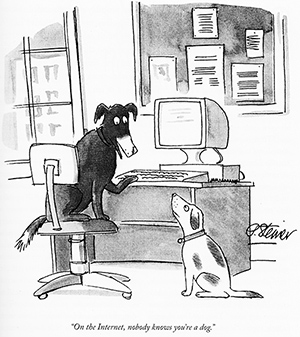
'Dog' could be a placeholder, but the cartoon showed dogs.
https://en.wikipedia.org/wiki/On_the_Internet,_nobody_knows_...
It was newsprint, so the color is not clear.
Maybe the dog was brown:
https://www.geekculture.com/joyoftech/joyimages/1862.gif
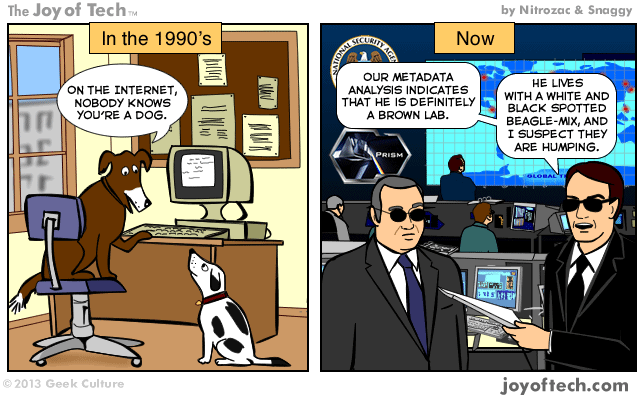
Not that it matters much.
I agree with the quote from the Wikipedia article:
Sociologist Sherry Turkle elaborates: "You can be whoever you want to be. You can completely redefine yourself if you want. You don't have to worry about the slots other people put you in as much. They don't look at your body and make assumptions. They don't hear your accent and make assumptions. All they see are your words."
Correct. And the mistake we made was assuming that that implied they weren't making assumptions.
Not in the New Yorker it wasn't.
> which is a placeholder for
... exactly. It's a placeholder; not literal.
It's a placeholder because if the New Yorker had run a comic that said "On the Internet, nobody knows you're a black man," that wouldn't have been funny at all.
https://upload.wikimedia.org/wikipedia/en/f/f8/Internet_dog....
Why might it matter? Because the rest of the world was a lot more racist and sexist, but IRC wasn’t.
And w now we're doing this whole "guilty of X by technology choice".
/s
Where and when does this this neurosis stop?
No, sorry, I was there. That's the key thing people need to remember about the Old Internet.
Some of IRC was extremely racist and sexist. Almost all of the rest was "regular" racist and sexist. It was pretty closely related to 4chan culture (under-moderated by outside forces that had little power to force any particular standards upon the moderators). The magic of the medium was that since everything was text, nobody knew you were the butt of the joke and you could pretend you weren't.
But go mask-off and admit you were a woman or a minority, and oh boy. Good luck with that. Good thing it's easy to change your handle, right?
There's a reason anonymity as a virtue grew in that space: it protected people from those who hadn't left their IRL baggage behind by letting people pretend to be the "default" (which was almost always white men).
We made a mistake believing the online space wasn't the real world. It was. It was just the real world where you could pretend to be something else. That was good at the time; it let more people participate by donning masks. But we should aim for better.
... but it's also a true generalization, in the sense that if you throw a dart at a random IRC channel across all networks, you'll proabably hit one where the level of tolerated racism and sexism is at least "American standard."
> Saying IRC was/is racist is like saying the internet is racist
I completely agree.
That comic meant a lot to me. When I was growing up, I found that most adults would treat me with condescension. On the internet, I could engage in conversation as an equal. Anonymity didn't change the prejudices that people held, but it did change my experience.
I think it was a strict step forward over the previous status quo but (not unlike the changes to American culture after military necessity broke racial segregation barriers in the military during World War II) it's not the final step.
I’m sorry if you had a bad time on IRC, but as someone who cut their teeth on IRC in the early 90s, and got their career started through contacts made on IRC, what you describe couldn’t be further from the kind of technical communities I participated in.
There can only be one omnipresent IRC God, and you're talking to them. You can wipe your ass with your experience for all they care.
My lord, the lack of self awareness...
However, I will say that I first got properly exposed to tech/computing by doing FIRST robotics in high school (2017), and those competitions were very diverse. Everyone I met through FIRST (students and mentors) was very accepting of everyone, regardless of gender, race, sexuality, etc. My college experience (classes, competition team, internships, etc) has thankfully been more of the same.
Don't conflate those jokes and offhand comments with hate. You're erasing all sorts of meaningful differences between basically harmless husbands joking about their wives or differences between men and women, and Andrew Tate.
It's also a poor tactic to effect change. If you immediately group basically harmless in-group type behaviours like these with actual devastating harm, you make yourself and your objections look silly causing people to dismiss you, and it's far harder to change behaviour after calling someone a hateful bigot, than it is to ask they tone it down because a joke made someone a little uncomfortable. I think you can easily imagine the difference in defensiveness each response might elicit.
Who really claims that though? Saying "black people are always late" is racist because it's a racial prejudice, but that's not an expression of hatred towards black people.
Outside of a context where the humor is understood by all like a stand-up comedy act, you aren't entitled to how other people perceive your behavior.
If you walk like a racist and talk like a racist, people are just gonna assume you're a racist.
If that's a problem for you, there's a really fucking simple solution.
Furthermore I'm entitled to argue for what I think are good practices for communicating online, just like everyone else.
Sure, some of those things can be harmless. I agree that when calling out bad behavior you shouldn't necessarily go all the way to 100 (ofc depending on severity). The main way to gauge malice is people's reactions to a reasonable request to tone it down. Apologizing and not repeating it? Cool, that's how basically any friend group figures out where the line is drawn. Doubling down and basically saying "grow a pair"? Not ok.
There's also a difference between something like "hah, guess they were on IST" vs "typical street shitter" (using my own ethnicity as an example).
A bit of pushback and people are usually super apologetic. Usually they're just aping someone else who said something counter-culture because they thought it sounded badass, and don't really believe it.
Otherwise I can only assume that chats within all-chat appeared to be racist in nature but again, that's not something I've seen (especially unchallenged) in any of the freenode channels I frequented.
I don't think the majority of people using the words were actually homophobic (I wasn't), just copying other people to "fit in" without even thinking of the possibility it was harming someone. I think it was early 2004-05 that someone private messaged me explaining that it sucks when people use the word that way and I stopped.
I don't recall much racism against black people, but I can totally see the N word being used casually in the same way in some other servers/channels.
Corporate America needs to get promotions out of the hands of the hiring manager chain of command. Create a board that’s independent and can deal with promotions impartially.
In absence of and independent entity handling promotions DEI is needed and necessary. Otherwise a lot of promotions are just plain nepotism.
> Do you know VIRULENTLY anti-black (or woman, or gay) these communities were? I can't begin to describe it. That is totally off-putting to someone who has the ability succeed but does not want to deal with the hate.
Wow, thank you. Gives me a new perspective.
I spent decades on IRC starting in the early 90s, and this is a politically-driven contemporary re-imagination of what existed at the time.
We were open to all because we ourselves didn’t fit in elsewhere.
Not a valid data point. You’re picking some fringe element and assuming the whole internet is like that.
Yes, totally, most of us were indeed social misfits. But many of us also instead of being empathic and understand what was the real issue there, simply perpetrate the same abuse to someone else who was in a weaker position.
Why is your comment so passive aggressive, though? While the counter claim hasn't presented any proof, the same holds true for the original claim.
You seem to be only thinking critically of the comment that goes against your confirmation bias. It's not a good habit to have.
Would you be part of the target audience, back then? Or you were part of the main group and just remember that "nobody was harassing nobody"?
So, I experienced homophobia first hand at least.
I've never felt like the communities (any of the tech related ones) were anything but wholesome, though.
Bullshit was immediately called out, and in more severe cases handled by ops (as was I in a few channels).
Again, we are talking about COMMUNITIES. Not INDIVIDUALS.
So, I guess I was (somewhat) in the privileged white male group, but that doesn't mean I'm illiterate or can't reason and feel empathy.
when someone makes posts of their personal experience, the follow up posts that claim "my experience is different" proves what? are you honestly suggesting you're having a better experience? that's great for you. are you trying to make the the original poster jealous and feel superior?
are you suggesting, "keep your head up because it's not that way everywhere so don't let 'em ruin it for you"?
are you trying to argue and say they are wrong because their experience differs from yours so it must not be true?
but to tell someone that they are totally incorrect about their very on personal experience is just baffling
They made a blanket statement about how all of IRC is a racists/sexists shithole. They obviously have some unresolved resentment, and I am not denying it seems from a bad experience; certainly wouldn't from good ones.
My comment wasn't meant to make them feel bad (maybe that's something you indulge in, given your comment etiquette).
It was meant to offer a different perspective—of someone who was a part of some of those large communities. And I was involved in a lot of technical ones on Freenode around 2000s. Those communities put a lot of effort into inclusivity (and was an operator in some) and generally making everyone feel welcomed.
So it feels a bit like a spit in the face to see someone going around talking about technical IRC channels being Xist.
I'm not sure when they added the EDIT to their original post, but the hypocrisy added another layer of annoyance, trying to invalidate any comment speaking about their experience and writing off authors as "omnipotent IRC Gods" when nobody here but them is talking blanket statement bullshit.
Edit: I'm not saying there's weren't racist/homophonic/whatever communities on IRC. I know a lot of shitty fandom channels I joined and promptly left to find better ones. So yes they were out there.
Edit 2: Also, I think I took their comment too personally, given I was there and I know how much effort was put into making it feel welcoming for everyone.
Also, I find it ludicrous you're trying to tell me off for commenting online—whilst you yourself are commenting online—and claiming my experiences don't matter, but another person's do, all in an attempt paint me as doing the same lol. But anyway, I digress.
"He’s completely, totally, and absolutely incorrect."
that's a very very bold comment to make about someone else's personal experience. what you're going on about seems very strange in this context. it's not like they said, "this person's experience is totally different from mine". No, they said the guy is absolutely wrong. that's where all credibility fails for me. to be correct, that would mean there was never a case of harassment, racist, homophobic, or any other kinds of negative experiences on any of the interweb services regardless of how early days it was. that's just an odd hill to die on for protection of one's memories of the early web.
I believe they call this "the soft bigotry of low expectations"
IRC tended towards super edge humor and was a big piece of like early internet culture generators like somethingawful and 4chan.
We do need long term improvements at the start of the funnel, but no-one is adding a 7 year KPI for improving stats of 14 year old girls quitting AP math.
Problem is, this is a social process that takes centuries to complete. You are never going to hit a point in a single institution where you can say "We fixed our diversity problem, let's go home", because it can just come back as you hire more people and older hires leave.
Furthermore, society is frustratingly prone to generating new discriminatory attitudes. America is pretty conscious of a handful of very specific racial minorities, and we have a vague idea of what sexism looks like, but we have little knowledge of things like caste discrimination[0], colorism[1], classism and so on.
To fully explain why this is a problem, try re-reading your original comment, but pretend it's talking about the police instead of DEI initiatives. What's our falsifiable condition where we say "ok, all the crimes are solved, let's abolish the police?"
[0] Discrimination based on the occupation of your ancestors, typically driven by religious beliefs. India is the poster child for this though Japan had a form of it too.
[1] Skin-color discrimination within a specific race. We don't see this in the US or Canada all that often because the mix of European ancestry that we brought over and called "White" is universally one skin color. Latin America has this in droves.
Racism against black people is different altogether. It’s not rooted in prejudice. Instead the prejudice arises from the unique circumstances of ADOS people being brought here in slavery and then society trying to unwind that and make up for it. That racism, which is accompanied by economic and social gaps that aren’t narrowing, much less closing, is a completely different phenomenon than the ordinary prejudice which exists between pretty much every group everywhere.
Failure to understand that fundamental difference is one reason why the prospect of cabining affirmative action to logical and legitimate ends is unlikely.
You actually could and should abolish the police in certain kinds of terminal states where crime was eradicated - the eradication may be due to a genuine shift in the way people behave (due to some other underlying reason.) One falsifiable condition would be “surveys show a fundamental shift in sentiment by the public towards the motives that have historically led to crime.” If you’re going to condition the abolishment of the police on a scenario where we need to also prove that this won’t regress, then in a scenario where the underlying motive of crime is systematically gone, the police will exist and seek out ways to regenerate it to ensure they have a purpose, among other toxic phenomena.
For a generation or two, sure, but eventually it will come back unless the cultural training continues. I mean, there's a reason for historic cultural universals such as racism, dueling between men, and talking down to lessers.
I think the best case scenario is that DEI eventually gets rolled up into regular HR.
And why do you assume the generalized tribalism will persist based on particular initiatives? The old initiatives used to be hire from the gentry. Attitudes amongst the many do change. It doesn't matter if some vocal minorities keep the same attitudes going.
DEI initiatives and targets are measured periodically: https://hbr.org/2021/02/research-how-companies-committed-to-...
Concretely, if your own perspective is taken as the standard, we ought to expect that without any motive or standard to dictate we unwind DEI goalposts around (for example) racial groups, we should expect those goalposts to persist, regardless of the general presence of the phenomena which motivated their creation in the first place.
Once DEI systematizes enough it can be incorporated into whatever HR eventually turns in to, instead of being a separate division.
Ironically, programs seeking to reduce discrimination which characterize the former phenomenon as entirely irrational is what helps perpetuate the latter, because it undermines any sense that there is a good faith engagement going on.
> "Ironically, programs seeking to reduce discrimination which characterize the former phenomenon as entirely irrational is what helps perpetuate the latter, because it undermines any sense that there is a good faith engagement going on."
From what I recall I don't believe these programs generally characterize implicit bias as entirely irrational. I see them characterize it as problematic. So I don't see how the "undermine good faith engagement" follows from this.
On a total tangent I think the main problem with counteracting people's biases is that it can lead to people totally discounting their gut reactions. Which has lead to people getting murdered, raped, etcetera, by bad people.
That has not been my experience at all, whatsoever, and my involvement in tech communities, both online and in the flesh, dates back to the 1980s.
> There's also the fact that most (read: all) of the computing pioneers are white. I respect all of those people, but it does help to have someone to look up to.
I don't need people with whom I share superficial characteristics to look up to. I can look up to brilliant white men, men from all over the globe, or even women, believe it or not.
Do you believe you have had the same experiences as a person of the races/genders experiencing the -isms, or that you will perceive as -isms the same things they do?
What do you mean?
At what point do you think DEI should stop? Is there any metric or threshold at which these programs/events should end? One of the biggest issues for me is that these measures are either argued as good because "diversity is intrinsically good" or because "we are righting historical wrongs", meaning reparations. While one could argue for or against either of these justifications, it would seem that the former would terminate once some ideal demographic composition is achieved, while the latter would end once some calculated total sum of restitution is reached. To me, these details are very important, since race-based hiring is an intrinsically bad thing that should be avoided. After all, it is part of the reason people of color got so screwed over in the 20th century in the first place.
No, DEI is about replacing one bias with another in order to make a bunch of white people feel better about themselves. DEI doesn't consider Indians or South Asian looking people "People of color", because there are "too many of them in tech already". DEI is just institutionalize racism. So much that some Indians have to fake being black to get jobs in DEI corporations, cause white people can't always tell the difference.
The baseline was never equality, however DEI is blatantly racist.
From which perspective are race categorized in USA? From the white man's perspective. These DEI are all about some's ego and sense of guilt. Never about fairness nor equal opportunity. Yet these programs makes people who themselves are victim of racism, who never had anything to do with US slavery, pay the price individually, regardless of the inherited wealth/connections AKA socio-economic background.
Of course all I said is true, there is just the racism DEI corporations care about and the racism they don't care about.
Prominent lawmakers in the US also game the system.
https://www.npr.org/2019/02/01/690806434/warren-apologizes-t...
https://www.vox.com/2018/10/16/17983250/elizabeth-warren-bar...
VOX: New evidence has emerged [SENATOR!] Elizabeth Warren claimed American Indian heritage in 1986 Warren identified as “American Indian” on a registration card for the State Bar of Texas, according to a Washington Post report.
By Ella Nilsen Updated Feb 5, 2019, 8:29pm EST
(TLDR for those not in the US: wealthy powerful while woman rose in ranks after abusing DEI quotas, now has huge influence over tech industry and always angry about an industry which has real diversity (tech:Asians) but conveniently not angry about lack of diversity at Harvard or Senate.
I'm doubtful about that. At least among my cohort (first generation south asian immigrants to the east coast) there's not a strong collective racial identity. There's strong ties to home countries, culture, and traditions, but not a strong group identification. It's interesting but not personally meaningful. I suspect it's similar to Jewish Americans--they're not looking up to Mark Zuckerberg because he's Jewish.
Overall, I believe that culturally-same role models is a stand-in for lazy parenting. Children whose parents constantly push their kids to be better, push harder will look towards successful people of any cultural background. Compare that with children with apathetic parents, who I surmise will only have the imagination to self-associate with those who "look" like them.
It also reduces ethnic identity to something extremely shallow. I’m Bangladeshi because of what my parents taught me and the norms and attitudes I’ve absorbed from the community. Kamala Harris shares almost none of those things with me. But the media says she “represents” me because of her skin tone. It’s offensively reductionist.
It's also not hard to receive this behavior as completely fucking racist. Do whites presuppose that just because we have the same skin color, ethnic background, or similar physical features, that we will be aligned on political or philosophical points?
How has it become acceptable to participate in such blatantly racist behavior, while still somehow being able to publicly label one's self as "liberal" or "anti-racist?"
I think it's time we conduct an audit of all self-identifying liberals or DEI advocates to determine which ones are actually free from unconscious bias and implicit associations, and which have merely co-opted the movement to weaponize minorities as part of a political power struggle.
But more I’ve come to realize that they’re just racist. They don’t actually care what minorities want, e.g. the fact that the majority oppose considering race in jobs or college admissions, as long as they can find some academics or activists who agree with them to “represent” the group.
Yes. There are many white people who align on skin color. That's how the US Antebellum South, SA Apartheid and WW2 persecution of Jews worked.
Downvote me for the snark all you want, but I feel that you can't describe it, because you weren't there. Nobody gave a crap about who you were, unless you made your incidental identity the central topic of discussion in unrelated conversation, in which case you were given shit for it, regardless of your skin color, biological sex, or sexual preferences. Because, quelle surprise, there were places to do that aplenty.
But your sentiment is absolutely the core of all DEI initiatives -- everything before DEI was the dark ages, and this new effort brings forth a new era of enlightenment.
People on IRC didn't care about "Who you were" because the assumption was that you came from privilege. Privilege usually translated to white, urban, heterosexual male. Those groups said some horrible things about other communities because they felt the space was "safe".
Now that this is changing and calling people "orientals" or "gay" is no longer acceptable, there is an attempt to rewrite history - as you are trying to do here.
http://bash.org/?top try ctrl-fing for "fag", "homo", "jew", etc. These insults were routinely used on the early internet _without_ anyone volunteering their gender/ethnicity/sexual preferences/whatever.
These things are not what HN is for and destroy what it is for, so we end up having to ban accounts that do them.
If you'd please review https://news.ycombinator.com/newsguidelines.html and stick to the rules when posting here, we'd appreciate it.
(A)
> user1: h3ll0 to all you g00d people :-) I have a question about Slackware installation.
> ...
(B)
> user2: yo wassup ma dudes! g is here to ask a qqqquestion about Linux!
---
Can you spot any cultural differences that could potentially put people off? user2 reveals themselves, no need to say much here. Such a communication style was perceived negatively because it reflects a low level of education.
Of course, more educated folks spoke normally and nobody knew their skin color. However, nobody liked speaking to folks like user2.
We didn’t even have real names or photos. Nobody had any idea who was behind the keyboard, and that was okay.
Just because you didn't mean it or it didn't bother you doesn't mean it wasn't hostile to others.
><p00p> why do you crackers steal everything from us?
>(@virt) cracker barrel is the most hilarious name for a place where a bunch of white people go
><Gabe> It's sad when white people try to talk like black inner city people. It's doubly sad when those white people are European. :P
Incredibly virulent anti-whiteness. Thank you for posting this to open our eyes to this.
So the fact that
- you had to search to find a couple low ranking quotes that might be insulting to white people
- there are numerous top ranking quotes that might be insulting to women, gay people, black people, etc
- those top quotes don't bother you
supports OP's point and undermines your own.
Bash.org is not IRC or IRC culture, despite being built on IRC logs.
Just because one group speaks loudly about hate doesn't mean the quiet group doesn't hate. But it doesn't mean they do, either.
It's a complex topic that would require considerable research, rather than all parties skimming.
Why do you capitalize the b but not the w?
"Early IRC" ends with The Great Split (ircnet fork). Heck, most of Early IRC is extremely Euro-centric even.
As we did.
I don't know how much of a cesspool it would have been back then as IRCOps back in that day were famously proactive, thin-skinned and intolerant of divisive bullshit. Generally trolls were k-lined quickly. Especially because operating a server then was an individual's labour of love and not using large, corporate resources. Server operators had to keep trash off their server in order to stay in their network. Individual servers could only handle _hundreds_ of connected users.
It was neither utopian, nor progressive. It was ruthless, impersonal and dog-eat-dog.
The shift towards what it is now was that the resources to operate a network became absurdly cheap and caring about who was on your network and doing what went completely out the window.
Realistically it shows that we (humans) still have much to learn about treating each other equally. Why can't we just be good to each other. :/
You don't have to know anything about anyone to say derogatory things about a group they identify with. Just look at the bigotry shared on social media today.
Oh wait:
> Welcome to the Internet, where the men are men, the women are men, and the kids are cops.
https://news.ycombinator.com/item?id=1546789
I picked this instance of course because it was said on HN, but it was a dead horse even in 2010.
Personally I remember hearing that joke in the 90s. If you want a different example, here's a variant from 2001: http://www.bash.org/?2832
Note that this one ends with "but some of the men are really women"; it's already old and well-known enough in '01 that people are modifying it for meta-humor.
Once I got dialup (in middle-school) and could join IRC channels, I realised, no one would know, how young I was. It felt great.
I'm a white guy. I've sat through many a DEI session. I've never, ever felt this. How could I? 85% of the people in the room are white or Asian men.
I'm not trying to sound disingenuous here, but I really want to know, how does "virulently anti-" empirically manifest itself in the communities you speak of? Hiring? Pay? Promotion decisions? Possibly freedom of speech? Even then it seems like I'm free to say whatever I want as long as I stay on topic.
This reasoning sucks. We need DEI in corporations now because IRC was toxic?
This is a great way to put it. I mean, I'm a bit older and over time I've been used to actually being that token, because for a lot of places I've been it was me and no one else. So, I didn't much mind the role as something of a pioneer.
So I'd say, anyone who doesn't like it, e.g. DEI, definitely understand the history, please -- and moreover, the difficulty of externally changing culture. It's ultra-clumsy, but at least for a time it was both inevitable and necessary.
I very much don't personally enjoy is at as well -- but I don't think that means it's without value. I suppose I see even the bad parts as a "bug, not a feature," because we're talking about it.
DEI not only legitimizes, but actually encourages the above behavior. This seems problematic to me for two reasons: first, it creates a positive feedback loop for (at best) actions that make one feel self righteous without adding anything of real value, and second, it undermines the importance of critical thinking and analysis in engineering.
So, all that being said, the justification is these changes help make black people in tech feel more included, a goal I support. In your opinion, do these changes have the intended effect? Are they meaningful and useful?
* For those who don’t know, there used to be a racist practice by some fraternities, etc called a “brown bag test” where a brown bag was used to judge skin color for entry. This made brown bags racist, which in turn made brown bag lunches racist.
I think you're exactly right here, the largest proponents of this stuff tend to be white and left wing (mostly women). In a way I find them extremely racist. To me, they're acting just like OP says. They don't think certain groups are intelligent enough to bring themselves out of squalor and everyone MUST believe like they do; that skin color is an impediment. So, they need the white savior to come rescue them.
Anyone who's been to Sunday school can tell you this isn't a new concept, and is at least two millennia old (almost certainly longer, since Judaism has an even longer shared tradition). Christians have continued riding the coattails of their martyrs and "oppression" for centuries after they became the dominant force. If anything, the modern "woke victimhood" is merely the cultural legacy of evangelical Christianity that was (and arguably still is) deeply engrained in US culture.
Kinda seems like you're justifying the current action of "woke" people by discussing past injustices? Isn't the whole idea of the "woke" DEI initiative to fix injustices in our society?
We have an entire country now that was founded based on legitimate religious persecution that devolved in the ~200 years since it's founding to go on to oppress others. We can and should do better.
Simply pointing out that victimhood has always existed serves no purpose at all in response to my original comment.
"This is, imo, what things like intersectionality begin to address."
How? All intersectionality does is create a competition for the most oppressed. You will never be enough of a victim. Nothing good comes of a society that focuses specifically on how oppressed they are and vies for the most oppressed group or person.
"We have an entire country now that was founded based on legitimate religious persecution"
Name a country where this hasn't happened. There are many where this is still happening and to a further extent than anything in the US.
Ironically, you're right in weird roundabout way that I do not think you fully comprehend. EVERYONE has been a victim of some sort so it's irrelevant and we shouldn't spend one iota more of our short lives trying to discern who the highest victims of our society are. What a waste and it does nothing to improve the supposed oppressed.
This occurs to this day. I do agree that repeating bad patterns doesn't do us any favors but if you'd like to move that needle, you need to sign on the largest groups first.
> All intersectionality does is create a competition for the most oppressed
This is not true. I can't give you a hip pocket introduction to intersectionality in a thread, but I can at least clarify things for you. There is no "hierarchy of oppression" in intersectionality. Not at least in any reading I've done, but as in all philosophies - beware who you read. The best short description I've found is this, "Intersectionality is the acknowledgement that everyone has their own unique experiences of discrimination and oppression and we must consider everything and anything that can marginalise people – gender, race, class, sexual orientation, physical ability". The key takeaway here is that oppression is just oppression, the topic makes no inclination as to what's worse. Someone who got bullied for having a southern accent in a northern state could've had a measurably worse experience than someone who was marginalized for their physical ability. Point being, intersectionality doesn't make a distinction between them. Instead, intersectionality promotes meeting people where they are and attempting to be thoughtful about how you approach those cases.
While I do agree that perpetual victimhood is not good, there is no accepted timeline to stop seeing yourself as a victim of something. Rather, the steps you can take after you stop seeing yourself as a victim are far more profound in your happiness.
> Name a country where this hasn't happened. There are many where this is still happening and to a further extent than anything in the US.
I can't. I'm not sure there's a point here on your end. We had high minded goals, saying we should do better is a reminder of those high minded goals and our own roots as Americans. It's not to rub your nose in some dirty history. Anyone that expects a perfect society is already starting from the wrong place.
Your last statement veers onto intersectionality tracks and then derails suddenly. The reason intersectionality matters isn't to promote the most suffered people on the planet to the top. It's so that you as a human can understand them and they can understand you without your significantly different life experiences making you think each other are aliens or villains.
Except reality has proven you wrong. We've never lived in a time where people are more well fed, have more personal belongings, longer life spans etc.
It is in fact, objectively, not a pointless game.
Ignoring this body of work makes the linked article a straw man argument with some cherry picked examples that don’t even make a point (why am I supposed to care that AOC tweets about some people at the exclusion of others?)
If your point is that not all leftists are intersectionalists and not all people who use intersectionalist words actually have the values, then I'd respond with, "duh".
Intersectionality isn't about telling one person's story or exemplifying one person's pain. It's about showing that these things are interconnected and effect people differently, and ways in which you probably wouldn't expect. It does the absolute opposite of a hierarchy.
(I could care less about AOC. She was like 1% of content of the article I posted.)
> 0 results
So to answer my question, no you can't provide a source.
(Also identity politics and intersectionality aren't the same thing, despite the right's habit of using them as meaningless scare words)
It is a bit weird overall. It decries conservatism, but is very heavy on fundamentalism. It is far more conservative than other groups it indicts with sexism/racism. And mostly these accusation are also false.
This is probably the best description I’ve seen of the parallel:
> wokeness is racialized neo-Marxism that uses collapsed mainline Protestantism as its leverage point, manipulating the guilt of the remnant elite and capturing the institutions that they have abandoned.
Marxism is distinguished as an ideology by totalizing class consciousness. That's the opposite of wokeness, which ratifies identity politics. In fact, "wokeness" is a fault line in modern leftist Twitter thinking, between the populist "dirtbag left" that eschews DEI-speak and the university left. Just how much work is the word "neo" doing in that name?
Most "DEI wokesters" are the farthest thing from Marxists. They're jealous and enthusiastic beneficiaries of the mortgage interest tax deduction.
"Collapsed mainline Protestantism"? Explain! Does being a Catholic draw me closer to or further away from "wokeism"? Because I have things to say about the intersection of DEI culture and Catholicism.
It's an ideology that replaces Marxism's "totalizing class consciousness" with a "totalizing race consciousness."
> Just how much work is the word "neo" doing in that name?
A lot, and the "Marxism" is doing very little. It's a clumsy construction. But the meaning is clear in context.
> "Collapsed mainline Protestantism"? Explain!
It’s a religious revival, but without Jesus. They’re descendants of Puritans who don’t believe the theology anymore, but have the same religious zeal, sense of moral universalism, and faith that America's institutions belong to them. See: https://www.youtube.com/watch?v=LbbxQqKXUIk (warning: offensive period language). I’ve had several experiences with woke whites where, when I pointed out that the minorities they purport to speak for disagreed with them about this or that, they responded with the same sentiment as Matt Damon in the final line of that clip.
The meaning is clear in context because you know who he's talking about. But you just called this "the best description you've seen", and it's not a description in the least.
I don't care that you disagree with DEI types and with wokeism in general. I have my own qualms! But don't elevate hucksters like Rufo. And stop following him on Twitter. He's a clown.
Correct, and in fact, many Marxists are virulently against CRT/wokeness, because it distracts from class as the central conflict in society.
Critics crudely call CRT/wokeness "Marxist" because it's a conflict perspective.
(I think we agree, just writing it down to clarify my thoughts).
It's interesting that calling CRT "Marxist" gives the Fox News watchers a familiar enemy to fulminate against, and it gives the CRT peddlers themselves unearned credibility as dangerous dissidents, so it's a misidentification that serves everyone but the dwindling number of actual Marxists, and pedants bent on accuracy.
In Marxist terms, when your opponent disagrees with you, you don't engage with their argument on its merits, but look for deeper structural factors that have led them into such serious ideological error, factors that render your opponent incapable of understanding the truth of your correct argument. In Marxism, these center around the person's class background, their internalized class interest, petty bourgeois thinking, etc. They may be conscious or unconscious, but in all cases they are the ultimate motive force behind the person's wrong beliefs.
In modern elite ideology (whatever name we give it), the role of class background is replaced by the cross-product of various -isms and forms of oppression that prevent the privileged from being able to admit deep truths that are obvious to the marginalized.
In both cases, it's a kind of nihilistic structuralism which asserts that the only meaningful way to evaluate an argument is by examining the identity, circumstances, and background of the person making it, as those factors relate to societal networks of power and oppression. In this form of debate, you counter what someone is saying by pointing out who they are, and whose interests they represent.
A lot of anti-CRT rhetoric is clearly trying to use the Marxism link to discredit, out-of-hand, CRT. American politics has always been like that--guilt by association with Socialism. I understand the reflexive instinct to push back against that. But if you try to deny that the links exist, all you're doing is discrediting yourself and others, bolstering those pundits arguments; the links absolutely exist and are substantial. The nuance is that they're not substantial in the ways that the cheap rhetoric implies. (It's like if you took Christianity and replaced Jesus with Santa Claus. You couldn't possible claim the new religion wasn't an offshoot of Christianity, and much of it would be indecipherable without understanding historical Christianity and Jesus. But it would simultaneously be true that the new religion would in some of its most fundamental dimensions be entirely incompatible and incomparable to Christianity.)
If anybody wants to have an informed opinion on these debates, they could do much worse than actually reading Frantz Fanon. IMO CRT begins and ends with Frantz Fanon. If you read his seminal work, Black Skin, White Faces, you've read all you'll ever need to read regarding the ideological underpinnings of not only CRT but much of modern liberal identity politics. I found it a very powerful and enlightening book. (I first read it 20 years ago, before CRT entered mainstream liberal discourse, and before I had any knowledge of CRT as a school of thought or movement. When I did learn of CRT, the parallels to Fanon's ideas were immediately obvious.) But Fanon takes the ideology to its logical conclusion, which is permanent apartheid, and therefore lays bare the stark choice being made when one adopts liberal identity politics. I can't refute Fanon's ultimate conclusion that black-skinned minorities will never be able to find equality among a white-skinned majority (or, presumably, vice-versa if the historical script were flipped), but I choose to believe that there must exist some way to get there; otherwise as Fanon persuasively argues, all identity politics can possibly do is mitigate some of the worst injustices, but ultimately never eradicate the fundamental inequities. And therein lies much of Fanon's motivation for his Marxism advocacy--he thought the only way forward was for black countries to go their own way, and that necessarily involved adopting Marxism as capitalist systems would ultimately benefit the white establishment at the expense of black countries and communities.
Notably, though I've never read any of Malcolm X's works in full, AFAIK he ultimately came to similar (in a very, very rough sense) conclusions as myself. Earlier in his life Malcom X believed it was categorically impossible for black communities to ever live equitably among white majorities. But later on he changed his opinion. It was a choice he made, to choose to believe despite so much evidence to the contrary that there's a path forward offering both diversity and equity, rather than carry on with the dismal axioms that logically pointed to their irreconcilability. Making that choice doesn't require denying all that has happened and continues to happen, it just requires denying a worldview that ultimately makes it inevitable--essentializing racial identity is a self-fulfilling prophecy.
Also, FWIW, modern Marxist scholarship provides some of the most vehement and technical opposition to CRT for precisely the reason you hinted at--replacing class conflict with racial conflict is anathema to Marxism. But when you read that scholarship, it's also instantly obvious that CRT and Marxism use nearly identical language. CRT is indisputably descended from the culture of Marxist scholarship.
Would Crenshaw agree that Fanon is the beginning and end of CRT? Race, Reform, and Retrenchment[1] contains an extended, detailed critique of Critical Legal Studies for instrumentalizing and superficializing Black struggle, and for the premise that in a conflict between avoiding legitimizing the dominant class (in the broader Gramscian sense) and advancing Black material interests, it's Black interests that need to give.
For that matter, you can go back to Crenshaw's Demarginalizing the Intersection[2] and see that (a) it is in the main a par-for-the-course case-by-case legal case study like lots of other law articles, and not an inscrutable blob of woke jargon, and (b) not especially Marxist? (Amusingly, this article was weaponized, with Crenshaw's approval, by Hillary Clinton against Bernie Sanders).
[1]: https://harvardlawreview.org/wp-content/uploads/2020/09/Cren... [2]: https://chicagounbound.uchicago.edu/cgi/viewcontent.cgi?arti...
I get that there are trolls out, including professional trolls, who weaponize innuendo and have zero interest in engaging in honest debate. But the reason for abstaining from quick dismissals is for the benefit of the people they're targeting, not the trolls. I guess what I should have written was: CRT absolutely has deep connections with Marxist thought. See, e.g. Frantz Fanon. So what?
[1] Only half using that phrase facetiously.
Again, just back to Crenshaw, who wrote at length about how Critical Legal Studies loses the plot about racism in its zeal to reconsider the entire liberal legal structure.
I promise I'm just writing this because, like many HN comments, it is a sort of rhetorical burp I just have to get out.
More seriously: it is somewhat frustrating that any serious analysis of oppressor/oppressed systems can be dismissed as "Marxist" because of Gramsci and hegemony, because oppression is obviously a real thing (ask any evangelical Christian) but neo-Marxism is principally trotted out when the oppressed are disfavored. But then, lots of academics who pretty clearly aren't Marxist are happy to use Gramscian neo-Marxism as a tool, so, sure, maybe you're just right about this.
It’s so funny that criticism of Rufo always revolves into this esoteric academic debate. I’m a plebe and I’ve never heard of any of those people. Rufo came to my attention because he leaked material that was given at a teacher training in Loudoun County, right next to where I grew up. As far as I can tell the bulk of his journalism is just publishing these leaks.
Maybe a better comparison is to the imams in madrasas teaching young Muslim kids that they’re oppressed by the west? Who knows? Whatever you label it, these materials shouldn’t be in the same building as kids, and the people who green lighted that should be out of a job.
1. A schema of the world as an unfair arrangement of oppression and coercion
2. The claim to a correct understanding of how this system operates and perpetuates istelf
3. The belief that contrary thoughts and beliefs, however sophisticated they sound, are a simple product of these more fundamental power relations, which must be unmasked
4. A plan for how to make everything better through transformative change, which includes a radical remodeling of the self to expunge wrong belief and wrong thinking
5. A totalizing belief that everything falls within this ideological universe of discourse. You can't go off and study butterflies or Taylor series and tap out of the battle.
This is the shape of the "thing" that makes people see a similarity between modern elite belief and Marxism. I'm not familiar enough with fascist ideology to answer your question, but consider that fascism was a pretty incoherent and fast-changing target, while the core beliefs of Marxism have shown remarkable staying power despite a body count that would have doomed lesser belief systems (like fascism!). Note also that, with small changes, the schema I gave above is a religious schema; part of the power of totalizing ideology is that it plugs into the mental and spiritual machinery of religious faith.
(a) Trace it back to Gramsci, call it neo-Marxist, and then accuse anyone who ever bought an Robin DiAngelo book and performatively left it on their desk at work of being a neo-Marxist, and
(b) Seriously argue that the phenomenon is not only a religion, but is simultaneously the result and cause of the ordination of women in the Episcopalian church --- which is absolutely part of Rufo's subtext.
I do not want to get in the line of fire between anybody and Ibram X Kendi. I get that there's lots to criticize. It's not that I think there isn't a lot of frankly silly Marxist stuff happening in, like, the "institutional" Black Lives Matter movement. I just dispute that Chris Rufo knows what he's talking about, or cares, and that his summary of "wokeism", the one quoted above, makes sense.
Prepared to be wrong about all of this, but don't need to nerd out about it any more than you want to.
I've heard this called the racism of low expectations. It's disgusting.
I think that's a inaccurate and misleading description. I think the correct term is "colorism" not "racism," and it sounds like those distinctions were more significant within the black community than outside of it. I don't think a stereotypical anti-black racist would accept a black person into a social club if his skin was as light as a paper bag.
https://en.wikipedia.org/wiki/Brown_Paper_Bag_Test:
> "The Brown Paper Bag Test" is a term in African-American oral history used to describe a colorist discriminatory practice within the African-American community in the 20th century, in which an individual's skin tone is compared to the color of a brown paper bag....
> The Brown Paper Bag Test was heavily documented and normalized with historically black fraternities and sororities (especially among sororities) and historically black social clubs founded before 1960, whose members selected others who resembled themselves, generally those reflecting partial European ancestry.[8][9] Some privileged multi-racial people of color who came from families freed before the American Civil War attempted to distinguish themselves from the mass of freedmen after the war, who appeared to be mostly of African descent and from less privileged families.
In some communities, colorism is a byproduct of racial categorization based on color. But in many places it’s just an aesthetic preference. Colorism in Asia and Africa long predates colonialism or contact with white people. An important thing to note is that in these societies, colorism doesn’t imply that white people are seen as the most beautiful. A person can be too light, just as they can be too tall or too skinny.
So in order to keep their ideology consistent in the face of clear and present racism throughout the non white communities as well, they had to invent the term "colorism".
So yes colorism is just racism.
Yes there are plenty of people who want to sit at the top of the food chain by way of gathering a "diverse" crowd.
> DEI not only legitimizes, but actually encourages the above behavior. This seems problematic to me for two reasons: first, it creates a positive feedback loop for (at best) actions that make one feel self righteous without adding anything of real value, and second, it undermines the importance of critical thinking and analysis in engineering.
This is not a problem with DEI. Look at the landgrab that is enterprise management.
> In your opinion, do these changes have the intended effect? Are they meaningful and useful?
Your premise is off, so I can't answer this.
> * For those who don’t know, there used to be a racist practice by some fraternities, etc called a “brown bag test” where a brown bag was used to judge skin color for entry. This made brown bags racist, which in turn made brown bag lunches racist.
This isn't true. Paper bags were never racist. I don't know where you picked this from. This is a misleading description to make anti-racism seem absurd.
What do you mean by 'isn't true'? It's at least real to some extent, without regard to how widespread it was.
https://en.wikipedia.org/wiki/Brown_Paper_Bag_Test https://www.ferris.edu/HTMLS/news/jimcrow/question/2014/febr...
It's also the case that DEI groups want people to stop using 'brown bag lunch'.
The paper bag test doesn't make paper bags racist. It's a shade test.
> It's also the case that DEI groups want people to stop using 'brown bag lunch'.
I can't say that this hasn't happened. But if it is, this is one of the useless things that I take umbrage with in my original post.
> I can't say that this hasn't happened. But if it has, this is one of the useless things that I take umbrage with in my original post.
I sat in a meeting where two young, white colleagues informed another colleague that the term was racist and we should come up with a different one. I tried to push back gently, but I am a white man and as such have no standing in the DEI hierarchy. So it was decided in this meeting full of white people that we would no longer use the term as it might cause offense to someone, maybe. And the two young engineers were satisfied they had made the world a slightly better place. I found it disturbing but don’t know what to do.
Woah this suddenly made the behavior of some people who gave me the creeps but were doing "all the right things" make sense. Thanks.
On the brownbag thing, I've had someone tell me we shouldn't say "picnic" because of a racist etymology. When I showed her this etymology wasn't real, she said it didn't matter. We still shouldn't say it because it might harm someone. This doesn't make anti-racism absurd. I think there are real heroes there. But that interaction sure felt absurd.
Don't be anti-racist. Just don't be racist and call it out where you see it.
You won't get through life without being hurt and learning to understand the meaning behind people using words is a skill you cannot skip to acquire. Misunderstanding happen and you need strategies to deal with them. It can but rarely results in conflict. You cannot expect everyone only using thoughts, associations and words you are content with. It is a false strategy without solution.
I would argue it also gives an indication of how “mission creep” works.
(A well-used term like “tarball” now being deemed potentially offensive, presumably because it sounds like “tarbaby”, even though it’s obviously just referring to a bundle of files archived with the “tar” command.)
While the term refers to an archive that has been created with the tar command, it can be negatively associated with the pejorative term tarbaby."
https://s.wsj.net/public/resources/documents/stanfordlanguag...
I'm genuinely fascinated by how this came to be written. Were there brainstorming sessions where people threw out random word associations to show willing, combined with a fear from the rest of the group of accusations of racism for calling it out as arrant nonsense?
A more compelling reason is because demonstrating "leadership" in DEI is a prerequisite to getting a promotion or getting a management job. It's baked into many job listings now and is part of the executive interview process. If you don't check the DEI box on some tangible dimension, you don't progress to the next round, especially if you are white.
I think this is the real harm being done here. Being trained to accept irrationality and poor judgment bleeds into engineering decisions.
It's amazing how blind people can be to experiences that don't match their own. And when you _tell_ them what has happened to you, point at the preponderance of evidence out there about it, they still don't believe you.
DEI initiatives as a backlash against the forced exclusion of people from the broader economy makes sense to me. It's crazy the amount of the legal and government system that was employed in the past because of what people thought to be true about other people.
I'm unclear of how much impact the intiatives have on hiring or retention. I feel this is one of the reasons why DEI initiatives highlight token people probably to show they are doing something (results) and the budget for it is justified. Would be nice to see the statistics from mid to large companies on how these initiatives have fared on multiple groups and worker productivity for that matter, but until then it feels like it has no to mixed impact at a company which seems to be the ideas of people not included in these initiatives.
DEI just feels vague and threatening to some people. I've seen Reddit threads of people saying they don't support DEI initiatives because how can they "secure a future for their child" which to me is highly obtuse. Who knows what a child will do in the future.
I'm all for hiring diverse candidates and helping those who have high curiosity and propensity to just do the work rather than the idea that one must be experienced in order to execute. It's the same way I am towards younger people, though you don't see the same backlash against initiatives in that arena unless older people are losing their jobs for the sake of it. In the end, I want people who will (not can) help with the work and will teach others.
Many communities were and are generally anti-human.
Not refuting this take as it's accurate, but if you're looking for someone that's Black in early computing I'd recommend free software pioneer Brian Fox (https://en.m.wikipedia.org/wiki/Brian_Fox_(computer_programm...) best known for inventing Bash.
Kelsey Hightower is also notable as the man that pioneered the use of Kubernetes at many businesses through his book.
Marian Croak is the pioneer of VOIP and now heads SRE among other things at Google.
Mark Dean pioneered ISA which is still the leading standard today in industrial applications.
(Non-exhaustive list, but these are the programmers that are Black that I know of off the top of my head)
I'll caveat this with my own take: all these folks worked in what is in the industry referred to as Systems Engineering, which is very much still a "working man's" profession when compared to traditional software engineering and prior to things like SRE paid accordingly less. It's also how a lot of vets, POC, and people without degrees enter the industry.
Elevating people, giving them opportunities to fulfill their potential, and giving people someone credible to look up to is a wonderful thing. We should do more of it, hopefully a lot more.
The problem is that these things start out for a very good reason, but then take on a life of their own. When that happens it's very difficult to stop them, and in the limit case they result in horrendous tragedies. It isn't an abstract philosophical thing. There is an underlying social process, as real as gravity, and it's crucial to study and understand. I saw the consequences of this process first hand in my country.
Roughly, it goes like this. When you create a mechanism to oppress someone to fix oppression, however small and ineffectual, this mechanism gets captured by bad actors. Then it grows and grows and grows in their hands. It's very difficult to stop because of a combination of moral-sounding purpose that many people fall for, and the benefits that accrue to a wide variety of interest groups. At the limit of this there is nothing left but oppression, for anyone.
I'm not overly concerned about this in America because we're extraordinarily good at preventing centralization of power, but I must say watching bad actors accrue power and watching politicians pander to them has been disconcerting to say the least. I hope we can find a compromise that allows us to create opportunities while simultaneously kicking bad actors to the curb. I promise you you do not want to live in a society where the annoyances continue down their natural course.
Would you count Katherine Johnson as a tech role model?[1]
But I agree with you. The old IRC culture gave the illusion of equity since by default your face isn't seen. But the rose-colored glasses overlook that once a person's age, race, or sex became known they'd be treated differently. And it often was not pleasant because as we've seen the pseudonymity tends to make people, who already generally suck at being kind to strangers, even more awful.[2](warning: language)
That's the reason we should have DEI. If the implementations of it are flawed, that should be a motivation to make the programs better. Think of it as fixing bugs in the human codebase.
[1] https://www.nasa.gov/content/katherine-johnson-biography
[2] https://www.penny-arcade.com/comic/2004/03/19/green-blackboa...
Not as virulently anti-white as companies currently are. DEI has just become a codeword for "black racial supremacy".
https://nypost.com/2021/02/23/coca-cola-diversity-training-u...
I keep hearing this idea from americans, that it's important to have a role model that has exactly the same ethnicity, gender and sexual identity as you do. It never made any sense to me. Can you explain it please?
First, role models are important because they show you what is possible for you to do. It's much easier to copy what someone has done before than it is to experiment yourself. For example, imagine the different types of work you can do to make money. Would you imagine that you can make money playing video games without seeing other people making money? Watching e-sports or streaming informs you that these are careers where some people are successful at earning a living. Role models are proofs of concept in ways to live your life. Without them, you would have to experiment yourself and make a bunch of mistakes on your way to living that kind of life.
Secondly, ethnicity/gender/sexual identity affect both your path and your destination. At least historically, people in the U.S. have been told that they can't do things because they are who they are, whether through explicit discrimination or by a prejudiced view of their capabilities. Seeing someone succeed in a role with a shared characteristic shows that the characteristic doesn't prevent you from achieving that role.
Furthermore, the way that these role models fulfill their role can be different than "normal". For one, their success may show that you don't need to hide aspects of yourself to protect yourself from others. Being gay is different from being out and known as gay. If it's easier to be out in some professions than others, then you may avoid being e.g. a teacher because the cost of remaining closeted may make it not worth doing. The role models aren't just for you to emulate, they are also comrades in social acceptance.
Finally, I want to acknowledge that these aspects are never the entirety of a person's identity. They are specific aspects which sometimes have zero impact, sometimes a great deal of impact, and very rarely total impact on a situation. The important of ethnicity/gender/sexual identity will vary based on the time and place. Ethnicity, gender and sexual identity are important parts of role models in the U.S. because those have been important parts of identity in the U.S. which have major influence on what people can do. Maybe their importance will wane with time, and other aspects of your identity will rise to prominence.
For what it's worth, this aligns with what I've seen on IRC as well (in the 00s.) I really think a lot of people just don't see bigotry for what it is when it's not explicit. (E.g. "lol girl = guy irl, there are no girls on the internet" being a common sentiment that might just be easily forgotten.)
No one asked, and no one cared. We discussed technical topics, and what mattered was the strength of your ideas and their ability to withstand rebuttal. Your identity did not factor into the discussion, as the medium being used (IRC) abstracted away all notion of geographic location, physical appearance, skin color, accent, tone of voice, gender, sex, etc... into the written word. That's all everyone saw - your words, and your words only.
Now, in our photo and video driven digital landscape, your physical appearance - the way you look, present, the color of your skin, etc. - is front and center. In fact, without a visual representation, you may as well not exist - "pics or it didn't happen."
Which makes the matter all the more aggravating - people are now using media that bring cues for common stereotypes (i.e. judging someone for the way they look [0]) to the forefront, while simultaneously declaring that, no, they are completely free from any and all such bias. Why not remove all doubt, the, and use blind Zoom interviews (which I did myself), text fora (such as this one), and text-only protocols (such as IRC)?
It's fascinating to see just how differently I am treated and perceived on purely textual media vs. other media where my physical appearance is evident. If IRC was racist, then I would say the new media is orders of magnitude more so, as I have been subject to numerous misjudgments of my character and/or microaggressions based on my physical appearance - which simply would not have been accessible in older, text-based protocols.
I can't escape the new "ethnic minority" or "visible minority" label that these DEI initiatives (and related ideologies) have created - they are now automatically and subconsciously applied to me the minute others take a look at me, and as a result all of the associated ideas are subsequently brought to mind - "disadvantaged," "lacking education," "lower socioeconomic status," "hired because of their race," etc.
I'd rather go back to IRC. None of these judgments would be possible there, and I wouldn't have to have the "minority" label applied to me if I chose to simply not to disclose my appearance or ethnic background.
[0] https://gap.hks.harvard.edu/orchestrating-impartiality-impac...
For the most part "there are no girls on the internet" was actually just a snarky way to say exactly this. It could just have easily been "there are no boys on the internet", except people would jump all over themselves to help a girl, so the only reason to bring it up was to get special treatment. The snark was to stop that, it's just really easily misunderstood.
An alternative more-PC version you've probably heard is "on the internet, no one knows you're a dog".
I've worked with a very small handful of black people over my career, several indians, a fair number of asians and a few hispanics.
The demographics in my experience were all pretty abyssmal, without some sort of policy in place, the actual bias that ends up hiring only other white males was never going to end. I would say it's probably still strong, as a recent place I worked was incredibly white and male.
My understanding is that hiring becomes much more fair if you are able to remove all racial/sexual details from a hiring process (at least, if resumes are shown without those details you get expected results, but with those details a bias appears).
That said, I think a lot of these people are upset by DEI precisely because it is resulting in more diversity. If you are biased against the people who DEI helps get hired, you are obviously going to think they are poor hires, because you always thought "those people" tend to be poor hires. Assuming OP is actually a black man, I think he needs to realize that many, if not most, people who make assumptions about him based on DEI or the like, are always looking for an excuse for their own biases.
You are exemplifying a fallacy known as asymmetric insight, whereby you assume to know more about someone else's "real" intentions than they do. While at some level we do have to have a mental model of other people's motivations, the temptation is strong to pathologize those we disagree with rather than take their ideas seriously.
So tell me, did you come to your conclusion based on sincere effort to actually understand the mindset of those opposed to DEI, or are you using it as an excuse to avoid thinking about their actual arguments?
I am, however, a white male who checks most of the 'tech dude' boxes, and I don't usually have to guess what people are thinking about this. I just have to be around at the right time for people to make their opinions known. So my evidence is anecdotal, but no, I don't have to wonder if people have racial bias, they will tell you if you let them. I have also observed a manager who's religion made women subservient, and no woman he ever managed was promoted. Bias or just probability? One of those women is now a very successful director of engineering. (She left his team and was promoted elsewhere)
While I can't speak to all DEI programs, the intent at most places I've been is to interview a wider range of people. That might show slight favor to interviewing, but the bar for hiring does not change. This is not just a problem in tech, the relatively recent NFL head coach issue of teams deciding to hire a coach and then interviewing a black coach after that "for compliance" with no intent of actually considering them is a huge problem.
If you work at a place that truly only hires people to check a box and doesn't care about that person's success or the impact around them, sure, move on.
I'm not asking for a scientific study, I'm just asking for some indication that you take arguments against DEI programs seriously.
> I am, however, a white male who checks most of the 'tech dude' boxes, and I don't usually have to guess what people are thinking about this. I just have to be around at the right time for people to make their opinions known. So my evidence is anecdotal, but no, I don't have to wonder if people have racial bias, they will tell you if you let them.
Sharing demographic characteristics with some people does not automatically give you special insight into their true motivations. The insinuations that people "let you know" about their racial bias suggests that they didn't explicitly tell you as such, but rather you inferred it based on other things they did or said (things that, if I hazard to guess, might not be seen as racist by most people).
I must say, as someone who does oppose DEI programs (and who has successfully lobbied against them in small ways) I find your presumption about the motivations of people on my side of the issue extremely aggravating. You are going to do much more to help the dialogue if you actually respond in good faith to the arguments against DEI.
But, if you want to know what motivates people on this side, just ask.
I literally have heard people say things like "We need less brown people". This may not be your reasoning, and not everyone says something exactly like that, but there are enough.
Apple does very well and loudly displays their diversity numbers, so it's obviously possible to be succesful and supportive of inclusion (which is or should be the DEI goal).
But sure, why do you not support DEI? You have a better solution that is somehow based on 'qualifications' that isn't biased?
I do not support DEI because it is based on a false assumption: that disparate outcomes between groups must be the result of some sort of discrimination or exploitation. Thomas Sowell's book Discrimination and Disparities is a good concrete overview of the reasons why this assumption is not warranted.
This is not to imply that groups or individuals should merely accept their lot in life: far from it! By all means find ways to improve. And sometimes that will mean overcoming some bias - but often it will mean other things. Just don't expect equality, as that is neither a realistic nor a desirable goal.
> Apple does very well and loudly displays their diversity numbers, so it's obviously possible to be successful and supportive of inclusion (which is or should be the DEI goal).
Apple's success almost certainly has nothing to do with it's DEI efforts. To the extent that DEI is counterproductive, Apple has so much wealth and inertia that it would be a long time before the problem would be visible to the bottom line. Most businesses cannot survive the level of irrationality that a company like Apple can.
> I literally have heard people say things like "We need less brown people". This may not be your reasoning, and not everyone says something exactly like that, but there are enough.
I do hear that kind of thing often from DEI proponents...about white men. Most of the people who oppose DEI do not think that way one way or the other. They believe in treating people with basic fairness and object to the divisiveness of DEI.
I mean, you say that IRC was virulently anti-gay, and yet gay and trans people are over-represented in tech.
Even if we accept that IRC culture drove minorities away from tech, that doesn't justify common corporate DEI policies such as affirmative action, unconscious bias training, etc. Those are just bad, counter-productive polices.
> EDIT: In the below thread are many people who personally identify as omnipresent IRC Gods, so my experience must have happened in an alternate universe. My bad.
You are generalizing from you own experience, expect others to do the same. And, to be fair, they probably aren't saying that your experience didn't happen, but that it either wasn't representative, or that you are misinterpreting some of it.
I feel this is something that will be lost to the history books if it isn't at least recorded for posterity.
I’ve dealt with enough bullshit early in my career that I don’t trust DEI initiatives. I don’t join meetings but your comment makes me think I should at least try.
> These DEI initiatives aren't perfect in any way, but the goal is to give the affected groups the foundations to succeed.
The goal is to distract from other issues such as the increasing class gap or environmental impact.
Sataya and Sundar aren't really computer pioneers. They are managers of multi-billion $ companies. There is also a strong contrast to computer pioneers and its culture. This isn't even comparable. Not saying they are bad people, but it is not a good comparison.
Firstly, young people aren’t stupid. They will be acutely aware if those role models were created in a tokenistic way. Young people know when older people try to distort the real world in order to manipulate them (whether or not it’s with good intentions).
Secondly, what makes you so sure that young people are so bigoted/sensitive that they would negatively judge an industry that was largely made up of people of skin colours other than their own? I think young people these days seem confident and tolerant of others regardless of their skin colour.
Two things can be true at once.
I have built great things. I can stand on my own. My merits are great. I do not want to be the token employee that is trotted around for Diversity Points (tm). I do not like the diversity porn that a lot of these DEI groups get off on.
That being said, I do recognize that I have benefited from these groups (at least at their most genuine). There are groups that are aimed at cultivating black people in tech. Prior to this, in the earlier internet age, you had to cut your teeth on IRC and forums. That was where technical people were in the computer tech space.
Do you know VIRULENTLY anti-black (or woman, or gay) these communities were? I can't begin to describe it. That is totally off-putting to someone who has the ability succeed but does not want to deal with the hate. There's also the fact that most (read: all) of the computing pioneers are white. I respect all of those people, but it does help to have someone to look up to. I'm positive that Satya and Sundar are great motivators for indian kids to look up to (as they should be).
These DEI initiatives aren't perfect in any way, but the goal is to give the affected groups the foundations to succeed. To put people in the affected communities out front as role models. I accept the annoyances for the sake of good and progress.
EDIT: In the below thread are many people who personally identify as omnipresent IRC Gods, so my experience must have happened in an alternate universe. My bad.