The sun actually has very little fusion per cubic metre or per kg.
Per volume the core of the sun produces only a quarter of the heat of the human body (and per kg it's even less, owing to high density).
That's why our fusion reactors can't just mimic stars, they have to far surpass them to be useful to us.
If it produced a quarter of the heat of the human body per volume, its temperature would be lower as well (less than 37 degrees Celsius).[1] This is obviously not the case.
[1] Obviously heat and temperature are not the same, I know that. But when something’s temperature is higher than another thing’s, then heat is exchanged along that gradient. Meaning if the sun produced less volumetric heat than the human body, a human body placed within the sun would warm the sun and cool the human.
For both the sun and a human on earth there are two processes going on:
1. Heat production per unit volume.
2. Heat loss per unit surface area.
The volume to surface area ratio for the sun is much larger than for the human, for a minor reason (the sun is a sphere) and a major reason (the sun's linear size is much bigger). So the equilibrium temperature of the sun in the same ambient outside environment is higher than the human's.
Your thought experiment about placing a human inside the sun would in fact work as you say, if a human body continued to produce heat once it had achieved thermal equilibrium with the surrounding plasma.
I guess you can call that a crisis.
Good old Wikipedia has this gem:
> The large power output of the Sun is mainly due to the huge size and density of its core (compared to Earth and objects on Earth), with only a fairly small amount of power being generated per cubic metre. Theoretical models of the Sun's interior indicate a maximum power density, or energy production, of approximately 276.5 watts per cubic metre at the center of the core,[63] which is about the same power density inside a compost pile.
https://en.wikipedia.org/wiki/Sun#Core
Another fun fact: there's a decades old design for a gadget that fits at the top of your desk and does nuclear fusion. You could build one yourself, if you are sufficiently dedicated. Unfortunately, no one has ever worked out how to run one of them as a power plant. Ie how to get more useful energy out than you have to put in.
But here is a MAKE magazine article explaining how to build! https://makezine.com/projects/nuclear-fusor/
> The highest instantaneous pressures we can obtain here on Earth are in the Fusion reactor at the National Ignition Facility and in Thermonuclear weapon detonations. These achieve pressures of 5 x 10^12 and 6.5 x 10^15 Pascal respectively. For comparison, the pressure inside our Sun’s core is 2.5 x 10^16 Pascal.
So for black bodies with identical shape and linear dimensions R1 and R2, with identical power production per unit volume, both in thermal equilibrium with whatever is outside them, you would expect:
R1/R2 = (T1/T2)^4
(because setting power produced equal to power radiated gives R proportional to T^4).
Pretending humans are spheres with radius 1m and the sun is a sphere with radius 7*10^8m, you would expect the sun to have ~160 times the temperature of a human at equilibrium in vacuum. It's going to be lower because not all of the sun is power-producing, of course. But higher because a human is not 1m in radius. And again higher because humans are not spheres and lose heat more than a sphere would for the same volume (more surface area).
The sun is about 6000K on the surface. That would give us ~40K for the equilibrium temperature of a human in vacuum, which at least seems truthy.
TL;DR: the sun is big, with a small surface area compared to its volume, because it's big.
One square inch of sun has billions of inches of hydrogen behind it making heat.
(Also - thanks for sharing one of the most interesting comments I've read on the internet in quite a while.)
Ironically, this experiment was designed primarily to simulate the fusion you have in thermonuclear weapons. That's the NIF's purpose and the purpose of this experiment. From Nature https://www.nature.com/articles/d41586-022-04440-7
"Herrmann acknowledges as much, saying that there are many steps on the path to laser fusion energy. “NIF was not designed to be efficient,” he says. “It was designed to be the biggest laser we could possibly build to give us the data we need for the [nuclear] stockpile research programme.”
When castle bravo was tested, we didn't knew that lithium7 fusion was possible and that it would generate energy. The bomb had a lot of lithium7 because it was cheaper than lithium6. Castle Bravo then proceeded to explode with way more power than intended, it vaporized the measurement instruments, ruined the test site, damaged civilian property and caused a horrible amount of fallout that screwed a enormous amount of people from more than one country.
Even during war, I suppose you want your explosions to behave in the way you expect... so you need to figure out all the physics related to them.
The fusion for power experiments are using the same laser equipment but different targets and sensors.
When (in XX years?) almost all US nukes are only simulated on computers and not actually tested, the Russians may start wondering if the US aresnal actually works, no? That would be a horrible outcome, since it means the Russians would be taking somewhat greater risks in their decision-making. Wouldn't far outweigh any opertaional or financial benefits the newer designs offer?
I suppose one could argue that if the loss of confidence in strategic weapons matched the actual loss in reliability, it might be a "no op" (although even this is arguable). But if the Russians think the US simulations suck, while the US is actually building really good simulations, the loss of confidence would be greater than the actual loss in reliability. In the extreme case, the nukes work great, but everyone thinks they are scrap metal.
Of course, the same happens in reverse: if the Russians are upgrading their weapons to untested designs, the US may start underestimating the risk.
If anything the last year or so has probably made the reverse happening and the US and its adversaries likely both have very high confidence in that the US arsenal actually works.
Also, there is a constant need to improve fusion/fission rate in the total energy output, and perhaps eventually design pure fusion weapons, though this is still probably out of reach.
1. How does this research help address this problem?
2. What are the sources for your opinion?
I see it the other way around, this problem makes me doubt that this research will ever actually lead anywhere, supposing it's even as good a result as it first appears.
> 2. What are the sources for your opinion?
It's a fact. And my source is dead tree media. I don't recall all the details, but there are some very finicky parts that go into a state of the art warhead and we have lost the capability to manufacture them. Is this really so surprising? We can't even build new F-22s anymore!
This research successfully initiated fusion, using a capsule of hydrogen made of some material, surrounded by something, with an outer layer. This outer layer is turned into X-Rays by the laser, which then ablate the hydrogen capsule's casing casing the inwards pressure. You could speculate, that they just found the makeup for something that would replace the Styrofoam, or we just improved upon it.
Similar to the "we can't make concrete as good as the romans" line of woo. Caveat Emptor
[1] https://www.motherjones.com/politics/2009/05/fogbank-america...
And that absolutely was not a non-sequitur.
If other countries joined, it would be a great outcome.
> If other countries joined, it would be a great outcome.
Why the optimism? Without MAD, it's nearly certain that we'd have a world war at some point in time. Sooner or later, it will surely happen. If you think it won't happen, or won't cost millions of lives, or won't employ re-developed nukes eventually, please tell me why you think so. (No sarcasm.)
* Several concurrent arms races in the Middle East, Asia, and Europe
* A high intensity conflict in Ukraine
* China threatening a land invasion into Taiwan
MAD might be preventing a country like Poland from jumping into the Ukraine conflict, but more likely it’s because of its involvement in NATO.
I think collective security organisations are a far more potent force for peace than nuclear weapons. If countries abided by their security agreements in WW2, then we’d have nipped the entire thing in the bud.
I mean... Only one of those is an actual fight. And there MAD doesn't apply because the defender doesn't have the Assured Destruction capability needed.
Before MAD, for thousands of years, all the big populations were shaped/educated/pushed into limitless sacrifice for the motherland.
> collective security organisations are a far more potent force for peace than nuclear weapons
I think if you take MAD away, the "collective security organisations" would quickly break into good ol' alliances.
Which is to say, possible future proxy wars between the great powers where MAD will supposedly restrict conflict intensity. See below.
> A high intensity conflict in Ukraine
What's going on in Ukraine is a bog standard cold war style proxy war. The NATO plan is basically to turn it into another Afghanistan for the Russians. It's the exact thing that MAD is meant to keep from spilling over into a world war between the principals.
> China threatening a land invasion into Taiwan
This is more interesting. US conventional forces almost certainly have no hope of beating China that close to home. Therefore, any effective US response would require nuking China and China is presumably deterring that with their nukes. There is an argument to be made here that a non-nuclear Chinese military would be in Taiwan's best interests. However, I see no scenario where either a nuclear or non-nuclear China and a non-nuclear USA is in Taiwan's best interests. So while the MAD case isn't the best case for Taiwan here, it's also not the worst.
But pretending to work on "carbon-free energy" is good for funding, just now. Four years ago, being all about weapons opened the tap.
Make no mistake, there is no story here. There will be no "unlimited free energy" from this, or any other fusion project. The fusion startups are spending down investors' money with zero possibility of payback (Helion conceivably excepted), because if they did get Q>1, they have no workable way to harness it. ITER will not even try to produce one watt-second of electricity. Its follow-on demo reactor won't start building until 2050, if not further delayed.
We know the way to get unlimited free energy: solar. Build more, get more. It doesn't have bomb scientists making inflated claims; it just works, and better every year.
With some clever choices in building materials, we may be able to dismantle ITER and its successors to use them as fission fuels.
They will probably be trying to come up with zero-fallout things they can use tactically.
I do have two question about solar
- is it “drivable” / “pilotable” ?
meaning reacting to surge in the grid? My understanding is that this feature is highly desirable for a grid.
- can we actually build enough solar panel, physically ?
Don’t we need some rare earth thingy that is not in sufficient quantity on our planet as far as we know ? ( follow up : if there is enough, will there be enough in 200 years ? )
Solar panels provide cheap power generation on a schedule. For dispatchability, you rely on storage. There are many different kinds of practical, efficient storage; which are used where will depend on local conditions. Which will be cheapest isn't clear, but probably not batteries. Batteries used won't need lithium, or rare-earths, either
The lie most frequently repeated is that storage needs some sort of "breakthrough". Second is that the small amount built out means more than that there is not enough renewable power yet to charge it from; when there is will be time to build it. In the meantime, we fill in with NG burning. The third is that "pumped hydro", the most common used just now, needs "special geography". Hills are very common.
The lie most frequently repeated about solar is that there is any shortage of places to put it. It is most efficiently floated on water reservoirs, where it cuts evaporation and biofouling, although efficiency is only one consideration. It shares nicely with pasture and even crop land, cutting water demand and heat stress without reducing yield.
There will never be any shortage of wind or solar: need more, build more; materials needed are all abundant. Likewise storage. Costs are still falling as fast as ever, but are already lowest of any energy source ever known.
It's not a lie but is an unfortunate synonym. They are rare in the sense that they are rarified, spread thin everywhere not concentrated in ores.
A new powerfully magnetic iron-nickel allotrope may eliminate much of the market for several of them.
  1. Deliberately backing off wind or solar generation from full capacity to provide reserves for demand spikes, transmission/generator outages, etc.  This means other generation that may otherwise not have generated at all over that period, is brought online to cover the shortfall.

2. Co-locating grid-scale batteries at intermittent generation sites ("hybrid generation facilities" in energy industry jargon) to cover short-term contingency events.Anyway. What I read is : having something else on the side can make solar dispatchable. Realistically, what would be that other things ?
Nuclear don’t like to be turned on/off. Wind has the same issue… are we saying the good ol’ coal burning kettle ?
If anybody succeeds in working out D-3He fusion, that could work in a spacecraft. (D-T, no.) We could probably scare up enough 3He to use for that, if there weren't too many.
Outside the frost line there is a lot of water and a higher percentage of D relative to H so it seems possible to "live off the land" between the stars without being dependent on starshine. A D-D reactor would produce ³He and T, a lot of those products would burn up in the reactor because the reaction rates are high but it would probably be possible to separate some of those out and use it as a breeder reactor that makes fuel for D-³He and D-T reactors elsewhere. I could picture the big D-D reactor running on a large comet or dwarf planet like Pluto producing D-³He for smaller reactors on spacecraft. (D-T not only produces a lot of neutrons but the T has a half life of 12 or so years and won't last for long journies.)
My guess is that interstellar travelers would develop a lifestyle that works around the frost line, where generic bodies above a certain size have liquid water inside. If they were grabby they might consume Ceres or Pluto but might not really care about dry, idiosyncratic worlds like the Earth and Mars.
Having got used to spending interminable ages out in the infinite chill void, they probably have come to prefer being there, so have no desire to roast deep in a stellar gravity well. Their equipment might not even work if warmed too much.
Do we know how to store it properly yet? How does solar pan out in case of surge ( eg : very cold winter night )
Anyway unlike fusion, seasonal thermal storage is viable and available now, and will be scaled up in immediate future. Also, with electrical vehicles inducing massive investment into the grid, there will be both pressure and resources to solve the rest.
Fine. How do you power a Europa base with Solar? A Neptune probe?
For those interested in near term answer:
https://www.nasa.gov/mission_pages/tdm/fission-surface-power...
Moon base can be fine with power beamed from a satellite or plain mirrors in orbit, no atmosphere in the way. Might end up being still cheaper than hauling nuclear reactor there plus all the infra to reliably dump waste heat from it.
I guess you're right that solar is useful for 99% of spacecraft -- in that they use it currently. Not a very useful observation
"and many other applications"
Power in polar regions. How well does Solar work in Antarctica? Or Alaska for that matter?
The main difference is that literally anybody can make it, not just "oil exporting countries" and "fuel refiners". And, will. And export excess production when local tankage is full.
Either that or a place near one of the poles where you get water and lots of sunshine. A small fission reactor is a handy thing to have, however.
> Fine. How do you power a Europa base with Solar?
A lot more solar panels, or wire loops harnessing Jupiter's magnetic field and Europa's momentum, etc. Fission is still cool for that.
> A Neptune probe?
Now we enter the nuclear fission territory. Maybe fusion, some day.
Abundant and cheap are relative terms. Solar and wind could be abundant in a "powers everything we have now and for the foreseeable future of population growth" sense, but maybe not in a "gigantic power-hungry megaprojects which aren't remotely possible today" sense?
What happen when we run out of that ?
The other was deeply ingrained in my understanding. That’s good news. I need to do my own research, like the crackpots are saying.
You seem to be awfully certain of that. I'm not an expert in this area, but my understanding is that the MIT Arc reactor is planned to use FLiBe as a liquid coolant that absorbs heat/neutrons/etc from the fusion reaction and is pumped into heat exchangers to boil water to run turbines. I mean, maybe there's some details not worked out and maybe I'm misunderstanding how it works, but it seems like a plan to generate electricity to me.
There's no plan to hook ITER up to a thermal plant because it's a research reactor not a power plant, but there's no conceptual reason they couldn't do it. (Not that ITER is a great example; the design is already antiquated before it's even finished.)
Driving steam turbines, even with other costs at zero, leaves you uncompetitive with renewables. But other costs would be very, very far from zero. Extracting the grams of tritium at PPB concentration dissolved in 1000 tons of FLiBe every day so you have fuel for tomorrow is an expensive job all by itself.
Making a whole new reactor every year or two because it destroyed itself with neutron bombardment is another.
Everything gets beaten by renewables when they're at high output.
But renewables plus reliable storage costs a lot more, and there's no way it's cheaper than steam turbines attached to a bottomless source.
The cost of operating a steam turbine far exceeds the cost of the coal or uranium driving it. But the steam turbine would not be the only operating expense for fusion. We don't know exactly what it would cost to sieve a thousand tons of molten FLiBe every day to get out the tritium produced that day, because no one even knows any way to achieve it at all. But it would certainly be a huge daily expense, if achieved.
Who said operating expense only? I was definitely considering capital costs too, amortized over a few decades.
Steam turbines are fine for backing up unreliable renewables.
> But the steam turbine would not be the only operating expense for fusion. [...]
Okay, but I was only addressing the idea of steam turbine costs by themselves.
It should be clear that to build out storage when there is not surplus renewable generating capacity to "charge" it from would be foolish. The immediate exception is to time-shift renewable energy generated at midday peak for evening delivery, as is being done successfully today.
Steam turbines, by contrast, are expensive to operate, and slow to start up and shut down.
Capital expense of renewables is very low already, and still falling. Even substantial overbuild to charge storage from does not change this. Cost of various forms of storage is falling even faster. By the time much storage is needed, it will be very cheap.
So are plain steam turbines, if you have cheap steam.
> Steam turbines, by contrast, are expensive to operate, and slow to start up and shut down.
Huh? Combined cycle setups use steam turbines as part of the system. Steam turbines can ramp up and down plenty fast. It's traditional heat sources that don't ramp well.
> By the time much storage is needed, it will be very cheap.
That would be nice but I'm not depending on it, and I'm definitely not going to assume that long term storage will ever be cheaper than steam turbines.
Interestingly, that's not really true: IIRC the japanese team working on the WCCB breeder module (that uses supercritical water as coolant) plans on connecting the water loop to a small turbine. If they succeed it would be the first ever electrical power produced from fusion.
Making tea would be better theater, if they need that, and cheaper: "the first tea ever brewed by over-unity fusing neutrons".
Even accepting the qualification that's not just a mere matter of engineering, capturing that heat from a source that hot is not without trouble. A bit like how there is plenty of energy in a single lightning strike and yet we can't easily catch it even though in principle 'just build a large enough capacitor and connect it to a lightning rod' is a workable recipe.
> Getting a contained fusion reaction that gives out more energy than input is the problem
Not in the least because the container itself is a very hard problem to solve.
> how to convert that into electricity is not going to be a problem.
It is also a problem, albeit a lesser one.
The better way to look at all of these fusion projects is a way to do an end run around arms control limitations with as a very unlikely by-product the possible future generation of energy. But I would not hold my breath for that. Meanwhile, I'm all for capturing more of the energy output by that other fusion reactor that we all have access to, and learning how to store it over longer periods. Preferably to start with a couple of days with something that doesn't degrade (think very high density super capacitor rather than a battery), but I'll take advanced battery technology if it can be done cheap enough per storage cycle. We're getting there.
https://engineering.mit.edu/engage/ask-an-engineer/is-there-...
Energy from one hohlraum ≈ energy from two lightning strikes
Turning dumb heat into electric power is expensive. Nothing that depends on doing that can ever compete with wind and solar, anymore.
Tritium doesn't grow on trees. Making it by blasting those hot neutrons into a thousand tons of FLiBe is easy enough. Getting your few grams a day, at PPB concentration, out of that thousand tons of stuff is... nobody has any idea how. But you need to, to have fuel for tomorrow.
No, there won't be any of that. It would be fantastically more expensive than fission. Fission is not competitive, and gets less so by the day. Fusion is nothing but a money pit (with the just barely-possible exception of D-3He).
> Turning dumb heat into electric power is expensive. Nothing that depends on doing that can ever compete with wind and solar, anymore.
This isn't even strictly true today when focusing on current "dumb heat sources":
https://en.wikipedia.org/wiki/Cost_of_electricity_by_source#...
"cost of extension of operations of existing nuclear power plants (LTO, long-term operations) has the lowest LCOE of low-carbon energy sources; "
I'm going to go with the OECD and NEA on this one.
> Tritium doesn't grow on trees.
https://en.wikipedia.org/wiki/Breeding_blanket
Saying that there are unknown engineering challenges is kind of a "duh", otherwise we wouldn't be researching we would be implementing. As you also mentioned there are other alternatives which we could consider than tritium.
> Fission is not competitive, and gets less so by the day.
https://www.sciencedirect.com/science/article/abs/pii/S03062... yeah that's not true
> Fusion is nothing but a money pit (with the just barely-possible exception of D-3He).
We genuinely don't know if fusion is a money pit or not, because we don't have any idea how much a successful form will cost. Tritium blankets may be easy or not. Maybe helion's D-3HE will have a breakthrough. Maybe it's ICF.
I've not seen suggestions by anyone that wind and solar build-outs stop, or get diminished. Indeed at this point because the cost are low, industry will continue to invest in them regardless.
However, we will need a lot more energy production than folks think. We need to decarbonize the atmosphere. And that's going to require a lot of power.
All that aside, solar and wind are not getting you to mars in a timely fashion. We have reasons to research fusion that escape large commercial power generation.
Not going to Mars sounds like a great plan. Sign me up!
Simulations with multiple global ecosystem models suggest that CO2 fertilization effects explain 70% of the observed greening trend, followed by nitrogen deposition (9%), climate change (8%) and land cover change (LCC) (4%). CO2 fertilization effects explain most of the greening trends in the tropics, whereas climate change resulted in greening of the high latitudes and the Tibetan Plateau.. https://sites.bu.edu/cliveg/files/2016/04/zhu-greening-earth...
This is not a surprise given that carbon is needed for plant growth, a fact well understood by commercial growers who pipe CO2 into their greenhouses. So one issue might be, if decarbonization is successful then what might be the acceptable level of reduction in global food supply?
Another issue relates to temperature. From an analysis of 974 million deaths in 384 locations across 13 countries it’s been concluded that twenty times more people die from the cold as from the heat.https://composite-indicators.jrc.ec.europa.eu/sites/default/... A recent paper (Dec 12 2022) regarding heart attacks states “extreme temperatures accounted for 2.2 additional deaths per 1,000 on hot days and 9.1 additional deaths per 1,000 on cold days.” Circulation. doi.org/10.1161/CIRCULATIONAHA.122.061832.
Do any of the reports present an ethical problem? No, they do not given an extreme interpretation of climate models.
Direct influence on economic variables and individuals are the smallest of its effects.
I fully expect a working fusion plant of some kind by 2030, assuming funding increases. Once we get them commercialized; coal, wind, solar and other power production will be obsolete for the most part. We can also use fusion heat to separate waste into it's base elements (you can recycle anything!), and help make any process needing a lot of thermal or electrical energy more efficient.
Right. The first law of fusion physics: working fusion power generation in 10 years. It has been proven true for the last 7 decades. Rock solid.
People paying attention over this time have noticed it getting closer as we improve our capabilities.
The next iteration of the joke will be 'fusion was always inevitable'
In the UK is 1 KWh is £0.34
So, this costs £28 in electricity to run this experiment. The experiment is a momentary thing.
Clearly there is now some work to, but now this is becoming an engineering problem of how to extend, sustain, and scale this process.
The cost per target varies a lot due to the precise manufacturing tolerances and the methods to get them. For example, the sphere with the fuel in it is made by dropping liquid glass from a drop tower. And then metrology is done on hundreds and hundreds of glass spheres.
So though the electricity might cost that, we are talking about a building in which just the lasers and their optical paths take up 3 foot ball fields of advanced warehouse space. And the target chamber is at ultra high vacuum, which is 10 meters in diameter. There are also countless diagnostics, computers, and other electronics, the lights for all the facility, and the number of people required to run it so this delicate experiment goes off without a hitch.
Honestly, it's almost not worth talking about as a power source anytime soon. Even if Q > 2 on NIF there are countless engineering problems that would have to be overcome (and haven't really been thought too hard on in the ICF field) to get a power reactor out of this tech.
My two cents, look towards MIT and CFS for news on their SPARC tokamak and plans for ARC tokamak. Based on some data I have seen, SPARC should hit Q>1 pretty easily. With some estimates of reaching Q> 3 to 9. And before you scoff at it, this reactor design is using magnetic tech that has proven it can withstand and produce a 20T magnetic field! In MCF, field strength and heating are the two key metrics. To put this into perspective, the massive tokamak being built in Europe has a MAX possible field strength of 13T, assuming it's run to the edge of it's theoretical design limitations. The SPARC one hasn't even been run to it's design limitations, most likely due to the mechanical stresses a 20T field produces in a 3-4 meter D coil.
Those are just two of the engineering problems. It'll be a while, and I doubt it will ever compete with solar, wind, and storage.
Maybe not on earth, but there are applications in deep space.
Depends on how long the interstellar craft is supposed to travel. If it's under 100 years, fission should be able to do the trick of keeping the craft warm and the lights on for the sealed ecosystem to function during the decades of coasting between stars.
Fusion rockets would be more convenient than fission ones because you can store the hydrogen you need in the form of water and water also acts as a great radiation shield while in deep space. Then, to brake, you use your radiation shield as reaction mass for fission or fusion rockets.
If we are talking about much more than that, fusion is probably a better answer as fission fuel will half-life itself into paperweights over a grand transgalactic tour.
I didn't have (only) travel in mind. I was thinking of living between the stars.
So, if you have enough fissiles for keeping the closed ecosystem happy for the duration of the flight, you can go quite far.
The ship/colony will need to enter orbit around a star and drop by a rocky planet at some point, to gather more fissiles and reaction mass (and other materials needed for fixes and upgrades), so it wouldn't be able to stay indefinitely in deep space. If it's fusion-driven, a gas giant may be a good option for both fuel and reaction mass, and icy moons may work well for replacing water.
Even if we had no other goal than becoming an intergalactic species as soon as possible, we might still benefit from working on other things first.
When you have a bunch of people who know how to build nuclear bombs sitting around with nothing to do, you damn well keep them busy before another country finds them a job.
You seem to be taking the perspective of individual countries? And not eg humanity.
And timescales of perhaps decades?
On longer timescales: people don't get born knowing how to build nuclear bombs. They are trained up.
I'm guessing in a decade we'll have a viable early stage industrial process, and in 2 decades we have commissioned fusion reactors.
If we don't kill the planet with nuclear war or the climate crisis.
The NIF fired 368 shots in 2021:
https://lasers.llnl.gov/for-users/nif-target-shot-metrics
At $10 million per target that would cost $3.7 billion. The annual LLNL budget (which includes NIF) is only $2.8 billion:
https://www.llnl.gov/doing-business/economic-impact
As of 2004, the targets were reported to cost $2500 each:
The 2004 targets didn't work. Neither did the 368 shots in 2021. Maybe ones that work cost more?
Even $2500 for 1 kWh is rather steep.
I do understand that with more focus things can happen faster but you can really only pour so much concrete per day. Hopeful that we can figure out "leaner" ways to get this done.
I would love to see progress on this stuff, just don't like the idea of betting on successive megaprojects in the age of "a website is hard".
Adding more funding will probably see more parallel projects as well, especially at major institutions
https://en.wikipedia.org/wiki/Laser_Inertial_Fusion_Energy
Give it a read. Intertial confinement fusion with a Q > 1 may very well point the way towards a realistic powerplant. Fusion is at a point it deserves investment. The NIF cost about the same as a single b-2 bomber.
[1]http://large.stanford.edu/courses/2021/ph241/margraf1/images...
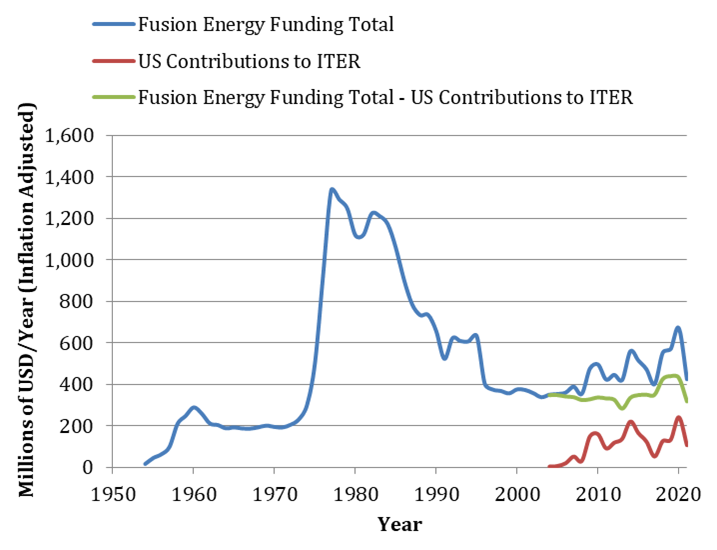
That would be fine, except some of the investors are pension funds.
IANAP, but I see no path forward to sufficient Q-total using plasma fusion to put this to any practical use. Unless the reaction can somehow be self-sustaining, I do not believe this will ever work.
There's a lot of supporting stuff as well as energy to drive that stuff that goes into leading edge tech development like this, that does not matter in terms of the reaction itself.
If they say they achieved more output than input, then I will believe them over a random HN comment snob any day of any week.
> will believe Wouldn't be better if you were able in to verify stuff to some degree yourself instead blindly trusting every expert (not at all implying that the people who did this experiment are untrustworthy but your bound to run into some bad apples with this attitude eventually)
For example p + p Fusion releases neutrinos which then escape any practical device without depositing their energy as heat. This isn’t a concern with DT fusion but again the point is we don’t really care about the actual mass to energy conversion but rather the amount of useful energy obtained.
this is about more power leaving the reaction chamber than what entered it. that's all the announcement is about.
this is NOT about how much energy it takes to ready the lasers. this is NOT about the electricity consumed by lighting, computers, cooling, or measurement or anything else-- none of that counts when you are measuring the efficiency of the reaction itself.
this is about more energy leaving the reaction chamber than went in.
understanding that is key to understanding the significance of the announcement, and this is significant.
and I maintain that the poster I originally called arrogant is arrogant, because they indicated in their comment that they knew how to calculate reaction efficiency better than the physicists doing the work. I called it arrogant because it is --objectively-- an arrogant position to take.
if that makes me arrogant, then so be it. my arrogance is independent of theirs and has no bearing on comments made before my own, and my comment did not influence theirs. (they were being arrogant before I pointed it out.)
Actual power plants are self sustaining as in they use the electricity they produce to operate, it’s mandatory though not sufficient for any commercial fusion power plant.
So, this isn’t about a different way to “calculate reaction efficiency better than the physicists doing the work” he was directly quoting their numbers from the paper. It’s only a question of communicating the meaning of efficiency.
> this is about more energy leaving the reaction chamber than went in.
The exact same energy was there before and after fusion only it’s form changed. It might seem pedantic to point that out, but if you don’t make it clear people will misunderstand.
Also, the applied laser energy also leaves the reaction chamber so any fusion would be net positive thermal energy by that yardstick.
Black start is obviously a different question than being self sustaining.
How is it possible for X energy to create X+Y energy in output? Doesn't that violate some fundamental law of physics?
2.01410177811 u + 3.01604928 u = 5.03015105811 u
4.002602 u + 1.008 u = 5.010602 u
5.03015105811 u - 5.010602 u = 0.01954905811 u
These heaver-than-iron elements are created in a very interesting and exotic process. When a large enough star dies it explodes in a supernova, and a huge amount of energy and neutrons are released in a very short period of time. This supernova generates enough energy and neutron material that small amounts of heavier elements like gold, platinum, etc. are created through exotic nuclear fusion reactions, even though these heavy fusion reactions are energy-absorbing.
It's interesting to think when you're wearing jewelry made from gold or platinum, all of those atoms in your jewelry were created during the death of a star.
  “The nitrogen in our DNA,
  the calcium in our teeth,
  the iron in our blood,
  the carbon in our apple pies
  were made in the interiors of collapsing stars.
  We are made of star stuff”.
– Carl Sagan We have calcium in our bones,
iron in our veins,
carbon in our souls,
and nitrogen in our brains.
93 percent stardust,
with souls made of flames,
we are all just stars
that have people names"
Nikita GillI think it might be an allusion to alchemy. Basically, the alchemists believed that ash (what was left after burning something) was the soul of all things...And-- this is where my complete lack of understanding about science shows-- I'm pretty sure Ash has lots of carbon? It's, you know, poetic. Many have claimed that poems are the "language of paradox" so it's okay for it to be a little non-literal. My interpretation of it, though, is that the soul is something impure that you must burn away, or maybe that the soul is polluted by our own words and behavior. It's definitely not meant to be scientifically accurate.
carbon's oxides are all gaseous at standard temperature and pressure
little carbon, then, not none
But not because “you are like a drop in the ocean,” but because “you are like an ocean in a drop.”
The idea of soul can be objectionable when it is based on an immortal being or on a vitalist life-force (like “anima” of the Latin). But it seems fine when it is based on the psyche (like the “Psuche” of the Greek).
I embrace taboo words like soul because they 1. are common 2. are useful for referring to things that seem pretty important (like avoiding soulless companies or products or buildings) and 3. are challenging to my normal (scientific) understanding of the world.
Still, I’d be more comfortable if the poem referred to the “carbon of our souls” rather than “carbon in our souls.” Hmm…
You and I are complicated but we're made of elements Like a box of paints that are mixed to make every shade They either combine to make a chemical compound or stand alone as they are
- They Might Be Giants
The conversion is also very slow. And expensive. To make it this way it would cost a Quadrillion dollars an ounce.
https://www.scientificamerican.com/article/fact-or-fiction-l...
Once you get past the enormous energy costs to do this you have a secondary problem, all the gold produced this way is radioactive and it beta decays to.. Mercury.
13.5 billion years seems like the time required to create a star, have the star die and blow up, have all that material settle and create a new star, then the planets are formed, than enough time on one of those planets needs to pass for life to form, then complicated life.
Therefore, life could have developed in a few tens to few hundreds of millions of years after the big bang. That's still true even if we assume that heavier elements are created mainly when neutron stars collide and not by super/hypernovas as we theorized before LIGO/Virgo observatories.
Consequently, we likely are not a "progenitor" civilization in the universe if we only consider planets formation. We might not see anyone out there either because there's a great filter for intelligent life to emerge (so the bottleneck is in our past) or because few/no civilizations get to have an impact on their host stars (the filter is in our future) that would allow us to see them.
That being said, I wasn't aware of how LIGO changed the understanding of how heavier elements are usually formed, guessing it changed the expected neutron star prevalence? Do you have any additional reading on that?
Regarding the second point have a look at https://www.ligo.org/science/Publication-GW170817Kilonova/in... . That isn't my field of specialization, so I am not sure about recent publications. At the time though this was a big deal as kilonovas seem to be the primary source of heavy nuclei in the universe. That particular event crested between 1/100th to 1/1000th solar masses worth of heavy ( heavier than iron) nuclei. This is a greater rate than supernovas estimations.
It's not about the prevalence, but about the light curves observed during the event AT 2017gfo. They indicate significant heavy metal ejection but, what's interesting, also production.
> mergers of neutron stars contribute to rapid neutron capture (r-process) nucleosynthesis
These two articles cite the relevant papers:
https://en.wikipedia.org/wiki/GW170817#Scientific_importance
https://en.wikipedia.org/wiki/Nucleosynthesis#Neutron_star_c...
Maybe for a main sequence star, but there other processes that involve nucleosynthesis.
You raise an interesting question though: what is the earlier point of time where the heavy elements were abundant enough for life (as we know it) to form? Just because we started existing at +13.5 billion years, it doesn't mean carbon based life couldn't have formed much earlier.
>all the atoms in our universe/galaxy/solar system with a mass up to that of iron are formed in the core of stars
Roughly 90% of the helium atoms in the universe were created via Big Bang nucleosynthesis.
He does an excellent job explaining things and put it to me like this.
Elements to the Left of Iron can undergo fusion and release energy, Elements to the right can undergo fission and release energy.
Iron IS the line because it needs energy to do either of these.
All elements want to find stability, and Iron is that Element because it needs energy for either fission or fusion.
So yes, Iron is the dividing line and this is what makes it so stable.
Edit: forgot to link the chart when referencing left or right..
(Yes I know it's technically mesons at the scale we're talking about but it doesn't rhyme so there)
-- Yeah there are a few alternative designs, but nothing that seems to do the division. https://en.wikipedia.org/wiki/Alternative_periodic_tables
And really, i guess everything is physics if you get specific enough.
Iron will not happily fuse further because this NEEDS energy and where would that energy come from?
"heavier than iron" elements are produced when a star explodes because that collapse produces enormous amounts of energy.
During the collapse, the outer edge of the star is accelerated to something like 20% of the speed of light, that is an ENORMOUS amount of energy slamming down on the core.
Lastly, neutron starts don't produce energy, they are the incompressible remnants of a dead star.
The wikipedia page is pretty good, as always: https://en.wikipedia.org/wiki/Nucleosynthesis
Almost everything with mass of 90 or above comes predominantly from neutron star mergers, basically.
I'd be interested to know if we're in an element rich vein of the wider universe or if all the good stuff is more or less evenly distributed?
>Some whole galaxies have average metallicities only 1/10 of the Sun's. Some new stars in our galaxy have more metals in them than the original solar nebula that birthed the Sun and the planets did. So the amount of "metals" like oxygen and carbon can vary by a few orders of magnitude from star to star, depending upon it's age and history.
https://www.reddit.com/r/askscience/comments/9tujxn/are_the_...
That kind of expansion rate has to rival any explosion imaginable.
I have no idea, though, but I'm pretty sure I watched a video about this.
all is a strong word
for example: the nuclear fusion experiment in the article, that would have produced a few atoms heaver that hydrogen
(not to mention all the nuclear bombs that had a fusion stage)
"Stars are made of quarks"
https://static.wikia.nocookie.net/memoryalpha/images/d/d9/Qu...

star stuff = sternzeug. stern stoff = star fabric
https://www.ling.upenn.edu/~beatrice/110/docs/uncleftish_beh...
So think about two stars killing each other to make your jewelry.
> When I initially decided to write The Magic of Recluce in the late 1980s, I'd been writing science fiction exclusively... I conveyed a certain dismay about the lack of concern about economic, political, and technological infrastructures in various fantasies then being written and published in the field...
> I faced the very real problem of creating a magic system that was logical... Most fantasy epics have magic systems. Unfortunately, many of them, particularly those designed by beginning authors, aren't well thought out, or they're lifted whole from either traditional folklore or gaming systems and may not exactly apply to what the author has in mind.
> I began by thinking about some of the features and tropes of traditional fantasy. One aspect of both legend and folklore that stuck out was the use of "cold iron" to break faerie magic, even to burn the creatures of faerie, or to stand against sorcery. Why iron? Why not gold or silver or copper? Not surprisingly, I didn't find any answers in traditional folklore or even contemporary fantasy. Oh, there were more than a few examples, but no real explanations except the traditional ones along the lines of "that's just the way it works."
> For some reason, my mind went back to astronomy and astrophysics and the role that nuclear fusion has in creating a nova... Each of these fusion reactions creates a heavier element and releases energy... The proton-proton reaction that produces iron, however, is different, because it is an endothermic reaction...
> At the same time, the fact that metals such as copper or silver conducted heat and electrical energy suggested that they were certainly less than ideal for containing electrical energy. Gold and lead, while far heavier than iron, do not have iron's strength, and other metals are too rare and too hard to work, particularly in a low-tech society.
> At this point, I had a starting point for my magic system. I couldn't say exactly what spurred this revelation, but to me it certainly made sense. Iron can absorb a great amount of heat. If you don't think so, stand on an iron plate barefoot in the blazing sun or in the chill of winter. Heat is a form of energy. In fantasy, magic is a form of energy. Therefore, iron can absorb magic and, by doing so, bind it.
https://www.lemodesittjr.com/the-books/saga-recluce/recluce-...
2.01410177811 u = 3.34449439340696e-24 g deuterium
3.01604928 u = 5.008267217094e-24 g tritium
17.6 MeV = 7.832863e-19 kWh energy
Divide through, and you will see that you need 4.27 ug/kWh of deuterium, and 6.39 ug/kWh of tritium.
A random source [1] says that New York will use 50.6 TWh per year by 2027. That would require ~216 kg/yr of deuterium and ~323/yr kg of tritium.
This is all assuming 100% efficiency. A quick read suggests 50% efficiency might be practical, so double those quantities.
Also, i could easily have messed up that calculation somewhere, so please do check it!
[1] https://www.buildingcongress.com/advocacy-and-reports/report...
Isn't that going to cause a serious problem if it requires 323Kg/yr of tritium just to power New York City?
[1] https://www.sciencedirect.com/topics/earth-and-planetary-sci...
https://en.wikipedia.org/wiki/Tritium#Production
And there's not much of it:
> According to a 1996 report from Institute for Energy and Environmental Research on the US Department of Energy, only 225 kg (496 lb) of tritium had been produced in the United States from 1955 to 1996.[a] Since it continually decays into helium-3, the total amount remaining was about 75 kg (165 lb) at the time of the report.
Tritium however is far more rare with only trace amounts of it being available within nature and barely more than a kg produced per year. Producing the 100s of kgs required per year still seems to be an unsolved problem, although my quick searching shows there's a couple viable solutions for it.
Though in practice enough will be lost that probably they'll still be somewhat net consumers-- just not nearly to the extent predicted by a simple thermodynamic model.
Still, even if fusion becomes a net producer of tritium, the whole tritium-is-hard-to-get problem will likely be a constraint that we'll be fighting as we ramp up use of fusion power in the future.
i.e. it's completely harmless unless you eat it.
They spent a few hours covered in dust on their coats, and did a bunch of subsurface skin damage which manifested as third degree burns. Sepsis, not radiation poisoning, generally killed them.
FWIW, tritium and a phosphor granule encapsulated in glass microspheres have been developed for self-illuminating runway paint, but again, no one really uses it because tritium is stupid expensive, and again, it' loses half its brightness in only a decade.
On the other hand, I've been told that Trijicon will replace their tritium gun sights for the lifetime of the original owner. I plan to live long enough to cost them money...
We'll all be using RDSs by then ;) ?
> ...I've been told that Trijicon will replace their tritium gun sights for the lifetime of the original owner.
I didn't know this, thanks.
Which I'm going to watch, because even though everything I hear about this company gives me insane Theranos vibes... Well, if they pull it off... They might light a bulb with fusion in my lifetime.
(And I though I had seen a similar segment on "Answer with Joe", but I can't find it.)
None of those would be opposable source, of course - there won't be any until they open a plant, publish data, etc...
In the meantime, I see a hype cycle brewing, and it makes me a bit uncomfortable - but, we'll see.
I'm not sure how tokomaks are expected to work; do you just add lithium and expect the tritium to get where it needs to go to keep the reaction going, or do you actively remove gases from vessel, filter out the tritium, and re-use it as fuel?
Either way, I don't imagine it'd be too hard to recapture the stuff.
I always thought this is the interesting takeaway, both fusion and fission funnel their constituent matter towards iron, as the final stable state of matter. Far future civilizations will have a lot of iron on their hands.
Thank you.
https://www.energy.gov/sites/default/files/styles/full_artic...
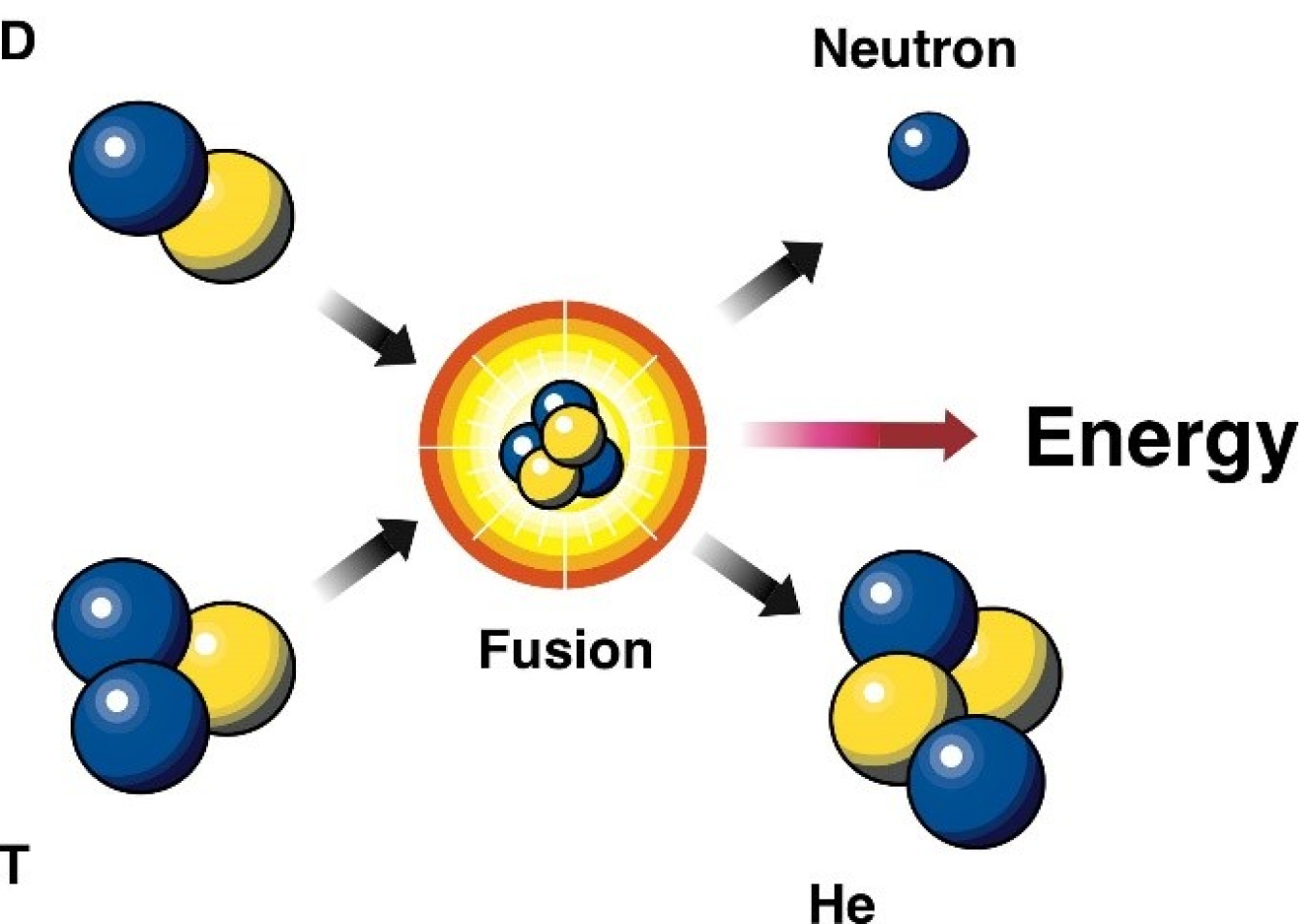
The original atoms (exactly which atoms depends on the reactor, but let's assume it's deuterium and tritium) have a certain starting energy. When you fuse them together the resulting atom (helium-4, if you start with deuterium and tritium) moves it into a lower energy state.
Since the fused atom has lower energy than the input atoms, the fusion reaction releases the difference in energy, which you can then capture.
This is effectively what is happening with any energy generator.
The reason nuclear fusion is such a desirable goal is because it only takes a relatively small amount of mass to convert into a relatively large amount of useful energy, and the mass (the fuel) is relatively easy to obtain.
Like all energy generation, it's converting one type of energy into another, more convenient type, to do useful work. Like a hydroelectric dam converting the potential energy of water into more useful electrical energy. Energy is conserved when water spins a turbine, it's just that electrical energy is more useful for work than the potential energy of the water. Of course you can still use the potential (or kinetic) energy of the water directly, such as with a water mill. But the energy to work ratio is worse in that form (especially if the work to be done is far away from the watermill).
Whenever you build a fire you need to input some amount of energy to begin the chemical reaction that releases energy. In this instance we get not electrical energy, but energy in the form of infrared and visible light, to heat our home and light our way. Yet the total energy released by the fire far surpasses the energy you used to start the reaction, but because the wood's mass is consumed, energy is ultimately conserved. You have converted wood (not useful for heating your home) into infrared light (useful for heating your home).
Mass is energy at rest, hence equivalence with exception of massless particles like photons that have zero mass and non-zero energy. Also, photons travel with the speed of light in vacuum and cannot be found at rest in any frame of reference. Modern physics is fun, isn't it?
P.S. Neutrinos were thought to have zero mass as well, but according to the Standard model they have mass.
There's a threshold of energy required to attain this fusion reaction (otherwise there would be no light nuclei in the universe), and once the nuclei combine there's energy that is released, similar to how some chemical reactions can be exothermic in nature.
Same principle, different means.
The law you're referring to might be the conservation of energy, but that applies to non-nuclear reactions and is more accurately called the law of conservation of mass-energy. In this case the energy in times the mass at the start is still equal to the energy out times the mass at the end. For the energy to increase, the mass must decrease to produce the Y in your equation.
When fusion happens, two hydrogen atoms fuse together into one, losing a bit of mass in the process. The mass difference is converted into energy Y (using E=mc2).
In this case, Y was greater than X, so there was a net gain in useful energy.
In a sense it's no more mysterious (conservation of energy-wise) than adding the energy of a spark results in the energy of the wood fire.
i.e. energy is transformed, not created as you quite accurately write.
Energy in total is still conserved, but it makes engineering sense to compare the size of the starting fire to the total inferno created.
because matter is energy, you can use conversion energy to turn matter into its stored energy.
the "extra" comes from the mass
Fusion and fission are like that but for atoms instead of molecules.
But, O2 molecules, with their double bond, don’t take much energy to break apart. If they do, and then pair up with say a bunch of Hydrogen and Carbon atoms that were nearby in some long chain or something, they form bonds that are stronger - that take more energy to break - and you end up with some leftover energy. Water and CO2 molecules are an even lower energy configuration.
but the extra energy you get wasn’t exactly ‘in’ the oxygen bond though - any more than when you have a ball at the top of a hill it has potential energy ‘in’ it.
It's largely the same reason why NASA takes so long to do anything.
1. Shortage of funding
2. failure can result in loss/exhaustion of funding
3. extremely low risk tolerance
4. physical experiments needing new HW only happen when the likelihood of success is extremely high
5. projects are over engineered to reduce chance of failure
6. projects are over budget and over schedule
7. projects only make minor incremental progress
8. lack of fast/exciting progress drives decrease in funding
9. GOTO 1
NASA just isn't about high-risk / high-reward "moonshots" anymore. The overarching political environment doesn't allow it, never mind the office politics.
NASA will get back to the moon using easily an order of magnitude more funding than it should have taken, with a launch system that costs an order of magnitude more money for each launch than it should. (almost two?)
This is so hilarious wrong I don't even know where to start.
> but the politics of its funding doesn't allow that.
The post that you are agreeing with says that "funding" is not the reason for their plan.
Anywhere at all would be better than nowhere. I worked for a defense contractor for a few years, so I'm basing my comment on my experience there.
> The post that you are agreeing with says that "funding" is not the reason for their plan.
Not sure what you are saying here.
You can't be swift and lean when you are given very limited, budgeted funding. You can't take risks or you risk putting people out of a job and killing the program.
That leads to an overly conservative culture that restricts any risk taking and over-engineers everything to the point failure is effectively impossible.
This slow movement, overly conservative, design by committee approach helps limit risk but it absolutely balloons costs in the long run and horrifically delays progress. Of course if they were a company they'd eventually run out of money but that's not really an option for gov orgs so when the overly conservative, limited run designs end up encountering production issues, the projects explode in cost with nearly no upper limit.
TLDR: The political climate is a direct consequence of the lack of budget and continued restriction of that budget only worsens the problem.
> NASA just isn't about high-risk / high-reward "moonshots" anymore. The overarching political environment doesn't allow it, never mind the office politics.
Why doesn't the political environment allow for it. What could happen. What could regulatory bodies do to NASA for taking a risk and failing. What sort of constricting change could political bodies do in such a situation.
Three astronauts were incinerated alive. That was when they started to take safety more seriously. Subsequent accidents have only reinforced this.
The entire point of my comment is that funding cuts happened. That is the reaction.
For another example from a different angle, the military has limitless supplies of funding but innovates even less than NASA.
Nasa develops nuclear reactors, landed on titan and has reached pluto. Spacex vehicle has never left the Earth-moon system.
They may not have the same accomplishments as NASA, but they're far from a "company that makes trucks".
Which scientific instruments does SpaceX make? I have never heard of a single one.
In contrast, curiosity rover has dozens.
Like, come on. I get shitting on Musk is the cool new thing, but this is genuinely the case where SpaceX is doing cool things in space, and at an extremely fast pace. Get over yourself if you can’t see through your Musk hate and only see them as “a company that builds trucks”.
"NASA makes precision scientific instruments and SpaceX makes precision scientific instruments that have higher tolerances with a higher focus on throughput, and there are rapidly diminishing returns in how much funding can be used to close the gap" is probably the right take if not as fun.
Also, spacex has launched outside of the earth-moon system. It was a roadster
- Their incentive is to optimize for political approval, which means spreading facilities among as many congressional districts as possible, which creates a ton of inefficiency from poor communication and the need to constantly ship things around
- Public approval is the goal and failure is the worst possible option, so things tend to be optimized to take as few engineering risks as possible and have huge amounts of bureaucracy to spread the blame for any possible failure
There's a reason why SpaceX started landing rockets with a fraction of the money that NASA spent on building ridiculous boondoggles.
Ummm.. I thought remote work was no less efficient?
Scientists also don't work for free. They arent mushrooms that grow by themselves
This seems like a gross mistake.
If we are going to avert a climate catastrophe we will need TW of power to "unburn" the carbon we put into the environment (ocean and atmosphere). Instead of barely hitting this target, we should over deliver since we are running out of wall-clock time.
Every project that meets a bar for feasibility, organizational/operational capabilities (if they dont have it, either fix it, or transfer design to capable team) should be given funding (50-100M). We should be dropping BILLIONS on this, if we can drop 50B+ on semiconductors we can do the same for fusion.
Money is fungible. Dropping $billions on this means not dropping those $billions on something that works already, works fantastically well, and would work even better with more money. We already know how to prevent (more) climate catastrophe. We just need to do more of it.
So, no. Each dollar diverted from building out solar to mining coal or fooling with nukes brings existential catastrophe nearer.
Surely if you have a non-satisfactory yield you shouldn't be building it. And that should be possible to estimate before we spend billions on it?
Fission reactors work really well and have been around for 50+ years. If we are going to go nuclear instead of renewable, we need to address the elephant in the room.
The elephant in the room is: why not just fission?
See https://www.iaea.org/bulletin/safety-in-fusion for more details
Let me put the question another way: suppose we get fusion that's equally as safe as fission like IAEA is saying here. Why would we switch to it if we were unwilling to switch to fission?
The entire reason why people are working on fusion IS the fact that it’s much much safer due to all of the key differences. That doesn’t mean there aren’t lessons from fission to transfer, just as lessons from ICE cars have gone to EVs.
My point stands though: we're not doing fusion at scale yet, so we'll see.
The softer the bed linen, the more rested the computer scientists will be and the more likely they are to come up with novel solutions that lead to faster computing.
This is big news but fusion will largely be a product of the people it attracts. The people can do the job attracting money and other talent if it's justified.
I've seen the Canadian gov try to throw money at trying to build a local tech scene and it all went to hucksters, old school finance suits with megacorp resumes, and administrators. While all the tech talent just kept going to SF where the capital was going into high risk ventures... not expensive buildings, events, 'entrepreneur/small business programs', and propping up old school D-round investors. Money is easily wasted even when the pursuit sounds noble and valuable on the surface.
I think what other commentors may be getting at is that in many cases the simple analogy of asking how 9 women can have a baby in 1 month is instructive here. You could throw trillions at that problem, a need to have a baby in 1 month. Sometimes there are hard limits that money has a hard time addressing.
A case could be made that with enough money put towards advanced technology, like gene therapy to force a fetus to maturity in 1 month vs 9, it could be done with horrendous side effects.
So to your point money does solve all problems, but I think diminishing returns is putting it very lightly.
> "had to put 500 megajoules of energy into the lasers to then send 1.8 megajoules to the target - so even though they got 2.5 megajoules out, that's still far less than the energy they originally needed for the lasers," says Tony Roulstone of the University of Cambridge.
But it's good to finally see progress. Very few technologies can transform the world the way a practical fusion reactor could.
300 megajoules was used to generate the laser (this is also captured in [1]). They also mentioned that newer lasers have 20% wall plug efficiency. If so, they need to improve the energy output by 5x in order to break even relative to wall plug energy consumption.
[1] https://techcrunch.com/2022/12/13/world-record-fusion-experi...
I don’t know why but this caused me to picture Alec from Tech Connections in a few years time, showing off his fusion laser plugged in to a kill-a—watt, while he explains carefully, through the magic of buying two of them, why you can get more power out than you put in, and why these old inertial confinement fusors were pretty neat actually.
a typical power price at trading hubs is US$40 per megawatt hour, though this varies considerably depending on many factors and is sometimes actually negative
a typical retail price is US$120 per megawatt hour
so this is about US$10 worth of electrical energy
You don't need to use efficient lasers to get the scientific results they're after - other people have already very accurately measured the properties of modern lasers, so we can predict how they would perform without having to actually use them.
Upgrading the lasers would slow the project down as new hardware is installed and issues are worked out. Not to mention I doubt the new hardware is cheap, and may be more expensive than burning excess energy using old laser tech in the meantime.
Other research groups work on laser efficiency, and the "final product" using this method (if it ever proves viable) would put together all the best pieces to get the best efficiencies.
Good to hear that there's a laser design that might achieve that.
Not even ask questions, not something like "hey, I saw this tweet, I know it's just a tweet, but can someone help me understand context?", no, you actually go ahead and criticize work that you know nothing about, and when confronted, you double down.
On some level, you must know yourself that it might be better to ask as many unloaded questions as you want, but otherwise sit this one out in terms of assessment.
I get that people are emotional about this, but it’s important to treat science with a critical eye.
The claim is that more energy came out than was put in. This is false.
It’s not just me saying it. https://www.tiktok.com/t/ZTRVP5Pmg/
There is no “context” to understand. Yes, it’s an impressive feat. Yes, other laser designs might fix the huge ignition costs. But that hasn’t happened yet, and until it does, it’s completely fair to point that out.
Will it win me any friends? Probably not. It’s like showing up to a party and saying the reason for the party is mistaken. Very few people care.
But scientists should, and I am one. Doubly so for incorrect reporting to laymen. We have a responsibility to convey what was actually achieved, not what we wish was achieved.
People do seem to be getting emotional about fusion, and pointing that out is hardly edgy.
Once fusion achieves more output than input, I’ll be celebrating right there with you. But until then, ignoring the Doberman in the room is a worse look, from a scientific standpoint.
I even cited a source from someone with a phd in mathematical physics, who is likely far more qualified to be talking about this than most of us here. So in terms of dismissing criticism, the stack seems to be in the other direction.
Scientific reporting matters. Reporting something false is generally a bad idea. Saying “we got more energy out than we put in” is false. Which link in this chain of reasoning is invalid?
That comment/criticism is a little strange in and of itself. I would say it's the oddness or seeming petulance of the above comment that brought on boc's comment.
A silly, but illustrative analogy:
  Kid:    Dad, look! I scored a home-run!
Father: Who cares? Have you won the game yet? Stop celebrating until you do something that everyone cares about!It's entirely valid to remark that fusion still is far from viable as a source of energy.
Sillysaurusx is right. The "impossibly complex" matter is actually quite simple, Q=1 is little more than a psychological milestone, not some sort of technical tipping point where further progress becomes easier. And they haven't even gotten to Q=1 unless you buy into the justifications they give for dodgy accounting of the energy they put into it. The "impossibly complex" matter of commercial fusion is actually quite simple, it needs to put out a lot more energy than you put into it after you fully account for all the energy you put in. They aren't even close to this.
You're arguing that the process of charging some inefficient lasers (aka eating food throughout the year) is invalidating this entire result. That was never part of the experiment, nor is it relevant to this test.
I understand exactly what you wrote above, and I'm telling you that it's not relevant to this discovery. You're arguing a non-sequitur in the classic definition.
It seems, to me, that boc was criticizing the unnecessarily dour tone of sillysaurusx's previous comment and not the technical aspect of the achievement.
The whole thing seems to come down to whether one interprets the announcement as an attempt to deceive the public at large or simply a celebration of a milestone that many in the fusion research community have been trying to achieve for a long time. I can understand it being interpreted both ways, but I think the more charitable interpretation is that science reporting, in general, doesn't usually properly explain the levels of nuance of various achievements and, as such, something that is genuinely exciting for those in the community is not necessarily as exciting for those outside of it - which comes across as deceptive.
So the NIF is supposed to give a testbed to study implosion created fusion reactions that produce enough energy to "ignite", that is, propegate the reaction to the rest of a hypothetical bomb. In that case, the amount of energy needed for the infrastructure to produce the initial implosion doesn't matter, what matters is that the energy coming out is more then the actual energy that triggered the reaction, so that the hypothetical bomb would blow up and not fizzle.
No one (except perhaps poor science "reporters") is claiming that this means we now have free and cheap fusion power. Of course the energy put in to operate the lasers themselves needs to be accounted for -- and it is! -- but that doesn't make what they've achieved useless. It's also useful to remember that the researchers involved are not the people writing press releases and articles; let's not minimize their achievement just because of sloppy, sensationalist reporting.
I like the analogy downthread of a kid being excited about scoring a home run in baseball, but the dad chastising the kid for celebrating before actually winning the game. That's what it feels like is happening here.
This is a huge step in the right direction, and it should be celebrated as such.
They are using inefficient lasers because they are cheaper to buy/maintain/modify for research purposes.
Determining the conditions for positive Q_plasma is largely a matter of science/research so the external system doesn't matter as long as the variables are controlled and results are reproducible.
Once positive Q_plasma is well understood/reproducible, achieving positive Q_total (more energy produced than spent running the infrastructure) is just a matter of engineering and potentially waiting for the SOTA for components (like lasers or materials) to catch up.
TLDR: This is the scientists proving the theory. Now it's the scientists' job to refine the theory. Then the engineers get to put it into production.
There will be no production, except of new, smaller thermonuclear warheads. That is their legislated remit.
What is the difference between todays announcement and yesterdays ?
I thought we were just getting re-submitted headlines, but apparently this news is different than yesterday ?
People believed that X:Y was 2.2:2.0, but it's now 3.15:2.05.
The 10% EROI apparently wasn't impressive enough, it's now 54% EROI on paper (assuming less because of capture inefficiencies).
I'm no expert, but theoretically my understanding is that this ratio should scale along this same pattern for higher values of Y.
Before that, the only official word was that an announcement was coming, and all the info was unofficial leaks and rumors.
One would think that one look at the sky would be enough to say that "hey this fusion thing scales pretty well".
I'm also a bit concerned that this type of research may encounter national security related obstacles. Obviously a pure fusion bomb would be a game changer for nuclear (non-)proliferation.
This is probably a bad thing; politicians might decide the bombs are clean enough to use.
I don't know enough about the Hafnium controversy to comment on it.
I'm not in any way saying that using lasers would be a plausible route to such a weapon, since the NIF facility is huge, but if it turns out that the research needs to focus on how to get more output per shot, which I think it inevitably would since a typical conventional or nuclear power plant generates on the order of 1 GW thermal power (To match that with a 1 Hz repetition rate, likely a stretch for a MJ class laser, you would need to generate 1 GJ per shot, comparable to the energy in a ton of TNT.), it would probably be touching on areas that are highly classified.
Basically it's a twist on the ice-9 solution to the paradox.
Wikipedia: "Fast fission of the tamper and radiation case is the main contribution to the total yield and is the dominant process that produces radioactive fission product fallout."
However it’s possible to have higher fusion ratios at the expense of a larger device for the same yield. Most notably in the case of the Tsar Bomba’s which reduced the contribution of fission and too massively reduce the amount of fallout produced.
Suggest "Ripple: An Investigation of the World’s Most Advanced High-Yield Thermonuclear Weapon Design" from the Journal of Cold War studies to read about a predominantly fusion device family.
That could be carbon-copied to a fusion power plant, and indeed, there are many proposals of hybrid fusion-fission plants in the literature that only require Q values marginally greater than 1. But if you go that route, you have radiation just like a fission plant, and one starts to question why you don't just build a fission plant (indeed, why don't we?).
My personal pet theory of the future is that, one day, we'll progress so far in fusion research that we get economic energy. But at the same time, the line blurs between both fission and weapons technology, so people are unhappy with the result. This doesn't feel particularly contrarian but no one ever seems to bring it up.
The history of thermonuclear weapons leads me to think that the answer may be yes. There does not seem to be any real upper limit to how large a thermonuclear weapon can be made. In the 50's and/or 60's there were proposals to build GT devices. I don't think the fission trigger for such a weapon could have scaled by nearly as much.
So by analogy if a relatively small fission trigger can cause a fusion explosion that is many orders of magnitudes larger maybe one or more tiny laser induced fusion reactions could be used to trigger a much larger one.
If that were the case the efficiency of the laser trigger would be of little importance.
The key thing here is the Lasers aren't doing the immediate compression, the lasers are simulating X-Ray radiation which then is ablating the casing around the tritium. Figuring out how to create and amplify a x-ray pulse was a major sticking point in the Star Wars program.
People are estimating how this result moves the equation for an overall system that is designed for power production. Most numbers I have seen still leave a theoretically optimal power plant producing around a 30% loss in power with this number.
While at it: I don't think the NIF approach will ever be applicable to commercial power generation on Earth. But I hope it will be one day applicable to a fusion-based rocket engine.
Just wait until the DoD figures out they can use this for some military application and it will get 100x funding overnight.
Harnessing the energy in a controlled and sustainable fashion is what's hard.
[0] https://www.atomicarchive.com/history/hydrogen-bomb/page-11....
https://en.wikipedia.org/wiki/Thermonuclear_weapon
Only very large bombs, such as the Tsar Bomba (97% from fusion) ever where primarily fusion, and those are not in modern arsenals.
It still very much is a fission weapon.
It still very much is a fission weapon.
"thermonuclear bomb, also called hydrogen bomb, or H-bomb, weapon whose enormous explosive power results from an uncontrolled self-sustaining chain reaction in which isotopes of hydrogen combine under extremely high temperatures to form helium in a process known as nuclear fusion."
So far it hasn't proven to be viable, but time will tell.
It may surprise people, but the DOE is the government body that is responsible for nuclear weapons research in the US.
I'm not trying to correct you, but adding context for the weapons aspect.
Peaceful ones too, probably.
From what I understand, a lot of the work from the past years has been trying to piece together geometries, pulse timing, stability, and quality of targets.
(And even then, it's dubious a laser fusion scheme will be competitive with other energy sources.)
True if you want to replace base load of a civilization size network it needs to be economically viable, but we generate "a lot" of power at higher than market minima. Ironically, "good batteries" are the natural enemy of fusion research.
One fun thing about laser fusion is it theoretically can scale down very low and has a trivial "off" switch making it a good resource for engineering tokamak reactor materials or sensors or similar tasks.
The inner lining of a production fusion reactor is hard to make, so a laser facility would be ideal for research. Which is why we have one...
Is there any calculation to this? What’s the cost of shot? Is there any limetime limit of the laser?
Why wouldn't a final Q of 50 be economically viable? Interest on capital costs? Other?
The targets are only expensive because they aren't produced at scale yet.
They are the exact kind of thing a machine could churn millions of per day out, and then use them at the same rate.
Even if the targets were made of expensive materials (eg. platinum), most of that platinum could later be recovered from the reactor wall, so it still wouldn't be very expensive.
And recovering comes for free?
Every step costs energy (or money).
There is no working design yet. It is waay too early to make any predictions about how scaling could reduce costs. Scaling can even increase costs, if it depletes limited resources like tritium.
If you can process a tanker worth of hydrogen per second, Q can be just above break even and you will still make money.
The higher the Q, the lower throughput needed for feasibility.
The destination will be a milestone for humanity, so we should not give up.
It's a fusion plasma research experiment. It's not a program that is being run with the goal of creating a usable fusion energy power plant.
A large, complex machine that explodes the equivalent of 500 lb. bombs to generate heat to drive a turbine sounds like an engineering nightmare.
It’s an incredible milestone, not a solved problem.
What’s the circle or not big milestone here?
From https://www.nature.com/articles/d41586-022-04440-7
Herrmann acknowledges as much, saying that there are many steps on the path to laser fusion energy. “NIF was not designed to be efficient,” he says. “It was designed to be the biggest laser we could possibly build to give us the data we need for the [nuclear] stockpile research programme.”
That is something personal and unique to each individual. In 1903 when the Wright brothers flew a heavier-than-air machine for 59 seconds, 99.99999% of the people on the planet wouldn't have cared. The airplanes you've flown on are vastly far removed from that original one. Same story for the point contact transistor in 1947. None of that solid state physics is used for modern transistors. Some people like to be early adopters for new ideas and things. Some don't. And that is OK.
Is this the right approach? Who knows. There are many fusion designs in the works, and those may ultimately be the right call. Or some yet-to-be-created design. That's even probable. The NIF is for simulating nuclear weapons, not creating energy. None of that takes away from this breakthrough - we've never had meaningfully more output than input on a repeatable basis. It's proof that contained fusion for energy isn't just hypothetical, which will also mean funding & interest will generally increase from this point on.
I think you're setting too high a bar. It's like saying no milestone should be celebrated until we have a working metropolitan-size plant running that's cheaper than anything else. Punch cards in the 1950s are insignificant compared to modern SSDs, yet they were an important step even though we don't use anything like it now. Breakthroughs are breakthroughs.
I agree that the original press release flubbed the explanation. Here's how I think they should have presented it instead:
How does "[It's big b]ecause sustainable positive energy out has never been achieved before in 60 years of research" translate to "because we say it's big" in your head?
You might not consider it big, but a specific reason was provided and it had zero similarity to your rephrasing.
Watt went around telling everyone that Trevithick and his compact (ie high pressure) steam engines were too dangerous and would never work.
Yes, some exploded. But then we got steam trains and even today almost all power generation on the planet is high pressure steam-electric power plants.
And using actual bombs and explosives to dig kilometers down and mine coal is not an engineering nightmare? Dying of gas in the mines, fires on oil wells, oil spills, these things are 'engineering simple'?
is that because while the obstacles are grave, the consequences of failing to overcome them are much graver still,
and to the best of our collective knowledge,
industrial scale fusion would be the least bad answer to our energy demands for the next epoch.
That is true but also does not obviate the need for other parallel efforts and other technologies whose challenges are also very grave, e.g. the need for very near term very large scale carbon sequestration, for a modern electrical grid with deep redundancy and resilience, the need for effective safe scalable stores for energy from whatever source, etc.
Why is that? Fusion is not needed, although if it turned out to be cheap that would be nice.
What alternatives to petrolium does the US have that it does not rely on others for?
Those crazy sci-fi stories from the 30s and 50s where everyone used nuclear power (and it was so cheap they didn't bother to meter it) were all completely accurate from a non-political viewpoint
the unsolved issue with laser fusion (ICF) as an energy source is the fast degradation of high powered lasers. High powered beam degrades optics on it's path and those things are expensive. ITER has similar problem with superconducting magnets.
Yesterday, everyone was complaining about the 2.2:2.0 ratio, but now we're working with 3.15:2.05.
With modern lasers, that'd be a total Q of 0.375 assuming 100% efficiency through direct-energy-capture.
The jumps to get here included
- 40% with the new targets
- 60% with magnetic confinement
- 35% with crycooling of the target
The recent NIF experiments have jumped up in power. The first shot that started this new chain of research was about 1.7 MJ of energy delivered. Now, 2.15 MJ. However, the output has jumped non-linearly, demonstrating the scaling laws at work.
> I’ve helped to secure the highest ever authorization of over $624 million this year in the National Defense Authorization Act for the ICF program to build on this amazing breakthrough.”
It's nice to see this milestone recognized, even if the funding it still rather small.