bzbarsky
Re:US Department of Energy: Fusion Ignition Achieved
on Wednesday December 14, 2022 @09:57AM (#33984272)
Total power radiated by a black body per unit surface area scales as T^4 (in Kelvin).
So for black bodies with identical shape and linear dimensions R1 and R2, with identical power production per unit volume, both in thermal equilibrium with whatever is outside them, you would expect:
R1/R2 = (T1/T2)^4
(because setting power produced equal to power radiated gives R proportional to T^4).
Pretending humans are spheres with radius 1m and the sun is a sphere with radius 7*10^8m, you would expect the sun to have ~160 times the temperature of a human at equilibrium in vacuum. It's going to be lower because not all of the sun is power-producing, of course. But higher because a human is not 1m in radius. And again higher because humans are not spheres and lose heat more than a sphere would for the same volume (more surface area).
The sun is about 6000K on the surface. That would give us ~40K for the equilibrium temperature of a human in vacuum, which at least seems truthy.
TL;DR: the sun is big, with a small surface area compared to its volume, because it's big.
Re:US Department of Energy: Fusion Ignition Achieved
on Wednesday December 14, 2022 @09:48AM (#33984154)
Heat and temperature are indeed not the same.
For both the sun and a human on earth there are two processes going on:
1. Heat production per unit volume.
2. Heat loss per unit surface area.
The volume to surface area ratio for the sun is much larger than for the human, for a minor reason (the sun is a sphere) and a major reason (the sun's linear size is much bigger). So the equilibrium temperature of the sun in the same ambient outside environment is higher than the human's.
Your thought experiment about placing a human inside the sun would in fact work as you say, if a human body continued to produce heat once it had achieved thermal equilibrium with the surrounding plasma.
Re:Granting Pardon for the Offense of Simple Possession of Marijuana
on Thursday October 06, 2022 @09:55PM (#33116567)
There was such a standardized test when I was in high school, for what it's worth. And some states still have them, and some require a passing grade on them to graduate from high school.
Re:Tell HN: Twitter suspends arrested Iranian tech blogger’s account
on Thursday October 06, 2022 @07:40AM (#33106968)
In some countries, you arrest people first, then find/manufacture evidence later.
Re:The euro has tumbled near parity to the US dollar
on Tuesday July 12, 2022 @03:07AM (#32066578)
Of course it comes out of your compensation in the end. It just doesn't come out of the "headline" compensation number you see.
Which is fine if you're comparing equivalent "headline" numbers. But for other purposes the ratio of take-home pay to what the employer has to pay out (so including all the employer-side taxes) might be more relevant in terms of determining your likelihood of receiving a certain level of take-home pay.
Re:The euro has tumbled near parity to the US dollar
on Tuesday July 12, 2022 @02:59AM (#32066534)
Note that France has one of the highest levels of government spending as a share of GDP (and hence represented by taxes, though this includes sales taxes/VATs/etc/etc) in Europe, at 62% or so.
For comparison, Germany is at 51%, UK at 50%, Netherlands at 47%.
Belgium is close to France at about 61%...
The US (not in Europe, obviously) is at 46%.
And Switzerland at 36%; this is the European outlier in the opposite direction from France.
But a priori, just from this data I would expect French taxes to be about 1.4x US taxes and Dutch taxes to be similar to US ones...
Re:The Crime That Killed Shinzo Abe
on Monday July 11, 2022 @01:38AM (#32052611)
My apologies; I forgot that the nytimes is all paywalled now...
I should make a habit of loading things in a private browsing tab as a test.
You should be able to see the whole Times article at https://web.archive.org/web/20220616003939/https://www.nytim... if you are interested in a less-pro-ACLU take.
Re:The Crime That Killed Shinzo Abe
on Sunday July 10, 2022 @05:18PM (#32049145)
https://www.nytimes.com/2021/06/06/us/aclu-free-speech.html is one such source.
Note that the shift has been quite recent (more or less since 2017) and not uniform; the ACLU does still take up free speech cases, while avoiding others, depending on various things.
Related, but not mentioned in the above articles, are tweets from prominent ACLU lawyers calling for banning certain books (see https://reclaimthenet.org/strangio-shrier-free-speech-suppre... for a reference, but this was quite widely reported). On the one hand, said lawyers have a right to their own opinions on their own personal twitter accounts. On the other hand, the ACLU never bothered to say that this opinion does not represent the ACLU organizational position....
Re:Apple previews Lockdown Mode
on Saturday July 09, 2022 @01:05PM (#32037101)
Popper was specifically referring to levels of intolerance that cause people to move from the world of discussion to the world of physical force.
That is, per Popper, tolerating people who will physically harm you as part of the discussion means a discussion cannot be meaningfully held at all.
But people really like to stretch this to whatever edge-case meaning of "intolerant" would be convenient to them at the time...
Re:Basement Fertility
on Saturday July 02, 2022 @05:47AM (#31957589)
> China had a literal one child policy
The operative word being "had". It hasn't had one in a while.
> Population grows exponentially
It really depends. It does if you assume TFR is a constant, but it tends to not be constant.
> I don’t think we should look at it in decades but rather as through lenses that capture time in centuries.
In the "centuries" timeframe, technological change (much reduced infant mortality, availability of contraception, career opportunities, etc) pretty much dominates the TFR situation.
Re:Basement Fertility
on Tuesday June 28, 2022 @02:15AM (#31904673)
Current TFR in China is around 1.7 according to https://www.statista.com/statistics/1033738/fertility-rate-c... it _has_ been climbing very slowly recently, but I'm not sure I would characterize that as "healthy".
"Asia" is pretty broad, but India was at 2.2 in 2020 and dropping pretty rapidly; as of earlier this spring it hit 2.0. Note that the Statista numbers are moving 5-year averages, so the "spot" number for India is lower than the number you see on that graph.
https://www.statista.com/statistics/1034075/fertility-rate-w... puts "Asia" as a whole at 2.15, which is indeed "healthy", but the slope is very much down.
Africa does have higher fertility, but from what I can tell the main reason is lack of access to birth control, not "community" or "big homes"...
Re:Useless Use of "dd" (2015)
on Monday May 23, 2022 @10:18AM (#31479339)
For your first command:
gzip -c /dev/sda > img.gz
gunzip -c img.gz > /dev/sda
Re:Finland will seek NATO membership immediately
on Friday May 13, 2022 @12:54AM (#31363485)
Just to make the numbers clear, Leningrad had something like 2.5 million residents in 1941. Depending on who is counting, somewhere between 600 thousand and a million died during the siege of Leningrad (largely from hunger, which is a separate long discussion).
There were also somewhere on the order of 350-400 thousand Soviet soldiers killed in the battles around Leningrad.
It's pretty hard to "take" a multi-million person city if the residents are willing to accept double-digit-percentage fatality rates to prevent it... The big unknown is always whether they will be willing to accept it.
The issue is that there is an implied difference in implied causation ("difficult because of their personal qualities" vs "difficult because of the college environment", say) and the truth values _with that implication included_ might be quite different.
Written as response to a request for such comments, and distributed in the forum designated for such comments, yes?
There are privately owned spaces (shopping malls, some towns) that have been treated as public spaces for free speech purposes in US court cases, as I understand it.
Basically, if a privately owned space is promoted as a "commons" and acts as one, some of the rules about speech start changing.
Re:Reinstating our SAT/ACT requirement for future admissions cycles
on Wednesday March 30, 2022 @03:52AM (#30852473)
> Candidly, no one would pay for a prep course for a 30 point gain.
My understanding of the research in this area is that the 30 point gain is if you compare people who take a prep course to people who put in an equivalent amount of time preparing on their own with the widely available (e.g. can check them out of the local public library in many cases) preparation materials.
The 200 point gain is if you compare people who did the prep to people who have not done any prep.
The set of people who can't make themselves put in the time without the structure of a course would benefit by a lot more than 30 points from the course, and would pay for it. And do.
Re:Reinstating our SAT/ACT requirement for future admissions cycles
on Wednesday March 30, 2022 @03:29AM (#30852348)
The "expensive preparatory courses" offer something like a 10-30 point benefit over checking out an SAT prep book from the library, if you control for the time spent on preparation, last I checked.
What the courses do offer, of course, is the structure to force indifferent students to sit through the preparation.
There's a lot of bad statistics, whether by accident or with an agenda, being done around the SAT....
But more important than all that, as the MIT post says, pretty much all the other measures elite colleges use for admitting students correlate even _more_ with income than the SAT does.
Re:Reinstating our SAT/ACT requirement for future admissions cycles
on Wednesday March 30, 2022 @03:22AM (#30852322)
Yes, but is that correlation after controlling for IQ and work ethic? Because family income correlates with IQ and work ethic...
As far as I can tell, the thing the SAT really correlates with most is the thing it's actually designed to predict: ability to succeed in college, as measured by college GPA. (In particular, the correlation between college GPA and SAT score is higher than between college GPA and high school GPA.)
Re:On Tolkien and Orwell
on Tuesday March 22, 2022 @01:46PM (#30769165)
> Orwell was quite a devout communist
I don't think that's true in his post-Spain days, depending I guess on how you define "devout communist". I would say he was a devout socialist and an ardent anti-communist after Spain.
I am having no luck finding it, but one quote that has stuck with me is where he talks about how if the anti-Fascist forces in Spain won they would obviously establish a totalitarian state which would only be "good" by comparison with the Fascist alternative and would be terrible in any sort of objective sense.
Re:Deliberately optimizing for harm
on Thursday March 17, 2022 @12:29AM (#30707684)
If I can trust https://en.wikipedia.org/wiki/LGM-30_Minuteman a Minuteman III (which is the current ICBM design used by the US) will land within 800ft (240m) of its intended target 50% of the time. And outside that circle the other 50%.
In other words, you can't really target a "building-size" target with these (with maybe exceptions like the Pentagon).
For nuclear payloads, a few hundred meters of error is much less of an issue, of course.
Re:The new silent majority: People who don't tweet
on Wednesday March 09, 2022 @02:24AM (#30611819)
> That's a bit of a strawman.
I think that depends on your social circle.
https://www.bbc.com/news/uk-england-57853385 has some examples of people for whom this was clearly not a strawman as of 5 months ago.
Re:Asian-Americans fight back against school discrimination
on Wednesday March 02, 2022 @03:42AM (#30525222)
> it is there to protect Whites
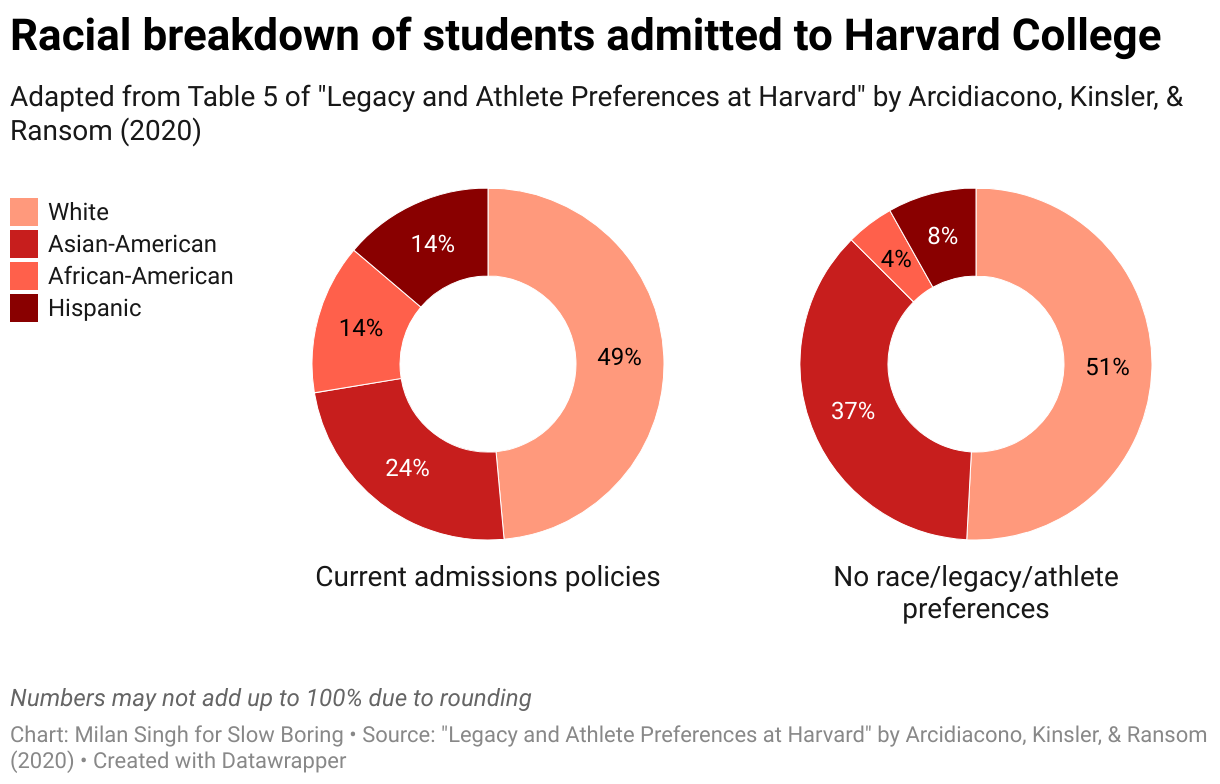
Is it? The estimate at https://cdn.substack.com/image/fetch/f_auto,q_auto:good,fl_p... disagrees, but if you have other data I would be interested.
> at least in STEM
This is an important caveat, by the way. The racial breakdown differs quite a bit by major at many of these schools. I doubt Harvard would be 44% Asian even without the discrimination they engage in (and so do the authors of the study linked above, who put it at 37% Asian admittees if all the racial/atheletic/legacy preferences went away).
> not the paltry 15% quota the Ivies have consented to grant them.
15% when? The data I've seen has Harvard at 15% Asian about 10 years ago. Per the chart above the fraction of Asians in the set of people who get _admitted_ is 24%. Per the numbers at https://www.collegefactual.com/colleges/harvard-university/s... Harvard's _enrolled_ undergrads are 21% Asian. Not sure whether the discrepancy has tso do with systematic differences in how often people accept the offer of admission or whether something else is going on.
> The other thing to consider is that “diversity” somehow fails to consider class.
Yes, fully agreed.
Re:Ask HN: Why is Firefox losing marketshare and how would you save it?
on Tuesday February 15, 2022 @02:47AM (#30343813)
$400m/year is in the ballpark for estimates of Chrome's _advertising_ spend, at various points.
Re:IRS to ditch biometric requirement for online access
on Wednesday February 09, 2022 @03:16AM (#30270233)
First of all, just to repeat: I am very much in favor of the IRS doing as much as it can on its end and then prompting for info it does not have but thinks should be relevant.
That said, neither daycare nor college tuition are itemized deductions. You can take the standard deduction and get credits/deductions for those at the same time.
Or the EITC: That one depends on who lived with you during the year, which the IRS also does not know. But it could ask that one question and then compute it for you...
Handling of stock transactions is the _easy_ case here, assuming the brokerages correctly track basis, because they already report all the relevant info to the IRS.
> I’m willing to wager that for the vast majority of U. S. residents for the vast majority of their lives, their deductions will not exceed the standard deduction.
That is a very sure bet, but not that relevant to whether the IRS can compute one's taxes because our tax code as currently structured has a bunch of credits and deductions that are not part of Schedule A that matter to quite a number of people.
To put numbers to this, per https://www.eitc.irs.gov/eitc-central/statistics-for-tax-ret... in 2020 25 million tax returns had EITC. Per https://www.irs.gov/statistics/returns-filed-taxes-collected... in that same year there were about 150 million total "individual, estate, and trust" tax returns. So at least 1/6 of individual tax returns (more to the extent that trusts exist) could not have been correctly done with the information the IRS has.
And as I said, the vast majority of people who paid for child care would need to correct whatever number the IRS came up with for that.
Now I agree there are lots of people (healthy retirees, young college grads with no kids) who probably _could_ have their taxes done by the IRS entirely. And I'm all in favor of that happening, as long as we're clear that this is not going to reach everyone, and will generally benefit the people who are in the best position to navigate the current system already....
Which brings us back to reducing the underlying complexity, so the IRS could handle more cases itself.
Re:Roman slaveowners were the first management theorists?
on Tuesday February 08, 2022 @01:24AM (#30255488)
> There really weren't any practical differences between Roman and American slavery, at least from the slaves point of view.
I really don't think that's true. Especially given that "Roman slavery" spans 1000+ years (ignoring the Eastern Roman Empire) and the legal situation was not static during that time.
> The owner had the absolute power of life or death over their slaves
If the owner was the paterfamilias, he also had that power over his children, including adult children. Legally, that is. It wasn't generally considered ok from a social point of view to kill your grown-up kids without provocation.
The paterfamilias also had the rights to any income earned by his kids (with the exception of military wages), etc, etc. But I would still have a hard time arguing that there was no difference between his kids and his slaves in practical terms, even though the legal structures were not as different as one might think.
Going back to that "change over time" bit, starting in the 2nd century CE killing a slave without a good reason would be tried as homicide, so even this "power of life and death" claim is not strictly true over what one would consider "Roman slavery".
> Few slaves in ancient times ever saw freedom except by escape,
I would actually love a good reference on this. My understanding is that manumission of household slaves was fairly common (double-digit percentages, and common enough in some periods that legislation got passed limiting how many slaves one could free), while manumission of agricultural/mining/gladiatorial slaves was nearly non-existent. So if you were an enslaved doctor or tutor or whatnot your chances at freedom were quite good. If you were a farmer, not so much. If you were a miner... well, you would be dead before it started to matter. But I have to admit I have not kept up with scholarship on this in the last 10-ish years.
In _practical_ terms, it's probably more correct to talk about "Roman slaveries", because the actual conditions of one's existence as a slave in Rome (the polity, not the city) depended heavily on time period, occupation, etc, etc.
Re:IRS to ditch biometric requirement for online access
on Monday February 07, 2022 @10:37PM (#30254639)
> The IRS knows what you owe and could just tell you if they wanted to.
This is true often, but not always. Examples just off the top of my head:
* Had large medical bills compared to your AGI? How does the IRS know that?
* Paid for college tuition? How does the IRS know that?
* Deducting state sales taxes? How does the IRS know what those were for you?
* Paid for daycare? How does the IRS know how much?
I'm sure I could find more examples if I went and looked at the actual tax forms right now. And while these are all things that don't affect everyone every year, they do affect a large fraction of people at some point in their lives. They certainly affect everyone who pays for college or has kids.
Note that this is not getting into anything too esoteric here, and completely ignoring anything involving self-employment or consulting, or running a small business or whatever. I _think_ those are rarer than having kids anyway.
Now could we have a more streamlined filing process that did the easy bits when possible and asked more directed questions to find out whether people might be in edge cases that might need more handholding or professional help? Absolutely. Could we get rid of the edge cases I listed above with a simpler tax code? Perhaps.
Re:Florida governor to investigate GoFundMe over Canada trucker donations
on Saturday February 05, 2022 @11:35PM (#30229476)
The use of the plural "people" here is interesting. As far as I can tell there was one Nazi flag and one Confederate flag. But they sure got a lot of media play...
Re:Send your email right to the other person's spam
on Saturday February 05, 2022 @11:20PM (#30229380)
Unless the recipient's mail reader doesn't do HTML.