The EU does not have a common enemy to force it together. It does not have a shared language, or culture, or identity. Its dream, while noble, does not speak to ordinary people. And it is pretty damned incompetent at what duties it has assigned itself.
The prospect of a United States of Europe was extremely remote even before today. It's dead, now.
That said, let's not derail the conversation with irrelevant historical anecdotes that are out of time anyway.
I'm fairly certain that the US was already independent and had adopted the current Constitution by the time the French Revolution happened.
The French Revolution was the event that kick-started the spread of democratic ideas and regimes throughout the Old World. It brought about the downfall of the medieval regimes, the abolition of serfdom and slavery, etc.
The American Revolution was more of a symbolic event at the time. On the other hand the fall of the French monarchy was a colossal event at the time: the new French Republic was continuously attacked by all its neighbors to prevent the dangerous ideas from spreading.
If you read Tocqueville, he actually clearly comment on the difference, and even impressed with American institution or people, he says that it only works because it was basically a blank slate, and does not believe it could work in Europe.
The American independence did not endanger that much the British Monarchy or British Empire (who happily went on to be the first world power in the XIXth century)
The elected official in question actually saw no problem with that. To make matters even "better", he is stuck to communist regime / fascist methodology of tightly controlling television and radio... in the age when everybody is on the Internet... awesome!
I know of another guy, over in Turkey, who works the same way... Ataturk would be turning over in his grave if he saw what that other guy is doing in the country he founded.
Anyway, when is Poland holding the referendum on leaving the european union?
Well Atatürk was not exactly a saint, for example I've just learnt the history of İzmir, which had a large Greek population who had been living there for generation and was relocated to Greece after the Greco-Turkish war.
Some of the events around the revolution and the subsequent foundation of the Turkish Republic would now be considered ethnic cleansing now. And the man is still worshipped in Turkey (at least in parts of the country that don't have an AKP majority). In İzmir there is even a Mount-Rushmore-like statue with his face.
This is not to say that Erdoǧan is better, far from it. But Turkey is a complicated country with a complicated history and talking about Kemalists vs Islamists as if they were good guys vs bad guys is a bit simplistic.
Clearly the American Revolution was far more than symbolic: it directly, entirely reshaped both North and South America.
Actually, Hugo Chavez was very popular and won all his elections by a wide margin. You could say a lot of things about him but he was not a dictator.
http://www.bbc.com/news/world-latin-america-15240081
Forget the excessive gerrymandering or his successful change to the Venezuelan constitution which allowed for him to be reelected indefinitely. He was indeed a lot of things, but his legacy will be mismanaging a country with enough natural resources to be one of the richest countries in the world. He was an authoritarian dictator. Faux democracy with fake votes and a press which is govt controlled and a leader that wants to run forever is a dictatorship no matter how you skin it.
> Except for the time he lost, and within two days a military coup of the democratically elected body put him back in power
LOL. The coup was done against him after being democratically elected in 2000 but it failed disastrously, making him some kind of a folk hero in most of Latin America. If you don't know this basic fact you really have no business talking about Venezuela, let along calling Chavez a dictator just because you didn't like the guy. Venezuela had many chances of getting rid of him democratically and they decided not to, we all can disagree about how wise a decision it was but that is different matter.
Here are two little instances I came across recently where the french copied their rhetoric and symbolism from America:
In 1787 Thomas Jefferson said, "The tree of liberty must be refreshed from time to time with the blood of patriots and tyrants". Then in 1793 Bertrand Barère, in an influential speech to the national assembly advocating execution of the king, repeated "The tree of liberty grows only when watered by the blood of tyrants" . In French sources the quote is often (incorrectly) attributed to Barère only.
Similarly, during the American revolution, Americans raised symbolic "liberty poles" in their towns. Directly inspired by this, during the french revolution most cities raised and decorated "Trees of Liberty" in their central squares. King Louis even stooped to visiting and honoring the one in Paris to appease revolutionaries (it didn't help).
(The French took the idea of "watering the tree of liberty with the blood of tyrants" quite literally).
Let's not make nonsensical statements like US independence was completely inspired by the Lumières then.
Most notably, US independence was also inspired by the Glorious Revolution in England (the American Bill of Rights is even based on the English Bill of Rights), about a century earlier.
"The Lumières (literally in English: Enlighteners) was a cultural, philosophical, literary and intellectual movement of the second half of the 18th century"
https://en.wikipedia.org/wiki/Glorious_Revolution
"The Glorious Revolution, also called the Revolution of 1688"
Your proposed timelines are a little off, old bean. ;-)
After Napoleon's defeat at Waterloo, the French monarchy was restored. When the Second Republic was established after the revolution of 1848, Napoleon III quickly abused his uncle's popularity to establish another dictatorship within five years. This lasted until 1870.
Why does HN pretend political revolutions are peaceful?
So HN is a single-minded entity? Just because a couple of people say something you don't like, you paint all of HN, with its 1000s of members, with that?
https://en.wikipedia.org/wiki/Slavery_Abolition_Act_1833
The UK abolished slavery, and even fought commonwealth territories that resisted. Maybe if parts of the US had still been in the commonwealth, slavery would have ended sooner there too.
If you look at the way Western Countries transitioned from one form of govt. to another its seems to have been very bloody. Glorious Revolution, French Revolution, American Revolution, German Revolutions, Russian Revolution etc.
So regicide doesn't count as violence? Also, as mentioned down-thread, we had a pretty bloody civil war here, which replaced the monarchy with a 'Lord Protector' which ultimately amounted to the same thing by another name and so we decided the monarchy wasn't that bad, as long as parliament kept the worst excesses in check.
Once you start meeting people from all those countries you realize even more how similar your cultures are. Some common sayings, some common tales, very similar political divisions, etc
There's a reason why Europe is many times referred as a whole. "They do it like this in Europe", "In Europe they prefer that" (and it's not always ignorance ;)).
This is interesting to me. As an American, our national identity certainly looks similar; it's composed of favorite pastimes and products and shared political values.
But is that true in Europe? The cultures of European countries are much older, predating capitalism and the democratic governments they have today. Most of them are more or less homogenous, whereas the US has always been a nation of immigrants, and the whole "melting pot" idea has been around for most of our history, even if our behavior and policies sometimes clash with it.
Also, I'd argue some of the nation states in Europe are invented, like Italy and Germany, which each were basically just a bunch of city states that were more or less force ably amalgamated into one country. I don't know much about modern German or Italian nationalism, but I think that might have a negative impact on an overall European identity.
Granted, I'm speculating here. At the end of the day I'm an American who doesn't know what he's talking about. Though I do think it's telling that a good number of things you offered as components of a shared European identity were invented in America.
> There's a reason why Europe is many times referred as a whole. "They do it like this in Europe", "In Europe they prefer that" (and it's not always ignorance ;)).
Do actual Europeans say that? Sounds more like the typical American who just got back from a vacation in Europe.
For a lot of things, I see countries of the EU are _more_ unanimous on topics than the US is internally.
The death penalty is a prime example. It varies state to state in the US, but (AFAIK) is consistent across EU countries.
Gambling is another, I didn't realize it was actually illegal in some US states. I'm not aware of any individual countries in the EU that differ from the majority there.
Ah. I wasn't trying to say we as a country have univeral political positions, but rather shared beliefs and values. Americans certainly don't agree on the death penalty, gun ownership, the limits of free speech, or hell, even gambling, but most everyone believes in things like one man one vote and equality (once again, even if we behave differently sometimes for the latter).
Even some more homogeneous (apparently) countries are melting pots. Romania: Some regions speak only Hungarian (and they're not bordering Hungary) and some others speak also Ukrainian. Their borders have changed a lot in the last 150 years. Hungary itself is nothing like it used to be (and it was the same country / empire with Austria... go figure!). Let's also not start with disastrous examples like the former Yugoslavia...
The difference is that the US assumed and took advantage of the "melting pot" idea whereas nationalistic views in Europe have been making the world think we have some special character or culture (and each of us different than its neighbour). Two World Wars mostly based on nationalism haven't helped either.
In many European countries it is frowned upon to worship the national flag or at least it's considered potentially close to extreme right wing and racism. Why? Because as opposed to the US flag which represents a melting pot and freedom, European flags represent nationalistic ideas. Ask and Englishman about Saint George's cross or a Spaniard about their flag. In both cases they'll only wave the flag during sporting events like the current Eurocup. Outside that, the above applies.
> Though I do think it's telling that a good number of things you offered as components of a shared European identity were invented in America.
Globalisation. Also, America didn't just happen. America is a branch of older European cultures (British, Irish, Dutch, Spanish and French at least), so in a sense the American culture is child of European culture, hence why it's not difficult for us Europeans to make it our own too.
American ideas and ideals come from Europe and / or Christianity. Some of them even predate the idea of Europe, coming from the Romans or Greeks. This is a long heritage than you guys and us have shared for long time. Globalisation is just making the rest.
> Do actual Europeans say that? Sounds more like the typical American who just got back from a vacation in Europe.
Not unheard of, specially if we're talking to someone not European. A clear example is political views: In Europe we consider American elections a choice between right wing and righter wing ;) whereas some of our social democratic (or labour) parties might look communist to you guys.
Times change and this might not be true anymore in a few decades, but a majority of Europeans would always choose Democrats over Republicans (and Bernie over Hillary).
These countries like their distinct identities. They like to visit other European countries but they really don't want a melting pot at home.
In addition, we as everyone else are capable of identifying with many things, and what is important at the moment depends on the context. When I speak to an American or Chinese, I'm European, when I speak to an Englishman I'm a Swede and if I speak to another Swede I'm from Stockholm.
In Spain, I identify as Catalan.
In Catalonia, I identify as someone from Barcelona.
In most world affairs, I identify as European.
It is human nature to look for your own identity; and sharing that with your neighbours substracts from your own personality. On the other hand, against external competition you would look for group membership.
What I'm saying is, the Brits are not special or different on their aspirations than their neighbours. Their main difference is who owns the media and the aspirations of those media moguls.
From philosophy, to mathematics, to physics, arts, and to democracy, we built everything based on each others past ideas.
Our foundations are really the same.
The foundations here are not all and only western though.
I would go to the extend to say, I am culturally much closer to the Germans, than to other American nations, even if we share the language, Spanish.
And no offense or disrespect, but Spain has a history with Latin American countries that they don't have with the Germans. That cannot be ignored.
Said this... do you seriously think that UK is closer culturally to India than to Germany?
EU membership challenges that, because in the EU the UK is one country out of many - and not even the most important one.
Of all the countries in Europe the UK has been least able to deal with the loss of empire in the previous century, and hasn't yet worked out a way to look forward to the rest of the 21st century instead of back to the 19th.
This is unfortunate because there's a lot of talent of all kinds. But it's trapped in a political and financial wasteland which is built on a bizarre nostalgia for the glory days of the 19th century.
If the UK had been like this in the 18th century, the industrial revolution would never have happened here. We'd have been pining for the old pre-civil war monarchy instead of building a future.
'infested' is a bit of a strong term.
What culture does a hill billy from the Ozarks share with a Bostonian? (And no, it is not a function of social status only; it really are deep cultural differences.)
TV.
From east to west to north to south everyone in the States has this common bond, television, and through this medium our "culture" is propagated.
Flip on the TV in Europe and not only will the language very likely vary from country to country, so to will the content, which is based on the cultural norms of that particular country (or language group from which the country evolved).
Also, given how new the country is, the "united" in United States is easily traced to the American Revolution and Civil War. In Europe there is no such common identity given the rich and varied history.
Holliwood movies, Game of thrones, Kommissar Rex, the borgias, eurovision song contest, european football championships, local versions of "the billionaire" or "big brother" etc.
Did you grow up in southern europe in the '80s? Then you probaly watched the same dubbed animes like "Captain Tsubasa". In eastern europe? Same, but this time it was Krtek. Are you a kid now? Then you are likely watching Masha & The Bear across the whole continent.
That list sounds more of a reason to being done with Europe rather than an argument for its shared culture.
You can avoid TV though, it's really quite simple to do.
Not really. At best you can avoid watching TV yourself -- but you can't easily avoid living in a city/country influenced by tv culture.
People do not only watch the "housewives of..." that's from their own part of the country.
Anyway, exceptionalism isn't really a common bond.
Eurovision?
Basque is a language isolate spoken in parts of Spain and France. There's also Turkish - part of Turkey is in Europe, but not in the EU.
Which makes me want to put up some bilingual fake warnings with jokes written in Irish and innocent information written in English as if it were a translation from the text above.
It'll be fun to learn Irish from my daughter as she starts school in the next months.
> Etymology
> From Russian у́гры (úgry), the name of an indigenous people dwelling east of the Urals, + -ic.
From the indiginous peoples in Russia whose languages are thought to belong to the language family.
Latin languages are French, Catalan, Portuguese, Spanish, Italian and Romanian. That's it. All the others are not.
... even the English word "language" is itself derived from Latin!
English sits on Germanic/West Germanic/Anglo-Frisian branch of the language tree. The Germanic branched together with Romance, Slavic, Celtic, Baltic, Helenic from the Indo-European/European branch, but Latin belongs to Romance, not Germanic.
Multiple invasions of Britain by different ethnic groups have patched together so many language roots into English that the conjugation of the core existence verb "to be" is just an aggregation of the same verb from seven or eight different languages, pasted together in one etymological mishmash.
At some point, English started stealing vocabulary from any language used in international trade, and simply invented any new words that needed saying, using whatever etymological root that was convenient or marketable.
At some point, the Normans and Picards hammered enough French words into Middle English that there should be at least a second root extending into the Romance branch from English.
How else would you get "milk" from a "cow" (Germanic), but get "beef" from "cattle" (Norman), and refer to them all as "bovine" (Latin)?
Edit: But taking some vocabulary from language does not mean being descendant. Half of the world uses the term "e-mail", but they still are not English.
If we want to define language as a common value for the European Countries, then it might be some Indo-European proto-language (even then it's not clear where Basque comes from).
I agree that Latin had a huge influence in most of the European languages, but this mostly through the Roman Empire and later through the Catholic Church.
The conjunction of those two sentences is a bit hilarious, considering the wanton abuse of the death penalty during the Reign of Terror.
And I think that the lack of capital punishment is an indicator of one of the EU's problems: it's stunningly undemocratic. Polls (until recently?) have shown for decades strong popular support for capital punishment, and yet countries have been forced by the EU to ban it.
The death penalty is prohibited by protocol 6 of the European Convention on Human Rights [1]. Ratifying the convention is a requirement for joining the EU, but it isn't the EU that is doing the banning. The ECHR is an instrument of the Council of Europe, which is not connected to (and pre-dates) the European Union.
[1] http://www.coe.int/t/dghl/standardsetting/hrpolicy/Others_is...
Polls (until recently?) Which polls? I'm honestly curious.
(However, this is forbidden by EU.)
Unfortunately the EU sees differences as a disease which must be wiped out with always the same prescription: more EU. Literally so. They talk of voting as a "contagion".
And why would you insist on a deal being all or nothing, bad with the good? Because you know that's the only way to get the bad ideas through. Same reason Congress attaches riders to bills they know will be strongly supported, when those same riders got rejected earlier.
Also, to me an institution keeping the peace also trying to contain the "contagion" of instability makes perfect sense. It's what I want and I contacted all my representatives to that end.
A few that I personally think are bad:
- Recent VAT reforms
- Cookie law
- Treating low taxes as "state aid" (EU Commission will be setting tax rates across the EU soon, just wait)
- Having a Parliament that can't make its own laws
But if you asked others you might get an answer like "the euro".
The EU has no relevance to peace or war. The USA is a much more strongly federalised union than the EU and had a brutal civil war. Most wars today are civil wars. There is absolutely nothing that'd stop the EU having a civil war even if it was incredibly federalised and had become practically a single country, like the USA. What has kept the peace in Europe was avoiding a repeat of the Treaty of Versaille, nuclear weapons, NATO, and the fact that European countries are now all mature democracies (the latter is imo the most important).
This is the first objective of the Maastricht treaty:
"strengthen the democratic legitimacy of the institutions;"
That sounds like championing democracy to me?
I don't see how the EU has pushed or facilitated any kind of political homogeneization. Apart from the short rise of the liberal democrat party, it seems UK politics have been the same for centuries.
One major advantage the US has is a single main language. That is something that will in time possibly occur within the EU but language is a barrier that cannot be over estimated
Napoleon III, the last French monarch, was captured during the Franco-Prussian war, and after his death, the French decided they'd had enough of monarchs and the third French republic lasted until WWII. It was replaced by the Germans with Vichy, and then after the war, the fourth and fifth republics.
It's highly unlikely that the French will ever accept another monarch. There are Bonapartist and a Orléanist (Bourbon) pretenders to the throne, but none hold any public office. If the government falls apart again like it did in 1958, it should be replaced with another republic as it was then. Nobody can really rule out a third French empire, but the trend of democracy worldwide has been towards devolution of power rather than centralization, France is more likely to break apart than it is to re-imperialize.
This is a somewhat funny thing to say, considering how many people were given the death penalty in the French revolution and its aftermath. Executions for "crimes against liberty" and whatever are estimated to have been between 16,000 and 40,000. [0]
Without this external factor it's hard to find something to really feel the same about.
Would one of the states exiting the US be thinkable, were it not for the unity in waging wars against external (and some internal) enemies?
And yes. Leo Strauss was of that opinion and you will find a whole suite of argument that talk about how the middle east became the new enemy out of need rather than actual threat.
This was part of the PNAC (Project for New American Century) which identified the need for a new enemy after the fall of the wall.
Now whether they were actually successful is another discussion but it was part of the Bush administrations fundamental belief as several of it's key members where students under Strauss.
(Although there are millions of Americans who do not speak English, only the tiniest fraction of those have any influence on American culture.)
And to bypass your essentialized romantic patriotic history for a moment while utilizing your "common enemy" rhetoric, the EU has many common enemies and innumerable common and unique struggles. Consider immigration, the struggle for democracy, ecological responsibility, social justice, annexation by Russia. All issues individually more compelling than the rich coalescing their power to maintain control of the poor in a relatively isolated country with the population of Houston. The EU has so many good reasons to exist.
> Its dream, while noble, does not speak to ordinary people.
Maybe not ordinary old guya. Many young people have a cosmopolitan attitude. They see themselves as Europeans first, and they like the freedom to live and work anywhere, not just within some postage stamp sized area like Slovenia.
I disagree that the dream is "dead"---in fact, Brexit might make it easier to integrate, since the biggest integration opponent is now gone
I am as cosmopolitan as they get, but I also abhor central planning and elitism. And, unfortunately, this is what EU has become.
Also, it appears that for international consumer sales, the seller may now apply its own country's VAT instead of needing to know the VAT regulations of the buyer's country.
As long as the new biggest integration opponent is less opposing to integration than UK was, it will still be beneficial to integration efforts.
And I voted remain
It's actually worse than that though. The EU Parliament doesn't really deserve the name. It can't actually initiate legisliation, so it's meaningless for EUP parties to have any actual policies, so they don't, so there's no formal opposition either, so nobody cares about them and ... therefore ... (phew) turnout in European elections is extremely low. Most people can't even name their MEP, and why should they be able to? That MEP has no power to speak of.
But the focus on Commission/Parliament is misguided: they are a just a smoke screen, as neither has much power. In the EU power is held by the European Council and The Council of the European Union [1]. These two institutions are composed, respectively, of the head of states (Merkel, Hollande, Renzi, Cameron, etc.) and the various ministers of each branch of government (economy, education, agriculture, etc.). The former controls the commission, and the latter holds most of the legislative power.
[1] Not sure I got the English name rights, as they are pretty confusing.
The EU is not a choice between integration and chaos, despite what Brussels wants people to believe. European economies were integrating before the EU anyway.
With VAT, you have to keep careful track of input VAT and sometimes later claim repayment from various governments.
There is a lot of obligatory registration and document submission.
The velocity of legislative change is high, especially when summed across member states.
Small entities have an incentive to underreport. Thus, a lot of enforcement activity is targeted at small entities.
[1] https://en.wikipedia.org/wiki/Switzerland%E2%80%93European_U...
No no no, the EU is an artefact of that integration. Just because it's grown a head and legs, and started to talk isn't an excuse to kill it though. Better off talking back. But when the quality of representative you send over is Nigel Farage you can't expect much of a conversation.
Definitely a frank discussion to be had about the behaviour of the EU (in particular the EC) and maybe such a discussion will be the good that arises from this ill wind.
So the UK sends Farage. He achieves nothing. Nobody cares, because nobody expected him to achieve anything anyway. No MEP could.
But it's not EU, nor is Yugoslavia.
People seem to forget that the American government has been made "incompetent" by design. The Founding Fathers never wanted a strong government.
Inefficient government makes it harder to move against your own population without open military action.
Also maybe you should consider the actual state of US : What's the percentage of english/spanish people speaking? What about Catholics/Jews/Muslim? Should we expect an USbreak ?
Saying that, I do not believe that we need a common enemy to be united. There is better values and challenges for all of us : environment, peace, love. Europe will stand strong, refine its vision to the current context. After a few years, UK we be back and we will all make love peacefully in a better environment.
Long live to Europe.
I think this view of the US having a shared cultural identity at any point before the 20th century is very far-fetched.
Federalization, centralization and bureaucracy are the natural order of empires and America has been on a slow roll towards them since at least the early 1800's and the barons. Honestly probably since it's inception, Hamilton was a devout federalist and Modern America would be a realization of his dream. I think Jefferson and Franklin would be horrified to say the least.
With all that said, it always seemed to me that the EU wanted to be America 2.0 and modeled the empire and not the early confederation that got us here. America used to look like a coalition of distinct states where basic rights (albeit for only some at times), where guaranteed so that a citizen has a host of options to find a representative government. More and more the states look like cookie cutter copies of each other and more and more legislation gets pushed to the federal level because there is little distinction between them. This makes for an efficient business environment but it comes at the cost of a representative government for the people. From the outside it seemed to me that the EU tried to fast track this homogenization in the interest of being a competitive business environment.
In my view the EU took it one step further and fully embraced unrepresentative bureaucracies and set up, for the better part, a technocracy. The people of Britain felt that they had no reach into these un-elected representatives and therefore made the choice to exit as it was the only ripcord they had.
This is a completely inaccurate and hamfisted statement. By the time of the Civil War, California was already predominantly Anglo. The only Spanish speaking parts at that point were the southern part of the state, which was sparsely populated compared to the Bay Area.
Florida was already filled with Anglo settlers as well. Spain had a number of horrifically protectionist policies that doomed their outlying North American colonies to poverty and depopulation, making them extremely vulnerable to infiltration by settlers from the US, who ironically, were illegal immigrants.
Also you're right,I was completely wrong about Florida.
I believe mentalities are changing slowly. My generation (generation "Erasmus") is the first that identifies itself more as an European citizen than a national citizen [1] but our parent's generation doesn't feel the same yet.
By the other hand I think the main reason for Brexit is economics and not identity: UK thinks that they are not having a positive ROI by staying in the EU. Puting it roughly: Germany "exchanges" money for leadership. Peripheral countries "exchange" leadership for money. And UK? The "exchange rate" doesn't seem favourable..
[1] http://www.mirror.co.uk/news/uk-news/young-voters-wanted-bre...
Not necessarily. There's no reason why the UK would have to be a vital part of that union. Quite the contrary, in fact: the UK has always been the biggest opponent of such a closer union. Without the UK, it's possible that the EU might actually be able to move ahead in that direction again.
If the other 20-something nations are ok with being basically ruled by Germany, that's fine. But no way in hell would Britain want to play second fiddle to Germany. Ever. They have always seen themselves as slightly more separate, more different, more "special" to the rest of the "the Continent".
But there's no way the UK was not a vital part of the union. 5th largest economy, a very strong military, still large sphere of influence outside of Europe. Losing Greece is one thing, but the UK...I don't know.
The entire world is moving in a direction I don't like. Populist policies, protectionism, "us-vs-them"....that usually leads to war.
The EU itself is likely still very far from starting that war. China and its superiority complex seems much more likely if they can find someone willing to stand up to them. Or maybe Russia is going to overstep its boundaries for real sometime. Either way we're probably close to our 80 or so years of "Western" (relative) peace, certainly fear and populism are not helping to avoid that path.
Well, ok, so what is the US then? It may have a few centuries of a headstart, but it's the same thing, with 13 colonies invading the rest of the continent. You just overlay the Third Reich onto the new union.
If the other 20-something nations are ok with being basically ruled by Germany, that's fine. But no way in hell would Britain want to play second fiddle to Germany. Ever. They have always seen themselves as slightly more separate, more different, more "special" to the rest of the "the Continent".
The UK is as important as Germany. But they didn't want a closer union so they just stayed out there while Germany played a more active role. So did France, by the way, but they're looked upon as losers so that makes Germany the "ruler" in the eyes of people.
And yeah, UK was special over a century ago, maybe they need a few decades to realize they're not anymore.
But there's no way the UK was not a vital part of the union. 5th largest economy, a very strong military, still large sphere of influence outside of Europe. Losing Greece is one thing, but the UK...I don't know.
It was. Greece is too, but they can also leave if they want. It would just completely destroy them.
The entire world is moving in a direction I don't like. Populist policies, protectionism, "us-vs-them"....that usually leads to war.
Always been like that.
Military industries need to sell stuff. France, Belgium, the UK, and others do the same.
Here about 30% of export increase from Germany to Russia at Deutche Welle - http://www.dw.com/ru/экспорт-из-германии-в-россию-вырос-на-3.... I bet they did not exported beer. Its Siemens, Rheinmetall and alike.
Also look in Gardner Research. The World Machine-Tool Output & Consumption Survey
FTFY. In all seriousness, this whole UK thing sounds like a good excuse for California and The Bay Area to attempt to secede from the union. I'm about sick of our broken consensus mechanisms here.
Why is it sad? Do you think the vote of young people should weigh more than the vote of old people? That'd be discrimination.
It's not sad, to me (not the parent) that the voting power of each person is the same; it's sad - though expected - that older people seemingly looked to their own interests and not those of the people who will have to live through it more.
You're making assumptions there as to peoples' individual motivations. Just because someone voted in a way that you deem is not in the best interests of another group doesn't mean that they didn't have that group's best interest in mind.
I personally think this is a good thing for both young and old people. So in your mind, me voting to "leave" would actually be me not-voting in the interests of the young?
I suppose it's also possible there was a cadre of older people who felt the young would be better out of the EU - the same problems but no say in how to fix them and less cooperation, that's got to help /s - but who choose to keep silent about that position?
Think of that quote attributed to Churchill - not liberal at 20 has no heart, and not conservative at 40 has no brain.
That's an assumption. You could even look at it another way and say it's the other way around where they've lived in the UK prior to being in the EU and know what the UK is capable of on it's own.
Sure, why not? At a shareholders meeting, people with more shares get more say. Young people had much more at stake in this vote than old people.
This isn't like a normal election where there can be a course correction in a few years. In all likelihood this was a once in a generation decision, and the old folks voted to take away young peoples' right to live and work anywhere in Europe.
There are plenty of reasons why that would be unacceptable, and I'm sure that's why human right conventions prohibit this kind of discrimination.
I can see it clearly all around, including my family. my parents, and I love them with all my heart, have simplistic views on politics (although both have university degree). easily to be persuaded, missing bigger picture and view beyond couple of months/years. my grandparents, they are completely lost in this world. they mostly look only what would affect their pension payouts and medical care fees. it doesn't matter if a proper gangster would be handling small financial favors to them, they would go that way.
older people are more invested? nope - we young will live much more of our lives in system that is coming compared to them. We have much more motivation to live in system that is stable and working well in long run (>20 years). it's fair to have same voting rights, but how much do we expect from usual > 70 years old in terms of clever voting decisions? Zero, and politicians know this, hence campaigns are quite emotional to work with them.
That was due to Labour's insane economic policies and the Tories failure to fix them. It wasn't until Margaret Thatcher became Prime Minister that the UK started to be well-run again.
In what way are they more invested? They have ~5-25 more years left and then it makes no difference to them. Furthermore, they're likely pretty settled in their life and already retired.
Young people are still building their lives, trying to establish their career. They're likely going to be denied the opportunity to live and work in 27 countries. I think it's pretty disgraceful that they've torpedoed our future based on their hazy rose-coloured memories of some supposedly-better past.
I'm also skeptical of your conclusion as to why people voted leave. In case you missed the poll, it wasn't just the 65+ age range that voted this way. Even down to the 25-49 group you're looking at a 45% leave vote. Age distribution isn't equal either - the majority of the UK falls in the 25-64 group band, which varies between voting leave or voting remain depending on which poll you look at.
I think you speak of real challenges that the EU has; but to put it in context, other countries have similar challenges. Spend some time in the US, and you will see cultural and language differences among the states. You can also find the same differences in India and China.
Assuming you are American, like me, it's very easy to see the differences in European culture because each state is still a sovereign nation. Chinese and Indian states don't bring their separate flags to the Olympics, so we just assume it's one culture. We go out for "Indian" or "Chinese" food in restaurants that gloss over their internal differences.
The geographical state of Wales being birthed now never was a unified Kingdom though it was very briefly conquered by Gwynedd (Northern principality in Wales), only for so much time as it took the English crown to realise and quell the 'rebellion'.
For GB there are about another quarter million people who are subjects of Her Majesty who remain in overseas territories.
If you're confused I suggest reading my first comment again...
I trust that you always refer to the Republic of China too, rather than Taiwan?
But the arguments at the time of the referendum didn't get stronger. The EU would require Scotland to join the Euro, join Schengen (means a border wall), and the primary argument for an independent Scotland was "we'll take all the oil money for ourselves". But now oil is cheap thanks to US fracking and the North Sea oil industry is going bust.
I think the future probably has more devolution in it. Which is fine.
We've also had almost 2 years of Westminster failing to deliver any of the promised devolution. We get these things are slow to happen but there's been pitiful progress towards them so far. Lots of people voted No on the basis of more devolution.
So while the arguments haven't changed the alternative to independence has for the worse. I'm honestly struggling to see a future without an independent Scotland tbh.
Hadrian's wall and miles of rural waste should already be sufficient for these purposes.
Seems like it'd be easier to get illegally directly to England, than go through Scotland...
As for NI - for the sake of peace that would be a more drawn out process.
Sinn Féin have called for an Ireland-wide referendum on unification because obviously they have. Even if you grant that they don't have the ulterior motive of being Irish Republicans and that they genuinely want Northern Ireland to remain part of the EU (and there's no reason both of these things can't be true), that's probably the only way to ensure that the six counties of Northern Ireland do remain part of the EU in some fashion. And, of course, if it did pass, you'd simply end up with a resurgence in sectarian violence as Unionist hardliners rebel.
It is productive.
Unfortunately, with euroskepticism strong also in countries like France, it seems improbable that we are going towards an U.S.E. any time soon. But if Britain were not in the EU in the first place, maybe we would have achieved it already...
You may think this is some form of conspiracy theory, but there's very strong evidence for it. I would recommend starting here...
Also, in general, whats wrong with multinationals having a strong influence in the present world? They are the modern day 'kings' replacing their medieval counterparts. Of course I am not arguing for blanket powers for them at all. We of course have checks and balances like regulators/auditors/politicians. Even take the example of #Brexit, it happened didn't it? If corporations had absolute power it would not have.
The point is what's good for society in the long term? Who knows best? No easy answers. But I am willing to err on the side of doers (with checks and balances of course) rather than pure career politicians.
Yes it does, Russia.
EDIT: Maybe some minority circles in the Russian Federation want to make it an enemy of the EU or the rest of Europe, but most people, rich and poor, don't want to. The former because of trade opportunities and the latter because of shared cultural heritage.
and old school means invading central European countries at whims (Czechoslovakia, Hungary, we have not forgotten), building iron curtain and so on. Or Ukraine now, exactly same approach. This is what world sees, so yes, Russia is the biggest threat to Europe, at least on par with current mass immigration.
trust me, people from central/east Europe feel very threatened by Russia's attacks on Ukraine. You haven't been through in past what we have been and obviously it's sometimes hard to learn from other's lessons...
Friends you say? Oh, that's rich. Maybe when they give us back our national treasure, along with Basarabia and Northen Bukovina, which they took with the Molotov–Ribbentrop Pact and apologize for crushing the national identity of those regions, for starving them to death and for the mass deportations and killings, maybe then we can be friends.
But that will never happen, especially given its leadership. So until hell freezes over, they can go fuck themselves.
Russians (there are exceptions certainly, but statistically) are proud for the oppression they did upon the neighbours and cherish it as their golden years and action plan ahead.
Also, both US and Russia do more bullying on the economic level anyway.
Like you can kill 300000 people and everyone is okay as long as the territory is whole.
This is the most dumb thing I've read in this thread.
btw: it's Gerhard Schroder, not Kohl. ;o)
People who try to argue that the cold war is still running don't get anywhere with me.
Interestingly, the survey conducted in 2013 in Crimea doesn't show any sign of Russian language discrimination at that time.
Which proves one more time that all Russian propaganda was just lie.
And you intentionally or unintentionally support Kremlin propaganda.
http://www.iri.org/sites/default/files/2013%20October%207%20...
Calling Ukraine "Europe" (again: in contrast with Russia) really just masks the power struggle that was going on before the annexation and the (Russia-supported) civil war. Ukraine was originally part of the "buffer zone" between Russia and the NATO. Both EU and NATO (i.e. US) were trying to change that (not that Ukrainians really complained or anything -- the prospect of EU membership was obviously exciting for many of them).
Does nobody remember the infamous "F### the EU" wiretap? It may have been published by Russia (though that was never confirmed AFAICT) but it was authentic.
Also it is much more Europe than Russia which is Asia by it's spirit and history despite has some European territories.
It annexed the Republic of Texas, which had been independent of Mexico since 1836, in 1846.
Considering two world wars and a history of war before that, EU's common enemy is itself, divided.
Isn't the US a conglomerate of former English, French and Spanish colonies?
Somewhere like Illinois is littered with places named in French or Algonquin, but there is zero culture leftover.
Parts of Lousinana are all that's left from France.
I think it sounds like populist grandstanding. We've been hearing that sort of thing for a year now. We (the US) seem to have a lot of people buying into it though. We get to see first hand how stepping back from globalization looks like before we vote for it ourselves come November.
As always democracy proves itself very dangerous. If I'm ill I go to the doctor, I don't start asking around common people opinions.
A very sad European living in uk.
People keep making this comparison, but they also keep forgetting two elements:
1. After the revolution, parts I and II, as part of the shared dream, they identified an even better external enemy, one which was not only weaker but could easily be vilified.
2. Then there was that whole civil war thing, which killed something like 2-2.5% of the population. (I know, that's low by European standards. For comparison, WWI cost France something like 3.5%. Anyway, still...)
That's only a matter of timing. If the civil war was delayed 50 years and was fought with WWI tech, it probably would have killed way more people. Trench warfare, machine guns, etc, just ate up lives.
https://en.m.wikipedia.org/wiki/2012_state_petitions_for_sec...
The EU traces its origins from the European Coal and Steel Community (ECSC) and the European Economic Community (EEC), formed by the Inner Six countries in 1951 and 1958 [..] The Maastricht Treaty established the European Union under its current name in 1993
If your position is that every major treaty establishes a new Union, then the EU is less than 10 years old (Treaty of Lisbon, 2009). Otherwise, the EU originated in 1951.
Why do most societies resolve internal stress by communautarism, law of ancestry, blind and stupid racism. Why not by gathering and looking at what's wrong then fix it with wisdom.
Maybe I'm too sensitive on this topic, but ever since the Crimea debacle I've become much more worried about instabilities in Europe. I have only ~300km to the Ukrainian border. There are nights when I hear some weird aerial noises and I wonder if that's a missile, and if this is the day when my city turns into a CoD: MW map.
Yes it did, that enemy was "world war".
I don't think this is true. German, for example, had a very strong presence.
The EU is not a abstract entity that only lives of ideas. Its a concrete implementation of these ideas (and many others). This implementation I judge to be deficient. The issues are to many to list here, but I just wanted to state the principe.
Europe can achieve most of the things you want without the EU. Switzerland has many of those things with the EU states. You can easily have all these contracts as bilateral contracts that everybody signs. Then you can do the joining and leaving independently, creating much better incentives for both the people who create the contracts as for the participants in the contract.
Their are already tons of things like that, and their could be more. Look at ESA for example.
> This is not always easy, and it means, that the richer parts have to give to the poorer, but that is just basic humanity.
You totally falsely imply that the richer part "HAVE TO" to give the poorer parts money to achieve these goals. That is totally false. Only with a currency their is a real issue and that is solvable even if you want a common currency without massive redistribution.
What you are doing is deceptive, you are making a operational argument for a issue that relates to moral. If we choice this kind of redistribution, we should do it based on MORAL properties and not operational issues.
Switzerland also has more freedom to have other international agreements, both with states in and outside of the EU.
Switzerland and Norway can join the parts that they like and avoid many others. They have agree to pay certain amounts but they not immediately have to pay more if the EU sets up something new. They have much more control over their spending.
I am not against many of the things the money are spent on so the fact that we are paying, is not that relevant. It is relevant that we have control over it. In Switzerland I can get a bunch of people to sign something and the population will vote on the issue. That why we are not in the EU in the first place.
https://en.wikipedia.org/wiki/European_Free_Trade_Associatio...
Norway has membership of the EEA council and they are able to affect the EU laws which affect them.
Obviously, you can't affect the laws in the EU which as an EFTA member you don't have to implement.
I don't know why people keep on saying that you don't have any representation...
Do I misunderstand?
Sure, as an EFTA member we have a veto, which we always never use because it always trigger repercussions or sours or relationship with the EU, on which market we're completely dependent.
Our former foreign minister paints a better picture than I do: https://www.theguardian.com/commentisfree/2015/oct/27/norway...
That being said, I don't necessarily think Norway should be a member of the EU, as I think we'd be too small to make a significant difference. UK on the other hand, had a lot of sway within the union, and it's sad to see them leave this behind for a potential "Norwegian solution".
A trade agreement, where it's "stay, or you'll lose access to everything", and which can't be renegotiated, is horrible for the young people.
What if I want to vote to change it, even just slightly? No chance.
With the EU, I can vote for a different party in the EU Parliamentary elections, and they can easily change it to the better.
Trade agreements are less democracy than even the EU.
Why is everyone telling this damn lie?
I don't know, I'm pretty glad myself.
>The EU is not only about trade regulations, but about a continent who had a not very peaceful history finally growing together.
Only there is not much "growing together". Besides the bureaucracy there were certain large countries (and alliances) pissing all over smaller ones, in things from trade agreements to fiscal policies and other decisions.
A lot of people seem to value vague unity, but this was the opposite of democracy, where rampant groups with no official standing (the ad-hoc "Eurogroup" for one) and bodies no one voted for, where ruling a whole continent.
So, valuing this kind of faux unity is, for me, like saying "It was nice when the US, Canada, India, Australia, England, Scotland, Ireland etc were united -- under British rule".
>so that there are no arbitrary geographic borders limiting the freedom and the rights of the individual
Borders in Europe are the opposite of arbitrary: they are based on culture, history, economy, popular revolutions, sovereignty, and lots of other factors.
(In a continent like Africa yes, a lot of borders are arbitrary, because they were decided and drawn on some map from colonial powers dividing their lands -- the will of the local people, culture, etc be damned).
And borders are not some plight on the "individual". They are a large-scale extension of their individuality -- ensuring the individuality and independence of their way of life at a larger scale.
There's a whole order of magnitude difference of 350 million people (most of which have different cultures and priorities, not to mention interests) voting for what happens in your country of 30 or 20 million. Even worse when the decision is left to some bureaucrats in the pockets of big business.
>In my eyes, the EU was very much about the same thing. It didn't matter in which part of the EU you lived or had your business. Being part of the EU granted you rights and equal access to the rest of Europe.
Well, if you could have that without the political power plays, coercion, disregard for democracy, and plundering of lesser countries, that would be great.
I'm not super familiar with the EU agreements, but the US Constitution was supposed to restrict federal power over the states. An unfortunate loophole was found through taxes. Citizens pay federal taxes, then some amount of those taxes flows back into state power. The federal laws I'm discussing don't have criminal or even civil penalties, but rather restrict or eliminate this flow of funds unless the will of the federal government is met. Sure, the states can technically do whatever they want, but these are very large funding streams that they will be missing out on. That's like saying I can technically choose to not work... It's true, but it's also a sure way to end up in a bad spot.
But in general, you're correct. Incidentally, this change is actually Constitutionally-valid in some sense, in that a Constitutional amendment needed to be passed (income tax) in order to give the Federal gov't the money to bully the states in the first place.
Farange reported the moves between offices that occurred twice a month and the lavish EU spending on administration. Both noted there was no way for the people to vote down laws or vote out these bureaucrats.
Statist bureaucrats too often spend the people's money with little regard for return on investment. They are the brightest people in the room - just ask them. They don't face the same restraining force as the business owner whose customers can go elsewhere if they don't think they are getting value for their money. As the Brexit folks framed the issue, this was about being responsive to the people, giving them the ability to vote out the whole lot and get others who will be responsive to the people paying the bill.
We have the same problem here in the US. There really is little difference between the establishment Democrats and Republicans. All are big government types who focus on policies that benefit their big donors. They are spending us into oblivion and devaluing all our assets by flooding the economy with more printed fiat currency. Our unfunded future liabilities are even worse. We need to do our own house cleaning.
So I say "Happy Independence Day" to the folks in the UK and hope my neighbors are looking closely enough at our own situation and will will band together to do our own house cleaning this November.
As an aside, for me this is a sterling example of the dangers of "direct democracy", that many see as the solution of all evils that plague the political process.
The majority of UK lawmakers (democratically elected by the same people that voted the referendum) were in favor of staying in the Union: even a large number with conservative and traditionalist background (including the PM).
Yet the future of the UK (and EU) was decided by people (on both sides) that cannot possibly have an idea of what the implications of this decision will be, and that can be easily swayed my media and influenced by emotions.
Representative democracy has its faults and inefficiencies, but if the alternative is to have gut-reaction votes and petty nationalism decide the future of a country, count me out.
People don't necessarily all use the same objective functions. I think many were disappointed by the EU as they perceive it as an economic-only enterprise, where not everyone wins. I think many could be OK with a lower GDP, and a slower and more local economy, etc. It's not so clear on the long run what will actually be the best for UK and its people.
In Switzerland, people vote on different issues about 12 times a year. Some of these issues are quite complex and technical (for instance, how should benefits of some state-dependent companies be handled, etc). Some are easy yet extremely consequential. Usually there is no particular tendency to fall for the easy stories based on gut feelings. In general I think that able to vote is more important (mostly for stability), even if it leaves a door open to populism.
I disagree. Sure it's possible to have a public educated enough to decide whether being in the EU is a good idea, (hi Switzerland), but the fact of the matter is that this doesn't apply to either the US or likely the UK.
It's possible to have a nation where direct democracy is effective, but I'd say it's more the exception to the rule.
I didn't - I said it's possible.
> the US and the UK public, in particular, are not?
To me this seems a self-apparent fact, but I admit it may not appear so to others. I'm not sure specifically where I'd lie my standard, but I'd say the public support for Donald Trump falls dramatically below wherever it would be.
Here in Germany, we have a strict representative democracy. But we have regional elections often enough, that the government gets to feel, if voters no longer agree with it. So it is a balance between short term popularity a long term considerations.
The leave voters I spoke to kept mentioning 'feeling in control' and concern about EU immigration and benefits. Also 'don't want them to ignore us'. Basically, bye election rhetoric. They bought the suggestion that 'a deal will be done' about England's access to European Economic Area as more or less certain.
I hope they are right about the last one :-)
But people forget, and when the jobs start going, ideas will change.
The more I look at the geographical/demographical distribution of voting, the more I see evidence of turkeys voting for Christmas.
All most strange. Enough for quite a few data analysis projects I think!
http://www.electoralcommission.org.uk/find-information-by-su...
Portugal is in trouble, so is Italy. The upcoming Italian banking center crisis, which is pretty much inevitable, will reset any economic gains from the last 5 years quite nicely. France is doing okay-ish. Definitely second fiddle to Germany though.
Speaking of Germany. Their bone-headed fear of - gasp - inflation and austerity measures are dividing Europe, not to mention Merkel's idiotic handling of the refugee crisis. Euro-scepticism is growing. Fully 1/3 of Germans are now Euro-sceptics. Let that sink in for a moment. Right-wing nationalism is increasing. Marie Le Pen and Geert Wilders are growing in popularity. If that's not a failure of Euro-liberal policies, I don't know what is.
I don't think what happened yesterday is great. But portraying the EU experiment (I call it that since it still might fail) as some kind of giant happy family and the UK being the unhappy, ungrateful child is grossly inaccurate.
The EU project has been in trouble and under pressure for a while now. I'm 100% convinced this is only the first domino to fall.
Now, the Greeks don't even have that. They're basically a collective EU servant class. Portugal is in the same boat. Italy is not too much better.
That's your precious EU with a single-currency-under-German-control right there, Bud.
That's indeed really sad. Young Europeans have enjoyed a freedom to choose where to study, live and work that was unprecedented in Europe. What will come next, with the resurgence of nationalism and bigotry in Europe, is very difficult to say, but I see no good coming out of this.
It needs to show that it can provide solutions for the euro financial crisis and the refugee crisis. Solutions that are sound, long term and have popular backing.
It has shown that it cannot.
And thus we europeans are better of with a smaller, simpler european cooperation of independent nation states.
At least this should be the very real threat the EU politicians should operate under.
We need a better EU.
They can only, by definition, find a worse solution than EU. The migrant crisis needs a solution at the scale of the continent. Individual nation state cannot deal with a crisis of this magnitude efficiently.
Without the EU, Greece, Italy, the Balkans would be left on their own to deal with the migrants. Northern and eastern nations would tell them to fuck off and keep their money. That's it.
EU is the primary channel for negotiating a long term solution. If it cannot find one, no one can.
The migrants NEED to solve their own problems where they live. All the western nations mucking around over there need to get out and let them sort their own stuff out and we would not have these problems in the first place.
>Without the EU, Greece, Italy, the Balkans would be left on their own to deal with the migrants. Northern and eastern nations would tell them to fuck off and keep their money. That's it.
And the better alternative is that they feed every person who decides to come their way and go broke? There is nothing wrong with a country defending its own border, just like there is nothing wrong with you locking your door at night
>EU is the primary channel for negotiating a long term solution. If it cannot find one, no one can.
The EU does not negotiate on some important topics. The EU vilifies anyone who brings reasonable arguments against welcoming massive amounts of people into their countries against the will of the inhabitants of those countries..
They absolutely can! Britain is now able to say "no more migrants are allowed into the UK", and it will now happen! That is a working long term solution for Britain.
This doesn't help OTHER EU countries of course. But why should Britain care? Those countries got themselves into this mess, so they can solve it on their own.
Not sure I buy that assertion. It actually seems easier for the handful of small political units directly affected to decide and act on than a giant EU bureaucracy. Which in fact is true in many other instances as well.
I think this is the most important misconception GB always had about the EU. It's a union which means, having a well tempered partnership should be the goal - not cherry-picking like the UK often did.
Or, to resemble a famous quote: Ask not, what the EU can do for you - ask what you can do for the EU!
We are not ready for further expansion of the EU project.
If this causes the EU to split in two parts: A smaller but stronger EU politcal/economical union and a broader but weak trade cooperation amogst european countries. Then Denmark will probably end up outside the political union.
We too had a number of referendums, more than one voting "no to EU" but always our representive polticians chose to negotiate a deal and create a new referendum which just scraped a yes.
The UK being out adds legitimacy to the "being out" case which EU opponents in Denmark and other places will use.
The dissatisfaction with the EU will much more visibile after this.
Getting out of the EU will not solve any of that. It could be that isolated countries will do better economicaly, and will be able to isolate themselves from the problems happening around them. It could be that you stay rich, or become richer, by closing your eyes and ears to the suffering happening around you, while the rest are left carrying the burden.
How sad.
The EU is the chance of Europe to be heard around the world, a great project being squandered by some right wingers opportunists.
That said, I'm certainly not that happy with the EU myself (also Dane), and really think it needs to shape up, but that is more related to the abundance of literally retarded regulations that they force down upon member countries.
Make no mistake, if the EU had competently dealt with the issues with the euro the UK would not have left.
USA, Australia, Canada, Japan ... all had their challenges with immigration and fiscal/monetary issues and have been able to find suitable solutions without their federation/country falling apart.
I really hope so. Right now most decisions are taken by the Commission and the ECB, which are neither directly nor indirectly elected by the people. A bit more democracy would help here.
Although I'm a firm believer that too much democracy is bad: see the topic of the day, where old and/or provincial people (fact) just voted hundreds of rights away from the younger generation and from urban people.
I'm sure our media will widely publicize any and all troubles brits will face in the coming months / years by not being part of our union and this will hopefully help reduce support for the most troublesome nationalist parties.
On the other hand, the UK never really played fair with the rest of us, what with keeping their own coin and having "tax haven" rates. So I'm not entirely sorry that they left. I'm sad for their younger people, of which I personally met a few in many occasions. This was a decision made against their will, which is never a good thing.
Most decisions were. Post-2009, legislation has to go through Parliament. The Commission remains the initial proposal engine, and makes executive decisions on some things, but in reality most of the urgent matters are dealt with by the Council, i.e. the elected heads of state. Commissioners these days are just people saying "wouldn't be nice if we did this and that?" and then elected MEPs hammer out details and eventually decide whether it looks sensible or not. A lot of Directives are actually fairly-generic guidelines anyway and can be "interpreted" at local level.
> and the ECB
Central bank independence is widely considered a pillar of economic stability. I have my problems with the ECB (mainly that they are fairly powerless in real terms), but not about being nominated vs elected.
So uhm, this trope that the EU is full of "unelected" people is not really up to date, although it was true in the past.
Are you talking about those too young to vote?
The ECB was modeled more or less after the German Central Bank who made the German Mark a huge success. There are good reasons to NOT make the central Bank "democratic" or a toy of politicians.
There are also significant movement and trade freedoms with Switzerland, which isn't even a member of the EEA.
The UK really has put themselves in a bad situation here. The main reason people voted to leave was immigration and to "take back power Brussels" and because they were convinced by the campaign that they could still get all the benefits of EU if they left. How will these people feel when they realise that they're going to need to join EEA which will mean the same level of immigration and less political power?
Also, I thought the way immigration numbers were used in the debate was appalling. If I remember correctly:
- The UK deals with 300,000 immigrants per year, of which 50% from inside the EU.
- The immigration target set by the government was 20,000 per year.
- That means the UK government was already allowing 150,000 of non-EU migrants in the country. And for these migrants, the UK does have full control.
How come everyone in the UK accepted this rationale as a valid argument against the EU, instead of a failure of the UK government?
The free movement of EU persons (and their families) holds in the whole EEA, independent of the Schengen Agreement. There are also EU rules about where refugees are settled, but the UK already had an opt-out from those.
> if the UK has not been part of the Schengen Area, then what controls did the UK lack?
The EU is not the only way to get the good bits of European integration. It badly needs some competition. I wish the UK would create a competitor to the EU and start advertising the new union to EU member states.
You seem to underestimate the language barrier. I once talked to a few British young people about which country they would like to move to and I recall they mentioned New Zealand and the US, none of them mentioned any country in continental Europe and when I asked why I got confirmation that language issues matter.
That's one reason among many why Europe can't quite work as a federation as the USA do.
But yeah, if they can't be bothered to learn another language...
Or never contemplate going somewhere else
[1]: http://www.insee.fr/fr/themes/document.asp?reg_id=4&ref_id=1... (French)
The top emigration destinations for British people are nit in the EU - the US, China and Australia.
To be honest, it is not just a language barrier, how about cultural barrier and others.
Funny you say that. If I remembered correctly it was the UK that blocked a lot of the banking reforms because it wanted to protect their financial industry... Not the way around.
"EU means a never ending future of joblessness"
Weird independent projections in this European country talks about new 140.000 jobs in a period of three years and we got horrific terrorist attacks in March which has a big negative economic impact.
Maybe with regards of new jobs it has also something to do with political choices ?
And global warming means some places actually get colder. You can't cherry pick things out of context.
wrt political choices, it'd be nice to choose for ourselves, which is one reason for the Brexit. Brussels doesn't exactly lead the way wrt good immigration policy.
Somebody eventually would, and in 2008 it was considered of paramount importance that it not be extreme left-wingers and communists. Stomp the Communists, get the Nazis.
Can you share the source of this data? I'd be interested in investigating.
I agree with everything that you said. Taking a glimpse at the history of the EU starting from the 2nd WW, Bretton Woods, Nixon Shock brought us 2008 is very well documented in Varoufakis latest book[1].
I travelled lately from Greece to Bulgaria and to Turkey. Having border controls really feels like 1980 and I believe it adds NOTHING to security. It's just a sign of hostility towards the neighbour country. Ideally borders should be like the ones the Swiss have with Austria or Austrians with Czechs.
But unlike technology, society progresses in cycles... My hope is that brussels will get re-shaped in a more democratic way, stop abiding to stupid rules and start looking after the prosperity of the remaining members of the Eurozone. But doesn't look good :-(
[1] "And the week suffer what they must?", goodreads URL: https://www.goodreads.com/book/show/24886497-and-the-weak-su...
UK border controls, though, probably aren't going to change much. They never had open borders, although they did - and will probably continue to - have mutual agreements on somewhat less strict border formalities with most Schengen countries (eg. a national ID is enough to enter, no passport required, but you still have to go through passport control).
no passport required
A biometric passport of those countries gets you through the automated passport control gates, which makes the whole process significantly faster an much less painful.
If I recall correctly:
  Minimum age requirements; kids are not allowed
  A biometric passport
A passport from an eligable coutry. Essentially the EU, Island, Norway, Switzerland and potentially a few moreBulgaria (which is 40k away from my town) had very lose controls. They had been tightened lately, I'm guessing because of the refugee crisis.
Let me stop you right there.
What the EU needs is a story about its future identity. What should the european values be? How do we bring more of those values to the EU's citizens? In other words: how do we make the EU better for those already in it, instead of just talking about how to preserve the status quo? Unless and until the EU develops a vision for future prosperity, it will keep facing "no" votes from its citizens. People want to believe their children will be better off than themselves, and they'll vote for anyone who promises them that. Who can blame them?
If all the people living in the UK regardless of citizenship were asked the result would have been different.
I wasn't allowed to vote even though I've been living in the UK over 5 years since I'm not a British citizen for example.
Edit: if you're going to down-vote at least explain your reasoning.
Just for point of discussion since since you only mention living in the UK for over 5 years but if someone had resident for 6 years or over then they could apply to become a UK citizen. For most nationalities (but not US I seem to remember) you could become a joint citizen so wouldn't really have to give anything up in the process.
If becoming a UK citizen is not something someone aspires to then surely a point could be made that that person is not invested in the future of the UK.
If you've only been here for 5 years and want(ed) to become a citizen in the future then you have my sympathies.
For disclosure, I'm British, pro-immigration and voted to remain in the EU; I feel sad today.
Yes, UK European Union Referendum, 2016. Resident Irish and Commonwealth citizens were allowed to vote.
Scotland Independence Referendum 2014. Resident EU citizens also were allowed to vote.
My only option is to wait another year so in can prove it even though if they really wanted they could probably check their own records to see my immigration activity.
It's quite difficult to get citizenship I know someone who got a 10 page letter citing a lot of random legal clauses for why she got rejected.
Hell it looked almost like they were trying too hard and felt borderline racist to me but I could be imagining things.
I'm sure there are plenty of British citizens who are expats living all over Europe, and despite the possibility that they have been living outside the UK for a large proportion of their life they are still eligible to vote. Perhaps I am wrong and there is some rule against this, so please do correct me if that is the case. But if it's not, then how is this fair? Why do they get a say in the decisions a country is making without being a resident of that country?
I will most certainly be attempting to apply for citizenship. Unfortunately the prospect of being rejected, for something which will quite likely be very random and illogical (likely designed to catch as many people out as possible), makes me worried. From the (admittedly quick) research that I have performed to date, it seems that just the act of applying requires a significant sum of money (around a £1000?). If my application gets rejected, then will that money essentially be gone?
On top of all that, I am still a student, it's not easy to part with £1000 under these circumstances.
http://www.theguardian.com/politics/2016/apr/28/british-expa...
Good luck with your citizenship application and don't be put off, if you've been here since 2005 I'm sure it will be OK.
If you view it as a single nation state or as group of cooperating partner nations.
Just my opinion.
(For Euro countries things are big different, but still.)
So some non British citizens were able to vote.
All the obligation but I don't get a say on what my new home country should do? Does that seem right to you?
It appears to me that as an EU Citizen in Britain you are the equivalent of a PR.
I'm not sure why you feel that the franchise should be further extended to cover people who work in the UK, but are not citizens.
The EU is not a political union. It is an economic union. This has been the problem from the start. People want it both ways when it suits them.
At least you get access to a bunch of benefits thanks to the UK (used to) being part of EU. I'm a non EU citizen working in the UK and I don't get any of that if I lose my job. I don't have any problem with not being able to vote.
Although funny enough, my spouse is Australian, and being a commonwealth citizen, he can vote here
Being a citizen is more than being a tax payer or generating wealth.
As it stands, the definition of citizenship from my own practical point of view is, "You've been a permanent resident for long enough, have picked up the language in the process, know a few history facts and the National Anthem, and are willing to give up your previous country's citizenship for us".
With all due respect, that's a lousy set of criteria for whether or not I get to vote in a country that I care about, whose people, policies and politics I follow closely, and that I consider a long-term home for at least a good portion of my life.
Being a citizen is definitely more than being a taxpayer. But then, look at what your criteria would be, and apply that same standard to born citizens. Being born in a certain place, or to a certain set of parents, is obviously a much better criterion to judge people and their connection to a country, is it not?
Obviously that's what people have decided on and continue to uphold. I just find it hard to follow that reasoning.
and it actually makes sense, citizenship brings a lot of rights.
I'm Irish and I voted, and my wife is from an Asian commonwealth country and she voted. Neither of us are British citizens
And if they did decide to get both, they'd end up fairly close to the current situation, but without a vote in EU matters. It's possible the Leave campaign may have mislead the voters on this point.
Two and a half years is a long time, you may well find that enough people have sort of forgotten about EEA free movement of people requirements by the time it comes to actually leave EU and gain membership of EEA. Remember, 'enough people' is only about 500,000 or so, and that will be in the context of a general election.
50% of the UK is flat out opposed to freedom of movement. In fact I'd wager it's even less than that since freedom of movement wasn't the only talking point of Leave.
The other big issue was the money we pay to Europe which was exaggerated; has the falling pound wiped out that 'saving' yet?
There are many treaties between Switzerland and EU, and after they slammed the door I just don't see EU countries accepting the same deals with UK.
I recently visited the swiss/french border region around Geneve. I can assure you that english was not really a good option for communicating there outside of airport.
This. But I will add that it is mainly the English that do not consider themselves part of Europe. You'll find much more European identity on the mainland, or north of Hadrian's wall.
Things like this is what's pushing people to brexit. 20 year old sheltered college liberals who never saw life outside their rich parent private houses telling people what to think and what is best for them. People are tired of being called -ists and -phobes, and this vote result expresses the sentiment.
Just because some people think globalism is cool, doesn't mean everyone wants it. Globalism isn't some universal goal everyone should be moving to. There are tons and tons of people that don't want globalization, and they were silent for a long time, but their patience is running out. UK is not some kind of exception, same thing on the rise is in US and many other countries too.
If Britain has a problem with it, then goodbye Britain, don't let the door hit you on the way out.
The euro is flawed[1] for similar reasons. The economies of southern Europe are too different and its impossible to adjust as the flow of labour is limited due to cultural and language difficulties.
[1] http://krugman.blogs.nytimes.com/2012/06/24/revenge-of-the-o...
The undertones in this point imply that votes from the young generation is worth more than others.
Of course, it's not a dichotomy. I think we can both have reasonable welfare.
At which point should you switch from trying to shape your generation's future to trying to shape the next one's?
My conclusion is that current day democracy does not work at the scale of hundreds of millions of people. The US, the EU, Russia and China are all examples of that in different ways.
We need a new form of democracy which scales better than the one we have today. Only then can we try to build sustainable unions on this scale.
I have no answer to what that would look like though. I can only guess at some of the components.
On the other hand, democratic elections as we know them skip the basic-understanding part entirely and go straight to the debate, denounce & convince part. Having that would be fine if people actually had a solid base from which to judge these arguments.
Personally, I wouldn't mind if there were a test similar to driver's license tests, far less involved but still a bit of a hurdle, and the voter base shrinking to a much smaller but on average much better informed populace.
Again, this has to come with completely free, government-sponsored access to time, opportunity and information for any citizen, so that even the poorest homeless person has a reasonable chance to take and pass that test. In that sense, it's a fragile system that can (maybe too) easily be rigged against the poor and struggling by educated and potentially malicious actors.
I disagree. Facts can and do often get in the way or confuse people - and oversimplifying the facts for mass consumption has its own problems.
What if the facts are data/statistics? Depending how they get massaged you can have wildly different conclusions and both still be "right". Or voters not willing to investigate the data themselves (or lack the ability to perform statistical analysis) could be easily influenced by how the data is presented, if the data is presented in a manner meant to make drawing the "favored" solution easier.
What if the information presented is meant to mislead people with facts? Such as the old "ban dihydrogen monoxide" campaign.
I can't remember the city (state?), but they held a vote to ban Uber. The way the phrasing was to accept/decline the ordinance to outlaw Uber was so confusingly worded I read it several times and still wasn't sure if I was supposed to vote "yes" or "no" on the ordinance... was it saying "yes" to the new ordinance to overrule/replace the old ordinance or was it voting "yes" to keep the old ordinance? If I voted "yes" was I voting to outlaw Uber or allow Uber? I have a feeling it was intentionally made as confusing as possible.
Also, by that logic Israel is part of Europe: https://en.wikipedia.org/wiki/UEFA#Members
Though I guess Israel must be European if it's also in the Eurovision: https://en.wikipedia.org/wiki/List_of_countries_in_the_Eurov...
Upon closer inspection participation in the Eurovision Song Contest is restricted to countries that are members of the European Council or members of the European Broadcasting Union: https://en.wikipedia.org/wiki/European_Broadcasting_Union#Me...
Here's an idea: a map of countries overlaid with membership in the various "EU" groups (i.e. including EC, EEA etc), membership in UEFA, membership in the EBU and participation in the Eurovision Song Contest (per year). That should answer the question of Europeanness of individual countries once and for all.
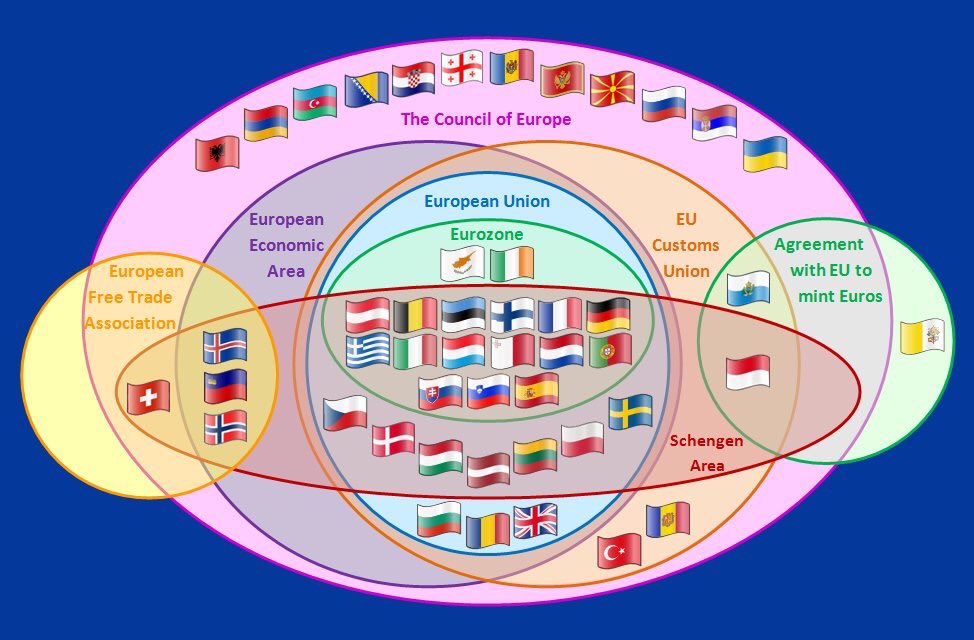
Now just add UEFA, EBU and Eurovision ;)
Correct. The way to refer to North and South American countries as a group is "the Americas".
Incidentally, the USA is the only country that has the word "America" as part of its official name.
Once a political unit gets too large things get weird. There exists an optimum complexity for political units for them to function effectively or you get fragmentation.
That's what's different monetary-policy-wise. California, for instance get's like 10 cents on the dollar back from its federal tax burden. Those 90 cents are used to shore up economically (and perhaps other kinds of) backward states like Mississippi. Nothing like this happened in the EU. Germany keeps a lions share of revenue and sends a tiny trickle back to the EU. This was never going to last long. Britain has probably only hastened the inevitable.
http://www.theatlantic.com/business/archive/2014/05/which-st...
Borders exist so the concept of freedom of movement is not absolute. Now, maybe that's a bad thing and we should abolish all borders all around the World. I feel that would be unreasonable though, but it's probably debatable.
The UK, little more than 10 years ago, was pro-immigration via EU in a way that seems inconceivable now. The UK's anti-immigration response today probably owes something to those decisions. Turns out those other EU countries knew a thing or two about immigration after all.
I feel like the EU has been becoming more of a ruling political power than just the trade regulator it began as. I think the recent increase in EU laws is what set this into motion. I agree that the EU is beneficial for trade, but I don't understand why they've started trying to make political moves impacting citizens day to day lives
Ironically, that might not be as easy as it sounds. Closing the borders works both ways.
Things that people used to call 'typically French/German/Italian/Spanish/Slovak/Greek' are increasingly seen as typically European. I can't back this statistically, but virtually all the people I met in my life who have lived in at least two EU countries think this way. I honestly can't think of a single person who I've known and thinks otherwise and I should know because this topic almost always comes in discussions when you get to know somebody.
Of course, there are some minor cultural differences, but these are not particularly larger than the ones found in the US, India, China, Brazil, or the Russian Federation for that matter.
Have you actually travelled in Europe? Germany is radically different from France; both are radically different from the UK, and let's not even start to talk about Eastern Europe.
The degree of deference to authority, the specifics of the rules of the road, the level of interference of governance - these things vary, but they're within a spectrum. Things go off the wall different outside Europe.
The difference in culture between the UK and other Northern European countries is often exagurated. Many say that the UK is more like the US. In my experience this really isn't true.
I think the problem with EU is primarily one of communication. The member states should do more to inform the public of what is going on in the EU, and EU should do more to avoid negotiations behind closed doors (because how can you ever trust a process like that?).
No, it's not mutually exclusive but the order matters. IMO American first see themselves as American while here a French guy will see him as French and then maybe European. That's the sentiment I'm referring to.
That is absolutely what the UK has never wanted from the EU. I would wager a good chunk of the Remain voters would have voted against a 'US of E'.
Wouldn't that be nice? Too bad no one stops to think about the rest of the world...
You don't have to be a fan of the bureaucratic EU but leaving was madness. They have now all the disadvantages and no advantage. The UK will likely have to pay MORE to the EU than before if they want to keep access to the EU market (see Norway who pays more per head already while not being a EU member).
"The City" will lose big time: https://www.bloomberg.com/view/articles/2016-03-16/london-co...
And the EU gets a chance to restructure. A good day for Europe and a bad day for the UK. Would be insane if Scotland and Northern Ireland now want to leave the UK.
Biggest Idiot of them all: Camerone. Wanting to leave the EU for years, then becoming an advocate of staying. He got what he asked for. At least he took the consequences. But all in all an idiot extraordinaire.
One of the larger vote swingers for Scotland staying part of the UK was that they would have had to renegotiate their membership with the EU from a weak position. Scotland overwhelmingly voted remain in the EU referendum last night, so arguably the SNP now have a valid mandate to hold another Scottish referendum on membership of the UK.
It's like they had a housemate they didn't really like, but who took them to all of the cool parties. Now they won't even get to go to the parties anymore, and I don't blame them for wanting to move out.
Arguably London is larger both in population and economy than Scotland and Wales combined, and also overwhelmingly voted remain. If there is a referendum on whether London should leave England, I know which way I'm voting..
The unskilled, or partially skilled working class in Britain had to compete with immigrants from poorer EU countries for jobs and the immigrants also drove down wage rates.
The leadership of the EU is able to dictate treaties to member countries, but the leadership (unlike the President of the US) is not elected by the people, but rather appointed by elites. In other words, the leadership of the EU had no mandate to govern by the electorate of the EU. This favored policies that favored elites, but not the working class.
The rise of Trump and of Sanders was caused by the Republican and Democratic political elites and media elites that ignored the suffering of the working class. Working class in the US has to compete with illegal immigrants for jobs while at the same time having their wages depressed.
It is against the law to hire illegal immigrants, but they are hired anyway.
Meanwhile firms are exporting jobs to Mexico, China etc.
Recently Carrier air conditioners closed a factory in Indiana and moved the jobs to Mexico. There is a video on youtube with the Carrier leadership acting terribly towards the factory workers in Indiana. Only Donald Trump spoke out against Carrier exporting jobs.
Trump may not be able to "fix" the problems, but at least he's not a member of the Republican or Democratic elites that simply ignore the plight of the working class.
The UK withdrawal from the EU was most about economics for the working class and lack of autonomy for voters. The situation was created by British political and media elite who by and large simply ignored the complaints of the working class.
PM Cameron had the hubris to call for the referendum because he that it was impossible that he would lose.
The EU leadership and the leadership of individual EU member countries need to start listening more to the citizens, the electorate and less to their clueless elites.
They need to take into account the job concerns of the working class in member countries instead of just ignoring them.
This is all probably because of a structural problem in the EU that makes it basically not a democratic institution elected by the people. If the EU has any chance of a successful union, they need to ensure that all leadership offices are elected, much as they are in the US.
http://www.boston.com/news/globe/ideas/articles/2007/08/05/t...
As long as you are white. They fixed that later with a few amendments. If you served a prison sentence you may have lost a few as well.
Seems like this inalienable rights can be taken away arbitrarily is what I'm saying.
Have you ever actually been to the US?
Maybe you'll visit some day and see what it's actually like!
UK was not part of Schengen. As such, it was always more difficult to go to/from the UK. Foreigners having a Schengen visa (work permit) still need an expensive Visa to go to UK.
Then there's the pound instead of having the Euro.
What was more easy is _permanently_ moving from UK to e.g. Spain (which happens a lot). Finding work in another EU country and being able to live there without too much hassle.
UK opting out of Schengen has nothing to do with it, EU citizens are visa-exempted and I as a European have traveled to the UK many times without a visa.
Please, after all the lies of the leave campaign, can we stop casually spreading utterly false information?
Ignorance is a terrible, terrible thing.
That is literally what i was saying.
Having to show ID or getting inspected doesn't violate the notion of free movement in the way that this term is used.
It's just that it's not commonly done in most modes of transport between most borders, e.g. cars between the Netherlands and Germany. But the UK is not alone in this, take the eurolines like I have half a dozen times (a bus network commonly used by poorer people, including poor immigrants) from e.g. the Netherlands to France and you're guaranteed to run into checkpoints. And if you've got the right ID for which there is freedom of movement, you're free to move.
This is not true. You obviously haven't travelled many times from UK to other european countries (or viceversa)...
At the same time, crossing the Channel tunnel or taking the Eurostar means having to get through border control, handing out your passport and sometimes, if they feel like it, having to answer questions on what you're going to do in the UK.
Taking the Eurostar from Brussels to Lille (because it's sometimes cheaper than a regular TGV, or because the timing is better) is even more bothersome because they get double suspicious that you only want to go to France instead of all the way to London.
One simple example, when you come back from an international trip to your native country you still need to go through the border even though you have freedom of movement there
Because even though you have the right, some people don't. And they only know which is which after you present your documents.
I guess the only case in when they can refuse entry is if you are wanted by police or something (or maybe not even then)
You have to embark and go through border checks 30 minutes before departure with Eurostar, that's a fact. Whether you will have to answer questions is very random and doesn't seem to depend on whether you give them a passport or just French ID. My wife has a Canadian passport and a French residency permit and this does make them ask more questions though.
Eurotunnel checks were lighter when I used to take it, but that was before the Calais crisis so I would guess it has become more bothersome lately.
In any case, you just can't say it's as easy as just hoping in your car and driving to Belgium and back to fetch your beer.
Schengen agreement mandates no border check, but the UK is not part of it, so of course they can have border check
I guess I misunderstood what was being talked about, but I was actually trying to make the point that movement between Shengen and the UK is different from movement within Shengen.
Specifically, I was answering to this exchange:
>> it was always more difficult to go to/from the UK
> This is not true.
by saying that it is actually more difficult to go to/from the UK. Which it is.
If I go to Indonesia for which I need a Visa on arrival, they asked me zero questions, nor said anything. I handed them the money, they gave the visa (etc), done.
For many countries I don't need a Visa for. Saying EU is freedom of movement, but then narrowly defining this something else is moving goal posts.
I have various foreign colleagues (non EU). They need a Visa to go to the UK. UK being part of EU or not does not make that much of a difference for them at all.
The effect is whether you can easily work in another EU country. But that is just one part of "freedom of movement".
Now try to enter LAX or JFK with your national ID and without a visa...
UK/Schengen and Schengen/Schengen are so close compared to EU/Rest of the world, that the differences are imperceptible.
But they are so much perceptible, when you live inside Shengen. Nobody says it is complicated (as an absolute) to go to the UK. But it is more complicated (as a comparison) than travelling within the EU. I don't even understand how that can even be in question.
Just saying that it very strongly depends on the person at border control at the airport and a lot of different circumstances, you can get pretty tight checks from EU to EU too.
The EU in my eyes should aspire, to what the US has achieved already, being a large region, composed of quite a lot of different states, which are united, so that there are no arbitrary geographic borders limiting the freedom and the rights of the individual. This is not always easy, and it means, that the richer parts have to give to the poorer, but that is just basic humanity.
Especially I am sad for the young generation in the UK. A very large part (about 75%) voted to stay in Europe, and this future is taken from them. I would guess no small part of them will try to move to the remaining EU states.