Al-Khwarizmi
In fact, you can almost prove it by bijective mapping to a subset. Almost all typical boy names have a feminine version (Juan->Juana, Carlos->Carla, Manuel->Manuela, Adrián->Adriana, and so on... there are some exceptions, but not many) while the opposite is not true, there are plenty of common girl names without masculine version (Carmen, Laura, Marta, Elena, and many others).
There are also papers doing the actual stats and concluding that girl names are more diverse. No idea what the reason is.
In other words, signatures don't address the fact that a human can ask an AI model for content and then sign it to pass it as their own.
Uploaders don't even get paid at all for views, it's just taking free labor and paywalling access to it, very similar to the infamous paid academic journals. But journals survive because they are an entrenched system that lives on prestige and hard-to-change academic bureaucracy. I really don't understand how Scribd, being an obvious scam and without those legacy advantages, can survive. I suppose hosting PDFs costs so little that a 0.001% of victims paying is enough to support it, but still, I don't understand why a free competitor hasn't come up to outrank it in searches and send it to oblivion where it belongs.
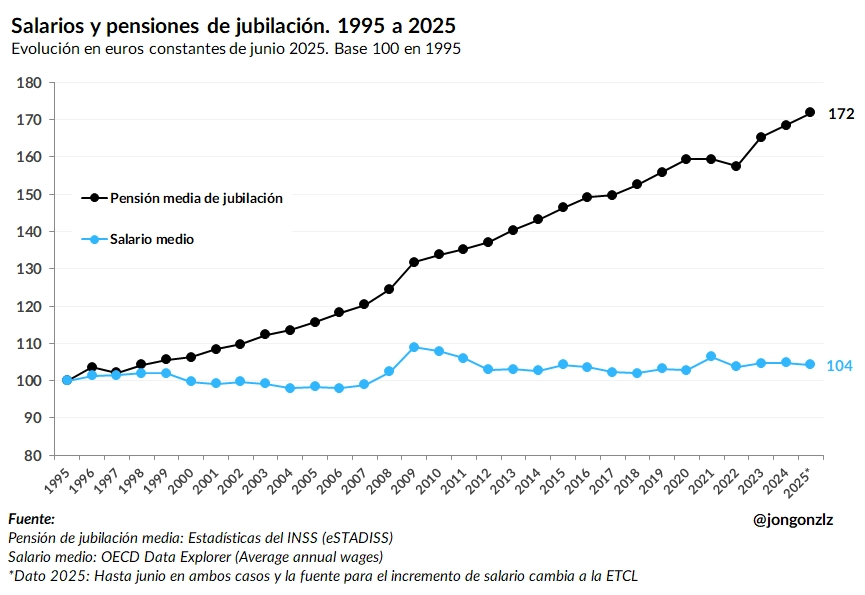
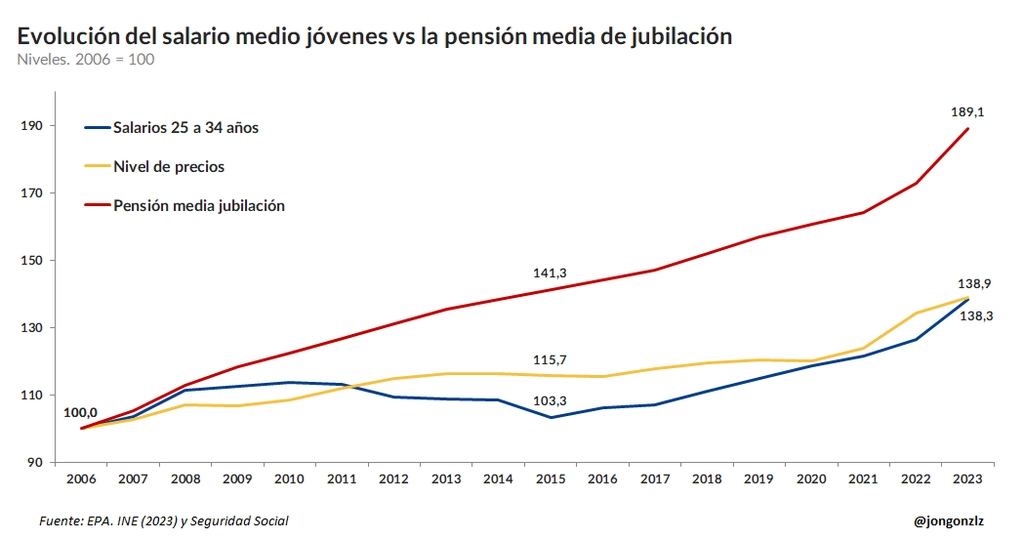
Check the charts above, pensions have been strictly updated with inflation in the last decades, while salaries (including both public salaries, fixed by the government, and private ones) haven't.
If salaries losing purchasing power haven't caused widespread riots, surely pensions doing the same wouldn't, and the impact on the budget would be noticeable. Of course, it would cause the party in government to lose votes, which is why it's not done.
https://elequidistante.github.io/graficos-jongonzlz/pensione...
https://elequidistante.github.io/graficos-jongonzlz/pensione...
https://elequidistante.github.io/graficos-jongonzlz/pensione...
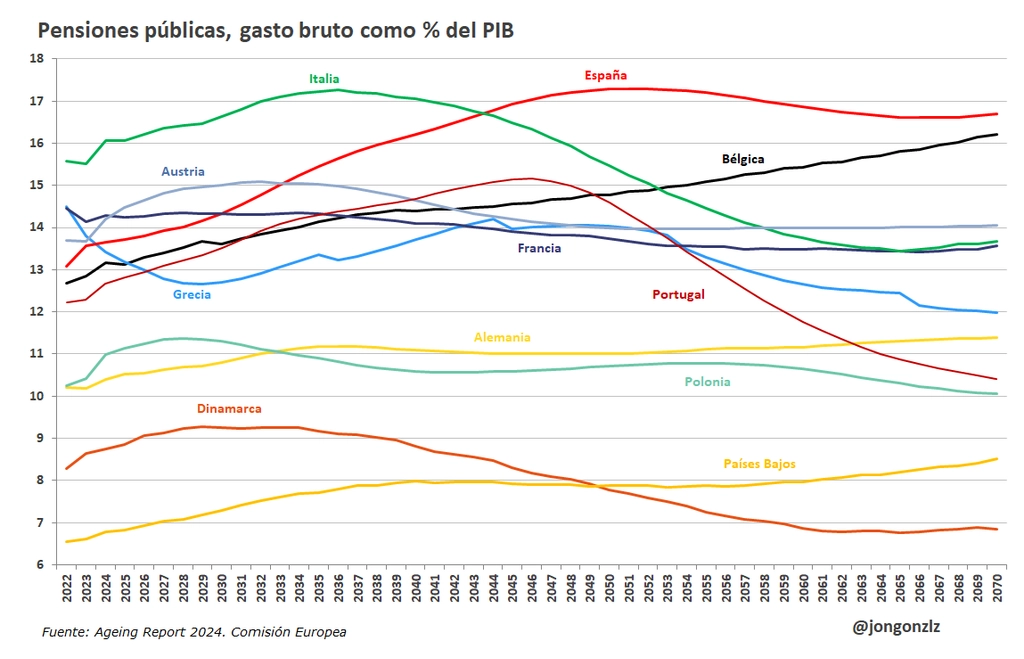
And maybe this is the most illustrative:
https://i.redd.it/uwvgxycxhjeg1.jpeg

So yes, the reason why we are underinvesting in pretty much everything is basically pensions. GDP is up, tax collection is up, debt to GDP is sligthly decreasing... but pension expenses keep growing at a fast pace so there's less and less money for everything else. And I say this with both of my parents earning the maximum pension, so I don't have an axe to grind, but it's just reality.
At one of my ancestral villages in Galicia, rabbit empanada is also a thing, and tastes amazing. But it's seen less and less often because it's messy to eat (it's cooked with bones so you have to open the empanada, remove the bones and close it again) so people tend to use fillings without that problem now. (You can cook it without the bones, there are also areas where they do that, but in that specific area they shun that variant).
So far, I haven't had pain in any of my teeth (I guess I would bite the bullet and go if I did). I'm not proud of my attitude and I fear some day my negligence may come home to roost. But on the other hand, I see other people who go to the dentist every year, and every year they seem to need treatment and have lots of cavities while if I have had any, they haven't had any practical consequences in 25 years, and I can't help but thinking "overall, am I sure that they are better off?"
Winamp hasn't aged so well, sadly.
Then MSN Messenger displaced it (at least in Spain) and it didn't have even 10% of ICQ's functionality.
Take the Condor Trilogy, for example. It's not even underground or punk, it's a major cultural touchstone. Written more than 50 years ago, over 300 million copies sold, dozens of TV and cinema adaptations. And as far as I know, only the first part has officially been translated into English, and nothing into Spanish. Even the TV adaptations, some of which had several hundred million viewers in China, haven't been published in the West: I have watched some with fan subtitles, but they haven't been brought officially as far as I know.
If even such major works don't reach us, judging Chinese culture by what does reach us is nonsense.
This exists and, from both my own experience and that of others, is not uncommon.
Considering this, I strongly believe that the ethical way to watch football in Spain is piracy. People who watch it legally are funding a mafia-like organization that harms society.
Of course, that doesn't say anything about the languages in general, there are also things where Spanish is less consistent. E.g. why do we say "la película es buena" but "el día está bueno"? I'm a native Spanish speaker and when asked by foreigners about a rule that would explain that, I've never been able to come up with one.
I'm learning Chinese and my feeling is that it's more consistent than both Spanish and English, things actually tend to make a lot of sense in Chinese. A pity that between the tones and the characters, it's much harder to learn than either of them.
If it's that unclear to me, I can't imagine how it can be to the average user.
The way they explain them is atrociously unclear, borderline negligent for services that nag people to activate it for accounts where they may hold valuable data for their personal lives. And while I don't want to spend much time finding out the details as long as I have the option to decline them, I suppose if they can't explain it and convince people of its advantages, it's because it's just bad tech.
Brilliant security: a highly secure high-tech shiny front door that can randomly fail to open, so you still need the low-tech back door, which is the one potential thieves will use.
Mind you, it can work if the back door is old but sturdy (basically, for a bank that will ask for KYC authentication, or in the worst case you can set foot in the brick-and-mortar branch showing your face and ID and ask for access) but for pretty much every other service it introduces risks for very little or no gain.
A specific example. The very same building developer completed these two buildings and offered the flats for sale more or less simultaneously, in the second half of last year IIRC.
Building 1. Renovated early 20th century building (originally built in 1923). Google Maps coordinates (the renovation is not yet visible in Google Maps): https://www.google.com/maps/@43.3621801,-8.4070271,11a,75y,2... Photos of the renovated building: https://ammapromocion.com/plaza-de-vigo/ Flats have 117 useful sqm and the middle flats were being offered at between 1.1M-1.2M €, and sold fast (you can still buy the 1st floor flat for 950K. But it's a 1st floor with a bar directly below, which reduces its value rather sharply. This is Spain, bars are noisy and open until late).
Building 2. Newly built. Google Maps coordinates (again, finished building not visible yet in Google Maps): https://www.google.com/maps/@43.3599669,-8.4061383,23a,75y,2... Photos of the finished building: https://ammapromocion.com/promocion-juan-florez/ Flats are different sizes, but some are only slightly smaller than in the other building - around 110 useful sqm. They were being offered for around 700K. They also sold fast.
The distance between both buildings according to Google Maps is 290 m, a 4-minute walk, so they are basically in the same neighborhood. You can argue that the new one is in a worse location because it has more traffic and the street is uglier, and it's true (although the other is in an area with many bars, so I think not everyone would prefer its location). Anyway, that kind of difference could be worth at most 50K in this market, being generous - and most likely more than fully offset by fact that the newly built flats include garage while the renovated ones don't have it! Anyhow, it definitely doesn't explain a 400K+ price difference.
It's just one concrete example, but I've seen many (I was recently looking for flats... finally I settled from one from the 1940s, building not renovated :)). Of course I don't know the trends outside my city, but at least here, fully renovated old buildings are the apex of the housing market.
Obviously no one likes having a small or no elevator, or poor insulation, but that's related to technological progress, not aesthetic trends. If we kept building in the traditional styles, we would obviously have incorporated this anyway.
In fact, at least in my (small) city, fully renovated old buildings (where the scale of facades, windows, etc. is old, but the floor slabs, insulation, elevator, etc. are brand new) are where the most expensive flats per m2 are. Considerably more than in new buildings.
BTW, Nike Pegasus is what I wear all the time :D
A rise in crude prices might pay off for a small country that lives almost exclusively off it (say, Saudi Arabia, in the hyphotetical case that it could keep exporting as normal) but for the US? I don't think it does. Surely, Europe is more exposed than the US and will suffer even more, but this is not a zero-sum game.
So I don't think it's an elaborate plan, it's just Trump being reckless as usual.
I get that maybe it's just the way it is, perhaps the underlying logic is so complex that it would be counterproductive to present it up front. I'm not saying that the theory should adapt to my pet peeves. But I'm very prone to learn things by understanding first principles and building from there. Having to memorize scales where suddenly you need to skip keys or use black keys without much apparent logic is a real deterrent for me considering it's something I learn as a hobby.
This is also the reason why I like algebra, calculus, etc. but dislike statistics... in algebra or calculus you start from first principles and work up from there understanding everything. In statistics (at least the way I was taught) you are shown the formula for the probability density of the Gaussian distribution and need to accept it as an act of faith.
My 7-year-old son (who by the way loves math) always wants to go there. I can't help but explain that the payoff is horrendous from any point of view, and he understands and doesn't argue against it, but he still insists. Sometimes I convince him by offering alternatives, but sometimes I have to cave because he seems to like it so much. But man, spending euros on that stings, I have the feeling that the people who run the stall must be laughing at all the suckers who fall into the trap.
Dictators are mortal and can't be present in the whole world 24/7 and self-replicate.
Dictators are human and tend to have at least either a sliver of morality or self-preservation instinct, and/or people around them who have it. Many people during the last century could have unleashed doom by pushing a nuclear button, including various ruthless dictators, but at the moment none have done so since Hiroshima and Nagasaki (not that I trust that they won't at some point, but at least, for the last 80 years they haven't, which means it's not something that easily happens). Would you give the button to an unaligned AI? Would an unaligned AI care about mutually assured destruction?
With this I'm not saying ASI will happen, but definitely if it does happen and it's not aligned, I don't find it much of a stretch to imagine that it could destroy humanity.