IkmoIkmo
In part I think we also have more time, life expectancy grew by about 7 years in the past 50 years. And our ability to have kids at a later age is growing with medical advances. Going to school for longer and getting kids later, makes sense in that context.
Anyway I think it’s a bit misleading to take particular ages and then compare percentages (e.g. 21yos with a kid in 1980 vs 2021) This way of presenting data can exaggerate the differences, average age of first kid would be better for example. I don’t know how to call this statistics phenomenon, but imagine the light blue area to be ‘kids in the house at 21yo’ and then imagine a minor shift in the average age of having the first kid, the resulting figure would seem much more pronounced than the minor shift in average age. Would’ve been nice to see the data presented differently.
Unlikely, plus there have been plenty of reasons to think otherwise. Just look at how the ministries are treating WOB/FOIA requests, frustrating the process, breaking every regulatory deadline and very willing to pay the silly fines for always being way late with taxpayer money. It’s a joke.
Besides, we have the toeslagenschandaal showing how civil servants are completely willing to screw over tens of thousands of civilians, driving people to divorces, bankruptcies, suicides, kids to foster homes etc. We NEED checks and balances, desperately so, also in the Netherlands. God knows what happens when we don’t. NL is relatively good, but it’s all relative, at the end of the day it’s a bunch of humans that will fuck up without good governance.
That may well be true, but it cannot in and of itself be a reason to decide to relax measures.
It's like saying the number of traffic accidents are low, thus we can abolish drivers licenses, speed limits, age limits on driving, alcohol limits on driving, seatbelts etc.
No: the measures (e.g. seatbelts) cause the good results (low traffic deaths). Simply looking at the good results can never in and of itself be a reason to remove the measures.
You'd want to evidence that the desirable results will remain without the measures, before removing the measures. e.g. if there's evidence that removing speeding limits does not impact traffic accidents/deaths, then you can remove the limit.
John Hopkins' sources do cover India, at 600k excess deaths (table at the bottom). Also covers China at just 4000 or so, clearly wrong. But it's not clear anymore which figures are right or wrong, as the table contains much of the exact same data as the Economist article on most other countries. Seems like there's a data consolidation happening in the background from many different sources, you'd have to review the methodologies of each yourself (or trust the news reporting to highlight doubts or margins of error, but if they report China without comment as having just 4000 excess death in ±2 years, you obviously can't do that).
Death is what the article covers. Impact would be the cost of the policy on everything else, e.g. mental health due to lockdowns, kids' learning falling behind due to lockdowns, bankruptcies and debt due to lockdowns etc.
Some countries were able to get the same results with fewer strict lockdown measures of other countries, those countries can be said to be more successful.
Of course one could correct for difficulty factor. That's a gray area. For example, do you include Japanese culture of masking and rule abidance? Depends on your perspective. But in any case, it's clear that countries with for example an average age of 18 like Nigeria, will be less impacted as a country like Italy, where the average person is 46. Knowing 50% of the population is almost over 50, make a big medical difference. Similarly, countries with high population density will do better than countries with little population density, etc.
There's a ton of these factors that determine 'difficulty factor'. As such it's hard to really say who did well and who didn't.
But no, Sweden wasn't a disaster. Australia and Germany did quite well, but Australia had some harsh measures that must be taken into account. Brazil indeed wasn't the worst of the bunch (although a top-25 spot is certainly not a good look, especially as only one other country in that list of 25 (Russia) has more absolute deaths, and outside the top 25 only the US has more, 600 thousand dead in Brazil is a disaster if you ask me, it's >10 years of homicides worth of death, in a country known for some of the worst gun violence and gang violence in the world.
When you do have a 4k TV and it's large enough, a PS5 can look a lot better. Especially versus the regular PS4 (rather than the PS4 Pro).
But historically the Playstations are known for upgrades every 6-7 years (from 1994 to 2000, to 2006, to 2013, to 2020), and then a support of about 3-4 years after, for a 10-year lifecycle.
The PS5 has been out for a year, making a PS5 exclusive at this time that's totally specialised for the hardware makes little sense. There's 14 million PS5s out there, and 115 million PS4s.
But the big games are in the pipeline that utilise the PS5 hardware specifically, and after a while these new games won't run on 4 anymore, or will, but will look a lot better on the 5 or be very slow on the 4.
Paying scalper prices makes no sense at the moment, but the PS5 will eventually take over the 4. If you can get one at retail prices, I'd rather have one sooner than later, if you're switching some day anyway. The loading-time improvements are quite nice.
This would be in a context of you having made a matter-of-fact accusation of sexual abuse of one of the 10 most powerful people in the country, that you recant only 5 weeks later as if it was some kind of metaphor that was misinterpreted.
You'd think in such a situation, you'd at least be prone to say, at most within a few days, to call a few media outlets to indeed show the world that you haven't been kidnapped but are instead just chilling at home. Not only every media outlet around the world was talking about this for weeks, but also Amnesty International, the Olympic Committee, the International Tennis Federation, the European Union, the president of the United States, the nr 1 world tennis player etc etc, are all commenting on your disappearance by the state...
Quite a weak attempt at propaganda.
To link this to corruption is a radical idea that requires proof.
https://www.yalemedicine.org/news/covid-vaccine-for-ages-5-t...
Then there's a public health discussion that goes beyond the individual. Even if a measure has no benefit to an individual, but large benefit to the public, and very rare side effects, it makes total sense from a public policy perspective to encourage the measure. Taxes for example are a direct negative measure for individuals, but a very beneficial public measure that will in turn indirectly benefits individuals. I'll grant you that you can argue against making measures mandatory that are negative to the individual but positive to the public, but to encourage it as a voluntary measure of course makes total sense, and that's all the CDC has so far done for ages 5-11.
Given the exponential pandemic potential of Covid-19, one cannot simply exclude entire groups of people (e.g. young people) from access to vaccines and also expect Covid-19 to be mitigated as a public health disaster. Nor can you in the case of excluding a large group (young people), expect new and more dangerous variants to stop popping up. That's a public health matter, which indirectly also translates to negative effects on children's lives, e.g. parents who are stick or die, parents who lose jobs/businesses/income, kids who need to be homeschooled and fall behind academically and socially etc. That is why it is crucial for there to be wide public access to vaccines for all who wish to take it, as long as it is safe. These vaccines were tested and were found to be safe. The data from the study is public, I haven't seen anyone credible argue otherwise.
It's not much different to teaching creationism in biology class next to evolutionary theory.
In this case it's not because of some big conspiracy, but simply because this type of reporting generates clicks and views much more so than inviting a bunch of medical researchers to present tables full of data on-air.
Japan's health ministry just reported a 15 per million, or 0.0015% risk of inflammation when taking Pfizer. This doesn't change their policy position, which is to recommend and urge as many people as possible to get the vaccine, as the risks of contracting covid and its effects far outweigh this 0.0015% sideeffect risk.
It's simply an average. People ride bikes in Amsterdam in their everyday clothes for work or going to a club., they're not looking to build up a sweat but to get from A to B. Recreational biking is a different story and typically brings people outside the city in less busy wide lanes across nature without traffic, stop signs or double-parked cars, where none of this is an issue.
The type of locks you'll typically find on bikes can be cut by $30 bolt cutters in about 5 seconds, which fit in a backpack, makes barely any sound, and you can bike away after. There's virtually no defence at night, police has to accidentally catch you in the act. If someone sees you, small chance they'll try to stop you over someone else's bike, especially at night when you're armed with a bolt cutter, and when they have no way to verify your story that 'it's my bike but I lost my keys'. If they call the cops they won't come, and if they do, will definitely not be in-time. And if they are, its a petty crime without real consequence, and the person will probably continue afterwards for quite some time.
Bike theft really is just quite shitty. The best you can do is make your bike less of an interesting target. There's typically lots of bikes around, if yours isn't the most expensive model and has two locks whereas other bikes have 1 lock, your bike is likely not going to be the one the thief picks.
And if you don't lock it to a fixed object, indeed it'll be susceptible to the bike gangs that just throw 20 locked bikes into a van at night and take the time unlocking them later.
I mean, I use a regular bike for 30 years in Amsterdam, I really don't think 2-3 hours of daily biking is the norm... There's 5 supermarkets and 5 gyms within a 5minute bike ride, including the ones I go to. My parents are 20min away, friends are typically 5-15min. It's really rare to spend more than an hour on my bike each day, even though I use it daily for just about everything in the city, I think it's an average of 20min a day the past years and about 50m if I wasn't working from home and biked to work (I work from home due to covid, but otherwise take the metro, not a fan of biking in a suit in rain half the year).
You can cut that by at about 30-40% if I had an electric bike, due to the speeds.
Going to Utrecht by bike is not really done, it'd be about two hours at the legally max speed (25km/h), and another 2h back. You'd typically take a train.
So 2-3 hours is really extreme. The Dutch average is just 16 minutes a day, by the way, Amsterdam won't be far off from that.
I think the issue is two-fold: 1) There's not much enforcement. Many units can be set to go say 32km/h with a software update. And speedbikes (which can look virtually the same) can go 45km/h, which require a helmet and must be on the car-road, but are often driven as regular e-bikes on bikelanes or the pavement.
2) The 25km/h really can be too fast, already. One must consider that in-city biking typically is done at say 9 to 15km/h, averaging 12km/h. The speed difference between an average cycler and his low (9) or higher-end (15) peers is typically about 3km/h. An e-bike going 25 changes the calculus, now the difference is 13km/h, or double the speed of the regular bike. And that creates a lot of issues. Overtaking is statistically the biggest source of accidents, and it happens way more frequently if the lane is shared by bikes going 12 and 25, rather than all averaging 12. And the act of overtaking is more dangerous too if it's done on a lane which has a large variance in speeds.
I'd love to see a limit of 20km/h, and a limit to 50% pedal assist, on bike infrastructure. That keeps the speed differences low, and it reinforces that one must bike, and put in effort.
Right now the experience as a biker is that you're sharing a lane with motorised electric scooters, going twice your speed, and doing it by essentially pressing a button.
I think electric motorised two-tire vehicles are still a great solution at 25 or 45km/h, but not regulated as bikes, but rather regulated as a scooter. That could mean having to wear a helmet, having to have a (light) license, a license-plate (to allow enforcement of rules), being 18+, riding on a separate lane with traffic going similar speeds.
Now the bicycle lanes are taken over by e-bikes going 25km/h and sometimes (illegally, as these must be on the car road) 'speedbikes' going 45 km/h.
It used to be that if you go say 12km/h, virtually every other bike will also go that speed +/- 3 k/m. With a speed difference of only 3km/h, that meant two things: 1) overtaking each other happens, but only every now and then. And (2) you only need to watch a few metres behind you before overtaking, because no bike in the bike-lane could overtake you from further away at such small speed differences.
Now with e-bikes going 25, you're sharing a lane with people who're on average going twice as fast as you. That means you're being overtaken constantly. It also means overtaking yourself requires much more thought and you need to look much further behind you.
Overtaking is statistically the area where most accidents happen, increasing the frequency so much is causing a lot of issues. Second, the 2x as high speeds increase the brake distance by a lot, requires much faster reaction times, and increases the force and damage upon accidents.
It's making me less prone to cycle, and for my parents its becoming outright dangerous to share the bike lane with bikes going 2-3x his speed. My dad broke his hip last year biking already.
I'm super enthusiastic about electric bikes, it makes a lot of sense on many levels. But I'm also a bit scared of what the future holds. In Amsterdam the shift from bikes to e-bikes I feel is turning a great situation for everyone, into an even better situation for some (young e-bike users without issues) and a horrible situation for others (young children, elderly, those who get caught up in accidents)
There's a reason that in recent years in Amsterdam gas-powered and electric scooters were taken off the bike lane and a mandatory helmet was introduced. Yet when recreating such a scooter similarly with some pedals, it circumvents the regulation.
Not easy, just easier.
Pinpointing those companies that see large growth in an old, competitive or low-margin industry, is a risk-indicator that allows you to filter out many companies and investigate only a few. Seeing that some are selling large fractions of palladium, is a risk-indicator.
Appearing at these companies with fake offers to sell palladium, can give insight.
Requiring source-of-scrap forms to be filled in, can give a paper-trail that either leads somewhere, or is obviously fake and leads nowhere. If that happens routinely, licenses could be revoked.
Don't get me wrong, none of this solves the issue and none of it is easy. It'll always be a cat and mouse game. AML regulations have shown to be quite ineffective at rooting out the problem, it's very much alive and kicking and perhaps even bigger than ever. Yet it seems also obvious that, much, much more money laundering would be happening in absence of any such regulations. Regulations can be helpful without solving the entire problem, if well designed (AML is very much a clusterfuck for example).
If you bet $10 on black and win straight away, earning $10, and go home with $20, and stay home for the rest of your life and never walk into a casino again, then yes, you won. But you're not really a gambler. You're actually the opposite of a gambler, one that never enters a casino again. Of course you gambled $10, but the amount is meaningless.
If instead you gambled a meaningful amount, say $50k, then indeed it'd be truly gambling something meaningful. But if you'd lose, you'd have to double it to $100k. If you lose that, $200k. It spirals out of control quickly if you're actually betting meaningful amounts.
And the amounts must be meaningful. After all, if you bet $10, lose a few and eventually win and go home with $80, the strategy requires you to never gamble again. If you come back because $80 isn't meaningful, you're really just starting over at a meaningful amount, that could make you win enough to never make you come back. But at that point, you're talking about significant risks (e.g. betting $50k and losing 4 coin unfavourable (47% / 53%) tosses in a row, and you've lost a total of $750k and need to risk losing another $800k to walk away with a profit of just $50k, by flipping another unfavourable coin toss)
If you were Jeff Bezos, of course you could bet a million and walk away with an eventual win before running out of money. But the amount of money isn't meaningful to Bezos. In the same way a kid with $40 of savings could bet $50 cents and walk away with 50 cents of profit by winning the 5th round. But that doesn't make any meaningful difference if it ends there. If the kid comes back to gamble, the strategy falls apart, as the house always wins in the end if people keep coming back.
And that's precisely why the strategy doesn't actually work for anyone. To win any meaningful amount, you'd have to bet a meaningful amount. And to do that, is incredibly risky as there's a good chance you'll run into your limit before you win. And even if you win, that experience will likely pull you back in to try to repeat it, the gambler mindset eventually will lose.
How quickly do you run into your own limit, and the limit of the casino? After all, the odds are against you.
Technical note: your final game winnings are never more than the first game winnings. That's why the first bet must be meaningful.
Say you bet $10 and lose, bet $20 and win, you made $10 profit. Say you lost the $20 too and bet $40, you again still made $10 as you made 80 - (10+20+40). Suppose you lost the $40 too, and the $80, and the $160, and the $320, and the $640, and now bet $1280 and win $2560... subtract 1280+640+320+160+80+40+20+10, and again, you only walked away with $10.
In other words, to walk away with something meaningful like $10k, you may end up having to wager 1.2 million after 7 coin toss losses.
Yes, a few things. For one, Germany isn't the richest in Europe. But that's besides the point.
Typically price to income measures not prices per person, but per household. After all, the average house isn't lived in by one person. particularly homes that are bought (average buyer is a family, or an investor renting to multiple people), leading to an income that's the sum of typically at least two adults.
Second, these figures are virtually always pre-tax.
Third, these figures often reference to price to income of buyers, depending on the study. The average income in the Netherlands for example is about 37k leading, 5.4x would for example get you to 200k. But the average income includes unemployed, students, retirees, disabled etc. The average salary of working individuals (i.e. the home-buying population) is substantially higher, particularly if you filter out the population which is eligible for cheap subsidised social housing (about 1/3rd of all housing stock in the Netherlands). At that point you get to >50k salaries, with families of two earners often bringing in 100k and able to afford 540k homes at price to income levels of 5.4x.
Fourth, interest rates in certain EU countries is substantially lower than in the US. I just bought a house at sub 1.5% rates (Netherlands), about half of what you see in the US. Denmark had negative rates, I believe. This pushes up the max mortgage / home price to higher figures than the US, at the same monthly fees (and thus same affordability). In that sense it's not any cheaper per se, once you figure in that the US has more expensive financing costs than some EU countries, including Germany.
Fifth, the average buyer isn't a 25 year old fresh from college with a new job, but instead actually 45 years old. In fact, the average buyer isn't a first-time buyer, but has bought and sold a home before and has some equity, some savings, a retirement fund, perhaps a small inheritance from his parents, buying with a partner in the same situation. In other words, people are typically bringing in quite a bit of equity and are able to afford more than they can borrow.
That's not entirely clear. In terms of births it's correct, but at any point in time there's millions of people ready to migrate to wealthy countries if they'd let them, and these countries spend billions a year on all kinds of measures to (except for some), keep most of them out.
At the moment it looks like most rich countries such as US/Canada, western-europe etc, will keep growing due to migration from places with birth surplus.
Apart from that, we're seeing substantial increases in housing demand simply from preferences alone.
The number of single-person households grew by 7x while the population grew by 2x since 1960, for example. The household size (persons) has halved despite household size (square foot) having doubled. Even if we had fewer people, we'd still want to live larger and share our homes with fewer people. That's directly linked to fewer marriages/children etc. In that sense, the drop in births is also correlated with an increase in single-person households and fewer people sharing a home, increasing housing demand, and at least partially compensating the smaller population.
In other words, I doubt we'll be seeing any drastic price drops from this demographic change alone, there's too many other factors, some of which correlate in the opposite direction.
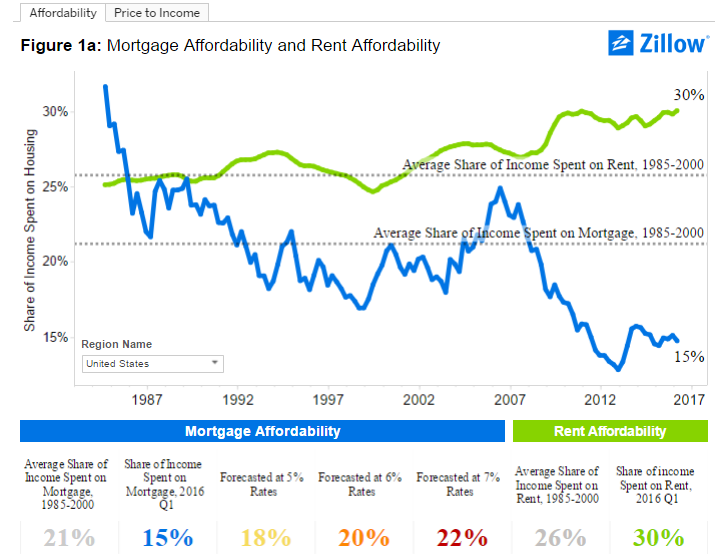
A much easier way to look at this entire discussion is simply to look at monthly fees as a percentage of income. The main fees to look at are either fees to rent the home directly (rent), or fees to rent the money to buy the home (interest rates).
Rent in particular is increasing as a percentage of income, but it's much less crazy than some people seem to think. For interest rates it's even been dropping despite increasing home prices. [0] I'm definitely not seeing any data that indicates exponential decreasing affordability which is what we should care about.
[0] http://www.doctorhousingbubble.com/wp-content/uploads/2016/0...
Enough has been said about the projects in general already which mostly mimics the game (not solving a real user problem, late-entry, competing with existing solutions, no marketing)
The other measures proposed (forcing railroads, national guards etc) are of course of a different order, but it's not clear they'd be necessary if the build-up of empty chassis at the port (because offloading in the nearby area wasn't allowed) never materialised into a massive bottleneck, because zoning laws were deregulated.
But there's no pretense around gold as having technological uses that require it to have a certain price, or that drive its price due to the technological demand for gold, in a way that people keep claiming for bitcoin tokens. Gold is used in tech applications, but it's not what is generally driving its price.
But insofar as you do want to look at gold's uses, it's pretty easy to link them to KPIs as they benefit end-users/consumers/companies in electronics, jewellery, space, medicine/dentistry.
The fact the responses so far are all comparing bitcoin to gold or dollars as a store of value, not as a medium of exchange, and not as a token or ledger that's useful for anything else (e.g. a notary function, or an open-source finance platform used by most tech companies to exchange value like the internet protocol or email protocol was for exchange of information), seems to me that crypto is not very interesting anymore for entrepreneurs, technologists, developers, users etc.
But rather, that it's just an asset class, one that's highly speculative and volatile vis-a-vis comparisons like gold. Interesting for investors, but not users. Just like gold.
* put differently: The internet protocol is driving just about every digital tech company. From Facebook to Netflix to Google to Apple. Bitcoin was aiming to be the digital money protocol, but it's not driving the financial infrastructure for any companies or end-users apart from those in a speculative sense.
And that's okay, if it's just a store of value / asset class like gold, but then it should loose that pretence.
I don't personally, I don't use or own it anymore. Could you explain more about your uses?
> I know I do, for a fairly large number of reasons, many of which revolve around "protecting value".
Protecting value seems (without knowing more) to imply a circular reasoning: the price going up protects the value of the token, that's why it's useful. But that's a speculative reason, no different from the price of a tulip bulb going up, has value because it protects the value of a tulip bulb.
I'm almost certainly misreading you but I'm just speculating as you haven't expanded on the large number of reasons you mentioned.
But I'd say that perhaps it's not the best comparison. Few people are looking to purchase dollars for the sake of holding them as an investment. There's of course tons of volume on Forex markets for hedging and speculation, but regular citizens aren't looking to purchase dollars for investments, i.e. in order to generate a return on dollars-held.
Typically people use dollars as a medium of exchange and the way in which prices are commonly expressed. But anyone with sufficient dollars will want to use them to hold assets, whether they're a home, stocks, or simply low-risk treasury bonds, the idea is that dollars give access to these assets, but few are looking to simply buy and hold as many dollaras as they can in order to generate some kind of a return.
Bitcoin is also a technology in a way that the dollar isn't. The dollar is an idea, backed up by lots of different technologies both analog or digital. Those technologies don't necessarily have much to do with the price of the dollar. Nor do dollars have to have a certain price for them to be used, in a way that for many years, people expected individual bitcoins to be value (and thus naturally to go up in price as demand for these tokens went up) because the tokens would be used in various technological applications... That hasn't materialised, which makes the increasing value of the tokens somewhat non-sensical.
When you want to value an organisation or company, it makes sense to look at these KPIs. They could be purely financial, e.g. profits, revenue, margins. Or they could be more fundamental, number of users, or rather, number of times a person has benefitted (e.g. # of one-night stands or relationships that Tinder generated).
What are these KPIs or metrics for bitcoin, that can tell us it has value, beyond the speculative?
When I invested in bitcoin in 2013, there was a lot of work to get user-adoption. It was seen as the way forward, also to create a return on your investment. we used to track numbers on # of wallets, # of daily transactions, # of merchants accepting bitcoin, # of volume on exchanges. Over time it began harder to differentiate true numbers from fake numbers, e.g. exchanges became notorious for faking transaction volume as a marketing tool. But overal, the general idea was that after 2015 or so, the number of real-world transactions and active (non-zero volume) merchants either declined, or in later years at least was not growing at remotely the same rates as the price of bitcoin.
Whereas I used to use bitcoin for various things and saw others do it, too, today I can hardly point to a single person or company which has utilised bitcoin in a way that isn't speculative. There's no positive KPI or metric that I can point to, except speculative ones (e.g. price).
If I survey my friends, the only reason they give to buy bitcoin, is that there's an expectation the price will keep going up. Yet, the work on user-adoption of bitcoin (i.e., real-world usage, not merely investing) seems like it's not at all part of anyone's calculus.
That's the reason I sold all my bitcoin some time ago. Although I would not at all be surprised that the price will keep growing, I can forgive myself and justify me having sold. But if the price falls it'd be entirely reasonable, and I wouldn't be able to justify my choice not to sell.
There is obvious real technology here in having a database/ledger that's not under control of 1 centralised party. But a decade later I'm not seeing anyone exploit that value outside of the speculative investment side.
Btw, I believe there's potential long-term value in bitcoin merely as a store of value, a digital gold. But right now there's still a pretense of something more. Second, the store of value ideal only applies to one coin, not the trillion other crypto variants. And it requires trust and faith (over decades/centuries) in one particular fork of Bitcoin. There's only one chemical that's pure gold, but one could create infinitely many bitcoin forks.