Those only really work if the opportunities are there for the person to succeed. If you have no hope of success, then people just give up.
But it's impossible if the will to work isn't there, and the only way to get that will is to instill a good work ethic and proper, family-oriented goals.
Minimum wage workers can't afford rent anywhere in America. There's no stability to be found for low-paid workers.
https://www.cnn.com/2021/07/15/homes/rent-affordability-mini...
There are no minimum wage jobs where I live anymore, and I live in a lower cost of living area (not Manhattan or silicon valley, LOL). I'm not surprised no one can afford rent at $7/hr when no one can find a job paying $7/hr. Costco has a sign up paying $19/hr to empty trash cans and they can't hire people at that low of pay and the article claims its a tragedy that a middle tier single bedroom would take $21 as a nationwide average; although I live in a lower cost of living area.
The government "Fair Market Rent" is sort of median quality housing. If the goal is to demand that even people at the literal bottom of the barrel of income in the 0-th percentile live in 50th percentile housing, then who will live in the 0th to 50th percentile of housing. A goal of having the lowest percentile in any group meet median achievements is inherently impossible.
There does not seem to be any actionable plan proposed; to me its obvious that raising the legal minimum wage from $7 to perhaps $8 will not improve anything if the absolute bottom of the barrel of jobs in low paying areas is already $19/hr AND there is no supply so there are unfilled jobs. Another obvious proposal is building more housing to crash the price, and the ownership class is not going to tolerate that behavior LOL.
As a thought experiment, if the living conditions are indeed unlivable as the guilt inducing article proposes, fine, lets run with that theory that its true nobody can live that way, then how are so many people living that way?
I am getting really tired of people casually talking about jobs like this as if they are easy. Do they require a ton of professional knowledge or skills? Nope. Are they way harder than your job? In all likelihood.
I mean, all the proof you need is literally in the fact that Costco can't find workers willing to do the job for that wage. The conditions suck for how hard the job is.
Employers were saying they're desperate to hire, and there are plenty of people applying and not getting hired. It makes no sense. I hear more and more of these mismatched supply-demand anecdata. I can only conclude that there are not honest conversations around hiring; that is, the real requirement for the job is not being conveyed, or at least written down or said out loud. Like you said, if an employer such as Tim Horton has a desperate need for labor but is turning down large number of applicants, the labor being asked for is not being proffered at the wage being paid, and the alternative (not filling the position and then complaining that you can't help) is better than hiring. That is the only reasonable conclusion I can draw.
Yes, I admit elderly living in nursing homes do have hired help empty their trash cans.
Is it a sign of society collapse that one-armed individuals and those lacking any upper body strength cannot live in the lap of luxury? Nah, they go be cashiers at the same store. Well, whatabout those too dumb to make change but too smart to get SSDI disability? Whataboutism has become tiresome and as such is no longer effective propaganda.
There are a variety of issues and possible improvements to help the situation, not just the two you mentioned.
And no, McD does not pay $10/hr, I live in a low cost of living area away from the coasts and the sign on the door opposite my grocery store lists $15/hr right next to the sign that they're cutting hours due to lack of employees. On the coasts I'm sure its higher although cost of living is probably higher.
I'm in Australia, so the numbers are approximately similar, our minimum wage is $20.33 an hour, our public health care system had been eroded by successive governments, and never included non-emergency dental so you probably want to spend around $40 to $60 or more a week on health insurance.
No one on $19 an hour is buying houses.
If your minimum wage is $7 an hour, but the lowest paying job currently advertised is $19 an hour, let's just call the effective minimum wage $19 an hour, and base or assumptions off that.
Many people are living that way, sure, but, man, both the USA and Australia have turned to shit. Fuck being a young person today without the good fortune of being born with good genes in to a good family. People can't find places to rent even in the small city I live in, families are living out of their cars, or in tents under bridges.
In Australian! It's not like we're short on land, or wealth.
Home ownership was never universal in the US. It has been within a few percent of 65% since the 1960s[1]. It was always out of reach for the lowest earners, like those that make minimum wage.
https://en.wikipedia.org/wiki/Home-ownership_in_the_United_S...

But it's also a matter of perspective. Here's a few additional perspectives, none of them the whole answer. But possibly provide insights and even hope for those who are most motivated.
Creating a house is a huge achievement, if you had to build it, and it's components, yourself, you would spend decades building a modern style house. It's unrealistic to expect that everyone can get this easily and early in life. Our mortgage system allows people to own earlier while paying it off to make that possible, but otherwise this is something that only a skilled person after decades of work would achieve.
Minimum wage isn't expected to be the maximum income achievement for someone who works hard, the idea is to find a niche where you can make more than minimum wage. This takes time of hard work, but it's patently still very possible in Australia, and much harder in many other countries overseas.
People who bought houses in the past had it easier in some ways, but lived a much much more basic standard of life. If you talk to average (ie not wealthy) people who bought houses from 50 to 20 years ago, it was incredibly hard for them, and involved sacrifice of pretty much everything to the mortgage for a decade of their life, while working hard and supporting a family. No overseas holidays, computers phones and entertainment, paying for kids sports programs, home delivery of meals etc etc. The standard of entitlement has raised incredibly decade on decade - in the past it was Expected to sacrifice to afford a home.
Some people still, despite the challenges were buying homes on minimum wage jobs in the last decade, before the current waves of price rises, and some probably are still buying now. But those people who did structured their life in a way to reduce every expense and save then buy modest places, away from conveniences and lifestyle areas. Similar sorts of sacrifices that people of the past would have done, just they are living in an era of inflated lifestyle expectations so they socially making more sacrifices even if the actual physical sacrifices are less in that they e.g. still have a phone and more entertainment than the past.
In my country the houses in the villages used to be built with local materials by the owners themselves, with some help from family and neighbors. The vast majority were very small even if the families were large but it didn't take decades or even many years to build them. Now houses are larger and built by dedicated teams or companies, families smaller and many moved into towns where they live in an apartment building. Most people I know, younger or older, either live in apartment buildings or they live in house in a village near the town, because owning a house in the town is terribly expensive. Either way, they are paying for the place with credit or they are renting. For many people, owning a home means paying rates 20 to 30 years.
So if you are 20 and feel entitled to a 5 bedroom house in one of the best areas the people who educated you did a poor job. B
Second, for some reason I believe the propaganda that city living is inherently less costly despite it being pricier everywhere in the USA, so I believe rich city liberals need to change zoning to allow cheap housing to be built.
Finally, they're living that way by getting ostensibly making minimum wage, but with so high of commuting time and cost as to be making less per hour but working more than 40. Or by living in miserable conditions: in an RV, 8 people to a 3-bedroom house, etc
The BLS data was only tracking federal minimum. I would like to the state minimum wage earners, but that wasn't in that report.
"so I believe rich city liberals need to change zoning to allow cheap housing to be built."
I believe it's all due to preferences. The preference for sfh, preference for better schools, preference for low crime, etc. It's pretty cheap to live in many north Philly neighborhoods. Many people don't want to.
I agree with the final part. I turned down jobs in college due to the commute cost.
They'd like their kids to go to school without bad influences. You can't watch your kids 24/7 so choosing the kind of people they'll be around is one of the few levers you have as a parent.
Now, if we had a national ethos/culture which the government was empowered to enforce (like Denmark, Japan, etc) then it doesn't matter as much which neighborhood you live in. But living in North Philly is basically dooming your children, what we might call "intergenerational poverty".
Meanwhile men will work full time in order to maintain such a noble society. Being a man and not working would be a crime.
Leaders would be appointed only amongst females because men are oppressive and violent.
I have a job as a dev and even I'm tired of this treadmill. Taxes, COL, healthcare, etc. No time/money to do the things I want. No real career, just a job. Lies and discrimination at work. I don't blame others for giving up when their circumstances might mean that's the best option for them.
There’s a ton of really good blue collar jobs, often where you are your own boss. Unfortunately, society is pushing everyone to college.
Many trades here in Australia spent two decades employing apprentices in insufficient numbers, for whatever reasons, to meet projected requirements.
Now we have insufficient tradespeople to meet demand, blowing out wait times to things like "not gonna happen this year mate" to repair a roof, and 7 months to fabricate new windows. The builders, roofers, and glaziers that do exist would prefer to work on green fields developments where they can do the same thing 50 times without moving their tools and equipment further than next door, so prices on minor repairs to existing houses have increased by a factor of "don't want the work, multiple the cost by five and quote at that" and that capacity is being eaten up by people borrowing $700,000 to fully renovate.
It doesn't help that the building and fabrication trades have been run almost entirely by obnoxiously unbearable pricks, and when you spend twenty years telling everyone bullying isn't ok, is it any wonder young people don't want to do physically demanding work in terrible conditions working with obnoxiously unbearable pricks? When it's -10 degrees C outside, it's minus -10 in your work environment, when it's 40 plus degrees C it's 40 plus degrees in your work environment, and people rarely make big changes to themselves, so here we are.
At the same time the common alternatives of computer games and tiktok aren't going to build much of a future.
Then for those that are motivated or smart there's plenty of other pathways in Australia today.
I would quit my job today if I could make $100k
To suggest people just do the thing that makes them money highlights another problem if you ask me.
Your comment suggests that it's not opportunities that have been lost in recent decades, it's that the younger generations' expectations for what life owes them have changed.
That's not necessarily a bad thing, to a point. But it's not accurate to claim that the lack of dream jobs out there means that there are fewer opportunities for gainful employment than in generations prior.
Yes it's beyond possible, it's clear that's the case, otherwise there wouldn't be a shortage of plumbers given they can make money to live or even raise a family on.
But the sense of expectation has grown way beyond that, everyone wants to be an actor so they spend their time on tiktok, which is a winners market, and then the leftover masses that didn't build skills or work ethic complain about having to start at the bottom of the more 'realworld' pathways available.
For most of human history people just did what made them money to live, and were glad if they have the chance to do just that. Go and spend six months in a third world country and you will see this is true.
It does not negate the fact that there are high paying jobs available without college degrees.
How would this be doable?
Here's an alternative: everyone is responsible for himself, society is responsible only for the ill end disabled. Everyone is provided with a framework that enables him to learn, work and find himself a way to live and fulfill his wishes.
A problem that doesn't exist. Plenty of that work out there.
Try to get a custom 3-phase power line run in the datacenter. Average age of electricians is about 55 around here. Nobody goes into the trades because the trades will "destroy your body before you're 35" yet all the thin healthy tradesmen around here are mid-50s boomers. Hmm. The union local total compensation package for mere journeymen is a hair over $65/hr because of mandatory health care and retirement extras that most people can only dream of, but even the takehome pay alone is still over $45/hr. On one hand that's only about twice what you'd get for emptying trash cans at Costco. On the other hand, you don't have to empty trash cans at costco AND you get a cooler more interesting job. Either way that power line isn't going to install itself.
The real mystery is all it takes to be an electrician is ambition, low time preference, agency, self discipline, motivation, concentration and study, and especially staying away from drugs, so how do you find people like that in a culture that glorifies the opposite and vilifies those values? Well, you don't ... thus they end up very unsuccessful in life and my power line ends up not installed.
If doing what you are told leaves you unsuccessful, maybe time to start distrusting those people when they give life advice. That's going to be the real turmoil and rebellion point in the next decade. "We were promised all our lives that self destructive behavior and self destructive beliefs would lead to a pleasant mirage."
If I could be reasonably expected to make that in my area (Philly region), then that sounds great and is substantially more than I make as a dev.
Im not saying it is the best job in the region, just demonstrate that blue collar jobs can still provide a comfortable living with such salaries.
I would expect it to scale by regional COL.
We know very different electricians ;). But seriously, I wonder how much of the 'conservatives are uneducated!' trope that gets thrown around in conversations like this is due to conservatives in high school placing a higher value on providing for a family, doing the math, and consequently getting into the trades rather than university.
I just wanted to point out that this is quite literally textbook survivorship bias. Instead of looking around and talking to the people that made it that far, you should try talking to those that didn't.
Maybe you mean both non-college work and non-skilled work?
Then one has to weigh if the job is worth it. With the high cost of modern living (shelter, taxes, healthcare) one might decide it's better not to work and just rely on assistance programs (I know someone like that).
Edit: I agree with the replies and I’m not one for shirking personal responsibility to change your lot in life, nor not instilling an eye for opportunity in children. We are at a point where more may be necessary
Even still, it's best to teach kids that they have more say than any other individual about their own future, and that anything is possible. If you must teach them that the world is hostile, you must also teach them how to beat it. You wouldn't refrain from teaching them tiger evasion just because the tiger is probably going to get them.
20% of children in the bottom quintile dont graduate highschool.[2]
8% of men born into the bottom quintile are currently incarcerated.[3]
The traditional advice to children for how to be in the 60% that escape poverty is still true. Stay in highschool, stay away from drugs and crime, and go to college if possible. If poor children can do this, their chances of improving are actually quite good and not at all hopeless.
https://www.heritage.org/sites/default/files/~/media/images/...
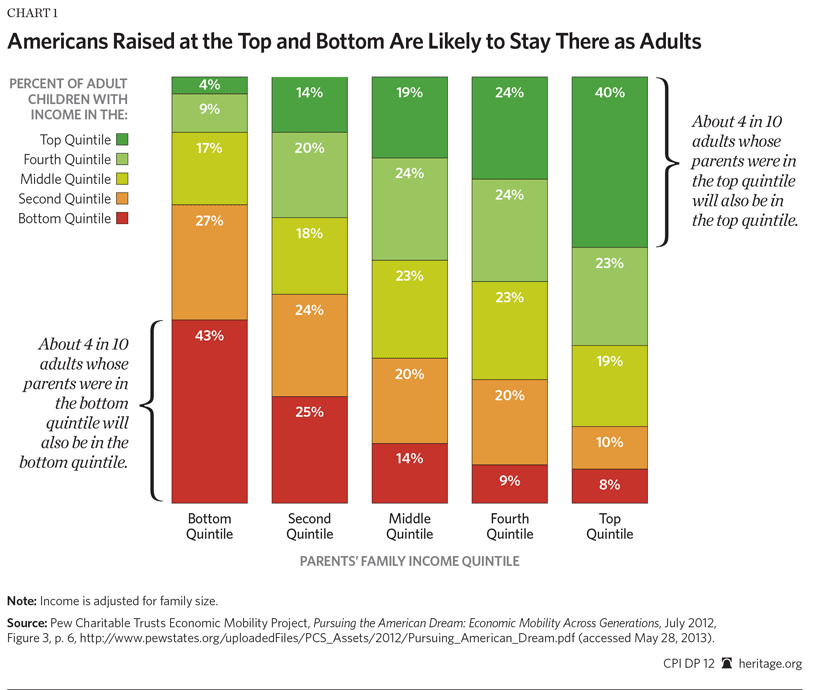
https://www.researchgate.net/figure/High-school-graduation-r...
https://www.brookings.edu/wp-content/uploads/2018/03/es_2018...
Edit: you edited your post to be more than just a link
You’ve provided some good research. Still I wonder how quickly it becomes outdated in today’s world.
Or you think its better to evade temporary failure by embracing permanent failure?
20% of children in the bottom quintile dont graduate highschool.[2]
8% of men born into the bottom quintile are currently incarcerated.[3]
The traditional advice to children for how to be in the 60% that escape poverty is still true. Stay in highschool, stay away from drugs and crime, and go to college if possible. If poor children can do this, their chances of improving are actually quite good and not at all hopeless.
https://www.heritage.org/sites/default/files/~/media/images/...
https://www.researchgate.net/figure/High-school-graduation-r...
https://www.brookings.edu/wp-content/uploads/2018/03/es_2018...
Success doesn't come from hope. It comes from hard work and fighting every day for something better.
Luck might help, but is neither required nor enough for success.
I was from a poor background and fighting for a better future was the only thing that brought me some kind of success.
Society has tried to influence me that money, wealth, status, career are beneficial.
I was raised middle class.
But I’ve never quite seen the point in all of it.
All it’s really led to is a lifetime of beating myself up and asking what’s “wrong” with me.
So I’m not sure more expectations and guilt is the answer.
It’s hard to see how that would have done anything more for me.
Émile Durkheim basically introduced the discipline of sociology with his study of suicide. He found that the ratio of suicide was higher among protestants than among catholics, and concluded that it was because they were less embedded in strict norms, and freer to do whatever they pleased, compared to the stronger social control among catholics. So, freedom turned out to be not necessarily a good thing.
(He also found that suicide is higher in times of peace than in war.)
Not sure how the theory held up, and what modern sociologists say about it. But that result stuck in my head, and it aligns with your experience and the article.
"Durkheim explores the differing suicide rates among Protestants and Catholics, arguing that stronger social control among Catholics results in lower suicide rates. According to Durkheim, Catholic society has normal levels of integration while Protestant society has low levels.
This interpretation has been contested. Durkheim may have over-generalized. He took most of his data from earlier researchers, notably Adolph Wagner and Henry Morselli, but they had been more careful in generalizing from their data. Indeed, later researchers found that the Protestant–Catholic differences in suicide seemed to be limited to German-speaking Europe, thus suggesting a need to account for other contributing factors."
Interesting, I'm from a catholic country and my characterisation of those two religions is basically opposite. Chill and rules-skirting catholics (Poles, Italians) vs uptight and law-abiding protestants (Englishmen, Scandinavians etc.).
I would argue that strict norms - if they don't come into contradiction with what is natural and proven in time as beneficial - might imply more freedom than some kinds of "freedoms" or "rights" imposed by force if those "freedoms" or "rights" come into contradiction with the natural way societies and civilizations evolved.
I don’t think it’s fair to call all these guys incels. As the article observes, most just have no expectations placed on them, and also have no way of attaining dignity and social worth through the avenues in life reasonably available to them.
It is Sunday morning. That means a lot of people are at church (and who is might be related to the demographic observation you've made). Is the message they're hearing one of hope or despair? Or are they not even listening? I'm not going to blame everything on religion, as tempting as that is, but for a non-trivial minority that might be part of who feels included or excluded and why they react as they do.
Despair. The average age at most churches now seems to be 80+, and those who are younger are there to support their older relatives. There is no chatting or mingling. Once the service is over it is time to begin the process of loading grandma back into the car. What I see of single people at church is the exhaustion common to all caregivers.
What do you attribute this to? Is it mostly just lifestyle choice? Or would most of them prefer to have a wife/gf but don't have one for whatever reason?
Is that true in the enlisted ranks, as well, I wonder? I believe that I saw you mentioned in another comment that you were talking about officers.
Anyway, I can tell you from experience that 20 years ago, around the bases I was stationed at, it was definitely still happening. We went out on the weekends, we partied hard, we hooked up, dated, some of them even got married, etc., with local girls from bars and clubs.
In the 40s, what did a young man have as far as entertainment options? Books, theaters, cigars, racing his motor vehicle with friends, going to horse races, hanging out in bars, finding a public telephone box to call someone, etc.
In the 80s, 40 years later, you had all of the above, as well as basic 8-bit arcade machines (more social because of the high score aspect, going to the arcade with friends etc), then the advent of the IBM PC and cohorts (yes HN I'm skipping the PCs that beat IBM's product to market, hand wave with me please) which enabled computer games with interactive stories and explorations, as well as home media and basic, basic internet connectivity (BBS, Usenet etc.)
40 years later in 2020, we have all of the above plus social media, greater fidelity movies, television shows streamed on demand, the interactivity of the web has made itself available in our pockets in the form of smartphones, smart watches, and tablets, we have virtual reality headsets for even more immersive UX, and all of this is before said social media platforms and app makers started their algorithm iterations in earnest to increase engagement and maximize distraction/user attention time.
In the span of 80 years time we haven't gotten less social by nature, but the sheer amount of engaging dopamine hits we can get from entertainment has gone way up versus ye olde library book or baseball game, so the boredom factor that pushed us to hang out with friends and eventually pair up with someone special is much lessened.
I think even media has evolved to become less useful for meeting people. Of course because of the technology shift from simultaneous viewing/broadcast to on-demand.
Watching movies at the cinema -> you can/want to go with friends. Watching netflix -> you can't watch with anyone except a close partner, because everyone has their own progress point to continue from in whatever series they are watching.
I believe many relationship form after you get to know someone casually over time (classmates, church members) but many people, myself include, stopped going to classes after college and don't go to church.
That leaves at best dating sites but dating sites are super awkward because instead of getting to know someone first, like the examples above, you're instead in a situation where you're supposed to decide yes or no immediately ("do you want to date me?").
uh? by who and why? it's just meme that has various meanings
You probably mean stereotype.
Something which requires luck to achieve is by definition unachievable by most. Something which requires good fortune could, in a better world, be had by all.
That's true only for people who play the same game, the same time. But life is a series of countless games, so both the law of probabilities and observation of people around make me think that nobody can be unlucky forever.
Having luck and taking advantage of that luck are different things.
Winning the lottery is both lucky and fortunate, while winning Wimbledon is only fortunate.
Not sure how much the dictionaries agree.
The vast majority of people have more quotidian difficulties. The fact that liberal tabloids and influencers are eager to refer to rich and famous men as "incels" when they obviously can't be reveals that the word is just an insult in many cases, not a product of a serious analysis of society.
I would lovingly and determinedly bully those who are so weak that they can't face the reality of bad conditions and their own inadequacies, those who show an emotional need to behave like they (just as they are) merit a sexual partner, and this not happening means women are evil scheming monsters who conspire to ruin the world and must be stopped and/or reduced to Gorean slavery for their own good as they're not really people. I'd bully those incels all day long. They are harming themselves by their own stubbornly held rationalizations and need to cut it out.
Properly having a sexual relationship means having a relationship, very likely with an opposite-sex partner if we're talking hetero incels, and it's not easy. I'm with a woman who is observably smarter than me and I'm a techie nerd. There are things we have in common, but there are also ways that we just don't operate the same. There's strengths I have that she doesn't (not physical, either), there's strengths she has (and sometimes expects out of me) that I don't, and won't. The male/female thing is compelling and interesting, but it's impossible to reduce to 'we are actually the same' 'cos we ain't :)
When you get anybody concluding 'therefore the enemy sex, being incomprehensible, is simply evil and must be destroyed rather than reasoned with', you gotta bully those people or they will ruin it for us all. They are being intellectually lazy and wrong, and causing damage and making it harder for everyone, and we can't afford that kind of wrong.
People that lack a partner are not incels, but incels lack a partner. Please spend a few minutes looking up what an incel actually is and what it means.
They might not be beating their wives but let it roll unchecked for 20yr and it gets bad.
When you are born and live in poverty, hold jobs that amount to minimum wage or tiny bits above it, have no way to *see* a future of any sort of success; happiness, alcohol, drugs, and sex are the primary forms of feeling good or not feeling pain....
Yeah, you're going to have massive problems at a societal scale.
The elites of this country, along with governments bribed, gerrymandered, and installed by said elites made the volitional changes to social programs that keep people down in poverty. And we're living with those changes since Reagan went off about that "black welfare fraud woman". That was the start of poverty-austerity movement: the idea that cutting off most/all funding would get them to not be lazy.
The credit system instituted in the late 80's only has further cemented the idea that "if you were poor now, you'll still be poor and we wont help you". And housing has gone stratospheric, as have all other bills. And insert homeless numbers talk here - homeless are used as a tool of the elites to show what happens if you don't play along monetarily.
I'm honestly surprised that the political elites haven't instituted ST:DS9's "Sanctuary Districts" (https://memory-alpha.fandom.com/wiki/Sanctuary_District) . Out of sight, out of mind.
Maybe it's wrong and I'd love to know if that's the case but from personal experience the only way I've seen out of poverty is interest in an in demand field leading to the building and maintenance of marketable skills that allow you to earn a living sufficient to attain economic escape velocity. That seems to me to be a whole lot do with luck at the ground floor. And fiscal and social policy can be as much of a burden as it is a boon all the way along the pipeline.
That said, that escape velocity was directly mediated by both the tax burden of the jurisdiction coupled with the economic opportunities of the jurisdiction and at the end of the day it meant the correct choice was to leave for greener pastures, both lowering the necessary target for escape velocity as well as reducing economic drag getting there.
In the meantime all those kids I knew back in the old neighbourhood are still there, mostly on subsistence handouts, firmly in poverty, and show no signs of that changing.
Would be interested to see any studies that indicate conclusively that any of this stuff does any good, rather than just making those who are politically aligned with it feel good, for anybody reading this that knows, not necessarily just the respondent.
I'm sorry but that is just an asinine thing to say and a textbook case of solving "my pet issue will fix the world" thinking.
Inter-generational poverty was the norm until the industrial revolution. While it certainly sucked for the people living it and we should definitively be taking steps to reduce it it is demonstrably tangential to societal stability.
It seems easy to say that societal stability isn't dependent on social mobility until the lower class decides that it's time to bring out the guillotines.
And yes, it is somewhat ironic society is making the exact same mistakes it has before: forgetting how destructive a large population of uninterested young men is towards society, without ever having to be violent.
What historical events are you referring to?
I consider myself a disaffected male, and am curious to understand my situation from a historical perspective.
It all has to do with incentives and the role of men in societies which to some degree still apply today. Stop giving men incentives to have families or any other reason to care about younger generations, and they stop having a reason to care for the future. Don't give them an incentive to care about the now (wives, partners, comrades), and they stop having a reason to care about the now.
Not having people care for the future is a great way to make them live their lives as short-sighted and hedonistic* as possible, which further affects their reason to care about the now beyond themselves. Not having people care for the now is a great way to incentivize inner conflict and have a party rise to fill the gap.
*: Hedonism on its own has a whole slew of other problems I'd rather not get into detail with, but for the sake of comparison, online dating apps' meat market approach hasn't exactly helped younger people obtain more satisfying relationships.
[0]: https://en.wikipedia.org/wiki/Societal_collapse#Examples_of_...
Societal collapse is probably something most people desire to avoid, and if the large numbers of disaffected men are the 'canary in the coal mine' and symptomatic of a weakened society, then we as a society also want to come up with solutions to ameliorate that particular suffering as a part of strengthening society as a whole
To quote Bill Burr "There are no feminists in a house fire"
  too many soldiers
  too many men, not enough solders
  too many immigrants
  not enough immigrants
  immigrants didn't integrate
  immigrants integrated too much
  not enough defense spending
  recession from too much defense spending
  lack of scientific knowledge
  proto-technocracy instead of realpolitik
  too much like today
  not enough like today
  the worst thing to happen to civilization
not actually that badMost people interpret inflation as obvious government mismanagement, I interpret it as an inevitability because of the inherent conflict between medium of exchange and store of value caused by using gold as currency.
Saved money that is used as a store of value interrupts the circulation of money which then stops the payment of taxes which then forces the government to find a substitute for the loss of tax revenue. The answer is to separate the medium of exchange and store of value function into two separate "institutions". Cash is not a store of value, banks delegate the store of value by giving loans to producers of value i.e. companies and entrepreneurs. If you just save cash/gold, there is no guarantee anyone is going to produce value in the future. You are basically speculating that there are going to be people in the future that will gladly take your gold and then people act betrayed when that speculation didn't pan out.
not enough cryptoI remember (and therefore don't have a source for) users on the web claiming the rise of fascism was enabled partly by strongman leaders engaging all of the disaffected men en masse to serve said strongman's agenda by offering them the things they wanted (respect, status, stability).
If my tripping of Godwin's Law is on the right track, then the GP may be referring to Weimar Germany where Hitler was able to take control over a very quick timeframe, starting with disaffected men and eventually spreading the message to the general populace, taking over the country's government sans violence (though there was certainly violence and intimidation near the end of the Weimar government and probably before then that I am unaware of).
Or, much more likely, the GP meant something else entirely, and I am Wrong On The Internet!
This causes unintentional and eventually intentional coverups when presented with someone “in your group” doing something obviously wrong.
Male violence is quite high stakes so I could see if you have two people who carry out lower stakes violence then you could end up with higher rates of violence.
Even without going full radical incel, a great many single males lose hope and lose thier drive to achieve. I work with some. They just dont care about work/money/stability/future in the same was as people with dependant families.
(which is funnily one of the most toxic subs I have ever seen but reddit dare to touch it)
As a brother of two sisters I would say that (unsurprisingly) the proportion of incels is the same in both sexes, they just express it differently. Women incels are not nearly as visible, but they're there.
One thing they do have in common though is a tendency to get fixated on someone/something, so they're over represented in IT.
So those without mates are possibly not stable? Good luck finding a date if you work in an predominantly male area such as a northern mining town or military base. Good luck funding a mate if you are stuck in a bad job/career. Good luck funding a mate if you are stuck taking care of disabled/elderly family members. A stable personality guarantees nothing.
Of course not. You can be stable and not be interested for a mate. Or as you pointed out, there can be huge friction between a person and their mate because of a job or circumstances.
But aren't those cases a minority, a exception to the rule? Even people in the military or working in extreme areas don't do that most of their lives. And this isn't something new really, frontiersmen and sailors faced same issues in the 20th and 19th centuries (and since forever really).
I was thinking about a people who are stable and also have a chance and will to find a mate.
I think that’s an interesting point. The political window has shifted further and further left in recent years. The fact is he’s not the head of the conservative moment, he’s the head of the Republican Party. There are differing factions and he promised something most in the party could support. For example, he supported states rights during the pandemic and didn’t use force. Similarly, the focus was domestic production and an improved foreign policy. Finally, there was a decent support of policies for the working class.
I’m not personally for the man, but I can see why there was support. It’s the most conservative president in decades by most measurements, though not personal life.
As an outside observer, I'm Canadian, this viewpoint of many Americans that their politics has shifted "left" is flabbergasting. The SC has definitely shifted hard right and Roe v. Wade is essentially overturned, or being, overturned in many states. "Don't say gay" and other anti LGBQT+ laws are being passed.
I feel you are using a very "true Scotsman" definition of Conservative in your world view in order to paint Republicans as "left".
The law could be described as “baring presentations about sex (straight or otherwise) to a classroom of 5-10 year olds”
After the age of 10 discussions in the classroom can occur. And at any age (5-10), children can ask about sex, but the teachers cannot say “don’t tell your parents”. Which was happening...
Anyway, it has support from all sides. It’s actually a great point about how far the political window has moved. A large segment of the population believes we shouldn’t be discussing anything related to sex, religion or politics in the classroom at any age.
One of the authors of the bill was asked if a math textbook that had a word problem saying "Jimmy and his dads go to the store..." would be in violation of this law. He responded that this was precisely the sort of thing the law was intending to prevent.
The law is very much not just about direct sex education prior to 3rd grade.
"Jimmy, Jack, and John go to the store..." would be just as effective of a setup for a story problem without sneaking in moral displays.
> Such subversively worded math problems should be avoided, no matter who the named parties are.
Thinking that phrase is "subversive" is a hard right stance. Classifying it as "sex" talk seems like a literal mental illness.
One other issue is that both sides will focus on what's happening in individual states and act like the whole country is behaving that way. What's really happening is that people are taking mutually exclusive extreme positions and it's influencing the state laws. This is by design and allows people who disagree to live in harmony.
I don’t know, sort of feels like we’ve largely moved on from the centrist opinions of the turn of the millennium. You’d get the half-shame branding of “metrosexual” for dressing better than average or liking things marginally off the mainline of masculinity, wasn’t exactly a particularly supportive attitude back then.
> Brigaded in less than a minute. Well done, LGBTQIA+ KGB.
Not exactly doing yourself any favours here. Behaving like this makes your point get lost in the emotional hysteria of your reaction.
"Better than average" is highly subjective. There have always been expectations in every society about how you're supposed to dress and comport yourself in public. The styles and forms these expectations take are largely arbitrary and in constant flux, but the uniformity they provide is anything but. The reason why that kind of uniformity is naturally desirable is because being the odd one out is more often dangerous than it is advantageous. The world is an incredibly dangerous place, so if you exhibit aberrant and/or disruptive behaviors from the majority population, their default response is going to be to shame you, or shut you up, or make you go away. It doesn't matter what the behavior is, only that it deviates from the norm.
There have always been hippies, flamboyant gays, and other eccentric types who have found themselves the odd one out (hello there). But I would argue that their status in society is really determined by the relationships they have with others. If you build up a decent rapport with someone, they'll usually tolerate more of your aberrant behaviors, and might not mind them at all since said behaviors are coming from you specifically.
To tie this back into some of the previous posts, being gay is a quality but it's not a redeeming one, and it doesn't make up for a person's negative traits. There seems to be this expectation from very sheltered people that being the odd one out should afford them certain privileges, often related to some kind of victim status. In reality, people will just see you as weak and bully you for those perceived weaknesses.
Just my two cents as someone who eschews the LGBTBLAHBLAH+++ label for myself, since I don't want to be associated with a cult of corporate and pseudo-academic pandering that deprives me of my agency makes certain assumptions about my morals and politics.
He supported domestic production, but failed to do anything meaningful. He claimed to support the working class but then passed the TCJA which benefited the owners of capital more than labor.
He did get a few things right like Operation Warp Speed, but it’s overshadowed by the sheer incompetence of the implementation of other actions (ref. CARES act).
I’m not trying to start a flame war nor am I insinuating that you are presenting arguments in bad faith; I’m merely stating that the actions need to be contrasted with the words.
The real puzzle to me is the level of support he enjoys after a term in the office. IMO there are much better people to implement the policies that he claims to champion (eg Ron DeSantis, Tom Cotton) who also happen to be vastly more competent.
Please provide actual policy examples. I don't mean like when he put on a hard hat and pretended to dig coal with an imaginary shovel while on stage, I mean actual tangible policy proposals that would have improved the lives of working folks. Tariffs were very likely a net negative. Tax giveaways to build domestic factories almost never resulted in actual factories being built or jobs being created. I can't think of anything else.
Not sure if you've checked what happened to living costs and housing during that administration, because they sure went up a lot.
That said, if you don’t focus on deportations, but instead look at the entire picture, note that the total net illegal immigrant flow was significantly lower during President Trump than it was during President Obama, and has jumped through the roof as soon as President Biden took over.
Somehow that hasn't happened.
But this is the kind of thing that directly and immediately helps the middle / working class. Reducing their tax burden puts money back in their pocket.
[1] https://www.usatoday.com/in-depth/news/politics/elections/20...
Income taxes are frankly terrible. They increase the risk of corruption because they are "free for all". Increasing land value through public investments is often straight forward. Proper urban planning increases tax revenues, bad urban planning decreases tax revenues. Meanwhile with income taxes, the connection is way more elastic. If you fund a $8 trillion infrastructure bill with income taxes, nobody is going to care if the investment is actually worth it but a lot of politicians will be interested in adding "pork" to benefit from the money.
Trump is absolutely not a small-c conservative. He's more like a European right wing populist than Reagan or Bush sr.
i don’t know if expectations being set because of being a man makes any sense, but i firmly believe you must have goals and morals. i think we spend a lot of time struggling with the roles we’re assigned. no for any deep reason, it’s just work and people tend to hate it.
i think it comes down to the intent of the parent in having a child. to a point of course, if you’re in your thirties and refuse to grow up. it’s hard to grow up when you were raised poorly by a sibling because your parents weren’t interested.
These days, at least it seems, without this social pressure people feel free to leave more readily before giving raising their family a greater priority. The priority is their convenience and not the new generation. Also people just don’t apply this social pressure on their peers so much, so there is less consideration when seeking divorce or plain abandonment.
Want to get married? Pay a small fee at the courthouse and get a license in a day or so. Very easy, very low cost.
Want to get divorced? The process can take over a year, cost tens of thousands or more, involve court appearances, and dividing property.
Granted both of these actions are easier or less restrictive than they were in the past. Although the lawyer fees seem to be higher, at least when considering real wages have decreased since the 70s.
With the prevalence of divorce, you would think that prenups could be made a part of the marriage license so that lawyer costs, court costs, etc could be minimized. It might even cause some people to reconsider a bad marriage. You could go farther with premarital counseling if this is really a concern.
I don't know of those are really good ideas or not. Personally, I think the government should get out of the marriage business altogether. With the wide variety of living arrangements and expectations for what a marriage is, I think it might work better for people to enter into private marriage contracts.
On the social pressures and unwanted kids part, I wonder how mate selection plays into this. Sure, there was free love in the 70s, but I still imagine that premarital sex was not as common as it has become today. I wonder how women's expectations of men have changed during this time, especially for when to allow for sex. I also wonder how the expectations men (and society) have of women have changed, especially in terms of work/home/financial responsibilities and contraception/abortion options.
That does not make any sense. Most older generations did not choose to have children (certainly not as much as we do) and it did not result in generations being "disaffected". If anything that's exactly the opposite - we are the generation when we have full control of who gets born and there's never been more unhappy families in History than now.
Birth control and family planning aren't a new invention.
Hence, "Birth control and family planning"
Now that all of those trends are reversing or at least stagnating, we are in for a really rough landing, as our values and systems have eroded as a consequence of those easy times.
Ideally, everyone should learn to take a literal or figurative punch to the face, shrug it off and refocus.
However, that doesn’t mean that someone can’t be severely traumatized or injured by a single punch to the face. The context matters.
So the ideal of ‘just learn to take it and toughen up’ is flawed because of the very real effects of trauma. And the ideal of ‘no one should ever get punched in the face’ is flawed if we never train ourselves for hardship.
It can be really unintuitive to figure out the middle path between the two.
Sometimes it should be obvious. Stuff like, kids should be made active enough to occasionally scrape their knee, but sanding a scrape into your kids knee is horrible abuse.
Teaching people how to pull together and get through tough times as a family together is a great thing to promote, but re-stigmatizing divorce to the extent it once was is not a way to achieve that.
The documentary 'The Pruitt-Igoe Myth' provides a nice case study on the societal impact of otherwise banal policy and funding decisions.
How does one get ahead with 4 children and maybe $2000 of household income per month when rents eat half of that.
This isn't simply a problem of moral failing on the individual level but of failings at the societal level to provide a means for these people to escape poverty.
Okay, but some people do, so what then? Fuck them and their 4 kids who did nothing wrong but be born?
- The rise in imprisonment is basically entirely a result of the War on Drugs, aka carceral slavery.
- The problems with employment are that unions have disappeared, jobs are hyperexploitative (a better measure than the unemployment rate here is the Social Security Disability rate), and real wages have stagnated.
- Middle-class divorce rates (different than what the author references, which is not-getting-married rates) have only started to decline over the last decade or so. The link between middle-class families--where the author writes "Poor and working-class people follow suit"--is totally unsubstantiated by his sources.
- I've not read this book, but looking at a synopsis [0], it's unclear to me how you could take a book clearly about women (162 of them!) and walk away with the conclusion that the root problem is no one expects men to stick around. It feels to me like more of a character study of broken systems (again War on Drugs, income inequality, etc.)
- The paper referenced at the end [1] is junk? Contains a lot of self-cites and no original research? I can't dig into the secondary sources, but the amount of editorializing makes me skeptical of the foundations here. It also seems at odds with the rest of the post: if men will do whatever it takes for sex, it seems like they should be working hard to stay out of prison? Or to hold down a job? Is the argument that women should be more discerning?
I'll also say I keep seeing this weird line from conservative or conservative-ish posts about people on the left not speaking up for marriage. I'm super left and that's not my experience or anyone else's I know? I mean, we're very in favor of gay marriage, and everyone I know acknowledges the research is pretty unequivocal in favor of two-parent households, so I think there's some nuance missing from this conversation.
---
Broadly though, I do 100% agree our society is busted, and not just for systemic reasons (though those are big pieces). Many of us have lost a sense of community and place we once had. I don't know what about our culture has done this, but it's bad.
[0]: https://searchworks.stanford.edu/view/13738165
[1]: https://carlsonschool.umn.edu/sites/carlsonschool.umn.edu/fi...
The marketing, political, religious, and cultural industries that divide and conquer us into ever finer slices of demographic identities to sell us things have convinced everyone that they can only be themselves by emphasizing their irreconcilable differences with others. In doing so they have robbed us of any sense of common identity.
It's no longer acceptable to be thought of as part of broad category A where everyone has different interests and affinities. Instead now, we have to be exclusively XYZ and W, and nobody else could possibly understand the XYZW perspective.
It's like, no wonder things are depressing, and I'm super privileged. Mostly what I'm running up against is existential and abstract. It's hard for me to even imagine working gig jobs or being back in tech support.
Maybe this is just rehashing what you're saying, but I find modern life intensely dehumanizing. There's so much space between us--on purpose--that we're just adrift.
My brother and I were talking with an older guy a couple years ago, and he pinned the blame for this on garages. Time was you parked in your driveway and had a neighbor interaction, but with the garage, you just slipped in and no interaction. Was it always an awesome neighbor interaction? Definitely not, but it had a cohering effect. I think he's wrong in the micro, but it does to me ring true in the macro, where we have so much more control over our interactions that we just don't get the incidental mixing. Then again lots of people in our society have tons of unwanted interactions (e.g. women) so dunno if this is at all right.
IDK this was weirdly personal and whiny, but I don't know how else to really get at what I've been thinking for a while.
Every community is a social organism fighting uphill on an energetic gradient. Therefore in order to survive a community always has to have a boundary. If you cannot delineate "These people are Us and those people are Not Us" then you cannot store energy in social bonds. People watch their cultural and societal investments get cracked open and poured out for the benefit of outsiders. Then they stop investing and turn to rationalized materialist systems that are more reliable. And then you do not have a community.
Here's an effective strategy if you're part of a materialist system: at every turn, make a moral argument for why the investments inside a target community are actually evil and must be cracked open. Mount a massive and continuous campaign to redefine the core concept of community (loyal in-group preferentialism) as an exploitive world-historic injustice. Then coordinate this as a basis for reward and punishment at scale. Now you can watch people trip over themselves to leave their community and seek material protection inside your system.
Rinse and repeat et voila, you've perfected technological metabolism of human culture. Bye bye, sense of community!
Pretty sure this is false, unless I’m really out of touch with the statistics
A big challenge with rigid social expectations is identifying the beneficial ones and removing the harmful ones. In practice, there tends to be little introspection about which traditional expectations help and which ones hurt. Instead, people appeal to tradition itself as evidence that an expectation is helpful. If we could more effectively iterate on these social expectations then we'd be able to more effectively optimize. But efforts to do this (e.g., discussion of topics like "toxic masculinity") are by-and-large rejected out of hand by traditionalists.
Another challenge is that social expectations may help on average but they may completely fail in individual cases. For example, having both parents raise a child will, on average, lead to improved outcomes. But if we codify this as a rigid rule, then people are unable to escape abusive relationships where the presence of both parents is a negative. Social expectations are necessarily generalizations and people need the freedom to identify when they are not helpful for their particular situation and adjust accordingly.
The society should be left to evolve on its own, in a natural way. If we don't want to replace small disasters with big disasters.
There is no such thing as natural society. Society is constructed by humans.
The philosophy of the cultural liberals is to remove restrictions that inhibit people from living the social lives they want.
The cultural socialists want to use the power of institutions to distribute a culture across the population. They believe their culture is societally optimal so reducing liberties to propagate it is morally justified.
I’m sure most peoples beliefs lie somewhere in between the two. But the cultural socialism maximalists in the west have been getting louder and louder and it’s beginning to terrify me.
I predict in the next 5 years, womens’ voting rights will be an actual political topic. It will start with “ironic” jokes and “rational” thinking but will get increasingly normalized in discourse.
We are already at the "ironic" jokes and "rational" thinking phase. Terrifying.
Being transgressive is definitely cool for disaffected trust fund kids who didn’t get into Deloitte, but I think there are darker undercurrents like you are implying.
The real irony in all of this is the post-modern and Marxist influences of the movement. Which is hilarious due to the Red Scare level of hysteria reactionaries have about those ideologies.
I really don't like the "cultural socialism" phrase. There are too many connotations in it and it's probably too vague for everyone. The way I see it there are really three extremes you can take on any political issue: One is an authoritarian preservation (or restoration) of culture, another is the authoritarian deconstruction (or liberation) of culture, and one is the libertarian position (which is almost moderate by definition; the individual communities are left to figure out what they want.)
The socialists/communists/bolsheviks (and in a more moderate sense, progressives) or in other words "The Left" are near the "authoritarian deconstruction" extreme. Examples of these might be the American progressives trying to take control of children's sexuality away from parents or the people writing laws against the cast system in India.
The Fascists, monarchists, religious fundamentalists, and in a moderate sense conservatives, or in other words "The Right" are near the "authoritarian preservation" extreme. Examples of these include the Taliban, America First etc.
The libertarians/liberals/anarchists are what we already know. Something I don't think people appreciate about them though is that they allow for consensus in some situations where none is achievable. People often confuse them for the Right because of the US's tradition of liberty and because of the freedom of association thing. They confuse them for the left because of how destructive anarchy is.
None of these extremes are ideal. All degenerate into something horrible if you lean hard into any one. It's much easier to understand your own position on any topic along with someone else's because they become a vector of sorts made up of these.
I think you've grouped the two authoritarian extremes under "cultural socialists" and are confused because they're different phenomena (often reactions to each other.)
Edit responding to your edit: I 100% agree that any extreme is bad. A society with no restrictions would be anarchy (note mores and peer pressure are means of restriction). But in a democratic society, anti-democratic ideas must be resisted. Once the structures of power are changed, it’s almost impossible to reverse. Therefore, I believe it is imperative to call out these ideas for what they are.
Also I disagree that progressives fall in the same bucket as leftists. All leftists are authoritarian leaning but progressives can be liberal or authoritarian.
I don’t think it’s usefully either to endlessly categorize political movements. If you are partial to post-modern thought, you could say categorizing things is a way of exerting power of them. This has clearly been the runbook historically of dismantling the left in America. This is mostly self afflicted due to the tendency of the left to over intellectualize things, but there has been a conscious effort by provocateurs to infiltrate left wing groups and cause discord.
I sympathize with the critique of democracy. However the failure of more authoritarian systems of governing is and always has been the lack of transparency and trust. In a democratic style of government there’s at least an attempt of oversight. Good luck making a FOIA request to a king or private corporation. Autocrats abuse this flaw to amass power and wealth for themselves at the expense of the population.
Democracy is also inextricably tied to civil liberties. Disenfranchised citizens have less recourse when their civil liberties are attacked
No, you didn't. HN will sometimes hide the "reply" link, but you can always reply by clicking the "ago" link.
jk, thx for the info
Are you sure you desire democracy? Because democracy literally means "will of the people" not "will of the elites".
Democracy is another extreme you don't want. Many people have written about how destructive it can be and should definitely be balanced with something slower (in the past this was an aristocracy/monarchy, in the US and Canada you have the Senate.) I really don't think maximizing democracy should be an objective.
To respond to your edit: This categorization is a pretty old one that comes from the french revolution. I think it makes empathy easier which makes political ideas much easier to communicate and reason about. Precise definitions and catagories (as long as they're consistent) are not oppression, they're necessary for communication.
What isn't helpful at all, on the contrary, is thinking about new words how to call disabled people.
What men do is based on what men want. What men want is sex.
If sex is free then you can have all the liberal or conservative values you want, but it won't cause those men to work harder. Why? Because sex is free. Full stop.
If sex costs more than most men will ever have, then you can have all the liberal or conservative values you want, most men will still opt out. Since they know their chances are nil. Why? Because they'll never get sex, it costs more than they have. Full stop.
No amount of ideology is going to change these facts. No matter what the ideology is. (Of course, now I think about it, you could probably change it at the barrel of a gun. That is, the government could make blunt force laws that would force women to lower their prices for sex and companionship, or force men to work hard even in environments where sex is free. Or both I suppose? But that's not ideology moving men and women, but fear of the government's guns.)
And that's it. There is no grand philosophy behind it all. It's just a bunch of guys out trying to get off. And women out trying to get the best deal for what they offer. This is the kind of issue where liberals and conservatives generally go off the rails. They usually never account for base, vulgar human nature in their grand philosophies.
Too simple, though what you say captures the essence. People have breakpoints for how hard they are willing to work for various things. Some of them are progressive (relationship -> kids -> family). Some are lateral (relationship, starting a business).
For a lot of men, they see getting a relationship is more difficult than just having low effort sex. So they get exactly that and continue on with their lives otherwise.
Next step, families and children. Have a relationship? Cool, now look at how much effort it takes to start a family and raise kids. Look at the risks involved. Look at the demands it takes. Loads of guys go "nope, too much, too risky, too little reward" and check out.
Society has been pushing to make it much easier to have sex risk-free. They have made it much harder to start a relationship, let alone start a family, by introducing all these risks and incentives not to. Plenty of men still want a family more than or on top of sex. They just don't want the current deal given to them.
Cherry on top, almost every time the debate opens as to why men in particular don't want this deal (as opposed to "why do people / women not want this deal"), the discussion turns into shaming men into taking the deal rather than evaluating things and working together. No civil conversation, just a bunch of monkeys flinging poo. And people are surprised men are ghosting society, when you won't even pretend to listen?
I fully believe (though despise) the harsh but true evidence that I have seen in my life. Love is a lie, children are a burden, the future is bleak, etc. I would love to live in a world of community, great for kids, having a family is awesome, etc., but that's not where we live. Best to live for short-term rewards and after I die let the rest of the humans destroy themselves. I won't add another person to the madness.
When you can see that nothing we can do can derail the train headed for the cliff, and that the game theory at play has reduced relationships to transactional, short-lived interactions, you can choose to "hope for the best" and get burned, or just check out, try to enjoy your short term by working as little as possible in the machine, and then ending it if you get too old/sick to enjoy anymore.
A good example is just watching the lib/conserv and pro/anti male sentiments in this thread. It just makes it glaringly obvious that seriously participating in this system is an exercise in futility.
Its kinda like starting a game of monopoly with all the spaces owned. I'm gonna role the dice and I assume I'm not getting ahead. But I'm sure as hell not going to get invested, invite more people to play, or do more to enrich the bastards who setup such a crappy game in the first place.
That may be true in your experience, but in my experience what men mostly want is to build things and dig really cool tunnels.
Both men and women want sex. And they want sex because Nature taught them so, as sex is vital for perpetuating the species.
Both men and women want food, shelter, financial stability and to feel good.
Both men and women were taught by their natural instincts and by the thousands of years of evolution of the society that they have to care for their offspring for the human kind to evolve and for their genes to spread.
What has the violent sliding of the society to the left has taught both men and women is to be hedonistic, selfish to not care about the others and to only search for instant gratification.
So both men and women were fooled by this poisonous ideology but while biology has made men more independent, they made the children more dependent of their moms than their dads, so once a woman has a child, it is harder for her to walk off.
Otherwise, women have a very low interest to get married, keep their marriage and have children. So they have a very similar attitude to men.
If it were that simple, there would be more goats and less stress.
I think you are close, this is probably mostly true for the 16-24 yr old crowd. But I think that the actual drive is to produce kids who make a family that he can provide for/care for.
The primal urge is steering the ship, but it's a step (or two) deeper then sex.
Admitting the base and vulgar nature of humans puts the whole concept of a liberal democracy at risk.
There are many, many more examples for us to find.
If the point is to raise revenue from those penalties, not so much.
"And creating a culture where men and women are told it’s okay not to do those things creates harm."
Thats just nuts
Even still, this article is examining one aspect of a problem, not the whole problem. It's okay to look at problems in parts without addressing the whole.
Here's my 2 minutes attempt:
https://www.cdc.gov/nchs/nvss/marriage-divorce.htm#state_tab...
I have sorted that list several ways (rate of divorce in 2000, in 1990 and average). Of the top five (Nevada, Arkansas, Oklahoma, Wyoming, Idaho) only Wyoming voted Democrat in 2020. The lowest five (Pennsylvania, Iowa, Illinois, Louisiana, Massachusets) Iowa and Louisiana voted Republican, the rest voted Democrat.
That seems to go against the "intuition" that divorce is less prevalent amongst conservatives.
The list also seems to show a steady general decline across all of the states in divorce rates between 1990 and now.
In other states with different cultures, that exact pattern (including the kids) can play out but never end up in the divorce stats because instead of getting married the couple just lives together for a while. Once kids are involved the negative effects are much the same as in a divorce (minus the legal bills), it just doesn't show up in the stats.
The way I see rigidity is to associate set roles to women, beating the gayness out of gays or shunning you for marrying out of your parents' religion. What you describe is complete laxism, maybe not telling men that they do have to own up their decisions, especially raising children that even someone like my dad did, despite being more flexible maybe than your parents ?
And I'm socially liberal in the sense I married a Chinese and raise my daughter telling her mariage is not the only goal in life, that if she's gay it won't matter, and that religion is BS, but I still expect her to raise her kids properly if she has some... so I'm not sure your parents raised you well because they were rigid or simply because they were good honest people... which even the liberals you dislike could also be !
As someone both from a somewhat conservative immigrant background who is basically a coastal elite type myself, I think that statement is not particularly accurate or insightful. My main point of contention is that low-income whites tend not to care for what the highly-educated and affluent think anyways. Absurd to blame the "educated and affluent" for lower-class abandonment of their own cultural values.
"Social change has swept through America so thoroughly that the head of the “conservative” party is a three-times-divorced man of little character. But that illustrates my point."
I think that has more to do with hypocrisy and is symptomatic of deeper cultural and moral problems erupting among "conservatives" both rich and poor.
"It’s the rest of America that most needs a supportive culture that tells men that by getting a job, any job, and supporting their family, they can attain a measure of that same dignity."
These cultural groups can have that with or without the help of "elites". Again, they don't like elites. The article cites some anecdote about a UN meeting--these people tend to not even want the UN to exist. They don't know about the UN does, nor do they really care. No outcome of that meeting would sway their behavior.
Ultimately, the issue isn't that somehow the culture of "[t]hose who sit at or near the apex of the social ladder" is failing these people. These people have failed themselves, some might argue in part precisely because they would rather NOT mimic what the people are the apex of the social ladder do. These people of course love to place the blame elsewhere, particularly on immigrants, but ultimately their culture has become degraded and their moral fabric destroyed from the inside.
The author isn't blaming the elite for the trend. In fact, he acknowledges that it has impacted all strata, even though the impact is greater at the lower end. What he's saying is that family stability is no longer a universal value. The thesis is that the elite set the fashion. He writes:
"Those who sit at or near the apex of the social ladder (who decide what behaviors are prestigious) have decided that family stability is unimportant."
When you say that "low-income whites tend not to care for what the highly-educated and affluent think," there may be something to that at some level, but I think these are trivial levels. The elite make the laws and rules and systems, and we all live with those. I think that is beside the point, though. It's not that the elites are saying, "Start a family and stick with it," and therefor everyone else is acting out in protest; it's that the elites are not saying it.
"It's not that the elites are saying, "Start a family and stick with it," and therefor everyone else is acting out in protest; it's that the elites are not saying it."
I'm not sure what you mean here, though--like, my point is that elite rungs of society saying "Start a family and stick with it" is simply going to be irrelevant to a lot of the people the author is talking about. Would you disagree?
Like, operationally, what difference would it make? Would unemployed, lazy, drug-addled fathers unmarried to the mothers of their children get their act together if Obama had said they should more when he was POTUS? If professors at Stanford or Harvard or Brown started writing academic papers that touted this as correlated with success?
I think this is more than me just being sassy here; the author has, IMO, failed to articulate a nexus between the problematic behavior he is calling out and the on-the-ground results he laments.
The hints contained in the article about what he seems to think or imply a better situation would like just don't seem...realistic. E.g., the UN lady vocally and openly supporting stable family units and this making it into the final product of whatever they were doing--it just strikes me as nakedly preposterous that anything contained in a UN report would have a real impact on the individual behavior of anyone in America.
And I get that that's a very isolated example and that the aggregate effect of all those little interactions and omissions may be real, large, and worthy of serious attention. I just don't see the fundamental link between the phenomenon and the problems he is concerned with.
Again, I think the ultimate issue with the article is that the people he is talking about already aren't trying to strive by the criteria of whatever mixed-bag of societal values we do have. Middle-class and higher, people value education. In terms of children, they are having them later and later in life (outside of certain communities, usually religious, but sometimes ethnic/racial in general). People generally value work and they value taking care of their families. So the people in the article are already failing to take heed.
Indeed, most of us don't seem to need some distinct and clear societal emphasis on not having a kid out-of-wedlock at age 21 after having not tried to pursue either higher education or some stable trade/skill. If anything, I can't think of any group that doesn't stigmatize this. Even the groups he is referring to in the article don't need to be told that's not the proper way; it's just sadly somehow become normalized for them.
No, I don't really disagree with that. If it were just elites shouting down, then you're right. It was the manner in which it used to be conveyed that matters. The mass media is no longer propagating that messaging in the way it had been for past decades. Pop culture celebrated families, especially in the age of television, from the '50s through the '80s. There were some hangers-on in the early '90s, like Family Matters, Full House, The Fresh Prince of Bel Air, but it was waning.
The contemporary messaging is very positive about nontraditional lifestyles. The people who control the media are the elite, and the messaging is delivered via pop culture stars.
I don't know which way the influence actually flows, but I think this is what the author is getting at, and it not too far out there if you ask me.
First of I would believe it's an educational problem and second it's a 'who cares' problem.
There are plenty of areas/ghettos of low income and low education around.
The blog also contains the following:
"The people with the most money and education—the class most responsible for shaping culture and customs—ensure that their children are raised in stable homes. But actively undermine the norm for everyone else"
How do they undermine the norm? They don't do this on purpose they are also just humans.
Richer people have kids in their thirties, so the media is full of people in their twenties living it up. Poorer men have kids in their twenties and then they feel like losers for living the boring lifestyle of a responsible breadwinner. They want to copy the carefree lifestyle shown as "normal" by our culture.
Conversely, the choice to have kids earlier brings its own set of benefits (having more physical energy is one that I wished for somewhat often and I think there’s evidence of earlier pregnancies being lower risk).
I read a book [1] that argued the upper middle class follows very traditional values (two-parent families, marrying before having children, having at least one adult working 40 hours a week) but doesn't really advocate for those traditional values.
People in the upper middle class will praise the bravery of single mothers and say there's nothing to be ashamed of - but when it comes time to have children of their own, rarely choose that for themselves.
It's not entirely hypocritical, of course; just because I think gays have nothing to be ashamed of, doesn't mean I have to become gay myself!
There isn't any hypocrisy here, they don't endorse single motherhood because it's fashionable they "endorse" it because the alternative is worse.
I'm curious what the GP was told that makes them think the alternative to endorsing single motherhood is worse. The alternative to reducing stigma would be fixing the underlying issues that cause the stigma...in this case the lack of ability for a single parent to provide. We have plenty of resources to fix this, but they're disproportionately distributed in favor of those at the top. Funny enough, both the left and right at the top have solutions different than what I described. The left wants to destigmatize, and the right wants to shame (another cheap and relatively easy tactic used by authoritarians).
Destigmatizing doesn't increase prevalence more than the conditions that actually cause it (welfare donut hole, the drug war).
Let’s face it, Homer Simpson is the face of traditional American family structures.
The life available to Homer Simpson included a skilled job that he could obtain without a college degree (and also while being an idiot). He was able to purchase a four bedroom home in the community he grew up in and provide for his wife and three children on that one income.
That was the norm, now it's practically gone. The lack of accessible economic opportunity, housing, and childcare are major barriers to having kids. If the same opportunities were available to my generation as they were to Homer Simpson's, this article wouldn't exist.
No one I know is delaying or avoiding a family because "the media" didn't show them how to start a "non-prgressive" one.
I don’t think you should blindly trust everything you see on TV. I doubt being able to afford a 4 bedroom while working in a low skilled job was ever the norm (even without being an idiot).
In any case Homer was an engineer in a nuclear power plant, while he was probably quite underpaid, his income should had still been relatively decent.
The great reset theory many were down playing might be coming true where people don't own anything they rent everything from society
Fast forward to now and it is one of my very few regrets. I have three kids, but wish I would have started in my twenties and prioritized family more.
When I was in my twenties, the homer Simpsons of the world were idiots. In my thirties, they were the ones who got it right.
I'm paraphrasing, but Charlie Munger [1] recently said that our economic system depends on agony to get ahead.
> what makes capitalism work is the fact that if you’re an able-bodied young person and you refuse to work, you suffer a fair amount of agony. It’s because of that agony that the whole economic system work.
[0]: https://www.brookings.edu/book/dream-hoarders/
[1]: https://junto.investments/daily-journal-2022-transcript/
Marriage is a huge liability. Men are gambling with nearly all their lives on their partner's unwillingness into a divorce.
On the other hand I've heard rumors where therapists were suggesting divorce to married women. I don't know how widespread that is but maybe something worth looking into.
The party that has always been the primary caregiver is expected to keep that role, in general. Without a partner who works and gets paid, they are left scrambling to find a job. Since their resume has gone stale, they end up making a fraction of what they would have, had they stayed working. Don't forget, they're still probably the primary caregiver and have to handle finding daycare or babysitters so they can work and take care of of kids.
You can guess which parent generally get the more difficult role. So which side has it better?
My wife hasn't worked since she completed her Masters. If we split, she'd have a degree that qualifies her to be a teacher but not valid certifications. I make a very good salary. She'd have our kid because there's no math that would make sacrificing my job a reasonable option. I could give her half my net and I'd still live the high life but she would have to deal with all the details of scheduling our kid's life and I'd be able to opt out of it. I never plan to split but my life would be much easier than her life would be, if we did.
This is flat out incorrect. More than 2/3rds of married mothers in the US work.
Also, the division of assets is not out of proportion I think. If I got married and my partner left the workforce to take care of the home/children, I do think they should get their fair share of assets in case of divorce.
In the cases where both do, majority custody is almost always given to the wife.
> noting that nearly 30% of fathers surveyed did not want physical custody
> The outcome matched the re-quest for maternal custody in nearly 90% of such cases. See id. In contrast, paternal physical custody was awarded in only 75%
> in a 1992 study of 1,124 divorced families, 67.6% of children lived with their mothers; 15% lived with both parents on a joint custody basis; and only 9.5% lived with their fathers
If it was the 19th century and I observed that most women who took the bar exam passed the bar exam, would that prove that men and women were on an equal footing?
It would require other evidence (of which there is plenty, for the 19th century legal training pipeline, including explicit institutional discrimination) to show the bias.
But other evidence isn't just an unsupported narrative.
~30% of men don't want ANY custody. Yet ~67% of children live only with their mother.
Assuming that 100% of children that the father didn't want go to the mother (they don't - some go to the system or relatives) - that means in 47% of the other cases, the mother gets FULL custody.
So this means for 100% of those 47% of cases, the father did not want the mother to get FULL custody, but that's what the court decided.
:popcorn:
It says that men are more likely than women to take risks across several domains. This does not support the idea that men (more than women) are "risk assessors by nature".
The article also says that women and men are equally likely to take risks in the social domain... which probably includes marriage.
In general, I think the blithe characterization of men and women in this way does not move the dialogue forward.
There's a proverb about apples that seems relevant.
I don’t think they do this on purpose; I think they’re well meaning and don’t “want to judge.” The problem is that social judgement is what creates signals for what’s good and bad and what’s worthy and unworthy; what has value and what doesn’t. And people respond to signals.
Imagine that you’re just an average dude growing up in the middle of nowhere. College isn’t in the cards for you—you’re not cut out to be a Facebook engineer. But the local canning plant needs people to work. Do you think social signals don’t affect what choices you make?
There's the 40 page document of all the medical reasons you won't qualify for military service, one of which I have. Everyone says just join the military, but I suppose 7 year old me should have thought of that before I chose to get bone disease.
Military and trade jobs require an element of physicality, it's the nature of the work. It's not for everyone, but neither is University.
- claiming a single parent household is no worse for children than a two parent household
- claiming men have no particular importance in the raising of children
- financially supporting (in some cases subsidizing) single parent families
On the other hand, my social circle is highly educated and well-off and I’m not sure I know a single person who would agree with the first bullet.
The second point I’m less clear on myself: is there evidence that children of lesbian couples are somehow worse off?
Practically, these subsidies mean that poorer women who could marry the father of their children will often choose not to because they are getting money from the government that exceeds what the man can bring in. It is a little bit like the effect of a very high minimum wage: it helps a certain group of people, but prices many others out of the market. Each step of the process is a perfectly rational economic decision, and it completely destabilizes the home.
I have witnessed this firsthand with some of my relatives, who unfortunately behaved exactly as the microeconomics predicted. They had children out of wedlock, wanting to get married but also wanting to keep their benefits, and then ended up separating because the man's attempt to work like a dog to provide more than the government burned him out (he actually wanted to get married and do the right thing).
Edit: I also want to add that I'm pretty sure the second point here is not true. Lesbian and gay two-parent households don't seem to have worse outcomes than heterosexual couples.
No the aren't: https://www.sciencedaily.com/releases/2010/01/100121135904.h... "The family type that is best for children is one that has responsible, committed, stable parenting. Two parents are, on average, better than one, but one really good parent is better than two not-so-good ones. The gender of parents only matters in ways that don't matter."
If it stands to reason that if the children of lesbian parents are indistinguishable from those of mixed-sex parents, then men play no particular role in the upbringing of children, no? They can be swapped out by a woman with no change for the child.
And conversely if a child raised by two gay men are indistinguishable from mix-sex parents, then woman play no particular role in the upbringing of children, no? Replace the mother with another man and nothing changes in that child's upbringing?
And therefore, one could argue that a single parent (only a man or woman) are only worse off due to limited parental resources (not to be underestimated), but not because an opposite sex partner would add anything unique to the childrearing.
Of course these days some people think the genders are not different, or whatever, some people think every strange though under the sun. I'm not speaking to those people they can believe whatever they want.
Have a read of 'Families and how survive them' for some detailed analysis of the roles of both genders in childrens development at various stages in their life.
There are plenty of wealthier families who shelter their children in ways poorer families cannot who have exactly the opposite views & approaches from what you described. Those efforts are often carried out through churches.
So we need to find a reason that you agree with. Not a better reason.
It's not that the article delivered any proof.
"How do education expenditures vary with alternative district and community measures? Students in districts enrolling the lowest percentages of students in poverty and the lowest percentages of students in need of special education services received the highest expenditures."
If you're not in the top 5% - I'm not sure this an insane world view.
If you just want to have an average job and not a career in the right field or run a business - life seems less like a positive sum game and more like a zero sum game.
It's easy for us at the top to talk about "making a bigger pie" when we get 90% of the bigger pie.
Assuming young healthy men, the next big issue is values. Are they self centered? Prideful? Presumptuous? These are values parents teach to avoid and cultivate beneficial qualities - they cannot be delegated to others. A growing trend is the absent parent (entire other thread on its own - not faulting the parent). Schools or anyone else should not teach children this. Out of need it happens at times and what you see is a reflection of the broader community.
Liberal social values includes committing and providing for your family
Freedom means you get to choose. Many choose unwisely. Without that choice you are limited to established career paths that can be easily communicated.
I am supposed to believe that a "sociology professor at Princeton, and Kefalas, a sociology professor at St. Joseph’s University" can somehow convince me that he knows what a "low-income woman" thinks or does in her life. I've lived around "low-income women" my whole life and I haven't figured it out.
"The conventional view is that a lack of money leads to out-of-wedlock births."
Whose conventional view? This is not the view of poor people.
"Today, one in six American men between the ages of 25 and 54 are unemployed or out of the workforce altogether: about 10 million men.", the book this came from was written by a conservative scientist from Iowa. I tried to check some of the stats and every one of them seem to be wrong.
This link outright proves there are not 10 million men unemployed in America. https://www.statista.com/statistics/193244/unemployment-leve... So who's statistics are right?
This is a horrible article that seems to do nothing by try and place blame rather than provide a solution to a problem that does not exist. I will go as far as to say this article is quite racist. The article says "American" men but then only targets white American men in their statistics. Which is it, American men or white American men?
He says at the beginning of the article he was one of America's "lost boys" which already tells me he has no idea what it means to actually be lost or poor. His other blog posts reveal his religious rhetoric. Remember when Cambridge produced leaders and not followers?
This is a poorly written article based on personal views and statistics that don't even target the proper demographics of the content of the article. Unbelievable.
Both of them are right, this is a common confusion in unemployment statistics. Unemployment as a technical term refers to people who both don't have a job and are "in the workforce", meaning they gave the right answers for the survey taker to conclude they're looking for a job. People who aren't trying to find a job are "out of the workforce" but not "unemployed".
https://www.stlouisfed.org/open-vault/2018/june/unemployment...
You seem to be attributing the cause of this to 'Telling men and boys it's cool and fine to divorce' and not attributing to say... declining material and social capitol in the lower four quintiles of wealth that have created pressure that exacerbates marriage instability and numerous other social ills.
Also, divorce sucks when kids are involved, I don't think anyone on earth, left or right, would dispute that.
> Creating a culture where men can attain dignity and social respect **
We do in fact need a culture where it is possible for people to attain human dignity. I don't think that the path to gaining this needs to be a rigid and proscriptive 'return to tradition'.
For example, with the advent of no-fault divorce, divorces went up, but female suicide rates dropped by 20%. It wasn't all streamers and light when the 'guard rails' were on.
And speaking of America specifically, dignity and respect were not equi-distributed if you were a simply a 'married man' in decades past. It was quite a bit stricter: white, middle class or higher, married men were the ones afforded government support and social protection.
> My family’s rigid expectations have been such a blessing.
I won't dwell on this, but not every (or even most) children benefit from this approach to parenting. Extreme rigidity, in fact, is more associated with negative long-term outcomes.
Finally, historically speaking, decrying the next generation as depraved, lost, and needing traditional discipline has been something the older generations have done since at least the invention of writing (across all cultures too!). Yet I'm still continually shocked that this argument continues to be unironically employed century after century.
"Creating an economy where men can attain dignity and social respect."
Whether hard-working folks can attain dignity and social respect is a factor of society itself, not merely a side-effect of material circumstances. The poorest countries in the underdeveloped Third World have far more recognition and respect for those who work hard and provide for their households (and the happiness/life satisfaction indicators to go along with it) than much of the rich West.
I feel it's always worth asking whether there are unstated axioms here being snuck into the discourse. Especially in a big conversation about how 'everything is being ruined because people won't stick to the old good ways'.
Though it may be an uncomfortable question to some, to what extent does this rest upon female humans serving as livestock and spawning/rearing children, being relatively disposable themselves?
If you REALLY want to maximize 'men attaining dignity and social respect', to what extent does this rest upon the existence of a subhuman underclass which doesn't count as 'men' and can be enslaved for their labor? Dignity and social respect are RELATIVE. The easiest way to make them seem enhanced for some is to strip 'em from others. People vary far too much to make 'free market' human interaction easy and seamless, and every time we run up against a conflict our dignity and social respect takes a hit.
How badly do you want your dignity? And how much is your end goal just you and not anybody else? (this would be an abstract 'you', not intending it as an argument that the original commenter is this 'you')
In the meantime, maybe ease up on flamebait language like "subhuman underclass" and trying to insinuate the person you're replying to is some kind of scoundrel and try suggesting solutions to the fraying social balance instead? Because it's increasingly obvious that there's a problem here.
From my perspective we are looking at social balance that incorporates more variation, and that there were obvious problems with the previous balance that's now said to be 'fraying'. I think 'dignity and social respect' is a zero sum game, and largely dependent on power balances: you can never truly feel 'I am treated with dignity and social respect!' unless you're being kowtowed to by at least some. Otherwise, your perspective will inevitably be challenged, perhaps a lot if you mingle with a lot of varied people.
The state of actual freedom, is a state of social instability. Nobody defaults to the dominant, nobody's guaranteed to win, and the larger the pool you're in, the more likely someone is going to turn up, compete hard, and make you VERY challenged indeed. And they're in the same pool so there's doubtless something making them very insecure in turn, even if they're stomping all over you.
You can make this seem like a solid, reliable, secure social balance as long as you're able to crush opposing forces and have whatever your class/gender/race is, totally dominate everyone else. Then it won't seem 'fraying' or 'a problem' at all, because you'll not be in serious danger: others will.
The nice thing about humans is that, as thinking life-forms, we get to self-govern the appetites we share with dogs. As such we cease being livestock. This counts for women, too, exactly as much as it counts for men: it's more aspirational than practical. But we do get to question these things, both personally and societally.
What does that mean? Is everyone going to attend college and become coders? Who is going to collect the trash. In my home country the dominant job opportunity is subsistence farming, people still manage.
One of my favorite parts of living in Germany has been the relative lack of social hierarchy associated with one's job. I'm in a martial arts class with a mix of doctors, lawyers, musicians, carpenters, students, and (actual) garbage collectors, and not once have I noticed a stratification or class connotation in discussion during or after class. They have very different economic means of course, but "dignity and social respect" is exactly the right description for the quality they all grant each other as contributing members of society.
It's a cultural quality I've come to accept as a marker of a functional social democracy.
The obvious solution is to discard classism and extend dignity and respect to the garbage-collectors. Why shouldn't they be respected? They perform an essential service for their community.
Yes progressive values are a thing, but its media representation is nuts, on purpose.
The it's us vs them narrative leads to subjucating all values to pure "survival". This promotes long term irrationality. The powers at be know this and capitalize it. On both "sides". In my biased opinion this sort of Machiavellism is more common with conservatives, but its definitely common enough in non conservatives.
You said it yourself, cultural wars are just distraction to keep the elite in power and talk about everything except classes. People in power don't care about conservatives or liberals, they just pick a team and play the game.
By making immigration-without-visas a criminal offense, rather than an administrative one, the anti-immigration movement serves to drive immigrants (but not immigration) underground and makes their labor cheaper.
It's a lot like prostitution: since prostitution is a criminal offense, all prostitutes are criminals. They can be abused freely because they cannot go to the authorities without certainty being punished themselves.
By the same token, an undocumented immigrant cannot contact authorities to report they're underpaid, stolen from, beaten, imprisoned, or enslaved. (These are all things that happen regularly.) Their "criminal" status is used as a cudgel to abuse them.
Keep in mind, these are all people that just want to work in exchange for money, and they're responding to people and companies that want to hire their services. The "illegal immigration" posturing is just the buyers' way of artificially depressing prices.
- are severely uneducated. Consider distribution of political alignments in Academia. Consider the fact that antivaxxers and conspiracy theorists are in their overwhelming majority politically conservative and authoritarian. Belief in conspiracy theories is highly correlated with an impoverished interpersonal functioning, such as interpersonal paranoia, narcissism, disagreeableness, insecure attachment and Machiavellianism [1]. Impoverished interpersonal skills signify lack of empathy, which fuels dehumanization, and enables exploitation of others.
- grew up hammered by propaganda and the red scare, where anything that resembles social welfare is considered communism even if they themselves are dependent on such systems. Accepting that one needs help is exceptionally difficult for a person high on narcissism and paranoia.
Furthermore, when threatened, the brain takes "conservative" stances, i.e. stances that preserve the status quo. When faced with an ever changing world that does not resemble anything that they were accustomed to, they cling on to the closest sense of status quo even if the person or structure that supports it only does so for optics.
The lack of education makes it difficult for them to see that they are played like pawns by the bourgeoisie, that they receive preferential treatment through systemic issues [2], and finally they misattribute the reasons for their successes due to their obliviousness [3].
[1] https://www.ncbi.nlm.nih.gov/pmc/articles/PMC6282974/
[2] https://libcom.org/library/advance-class-struggle-abolish-wh...
[3] https://en.wikipedia.org/wiki/Attribution_(psychology)
Kind reminder that I stated facts, so please argue, as adults :) .
The gist of what you’re saying is true: family instability causes one to question their identity. You fixated on sexual identity so explain why.
In my experience families that are dirt-poor but land-rich tend to have successful offspring. Maybe that sense of place contributes to the needed stability for children to do well as adults.
https://today.duke.edu/2022/03/lead-exposure-last-century-sh...
The situation in my case was so extreme that my father ended up with custody, but from what I’ve heard from others it doesn’t sound like the government is standing for the interests of the children. The courts for example, in my fathers parents’ divorce, gave custody go him and his siblings to his broke, alcoholic mother instead of his mentally and financially stable father.
It's six of one, half a dozen of another. As the Chinese philosopher Confucious was already well aware of, a tight-knit family is the foundation of all other social structures.
> Finally, historically speaking, decrying the next generation as depraved, lost, and needing traditional discipline
Except that it's not merely "the next generation", i.e. youth that's being so described. The ongoing fraying of the social fabric in late-stage modern societies, especially among those most vulnerable to marginalization due to a broad variety of added factors, has been ascertained quite objectively.
But you're missing an important part there: the "tight-knit" part doesn't just mean "stays together no matter what". It means "genuinely care about each other and work well together."
Yes, a close, loving, supportive family is hugely important, for everyone in it. But a) the nuclear family you're almost certainly thinking about (a married couple and their children) has not been the norm for the vast majority of human history (and certainly wasn't when Confucius was writing), and b) whether you have a nuclear family or not, when one or more of the relationships at the core of your family is dysfunctional and causing significant stress, breaking that relationship apart can be a big improvement for the family as a whole. (In fact, when you don't have a nuclear family, it's much easier and safer to do that, because you're much less likely to be losing half the income in the household, or the only stable adult-to-adult relationship in the household.)
Telling people that it doesn't matter if they divorce and that they should put their own short-term happiness first and foremost is tantamount to denying this. And when it's the liberal upper class doing this, they're pretty much pulling up the ladder to effective social cohesion behind themselves, even as they hypocritically enjoy its benefits while denouncing the horrific plight of those most socially marginalized. The fact that some people in terrible relationships are genuinely better off if they split apart doesn't mean that celebrating divorce as anything other than potentially a lesser evil is a sensible idea.
That's a straw man, though. Nobody relevant is telling people that. You're either not listening to the primary sources and are getting a distorted representation by politically motivated secondary sources, or your own biases are clouding your understanding when you're reading the primary sources.
"Dismantling the nuclear family structure" doesn't mean "throw organized families to the wind, let children fend for themselves, force everyone into single-parent households" or anything like that.
Like I said in my previous comment, the "nuclear family" is not the norm, it is not a particularly stable or sustainable model for family units, and what we had before, while it certainly also has its flaws, tends to be much better for any family that doesn't completely fit within the happy fairy-tale ideal of two parents who love each other completely, 2.4 kids, and a dog.
Through most of human history, "family" has meant either "three generations of blood relations living under one roof, out to aunts/uncles/cousins or even farther, all sharing responsibility for things like child-rearing" or, even more broadly, just "the entire community, made up of a big extended family (with or without blood relations)/tribe/clan." When two parents didn't get along, even if they didn't "divorce" in the way we understand it today, they could still stop being pair-bonded without it significantly affecting the children, because those children were being raised more or less in common with a half-dozen (dozen? score?) others in the much large "family unit", by all the parents, uncles, aunts, grandparents, etc.
"Dismantling the nuclear family" doesn't mean breaking it down and sending the component parts off to do their own thing individually. It means removing that very specific and very inflexible structure as our society's only acceptable model of what it means to be a "family," because like many other things that emerged in the shadow of the Industrial Revolution, it may be helpful for some people, but it's deeply harmful for many, many others.
Yes, there are some social norms around the nuclear family in the West, but it isn't a requirement in society. Nobody is stopping anybody from living how they want as far as who you can have in your life or whether extended family/community can support each other. Nobody is not hiring people because their parents are divorced.
There IS evidence that growing up with both parents greatly increases the likelihood of success. Does that mean having 2 parents is the only way to live? No, it doesn't. But why be hostile/negative towards something that evidence shows is positive? Why not just be positive towards something else?
The term, as used in there criticism, refers to the social norm and institutional structures centered on it, not the existence of families that happen to fit the norm..
> But why be hostile/negative towards something that evidence shows is positive?
The nuclear family norm is not positive for the community BLM is concerned with, it both stigmatizes what is common in that community (a harm in itself) and idealizes something which evidence shows is harmful for that community (almost certainly more due to present material conditions than inherently, but the reason isn't that important for this purpose.)
https://news.umich.edu/more-than-one-third-of-american-kids-...
However, I don't think they support the idea that the nuclear family is harmful to african-americans.
A few points:
1. Logically, if certain behaviors/social arrangements are common within a community, then they inherently become 'norms' themselves.
2. The study you linked, associates cognitive scores at 2 years old to household structure. I personally don't think using data for 2 year olds is the best measure for determining the impact of household structures on life outcomes/the community. There's also a lot of massaging of the data to produce its final results, which raises a flag for me without further investigation (this does NOT mean anything untoward has happened, just flagging that).
3. All that being said, the study linked shows that the nuclear household is the second best household structure for african-americans (as measured by 2 year old cognitive scores), bested only by also having a grandparent around. Interestingly, grandparents weren't net good in every case. Here's a further quote directly from the study:
> Supplemental split models showed that for African American children, living with both grandparents and other adults was associated with a significantly lower cognitive score than living with grandparents or in a nuclear family
4. If that study is the backbone of the idea that the nuclear family is harmful for african-americans, then more attention should be paid to keeping other adults out of the house, and keeping biological parents in the household.
5. Just a word of advisement, as far as American social norms go for sharing data on cognitive scores across different racial groups, there's a strong norm to NOT share the data if it doesn't suggest perfect equality. The study you linked doesn't show perfect equality, so I would just be careful sharing in other environments.
That means that a) there will be very few such families to study (and where you do find larger populations that have non-nuclear family structures, there are likely to be other confounding factors, as they are likely to belong to some particular subculture). This reduces your sample sizes and makes it hard to draw rigorous conclusions based on the data you are able to collect.
But also b) any such families you find will be necessarily marginalized to some extent, because, again, the nuclear family is the norm, and that fundamentally means that those who eschew it will find themselves underrepresented and frequently discriminated against, both overtly and subtly.
That means that outcomes for such families in the real world, today, will be almost guaranteed to be worse than they could be otherwise, because of the exact thing BLM is trying to change (the nuclear-family norm).
Now you are responding to me and saying empiricism cannot be used to support the given sociological position. Did you mean to respond to the poster I was responding to? I did not put forth that study in this thread.
Even given all of that, I strongly disagree with the anti-empiricism notion for this topic and any other related one.
On sample sizes being an issue:
-The US has 330 million people.
-There are 130 million households in the US.
-There are 74 million children in the US.
-35% of children have lived with a relative (i.e. non-nuclear) other than their parent or sibling at some point by age 18 (source: umich link the previous poster posted)
-And when you look beyond the US, the world has a population of 7 billion people
-Needless to say, we don't have a dearth of data to lean on to answer questions such as these
-There's also such a thing called statistical significance, which can be used to display the confidence of a result given the sample size. Studies usually use p=0.05
On the idea that non-majority populations/lifestyles automatically means guaranteed worse outcomes, I do not agree that's a given, and don't accept that it must be the case here. I have seen no causal chain presented yet (that also accounts for the available evidence). A couple counter-examples:
-Non-overweight people are the minority in the US, but their outcomes are much better, even though there are norms around larger/higher caloric meals in the US
-Same-sex couples, a minority, have higher household income than heterosexual couples
Do not misread the above examples as saying there's no discrimination going one way or the other or there being no confounding factors. They are showing that living a minority lifestyle does NOT guarantee worse outcomes. And we shouldn't assume that's the case without evidence for other things.
https://www.theatlantic.com/magazine/archive/2020/03/the-nuc...
The relevant bit:
> We disrupt the Western-prescribed nuclear family structure requirement by supporting each other as extended families and “villages” that collectively care for one another, especially our children, to the degree that mothers, parents, and children are comfortable.
I imagine this is in response to various conservative proposals over the years to put forth (straight) marriage as a solution to various unrelated societal ills.
I'm not in favor of requiring hiking or certain family structures either. Serious question, is there a requirement for the nuclear family?
Let us not conflate norms and legal requirements. Where I live, there is most certainly a norm around hiking being a really positive thing that you should do, and it's associated with being higher status (local fashion trends even favor looking like you are a hiker). Not everyone is a hiker, and some people don't like hiking. But I'm okay with the norm existing, but would never support a requirement for it.
The answer depends on where you are. It's nowhere as strict as "if you have a child outside a nuclear family, you go to jail". But there may be all sorts of softer pressures in place.
Now, I don't think having such pressures is necessarily bad in all places. It becomes bad when it's a "one solution fits all" approach, and the pressure is applied even in situations where dissolving a traditional nuclear family would be in the participants' (especially the children's) best interests.
Putting myself in the shoes of black folks, I can certainly see how certain conservative initiatives cross that line.
If your position is just a flavor of the 'No true scotsman' fallacy, why even bother?
Why not just come out and say "There can never be a true BLM source! You can never cite an authoritative position from BLM! You cannot cite anything because there are many local chapters, and the movement can exist even independently of that! BLM can never be criticized thusly for any positions! Ha!"
That is your position here, no?
It ignores that THERE IS a central hub for the BLM network. And the website for this is blacklivesmatter.com, which is what I cited. This is the primary website for the BLM org and movement. It is by far, the most heavily trafficked website in the BLM movement. BLM started with the group of people who created the org for which the website serves as the face for. Calling it 'purportedly onboard' the BLM movement is incredibly ignorant of its history. Yes, there is a broader network. But this is the center of that network.
This central hub (which runs blacklivesmatter.com) took in $90 million in donations in 2020. And it then distributed $21.7 million of that to local chapters.
> That is your position here, no?
Not at all. Your core point revolves around me thinking about and using local chapters as a core defense. I didn’t even know that was a thing for all of this.
The comment revolves around various assumption. Pointing to a caricature of an immature left wing person who craves getting one under everyone to the right of them. Like “if you wouldn’t accept any evidence”. I asked because I don’t particularly care much about BLM a specifically because caring about oppressed minorities has always been a core tenant. i knew little about this most famous blm group**. Similarly, I can’t remember the last video feed in the past year I’ve gotten from YouTube that was about BLM from a lefty source. Except for two specifically focused on black issues in America.
** I searched “blm vs black lives matter group”. I see a majority of front page news and other stuff being conservatives foaming out about stuff. As if a lot of the issues and “facts” of BLM centralization are something greatly discussed by all sides. Not just the people upset over it. Now I more likely believe how big this org is. If they get this much attention from center and right leaning media. Not dissimilar to the over exaggeration done by the mostly centrist and neoliberal media of focusing on Trump so much (though definitely including more left wing media a lot too). Still. Not every one on the left or sympathetic to certain issues thinks this way. Nor is every one on the left a smarmy smart ass. People aren’t a monolith.
Same issues with out of touch elites like Biden and Mrs Harris throwing every other struggling person in prison if it benefits them while pretending it is being tough on crime and prevailing justice. Or Pelosi, or the Clinton’s, and oh so many more. Pelosi with her “let me trade investments with possible insider knowledge as possible” heh.
There's little about this claim that's "bizarre", and the OP brings relevant evidence. Celebrating widespread, no-fault divorce and dismissing the importance of household-scale social cohesion is indeed a key part of the current Zeitgeist amongst intellectual, often left-leaning elites.
Tons of people dispute this. The thinking is that people staying married when they don’t want to stay married is worse for kids than people getting divorced and creating two separate households the kids float between. I don’t agree with this thinking, mostly because I’m the product of divorce that saw the aftermath and have seen the deep regret of what happened on both the parent of the previously married parents and the children. I suppose the good thing that came out of it is that neither I nor any of my siblings have gotten divorced, despite now all having been married longer than our parents ever were. Divorce is rarely the answer and does terrible things to children.
My mother sat my 2 sibs and I down before and asked for our thoughts/feelings, and we all said "Do it" without hesitation or doubt. In my case, we were all clearly worse off materially after. I think we kids were a little better off mentally and emotionally, but a large component of that is that my mother would have continued attempting suicide otherwise, and it's possible she might have succeeded.
It's useless to speculate about whether they could have stayed together if they'd had the capacity to put others above themselves, because they didn't have it, and no amount of counseling could have endowed them with it.
My mother was shocked that I supported my parents' divorce. She couldn't imagine how I wasn't devastated. They screamed at each other frequently. They'd stayed together "for the kids," and that was a nightmare.
(My parents are not divorced and have had a quite good, tho imperfect, marriage so I can’t speak for either scenario. But this is what I gather knowing and observing people who grew up with parents who divorced or remained married while miserable and hating each other.)
I also saw my parents become much happier after they split up (when I was an adult.)
It was one of the best things that happened for me. And my parents.
I wasn't arguing that parents with children shouldn't divorce at all. Each couple will need to consider the pros and cons as best they can.
I myself was a product of a home that tried both 'stay together for the kids' and 'extremely messy 6 years long divorce' in that order. That relationship was doomed from the start, it would have been better if they'd never met. My dad is/was a high-functioning drug addict (among other thing), divorce was always the best answer for them.
My parents trying to get me to hate the other parent caused severe damage and was entirely ineffective at its goal.
Not being able to spend much time with one of my parents, especially the one with the most life survival skills was bad. I had a relative that could have stood in, but they declined to really be there regularly.
An amicable divorce with some mitigation of the parenting structure would have turned out just fine. And, maybe part of that would have been achieved with an earlier divorce.
> Tons of people dispute this.
Divorce with children clearly does suck, statistically and practically. Those who dispute it are simply wrong, for whatever reason they wish to assert. That's obvious, with the data we have today.
[1] "sucks" is a fairly broad word, but graciously, it can be considered "not good".
Maybe a part of that is attitude and culture and values, and not so much unreconcilable problems. If they felt strongly about providing for their children together, and that was highly respected by society, maybe the problems they have would look trivial.
We're always going to see this through the lens of the experiences we grew up with.
My parents stayed together much longer the should have. One day, much later, my mother cried and apologised that she hadn't left my father 13 years earlier.
My father was a massive piece of shit, the lung cancer couldn't have taken him soon.
We wouldn't have been floating between two houses, rather we would have had one stable home.
I don't believe the people arguing for divorce in some situations are saying "divorce doesn't suck", but there's at least some chance it might be better than the alternative.
Like, I don’t know anyone who argues that divorce is easy and fun and causes absolutely no issues for kids who are involved. What I do see people argue is that divorce can be a better outcome than staying together and being miserable.
You're conflating dignity and respect with government support. These are not remotely the same things. Some highly respected men were actively opposed by their respective governments because they stood up for what they saw as right despite the corruption of their governments, e.g. MLK Jr, Mahatma Ghandi, even Jesus. All dignified and respected by large numbers of people, all opposed by their governments.
I can’t be the only one who grew up seeing how little is expected of affluent men.
The ideal is someone “brilliant” who gets others to do what’s expected of him. And then you can afford to be divorced and retain respect.
At this point I think my sons may accomplish more in life if they remain unemployed as adults.
Nobody is advocating "extreme rigidity". Consistently enforced boundaries have benefits for people across the board. I would argue that's the most important thing (maybe even the only thing) in raising kids to become responsible adults.
...hmm, male suicide rates are going up...
https://www.webmd.com/depression/news/20200911/suicide-rate-...
> "Suicides among children and young people aged 10 to 24 rose 57% from 2007 to 2018, according to a new report from the U.S. Centers for Disease Control and Prevention... In actual numbers, the suicide rate among 10- to 24-year-olds jumped from about 7 per 100,000 in 2007 to nearly 11 per 100,000 in 2018, according to the National Vital Statistics Report published Sept. 11."
That's called massive societal failure any way you look at it. Oh well, I guess there's the upside that wealthy boomers can ride off into their cruise ship futures on the backs of 401K retirement plans financed by investments in student loan debt, fossil-fueled global warming, price-hiked pharmaceuticals and the war machine. What a wonderful picture, really shows the mentality here.
Jim Morrison was speaking for that class when he said, "I don't know what's gonna happen, man, but I'm gonna get my kicks in before this whole shithouse goes up in flames."
Considering that the divorce rate has increased massively while poverty has decreased, it is nearly impossible that the cause of marriage instability is poverty.
Did the female rate decrease more in married groups than unmarried groups? Without more data, this seems like a ripe candidate for https://www.tylervigen.com/spurious-correlations
Suicide rates have been dropping across the board due to a variety of reasons. Attribution is very hard here.
https://www.statista.com/statistics/187478/death-rate-from-s...
Additional Googling has turned up for me a paper that gives the 20% reduction claim. Still not clear to me how a 20% reduction in female suicide does not show up in a chart of female suicide rate.
Another interesting thing about this paper is that it references another paper that found the opposite result - i.e. that no fault divorce seems to have increased the suicide rate.
https://repository.upenn.edu/cgi/viewcontent.cgi?article=104...
I tried to find suicide rate in California specifically around 1970. Ideally, I'd like to see a graph going from 1950 to 1990 and see that there is a ~20% drop around the legalization of no fault divorce. I found this paper that does mention a big drop in California suicide rate, especially among women and teens, between 1970 and 1990.
https://sci-hub.se/https://doi.org/10.1111/j.1943-278X.1994....
This paper does not attribute the drop in suicide rate to no fault divorce though. As I understand it this paper is saying that the suicide rate drop is explained by two main factors.
First, a change in how California coroners coded suicides relative to how other coroners did it. If I'm understanding correctly it seems in 1970 California coroners were inclined to mark deaths resulting from suicide attempt damage as suicide. Because of this, in 1970, California cities had about double the suicide rate of US cities. By 1990 California coroners were doing what other coroners were doing and California cities had effectively the same rate of suicide as US cities.
In my imagination this works as - if a woman attempts to kill herself by overdose, but survives the attempt, though has irreparable organ damage and dies from that a month later - in the 1970's California coroners would call that suicide, but by 1990 they would call it an unintentional death. Since men tend to kill themselves with guns or by hanging men tend to die when they attempt suicide. Women are more likely to try poisoning or drug over dose and thus are more likely to survive the attempt but take an eventually fatal injury. This would explain why women's suicidality is apparently more affected by a change in coroner practice than men's.
Second factor is changing demographics. American Indians are the most suicidal, then white people. Between 1970 and 1990 the proportion of these two groups declined and the number of the relatively not-suicidal Hispanics increased dramatically. Thus, the suicide rate in California will appear to plummet - not because of any change in behavior or policy, but simply because there are more less suicidal people moving in.
After reading about this for the last hour my current impression is that we probably don't know the affect of no fault divorce on female suicide rates. The academic literature is contested (I've seen two papers on the specific point with opposite claims), the statistics are not clear (female suicide rate is trending up), and in the state with the sharpest change in suicide rate following no fault divorce legalization (to my knowledge this is California) there are other explanations for the change.
The article disputes that:
"Most social scientists who study poor families assume financial troubles are the cause of these breakups. After all, these young people grow up in a context of extreme disadvantage, at least by American standards, and they come of age with little education, few skills, and not many future prospects. Lack of money is certainly a contributing cause, as we will see, but rarely the only factor. It is usually the young father’s criminal behavior, the spells of incarceration that so often follow, a pattern of intimate violence, his chronic infidelity, and an inability to leave drugs and alcohol alone that cause relationships to falter and die."
I really respect the hardliner commies and theocrats on their respective ends of the spectrum for consistently doing this and for consistently acknowledging and not liking when they are forced to do things not consistent with their beliefs.
As a side note with regard to familial stability in general, look how dis-incentivizing familial stability and fostering government dependency worked out for the communities it was done to in the 1960s and who benefited and who is still befitting. That's why it's being pushed, because the people who benefited want to go around again but with different/more demographics.
Divorce rates are much higher among people with lower educational attainment
I don't consider believing in matrimony, fidelity, and prioritizing ones' children as socially conservative.
It's just normal.
Just spend some time watching Tiger King to pick up on their lifestyles and politics: They might appear liberal because Joe Exotic is a freewheeling, open homosexual with multiple partners. But on closer inspection, they love Trump and hate Nancy Pelosi.
Exactly, so long as this is true, every other discussion about the economics of the working class is a distraction from this
Can’t say whatever we have today looks all that compelling, and I say this as a “winner” with a high salary, owned home, wife, and children.
I think of a future beyond my ability to retire to Margaritaville. What future lies for my daughters and sons?
A hedonist utopia that denigrates and denies the most basic human imperatives? To build a family? Why would I want that for them?
"Coherent and functioning" sounds great, but in practice that coherence was usually bought on credit, by pushing negative social externalities somewhere out of sight. Those externalities are more easily ignorable when the boundaries of the world are smaller. Just push the trash into the river; just tie the witch up in the forest. Just shut up and marry, girl.
I really don't think I'd describe a system where 50% of the population has basically zero rights to be "functioning."
There is plenty of reasons to be critical of the patriarchy, but in this aspect they were right.
(Sorry if I didn't get the memo, who can keep track of the latest things Deemed Problematic these days)
Any sort of "staying with the mother of their kids" argument has to acknowledge we can't just turn the clock back. The truth then and now is that a lot of men were not and are not good partners. (Anybody who doubts me should spend time reading Am I the Asshole. Not only are bad male parental partners rife, but they are often bad in ways that echo patriarchal beliefs that would have been perfectly acceptable back in the day.) Just as an example, marital rape was not outlawed in all 50 states until 1993, and it was legal everywhere until 1972.
Young men do need plenty more education and pressure on how to do it right. But we must acknowledge it's a new kind of right. And I think we need new kinds of measures. "Family stability" in an unhappy or unsafe home is not something we should be aiming for.
People in general need more education on how to do it right. Women aren't exactly free of guilt on this.
>Anybody who doubts me should spend time reading Am I the Asshole.
This only confirms men are more often outed as poor male partners. A forum full of anecdotes being labeled does not imply a large population of bad male partners. That's about as ridiculous as going to 4chan and implying a significant amount / too many women are promiscuous because it has enough examples of promiscuous women.
Single moms outnumber single dads 5:1. People in general need more education, but much more the men. Partriarchy left women holding the bag for a lot of things, so they were more prepared for a post-patriarchy world. Men will need more explicit support in learning to adapt to their new societal role.
> This only confirms men are more often outed as poor male partners.
Technically true, but unless you have some data to suggest it's meaningful, I think that's just a distraction. Reddit is 2/3rds male [1], so if anything we would expect more stories to be about bad women. But in the real world, women initiate the bulk of divorces [2]. And men are more likely to be the kind of bad partner who, say, turns murdery [3]. So I think my inference that men are on average the worse partner and need more help is reasonable.
[1] https://www.alphr.com/demographics-reddit/
[2] https://www.whitleylawfirmpc.com/3-reasons-why-women-initiat...
[3] https://www.womensaid.org.uk/information-support/what-is-dom...
How is this relevant to your point? You might as well turn it around and ask why single moms are selecting men who leave them to be baby mommies. Birth control is still accessible to many and rape isn't so omnipresent these women didn't have a choice in the matter.
>Men will need more explicit support in learning to adapt to their new societal role.
They seem to be doing just fine when society incentivizes them to "pump and dump", and they end up doing just that. Again, it takes two to tango. It's not just "teach men not to do this", which school has been doing for decades. It is also "teach women not to accept this".
>Reddit is 2/3rds male [1], so if anything we would expect more stories to be about bad women.
This implies there is an in-group bias. Can you prove that? Furthermore, can you extrapolate such an in-group bias towards the select few communities which label these men?
>But in the real world, women initiate the bulk of divorces [2]
This doesn't say anything on its own except "women initiate the bulk of divorces". Something as simple as "there is a financial incentive for women to divorce men" or "men are more attached to their relationships than women" can just as easily counteract the premise and require further investigation.
>And men are more likely to be the kind of bad partner who, say, turns murdery [3]
And filicide is rising among women while dropping for men, with women being the primary offenders[0]. See, it's pretty easy to pull a statistic from a site which supports your PoV and paint a broad stroke. Just teach those darn girls not to kill their kids!
But really, just look at your source: what does it say of the total population? How many cases are there? How many "male perpetrators" are there in the total male population? Do I think as well of the source I randomly pulled? Of course not, it is so extremely superficial it says nothing of why this is happening.
The premise rests on some "look, men are most on X, so this needs to be educated on!" despite the actual numbers and reflection in the whole population. If that were really the problem, you could teach women to practice less filicide, less bullying, and more.
Worse, by focusing on men alone, you're creating a self-fulfilling prophecy that men are inherently bad or worse, instead of treating them like people. How someone who supports "dismantling the patriarchy" in name of having women be seen as people advocates this, is beyond me.
>So I think my inference that men are on average the worse partner and need more help is reasonable.
I think it's more reasonable to infer you're pressing an agenda by presenting information and then retroactively fitting your rationality into it. These things aren't saying what you think they are, and to come to such extreme conclusions is diminutive to men, women and humans as a whole. Nor do I believe you're helping women as much as you think you are by spreading this information.
>Ah yes, think of the men!
And everyone else. There's no need to be this reductionist. Again, it takes two to tango.
[0]: https://www.abc.net.au/news/2019-02-08/mothers-murdering-the...
Healer, heal thyself.
I'm pretty clear about my agenda, and have been for a long time. As the Hindus put it, "May all beings everywhere be happy and free." One specific application of that is helping to end patriarchy, the millennia-old system of oppression of women.
You certainly have a facility for objecting so much to every twig and branch so that you don't even glimpse the forest. And obviously, I can't make you see the it, so I won't try. But just so it's clear for others, I think patriarchy is also damaging to men and that they especially need education in coping with a post-patriarchal world. It was certainly a struggle for me to throw off a lot of that nonsense. Women need less help, especially these days, because a) a lot of that education has taken place starting with the suffragettes, and b) a lot of the post-patriarchal changes for them are ones of increasing opportunity, and so are easier to adapt to.
> This highly educated and affluent person prioritized stability for her own children. But refused to publicly endorse this value so that less fortunate children could also benefit from family stability.
I’m from a rigidly socially conservative immigrant family that professes fashionably liberal values in public—imposing a double standard between “us” and “Americans.” Meanwhile my wife’s family is from a working class part of the Oregon coast. Watching and hearing about the family instability in these communities is heartbreaking. Half or more of everyone’s parents are divorced. The kids float around seeking stability and the adults can’t provide it.
The article is right on the mark talking about the importance of social expectations for men. My family’s rigid expectations have been such a blessing. It made a difference that the way to earn their respect was to get an education and a good job and support my family, and knowing that I would lose that respect if I did anything selfish to destabilize my kids’ lives. The contrast made me realize that professing liberal social values that one doesn’t live by harms society. It matters what we say about what’s good and what’s bad, what works and what doesn’t. Creating a culture where men can attain dignity and social respect by providing for their family and staying with the mother of their kids matters. And creating a culture where men are told it’s okay not to do those things creates harm.
This isn’t really a political point though it sounds like one. Social change has swept through America so thoroughly that the head of the “conservative” party is a three-times-divorced man of little character. The social and cultural guard rails have been removed from the whole country. But the impact is obviously felt most damagingly in parts of the country where men need to find dignity in working at the animal feed plant are harder hit by that cultural change than parts of the country where men can find dignity earning half a million dollars a year doing interesting knowledge work.