If that's not the case, how do you propose to enforce that all use cases use less electricity, and how do you punish those who use too much?
To paraphrase Alan Watts slightly, do you know of a law that set everything to right? Let's just all sit around twiddling our thumbs eh? Since you obviously didn't really offer a counter solution.
https://news.ycombinator.com/newsguidelines.html
Perhaps it's not idle pedantry to observe that many of those who are angry about crypto energy usage couldn't care less about the energy wasted and pollution generated by other endeavors.
It's like an uncle of mine who is outraged that mosques get tax exemptions, but he doesn't care that churches get tax exemptions.
Clearly tax policy isn't a genuine concern for him. He's angry about something else that he won't say out loud.
Industrial production of greenhouse gases is nearly an order of magnitude larger than consumer production, but often inordinately the "guilt" burden is pushed to the consumers: Do you have an EV? Have you changed all your light bulbs to more efficient LEDs? Are you Vegan enough?
Here too: Bitcoin alone has risen to an order (or three) of magnitude more energy consumption than Facebook could ever use/do ever use to track people. (Cumulative, the rest of cryptocurrencies only further dwarf Facebook's comparative energy costs.) We can be angry about two things, we can be angry at both, but why can't we discuss the bigger problem first without getting into the weeds of all the smaller problems?
(And of course, the two order of magnitude problems above are inextricably linked: Bitcoin is on track to make many industrial users of electricity look like chumps and dwarf them by an order of magnitude. Nearly all of the consumer-side gains from veganism, LED lightbulbs, EVs has been offset again, if not entirely dwarfed, by cryptocurrency mining.)
People are bad at reasoning things at large enough scales, have a hard time gut understanding order of magnitude problems, so the fallacies keep creeping up, and keep getting weaponized by bad agents (the consumer "green guilt", the consumer "recycling guilt", so many other "demand-side fallacies" that if consumers just bought "smarter", problems would just go away, when really it's the suppliers that are in control).
Gold mining uses something like 140 terawatt-hours of energy annually, and produces enormous pollution and environmental destruction in addition to that.
That's greater than Bitcoin's energy usage.
Since gold mining is so much more harmful to the environment, maybe we should outlaw that first before we work on smaller problems.
For now. Gold's been around for centuries, Bitcoin not even for two decades. It's got a momentum that Bitcoin may or may not match in the future.
The "other endeavors" category above was "digital endeavours" and specifically "Bitcoin versus Facebook", which is an order of magnitude difference.
You've introduced an entirely different category from the above discussion. It's maybe an interesting category [1] to discuss elsewhere, but is off topic from the fallacy we were discussing. Thanks for the non-sequitur, though.
[1] Personally, I'm not so sure it's a useful counter-comparison to Bitcoin: Gold is used in electronics and other industrial needs, beyond its service as a value store/commodity of interest to collectors. Gold is also increasingly rarely the "primary" focus of mines. Most of our Gold today comes from Copper mines and very few would argue we are mining Copper as a value store/solely for greed.
Gold mining isn't a fucking edge case if it uses more energy and produces far more environmental damage.
According to the principle you described, Bitcoin is the edge case we should ignore until we solve the gold mining problem.
It's not an edge case of the "electric waste of Digital Services", because it is an entirely different problem. So not only do we have "pedantry pageants" of edge cases, but we get to address the "pedantry pageants" of all the unrelated but seemingly related problems too?
The most apropos commentary in this entire thread yet.
People seem to be intentionally conflating some things. A carbon tax is nice precisely because it avoids getting into weeds and is a general approach that applies equally to everything. Some people are proposing this and others are saying "don't get caught up in the weeds." What? Makes no sense. It just reinforces the poster's point: that some people's real motivation doesn't seem to be environmental, there's a strange focus on crypto specifically that makes it seem like they want it to be reigned in for other reasons.
The raw statistics already tell a story that the difference between "BTC" and "Facebook" is greatly exponential. Wanting to focus first on the (much) bigger exponent isn't necessarily a sign that people's real motivation is "conspiratorial" against crypto.
It is orthogonal to the issue at hand that PoW is using far too much energy per transaction/per capita/per GDP/per most metrics you want to point to. Not using the energy in the first place is always going to be greener, no matter how much PoW systems invest in renewables and their R&D! I can't see that as "misguided". An outright ban would get immediate results versus a carbon output tax would incentivize eventual results, maybe. That's not misguided, that's just a different perspective, and a different preference on an ideal time window to address the situation versus wishful thinking and "golly gee, sure hope the market eventually figures it out someday".
It seems like you implicitly draw the 'fair' line between FB and BTC.
BTC's market cap is roughly equal to Facebooks. If a POW coin used facebook levels of energy at the same value, would you find that acceptable?
To your point, though, I'm willing to wager that most of the people whose biggest problem with crypto is energy consumption would happily also support other harsh measures against all manner of pollution generating entities. I know I would.
So long as pollution and carbon are free or cheap, people will find wasteful ways to generate it.
Incentives work, and taxing carbon and pollution will incentive green alternatives.
Yah that's the point and business with less environmental impact will be more competitive. Industries/products with more of an impact will be more expensive, reflecting their true cost.
> Even worse, it just gives more capital to inefficient governments
Most pollution/carbon taxes are proposed to be revenue neutral, i.e. all the proceeds are returned to the tax base. This is also important because like other (non-luxury) consumption taxes, a carbon tax is regressive.
Solar is taking off not because we banned coal, but because it's cheaper than coal. If coal and natural gas were taxed according to their carbon output, solar would be even more ahead, nuclear may become more attractive as well.
Aluminum is heavily recycled not because it's green, but because it's significantly cheaper than mining new.
Incentives work. The free market responds to incentives, and works around regulations.
And what are those? District heating?
Have you observed this, or are you simply speculating?
Personally speaking I find it just as irritating of a pattern here that knee-jerk calls for "regulation" (i.e. bring in the coercive power of the state) or outright banning are so often floated as a/the solution to every problem. When legal coercion is suggested, it is entirely proper to bring up the existence of the dragons that lay down that road.
If cryptocurrencies didn't have the energy footprint, I would find them pretty uninteresting and/or ridiculous for various reasons, but ultimately it wouldn't bother me that people do what they do with them. When they start adding seriously to the global energy load in a time of climate crisis that makes them pretty offensive.
Best i found for Bitcoin was 40-100 TWh per year: https://digiconomist.net/bitcoin-energy-consumption
And for Facebook it appeared that they used 5140 GWh in 2019: https://www.statista.com/statistics/580087/energy-use-of-fac...
So essentially:
  Entity    Consumption (GWh)
  Facebook   5 140
  Bitcoin   40 000 - 100 000
Attacking the motive or whatever is not said out loud is responding to a weaker interpretation
I don't think that's correct. I think that it's possible to care about both, but to be dismissive of misdirecting subject changes, i.e. "whataboutism".
Nicely done, nicely done.
The (counter) solution is not to discuss for what to burn coal, but to finally stop burning coal, oil and gas. USA and EU could do that within a few years. And then stop or tax imports from countries that still do burn coal.
But that is inconvenient for many, so they prefer discussing nerdy Bitcoin PoW instead.
And secondly and most importantly, the government should not decide what products are allowed to be traded: Governments should lift all bans on products currently banned, all drugs, all books, all music, all banned clothing, etc.
Is there a concrete plan for how this would work documented somewhere? The ways I can think of doing this in the USA are all politically nonviable.
Which makes it a self-inflicted injury. Like corruotion in Russia - it can't be adressed by anyone else.
I can think of many things equally or similarly energy wasteful as Bitcoin.
https://news.climate.columbia.edu/2010/06/04/the-problem-of-...
https://blogs.scientificamerican.com/anthropology-in-practic...
If you spent the same energy used to mine bitcoin on producing Legos or In-N-Out burgers, then you'd have much bigger problems.
I
It's a nondescript pollution factory from the Captain Planet cartoons.
Every other wasteful activity has just been overconsumptive, decadent, or externalized, not an actual burning of resources for no reason.
All energy production will have an environmental cost, not just carbon dioxide emitting ones.
Why not both?
It is very possible to bring up edge cases in a productive manner. Expand the conversation to include them. there's no need to assume the first solution idea posted is meant to be the final form
By banning that because it uses "too much" energy now - what are we potentially losing? What developments in renewables, energy storage, or grid development simply won't be there, which we won't know we don't have, because we banned the largest for-profit, skin-in-the-game competitive contest for low-cost energy that the world had ever seen 25 years prior?
Banning it outright is short-sighted. Thinking about it from a higher level is a way of addressing the real issue of carbon emissions while allowing a phenomenon that has the potential to massively help, not hurt, to thrive.
The issue is clearly a tragedy of the commons - the cost (higher air pollution/higher energy costs) is socialized, while the profits are centralized. So the maximization function is cheap >>> anything else. Why wouldn't we expect more and larger coal plants versus research into fusion reactors?
Unsubsidized renewables are already the cheapest new source of energy generation. [0] Even if miners wouldn't be doing direct renewable research themselves, their capital investments into renewables in the name of competition and cost-savings would incentivize more efficient technologies.
In this case the immediate marginal profits from mining are centralized, and the larger benefits of more advanced renewable energy are socialized.
Plus - do you believe that the price of Bitcoin will rise forever? If it did, wouldn't that mean to you that it might be doing something important, to constantly have growth and demand for 100 years? Cuz if I thought so then I'd want to preserve it, not throw it away. Sounds important.
[0] https://www.forbes.com/sites/jamesellsmoor/2019/06/15/renewa...
Even if Bitcoin isn't intended to be "growing forever", the ecosystem can and will.
Shameless hijacking here: at what point will the heat consumption/release rate be so great that the Earth becomes unable to support life? I've seen some back of the napkin calculations that estimate a couple hundred years, at our current acceleration.
On this particular topic, I particularly hate the amount of fossil fuels getting burned on cryptocurrency. I'm less concerned about the amount of energy getting "wasted" on data centers in general. At least in most cases, there's alignment of interests when it comes to efficiency optimization. Facebook has an incentive to make their servers more power efficient over time, and scale their capacity to the size of their customer base. With proof-of-work, there's also incentive to increase power efficiency, but also incentive to scale up to capacity limits.
I think it is possible that proof-of-work cryptocurrency algorithms could be tuned to the point of striking a sustainable balance long term, but that would require the world economy to converge on one or two of them. The issue with that I think is the speculative nature of the currency's distribution of ownership. With large portions of the currency being held by a small number of anonymous people, and no clear path for the majority of normal folk to exchange their wealth, it's just not going to happen without some sort of societal collapse. I also struggle to have faith in a system meant to disrupt the global economy when its existence depends on global scale internet infrastructure.
Don't just sit around making the same useless attacks against other people's arguments.
Instead, offer a different proposal and explain why it is better.
And banning isn't really a proper solution in the first place. It's a literal avenue for tax revenue for countries at this point. The fact that PoS coins like Cardano and L2 solutions like Polygon are bullish despite the crash in Bitcoin shows something about investor sentiment surrounding the whole energy consumption ordeal. Voting with your wallet is a real possible solution and IMHO, people are starting to take the hint.
Here's my issue. There is such a thing as too-late in environmental matters. Once it's too late, it's a fire that sustains itself. Therefore, acting quickly matters. Addressing the source directly is obviously the superior solution. But I just don't see it happening at a fast enough rate. I see nuclear power in the same way. Yes, it's a little bit of trading one problem for the next, but it's a very necessary stop gap to buy us time.
In this case, tax carbon. Then people will decide what they want to spend their (expensive) energy on.
As for the carbon side of the issue, that isn't something which is specific to cryptocurrencies or any other kind of energy usage. I support carbon taxes and import taxes on CO2-producing goods/services, including cryptocurrency services, and I am certain that many cryptocurrency believers feel the same way.
OP proposal to ban cryptocurrencies for 'damaging environment' while we have companies who's entire business model is giving their customers cancer and preying on addicts.
2. For all their many flaws, those industries also provide something of value. If they shut down tomorrow, people would miss having cars, pesticides, fuels, medications, etc. but if every cryptocurrency suddenly halted tomorrow nobody outside of a few speculators would find their daily life any different. That doesn’t mean that those externalities aren’t real and don’t require action but they’re widespread because there is some kind of real value to society and you’d need a transition plan to avoid disrupting a lot of processes.
That doesn't mean that threads on HN can't take a nosedive and become flame wars. But that's what good moderation is here for, and I believe HN has that.
modern politics in a nutshell
You're presupposing this is a problem that needs a solution. I think myself and the commenter you are replying to would agree that either: A) it's not or B) it does not need to be solved by a regulatory body.
Instead of getting annoyed by people pointing out edge cases, it would be more productive to explain what criteria should be used, or admit this is a half baked solution.
unless of course those regulations are about regulating "big tech" for "censorship".
- There are those who are OK with high carbon emissions for various things that are a proven net-negative to the society or the planet - examples being, as I mentioned, social media, user tracking and advertising server farms, plus anything directly related to that. If these things are not a net-negative, then at the very least they could operate at the fraction of their current emissions, were they built with externalities in mind. To be OK with that but not with Bitcoin where it objectively provides some value by directly helping human lives (it is a store of value and a way to transfer money for people whose home currency is unstable or restricted by hostile governments, for instance), is hypocritical.
- Literally all legislation surrounding cryptocurrency (well, anything else too, really) by necessity has to be based on someone's opinions. Whose, is my question. Because that will shape what's allowed and what's not allowed to a great extent. Badly chosen opinion-givers lead to clusterf*cks like Disney, Sony and a few other giants effectively being in charge of worldwide copyright durations, which causes untold damage to the cultural commons.
In this particular situation, I may not have the solution, but I know that the offered one is a short-sighted knee-jerk reaction which has terrible implications for other things
Because it is an incredibly common fallacy to ignore boundary conditions and unintentional consequences when proposing a pie-in-the-sky regulation that is supposed to just fix things.
Any regulatory mechanism is essentially a machine that will need to work with every input and minimize some class of error, be it precision or coverage or some other system level metric. Turns out the most interesting part of such a system is indeed around the edge cases, and the difficulty of handling such cases is essentially the bulk of the difficulty of building such a system to begin with.
It is like saying "why don't we build a system that punishes criminals", which sounds very agreeable and popular at that level of construal, but is incredibly complex and sophisticated at the actual implementation level; e.g. to have a process to minimize false positive convictions rather than maximize conviction rates.
> It's SO trite, predictable, wearisome and boring
Not to sound harsh but HN does not owe anyone their favorite type of entertainment and honestly criticisms on those metrics are more trite, predictable, wearisome and boring themselves than anything else. Many find intellectual stimulation and systemic thinking entertaining and thus those comments enjoyable.
I will say that given the text based medium of HN, it can be hard to gauge whether one wants to have a mindful discussion or if one is just trying to mindlessly ding a poster.
Choose an argument which requires you to offer a viable and compatible alternative and you'll probably get a lot more ears.
Be kind. Don't be snarky.
Comments should get more thoughtful and substantive, not less, as a topic gets more divisive.
When disagreeing, please reply to the argument instead of calling names.
Please don't post shallow dismissals
That’s the first time I’ve ever seen someone describe Facebook as an “edge case”.
If $900,000,000,000 of market capitalization counts as an edge case, I’d think you must be hard to please at Christmas - those are some really high standards!
Maybe it's time to grow up and realize that the real world is highly complex and requires sophisticated tools, mathematics, and questions in order to better live in it?
Instead what people are doing is advocating for the government to come and point guns at people who don't do what they want -- even if they happen to be wrong. And when they are wrong, there are disastrous consequences as is currently extremely apparent in California. There are all kinds of perverse incentives which have resulted in the severe homelessness and extreme government waste.
The people advocating for this neither listen to the wisdom of Murphy's law, nor do they understand that when regulation impacts the market that regulation becomes what is bought and sold. Have you never heard of regulatory capture? That has worse human-cost impacts than leaving people to their own devices.
Vote with your wallet. Don't like the environmental cost of beef? Don't buy it. This works -- you can see it playing out.
https://ichef.bbci.co.uk/news/976/cpsprodpb/BA65/production/...
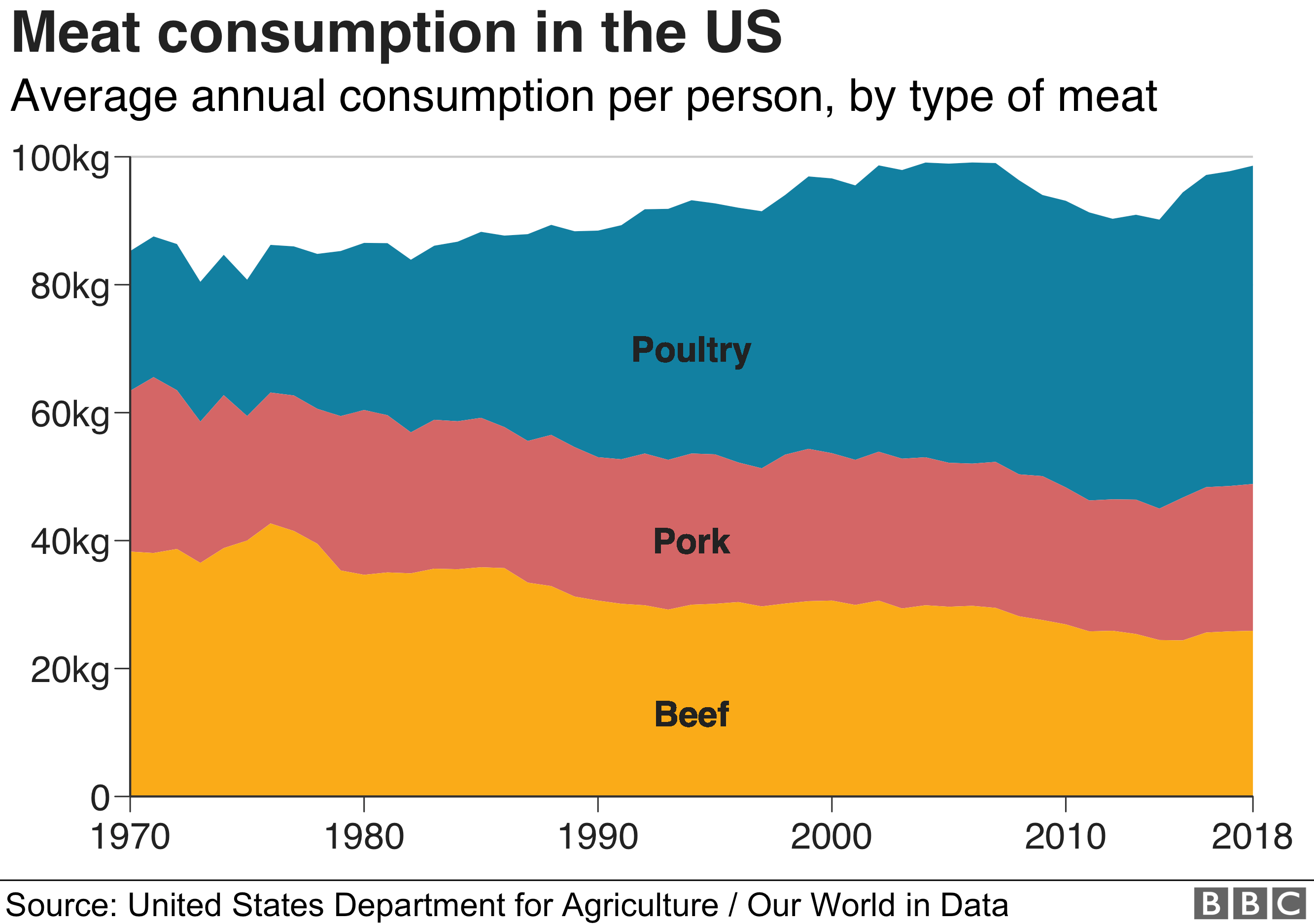
One of those is the assumption of perfect competition. Electricity is far, far from being a market with perfect competition. How many electricity providers are you able to choose from at your house? I'm going to guess 1.
Another assumption that doesn't hold here is the absence of externalities. The full cost of damage to the environment is not included in the price you pay for electricity, so people are going to over-consume it.
You rail against laws and regulations but even in the second sentence of your post you assume their necessity with the phrase "create an economic system..." Laws and regulations are how you create such systems.
Regulatory capture is a real thing, but it's not a good argument against all regulation. Maybe it's an argument for relatively less regulation than we'd have otherwise. It's also an argument for doing regulation better.
Sorry, sometimes there are great reasons for regulation.
Fixing the problem is up to you.
~"The reason things things never change is that those who stand to lose by change are the ones who hold all the power" -- Machiavelli
Huh? Great newa! I can pollute and create oilspills and its all someone else's problem!
Humans optimise for short term gain, generally perceived gain over others, and rationalise this over large nebulous things like climate change, environmental health etc. They don't count externalities without being made to. And that's individuals. Companies are downright sociopathic and will happily defecate in their own back yard if they can make a dime out of it.
As a result we can already see what happens when people are left to choose themselves or the environment, they choose their own short term relative gain over the long term prospects of the whole species (before we even look at other species).
> Fixing the problem is up to you.
Yes, in a democracy it is, which is why I vote for political parties which will bring in regulations.
As another good counterexample to your "market solutions for everything": I don't want rhinos driven to extinction, so I vote with my wallet by never buying powdered rhino horn or other poached products, and donating to environmental charities to protect them. However, it's very likely that rhinos will be extinct in the wild within our lifetime. Does this mean "the market" has decided to exterminate wild rhinos? Should we eliminate poaching regulations and remove red-tape to stop distorting the free-market price of rhino horn?
Current 'free market' is just fancy name for barbaric ransaking
Don't address of any the things that you are proposing need addressing, because they don't need to be addressed in the same law, or really addressed right now at all.
The law doesn't need to try and anticipate the actions that occur in the future, we will still have a legislature in the future capable of addressing the future when it comes about. The law needs to address the actions of today.
That's an incredibly dangerous idea.
Subsidized coal mining and untaxed carbon emissions are dangerous ideas.
This makes investments in renewable energy infrastructure more profitable and paid off sooner. A solar farm has more demand and higher margin for its products.
On the other hand, it means cheap coal energy is also financially productive.
What is anti-economical is the unfair price competition due to externalities not captured by coal energy's pricing.
Why not focus on the source of the electricity rather than what the electricity is used for?
> proof-of-waste
It's Proof of Work. Productive work has value and in this case, it's widely distributed censorship-resistant validation of transactions.
Today you probably consume more energy in a few days than your ancestors whole lives.
Now, we've created distributed, immutable property, something that has never existed before. It turns electricity into value storage. What is the "correct" amount of energy for humans to spend on such a thing?
Perhaps the "correct" amount is less than what it would take to increase planet temperature by 4°C?
You're equating energy usage to carbon emissions, but you should be able to distinguish the difference.
As long as we're using fossil fuels, planet temperature does in fact have something to do with energy consumption. You seem to be arguing that because renewable energy sources exists, Bitcoin has nothing to do with fossil fuel emissions. However, that is false, as 8% of Bitcoin mining happens in Inner Mongolia, which is home to many of China's large coal mines[0].
[0]: https://www.independent.co.uk/life-style/gadgets-and-tech/bi...
So when you call for a ban of Bitcoin in the name in environmental concerns, you've decided to be the arbiter of energy usage, on what is productive and valuable, and what is not.
You're welcome to argue your points, but it would still be far more efficient and productive to addresses the actual core problem: coal fire plants, and energy prices.
> a bunch of aircraft carriers and planes and bombs and people with big guns, which gives the ability to say (credibly) that it is a crime to forge dollars no matter who you are or where you live
Cryptocurrency offers all this and more for a fraction of the price.
It's good that Ethereum is moving to proof of stake. Not because of some environmental impact though. Mining is just really expensive, it results in huge fees making the coin almost unusable for normal people.
Even better, how much energy is wasted per page view due to inefficient frontend web frameworks?
Seems to me that code is speech, and restricting what one can and can't do with silicon that one owns is absolutely ridiculous.
> Current estimates put bitcoin’s energy requirements at around 130 terawatt-hours (TWh) annually, which would rank it in the top 30 electricity consumers worldwide if it were a country.
Source: https://www.independent.co.uk/life-style/gadgets-and-tech/bi...
This concern over the environmental impact of cryptocurrencies is utterly laughable when you figure out the real source of these problems. I guess they're just too powerful to be messed with.
Well, some environmental activists try by turning off oil valves[0], just like environmental activists are upset with Bitcoin.
> You have big entrenched organizations such as the oil industry doing far more damage.
People who criticize Bitcoin for its environmental impact don't give a pass to oil companies. The issues overlap, like in Texas where they plug Bitcoin mining rigs straight into the oil well[1].
But I hear you. All big entrenched organizations must be held accountable. Of course.
[0]: https://abcnews.go.com/International/wireStory/companies-dec...
[1]: https://www.independent.co.uk/climate-change/news/bitcoin-mi...
People who want to see real change need to deal with fossil fuels. Taxing mining operations will do absolutely nothing to solve the actual problems of this world.
there's every incentive for it to keep growing forever, which is what makes it dangerous
vs. there's only so much ice cream people can eat
I don't think this applies to laws. In fact, I'd claim the opposite. Laws are something you REALLY want to get right
If we won't legislate it now, it's possible we won't get a chance to do it later thanks to bickering from lobbyists and fossilised laws and practices. See IPv4.
Banning PoW cryptocurrencies is not a big enough priority for anyone that it will be a motivating factor to move past the other issues surrounding the climate debate, especially not anyone on the side of "don't do [thing] to fix the problem". I don't see any other mechanism by which it makes passing other climate legislation harder.
Banning PoW cryptocurrencies removes money that is currently on the side of "don't pass climate legislation because it will harm my PoW cryptocurrency business" from the table. That makes passing future legislation easier.
In general, trying to solve all the worlds problems at once doesn't work. It's too complex, you paralyze the decision making body with too many tradeoffs. When something is obviously bad, banning it immediately not only has the effect of meaning it's gone immediately (and doesn't hang around until you solve the whole problem), but it simplifies the remaining problem for the decision making body. This makes them more likely to come to a consensus on exactly what to do in a finite amount of time.
Does it? And, do you have data that backs this up? It stands to reason to me that PoW miners only want cheap power; they don't really care too much how it gets generated. Considering that the cheapest power source you can build out today is green energy, it sounds like a win-win to me for them to put their money into "advocate for more cheap power."
But that’s exactly what the law should do...
The question was about how to choose who is using too much and how, and the response was basically "don't think about it, we will exist in the future and can think about it then." But we exist now. And even if we were to wait, it's still a question we can answer now to have enacted later. The response provided was a bypass, a non-answer.
Instead, they explained why these questions are (partially) misguided.
That's also an answer.
Because that is what always happens. Every time someone make s a general proposal, for any law at all, there are people making the same old, dumb argument, of "well who decides?!?" Every single time.
Sure you do not believe that all laws ever are wrong, right?
Because the answer to this dumb question is the same as for every law ever. That makes it valid, unless you believe that all laws ever are bad.
There are absolutely many laws, that are very targeted and specific. Were you unaware of this?
For a random example, there are laws that probably say something like "A truck, of this size, must follow these specific environmental regulations".
That would be a specific law, that applies to a truck, and required it to do a specific thing, like have a certain mileage efficiency, and it is not general. It is pretty specific, and it is not a general law that applies to all environmental related things.
The world is full of many specific laws, all over the place.
once again, you have merely just assumed the role of arbitor. What makes this opinion better than the opposition?
What needs to be addressed isn't energy usage, but the cost of energy in the first place. Why isn't the fix be passing a law to tax carbon properly? Tax the externalities, and the rest would follow. I don't care if people burn up energy for crypto, as long as they pay for the cost properly.
This is literally the role of legislators. What makes "my" opinion better, is in the event that this sort of legislation passed, the majority of the elective representatives in both houses agree we should ban proof of work crytpo currencies, nothing less, nothing more.
> [alternative proposal]
I mean, I happen to like this proposal too, but you haven't given any reason not to do both...
So while carbon pricing would be a more ideal solution, OP is suggesting that a targeted ban on POW crypto is a good-enough bandaid that might actually pass.
Nothing about the opinion is better than any other. But the only thing we have to achieve is that it is a majority opinion, which frankly doesn’t seem all that hard to me.
And Bitcoin is hardly used for any transactions, and its energy usage will increase linearly with BTC price.
(If someone has a direct source that would be great. Statista is not good)
Update: seems the FB figure is correct, for 2019: https://sustainability.fb.com/report-pages/renewable-energy/
However, in Facebook's defense it's per-user per-transaction energy costs are going to be much lower than Bitcoin.
Did Ye Olde BBS support 1:millions broadcasting, and real-time viewing of high-definition video? Uploading and viewing thousands of high-quality photos?
Calling Facebook 'basically a giant BBS' is a lot like saying 'Oh, I could build Twitter in a weekend'.
Especially when talking about CO2 emissions absolutely everything is included, including plane trips and whatnot.
That comparison ignores the actual value add of Facebook and the fact that people are using it. Most BTC trades happen off blockchain and are powered by the servers of the market places and nobody really knows how much energy they use.
Therefore, if the price of Bitcoin doubles, miners can afford to burn twice as much electricity. (Roughly. This is a simplification of course.)
Proof of stake is a newer way of coming to consensus on one correct chain. It took people a while to figure out how to do it securely and efficiently.
I'm curious if someone driving an electric would get ticketed as well.
EDIT: Specify the part of the post that bewildered me.
Thanks for the information.
Spinning up cores to do intensive math for the sake of its difficulty is wasting energy by design. PoW's financial incentive is to waste power.
Facebook spends a massive amount of money on compute, and their profit is only as good as the margin they can make over that compute cost. Therefore they have a financial incentive to save power.
The legislature and the regulatory agencies it has created, obviously.
The exact same way literally every other environmental regulation has ever been passed.
There are entire divisions of agencies dedicated to drawing the line of "too much" in all sorts of areas, for pollution, poisons, contamination, energy usage, etc. In fact, pretty much everyone but extreme libertarians agrees this is one of the main functions of government.
So while you might not agree on the resulting policy or even the mechanisms that arrived at it, it is a solved problem. You don't need to wonder how we'd accomplish it -- that part is easy.
I see a lot of people replying with a slippery slope argument of this nature, which makes me think I should explain my argument better.
I'm not arguing that burning electricity alone is the problem. I'm arguing that burning electricity for the direct purpose of making a financial product is a problem for society, when 1) the financial product explicitly incentivizes burning up as much as you can to make more money and/or 2) burning up that energy can be alleviated by other technical solutions.
I'm not arguing that mining should be illegal. I'm saying the 'sale' of the results of that mining should be illegal. Using or making incandescent lightbulbs is not illegal, but the sale of them is banned or restricted in large portions of the world [1]. Less harmful alternatives exist, so sale is disincentivized, the world moves on.
This is not the government deciding how you spend energy resources. You can continue to mine all you want. But you shouldn't be rewarded for that.
One thing I should point out is that I recognize that an alternative solution for these incentives is to make electricity always so expensive that it costs more money in electricity spend to mine crypto than you can make money of it. Make electricity price depend on crypto price. Needless to say I don't see that working out :)
[1]: https://en.wikipedia.org/wiki/Phase-out_of_incandescent_ligh...
The difference is that Facebook’s energy use potential is limited and gets better with improved computer tech.
There is a limit to how much analysis you can do. As you get more efficient hardware, the energy use would go down. Facebook also invests a lot of effort in optimizing their code to run more efficiently.
With proof of work crypto, the only limit is the price of crypto. Despite any efficiency gains, you can always expect the energy use to scale with the price of crypto. For example, a 10x more efficient miner, won’t cause 10x less energy use, it may actually increase energy use as more people mine with higher rate electricity.
There is a chance that we develop a situation that the most monetarily efficient thing you could do with electricity is to mine proof of work crypto. If that becomes the case, then even a carbon tax won’t help because proof-of-work crypto can easily pay the tax compared to all the other uses of electricity.
Fundamentally it's become too big a waste to ignore, like so many other things. We banned incandescent bulbs, we can ban proof-of-waste, which is basically an incandescent bulb that never illuminates anything.
The tax avoidance schemes in Europe are well documented for all tech companies.
And what do you mean by employment taxes? Just the employers part of the income tax?
So 21% + 15% to 20% capex on individuals = a tax rate around the same.
Now, if you really want to look at the big picture, look at a company's tax rate of 21% on profits, but they also pay taxes on employees of ~21% of salary in the USA not to mention health care (which in europe would be included as taxes so maybe in Europe 46% to 50%). So if payroll is 40% of your costs that is another 8.4% of taxes added in there. And, you can probably add health care as a tax as well.
Legal tax avoidance is legal. I hate when people bitch about companies doing legal maneuvers. It is very easy to stop that, apply a tax on gross receipts for all income created in the country.
Washington State does that for example if you have a company operating in their state.
Yep, I hate to say it, but even FB is more useful compared to BTC. No one uses BTC for actual payment but to hold a value. People holding BTC could just switch to MtG cards and saved tons of energy without losing any benefits that they are currently using.
Bitcoin is an endless energy pit. The same isn't true of things like Facebook.
The laws set up the playing field, and the market responds to the incentives. There has never been any such thing as a "free" market, and it's a good thing too.
Congress, courts, Department of Energy.
Regulating the energy consumption/efficiency is more akin to fuel efficiency standards for cars.
"If there is a clear and obvious better with minimal impact." It's just that simple.
We make choices like this all the time. Here in the US we set CARB rules to slow emissions but we don't just ban old cars even though that would be better for the environment. Grey is okay in laws if the black and white bit behind it is clear! (Reduce emissions if possible with least possible impact on people.) Otherwise you will never be able to improve anything until the harmful methods have grown too much.
With crypto it's too decentralized to implement either.
> who's the arbiter of what's "too much" power for a use case
Ultimately Mother Nature will be the arbiter. If people spend too much time arguing about politics instead of either lowering power usage or moving to clean energy, those people will be killed sooner or later.
Electricity usage has almost no negative externalities. Electricity production does. Attacking people for using their own resources on something that they find to be useful and worthwhile is foolish. Confront the actual problem, and quit harassing innocent third parties.
The quick google says facebook uses 5 while bitcoin uses 143 terawatt-hours
At some point the shaming would begin, web devs would respond, and then I'd generally get what I'm really after -- much faster page load times!
You don't need to worry about how much electricity was burned, only that it wasn't done in exchange for a plaque saying "I filled a swimming pool with gasoline, then lit it on fire"
The king. The digital crypto king.
CO2 taxes
Always the same fucking slippery slope!
Without Proof of work, cryptocurrency would have never been established as a novel concept. Proof of work was the only rationale way to decide who should initially own how many units of the currency.
Just tax the carbon sources and ban building new coal power plants or reactivating defunct ones.
Instead of downvoting please give me one other example why would rational market entity build more renewables than to satisfy demand when production peeks. Because to go full renewables without batteries (and we barely have any when compared to our renewables) we need to always meet the demand even when renewable energy production is the lowest. And what should rational market entity do with the power at all other times where production is far higher than demand?
Because "mine cryptocurrencies with it" seems like the only reasonalble answer in the world where cryptocurrencies exist and people with too much money buy them enthusiastically.
I could see a lot of people make the argument the production of a lot of energy intensive goods is not worth-while.
Which is to say, discussing on HN is a valid way to contribute your opinion to society. Voting is not your only voice.
if enough people agree that a law should be passed, and it's a high enough priority, and the opinion stays that way for a long time, then eventually enough politicians get on board by virtue of pressure from their voting base, and a law gets passed.
It's not great.
But on the other hand, near-immediate direct democracy is also not great, because it leads to knee-jerk reactions causing laws put in place. I'm thinking of stuff like the USAPATRIOT Act, except worse.
It's literally regulation to stop "Proof of work". Which is a generic algorithm that can be applied to other circumstances.
It could have applications in CAPTCHA's, or anti-spam.
It could be a critical component of other decentralized technologies, not just blockchain crypto currencies.
Making this math illegal JUST to kill cyptocurrencies seems a tad much, right?
Governments already have regulations for energy efficiency, waste and pollution, and for most things it's possible to negotiate reasonable limits.
For PoW it's not possible. If you put an upper limit on its wastefulness, it'll be a limit on its security. Even if we had a Dyson Sphere, PoW would eventually eat more than half of it just to be secure.
Maybe in theory but in actuality it is comprised of moneyed interests which is why it needs to be limited to preserve the freedom of the people.
There will come a time when people like you -- who play God over others -- are ousted from society.
There are already laws in most countries forbidding you to litter, and you would never call that "playing God" - it just happens that littering with crypto mining is a multi billion dollar industry.
It's just not a realistic outlook on how typical people want society to function. Most people do not believe PoW cryptocurrency is important to society.
If carbon taxes go up, some things will no longer be worth spending energy on, but crypto mining is just competitive, so the value of mining will go up with the cost of energy and keep using as much energy as ever. The only thing that can stop it is reducing demand for the coins, which the government is not even trying to do yet.
That is not true. If the cost of energy increases, mining / hash rates will decrease. Miners are competing, and the limit to the price they will pay for electricity is the value of the cryptocurrency they are earning for the activity.
I am all for carbon taxes, to shape the market towards cleaner energy. And I do think it will successfully push miners even faster towards adoption of other energy sources.
I disagree. If we must cap the CO2 we can emit, we should definitely favor basic needs over luxury. Here in France, the government tried to set a carbon tax on gas (which is required for many simply to commute to work, with no affordable alternatives yet) but they refused to impose a tax on jet fuel which is known to be used by the ultra rich to fly their privates on the weekends (while they can afford high speed trains).
We should not just let money decide what's possible, when so many are still in need of basic necessities. Many could pay a 300% tax just to fly 10x a year across the globe (emitting many, many times the carbon footprint of an average household). How would that be fair, when the problem is not what people pay but how the planet is becoming inhabitable?
I do not believe consensus mechanism other than PoW can provide enough security for a cryptocurrency
What's interesting, is that you can gather ~300 random citizens - including jet setters and cryptofans - and let them think about it for two years in order to decide what they considered as basic needs, on a consensus basis. And then, we can organize a vote (e.g a referendum) to make sure society finds a common ground on this (just like we do for most things, such as banning crime).
See https://en.wikipedia.org/wiki/Citizens_Convention_for_Climat... for a good example.
I bet PoW would be far down the list of basic needs but it might, still. I like democracy (where people vote, not their fortune).
Unless you are suggesting taxing crypto itself, in which case… sure!
In other words, the amount it takes in can be given back to the average person -- in forms of tax rebates, investment in public transit, education, whatever. In an ideal world a carbon tax would have no adverse impact on lower and middle class people.
I should also add that in that world higher electricity cost due to carbon tax is a good thing -- it'll help carbon-neutral sources of energy to compete and replace the more dirty forms. Which is exactly what we want.
But perhaps more importantly, you wouldn't be taxed because others are using electricity for virtual money. You would be taxed because your carbon emissions are causing climate change, and to encourage you to reduce energy usage where possible.
[1] - https://citizensclimatelobby.org/carbon-pricing-studies/
Also, you can make the tax progressive so that the high consumers can pay much more.
All money has a cost on society. You have to do something to maintain its value. You don't think wars in the middle east -- to maintain the petrodollar -- have an environmental impact?
And when it isn't oil it'll be fights over germanium and lithium veins.
If you actually cared to do more than sit in a chair -- advocating random things you didn't research -- you'd be advocating for Thorium power. Thorium is nearly as abundant as lead -- it's all over the place -- and it's much more clean and less dangerous than even solar or wind.
An obvious example is the existence of pseudonymous digital payments. Given that cryptocurrency already exists, and will continue to exist for all illicit activities even if you ban it, you might as well let people open numbered accounts at a bank.
Do this for any other advantage cryptocurrency has over the existing banking system and there is no more demand for cryptocurrency. And without demand, the price crashes and people stop burning coal to mine it.
What if we want to decide that we want to minimise carbon, but some use of energy is preferable (for instance consumer/home use) to bootstrapping new financial products?
and that's where the price signals what is preferable. The correct allocation of energy should be based on the price people are willing to pay for the energy. Like any other commodity.
Why? Why is that 'correct'? Why would we not want to ensure the population has affordable energy for home use, but others seeking to make a profit from it rather than use it for basic needs pay more?
You phrase your reply as some sort of moral absolute, but it's nothing of the sort.
Because we already have the former and we don't need the latter.
A carbon tax with a dividend doesn't make life harder for lower income people, because they already have below-average energy consumption (wealthier people have bigger houses that need more heat etc.) and as a result the dividend would be larger than what they pay in tax.
But you still want them to have good incentives. If they can use the dividend to switch to solar or buy an electric car, you want them to do this, because that's the whole point.
Meanwhile there is no reason to charge profit-seeking enterprises more than the true cost of their usage, because all that's doing is inhibiting economically productive activity. Aluminum smelting uses a tremendous amount of electricity, but what you want is to cause them to switch to non-carbon electrical generation, not to shut down operations.
Is not what was being proposed in the free-market fundamentalist post I was replying to.
> Meanwhile there is no reason to charge profit-seeking enterprises more than the true cost of their usage
But there might be if it's merely "burning energy for a new financial product", society might decide that it's not worth the carbon to have that around, regardless of tax, but that aluminium is a useful physical product.
We have differential taxes on all sorts of things, I don't see why they would be so wrong here.
But even given all that, my comment you're replying to was specifically adressing the "price should be the only indicator" assertions in the libertarian spiel above.
A carbon tax with a dividend is the free-market fundamentalist proposal. Markets require externalities to be priced and a dividend is the most economically efficient use of the revenue so generated.
> But there might be if it's merely "burning energy for a new financial product", society might decide that it's not worth the carbon to have that around, regardless of tax, but that aluminium is a useful physical product.
The way of determining which is pricing. If society values "new financial product" more than the cost of the energy, including the carbon tax, then it gets produced. If the carbon tax increases energy costs to the point that "new financial product" isn't viable in the market, it doesn't. Or it switches to non-carbon electrical generation at which point you can't blame them for climate change anymore and they're expediting the transition to renewable energy by financing the creation of generating capacity and increasing economies of scale.
It's specifically not the one I was replying to -
"The correct allocation of energy should be based on the price people are willing to pay for the energy. Like any other commodity."
> The way of determining which is pricing.
It's not the only way, it's not even the only way that's employed right now in a lot of places, for instance we don't apply sales tax to items we deem 'essential' here in the UK, have a 5% rate for some things and 20% for 'luxuries'.
Price is not the only mechanism available, nor is it always the best one.
This is in no way inconsistent with the need to price externalities, which is the default assumption in free market theories. (Otherwise you have obvious problems with people dumping industrial waste into rivers etc.)
> It's not the only way, it's not even the only way that's employed right now in a lot of places, for instance we don't apply sales tax to items we deem 'essential' here in the UK, have a 5% rate for some things and 20% for 'luxuries'.
Just because somebody does something doesn't make it a good idea.
Things like that have counterintuitive economic consequences. See what subsidized student loans do to education prices. Is this what we want for "essential" goods?
If we do that, the tax rate has to be higher for non-"essential" goods in order to generate a given amount of revenue. Now you're into central planning to determine what's "essential" and what isn't. Is a laptop a luxury good? A poor person might need one. What about an electric car? Meanwhile every such decision of what to tax more is subject to lobbying and corruption.
If you want to help the poor, give them money. They know what's "essential" to them better than the bureaucracy does.
There's nothing in free markets that will make this happen without regulation, as evidenced by the fact that it so far hasn't happened.
> Just because somebody does something doesn't make it a good idea.
No, but it also doesn't make it impossible or something which can just be dismissed. There blatantly are mechanisms that can be used other than the ones you mentioned. You don't like them, that's not the same as them not existing.
However ridiculous you want to make the results - oh my god now you're into planning! - this already happens in quite a number of pretty successful countries, so it's clearly not some bizarre fantasy.
According to hardcore libertarian free market theory, polluting someone else's property without their permission is a violation of their property rights. In principle this would make it impractical to burn anything at all, because the combustion products go out into the air and spread to someone else's property without their permission. You would need the permission of everybody everywhere, for which they would want to extract payment.
Obviously that isn't how it's implemented in the US, but that's what the theory says should happen.
A carbon tax + dividend is a pragmatic alternative. The criticism of it is actually that it gives the polluters too much -- maybe someone thinks the tax isn't high enough and wants to demand more of the carbon emitters. By implementing the tax you're taking away their right to refuse to have their air polluted and hold out for higher payment from the carbon emitters.
> You don't like them, that's not the same as them not existing.
Nobody was claiming that implementations of bad ideas don't exist.
Actually it sounded a lot like you were saying that the only way to do this was pricing.
Either way, you'd have to go a long way to convince me that the free market ideology principles are always better than what we can see working in a number of wealthy, successful countries already.
A carbon tax and dividend is certainly one way that such things could be achieved, though it's not the only way and it is a blunt instrument. It's not the only way or necessarily the best, and it doesn't allow a society to make choices with much granularity.
Your argument is basically that it is wrong to do so - I think that's a pseudo-religious belief.
i argue that pricing carbon is the only way to allow everyone in society to make their own choice with the granularity that you propose.
After all, when has central planning ever taken everyone into account properly? How will i know that policy makers will take my interests into account when they plan policies?
And in this specific case, what about the people who _do_ want to mine crypto? Why do they get the bad end of the stick, just because some authority says so?
That's the point - it's perfectly fine for a society to decide what energy can and can't be used for, because we don't live in a time when we have infinite, environmentally neutral power available to us.
On the surface this sounds like bitcoin's PoW use will simply stop. It's actually the entire opposite.
When governments ban it, they go after sizeable, identifiable organizations running these operations, that is their only choice. These operations are optimized in their energy usage, because it's only in their interest to reduce their consumption relative to the value of the coin they mine.
The moment these operations are shutdown, there is a massive sink in the hash rate, smaller operations and hobbyists will rush in to fill it. Hash rate gradually climbs back up and instead you have 10x the energy usage because you can no longer run the PoW in a scalable way.
BTC's main uses (speculation and laundering) are possible only as long as it can be exchanged into fiat. This can change tomorrow if the right strings are pulled.
Let people trade cryptocurrency to fiat in person all they want, it's completely insignificant.
It turns out laws do sometimes have effects.
The only answer that works is a carbon tax.
And if you can't really do anything with your coins but have your coins, why would people rush out to break the law to mine them?
Ever since Dogecoin had a moment, there's now a million coins trying to engineer their own "moonshot".
This is on top of the security issues and of course the energy issues. Cryptocurrency is garbage.
This is false. Miners will spend about the same amount of money they get from block reward to run their operation. Asymptotically, this money is spent to buy electricity. This is the result of competitive pressure from other miners. What you will observe instead is the same amount of electricity burned but with 10x less hash rate.
Not really. It wouldn’t stop, but it would decline substantially.
Smaller operations and hobbyists only participate because it’s worth money to do so.
Making Bitcoin illegal would kill the argument that it will eventually displace fiat, and relegate it to being used only for illegal purposes.
The incentive to mine a currency that can only be used for crime as a hobbyist would end up being low.
We will see, the trouble with Freakanomics, is that it had quite a few avoidable errors in it, so maybe it's not the best example.
However, some of the biggest plagues to society are rooted in central banking policies that over time devalue a nations currency through excessive money printing backed by nothing, or gambling via derivatives that when a bubble pops requires bailouts. Even worse, where we are now is done via quantitative easing which is a fancy word for more money printing to buy government debts to keep the economy afloat. If Bitcoin or other cryptocurrencies can provide all the same services banks offer (borrowing/lending/saving) and be backed by a finite number ensuring value over time then we, as a society will be less manipulated by politics and therefore experience deflation which will could close wealth gaps.
Bitcoin may have an energy problem but the problems it aims to solve are extremely important as well. “Necessity is the mother of invention.” If Bitcoin can really solve some areas maybe the conversation should be about how can get 100% of BTC energy consumption to be renewable.
With PoW the state can influence the existing miners, but cannot prevent new independent miners to pop up and counter act.
Bitcoin (the network with the most mining effort) lost 25% of their hashing power due to blackouts in Xinjiang. (Soure: https://twitter.com/nic__carter/status/1384938089748041730?s...) State capture of a majority of Bitcoin miners is comparatively easy.
In addition, independent miners have less hardware and that hardware is generally less efficient when compared to the large ASIC farms. In reality a recovery would probably require social consensus and a hard fork
Many of you in this thread need to read up on how the staking is designed to work.
With PoW you can corrupt many miners, but the other superpowers can spawn new miners to counter act.
And other methods introduce the possibility of stake grinding.
BOTH converge to the same energy usage as mining.
OTOH, the legacy financial system is significantly more energy intensive for a given financial network value. You don't think banks and wars in the middle east to maintain the value of the network have an environmental impact?
Proof of Stake as setup gives all the power to people/companies who have large amounts of liquid assets.
Consider Amazon, they keep a rolling window of cash in-between when an item is sold and when the seller gets paid. This effectively gives them billions in interest-free capital. If this were Etherium, it would translate into huge amounts of voting power.
Likewise, if/when people deposit their etherium into banks, those banks can then leverage that "free" capital to grab huge voting stakes that wouldn't otherwise exist (because no person living paycheck to paycheck has the equivalent of 100k sitting around).
This leverage simply does not exist with proof of work.
Slashing stake is significantly more arbitrary. You basically need to reset the coin's ledger in order for it to make any sense.
It's only possible once, and this move is so obviously predictable any determined attacker is going to have gpus ready.
That isn't relevant to the conversation of stakers having misaligned incentives to change the rules. The most a state level actor can do is censor transactions if they were to take over a chain.
With PoS you'd need to slash the validators stake on a fork; which isn't going to happen because the stakers run the validators everyone is using. You already saw this with the steemit takeover.
In PoW coins, the miners and validating economic nodes are two separate groups. Watch what happens when exchanges slip over to Eth2 nodes and call it Eth.
During the BCHA/BCH split the exchanges were the ones that decided the ticker. Most users have ZERO CLUE about what happened. They went on their with their lives calling the fork the exchanges chose BCH. Once exchanges are validators there is no bulwark against changes.
Sorry but I don't see your point here. A fork inherently requires action, it's enough to force a node to follow a different block from some height. At that point the attacker would get penalized for being offline. Outright deletion would require code modification. It's even possible to automate a minority fork in the case of censorship, although this capability doesn't exist yet.
>You already saw this with the steemit takeover.
Steem isn't even PoS, it's dPoS. Even in this case users successfully created a fork called Hive and removed Justin Sun's coins.
Which is the exact thing state level actors want to do !
What is the use of crypto if the state can ban me or my country from it ? Isn’t that exactly what decentralisation was supposed to prevent ?
PoS is resistant to state attacks because it would require buying up tokens on an impossible scale, and in the case an attack somehow succeeds a fork can be created that deletes the hostile stake. This can be repeated indefinitely. That's impossible in PoW more than once, once a gpu PoW gets attacked it's over.
PoS has no economies of scale, so contrary to PoW it can stay decentralized forever. There's no way to make existing stakers unprofitable by adding more nodes, like it's possible with mining hardware in PoW.
PoW is also vulnerable to takeover of existing miners because mining at scale requires big industrial warehouses with industrial power owned by registered companies. Impossible to hide. PoS can run on anonymous home nodes.
In every single security and decentralization aspect PoW is hopelessly inferior to PoS.
You don't need to buy the tokens. You make laws which the stakers have to follow, otherwise you seize their tokens for breaking the law. You can also use electronic warfare to steal the tokens of stakers outside your juridiction. If you are doing this as a big country such as USA/China, then other stakers might be tempted not to fork because a compromised system that works with those countries might still be more valuable than an uncompromised system that has not access to a large part of the world economy.
>otherwise you seize their tokens for breaking the law.
that's not possible, there's no mechanism to seize eth. What can be trivially seized, though, are physical miners.
Additionally except for eth all have the fundamental problem of extremely centralized distribution. This [1] extreme centralization is representative of new VC coins. That tiny sliver of 'Coinlist (unlocked auction) 4.3%' is the only part that was available to non-insiders.
[1] https://icodrops.com/wp-content/uploads/2018/04/Solano-token...
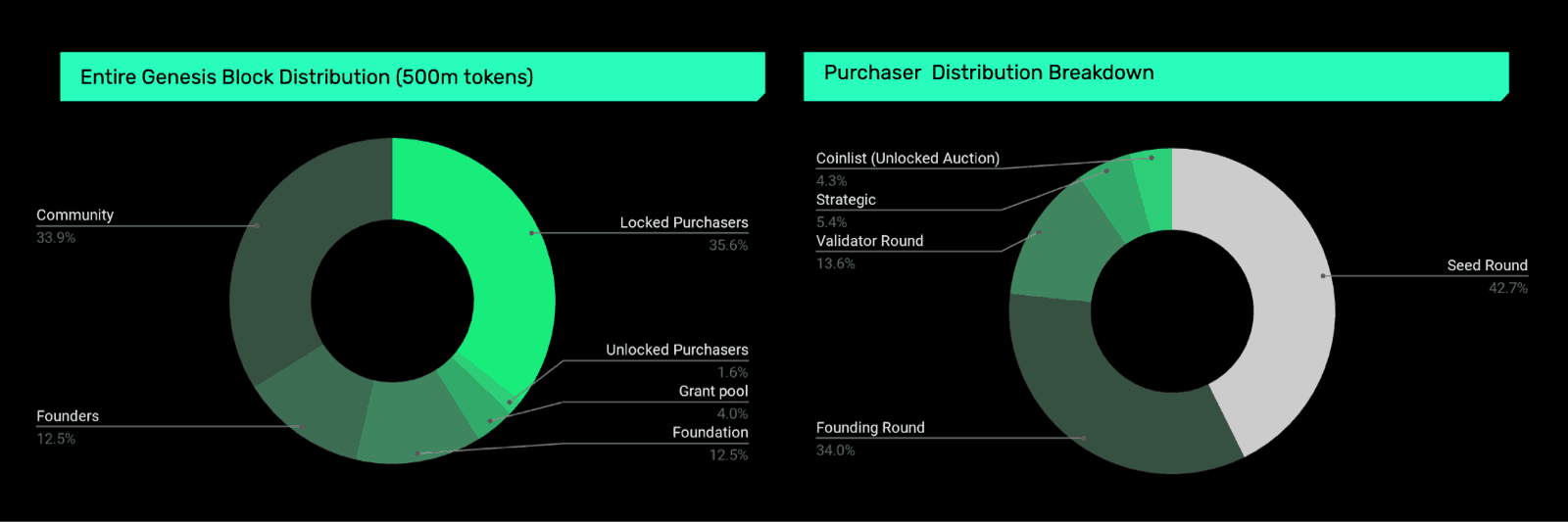
I'm also wondering about the resiliency of PoS. The PoW used in Bitcoin has demonstrated resiliency against attacks, and none of the attacks have been successful so far, that I know of.
Multiple PoW coins have been successfully attacked, like ETC. Because they are already on GPUs there's no fix - just hope it doesn't repeat. Those successful attacks prove that any attack on PoW is only a question of external resources (sha256 ASICs for btc).
It's also surprisingly hard to profit from a 51% attack on pure speculation coins like btc or etc because next to zero actual economic activity is happening on them, which is why such attacks were rare and small in scope. The best you can actually do is to try to double spend an exchange. If they were actually used for real commerce profit becomes much easier. It could also become a military goal - if Iran relied on a PoW-coin for its economy, blocking their coins would destroy their economy.
This is one of the reasons why ethereum absolutely must switch to PoS - PoW is extremely insecure for smart contracts because there are many more ways to profit from an attack, like censoring price updates for defi.
Seems like you know a lot about PoS, would you be willing to check out my other comments on this post (https://news.ycombinator.com/threads?id=swensel)? I've covered some concerns / questions that I have about PoS that maybe you can answer in more detail.
It's not just miners, it's also full nodes that validate.
Full nodes can disagree with miners: instant fork.
If say Putin would acquire 51% of mining hash rate people would realize (before he gets there) and would fork.
My comment is not in support or against PoW, I'm just stating the fact that PoW isn't inherently unsafer than PoS.
After that, if the fork becomes popular, the attacker moves and attacks it again. Are people supposed to fork once per week? At that point it's not PoW consensus anymore, because the interventions move from emergency to normal, and you're under something else.
Humanity will continue to require energy as it advances and banning anything "because it uses too much energy" is a ridiculous advice. How about we ban gold mining, or set quotas on the number of children people may have, that will surely contribute to our CO2 reduction goals. It's also Orwellian and reminiscent of how the world looked like for citizens of the USSR back in 1960-1990
i find views that want to ban anything for energy consumption ridiculous. also what the people advocating for this kind of thing are missing is that it’s all fun and games until something you rely gets banned because of reasons.
here are my proposals:
the entire banking system is obviously using a lot of power. how about we ban banks and go back to using paper money. that’s def more environmental friendly. /s
electric cars run on energy that’s generated with coal. that’s not cool. let’s ban electric cars and keep driving gas cars. they have been around for a long time and the technology is so good that we actually pollute less with a gas car /s
the internet in general and datacenters in particular are using a lot of power. let’s ban datacenters. guaranteed between environment afterwards /s
Also "until something you rely gets banned", what do you rely on bitcoin for besides being a store of value?
my point is that you don’t get to decide what i consume. and banning bitcoin == banning any type of computing that you don’t like. do you understand how much power a modern datacenter sucks? do you also understand that some things that run in a datacenter are straight up dangerous to the fabric of our society?
I am not making any decisions about your consumption. Our democratically elected government is responsible for making the best choices that balance our societal needs. Our government already regulates a lot of things around computing: Child porn/CSAM, export controls around cryptography, data privacy, the computer fraud and abuse act. This isn't novel stuff, having a computer doesn't mean you can do literally anything on it with zero consequences.
democracy? data privacy? thanks for the good laugh
By optimizing around energy conservation at all costs, we have homes that cost 3x, held together with glue, susceptible to mold, and filled with toxic crap like vinyl.
VS
An estimate of Bitcoin power consumption by the Cambridge Centre for Alternative Finance.
I know which one I’m more prepared to believe.
Even if this were true. I go on YouTube and can learn things: recipes, FreeCad tutorials, coffee nerdery, harmonica lessons.
Bitcoin literally does nothing.
Except make those little pieces of green paper in your wallet look foolish.
The virtue of energy use argument is just dumb.
Electricity is a commodity and a utility. Who are you or I to subjectively decide that a use is valuable or virtuous?
Is YouPorn worthy? Is MLB.tv valuable? What are the criteria that you use to determine worth?
Yes because people like porn and baseball.
Bitcoin is like gold. It’s valuable because other people say it’s valuable. But nothing useful happens when you mine crypto. Was I entertained? Did I learn something? Are they producing a widget? Even gold can be made into jewellery or used in electronics. Crypto literally just uses power.
As far as I can tell PoW is the most proven consensus mechanism so far. PoS may be promising though. ETH2 successfully switching will be telling.
By enabling ransom ware attacks? Creating GPU shortages?
"the internet uses 10% of the total electricity consumption worldwide. How much of that is consumed by Youtube? After Netflix and embedded videos, Youtube is the third biggest global internet bandwidth eater. About 11.4% of global internet traffic is consumed by Youtube"
That figure assumes that the electricity usage of the internet is exactly related to the amount of bandwidth - so if YouTube uses 11.4% of the internet's total bandwidth, that means that YouTube uses 11.4% of the internet's total electricity consumption.
That is a highly dubious assumption.
That you only use it to watch videos that bring zero gain to your life is a You problem.
You're advocating for violence against people who do things you don't like. Use your wallet and leave other people alone.
Oh give over, this is ridiculous too.
When other people are causing harm that affects everyone it's perfectly reasonable to look at legislation to kerb the behaviours.
And no, that's not violence. No.
Not right now it's not. Not when we have constraints on how much CO2 we can pump into our atmosphere.
Right now, and I mean right now, when we're having huge problems de-carbonising the planet's energy supplies and are risking making life very uncomfortable for ourselves for decades or centuries to come, limiting energy use is actually one of the few levers we have to try to make a difference.
In this current situation, bringing online a whole new mid-sized country's worth of energy consumption for a financial instrument is ridiculous, and a huge own-goal for humanity.
Where do you see the problem in using less energy for a crypto currency? Why not make a cryptocurrency that uses even more energy?
Why not?
>or set quotas on the number of children people may have
Some people consume 10x less energy than others, so blindly capping the number of children does not seem a good idea. What about capping the carbon footprint per person instead?
We track and tax revenues (not perfectly but as well as we can). We could definitely track and cap carbon emissions. Sounds good to me!
it’s all fun and games until I ban something you rely on for your livelihood
And to do so for speculative fun is ridiculous.
Also, how do you decide which computing is good and which computing is bad?
Kill the value of POW as a store of money and see how much of that computing still happens. Then you’ll know how useful it is.
now, the question is: who decides what’s acceptable and what’s not acceptable for energy use?
Videogames run GPUs at full capacity too, we should ban them too. No one NEEDS to pretend to be a cowboy for 100+ hours each across 36 million GPUs.
Actually maybe there should be a ban on computing power above mobile CPUs available to non-government bodies, if this really is so devastating to the environment we need to limit the amount of damage people can cause as individuals, why does a normal person need a GPU anyway when smart phone graphics should be enough.
32 million bought it, takes about 100 hours to complete runs GPU full capacity.
If we're going to say using GPU computing power is bad for the environment then we can't just stop at crypto because it's convenient. We have to look at all computing and videogames isn't something that should be considered essential either.
There are tons of things that people do that I might deem not worth the environmental impact, like flying a hundred thousand miles a year for business, or eating beef, or driving to work every day, or having bigger houses and lawns than they need. Seems kind of arbitrary to allow most wasteful things that people do but draw a line at being able to participate in a certain kind of blockchain. The per-person impact of holding and transacting with bitcoin is not egregiously high compared to all the other things people do in their day to day life.
And based on ethereum's move here, perhaps people are starting to vote with their wallets anyway and such dramatic limiting measures aren't needed?
Did you mean "the rich"?
This is an insane take. Proof of Stake is NOT secure, the stakers can collude to reorganize the chain at almost no cost. This is like the exact system we tried to get away from, the USD system is also a Proof of Stake.
I think that at some point, PoW will become so economically unfeasible that it'll simply make more sense for miners to ditch those coins and whale up on PoS ones.
You don't necessarily need to ban the coins to fix this aspect however, just make sure they don't get integrated in the financial system too much. They're basically digital gold. Gold was ok until central banks tried to anchor to it which caused the Great Depression and maybe even WWII.
I think of each community as a game of Civilization. As you progress you unlock higher rungs of the tech ladder. Exporting your raw materials to later import finished products made from them is a waste of resources and stagnates the local industries at the raw material stage.
What industries could be developed in your community if the power was available?
Bitcoin mining creates a price floor for energy. It is a buyer of last resort with infinite appetite. By pushing up the value of energy in the market, it encourages expansion of energy production.
Rather than deny that reality, you're better off working with it to produce more, but cleaner, energy.
[edit] - downvotes because I used the word "mother" maybe? I don't understand this community.
Unless you want to also ban servers or services that are using deep learning training, decoding massive videos and livestreams on storage systems that are also burning up the planet.
It's not fine to allow PoW cryptocurrencies to continue to burn the planet but collecting mass amounts of user data and using wasteful deep learning training continuously is fine to burn up the planet on GCP, AWS and Azure?
If you want to encourage other uses of electricity, subsidize them, don't just ban arbitrary forms of consumption.
Well, for one, because that tends to mean "rich folks and large companies can act with impunity, everyone else not so much".
For two, we actually do discriminate quite happily between different uses of things. Maybe it's OK to keep energy prices low for households, as a compromise, but not for crypto mining?
Well, firstly, are we even sure that's really possible?
> Giving each household some amount of free or subsidized power makes sense
Which is basically exactly what I was talking about - we can and do decide that some uses are better than others, and use regulation (some of which may be tax or credit) to achieve that.
We already do this. I'm not sure why people are so aghast that we might do it some more for PoW cryptocurrencies.
If you want to target an externality of the free market, do it directly: simply tax emissions. This will guide the market towards greener energy generation and direct capital out of activities that produce emissions without generated value.
Proof of work is the only thing of value, the only distributed consensus model that is secure and the only way forward for store of value cryptocurrencies.
That is to say, it's self correcting. If the price of energy increases, there is less mining. Alternatively, the miners are also incentivized to find cheaper or develop cheaper alternatives; this spurs innovation.
If prices rise due to mining, innovation will take place and more energy will be developed.
There's nothing wrong with this mechanism, as it corrects itself. In 2050 when you can no longer mine bitcoin we will that have an abundance of cheap power. Which is the single greatest factor in reducing poverty.
Frankly, I think this comment is off base. So far there have been zero negative measurable impacts from power usage related to crypto.
> innovation will take place and more energy will be developed.
This has way too many assumptions baked in. Increased demand will not guarantee a clean supply, nor does it guarantee technological progress in performance of efficiency.
All that wasted energy is paid for by the holders, and proof-of-stake is just more financially attractive.
No government intervention is required IMO.
Could you explain me what energy is "wasted" in Proof-of-Work and also how the people currently holding the cryptocurrency is paying for that "waste"?
AFAIK, the same number of blocks are made no matter how many transactions are being made or how many holders there are (or how much each holder "holds"), so the energy consumption of Bitcoin remains more or less the same during an hour, only slowly rising as more miners get on-boarded. But the energy consumption of those brought online remains the same over the lifetime of the miner instance itself.
democracy! f yeah!
This ban needed to be internationally, though. Pretty difficult to enforce on a global scale. And then it would only have a short term influence on the price of, say, Bitcoin, until enough “black” mining power emerges.
I would just relax. Bitcoin is not going to destroy the planet. In the long run it’s going to be a niche financial tool compared to the scale of Ethereum or other competitors (Cardano, Solana or Algorand). It’ll be the PoS enabled DeFi networks that are going to disrupt the banking business.
Maybe there need to be more guidelines around how to use excess energy instead of coal, but to totally disregard that PoW could be mined from excess energy is shortsighted. Flare gas is just one example.
[1] https://oilmanmagazine.com/how-and-why-natural-gas-flaring-i...
* Reduce trade * Reduce value * Reduce carbon use?
Is there a case ever where an illicit market found a price equilibrium which was lower than the licit one? And, if such a ban does cause the price go up, won't the same incentives cause continued mining competition?
How about continuing research and development of solutions providing cheaper, greener energy instead of sparking righteous war against something that consumes energy based on incompetent social media fart?
The loudest voices against something are typically hypocrites that happily fly on their gas guzzling private jets bitching about people driving their oh so inefficient cars to work.
That's not only radical, but a grotesque knee jerk reaction.
If you think about renewable energy, there's a problem of mismatched production with consumption and transmission. This causes wasted energy (or energy that is very low value), which makes renewable energy projects less viable.
Sure, one obvious way to address that is to add batteries to store such energy. Now, go mine (and refine) enough lithium to build utility-scale batteries. That's a huge environmental issue that no one wants to talk about, specially Tesla/Elon.
What's a competitor to energy batteries? Proof-of-work mining of bitcoin: it make renewable energy projects economically viable, because the energy of low-usage times can be used to mine bitcoin, which can pay for energy of high-usage times.
If there's an environmental/carbon cost to BTC mining, then attach a carbon tax to it (or something like that).
If one thinks about tracking the carbon cost of a mined BTC (based on the energy source used to mine it) such that a carbon tax can be accurately exacted, the usage of blockchain to track carbon offsets and cost is a pretty obvious thing that comes to mind.
I don't know and personally hold only a little bit, nothing I would be very pained to lose, but it would certainly cause a lot of economic harm to a lot of people to do what you propose. The idea cannot be taken seriously without first answering my question.
Bitcoin provides... idk a way for some people to make a lot of money and some others to lose it?...
Even if we say that BTC provides some value by transferring money etc. the amount of value per Watt is so slanted its ridiculous to even make that argument.
Bitcoin uses ~118 TWh - https://digiconomist.net/bitcoin-energy-consumption
Youtube souce is from 2019, Bitcoin one is current.
Other sources put Google’s total energy usage (including youtube) at around 12 TWh [1]. Total datacenter usage is estimated to be around 205 TWh [2].
[1] https://www.statista.com/statistics/788540/energy-consumptio...
[2] https://energyinnovation.org/2020/03/17/how-much-energy-do-d...
Buy bitcoin.
https://web.archive.org/web/20210116135412/https://taaalk.co...
https://bitcoinist.com/bitcoin-mining-energy-consumption-us-...
Miners will move to where is is profitable and will be ultimately incentivized to find cheaper (ultimately cleaner) means to mine.
A re-distributive carbon tax incentivizes efficiency, doesn't hit stuff like renewables and allows individuals to keep on choosing what they want to do with their life.
Just because you don't find facebook valuable doesn't mean that others feel the same way.
First it was 'but criminals use it'. Now it's 'think of the environment'. What's the next excuse going to be?
You end up needing to solve the same type of problem that PoW solves in order to enact a PoW ban simultaneously across all countries - how can all parties trust that every other party is being honest and will follow through (Byzantine Generals problem)?
If the government starts arbitrating on what is a judicious use of energy on environmental grounds, then you're a short step away from banning, say, beef production.
It seems kind of necessary to achieve wide distribution and avoid wealth concentration.
Ethereum will drive and that is good - but it solves different problems compared to Bitcoin.
In regards to banning PoW, sounds like the net neutrality discussions honestly... so to me that does not make sense for the same reasons.
And here is the kicker, because its permissionless, it can't be stopped.
POW is more _government_ proof than any other method. To many the threat of central bank digital currencies is justification enough for POW's energy consumption.
Just ban people doing bad things, like all of them.
Problem solved
All problems solved
That might cause a financial crash of the cryptocurrency market, with the trust issues, etc. It wouldn't be wise.
Jokes aside it's really hard to decide what's reasonable energy usage from waste. Ultimately the real question is who gets to make that decision.
And overall, the idea of government getting to decide what are acceptable uses of energy and what isn't is actually terrifying
I'm a crypto-skeptic, but why would I ever hold a crpytocurrency in that scenario? If governments would ban it for environmental goals, they'll ban it for political goals, too.
The only interesting bit is cryptocurrencies would have to legitimately bring something new to the table that's actually better than the existing financial system in order to be viable.
To me this illustrates a lack of understanding of the space.
It’s all bullshit and hype — the crypto equivalent of the Chick-Fil-A cows saying “eat more chicken”.
Outside of ethereum, proof of stake is no different than a database. The ownership is so centralized that you only have 3-5 people/organizations approving everything.
The whole point of crypto was to be decentralized, proof of stake is not that. Cardano, solana, they all are pointless as a token because the whole supply is largely owned by a few people.
The number of bitcoin addresses with a balance is 30 million. The number of bank accounts is in the billions.
As you said, BTC is two orders of magnitude less efficient than banks assuming mining provides the same value to people as ALL of the services banks provide including loans, savings, and money transfer which IT DOES NOT.
That's where it stops, because what you've said is nonsense.
PoW doesn't scale. It eats up power needlessly and we're only stuck on it because the original BTC was a PoW cryptocoin. Simply banning trading of PoW coins would do mounds of good - the crypto community would be better streamlined to move toward PoS coins of the future and environmentalists wouldn't have to waste their resources lobbying to ban BTC anymore.
This may be a radical take, but I think nations should introduce some unprecedented legislation: ban trade of proof-of-work cryptocurrencies.
Don't ban their trade because they make poor financial products, either because of rampant fraud or criminal activity. That's a different argument and requires different approaches. Ban their trade because global society shouldn't accept rampant incentives to literally burn up energy [1] to make financial products. Especially because proof-of-work simply just isn't necessary to have cryptocurrency.
Banning their trade won't categorically stop PoW cryptocurrencies. What it should do is completely tank their value and get the world to move on to less destructive coins.
I don't think there's any precedent for banning classes of financial products for environmental reasons, but it's time to create one.
[1]: In addition to environmental reasons, there's probably also economic ones. Mining burns through other scarce resources such as chip production capacity, although the true impact there is unclear.