oehpr
Soooo youtube premium costs $13 CAD, You're saying that google would make MORE money off me if I cancelled that, turned off my ad blocker and just watched videos with the ads?
For things like LLM the inference cost is higher than it is to deliver a video.
What you just said was shocking to me. Absolutely shocking. Where can I find more information?
If something is working but it is ugly, sketchy, or I feel there may be a more apt abstraction or generalization of the problem, every other human being on the planet has persistently turned that situation into an exhausting argument. If the code works, it works, right? And all this shit I talk about is pointless because it works. And I have to fruitlessly construct an argument that would appeal to someone who cares nothing other than a complete ticket.
LLMs are at least not needlessly combative and incurious as to think that every approach but the first one we try is a pointless waste of time.
* Of course do whatever you want! * Nah I'm a big dumb idiot who doesn't know whats good for him so ask me in 3 days when I've hopefully come to my senses.
I think a simple law would fix this
If no wasn't an option, you did not establish consent.
you DESERVE misery. If you are suffering, then you are the cause.
I feel I should hate this line of thinking... But it's too common. I can't hate all of humanity. Instead, I know to fear others. I know to never ask for help. This belief is so common that to do otherwise is self destructive.
If you had gone to the police they would have blamed you.
Your husband resolved it because it wasn't "his" problem. He didn't "cause" it so could not be blamed. Because as far as everyone else is concerned, the reason you had that problem was because "you weren't trying"
it's not true.
Of course... That's the quiet part. The out loud part is just dismissing everything you say and passing you over for promotion.
The objections you have raised, the things you have said. I really understand what you mean. There's evidence all around that the aspects of our experience isn't alien at all. Why can't others see that? At this point I think that not seeing it is necessary mental infrastructure for some people. It's a bridge over an abyss that for us broke.
I think the solace I get is that this line of work tends to funnel people of our disposition into it. So we find ourselves less alone than we normally would.
for disabilities well... That one I dunno. I don't have a good concept of what kinds of UI are most convenient for each type of accessibility case.
And it's a little tempting to get lost in the weeds of who watches the watchers, but to be honest even if implemented in hacker news case, the mods themselves could vet flags for anomalies. Just this on its own would serve as a force multiplication for HN mods.
For more decentralized forms of moderation. One method might just be a simple flag appeal. Circles back to the community, they can discuss if the rule that is cited is fair, and if it wasn't possibly remove or limit flagging abilities of those who cited the rule incorrectly. And possibly some increased punishment if the appeal fails? There are lots of options there. Big wide design space.
I do think the direct text highlighting has a few important features. The Sybil attack resistance is one. That was one of the OP's primary concerns. Also, clarity on what rule was broken and why is very important, and a given rule can be verbose. It might not be obvious what specifically in a given rule was the reason for the violation. Direct highlighting lets flaggers more directly communicate what the issue is, without opening the communication channel up for a flame war.
buuut...
I will also mention that these agent files are typically generated by agents. And they're pretty good at it. I've previously used agents to dissect unfamiliar code bases in unfamiliar languages and it has worked spectacularly well. Far far FAR better than I could have done on my own.
I have also been shocked at how dumb they can be. They are uselessly stupid at their worst, but brilliant at their best.
It would work like this: When you flag a post for breaking the rules, the community's guidelines will pop up. You are then asked in this window to highlight the relevant section or sections of those rules that this post has violated. And I don't mean just "select which rule was violated", I mean "use your cursor and highlight the text of the rules that were violated." (with support for highlighting multiple sections if so desired).
This serves the following functions:
1. Communicates why something was flagged (obviously).
2. Forces the person who's flagging the submission to actually read the rules.
3. The subjectivity of the highlighting system is used to make Sybil attacks more obvious. I'll explain why after this list.
4. It differentiates flagging from downvoting. Downvoting is for saying "I don't like this". Flagging is for saying "This violates our community's rules".
As to why this helps reveal Sybil attacks: There are several subjective points on what, where, and how people will highlight rules. Should punctuation be included or not? Should the key word in the rule be highlighted? The key sentence? The whole section? What about examples? Should we include them? Or only highlight them? Users operating in good faith will cluster around common points in common areas, but will have different ways of doing so. So, if a block of users all have: the same input, in the same way, clustered around the same time, then it was likely a Sybil attack.
This system doesn't require that it de-anonymize the people who submit flags, but it does provide a form of publicly visible transparency as to why something was flagged.
Edit: I forgot to make clear, you would be able to see a heat map of the rules that were highlighted for a flagged post.
I'd be interested to hear any thoughts on this idea.
Truly perverse, but it works.
I agree with you... but the reality is that there's a wide contingent of people that are not capable of understanding "people don't know the same things as me". So they need some other reason.
I think it's a pretty good idea. I'm just wondering how this translated to other systems.
All this needs to work is the ability to mark blocks of the document as "public" so only that gets published properly. Any possibility of doing this currently or interest in supporting in the future?
Additionally: you would be surprised how infrequently you have to switch to chrome
help me understand that position.
https://upload.wikimedia.org/wikipedia/commons/9/94/Gartner_...
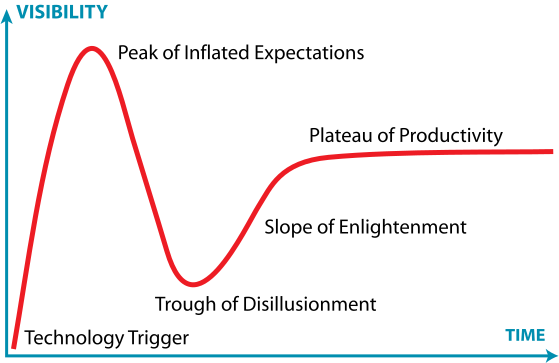
So long as no one sees your workflow as valuable, they will happily destroy it if it means getting the ticket done.
I have no love for Microsoft, but the idea that a locked in monopoly, responsible for tainting or outright destroying huge swaths of the internet, is a "success"...
Not gonna lie though. Making a fake page that looks like a competitor to show people after they ask you to give them their competitors site is very mockable.
I see the similarities between these situations, but the difference is deception, Not that it's "copying".
I can't imagine anything clearer to prove intent than a user requesting that they want to go to Google to Bing, Bing responds to that request by showing them a page that looks like Google's. That is so clear. Is that really not able to be proven in court?
Any normal human would be sued into complete oblivion over this. But everyone knows that these laws arn't meant to be used against companies like this. Only us. Only ever us.
Every off the shelf component on the market needs institutional knowledge to implement, operate, and maintain it. Even Apple's "it just works" mantra is pretty laughable in the cold light of day. Very rarely in my experience do you ever get to just benefit from someone else's hard work in production without having an idea how properly implement, operate, and maintain it.
And that's at my little tiny ant scale. To call the problem of streaming "solved" for Netflix... Given the guess of the context from the GP post?
I just don't think this perspective is realistic at all.
Humans are really bad at understanding distributed harms.
I think this is important because it feels like an endless surprise to everyone that this keeps happens. It feels like we have to cover the same ground again and again in discussions about it, and it feels like if we could tackle this problem more generally, the benefits to society at large would be massive.
Product reviews are valuable, producers capture reviewers, spam fake reviews.
Email is valuable. Spam nearly destroyed it until we migrated the entire decentralized system to Google.
Public discussions like these are valuable, and God knows how much work Hacker News does to moderate all this.
None of this feels like it's designed to resist this problem.
... At the same time, I also am aware of how hilariously dumb chat GPT can be in deep technical contexts. I've taken to saying that when it comes to a technical topic, chatGPT will confidently tell you the wrong thing to do 50% of the time, but that's fine because it will give you the terms and context you can use to audit its solution yourself. Even if you don't understand the answers you can easily have chat gpt explain the gaps, again, 50%, but giving real information contextualizes the conversation better. I would expect this to improve accuracy, and my personal experience bares this out.
There was a brief window of time where the strongest chess players were chimeras, humans who assessed AI suggestions. Quickly even they found themselves outperformed by engines.
I suspect this is happening here as well. And I also suspect its going to take a good deal longer.
1. Why clone Jeff's voice?
When I was messing with stable diffusion using Automatic1111's interface, I noticed it came with a big list of artists to add to the prompt to stylize the image in some way. There was a big row in the media about ai art reproducing artists work and many artists came forward feeling it was a personal attack. But... I mean the truth is more general than that. When I pressed a button to insert a random name into a prompt, my goal was not "yes give me this person's art for free", it was "style this somehow".
I wasn't personally interested in any particular artist, I honestly would have preferred a bunch of sliders.
Jeff here is clearly a good speaker. That's a practiced talent and voice actors exist because it's hard. Elecrow wanted a voice over and they wanted it to be as good as they could make it. Jeff is very good. So did they want Jeff?
I think what they really wanted was a good and cogent narration with the tenor of a person. Not a machine making noises that sound like english. If they had an easy way to get that, we wouldn't be talking about it here.
2. What function does copyright serve?
Well. I think a reasonable argument would be that if people were able to reproduce your work for free, you would quickly find yourself without a monetary incentive to make more of it.
So. What happens if you combine answer 1 with answer 2?
I think it leads to: "We should consider making it illegal to automatically reproduce the work of an artisan.", you know, the luddic argument. An argument that has been perceived to be, more or less, settled.
So it seems to me: That for individuals, harms matter, and for society, it doesn't.
To illustrate:
If I were to do something horrible like kick a 3 year olds knee out and cripple them for life, I would be rightly labeled a monster.
But If I were to say... advocate for education reform to push American Sign Language out of schools, so that deaf children grow up without a developmental language? We don't have words for that, and if we did, none of them would get near the cumulative scope and harm of that act.
We simply do not address distributed harms correctly. And a big part of it is that we don't, we can't, see all the tangible harms it causes.