BenoitEssiambre
BenoitEssiambre on Hacker News
Re:The State of Context Engineering
on Monday October 26, 2026 @09:26AM (#50243280)
My impression is that there's only a small area at the beginning of the context window that is artificially boosted, after that DLM becomes important.
Full disclosure: this is info I got from Claude. I was discussing DLM ideas with it a while back and while it mostly confirmed (maybe sycophantically) my ideas, it also said that rather than a pure decaying distribution effect with distance, it was U shaped because of the small boost at the beginning of the context window.
Re:The State of Context Engineering
on Sunday October 25, 2026 @10:40PM (#50238443)
It's nice that this article goes beyond the "context too long" scapegoat diagnostic.
There is more to it than just reducing content in context. LLMs attention mechanism works by finding graphs of related words and concepts and it works best when the relevant relationships are close together in the text. Length matters but how well the information is organized matters as well.
It's useful to be familiar with the concept of dependency length. The two sentences in this image ( https://benoitessiambre.com/img/dependencylength.png ) have the same words and same meaning but sentence C is organised to minimize the distance between related words.
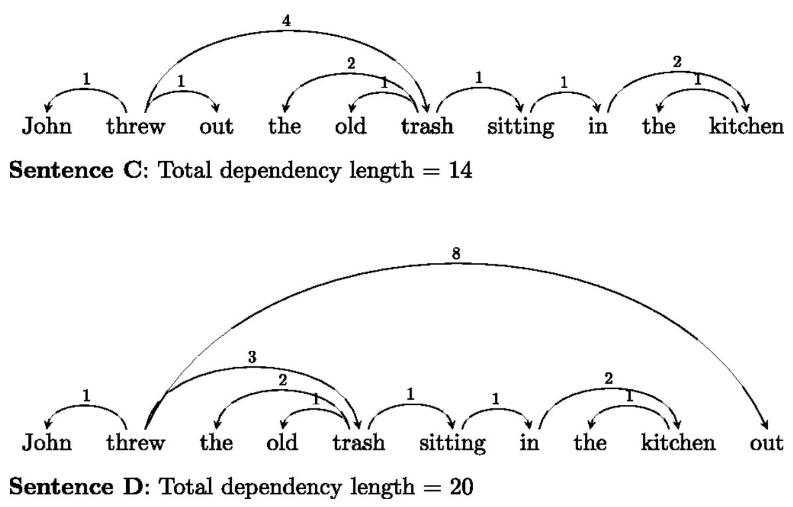
This can also apply to paragraphs and sections. Ordering them so that related information is recursively closer together, helps AIs think better (also helps humans, Dependency Length Minimization, DLM is an idea from psycho-linguistics).
This is one reason progressive disclosure and sub agents are important. Including unnecessary information spreads apart surrounding information and makes it more difficult for AIs to figure things out.
For eg. optimizing skills, it can help to put more important information at the bottom of a skill. Usually after a skill is loaded, the AI will start “thinking”, talking to itself to try to reason through a problem. The thinking block will have an easier time considering the text closest to it, the last part of the skill, than information farther up.
Thinking blocks can produce a lot of text (a lot of it often hidden from users) that also spreads information apart. Sometimes, when an early instruction is still relevant but there’s been a lot of thinking and discussion added to the context since, it’s worth repeating a summary the early information ( keeping in mind that too many reminders can also spread other information apart ). I think however, LLMs are tuned to overweight very early information so that they don't disregard system prompts. You might be able to exploit this by placing some important facts near the very beginning of a conversation.
If you've ever written compression algorithms where repeated blocks are referenced instead of encoded, you'll be familiar with how related information being clustered allows for better compression. It's another example of the parallels between intelligence and compression and it hints at the information theoretic aspect of DLM.
Re:Visa, Mastercard, Major Banks Facing New Litigation over 'Anticompe...
on Wednesday October 07, 2026 @01:42PM (#49996187)
Is that practice illegal? I've never gotten a discount for using cash or debit.
That is the crux of the problem though. By adding fees and then contractually forbidding merchants from passing those fees on to credit card customers, it is forcing non card users to pay for card users fees since the fees are embedded in prices. Plus they're even giving card users kickbacks in the form of points. So non credit card users end up paying more credit card fees than credit card users which is nonsense.
Re:AI needs $6T in annual revenue to justify data centre boom
on Tuesday September 29, 2026 @04:40PM (#49900142)
In theory:
1) This would make stocks worth a lot more and produce more dividends so everyone owning stock would get money to spend.
2) Governments effectively indirectly own ~40% of all business profits via corporate taxes, capital gains taxes, dividend taxes, sales taxes. So governments would also have more revenues to spend/redistribute (this depends on governments not wasting it, spending it on wars etc.)
Re:OpenAI GPT–6 Astra breaks Enigma message that has resisted solution...
on Tuesday September 22, 2026 @02:46PM (#49806190)
Now that's passing the Turing test for real.
Re:Why don't machine learning research agents overfit?
on Monday September 14, 2026 @05:31PM (#49704390)
It doesn't have to be arbitrary. The Kolmogorov/Solomonoff definition, that the simpler models are the shortest programs that can generate what we know about a domain, measured in bits, have a solid mathematical foundation, based on information entropy and even thermodynamic entropy if you cross over into computer hardware.
Entropy is a metric targeted in LLM training which is likely why LLMs are overfitting less and less as they improve and why they subjectively seem to obey Occam's razor.
There's lesson for software engineering in general behind that kind of simplicity. https://benoitessiambre.com/entropy.html
Re:Simple Is Not Small
on Monday September 07, 2026 @10:13PM (#49604972)
Reducing entropy or cross entropy fits intuition and theory and it's what LLMs target during training in order to model languages, to model the world and to enable calibrated reasoning across uncertainty and gray areas. I think you can use entropy reduction as a good definition of simplicity even though it's not always "simple" to understand what that entails.
Re:The Economic Benefit of Refactoring
on Thursday July 30, 2026 @12:25PM (#49112219)
The benefits go beyond reducing token consumption. Compact contexts also foster better reasoning, enable intelligence across more layers if you can load them in a single context, and writing software to enable this, results in more correct software, software that _generalizes_, that has higher probability of being correct not just for tested cases, but for the interpolations and extrapolations of these cases.
Refactoring towards good abstractions is more powerful than people realize. There's information theoretic bayesian math to back this up.
It's a bit of a divine coincidence that software that is more economically and energy efficient to process and run tends to also be more correct.
It's all about reducing the entropy of your code. https://benoitessiambre.com/entropy.html
Re:Claude Fable 5
on Tuesday June 09, 2026 @01:29PM (#48464343)
Looks like a good model (sir). Costs are getting out of control though. 2x Opus and non-metered usage going away. We're quickly approaching the cost of a human salary for normal usage.
Re:The software industry: annealing, but wrong
on Sunday May 31, 2026 @09:26PM (#48351634)
Attempts to impose always small PRs might get me to argue that optimal change sizes are normally distributed.
If you look at how simulated annealing (https://en.wikipedia.org/wiki/Simulated_annealing) is done, while the average size of jumps shrinks in the wikipedia annealing animation, there's always _some_ probability of large jumps in the optimized metropolis-hasting process as the jumps are still normally distributed just with shrinking variance over time.
"[I split a large PR into multiple] But also, I could not have developed the quotas feature in real life in that artificial order. The grants structure evolved as my understanding of pricing and quota enforcement evolved. The original quota semantics sucked, so I rewound back to the data structures, which affected how the pricing got imported, which changed how the quotas were stored. The code reviewers didn't have to worry about that but I did."
This is also one way LLMs are fundamentally different from prior language models which worked by searching over parse trees top-down or bottom up trying to fit independently evolved pieces. LLMs lay everything out in a large matrix of randomized weights and try to slide everything into place jointly.
This means organizing all the pieces well into a single context window unlocks a special AI power: to efficiently jointly converge these pieces to fit better with each other (like a smart human having loaded up on context would do). Splitting the work into multiple PRs or contexts might stymie this powerful aspect of AI.
It is a challenge and somewhat of an art to pack and organize the information in a context window to exploit this type of reasoning LLMs are made for.
The Era of Compounding Language
Re:Nobody Gets Promoted for Simplicity
on Wednesday March 04, 2026 @09:49AM (#47248257)
If you're at a place that rewards complexity, you might be able to pitch simplicity as something that to get right, requires deep understanding of complex information theoretic concepts and deep understanding of ontological knowledge about the domain (it helps that this is true https://benoitessiambre.com/simple.html ). You can talk about the Bayesian Occam's Razor ( https://benoitessiambre.com/abstract.html ) and about minimizing the entropy of code ( https://benoitessiambre.com/entropy.html ), of tests ( https://benoitessiambre.com/integration.html ) and even of infrastructure ( https://benoitessiambre.com/pgcentrism.html ).
Re:MCP is dead. Long live the CLI
on Sunday March 01, 2026 @08:18PM (#47212710)
One underrated reason that CLIs are often better than MCP is that Unix tools seem to have close to information theoretically optimal layout to enabled reasoning. They are concise, in the Solomonoff/Kolmogorov sense.
This means that the related parts in the inputs and outputs are recursively as close together as possible.
There's a reason humans don't type and read http/json on the command line. It's hard to read and reason over that type of syntax. json is made to be easy to parse for simple algorithms, not meant to organise info in an easy to reason about layout.
AIs benefit from the easy to reason about layout. It's not just about being able to fit in the context window but about the contents of that context window being organized such that the attention mechanism doesn't have to stretch itself out trying to connect far apart related pieces. It doesn't have to try to match brackets to disambiguate information. CLIs tend to use formats that are obvious at a glance for humans and LLMs alike.
It's about the entropy of the formats. https://benoitessiambre.com/entropy.html
Re:Pretty soon, heat pumps will be able to store and distribute heat a...
on Monday February 02, 2026 @11:08PM (#46866362)
Yeah I always wondered if I ever switched to solar panels, would there be a way to accumulate heat to be used in the Canadian cold months that have little sunlight? The closest I found was electric thermal storage based on heating bricks. They can accumulate more energy than water since they can go to higher temperatures. For example these say they go to 1300°F or 700°C https://steffes.com/ets/roomheater/ . They don't seem to have large models that could heat a house for months however.
Re:The Hot Mess of AI
on Monday February 02, 2026 @10:36PM (#46866143)
This matches my intuition. Systematic misalignment seems like it could be prevented by somewhat simple rules like the hippocratic oath or Asimov's Laws of robotics or rather probabilistic bayesian versions of these rules that take into account error bounds and risk.
The probabilistic version of "Do No Harm" is "Do not take excessive risk of harm".
This should work as AIs become smarter because intelligence implies becoming better bayesians which implies being great at calibrating confidence intervals of their interpretations and their reasoning and basically gaining a superhuman ability for evaluating the bounds of ambiguity and risk.
Now this doesn't mean that AIs won't be misaligned, only that it should be possible to align them. Not every AI maker will necessarily bother to align them properly, especially in adversarial, military applications.
Re:Compressed Agents.md > Agent Skills
on Thursday January 29, 2026 @05:55PM (#46818024)
Wouldn't this have been more readable with a \n newline instead of a pipe operator as a seperator? This wouldn't have made the prompt longer.
Re:France Aiming to Replace Zoom, Google Meet, Microsoft Teams, etc.
on Monday January 26, 2026 @03:12PM (#46770858)
Countries are waking up to the danger of having the US in a position to take control of most of their computers and phones via software updates.
Open source solutions like https://en.wikipedia.org/wiki/GendBuntu could become more prominent. There's even interesting non us hardware options like https://starlabs.systems/
The US has had an unfair advantage in tech, defense, science and finance because it hosted the global hubs of the free world. This attracted eye-watering amounts of money to places like SF and NY. With the newfound isolationism, tariffs, threats etc. reducing the viability of hosting the global hubs, there's massive opportunities opening in europe and elsewhere, especially if governments can help bootstrap these sectors with efforts like these.
The Unreasonable Effectiveness of Failure
Re:Proof of Corn
on Friday January 23, 2026 @03:33PM (#46737504)
It could be just an owner or a board or directors at the top. It's possible the CEO will be automated for some companies.
Re:European Alternatives
on Friday January 23, 2026 @01:47PM (#46736163)
I also mean Hacker News
Re:Proof of Corn
on Friday January 23, 2026 @01:33PM (#46735967)
AI CEOs are coming.
Re:European Alternatives
on Friday January 23, 2026 @01:23PM (#46735834)
Its founder lives in europe so there's that.
Re:European Alternatives
on Friday January 23, 2026 @01:06PM (#46735623)
It is a sad reality. The US has recently threatened to annex Denmark and Canada. Some of us are suddenly keenly aware that the US is in a position to take control of most of our computers and phones via software updates.
Open source is the global alternative you're looking for. There's even interesting hardware options like https://starlabs.systems/
The US also has had an unfair advantage in tech/defense and finance because it hosted the global hubs of the free world. This attracted eye-watering amounts of money to places like SF and NY. With this newfound isolationism, tariffs etc. reducing the viability of hosting the global hubs, there's massive opportunities opening in europe and elsewhere.
Re:European Alternatives
on Friday January 23, 2026 @12:50PM (#46735440)
For consumers, these computers look interesting: https://starlabs.systems/
Re:'The answer cannot be nothing': The battle over Canada's mystery br...
on Sunday January 11, 2026 @10:47AM (#46576711)
I know doctors who've worked with Marrero and they seem to be split in their opinion. They seem to agree he tends to be "excessively thorough", frequently sending tests to labs across the world. This makes him liked by desperate patients with potentially incurable diseases who want someone to "do something".
They are split on whether his thoroughness is just fueling false hopes and sending patients down unnecessary rabbit holes or if he could have potentially identified a real issue.
Re:Jensen: 'We've Done Our Country a Great Disservice' by Offshoring
on Tuesday January 06, 2026 @09:25AM (#46512635)
Right but the majority of people holding significant amounts of capital is retirees or people saving for retirement. There is a small minority of people wealthy for other reasons. It doesn't really make sense to strongly associate these people to "capital" since they are a small minority of capital holders.
Re:Jensen: 'We've Done Our Country a Great Disservice' by Offshoring
on Tuesday January 06, 2026 @09:19AM (#46512557)
Do you have a link? What I've seen in most discussions is obscuring of the fact that the majority of "capital" is directly or indirectly retirees or people saving for retirement. Those in the top 5% wealthiest often need to survive on that wealth for decades so it's not as if they have per year spending power that is that high. You too will be at your top percentile wealthiest of your life when you are nearing retirement.
Re:Jensen: 'We've Done Our Country a Great Disservice' by Offshoring
on Monday January 05, 2026 @01:22PM (#46502567)
Note that the "Labor vs Capital" distinction mostly means "workers vs retirees". The reason more money goes to capital these days is not necessarily that each retiree is getting more but that in an aging population, there's more retirees so it takes more resources diverted from workers to support this larger non working population. This problem can be solved with more babies 20 years ago or more immigration of workers now to share the burden (unless AI makes everything weird).
Re:Trillions Spent and Big Software Projects Are Still Failing
on Wednesday November 26, 2025 @09:40AM (#46057794)
If you click on the link, I mention other competing attempts and architectures, like Multics, Hurd, MacOS and even early Windows that either failed or started adopting Unix patterns.