Yes, it is. The job of a proprietary OS is whatever that company says it is. If it's shoveling annoying ads to users, that's its job, and having annoying ads is a very sensible thing in a proprietary OS since the company is driven by profit, and they can make more profit by including lots of annoying ads. If you don't like the product your vendor has sold you, then you should choose a different vendor. A Free OS that doesn't come from a company with a profit motive won't have this same problem.
There is not, and has never been an alternative to windows for all use cases. Most notably: a gaming rig (One of few remaining use cases for stationary home PCs these days, so perhaps the most relevant for the idea of the Microsoft monopoly on the desktop). If you want to reply that Linux is a perfectly usable OS for a gaming rig these days then please reconsider. It's just not.
I actually don't understand how Microsoft reasons around these things. There is zero way that these news links actually "pay for themselves" in income vs customer alienation. There must be something else to it.
Could you please elaborate? It was impression that SteamOS (based on Arch with KDE Plasma) does cover all bases - what's missing?
Because when people buy gaming rigs with $1-$2k graphics cards, those are the titles they are likely to want to play. Anything simpler, older, indie, you can basically work around by other means (virtualization, emulation. Or the community or company, or driver vendor has caught up and "fixed" the problem, see e.g. Apex Legends).
The fact that Valve recently released a gaming handheld that runs Linux, and is wildly successful, should be a hint on the status of gaming on Linux
About 3/4 of my library is marked with “no” on their compatibility chart, and from some experimentation, they’re largely not wrong.
It's unlikely as they haven't checked that many games, I suspect most of your games are still "unknown" (but are very likely to just work in practice).
Anyway you're very unlucky with your library, in my case most of the games work out of the box regardless of the rating, and most of the games marked "unsupported" can be played by changing the proton version or using protontricks.
Did you check ProtonDB for full stats about your library?
I'd call that "unusable" if you need to tweak it. It's possible for power users like me or you, but if it requires some knowledge of computers, or being able to google an error message or visit a forum to look for solutions, it's way beyond usable for most people.
I'd say using any tweaking at all would for most people fall under "nope". It's only enthusiasts that can do that.
My point remains: only enthusiasts who are ready (and able) to tweak even small settings - particularly e.g. visit a forum or google the occasional error would this work for.
Let's measure it this way: how frustrating would an average non-power user find the desktop Linux gaming experience today? I'd argue that while it's a lot less frustrating to them than it was a few years ago, but it's still not so frustrating when put next to the windows start menu ads frustration.
I think if more people tried Rather than just assuming they would probably be pleasantly surprised.
Linux is very much a viable gaming platform these days, and Windows only has a minimal advantage in that area.
Here's the top of the list of 2022 most sold PC games (US chart):
#1 Most sold 2022 (CoD MW2): Nope https://www.protondb.com/app/1938090
#2 Most sold 2022 (Elden ring): Sort of (Steam deck apparently great, Desktop less than pefect) https://www.protondb.com/app/1245620
#3 Most sold 2022 (Madden NFL 23): Barely. No online play and worse perf https://www.protondb.com/app/1760250
And so on and so forth. But if we give a little more time it could be better. So look at 2021 most sold PC games instead
#1 Most sold 2021 (Apex Legends): Yes. Fixed in 2022 with official anticheat support 3 years after release. https://www.protondb.com/app/1172470
#2 Most sold 2021 (BF 2042): Nope https://www.protondb.com/app/1517290
#3 Most sold 2021 (CS:GO): Works (Although some of the user reports look really painful). https://www.protondb.com/app/730
Looking at protondb the number of titles that get a "Platinum" rating meaning they work out great of the box without tweaking, is extremely low. (proton/steamdeck isn't the only way of running Linux games of course).
I disagree it's 'far from great', I'd say it's only slightly short of Windows support. There's a reason Steam thought it made sense to use it as a base after all.
As for CSGO I have better performance under Linux than I do on Windows, and many other users support the same.
Others might shrug and say "hey 9/10 that's great, and if 3 of those run even better then I love it!"
So yeah, it's not all sunshine and butterflies, but "extremely low number of games that work out of the box" is not true in my experience.
(Important side-note: I don't play online multiplayer stuff, so the whole anti-cheat software topic does not apply to me.)
Few people think to visit it and report that a specific game works great for them.
I sold my steam deck because I don’t have the time to play switch, desktop, and steam deck. Proton configs were one of the reasons I chose to sell the deck instead of the switch or desktop.
The proton configs worked and I was surprised they made a big difference. They made unplayable games playable. I’m just not trying to debug pleasure activities.
Which is worse? :)
I am guessing that there have been real issues with incompatible root kits, but there has never been an ‘era’ where it was a common thing for the average gamer to reinstall windows weekly because of incompatible rootkits.
The only thing close to that I can think of is places where poorly maintained rootkits were required for banking, could not be easily uninstalled and caused havoc. That’s a hellscape for sure but not quite the same thing.
Usually, home users do not NEED whatever software only works on Windows. Usually, the example is some AAA game. No one needs a game; it's a luxury. So if some stupid game is "forcing" you to stay on Windows, that's your own fault and I have zero sympathy.
For everything development related, Windows just that thing that runs WSL2, and dropping the WS makes it better.
Though if I had to deal with the consumer windows garbage from win11 again at work, I'd start advocating for a full switch (I know at least 1/3 of devs would be with this, and it's a .Net/Azure shop mostly).
let me guess, Photoshop and Autodesk?
Can't play Rust on a steam deck.
I remember when Loki was porting a small handful of games to Linux and clueless Linux Desktop evangelists back then claimed the same thing: "look, it is a perfectly useable gaming platform!".
Look, Linux has made a ton of progress as a viable gaming platform lately, largely due to the Wine and Proton projects[0], but there are still large holes in what it has reasonable support for. For me personally, VR is a shitshow on Linux, even with Valve's own offerings.
[0] Because the actual Linux Desktop community could never get their shit together enough to actually be a platform, we ended up just porting Windows's own platform.
The opposite is basically "Yeah you pay for an OS that shows ads in your face and that you hate, but on the other hand you don't need to occasionally google error messages for that latest game you bought or worry that the anticheat doesn't work" Sadly you can't have both. But my point is if you absolutely must play all AAA online PC multiplayer games perfectly, then you must also use windows. I guess the contentious part is, is that the definition of "usable" to me it is, but clearly not to everyone.
10 years ago things improved a bit when Valve started bringing Linux ports to Steam but still most games didn't work and needed effort in Wine to launch. Now you literally click one check box in Steam and install the game and it just works most of the time. If it doesn't work you can often use ProtonUp Qt to get the latest Proton build and that often solves it. It's about as much effort as updating a GPU driver on Windows. For non-Steam games Lutris and Heroic are pretty similar.
I'm not just talking indie games either, big AAA stuff like Marvel's Spider-man work well. Online kernel anti-cheat games are really a pretty tiny list. Obviously there's some popular, high profile stuff on there but a lot of good recent stuff that does work.
So if you look at "N titles of M work well" then the Linux glass is half full. If you look at "X hours of Y of the total played hours of recent popular AAA games are played on games or modes that work poorly on linux" then it's still half empty.
Unfortunately it's not by hours but peak concurrent players. It's also pretty similar to the top grossing list. I checked each games Steam Deck rating and if it was verified or playable (usually means it needs text entry with a keyboard or doesn't support controllers) marked it as "works" (with the exception of TW: Warhammer III which is listed as not working because the performance isn't good on Steam Deck but it's a native linux title). If it was unsupported and the reason was given I marked as so, if it was some other reason I checked ProtonDB and noted the rating. I assumed if Valve marked it not supported it doesn't work regardless of ProtonDB rating (except again TW:Warhammer III). Out of the 90 titles there 21 are marked unsupported mainly because of anti-cheat or 23%, when weighted by player base that rises to 26%. So arguably it's 3/4 full. ;)
Of course if you demand every title MUST work and no alternatives will ever suffice I doubt you'll ever be satisfied. Anti cheat also gets rarer as you move away from big online games.
Here's the full list:
Over 240,000 Peak players:
Goose Goose Duck - works Ark Survival Evolved - works Elden Ring - Works Dota 2 - Works COD MWII (2022) - Doesn't work, anticheat PUBG Battlegrounds - Doesn't work, anticheat Yu-gi-oh Master Duel - Works Apex Legends - Works Lost Ark - Doesn't work, anticheat CS GO - Works Destiny II - Doesn't work, anticheat Dyling Light 2 - Works
Over 130,000 peak players:
Cyberpunk 2077 - Works New World - Works Monster Hunter Rise - Works Total War Warhammer III - Works WB Multiversus - Works V Rising - Works Path of Exile - Works Team Fortress II - Works Naraka: Bladepoint - Works Rust - Doesn't work, anticheat GTA 5 - Works Wallpaper Engine - Doesn't work? (is it really a game though?)
Over 75,000 Peak players: Raft The final chaper - Works Vampire Survivors - Works The Sims 4 - Works Rainbow Six Siege - Doesn't work, anticheat War Thunder - Works Fifa 23 - Doesn't work, anticheat Left 4 Dead 2 - Works Unturned - Works Witcher III - works The Forest - works Civ 6 - Works Valheim - Works Fifa 22 - works Football Manager 2023 - Works Dead by Daylight - Doesn't work, anticheat Dread Hunger - Maybe works? ProtonDB says Gold Warframe - works Terraria - works Football Manager 2022 - works NFS Heat - Works Warhammer Darktide - Maybe works? ProtonDB says Gold Warhammer Vermintide - doesn't work, anticheat Lego Star Wars Skywalker Saga - Works
Over 40,000 peak players Skyrim - Works Euro Truck Simulator 2 - Works Fall Guys - Doesn't work, anticheat Don't Starve Together - works God of War - Works Gundam Evolution - Doesn't work, anticheat Cycle Frontier - Doesn't work? ProtonDB gold Stray - Works Deep Rock Galactic - Works Stellaris - Works The Scroll of Taiwu - Works Mirror 2 Project X - Doesn't work?, ProtonDB silver Conan Exiles - Doesn't work, anticheat NBA 2K22 - Works Farming Sim 22 - works Marvel's Spiderman - Works Battlefield 1 - works Battlefield V - works Risk of Rain 2 - works Crusader Kings III - works No man's sky - works Final Fantasy XIV - works Red Dead Redemption II - works Warm Snow - works Mount and Blade II Bannerlord - works World of Tanks Blitz - Works Payday 2 - works Hearts of Iron IV - works Super People 2 - doesn't work, anticheat Stardew Valley - works 7 days to die - works phasmophobia - works VR chat - doesn't work? ProtonDB gold Undecember - works garry's mod - works Halo Infinite - works Stumble Guys - works Day Z - doesn't work? ProtonDB gold Mir4 - doesn't work? ProtonDB borked Project Zomboid - Works Cult of the Lamb - works Victoria 3 - Works Rimworld - works
If it doesn't work out of the box and requires fiddling, then it's at most "barely usable", it doesn't even meet the standard for "decently usable" much less "perfectly usable".
https://store.steampowered.com/app/1938090/Call_of_Duty_Mode...
Looking back over the previous call of duty titles, it doesn't seem to support any of them. Missing giant and popular gaming franchises like this is why I would not even be comfortable calling it 90-95% compatible.
I also checked BF 2042 which I play probably 2nd most often, same, not compatible.
And 3rd most played for me, Rainbow Sig Siege, also not compatible.
These are not exactly small games or small gaming franchises and so basically steam deck or Linux doesn't support basically any of the games I play.
Just wanted to give my perspective.
no, linux is not "perfectly usable" for every single task imaginable, but you know what? neither is windows, or osx, or ios, or android.
People are used to all the bullshit windows forces them to do, and since they consider that the default, thats just how life is for them, and nothing they can do can change that. Ask them to use linux? they will have all sorts of things they need before "its ready", but all the shit they put up with on windows does not get to go in same category, because they already accepted that thats just life.
There are games made for xbox. On Linux, the story is sadly that you are basically trying to mostly bend games made for windows to work on Linux. It's not the same to the xbox vs playstation situation.
Some people (myself included among them) have hardware or use software that is either Windows-only or works much better on Windows - even if we really dislike some aspects of Windows.
Doesn't mean we won't complain about the things we dislike and call out for them to be changed/improved.
This × 1,000. Everyone has a tendency to do this, but I think it's especially prevalent for choices that we make essentially 'by default'. They no longer register as tradeoffs, and are naturalized and universalized as 'facts of life'.
You know that feeling when you move from Windows to Mac, and suddenly realize that there is a paradigm of personal computing that doesn't involve multi-gigabyte updates to the operating system every other week? Maybe you don't, but it exists. There is a similar experience when moving to Playstation (or Xbox) for gaming, and suddenly noticing how much time you were spending in keeping video, mouse, and keyboard drivers up to date, and fiddling with all the settings that ultimately make little difference in how games actually play. I know, I know. "Mouse and keyboard." "Framerate." "Mods." I don't care. Moving to a console has been liberating. Since the advent of getting everything running at 60 FPS on the current-gen models, there's really nothing holding it back. Also, as an outstanding bonus: no cheaters in online games!
CoD has supported this since their 2019 release, for example.
Honestly - has this ever been a problem on Windows ? After the initial setup, I am done. I occasionally update the Video Drivers - but thats once in 6 months. Only if you change the keyboard, mouse hardware, would you need to run through the driver update process again and that too - only if Windows did not auto-detect and install the driver.
Source: experience in maintaining a dozen family windows installs on PC/laptops.
Complaining or justifying why you have to do something that doesn't give you choice is a victim's way of thinking.
If you want the world to continue to become less free, keep blaming the world for your choices.
Your choices, good or bad, determine the world that we all live in together. It's up to each individual to make right choices for this world to change.
With that out of the way I think it's completely irrelevant for the original discussion. Game developers are going to make games for the biggest platforms. So if you want to play the most titles, you choose the bigger platform.
Yes, so long as people keep using windows, the games will keep coming to windows . But I'm not going to waste my time crusading against that in order to maybe see Linux be a more viable gaming platform in two decades. Life is just to short. I'm not enjoying Linux on the desktop much to begin with, so in my case the game issue isn't really the deciding factor. For a lot of gamers it probably is, though.
That's just semantics. The job of an OS is to be an OS, not to be an advertisement delivery mechanism. At least primarily. Just like a car is primarily for driving, not sampling random smells, even if a carmaker makes a car that can do that.
The assertion that, because they put ads in, that it is the business-optimal thing to do is weird.
Then, how is Microsoft supposed to properly track your interests and sell that information to their "partners"?
It's been a long time since Microsoft made an operating system. What they make today is basically a spyware-platform where you can run applications if you are really disciplined and persistent. I don't understand how people keep up with it.
I've used Linux on my desktops and laptops for decades now.
One reason I think Linux (the kernel) would be a poor fit as a Windows replacement is the lack of a stable driver ABI. Linux is a monolithic kernel and all the drivers are expected to be part of it. It is a model that works because it fully embraces open source and community driven development. But not all manufacturers want that, first because they may not want to, open their code, or maybe they can't due to licensing arguments. It also means they need to invest significant resources into getting their code accepted by the community. The Windows driver model drove its rich hardware ecosystem. And if you think switching to a Linux driver model is going to be better, more free, think again, because we already have that with Android. Manufacturers fork the kernel and don't give much back to the community, just having them comply with the GPL is a struggle, and hardware support besides what is built into the phone is extremely limited, and because they don't work with the community, support for what's in the phone isn't carried on for more than a couple of years.
And Windows really strong point is backwards compatibility. For example, I still use the "free" Photoshop CS2, 20 years later, works perfectly fine as a binary, I can run stuff that dates back from the 3.11 era, though as I understand it, it is mostly emulation at this point. This is part of the reason people use Windows. Microsoft tried to start clean with Windows RT, it was a failure. Apple can get away with it because they have complete control over their ecosystem, not Microsoft.
Also, games.
On Windows, you sometimes cannot even install the OS without hunting down the right drivers for some piece of hardware like the RAID controller, if you can even find them. Most drivers are authored by the hardware vendors whose main competency may not be writing kernel code, so driver quality tends to be extremely variable. The result is often drivers that just don't work well (which can look like a hardware issue, e.g. lack of performance) or crash the whole system.
Not all Linux drivers are bug-free or feature-complete of course, but they tend to be reasonable or high quality due to the fact that they are written by and/or reviewed by the kernel community. Since all the drivers come with the kernel, the user generally has to do nothing to make their hardware work, it just does right out of the box.
(Notable exceptions here are vendors of certain video cards and wifi chips who refuse to either write Linux drivers or supply the information needed to write them. So you do have to be somewhat careful to avoid those vendors when purchasing hardware.)
I'm not a heavy gamer but my understanding is that a surprising number of popular games run just fine on Linux, thanks in part to the WINE community and the efforts of Valve.
This sounds like an experience from 2007.
For the past 5 years, every piece of hardware I have ever bought, even from aliexpress, either works automatically or downloads a driver from windows uodate automatically.
Coming back to linix, I want wifi 6 on my little linux server, and you have to hint down the few pieces of hardware that are compatiable.
I've also used a few other intel mini pcs, since the pricing for RPi went insane from limited availability... 8gb RPi 4's were going for close to or over $180, adding in a case, drive, power and the intel mini pc options were about the same price, coming with storage, ram, case, etc.
The "notable exceptions" of video cards and WiFi (and Bluetooth) chips are huge ones. But I would also add fancy keyboards/mice, printers, RGB, VR, etc... There is a video by LinusTechTips where they try to do tasks like printing a document or streaming a video game that I find very interesting because I think it is representative of what the experience of an experienced Windows user coming to Linux would be, and it is painful. If I remember well, at one point they have to run a Windows VM to have some of their hardware work.
Sound cards tend to have pretty good support, but as often with Linux, it is all about the details. You will get sound, but maybe you won't be able to reassign your outputs, or that physical volume knob won't work. In my case, which is a somewhat complex setup, I sometimes get Pulseaudio crashes and sync issues I don't have on Windows. The setup itself was a pain on both OSes, on one side, a mess of drivers and broken Windows 10 UI, on the other, obscure text file configuration and Pulseaudio plugins.
True but at a loss of performance compared to running the game natively on Windows.
But my problem wouldn't be with games, it would be with software I either use professionally or out of personal interest. Visual Studio, Photoshop, Lightroom, 3D Max.
Windows strong point is basically some large software vendors just don't support Linux (Photoshop, finance software, etc). And of course corporate. For the day to day 'casual' user Linux is every bit as good. But, much as we all had to 'learn' Windows when we started using it, so there will be at least a little learning required for Linux.
Will have to see which direction things head over time.
Did you know Win32 runs as a subsystem on top of NT, as there are several more such as a subsystem for Unix?
Then again maybe the modern NT no longer has that capability.
> Microsoft's first foray into achieving Unix-like compatibility on Windows began with the Microsoft POSIX Subsystem, superseded by Windows Services for UNIX via MKS/Interix, which was eventually deprecated with the release of Windows 8.1.
There was also the possibility to run Linux software under Windows using coLinux.
I have a device in our work environment which runs on kernel 2.6.32, last patch 2014. Can't update the machine because they do not update the drivers for that machine's hardware. The "open" (aka diy) driver runs on 4.9 at the latest and won't be updated any further despite the EOL being only this year.
It's all about money, they just want you to buy the new hardware and cough up some extra cash for them.
If they are USB they just work.
I imagine something that uses a serial port or the microphone jack to function as a joystick would need a special driver, yes.
If you're saying that games work better than windows that they do in Linux I'd have to say that this is changing very quickly.
The proton layer is really changing the game on that. And it seems like many companies like Google will be moving to running applications in that environment. I could see The day where this leads to companies developing native applications for Linux.
You can with emulation, compatibility layers, stuff like Wine and DXVK and using Linux drivers. Also lots of software ends up being written in top of Electron, so it makes easier.
Will it be a great user experience? Probably not, but that's not the point. If it will win Microsoft some money, that would be enough of a reason.
A better idea would be open sourcing Windows if that is legally possible for them to do.
My homeserver runs linux and at work I use Linux, shrug.
Currently I consistently get BSOD after 5-10 minutes of use and have spent 10-15 hours troubleshooting it.
I've railed in the past about how Windows users think it's acceptable to constantly reboot your machine, experience crashes, etc. Perhaps I am too pampered/spoiled, but I'm pretty sure 99% of Windows users are just experiencing Stockholm Syndrome.
> 've railed in the past about how Windows users think it's acceptable to constantly reboot your machine, experience crashes, etc.
Probably because most of us don't have such issues. I have both a Windows box and an OS X box, and they both need about the same amount of rebooting (maybe once a week? I don't actively keep track). My current Windows box (about 4 months old) has never crashed. My previous Windows box rarely crashed (but it was >10 years old, so it _did_ have some crashes).
I haven't rebooted this particular machine since the time it said it was required for an update, which was weeks ago.
I use it as my primary dev machine for my day job and it's a gaming machine that I use for gaming daily.
Something else is wrong. It's installed on billions of devices, noone would accept constant BSODs, crashes and forced reboots if this was the normal experience.
They do make pretty decent machines for work, due to spec., large battery, and generous cooling. While many find them too heavy or bulking, but I do not mind that bit at all. However, the amount of heat needed to be dissipated, and GPUs having very low power envelop, makes them quite pitiful for the price paid.
You don't honestly think that's what everyone else experiences, do you?
I'm a gamer running Win10. In the past 5 years, I've had 4 BSoDs, 3 of them caused by Riot's Vanguard anti-cheat (Which I've uninstalled since I don't play Valorant anymore).
It sounds to me that you got a faulty laptop, and rather than consider that possibility, you decided that Windows is to blame.
As it is though, I'll just give up on VR and whatever else I like that doesn't work on Linux before I go to 11.
Definitely agree. It's almost there. But some things are still holding me back.
1) As you mentioned, VR is shit. I don't use VR a lot, but a couple of times per year I just want to try it again.
2) There's definitely a performance hit. Some games are very jittery on Linux, while running smoothly on windows. I spend a lot of money on my gaming PC because it's one of my oldest and favorite hobbies, and if an OS just tanks the performance it's kind of annoying.
3) Some games just don't work. Mostly multiplayer games. Normally I exclusively play offline, singleplayer games. But sometimes I like to visit private LAN-parties. Which I can't really do with Linux without spending half a day with debugging.
3.1) My work-life consists of debugging linux servers and fixing them, or setting them up. After work I just want to turn on my PC and game a bit. With Windows, that's 99.9% doable. With Linux, I have to debug and fix things during my free time as well, because the chance that a game just works out-of-the-box is pretty slim for me, even though Steam Proton is quite awesome.
4) A smaller hobby of mine is video editing, which is also not optimal on Linux. Aka., I would have to find a different tool, which I've tried unsuccessfully.
Basically, I use windows on my daily, free-time PC because gaming "just works" and sometimes I like to use VR or video editing softwares. If all I'd do in my free-time was browse the web etc., I'd just use a cheap laptop with Linux on it. After all, I really dislike Windows for anything else because it's such a bloated piece of shit OS ¯\_(ツ)_/¯
I'm waiting for Valve to maybe make a successor to Index with proper Linux support, but I'm not holding my breath.
I was a Windows user for a long time until Windows 11 came out that was the last straw for me.
[1]: https://www.scottrlarson.com/publications/publication-transi...
Man I havent played at a lan event in a long time. So many games now don't seem to support that. All my friends I use to play with have moved away. I would be nice to attend a LAN event again someday :D
A selection of games is Minecraft, Valorant, Left for Dead 2, CS:GO, Age of Empires, Stronghold, The Forest/Sons of the Forest, Valheim and some others.
Way too many of my hobby stuff is better dealt with on Linux
Don't know why I never considered this... Should try it :D
Then I could use Windows for video editing and windows-only games and Linux for everything else.
Saw that it's even usable on Windows, so I could try the workflow before having to switch the OS completely. Currently I'm using Davinci Resolve but I'm not really a power-user anyways.
Thanks for the tip!
Yes I recently switched from windows to PopOS[1] and this is one thing that I haven't found a solution for. There doesn't seem to be any good video editing software for Linux other than blender and in my experience video editing on blender isn't that great.
[1]: https://www.scottrlarson.com/publications/publication-transi...
AFAIK Proprietary codecs(H.264/265, AAC) are not supported on Davinci Resolve on Linux. Maybe they fixed it since I last checked.
------
Did you try the Linux appimage of "Shutter Encoder" shutterencoder.com/en/, it works fine for me to convert H.265 to DNxHD or DNxHR (a better format than h.@265 for editing in Davinci) and I can use these files in the free version of Davinci Resolve 17 & 18. But I'm just a hobbyist and I'm using Davinci only for basic things, I'm at the beginning of my learning path... So I hope I'm not giving you a bad advice !
I'm on Arch Linux with ffmpeg4.4
Now, I love Linux and don't really like Windows that much, but when I want to game I just want the experience to be as smooth and easy as possible. And if I spend thousands of dollars on hardware I want it to be used as effectively as possible.
Maybe the problem with gaming on Linux is my own laziness...
In the past few years protons come a long way in my humble opinion.
I'm someone who switches games pretty fast, I'm not one to play the same multiplayer game for a long time. So each time I started a new game, I had to debug in Linux to get it working.
Since January I've played Planet Crafter, Steep, Back 4 Blood, Bioshock Infinite, Atomic Heart, Hogwarts Legacy and now Elden Ring. No idea what percentage of these games "just work" on Linux, but I doubt that the experience would be the same as on Windows.
Well, you know, if you have to take an edge-case which doesn't apply to my situation to tell me that windows isn't flawless for gaming...
Does ultrawide/triple screen work better on Linux?
Only if game is on Steam, got no patience to fuck with wine/proton manually
Yeah, I think the best tip I got is to try dual booting to make it easier.
Windows has many issues, but it never decided to break on me in the middle of the day. For me, an OS is not a religious affiliation but a tool, and Windows performs much better as one.
Would you mind sharing your Win10 setup? I use it too, but it's a stock version with just some basic cleanup.
GRUB has also been quite the happy camper in my experience (at least if you don't go mucking about with config files).
GRUB has also been quite the happy camper in my experience (at least if you don't go mucking about with config files)."
How dare you not have a problem in a discussion on Linux. (Not just there yet :)
I still think the future is Linux. I see Microsoft and Apple taking their O/S in directions that are anti-consumer.
And while macOS isn't as free as Linux, it's certainly less "spyware" than windows.
I think in the same way we now see advertising on school buses and display-covered vending machines (even inside a state office), were going to end up with forms of outreach / ads in our tools unless there's more robust forms of support (could be paying, could be a more multicapital flow of support).
Microsoft makes it much more difficult, then wipes out your preferences a few patches later.
A year or two after AMD acquired ATI in 2006, I had just gotten my hands on my first ever modern graphics cards: the All-in-Wonder 2006 edition. It was basically a Radeon 9600 with a built-in capture card.
This was also around the time I was really getting into Linux. I'm pretty sure I could dig up a CD with Ubuntu 8.04 that I burned fresh in 2008.
As a poor teenager living on abandoned hardware, I watched the full life cycle of that card's Linux support. I lived it.
At first, the proprietary driver support was pretty good. I could just open Ubuntu's handy dandy "driver manager", and get a neatly wrapped .deb installed. A quick restart of Xorg, and I had full GPU support. I could turn on all the flashy compiz effects: wobbly windows and a cube of virtual desktops.
This was the most exciting era for the Linux desktop. It was easy, familiar, and powerful. All we needed was a compatible MS office alternative and a few well-ported AAA games, and we would be living the dream. The future of Linux was bright and close.
A few years passed, and proprietary Radeon drivers weren't getting packaged anymore. The free fglrx driver was stable, but didn't have DRM (direct GPU rendering). Even in windows, there wasn't great driver support for ATI cards. This was pain from every direction, and for whose benefit?
A few more years passed, and fglrx became the best driver: better than the proprietary one. By the time this happened, though, you could get a vastly more powerful card for ~$30, so the point was moot.
When AMDGPU was announced, I was ecstatic. Finally, a major hardware company found the value in making a full-featured, performant, and open driver. Never again will I need to fight the most purposeless incompatibility, the pain with no benefit, the hell that need not exist in the first place: proprietary video drivers.
Linux is the opposite, nearly everything has a documented fix. It can be fixed in less time than it takes to backup, reimage, and reconfigure your machine.
In fact unless I was new and heavily tinkering with my distro, linux has easily be the more "stable". All my problems were...definitely me problems.
At the end of the day, they're both OSes running on a jaw droppingly wide variety of hardware, but whenever I look up a problem I have on linux, I find an answer that makes sense.
Meanwhile, the brand new, mainstream hardware I bought for gaming with windows forcibly sold to me with it, spent a year not being able to play audio properly while microsoft publicly insisted it had nothing to do with them, until it was quietly fixed in a windows update, which I'm sure had nothing to do with them.
Also, waking my computer from sleep occasionally just crashes my entire system, or even booting it up will cause it to crash or bootloop a few times. It's genuinely amazing what "paid development" gets you from monopolists.
Same. I switched to Ubuntu a decade ago when my Windows machine started displaying the blue screen. Somehow the motherboard itself became incompatible with Windows overnight even from a clean install. Instead of junking the machine I put Ubuntu on it ... and it's still my daily driver a decade later. And though there have been issues I'd say less than I had with Windows overall.
I had a an ASUS RoG Zephyrus G15 for a little bit and its Nvidia GPU was weirdly fussy in that it had to be running ASUS-provided Nvidia drivers, because if it wasn’t it’d perform 20-30% worse while running just as hot as if it were at full performance. This was maddening because Windows Update would want to update the ASUS drivers because they were old, but this of course nerfed performance. I tried restricting this in the Windows policy manager thing, but unbeknownst to me the Nvidia driver is split up into several pieces which then resulted in the pieces getting mismatched which broke all sorts of things.
I ended up returning it and putting the money towards a custom built tower instead, which has had none of these issues.
Also not saying that things aren’t getting better, but it’s a snail’s pace.
Windows for all its flaws is zero friction and will win from any competition.
It wins because it's less friction, not zero friction. There's a reason, other than old applications, that there are still Windows 7 installations. Many people don't want to upgrade their Windows until they upgrade their hardware because it's a hassle getting the interface back to the way you want it.
Anecdotally I'm not a programmer and I switched to Ubuntu when I bought this laptop in 2013, with about 3 or 4 years of dual booting for software purposes before I stayed on Ubuntu. I'll switch away from Ubuntu to a more user friendly distribution with my next computer because it's pushing features I really don't like, and deleting features I really do like. My wife is also not a programmer and with the upgrade to Windows 10 we had to do a bunch of searching and tinkering to make the user interface satisfactory. She's avoiding Windows 11 for as long as possible.
People are creatures of habit. Microsoft learned this when they removed the start button in 8.
Here's the most crucial point: windows has the most thoroughly documented friction. If you ever have a problem, chances are 1,000 or more other people have had that problem, or a closely related one, and 1 or 2 of them even wrote about it somewhere. Life is way harder than it needs to be, but you are not even remotely alone.
Apple takes the opposite approach: walls instead of friction. If you can't figure it out, it's because you computer can't do it. That implies your computer shouldn't be able to do it. You would be surprised at how comfortable people are with this conclusion. It doesn't get them what they want, but it saves them time and energy by providing early and confident rejection.
Linux maximizes the ability to manage friction. There is always a way to actually resolve it with constructive effort. That's an unfamiliar strategy, and it requires some level of education that the average user refuses to accommodate, even if it will definitely save them time and effort.
Microsoft are often taking the blame for, and working around, other vendor’s bugs. Just because they fixed it didn’t mean they broke it.
e.g. https://twitter.com/pwnallthethings/status/13632662289708113...
If I decide to go down a rabbit hole that involves totally messing up my system, I can undo all of that by simply rebooting into an older generation. NixOS never diverges from "fresh install".
Now if we can just get the UX together, it will be incredible.
The crux of the NixOS issue right here. I tried NixOS a few times, even this past weekend, and it was such a pain that I gave up each time!
I am planning to integrate Nix (the package manager) into my recent fresh OS install if I have some time this week. I want to use Nix to have, at the very least, a controllable way to install and remove toolchains of different versions in a reproducible manner; if I can swing it I am going to use it to install pretty much anything that requires any sort of configuration care (the rest I'll just use apt). I also want to integrate more tools like asdf or pyenv which help with that, but I prefer if I could do it all through one package manager like Nix. I finally separated my /home into another drive this time, so that'll be nice for future re-installs.
NixOS is pain without scars.
It was more stable, that's why I used it. Then starting with a certain Windows 10 update I had to reinstall the system multiple times because automatic updates kept breaking it overnight, it started crashing the USB driver, suddenly it kept randomly switching keyboard layouts by itself, and somewhere around the third ruined weekend due to an unbootable system I had enough. Switched to an Arch-based distro for 3 years in which I only had one update-related issue and it took me a whole 5 minutes and one reboot to fix. Now I partially use Mac OS and while I'm disappointed by some of its aspects I can at least be certain it will boot tomorrow and it won't install a system update without my confirmation.
Oh, how the turntables.
I don't think I'm going back. I use Win10 at work, and fortunately most of my actual day is in VS Code under WSL. And that's about all I can stand.
In fairness, you can't take your experience with insider builds as an indicator of the stability of the OS. Insider builds are expected to be unstable.
I suspect you are dual-booting, which is itself a hacky middle ground full of bugs. Linux and windows will never share a drive well.
>> reduced laptop battery life
??? Odd. I find battery life on my laptops far better on linux, generally because linux knows how to actually stop doing things when asked. Windows, no matter what you do, will randomly decide to install/download something.
>> general UI clunkiness,
For me, the fact that linux UIs don't change every few months, and when they do I can undo them, makes window the clunkier UI. It is monday morning here. I have so far had to restart Outlook twice on my work computer as new "updates" are applied. I'd take a thousand clunky-looking widow borders over MS's daily popup pollution of my screen time.
The Windows installer unfortunately will happily clobber the EFI partitions on completely unrelated drives. Had it happen on a triple boot (Win/Linux/Hackintosh) setup a couple of times, with each OS getting its own drive. MS almost certainly is not testing against multi-OS setups of any kind.
Nowadays with UEFI and GPT, sharing a drive is not a problem; they don't stomp on each other's MBR anymore and even UEFI itself comes with a boot manager.
The bigger problem is to learn about these "new" things ("new", because introduced ~15 years ago) and stop doing stupid shit that worked with legacy BIOS and is not necessary anymore. Grub breaking itself randomly is mostly self-inflicted problem.
To be fair, though, there was a short-lived period a couple of years ago where a lot of laptop trackpads wouldn't work, and I had a work-issued laptop that didn't seem to want to play nicely with an external monitor.
So I wonder if this is largely what you're used to. I run Linux on all of my devices, which are hardware I've chosen myself and had high confidence would have good Linux support. It's only been the work-issued machines that I've had issues with... so I probably just have a sense of how to get things to play nicely because it's what I've used primarily for so long.
It's the times when it breaks that make the difference for me. One Windows, most breakage is an annoyance. On Linux it can grind my day to a halt. Here's something I did on an Ubuntu install recently.
apt install python3
apt autoremove python3
    apt remove python3
    apt autoremove
The main thing that kept me on Windows for years was games, but once I jumped into using Proton via Steam on Linux (and now the tweaked Proton GE), I can run almost all of my game library at full speed. The few games I can't play are due to anti-cheat software like Battleye.
I don’t have to do this stuff with Windows. It just works. I don’t mean to downplay the efforts Ubuntu developers have gone to in order to get it to its current usability. It’s pretty good, it just has a bit more maturing to do before I can make the permanent jump. A while back, I read that Ubuntu was hiring a product manager for the desktop, or maybe gaming? Anyway, I wish them luck, and hope they’re able to make strides on the experience.
Will likely switch back to PopOS when the next LTS comes out though.
In the amount of time you took to do that, you could have opened a browser and typed weather.com to see the weather.
I think this is the grandparent OP's point: Showing you news or showing you the weather is not the job of an operating system. The operating system is there to manage system memory, the filesystem, networking, security and permissions, drive peripherals and accessories, maybe provide a desktop environment.
That said, I would expect my operating system's vendor to also ship high quality applications that I can optionally install after I install my operating system. Ubuntu should have a weather application, or at least a strong opinion about which third party one is the best and that new users should use. So, you're not wrong. The whole "search through 40,000 half-assed weather applications and hope user reviews are accurate" situation is also bad.
Heck, if a linux user wants to know the weather, all they have to do is lok at their windows. (might have to go up the stairs though :-)
-
I run W11 - and it SUCKS... one weird thing was I have my webcam covered in tape 100% of the time. Here was a creepy popup I got one day - it slid down from directly top-center of screen and gave me a notification asking my to uncover my webcam.
it only happened once - but WTF - and I havent seen it since, and I couldnt find anything on google about it. WTF is that?
When I run Windows these days, I assume every single part of it is compromised, either by scummy third party software running in the background or by Microsoft's scummy software running in the background. This includes cameras, microphones, any radio, the networking stack, any drives (local or network) the machine can so much as ping, everything. I have a special vlan prison I put my Windows machines in because I treat them like the hostile attackers they are.
Say what you will about Apple's "walled gardens" but every time a frustrated 3rd party developer complains online that they can't do X, Y, or Z on Macs because of permissions or security, I get a little more comforted that my Mac's software is not constantly attacking me.
I'm guessing that was probably Windows Hello attempting to use your camera for face recognition.
Saying that because I've used black electrical tape for years, including over the camera lens of my iPhone SE.
But it turns out the iPhone SE can take pictures right through that (at least in daylight), and they're not terrible quality.
Showed a friend photography inclined friend and he was as surprised as I was. eg very
years and years ago we'd buy a roll of film, pull it out in the sun, and then get it developed but not printed. You could use that as an IR-passthrough filter on a camera lens - this is if my memory isn't faulty.
"Why isn't your desk in front of the telescreen?" - "1984", Orwell.
Does the news you get depend on who you are?
User A may want a weather app preinstalled; user B may not want their computer knowing their location. User A and user B might even be the same person.
And that's assuming Ubuntu knows it, which let's be real, Ubuntu isn't great at knowing what its users want.
And all of that is assuming it's even true that most people do want a weather app.
Thanks, I needed that laugh this morning.
So the only sane course of action was to disable widgets altogether while I still can. And now I don't have the weather anymore.
Windows is a completely unified OS where there is a huge repo that can build the whole OS from source.
That makes Ubuntu extremely customizable. You can swap out the window manager, or just remove it, use a KDE file manager instead of gnome, do whatever the hell you want. That comes at a cost.
Windows is just Windows. You can’t replace the desktop (you used to be able to swap the shell), or file manager or task manger or installer system. That makes things integrated and easy to use. That comes at a cost also.
For me, I use Ubuntu with i3 for work, Windows for gaming and personal stuff, and macOS because i have old work laptops that are MacBooks.
They all have their pros and cons. Having all three means I always have the right tool for the job available.
Oh boy where to begin?
>Nvidia and Intel driver issues
Not a personal dig, but this is a result of having been spoiled. I still remember the small dime novel that came with my box of WinNT 4.0 workstation, all it did was list the various hardware that was on its hardware compatibility list. You wanted to buy some piece of hardware? Better do the homework because not everything was going to be compatible or even supported at the same level. Today everyone expects everything to just work out of the box when you throw an operating system at it. They've completely forgotten the need to even check for compatibility, they've outsourced that to the operating system. They expect it to 'just work' without input.
When it works well it's great! It's magical! But people forget that it's a relatively recent thing and that to get the best use of your hardware you're advised to research it before purchasing and to make sure you check compatibility with the operating system(s) you plan to use.
>package manager bugs
OK, this has hit us all eventually. Valid. But I've noticed most of the time when I've run into this it was a result of me doing things that I really shouldn't or at least which should prime me to monitor my system more carefully. Such as installing Debian packages into Ubuntu. Sure it can work, especially if you do your best to install any needed dependencies. But you'd better know what you're doing and watch for issues after doing so. I'm sure there are other ways the package manager can crap the bed. It's not all on us when it does so. But I really don't think Windows is any better in this regard. I've had stuff eat itself there too with applications and systems upgrading DLLs and leaving me up the famous creek without a paddle.
>reduced laptop battery life
Valid as well. But have you looked into tlp? Have you tried tuning it for battery life?
>general UI clunkiness
This heavily depends on your desktop of choice. As a Mate desktop user I've been fairly happy with how my UI behaves. To the point where it is actively annoying to be in another desktop now. Different strokes for different folks though. If Windows is the UI you rely on to the point you have muscle memory, I can sympathize. I'd argue there is a desktop that can match that UI for you on Linux but you'll have to customize it a bit and you'll have to test for which one is closest to what you prefer.
But if your preferred desktop UI is indeed Windows, it's not Linux's fault that it is not Windows any more than it would be OSX's fault it is not Windows. You have to adapt and accept that things work differently in a different operating system. Not wrong. Not misconfigured. Different.
I just want to get my work done, and be able to reliably turn my computer on and run my applications. Windows lets me do that. Linux doesn't. I haven't had a Windows update break things in years, where my last Linux experience had the Ubuntu live USB work fine and completely fail to boot to a GUI environment after the install. I don't have time in my life to troubleshoot kernel issues anymore.
I suspect you are talking about some other Windows that the rest of us.
> I just want to get my work done, and be able to reliably turn my computer on and run my applications.
Don't we all?
> Windows lets me do that. Linux doesn't.
You, ok. Others? It's the other way around.
> I haven't had a Windows update break things in years,
Last time? Cumulative update 2022.12 for W19 22H2... that's not that long time ago.
Windows is the standard bearer of paid OS's - yes, true.
Ubuntu is the standard bearer of free Linux OS's - not really, and (this is important) less true over time.
What's happening is that, as Windows is improving, Linux appears to be getting worse. But that's really just an Ubuntu problem.
I don't know how Ubuntu got the crown exactly, but it seems to be performing less well over time, and is, increasingly, not the default choice. I would understand if other distros are harder to learn or simply unsupported, but that's not the case.
It feels like 90% of these issues could be resolved by saying "Start with Fedora. In 2023, that's the actual default Linux distro that fixes these problems."
They asked for it. Red hat the former bearers of that crown dropped the ball and walked away, leaving it open for Ubuntu to step in.
https://web.archive.org/web/20031127055732/http://zdnet.com....
https://web.archive.org/web/20030812095615/http://www.linuxa...
https://web.archive.org/web/20040508195941/http://www.newsfo...
People forget now but Fedora was created because Red Hat abandoned the home desktop market in 2003. Then Fedora was spun off to be a test bed for their enterprise offerings and it was no longer possible to buy a copy of workstation in stores. So when Canonical showed up in 2004 and was focused on the desktop they were able to get a lot of people to move over fairly quickly. The fact that they were using a different type of desktop interface with Gnome that had the two panels unlike Fedora which still had the single large panel like Gnome 1.x made it stand out even more. That and the way almost every other Linux desktop at the time was KDE based...
So yeah, Ubuntu took the crown because it wanted it. It maintains that crown because outside of it and its various spinoffs and flavors no one else is really seeking to be a desktop operating system. Since Canonical has made it clear that its focus is now also Enterprise at the expense of the desktop experience, I imagine it's only a matter of time before someone else steals that crown by focusing on the desktop again. We just need one of these billionaires to fund a company to make it happen...Say what you will about Shuttleworth, he did put his money where his mouth was and I for one am grateful for the many years of good use I got from Ubuntu as a result. I will be sad for the day when inevitably the pain points out weigh the benefits and I must switch away from Ubuntu-Mate to some other system.
It absolutely is not! I recently put together a Windows 95 VM and was blown away by how straightforward and automatic everything was. It automatically recognized most hardware I threw at it, and didn't even need manual driver installation or anything. Things just worked after a reboot.
Early versions of NT (pre 2000) were not consumer oriented and that's why they were more finicky, but by the time of XP, you could expect it to just work with mostly anything again.
A virtual machine you say? With a virtualized set of hardware prechosen for compatibility so that Windows would recognize it without issues? It just recognized this collection of virtual hardware selected for compatibility without further interactions? You don't say? ;)
As someone who began with Windows 95 OSR2 on real hardware you will forgive my amusement I hope?
And don't make assumptions about me, our 1996 toshiba came with OSR2, including beta USB drivers and more built in driver profiles for commodity hardware than the plug and play "pick device" window actually could handle (it wasn't resizeable!)
By the time of OSR2, and then 98, if your device had been reviewed in a PC magazine, you could probably just plug it in, select it from a list, and go on your way.
~woosh!~
Well I've had the exact opposite experience. Windows was an endless source of bugs, crashes, and instability. Linux (Mint) is rock-solid, clean, fast, pretty, and stable. I've had more blue screens that I can count but I remember less than a handful of kernel panics over the last 10 years. No more fiddling around in settings, no more having to use external tools off some forum thread to accomplish something as simple as updating drivers.
The only issue I give you credit for is the battery life, which is indeed better on Windows by some ~20%.
I wonder why there's a difference in our experiences here?
Intel is pretty good about upstreaming drivers into the kernel. The only bugs I've ever ran into are around brand new wifi cards that haven't been mainlined yet. And even then I don't think I've seen that in about ten years. Nvidia on the other hand is a huge pain on Linux, but thats deliberately done by Nvidia.
> reduced laptop battery life.
Been using Linux as a daily driver for over 15 years and laptop life has been better than windows nearly the entire time.
To be fair, I cut my teeth automating Linux environments in physical datacenters. So I've lived in a world where power consumption mattered, know how to select hardware with good driver support, and can tune the os.
That said, you can get a brand new Lenovo idling under 5w without that knowledge and by simply installing tlp. With additional know how you can get it under 3w.
> For me, an OS is not a religious affiliation but a tool, and Windows performs much better as one.
Funny how you and I have the same value but wound up at opposite conclusions. I guess it's all about the tools and how we need/expect to use them.
Edit: grammar
Overall, when there is not some specific hardware issue, I've found linux running much smoother and more user friendly _for me_. Gnome is a lot less cluttered, things are easier to find. It is also often much better in supporting older hardware and, ironically, older windows applications.
Every now and then I get my hopes up that the year of Linux is finally here and I install the latest.
I have a simple heuristic. If in the first day of setting up the system I am required to fire up the terminal, it means that more pain is coming in the future, so I immediately delete the Linux partition.
I am still using just windows and macos for my personal computing needs.
So you're no longer reality checking this prediction? What are the reasons for firing up the terminal? Config file editing? Or something more serious?
This is exactly my litmus test. The requirement to touch the CLI indicates little thought for the UX or care for users who don't want to use the CLI. Every year I boot up another flavour of Linux and every year it fails this test. Linux is built by developers, for developers. That's fine, but let's be honest about it.
Oddly enough, this means that Linux tends to work better as the computer it's running on gets older. The reverse is true for Windows -- updates tend to make it slower and/or have more compatibility issues. A computer that worked better with Windows a few years ago will not-infrequently perform better under Ubuntu today. It's not usually suggested on new PCs unless it's spec'd specifically with Linux compatibility in mind.
This was also the era of major desktop environments playing fast and loose with there UX. GNOME3 was released in 2011. Ubuntu started defaulting to Unity in 2010, and started their Wayland competitor (Mir) in 2014. KDE Plasma 5 (2014) defaulted to fancy composting, and felt really bloated relative to the others. The only desktop environments that really kept true to the good old days (~2008) are XFCE4 and MATE (the GNOME2 fork). KDE5 isn't bad, either, but it's still a bit too bloated.
The other problem caused by proprietary video drivers was package versioning. It's tricky to have the right kernel version and Xorg version necessary to run a proprietary video driver blob; and keep the rest of your system up-to-date. Ubuntu found its initial success by creating a generally stable package repository roughly as up-to-date as Debian unstable. Unfortunately, Ubuntu became a bloated mess with strange things like Unity and Mir bundled in. Archlinux has been a good alternative, but it does expect a level of familiarity with shell utilities. Linux Mint (an Ubuntu or Debian fork) is still my first recommendation to casual users. One of these days, it will be NixOS, which is a giant leap in stability and package versioning.
The last change of that era that has been breaking the Linux experience is the switch from BIOS/MBR to UEFI/GPT. This shift was slow and messy, with most hardware adoption following the release of Windows 8 in 2012. GRUB used to break in one predictable way: windows overwrites the MBR, replacing GRUB with its bootloader. Now, with UEFI, boot entries are saved directly to the motherboard, and the bootloader itself lives in the ESP partition. The windows installer will put its bootloader in the first ESP it can find, and you don't get to choose which one that is. Now you have to worry about the ESP running out of space, but that's about it: everything else has been generally resolved, and the UEFI bootloader experience is very solid (apart from the windows installer caveat).
Now that AMDGPU is mature, and NVIDIA's drivers are relatively well maintained (and packaged), the Linux desktop experience is even more stable than its heyday back in 2008. If you install a distro that targets relatively recent package versions, like Archlinux, Linux Mint, or even Fedora; and you use a solid familiar desktop environment like MATE or XFCE4; you can avoid most UI/UX clunkiness and have very little need to fiddle with your package manager. Boot issues are pretty unlikely now, so long as you install in UEFI mode (not legacy BIOS emulation), and completely avoid MBR.
Linux has its own pain points, I agree, but especially after 2019 they are rare. With Pop_Os! I never experience any of the stuff I deal at work. I dare say Pop makes Linux boring - because everything works out of the box.
Every time someone mentions Linux driver problems, I see that name.
For me, the strategy that has worked for the longest time is to get boring computers. The boring Thinkpad, the boring Vostros and Latitudes, the boring ThinkStation and ThinkServer boxes. Large PC makers don't want their corporate-oriented products causing support calls, and that forces them to not be overly creative with their implementations. With that powerful incentive, the hardware is usually well supported by the two boring operating systems (for generic hardware) out there. Either that, or get a machine that's designed together with its OS (and know the odds of you installing anything other than that are slim).
I use my W11 22H2 as a daily driver because of that: it just works (TM).
Also, I don't see any kind of news or the likes on Windows, and it feels really close to Windows 7. Here are the things I've done so far:
- Bought a Windows 10 Education license from a shady website, and it's been working fine for the past 4? years. The upgrade to Windows 11 Education went smoothly as well.
- Local account only. No Sign in to Windows crap.
- (Most important imo) Installed OOSU Shutup10++ (it's for Windows 11) and turned almost everything off there.
- Bought a Start11 license for 5 USD and installed it, and switched to the Windows 7 start menu using it.
No ads anywhere in Windows, feels like Windows 7, talks much less to whatever 3rd party people MS have contracts with to get my data.
FWIW, I did try daily-driving Linux Mint Cinnamon, which is the best Linux for me imho. However, there is a show-stopping bug as follows:
I have 3 monitors, with the main one being a 4K over DP. My monitors are set to turn off after 5 minutes, and in Windows, they turn back on just fine when I move the mouse (minor annoyance: display scaling is not reflected across all application windows till I minimize and open the window again but no big deal). For Linux, the DP monitor won't get detected; it behaves as if my other 2 monitors are the only ones connected. I have to turn off the monitor switch and turn it on again for it to be detected. I looked around but didn't find any good way to solve it...
Desktop stability and reliability hasn't been a top-level OKR at Microsoft for many years. The company has been growing more product driven for years and falling victim to roadmaps being driven by muggles.
The only place where you can actually design a truly stable and reliable desktop is with open-source kernels and user software.
For gaming / work. You wont have a better OS to work on as a .NET Developer considering Visual Studio is top tier, I guess VS on Mac comes second close, and Project Rider, but otherwise, Windows is the main platform.
I otherwise use Linux on personal devices.
I only used .NET for modern Unity development, tho. I was using VS for C/C++ before using CLion and Riderfor that.
I work in .Net for a lot of backend code, mostly in WSL/Linux on VS Code. And it's not been horrible, though I'm much more efficient with Node or Deno at this point. Since .Net Core (and now .Net 5+) the space has changed a lot.
I can rebuild an engine, but I pay a mechanic to do it. I don't buy cars as pet projects. I just want to drive the goddamn thing.
I would pay the NSA money in addition to letting them spy on me if I could just have a working fucking computer.
have you used Windows in the last 20 years?
meanwhile Windows 11 has 4 or 5 different UI styles in control panel
Binary compatibility on Linux is often out of the question. Frequently this means picking up some old libs. libc5, old stdc++... For really old stuff with fewer dependencies that may not be a problem. As you get into a more modern era where software started to pile on large heaps of dependencies it becomes more challenging.
Source compatibility typically means porting, sometimes nontrivial. Likely something is written in a time capsule of that era's poor C and C++ standards compliance. (i.e. C89 or C++98 existed, but compilers of the day accepted lots of nonsense, so software of that era doesn't even conform to those.)
In contrast the Win32 API or COM is designed around binary compatibility. Maybe early 2000s dependencies (when MS started getting worse at this) are a problem. I think Win16 on modern amd64 is also a problem. But on average, compatibility is higher.
Heh, in my experience Bluetooth is actually entirely broken on Windows. I simply cannot get my headset to connect to my Windows laptop, but it works just fine on my Linux laptop out of the box.
this is hackernews, not usernews
Do i want write code. Yes.
Do i want to write ALL of it. No.
But linux assumes you kinda sorta do want to do it.
huh?
Also bluetooth, who even needs that? It's important that we have out of the box docker support. /s
To make it even worse, no one likes doing the last 20% of the work to make things stable and even less people like maintaining finished projects, so basically everything in Linux is about 80% done and gets replaced before it even hits the point of being reliable.
I've used Linux since I was afraid to touch BSD (in early-mid 1990s, i386 and TMS). I grew up on nix and found the whole shit-can of ~1992 horrible. Then Linux appeared. Of course I switched. Now I am back to BSD and Linux (Slackware).
I have never had a prob (save for some audio with a CS* chip that was fixed by loading MS-NT & copying their firmware from a hot running machine and dumping it back into some otherOS - Dell Lat 360 or 36x).
Mostly true, it's been a long time since Microsoft made a CONSUMER operating system.
Windows Server isn't plagued with this crap, it costs a whole lot more, but doesn't have this nonsense. Also, isn't designed to be a desktop, the recommend install model these days is to install without the desktop gui (you basically get a powershell prompt, and that's it).
If you do Windows development you'll probably have a Visual Studio license which will include a server license for "testing". I use that license as my base OS.
As for these news you can disable them if you find them annoying.
One word: Adobe.
Once the Adobe suite goes completely online, Windows will be considered a lot less essential in the office, at least on the client end.
I don't think most big companies will move away from Windows completely, there is simply no worthy competitor to replace the office suite and to have it all integrated from top to bottom.
Enjoy :)
More importantly: the core framework just outright omits many of the core features that I've come to expect in tiling WMs. There's no support for i3-style window stacks, for example; I've tried several community solutions, but they're all trapped on a too-high abstraction layer and inevitably end up fighting with the WM in ways that you simply never need to deal with in first-class implementations.
All in all, I'm planning on returning to i3wm. For me, it's a bigger struggle to try building up a usable environment from scratch than it is to start with a solid foundation and then replace the undesirable components (i3bar => polybar, bindsym => sxhkd). AwesomeWM is very fun to work with thanks to the great APIs and documentation, but I can only wholeheartedly recommend it if you need absolute and total power over the UI, since that's AwesomeWMs whole schtick.
As for widgets, I've had no trouble with that, there's quite a few fantastic collections and I've found everything I've needed.
Sure, stacks are not supported out of the box, but it is an easy thing to add if you want it. I think they are entirely consistent and bug free, as much as anything else - some specific apps might have an issue but you can also write a rule to deal with them as needed.
I'll take a completely customizable lightweight interface that I can tailor every aspect of every time, especially when it's so user friendly (for what it is).
It's the community widgets that tend to have memory leak problems, not the core package. As mentioned, this seems to be a quirk in how Lua and GTK interact (many community widgets use GTK).
> Sure, stacks are not supported out of the box, but it is an easy thing to add if you want it. I think they are entirely consistent and bug free, as much as anything else - some specific apps might have an issue but you can also write a rule to deal with them as needed.
They're not. I've used all of them. It's not an issue of rules, it's an issue of the core UI framework fighting against the hacked-on stacking implementation. There are design-time assumptions baked into the AwesomeWM layout engine that cannot be worked around using the API. You'll just have to take my word for it when I tell you that I've tried very hard and for a very long time.
> I'll take a completely customizable lightweight interface that I can tailor every aspect of every time, especially when it's so user friendly (for what it is).
I wouldn't really call AwesomeWM exceptionally user-friendly. The docs are good. The API is good. It's developer-friendly, certainly, but that's as far as the ease-of-use goes.
What widgets are you referring to that you found to have leaks?
> You'll just have to take my word for it when I tell you that I've tried very hard and for a very long time.
It's just that it seems to contradict most of the other reports I've seen, but then I don't care about stacking myself, so ok.
> I wouldn't really call AwesomeWM exceptionally user-friendly. The docs are good. The API is good. It's developer-friendly, certainly, but that's as far as the ease-of-use goes.
I said it was user-friendly for what it is. There is nothing else really like it that allows that level of extensibility, and given how it abstracts so much complexity, I would say they did indeed do a good job of making it user friendly. Again though, that's keeping in mind what it is. It isn't trying to be i3/xfce/etc or as user-friendly as those.
I'll cite myself here: https://github.com/streetturtle/awesome-wm-widgets/issues/11...
Here's another affected library [1]: https://github.com/deficient/volume-control
I've had similar issues wherever GTK interacts with awful.spawn. Basically: glib (GTK) + awful.spawn.easy_async + polling = extremely leak-prone. This is a very common pattern in community awesomewm widgets.
[1]: No bug under the main repo because they're considering it as a framework bug. See here for discussion: https://github.com/awesomeWM/awesome/issues/3584#issuecommen...
This can be done in a user respecting and useful way but that doesn't make $
I get that a company the size of Apple or Microsoft are going to want to have syndication deals. It should not be integrated so directly with the OS though, and should absolutely be removable (really, out of principle it shouldn't be installed by default).
After a lot of GPO settings and hacks I've tamed W10 to be acceptable, but it's still crappy on principle.
If Steam was not available on Linux then I would likely still have abandoned Windows and just limited my gaming to whatever runs on a Nintendo Switch.
Anyway, My husband decided to stick with Windows for his gaming computer (same hardware as mine) and my Linux computer (with ZFS) can load every game in under half the time it takes his machine.
It did take a day to figure out the magic environment variables to better performance in games, but now that I got them I just copy paste them for new games.
What are your main? If you don't mind sharing?
PROTON_HIDE_NVIDIA_GPU=0 PROTON_ENABLE_NVAPI=1 gamemoderun %command%
But otherwise, I agree with you. Windows should not be in the business of syndicating news. That should be the job of a third party widget (maybe provided by MSN!) that you install if you're interested.
I agree with you though if it exists it should optional and from credible (or from user selectable) sources.
For you, nothing. The UI is just more Windows-esque.
It's often recommended to Windows users to make their transition to Linux desktops easier.
I mostly like it, but it does have one major downside.. the 4k font scaling is terrible compared to windows. When I adjust font scaling on windows it only modifies font size. When I do it in mint, it messes up a bunch of other things, and games start running at the wrong screen size etc.
So I still ended up mostly using Windows almost entirely because of this issue.. (These search ads/news can be disabled that this post is talking about, so not a problem for me).
we were all hanging off the edges of our seats!
I seriously want to know why people hijack threads like this to tell us how they've solved the issue as they uniquely see it to their own unique liking in their own unique situation in their own unique way.
1) no one asked. why you would want to show & tell at this point in time and in this location just puzzles me ceaselessly.
2) relatively few people are going to view your solution as something they can even use, because of their own unique constraints.
3) you're making an assumption that people want to see these solutions unprompted, which is quite a leap, especially here. we mostly know how to solve these things for ourselves.
4) (and the only correct move you have made) you're definitely on a site with a lot of hatred for Microsoft, so you've got ears listening, I suppose.
I see what you did there.
..but its the popularity of Android and Google which put Microsoft to this direction. They get away with it, why not Microsoft? On my Nvidia Shield TV, I have to watch about 33% of my startup screen with commercials. Commercials which sometimes aren't meant for my children. What have we come to that we accept this behavior from a TV? And Google gets away with this. (I'm not trying to downplay Microsoft's behavior, however.)
https://techcommunity.microsoft.com/t5/ask-the-performance-t...
Telemetry returns information about applications crashes to the "mothership" and MS is pretty quick to update the application compatibility database to fix problems.
In the Vista era, the OS was able to detect programs that crashed and give the user the choice to report it. It could even, with consent, check to see if there was already a known solution, which might involve an updated version or might involve changing compatibility settings.
None of that needs the MS personal info vortex and none of that requires trampling on consent.
https://social.technet.microsoft.com/wiki/cfs-filesystemfile...

https://www.howtogeek.com/wp-content/uploads/2009/09/1pca.pn...

http://s3.jasonlitka.com/wp-content/uploads/2007/05/bluescre...
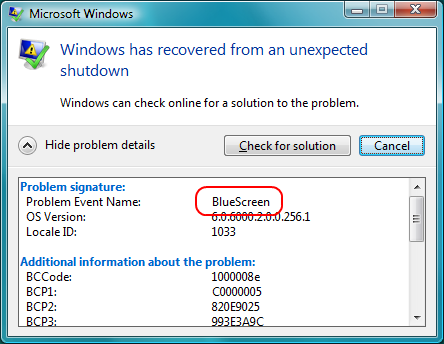
So I was thrilled when I saw a headline saying that removing media would be fixed in Windows 11. The article informed me that Microsoft's solution was (pause for effect) to remove the system tray icon.
Apply palm directly to face.
I'll admit that modern Windows is more stable than in the past. But how much of that is simply the benefit of memory safety in C#? Also stricter oversight of third-party drivers.
Back when the love letter crisis was ungoing I had a Linux machine fill the disk with log messages and deleting /var/log/messages didn't free the space because there still was a process that had the file open.
In a similar situation in Windows you can't delete the file. Either way it is a problem like looking at Cthulhu and something bad is going to happen either way you resolve the situation.
If not for games I would NEVER run modern windows at all. It is explicitly anti-user. It violates my consent all the time with their Edge shenanigans, and it pushes all the MS services like Cortana that I simply do not care about. At this point it’s hard to say that windows takes less fiddling than Linux to set up, if you include the time spent fighting the OS and time spent disabling Microsoft’s crap
This is my biggest complaint about Windows (which I no longer use), in that it had the chance to be, and once was, an opportunity to bridge the gap between MacOS and Linux. More open than the former, more opinionated than the latter.
I use 10 now, as locked down and 'fixed' as I was able to make it (custom ISO via NTLite with a bunch of crap removed and some fixes steamrolled in), but really I look forward to ditching it altogether - which is a shame. For all the MS hate in the OSS community, I always thought Windows did a lot of stuff well (when it was good at least).
The telemetry, changing things for the sake of changing things and forced crap constantly being added is enough. I'm so in love with awesomewm at this point, and the fact that I can customize and program every part of my UI, allowing me to have something absolutely perfect and tailor made.