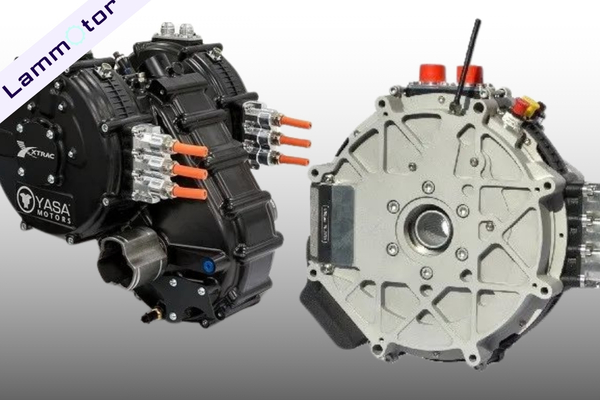
From https://lammotor.com/yasa-axial-flux-motor/
the shape is due to the change to the motor layout: https://www.thedrive.com/news/why-axial-flux-motors-are-a-bi...
By using motors at each wheel you'd eliminate the need for a differential, saving a good 40-50kg or so. Of course, if you kept the drive shafts and put the motor and reduction box in the middle, you'd be able to use inboard brakes and save a lot of unsprung weight!
It's hard to fit inboard brakes to front wheel drive cars because there's so little space but Citroën managed it with the 2CV and various derivatives, and the GS/GSA/Birotor family. They had an inline engine with a very compact gearbox behind, with the brake discs (drums, on very early 2CVs) right on the side of the gearbox.
You got lower unsprung weight and possibly more usefully the kingpin was aligned with the centre of the tyre, so when you steered the tyre turned "on the spot" rather than rotating through a curve.
Some old Jags and Alfas had inboard discs on the rear axle, which was of course rear wheel drive. They were a bit of a pain to get at.
There are probably a range of application where in-wheel makes perfect sense.
Do e-bikes really need significantly more power than they have? They already run arguably dangerously fast for their application. Is efficiency not the primary target there?
The lower weight would be definitely welcome, my ebike is comically heavy compared to a normal one and sometimes I have to carry it up flights of stairs (some German railway overpasses, grr).
Also in scooters it could fit in the wheel (since the wheel is tiny and has to spin quite quickly - no reduction gear needed vs a bike with 26-28" rims) allowing a simpler design and cost savings. But maybe in scooters they're already using in-wheel motors, I'm a bit ignorant there.
Oddly, a very large majority of current fully suspended e-bikes with rear cargo racks have those racks unsprung, which suggests that most e-bike manufacturers don’t actually care about the handling of anything other than their pure e-MTBs.
I'm always interested to hear about the latest in lighter and possibly more powerful and torque-y e-bike motors.
Ref: https://www.cyclinganalytics.com/blog/2018/06/how-does-your-...
I think large drones will be another place where a downsized version of this motor will make a huge difference, assuming the power scales nicely with size.
https://electrek.co/2023/04/27/saab-engineers-develop-secret...
Wouldn't that make it worse or just ... different. Before this the unsprung weight wouldn't have had a motor in there and now it does. Increasing the unsprung weight doesn't seem a like a good thing.
> No wonder electrics don't sell well in the US. People weigh more, you're basically saying that leaving grandma at home, is a "game changer".
Even in the US, your average grandma weighs less than 2-300kg :D
If we could indeed leave "grandma" home, that would make things better.
And they don't sell well in the US because of oil lobbying and think tanks whose sole goal is to make you buy more oil.
In an ICE, the same load is less visible because most energy gets wasted as heat. This is also why cold weather seems to affect EV range more.
There's a kernel of truth here in that Otto engines suffer lower efficiency at part load, however I suspect the real reason is that gas car range is "good enough" and refilling is fast, so one doesn't tend to obsess about remaining range.
> This is also why cold weather seems to affect EV range more.
That's because a) some batteries suffer degraded performance at low temperature, and b) ICE cars use the plentiful waste heat for cabin heating whereas an EV needs a heat pump or even resistive heating of the cabin air.
You are making my point here actually. Combustion engines suffer from the exact same, but because they waste so much energy as heat already, less “extra” energy needs to be spent on that.
Yes heating impacts range in an EV, but it's not really an efficiency thing, it's because you can't get it "free". If an ICE didn't let you harness the heat, you'd see a similar percent drop in range.
And for extra weight, it's just not true. Making a motor work 10% harder at 90% efficiency, compared to making an engine work 10% harder at 20% efficiency, both of these are going to reduce your range by 9%.
250kg weapons = ~20 small dogs
Instead of technological advancements of EV motors, we can immediately use existing pharmaceutical tech (Ozempic, GLP-1) to immediately deliver weight reduction to cars. However, this will be immediately offset by the increase in weight of weapons carried, thanks to Jevons Paradox.
They claim, this compounding effect works out to basically double the effective weight saving from battery and motor.
ie if you start with saving 50kg on motor, and 50kg on battery, you end up saving 200kg over all. Still only about 10% of a typical electric car.
Nitpick: You can have a lighter motor, but you're never going to have a significantly more efficient motor because existing EV motor systems are already 95% efficient or better. The electric motor is an old and refined technology.
And apparently axial flux motors have shorter magnetic flux paths which reduces losses.
ie the efficiency gain is due to the switch from radial to axial flux - not some incremental gain on radial flux.
Having said that the efficiency gains are relatively small - 1-2%.
However again there is a compounding effect, in that the reduction of loss of energy as heat, leads to requiring less cooling - and/or the motor is able to operate a full efficiency over a wider power output range ( as heating the copper increases the electrical resistance ).
https://www.stanfordmagnets.com/advantages-and-disadvantages...
The next innovation we need is Aerial refueling[1] for electric planes. High density swappable batteries and high altitude wind/solar plants that can swap batteries mid air. Perhaps some billionaire will develop a large fleet of these to service all flights! If no western billionaires, we just have to wait for China to develop this tech.
Also planes would not have to wait for a tug to pull back from the gate, which improves turnaround times for the airline.
On the ground: swapping batteries is faster, and batteries are cheaper than planes or drones. You want the expensive part back in the air as soon as possible so you don't need as many of them. On the whole this probably also simplifies logistics (in civilian aviation airport space is limited, in wartime it's easier to transport one hundred drones and two hundred battery packs to the frontline than to transport two hundred drones.
A laser over 10W has safety implications. This is 50,000 lasers all shining on the same plane.
Given your collectors are only going to be say 50% efficient, you're likely going to dumping enough wasted energy into the wings to melt the aircraft - not sure what dumping 3MW of heat energy into a plane would do over an hour, but I suspect it would stat to melt in a few seconds if you're lucky (otherwise your passengers would start getting very toasty)
At 3MW for an hour that's not a great amount of electricity that's needed - at 10c/kWh it's $300 an hour. You don't need fancy things like fusion to generate that. In the UK alone Solar is currently (in November) generating 600 times that - plus domestic installations.
Not very feasible, but an option that has been thought through.
I guess there’s a system that’s gated to track dependent technologies, to track improvements and what they’ll enable.
Not really. EV's are very heavy from non-motor weight. A Model Y weighs ~4300 lbs. A motor that is 75 lbs lighter is a 1.7% savings. That's not nothing, but I wouldn't say "significant". You can do better by swapping for fancy wheels or eliminating some of the glass roof.
And really this is true up and down the electric vehicle world. Weight-sensitive applications are always going to be completely dominated by battery weight. Making the motor smaller just isn't going to move the needle.
Basically this is good tech without an application, which is why it's having to tell itself with links like this.
But yeah, EVs seem weird except for racing reasons perhaps.
What I can’t figure out is how they dissipate the heat - double digits kw per kg is crazy.
    The YASA axial flux motors benefit from much shorter windings and direct oil cooling which gives an unparalleled performance proposition.

    A 200kW peak-power radial motor, run continuously, might typically give 50% of peak power between 80 and 100kW, as a result of thermal limitations. In contrast, a 200kW YASA motor runs continuously at 150kW thanks to the improved high-thermal-contact cooling that oil offers.
The more of the energy going into moving the vehicle, the less heat the motor has to handle.
And there is no way this is 99% efficient.
So my question still applies. Even 98% is 1kw/kg, or 1kj/sec. or around 3C rise per second assuming the mass is 100% nice clean copper (it isn’t). Everything else will be worse.
Not even counting increasing losses with temperature, it will be a molten puddle pretty quick at that rate without some major active cooling.
Liquid cooling at least for now should work - as long as it stays below the flash point of the liquid I guess.
Obviously if you go from eg. a large air-cooled motor to a smaller water-cooled motor, then the smaller motor could potentially dissipate more heat, but that's a different scenario.
The other assumption I probably should have stated is that the two motors are made of similar materials with similar temperature limits. We know the ambient temperature and we know the maximum temperature of the materials used. So for a component made of those materials, existing in that ambient temperature, with an additional heat load proportional to the waste heat in the motor...
The ability to shed heat (assuming similar forced fan cooling, as we were) determines the amount of power we can deliver to the device without increasing its temperature.
Tesla (I know) claimed a 30kg (?) weight loss on their Cybertruck (I know) just from moving their 12V systems to 48V, allowing for lighter cables at lower currents. Not all such potential is untapped, and my hunch is that there is more to be had with structural battery integration, battery cooling, and high voltage wiring.
For light weight vehicles on the other hand, it might be.
So yeah, weight reduction on EVs is great.
I think people are overlooking that the announcement is for a performance motor meant for the performance market at the moment because that is what the backers of YASA are most interested in because it has the highest margins and prestige. Also not mentioned is the efficiency from the simpler production line.
My impression from what I know is we are looking at an impact equivalent to direct injection engines; not revolutionary, but a major advancement of one component that has significant and consequential effects.
That's why a modern Camry makes almost 200 HP
Suppose we have a motor that weighs half as much, but produces double the output power, but consumes 4x the input power (so, it is half as efficient).
How would that lead to a smaller battery?
Wouldn't we need the component to use less power if we wanted to shrink the battery, rather than just weigh less?
Cutting the motor weight probably matters more for smaller vehicles than bigger ones though.
Unfortunately I feel much less safe in a Fiat 500 when a significant portion of cars in the road weigh nearly 3 tonnes and perhaps can't even see me. I suspect most people are in SUVs because they're the pragmatic trade off between safety and convenience, not because they were hoping for excellent performance.
[1] which no SUV's nor trucks used as passenger cars, do because they are classed as 'utility vehicles' and have lower safety/fuel economy standards -- which is why the auto-makers went whole-hog on making/selling them, it got their CAFE averages down artificially.
You take a defensive driving course, I’ll let you drive a tank down the road. But my neighbor’s kids should not be behind the wheel of a death dealer. Those vehicles were meant for skilled laborers, not Sally who is on her phone while driving.
I also think it's odd that people don't already choose other options w/o a tax in place, considering the price of a bigger vehicle is almost always just going to be higher because of materials and a bunch of other factors.
Which two cars? I've gone from a 911 to a BMW X5 and the X5 was just as fun for what it was. They are completely different cars, I'm not sure what you would expect and why you judge others.
In states of Australia registration is more expensive depending on the amount of doors and cylinders your car has. This doesn't seem to stop big cars being popular though, the #1 selling car in Australia is the Ford Ranger (which is BIG in Australian car standards). We're working on getting F150s sized vehicles even more heavily taxed, they aren't seeing wide adoption here and they're pretty highly criticised.
In cities like Rome you can see many small cars due to the nature of their streets and parking.
For highway driving these cars are a bit less comfortable but honestly modern Kei cars aren't even that bad. The Fiat 500 isn't a Kei sized car but it is also a very reasonable highway and city car, it can happily do both.
But small cars are only unsafe because of that discrepancy between the largest and smallest cars, and it's not just weight, but height difference. It's possible to survive crashes at very extreme speeds in very light cars if they are designed to work that way (see: F1 crash g-force). Not so much if you literally get run over.
The culture needs to change. A vehicle is not a living room. The driver's seat is not a sofa. You don't need a TV in the dashboard. You don't need 8 seats when 7 of them are unoccupied 90% of the time. You don't need to go into debt to buy a land yacht.
So yeah... you're right, but it's a bummer that we've arrived at this situation.
Everyone who can will naturally choose "defect" unless there's some sort of external coordination mechanism.
Americans’ Love Affair with Big Cars is Killing Them (https://www.economist.com/interactive/united-states/2024/08/...) - The Economist.
> In a crash, the fatality rate of the occupants of the heavy pickup truck is about half that of the compact car. But they are also far more dangerous to the fatality rate of people in other cars.
> The fatality rate is roughly seven times higher when colliding with a heavy pickup truck than with a compact car. As the weight of your car increases, the risk of killing others increases dramatically. For every life that the heaviest 1% of SUVs and trucks save, there are more than a dozen lives lost in other vehicles.
Unfortunately car safety is only evaluated in terms of safety for the occupants. Not safety of society.
There is another small vehicle around, which usually has a lower stopping distance, and a smaller blind spot in front of the vehicle at around 7-9 meters under somewhat more adverse conditions than regular highway traffic. That's the Leopard 2 tank.
That vehicle also has less problems to find a parking spot.
(I agree with the spirit, just calling out that there are going to be edge cases galore with a scenario like this)
This is why the first performance mod that most people put on their cars is an adjustable coil over suspension. Dropping the car down by an inch or 2 changes has just as much of an impact as shedding some weight.
Ironically, most people put lift kits on Jeeps but that also usually comes with widening the wheel base and putting on larger wheels/tires.
I didn't realize that Jeep was so light... pretty nice actually, but yeah, that's just an application mismatch. People buy Jeeps that will never see even a dirt road in their lives. Then they get on a dirt road once or twice and say, "Look what it can do!" Sure... a rally car would be much better. In order for the Jeep to come into its own you need to be doing something that requires ground clearance... that's basically their singular purpose: rock crawling (which almost no one does).
The modern Jeep Wrangler, and the one that would be contemporary to the Honda Fit weighs in at 4,000 lbs in the 2-door base model or significantly more depending on options.
If you compare a YJ to a Honda Civic of the same era, you see that the 1986 civic was 1800 lbs up against a 1986 YJ at 2800 lbs.
Increased height makes for increased ground clearance and improved break over angle. Sway bars are another suspension component that's great for reducing body roll on road at speed, but reduces articulation and ground contact off road. Differential lockers also negatively impact turning radius, and cause tire chirp, wear, and oversteer under throttle on road, while increasing traction off road.
What's silly is daily driving an off road vehicle on road, especially if you never take it off road.
That's not ironic. That's just caring more about the looks and you like that look. And looks > handling for that person
Yes, some people choose to emulate off road appearances, such as with fake bead locks and then only ever drive their vehicle on road. That doesn't discount the fact that there are a great many explicit choices you can make in designing and building a vehicle that sacrifice on road performance for off road performance.
This is a blanket statement and completely untrue. Good driving experience is directly correlated to TRACTION, not just weight. And traction isn't just a function of weight - it also is affected by center of gravity, friction between the wheels and the road. Traction is what gives you the perception of being in control of the car.
I used to own two cars of the exact same model - one petrol and one diesel. The petrol is lighter in weight, about 100+ kgs lighter than the diesel variant. And the driving experience on that is slightly scary especially on roads with strong winds. In fact, it is so light that if you drive over tiny puddles or rumbles strips, the car will sway sideways. The diesel always feels more planted because it is front-heavy, thus adding more traction to the front wheels (both are FWDs). I always prefer the diesel for longer drives because of the heft and confidence it provides.
I also drive a FWD (a quite spicy one) and I break traction all the time, not because of weight, but because of torque. You can modulate torque, not weight. The biggest traction increases that I made on my FWD were when I put on sticky summer tires, the second was subtly changing front control arm geometry and bushings, and the third was adding stiffer engine mounts.
Agreed on getting tossed around in a light car though, not much can be done about that... other than making the roads better and lowering the center of gravity.
It was an absolute shock the first time I braked in the Volvo, not to mention trying to take a corner.
If we take a Tesla model 3, I believe it weighs 1611kg, and the motor shows up at 80kg if you google it (no idea if this is correct). This YASA motor by comparison weighs 14kg. So, this would drop the vehicle weight by 66kg out of 1611, so that's a 4% saving.
But torque and power were never the limiting factor for an EV. You would only benefit on a track, and if you're taking a model Y there...
The motor is high torque, so I’d expect the drive shaft to be on the heavier end of that.
I’m not including the other power train components, but it’s easy to imagine it all adding to more than the weight of a second engine + wiring.
Also, having one more complicated power train is probably less efficient than two simpler ones, which implies a bigger battery.
This new motor is more powerful, that's it.
Nothing was said about cooling or voltage requirements. The latter is important because higher voltage is more dangerous to work with or be near.
It’s a little sad to me that fundamental innovations in electromechanical engineering like this get just a few million in investment, yet if this had been yet another derivative software startup with “AI” in the pitch, they’d probably have 10x+ or more investments being thrown at them.
That is ever more special
EV motors are already lightweight. The electric motor in a vehicle like a Tesla Model 3 already weighs less than you do. Reducing that one component by 75% would be a weight savings equivalent to about a half of a passenger.
Not a significant efficiency improvement for vehicles that weigh over 3000lbs (or double that for many EVs).
Every little bit helps, but this isn’t a game changer.
Then you can do clever things with traction control without having to use the ABS system to brake the drive wheels.
Or dramatically change the turning circle on big cars and vans. Maybe even reduce the size and weight of the braking system by taking on some of that role.
All for the same weight budget.
has four electric motors
Every ounce you have in the hubs that don't float on the suspension reduces certain suspension attributes. You end up with a crappier ride and poor performance.
Unless you used the motors to power fans instead, then you could use that for downforce and propulsion, and get well belown 2 seconds, theoretically.
F1 cars with fans to run them upsidedown but with remote drivers for their safety maybe?
Although, I guess at some point in the future if we can get the weight down low enough and the strength of the motor high enough we could replace the existing braking system with a motor for the same weight penalty we already pay.
In an ideal world all the energy from breaking would be used for regen anyway.
I'm not sure how close we are to that but it's an interesting thought experiment thinking about the trade offs we might be able to make in future.
EDIT: Quick maths show that decelerating at 1g (basically what the best sport tires can do) in a 2000kg car at 300kph requires absorbing ~1500kw, so conveniently two of these motors.
I see no reason the small motors can't be mounted inboard from the wheels on the underside of the chassis, as are a rear differential or front transaxle in an ICE car.
Having such a small and lightweight power package opens up serious design and performance opportunities. Plus, even without major redesign to take full advantage, every reduction in weight rolls through the system, providing immediate improved acceleration, cornering, & braking or similar performance using smaller tires, brakes etc..
It can make cars cheaper, or longer range, or faster, or any number of other designs based on what the manufacturer is looking for.
But to OP's point about flight - stacking 6 Tesla motors is not an option. Stacking 6 of these YASA motors? Much less weight.
You’re reading their marketing material. You have to think of this like all of those PR releases you’ve seen over the years about new battery technology that is 4X smaller or new hard drive tech that is 10X more efficient. The real world improvements aren’t going to be as big as their one lab test.
A Model 3 motor is already well under 150lbs, unless you start including ancillaries like the inverter and power transmission parts.
They’re not dropping “a buck fifty” from typical EV motors.
According to purchasable equipment, the Model 3 engines weight ~175 lbs. If that's wrong, that's on them for claiming it. Subtract 28 lbs from that and you're at 147 lbs. That is very close to 150 lbs.
[0] https://evshop.eu/en/electric-motors/295-tesla-model-3-drive...
> This kit includes the Tesla motor, inverter, gear box, power cables and drive shafts.
Drive shafts, gearbox, power cables, inverter. Also includes the mounts, which is likely not factored into the lab calculations for this marketing material.
You cannot drop 150lbs from the Model 3 motor because it doesn’t even weigh 150lbs.
I'm happy to compare apples to apples when we can do that, and if you want me to say I was wrong about the Tesla motor size I'm happy to say that I was just going by what was available on the internet and skipped the details. But I did so in service of a point which you still haven't actually engaged with beyond "Nu uh!".
Auto makers could drop 10lbs, 100lbs or even more from every EV right now by choosing more expensive materials, more expensive manufacturing processes, or simply cutting back on amenities.
10lbs is not significant in the grand scheme of things. The real question is how much it costs, what are the tradeoffs, and how practical is it.
> But I did so in service of a point which you still haven't actually engaged with beyond "Nu uh!".
That’s not a fair take on what I’ve been posting at all. I said every little bit helps, but pointed out that motor sizes are already small.l
It's a fair take on your responses because talking about a SINGLE motor is missing the point. You're not engaging with the actual point that OP made, you're trying to dispute OP by engaging in your own point about what difference this would make in single-motor cars, instead of what difference it will make in general.
That's cool but the conversation was about cars. It's a welcome but tiny improvement for cars. Even after you multiply by 2 or 4, especially because the more motors a car has the smaller they are.
But also, I reject your attempt to reframe the discussion as strictly car focused. OP specifically mentioned flight. Which doesn't necessarily mean it was all about aircraft - the article is about cars after all. But it certainly doesn't mean that the conversation was strictly about cars, either.
[0]: I've googled this claim and I'm willing to accept it, but the only sources for it I could find were subtractive estimations from youtubers whom had pulled apart the motors. Even additional claims from forums and whatnot seemed to trace back to one of those video sources. It would be nice if Tesla would deign to discuss some specificiations themselves, but if there's an actual official source, I have yet to see it. And, for what it's worth, the motors that I've seen referenced were all for the rear motor that I understand to be the smaller motor in Teslas. Either way, I don't doubt the 70 lbs estimate is far off, so it's moot.
I took this out to the shop floor yesterday and asked the guys what they could do with 10 fewer pounds in the leafs we have around, and believe me - I'm so much less excited about being vindicated in this thread, than I am about the ideas they came up with. Mostly nonsense, but there's some interesting stuff in there that I can't wait for them to try out!
I guess it's just not worth it to pay way more for a motor just because it provides a pretty-insignificant weight reduction.
OP mentioned flight. But the part that got argued back and forth over the next 7 comments was about EVs. Aurornis never said a word about anything but EVs.
The 737-800 has a maximum takeoff weight: 174,200 pounds (79,010 kilograms).
What’s 10lbs got to do with anything?
Tesla still doing a gearbox? Their marketing has been telling me they got rid of those. Typical.
Shaving a couple percent off the total vehicle weight would still be a very good thing, but improving batter energy density by 10% or so would be a bigger deal for most EVs.
There might be some niche applications where the battery weight isn't the biggest issue -- like very short-range, light-weight vehicles that need to have enormous amounts of power for some reason.
I could see motors like this being used in power tools if they can be scaled down. A light-weight plug-in electric chainsaw would be pretty awesome.
These already exist, in both plug-in and cordless / battery powered.
At 30 amps and 220 volts, that would be about 8 horsepower. I think most motors that size rated for that much continuous power would be rather heavy.
For a guy trying to drive 300 mph though maybe he should have been able to do that with math instead of sketchy road tests.
But that’s still a lot less rotating mass, and might make multiple motors attractive again.
Right now it takes about 10-15lbs of motor to produce a 3KW motor for an electric bike, this motor is about 10 times that in power density afaict.
The Livewire electric motorcycles use something like 100-200 lbs of motor to produce 1/4 as much power, 75kw, so that’s an improvement of 8-16x.
A 30lb 1000hp motor doesn't necessarily mean that they can also produce a 3lb, 100hp motor. It would be cool if it did, but I doubt that it does because usually component strength doesn't scale linearly.
That being said, these are still valuable for traditional EVs. Even if they are only a modest weight savings in the grand scheme of modern vehicle weight, their ability to improve packaging options will be a boon. One thing the industry has dicovered is that the generic "skateboard" platform doesn't make for the best vehicles, in terms of packaging.
https://yasa.com/news/yasa-smashes-own-unofficial-power-dens...
The law needs to catch up. There are clearly good reasons for people to want extremely powerful e-bikes and they should be allowed to. They can't be treated like bicycles because they're too fast but aren't nearly as dangerous as motorcycles. We need a new category for light motorcycles.
The real problem, IMO, is that the law is generally not deferential enough to cyclists and already forces them off sidewalks, onto the street, and to follow traffic laws designed for cars. There's not much else to take away, and the rules right now are unreasonable enough that cyclists always break them.
I think what I would like to see are explicit requirements for insurance and licensing for powerful e-bikes, but made significantly cheaper so that people will actually bother. Requiring helmets for the insurance would also make it much more straightforward. We can require them to take the street or a dedicated bike lane and fully mandate that they have to be walked on sidewalks.
I'm not so sure about that.
I don't want a 6000kw Sur Ron riding in the bike lane with me. The whole point of the bike lane was to make a safe space for riding a bicycle. I want the bike lanes to be safe enough for children to ride their bikes in, and having something that powerful in it is not conducive to that goal. They are by and large too fast and too unlike a bicycle for bike lanes. Having things that powerful there is going to dissuade a lot of potential (non electric) cyclists. My girlfriend already gets too freaked out by how fast some of the legal e-bikes in the bike lane go.
Certainly they shouldn't be on the sidewalk. But what does that leave? Just the road. If that's the case they probably need to just adhere to whatever standards the state has for scooters or mopeds. Which probably means some kind of license, maybe registration, and possibly insurance.
But that type of e-bike manufacturer doesn't want to make a light electric scooter that's road legal, they want to make a thing that skirts regulations by being "for off road use only".
And the buyers by and large don't want to deal with license and registration, and certainly not insurance.
Just because people are doing an illegal thing a lot doesn't mean that the law needs to find a way to make it legal.
Why would an extremely powerful ebike be any less dangerous than extremely powerful gas motorcycle?
The real solution people don't want to accept is that ALL non arterial roads in ANY urban/suburban/rural environment should be limited to 30kpmh (and equivalent in NA). And by limited I mean traffic calmed: 1 lane per direction, narrow lanes, raised street crossing, raised intersections, European style roundabouts, the works (Dutch style) - so that people actually respect the speed limit because they don't want to bang their car.
Once that happens, bike stay in bike lanes (or multi use paths with pedestrians) and everything else can go on the regular non arterial roads and stuff that's registered (mopeds and up) and go on any road.
But my "solution" requires major political adoption and probably decades of sustained vision in investment. In places with good governance it will happen naturally and everywhere else will slowly be left behind.
So, literally any bicycle?
Anybody moving significantly faster than the flow of traffic is endangering the rest of the users.
Bikes should be allowed on shared use pathways and all sidewalks larger than 2m should by default also allow bikes.
Mopeds should be banned and fines should be big, to discourage that kind of use.
I propose that in order to be able to leave your house people should have to have a valid reason, have done a course, and apply for a single-use permit.
Because, obviously, people can’t be trusted to do the right thing, ever, and one death in the community, for any reason, ever, is too many.
Fairly sure the Netherlands is a more advanced democracy than the "my freedumbs" US is at this point.
And Dutch infrastructure is also better.
They are called motorcycles. At > 4kw they are that (here). So either you get them registered a such, get a license and insure them, or downgrade them to under 4kw, get a license and insure them as a moped, or downgrade them to 2kw and pedal assist only and register them as a pedelec. All other options is 250w continuous (you can get away with about 500w peak) and pedal assist only.
You are also not insured if you drive an illegal bike on the road.
Opinions differ. I have seen far more accidents with powerful e-bikes than I have seen with motorcycles, and yet there are many more motorcycles.
As a former rider, why? Cars were the most dangerous part, in my experience.
Something that stuck with me from my motorcycle safety course, the speed at which hitting a wall is 50% fatal is 30 mph. Doesn't take highway speeds.
The goal is to protect the regular cyclists and pedestrians who they currently share paths with while trying to not make them TOO unsafe.
What a ridiculous statement.
I don't think there's any inherrent difference, but until the laws catch up the "powerful e-bikes" are clearly more dangerous. Riding a traditional motorcycle requires a license, passing a driving test, and following the rules of the road - none of which are true for e-bikes.
But I'd love to hear why you think the opposite.
Thus, less energy to transmit to a pedestrian
But it's really a moot point because there are essentially zero motorocycles travelling on sidewalks, bikepaths, and trails where pedestrians are going to be concentrated, while it's a free for all for e-bikes.
In general, motorcycle/pedestrian accidents are pretty rare. Statistically, motorcyclists are most likely to injure or kill themselves rather than bystanders.
There are lots of gas powered motorcycles in the bike lanes where I live. Not legal, but nobody enforces it.
https://www.ctvnews.ca/vancouver/article/pedestrian-dead-aft...
In this case it was a bicycle and not an ebike. That said, anecdotally, many ebikes I see regularly travel faster than the people powered versions
If we’re talking about high powered e-bikes, I don’t want them on the sidewalk either. Once they exceed the current regulations they’re in the moped/motorcycle category.
> There's not much else to take away, and the rules right now are unreasonable enough that cyclists always break them.
So what’s your suggestion? Let people ride electric motorcycles on sidewalks? Change the laws so that high powered e-bikes don’t have to follow the rules of the road?
I don’t think the current laws are unreasonable. I live in a place where people routinely ride their e-bikes on the sidewalks and it’s absolutely awful, especially with young children. Every time we go somewhere I have to hold their hands and yank them off the sidewalk at least once to dodge another e-bike zooming past. I can only hope enforcement catches up and starts impounding bikes from people breaking the law and issuing large fines, because I don’t know how else to stop this.
Kids treat them like fast bikes you do not have to pedal. Wiping out on a bike at 13mph is a very different proposition to wiping out on a bike at higher speeds.
I saw just a couple nights ago some kid doing what appeared to be about 40mph on an eBike. Wind in his hair, not pedaling, just blasting it. I am sure new regulations will come to speed limit them, but at the cost of dead and disabled young people.
ETA: I went to go look up laws requiring speed limiters on bikes, and the top hit was about how you can disable them:
https://goebikelife.com/how-to-remove-ebike-speed-limiter/
Article states typical eBike speed limiters are 20-28mph. That is the kind of sustained speed Olympic cyclists can maintain for some period of time, and much faster than kid's toys need to be capable of. And these are the mandated limiters!
This is not the same as being able to go > 60 mph anywhere, at any time, simply by pressing a button.
> When you get a bike like this you deal with the danger and wear protective gear just like you would with any other bike (motorized or not).
This only deals with the danger to the rider - it doesn't address the danger to pedestrians.
Bicycles have long needed a dedicated infrastructure as they are neither cars nor pedestrians.
Yes, I've done this before by riding all the way up a local mountain on a road bike, clad in lycra, then on the way down I went over 60mph. It was terrifying and the physical fitness required to get up there in the first place required months of riding to actually do it. Meanwhile literal kids ride these on pavements, in between people, in cities where pedestrians walk - it's simply not acceptable. And I do own and ride an ebike(limited to 15.5mph) legally.
Therefore, we should count our blessings that it’s not more common, rather than allowing devices that enable it.
Because they have pedals which nobody uses. In theory, it's pedal assist, but kids aren't really pedaling eBikes, they are using them like electric motorcycles.
You might think: Hey, how can you tell the difference between somebody using an eBike with pedal assist if so many of them look just like regular bikes?
I don't really see young people pedaling bikes at all of any kind. It's adults who don't have cars, or adults who are exercising pedaling bikes.
Where do you live - over here(North of England) most kids ride bikes, especially to school. And not ebikes either - actual regular pedal bikes.
https://www.reddit.com/r/AskAmericans/comments/184oag8/can_y...
That assertion seems to be a disconnect of language. But - Selling firearms in Wal-Mart is bad enough, but it does tend to be more rural Wal-Marts than suburban (and not at all urban).
Said firearms are under lock and key in the same way they would be at gun stores. There are many gun shops in the same areas where Wal-Mart sells firearms. At least - where I live, which is a blue state. All bets are off for Texas.
We have everything locked up too just as you describe. We just have a lot of places to buy them, it's not like Wal-Mart here has a bin in the middle of the isle full of AR's next to the bin of Pokemon stuffies. Only pellet and BB guns are found on the shelf.
I don't know why I'm being pedantic, guns here are insane for many reasons but not because of this one. What bothers me is once you do buy it, you can just carry it anywhere you want now. Like random guys in MAGA hats holding what looks like a machine gun on a street corner is no longer an unusual sighting. It's weird, when I was a kid, my dad had rifles mounted to his truck rear window and it was common. Then, there was what seemed like a zero tolerance decade or two when guns were only on the news (gang violence) or in a gun safe (for hunting only). Then the pendulum swung to the wacky side of guns everywhere.
My kids school recently hosted a "gun recycling day" recently, with good intentions I think, but obviously once it occurred the parents were riled up with "you seriously invited people to bring their guns to the school! Where are the guns? Did they get moved off campus? etc" It's technically a private school and the event was hosted by the affiliated church, but still, pretty tone deaf to have that kind of event on the same property as a couple hundred elementary students
I am not sure about further out. I know people in Michigan who keep a piece in their glovebox. I've seen in the movies what you talk about - the gun rack in the truck cabin. None of my rural relatives ever did that, not even in Michigan which is pretty gun-friendly away from cities.
> I don't know why I'm being pedantic, guns here are insane for many reasons but not because of this one.
Yeah, I mean. In Illinois at least, the guns get into the hands of the bad guys overwhelmingly because of straw buyers. Not because of "the gun show loophole". A small number of guns are obtained through theft. Mostly it's straw buyers, at least when it comes to guns used in crimes.
My family is filled with outdoorsy people (myself included), and although the numbers don't paint a picture of legal CCR owners being problematic, the wide array of people I've known who do carry makes me wonder how the hell it isn't a bigger problem. All manner of unhinged weirdos, some of whom pretty openly muse about the opportunity to shoot the kind of person they don't like. (Lots of normal people too - but plenty of weirdos)
How is this "not really"?
Most people are not buying groceries there, they go to actual supermarkets - near me Jewel-Osco, Mariano's, Aldi, Whole Foods, Kroger - none of which sell guns. Grocery stores do not sell guns by any common definition of the term "grocery store". You've got a corner case off of which your talking point is built. Corner cases do not make good foundations of arguments.
My advice: Come to the US and do some grocery shopping before making more such arguments.
And I'll pass on visiting the US why y'all have armed police running around tackling people & disappearing them, and are demanding social media passwords only to refuse entry if you've been critical of Dear Leader. Sort your shit out, then maybe.
Walmart would be called a superstore or box store.
I'm fine calling walmart a supermarket.
As I said, even though I'm reluctantly willing to entertain this, it's an incredibly niche talking point. Except for this one corner case which is only kinda-sorta true, people cannot buy guns at grocery stores. That's nonsense, and your talking point is nonsense.
Most of them do have a (relatively small) grocery section, but are primarily dedicated to non-consumables like clothes, children’s toys, furniture, electronics, etc.
Whereas a typical supermarket (e.g. Safeway, Fry’s, Albertsons, Whole Foods etc.) might have a relatively small section of all of the above, but are primarily dedicated to food.
And like the NRA also says, "Unless you're attending an NRA convention, in which case please leave your firearms at home or use one of our provided lockers, because gun-free zones are a communist hellscape except here, and please pass through this metal detector too."
It is authoritarians that want gun control the most because they want a monopoly on force through the military and police.
Apparently, just this year, a total of 366 people have been killed and 1,668 people have been wounded in 374 shootings, as of October 31, 2025.
Would I have as a kid blasted around at 40mph if I could have? Goddamn right. That's actually my point - I'm not dead or permanently damaged, just the recipient of quite a lot of road rash. Worst injury I ever had on a bike was a broken trapezium, as an adult, for something totally not speed related (~13mph, yes), when a tree fell in front of me and I braked and flew across the handlebars. Game that out doing even 20mph and that's a different outcome.
Classic case of, "I've been there, done that, and this situation is nuts".
And never mind the 45 kph scooters (that regularly do half as much) using the same bike path.
Saw an ebike zip past me at about 40 MPH in a wheelie, little motor screaming, splitting a lane in traffic. (El Camino Real, Silicon Valley). If anything happens ahead of them, they're toast. Can't stop and can't evade.
Now hold my beer...
Increasing power density (of the motor) just isn't worth much when it does not happen to coincide with an increase in efficiency (and then the battery mass saved for achieving the same range will quite literally outweigh the mass saved by a smaller engine for achieving the same power)
The good news is that those striving for power density aren't really at liberty to completely ignore efficiency in the process because cooling is a key issue for them.
That’s enough power to potentially do that to a full size car frame.
I've noticed that people seem to believe as long as they bought something it should be safe. If you're smart enough to build something, I have to hope you're at least smart enough to realize that there might be consequences.
Take your beer back, I'm going for a rip next.
While I'll be likely be riding my ICE bikes for decades because one of the things I do on them is trips with 1000 or 1500km days, truth is the vast majority of my riding is sub 25km round trips from my place. Most of my friends places, a lot of the places I shop or socialise, and the office (which I pretty much never go to any more) fit inside that range. And most of those trips take place on roads with a 60kmh or slower speed limit. _Maybe_ a few short sections of 80kmh.
For all of those short trips, I probably don't even need 2kWHr worth of battery, maybe only 1. The electric motorcycles available around here seem to start at 7 or 8kWHr, and go up to over 20.
The downside to that is the smaller the battery capacity, the smaller the short term peak power it can deliver. The sort of cell chemistry and construction typical in those sort of bikes seem to be limited to 10 or 15C peak discharge, so while their 8kWHr battery can peak at 80kW or just over 100hp, if they downsized the same pack to 1kWHr it'd probably only deliver 10kW peak power.
On the other had, alternative cell chemistry and construction can look way better. I have a few LiPo drone battery packs rated at 60C continuous and 120C peak. A 2kWHr pack of those would give me 120kW continuous and 240kW peaks. Quite likely though at the expense of much greater risks of catastrophic fire. I've had a few of those pack catch fire while charging and one that self combusted in an almost explosion like fashion when I slammed the drone into a concrete pole at about 120kmh. I can totally see why an electric motorcycle manufacturer with warranties and safety reputation and legal/regulatory obligations wouldn't want to accept that risk.
I'd love an electric motorcycle that's "fun" enough to ride, and gets 25km or so reliable range. But it'd need to be at least a bit price and "fun" competitive with my little bikes, a 117kg 125cc ~25kW two stroke and a 138kg 250cc 24kW fourstroke. I have no doubt it'd be possible, perhaps even easy to build an electric bike with the same "fun" power to weight ratio, but right now not down to the sort of price that'd make me take on a project like that.
It really can't be offset by that (with current tech). All existing electric motorcycles are both overweight and very limited on range.
Maybe what you want is a large electric bike like a Surron or similar?
Good, even some great, stuff out there, today.
Cost is a challenge.
These things go 175 miles, up to 450+ miles if you have money.
> These things go 175 miles, up to 450+ miles if you have money.
Only the heaviest models, ridden extremely conservatively.
Buyers don’t know they exist, if they’ll struggle to register them, or how to work on them!
The heaviest ones seem like the same weight as a 600cc or 1000cc crotch rocket - am I missing something big?
> The heaviest ones seem like the same weight as a 600cc or 1000cc crotch rocket - am I missing something big?
Livewire One is 560 lb! Energica Ego was 570! 600s and liter bikes aren't anywhere close to that -- low 400s lb for 600s, and 430-440 lb for a liter bike.
10kw+ is comparable to starter gasoline motorcycles in the US (or midsize motorcycles elsewhere) capable of going on the highway. At that point, you need to start scaling everything, like brakes, tires, and the size of the chassis.
The livewire has a motor large enough to drive a car.
Sounds terrible for every other user of paths currently.
The Model 3 manages < 140 Wh/km, and many seem to be under 150/160/170.
This is on a 2022 Long Range Model 3.
Lighter motors for mobile robots could also be cool.
Of which there can be two, or even three.
It does seem like with this advancement, and the size of these axial flux motors that maybe, all wheel drive vehicles will be the default. As well as sub 3 second acceleration, which can make vehicles safer, for example getting out of the way of an incoming object. Of course it could also make them less safe because that vast of acceleration is kind of dangerous.
But I do wonder if the weight reduction (over 30%) of lithium sulfur batteries paired with these is really going to make a great recipe for all sorts of quiet, long lasting, powerful electric vehicles and robots!
For example, by making the flywheel in a clutch lighter, you reduce the amount of torque it takes to spin the flywheel. Saving 10 pounds there is not a 10/3000lb difference.. it could be a huge percentage of total power output.
For a typical EV, I think that works out to a factor of around 2.
Even if motors were literally weightless and mass-less, EVs would weigh more than ICE cars.
It's like making a more efficient CPU for your phone when all the power is eaten up by the cell-modem, screen and RAM. People wonder where the practical battery life gains are and theyre miniscule in practice
How far does YASA's tech allow the motor weight to scale down, for applications where you don't need the power?
Can you make it 2.8 pounds instead of 28, if all you need is 100 hp? Likely not.
There is a single exception, and it's a big one. Direct-drive, wheel-hub motors are not well-regarded right now, specifically because they increase unsprung weight (the part of the car more closely coupled to the road surface than the passenger) and this impacts handling substantially. So instead we backport a bunch of the mechanical infrastructure that transfers power from a traditional ICE engine to the four wheels. We're paying that bill already, on almost all production EVs. Quadruple the power density and simple, 1-moving-part wheel hub motors look like a lot better case versus central driveshafts and mechanical linkages.
It will always be lighter to not have the motor in the wheel.
> So instead we backport a bunch of the mechanical infrastructure that transfers power from a traditional ICE engine to the four wheels.
No, we do it because it's smart and efficient for freeway-capable vehicles.
Wheels get banged up in use. They're easy to replace for different applications. They're exposed to 200 kph salt spray at hundreds of RPM. They are not a great place for motors.
1/4 of something that is a small fraction of the total weight of a car means very little improvement in overall power to weight ratio.
I suspect that gaining 40% of car seat weight would be much more beneficial even if way less sexy.
In Bay Area that is small investment in a startup which would be able to lease a small office
>Could lead to significant efficiency gains for EV's, because 1/4 of the motor weight means better power-to-weight ratio...
that would help VTOL a lot. Unfortunately YASA motors are priced for supercars and availability seems to be low. Until some factory in China starts making similar ones, there are not much chances on getting hands on such a motors.
This video https://m.youtube.com/watch?v=WU9Ptibu2WQ&t=179s claims that SMC materials have much higher losses at low frequencies than laminated materials, up to around 400 HZ when they very rapidly pull ahead.
So as the core of a step down transformer for consumer electronics, SMCs would be worse than a laminated core (stack of sheet metal pieces punched with a press, stacked and wound with the windings). But in a motor operating at 100s of rpms, no problem. And as I understand it, in high torque motors the magnetic fields pulse far more often than once per revolution because the windings are many and small, so that several can pull on the armature at any orientation.
As others have noted, battery remains a major factor in overall mass, and motor placement (in-wheel vs. driveshaft) is a concern in ground-transport.
In aviation, battery limits overall range, but a high-power, low-range, lower-mass vehicle could be useful for short-hop flights, manned or unmanned, especially where payload considerations are paramount.
Mobile-power applications (tools, transportable equipment) might also benefit from high power-to-weight, especially if this means that overall weight limits could be more readily met (e.g., total vehicle weight, total carried weight), or additional equipment (or battery) could be provided.
YASA was founded in 2009, a spin out from Oxford University following the PhD of founder and still CTO, Dr Tim Woolmer.
"Over the decades that followed both of these technologies were explored. But despite the potential for weight reduction, smaller size, shorter axle length and increased torque, it was the difficulty in manufacturing the axial flux technology that limited its commercial viability, because the motor could not be made by stacking laminations, as with radial machines."
"The breakthrough innovation came by segmenting the axial flux motor in discrete "pole-pieces", so the motor could be manufactured using Soft Magnetic Composite material.
SMC can be pressed at low cost into a wide variety of 3D shapes. This removed the need for the complex laminations, overcoming the major manufacturing challenge of the axial flux machine."
"In 2025, after a £12m investment, YASA opened the UK's first axial-flux super factory, in Oxfordshire.
The opening of this facility boosts YASA’s manufacturing capacity, setting new benchmarks in e-motor technology and quality, and enabling production to scale beyond 25,000 units per year."
This is awesome. Lighter motors also make electric flight more viable