The first reason is the infrastructure, both visible and invisible. Separated bicycle lanes are commonplace and in the few places where they intersect with car traffic, care is taken to make crossing safe and comfortable. This visible infrastructure is complemented by the concept of "Hoofdnetten", where the default routes to some place for different modes of transportation coincide for the least amount of time/space. For example, going somewhere by bike might take you through a residential neighborhood with barely any traffic, which is also slowed by speed bumps and narrowed streets, whereas buses will use a bus lane taking a slightly longer route, and car traffic has to go all the way around.
The second reason is that here, everyone is a cyclist. Going for groceries? Five minute bike ride, much easier and quicker than going by car. Kids cycle to school alone from a young age. Going out for drinks? Bike. Because everyone is a cyclist and there are cyclists everywhere, cyclists are equal participants in traffic and are treated with care and respect.
https://www.google.com/maps/@52.3495859,4.8053688,3a,75y,74....
I am from The Netherlands and I only realized since moving to Canada that my home country is such a safe place for cyclists. I find it interesting that no one in The Netherlands wears a helmet when cycling and yet serious cycling injuries don’t seem to be a common thing, whereas here in Canada I know of multiple people that got “doored” or otherwise have been in a bike related accident.
Neurosurgeons in the Netherlands disagree with this, and are begging locals to wear helmets. https://www.dutchnews.nl/news/2021/10/neurologists-launch-ca...
I don't know how rates of injuries compare between countries, but that is irrelevant.
A helmet requirement is wholly incompatible with the role of cycling in NL. You hop on a bike anywhere, regardless of what you're wearing. It's a casual transportation mode, just like walking, not a sport activity. This proposal can only make sense for people who don't live in this reality.
In addition, as mentioned by another commenter, when the dutch traffic rules were written decades ago, it was found that helmet usage correlated to increased accident rates - people take more risks when they feel safer, and that in turn makes pedestrians less safe.
I'm probably a bit of an oddball in this respect, but I do not regard helmets as a means of preventing injury. Reducing the severity of an injury, sure, but even then they are of limited scope (i.e. they are only really useful if there is a direct impact to the head).
Helmets are not an excuse for taking risks. They are a means of reducing the impact of accidents.
I don't really understand this. I keep my helmet clipped to my handlebars, so if I have my bike, I have my helmet. Is it really so much of an inconvenience?
I'm sympathetic to the overall anti-helmet-requirement position, even seemingly trivial concerns like "it messes up my hair" sound legitimate to me. The convenience argument in particular just never made much sense to me though.
Here are some important conclusions:
1) Cycling as a commuter is quite safe, with or without a helmet.
2) Cycling is safer with a helmet.
3) If you found yourself in some binary where your only options were "cycle without a helmet" or "don't cycle at all", the health benefits of "cycle without a helmet" likely outweigh the risk of serious injury due to not wearing a helmet.
4) Because of #3 and other factors, helmet laws for adults aren't generally a net positive.
5) BUT - it's a good idea to wear a helmet whenver you can, and even the Dutch (fore example) would be better off if they kept their usage of cycling high, but culturally embraced wearing helmets as well.
6) Things are very different in higher-risk forms of cycling like BMX, road racing and MTB, where crashes are much more frequent and higher impact, and you'd be an idiot to not wear a helmet.
Neurosurgeons have a very skewed view of the statistical likelihood of head injury. They see such injuries every day, and it can most definitely make them believe that the risks involved are much greater than they actually are.
>Crucially, the Dutch distinguish between everyday cycling (fietsen) and competitive cycling (wielrennen). Fietsers (cyclists) are found everywhere. ... The term wielrennen, on the other hand, is reserved for the sweaty, colourful and seemingly endless cycle races on which the people of Benelux are so keen.
In my experience, at least in my area of the US, mostly kids do fietsen - biking to their friends' houses, or the park, etc. Grown-ups on bikes are typically serious about their wielrennen and wear skin-tight gear and ride fancy road bikes.
I try to drive safely around any cyclists, but I think it's easier to cut folks in the first category a break - they're aware they're slow, they try not to be in the way, etc. Folks in the second category are sometimes frustrating to drive near - at traffic lights they cut to the front, only to advance relatively slowly when the light turns green, or they blow through a stop sign as a car is approaching, etc.
I wonder if we would have better rules, better set expectations, etc, if we similarly had 2 words to talk about cyclists in English.
0: https://www.iamexpat.nl/expat-info/dutch-expat-news/how-do-y...
    at traffic lights they cut to the front,
    only to advance relatively slowly when the light turns green

    they blow through a stop sign as a car is approaching
I also see kids and adults riding their bicycles on the sidewalk, sometimes even the wrong direction. I used to get mad at that, until I realized that our local cycling infrastructure is crap, and _on that street_ I'd not want to cycle on the road either.
Apparently it's a matter of debate/context: https://old.reddit.com/r/cycling/comments/b9xklo/at_a_red_li...
Middle-aged men in lycra
Requiring a helmet has apparently been shown to depress the use of bikes for every day activities. Going grocery shopping with a bike is less convenient if you have to juggle a helmet along with a liter of milk.
Less biking means roughly more pollution, more obesity, bigger roads, more car accide ts.
On the other side of this equation is the death and injury that helmets prevent. This is non-zero, but apparently in the Netherlands we have judged this marginal benefit of helmets to be less than the advantages of more cycling.
The calculation might be different in countries with inferior cycling infrastructure.
Don’t really care for requiring one at all really, our bonces inside out are our own business and if people want to take that risk it’s on them.
maximum conformity punk?
Helmets signal the choice for security over freedom which is simply not sexy. Moreover it signals your own inability to ride a bike and to recognise/avoid dangers rapidly. Just compare images of cyclists with and without helmet.
Helmets are for children only.
The reduction of freedom has a cost as well. Not in the very visible form of shattered skulls but more hidden in the form of lives not lived and pills of various colors.
There are a couple of problem with mandatory helmets, including:
* It discourages a healthy activity.
* It shifts the responsibility from the person causing to danger (drivers) to the potential victims.
* It creates a false sense of safety (e.g. biking slower reduces risk of injuries far more then a helmet).
So it's relevant information, but the direct effect of "wearing a helmet cuts the risk of serious head injury by 60% and a deadly brain injury by 71%" is more important information.
There have been some studies that correlate higher levels of head injuries with mandatory helmet laws. The thesis was that wearing a helmet induces more reckless cycling (higher speeds, etc) due to feeling safer. I don't remember seeing any good follow-ups studies either way and don't necessarily agree with the study.
Personally my wife can't find a helmet that fits, Asians have rounder heads and north American helmet manufacturers are oblivious. As a result we never cycle.
Once you learn about the https://www.dutchreach.org it's hard to forget it. It helps to avoid the not-looking-for-cyclists problem :)
(It might even have been here on HN where I learned about it.)
[1] https://www.anwb.nl/juridisch-advies/aanrijding-en-dan/aansp...
Yeah, like riding a bike in the first place. Only thing worse is riding a motorcycle.
"The car is always wrong" has got to be the stupidest traffic law ever written. Every single day cyclists and motorcyclists do straight up illegal stuff near me and I have to accomodate them because of stupid laws like that. They do absolutely insane stuff. I get anxious every time I see one on my mirrors.
In most countries, the car lane is lower than the sidewalk, and when they have to turn, the lane doesn't change - no bumps, or elevation. A pedestrian / cyclist going from their space into the car lane has to usually face a down slope, so it's very clear the person is entering another area.
In at least this Netherlands city or video I watched, Not Just Bikes talked about how over there the car goes into ascent, as in, the car is entering the bicycle space. So it's not as smooth, or convenient, or the same mental model as the other way.
edit: found the video https://www.youtube.com/watch?v=9OfBpQgLXUc
that's how I felt in Munich. Bikes were everywhere and drivers were used to them. In the US in most places bikes are rare so drivers (including me) stop looking for them.
From an American perspective Munich certainly is good, but Amsterdam is still a different league. If you got the chance go there for a while.
The great thing about the Dutch bicycle structure is that it spans the entire country. It's not just the big cities. Every city, town and village has high quality bicycle lanes. You can easily bike around the country on dedicated bicycle routes in The Netherlands.
If anyone has recommendations for stealth theft detection/tracking devices I’m all ears.
Your wheels and components might still get stolen, but not much is really going to stop that. You can add a cable lock if you really want to but they're easy to cut through.
Bike registration (https://bikeindex.org/) might help in some circumstances.
But really, insurance is the thing that will cover you. Many renters'/homeowners' insurances will cover theft of bikes too, even when you're away from home, so you don't necessarily need supplemental bike insurance.
The thing about the trackers is that they're for after-the-fact recovery, not deterrent (especially if they're stealth). It's just going to get parted out, so if you're lucky you might recover the frame and not much else.
Vehicle registration works, but takes a bit of effort:
* https://www.youtube.com/watch?v=el1Xznv5ge4
Vancouver had a 42% drop in theft after joining this program:
* https://project529.com/garage
Created by X-box co-founder:
Often I don’t think the bike theives check if the bike is “good”. My cousins bike was just over $150 new and was stolen. He had a cheap lock because he thought who would steal this.
I’ve been riding 10 years a moderately decent bike. No issues but I use a U lock which is decent.
Please lock through the frame. I’ve seen like 6 front wheels locked to bike racks with the rest of the bike gone..
The new bikes had GPS attached, but they limited the numbers, due the theft. Those slowly disappeared, too. Last I saw, there were just a few bikes at each bike rack, compared to maybe 50 at each.
A big waste imo, though newer models have trackers inside the battery - smart considering it's quickly becoming the most valuable part.
Is it? Or were your cops right and doing their job?
At least in the US, road bikes are pretty much immune to being stolen because they're seen as terminally uncool by the lay population. Would I leave a $5000 road bike locked up at a subway station? Not likely, but I'm not fast enough to justify owning one anyways. $2000, yeah probably, as long as I'm not leaving it there daily.
Anecdotally, police won't do shit to recover a stolen bike in the US. Having some kind of tracker is only going to help you once it's already been stolen. I'd focus my efforts on preventing the theft in the first place.
Right, in The Netherlands, where there are a lot of bikes, this is the basic rule: just make sure that there are other bikes that are more attractive to steal, even if it's a new bike. The second basic rule is: use a chain lock to attach your bike frame to an unmovable object, so that a thief cannot just throw your bike in a van and remove the locks elsewhere.
What I do:
- Use a ring lock for the back wheel. Makes it unattractive to steal just the wheel. The lock needs to be unscrewed from the frame to remove the wheel.
- Use a chain lock and make it go through the frame, front wheel, and attach it to an unmovable object. In order to steal the frame, the thief would have to saw through the chain in plain sight.
- If there is no supervised parking, park the bike in an area where there are enough people where someone will notice a thief trying to break the locks.
- Get bike insurance. It's usually only 10 Euro per month and if your bike gets stolen, you get back the bike's value.
- Some insurers also install a tracker. This has double value: bikes with a tracker are less attractive to steal. Secondly, bikes with a tracker are usually moved to a 'cool-off' location first. This is usually just some place removed a few streets from where the bike was stolen. If it's still there after a few days, the thieves know that nobody is actively tracking the bike and they can take it somewhere to comfortably break the lock. So, it's likely that the insurer will find the bike at the cool-off location without much damage.
I think this is mainly an enforcement issue. The police could easily track these people down if they were willing to put any energy into it.
That's a bit of a myopic view - in many of these cities, the DA will refuse to prosecute someone for thefts like this, so it does no good to arrest someone. Police in many cities are underfunded and understaffed, and if they're getting no support from the DA they have to prioritize.
It's a really frustrating problem, and has changed the way I feel about this city a lot. Being able to just casually ride around with friends socializing in summer evenings was really great. Now it's everyone taking ubers.
I mean thief can steal one for their own purpose, but then what? He steal another one every weeks?
I dont get it.
It can often take less that 5/10 minutes to steal a bike which is a pretty good RoR.
How could we stop it? Probably the best way would be stronger regulations on community marketplaces/pawn shops/ebay/etc. ATM, they don't GAF about selling stolen goods.
Even if they had a dedicated bike recovery task force, the most they could do is visit local pawn shops and browse community marketplaces for a bike matching the description (assuming it wasn't broken down for parts).
Now, before a bike is stolen, I'd expect police to actually patrol places where bikes are being commonly stolen from (or for that matter, places where cars are commonly broken into). That part is something I do blame them for. The fact that SF is basically synonymous with "don't leave anything in the car" is an indictment on local police.
But from the air of the police taking reports, absolutely nothing will happen. One time a cop asked me why I was bothering, did I need it for insurance or something? No, I told him, it was a crime and I figured that being police, they'd want to know. That seemed novel to him.
But I don't just want them to do something for me after my bicycle is stolen. I'd like them to be energetic enough in running down organized bike theft operations that those criminals find some other line of work. And a good way way to do that is taking individual bike thefts seriously.
Naturally we took videos and called the cops. Naturally the cops didn't show up (the store manager we left the videos and pictures with said they did show up like 7 hours later). In the subsequent 10 minutes the thief came back and stole two more bikes, while we continued to watch and video (and not physically intervene, because fighting a guy with a power tool is a really stupid idea).
If the cops showed up promptly at the very least they could have prevented two bikes from being stolen. There's a good chance they would have managed to arrest the thief too.
Even if you’ve locked it overnight for multiple days at the main train station (tested in Düsseldorf and Kiel), it’s going to be fine.
If the lock is a cable lock, it's worthless. If the lock is solid metal over 5mm, it can only be cut by angle grinder. Once you are in angle grinder territory, whether it's 5mm or 15mm doesn't seem to matter. So i think there is no point spending over $100 on a lock.
Additionaly, you can use a hydrawlick jack to break d-locks, but that doesnt work on chains and is very dependant on how exactly you locked up
If you have a bike lock/chain that can resist bolt cutters, you're probably fine for everything other than leaving it overnight. Casual bike thieves are looking for easy money and likely aren't going to bust out an angle grinder in the middle of the day unless your bike is obviously worth a grand+.
I have a hefty Abus “sold secure” (requirement of insurance) D lock that I lock through the frame, but I’ve watched enough lock picking lawyer to know this won’t stop thieves with angle grinders (most thieves now) or ones handy with a disc detainer pick.
But the exception is always high-value bikes. That's why I called out bikes that aren't "obviously worth a grand+". If you leave out a nice eBike or a superlight road bike, the thieves have solid financial motivation to risk breaking out the cordless grinder and making a ruckus to steal it. Hell, sometimes thieves would straight up wait for people to come back to their bikes after brunch or whatever and mug them for it after they unlocked it in Albuquerque. No tools needed other than a knife.
I used white engineering reflective tape. They'd have to be very dedicated thief to notice to the Deore XT components.
Plus, the reflective tape is very visible at night.
The thing is people aren't stealing them to always sell them. Sometimes it's just easier to quickly grab a bike when the thief needs to get across town for some other reason. When they get to where they want to go, they just ditch the bike. Sometimes I think some people just want to steal a bike for no real reason.
In Seattle, I've seen gigantic piles with hundred of bikes in them just sitting in a homeless camp. They clearly aren't selling those bikes, as they've been sitting out in the rain for months, or even years now. And I guarantee those homeless camps aren't full of multi-thousand dollar bikes.
https://pimpmybikeretail.co.uk/product/sherlock-bike-tracker...
The reasoning is simple: bike thieves disproportionately contribute to climate change by discouraging large-scale bike use. This must be punished.
Please don't - this is typical 'tough on crime' trick: promise long sentences, so easy - longer sentence-less crime, right? Wrong. Sentenses are useless if no-one ever gets caught. Look at countries with the toughest sentenses in the world, and you will find they have loads of crime
You actually have to use your brain, and think and plan, on how to make sure criminals are caught. You have to take real action like training investigators, installing trackers, registering property, etc.
For example in UK concervatives have been in power for 12 years, punishment got much harsher but crime is growing because they have cut police numbers, and you chance of getting caught is ~0%. The longer people get away with crime, the better they become at crime. Now we have a large 'talent pool' of highly trained thieves.
Perhaps the causality goes the other way here? Perhaps suffering under loads of crime makes people vote for tough sentences?
Bike theft is a very harmful crime. It stops the move to healthier lifestyle, it leaves people, often poor ones who don't have cars without means of transportation and it cause many to not commute by bike.
I want aggressive policing, including trap bikes set up by the police to fish out potential thieves and lock them for years once caught, alternatively make them wear GPS locator all the time. I want them to feel fear every time they think about stealing. Maybe empty "tough on crime" promise isn't enough but it's surely better than typical approach of "let's all think about those poor thieves" or victim blaming (just lock your bike with 2 U-locks and keep your eyes on it all the time if you don't want it stolen).
Yes it is, but I disagree that turning bike theft into a 20-year sentence is going to help.
> Idk, it seems theft is low in countries where they cut hands for it.
Russia has 99% conviction rate, long sentences and torture in prisons, yet crime rate is sky high. US has more prisoner and tougher sentenses than UK, but UK has less crime
Half the people here are engineers, think like one, about systemic solutions and not revenge. Crime is a business, it only happens because its profitable.
You could setup a city-wide LoRaWAN bike tracking network for $100,000, you could hand out $20 trackers to every cyclist and weld them to the frame, from the inside if you have to. You could produce airtags-compatiable trackers, register every bike and check them periodically, etc.
You could install safe cycle storage throughout the city, that is alarmed and has cameras and calls the police when it detects sound of angle grinder.
Thousands of different solutions are possible.
https://www.theglobaleconomy.com/rankings/theft/
Neither USA nor UK have tough punishment for theft. Theft is different than violent crime as that is most often caused by emotions/rage/etc. While theft is more calculated. It makes sense there is little consideration to punishment when committing the former but more when engaging in the latter.
Some people want to steal. Bikes are currently one of the easiest targets but if you make those difficult to steal they will move to another attractive thing like catalytic converters or purses until you lock everything. Aggressive policing and punishment wasn't tried yet in Western countries when it comes to theft. That would involve setting traps for thieves and taking the crime seriously instead of making naive calculation about the value of stolen items and ignoring long term cost and damage to social structure.
What is the basis for your certainty? We've done research on the subject, we know that certainty of punishment is a lot more effective than severity.
Noone thinks 'ow yeah, I am gonna do a year in jail', everyone thinks they will get away. I am not against setting decoy bikes that are actually traps, but thievs will learn to tell them apart. US police uses sting operations against hookers and drug dealers all the time, and there is no shortage of either.
https://www.sentencingproject.org/publications/deterrence-in...
> ignoring long term cost and damage to social structure
You could try that, but you cant just have a special calculation for one crime. Then we must equally apply it to corporate misbehaviour, like illegally selling customer data or manipulating the market.
The paper you linked doesn't mention aggressive, proactive policing. It wasn't tried anywhere in the Western world. It mentioned punishment comparison in UK, Sweden and US and is about general crime. All those countries have similar punishment and attitude to theft. Meanwhile countries where they cut hands or has done so in recent past has very little theft.
I tend to agree it's more important to catch thieves than punish them harshly but the point is we are not doing either so I vote for people who at least acknowledge it's a problem.
As long as you don't actually drink anything hah. Everyone's a designated driver with bikes.
It's still illegal in most places however, so your point stands
As for the law, it's good to have limits to drunk cycling, but it's important to have them tolerate a considerably higher BAC than those for driving.
The limit for a bicycle is if you can cycle safely, and it is only a fixed fine. You can go to prison for doing it in the other cases (though you will typically not, for a first offence).
The other advantage is that you can walk home with your bicycle if you are too drunk to drive it. You don't have that option with a car.
I am ok with people killing themselves but it's not OK do something stupid that makes another person kill you. An example would be jumping in front of a train to commit suicide. These things leave deep trauma in the people this happened to. I view drunk cycling in that category.
achenet: The officer will direct you to the separate bike lanes for Ketamine and LSD.
Personally, while drunk, I lose the ability to walk straight before I lose the ability to bike.
Drunk tricycle driving and bikes with training wheels: now those much more inherently dangerous problems!
That said, I have seen and still see some questionable cyclist practices on these roads from type of bike, lane of travel, footwear (or gear in general), lack of helmet (or misfitting/unfastened helmet) and route choice though I understand, at least where I live now, there sometimes isn't a choice. In larger cities there was an unspoken agreement _most_ of the time between myself and vehicles in the road that we were "aware" of one another. I find sometimes cyclists being far too aggressive to assert that awareness on drivers here (or today?) where it could be an honest misconception that the person behind the wheel knows how to interact with a cyclist for any number of reasons.
Full disclosure; former bike messenger in Boston, Philly & Portland OR, long-time commuter when not riding for work.
...and you're absolutely royally fucked if you hit one, plays a part.
It is very difficult to use the brakes and indicate a change in direction at the same time.
While cyclists should indicate, the nature of the vehicle does make it hard under some conditions.
Here's a question for you. If i am stopped at a red light on my bike in what is clearly a left turn lane, why do cars attempt to pull up in front of me anyhow?
Cant be bothered waiting for me to make the left so they just force themselves in front of me? is this because i didn't signal?
Signalling a change in direction should only be done with your left hand, per manuals.
Braking can be achieved with only the right hand (rear brake, typically).
Dismounting and signalling/braking is hard to do at once though. And you're right it should be obvious that a cyclist is turning left if they are in the left turn lane.
Comment in question claims people are more empathetic because individuals seem to switch between biking and driving cars almost daily. This is not happening. Live a 30 minute drive away from work, most individuals would take the bike every weekend at best. Most individuals do in fact live that far from work. Furthermore, car usage continues to increase, and roads continue to be expanded as a result. You can say all you want, most individuals are not going to cycle after an 8 hour workday and spending at least an hour commuting.
>While cyclists should indicate, the nature of the vehicle
>why do cars attempt to pull up in front of me anyhow?
Way too focused on cyclist vs vehicle. There are plenty of roads where it isn't always obvious which way someone is going, no matter cyclist or vehicle. These are old roads, but they exist nonetheless. Vehicles are actively punished for not indicating, cyclists are not. Both are hazards for everyone else, themselves and pedestrians included. That's not exactly something that would instill empathy.
That should also make it obvious the inverse situation doesn't create empathy either. It's a two-way street and neither is particularly giving to the other. That has nothing to do with automobile vs cyclist vs pedestrian vs whatever, it has to do with.. who would've guessed, people being people.
Why do you think laws were made to accommodate cyclists in particular? Why do you think lanes are split? Why do you think many individuals have a particular distaste for sport cyclists, who go high speed through busy roads and expect everyone to adapt to them? It's not empathy, it's a lack of empathy, followed by individuals not wanting to get in trouble over petty little things, and a legal system not wanting to spend thousands of manhours covering he-said-she-said scenarios.
Is it actually true that "[motor] vehicles are actively punished for not indicating, cyclists are not"? So far as I can tell, it's extremely rare for anyone to be punished for not indicating. (Which is probably the Right Thing; the police surely have better things to spend their time on than watching for drivers or cyclists who fail to indicate.)
Bicycles aren't the problem, the singular focus on cars in our societies is the real problem. Roads used to be shared between horses, carriages, bicycles, vendors, and pedestrians.
The car is a monotheistic religion, there can only be one god, the car, and you have to devote your whole life and society to it.
This feels a bit like saying that the US shouldn't have abolished slavery since it was founded by slave owners.
> Roads used to be shared between horses, carriages, bicycles, vendors, and pedestrians.
Lead used to be in paint and gas. Doctors used to perform surgery without even washing their hands first. People used to use chamber pots instead of toilets. And roads used to be disgusting from being covered in horse manure.
> The car is a monotheistic religion, there can only be one god, the car, and you have to devote your whole life and society to it.
No, we just want different spaces to be used for different means of transportation, similarly to how you wouldn't want someone riding a motorcycle on the sidewalk.
So does every cyclist. Yet it's motorists that protest against that every time they'd have to sacrifice a lane.
People also want to have as low rent/housing costs as possible, so they'll often want to move as far away from the city as possible.
e.g., I'll never move to a place where my commute to work is over 30 minutes.
If you add lanes, travel time decreases, so more people move further away. This increases demand, so that congestion quickly becomes just as bad as it is today.
This means there are never enough lanes. If you reduce the lanes, over the next years people will move closer to the city again, demand will decrease, and the congestion won't be any worse than it is today.
You can never have enough or too many lanes, all you can do is decide whether you want to subsidize people moving further away while making cars required for transportation, or if you do something against this, and reduce the lanes available to cars.
Considering this is a zero-sum game, if you reject replacing lanes with bike lanes, you reject bike lanes pretty much everywhere.
This allows development of mixed use, middle-density (think: 3-8 floors) buildings, which provide a lot of housing at far lower cost compared to high rises.
These mixed, often mostly walkable, neighborhoods are what can help provide living space. Single-family housing is something that just gets cities into debt, increases traffic, yet does not improve the housing situation at all.
I would argue that they are not the same thing. I find it easy to tell which direction a cyclist will go even when they don’t/can’t signal. I see it in their head movement, the orientation of the bike, etc. Especially when driving behind a cyclist.
When cars don’t signal, I find it harder to guess where they are going.
Now add the many laws favorable towards cyclists and measurements taken to accommodate them. It's not empathy. It's saving one's own hide from causing a lot of harm, a sense of guilt and the potential lawsuit waiting to happen. There's no special empathy given to cyclists in particular, only universal respect towards any non-motorized vehicle and individuals (e.g. children, individuals with heavy groceries).
Your experience is dispelled the moment you take an hour cycling to and from work. That's pretty easy for anyone not on a SDE salary.
The point these posts are making is that you need dedicated infrastructure to get people to cycle. Roads need to be walkable as well. So NA's car centric infra is the cause. Not the cyclists.
Unfortunately our kids weren't allowed to cycle to school unaccompanied by an adult until they reached year 4 and had passed their cycling proficiency test (mid-way through that school year).
I've been cycling with my daughter to kindergarten for at least a year, she's fine with the cycling bit, it's the looking-out-for-other-vehicles bit that's not quite there yet :/ This obviously depends a lot on local road layouts, and unfortunately we have a junction more or less right outside the school and kindergarten that way too many car drivers come through at speed...
Depending on region, children cycling on their own to school typically starts somewhere between ages 6-10.
I saw a lecture a while back by the head of the San Francisco Bicycle Coalition, who spent some months in Amsterdam and talked about this. It was inspiring to think how much was possible here with relatively modest changes. Changes which seem even more possible with the pandemic, as a bunch of streets here got converted to low-traffic roads.
The infrastructure and safety comes from a conscious shift and a lot of hard work, roughly starting in the 1970s. But cycling used to be the predominant mode of personal transportation until well into the 1960s; the average Dutch person simply couldn't afford a car until then. There are films of throngs of bicyclists completely blocking the road for cars, purely by overwhelming numbers. There were campaign films "educating" bicyclists about "their proper place on the road".
(A short, easy example: https://www.youtube.com/watch?v=QTcQ9tSyUCs . It's a commercial, it's message is "It's no fun driving a car in Amsterdam; bring a bicycle!")
Bicycle-safe infrastructure was as much about clearing the main road for motorists, as it was about making bicyclists safer, and relatively speaking, bicycles have dwindled in importance since the country started building bike-safe infrastructure; correlation, not causation.
So I'm a bit uncomfortable when people mythologize the infrastructural revolution of the 1970s. Yes, impressive work was done. But it happened within a specific cultural and economic context that doesn't exist anymore.
Tbf I stopped doing that because I fell a couple of times, last time really hard, too.
Dutch cyclists are also more observant of the rules. In New York, cyclists regularly blow through red lights and cross walks going through wrong way and at high speed.
People like that should have their driving license taken away, because they show that they cannot be trusted to operate a vehicle in a public setting.
I find it bizarre how much some drivers feel like they're imposed upon by other people who dare to be outside.
The entitlement of car drivers in unbelievable, they feel like they own the ourdoor space, park on sidewalk, and the only reason we havent paved every forest and ocean is their mercy
Most car ads always show the car as alone on the road or street, as a symbol of ultimate freedom ("own the road" often comes back as a catchphrase). Yet this can't be further from the actual reality of driving.
Maybe the cognitive dissonance is what drives (pun intended) driver entitlement and anger when challenged.
After I'd been there 30 seconds or so, a big SUV pulled up to the stop sign on my left. He was wanting to make a left turn toward Total Wine. Obviously, I had the right of way over him, and the pedestrians pushing their grocery carts out of Costco had the right of way over both of us.
After another 30 seconds, the SUV driver had had enough. He barreled through his left turn as shoppers were still crossing the driveway, barely missing one of them by a foot or two.
I have no idea what causes this, but I've noticed it in many others. Maybe because if you do wait a bit, some drivers behind you will get irritated and honk, flash their lights, tailgate, and pass you via some dangerous maneuver? That might be enough to associate waiting with anxiety for people who'd normally be ok with waiting.
The road is a place when generally incompetent people are forced to operate heavy machinery and no one is really safe there, even inside a car.
I obviously had to wait a few hours, because while I may have a concussion and broken some bones, there are people with far worse injuries in the ER.
One time I had to wait 12 hours because a major car accident had happened, and I saw them move the victims of that into the ER.
I was instantly reminded of the difference in danger, and very glad that my injuries happened with a 20 kg vehicle at 20 km/h, and not a 2000 kg vehicle at 100 km/h.
I'd bet the number of licensed drivers would drop, people wouldn't want a license after seeing the harsh reality.
when I had my motorcycle most near misses were also with SUV drivers not paying attention when changing lanes. The more expensive the SUV the more dangerous.
1. The person you're responding to is clearly aware of the responsibility required when driving a large car (their comment says this explicitly);
2. An outbacking trip through Africa is not meaningfully comparable to daily automotive commuting. It's probably safe to assume that the GP practiced outsized caution, given the logistical and legal complexity of such a trip.
It’s kind of like how our love for sugar once, it’s abundantly available, turns us into a diabetes machine.
So evolutionarily we should see men on SUVs riding down other men and rounding up women, I suppose.
For our nearest ancestors, chimps, being a dominant male has a lot of value in terms of reproductive success. So it's not shock to me that humans males are prone to the same sort of dominance assertion and performance of being highly placed that chimps are. I read this sort of behavior as the driver asserting his "superiority", putting "lesser" people in "their place".
If you're interested, de Waal's "Chimpanzee Politics" was a real eye-opener for me. There was a big chunk of human behavior that went from "what is wrong with him" to "ah, ok, primates gonna prime".
However I think it is hard (and unwise) to ignore the role which (car) culture has played in this. Before car culture streets were a thing one shared with pedestrians, horses, carriages and cars. If you change that culture and priorize other things in your public spending for a decade you can end up somewhere entirely else [queue pictures of Amsterdam in the 70s vs today]. This influences culture and therefore the way motorists will treat cyclists.
I am not saying that the nature-side of the nature vs. nurture debate isn't existing. It is quite clear that both sides exist from what we can observe. Thr nature side is much harder and riskier to change in our favour than the culture side.
The way it worked in the Netherlands is a good example. If your bicycle infrastructure is good enough, more people will bicycle. If more people bicycle, more motorists bicycle. This means more motorists understand what it feels like as someone cycling. This in turn means there is less conflict for both sides.
When I cross I make sure nobody has to worry about hitting the brake (provided they go with roughly the same speed they did before).
Yet it happenstwice a week that some lunatic thinks "hey the street is for cars" and starts speeding towards me (definitely also over the speed limit) just to get to a stop at the red light down the road.
Felt like my suspicion was confirmed after seeing that other “Men of the Year” articles in the Free Beacon include “The Brothers Cuomo” (https://freebeacon.com/men-of-the-year/2021-men-of-the-year-...) and “Dem Who Spent Campaign Cash at Strip Club” (https://freebeacon.com/men-of-the-year/2021-man-of-the-year-...).
In this case the cyclist is the primary butt of the joke, not the driver. But the grandparent’s description of the article as “pure incitement to violence” is ludicrous hysteria.
A few have reported that pedestrian aggression towards them is common, too.
Anti-cycling sentiment seems to be one area where the "both sides" argument has at least a hint of truth to it.
Just as a proxy measure of right-wing-ness, 11% of people in Balitmore city voted for Trump, and 35% in Baltimore County.
But I think the aggression is part of dominance assertion, a behavior that is more approved of on the right, but you still see plenty of on the left.
They're absolutely not equivalent.
Can you link to hundreds videos of left wingers with Biden bumper stickers rolling coal on anti-environmentalists, smashing their scooters and pickup trucks with Priuses, Biden supporters murdering right wing protesters with their cars just like a Nazi Trump supporter murdered Heather Heyer, and articles glorifying those attackers as left wing "heroes" and "man of the year"?
Or are you just trying to make another tired and dishonest false equivalence to justify and carry the water for right wing violence and aggression that is no way reflected on "both sides"?
And rolling coal is only a drop in the bucket of the mainstream right wing violence that's happening today. I can't recall anyone on the left wing rioting and breaking into the capitol, hanging a noose to murder the vice president, proudly marching and waving Confederate flags and flagpoles with spear tips, vandalizing and defecating through the halls of the Capitol, or shooting a nail gun at FBI agents as revenge for Mar-a-Lago then getting killed in a shootout with automatic weapons by the FBI. (Or do you agree with Trump that was a false flag operation? What's your evidence?)
Did I simply miss all those news stories about left wingers rolling coal and executing insurrections and attacking the FBI, just because of the left-wing media bubble I live in, and if so, can you please provide a link to them to prove that "you still see plenty of it on the left"?
Or are you just ignoring the whole point and moving the goalposts a few football field lengths to make a false equivalence?
If you're really trying to reply to me, could you please connect what you're asking of me with what you said?
Or, you know, perhaps the articles that make money based off of clickbaiting people with outrageous premises that make people mad are not indicative of the vast majority of people. I find that when I talk to people, you know face to face in person, we usually agree on 90% of topics regardless of which side of the aisle you fall on.
The internet and social media thrives on labeling your in-group as the heroes and your out-group as racist, homophobic bigots (left and right). I really hate this mentality because it paints a broad stroke on a whole lot of people that are not crazy and holding radical ideas.
I would hope on HN I could expect the average commenter to be able to realize this and recognize that there's a lot more commonality than social media and news media would like us to believe. And that the average HN commenter wouldn't resort to automatically pointing a finger at their out-group and casting all social woes and responsibility on them. There are jerks on both sides of the aisle. There are great people on both sides of the aisle.
And just as an example, here's Chris Cuomo bullying a bicyclist[0]. I'm sure there are others on the left like this as well, but I'm not going to automatically assume that somebody on the left hate or loves bicyclists. I don't know that because we're all individuals and make our own decisions at the end of the day.
[0]: https://nypost.com/2020/04/14/long-island-bicyclist-verbally...
Cyclists shouldn't even be allowed on the road without a license. It's unbelievable the amount of crap I have to deal with on a daily basis because of people on bikes and motorcycles. Cyclists going the wrong way and against traffic, on the side walk, blowing past pedestrians at high speed even on pedestrian crossings, running red lights, failing to signal turns, travelling at obnoxiously slow speed, a whole group of them travelling side by side talking while blocking half a dozen vehicles behind them, travelling in between the traffic lanes, weaving through traffic, colliding and destroying car side mirrors even stationary parked cars, driving extremely aggressively in general, doing wheelies near me... It goes on and on, and any number of these behaviors can combine into something new. Every day cyclists invent new stupid shit for me to deal with. It takes serious effort not to accidentally kill someone on a bike.
-- A car squeezes past you at high speed -- Less than 30 seconds later I pull in front of it as we both stop at a red light.
In fact, a car coming too close and knocking you off your bike is not a common cause of injury. It certainly makes cycling unpleasant though.
40% of non-cyclists in London say the danger of cycling is a significant factor in their decision not to cycle.
Interesting question. I just googled for statistics and found some for German cities. In Berlin (2021), the majority (~50%) of accidents involving bicyclists in which the bicyclist was not at fault were caused by cars turning. But "insufficient distance" was still at 5%.
For one, the driver was turning right and only looked left -- I was still in front of him, and he never looked ahead; T-boned!
For the other, I pull up to a stoplight alongside a few cars, against the curb. There is only one lane for left/right/straight. No one had on turn signals. Light turns green, so myself and the first car go straight. Second car apparently wanted to turn right without signaling, and once again does not look to the right (looking left, maybe?). Cuts me off in their turn and I hit their right side door.
So yeah, can definitely confirm that people do not look when they are turning.
Always prevent careless drivers from killing you and always have an escape path.
I hate to use the common refrain, but it really seems to me that a higher percentage of bicyclists drive like maniacs. What purpose, exactly, does driving without a light at night serve? Especially when combined with barreling through a red light into a multi-lane traffic circle? And, of course, sidewalks are meant to be driven on — wouldn't want to lose your bicyclist card for ever pushing your bike. Leading to the ever popular driving across a crosswalk (I'm not so sure who's at fault if I were to hit a bicyclist on a crosswalk, and I'd rather not find out).
Granted, due to the lower weight of bicycles, accidents are considerably less deadly, but there is still a considerable injury risk to me as a pedestrian, and as an automobilist, I'd rather not have an accident on my conscience, whether I'd be legally at fault or not.
It's you. If someone had left a dumpster in the cross walk it's also you. If you hit a cyclist without any lights in the dark, it's you.
You're in charge of a vehicle, unless someone jumps out at you, it's on you not to drive it into things.
So you expect to get unlawful right of way because your vehicle is big and dangerous. Allow me to not share your view about who's a maniac.
> That would seem like an invitation to power abuse
As in, cars could set their turn signals all the time? Pretty sure that would be against the law, and it would probably be easier to achieve that effect by hogging the right side of the lane (which is also against the law, except when combined with setting the signals and preceding a right turn).
(when the lane is just painted and the right turn is unobstructed otherwise, I do like to change lanes to behind a right-indicating car: so much better flow than stopping them, while almost stopping myself to be prepared for a forced turn - one of the many reasons I prefer painted lanes)
Had you just overtaken these cyclists?
I haven't seen many do that, but I still look over my shoulder when I turn.
Guy going in parallel to the road on the sidewalk, looking sideways and gunning it to make it before the car makes a turn.
Or worse: also going in parallel, but making a left turn onto the road without looking.
Edit: point being, for some reason, some drivers really like to reach red light as quickly as they can, and that's not necessarily related to bikes.
I just want as much distance as possible between other drivers. Less stuff to deal with.
At least that was the situation a few years ago when bicycle lanes were just narrow lanes directly next to the road or the sidewalk. As I wrote, it can work if done correctly (see the Netherlands). Perhaps the road planners and drivers have learned "their" lesson in the meantime. I say that as a car driver.
https://en.wikipedia.org/wiki/Hans_Monderman
>Hans Monderman (19 November 1945 – 7 January 2008) was a Dutch road traffic engineer and innovator. He was recognised for radically challenging the criteria used to evaluate engineering solutions for street design. His work compelled transportation planners and highway engineers to look afresh at the way people and technology relate to each other.
https://www.youtube.com/watch?v=3Wte5-_gCDQ
>de Kaden shared space.wmv: Shared space traffic intersection in Drachten, The Netherlands. Traffic signals removed in 2002. The junction handles around 17,000 vehicles per day. One of many projects led by the late Hans Monderman.
https://www.youtube.com/watch?v=zpHlj5j7nyY
>Shared space intersection, Drachten - The Netherlands 3,824 views Apr 29, 2009 Drachten, Drift/De Kaden, shared-space-intersection. From the centre of expertise on bicycle policy: http://www.bicyclecouncil.org. The intersection Drift and De Kaden is an example of shared space in the purest sense. Despite a quite high traffic volume hardly any measures have been taken to regulate traffic.
https://www.youtube.com/watch?v=pqQSwQLDIK8
>Unbelievably busy bicycle crossing in Amsterdam: The Netherlands, Amsterdam, May 8, 2018 Bicycle and car traffic at the crossing Korte Prinsengracht and Haarlemmerstraat.
https://www.youtube.com/watch?v=bjBGokenEhQ
>Hans Monderman: Rethinking the design of streets and public space.
>An Urban Design London and Urban Design Group Lecture Hans Monderman has been one of the most significant influences on the current debate about the design of streets and spaces in the UK. A traffic engineer and road safety specialist from Northern Holland, he is celebrated as the pioneer of shared space as a means to influence speed and driver behaviour. Monderman has been the inspiration behind scores of towns and villages which work without road markings, traffic signs, signals, kerbs, barriers and bollards. ‘Most engineers, when faced with a problem, try to add something,’ he says. ‘My instinct has always been to take something away.’ Following a short introduction by Rob Cowan, Hans explains his approach, work and experiences. Copyright: Esther Kurland. Director. Urban Design London
Bicycle lanes in many cities are close to unusable.
For example:
- they are right next to parked cars and you can't ride on them without constant fear of getting doored
- they abruptly stop and there is no obvious place where to continue riding
- cars park on the bicycle lanes
- bicycle lanes go right next to crowded bus stops and there are so many people that it's impossible to ride
- crossings are designed in such a way that you need to wait for three (!) traffic lights to cross a single road, leading to a waiting time of at least 3 minutes
There are only a handful of roads with usable bicycle lanes in my city. And guess what: In places where bicycle lanes are usable, people use them. Nobody rides a bicycle on the road if there is a usable alternative.
- if you want to turn across the road, you have to merge onto the road which can be dangerous and awkward, so it's better to be on the road for longer before you want to turn than you might expect.
- cycle lanes are often too narrow (if just painted onto an existing road), so push you closer to the curb than is really safe. i often feel like the best position would be on the edge of the cycle lane, but then cars will not overtake properly
- ungraded cycle lanes tend to fill up with the dirt and detritus that's flung off the road by vehicles if they're not cleaned regularly enough (this is especially a problem if there are bollards or other street furniture that is supposed to separate the bike lane from the road, as it makes them harder to clean)
- cars are more likely to cut you off when turning across a cycle lane, than if they are forced to overtake properly
most cyclists I've talked to here think the kind of cycle lanes we have are worse than useless
many cyclist don't understand this because they are bad drivers
the point of passing a bike on the road is to avoid the danger you as a driver pose for the bike in the case of an unexpected event.
like if the biker falls.
clearing up the way as fast as possible is safer for both.
Doesn't matter who's faster in the end, if that was the purpose, it would suffice for drivers to not respect traffic laws, like many bikers do, for the exact purpose of arriving to the destination sooner.
Of course you are faster if your parking technique involves blocking the road for pedestrian, especially hadicapped people, like this
https://blog.urbanfile.org/wp-content/uploads/2019/02/2019-0...
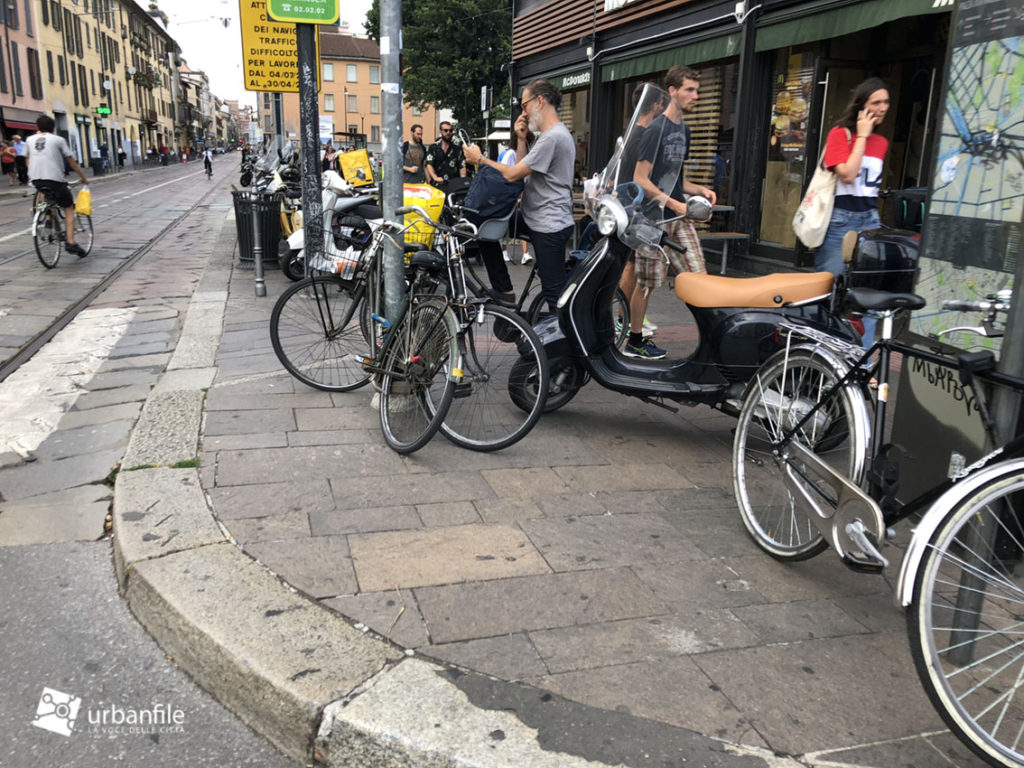
or this
https://blog.urbanfile.org/wp-content/uploads/2019/02/2019-0...

(real pictures in Milan one of the cities where bikes are more popular in Italy and they have become a problem for everyone else)
the point is also that bikers should be in charge of their own safety, if a road is very narrow they are voluntarily endangering themselves for no reason, no other road user should be responsible for your safety more than you!
that also apply to motorbikes, mopeds, scooters etc
which are harder to drive because they rely on the gyroscope effect and only.have two wheels, they do not stand in case of sudden stop, the user can only fall or be shoot forward with grave consequences.
so they should care for their life more than a driver that is protected by the car case.
I wish I could show you the suicidal moves tourists make in my city (Rome) while riding electric scooters, two people, while the regulation says only one person can ride them, in the middle of high speed roads, with no knowledge of how the traffic works in a city they do not know, like it's OK to be idiots trying to die (and possibly ruin the life of someone else who happens to cross their path on a motor vehicle)
Not saying people shouldn't use alternatives means of transport, I do.not drive often anymore, I walk
As a pedestrian bikes are much more disruptive than cars for me, even though I'd like to ban cars from every city center in Italy.
> 40% of non-cyclists in London say the danger of cycling is a significant factor in their decision not to cycle.
people make a lot of excuses when confronted with something that they do not want to do.
if they asked them why they do not exercise they would say that they have no time due to work or that the water of the pool is too cold, but the real reason is that they prefer the couch with Netflix.
we should never take those polls too seriously.
They really aren't endangering themselves, the city planners are endangering them.
In the Netherlands if there is a street or junction with too many accidents they consider it a design failure and redraw the whole thing, often to slow down cars, separate cyclists and to make cyclists more visible.
> people make a lot of excuses when confronted with something that they do not want to do.
So why do bikes outnumber people in the Netherlands but not in London? Why don't the Dutch make up excuses for not wanting to exercise.
Maybe exercise is actually enjoyable and healthy and the little in London would actually like to do it safely?
if a driver is driving so close that they couldn't react to a cyclist falling, they are a bad driver.
You should drive within safe limits. If you cannot brake in the distance between you and the car in front, you are _too close_. If you squeeze to overtake, you are too close. Potholes exist. Wind exists. In the UK, the (edit) guidance is that you should pass a cyclist with as much a gap as you would pass a car (1m). The suggestion is 1.5m at 30mph (~50kmh). In other words, you should basically be in the other lane, as you would be if overtaking a car.
YES, driving slowly can cause accidents as drivers are impatient, but in most roads, waiting 10s for a clear passing spot isnt going to drastically change your journey time
...and if more people cycle, that means less people are in vehicles, so you have _more_ space on the road and less congestion. cars are very space-inefficient
(edit: formatting)
Basically no one is ever willing to wait for anyone else, as OP's reasoning shows pretty adamantly.
Of course they're grossly incorrect.
It used to be like that around 2000s, things have vastly improved here though.
Have you ever tried Barcelona or New York or Paris or Krakow or Milan or, god forbid it, Naples?
Prejudices are fun, but usually they are grossly incorrect.
Also as I've said, I drive very little (less than 2.000km/year) and cyclists in Rome are still from Rome. they are not Martians so their mentality must be the same of everybody else don't you think?
if romans are bad drivers, isn't it safe to assume they are also bad cyclists?
The only time in my life when I felt people were out to get me was in Italy. They drove like absolute maniacs. And I was on a big motorbike, not a bicycle going at 10 kmph. The road was wide, too (outside a city), with very light traffic, but for some reason they really couldn't be bothered to move over to the other lane when overtaking. Weren't going particularly faster, either.
---
[0] I'm not saying Paris is great, mind. I'd even say that in the last few years it has deteriorated a lot: whenever a light turns red, at least one person is guaranteed to run it.
Of course, you're French!
In Aosta!
You usually forget how shitty your country has been.
https://fr.m.wikipedia.org/wiki/Tentative_de_rattachement_de...
> Cars must leave at least 1.5 metres room when passing bicycles - while revised guidance also says "it can be safer" for cyclists to ride two abreast.
But cyclists will always complain, because they don't talk about reality. they talk about their perceptions because they are scared and need to blame someone.
Cyclist also make the worst drivers I know, because they really can't stop thinking they are the victims.
if they do not kill you, they are not.
or maybe if you are scared of other road users and need a "safe space" you aren't a good road user.
just maybe
> if a driver is driving so close that they couldn't react to a cyclist falling, they are a bad
welcome to the reality.
I'm not driving too close to you, you are zig-zaging in the middle of the street and you wear noise canceling headphones and no rearview mirror and no stop signal when you brake.
Thanks, but no thanks, I'm passing you, I don't trust your abilities, sorry.
let's not pretend that the majority of cyclists are Tour de France participants, they are usually terrible.
The good ones do not complain and they are those passing you left and right because are very confident and know what they are doing.
I'm also simply trying to not be responsible of your injuries if you injure yourself.
By the law I have to stop and check on you and stay there until.an ambulance or the police arrives. It usually takes hours.
Most people think they are good drivers and its "the others" that are bad, regularly driving and behaving in a way that leaves little to no contingency. You can't control the environment. You can't control other road users. So if you are 'squeezing' then you are reducing your contingency, making it more dangerous for you and everyone else, and leaving yourself much more susceptible to negative events. So yes, a bad driver.
Most cyclists think they can ride a bike and it's the cars.
How is that different?
The main issue is don't harm.other road users, you don't do that?
Fine with me
I've never been in an accident that was my fault in my career as a driver, than now spans 3 decades.
The only accidents I've been were:
- a bike hit me laterally because the rider was going too fast on a wet road, panicked and hit the front brake. He almost killed himself and ruined my day.
- a moped took a turn too fast and hit me straight on the drivers door. When the father of the rider arrived he apologized saying his son "is a bloody idiot" (my adaptation of his Italian words, which are probably NSFW)
- I stopped at a stop sign and two teens on a motorbike hit me on the back because they were running too close to me. They also attacked me for braking, I showed them the stop sign, I threatened to call the police, they calmed down and gave me some money asking me to not make it official or their parent would be furoious at them. it wasn't their first time.
people are people, people make mistakes, people who think cars are dangerous for bikes usually aren't aware how shitty as cyclists they are, I'm sure they are bad drivers too.
Riding is dangerous, do it at your own risk, but nobody is really trying to kill you, because you are not that important.
Be careful and you'll live.
Wanna be safe on a bike?
Don't use it! Walk!
have you noticed that in motor sports at 300km/h nobody dies while every year in professional bike competitions someone dies or injure himself badly?
Because bikes are dangerous.
The consequences of riding a bike badly are much lower. 10kg bike vs 1500kg car? ~14mph cyclist vs ~30mph+ car?
> I've never been in an accident that was my fault in my career as a driver, than now spans 3 decades.
That doesn't say _anything_ about whether your driving caused an adverse reaction from other road users. Merely that there was nothing severe enough to legally mark you as 'at fault'.
> people are people, people make mistakes, people who think cars are dangerous for bikes usually aren't aware how shitty as cyclists they are, I'm sure they are bad drivers too.
Cars _are_ dangerous. Cars cut across cyclists path (hence why the UK highway code received clarification/updates this year). Cars pass without enough space and clip cyclists (which you just seem to completely ignore and think it's "safe enough" and "the bloody safe-space demanding cyclists' fault").
> Riding is dangerous, do it at your own risk, but nobody is really trying to kill you, because you are not that important.
Riding, in general, isn't dangerous. For the average cyclist who is using it for commuting, and _maybe_ getting up to ~20kmh? Other than slick road surfaces from spilled oil or deep rain puddles or ice, there's not much that would cause random danger.
> have you noticed that in motor sports at 300km/h nobody dies while every year in professional bike competitions someone dies or injure himself badly? Because bikes are dangerous.
Road racing, where the racers are travelling in bunches of 40 cyclists at average speeds of 30mph, deliberately taking risks to try to win, is _nothing at all_ like typical road use for a commuting cyclist. You seem determined to strawman cyclists, and think that cyclists should just accept dangerous roads. You seem utterly unwilling to accept that car drivers can be a significant danger.
I accept that there can be bad cyclists. I shake my head if I see one jump a traffic light. How much of your perception of cyclists is just because you _expect_ car drivers to be bad, and whatever way they behave is just 'typical' so doesnt stand out to you...but when you see a cyclist it's obviously different, so much more memorable? In the UK there were more than 150,000 road traffic accidents in 2019. In Italy, around 190,000. That suggests to me there is a lot of bad driving.
My general position is that most road users (not just cars) are incredibly entitled and so we should figure out ways (such as the Netherlands' road design) that make everyone's life better, rather than just accepting things are shit and saying "suck it up and find a safe space".
> let's not pretend that the majority of cyclists are Tour de France participants, they are usually terrible.
Let's not pretend that the majority of drivers are Formula 1 participants, they are usually terrible.
It’s not cyclists who feel the need to bring a climate-controlled metal protection bubble onto the road with them.
Fear of other road users is in part what is fueling the SUV boom.
what foes that even mean?
do you live in the woods and only feed yourself with carcasses?
> Fear of other road users is in part what is fueling the SUV boom.
maybe in America
here it's micro cars that are booming
because after all SUV are stupid cars for stupid rich people with small dicks
Your implication is that cyclists who don’t want to be close-passed are wimps who shouldn’t be on the road. You used the term “safe space”, which is usually pejorative. My point is that those cyclists are braver than the drivers who wouldn’t be on the road without a protective, climate-controlled bubble (their vehicle).
>> if a driver is driving so close that they couldn't react to a cyclist falling, they are a bad
> welcome to the reality.
So you are admitting that they are bad drivers, and thats just reality? Ok. I'm saying we should face reality and give ourselves space to fuck up with less consequence.
Again, you seem very confident in your _own_ abilities. I don't know them. I just know that very few drivers ever consider _themselves_ to be at fault. Overconfidence.
I am comfortable weaving in and out of busy traffic. I can hold 20mph+ comfortably. I ride both for commuting and recreation, and have done 40mph+ on my bike. That doesn't stop me being able to see that other drivers are bad, and even if I know what I'm doing, can hope for society to be better.
I'm also the kind of driver that when you trip from your bike because you are on death on wheels vehicle, stops and helps you
And when you burn. ared light, brakes
and when you miscalculate a turn and go wide, leaves you room, because I an actually looking around me when I drive, you aren't, because you don't care.
maybe I should stop doing all that, I guess a couple of weeks with a broken leg teach a lot of lessons to people like you.
You are in control of your car no?
if you die riding something that runs on two minuscule strips of rubber that requires movement to stay in equilibrium and has no protection whatsoever for the rider, that usually don't even protect themselves because "who cares", why should be other people's fault?
> like if the biker falls.
In this scenario the driver is not leaving sufficient space ahead of them, given road conditions. There should always be enough space for the driver to react & bring their vehicle to a stop safely--if not then the driver is not driving safely.
There is nothing wrong with overtaking at a sensible speed and at a sensible distance. "car squeezes past you at high speed" means that the driver is failing on both accounts.
When I am near cyclist or motorbikes there is a lot of ways I can not put them in danger, but the biggest ones are being attentive and keeping safe distances when folllwing or passing. This gives everyone space and time to react to any issues. Simple stuff.
Cyclists are doing the best with an infrastructure built in favour of cars, if they could be riding on a separated bike path out of your way they would definitely prefer that.
if they wanted to be safe, they wouldn't go when cars are allowed to go 90km/h, side by side.
if you are suicidal, I don't wanna be part of your plan.
> Cyclists are doing the best with an infrastructure built in favour of cars,
that's so boring that is gives me nausea
Americans don't understand that they are not the center of the world.
Most of the bikes accidents in.my country happen far away from cities.
Most of those roads are the same that 200 years ago were used only by mules and cows
people didn't complain at the time when they used them with bikes, but complain now that bikes are 100x times better and roads are 100x times easier and safer.
the only "new" infrastructure have been highways in the 60s of the 1900
Viale Trastevere is kinda new in Rome, it was made by Mussolini in the late 1920s
that's the "infrastructure" you're talking about.
It just happens that now the main users of roads are cars, get over it, they won and will keep being the most used vehicle's form factor even after the electric transition.
We might agree on one thing, ridin on high speed roads outside of the city is pretty crazy. But I would still say it's my responsibility to not kill the cyclist and not their responsibility, again it's my car, I am in control of it, it's on me to not hit stuff with it.
No. Speed kills, especially in the form of massive objects like a car. The car should slow and stay behind the cyclist until it is safe to overtake with adequate margin.
The vast majority of drivers are actually totally fine and courteous on the road. But when a moderate cycle can take you past literally hundreds of cars, even a tiny percentage of discourteous drivers can make the whole experience of cycling extremely unpleasant.
please understand than bikers don't make a good judge, because they are biased to think everyone is trying to kill them because everyone hates how free and both environmentally and physically better they are than everyone else.
this thread started with someone claiming that bikes are "healthy, less noisy, creates vastly less pollution, less dangerous to pedastrians"
which are only claims, not facts.
the fact that I sometimes drive for 30kms with a car and walk the rest of the times, doesn't make me less healthy or more polluting,it's just propaganda fueled by self righteousness which doesn't help the matter at hands: why bikers love to take on cars, while, like it or not, cars are still the main users of roads because the astonishing amount of taxes road users have to pay, pay for those roads and their maintenance.
I hate cars in walkable cities, but I understand that walking is better for me, I don't blame people driving, I just avoid them.
I would like to avoid bikes too, but they use the pavement I'm walking on 'because roads aren't safe', like their right to defend their safety overrides my right to not be bothered where only pedestrian should walk.
I don't feel safe walking in the middle of the street, even though no law here prohibits it, I simply don't do it.
If a road is too dangerous to walk, I change directions.
There'll be a day when all of this won't b necessary, in the meantime, while some scientist invents the "no danger machine" everyone risk their life by simply living.
House accidents cause more death than accidents between bikes and cars in my Country, heck, they cause 4x more deaths than car accidents!, so bikes are still much safer than staying home anyway, enjoy the biking and stop complaining.
Pretty telling that you think that but at the same time defend drivers squeezing past cyclists at high speed.
I am a cyclist who would want to do it a LOT more. And the main reason is two-fold.
One: cycling in London is scary, dangerous and extremely stressful. The cycling lanes, where they exist, are poorly maintained, tend to hop between the sides of the road at a rapid pace, and far too often cross with bus stops. On a bike you are forced to mix with car traffic more than if you simply _walked_ on the side of the road!
Two: I live at the bottom of a valley. Going anywhere starts by cycling a minimum of 2.5km uphill. Going anywhere interesting requires to take on a 5-7km uphill drive. Combined with the dangerous environment, being exhausted all the time adds to the risk. (FYI: on flat terrain I can do 25km on one go with little effort.)
Back in Finland I used to cycle ~170km a week during summers. In London, not a chance.
Entitled much? Try having a family, and getting a place with a garden. Around Islington decent places like that go for around £2M. With the most lenient lenders you can get a mortgage for 5.5x your annual income, so in order to afford one, I would have to make about £365k a year.
Which would likely put me in the 99.99th percentile in terms of income.
Yeah. Sure.
Islington is massive with expensive and cheaper areas, but all of it is fairly cycleble. But if you want to go further away, I did cycle from Lea bridge road close to Walhamstrow every day for years to around Euston. That's North East and used to be cheap the live back then. I tried Tottenham, too. That's harder to cycle to and from.
We should never take such posts too seriously.
when lockdown happened, cars weren't around, people started using electric scooters, with no cars around
results?
ER saw a spike of brain I juries because people where falling from them!
Is that the cars fault or it's people that are reckless?
https://www.theguardian.com/world/2022/jun/25/rome-to-impose...
that's absurd.
ever seen a traffic light from a car?
> Literally nobody keeps the necessary distance to the car/cyclists in front of them in city
you mean literally no cyclist keeps the distance between them and the car in front of them, tailgate them at traffic lights, and then keep everybody else stuck because they are slow to move?
they are forbidden by the law to pass other vehicles in my country and keep the right lane, they never do it.
have you ever seen a bike wait behind a slower car or in line at a traffic light?
cameras could fine cars not behaving, but bikes?
> When a cyclists falls in front of a car it's fatal.
then why they do it all the time?
because I literally saved tens of them in the past 30 years.
> As a pedestrian bikes are much more disruptive than cars for me
yes, for you. for the collectivity, the cost of cars killing people all the time outweighs the discomfort of seeing mopeds parked, you'll understand
two wrongs don't make a right.
but I've never seen a car chained to the subway gate
> yes, for you. for the collectivity, the cost of cars killing people a
spare me the "pistolotto"
I use public transport and my feet, bikes are not saving anyone and frankly having to hear people defending the right of bikers to break the law is ridiculous.
At least cars don't disrupt my mother in laws's whose almost blind walks.
Why bikers never walk their bikes on pedestrians only paths, like they are supposed to?
there are no cars there.
No wonder bikers are considered by the book selfish people
https://www.psychologytoday.com/us/blog/black-belt-brain/201...
They are actually, biking improves health a lot more than any negative aspect. It's a ridiculously good way to save lives.
So charitable of you to assume that they are only bad at driving.
I find that people who don't "get" mixed traffic create uncertainty and danger for everyone else around them whether they are on two wheels, four wheels or two feet. And then many of them have the gall to assume it's everyone else who's doing it wrong.
Actual statistics about encounters clearly do show it is less dangerous, and expecting a concussion to be a false interpretion of actual risks. I do get your problem though: you're not used to it. You need eyes everywhere which essentially takes training.
For example they will be ready to crash on a pedestrian who is walking on a bike lane for good reason (most common ones are: an excavator made a trench on the sidewalk, the snow clearing machine took all the snow from the road and made a mountain on the sidewalk).
However when there is no bike lane available, they will have no problem in going on the sidewalk at 50km/h with their electric motor. Despite this being clearly forbidden.
And getting hit by an electric bike going 50 is no joke. You don't just get a bruise and move on with your day.
That being said, I do have the impression in the local town (but definitely not everywhere) the behavior of cyclists in general became worse in the last decades. I'd really wish I had a way to make sure, but I just don't remember seeing multiple highest category rule violations every single day.
The average speed of a bike, as measured in Netherlands, is around 15km/h. When there is snow the speed is generally even lower. It is also fairly common where I live to see parents use strollers on snowy days since the bike roads tend to be clear of snow before sidewalk. No one, neither police or other pedestrians, acts as if those parents are putting their children at mortal danger. Statistics also support this.
A motorized two wheeler that can travel 50 km/h is not a bicycle, it is a moped. If its electrical then its an electric moped. Mopeds are not allowed where I live to use bike lanes unless they travel at the maximum speed of bikes. Mopeds also require a moped driving license and a license plate, and police can and has apprehended people who break the traffic law in this way.
> Mopeds are not allowed where I live to use bike lane
Welcome to Sweden I guess… I think they are not allowed but they don't care. Electric or benzin engine alike.
I would slightly agree that parents that train their kids on training wheels should maybe select a better place than a trafficked bike lane, but I for one is not going to stop them and tell them how to raise their kids. I would definitively not call the police and social service. I would be much more concern seeing the same behavior on the road, and if they were on the highway I would consider it.
> I think they are not allowed but they don't care. Electric or benzin engine alike.
Mopedists are what they are, or rather young adults without a driving license will behave like they always have. Motorized teens. Of course some of them will break the law. Modified electric bikes are however fairly rare since moped strength engines are generally more expensive, and if you are paying that much already then the moped license is fairly cheap to get. Modified mopeds however that goes faster than 45 km/h are very common, especially the four-wheel ones. The legal age to get a driving license is 18 so there is also a incentive to break the law for those that are around 15-18.
The classification in turn determines which laws the seller and driver is under. A bicycle doesn't require a driving license or license plate. Mopeds and motorcycles require a license plate (registered) and have corresponding driving licenses. There might also be different taxes involved.
There is a similar classification with four wheel vehicles. There is electric four wheel mopeds, tractors and cars, each defined by the maximum speed. You can even convert a car into a moped or tractor by changing the gear box to limit how fast they can go.
As a pedestrian, I had few super close calls (5cm max) where a crowd of us pedestrians were going through the road on green light and cyclist zoomed at 30-40kph through cars on red light and our crowd, not even attempting to break. At that speed, crash can be fatal/disabling for both. Its not just theoretical - when my wife worked as doctor on biggest urgence here, they had a case where 40 year old guy was hit in same way by cyclist on pedestrian crossing, green light. He went into coma and died in 2 days. Red light is just invisible to most, unlike rest of traffic. As pedestrian I consider cars and motorbikes/scooters OK, but cyclists I avoid / look out for very carefully, especially when with kids.
They really act like everything belongs to them and they are above any constraints, be it red light, no-bike-parks for kids etc. You can't simply cross road because you as pedestrian have green light - you need to have green light and check that no cyclist is going through the town like its some post-apocalyptic wasteland with no humans around.
They are aggressive to the car drivers too - I had cases where drink cyclists were trying to damage my car by kicking into it (I was stopped on red light so no threat to anybody, no idea why). Damage to well parked car, also by cyclists. No love there despite obvious ecological benefits.
With that said, people do stupid things there are always outliers.
How did I make any cyclist unhappy by just standing still with my car on red light in a row of other cars?
How did I insult cyclists by daring to cross on green light as pedestrian?
I don't talk about outliers, I talk about daily experience for past 10 years I live here. Consistently the same. As with cars, you don't notice normal drivers/riders, but a-holes you notice well. And a-holes on bikes I do notice practically every single day, unlike any other traffic on the roads which respects basic traffic rules.
Crazy stuff happens in traffic for sure, but when someone is angry with you it is mostly because you have done something. The cases of random deliberate violence are so rare that they should not happen to you.
If you want to live a life were you assume the worst about a completly heterogeneous group of people consisting of people from all walks of life and state of mind, that represents "people", you are free to make that choice but do not blme cyclists for that. This is my point: you might feel innocent all the time, but what you do is also interpreted by others they might feel the same thing.
Again I do not really talk about you or your specific experience but in general, and what should be true for longer period of times. What you feel and experience is up to you, can't change that.
This seems to be a persistent myth. All the studies I've come across say the exact opposite; for example:
https://www.forbes.com/sites/carltonreid/2019/05/10/cyclists...
Imagine 16% drivers not stopping on red.
Motorists exceed the speed limit, roll through stop signs, sometimes blow through red lights (every light cycle at one intersection on my daily commute), and drive while distracted (I see the cell phones from my bike).
Cyclists blow through stop signs, sometimes blow red lights, and often take shortcuts that are technically illegal.
in 2017 over 900 americans died in accidents involving running a red light
https://newsroom.aaa.com/2019/08/red-light-running-deaths-hi...
One safe assumption is that the number of drivers killed by bikers running red lights is near 0.
I can promise you that every biker care. If nothing else, then at least for their own safety. And in the 35 years I've been biking around here, I've never seen a collision between someone stepping out of a bus and a bike coming from behind.
The city is badly designed. Busses shouldn't stop on traffic.
As a bicyclist and driver I do think it can be difficult to pass a bicyclist that's travelling at a considerable pace. At 10 MPH I can easily and safely get by a bicyclist but if they're travelling 15-20 MPH it can be more difficult (assuming a speed limit of 30 MPH) and almost require a higher rate of speed than is comfortable for both parties.
The solution is better roads and bike pathways and less mixture of automobiles and bicycles.
The main problem seems to be that people (drivers, cyclists, pedestrians, ...) all think they own the road and show very little respect to those around them. Especially those travelling by another type of vehicle. It makes for frustrating and dangerous situations.
Few voluntarily bike with cars, especially not those only doing 15 km/h.
Ah, the joys of almost getting killed by someone who is so rude that they don't even realise they were about to kill me.
I am blessed to live in a medium sized Danish city, so it only happens about weekly that I have to face the reality of death by demigod encased in steel plate.
Can we talk about people on e-bikes with phat tires? There’s a certain profile of riders that think they are just as meek and harmless as a normal rider, but their presence and riding style is usually aggressive.
Don’t forget the angsty 40- and 50-year-olds who uncapped their limiters and installed 1000 W motors for their “sleeper” builds.
[In the UK, electrically assisted pedal cycles must cut out after 15.5 mph; the max motor output is 250 W; and the motor must solely be activated by the action of turning the pedals; vehicles that don't comply with these rules are illegal]
Edit: I say this a cyclist myself. I see other people on bikes do some dumb shit, we can't say they aren't real cyclists because they do something that makes us look bad.
However, e-bikes can give unconditioned people “superhuman” strength and endurance. Physical training tends to give individuals intuitive limits for personal safety, but using a modified e-bike short-circuits this intuition.
I am thinking that limits on stuff like diameter of frame tubing or tire width (which would not stand up to riding at speeds outside of normal “human” parameters) can help.
He took it up to 40 MPH (on his own private land) before chickening out. The chain would simply not stay on the cassette at that speed. He reckons that if you did drive it to the limit, you'd go through a brand new set of disc brakes and calipers in a week, if you didn't manage to boil half the hydraulic fluid off in the mean time!
But to a non expert this thing looks exactly like a regular bicycle--because it is (or was, before it was illegally modified to be a motorbike).
I like e-bikes, they are getting more people to ride bicycles, and I’m especially seeing a surge in older people getting out and riding far. This is a good thing for all cyclists. But parent is correct: e-bikes are motorized vehicles. There are bicycle trails where I live where motorized vehicles are not allowed, and that includes e-bikes, and it is enforced.
You have identified that they give cyclists a bad reputation, and we all suffer due to it. :(
Cyclists who behave badly are cyclists. People riding vehicles with motors that let them go that fast simply aren't cyclists. We don't call ICE motorcycle riders "cyclists" in that sense either.
Unfortunately I see it the other way. Asa rule I give cyclists plenty of space when overtaking, even happily sitting behind a slow cyclist on a 60Mph road for 30 seconds to a minute in order to find a safe passing spot.
However the same courtesy is not paid the other way. When in multi lane traffic jams (or even slow traffic on a single lane road) cyclists will fly down the tiny gaps between the cars, often only just wide enough for their handlebars to fit through. If vehicles at speed need to give such room for an overtake, why doesnt it work the other way around? There are plenty of videos on youtube of bikes going very fast between stationary cars, only to hit a wing mirror and crash.
Second, while room should be given by both parties, the consequences for failure are far different between the two scenarios. In the scenario where the car driver is passing dangerously close, you have a multi-thousand pound vehicle potentially hitting an unprotected body. Even if the initial impact doesn't cause great harm to the person, there's a lot of potential for knocking the bike and person over and then causing them to get run over by the initial vehicle's wheels or into the path of a second vehicle nearby. Who loses most in this situation? The person riding the bike.
In the scenario where the person on the bike passes too closely and hits the stationary car, there's just a lot less energy and moving mass involved. The potential for serious injury is greatly reduced. And perhaps most importantly, the party suffering the greatest potential for serious injury is the one that caused the situation.
I don't mean to dismiss the potential for damage to the car (mirrors knocked off, scratches, etc) as that's a real thing which should be avoided. But there's also a VERY big difference between property damage and bodily damage.
If a hammer lies on the table, and I slam my hand next to it, that poses no danger to anyone.
Enforcing such a law would remove the vast majority of dangerous interactions between cars and bikes.
(Incidentally, I do ensure there is clearance when I pass and I avoid passing on the right. But that has more to do with being predictable and valuing my life than the law.)
https://www.google.com/search?q=london+cycling+health+pollut...
In fact, the second link for me in that Google search mentions this study, as well as others suggesting the physical and mental benefits of cycling outweigh the pollution you breath in: https://www.standard.co.uk/optimist/theairwebreathe/cycling-...
> Our study also found that there are simple changes that could reduce exposure to emissions for professional drivers, such as keeping windows closed when driving, or changing routes to avoid tunnels. Having an air-tight vehicle cabin can also play an important part in reducing driver exposure. Technological fixes such as specialised in-vehicle cabin pollution filters may also be a short-term solution to reduce exposure for professional drivers.
* https://airqualitynews.com/2019/10/07/drivers-are-exposed-to...
How many vehicles are air tight?
As a pedestrian in Manhattan I am in much more danger from cyclists that from cars, trucks and buses. Literally every single day I will see a dozen cyclists run red lights, go the wrong way down one way streets and ride on crowded sidewalks. While bicycles are much lighter and don't move as fast as cars, they pose a greater danger to me than cars because a very large number of cyclists in Manhattan simply do not subscribe to any rules of the road.
[0] https://www1.nyc.gov/html/dot/downloads/pdf/nycdot-pedestria...
https://www1.nyc.gov/html/dot/downloads/pdf/nycdot-pedestria...
- I care about injuries other than just fatalities
- Non-fatal injuries due to being hit by cyclists are underreported
- Those statistics are for all of NYC - the pedestrian experience in much of the Bronx, Brooklyn and Queens, and all of Staten Island is similar to the pedestrian experience in suburbs - and I'd agree there my danger is greater from cars.
- Those statistics pre-date the dramatic rise of e-bikes on the streets of Manhattan
Streets with bicycle paths are a safer for pedestrians, I think there is research from NYC/Brooklyn comparing streets before and after bike paths.
And, I usually have a lot of steel and airbags around me to protect me.
It's the #1 reason I don't ride bikes on the road in the US. If I lived elsewhere I might change that.
try braking suddenly on a bike when a pedestrian walks in your way. and either you will get thrown forward or you will not break in time. I would argue that bikes make it more hazardous to the user to suddenly brake.
I have gotten hit before!
The benefits are tremendous and not even close:
- Faster for most of America, unless you're in places such as Manhattan.
- Can use normal clothes, no need to specially dress up for it
- Can enjoy beverages, music and audiobooks, you can do that on a bicycle but not as safe
- Better quality of air to breathe
- Not going to get stolen
- Not going to get robbed
- Much much safer, modern automobiles are riduculously safe
- Better for the knees
- No need to worry about weather. Flip of a switch and it is awesome, instant heat or cold
- Luxury vehicles are incredibly comfortable
- Cost of cars + insurance + fuel is not a problem for me
- I really don't care about energy consumption, I am not going to give up modern QoL for some ostensible collectivist goal like cycling or eating bugs. We have unlimited source of energy (Sun), we're going to be fine in the future
- Much more fun (subjective). I love driving, especially manual transmision cars and performance cars with great suspension
I've lived in a third world nation full of weavering motorcyles and two wheelers. It was a hell hole.
"Not going to get robbed" In Europe this is not an issue to be honest.
- Red light, move to the other side and cross on the side-walk and back on the road - Stop sign - funny... - Yield sign - funny... - Get a ticket from officer - funny...
I bike a lot and when I bike I always yell at drivers etc but I also ride the bike like a cowboy as well, most rules do not apply.
I think if cyclists generally obeyed traffic laws when they are riding on the roads things be different in terms of how drivers are treating them... How much different is another story but I think significantly!
Perhaps you don't see it anymore because it's so common but cars break rules all the time -- rolling stop, speeding, illegal u-turns, running reds, etc.
[1] https://usa.streetsblog.org/2018/01/03/study-cyclists-dont-b...
[2] https://www.forbes.com/sites/carltonreid/2020/09/18/motorist...
The "rules of the road" were made for cars, not bikes. Bikes are inherently different and should have different rules. Cars and bikes should not be riding side by side in cities.
Provide reasonable bicycle infrastructure and the problem starts to resolve itself.
A few local examples... the main road outside my subdivision has a bike lane, but it ends a few blocks before the school, starts again, then stops a few blocks before the shopping center. So, bikes have to move to the sidewalk and interact with pedestrians, dog walkers, children (or enter a traffic lane). Terrible design.
That shopping center has a single bike rack at one end. To get from that rack to the coffee shop on the other side requires a long walk through the shopping center OR walking across a large parking lot. So, people just leave their bikes leaning against the wall outside the coffee shop. Terrible design.
I bike around the city quite a lot, and usually I will have bike parking available, but when I don't, I find the nearest signpost or street lamp and lock it there. I try to be mindful of pedestrians by orienting the bike parallel to the walkway, but I have'nt probably given that enough thought.
Would you mind explaining the physics of how you interact with these or my misparked bicycles, and how they are causing you to hurt yourself ? Is it just that they are parked in your way, or is there something that makes bikes different from other obstacles you have to navigate ?
I know the issue exists, and I can empathize with your situation. But I’ve also lived in cities with better bike infrastructure and more bike parking spaces, and in those places there were no issues with bikes parked in random places.
This may be true, but it can't be a case of letting shit roll downhill i.e. I'll think about the blind when I park my bike only after sufficient bicycle parking is designated in every part of every city in the world.
Take your example, often pedestrians miss that there is actually an bikepath on the pavement. If you have impaired vision it is even worse. There are many more mistakes that are perfectly valid excuses for just saying "Sorry". Even though only a few people in traffic are ass hats, one is often very sure that is what you are witnessing.
Cyclists are like most people we make mistakes, but we are the sme as you statistically speaking.
No one likes cycling on a sidewalk. People do it because either a bike path ended in a random place and they ended up on a sidewalk or they feel it's very dangerous to be on the road.
As a pedesrian, the risk of being hit by a bike riding on the pavement is higher than by a car driving on the road. As a pedestrian I can tell you that I have been hit by bikes several times but luckily never by a car.
That makes bikes more dangerous to me than cars are.
Cyclists are not forced on pavements, by the way. They make a conscious decision (even if that breaks the law). Sometimes they are allowed to ride on the pavement but unfortunately many are not considerate of pedestrians.
Ideally pedestrians and cyclists should be physically separated. When not possible cyclists should be very careful and considerate. Just common sense, really.
We all agree about common sense. It's just your perception of what represents danger doesn't align with reality. It's important to understand where the danger comes from (for both cyclists and pedestrians) so you can support measures that actually makes everyone safer instead of just some people feeling better.
I don't understand why some cyclists are so defensive as soon as someone says anything perceived as against then. Cycling is good but comes with responsibilities.
Cyclists on pavements are a danger to pedestrians and too many cyclists do not behave in a safe and considerate way to pedestrians, not least when they ride on pavements illegally (all statements of fact here). Cars are on the road.
Edit: as said I was actually hit twice. I don't keep track of the near misses...
Whether they like it or not, shouldn't they ride safely and be considerate of pedestrians?
Anyway responsible cyclist ought to answer an emphatic 'yes', so I don't understand why stating it is a problem...
PS: and of course depending on the jurisdiction, including the UK where I am, cycling on the pavement is illegal unless there is an explicit notice to the contrary, in which case I would expect cyclists on pavements to really, really try to be invisible.
And I'd guess that about 95% of drivers that I come across are respectful of the danger they present - overtaking with enough space, and not at too high a speed (my city doesn't have great bike lanes). Unfortunately, a typical journey involves passing more than 20 cars, which means experiencing at least 1 very close pass, or some kind of dangerous driving.
And the frustrating thing is that the drivers who impatiently pass dangerously are putting people at risk for the sake of ~10-30 seconds (or less). Often I'll catch up with them at the queue for the traffic lights.. Average traffic speeds for cars are around 8-12mph, including stopping for lights, congestion, etc, [1] which is fairly easy to surpass on a bike..
[1] https://www.london.gov.uk/questions/2019/19767