I’m trying to find a color coded current map. Wind too. I wouldn’t expect wind or current to cause the pronounced heading change that is visible. The drift seems possible.
Note: I’m an experienced dinghy/keelboat sailor, but lack virtually any experience driving boats under power, much less commercial vessels
Ship travel, much like orbital mechanics, are so often non-intuitive if you're not familiar with how much effort it takes to make significant speed changes vs. heading changes. And speed changes often affect the heading as well if you're not careful.
.2knots/hour = 405 yards/hour
It was 4 minutes from power loss to impact.
405 yards/15 = 27 yards. And that's if the ship instantly accelerated to a 0.2 kt drift, which it wouldn't. Wind acceleration on the vessel than current.
Of course, lawyers will try to spread the blame around (who chose the pilot, did captain's actions or orders somehow get in the way of the pilot; did captain not ensure engines were working properly...). But the base responsibility lies with the pilot.
It probably helps the captain that this was a ship owned and operated by a very big vertically integrated company (Maersk). Most ships are owned by smaller companies with a few (10-150) hulls and then chartered out. And while in this case the ship was chartered (along with crew) I bet Maersk's systems are stronger than your average charterer's.
Is that just a Panama Canal thing? Or should I find better documentaries?
Panama is the exception
> Legally, the master has full responsibility for the safe navigation of their vessel, even when a pilot is on board. If they have clear grounds that the pilot may jeopardize the safety of navigation, they can relieve the pilot from their duties and ask for another pilot, or, if not required to have a pilot on board, navigate the vessel without one. In every case, during the time passed aboard for operation, the pilot will remain under the master's authority, and always out of the "ship's command chain." The pilot remains aboard as an important and indispensable part of the bridge team. Only in transit of the Panama Canal does the pilot have full responsibility for the navigation of the vessel.
Canal accidents cost so much that they're each individually investigated and insurance companies fight over who is liable. Sometimes it's the pilot's fault and ACP's insurance pays out, sometimes it's the shipping company's insurance, and sometimes they split the cost.
I would doubt the pilot would have ordered the power to the ship to be cut and for everything to go dark right before hitting the bridge. Pretty sure they were probably telling them to navigate away from the pylon.
The after-accident report and insurer and re-insurer wranglings will be a fascinating read, I'm sure. It will be a miracle if the taxpayers escape unscathed for the rebuilding of the transit spanning the harbor, and it falls entirely upon the insurers and re-insurers.
As dramatic as this accident was though, and the many parallels I can draw from its lessons to software engineering, IT operations, cybersecurity and so on, I'm not as sanguine believing it will really drive home to organization leaderships the evergreen advice to pay down your tech debt, maintenance matters, organizational culture/esprit de corps counts, the operational teams are just as important as the engineering teams, etc.
[1] https://fox59.com/news/national-world/cargo-ship-hits-baltim...
It is quite common and vessels often have outages that leave them Not Under Command. Usually they are safely at sea when this happens and they can drift for hours without causing problems. But of course there's always a possibility of it happening at exactly the wrong moment.
The reasons for this are the usual: lack of redundancy, lack of maintenance, overworked and understaffed crews, etc. etc. The book lays out how ships are pretty much designed to be floating disasters and the Class societies (essentially privatized regulators) are in the pockets of the builders, and they are so captured that they make rules that make it difficult to make safe vessels.
For instance, he was trying to design multi-screw vessels but the rules now assume single-screwed ships and it can be impossible to design in additional shaft alleys and still conform.
Furthermore, steering could absolutely have an electric backup for the hydraulic pumps that power the main steering gear. As long as there's some forward speed through the water, the rudder should work. But again, backups clearly aren't required or they would've worked here.
Steer-by-wire cars are required to have all sorts of redundancy so they're almost as safe as steering-shaft cars in case of an engine failure. This is a 9,900TEU ship with a 41480 kw powerplant. That a ship with so much more destructive potential is allowed to operate without the same level of redundancy as a $90k Audi, is unconscionable.
That ship spent 1 (4:30 to 5:30) hour of a presumably 10-20 day voyage in a critical control section. The tugs left the ship right around 5:08 (43 seconds into the video). A much better policy for this case would be to have required the tugs stay with the boat until it passed the main span safely.
There were no doubt maintenance issues that led to this accident, but it is exceedingly rare for these types of failures to cause this type of catastrophic result.
It’s not clear why adding ~$100k to the cost of a billion dollar ship is unreasonable
I don't know enough about the cost and safety tradeoffs made in the design of these ships to comment but your numbers are orders of magnitude off from both directions.
AFAIK the water around the bridge is only like 50 feet deep and the ship itself is about 150 ft high. It wouldn't even really sink, just get stuck on the bottom. A crane ship would come unload it and then tugboats would pull it out.
The worst case scenario though does take a long time if it gets fully grounded and stuck beyond the ability of tug boats to pull it out. A company specializing in marine salvage has to come in to cut it up in place and haul the ship away piece by piece. They use large cutting chains that they pull back and forth to cut through the metal. It's a fascinating process: https://www.youtube.com/watch?v=Ndr2a7AQ8b4
In this case it seems the ship wasn't full, but it's not hyperbole to estimate it as being worth a billion dollars fully loaded. Cars aren't the cheapest things you can ship in containers, but they're far from the most expensive either, and they're what the Port of Baltimore specialises in.
Second-guessing the marine engineers in this case is like the people post-9/11 who argued that future buildings should be designed to withstand the impact of a wide-body jetliner fully loaded with fuel.
It's basically not a serious argument.
http://martrans.org/documents/2006/safety/The%20_tankership_...
The bridge has been there for nearly 50 years, in a port that handles around 50 million tons of cargo every year.
It seems pretty clear that whatever the cause, it was an extremely rare incident.
If someone made a landscape painting today using the wet-on-wet technique, would you argue that a Bob Ross episode from years ago couldn't possibly tell us anything about it? That's silly. It's precisely applicable. Mr. Ross himself might not describe the specific location of today's trees or clouds, but he can darn sure tell you how the brush strokes add up to make a tree. Actually he's probably one of the world experts on precisely that.
Proclaiming your ignorance of extremely-well-researched expert sources is not a good look.
While it is true that the investigation into the causes of the disaster is just starting and we don't yet have a definite conclusion, user "jordanb" has done a great service in pointing us to a book written by a domain expert which had pointed out fundamental design flaws in the design of Tankers long ago. Design Flaws have no expiry date until they are acknowledged and fixed properly. In an era of disinformation/misinformation and focusing solely on profits it is important that people be shown some factual data by actual engineers/experts who were very much concerned with safety and how all concerns were flouted by concerned companies/authorities.
Just like the Boeing disasters have shone the spotlight on Civilian Aeroplane Safety, this disaster shines a spotlight on Tanker Safety, arguably a far far more important topic since almost all the world trade of goods and oil is dependent on them exclusively.
It may be rare in the lifetime of the bridge, but if there is a variable which has change (or is moving) then that isn't so important a consideration. For example, if container ships have recently become much larger in relation to the design requirements in place at the time of the bridge's construction.
Just browsed the book and immediately found "the smoking gun" in the preface itself!
Mandate twin screw in the form of two fully independent engine rooms. Under the current system, 99.5% of all tankers, however large, are single screw. These ships are always a single failure away from being helplessly adrift. The book presents evidence, never before public, that there are at least ten total loss of power incidents on tankers every day. Twin screw, properly implemented, would reduce this failure rate by more than a factor of one thousand. Twin screw would also drastically improve tanker low speed maneuverability which is implicated in a number of big spills including the Aegean Sea shown on the cover.
Thanks to that, they aren't performing an accurate cost/benefit analysis.
Most ships use flags of convenience, so the regulatory structure is pretty much nothing.
Would you still believe this if it was demonstrated that the system lacking redundancy was - due to factors beyond the scope of this conversation - more safe by an order of magnitude than the steering system that includes redundancy but in a different medium?
Put differently: do you think the Space Shuttle should have had ejection seats? If yes, what about an Airbus A320 flying a normal commercial route?
If you really want chills, think about this: a conscious decision was made with covil aviation that it was more economically feasible to sacrifice the human lives on board, and resolve the rest through lawsuits.
In short: if you know/are critical to the process of murdering extra-natiomals, you warrant a life saving device.
If you're a civillian, you're a line item in a potential series legal judgements.
Do you think it's even feasible to install ejector seats for 10-30 passengers? What do you think will happen if they all fire at once?
What I'm decrying, however, is our practice of letting actuaries and lawyers be the final arbiters of what is desirable to engineer.
Military aircraft are subject to failure from being shot at. Aircraft in combat will fail much, much more often than properly maintained civilian aircraft.
Civilian aircraft don't have election seats because situations where they would be useful are exceedingly rare.
Warships have several independent backup steering options reducing finally to a worm gear at the top of the shaft with a winch handle big enough to put a gang of men on it. But ships like this will have none of that. They will have a small wheel or joystick on the bridge and if power goes out the rudder will definitely stay in the last commanded position until power is restored. Even if they had auxiliary steering they would not have the crew to man those positions.
This ship would have alternate diesel power plants called "mules" (think APUs on aircraft). It's possible that when the lights came back on that was because they got a mule started.
But really if we don't want accidents like this to happen the ship should have redundancy. A 10,000 TEU container ship is one of the largest and heaviest moving structures ever created by man. Why is it acceptable that it is driven by exactly one engine powering one screw in front of one rudder?
By the way a ship this big with only one screw is very difficult to maneuver at slow speeds. They pretty much have to be going at least 14-15knots to have any rudder authority.
Perhaps because we have a whole lot of them going and a very low frequency of events like this.
Maybe there's some lighter weight interventions we could do that would further halve the risk of something like this happening that are less costly than fully redundant engine and drive.
They're supposed to have emergency steering gear. Why didn't it work? Maybe ships should have an auxiliary genset running while near land.
This is literally the second major loss of control/allision incident this month.
https://www.tradewindsnews.com/casualties/out-of-control-con...
Seriously, in England it is a legal requirement to have redundant brakes on a freaking bicycle. A dude that hit a grandma with a bicycle due to 1 non-functional brake went to prison. But a giant container ship needs nothing?
What is the cost of fixing this bridge and + lost lifetime earning of all the people who dies + compensation to their families? Is that really cheaper than installing batteries plus electric motor?
Now imagine this ship would hit a bridge in daytime, when it’s clogged with traffic?
But presumably they will ultimately seek reimbursement from the Dali’s insurers. As will the Port of Baltimore and anyone else who has suffered damages.
I don't mean to contribute to this already-too-charged discussion any more than to say that the answer to this question is not as obvious as you think it is. If anything, I would bet that the former is less expensive than the latter, and I say that with immense sadness. Does that make sense?
Cost-benefit analyses aren't designed to evaluate the total risk a business venture presents to everyone who could possibly be involved; they're designed to evaluate the risk posed by a problem that will launch lawsuits that will play out in courts for years, if not decades. Meanwhile, some injured parties settle for pennies on the dollar, laws change, and in the absolute worst-case scenario, major shareholders draw down their positions in the corporate venture that caused the problem. The world keeps on spinning, and just maybe some regulatory agency will pay attention to the report issued by the likes of the NTSB and USCG.
The process does not adequately protect the public.
And that fundamentally means until someone ‘bleeds’/a big enough disaster happens, some things won’t get fixed.
See the triangle shirt waist factory for an example of what it took to be able to force people to pay for certain kinds of fixes.
[https://en.m.wikipedia.org/wiki/Triangle_Shirtwaist_Factory_...]
Since folks aren’t currently burning down the NTSB’s offices or the like, it also seems like your opinion that the public is not currently adequately protected isn’t a majority one?
The only way we’ll ever hit zero accidents is if we are all dead, it’s impossible to do anything without some risk.
And the dude went to prison because he hit and killed a grandma while riding with reckless disregard for the safety of pedestrians. The brake thing didn’t help, but it was a side story.
It is. Redundancy doesn't necessitate the redundant option being identical to the first.
Yes. In fact, in a redundant system, using different designs or technology is often an advantage, so that a failure mode that affects one system is unlikely to affect the other.
But if something is redundant, it is “able to be omitted without loss of function”. Front and back brakes on a bike are not there for redundancy. They are components of the same braking system: without both in service, they don't work as well.
Or to put it another way, the front brake isn’t there as a spare in case the back brake fails. It’s there because without brakes on both wheels, you can’t stop quickly in an emergency.
Bikes are very different from cars due to the short wheelbase vs high center of gravity.
At moderate or fast speeds maxim deceleration occurs when the front tire applies enough force to lift the rear tires off the pavement thus removing the impact of the rear tires. Below maximum acceleration you could use the rear break but it doesn't do anything applying the front break slightly harder would do.
At sufficiently low speeds the rear tire can help, but it's really there for redundancy as even acting alone it doesn't work very well.
So sure there’s a minimal benefit in some very specific conditions, but no they are there for redundancy.
The law literally says mechanically redundant, as in failure of one cannot affect the other.
It's illegal to have a single hydraulic system controlling both.
Children die at or going to/from kindergarten a few times a year I bet in the US.
Redundancy doesn't inherently have to cost a lot more. For example, if you have three engines driving three props, they can each be 1/3 as large, and not necessarily weigh much more if at all. But then if you lose one, you lose 1/3 power rather than experiencing total loss of control.
Yah, from aviation everyone moved to twins because tri-jets and four engine jets were too expensive in comparison. Things don't scale up or down perfectly; in practice you end up with more maintenance.
But it seems like here they lost steering, so maybe there's something better we can do to keep steering more of the time (the cutover to emergency steering gear isn't instantaneous or perfect).
Not just for a while. They must be able to do so indefinitely, until you run out of fuel. Of course, you are going to want to get it back on the ground long before that happens.
- The current accident rate due to lack of redundancy isn't too awful.
- Adding redundancy increases cost, even when it seems like you have the same total power or whatever.
My bias is towards a bit more redundancy than we have now, but not massive changes.
They showed us one such station, on the USS Hornet in Alameda, it it in the officers' dining room.
> lack of redundancy
This is what I am surprised at from many angles. It seems to me that the ship, the port (in the form of lack of tugboats), and the bridge (in the form of lack of secondary protection of the pillars) all had a lack of redundancy and secondary options.
But the ship's pilot [1] (not captain) should know exactly how the boat will handle and the exact course of action. Pilots are extremely well paid ($200-$400k) and the tests are very stringent. Friends have told me that the Narraganset Bay pilot test involves drawing every shipping navigation bouy on a map by hand to within ~200 yards from memory alone, compass, ruler and scaled map provided.
[0] https://www.balticshipping.com/vessel/imo/9697428/seafarers
> The Florida Alliance of Maritime Organizations reported that Florida pilots' annual salaries range from US$100,000 to US$400,000, on par with other US states that have large ports. Columbia Bar pilots earn approximately US$180,000 per year. A 2008 review of pilot salaries in the United States showed that pay ranged from about US$250,000 to over US$500,000 per year.
Pilot != Master
Pilots are very highly paid
I think it was something like bad fuel killing the generator.
[1] - https://warontherocks.com/2021/10/cant-sail-away-from-cyber-... (2021)
It is insane for a 100,000 tonne vessel, that takes so long to stop due to its incredible inertia, that can find itself many thousands of miles from land, to rely on one engine, one gearbox, one shaft and one rudder; without sufficient secondary and tertiary back-up systems. Why was there no battery back-up, or motor on the shaft? Surely the bow thrusters should have a battery back-up to stop such a lurch to starboard.
How can all of the generation and all electrical busbars fail at once? Even if the fuel was bad, surely the generators should draw on separate fuel tanks. For such a large and relatively modern ship to suffer a total power failure is complete corporate incompetence.
If, as some allege, the refrigeration containers were causing problems, and total power outages occurring before sailing, the vessel should not have sailed, certainly at night. If this is the case, The Master needs locking up. But, poor man has to take the blame, because he is cheaper than a Danish Master and his Singaporean employer (if he is employed and not a contractor) also operating in a cheaper flag state than Denmark. The Singaporean Company also needs hitting hard if the culture was the cause of the Captain sailing after such alleged pre-sailing power outages.
Maersk outsource to reduce personnel and running costs. They use the cheapest crews, cheapest ships and need hitting very very very hard. We might then stop this culture of wealthy shipping companies using every method possible to avoid complying with IMO and more rigorous Nation State standards, operating in the shadows and ducking accountability and responsibility.
Also, there's a lot of mass concentrated in that ship. It's the equivalent of hitting a window with a sledgehammer. Small recreational vessels could probably crash into those pylons all day long.
You got me wondering:
> the whole bridge failed because the impact didn't exceed the impact strength of the bridge's material
When I first read this, it initially threw me off. The cargo ship's impact not exceeding the strength of the bridge sounds like a positive thing, but upon closer reading of your comment, it sounds as if it was the catalyst to the entire bridge collapsing.
So, how do engineers balance these properties of impact strength and tensile strength, especially considering large ships channel through these bridges near their pylons frequently? How much engineering goes into the possibility of large structures hitting their pylons?
I had intended to add that exceeding the impact strength typically results in a local failure near the impact point. A tensile strength failure could happen far from the load and so could be more catastrophic.
I'm not sure if it would have made a difference in this case though, as destroying a main pillar by exceeding impact strength would have by itself transmitted most of the full bridge load to the remaining pillars and that alone may have been enough to exceed the safety margins on the tensile strength that are built into all structures. Unclear without more data, but there was a chance it could have survived in that case, but no chance with the ship consistently applying more and more shearing load.
> How much engineering goes into the possibility of large structures hitting their pylons?
Good questions, I'm not familiar enough with it to provide any further insight, except to say that I believe this bridge was designed long before these huge container ships existed. If they factored ship collisions into the bridge's design constraints at the time, they've no doubt been dramatically exceeded with these huge ships.
I don't think impact strength is factored very much into static structures, tensile strength is more important. It only comes up in very unusual situations like this or 9/11.
Imagine you're holding up a barbell with heavy weights at each end. If the weights on one end drop off, the bar will tilt strongly in the other direction, dropping the weights off on the other end.
If you do the math, you find that it’s just an astronomical amount of momentum, and there’s no effective defense for a bridge that needs support in more than 30 or so feet of water.
He spent a full quarter of the movie’s budget on that one scene.
https://youtu.be/_lDM1nAmPHI?t=797
The bow is real, the back of the ship is CGI.
Building a bridge to actually stop the ship is not only infeasible, but it would likely kill (more) people onboard.
"A notable example of dolphins used to protect a bridge is the Sunshine Skyway Bridge across the mouth of Tampa Bay. In 1980, the MV Summit Venture hit a pier on one of the bridge's two, two-lane spans causing a 1,200-foot (370 m) section of the bridge to fall into the water, resulting in 35 deaths. When a replacement span was designed, a top priority was to prevent ships from colliding with the new bridge..."
Source: https://en.wikipedia.org/wiki/Dolphin_(structure)
The MV Summit Venture was a 33,900 deadweight tonnage ship. MV Dali was a gross tonnage of 95,128. Nearly 3× as large. It's questionable whether dolphins would have totally prevented such a tragedy.
Yet similarly, expect dolphins to be brought up as a key component of resiliency for any designed replacement bridge.
But note how the main bridge piers are on giant islands much larger than the pier itself: https://en.wikipedia.org/wiki/Dolphin_(structure)#/media/Fil...

If you really want to make it unblockable you build a bridge+tunnel. https://en.wikipedia.org/wiki/Bridge%E2%80%93tunnel
You put in sheet piling 50 meters upstream, and you fill the box with rocks. That's state of the art practice, nowadays, but that bridge was 50 years old.
In 1977 (and in 1972, when construction began), vessels of this size did not exist, and certainly were not allowed in the harbor[1]. But over time, they were given authorization, despite the fact that they could collapse the unprotected bridge like a load of toothpicks.
The real crime here is that there was no retrofit to protect the pylons. It was almost certainly considered and rejected due to cost.
[1]: https://logisticselearning.com/wp-content/uploads/2022/06/Co...
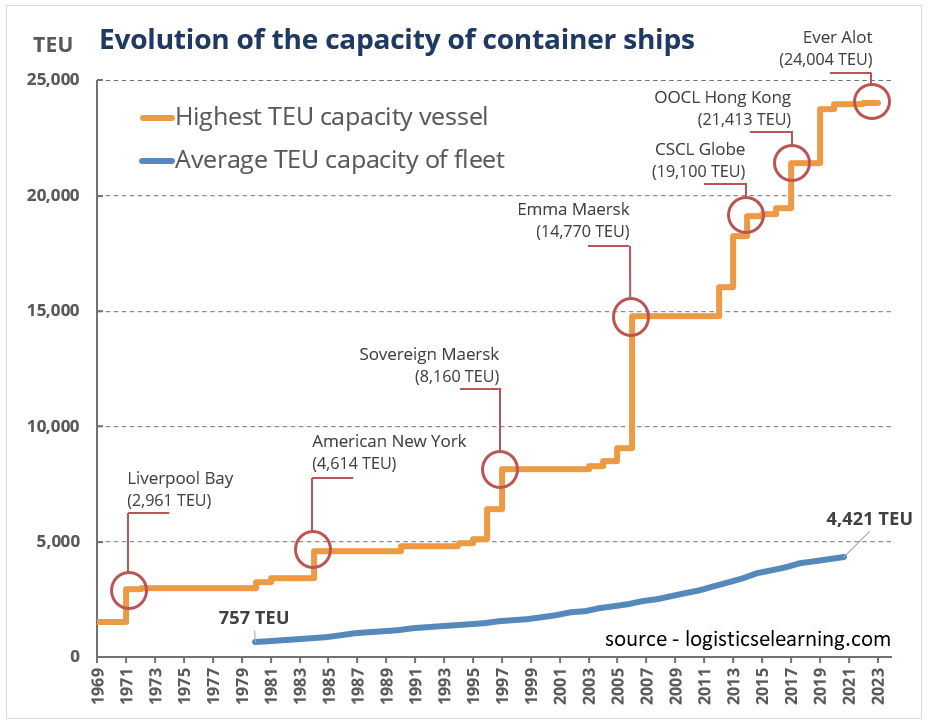
The ship in question here was 10K TEU.
The container vessel in question is tiny compared to e.g. the Seawise giant or Batillus Class.
The smaller VLCCs are dime a dozen and they are 2-3x the weight of the Dali.
Even ports on the US Gulf Coast do not generally have the capability to dock VLCCs.
https://www.eia.gov/todayinenergy/detail.php?id=36232
If Baltimore had been anticipating VLCC traffic in the 70s, then presumably the bridge would have been built accordingly and this incident would not have led to a collapse.
If thems be full, that guy would be illegally parked for far longer.
--
What is the traffick-routing-around plan look like? (both sea and land, helicopters cry in lack of TEU)
I would expect they're as close to full as they can get in every trip. They'd be terribly inefficient ways to transport goods otherwise.
Some import products are crazy cheap because cross-planet shipping is basically free because it's the reverse end of a trip carrying valuable stuff. But they mainly applies to ships returning from low development level regions.
Most our exports are bulk not container afaik
Unless ImportYtei.com can get the bills of lading for that ship....
You deflect it. Failing at that, you direct the force into destroying the ship.
Of course, the best solution is no in-water pylons. But that isn’t always feasible.
Nice immovable object you've got there.
You don’t need to dissipate every joule of kinetic energy in the vessel. You just need to redirect it away from the pylon. That horizontal component can be done with bollards and dolphins sufficiently that even a relatively direct original angle should only damage the fenders. From what I see, there were zero such protections around this bridge.
Nothing can protect against a direct hit. But most hits aren’t direct, and those can be redirected without catastrophic pylon failure.
> You put it ahead of the pylon so that even when the dolphin or bollard is destroyed
Dude, seriously? That has nothing to do with what I was replying to.
The bridge style in question
> Conversely, continuous truss bridges rely on rigid truss connections throughout the structure for stability. Severing a continuous truss mid-span endangers the structure. However, continuous truss bridges do not experience the tipping forces that a cantilever bridge must resist because the main span of a continuous truss bridge is supported at both ends.
* https://en.wikipedia.org/wiki/Continuous_truss_bridge
* https://en.wikipedia.org/wiki/Francis_Scott_Key_Bridge_(Balt...
So taking out one end basically takes out the whole thing.
I would not be surprised that when they build the replacement, it will be a design where the individual components are more self-resilient, like:
* https://en.wikipedia.org/wiki/Cable-stayed_bridge
The engineering best practices, budgets, and needs may have been different fifty years ago. Cargo ships were also a lot smaller fifty years ago.
(This is about the estimated yield of the Beirut explosion.)
I would rather get hit by a slow moving object than a fast one with equal momentum.
Keep the same momentum but scale the mass down to, say, 200g. Now it’s supersonic, and it will hit with maybe 10x the energy of a musket ball. This would be extremely damaging and likely lethal.
(If you make the mass too small, it might go straight through a person, in which case not all of the energy is delivered.)
The only reason why a high energy but slow moving object (thus high momentum) is harmless is that it will deliver a small acceleration to you and you won't suffer from the consequences of a high acceleration (which is what generally kills people when they hit something like the ground at high speeds). But that assumes that you're free to be accelerated and move away.
One could be torn apart. If you are glued to the ground and you are pushed away with too much force to resist, you have a problem. You can stretch or move a certain distance and withstand a certain force while doing so, and the product of those numbers is the energy you can remove from the thing hitting you. If the impactor is at a fixed speed, then you can turn that momentum into an energy, but that’s a bit silly. You really can stand still and deliver more stopping impulse to an object moving toward you when it’s moving slower because you can resist for a longer time.
One could collide with an effectively infinitely massive object. But the momentum of that object seems irrelevant — hitting a brick wall on wheels at 25 mph seems much worse than hitting the Earth at 0.1mph despite the Earth having many orders of magnitude more momentum. The impact velocity seems more relevant.
One could get hit by a fast-moving projectile. This is complicated, and neither momentum nor energy seem like sufficient measures. As an extreme example, ultra-high-energy cosmic rays surely hit people on a somewhat regular basis, and I’ve never heard of anyone noticing such an event, despite the energy involved being quite macroscopic.
For a 2 tonne car, my very rough math puts it at more like 2100 mph.
As I said though, I'm far from a physicist so happy to be schooled if I'm way off...
But at even very low speeds, I cannot stop it from hitting a pier. I have not tried to do this, but every harbor master has a bunch of stories about people trying to do so and getting a leg or an arm or something squished and pulverized.
People who are not boat people rarely recognize these sorts of dangers, which is why so many get hurt on boats. "I can push us off the dock, so I can definitely keep us from hitting it." Nope, Sir Isaac Newton says you're wrong.
And we got the good tour, because we had a severe storm warning as we visited that ship - the kinda storm in which gusts stop you in your tracks and forces you to lean into it to not fall over. Was a great experience. I wouldn't want to be up there with that kinda wind.
And this was a medium sized clipper, somewhat on the small size.
And based off of that, I kind of want to see a retired battleship or an aircraft carrier. Because now I have an idea of how dumbfounded I'll be at those kinda dimensions. It just doesn't appear that big on photos!
We had a team we work with a lot over here in HH and went on the treasure hunt on the Rickmer Rickmers as an event. That was very nice - they spread a bunch of little puzzle boxes across the ship so you can search for these, walk through the museum and look at stuff. And the puzzles were neat as well - you'd use the compass the actual helmsman used back in the day to figure out where east is to find some clue, count pests in cargo and such. Very recommendable and a lot of fun.
We just didn't climb up the ropes in winds that almost pushed you over on foot, haha.
If you are invited onto someone else's boat, sit down and shut up during docking, don't talk to friends, let the captain concentrate. Don't help, if the captain wants you to do something, they will let you know. If you think you know better than the captain, and this advice is unknown to you, you don't know better. Being a good guest during docking shows experience and helps get an invite back.
I always let guests know exactly what I want them to do, and to your point, it's mainly to sit tight and let me focus.
(Liveaboard cruiser here)
I have a 44ft sailboat. Docking is not easy. People do not realize how difficult it can be
Reminder: Kinetic Energy = ½mv^2
Squaring numbers can make them big in a hurry.
The knee is like this too. It lets you stand, run and jump just fine, but you can knock down an opponent with a relatively mild lateral impact to the knee.
Much more of the bridge collapsed than you might think, though, far from the impact.
A looks like 'barely a bump' M is what got the bridge.
There is a fascinating article about Pilots in the SF Bay talking about how containerships are affected by mountain shadows (meaning that hte actual shadow of a Mountain affect the temp of a large swath of water, thus affecting the currents in the region of the large shadow and that container ships in the SF Bay have to make course corrections ~8 minutes in advance, hence the need for a Pilot. (Sextant/Antikythera mechanism much)
-- This ship had an internal engine failure which resulted in their inability to adjust... hoever *EIGHT** naughts seems like the engine blew and the throttle stuck - hence the full reverse and resultant explosion(smoke) and it was also said that there are (some sort) of current effects ocurring in this waterway contributing to the drift...
this will be a maritime study forever.
https://www.sfgate.com/bayarea/article/MASTERS-OF-THE-MONSTE...
https://youtu.be/Aia5X1qoeME?t=1534 <-- Bar Pilot docu
--
I cant wait until the EU (such as the dutch) chime in...
But this really comes down to causeway design with MASSSIVE SPANS..
(oops on cpas)
What is the criticality notion for a particular causeway.
(look at the straights of malaka for piracy, SUEZ, Panama etc...
So where are the fuckn actuaries who are married to engineering and quants.
So build an AI that understands civil engineering endevours (panama canal, Suez, etc) - as well as the economic impact, and make a SIM CIVIL AI engineering model that understands the economic impacts if your thing fails.
I could type for hours on this - but I am sure you guys can daydream about such infra consequense and maybe talk about....
I would love to hear input from civil eng folks on this.
----
===
----
>(Sextant/Antikythera mechanism much)
------
===
<how many ideas this inspired!
I just want to qualify - you did not inspire these ideas.
These are desires sought which have been there for eons...
You are not inspiring them
You have atool that ENABLES them.
Seek that which already is a flustered pop of ideas waiting for a release valve for such thought.
You are not inspiring - you are enabling that which is already there, think of it as which valve to open - the pressure is mounting upon your dyke.
These were measures of TIME.
Time is important in mariTIME due to the influences on current events... CURRENTS...
(our history is lost to the Seas of the Cosmos)
Yeah - how do these waters flow? Took thousands of years to discover the magnetic nature of inertia... only measurable on galactic scales.
Hence - when those excluded from scientific study resulted in 'astrology' to explain quantum faint implications through galactic 'tidal' movements
(Source:
Mayans
Masons
Essenes
Rosi
Undertanding CURRENTS is intrinsic in the philos of the mind...
I wont go too deep on this - but whats really awesome is that when you watch Ship s
I was responding to multipile threads and somehow my comments merged...
I ended up with no injury, not even a bruise as far as I can remember (who would count bruises as a kid), but definitely with an intuition to respect mass.
The strongest man in the world probably seems pretty solid. Put him at the bottom of a 3 degree grade and release the brakes on a full tractor trailer and he'll seem fragile too.
But why not (or did it?) also just blast its horn repeatedly, drawing attention so people on or near the bridge would notice it and realise something was wrong and perhaps even where it was headed?
I'm sure it's not allowed generally and not the protocol and whatever ... But it does seem like a common sense & do whatever you can sort of situation to me?
I wasn't criticising anyone, I was 1) asking if that happened; 2) asking why it might not have.
I think the answer is much more likely that the loss of power disabled the horn (as others have suggested) than that the crew thought it wasn't worthwhile because there was insufficient time for anyone on the bridge to fare any better anyway!
Hard to blow your electrically driven horn when you've lost power.
Even so, it probably still requires electricity to activate the solenoids to open the valves or whatever. I'm speculating since I don't know how large boat horns work, but I wouldn't be surprised if they require power.
Also, how does the driver know what to do? Stopping on the bridge, even well before the point where the ship hit, was clearly the wrong choice. Authorities need to stop new cars from entering the bridge while those on it leave, but that takes more than a handful of seconds to arrange. Unless there are traffic lights, perhaps.
It's hard for people on the bridge to understand what that means. The more it blasts the horn, the more likely people to turn around, stop and maybe get their phones out to take a video what strange thing this ship is doing. By the time they realize the impact is imminent, it's too late, unless they take a helicopter ride.
What I am wondering is: why couldn't the bridge have been blocked off preventing casualties? It seems like more than just the boat and operators' failing if there's no time or secondary precautions if such failures occur.
I wonder if it makes sense to protect bridges with pylons like they have in front of buildings to stop cars and trucks.
Most (all?) of the people on the bridge were contractors repairing potholes.
> I wonder if it makes sense to protect bridges with pylons like they have in front of buildings to stop cars and trucks.
They're called "dolphins" and some bridges do have them.
This video makes that a little hard to believe: https://www.youtube.com/watch?v=qJNRRdha1Xk. Looks like traffic was crossing up until the last second.
Will have to do some more reading as it's very confusing what the ship was doing and what it should have been doing under normal circumstances. In the video, it almost looks like it was steered directly into the bridge. Very confusing.
> They're called "dolphins" and some bridges do have them.
Thanks for that!
Catastrophic engine failure (1:24) causing wide scale power loss.
No rudder control, rudder drift, and ship alignment drift (1:24-1:25:30)
Power restored and ship reengages prop with bad ship/ruddder alignment (1:25). However, ship is now pushing itself into a further bad turn. Pilot likely stomps the brakes realizing misalignment. Obviously 2-3 minutes is not enough to stop 100,000 tons at 8.5 kts, since it only got to 7.5 kts before crashing. Power loss may have caused total rudder loss.
Similar to a car that hits ice, wheels have arbitrary alignment when they reengage road, when power starts being delivered again, car swerves towards concrete barrier even with brakes. Driver with limited crash experience is mostly just panicking and stomping.
How many pilots, trained or not, really have any experience with a 100,000 ton ship in a crash situation with responses where seconds matter?
Edit: Also, economic disaster for Baltimore.
> (Wiki) The Port of Baltimore generates $3 billion in annual wages and salary, as well as supporting 14,630 direct jobs and 108,000 jobs connected to port work. In 2014, the port generated more than $300 million in taxes. 1st in automobiles, light trucks, farm and construction machinery, imported forest products, aluminum, and sugar. 2nd in coal exports.
Edit2: Bloomberg has an economic look including info on autos. ~$500 million in March 2024 so far. Honda, Mercedes, Subaru likely worst hit. https://pbs.twimg.com/media/GJmvXiCWkAAgDcE?format=png&name=...
3,600 commercial trucks / day. Hazardous material transport has a 30 mile detour. Baltimore had $350 million of insurance. However, Brent Spence Bridge is noted for cost comparison at $3.6 billion and 1/5 the length.
Baltimore StreamTime also has live view with ongoing discussion. https://www.youtube.com/watch?v=83a7h3kkgPg
The fact that ship was able to reverse hard ( as evidenced by the slowdown), indicates to me that the prop was most likely still attached to the propshaft and hadn't flown off to mangle the rudder.
We still don't know exactly what happened on board, but it is interesting to work through possible scenarios.
Pilots certainly have experience with ship handling of 100,000 ton ships, that's their job. Pilots coordinate the moves of multiple tugs to assist with docking regularly.
Were there tug boats helping with the exit?
I have often felt that the harbor protocols were overkill, but this is one of the times they could have helped.
There are some seemingly good details here[0].
> In Early Modern Japanese there was a word 按針 anjin, literally “searching needle,” which referred to the process of using a compass. At the time, this was the main way in which ships were navigated and so, by extension, the word was applied not just to ship navigation, but also to ship navigators
It goes into more detail about things as well but that is the part that stuck out to me the most.
also does a shout-out to SONU Sleep mattresses a few posts back.
enough other posts in there to create doubt -- maybe this is a person. maybe this is a person who does marketing sometimes.
I have a mixed relationship with my mattress, and I talk about the downsides in that very same thread: https://news.ycombinator.com/item?id=39757531
Apparently for you at the moment, any mention of a product on the market is a flag for a marketing AI. I suppose this comment too is just what a marketing AI would say.
All pilots are "harbor pilots".
One had a nasty pill habit and crashed an oil tanker under his purview into the Bay Bridge.
https://www.justice.gov/opa/pr/guilty-plea-case-cosco-busan-...
https://en.wikipedia.org/wiki/Blossom_Rock_(San_Francisco_Ba...
I don't think that's true. The Suez Canal famously requires pilots, but isn't a harbour (I guess you could argue it functions as one). I've heard of pilots for the Great Barrier Reef which is even more not a harbour.
Tugs - quite often, but not always - depends on the currents, ship weight, and time of day.
No tugs.
Harbor protocol was in effect.
That one was due to pilot error. The point is the pilot was still onboard but he was impaired by medication, the captain and mates kind of engaged in dereliction of duties contributing to the accident.
Obviously it’ll be a while before we know what happened in Baltimore.
AP News [1] is reporting that harbor pilots were on-board and were nominally in control of the ship at the time of the accident.
[1] https://apnews.com/article/baltimore-bridge-collapse-53169b3...
Update: added timestamp, link
My sailors guess from the footage and the reports is diesel generator failure(s) resulting in loss of power, restoration of power, then loss of power again. Bypassing the diesel generator (which provides power to hydraulics too) and manually throwing the engines in reverse. The billow of black smoke. This could have possibly burned out an engine, blowing the camshaft or propshaft or transmission.
The reverse was too late as the ship was already heading for the bridge pylon. Even at full reverse, you couldn't slow it down fast enough. Tragic.
Still, a diesel gen malfunction would render them useless unless one of them was a diesel mechanic as well (we sailors often have multiple credentials).
There is likely a pilot onboard until it leaves the Chesapeake, well past the CB Bridge-Tunnel.
When I worked on cruise ships, a pilot boarded a few miles out from the Sunshine Skyway going into Tampa.
The release was the decision of the pilot, who remaining in charge of the ship till the accident. If pilots are too liberal in their use of tugs, the ship owner becomes unhappy (because the ship owner ends up paying for them), and if they become unhappy enough, will stop using the port. I.e., pilots are under some pressure to keep the use of tugs to a minimum.
Note that it is probably the pilot who advised authorities to stop cars from entering the bridge minutes before the accident, which is why the only deaths were a team of 6 construction workers working on the bridge.
https://youtu.be/gafDs7sxJqg?si=hvLselyX9FQSczOH&t=98
MDoT == Maryland Department of Transportation. Note that the pilots in command of the ship were also employed by the Maryland state government.
https://en.wikipedia.org/wiki/MV_Dali
Propulsion Single shaft; fixed pitch propeller
Funny, I was starting a 2 stroke chainsaw a couple of years ago. I yanked the cord, it kicked back, pulling my arm back down but the saw started up and ran anyway. But it would not cut at all. I killed it and restarted it and noticed the chain going the other (right) way and it was now cutting fine. It has started in reverse the first time!
So to accomplish this for propulsion, you'd add a reverse polarity switch for your starter and you're good to go.
You don’t want to do it very long, because they don’t make oil pressure in reverse.
US energy policy has entered the chat.
As you start getting into more complex engines, where you have fuel injection, timed spark plugs, oil pumps, transmissions it becomes untenable, but not because a v6 can't run backwards but because you'd have to rebuild and time all the support systems.
[1] https://chiefengineerlog.com/2022/06/24/main-engine-fixed-pi...
For example, a transmission would expect the engine to always run in the same direction, but given correct fuel and ignition timings, it doesn't really matter which way the crankshaft is turning while things are running.
The center prop (that only goes forward) is the one directly behind the rudder, so the theory is partly that they lost some steering advantage when they lost the center prop.
In general it depends on the rudders and the boat.
Longer keeled boats don't respond well in reverse at all but more modern boats (like mine, 1990) will do better but will still need some way to have steerage. I can certainly manouver around the marina in reverse, it's just harder than forwards and I need to be going a bit faster to get the control.
I have no idea about container ship sized boats, though I'd imagine a bow thruster of steerable prop might not be practical at that scale.
Modern flat boats (like the 2017 Dufour I learned on) are highly manouverable at slow speed, we practiced spinning the boat on the spot by using prop wash over the rudder forwards then ticking over in reverse. Could turn the boat in not much more space than the boat length, but may not track as well, may slam more, and make more leeway.
I have to protest here. Reversing and using the rudder on a 40ft boat works perfectly fine. I've done it on multiple sailing boats. You need to hold tight so that the rudder wont slap you if using a stick.
EDIT: also planning ahead is important, because if I do it right the prop walk in reverse can be used advantageously.
Also, with the BI-40's barn door rudder it'll slap you through the wheel if you're not careful. Almost broke my leg that way, not a lesson to forget.
It happens something that I really can't explain, but I guess it is weight related. Or maybe area. Dunno.
Also, the bow seems to catch the wind really hard so you can get spun around if it's blowing and you head off the wind too much without enough way on. Leave room, plan ahead, have a backup plan, etc.
The rudder is a wing, it's just vertically oriented and underwater.
The rudder is capable of stalling, just like any wing. The rudder only produces lift related to the flow of water over the rudder. The lift produced by the rudder is what is experienced as turning force. The tiller or wheel changes the angle of attack.
I used to helm a racing sailboat with a high aspect (long & narrow) rudder. It could provide a lot of turning force but stalled easily. It didn't work as well under power as it did under sail; I suspect this was due to the turbulent flow off of the propeller, which was forward of the rudder.
On the Dali, the rudder should have been providing some turning force due to the 7+ knot flow of water over the rudder. Full reverse propeller might have impacted that; I can't comment because I've never helmed a ship that large.
Additionally, a single-propeller vessel like the Dali, will have "prop walk" - asymmetric thrust that pushes the stern of the craft one way or the other while the propeller is rotating.
It sort of makes high-level sense that a lifting bias could in theory work as a counteraction to propwalk. But the terminology is a bit confusing because aerodynamic lift is a byproduct of air being a compressible medium, whereas water is not. Maybe lift means something different when we're talking about water?
At any rate in scenarios where the prop is not engaged, which in a sailboat is most of them, I don't think I've ever noticed a tendency for heading to track predominantly one way or the other, in circumstances where it seems that would be very pronounced and hard to miss, like extended running downwind. Is the lifting body rudder mainly a performance boat thing? Or perhaps am I just so used to trimming this bias out that I don't recognize where it's coming from?
But water and air are both fluids and the same aerodynamic/hydrodynamic rules apply.
A rudder on a boat or airplane is symmetrical in cross section; the chord on both sides is equal. Wings and hydrofoils are asymmetrical; usually the “top” has a deeper chord than the “bottom”. But rudders are a still a kind of wing in that they generate a useful force by redirecting a fluid and thereby inducing a pressure differential. The pressure differential between the two sides is what causes lift - vertically with wings/foils and horizontally with rudders. If you think about it, this makes perfect sense – it would be silly to think that rudders and ailerons and elevators obey different laws than wings. In fact, one of the first things you learn as a racing sailor is that the sails themselves are wings - they’re not “parachutes” as commonly believed.
Anyway, my point was that you can stall a rudder just like an airplane can stall its wings- if the angle of attack is too high.
Stalling, the rudder, most commonly occurs during a round up, if you’re familiar with sailing with spinnakers. The rudder in that case is no longer able to generate enough lift (turning force) To counter the turning force, imparted by the force on the spinnaker forward of the center of mass of the boat, and the boat turns uncontrollably.
I am just speculating, but if the rudder became very misaligned compared to the direction of the ship, then when power was restored, the rudder might not be able to establish laminar flow and therefore would be stalled and unable to provide turning force.
A https://en.wikipedia.org/wiki/Hydrofoil is a wing that produces lift in water.
Though note: compressibility is not the same as "exerting pressure". A hydrofoil or marine propeller works on pressure differences, even though the fluid is effectively incompressible.
An interesting note is that well-designed sailboats are designed to round up in the case where the headsail gets overpowered. As the sail gets overpowered, the boat will naturally try to turn away from the wind and also will heel further. The heeling of the boat will cause the headsail to lose lift and spill air before the main sail does, and the keel, which normally generates lift and drag to counter sideslip, combined with the now-more-powered mainsail, Generate a strong leeward yawing force aft of the center of mass which causes the boat to turn sharply into the wind. Rounding up only happens when you are losing control of the boat so turning into the wind ends up putting you in a safe mode where you can recover. There are a few boats out there where the keel is too far forward and/or the main spills air before the headsail; these boats round down in uncontrolled situations and can jibe unexpectedly – very dangerous.
This is not correct.
this is a stupid argument from all users , comparing a 40ft sailboat to other 40ft sailboats is like making a broad assumption about cars when comparing a dragster to an SUV simply because they have a similar singular aspect.
ANY sailboat, regardless of size, can have poor reversing performance just simply due to its hull shape and rudder plan. Some boats famously cannot reverse with authority due to the turbulence created between the parts. Some boats use feathering propellers which collapse inwards when reverse is applied in order to make a more efficient sailing experience, which effectively makes propulsion reversing useless.
There is NO generalized '40 foot sailboat' in existence. They all act different, and there are some that are perfectly capable of doing what other 40 foot plans might consider IMPOSSIBLE.
I would expect anyone piloting such a ship in a harbor/under bridges. We requite airline pilots to train for many unlikely plane failures because the alternative is letting planes crash that we could have saved with better training.
Friends of mine are pilots on the Thames (London) and I seem to recall one of them telling me it was over 10 years training before you could bring a big boat in. Pretty fascinating really - they figure out all the tides and weather and plan the route. On the day they board along with a sensor system that sits in the bridge and gives the position to a high level of accuracy.
The crew would have know for several minutes that the collision was imminent. These things happen slowly, it wasn't like the bridge suddenly jumped out of the water unexpectedly in front of them. The tragedy is that the crew had no options to avoid the disaster.
I think you are missing the point.
Clearly I am speculating, but I don't think any more experience would have helped in this event.
Why ? I think what happened today was almost entirely down to not being able to fight the basic Laws of Physics.
Its a well known fact that enormous ships take an equally enormous amount of time and distance to reflect the actions of the captain. You make an input and you see the result a bunch of time and distance later.
Time and distance were, sadly, not on the captain's side today. Physics took care of the rest.
I would hope, given the economic and humanitarian consequences of a crash, that we have simulators for this
And I assume there will lawsuits to recover costs as this caused economic damage and risk to life (8 people unaccounted for at current time).
Not to mention that one can scarcely find a "bluer" area than Baltimore -- I would assume that the most proudly right-wing politicians would be more than happy to let Baltimore suffer to score points with their polarized supporters. I hope it doesn't come to that, but they tried to block Hurricane Sandy relief, despite every hurricane in the South being an automatic 'non-partisan' emergency.
This is what he said. I would expect Congress to play along too -- just how unpopular would it be to abandon Baltimore??
1/8 red house seats. The other 7 very comfortably blue.
The rest of the state doesn't seem like it matters much to the only results they'd care about - seats and EC votes.
Edit: not that Republicans are any better.
You underestimate how much vitriol is coming from the Right about Democratic-leaning cities. Baltimore is 60% Black and voted 87% for Biden in 2020. Baltimore isn't on the top of the list of cities they like to claim are failures, but just wait.
My dad is deep in the Right-wing media econsystem and he is convinced that the downtowns of Portland and San Francisco have been burned to the ground and the entire region is a lawless anarchy.
I mean I'm from the Baltimore area and.. well.. I mean some of us would consider that town somewhat abandoned already, think Detroit. It has some pretty rough parts. With the main triggering event being 60s/70s loss of steel industry (Bethlehem Steel). Of all the big east coast cities (Boston, DC, NYC, Philly, Baltimore) I would say Baltimore is the most abandoned already.
As someone else posted above, Baltimore is a massively important US seaport, that moves tons and tons of goods.
Even the most pro-business Republican realizes that a lot of industries are going to get hurt, and in places far away from Baltimore, if they can't move freight through there.
But a loaded container ship at 8 knots is not going to be stopped by anything remotely feasible.
Container ships weigh between 50,000 and 220,000 tons. A US aircraft carrier weighs 100,000 tons.
If they're designed to stop a bulk carrier then presumably they can stop a container ship.
deadweight tonnage of 33,912, gross tonnage of 19,735, and a net tonnage of 13,948.
The one that took down this bridge:
https://en.wikipedia.org/wiki/MV_Dali
Her registered gross and net tonnages are 91,128 and 52,150, respectively, and her deadweight tonnage is 116,851
Many times larger.
My guess, and it is a total guess, is that the protection on the bridge was nowhere near sufficient for a ship of that tonnage.
I’m assuming it was built to whatever the correct standard was when constructed in the 70s. I’m also assuming the ship weighed far more, or perhaps traveled noticeably faster, than the cargo ships going into the port back then.
Basically I’m guessing it needed an upgrade in its protective barriers but it wasn’t recognized or hadn’t happed if it was.
Wouldn't the ship's insurance be the one paying here?
This
> Similar to a car that hits ice, wheels have arbitrary alignment when they reengage road, when power starts being delivered again, car swerves towards concrete barrier even with brakes. Driver with limited crash experience is mostly just panicking and stomping.
is almost certainly not the case on a large ship. The rudder is rotated hydraulically. Loss of power simply causes the rudder to stop moving, it's effectively "stuck". Some ships have manual override using a massive wrench, but it takes hours to move the rudder meaningfully in that situation.
As for this:
> How many pilots, trained or not, really have any experience with a 100,000 ton ship in a crash situation with responses where seconds matter?
Probably way more than you think. This is a significant reason why they seem so calm when they show up on the bridge. They just hopped from a relatively tiny pilot boat or tug onto a massive ship, possibly with significant sea state. This can be some Indiana Jones level crazy.
https://www.youtube.com/watch?v=18VF8WXWfZw
https://youtu.be/C8ER9Ladqg4?si=Ijwhu90iJi8WPAas&t=226
Pilots are very seasoned mariners who have seen multiple losses of power, and pretty much everything.
Now, back to point 1: bridge team. I have seen a captain the crew trusts execute flawless maneuvers even in exigent circumstances. I have seen a captain the same crew doesn't trust fail repeatedly at everyday things.
We don't have the whole story yet. What happened on the bridge? What happened in the plant? Why did power drop? Did they flood an online generator with diesel oil? I ask because I've seen that happen. Did they blow an exhaust manifold? Seen that. Did they trip the plant by getting preparatory checklist work backward? Seen that. Did they go all back full immediately? Possible that they couldn't ring the order if they dropped power. Was there panic on the bridge (bad sign) or was there grim fortitude to process checklists that would never help (better sign). In any case, no doubt the captain is done. Probably happy to never drive a ship again after that, tbh.
I've just always be impressed by the amount of energy that boats impart when they collide with anything. Like in this case, the entire bridge was brought down by a collision at under 8knots. Obviously that ship had orders of magnitude greater mass than the little pilot boat, but presumably you want to avoid even dinging up the larger ship, and so that's an orders of magnitude smaller goal as well.
Back to the pilot boat: Steering one in heavy seas when trying to deliver or recover a pilot is clearly a difficult art. But at least in the videos shown, there doesn’t seem to be much of an impact between the vessels. I am sure that is in part due to the skill of the steersman. Besides, I am sure the pilot boat will have permanently mounted fenders all around.
Or even if so was it just too late when it all went down and it wouldn’t have made a meaningful difference?
That’s such a ludicrously low bar that I’m not even sure this would qualify as a compliment to these alternative producers.
The sad truth is that "local" news more often than not barely has any local people any more, a lot of content is directly ripped off from others (especially fire dep't or police reports, with the added problem that no one challenges the copaganda), or not local at all but produced/sourced by central agencies, or theoretically "local" reporters have such large areas to cover that they can't reasonably build relationships with experts.
> One might expect that local news
Is this similar to Boeing for the shipping world? I realize it is early to come to any conclusions.
The question of this being a rare one off vs container companies deprioritizing safety protocols is what I am interested. The power failures make me go down this logic of thought.
Maersk/ZIM rent container ships from another company who makes them and drive them around.
These are completely different companies. A more correct comparison would be something like Jetblue or American Airlines.
But I seriously doubt there is the result of some kind of profit hungry CEO. However I cannot with 100% say it's not until we find more details. But I feel confident enough to avoid the tin foil hat.
A modern harbor tugboat can go perhaps 15 knots. In 4 minutes this means it would travel 4 nautical miles, at the very best (running start in correct direction).
So let's say that there would have been 4 minutes for a tugboat to (1) become aware of the problem, (2) travel to the location of the ship, (3) figure out what it needs to do, (4) maneuver into position [keeping in mind it might need to move to the other side of a 900' ship moving 8 knots] and (5) move the ship. And this assumes that the tugboat was idle in the first place.
There just would not have been enough time to do anything meaningful if the tug wasn't already right at the ship, on the correct side.
It's probably pedantic, but I don't understand your math. Knots are nautical miles per hour. To travel 4nm in 4 minutes would imply a speed of 60 knots. At 15 knots, you would travel 1 nautical mile in 4 minutes. (15kn/60min * 4min = 1)
Or it's possible I haven't had enough coffee.
He says that at about 1:24 AM the ship loses power (from video feed) while traveling 8.5 knots.
at 1:25.30 power is restored.
at 12:25.59 the ship shows smoke. The ship has already drifted in the channel. It is believed that at this time the ship applied full reverse power as evidenced by the black smoke. (My analysis: the ship drifted but hasn't turned in the channel, more of a translation)
By 1:26.45 the ship has obviously turned in the channel pointing at the pier. Full reverse would cause prop walk to change heading angle;
1:28.52 impact at 7.6 Knots. Camera says 1:28.52, AIS reports the ship still moving at 1:29:35
https://www.youtube.com/watch?v=N39w6aQFKSQ