News for hackers. Stuff that matters.
Re:The Francis Scott Key Bridge in Baltimore, Maryland Has C... by bastardoperator on Tuesday March 26, 2024 @12:33PM (#39829799)
The video is surreal, it looks like it barely bumps the bridge and 2 seconds later the entire thing is gone. I don't know what I was expecting, the bridge just looked extremely fragile, makes me wonder what other bridges are at risk of an event like this.
Re:The Francis Scott Key Bridge in Baltimore, Maryland Has C... by anigbrowl on Tuesday March 26, 2024 @01:13PM (#39830326)
It's not the impact, it's the fact that it just keeps pushing. Movies commonly use slow motion and time extension via editing for destruction scenes because (as we've just seen) real time doesn't always look impressive to the untrained eye.

Also, there's a lot of mass concentrated in that ship. It's the equivalent of hitting a window with a sledgehammer. Small recreational vessels could probably crash into those pylons all day long.

Re:The Francis Scott Key Bridge in Baltimore, Maryland Has C... by naasking on Tuesday March 26, 2024 @07:32PM (#39834057)
Indeed, the whole bridge failed because the impact didn't exceed the impact strength of the bridge's material, which means the whole bridge bent until the deflection exceeded the tensile strength of the material. A missile impact with the same total energy would exceed impact strength and would probably have destroyed only part of the bridge.
Re:The Francis Scott Key Bridge in Baltimore, Maryland Has C... by AnarchismIsCool on Tuesday March 26, 2024 @11:18PM (#39835361)
Did the math, this seems surprisingly spot on, at least from the energy perspective. 100k tons going 7.5 kts is about 160kg tnt equivalent which is a little less than the explosive power of a Mk83/GBU-32, probably not enough to take down an entire bridge, just one span if you're lucky. That said, the issue is the bomb expends most of its energy moving air around, the freighter expended nearly 100% of its energy on the bridge.
Re:The Francis Scott Key Bridge in Baltimore, Maryland Has C... by varrock on Wednesday March 27, 2024 @12:14AM (#39835652)
Thank you for breaking it down like this. As someone without an engineering background, your explanation (along with some Googling for terms and definitions) really helped me grasp what happened.

You got me wondering:

> the whole bridge failed because the impact didn't exceed the impact strength of the bridge's material

When I first read this, it initially threw me off. The cargo ship's impact not exceeding the strength of the bridge sounds like a positive thing, but upon closer reading of your comment, it sounds as if it was the catalyst to the entire bridge collapsing.

So, how do engineers balance these properties of impact strength and tensile strength, especially considering large ships channel through these bridges near their pylons frequently? How much engineering goes into the possibility of large structures hitting their pylons?

Re:The Francis Scott Key Bridge in Baltimore, Maryland Has C... by naasking on Wednesday March 27, 2024 @12:45AM (#39835779)
> The cargo ship's impact not exceeding the strength of the bridge sounds like a positive thing, but upon closer reading of your comment, it sounds as if it was the catalyst to the entire bridge collapsing.

I had intended to add that exceeding the impact strength typically results in a local failure near the impact point. A tensile strength failure could happen far from the load and so could be more catastrophic.

I'm not sure if it would have made a difference in this case though, as destroying a main pillar by exceeding impact strength would have by itself transmitted most of the full bridge load to the remaining pillars and that alone may have been enough to exceed the safety margins on the tensile strength that are built into all structures. Unclear without more data, but there was a chance it could have survived in that case, but no chance with the ship consistently applying more and more shearing load.

> How much engineering goes into the possibility of large structures hitting their pylons?

Good questions, I'm not familiar enough with it to provide any further insight, except to say that I believe this bridge was designed long before these huge container ships existed. If they factored ship collisions into the bridge's design constraints at the time, they've no doubt been dramatically exceeded with these huge ships.

I don't think impact strength is factored very much into static structures, tensile strength is more important. It only comes up in very unusual situations like this or 9/11.

Re:The Francis Scott Key Bridge in Baltimore, Maryland Has C... by jaxson60 on Thursday March 28, 2024 @07:27AM (#39849820)
Bridges were not designed for being hit. They were designed to span. If those designing and engineering it had considered an impact, the design would not be catastrophic but rather sectional. If sectional, each span would remain standing rather than collapse like dominoes. It takes 3 miles to stop a 100k ton stacked container ship. The things nobody has mentioned are: Current direction and speed. Wind direction and speed. The entry of the vessel in relation to the bridge. The fact that dragging anchor would have on the starboard side pulled the bow right into the pilon, the worst case.
Re:The Francis Scott Key Bridge in Baltimore, Maryland Has C... by WalterBright on Wednesday March 27, 2024 @12:29AM (#39835723)
There's also the loads are balanced on the pylon. When the collapse took out the bridge on one side of the pylon, the other side failed as well. You can see that in the video as the bridge on the right side of the pylon is no longer counterbalanced by the bridge on the left side, and collapses.

Imagine you're holding up a barbell with heavy weights at each end. If the weights on one end drop off, the bar will tilt strongly in the other direction, dropping the weights off on the other end.

Re:The Francis Scott Key Bridge in Baltimore, Maryland Has C... by hgfghj on Tuesday March 26, 2024 @01:07PM (#39830256)
That ship had a 10,000 TEU capacity and was actually hauling a little under 5,000 TEUs. An empty container weighs a little over 5,000lbs, and a full one can be up to 67,000lbs.

If you do the math, you find that it’s just an astronomical amount of momentum, and there’s no effective defense for a bridge that needs support in more than 30 or so feet of water.

Re:The Francis Scott Key Bridge in Baltimore, Maryland Has C... by semi-extrinsic on Tuesday March 26, 2024 @01:20PM (#39830410)
Throwback to the scene in The Day After Tomorrow where the cargo ship comes to an almost instant halt after impacting a bus wreck under water. For some reason it managed to stand out as ridiculous even in that movie.
Re:The Francis Scott Key Bridge in Baltimore, Maryland Has C... by Gare on Tuesday March 26, 2024 @03:27PM (#39831837)
Speed 2: Cruise Control on the other hand: https://www.youtube.com/watch?v=gBxaGB65TB8
Re:The Francis Scott Key Bridge in Baltimore, Maryland Has C... by MBCook on Wednesday March 27, 2024 @12:23AM (#39835698)
I just saw in a YouTube video yesterday that they actually built a full-size model of the ship (or at least the bow area) and the bit of town it hit. The director didn’t want to use CGI or miniatures.

He spent a full quarter of the movie’s budget on that one scene.

Re:The Francis Scott Key Bridge in Baltimore, Maryland Has C... by ralfd on Wednesday March 27, 2024 @08:48AM (#39838352)
Corridor Crew SFX specialists watching/explaining the stunt:

https://youtu.be/_lDM1nAmPHI?t=797

The bow is real, the back of the ship is CGI.

Re:The Francis Scott Key Bridge in Baltimore, Maryland Has C... by peteradio on Tuesday March 26, 2024 @01:30PM (#39830512)
Somebody should do a side-by-side of that scene with this threads scene in gif.
Re:The Francis Scott Key Bridge in Baltimore, Maryland Has C... by kazinator on Tuesday March 26, 2024 @02:35PM (#39831254)
I think the only reasonable goal would be to design the bridge to minimize damage to it, so that one damaged section doesn't bring down others.

Building a bridge to actually stop the ship is not only infeasible, but it would likely kill (more) people onboard.

Re:The Francis Scott Key Bridge in Baltimore, Maryland Has C... by bobthepanda on Tuesday March 26, 2024 @03:12PM (#39831681)
the modern practice is layers of defense; in addition to building a bridge that doesn't fail at a single point of failure, you also generally design what's around a bridge pier to stop or at least slow down the ship (by, say, running aground onto a bed of rocks around a pier)
Re:The Francis Scott Key Bridge in Baltimore, Maryland Has C... by PeterCorless on Tuesday March 26, 2024 @04:30PM (#39832487)
For a bridge such defenses are called dolphins.

"A notable example of dolphins used to protect a bridge is the Sunshine Skyway Bridge across the mouth of Tampa Bay. In 1980, the MV Summit Venture hit a pier on one of the bridge's two, two-lane spans causing a 1,200-foot (370 m) section of the bridge to fall into the water, resulting in 35 deaths. When a replacement span was designed, a top priority was to prevent ships from colliding with the new bridge..."

Source: https://en.wikipedia.org/wiki/Dolphin_(structure)

The MV Summit Venture was a 33,900 deadweight tonnage ship. MV Dali was a gross tonnage of 95,128. Nearly 3× as large. It's questionable whether dolphins would have totally prevented such a tragedy.

Yet similarly, expect dolphins to be brought up as a key component of resiliency for any designed replacement bridge.

Re:The Francis Scott Key Bridge in Baltimore, Maryland Has C... by bobthepanda on Tuesday March 26, 2024 @04:53PM (#39832718)
That's also a thing.

But note how the main bridge piers are on giant islands much larger than the pier itself: https://en.wikipedia.org/wiki/Dolphin_(structure)#/media/Fil...

If you really want to make it unblockable you build a bridge+tunnel. https://en.wikipedia.org/wiki/Bridge%E2%80%93tunnel

Re:The Francis Scott Key Bridge in Baltimore, Maryland Has C... by js2 on Tuesday March 26, 2024 @05:40PM (#39833186)
The CBBT is downstream of the bridge which collapsed. I've driven it many times.

https://en.wikipedia.org/wiki/Chesapeake_Bay_Bridge–Tunnel

Re:The Francis Scott Key Bridge in Baltimore, Maryland Has C... by KWxIUElW8Xt0tD9 on Tuesday March 26, 2024 @09:00PM (#39834627)
It has tunnels because the Navy did not want the bay blocked if the bridge dropped into the water. Which is exactly what has happened in Baltimore.
Re:The Francis Scott Key Bridge in Baltimore, Maryland Has C... by HarryHirsch on Tuesday March 26, 2024 @01:41PM (#39830608)
there’s no effective defense for a bridge that needs support in more than 30 or so feet of water

You put in sheet piling 50 meters upstream, and you fill the box with rocks. That's state of the art practice, nowadays, but that bridge was 50 years old.

Re:The Francis Scott Key Bridge in Baltimore, Maryland Has C... by nwiswell on Tuesday March 26, 2024 @04:58PM (#39832778)
The sheet piling didn't need to be 50 years old.

In 1977 (and in 1972, when construction began), vessels of this size did not exist, and certainly were not allowed in the harbor[1]. But over time, they were given authorization, despite the fact that they could collapse the unprotected bridge like a load of toothpicks.

The real crime here is that there was no retrofit to protect the pylons. It was almost certainly considered and rejected due to cost.

[1]: https://logisticselearning.com/wp-content/uploads/2022/06/Co...
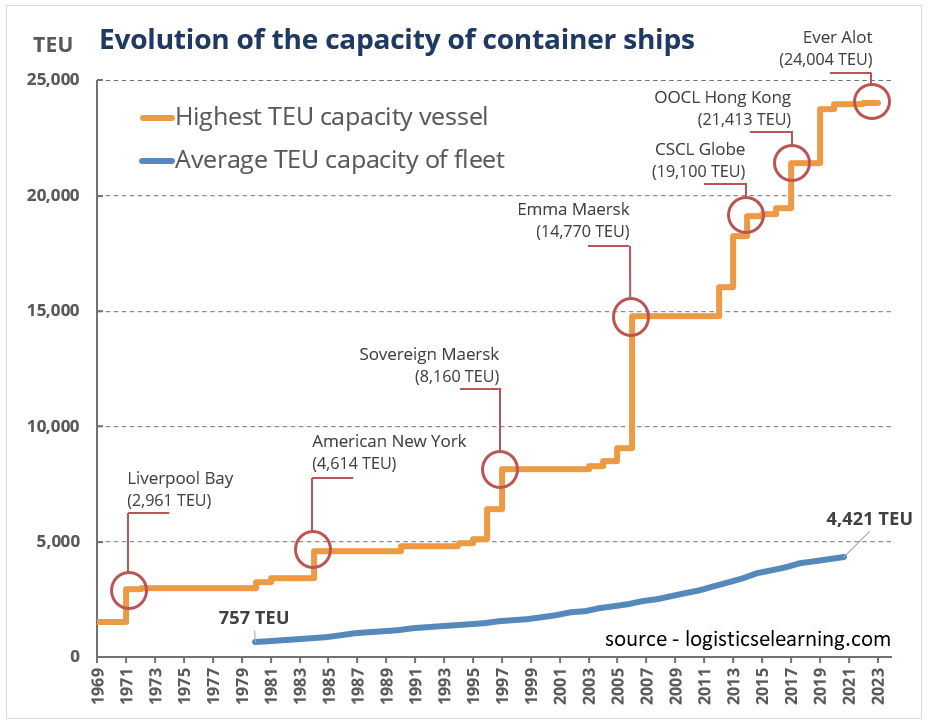
The ship in question here was 10K TEU.

Re:The Francis Scott Key Bridge in Baltimore, Maryland Has C... by ViewTrick1002 on Wednesday March 27, 2024 @07:19AM (#39837660)
The Oil Tankers of the 70s were the largest vessels ever built. Today the largest container vessels are starting to creep up to their size, but not weight.

The container vessel in question is tiny compared to e.g. the Seawise giant or Batillus Class.

https://en.wikipedia.org/wiki/Seawise_Giant

https://en.wikipedia.org/wiki/Batillus-class_supertanker

Re:The Francis Scott Key Bridge in Baltimore, Maryland Has C... by nwiswell on Wednesday March 27, 2024 @04:12PM (#39844008)
Those ships would never have been permitted in the Baltimore harbor. They presumably still aren't, since there's no reason for them to be there.
Re:The Francis Scott Key Bridge in Baltimore, Maryland Has C... by ViewTrick1002 on Thursday March 28, 2024 @10:19AM (#39851847)
It only depends on where the large-scale refineries are. If Baltimore had one they would be going there.

The smaller VLCCs are dime a dozen and they are 2-3x the weight of the Dali.

Re:The Francis Scott Key Bridge in Baltimore, Maryland Has C... by nwiswell on Thursday March 28, 2024 @08:06PM (#39859032)
The Port of Baltimore does not even have an oil handling facility, never mind the fact it could not admit a VLCC even if it had cause to.

Even ports on the US Gulf Coast do not generally have the capability to dock VLCCs.

https://www.eia.gov/todayinenergy/detail.php?id=36232

If Baltimore had been anticipating VLCC traffic in the 70s, then presumably the bridge would have been built accordingly and this incident would not have led to a collapse.

Re:The Francis Scott Key Bridge in Baltimore, Maryland Has C... by jameshart on Tuesday March 26, 2024 @05:10PM (#39832910)
According to the marine traffic track shown in the YouTube analysis above, the ship looks to have been heading through the channel, but then nosed in right under the bridge. Would have sailed right past upstream dolphins, and rammed the pylon from the inside anyway.
Re:The Francis Scott Key Bridge in Baltimore, Maryland Has C... by samstave on Tuesday March 26, 2024 @01:33PM (#39830551)
Thank FN gosh that those TEUs were likely ~mostly empty returns.

If thems be full, that guy would be illegally parked for far longer.

--

What is the traffick-routing-around plan look like? (both sea and land, helicopters cry in lack of TEU)

Re:The Francis Scott Key Bridge in Baltimore, Maryland Has C... by samstave on Tuesday March 26, 2024 @05:03PM (#39832836)
Jeasus - seriously - if that was an inbound shipment then it would be worse - this appears to have been leaving - which would infer that the TEUs were more empty than full.
Re:The Francis Scott Key Bridge in Baltimore, Maryland Has C... by senectus1 on Tuesday March 26, 2024 @07:56PM (#39834202)
do they ever run these empty?

I would expect they're as close to full as they can get in every trip. They'd be terribly inefficient ways to transport goods otherwise.

Re:The Francis Scott Key Bridge in Baltimore, Maryland Has C... by marnett on Tuesday March 26, 2024 @09:17PM (#39834734)
With what would they be filled with?
Re:The Francis Scott Key Bridge in Baltimore, Maryland Has C... by lupire on Tuesday March 26, 2024 @10:04PM (#39834991)
Ideally, something exportable from this region.

Some import products are crazy cheap because cross-planet shipping is basically free because it's the reverse end of a trip carrying valuable stuff. But they mainly applies to ships returning from low development level regions.

Re:The Francis Scott Key Bridge in Baltimore, Maryland Has C... by katbyte on Wednesday March 27, 2024 @01:00AM (#39835821)
Like what? What does na export in containers?

Most our exports are bulk not container afaik

Re:The Francis Scott Key Bridge in Baltimore, Maryland Has C... by 83 on Wednesday March 27, 2024 @09:59AM (#39839198)
While the majority is bulk, the US does export a lot of industrial machinery. It's just not stuff you normally think about - like the large hvac systems on the roof of large buildings or the caterpillar earth moving equipment/parts to make roads.
Re:The Francis Scott Key Bridge in Baltimore, Maryland Has C... by heads on Wednesday March 27, 2024 @02:38AM (#39836227)
North America has lots of land and oil. Timber (Canada), plastics, and corn fertilised by nitrates that were made using fossil fuel energy. Corn probably doesn’t ship in containers but corn-fed beef and poultry do?
Re:The Francis Scott Key Bridge in Baltimore, Maryland Has C... by samstave on Wednesday March 27, 2024 @11:49AM (#39840828)
Apparently, I was wrong - they are reporting it as a "fully loaded" -- but that does not mean the TEUs were full of goods and services... but thats what they are calling it. So I have no Idea.

Unless ImportYtei.com can get the bills of lading for that ship....

Re:The Francis Scott Key Bridge in Baltimore, Maryland Has C... by JumpCrisscross on Tuesday March 26, 2024 @01:25PM (#39830453)
> there’s no effective defense for a bridge that needs support in more than 30 or so feet of water

You deflect it. Failing at that, you direct the force into destroying the ship.

Of course, the best solution is no in-water pylons. But that isn’t always feasible.

Re:The Francis Scott Key Bridge in Baltimore, Maryland Has C... by Repulsion9513 on Tuesday March 26, 2024 @02:52PM (#39831437)
> direct the force into destroying the ship

Nice immovable object you've got there.

Re:The Francis Scott Key Bridge in Baltimore, Maryland Has C... by JumpCrisscross on Wednesday March 27, 2024 @04:57AM (#39836863)
You put it ahead of the pylon so that even when the dolphin or bollard is destroyed, it redirects the ship to—at worst—a glancing blow with the pylon.

You don’t need to dissipate every joule of kinetic energy in the vessel. You just need to redirect it away from the pylon. That horizontal component can be done with bollards and dolphins sufficiently that even a relatively direct original angle should only damage the fenders. From what I see, there were zero such protections around this bridge.

Nothing can protect against a direct hit. But most hits aren’t direct, and those can be redirected without catastrophic pylon failure.

Re:The Francis Scott Key Bridge in Baltimore, Maryland Has C... by Repulsion9513 on Friday March 29, 2024 @07:31PM (#39870212)
> direct the force into destroying the ship

> You put it ahead of the pylon so that even when the dolphin or bollard is destroyed

Dude, seriously? That has nothing to do with what I was replying to.

Re:The Francis Scott Key Bridge in Baltimore, Maryland Has C... by throw0101b on Tuesday March 26, 2024 @01:41PM (#39830610)
> I don't know what I was expecting, the bridge just looked extremely fragile, makes me wonder what other bridges are at risk of an event like this.

The bridge style in question

> Conversely, continuous truss bridges rely on rigid truss connections throughout the structure for stability. Severing a continuous truss mid-span endangers the structure. However, continuous truss bridges do not experience the tipping forces that a cantilever bridge must resist because the main span of a continuous truss bridge is supported at both ends.

* https://en.wikipedia.org/wiki/Continuous_truss_bridge

* https://en.wikipedia.org/wiki/Francis_Scott_Key_Bridge_(Balt...

So taking out one end basically takes out the whole thing.

I would not be surprised that when they build the replacement, it will be a design where the individual components are more self-resilient, like:

* https://en.wikipedia.org/wiki/Cable-stayed_bridge

The engineering best practices, budgets, and needs may have been different fifty years ago. Cargo ships were also a lot smaller fifty years ago.

Re:The Francis Scott Key Bridge in Baltimore, Maryland Has C... by bobthepanda on Tuesday March 26, 2024 @01:56PM (#39830780)
cable stays are also generally more popular these days because of the differences in material. All other things being equal, concrete is generally a lot cheaper than a steel truss bridge these days
Re:The Francis Scott Key Bridge in Baltimore, Maryland Has C... by londons_explore on Tuesday March 26, 2024 @04:30PM (#39832484)
If they play the cards very carefully, they can pull out and recycle all the steel of the old bridge, and use that to pay for a new (cheaper) concrete bridge.
Re:The Francis Scott Key Bridge in Baltimore, Maryland Has C... by moritonal on Tuesday March 26, 2024 @02:19PM (#39831071)
When you play about with game engines long enough, you start to realise that momentum is the key metric to track rather than speed. Especially in water magnitude can be very deceiving but to give some quick math, this vessel had a momentum at impact of about 154,000,000kg⋅m/s. For a car to have equivalent momentum it'd have hit the bridge at 156,580 mph. Humans are just less adept at appreciating mass vs velocity.
Re:The Francis Scott Key Bridge in Baltimore, Maryland Has C... by amluto on Tuesday March 26, 2024 @03:55PM (#39832131)
Energy matters, too. That hypothetical car has the order of 1 kiloton of TNT of kinetic energy. The resulting blast would have been large.

(This is about the estimated yield of the Beirut explosion.)

I would rather get hit by a slow moving object than a fast one with equal momentum.

Re:The Francis Scott Key Bridge in Baltimore, Maryland Has C... by ithkuil on Tuesday March 26, 2024 @06:42PM (#39833671)
If you're moored on the ground you'd be torn apart in both cases
Re:The Francis Scott Key Bridge in Baltimore, Maryland Has C... by amluto on Wednesday March 27, 2024 @09:56AM (#39839153)
On the other hand, if I were hit by a loaded shopping cart at 3 mph and I weren’t allowed to move my feet, I’d probably be okay if I saw it coming.

Keep the same momentum but scale the mass down to, say, 200g. Now it’s supersonic, and it will hit with maybe 10x the energy of a musket ball. This would be extremely damaging and likely lethal.

(If you make the mass too small, it might go straight through a person, in which case not all of the energy is delivered.)

Re:The Francis Scott Key Bridge in Baltimore, Maryland Has C... by ithkuil on Wednesday March 27, 2024 @06:39PM (#39845464)
But the point was that if you were hit with a full container ship at 0.1 mph and not allowed to move you'd be dead.

The only reason why a high energy but slow moving object (thus high momentum) is harmless is that it will deliver a small acceleration to you and you won't suffer from the consequences of a high acceleration (which is what generally kills people when they hit something like the ground at high speeds). But that assumes that you're free to be accelerated and move away.

Re:The Francis Scott Key Bridge in Baltimore, Maryland Has C... by amluto on Thursday March 28, 2024 @12:30AM (#39847813)
I think this is a bit too simple. People can get injured and objects destroyed in multiple ways. For example:

One could be torn apart. If you are glued to the ground and you are pushed away with too much force to resist, you have a problem. You can stretch or move a certain distance and withstand a certain force while doing so, and the product of those numbers is the energy you can remove from the thing hitting you. If the impactor is at a fixed speed, then you can turn that momentum into an energy, but that’s a bit silly. You really can stand still and deliver more stopping impulse to an object moving toward you when it’s moving slower because you can resist for a longer time.

One could collide with an effectively infinitely massive object. But the momentum of that object seems irrelevant — hitting a brick wall on wheels at 25 mph seems much worse than hitting the Earth at 0.1mph despite the Earth having many orders of magnitude more momentum. The impact velocity seems more relevant.

One could get hit by a fast-moving projectile. This is complicated, and neither momentum nor energy seem like sufficient measures. As an extreme example, ultra-high-energy cosmic rays surely hit people on a somewhat regular basis, and I’ve never heard of anyone noticing such an event, despite the energy involved being quite macroscopic.

Re:The Francis Scott Key Bridge in Baltimore, Maryland Has C... by sho on Wednesday March 27, 2024 @12:39AM (#39835753)
Hm. I'm no physicist but I think your math is off. Remember it's velocity squared. Your car going that fast is has more than a kiloton of TNT or approaching 5 terajoules of energy... that can't be right.

For a 2 tonne car, my very rough math puts it at more like 2100 mph.

Re:The Francis Scott Key Bridge in Baltimore, Maryland Has C... by snarkconjecture on Wednesday March 27, 2024 @01:51AM (#39836043)
Momentum is just mv, not mv².
Re:The Francis Scott Key Bridge in Baltimore, Maryland Has C... by sho on Wednesday March 27, 2024 @02:55AM (#39836305)
I can't edit my post now, but to be clear I was talking about kinetic energy. I would have thought momentum is not a very useful thing to talk about in a case like this where there was some pretty obvious transformation of energy into damage, etc.

As I said though, I'm far from a physicist so happy to be schooled if I'm way off...

Re:The Francis Scott Key Bridge in Baltimore, Maryland Has C... by jaxson60 on Thursday March 28, 2024 @07:47AM (#39850006)
Spot on.
Re:The Francis Scott Key Bridge in Baltimore, Maryland Has C... by danpalmer on Tuesday March 26, 2024 @12:41PM (#39829920)
It's somewhat counterintuitive how much energy can be in something moving so slowly. I say somewhat, because when you're up close it's much more obvious, but you're right that on a video it doesn't look like much.
Re:The Francis Scott Key Bridge in Baltimore, Maryland Has C... by deltarholamda on Tuesday March 26, 2024 @01:51PM (#39830722)
This disconnect happens with boats quite a lot. For example, I can, by myself, pull a 45 foot grand banks trawler in shallow water. I know because I've done so.

But at even very low speeds, I cannot stop it from hitting a pier. I have not tried to do this, but every harbor master has a bunch of stories about people trying to do so and getting a leg or an arm or something squished and pulverized.

People who are not boat people rarely recognize these sorts of dangers, which is why so many get hurt on boats. "I can push us off the dock, so I can definitely keep us from hitting it." Nope, Sir Isaac Newton says you're wrong.

Re:The Francis Scott Key Bridge in Baltimore, Maryland Has C... by tetha on Tuesday March 26, 2024 @05:01PM (#39832811)
This hit me a a bit ago - you can't really tell how big ships are if you just see pictures of them on sea. I recently hit this in real life. Yeah it's a ship. Oh. It's like 3 - 4 times as tall as I am above water. And it goes 2-3 stories down. And holy hell, a crows nest 30 meters up is... really high up?

And we got the good tour, because we had a severe storm warning as we visited that ship - the kinda storm in which gusts stop you in your tracks and forces you to lean into it to not fall over. Was a great experience. I wouldn't want to be up there with that kinda wind.

And this was a medium sized clipper, somewhat on the small size.

And based off of that, I kind of want to see a retired battleship or an aircraft carrier. Because now I have an idea of how dumbfounded I'll be at those kinda dimensions. It just doesn't appear that big on photos!

Re:The Francis Scott Key Bridge in Baltimore, Maryland Has C... by Symbiote on Tuesday March 26, 2024 @07:40PM (#39834108)
The best place I've seen huge ships is Hamburg. People sit and picnic on beaches along the river in the summer, and enormous container and car carrier ships go past.
Re:The Francis Scott Key Bridge in Baltimore, Maryland Has C... by tetha on Wednesday March 27, 2024 @01:08PM (#39841771)
Yeah, this was the Rickmer Rickmers[1] in fact.

We had a team we work with a lot over here in HH and went on the treasure hunt on the Rickmer Rickmers as an event. That was very nice - they spread a bunch of little puzzle boxes across the ship so you can search for these, walk through the museum and look at stuff. And the puzzles were neat as well - you'd use the compass the actual helmsman used back in the day to figure out where east is to find some clue, count pests in cargo and such. Very recommendable and a lot of fun.

We just didn't climb up the ropes in winds that almost pushed you over on foot, haha.

1: https://www.rickmer-rickmers.de/

Re:The Francis Scott Key Bridge in Baltimore, Maryland Has C... by paddy_m on Tuesday March 26, 2024 @02:08PM (#39830932)
To anyone reading this who isn't an experienced boater:

If you are invited onto someone else's boat, sit down and shut up during docking, don't talk to friends, let the captain concentrate. Don't help, if the captain wants you to do something, they will let you know. If you think you know better than the captain, and this advice is unknown to you, you don't know better. Being a good guest during docking shows experience and helps get an invite back.

Re:The Francis Scott Key Bridge in Baltimore, Maryland Has C... by Projectiboga on Tuesday March 26, 2024 @04:08PM (#39832259)
Similar to stay quiet if the car is about to merge into traffic. But with a boat the stakes are 100,000 times greater due to the huge momentum and that it would be gliding and not slowing down like a wheeled vehicle on land.
Re:The Francis Scott Key Bridge in Baltimore, Maryland Has C... by imoverclocked on Tuesday March 26, 2024 @03:17PM (#39831724)
This advice also translates for general aviation during takeoff, landing and taxiing.
Re:The Francis Scott Key Bridge in Baltimore, Maryland Has C... by CIPHERSTONE on Tuesday March 26, 2024 @03:22PM (#39831783)
This is great advice. For myself, docking in windy situations can be nerve racking. The old adage is to only dock as fast as your willing to hit the pier, and for me this means slow as hell.

I always let guests know exactly what I want them to do, and to your point, it's mainly to sit tight and let me focus.

Re:The Francis Scott Key Bridge in Baltimore, Maryland Has C... by EB-Barrington on Tuesday March 26, 2024 @04:23PM (#39832417)
Wind, current, tides, your own boat at risk as well as other people's boats alongside... docking can certainly get the heart pumping.

(Liveaboard cruiser here)

Re:The Francis Scott Key Bridge in Baltimore, Maryland Has C... by deltarholamda on Tuesday March 26, 2024 @03:41PM (#39831988)
Screwing around during docking is a great way to get to swim to shore at an unspecified later date.
Re:The Francis Scott Key Bridge in Baltimore, Maryland Has C... by jml78 on Tuesday March 26, 2024 @06:35PM (#39833615)
Take things slow so you aren’t the show.

I have a 44ft sailboat. Docking is not easy. People do not realize how difficult it can be

Re:The Francis Scott Key Bridge in Baltimore, Maryland Has C... by organsnyder on Tuesday March 26, 2024 @06:51PM (#39833728)
Given how hard I find docking my 16-foot bowrider if there’s more than a light breeze, I can only imagine.
Re:The Francis Scott Key Bridge in Baltimore, Maryland Has C... by hanche on Wednesday March 27, 2024 @03:02AM (#39836320)
Try docking a sailboat on a river. Then slow isn’t an option, since the current will sweep you away in a heartbeat. The key here is planning ahead, including a plan for what to do when you don’t get it right. And you won’t, on the first couple of attempts. I’ve seen it in action, totally hair raising to watch.
Re:The Francis Scott Key Bridge in Baltimore, Maryland Has C... by deltarholamda on Wednesday March 27, 2024 @08:50AM (#39838375)
This is one of those situations where I know I will not be good enough often enough, I will totally warp in. River currents are hard.
Re:The Francis Scott Key Bridge in Baltimore, Maryland Has C... by gottorf on Tuesday March 26, 2024 @05:55PM (#39833312)
Landlubbers are accustomed to momentum (p = mv) behaving in a certain way instinctively from years of experience, where the heavier something is, the more frictional force against it from the ground, and therefore the mass behaves a certain way. This breaks down once the expected friction changes a lot, e.g. trying to stop a moving car or, like you said, a boat in water. I'd imagine it's the same thing in space, where a slowly-moving but massive object would surprise someone at their inability to stop it.
Re:The Francis Scott Key Bridge in Baltimore, Maryland Has C... by hangonhn on Tuesday March 26, 2024 @12:49PM (#39830026)
The same go for cars. I was hit by a car which was already slowing down but over ran the line and hit me. The car couldn't have been going more than 10 mph but it was enough force to fracture my knee (the fracture type is also colloquially known as a bumper fracture).
Re:The Francis Scott Key Bridge in Baltimore, Maryland Has C... by throw0101b on Tuesday March 26, 2024 @01:42PM (#39830621)
> It's somewhat counterintuitive how much energy can be in something moving so slowly.

Reminder: Kinetic Energy = ½mv^2

Squaring numbers can make them big in a hurry.

Re:The Francis Scott Key Bridge in Baltimore, Maryland Has C... by dweymouth on Tuesday March 26, 2024 @01:56PM (#39830776)
But in this case with slow speed, it's the massive (literally) amount of mass of the cargo ship that gives it an un-intuitively large amount of energy.
Re:The Francis Scott Key Bridge in Baltimore, Maryland Has C... by trilbyglens on Tuesday March 26, 2024 @02:10PM (#39830949)
8kn isn't super slow
Re:The Francis Scott Key Bridge in Baltimore, Maryland Has C... by rtkwe on Tuesday March 26, 2024 @02:20PM (#39831094)
It's 10 mph which is pretty slow as speeds go.
Re:The Francis Scott Key Bridge in Baltimore, Maryland Has C... by euroderf on Tuesday March 26, 2024 @03:00PM (#39831537)
Slow-but-irresistible force meets movable object.
Re:The Francis Scott Key Bridge in Baltimore, Maryland Has C... by samplatt on Wednesday March 27, 2024 @12:15AM (#39835660)
All objects are surprisingly movable when they encounter enough mass.
Re:The Francis Scott Key Bridge in Baltimore, Maryland Has C... by jaxson60 on Thursday March 28, 2024 @07:46AM (#39849992)
To your point, it is mass. Most people don't understand mass on water. At 1 knot the ship would do the exact same damage, topple the support and drop the bridge.
Re:The Francis Scott Key Bridge in Baltimore, Maryland Has C... by euroderf on Thursday March 28, 2024 @03:35PM (#39856365)
Motor control and rudder control in a momentumous frame of reference.
Re:The Francis Scott Key Bridge in Baltimore, Maryland Has C... by lupire on Tuesday March 26, 2024 @10:01PM (#39834969)
sqrt of 100K times weight of a car is 300 cars worth.
Re:The Francis Scott Key Bridge in Baltimore, Maryland Has C... by eternauta3k on Wednesday March 27, 2024 @03:31AM (#39836448)
Nitpick: squaring makes numbers greater than 1 bigger, and numbers smaller than 1 smaller. In this case we're squaring something with units, and we can't say the input is greater or smaller than the output, because they have different units. What we can say, is that v^2 curves upward: it grows faster with increasing v, and slower with decreasing v.
Re:The Francis Scott Key Bridge in Baltimore, Maryland Has C... by major505 on Tuesday March 26, 2024 @03:24PM (#39831793)
Force = mass * acceleration, it might be slow but how much does a container shop weighs? 100, 200 thousand tons?
Re:The Francis Scott Key Bridge in Baltimore, Maryland Has C... by kazinator on Tuesday March 26, 2024 @02:32PM (#39831211)
Probably most of them. A structure like that not designed to bear vertical loads, not lateral ones, other than high winds.

The knee is like this too. It lets you stand, run and jump just fine, but you can knock down an opponent with a relatively mild lateral impact to the knee.

Much more of the bridge collapsed than you might think, though, far from the impact.

Re:The Francis Scott Key Bridge in Baltimore, Maryland Has C... by mlrtime on Tuesday March 26, 2024 @04:33PM (#39832508)
F = MA

A looks like 'barely a bump' M is what got the bridge.

Re:The Francis Scott Key Bridge in Baltimore, Maryland Has C... by major505 on Tuesday March 26, 2024 @03:09PM (#39831631)
Bridges are design to withstand a very predictable type and direction of force. It can withstand the lateral wind, but imagine how much force a fully loaded cargo ship can put into it. Once one segment gone the rest is history, because makes the who construction imbalanced.
Re:The Francis Scott Key Bridge in Baltimore, Maryland Has C... by samstave on Tuesday March 26, 2024 @01:26PM (#39830467)
The span has two pylons. If I drive my car into your left leg, even at idle speed, and your foot is firmly planted on the ground, your massive shoulders are going to buckle.

There is a fascinating article about Pilots in the SF Bay talking about how containerships are affected by mountain shadows (meaning that hte actual shadow of a Mountain affect the temp of a large swath of water, thus affecting the currents in the region of the large shadow and that container ships in the SF Bay have to make course corrections ~8 minutes in advance, hence the need for a Pilot. (Sextant/Antikythera mechanism much)

-- This ship had an internal engine failure which resulted in their inability to adjust... hoever *EIGHT** naughts seems like the engine blew and the throttle stuck - hence the full reverse and resultant explosion(smoke) and it was also said that there are (some sort) of current effects ocurring in this waterway contributing to the drift...

this will be a maritime study forever.

https://www.sfgate.com/bayarea/article/MASTERS-OF-THE-MONSTE...

https://youtu.be/Aia5X1qoeME?t=1534 <-- Bar Pilot docu

--

I cant wait until the EU (such as the dutch) chime in...

But this really comes down to causeway design with MASSSIVE SPANS..

(oops on cpas)

What is the criticality notion for a particular causeway.

(look at the straights of malaka for piracy, SUEZ, Panama etc...

So where are the fuckn actuaries who are married to engineering and quants.

So build an AI that understands civil engineering endevours (panama canal, Suez, etc) - as well as the economic impact, and make a SIM CIVIL AI engineering model that understands the economic impacts if your thing fails.

I could type for hours on this - but I am sure you guys can daydream about such infra consequense and maybe talk about....

I would love to hear input from civil eng folks on this.

----

===

----

>(Sextant/Antikythera mechanism much)

------

===

<how many ideas this inspired!

I just want to qualify - you did not inspire these ideas.

These are desires sought which have been there for eons...

You are not inspiring them

You have atool that ENABLES them.

Seek that which already is a flustered pop of ideas waiting for a release valve for such thought.

You are not inspiring - you are enabling that which is already there, think of it as which valve to open - the pressure is mounting upon your dyke.

These were measures of TIME.

Time is important in mariTIME due to the influences on current events... CURRENTS...

(our history is lost to the Seas of the Cosmos)

Yeah - how do these waters flow? Took thousands of years to discover the magnetic nature of inertia... only measurable on galactic scales.

Hence - when those excluded from scientific study resulted in 'astrology' to explain quantum faint implications through galactic 'tidal' movements

(Source:

Mayans

Masons

Essenes

Rosi

Undertanding CURRENTS is intrinsic in the philos of the mind...

I wont go too deep on this - but whats really awesome is that when you watch Ship s

Re:The Francis Scott Key Bridge in Baltimore, Maryland Has C... by manzanarama on Tuesday March 26, 2024 @04:28PM (#39832470)
I have no idea what any of this means.
Re:The Francis Scott Key Bridge in Baltimore, Maryland Has C... by what on Tuesday March 26, 2024 @05:47PM (#39833234)
Pretty sure this person uses an LLM to generate their comments.
Re:The Francis Scott Key Bridge in Baltimore, Maryland Has C... by samstave on Tuesday March 26, 2024 @04:44PM (#39832626)
IT was a glitch in posting...

I was responding to multipile threads and somehow my comments merged...

Re:The Francis Scott Key Bridge in Baltimore, Maryland Has C... by whats_a_quasar on Tuesday March 26, 2024 @05:53PM (#39833290)
No part of that comment made sense. I don't think the problem was that multiple comments merged.
Re:The Francis Scott Key Bridge in Baltimore, Maryland Has C... by cdelsolar on Wednesday March 27, 2024 @08:28AM (#39838143)
lol don’t be mean
Re:The Francis Scott Key Bridge in Baltimore, Maryland Has C... by samstave on Wednesday March 27, 2024 @12:11PM (#39841094)
I didnt blame the glitch on HN....
Re:The Francis Scott Key Bridge in Baltimore, Maryland Has C... by Etherlord87 on Tuesday March 26, 2024 @06:55PM (#39833753)
I remember when I was a kid, I left a bus, and the bus started moving, and I, not being intimidated by the bus moving very slowly (somewhere between 5 and 10 km/h), didn't move a safe distance away from the bus. I think the bus, due to the nature of its maneuverability, had its tail moving not in parallel to me but slightly towards me - so when it has "touched" (hit?) me, even though I thought it was just sliding in parallel, the force was so strong I made a full 360° turn - and I was a tall and chubby boy.

I ended up with no injury, not even a bruise as far as I can remember (who would count bruises as a kid), but definitely with an intuition to respect mass.

Re:The Francis Scott Key Bridge in Baltimore, Maryland Has C... by naasking on Tuesday March 26, 2024 @07:22PM (#39833993)
> I don't know what I was expecting, the bridge just looked extremely fragile

The strongest man in the world probably seems pretty solid. Put him at the bottom of a 3 degree grade and release the brakes on a full tractor trailer and he'll seem fragile too.