News for hackers. Stuff that matters.
Re:The Francis Scott Key Bridge in Baltimore, Maryland Has C... by hgfghj on Tuesday March 26, 2024 @01:07PM (#39830256)
That ship had a 10,000 TEU capacity and was actually hauling a little under 5,000 TEUs. An empty container weighs a little over 5,000lbs, and a full one can be up to 67,000lbs.

If you do the math, you find that it’s just an astronomical amount of momentum, and there’s no effective defense for a bridge that needs support in more than 30 or so feet of water.

Re:The Francis Scott Key Bridge in Baltimore, Maryland Has C... by semi-extrinsic on Tuesday March 26, 2024 @01:20PM (#39830410)
Throwback to the scene in The Day After Tomorrow where the cargo ship comes to an almost instant halt after impacting a bus wreck under water. For some reason it managed to stand out as ridiculous even in that movie.
Re:The Francis Scott Key Bridge in Baltimore, Maryland Has C... by Gare on Tuesday March 26, 2024 @03:27PM (#39831837)
Speed 2: Cruise Control on the other hand: https://www.youtube.com/watch?v=gBxaGB65TB8
Re:The Francis Scott Key Bridge in Baltimore, Maryland Has C... by MBCook on Wednesday March 27, 2024 @12:23AM (#39835698)
I just saw in a YouTube video yesterday that they actually built a full-size model of the ship (or at least the bow area) and the bit of town it hit. The director didn’t want to use CGI or miniatures.

He spent a full quarter of the movie’s budget on that one scene.

Re:The Francis Scott Key Bridge in Baltimore, Maryland Has C... by ralfd on Wednesday March 27, 2024 @08:48AM (#39838352)
Corridor Crew SFX specialists watching/explaining the stunt:

https://youtu.be/_lDM1nAmPHI?t=797

The bow is real, the back of the ship is CGI.

Re:The Francis Scott Key Bridge in Baltimore, Maryland Has C... by peteradio on Tuesday March 26, 2024 @01:30PM (#39830512)
Somebody should do a side-by-side of that scene with this threads scene in gif.
Re:The Francis Scott Key Bridge in Baltimore, Maryland Has C... by kazinator on Tuesday March 26, 2024 @02:35PM (#39831254)
I think the only reasonable goal would be to design the bridge to minimize damage to it, so that one damaged section doesn't bring down others.

Building a bridge to actually stop the ship is not only infeasible, but it would likely kill (more) people onboard.

Re:The Francis Scott Key Bridge in Baltimore, Maryland Has C... by bobthepanda on Tuesday March 26, 2024 @03:12PM (#39831681)
the modern practice is layers of defense; in addition to building a bridge that doesn't fail at a single point of failure, you also generally design what's around a bridge pier to stop or at least slow down the ship (by, say, running aground onto a bed of rocks around a pier)
Re:The Francis Scott Key Bridge in Baltimore, Maryland Has C... by PeterCorless on Tuesday March 26, 2024 @04:30PM (#39832487)
For a bridge such defenses are called dolphins.

"A notable example of dolphins used to protect a bridge is the Sunshine Skyway Bridge across the mouth of Tampa Bay. In 1980, the MV Summit Venture hit a pier on one of the bridge's two, two-lane spans causing a 1,200-foot (370 m) section of the bridge to fall into the water, resulting in 35 deaths. When a replacement span was designed, a top priority was to prevent ships from colliding with the new bridge..."

Source: https://en.wikipedia.org/wiki/Dolphin_(structure)

The MV Summit Venture was a 33,900 deadweight tonnage ship. MV Dali was a gross tonnage of 95,128. Nearly 3× as large. It's questionable whether dolphins would have totally prevented such a tragedy.

Yet similarly, expect dolphins to be brought up as a key component of resiliency for any designed replacement bridge.

Re:The Francis Scott Key Bridge in Baltimore, Maryland Has C... by bobthepanda on Tuesday March 26, 2024 @04:53PM (#39832718)
That's also a thing.

But note how the main bridge piers are on giant islands much larger than the pier itself: https://en.wikipedia.org/wiki/Dolphin_(structure)#/media/Fil...

If you really want to make it unblockable you build a bridge+tunnel. https://en.wikipedia.org/wiki/Bridge%E2%80%93tunnel

Re:The Francis Scott Key Bridge in Baltimore, Maryland Has C... by js2 on Tuesday March 26, 2024 @05:40PM (#39833186)
The CBBT is downstream of the bridge which collapsed. I've driven it many times.

https://en.wikipedia.org/wiki/Chesapeake_Bay_Bridge–Tunnel

Re:The Francis Scott Key Bridge in Baltimore, Maryland Has C... by KWxIUElW8Xt0tD9 on Tuesday March 26, 2024 @09:00PM (#39834627)
It has tunnels because the Navy did not want the bay blocked if the bridge dropped into the water. Which is exactly what has happened in Baltimore.
Re:The Francis Scott Key Bridge in Baltimore, Maryland Has C... by HarryHirsch on Tuesday March 26, 2024 @01:41PM (#39830608)
there’s no effective defense for a bridge that needs support in more than 30 or so feet of water

You put in sheet piling 50 meters upstream, and you fill the box with rocks. That's state of the art practice, nowadays, but that bridge was 50 years old.

Re:The Francis Scott Key Bridge in Baltimore, Maryland Has C... by nwiswell on Tuesday March 26, 2024 @04:58PM (#39832778)
The sheet piling didn't need to be 50 years old.

In 1977 (and in 1972, when construction began), vessels of this size did not exist, and certainly were not allowed in the harbor[1]. But over time, they were given authorization, despite the fact that they could collapse the unprotected bridge like a load of toothpicks.

The real crime here is that there was no retrofit to protect the pylons. It was almost certainly considered and rejected due to cost.

[1]: https://logisticselearning.com/wp-content/uploads/2022/06/Co...
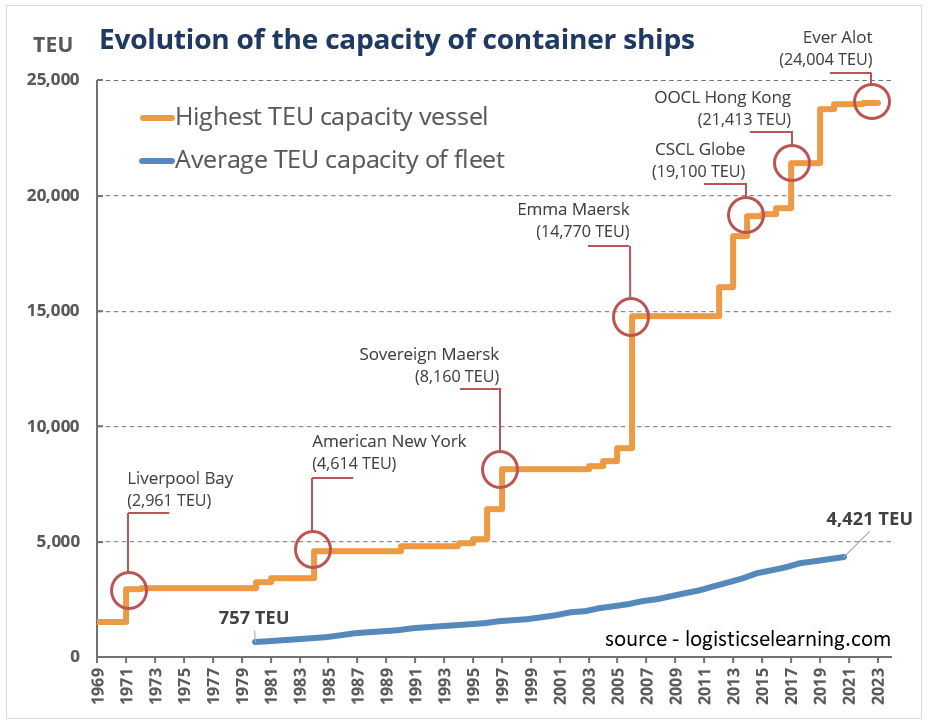
The ship in question here was 10K TEU.

Re:The Francis Scott Key Bridge in Baltimore, Maryland Has C... by ViewTrick1002 on Wednesday March 27, 2024 @07:19AM (#39837660)
The Oil Tankers of the 70s were the largest vessels ever built. Today the largest container vessels are starting to creep up to their size, but not weight.

The container vessel in question is tiny compared to e.g. the Seawise giant or Batillus Class.

https://en.wikipedia.org/wiki/Seawise_Giant

https://en.wikipedia.org/wiki/Batillus-class_supertanker

Re:The Francis Scott Key Bridge in Baltimore, Maryland Has C... by nwiswell on Wednesday March 27, 2024 @04:12PM (#39844008)
Those ships would never have been permitted in the Baltimore harbor. They presumably still aren't, since there's no reason for them to be there.
Re:The Francis Scott Key Bridge in Baltimore, Maryland Has C... by ViewTrick1002 on Thursday March 28, 2024 @10:19AM (#39851847)
It only depends on where the large-scale refineries are. If Baltimore had one they would be going there.

The smaller VLCCs are dime a dozen and they are 2-3x the weight of the Dali.

Re:The Francis Scott Key Bridge in Baltimore, Maryland Has C... by nwiswell on Thursday March 28, 2024 @08:06PM (#39859032)
The Port of Baltimore does not even have an oil handling facility, never mind the fact it could not admit a VLCC even if it had cause to.

Even ports on the US Gulf Coast do not generally have the capability to dock VLCCs.

https://www.eia.gov/todayinenergy/detail.php?id=36232

If Baltimore had been anticipating VLCC traffic in the 70s, then presumably the bridge would have been built accordingly and this incident would not have led to a collapse.

Re:The Francis Scott Key Bridge in Baltimore, Maryland Has C... by jameshart on Tuesday March 26, 2024 @05:10PM (#39832910)
According to the marine traffic track shown in the YouTube analysis above, the ship looks to have been heading through the channel, but then nosed in right under the bridge. Would have sailed right past upstream dolphins, and rammed the pylon from the inside anyway.
Re:The Francis Scott Key Bridge in Baltimore, Maryland Has C... by samstave on Tuesday March 26, 2024 @01:33PM (#39830551)
Thank FN gosh that those TEUs were likely ~mostly empty returns.

If thems be full, that guy would be illegally parked for far longer.

--

What is the traffick-routing-around plan look like? (both sea and land, helicopters cry in lack of TEU)

Re:The Francis Scott Key Bridge in Baltimore, Maryland Has C... by samstave on Tuesday March 26, 2024 @05:03PM (#39832836)
Jeasus - seriously - if that was an inbound shipment then it would be worse - this appears to have been leaving - which would infer that the TEUs were more empty than full.
Re:The Francis Scott Key Bridge in Baltimore, Maryland Has C... by senectus1 on Tuesday March 26, 2024 @07:56PM (#39834202)
do they ever run these empty?

I would expect they're as close to full as they can get in every trip. They'd be terribly inefficient ways to transport goods otherwise.

Re:The Francis Scott Key Bridge in Baltimore, Maryland Has C... by marnett on Tuesday March 26, 2024 @09:17PM (#39834734)
With what would they be filled with?
Re:The Francis Scott Key Bridge in Baltimore, Maryland Has C... by lupire on Tuesday March 26, 2024 @10:04PM (#39834991)
Ideally, something exportable from this region.

Some import products are crazy cheap because cross-planet shipping is basically free because it's the reverse end of a trip carrying valuable stuff. But they mainly applies to ships returning from low development level regions.

Re:The Francis Scott Key Bridge in Baltimore, Maryland Has C... by katbyte on Wednesday March 27, 2024 @01:00AM (#39835821)
Like what? What does na export in containers?

Most our exports are bulk not container afaik

Re:The Francis Scott Key Bridge in Baltimore, Maryland Has C... by 83 on Wednesday March 27, 2024 @09:59AM (#39839198)
While the majority is bulk, the US does export a lot of industrial machinery. It's just not stuff you normally think about - like the large hvac systems on the roof of large buildings or the caterpillar earth moving equipment/parts to make roads.
Re:The Francis Scott Key Bridge in Baltimore, Maryland Has C... by heads on Wednesday March 27, 2024 @02:38AM (#39836227)
North America has lots of land and oil. Timber (Canada), plastics, and corn fertilised by nitrates that were made using fossil fuel energy. Corn probably doesn’t ship in containers but corn-fed beef and poultry do?
Re:The Francis Scott Key Bridge in Baltimore, Maryland Has C... by samstave on Wednesday March 27, 2024 @11:49AM (#39840828)
Apparently, I was wrong - they are reporting it as a "fully loaded" -- but that does not mean the TEUs were full of goods and services... but thats what they are calling it. So I have no Idea.

Unless ImportYtei.com can get the bills of lading for that ship....

Re:The Francis Scott Key Bridge in Baltimore, Maryland Has C... by JumpCrisscross on Tuesday March 26, 2024 @01:25PM (#39830453)
> there’s no effective defense for a bridge that needs support in more than 30 or so feet of water

You deflect it. Failing at that, you direct the force into destroying the ship.

Of course, the best solution is no in-water pylons. But that isn’t always feasible.

Re:The Francis Scott Key Bridge in Baltimore, Maryland Has C... by Repulsion9513 on Tuesday March 26, 2024 @02:52PM (#39831437)
> direct the force into destroying the ship

Nice immovable object you've got there.

Re:The Francis Scott Key Bridge in Baltimore, Maryland Has C... by JumpCrisscross on Wednesday March 27, 2024 @04:57AM (#39836863)
You put it ahead of the pylon so that even when the dolphin or bollard is destroyed, it redirects the ship to—at worst—a glancing blow with the pylon.

You don’t need to dissipate every joule of kinetic energy in the vessel. You just need to redirect it away from the pylon. That horizontal component can be done with bollards and dolphins sufficiently that even a relatively direct original angle should only damage the fenders. From what I see, there were zero such protections around this bridge.

Nothing can protect against a direct hit. But most hits aren’t direct, and those can be redirected without catastrophic pylon failure.

Re:The Francis Scott Key Bridge in Baltimore, Maryland Has C... by Repulsion9513 on Friday March 29, 2024 @07:31PM (#39870212)
> direct the force into destroying the ship

> You put it ahead of the pylon so that even when the dolphin or bollard is destroyed

Dude, seriously? That has nothing to do with what I was replying to.