Fact is the inflation we are seeing here is caused by the after effects of Covid, the Energy price surges caused by the Ukraine war and in the special case of UK - Brexit, which has lead to huge import shortages due to increased bureaucracy at the border, etc…
So please stop this conspiracy talk about the “rich” creating inflation to disown the “poor”.
The thugs get to keep the loans, but the debt gets transferred to the local community, which cements the "somebody who isn't you gets to create abstractions that you have to treat as money"-part of the deal.
The words that used to go with it are "progressive free-market policies", but I think Kamala Harris recently called it "anti-corruption" or something along those lines.
the rich by this point aren't any group of people, but a section of the system.
the system is structural, not-alive. he is choosing to regard the system like rungs on a ladder. each rung is a social class.
the point I'm making is that he's describing the "ladder", referring to structural/systemic aspects of our civilization, not the "persons" standing on each rung which is the meaning you chose to focus on.
our society really is arranged in tiers or classes regardless of you accept it or not (but again, this is a way to understand it; there may be others)
in the UK the so-called "rich" (to answer your question) would be people with legal noble titles.
in Smerica this class of people is not explicit. I guess the older European system (which inspired American ones) at least is explicit about the fact that the royals and their nobles are "the rich" class. I countries with continuing monarchies, like the UK, they really have a noble title and registration. they're "better than you" by legal definition because of choices their parents and older ancestors made (or were forced to make)
The Ukraine War is the direct result of Joe Biden becoming president. Since both sides like to play for the military industrial complex in the US, and the MIC needs a war to provide for, this conflict isn't going away any time soon.
Even if e.g. DeSantis wins, he's not an anti-war conservative like Rand Paul or Trump, so the effort to prolong the Ukraine war may continue to persist well into his term.
Obviously Biden shows how much he cares about stopping the war.
The last time Putin pushed the Ukraine issue was under Obama. Under Trump’s watch, Putin didn't dare touch Ukraine.
If I was Putin, and I wanted to invade a country, I would sure as hell prefer Biden as the opponent than Trump. Trump might actually finish the war before it starts. Biden is still trying to remember he's president.
instead of the dude who actually started it with the invading?
you also seem to misunderstand that Putin has been "touching Ukraine" since the war started in 2014, and the former guy did nothing to stop the war
Obviously, people commit evil.
However, if you are charged with authority, it is your responsibility to defend against evil, while also pushing to being about peace. Obama and Biden did not keep evil in check. Trump did so much more, as ironic as that may seem to you.
Oh yes, of course. All we have to do is negotiate an end to the Sudeten crisis and there will be no more wars, or threats of wars, from Hitler.
Been there, done that. The best preventative for war is making it quite clear that any victory for warmongers will be a Pyrrhic victory.
So blaming it on the rich might be appropriate, but not in the way that it's usually meant.
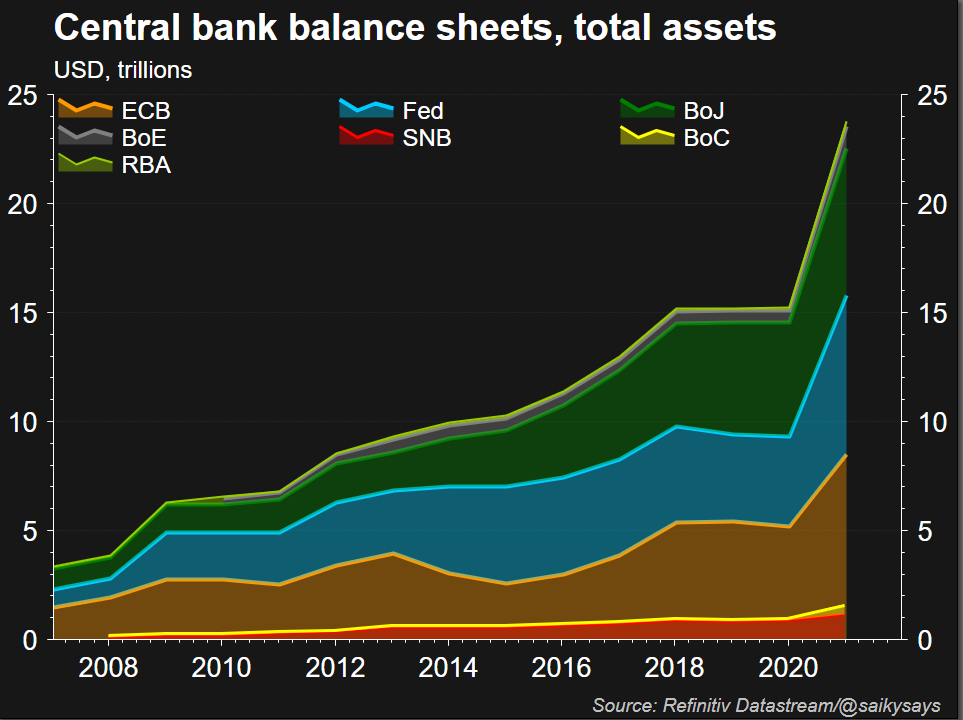
You do not get it.
This inflation is due to insiders (central bankers) printing money. Covid & ukraine are convenient excuses. Look up where this money ended up.
Help me understand: is this a stacked chart? Why does a chart that ends in 2021 show inflation in 2022 and 2023?
> This inflation is due to insiders (central bankers) printing money.
If this is about the money supply, why is food more affected than other products? IMO everything is a factor, and there is no one culprit, and therefore no one easy fix.
https://image.cnbcfm.com/api/v1/image/106649548-159664277043...

I look forward to open source ai economic simulation tools - when you change variables like m2, you'll see what happens to inflation - and there'll be no more ambiguity
For now: ask gpt-4 yourself & get a lesson
Imagine being a rational human and deciding that a war involving two of the biggest agricultural exporters in Europe, one of whom is also one of the main exporters of oil and gas, as well as a ton of different important materials (nickel, steel, fertilizers, etc.), after 2 years of pandemic that crippled global supply lines and resulted in explosion of prices in many raw materials, have combined absolutely no impact on prices anywhere.
We know the model pretty well: "money printer goes brrr" leads to higher prices for good and services. But the data lately doesn't make a great supporting case.
> I look forward to open source ai economic simulation tools - when you change variables like m2, you'll see what happens to inflation - and there'll be no more ambiguity
Economists have been leading the way in multifactor causal inference, but GPT in particular is not well suited to it. And macroeconomics in particular is hard to measure via natural experiment, so you're left trying to estimate counterfactuals based on a paucity of data
but look, my day job is people coming to me with timeseries data showing an engineering fuckup and debating about what caused it (usually ops vs prod). if theres a nuanced take, im all ears, but so far your fire has brought more heat than light.
you don't get it
money is worth less when there's more of it. especially 40% more of it.
all the inputs to your groceries (labour, energy, materials, transport etc.) thus nominally cost more
when inputs cost more, your groceries cost more
What do you think putting more money into circulation does to demand & nominal purchasing power?
An excess of money causes increased demand per unit dollar and subsequently, higher prices and inflation, through mechanisms including the Cantillon effect, changes in monetary velocity etc.
If i deposit more $ in your bank account, what happens to your nominal demand?
Ideally people would save for a rainy day. But people don't, and can't, always do this. Because for some this is the rainy day.
Non-ideally I would assume that most demand increases would go for non-groceries, and non-commodities in general, such as housing and travel, though I would expect some increase in durable goods commodity prices as people replace older goods with newer. Yet here we have grocery price increases. Are salaries in the grocery production chain going up 18%? I doubt it. The price increases are coming from elsewhere.
Is this a conspiracy theory or a simple observation of incentives?
They don't all have to actively conspire or even know one another for them to have a shared business interest.
Food inflation in Sweden is 22.1% over 12-month [0]
Food inflation in Norway is 8.8% over 12-months [1]
Obviously someone is making money hand-over-fist from this 12.7% discrepancy.
Comments like the one above are really disruptive to any constructive conversations. It is not a conspiracy.
The comment above is (at best) astonishingly naïve. While it is a emotionally plausible argument, we can see it does not hold up if we compare the rates of inflation over similar countries.
[0]: https://www.scb.se/en/finding-statistics/statistics-by-subje... [1]: https://www.ssb.no/en/priser-og-prisindekser/konsumpriser/st...
Maybe we should mention that Norway exports oil and gas, and Sweden does not.
https://www.nibio.no/en/news/ten-facts-about-the-norwegian-f...
[0]: https://tradingeconomics.com/switzerland/food-inflation
To say it is a conspiracy is true, in that corporations are conspiring against consumers to make more profit.
Some articles:
https://www.theguardian.com/business/2023/mar/24/greedflatio...
https://www.cnbc.com/2023/01/24/greedflation-food-brands-may...
https://www.theguardian.com/business/2023/mar/12/global-gree...
https://www.theguardian.com/business/2023/mar/02/ecb-looking...
Every western society heavily taxes working, where often for me as a freelancer it hardly pays of to work more then 6-8 months per year.
But taxes on wealth are very low. And owning property often has many tax cuts, and tends to benefit from low interest rates.
The effect of it is is that either you play the wealth game through property or investing or you are lost out.
I think it would be fare to protect the assets people accumulate through hard work, but at the same time it should be more balanced then it is now and we shouldnt all have to be financial experts.
On top of this, you've got Brexit which was orchestrated by the right wing conservative aristocracy class for their own benefit. And we've also had a conservative government that has not only not pursued a green agenda over the last 13 years, but bent over backwards to get Russian energy money.
So yes, the factors leading to inflation were outside of control. But that doesn't change the fact that the powers that be in this country have been running the country in their own self interests and have given up on even pretending otherwise and that is why the UK is being hit harder by inflation than any other country in the western world. They were so high on their own supply they even elected Liz Truss to cut taxes in an inflationary environment and only reluctantly accepted that they weren't going to get away with it when the global market responded by saying it would tank the property market (which the whole stack of cards relies on).
> Are they all friends with each other and plan all their schemes together?) against the “others”.
This is the UK with it's notorious and very real class and aristocracy system. They don't call the royal family "the firm" for nothing.
It was the same in most EU countries, but wouldn't that result in lower inflation? The rich that kept getting richer would invest in stocks, business, real estate, park it offshore, buy another helicopter or yacht, etc. which wouldn't impact demand for most products whose prices are increasing.
I don't think that's true. Right now, UK inflation is lower than almost any European country east of Germany, including Sweden, and it seems inflation was running lower throughout COVID than even the US.
How does printing more money to give to everyone lower inflation?
>The pandemic could have been the perfect opportunity for a soft debt jubilee to rebalance the system.
I don’t agree with either stimmy or the lockdown business handouts but I find it ridiculous people are using a world tragedy as some sort of crowbar to bring about their idea of some sort of require rebalancing. Not sure how those people even think how that could possibly play out beyond 3 months.
Starting to suspect some people feel the pandemic was the best thing to ever happen to them and are now upset it didn’t go further.
Amazing. Yes, I am sure the poor will just piss their money away on nothing. Rather than you know, starting businesses or upskilling themselves or paying their houses off or whatever. Because, you know, only the people already at the top of the pyramid know how to be productive and everyone at the bottom are just there because they're lazy and useless.
> I don’t agree with either stimmy or the lockdown business handouts but I find it ridiculous people are using a world tragedy as some sort of crowbar to bring about their idea of some sort of require rebalancing. Not sure how those people even think how that could possibly play out beyond 3 months.
Because historically, debt jubilees have been a common occurrence to maintain social order. The topic comes up semi regularly on hacker news, including yesterday. The fact of the matter is, if you don't agree with business handouts or stimulus, then you either don't agree with lockdowns and think we should have just gone about our business and let nature take it's course (if so I can see where you're coming from), or you want social disorder (I don't see where you're coming from). There's no way in hell you could have maintained a lockdown otherwise. People need money to eat and keep a roof over the heads and the poor do not have the savings to do that for an extended period of time without work. So if we're going to give money away to keep people alive, we might as well give more to the people who are struggling to survive rather than giving thousands and thousands to people who already have substantial amounts of assets. Similarly now with energy payment help, why on earth are we giving energy payments to people with second, third, fourth and however many homes rather than using that money to increase the amount we give to the poorest? That is not a ethical allocation of public money.
> Starting to suspect some people feel the pandemic was the best thing to ever happen to them and are now upset it didn’t go further.
If you're aiming this at me personally I was living at home and working a zero hours contract at a local venue so saw basically hardly any furlough money when the pandemic happened. I got £100 week from the job centre for and a handful of hours wage from the venue for a couple of months before they let us go. Meanwhile a guy I know who had been in his new teaching job barely a few weeks before covid hit was raking in over £3000 a month in furlough and treating himself to all manner of things like fire pits, jacuzzis and game consoles.
I saw the pandemic as an opportunity to escape minimum wage drudgery and worked my arse off improving my coding skills and used that to land a job at a local company as a software developer. Despite the fact half the developers worked remotely abroad, they made us go into the office with hundreds of others throughout the entire pandemic and then, when lockdowns were finally lifted for the last time, handed us all laptops and said we were free to work from home. So yeah, that was my covid experience.
So no, I don't think the pandemic was the best thing since sliced bread and that it should have gone further. What I do believe, is that when you give people at the bottom an opportunity and a bit of breathing space as opposed to pummelling them into the ground with debt and drudgery, is that those people can go on to make something of themselves.
No of course not. That'd be 90s-Mr-Burns territory.
Nowadays you pay a SaaS offering to do it for you if you're a landlord:
https://www.propublica.org/article/yieldstar-rent-increase-r...
So the question is -- is real estate the only market you'd do that in? Seems unlikely.
"If I had to guess, I would bet that the big food conglomerates have all signed up with some common AI-backed pricing software package, and that shares data between them. Or, at the very least, they've all started using AI algorithms to increase or decrease production of any number of goods to maximize their profits based on real-time sales and economic data. And since they're all probably contracting this out to the same or a handful of similar AI firms, the conclusions they reach are similar. If all the production companies are running algorithms that tell them to jack up their prices at the same time, well they all jack up their prices at the same time. They don't actually have to meet in some smoke-filled backroom to plot a price-increase conspiracy. They just all run similar algorithms that respond the same way to market trends. The consumer market is highly consolidated, with most goods having just 1-3 producers. If those few producers all sign up for the same AI price-setting software, there won't be price competition to punish needless price increases."
https://www.reddit.com/r/TrueReddit/comments/11gwm2y/europea...
Uh, you should google what the word "profit" means. You're thinking of "revenue".
But it’s a typical observation I have whenever discussing economics with Europeans — economic illiteracy is rampant, here, unfortunately, because schools do not give much priority to basic economic facts.
The economic illiteracy would be not being aware that all those megacorps are posting record profits and trying to gloss it over with made-up theories of your own an accusing an entire continent of people with economic illiteracy:
https://theconversation.com/food-giants-reap-enormous-profit...
https://www.nytimes.com/2022/11/01/business/food-prices-prof...
If their costs were rising more than their revenue, they wouldnt post record profits. They are posting record profits. You are simply wrong. You just !made up! a theory to avoid the actual reality.
Why have you made such a blunt, exaggerated, false statement like 'European economic illiteracy' without doing so much as a google search. Do you know how that made you look...
That‘s a newspaper article published last year citing an NGO report based on annual reports on the year 2021… that was way before the price surges really began. I would wait for the annual reports on the year 2023.
Nestlé e.g. (to stay in Europe) reported a 45.2% decrease of its net profit for 2022 — but, supposedly, also due to out of the ordinary profit in 2021 after selling L‘Oréal. But they also note: „Organic growth reached 8.3%. Pricing was 8.2%, _reflecting significant cost inflation_. Real internal growth (RIG) was positive at 0.1%.“
But it’s typical for leftists to cherry-pick their data and only read news sources that confirm their bias. I hope you are even more angry with me now. :-p
So, the corporations were bamboozling entire planet and sucking it dry during the pandemic, but they are not doing it now...
> before the price surges really began
What does even 'really' mean. 36% is not 'really', but some other percentage is? Doesnt make sense.
> Nestle
https://www.mashed.com/1117426/popular-food-companies-that-r...
There are heaps of other companies other than Nestle. One company doesnt make an argument.
> But it’s typical for leftists to cherry-pick their data and only read news sources that confirm their bias
Its not 'leftists' cherry-picking data. Its those who use vague words like 'price increases REALLY starting' - whatever that means - even as the very capitalist publications of the most capitalist corporations on the planet say that food corporations profited off of pandemic and the war.
So its basically the words of CNBC, Oxfam etc versus your 'really' theory.
> I hope you are even more angry with me now. :-p
I didnt notice that you were disingenous debater. I do now. It explains your absurd arguments, and the 'really' theory of price increases. I'll act accordingly and avoid losing time discussing with you.
> bamboozling entire planet
> …
> food corporations profited
> off of pandemic and the war
I am sorry but you are mangling together so many different things just to prove your narrative about greedy food corps profiting from food price inflation. It all just doesn’t quite make sense. At least, I am assuming that’s what you like to communicate: Food prices increase because food corps want to make insane profits. Right? Everybody will agree with you, of course, as nobody likes big anonymous corporations making billions in money.
I’ll try to show you now why food corporations might make profits and impressive ones, too, but why they can’t have anything to do with steeply rising prices and why their profits do not hurt the average joe, necessarily.
Let’s reflect a little a bit about what a price is: When food prices rise why do they based on economic theory?
In a first approximation it could just reflect a scarcity. Say apple juice becomes more expensive. That could be because apples had a bad harvest season. Or transportation was hampered so not enough apple arrived in the factory or became spoiled. Or there were not enough people available for the harvest or the transportation. Can apple juice corps. expect fat profits because of an apple scarcity? Well, only if a company was lucky enough and managed to produce and sell the same amount of apple juice for the same cost compared to the last season. But since there is an apple scarcity, most companies would have less apples and, hence, have less juice to sell. Furthermore, people tend to drink less apple juice when it’s expensive. Both effects offset the increased revenue per apple on average for all the apple juice companies and, hence, imply a constant profit.
Another reason for a price surge might be monopolization. Say, Nestlé bought all apple juice corps. and can now command a much higher price. Fat profits? Well, Nestlé would have had to buy all their competitors first and in that process had spent quite a lot of money to be in this position. That would have seriously slashed their profit (even though their apple juice revenue would have sky rocketed). Furthermore, again, people would drink less apple juice under these conditions. Finally, obviously, Nestlé isn’t the sole provider of apple juice and in fact does not happen to be the sole provider of food (as you stated yourself) —- so it can‘t in fact profit from a monopoly under the current situation.
A third reason for a rising apple juice price might be a trend shift: People might find apple juice suddenly more attractive and tend to buy more of it at the expense of orange juice and are willing to pay more for it. Surely, that would increase profits for companies only producing apple juice. Producers of both apple and orange juice (like the typical Food Corp), however, would just measure a net zero revenue shift and a rather similar profit unless apple juice production is much more efficient than that of orange juice. But — whatever, consumers wanted to spent more money on apple juice and are now happy nevertheless.
That leaves inflation for another driver of increasing prices. Inflation means our money is losing value and, hence, can not buy as much apple juice as last year. That affects both consumers and producers, however, meaning consumers can buy less apple juice but at the same time apple juice producers can buy less apples (and less machine parts and transportation services). That brings us back to my original argument: Inflation can not drive real profits as — per definition — inflation affects the economy as whole and hurts consumers and producers alike. Inflation does not mean a redistribution from consumers to producers as your thesis implies.
So why do apple juice corps. make profits in the first place? Because they spend less money in producing apple juice than they make in selling it. The larger the profit margin, the more efficient the company is and the bigger its profit. In a competitive market economy companies cannot just increase the price of the product they produce to boost profits. It is commanded by the market and is simply given. All they can really do is lower the costs of their production.
So while the food price inflation is bad — no doubt — it is not the fault of the food corporations with their fat profits. Ultimately, you want them to make a profit otherwise they would go bankrupt and couldn’t produce any food any more. And no food production is way worse than expensive food production.
Wouldn’t you agree?
In this case though, we're simply talking about inflation. One cause of inflation that you've neglected to mention is quantitative easing and how it's been used to artificially lower interest rates while allowing for higher deficits. I'd suggest you start there before you strawman people who disagree with you as "conspiracy theorists"...
Except countries in the EU, which has a common market that made such checks unnecessary inside of it. Of course there are still customs on the outside EU border.
So if you leave that, and your borders are now not internal market borders anymore but your and the EU's external borders, you're going to do more customs checks than you used to have. In both directions.
I agree with you that bureaucracy here is the problem, and Brexit was the cause of it.
It breaks democracy benefitting a few in power.
The effects of covid are actually the effects of covid policies which benefited govs and big tech and other corporation's while screwing most people. Yes, it appears that people wanted it but when you consider the censorship, behaviour modification propaganda and unconstitutional state force application to suppress people who wanted to oppose them, it's not that clear of a picture.
Then Ukraine, also something that benefits the gov, the energy/war companies and corporations, and not the people. Also heavily propagandized to push more profiteering through endless war.
No conspiracy. Just the system at work and people like you dismissing the true criticism with the same old labels. You may feel an impulse to call me fascist, racist and other customary labels soon, heh.
Do you mean the sanctions our rulers voluntarily chose to impose on that sector? Or is there something intrinsic to the war that would have that effect?
You don't need a formal conspiracy when interests converge.
- George Carlin
I present you the US housing market.
I also agree that low rates were good as you could invest in property with leverage and in businesses which could borrow and raise money to cheaply to grow.
Nobody is having a good time right now.
Anyone with debt is better off with higher inflation as the amount required to pay back is worth less. Anyone who gave money away for interest takes a haircut. The richer entities usually loan money so this is better for the poor with debt. If wages don't raise than this changes
Loans to the poor will always have an above-inflation rate. And the poorer you get the more extreme the rates.
Interestingly this is somehow not considered inflationary.
The real metric isn't total cash, it's outgoings vs income.
Billionaires do not have significant non-discretionary outgoings. At the billionaire level food, housing, and transport are essentially free, and your time is your own. There may be mild chagrin if you can't afford a bigger yacht or another private jet, but mild chagrin is all.
That's not true for most people. The poorer you get, the more aggressively you have to sell your time, and the more likely it is that your outgoings are going to exceed your income.
Not because you can't organise your finances, but because inflation and wage stagnation have made any other outcome impossible.
I noticed you didn't say "declining" because that wouldn't be true.
1 Feb Guardian - house prices fall for fifth month in a row
1 March Guardian - house prices fall at fastest annual rate since 2012
The price-to-earnings ratio is 9X in London and around 5X in the rest of the UK.
Property speculation is always ten steps forward and one step back. Prices in the UK would have to crash by at least 50% to return to any kind of widespread affordability.
At least 2-3 years, anything less is too small a sample size. You could be highlighting a 10% decline after a 200% increase.
You can't get something from nothing.
This was simply subsidizing business borrowing / capitalists at the expense of the labor's purchasing power.
It shouldn't be a mystery why inequality sky-rocketed to surpass Belle Epoch levels under ZIRP.
Well, idk about your area, but property prices in northern Germany are still well above the 2020 mark.
https://www.theguardian.com/commentisfree/2023/mar/05/house-....
"UK house prices defy gloom with an average £3,000 rise"
20/03/2023
https://www.theguardian.com/money/2023/mar/20/uk-house-price...
UPDATE: I can see a comment below says they have gone up in some places. Well, when both rates AND prices have gone up, it is not hard to tell :-)
it's emergent out of the incentives e.g. the Cantillion effect
it wont be around forever with AGI making this so obvious
this is true in the short term because a lot of assets are held with borrowed money. when interest rates go up those assets get sold to cancel the debt and bring down the market value.
however, either if inflation is sustained or interest rates go down, asset values will inevitably bounce back, but money will NEVER recover its value.
It's what you're seeing happening in Silicon Valley right now.
Usually a reality check occurs every decade or so, bringing heads back down to Earth, but I think too many felt that the COVID lockdown lows in the markets were that reset. They then went right back to their old habits, after a brief pause.
Just thinking about how long it took to recover from 2000, 2008, etc., it's obvious that we didn't truly have that reset.
The lockdowns fundamentally changed a lot, but few people seem to want to acknowledge it. The effects of the lockdowns will been seen for a long time, I honestly do believe.
Just my take on it all.
The alternative where the rich are sitting on piles of money because they can’t profit off loaning would quickly make apparent how they’re leaching off the labor of the people.
Inflating wages makes wages relatively more important than existing assets.
And a large part of today's work force is simply not familiar with fighting for wage increases. They're used to getting meager increases that don't keep up with inflation. Workers have been getting screwed for decades, the slowly boiled frog. It's not worth the fight so they have in effect gotten pay decreases, in aggregate, over 30+ years.
[1] https://www.cnbc.com/2021/02/16/map-shows-typical-payday-loa...
[2] https://www.forbes.com/sites/johnhyatt/2021/11/11/how-americ...
This is a tautology. The lower class is defined that way. If they didn't suffer the most, they wouldn't be lower class.
It's possible to imagine circumstances in which the upper classes suffer proportionately more than the lower classes. We have, in fact, had these circumstances. Such as the impact of transition from land wealth to industrial wealth during the first couple of industrial revolutions that saw various nobles having to sell their ancestral estates and belongings. Meanwhile the lower classes gained jobs that allowed them to afford more than they could before.
But the article is saying "d suffer(poor) / d(inflation) > d suffer(rich) / d(inflation)", the truth of which is not immediately obvious.
https://www.grocerygazette.co.uk/2023/01/31/food-companies-p...
Honestly you're right that inflation can benefit the well off, but I don't buy the conspiracy theory angle. "The Establishment" has been holding inflation rates at historically unprecedented lows for the last generation. It's been the number 1 priority for central banks since the early 90s. The last time the UK inflation rate was above 4% was over 20 years ago.
https://www.macrotrends.net/countries/GBR/united-kingdom/inf...
Inflation of 4% sure isn't as good as 2%, but generally speaking the inflation rate in the UK appears to hover around 2-3% during "stable" periods. https://www.macrotrends.net/countries/GBR/united-kingdom/inf...
https://asia.nikkei.com/Economy/After-20-years-Japan-still-s...
Compare pre and post 1945. The 1800s had a depression every banking cycle, now we just get recessions. Bank failures no longer take down your life savings. The king of England doesn't sometimes surreptitiously start putting copper in the gold coins to fund wars any more (e.g. inflation). GP's chart is pretty impressive, actually. Aside from the 70s oil shock, inflation is pretty constant, especially in the last couple decades.
I might believe this is M2 hadn't increased 4x since 2000 https://fred.stlouisfed.org/series/M2SL
However inflation!= growth in the money supply. A lot of the reasoning behind that growth was because inflation was persistently below the 2% target for the entire period up until 2021. That’s two decades of stubbornly low inflation, despite the feds best efforts in juicing the money supply.
It’s maddening how common it is for this forum to treat the issue as so simplistic and formulaic as though policymakers are somehow dunces compared to software engineers.
One of the reasons why the M2 supply increasing wouldn't directly correlate to inflation has to do with global demand to hold the asset in reserve.
So the argument I don't think is bad, just misguided in the sense that once the global demand for currency reserve is saturated the party is over for increase in supply with out a very direct affect on inflation.
However it usually is a more simplistic conversation that glosses over the challenges of actually making policy at the fed.
The post you replied to referenced the St. Louis Fed chart saying 4x M2 growth from 2000 to now. The page I referenced shows the same 4x M2 growth for the UK: from 750k at 2000 to 3000k at 2023 (values in GBP Millions). Virtually identical.
On the other hand, rising interest rates causes all assets to decline in value, and the decline is worse depending on how far away the "maturity date" is. It looks like the UK has been raising rates, similar to the US. [1]
[1] https://www.bankofengland.co.uk/boeapps/database/Bank-Rate.a...
Inflation only negatively affects the poor in that their wages are sticky and do not adjust in time (so in effect, their wages in goods and services terms declines)
The same thing happens to rich people, it’s actually a “capital owner vs salary man” divide. (A small building owner is impacted less than a very wealthy athlete for example, since one can raise rent yearly and the other is in a long term salary contract).
Very similar dynamics probably hold almost by definition for anyone who is wealthy.
Yes, that makes them a capital owner, but it's hard to make a metaphor where people aren't allowed to buy stocks with their excess money.
>They probably also have a steady stream of sponsorship deals that get (re-)negotiated more frequently than salary at McDonald's
Sure, but that still makes them worse off than a capital owner.
>Very similar dynamics probably hold almost by definition for anyone who is wealthy.
Sure, but a relatively low-wealth landlord is hurt less than a wealthy banker who consumes most of their salary. That's the only point- that it's more than rich/poor, even if the true nuance is correlated to rich/poor.
I think you have it backward. I think the inflation is the byproduct of their ability to own and hoard assets like land and labor, and reap the most value from those things, while everyone else is unable to get a foothold.
Inflation is happening because everyone is making more money, and everyone got a bunch of during covid, and now a lot of people are having large swaths of debt cut from their lives (college loan forgiveness program), not because rich people own stuff. But poorer people also can’t get ahead because rich people own everything.
This is a capitalism problem more specifically than it is a rich v. poor problem. Make it illegal to own more than one property and you will instantly give the lower and middle classes a chance.
Not in the UK.
Real average weekly and hourly earnings have decreased.
> and everyone got a bunch of during covid
Several thousand dollars is more money? That’s one rent or mortgage payment.
> and now a lot of people are having large swaths of debt cut from their lives
Where?
You mean dark, sinister side of capitalism, right?
Obliterating the entire hospitality and entertainment industry without compensation would have been .. unpopular.
https://migrationobservatory.ox.ac.uk/resources/briefings/lo...
This is a supply side issue, a labour issue, a border issue, and a stagnant economy issue. Productivity in the U.K. flatlined years ago, with the 2008 recession, and what is being experienced there remains the after effects of the bungled policy decisions at the time.
If the assets are liquid ones not really; that's one of the reasons asset-holders start to clamor for the Fed to do something when inflation is high. I read the introduction of Secrets of the Temple, which is kind of a counter-conventional wisdom explanation of how higher rates of inflation were salutary for regular people at the expense of the ruling class, and it was pretty compelling.
For instance our PM Rishi Sunak has paid 24% tax on his £1.9m income last year, while my the tax man takes 39% from my wage.
This should be fixed, but Sunak who was pushing for higher taxes on the workers, would never do that.
This is absolute scandal the rich can avoid paying their fair share this way.
I think it is very important to note that when it comes to grocery price increases, even if suppliers are raising their prices (and this isn't always the case), groceries stores aren't just passing down wholesale price increases, they're raising prices even further.
For grocery stores, this isn't an issue with (unqualified) "inflation", it's an issue of price gouging.
https://www.dailymail.co.uk/news/article-11668863/Supermarke...
Unless that has jumped to 10-15%, or jumped in any meaningful way, you're just seeing inflation, not gouging. Generally, grocers are among those businesses with the least pricing power.
https://www.reuters.com/markets/europe/savings-algorithms-uk...
The whole point with inflation is that nobody knows what future price-levels are going to be, so there's upward price instability. Everyone is trying to gauge how much to raise things -- and of course, they tend to overshoot, which leads to a higher rate of inflation. That's what makes inflation so pernicious, and hard to eradicate. It's not so much that a constant rate of inflation is damaging, but when increase become noticeable, people begin trying to anticipate it, and that increases the rate of change.
You'll also see this in pay negotiations: you'll see more strikes over pay raises, but it'll be very hard for unions or companies to accurate gauge what the pay rate rise should be. It's not that unions are trying to "gouge" management -- it's that the consequences of demanding too small a pay rise is the same as accepting a pay cut. So labour demands more than inflation, which in turn tends to push up the inflation rate.
e.g. the ability to accumulate "Tokens of Power" (vs the equivalent of arcade game tokens for commodities) is what motivates the Steve Jobs and Elon Musks to do their universe denting.
This is quite different than say tribal societies where extra resources do not maintain their value across time. An abundance of meat and other resources can only be transmuted into common cultural power via Feasts and Festivals.
Metaphorically, "gold" creates "dragons" because it allows immortal hoarding. Dragons are the only thing with influenceable agency that can reshape "nature". Controlling dragons allows this dominance (for better or for worse) at the cost of dragon externalities (burned towns, randomly devoured livestock)
Ummm... nothing like the 70s/80s (I'm old).
Seriously I think that the younger people in the UK are showing immense stoicism and forbearance.
Actually, it's the opposite that is happening, because central banks have aggressively raised interest rates to bring inflation under control.
When rates rise, the net present value of every long-term cash-earning asset declines, and those individuals and businesses (including banks) that borrowed too much in relation to the declining value of their assets, can and will suffer large losses.
It's not a coincidence that stock markets are down, businesses are cutting costs, office buildings everywhere are starting to file for bankruptcy protection, mismanaged banks are now in financial distress, venture capital firms and their investors are facing the prospect of large losses, and so on.
The opposite is happening:
Asset values are declining.
Stocks, bonds, property, etc. -- all declining in value.
That's the reality.
Also, who is rich/poor and has assets/debts can be hard to tell from appearances alone. Would you call this guy poor [0]? Seems like he has a good life. Which begs the question... when we talk about taxing the rich, who are we thinking of exactly? Someone living beyond their means, or below their means?
Keeping interest rates low keeps inflation high. Raising interest rates reduces inflation but also hurts asset prices and can potentially bankrupt some heavily indebted businesses. This is the balancing act the central banks have been trying to perform. The reality is that getting it wrong in either direction hurts the lower class: excessively high interest rates lead to high unemployment; excessively low interest rates lead to high inflation.
Being deluded into thinking ["the rich" nor the "lower class" are monolithic entities] is a recipe for abuse by those in power.
What on earth are you eating? From where? The average 800g loaf costs £1.36.
But to feed into your point about who suffers, if you had to give up your luxury loaf, you could still afford two average loaves in its place. People who could only afford a 80p loaf before are now going without.
The solution to allowing lower classes to have more stuff is to make it easier for everybody to produce more stuff.
Giving money CAN help with distribution of stuff, allowing poor people to purchase a larger share. But it requires lots of money given directly to the people that need it (vs allowing the gov't to spend it themselves). And also requires lots of high inflation. Imagine, for example, just giving everyone £10M to spend on whatever they want. This would not create any more stuff - but it would sure be a big equalizer for people buying that stuff!
But really - if we could all focus a bit more on production - allowing, encouraging, and celebrating it - then we'd all have a lot more stuff.
The fact that real wages haven't kept up with productivity means that we can't afford as much more stuff as is being produced, but we can still afford more stuff.
I'm not making a point about society, I'm making a point about what real wages mean.
Inflation was fixed in the U.S. when Reagan became president: https://www.pacificresearch.org/beating-back-inflation-team-...
Recent studies in fact show that wages and productivity are still linked: https://www.aspeninstitute.org/wp-content/uploads/2019/01/3....
And, finally other analyses show that studies on wage stagnation fail to take into account other factors, like the increase in non-wage benefits since the 70s: https://www.cato.org/projects/humanprogress/cost-of-living
These are the orgs who persistently try to sell trickle-down economics, minimal taxation, low regulation, and other discredited, disastrous, and irrational neoliberal policy arguments.
Many are also enthusiastic climate change denialists.
One man's propaganda is another man's truth, and vice versa. Do you really think the EPI is credible? https://www.influencewatch.org/non-profit/economic-policy-in...
> These are the orgs who persistently try to sell trickle-down economics
That's ironic, given that the phrase "trickle-down" was invented by leftists as a marketing tactic: https://www.aei.org/carpe-diem/thomas-sowell-on-the-trickle-...
> low regulation
Well, we can agree on that one at least.
> and other discredited, disastrous, and irrational neoliberal policy argument
Never mind. I guess we have nothing to agree on.
> Many are also enthusiastic climate change denialists.
You're clearly influenced by the outputs of a propaganda industry, not the outputs of credible independent research. See what I did there? I'll even one-up you with some links:
https://www.amazon.com/Unsettled-Climate-Science-Doesnt-Matt...
https://www.amazon.com/Apocalypse-Never-Environmental-Alarmi...
https://www.amazon.com/Fossil-Future-Flourishing-Requires-Ga...
How about giving some arguments?
Inflation in 1980, when Carter's presidency ended, was at 12% YoY, the highest they'd ever been in his entire presidency. Rising oil prices were not the only, or even primary, cause of inflation.
From the article: "In the early 1960s, a pair of Nobel Prize–winning economists, Paul Samuelson and Robert Solow, argued that in order to keep unemployment around 3 percent, U.S. policy makers should be willing to accept that "the price index might have to rise by as much as 4 to 5 percent a year. That much price rise would seem to be the necessary cost of high employment." Both economists were close to Kennedy, who pushed for low interest rates, hoping to spur rapid economic growth."
This idea turned out to be false.
Also from the article: "In the early 1960s, a pair of Nobel Prize–winning economists, Paul Samuelson and Robert Solow, argued that in order to keep unemployment around 3 percent, U.S. policy makers should be willing to accept that "the price index might have to rise by as much as 4 to 5 percent a year. That much price rise would seem to be the necessary cost of high employment." Both economists were close to Kennedy, who pushed for low interest rates, hoping to spur rapid economic growth."
This turned out to be true. And, lastly:
"In the 1970s, that is exactly what happened in the American economy, often by design. As Frum wrote, "The United States had consciously chosen to inflate its currency. It made that choice because of the political ideology and personal weakness of the men entrusted with the job of managing the American economy: their utopianism, their arrogance, and then finally their cowardice." The inflation that vaulted Reagan into office was not an accident or an incidental effect of policy. It was the result of deliberate policy choices."
Deflation = low employment, high buying power
People can pick between high employment and high buying power but they want both. Having both is impossible.
"It was only after the election, when Volcker knew Carter had lost, that he really clamped down on the money supply. This illustrates an important point: Presidents get the Fed policy they want, no matter how “independent” the Fed may be. If there had been any doubt about this, it was settled in 1967, when Fed Chairman William McChesney Martin buckled under pressure from Lyndon Johnson and eased monetary policy even though Martin knew he should be tightening. This caused inflation to jump from 3 percent in 1967 to 4.7 percent in 1968 and 6.2 percent in 1969."
And:
"Few people now remember how much pressure there was on Reagan to get rid of Volcker and have the Fed run a more accommodating monetary policy. Yet Reagan not only supported Volcker publicly, he appointed like-minded people to the Fed whenever he had the chance. He reappointed Volcker to the chairmanship in 1983 and appointed Alan Greenspan to replace him in 1987.
The result of the Fed’s tight money policy was a far faster reduction in inflation than most economists thought feasible. From 12.5 percent in 1980, inflation fell to 8.9 percent in 1981 and 3.8 percent in 1982. It is difficult to explain just how remarkable this achievement was. Most economists would have considered it impossible in 1980, especially given the big 1981 tax cut, which economists schooled in Keynesian economics generally viewed as pouring gasoline on the fires of inflation."
There's plenty of other takes that contradict yours as well, like this one: https://www.forbes.com/sites/briandomitrovic/2011/02/07/volc...
The authors claims that the Reagan tax cuts were a key ingredient without which the inflation reduction may not have occurred at all, or it at least would have occurred at a much slower rate.
But, look at me not carrying on a "discussion" because I keep citing other sources. I should just respond with one single sentence stating my belief as fact, right?
We're not talking about luxuries, we're talking about essentials. A nice iPhone is useless if you can't afford to feed your family or pay your energy bills - which is quite literally the situation many families in the UK are now finding themselves.
Says who? Why can't the people producing stuff simply take lower profit margins instead?
Increasing the cost of potato supply, with - for example - extortionate energy and fuel prices means the potatoes don't get grown in the first place.
This is exactly what's been happening in the UK.
Literally.
Not I-read-this-in-an-econ-textbook hypothetically. But for real in the stores.
This means that the normal way of controlling inflation (e.g. taking money away from people so they can't spend it) is not going to work. And in many ways is probably counter productive as it is making supplying goods more difficult.
Companies don't use some formula where they give a percentage of what you create to you in return, they try to squeeze your wages down as low as possible. It doesn't matter if you produce 5000 bucks an hour or 100 bucks an hour in value for your company, they still want to pay you as little as possible.
Stuff like staff loyalty and retention has been to a large part abandoned in favor of simply keeping wages down.
Just tax the rich (companies) properly. The resources and money is available. The current government chooses not to allocate it properly.
What is happening in the UK is to me 100% the result of the current Conservative Party and their policies.
The rich have historically funded the arts (e.g. patronage), public buildings, public institutions (e.g. Carnegie's libraries).
Useful businesses that require high capital are difficult to get going if no one has any capital.
There's no reason the government couldn't fully fund those things instead.
In fact, "businesses that require high capital" are almost always funded by the government. It's called infrastructure spending.
Let them go, then, the earlier the better and threat them as pariah. What good do you expect to gain from them at that rate?
I'm not sure how it is in France though.
[1]: https://www.bloomberg.com/news/articles/2022-12-14/new-york-...
Why do tax reliefs and strategies always benefit the big companies with lots of lawyers.
Lower the taxes of the common folk. Their interests are not being met, but those of the lobbyists.
The problem wouldn't be that they would leave. The problem would be that they would stay and become violent.
Eyeballing this, only 11 of the top 50 richest people in the UK have property as their source of wealth.
There's quite a number of very rich foreigners who economically have very little effect on the UK apart from monopolizing scarce inner city property.
So? Let them be violent. What are they gonna do? They don't have guns like in 'Merica.
They're dangerous not because they'll be violent (they won't be), but because they hold missive political leverage.
Not the structure built on it (well ... not much ... and you can often just tax that through the resources it consumes).
Not only are you taxing the asset that can't flee the country, and which the poor typically don't own, you also incentivise efficient land usage (it becomes too expensive to be a NIMBY).
And if you're talking about companies leaving France, then that's flimsy too. French citizens are among the richest in the world. International companies will pay higher taxes to access that market, and if they don't that's fine, a domestic company can step in or the government can snap up the productive capacity to invest in infrastructure.
Why can they do this? One reason is monopoly power- monopolies must be broken up.
But what else can be done (besides central bank driven demand destruction)? So instead of price controls, a more palatable solution is collective buying. This gives buyers more clout, allows them to bargain for lower prices.
https://en.wikipedia.org/wiki/Buyers_club
So we need more large non-profit buyers clubs, things like that. In the US, allow medicare to bargain with drug companies- it's insane that they can not.
An example where this works: my parents live in a gated community. They pay very little for the cable + internet + cell phone because the entire community has a deal with the provider.
Large retailers have this exact role: they certainly demand and get lower prices from their suppliers. We need a non-profit version of this, why should Walmart owners only benefit from their buying power?
This has been tried a lot in the 20th century (starting in the 19th century), usually emerging from the labour movement. I think in food retail and energy it has mostly failed or simply stopped making difference. The profit margins of food retailers are small to begin with and easily lost by being a bit less efficient.
But Europe and the UK in particular has been using a similar model pretty successfully to keep drug prices low. Some argue that costs were merely shifted over to the U.S. I think this is only partially true.
(Well, the actual question is DO they have a monopoly, to which the answer is mostly no)
Target has a NET 2.6% profit margin, Walmart has 1.9%, which are on the low side of what you'd expect for a sustainable commodity business. Tesco appears to have a GROSS (not net: this is after cost of goods but before salaries, etc.) margin of 6.5% and Sainsbury's has 7.6%. [1] Obviously their net profit margin is going to be less. This is hardly a company with a huge pricing power dynamic. If you want to see that, look at Apple (24.5% NET margin), Coca-Cola (22.2% NET margin), Visa (50.3% NET margin). (Note however that Coca-Cola's customers are its bottlers and Visa's customers are merchants so their pricing power might be invisible to end consumers)
Gross is 23.5%- it makes you wonder where all that money is going.. oh yeah, $9.85 B of stock buybacks.
My father once went to buy me diapers and returned with living room furniture set(ugly one also), because this was only one available since month or so, and he had to take it on the spot, because entire shipment will be gone in next few hours.
Then he had to go back to the diaper line and wait a few hours, because I wasn't impressed with the furniture enough to stop eating.
> "It happens when someone decides to raise the prices"
What would drive someone to raise the price of something with the confidence it will still sell at that price?
Rising demand and limited supply. Someone with a monopoly on all the widget production can arbitrarily decide to limit supply (e.g. your "limited edition" MTG card), which is a farce.
More often and importantly, in an environment where there are many producers of a commodity like toilet paper, they suffer input shortages or other increases to the cost of production/delivery. On and on this analysis goes until you get to your question, "why not stop the problem at the source". Where is the source in the price increase in toilet paper? Paper production costs are up? Ink costs are up? Shipping costs are up? Regulatory costs are up? Energy prices are up? Labor costs are up? Freeze all of these by government mandate?
As the guy cutting down trees for toilet paper with a shortage of gas for your chainsaw (meaning it costs more to run), do you want the cost of your product arbitrarily frozen with no regard to your input costs? What if the cost of your logging lease from the government increased? Can you raise the price of the toilet paper logs you're selling? No? How is that fair? What if landslides decreased your tree availability by half, but the number butts that needed wiping hasn't changed, or worse, has increased? Are you to sell your now scarce trees at the same price you always did? Or shall you sell to the highest bidder? What if the government says you can't auction the trees but must sell them for the same price? Maybe you look for off-the-books compensation - free tickets to the game, whatever. Someone still bears that increased cost.
If rising demand relative to limited supply is the actual source of the problem (too many people want toilet paper) why not stop the problem there by simply rationing toilet paper? Turns out this is what happens more frequently - rationing eggs, toilet paper, trying to prevent hoarding, scalping, etc.
Arbitrarily limiting the supply costs of a product or the demand for a product is a temporary solution at best.
> Gives anybody with elementary knowledge of econ a heart attack
Plainly, this isn't true. This opinion is not uncommon amongst so-called "Marxist economists" such as Richard Wolff. You can disagree that price controls and rationing would be the best way to solve the problem, but it is outright ignorant and needlessly insulting to make this claim.
See the Nixon era price controls and how they failed to get inflation under control.
If you fix prices, it just means the product keeps selling out quickly and most people can’t get the product.
This is why prices go up when there is a supply shock (like with eggs and the bird flu). There are fewer eggs available, and raising prices reduces demand until it matches the supply (as people who only kinda like eggs switch to cheaper alternatives). While it sucks that eggs are more expensive, at least you can still buy them if you really like eggs. With price controls, it becomes a crapshoot on whether you can get them or not.
Supermarkets earn a lot on eggs, always have.
Many people don't seem to learn from history. When something appeals to their emotions they follow it blindly.
But focusing on the alleged producers while fleecing the people in the middle (who are not the lower end either) is equally bad.
The people in the middle get high taxes, no real possiblity of ownership, no benefits of the bottom (state help) or of the top (the top just increases their own margins).
The top lobbies government and sets an unfair advantage for themselves, making the whole alleged democratic representation a farce.
The government should be more frugal with their won bureocracy and corruption and lower the taxes for the middle and bottom. The pretende that increasing conditions to the top will drip down is demonstrably false. It's mostly a rigged game, depending on where you started.
In theory, you could do this with toilet paper or loaves of bread too.
In the US, the Fed is not concerned about the bottom. They're solely concerned on the top. Check the numbers, zero interest rates did *not* trickle down. Instead they helped further increase the income inequality gap.
To blame to poor (read: the powerless) in any way, shape or form is, at best, misinformation. Worse it gives those responsible a free pass.
"I sit on a man's back choking him and making him carry me, and yet assure myself and others that I am sorry for him and wish to lighten his load by all means possible… except by getting off his back."
Leo Tolstoy
Those spending never reaches the "lower classes", and seldom even reach places where it would have the potential to increase productivity.
It's a tired, old argument that is done to justify stupid spending and enriching certain pockets while claiming to benefit all with a shoddy reasoning that omit the important details
1. Interest-free money for businesses to launch, grow, and advance. This leads to more goods in the market and thus lower prices
2. Free money straight to the people which means more money in the market and thus, inflation, empty shelves, etc.
His general point is that having interest-free money keeps existing players honest since newcomers can come in and start a competing business. Now that the money is drying up, existing players are increasing their moat.
I mean if you blocked companies from acquiring their competitors sure.
Otherwise you just end up with the largest company treating acquisitions as an R&D expense.
The current UK government has not been doing much of this.
We did that in comunism with the known results.
Like they can build housing and windfarms, etc.
(The US actually has more public utilities than the UK.)
To a degree you can do it, have the state own companies. But it will kind of be economically inneficient, high position employees and some politicians will steal money. No one will have the motivation to push farther.
Most US transit systems are bad because the government puts even more effort into stopping them from working (via bad land use, incredibly slow decision making, power-harassing Andy Byford) than it does operating them.
It is only acceptable to give money to corporations.
Seems very convenient and totally unbiased
So I go and register an LTD company now I am eligible for free government money.
We tried that. It all went into real estate and stocks and gave birth to a massive scam industry involving crypto and other get rich quick schemes.
The average joe didn't see much trickle down to him unless he was already invested in real estate or stocks.
Giving away free money without any strings attached to individuals or corporations is a bad idea as they both can be extremely reckless.
Here, we're discussing a different paradigm: interest-free money vs free money. The issue is that interest-free money has little to no use for individuals. They can't put that interest-free money into an existing business and reap the returns. That's why most people just use that "interest-free" money for stocks (margin trading) and even then it wasn't fully interest-free.
The fundamental issue is how to give individuals interest-free money and have them see returns. Maybe using that money toward job training, or starting incubators that find small businesses and infuse them with money, mentorship, etc.
Tax-breaks doesn't mean giving money to businesses, they mean taking less money from businesses.
At least giving money directly to poor people is spent on things that can grow local economies. It is not perfect, but a lot more “stimulating” than giving money to institutions, corporations and rich people.
[1]: https://fortune.com/2023/03/20/is-federal-reserve-too-powerf...
What's the mechanism? A big loan is a big risk. With a big risk you can have either a big reward or a big failure. Smaller loans, smaller risks, smaller rewards and smaller failures. It's proportional. Why do you think of wealth redistribution?
Big risk are if you use that big loan to start a new business, but not if you dump it all on stocks and desirable real estate in hot or future hot areas.
Buying real estate seems sound only because real estate has some good returns last years. But real estate can go down real fast like in 2008.
Many people gambled money, be it stock, real estate, crypto. Some got very rich, some didn't, some went bankrupt, some will.
I don't believe in speculation and gambling. The market can always can catch you on the wrong foot.
I believe in hard work, well invested thoughts and patience. The results might not spectacular but I rather construct my future than gamble it.
For every new billionaire who got lucky there are 100 new beggars who had bad luck.
You tried the wrong thing. You shouldn't hand money without conditions. Instead of letting speculative assets grow, you should only let productive bussineses borrow money with low interests. Businesses which produce tangible goods and are creating jobs.
By contrast I now live abroad in a developing country and it's quite amazing how ripe small business is. Want to sell bread? Okay, bake it and sell it. You can even get it stocked at "convenience marts" easily enough since a that's often just some guy's lower floor transformed in a shop. Talk to the owner, who's probably the guy at the counter, and make a deal. If people like your bread, you're now officially a baker - congrats.
Make it easier for people to sell stuff, and there will be more stuff. And the prices of stuff will trend downwards. While money is a way around these issues, a regular joe who happens to make a great loaf of bread probably isn't especially keen on taking on 5-6 figures of debt just to see if selling his bread actually works, let alone being something he really wants to dedicate himself to.
In some cases, business simply ignore regulations that that are obscure or inefficient to comply with; this leads to corruption and/or shadow economies.
In more cases, business is simply discouraged and doesn’t grow, or just doesn’t start at all.
The messy patchwork is city, (sometimes) county and state licensing and taxation framework in the US is a huge drag on small business.
I am not arguing for no regulation, licensing, or taxation, only that these entities recognize that requiring businesses to file paper tax returns every quarter, even if they have done zero business in a given city is a significant hindrance to business activity.
This is an excellent idea. Just lower the barrier whatever that barrier is.
Some people can think that lowering the entry barrier can result in subpar products and services but in fact the higher the competition, the higher the quality will be.
If this were true, then appliance manufacturers who produce higher-quality goods would be rewarded. But instead, we're at a weird state where appliances are still not cheap while also not being built to last.
Competition isn't guaranteed to keep the market honest; I'd argue once a market passes a certain size the number of people who can spot lemons becomes insignificant, and then it's a race to the bottom.
Excessive bureaucracy and excessive legislation have the perverse effect to seemingly protect the consumer while in reality helping the big players. Small players will go out of business while new players can't enter. It wouldn't be much surprise if powerful lobbies ask for such legislation while they pretend they think of the public good.
No one likes competition, even entering the bar as a new lawyer is difficult.
Sure, you can raise the standards so much that only multi billion companies will be able to comply. In fact that is what we witness today. How many mom and pop shops still exist compared to the '60s?
Let's just be honest with ourselves that these regulations cause us to have less stuff, and consider when they are worth it, and when they are not.
And 100% - making it easier for individuals/businesses to comply with regulations is winners all around.
I don't believe "safe" and "good quality" are necessarily aligned. I live close to a dairy farm where they sell (their own) unpasturised milk. You bring your own bottle, fill it, and pay in the honesty box. The farmer has a (small) disclaimer suggesting that the milk be boiled prior to consumption, but I don't believe any of the local buyers actually do that.
Q: Should this be forbidden?
UNPROCESSED Raw Milk (animal species)
There should probably be a poster or something created by the FDA that quickly summarizes the risks involved with not performing each of the mandatory safety steps for normal retail 'Milk', and it would be helpful if more detailed information were available on a website and from the local health agencies.
Some states such as California do have special exemptions for "cottage" production of low risk foods such as bread.
https://www.cdph.ca.gov/Programs/CEH/DFDCS/Pages/FDBPrograms...
In other industries it's much easier to legally start selling things. Want to make screwdrivers and sell them to the local hardware store? Go ahead.
Bread was just an example. Just try to open a small corner shop and see how easy it is. Almost any small business has legal obstacles and a barrier as a high to entry as a large corporation. While the corporation can pass that barrier, little guys can't.
> Want to make screwdrivers and sell them to the local hardware store? Go ahead.
I doubt you can do it without having to pay attention to thousand of different regulations.
It's only when you start making all sorts of things for yourself that you really start to see how completely irrational the markup on many things is, which then begs the question - why isn't anybody simply dropping the prices by 50% and making a killing? And the only answer I can really see is because it's become really quite painful to be able to sell things in America, unless you want to go all-in on it.
I'd also add that in terms of food safety, the big concern is not small business, but big business. Buy food from an individual or a family and you're eating what they're also eating for dinner, and probably have been for decades. By contrast at e.g. McDonalds, those executives probably aren't touching their "product" except for photo ops. Their only motivation is to maximize profit, which often comes in the form of sacrifices in quality or even safety of what's sold. [1] And this has always been true. "The Jungle" wasn't about Joe Bob's streetside shop.
[1] - https://www.meatpoultry.com/articles/20650-lftb-to-be-classi...
Sure if you bake a few loaves of bread at home then that probably seems cheap in terms of ingredients. Now add in your labor, allocate costs for utilities and kitchen appliances, and figure out what it would cost to drive around all day delivering that bread to retailers. Suddenly it's not so cheap.
But yeah I think that's weird and destructive. Wouldn't it be better to prominently track and celebrate how much new housing is built?
OTOH, many people have all or most of their net-worth tied up in their home price. So even though NOTHING CHANGES when that price goes up or down, it has a psychological affect on them, who vote a lot.
Small plots of land are dominated by HOAs. Finding small plots of "unregulated" (no HOA) land requires one to live very far from a city & decent grocery stores.
I'm not a big fan of the red tape of regulation & how regulations can be abused by large capital, but in the case of housing, HOAs are a bigger problem. Of course, there are also municipal regulations which require small plots of land to be more tightly regulated re: housing.
Debt is a heat sink, which is why Japan failed to spur inflation for two decades despite pulling every spending lever they could come up with. Debt kills economic dynamism, robbing the economy of the capital it requires to invest, expand.
To get to inflation out of borrowing + consumption, you need supply to not keep up. For most of the prior two decades for the US, supply kept up (courtesy of the China manufacturing juggernaut, which was a deflationary force for US consumers). The China effect has reached its end in terms of peaking, the next two decades will not see that kind of offset benefit (at least for the US).
Over the coming decades, the US will see similar problems that Japan did in terms of being unable to spark expected levels of inflation, despite high spending and debt problems. The cause will be the same, more and more of the economy will be locked up in the freezer as debt (typically yielding ever lower interest, in a downward spiral).
As long as execs and CEOs are free to reap the benefits brought by their staff without paying any of it back this problem will continue to be exasperated.
Another contributing factor in the matter is the fact that politicians seem to be immune from the affects of their policies.
This gives them very little incentive to actually help people at the bottom of the totem pole as their funding is coming from the very same people whom are essentially exploiting a desperate workforce.
Is a shelf stacker in Sainsburys a high skilled job? No. Is it absolutely crucial in order for Sainsburys to have a working business? Yes.
The same is true for the cleaner in a bank. If a bank is covered in dirt and stinks people are not going to bank there. Likewise with cleaners of trains and pretty much any other industry.
When you pair the fact that governments are funded by the same people whom are also funding a divisive narrative throughout all media outlets you end up with a grim and bleak outlook for society.
As someone that has come from below 0 to get a good job and try and get out of the council estate poverty cycle it really strikes a nerve when people act as though we get given handouts for nothing.
My mother worked her damn arse off through my childhood and continues to do so now as a 69 year old woman with chronic health issues. She has been left behind and forgotten by society and ill informed people seem to lack any ability to see beyond the outliers in shows like benefits Britain.
Err, votes are the biggest incentive for politicians.
> Is a shelf stacker in Sainsburys a high skilled job? No. Is it absolutely crucial in order for Sainsburys to have a working business? Yes.
Not really, they will soon use robots.
> The same is true for the cleaner in a bank. If a bank is covered in dirt and stinks people are not going to bank there. Likewise with cleaners of trains and pretty much any other industry.
I think in Japan cleaning is robotized already.
> When you pair the fact that governments are funded by the same people whom are also funding a divisive narrative throughout all media outlets you end up with a grim and bleak outlook for society.
Governments funded from taxpayers money.
Not sure if you are aware of the little old B word which was proven to have been based on a campaign of lies.
As for your remark about robots replacing shelf stackers and cleaners. I’ll leave that as the ill-informed and provocative comment it is.
Regarding government funding, governments spend public tax payer money, yes. Political parties receive their funding from private donors who ultimately end up expecting some kind of payback for their donation/bribe. Which ultimately comes out of the tax payer’s pocket.
This creates a cyclic system which is built to extract wealth from the bottom and middle classes in order to feed it back to the society’s richest people.
It can, and has at times, meant:
- Corporate bailouts and "welfare"
- Tax cuts
- Deregulation
- Lobbying / big money donations
Sometimes it means some of the above, other times it means all of the above. But the point is that no one on the fiscal conservative side of the aisle has ever come out and used the term "trickle down economics." Their opposition uses that word because it is loaded and it speaks to their base.
> Those spending never reaches the "lower classes"
What spending are you talking about? The OP was talking about removing barriers to creating business and attributed these barriers to good intentions. We can probably safely assume that the OP is a fiscal-conservative who favours deregulation and a business-friendly environment. And for what it's worth I am not trying to take one side over the other, you just lost me at "spending." The OP is talking about the exact opposite of spending. They are taking a "private solutions over public solutions" position. One where you spend less by having less overhead and red tape standing in the way of those who want to produce goods & services thus creating abundance of supply which lowers prices in addition to more jobs which puts more money in peoples' pockets.
Global ecosystems are already in a free fall, we don’t need to “encourage production” [by deregulating industries? perhaps getting rid of those pesky environmental and worker protections? (that’ll definitely help out those workers) ] and even more rapid resource consumption.
In the US the rate peaked at 91% on earnings over $400k - which is about $4m adjusted.
This is also why middle class tax rates are so high in Nordic countries, and most affluent nations with good social welfare structures. Taxing the rich isn't nearly enough. The US would have to shift to a much higher tax system for everyone, and the US middle class (which is spoiled by relatively low income tax rates) will not go for it (not yet anyway).
It you take all the cars from the top 1% and give them to the other 99%, how many additional cars do you suppose the average family will get? How about for houses? How about for haircuts?
Completely inaccurate. Giving people money that came from taxes does not increase the money supply.
Giving people money that came from selling bonds does not increase the money supply.
Only printing money increases the money supply.
So while one could nitpick some points about the specifics of government actions as relation to monetary supply, even if we take all of your points for granted - there would almost certainly be inflation proportional to the amount given. The only way there would be no inflation is if this action didn't increase monetary velocity.
That's why, for instance, the Fed is currently raising interest rates. They want to 'gently' brake the economy (while trying to avoid breaking it) such that people stop spending so much money, and inflation cools down. By contrast countless countries have tried to solve inflation by simply naively tackling the problem.
People don't have enough money to buy chicken? Well obviously we just need to give them more money! And that's how you get Zimbabwe. [1] Alternatively, another direct approach is to say "Okay - companies may no longer charge more than $0.50 for a chicken." That's how you get Venezuela. [2]
[1] - https://www.theguardian.com/money/2016/may/14/zimbabwe-trill...
[2] - https://www.reuters.com/news/picture/venezuelas-empty-shelve...
> So tax $1.10 for every $1 redistributed
I would say this is also mostly innacurate. Velocity is one factor, but may or may not be the driving factor depending on circumstances.
If a global pandemic shuts down most of the manufacturing cities in China, and a war in Ukraine takes Russian energy and Ukrainian grain out of the supply equation, then the velocity of money is irrelevant compared to supply constraints.
Also, it's not just about the money supply. It's about who has the money and what they do with it.
Taking money from a rich person who might have had it tied up in stock, and giving it to a poor person who takes it to the grocery store - will not put anything more on the shelves in that grocery store. In the aggregate, it MUST do one of those three things. It may ALSO decrease the price of stock as it's sold by the rich people.
Clearly the economy is complicated, and it's hard to follow around the money. That's why I like to get back to fundamentals. Not even economics, but basically physics: We can't consume what isn't produced. Money is to some degree beside the point. If we want people (of any class) to have more stuff, then we must allow for that stuff to be produced.
Not exactly. Printing simply introduces new money supply. Borrowing (or selling bonds in our case) comes with a corresponding liability that decreases the supply over time in an aggregate amount greater than the original amount, and results in a corresponding difference in behavior from the borrower.
The government hands out that money, and people use it to buy more bonds, then the government hands out more money, and repeat. There is now more money in the world.
Yes, if you unwind everything it will go back down, but that's never actually done.
With a corresponding liability that will eventually remove more money from the system than was introduced. This is of course a dramatically different equation.
I defy you to find any policies in capitalist countries that are intended mainly to "help the poor." Even the liberals' beloved FDR claimed he was just trying to save capitalism with his social programs.
The policies are not intended to help working people. They're only helping non-working, non-contributing parasites on society.
In the UK particularly, there are multiple examples of welfare putting women in multi-million pound houses in elite areas.
https://www.dailymail.co.uk/news/article-2297796/The-single-...
This isn't meant to help British laborers. It is explicitly designed to destroy them.
This is mostly true, but it isn’t always, and it isn’t a perfect formula.
For example, there are some goods that have zero or negligible marginal costs to provide. For example, a streaming service. If people use the extra money they get to buy Netflix subscriptions, it isn’t like there will suddenly be a shortage of Netflix streams. It doesn’t take many resources to add additional subscribers for Netflix… it isn’t exactly zero margin, but it is pretty damn close.
This is even somewhat true for some physical goods. There is a lot of latent productivity in our economy… factories only running at 50% capacity, for example, or mines that aren’t producing all the ore they can because the demand doesn’t exist for what they produce. If demand suddenly increases because there is more money being spent, they can increase productivity without putting strain on the productive capacity of the industry.
Obviously this is not infinite capacity, but it is why it is not as simple as “creating more money == 1 to 1 equivalent inflation”. In other words, you aren’t going to get a 10% inflation if you add 10% to the money supply. It would be some fraction of that 10%.
Which specific policies of this Conservative government amount to a change in the direction of giving more money to more nonproductive people? If anything, exactly the opposite has been happening, and yet inflation has been getting worse.
So tax wealth rather than income?
Uh, that's not true in the slightest?
Are you completely unaware of what's happened in the stock market and real estate market over the past year (these are the examples you provided lol)?
(something similar to that, I'm probably paraphrasing badly)
Cmon..I'm a brit too. I haven't seen riots. It's dangerous comment from you.
For people not in the UK: bread at a supermarket costs a quarter of that.
A 1kg wholewheat sourdough loaf. I'm a bit picky regarding bread and have actually started making my own in the last few months due, in part, to A) rising prices, B) manufacturer corner-cutting, and C) it's fun!
Regarding "A quarter of that", that is, IMHO, very optimistic. 1kg of bread for £1 would be quite the steal.
However I should have been more specific about it being sourdough, which is much more expensive to produce than "regular" bread at UK supermarkets.
The main winners of inflation are:
Adaptive over passive. As you mentioned, the average blue-collar wage growth always lags behind inflation. We aren't really seeing white-collar wage inflation either in the U.S. right now though - fast food workers are making $22/hour and Amazon drivers $18/hour, but FAANG engineers are getting laid off. Who are the winners then? The people who swap jobs or swap industries into ones with pricing power, or who found new businesses enabled by changing price structures. What we're seeeing in the U.S. now (with ~5% wage inflation) is that the 80% of wage earners who stay put at their job are getting ~0% raises, while the people switching are getting ~20% raises.
Debtors over savers. This is well documented in econ textbooks - inflation is a transfer of wealth from savers to debtors, because debtors can pay back their debts with less valuable money.
Governments over citizens. Partially this is because of government usually being a net debtor if it gets into a position where inflation happens, and partially it's because of the government's power to issue new currency. Plus tax revenue is usually a percentage of economic activity, so if all prices & wages increase by a certain percentage, so do tax revenues (and the government can bracket-creep you into higher tax brackets).
Poor people usually fare worse than rich people because of the adaptive vs. passive bulletpoint - they have fewer options and less awareness of options than richer people do. But the debtors-over-savers effect works in their favor: poor people usually have higher debts than rich people, and inflation is a form of debt jubilee. If, for example, they jump into a fast-growing new business started because of inflation (like Microsoft or Apple Computer in the 70s) it could be their ticket out of poverty.
Again, thanks.
Wouldn't this be true when interest rates are fixed only? People with variable rates will suffer as interest rates tend to spike during inflation and drive bankruptcy.
Also given wages lag inflation, the debt cost proceeds the payback.
So it feels a mixed case of, this will make some people loose out significantly, but those that can see the other side do well.
Wages only lag inflation if you stick with one job. If you're forever job-hopping, you get the new wage as soon as you land the new job, which could be within weeks.
Yes, this means that you have an incentive to never do any actual work and instead spend the time immediately looking for a new job. This is one of the positive feedback loops that turns inflation into hyperinflation and state failure. With everyone incentivized to look for new work rather than do the old work they signed up for, no actual work gets done. This exacerbates shortages, which causes further price hikes, which increases inflation, which means people have even more of an incentive to take very short jobs and not do them. It also prevents the formation of capital stock - nobody can get good at a job, or train on some expensive piece of machinery, if they need to take a new job tomorrow. That's why there's this compression of time horizons in countries undergoing inflationary episodes, where everything becomes focused around surviving until tomorrow rather than building for the long-term.
Also regarding job hopping, that may be true but taking a macro view of the world, most people don't or can't job hop that often, so I feel this is more the exception that the rule.
Generally I'm not convinced debt is a good thing during inflation as a broad rule. I feel it's more there are good exceptions if the right conditions align but this is not true to the average.
I believe that Andrew Bailey, the current Governor of the Bank of England, was criticised for exactly that last year.
https://www.theguardian.com/business/2022/feb/04/bank-of-eng...
Other than the sticker shock on the price of everything, it's not too bad for a lot of us.
based on what?
I think fewer folks are willing to talk about what lockdowns did to the supply chain.
What happens with those classes during deflation?
Identity politics have turned out to be the ultimate drug for the masses. There is no defense against it and the working classes will continue to push it further and further to their own detriment and to the glee of the powerful. Doesn't even matter if workers and the rest of the lower classes understand this, they simply cannot stop taking the drug and fighting each other. The tragically comical part of this is that those on the extremes of the political spectrum both think this applies only to the other end.
Inflation helps them as their assets are inflation-proof and it helps wipe out their debd.
Although, to be precise: Inflation hurts everybody maintaining their savings in some form of cash. Rich people with a large pile of cash also have a lot to lose.
In the medium term current retail prices will be offset by wage increases as long as inflation does not become a galloping inflation.
Individual "wealth" is so boring and flat and uninspired. Just Scrooge McDucks everywhere. Doesn't it feel like an archaic concept at this point? Such a narrow instantiation of humanity, can't die soon enough.
The system benefits those who get choose how it operates.
If by "natural" we mean somehow rooted in or consequent to human nature, then economies are very much natural. Human beings are social animals, and within this social context, we exchange goods and services for mutual benefit and for the sake of the common good. Economies become unnatural to the degree that they are detrimental and depart from human nature, in which case they cease to be economies to the degree that they fail. The details of economic practices are subject to a great deal of prudential judgement, and regulation is but a prudential determination of general principles of human nature to specific circumstances.
Economies don't live in some abstract realm, of course. They are the sum of human exchanges which themselves are a product of individual choices themselves influenced by culture and law. When the law is used by those in power to exploit everyone else for their own (myopically understood) benefit, we call that a tyranny.
But to be able to judge any of this requires a clear grasp of what is just. Recall that justice consists in rendering onto others what is their due.
The elite could simply dictate how societies would operate.
I’m sure the Roman plebeians also thought as much during drought induced famine; “the wealthy caused shortages by their greed”
Seems to be the natural response of the hyper-social-aware-confabulatory-ape-mind we, as humans possess.
But make no mistake, inflation is caused by a mismatch between societies expectation of productive capacity, and its real productive capacity.
Right now, real asset values are going down. Yes, some businesses have maintained nominal increases, but as consumers feel the squeeze so will asset real values. Asset valuation is based on real returns, and consumer behavior drives real returns.
Agree. But, even better in inflationary economy: Debt. You want to own massive assets with loads of debt.
When you point your finger, there's three point back at you
In fact, inflation is, in its current form, a tax levied by the government on all citizens--rich and poor. You are correct that the rich can find ways to hedge some of the effects of inflation, but that's expected as the rich have way more disposable income.
I just want to know for how long people will close their eyes to these policies (green energy stimulus, self-inflicted supply chain bottlenecks, QE and bailouts to ultra rich and party donors via deposit bailout).
Related Google:
https://www.google.com/search?q=did+brexit+impact+uk+food+pr...
Source:
- https://www.cnbc.com/amp/2022/12/01/brexit-has-added-6percen...
(roughly speaking the UK can print as much money as it has productive capacity, ie nurses or house builders, then pay those nurses to do something useful, then when there is too much money in nurses pockets and they go spending 4 pounds on bread, the government can tax the money back out of the economy. Either by taxing nurses, or you know million pound equity portfolios or billion dollar companies. The point is if inflation is too much money chasing too few productive capacity the government has a way to remove that money from the economy. How is the politics, but belief is the overton window)
Anyway, yes inflation bad. Solution is not to spend less but to tax more. Who you tax is a political choice. Personally Machine Gun Kelly is the brains here - rob the banks because that's where the money is. Tax the rich because that's where the money is.
(#) not sure what the right term is here. It seems so simple and obvious. But believer is close.
(might not be machine gun kelly)
When inflation is entrenched, wages and prices rise at a similar rate so that workers aren't too terribly effected but the value of financial assets don't keep up.
Inflation is insidious in that respect in that it compounds like interest, you might think 5% a year is not that much, but over 50 years the value of your assets are less than 10% than what they were.
It is harmful to the financial services industry in that people decide it is not worth investing. In 1979 Merrill Lynch was practically a penny stock because they didn't have any products to sell that people found attractive.
A sad thought I have about inflation is the fact that it is, wittingly or not, a weapon wielded by the rich against the middle and lower classes. In an inflationary economy, the winners are rich who have valuable assets whose value skyrocket - think real estate, businesses, etc.
The lower classes rely on A) proportionately much more on fiat, i.e. monthly paycheck going into current and savings account, and B) a blue-collar job, the wage of which always lags further behind inflation than white-collar jobs.
Those two factors combined means that the lower classes get absolutely battered, while the rich just sit gleefully as their asset values balloon and pass down wholesale price increases, etc.
It's the dark, sinister side of inflation, and I think we are all beginning to see the societal tensions that it is breeding, e.g. endless blue-collar UK worker union strikes, riots, protests, etc.
Not saying that it is only one class that is affected, but let's face reality here - the lower class suffers by far the most in this situation.