The thugs get to keep the loans, but the debt gets transferred to the local community, which cements the "somebody who isn't you gets to create abstractions that you have to treat as money"-part of the deal.
The words that used to go with it are "progressive free-market policies", but I think Kamala Harris recently called it "anti-corruption" or something along those lines.
the rich by this point aren't any group of people, but a section of the system.
the system is structural, not-alive. he is choosing to regard the system like rungs on a ladder. each rung is a social class.
the point I'm making is that he's describing the "ladder", referring to structural/systemic aspects of our civilization, not the "persons" standing on each rung which is the meaning you chose to focus on.
our society really is arranged in tiers or classes regardless of you accept it or not (but again, this is a way to understand it; there may be others)
in the UK the so-called "rich" (to answer your question) would be people with legal noble titles.
in Smerica this class of people is not explicit. I guess the older European system (which inspired American ones) at least is explicit about the fact that the royals and their nobles are "the rich" class. I countries with continuing monarchies, like the UK, they really have a noble title and registration. they're "better than you" by legal definition because of choices their parents and older ancestors made (or were forced to make)
The Ukraine War is the direct result of Joe Biden becoming president. Since both sides like to play for the military industrial complex in the US, and the MIC needs a war to provide for, this conflict isn't going away any time soon.
Even if e.g. DeSantis wins, he's not an anti-war conservative like Rand Paul or Trump, so the effort to prolong the Ukraine war may continue to persist well into his term.
Obviously Biden shows how much he cares about stopping the war.
The last time Putin pushed the Ukraine issue was under Obama. Under Trump’s watch, Putin didn't dare touch Ukraine.
If I was Putin, and I wanted to invade a country, I would sure as hell prefer Biden as the opponent than Trump. Trump might actually finish the war before it starts. Biden is still trying to remember he's president.
instead of the dude who actually started it with the invading?
you also seem to misunderstand that Putin has been "touching Ukraine" since the war started in 2014, and the former guy did nothing to stop the war
Obviously, people commit evil.
However, if you are charged with authority, it is your responsibility to defend against evil, while also pushing to being about peace. Obama and Biden did not keep evil in check. Trump did so much more, as ironic as that may seem to you.
Oh yes, of course. All we have to do is negotiate an end to the Sudeten crisis and there will be no more wars, or threats of wars, from Hitler.
Been there, done that. The best preventative for war is making it quite clear that any victory for warmongers will be a Pyrrhic victory.
So blaming it on the rich might be appropriate, but not in the way that it's usually meant.
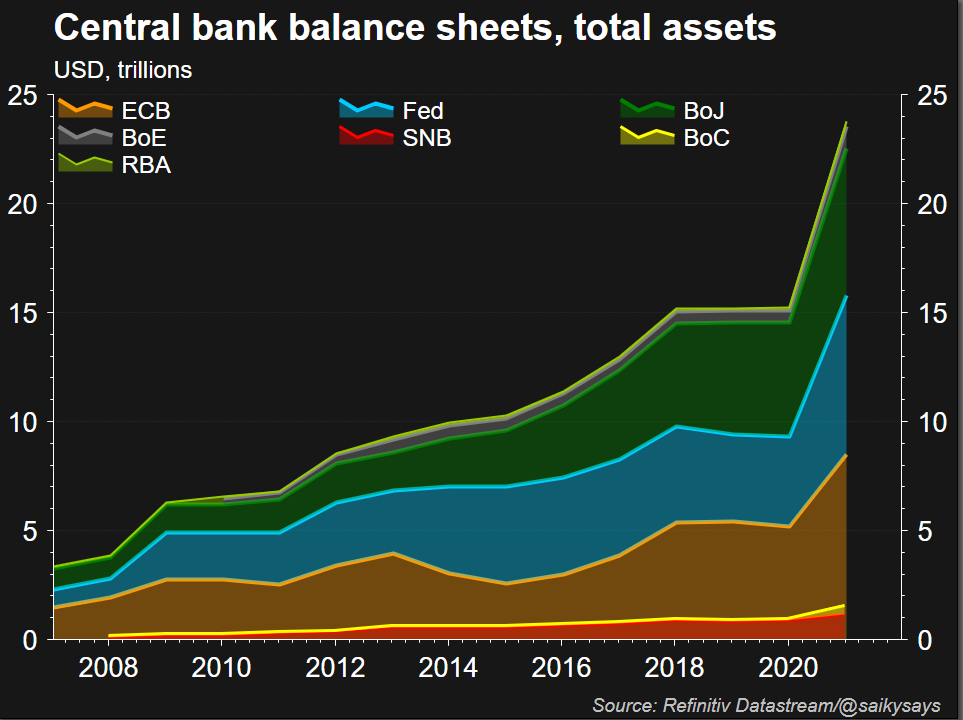
You do not get it.
This inflation is due to insiders (central bankers) printing money. Covid & ukraine are convenient excuses. Look up where this money ended up.
Help me understand: is this a stacked chart? Why does a chart that ends in 2021 show inflation in 2022 and 2023?
> This inflation is due to insiders (central bankers) printing money.
If this is about the money supply, why is food more affected than other products? IMO everything is a factor, and there is no one culprit, and therefore no one easy fix.
https://image.cnbcfm.com/api/v1/image/106649548-159664277043...

I look forward to open source ai economic simulation tools - when you change variables like m2, you'll see what happens to inflation - and there'll be no more ambiguity
For now: ask gpt-4 yourself & get a lesson
Imagine being a rational human and deciding that a war involving two of the biggest agricultural exporters in Europe, one of whom is also one of the main exporters of oil and gas, as well as a ton of different important materials (nickel, steel, fertilizers, etc.), after 2 years of pandemic that crippled global supply lines and resulted in explosion of prices in many raw materials, have combined absolutely no impact on prices anywhere.
We know the model pretty well: "money printer goes brrr" leads to higher prices for good and services. But the data lately doesn't make a great supporting case.
> I look forward to open source ai economic simulation tools - when you change variables like m2, you'll see what happens to inflation - and there'll be no more ambiguity
Economists have been leading the way in multifactor causal inference, but GPT in particular is not well suited to it. And macroeconomics in particular is hard to measure via natural experiment, so you're left trying to estimate counterfactuals based on a paucity of data
but look, my day job is people coming to me with timeseries data showing an engineering fuckup and debating about what caused it (usually ops vs prod). if theres a nuanced take, im all ears, but so far your fire has brought more heat than light.
you don't get it
money is worth less when there's more of it. especially 40% more of it.
all the inputs to your groceries (labour, energy, materials, transport etc.) thus nominally cost more
when inputs cost more, your groceries cost more
What do you think putting more money into circulation does to demand & nominal purchasing power?
An excess of money causes increased demand per unit dollar and subsequently, higher prices and inflation, through mechanisms including the Cantillon effect, changes in monetary velocity etc.
If i deposit more $ in your bank account, what happens to your nominal demand?
Ideally people would save for a rainy day. But people don't, and can't, always do this. Because for some this is the rainy day.
Non-ideally I would assume that most demand increases would go for non-groceries, and non-commodities in general, such as housing and travel, though I would expect some increase in durable goods commodity prices as people replace older goods with newer. Yet here we have grocery price increases. Are salaries in the grocery production chain going up 18%? I doubt it. The price increases are coming from elsewhere.
Is this a conspiracy theory or a simple observation of incentives?
They don't all have to actively conspire or even know one another for them to have a shared business interest.
Food inflation in Sweden is 22.1% over 12-month [0]
Food inflation in Norway is 8.8% over 12-months [1]
Obviously someone is making money hand-over-fist from this 12.7% discrepancy.
Comments like the one above are really disruptive to any constructive conversations. It is not a conspiracy.
The comment above is (at best) astonishingly naïve. While it is a emotionally plausible argument, we can see it does not hold up if we compare the rates of inflation over similar countries.
[0]: https://www.scb.se/en/finding-statistics/statistics-by-subje... [1]: https://www.ssb.no/en/priser-og-prisindekser/konsumpriser/st...
Maybe we should mention that Norway exports oil and gas, and Sweden does not.
https://www.nibio.no/en/news/ten-facts-about-the-norwegian-f...
[0]: https://tradingeconomics.com/switzerland/food-inflation
To say it is a conspiracy is true, in that corporations are conspiring against consumers to make more profit.
Some articles:
https://www.theguardian.com/business/2023/mar/24/greedflatio...
https://www.cnbc.com/2023/01/24/greedflation-food-brands-may...
https://www.theguardian.com/business/2023/mar/12/global-gree...
https://www.theguardian.com/business/2023/mar/02/ecb-looking...
Every western society heavily taxes working, where often for me as a freelancer it hardly pays of to work more then 6-8 months per year.
But taxes on wealth are very low. And owning property often has many tax cuts, and tends to benefit from low interest rates.
The effect of it is is that either you play the wealth game through property or investing or you are lost out.
I think it would be fare to protect the assets people accumulate through hard work, but at the same time it should be more balanced then it is now and we shouldnt all have to be financial experts.
On top of this, you've got Brexit which was orchestrated by the right wing conservative aristocracy class for their own benefit. And we've also had a conservative government that has not only not pursued a green agenda over the last 13 years, but bent over backwards to get Russian energy money.
So yes, the factors leading to inflation were outside of control. But that doesn't change the fact that the powers that be in this country have been running the country in their own self interests and have given up on even pretending otherwise and that is why the UK is being hit harder by inflation than any other country in the western world. They were so high on their own supply they even elected Liz Truss to cut taxes in an inflationary environment and only reluctantly accepted that they weren't going to get away with it when the global market responded by saying it would tank the property market (which the whole stack of cards relies on).
> Are they all friends with each other and plan all their schemes together?) against the “others”.
This is the UK with it's notorious and very real class and aristocracy system. They don't call the royal family "the firm" for nothing.
It was the same in most EU countries, but wouldn't that result in lower inflation? The rich that kept getting richer would invest in stocks, business, real estate, park it offshore, buy another helicopter or yacht, etc. which wouldn't impact demand for most products whose prices are increasing.
I don't think that's true. Right now, UK inflation is lower than almost any European country east of Germany, including Sweden, and it seems inflation was running lower throughout COVID than even the US.
How does printing more money to give to everyone lower inflation?
>The pandemic could have been the perfect opportunity for a soft debt jubilee to rebalance the system.
I don’t agree with either stimmy or the lockdown business handouts but I find it ridiculous people are using a world tragedy as some sort of crowbar to bring about their idea of some sort of require rebalancing. Not sure how those people even think how that could possibly play out beyond 3 months.
Starting to suspect some people feel the pandemic was the best thing to ever happen to them and are now upset it didn’t go further.
Amazing. Yes, I am sure the poor will just piss their money away on nothing. Rather than you know, starting businesses or upskilling themselves or paying their houses off or whatever. Because, you know, only the people already at the top of the pyramid know how to be productive and everyone at the bottom are just there because they're lazy and useless.
> I don’t agree with either stimmy or the lockdown business handouts but I find it ridiculous people are using a world tragedy as some sort of crowbar to bring about their idea of some sort of require rebalancing. Not sure how those people even think how that could possibly play out beyond 3 months.
Because historically, debt jubilees have been a common occurrence to maintain social order. The topic comes up semi regularly on hacker news, including yesterday. The fact of the matter is, if you don't agree with business handouts or stimulus, then you either don't agree with lockdowns and think we should have just gone about our business and let nature take it's course (if so I can see where you're coming from), or you want social disorder (I don't see where you're coming from). There's no way in hell you could have maintained a lockdown otherwise. People need money to eat and keep a roof over the heads and the poor do not have the savings to do that for an extended period of time without work. So if we're going to give money away to keep people alive, we might as well give more to the people who are struggling to survive rather than giving thousands and thousands to people who already have substantial amounts of assets. Similarly now with energy payment help, why on earth are we giving energy payments to people with second, third, fourth and however many homes rather than using that money to increase the amount we give to the poorest? That is not a ethical allocation of public money.
> Starting to suspect some people feel the pandemic was the best thing to ever happen to them and are now upset it didn’t go further.
If you're aiming this at me personally I was living at home and working a zero hours contract at a local venue so saw basically hardly any furlough money when the pandemic happened. I got £100 week from the job centre for and a handful of hours wage from the venue for a couple of months before they let us go. Meanwhile a guy I know who had been in his new teaching job barely a few weeks before covid hit was raking in over £3000 a month in furlough and treating himself to all manner of things like fire pits, jacuzzis and game consoles.
I saw the pandemic as an opportunity to escape minimum wage drudgery and worked my arse off improving my coding skills and used that to land a job at a local company as a software developer. Despite the fact half the developers worked remotely abroad, they made us go into the office with hundreds of others throughout the entire pandemic and then, when lockdowns were finally lifted for the last time, handed us all laptops and said we were free to work from home. So yeah, that was my covid experience.
So no, I don't think the pandemic was the best thing since sliced bread and that it should have gone further. What I do believe, is that when you give people at the bottom an opportunity and a bit of breathing space as opposed to pummelling them into the ground with debt and drudgery, is that those people can go on to make something of themselves.
No of course not. That'd be 90s-Mr-Burns territory.
Nowadays you pay a SaaS offering to do it for you if you're a landlord:
https://www.propublica.org/article/yieldstar-rent-increase-r...
So the question is -- is real estate the only market you'd do that in? Seems unlikely.
"If I had to guess, I would bet that the big food conglomerates have all signed up with some common AI-backed pricing software package, and that shares data between them. Or, at the very least, they've all started using AI algorithms to increase or decrease production of any number of goods to maximize their profits based on real-time sales and economic data. And since they're all probably contracting this out to the same or a handful of similar AI firms, the conclusions they reach are similar. If all the production companies are running algorithms that tell them to jack up their prices at the same time, well they all jack up their prices at the same time. They don't actually have to meet in some smoke-filled backroom to plot a price-increase conspiracy. They just all run similar algorithms that respond the same way to market trends. The consumer market is highly consolidated, with most goods having just 1-3 producers. If those few producers all sign up for the same AI price-setting software, there won't be price competition to punish needless price increases."
https://www.reddit.com/r/TrueReddit/comments/11gwm2y/europea...
Uh, you should google what the word "profit" means. You're thinking of "revenue".
But it’s a typical observation I have whenever discussing economics with Europeans — economic illiteracy is rampant, here, unfortunately, because schools do not give much priority to basic economic facts.
The economic illiteracy would be not being aware that all those megacorps are posting record profits and trying to gloss it over with made-up theories of your own an accusing an entire continent of people with economic illiteracy:
https://theconversation.com/food-giants-reap-enormous-profit...
https://www.nytimes.com/2022/11/01/business/food-prices-prof...
If their costs were rising more than their revenue, they wouldnt post record profits. They are posting record profits. You are simply wrong. You just !made up! a theory to avoid the actual reality.
Why have you made such a blunt, exaggerated, false statement like 'European economic illiteracy' without doing so much as a google search. Do you know how that made you look...
That‘s a newspaper article published last year citing an NGO report based on annual reports on the year 2021… that was way before the price surges really began. I would wait for the annual reports on the year 2023.
Nestlé e.g. (to stay in Europe) reported a 45.2% decrease of its net profit for 2022 — but, supposedly, also due to out of the ordinary profit in 2021 after selling L‘Oréal. But they also note: „Organic growth reached 8.3%. Pricing was 8.2%, _reflecting significant cost inflation_. Real internal growth (RIG) was positive at 0.1%.“
But it’s typical for leftists to cherry-pick their data and only read news sources that confirm their bias. I hope you are even more angry with me now. :-p
So, the corporations were bamboozling entire planet and sucking it dry during the pandemic, but they are not doing it now...
> before the price surges really began
What does even 'really' mean. 36% is not 'really', but some other percentage is? Doesnt make sense.
> Nestle
https://www.mashed.com/1117426/popular-food-companies-that-r...
There are heaps of other companies other than Nestle. One company doesnt make an argument.
> But it’s typical for leftists to cherry-pick their data and only read news sources that confirm their bias
Its not 'leftists' cherry-picking data. Its those who use vague words like 'price increases REALLY starting' - whatever that means - even as the very capitalist publications of the most capitalist corporations on the planet say that food corporations profited off of pandemic and the war.
So its basically the words of CNBC, Oxfam etc versus your 'really' theory.
> I hope you are even more angry with me now. :-p
I didnt notice that you were disingenous debater. I do now. It explains your absurd arguments, and the 'really' theory of price increases. I'll act accordingly and avoid losing time discussing with you.
> bamboozling entire planet
> …
> food corporations profited
> off of pandemic and the war
I am sorry but you are mangling together so many different things just to prove your narrative about greedy food corps profiting from food price inflation. It all just doesn’t quite make sense. At least, I am assuming that’s what you like to communicate: Food prices increase because food corps want to make insane profits. Right? Everybody will agree with you, of course, as nobody likes big anonymous corporations making billions in money.
I’ll try to show you now why food corporations might make profits and impressive ones, too, but why they can’t have anything to do with steeply rising prices and why their profits do not hurt the average joe, necessarily.
Let’s reflect a little a bit about what a price is: When food prices rise why do they based on economic theory?
In a first approximation it could just reflect a scarcity. Say apple juice becomes more expensive. That could be because apples had a bad harvest season. Or transportation was hampered so not enough apple arrived in the factory or became spoiled. Or there were not enough people available for the harvest or the transportation. Can apple juice corps. expect fat profits because of an apple scarcity? Well, only if a company was lucky enough and managed to produce and sell the same amount of apple juice for the same cost compared to the last season. But since there is an apple scarcity, most companies would have less apples and, hence, have less juice to sell. Furthermore, people tend to drink less apple juice when it’s expensive. Both effects offset the increased revenue per apple on average for all the apple juice companies and, hence, imply a constant profit.
Another reason for a price surge might be monopolization. Say, Nestlé bought all apple juice corps. and can now command a much higher price. Fat profits? Well, Nestlé would have had to buy all their competitors first and in that process had spent quite a lot of money to be in this position. That would have seriously slashed their profit (even though their apple juice revenue would have sky rocketed). Furthermore, again, people would drink less apple juice under these conditions. Finally, obviously, Nestlé isn’t the sole provider of apple juice and in fact does not happen to be the sole provider of food (as you stated yourself) —- so it can‘t in fact profit from a monopoly under the current situation.
A third reason for a rising apple juice price might be a trend shift: People might find apple juice suddenly more attractive and tend to buy more of it at the expense of orange juice and are willing to pay more for it. Surely, that would increase profits for companies only producing apple juice. Producers of both apple and orange juice (like the typical Food Corp), however, would just measure a net zero revenue shift and a rather similar profit unless apple juice production is much more efficient than that of orange juice. But — whatever, consumers wanted to spent more money on apple juice and are now happy nevertheless.
That leaves inflation for another driver of increasing prices. Inflation means our money is losing value and, hence, can not buy as much apple juice as last year. That affects both consumers and producers, however, meaning consumers can buy less apple juice but at the same time apple juice producers can buy less apples (and less machine parts and transportation services). That brings us back to my original argument: Inflation can not drive real profits as — per definition — inflation affects the economy as whole and hurts consumers and producers alike. Inflation does not mean a redistribution from consumers to producers as your thesis implies.
So why do apple juice corps. make profits in the first place? Because they spend less money in producing apple juice than they make in selling it. The larger the profit margin, the more efficient the company is and the bigger its profit. In a competitive market economy companies cannot just increase the price of the product they produce to boost profits. It is commanded by the market and is simply given. All they can really do is lower the costs of their production.
So while the food price inflation is bad — no doubt — it is not the fault of the food corporations with their fat profits. Ultimately, you want them to make a profit otherwise they would go bankrupt and couldn’t produce any food any more. And no food production is way worse than expensive food production.
Wouldn’t you agree?
In this case though, we're simply talking about inflation. One cause of inflation that you've neglected to mention is quantitative easing and how it's been used to artificially lower interest rates while allowing for higher deficits. I'd suggest you start there before you strawman people who disagree with you as "conspiracy theorists"...
Except countries in the EU, which has a common market that made such checks unnecessary inside of it. Of course there are still customs on the outside EU border.
So if you leave that, and your borders are now not internal market borders anymore but your and the EU's external borders, you're going to do more customs checks than you used to have. In both directions.
I agree with you that bureaucracy here is the problem, and Brexit was the cause of it.
It breaks democracy benefitting a few in power.
The effects of covid are actually the effects of covid policies which benefited govs and big tech and other corporation's while screwing most people. Yes, it appears that people wanted it but when you consider the censorship, behaviour modification propaganda and unconstitutional state force application to suppress people who wanted to oppose them, it's not that clear of a picture.
Then Ukraine, also something that benefits the gov, the energy/war companies and corporations, and not the people. Also heavily propagandized to push more profiteering through endless war.
No conspiracy. Just the system at work and people like you dismissing the true criticism with the same old labels. You may feel an impulse to call me fascist, racist and other customary labels soon, heh.
Do you mean the sanctions our rulers voluntarily chose to impose on that sector? Or is there something intrinsic to the war that would have that effect?
You don't need a formal conspiracy when interests converge.
- George Carlin
Fact is the inflation we are seeing here is caused by the after effects of Covid, the Energy price surges caused by the Ukraine war and in the special case of UK - Brexit, which has lead to huge import shortages due to increased bureaucracy at the border, etc…
So please stop this conspiracy talk about the “rich” creating inflation to disown the “poor”.