In places like SF and LA even existing traffic laws are not enforced due to "equity".
https://www.ghsa.org/resources/Equity-in-Highway-Safety-Enfo...
Vehicle weight is also a significant factor, so EVs will make this particular problem worse. Still worth the tradeoff, but obviously not using a car at all is the best option.
Tailpipe emissions are a significant problem (https://iopscience.iop.org/article/10.1088/1748-9326/ab35fc), and I know this is an extreme example but you can literally kill yourself by just leaving a car running in an enclosed space. EV tailpipe emissions are not fully replaced by electricity generation emissions, even if you get your power from 100% coal (and you don't). Power plants are much more efficient than internal combustion engines.
> "Tires release 100 times the amount of volatile organic compounds as a modern tailpipe, says an analyst."
> "Moreover, tire emissions from electric vehicles are 20 percent higher than those from fossil-fuel vehicles. EVs weigh more and have greater torque, which wears out tires faster."
I'm not sure how all of this works out in the grand scheme of things, or how accurate those claims are, but I think those are issues that surely deserve more looking into.
[0] https://e360.yale.edu/features/tire-pollution-toxic-chemical...
By solving the following problems:
- Waiting in the bitter cold / snow, or baking in the sun
- Allow me to transport medium/large size dogs (most restrict animals to being in crates that can fit on a lap), without being a bother to other riders (good luck)
- Reasonable wait times. Even better, do it regardless of time of day
I love my car. I've been in public transit in 5 states and 5 countries, and I'm always whelmed at best. It suffices on a good day.
What do cars specifically positively provide? NOT including the positives that exists due to constructing infrastructure around that mode of transportation (artificial issues).
Many areas simply can't be served efficiently by transit.
But what we cannot do is pretend that cars are inherently superior, ignoring the unprecedented investment we made in highways to make that happen.
But it also isn’t the case that improvements will take decades. Maybe solving the problem completely would, but local governments can convert big dangerous streets in to walkable areas with safer bike transport in just a few years or less.
Solving the whole problem would take decades but then, governments do tend to deal in decades long plans when needed. If they’re ever going to launch new national rail projects, they’re going to need the public to recognize the value of alternatives to cars.
Cars as the main method of transportation are obviously not good. They're too inefficient, no matter how you look at them. Manufacturing, infrastructure requirements, footprint per person, energy use, impact on human health and the environment. Cars suck.
People use whatever's most convenient and that's realistically going to be whatever the government has invested in the most.
The more car dependent a society, the more degenerate it is. This is hard to understand due to how car-infested most of the world is. Watch some videos by the Not Just Bikes channel on youtube [1] to see what reality could look like. Here's two direct links to poignant examples: https://youtu.be/AOc8ASeHYNw?t=204, https://youtu.be/oHlpmxLTxpw?t=361.
Here's an obscure video that exemplifies what's wrong with car culture: https://www.youtube.com/watch?v=qWi4gHm6pjQ. This is what a brainwashed society thinks like.
They are more practicable/convenient because the infrastructure is already in place. Also, in more rural areas there might never be an alternative. That is pretty much it.
There was some study done in past decade that found that in the US only about 60% of 18 year olds had drivers licenses. Is that because of preference, or other factors?
Real estate located where it is possible to live without owning a car tends to be priced much higher than comparable real estate located where it is inconvenient to not own a car. Is this because people's preferences, a significant under supply relative to only a portion of the market's of demand, or other reasons?
No we can't. It takes 30 minutes to get to the airport for me by car - even during rush hour, or 1.5 hours by express bus.
Or for a friend of mine - 40 minutes by car, or 2 hours by train + bus.
Sorry, but there's no fix you can apply to public transport that will fix this.
Public transport is also more expensive - I took a group to Washington D.C. by metro - it cost around 5x as much as driving did (we drove the next day) including paying for parking. And the metro was far far slower.
There’s no reason that bus has to take 3x as long as driving. Reducing the number of stops to a strategic few could make it very comparable to driving, especially if busses are given their own traffic lane.
In Taiwan, when you land at TPE, there is an express MRT line that connects directly to Taipei Main Station. You can also hop on the High Speed Rail and connect to southern destinations. Bypasses all of the traffic and congestion.
Fantastic way to travel and makes it so much more convenient.
Personal modes of transport like cars and bicycles give you more degrees of freedom compared to public/shared modes with respect to:
a) space (can go to more places point to point)
b) time (travel any time)
c) privacy
But if you like bullet points, cars are:
a) expensive to operate
b) dangerous to pedestrians
c) more polluting than trains or bicycles
Now I don’t actually think this form of argument is comprehensive but you see that we can easily pull out pluses and negatives without taking a holistic view.
This is what this statement was trying to address. If we built everything around using ziplines we couldn't go "OF COURSE ziplines provide a net positive." That'd be an incredibly silly statement.
Roads of course are useful for economic activity, but we’ve gone so hard in to roads that every person has to have their own car. If we put more commuters on trains, we could still have roads for trucks and other things that don’t work well for trains. But with every person needing a car, way too much land gets swallowed by parking and road infrastructure.
Speaking from the Netherlands with a relatively good public transit system.
Is that the latest euphemism for "school"?
What do you mean by crashproof car? Those words don't go together. Even a little.
I really don't think you meant to use the word externality here. And the other replies so far are not about positive externalities.
Perhaps roads are an indirect positive externality - roads are useful for bikes and buses, also useful for demarcation between properties or areas and addressing!!!
Perhaps you don't know what an externality is. Congrats, you are one of today's lucky 10000.
We are so focused on climate change and greenhouse gases that we do not see a lot of other issues and may exacerbate some of them in the process of decarbonisation.
Road tripping. Visiting far away family. Day at the lake or beach. Going camping. How do you convince people to give all of that up and just be content with whatever is 15min away.
The USA subsidizes the suburbs to an absurd degree, pushing most of the costs into the future and making city dwellers pay more than their share for the rest.
Living in a relatively large house in the suburbs should in principle cost several times more than living in a flat in the city, because it requires vastly more infrastructure and the amortized cost of services is much higher. But our broken economic system has flipped this around and made suburbs extremely artificially cheap, while making most of the building practices that make denser walkable neighborhoods possible illegal under building codes and local ordinances.
All for a back yard that’s rarely used and worse in just about every way than a nice park.
What they are is a cheap imitation of the wealthy enclaves near cities that only work because so few people can afford to live in them. You can imitate such buildings cheaply, what you can’t do is build or maintain the support structures which made such places so appealing.
Wealthy parts of cities have vastly better schools and less crime than the average suburbs, but the American middle class abandoned cities. Air pollution again can go either way, suburbs often have surprisingly terrible air quality made worse by long commutes.
Social norms also vary widely, first graders in Tokyo take public transportation to school alone. This isn’t inherently unsafe or unreasonable.
Sorry if the question is naive, I don't live in USA.
Building around roads results in everything being pushed farther away and that includes other people’s homes too.
Do kids attending the same school really live that far apart? Seems like a very long distance, especially in a suburbian neighbourhood.
Typically, those old suburbs were originally built around train stations or street car lines, which influenced their design. The newer ones were designed around access by car and zoning prevents any non residential land uses nearby.
My suburban neighborhood also has a metro tax district that funds the roads sewers etc.
In either case, the suburbanites (especially near the beginning of the construction cycle) and initial construction companies are getting a huge subsidy from everyone else (and from future generations) to promote an inherently unsustainable and destructive living arrangement.
It's a kind of Ponzi scheme, and like any other Ponzi scheme, at some point the music stops and then the whole system is in an extremely precarious place.
Of course the suburbs don’t make sense, you have a half mile of road out to a neighborhood and another half mile of street in the neighborhood itself. The percentage of property taxes going to the road is probably just a few percent points. With only a few hundred houses, it would take decades to raise the 1-3 million to replace the road.
And underused parking lots. Dear god the huge, empty parking lots.
The upside of how sparse American suburbs are is that we can repurpose all the junk/wasted land with normal market incentives. Roads can be thinned and the land handed back to the owners of that land, along with the setbacks that are used to force people to maintain water-intensive lawns[1]. Upzoned buildings can be redeveloped to higher density or turned into small commercial stores as market forces dictate. Anyone who wants to hold out can still do so.
None of this requires absolutely banning cars[2]. People will stop driving as cars become less necessary for daily suburban life. Road trips can still happen. So instead of families with three or four cars, maybe they only have one or two. As car infrastructure is used less, it can be repurposed for transit networks that don't suck - i.e. BRT, light rail, or tram systems with dedicated rights of way.
"15 minute city" doesn't mean "you should only ever travel 15 minutes on foot and anything further will be stopped by the pollution police". It means "building a city so that everything you need is closer and more convenient".
[0] Surface street / highway combos, i.e. roads with 3 lanes on each side, highway speed traffic, no pedestrian infrastructure, and business access. They try to do everything and fail at everything.
[1] Incidentally this was sold as a way to stop communism, somehow
[2] OK, but can we still at least ban the giant Escalade mega-SUVs that let you run down like ten kids without even seeing them
You could also rent a car for the 5 or so days a year the average person is doing anything other than commuting, shopping, and other local activities.
There is no such thing as free lunch. If you start absorbing massive amounts of solar, you will have some effect on the environment that we have absolutely no clue about. Same with interfering with wind patterns and ocean currents, which would happen with energy generation at true humanity-scale.
Critical thinking left the room a long time ago.
One great example (some will say absurd and impractical) is just using energy whenever it is available, with minimum storage. That means cooking, heating water etc. during the day (or when the wind is high) and only using lighting and low-energy devices at night. Factories could work on a similar principle (producing more in the summer) but then we would have to rearrange a lot more stuff to suit the seasonal renewable energy production capabilities.
This may sound absurd but it only shows how much we are locked in our way of thinking about how reality is supposed to work, not what it is. There's no reason to have high quality on-demand electrical energy available 24/7/365 other than convenience. Convenience that fossil fuels brought us.
This feels like about as useful a solution as saying "the US could balance their budget by simply disbanding their military". Would it work if implemented? Sure. Would the resulting world be arguably better than before? Quite possibly. Is there a path to that outcome from the present day with a nonzero chance of success? Well...
It magically disappears from this universe of course. The photons know if it is actually being of use to sentient humans and decides to wreak havoc (in some as yet unknown fashion) only in that instance.
I suggest nothing other than what I said - discussions around new technologies, particularly those in response to perceived crises, rarely receive the scrutiny they deserve and rarely show both sides of the coin. This makes me immediately suspicious for the same reasons history has already shown time and time again.
Tidal Energy Is Not Renewable
https://cs.stanford.edu/people/zjl/tide.html
We really have to think this all through before jumping 100% on any particular bandwagon. Researching, testing, seeing how it goes and adjusting is a must.
Nothing is a silver bullet but I'll be much happier when we're done with ICE noise and exhaust.
Agreed. I can't even hear the engine in my car on the highway over tire and wind noise.
You mean like at a stop light or even a stop sign? A very common thing to be near in a city?
And what is your point, in general? Engines make noise. That's not under dispute.
> As required by the PSEA, (1) this rule proposes to establish FMVSS No.141, Minimum Sound Requirements for Hybrid and Electric Vehicles, which would require [quiet vehicles] to produce sounds meeting the requirements of this standard. This proposed standard applies to EVs and to those HVs that are capable of propulsion in any forward or reverse gear without the vehicle's ICE operating. The PSEA requires NHTSA to establish performance requirements for an alert sound that is recognizable as motor vehicle in operation that allows blind and other pedestrians to reasonably detect a nearby EV or HV operating below the crossover speed. The crossover speed is the speed at which tire noise, wind noise, and other factors eliminate the need for a separate alert sound.
>[...]
> This standard will ensure that blind, visually-impaired, and other pedestrians are able to detect and recognize nearby hybrid and electric vehicles by requiring that hybrid and electric vehicles emit sound that pedestrians will be able to hear in a range of ambient environments and contain acoustic signal content that pedestrians will recognize as being emitted from a vehicle. The proposed standard establishes minimum sound requirements for hybrid and electric vehicles when operating under 30 kilometers per hour (km/h) (18 mph), when the vehicle's starting system is activated but the vehicle is stationary, and when the vehicle is operating in reverse.
Some ICE cars are noisier by choice of course but modern commuter cars are very quiet at the exhaust typically, the road noise is the dominant noise.
I have cars driving past me at about 50kph right now, I am barely hearing the engine for about 3 seconds or less as it passes, and the road noise continues to be audible for about 20-30 seconds. Pretty much all I am hearing is road noise. Same was true when I lived near a highway. Just a whooshing blob of road noise.
Indeed at slow speeds EVs are quieter. That probably does make a difference for inner city traffic, which is also where you really want less tailpipe emissions, EVs help there too.
It's pretty evident when you drive next to a large vehicle with knobby tires meant for off-roading (Jeeps seem to commonly have these). The tire noise is easily MUCH louder, even ignoring any engine noise.
The other thing, broadly, is road construction can lead to a huge difference in noise from highways. I'm sure you've experienced huge differences depending on the road surface.
I think that is good in one aspect though, road noise is the only warning you get that an EV is approaching, which in a PED/Cylcing friendly city is important.
Personally, I'd prefer strongly if road noise were eliminated entirely. It'd lead to a better society broadly by reducing noise pollution. Ped/cyclist safety is better handled by other policies than "just make more noise" IMO.
EVs are just cars, any tire that you can put on an EV you can also put on an ICE car, so that is not a differentiator.
EVs tend to be heavier though, and weight is a primary factor in how fast a tire wears.
Not to mention the jerks intentionally making noise with loud engine mods but I guess there's no getting rid of them.
I really don't think it is. We're thrusting ourselves into just new problems. Yes, we move away from old problems that gas-powered cars have, but we move into new problems. For one, EVs perpetuate the idea of the car, which is perhaps the most dangerous part. Then, there's all sorts of new things like building out the infrastructure required for EVs and mining the new materials. For example, have you looked into the areas where lithium mining occurs? It is not a clean process and brings its own new problems, especially for the local people. You have foreign owned and operated companies move in and suck out manufactured value from the land, all the while polluting the local ecosystem. It's oil all over again.
It isn't contrarianism to point out that a solution is not the solution everyone thinks it is. Yes, we should probably switch to EVs, but we should be switching away from cars as a whole. But we're not. Cars are selling more than ever. It's not contrarianism to simply look at facts rather than hype.
Make competing modes of transit at least one of more useful at no more cost or no less utility but at a lower cost and people will switch incredibly quickly. That's a tall order, because the modern automobile is a wonder of transport speed, comfort, and convenience.
*) it's estimated up to 20% of the US's defence budget is spent protecting oil supplies for a start.
If you want to undo the car centric culture and economy, you cannot just ignore the broad base of popular support it enjoys.
So yes the car is convenient but we also built many things to make it more convenient. In places where subways/rapid transit are made more convenient, there’s of course less parking and less road space and naturally % of car ownership goes down
It’s a choice. It’s not naturally always based on the merit of the car.
There's order of magnitude 1 car per US resident. Does it seem like there are 800 parking spots per US resident? A quarter of a trillion total parking spots?
If we did it once for cars we could do it again agin 'em.
I'm happy to accept the reality that currently we have no form of alternative transport technology that offers the same comfort & convenience of the car - but I also believe we'd've been better off in the long run if public spending hadn't been so grotesquely skewed in favour of that particular option - other technologies would have had a better chance to come to the fore (e.g. why have e-bikes/e-scooters taken so long to become popular - there's no particular reason I know of they couldn't have been a big part of our transport network 20 or 30 years ago), we could have laid out our cities so we didn't need to travel such huge distances on a regular basis (vs, e.g. occasional long-distance travel between dense hubs where most facilities and services could be accessed via walking/cycling etc.), goods transportation could've been revolutionised by dedicated automated networks etc. etc. For me the most convincing argument that exists against the size (and reach) of government power that we've become accustomed to is that so many opportunities for a better balance of transportation options have been lost to a virtually single-minded focus by the powers-that-be over the last 70 or 80 years on private cars above all else.
If the kids grew up in a different world and we advertised sticking to it during election season, we’d stick with whatever that is too.
Politicians are the biggest rent seekers on the planet. They are not the sort to suggest changes to status quo as then they’d have to do real work crafting the laws around new thing.
It’s popular because we’ve been sold on it by manufacturers and politicians since we were old enough to translate the commercials during football and evening news. Thats not a thing with the internet, and clearly discourse is changing.
This is kind of a chicken and egg problem.
The value of a car is proportional to the extent of the road network. There is no value (for most cars) in isolation.
The original push for government investment in car-friendly infrastructure and highways was from industrialists, technocrats, and military minds. It was top-down planning, not bottom-up. After those major infrastructure investments (and divestments from commuter rail), the car was an obvious choice. Everything after that was self-reinforcing: more cars -> more roads -> more cars -> more roads. Of course if you already own a car then it is a sunk cost and you will prefer the government spend more on car infrastructure to benefit you, further perpetuating the investment cycle.
If the initial circumstances had been different (maybe progress in electrification proceeded a little faster and oil refining a little slower) then public transit and urban planning might have developed differently and the car would not be as important as it is now (practically a necessity in most of the US).
In the US, this is true.
In most European cities, you can just walk instead, or take the metro or a tram.
It's really convenient to just walk to where you want to go, and when the grocery store is a 10 minute walk away, you don't need to fill a car with groceries. Just go more often.
Need to go further? Clean and safe public transportation is often more convenient than having to drive yourself.
I really like being able to read a book on my way to work rather than paying attention to the road and making sure i don't kill myself or someone else.
Undoing our mistake is always an option.
I will not take my kids on any transit where they might be assaulted by a naked homeless man. America will never have safe public transit because it lacks the will to handle the mentally ill and addicts.
Thankfully in Australia's biggest cities our public transport systems are generally clean and safe to use - but a) they're not always super reliable, despite some improvements in recent years b) they're often poorly interconnected, meaning I could potentially do 80% of the journey sitting in comfort on a train, but spend 3 times longer than it would take to drive trying to deal with getting to/from train stations and c) there are still huge areas of said cities that are fairly poorly served by trains, and buses will always be a second rate way of getting around. Oh and d) you can't carry v. large items or animals on most public transport (*). All solvable problems, some easier than others, but there's a distinct lack of real political will to do so.
(*) e.g. it'd be a 15 min train ride to take my dog to the beach from where I live, but she's not a service animal so wouldn't even be allowed on, despite taking up less space than a human.
If you want to make wholesale changes quickly, you probably need the support of voters.
Nobody put 240V center-tapped, 60 Hz AC residential electricity to the voters either, but if you wanted to change it, you're probably going to need a strategy and a communications campaign to explain why and how.
If I can send my car out to be a robotaxi while I'm at work and/or :^) asleep, then how much do I care that MY specific vehicle return to bring ME home, when I could just use any other robotaxi available? So then I don't own a car at all and ownership elsewhere falls and the number of total cars drops to the number needed to handle only the maximum number of simultaneous rides.
EVs are usually designed for consumers convenience insofar as being able to travel a substantial distance between charges to accommodate a minority of actual use when user may need to travel further than the average commute inside the city. A company that operates a fleet of taxis can purchase a very large number of short jaunt single/dual passenger EV and a much smaller number of large vehicles and task the former with the majority of rides either charging frequently when unused or hot swapping batteries when theirs get low. Therefore weight and ergo tire dust might be decreased even more so than one might imagine from size alone due to the reduced battery needs.
One might also suppose that in exclusively urban environments it might make sense to provide harder tires designed to produce less dust and less aggressive driving than human drivers to the same end.
If we look at the economics of Uber and Uber Eats, we see that they have shifted to ride sharing and also delivery sharing. In that, it makes more sense to bundle up multiple people and deliveries into one. Doesn't that sound a whole lot like buses?
https://www.templetons.com/brad/robocars/design-change.html is very old and there are newer discussions, but I'm too lazy to find them for you. Also michaelmrose's answer.
London: 3.6b pounds https://www.google.com/search?q=london+tube+government+subsi...
New York: $7.2 billion https://new.mta.info/budget/MTA-operating-budget-basics
Amsterdam: 370m euros for 3 months service https://www.railjournal.com/financial/dutch-government-provi....
Ok, Hong Kong appears to turn a profit.
(Even more abstractly, it doesn’t matter whether or not public transit is highly subsidized, so long as the positive externalities of that subsidization are deemed worth it. You don’t get to the size and density (and corresponding economic output) of cities like NYC by allocating personal parking space for every resident.)
It's also heavily subsidised and its cost does not include a signficant chunk of externalities.
Also, this has been discussed to death, but a large chunk of car usage can be replaced by other modes of transportation. However, that transition requires upfront infrastructural investment.
Sadly, arguments like yours ensure that investment won't happen. So, externalities will keep piling up, until the situation will get dire enough that 1. it can't be ignored anymore and 2. it's too late to meaningfully undo the damage.
> "Faced with severe shortages of oil .. Japan decided to attack the United States and British forces in Asia and seize the resources of Southeast Asia."
Had they not decided to invade Indochina (and China before that) US wouldn’t have embargoed oil exports to Japan.
It's OK to be against the Iraq war or all war, but it's not OK (or at least accurate) to say it was so we could get their oil, pretty much the exact opposite.
Stop fighting it, you're wasting energy.
pursuit of speed, comfort, convenience and immediate utility with scarcely a thought for consequences is precisely what is propelling us toward hard physical limits at breakneck speed
Not where I live, in north western Europe. Here the subways are fast, and not many use cars inside the city. Many buses and bike lanes too.
Here, cars are slow: traffic queues, finding a parking lot. But the subway never runs into any traffic queues.
And the subway is many times cheaper than a car's monthly cost. And I can read HN on the subway
Literally nobody thinks that EV's will reduce microplastics. What are you even talking about?
EV's have the potential to dramatically reduce our reliance on gasoline. Current EV technology is far from perfect, but do you think people will just stop having personal transportation? Do you think it's better to keep using gasoline cars forever? So you agree that some kind of non-gasoline personal vehicle is likely to be dominant for some time as a method of personal transportation, unless you are just ignoring reality completely or think that people will magically change how they live in even more fundamental ways without incentives to do so, which is magical thinking. So EVs are inevitable, since there is no other credible alternative to gasoline personal vehicles that is even proposed, and EVs are starting to displace gas vehicles in significant numbers.
So keep shouting as much as you like about how we need to 'stop normalizing the idea of a car' but just realize that less than a fraction of a fraction of a fraction of 1% of the world will even bother to listen to it, and in the meantime we are likely to end up building several billion electric cars before another alternative comes around. If you want to change the world, develop the technology that makes it make sense to act the way you want people to act, because nothing else will persuade anybody.
Not that, for starters.
Is there data that proves inconclusively that electric vehicles AND the new infrastructure and mining and every other systematic thing that comes along with them and doesn't currently exist is actually (not just hopes and dreams) less impactful on the environment? Because as far as I can tell, your comment relies on that, and I haven't seen that data. I could care less about holding on to gas-guzzling cars. I would just like to understand things better before jumping headlong into a "solution" that may or may not be any better. And there are massive incentives for companies to jump into EVs, so there is a lot of conflict of interest with EVs. Can corporations and investors be trusted when they stand to make a fortune?
Again, my point is to reach an understanding. I do not currently understand why EVs are some bastion of hope when it comes to cars. The best data that I have seen does not account for disposal of batteries nor the mining, long term maintenance and upkeep and continual use of EVs, infrastructure, etc. when it comes to EVs. And if they are better, then where is the crossover point when all this is considered? Is it 10 years? 50 years?
And yes, I do think re-enforcing the car is not a good idea. You can think it's unrealistic, and sure, in the short term it probably is. But we shouldn't just throw our hands up and reach for a new "solution" that just brings new problems.
It is hard to find, but what I have found is that EVs cross over, in terms of emissions, around 6-24 months into ownership over ICE vehicles. This accounts for manufacturing to use. As far as I could tell, it does not take into account the new mining required, the new manufacturing centers, the new infrastructure, battery disposal, end of life scenarios, etc. Basically, what I've already said.
These are systems. Yes, in isolation EVs are better than ICEs. As you start to broaden the viewpoint, I think things get a loss less definitive such that the wins become a lot less impactful.
So that effectively confirms (and is actually worse than) what I stated above. Everything else I am merely asking about because I haven't seen the data that says one way or the other. You and the other commenter claim there's the magic data out there if I "just search for it", while everything I've stated is just oil propaganda. It's just dumb that if you even ask for data regarding EVs, you get labeled an oil person, when such a claim, for myself, could not be further from the truth.
The Volvo report seems pretty good, so I guess I'll read it while missing out on your and the other commenters' magic data unless you decide to materialize it. Although, it goes without saying that Volvo stands to make money from this, so there is a conflict of interest for sure, at least for this particular report. But it seems relatively accurate to my read so far.
My advice is to sit and actually decide before you research it what constitutes "good" and "improvement" for this topic. Then go see if you can decide whether those things are delivered, potentially. Then write down a list of specific "problems" and try to verify, feom credible sources, if they are really significant problems. Otherwise no matter what is presented you will just keep saying "yea but" and bringing up new unrelated "facts". This is the sort of emotional argument used by talk radio charletans.
That means not just saying "infrastructure" as though that is an actual argument. Keep in mind any argument that could equally well be used against current technologies as well is not a valid argument against electric cars.
For example, in 1915 I could claim that adoption of gasoline cars is impossible because of a lack of infrastructure. You would have to build a gas station on every corner in the city! This is not a valid argument because they did easily build all those gas stations, as well as a vast network of pipelines to deliver fuel to them, millions of workers to sell the gas, hundreds of refineries, etc. So when you make vague claims about infrastructure, you need to state what infrastructure and why its not reasonable for it to be built, and in fact you have to show its not even possible for it to be built. The market for cars is vast, the amount of resources available is enormous.
I don't know why you are claiming my data is FUD when I meed to explain this basic fact about EVs. It's also explained in the report I linked.
The point, which is very well known at this point, is that manufacturing EVs actually causes much higher emissions than ICE cars. In other words, at time of purchase, buying an EV is worse for the environment than buying an ICE car.
Since EVs are cleaner to drive but not manufacturer, it takes time for EVs to emit less emissions overall. That's what I have mentioned and the chart in page 6 mentions. It takes tens of thousands of miles of use for EVs to have less cumulative emissions than ICE cars.
So this is just one component that shows EVs are not strictly better. My overall point is that such estimations do not take into account the rest of the EV ecosystem which can only worsen the numbers for the EV case.
Given people usually buy new cars fairly frequently, it's very possible that EVs are a wash in terms of environmental impact and that it might take several decades, if ever, for them to actually be better. This is important to understand, to question, and to investigate.
At the point of purchase, buying a reusable water bottle is worse for the environment than buying a disposable water bottle. This is not a complete argument.
> Since EVs are cleaner to drive but not manufacturer, it takes time for EVs to emit less emissions overall. That's what I have mentioned and the chart in page 6 mentions. It takes tens of thousands of miles of use for EVs to have less cumulative emissions than ICE cars.
Vehicles last about 12 years on the road (on average in the USA). Average miles per year is over 12,000. It seems like your argument implies that EVs very very easily save emissions over their life, and probably massively since they will pay for their own emissions 4 or 5 times over their life. This assumes that EVs don't have a longer life on the road than gas vehicles, but it is reasonable to think they could last longer.
> So this is just one component that shows EVs are not strictly better.
No, it absolutely does not show that. It shows that you can arbitrarily pick a moment in time where an individual EV is behind in terms of emissions, but that over the average life they are STRICTLY BETTER. If on average they are strictly better, then net they are strictly better (this is how averages work).
> Given people usually buy new cars fairly frequently, it's very possible that EVs are a wash in terms of environmental impact
This is a very stupid thing for you to say. You don't get to just make up nonsense and draw conclusions from it. This isn't something you get to just say 'people like buying cars, therefore they won't drive them enough to save emissions'. You have to look at data and extrapolate from the data, and the data says you are just being ridiculous. Like not even close, COMPLETELY REDICULOUS.
Entangling ideology with progress is a recipe for getting nothing at all. We see this consistently in climate activism and drug activism. If you try to use a crisis (say, global warming) as a wedge to force your ideology (say, austerity) on the public, you get zero progress on said crisis.
But that's not "entangling ideology with progress", that's just ... pointing out the drawbacks of a progressive initiative (EVs).
Put another way, the idea of a burger decoupled from the beef industry has few negative externalities. The idea of a cat decoupled from fossil fuels does.
Article here: https://earth.org/tyre-pollution/ Research here: https://www.emissionsanalytics.com/tyre-emissions
Right now, there's a big push to move to EVs. However, in the long run you might end up with more cars total. As the old cars aren't going away for a while. So you're kinda pushing a even heavier car dependence on society. All for a small net gain of reducing a few ICE vehicles.
If the same subsidies were also applied to (electric) bikes, public transit etc it would instead actually shift behavior.
EVs aren't saving society. They're saving the car industry.
Can do it cheaper like how they did in Paris: just give some of the roads and lanes to cyclists. Almost free, might need a bollard in the beginning, but the road is there already.
Maybe some of it, but it's very valid point.
Switching everything about the country's infrastructure from gas to EVs is a huge undertaking. If we're going to do such a massive change, just to end up with something that still carries all the same problems except one, that's a missed opportunity.
If there was a will to spend that quantity of effort in making public transit practical for the long haul and heavily promoting cycling and e-bikes for the short haul we'd be much better off.
Would be better to walk, bike, take public transport or similar or course. And if your area makes that not viable, consider fixing that.
(All the famed bicycle paths in Copenhagen are relatively new - they can be added anywhere.)
Soil exhaustion, poisoning, and erosion; groundwater depletion and poisoning; deforestation; wild ecosystem destruction and food web destabilization; coastal sea surface and seabed destruction; river and lake poisoning; acid rain; carting invasive species around the world willy-nilly; anoxic ocean zones; hunting fish species to extinction; the ruinous effects of mineral and sand mining... all in parallel with the effects of extra carbon in the atmosphere.
Just to put things in context.
A bike ala a Tern cargo bike solves most of a family with kids needs where I live. (disclaimer, I'm not living in a car based society like the US). Then for hauling big stuff or something one just rents one of the share cars in the street for an hour or two.
But I do live in the US where the city is fairly car-centric, and it is ludicrous to suggest as the person I first replied to did that a cargo e-bike is a full replacement for a short-range electric car like a Leaf. There are large commercial sections of my city that cannot be safely accessed by bike, as the only ways to get there include highway off-ramps that have a 12-inch shoulder, with concrete barriers to the right and cars going 50mph just a few feet to the left.
Few people would regularly bike on such a route with their children. Especially in inclement weather.
I can take care of 70% of my day to day life with my ebike. But for the remaining 30%, a car really is necessary. And that 20% is too frequent to rent, especially lacking the inexpensive carshare services of other countries.
> If a low range EV is enough 100% just buy a bike.
Pretending that a short-range electric vehicle is not useful because ebikes exist is just sticking one's head in the sand and pretending that people unlike oneself and locations unlike where one lives do not exist.
People will buy a car because otherwise they would be a low status male and they want to f#. Note that cars are expensive, I live in a poor country with absurd interest rates, so many are making debts that they will need a decade to get rid of, if ever, just so they can constitute a family.
Here at least car culture is squeezing the middle class into indebtedness and poverty and overcrowding the streets with cars and idiots, not a causal relation but a dangerous combination. Cars are great tools but f# car culture.
And EVs make almost zero brake dust. On many EVs the pads will last the life of the vehicle, unless they malfunction due to non-usage.
So, EVs are a huge improvement.
Recently, tire manufacturers have started phasing out some of the nastier additives in tires (due to a new one causing fish die offs when it rains).
Tire dust is still terrible though. Hopefully, it’ll be the biggest environmental problem today’s toddlers have to deal with.
If anyone was serious about any of this, wfh for anyone that can is such an obvious solution with by far the lowest cost. Its a solved problem, we just don’t like the solution enough.
Fixing that is much harder than switching to EVs and would have a massive environmental impact. Buildings have 2x more global warming footprint than transportation.
Also, due to range anxiety, they tend to use low rolling resistance tires that wear more.
I spend more on tires than electricity for my EV, so I can imagine someone offering low efficiency / low wear tires as an option.
The above leads to about 20% more tire dust on average.
Yes, they do. Even our lowly Fiat 500e's consumed tires much faster than any of our ICE cars.
It's not just raw power, which a Fiat 500e doesn't have much.
It's the fact that with an electric motor you have 100% torque at 0rpm starting from a standstill, which is when there is most opportunity to briefly spin the tire. Tire wear is much reduced when driving in a straight line at a constant speed.
Wow, people are going to be pissed off in thirty years. "Why didn't that fix it all? We have to do more?"
Certainly no, that's not why people are "cautious". They are hesitant about EVs because they fear running out of "gas" mid-trip.
Most people don't give a shit about anything except their plans and needs (and not necessarily unreasonbly so). You can just look around at what kinds of cars most people purchase to reason what their priorities are (or are not).
Reducing greenhouse gasses are not on most people's priority list.
So for affordability's sake, figure out how to avoid cars entirely is the best bet.
Assuming charging is available at most gas stations on US highways, it's still not attractive to most people to have to wait 30 minutes (or whatever) for a fast charge to allow them to continue their journey.
Norway might be a good use case, but currently the US is not a good use case (except in town). So US buyers will still need one gasoline car for road trips.
Personally I'd prefer passenger train infrastructure over millions of electric cars. Equal or more cars is, as the article notes, still a bad thing.
Well no, it wasn't. My partner just bought a new EV recently and range anxiety is huge. I've been researching places to charge and there's nothing convenient nearby. There's an old business campus but it's a sketchy area to go sit for an hour or more. There's one near a starbucks close by but they are ridiculously expensive (95c/kwh). The best one is at a whole foods, but requires driving 15 minutes away from their destination, go sit there for an hour and then drive to campus. Not so great.
There's no reason that an EV needs to weigh as much as a Sherman tank.
And at certain times of the year, the "dust" smells like manure.
They’re worried about the wheel and wind noise, I think.
If I lived near Caltrain, I’d be more worried about diesel exhaust and commute times (the new trains are faster).
The windows on the railway side gained a gritty, black dust. On the road side it was an oily black film.
Only motorized vehicles allowed are a handfull small electric transporters for logistics (and construction vehicles, ambulance).
Turns out the space gained from lack of car infrastructure increases space efficiency by a lot (not that that wasn't obvious from theory).
It really was bliss and it makes me despise the status quo so much more fervently. Paradise is so close and yet so far away...
It's mind boggling how much resources get poured in to cars and car infrastructure only to provide a slower, inefficient, more expensive, and toxic system. Feels like the next generation is seeing this now and things are slowly starting to change in some countries. Not sure how fast we can undo decades of damage and corporate brainwashing though.
If there’s no roads and vehicles, how does the food get to the supermarket?
You can still stock supermarkets, etc, with larger vehicles that only run once a day or every few days depending on demand, etc.
It's common in places other than the US with it's hyper car centric development to have more walkable spaces.
These bad faith arguments are tiring.
Roads and streets existed before cars. Even then, that ignores that the same location can be traveled to through different means. Goods can be delivered to a store by a van even if most customers arrive on foot or by public transportation.
There are streets within north America which ban passenger vehicles but still allow trucks and vans for deliveries.
The other times these are closed with things like this: https://lowist.be/app/uploads/2017/03/Meir-antwerpen-4-1024x...
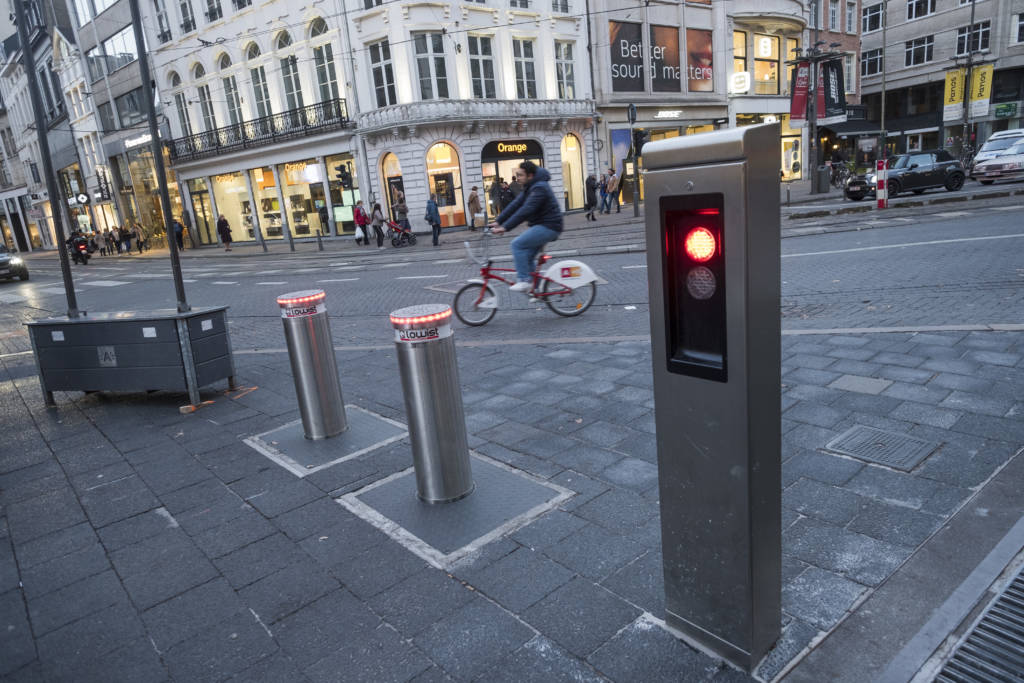
Now each of the towns' refineries and chemical plants have grown in response to consumer demand for automotive fuel, but these are not really big cities and they don't have the number of cars you get in Dallas or Houston.
But you still get some fine particulates that build up after a while, like when you wake up and find a layer on your car after you just washed it the day before.
Even when it was black it wasn't tire dust, and sometimes there would be brown, white, grey, or yellow. You never knew what you were going to get and when. Depending on the wind it could be a discharge from Mobil in Beaumont, Texaco in Port Arthur, or DuPont in Orange.
This is what you get before the fuel even makes it into your tank, so that everyone can spread their tire dust all over the rest of the country.
I've also spent time near the 10 freeway, in Texas. A major cross-country thoroughfare for 18-wheelers.
I'm also guessing that simply walking around the city and being in the subway is also pretty bad. Separating the tracks from the platform with doors would probably help with that.
- sourcing rare earth materials needed for batteries and computer components
- powering them
- handling the waste cars when owners upgrade or crash them
- putting tires on them
- the space needed to operate and store them
- the amount of time people spend in them
- the amount of labor required to build and maintain them
- the amount of labor required to maintain roads for them (maintenance, snow removal, etc.)
Doing any of this arguably involves human rights or ecological disasters. But that aside, barring widespread fusion reactor deployments, it is impossible. This above all else is why I just can't agree that Tesla will save the world or that self-driving cars are the future. They simply can't be, unless the future is absolutely terrible.
The western world is due for a reckoning. If we flatten out living standards across the world, GDP per capita is $12,414. If you want to be extraordinarily generous/cruel and leave out everyone except the US, Canada, Europe, India, and China it only goes up to $17k. That doesn't leave room for things like car ownership, air travel, Macbooks, college, eating out, child care, health care, etc. etc. It also doesn't help (to put it lightly) that the overwhelming majority of population growth is going to occur in poorer parts of the world.
The simple truth is either the western world figures out how to make do with far, far less than it currently does (and notably its elite essentially learn to be poor) or we suffer a prolonged period of intense violence while everyone else either quietly suffers/dies or loudly makes us pay for hoarding. There's a sliver of a chance where we figure out how to generate enough clean energy to raise everyone's living standards enough to pacify them, but it seems inevitable that the inequality that characterizes the current arrangement will apply to that as well, i.e. 1% to Africa 99% to Europe. It's possible they're just used to it and won't complain, but my guess is that climate change will force the issue.
demonic?
spare us the histrionics
I made the mistake of renting next to the freeway. Noise was perfectly tolerable, but I could not use my back porch, because after just a few weeks, everything had a fine coating of black dust. I could not keep my windows open in the summer. I was certainly breathing this vile shit the entire time I lived there.
This doesn't surprise me in the least. Every time it rained you could see streaks of black sediment trails where rivulets would collect and concentrate it. It flowed completely unfiltered straight into the ocean. Poison.
The negative externalities around cars are incomprehensibly huge. And yet, we have more of them than ever, they are getting bigger and bigger, and they laugh in our face with "green leaf" or "PZEV" decals. It's demonic.