`The commission documents said Perkins Coie — where a partner at the time, Marc Elias, was representing the Clinton campaign — paid Fusion GPS slightly more than $1 million in 2016, and the law firm was in turn paid $175,000 by the campaign and about $850,000 by the party during six weeks in July and August 2016. Campaign spending disclosure reports described most of those payments to Perkins Coie as having been for “legal services” and “legal and compliance consulting.”`
https://www.nytimes.com/2022/03/30/us/politics/hillary-clint...
https://www.usnews.com/news/politics/articles/2022-03-30/dnc...
Degree of severity and attempts to conceal a crime are both considered serious factors in punishment a crime merits.
> Degree of severity and attempts to conceal a crime are both considered serious factors in punishment a crime merits.
Which do you consider a more direct violation of campaign finance law with direct intent to benefit a campaign?
1. Paying a lawyer to pay a woman to not speak about an elicit affair from a decade prior.
2. Paying a lawyer to pay a private investigator to compile a negative dossier about your political opponent in the, at the time, current US general election.
Maybe reflect then on why one campaign settled a law suit, and Trump is being indicted at the moment, if again, neither is actually illegal under campaign finance law.
Hint: it's legal to pay for opposition research, but a violation to not disclose that you're doing it.
It's also legal to pay for an NDA, but not legal for the NDA to be created by direction of one's private lawyer, and then subsequently to use campaign finances to reimburse and list bonuses to that lawyer for legal services they never rendered to the campaign.
If Trump gets a $1000 fine for this, I feel like that's justice.
It's felony or nothing as the statute of limitations has expired on the misdemeanor. My money is on the latter.
Similarly the DOJ looked at the Trump hush money case and declined to prosecute.
Campaign finance laws in the US are a land mine and need reform. There is too much prosecutorial discretion and not enough clarity for people to know whether they are breaking the law. Campaign finance laws have become a way to fish for a crime against political enemies.
To wit: Bragg actively campaigned for his position promising to investigate Trump.
Rule of law should be about observing and then prosecuting crimes, not about spending years and millions investigating people looking for a crime that they committed.
But I'd still say that we need to see more details of the case than have been released yet before drawing any conclusions.
We haven't seen the indictment yet so it may be well justified but the scuttlebutt so far does not seem to strongly indicate that.
Such an odd take.
And that "impossible to prosecute all" is BS. We are talking couple of people here.
The article referred to in the parent asserts that Clinton was also prosecuted (albeit for a different, and lessor charge apparently). As many others have been. So the argument you're making here seems rather weak.
> The Clinton campaign agreed to a civil penalty of $8,000
It really helps to know the difference between civil, criminal, charge, prosecution and indictment when reading such things, and to keep note of who is being charged etc by whom.
Regarding the email server farrago, she was not prosecuted for that either. As this helpful article[0] comparing the raids on Mar-a-Lago to the email stuff points out:
> So prosecutors decided "there was no basis" to charge Clinton or her aides, the inspector general said.
and
> "The biggest difference right now between Hillary Clinton and Donald Trump" is that with Clinton, "we know there was no prosecution -- that ship has sailed,"
The NYT article also backs this up by not mentioning any charge, indictment or prosecution. I certainly didn't notice it. Hillary Clinton is mentioned once.
> Some Democrats pointedly recalled Trump supporters’ calls during the 2016 election for Hillary Clinton, then the Democratic presidential nominee, to be arrested.
> “Those lock her up chants that people were chanting like hyenas in a stadium around the country were never funny,” Representative Jared Moskowitz, a Florida Democrat, said in a Twitter post. “Perhaps they now understand why.”
That's it.
[0] https://abcnews.go.com/US/fbis-trump-investigation-hillary-c...
I didn't. Thanks for taking the time to properly read my comments in future.
Don't try to take it back now.
b) It's an example of lack of discrimination, not a wish or obligation to have them prosecuted - I'm all for prosecuting Trump and Clinton. I could've written Biden or Pelosi, or Clinton B.
c) You're tumbling in the weeds now.
My advice, you mucked up in your reading - of the article you mentioned and of my comments - and you're clearly finding it hard to deal with having that pointed out. Just take it, learn from it, and move on. Arguing about it like I care about Republicans or Trump isn't going to get you anywhere. It's certainly not going to magic up anything that matches what's happening to Trump, like a charge for Hillary.
Hillary paid for the Steele Dossier and improperly reported it and was fined for it. They didn't try to press criminal charges against her for that or for mishandling classified emails (also a crime technically).
Did you notice how talk of Trump's crimes related to classified documents disappeared completely after Biden was found with improperly handled classified documents?
It's all theater.
Well, it could also be because Biden's discovery (a) was smaller and self-reported, (b) his legal team helped in resolving the situation, AND (c) the documents have been recovered in both cases and the ball is now in competent authority's court.
It's like this - say you and I both run over someone. I hide the evidence and try my best to prevent my guilt from surfacing. You, on the other hand, co-operate with the authorities and accept your blame. Which story is more likely to linger longer in the papers? I'd say mine simply because I'm being obstinate and refusing to do the right thing as expected by the law and by common decency.
I'd say that's why Biden's story died because of this.
Let me restate your example of running over someone:
Let's say you and I both run over someone. I did it last year, and you did it 6 years ago. You say nothing for 6 years, I say nothing for 1 year. I get caught, and provide no cooperation whatsoever. You watch me get caught and excoriated in the press and decide you need to fess up and cooperate. 6 years after the fact.
That's a truer representation of what actually happened.
The Biden team discovered some very old files nobody ever knew were missing and turned them over immediately.
Trump meanwhile, clearly intended to take these documents, clearly lied to the feds about having these documents, gave some of them back when the feds said they knew he had them, lied about having more, and other stonewalling tactics. The feds TRIED to keep this hush hush for like a full year. If Trump would have given everything back at the first question, we might never have even heard of it.
IIRC the first instance wasn't, it was the second and third that were afterwards.
Also the FBI knew about and helped secure the documents Trump had before they were "discovered".
Don’t think it’s malicious.
Trump is the war-machine establishment, bro. Recall he wanted (and according to some stories yesterday, still wants) to invade Mexico.
It wasn't just a campaign finance violation. It also was a major financial misstatement, even fraud telling the election bureau, the IRS and state officials this was legal expenses, which it clearly wasn't. There's no way no how one can make the claim "not a big enough deal to charge". Things like that and even more minor get charged all day long. It's just that there is a very long history of Trump and his goons interfering with this charge getting brought and making a much bigger deal about it.
The general speculation around the falsified business records charge is that according to NY law it's a misdemeanor that gets escalated to a felony if it was done with the intent of hiding another crime.
That would be NY PL 175.10
> A person is guilty of falsifying business records in the first degree when he commits the crime of falsifying business records in the second degree, and when his intent to defraud includes an intent to commit another crime or to aid or conceal the commission thereof.
> Falsifying business records in the first degree is a class E felony.
https://www.nysenate.gov/legislation/laws/PEN/175.10
So, that's the speculation about how a prosecutor would get a felony of the falsifying business records charge (which, I'll reiterate one more time is speculation since we don't yet know the specific charges).
There are other statute of limitations factors that complicates things. I heard one legal analyst claim that the NY statute of limitations is tolled when someone has permanently left the state (which means while Trump is in Florida, the NY statute of limitations clock would be paused). I haven't been able to find a source for that information, so... I'm not confident that it's accurate.
But, while the statute of limitation math can by mildly complicated, but it would be absolutely stunning if the DA fucks it up in a case this high profile.
The statue of limitations in New York doesn't accumulate when the defendant is outside of the state.
I would be sure to make note of who is suggesting that legal approach. The full opinions of the court in that case can be found https://www.supremecourt.gov/opinions/19pdf/19-635_o7jq.pdf
Your link is wrong, but now I probably know what you watch on youtube.
> I would be sure to make note of who is suggesting that legal approach. The full opinions of the court in that case can be found https://www.supremecourt.gov/opinions/19pdf/19-635_o7jq.pdf
Please make note of it for me, because I don't want to read a 68 page legal opinion just to figure out what you already seem to know.
Page 18 of ALITO, J., dissenting. It is on page 82 of the pdf overall.
The question will be "is it literally 'being outside of New York' or is it 'being outside the jurisdiction New York, of which assuming the role of POTUS is example of'?"
What is the point in such a statement?
That's because the charges haven't been announced yet. The facts that we know are that a grand jury has voted to indict Donald Trump and has delivered a True Bill to the prosecutors.
The indictment is at this moment sealed. It should be unsealed shortly (speculation was a timeline of tonight/tomorrow, but I could also see it being early next week).
So, it's not known publicly what the specific charges are. Which is why people haven't described them in this thread. They're not yet known.
> most stories are vague.
This is partly because there's not a lot of information, but it's also because the news media needs to pump out an endless amount of content around this story (since it's both historic, and they have a profit incentive to keep people reading/watching), but there's really only a few paragraphs* of information that's currently available or relevant.
> It sounds like they have to prove two separate crimes, and connect them with intention. Intent of course is always hard to prove in court.
The speculated charges (which, again, are speculation, not the known public charges) involve a crime which is, on its own, a misdemeanor. The crime becomes a felony if it was committed with intent to commit another crime.
So, if (and again, this is a big if, since it's not the actual charges, just speculation) the prosecutors are going down that road, they don't actually have to prove two crimes. They have to prove the first crime and intent to commit another crime. They don't actually have to prove the facts of the second crime.
> Intent of course is always hard to prove in court.
Intent is hard to prove, but it's also something that gets proved in court cases frequently. For example, murder is (in almost all states) an intent crime. Prosecutors are still able to charge and convict on murder. So, while an intent element makes a case harder to make, it doesn't by default make it impossible.
For a crime similar to the being speculated about, consider Breaking and Entering. In many states a B&E is only a crime if it's done with the intent to commit another crime (in Washington state, for example, this is "Residential burglary" RCW 9A.52.025†). But if someone is caught breaking into a property at night with a ski mask and a burlap sack, prosecutors won't find it a challenge to demonstrate the requisite intent.
> Overall this seems like a weak case to me.
I think it's really too early to say at this point. I'd at least wait until the indictment is unsealed and released publicly so we can know the actual charges. Once we know the charges, and a summary of the available evidence, we'd be in a much better position to make a claim about the quality of the case.
* There's really only a single sentence of _news_ to report, but there's probably a decent amount of explaining the process that can reasonably happen, since most people aren't familiar with the details of the process.
† https://app.leg.wa.gov/rcw/default.aspx?cite=9a.52&full=true...
Logic and the rumor mill suggest it's far closer to the former but until the indictment is unsealed we are all going to have to wait and see.
The 24 hour news cycle can't handle that vacuum but that's their problem.
With the way things are going, I’m sure you will find out soon. This is the type of stuff that happens in authoritarian regimes, not liberal democracies. All I can say is, I hope you’re armed when they’re at your doorstep next.
Even if this results in a prison sentence, that prison sentence wouldn't be served in prison, more likely he'll get some home detention, because of the practicalities of secret service protection and what not. Maybe they restrict his TV access and tee times.
So yes, Trump gets treated extremely unfairly in the justice system.
Sealed indictments are not new. All indictments are sealed after the Grand Jury returns a True Bill. Indictments must be unsealed before an arrest warrant is issued.
While the indictments haven’t yet been unsealed, Trump also hasn’t been arrested, nor has an arrest warrant been issued.
Finally, an arraignment (the first Court appearance where you are formally notified of the charges) will never happen with a sealed indictment.
The 6A protects you from being tried on secret charges.
However, when being arrested the police *are not* required to notify you for the reason for your arrest.
So, nothing novel is happening in this instance related to the sealed indictment. The thing that’s unusual here is the case is so high profile we know about it after the Grand Jury returned an indictment but before it was unsealed.
Michael Cohen pled guilty and was sentenced to three years for the campaign finance law, and he's been very vocal about Trump's knowledge and involvement. So proving intent doesn't seem impossible. And, by definition, falsifying business records comes with a record of false information.
It is weird, but it is likely he is being threatened. If they can get Trump arrested for this, they can certainly put Cohen in jeopardy.
[0] https://www.nytimes.com/interactive/2018/08/21/us/mueller-tr...
> 'Leave Trump alone. Forget the story.' And then he leaned around and looked at my daughter and said, 'That's a beautiful little girl. It'd be a shame if something happened to her mom.'
https://www.independent.co.uk/news/world/americas/stormy-dan...
that would also be illegal though, and could not be used in court as evidence? (Not a lawyer, not legal advice) On the other hand, nowadays it's pretty easy to fake voice recordings. I'm not sure if it can be done in a way that is hard to detect by experts.
Some states have stricter "two party consent" laws which require both/all parties to approve, which is why most national companies put automated warnings in their phone systems if they're recording any calls.
https://www.newsweek.com/fact-check-did-stormy-daniels-admit...
https://nypost.com/2018/08/23/how-long-before-cohens-lawyer-...
The rest is marketing/BS.
You mean that what a witness has said outside of court can't be presented as evidence?
What someone said publicly can definitely be used and has been used criminal trials.
Also, from everything I've read, well defended people are remarkably hard to convict. This is as it should be, as it may let some people go scot free, but protects the rest of us.
Convicting Trump will be hard. It might fail. Does this mean that charges should not be brought in the first place? That's a question I don't know how to answer, for any "white collar" or prominent defendant.
https://en.wikipedia.org/wiki/Dobbs_v._Jackson_Women%27s_Hea...
I was thinking along the lines of protections such as presumption of innocence, and burden of proof, as making it hard to convict people. But it does require competent defense to enforce those things.
An example of easy to convict is countries where prominent dissidents are arrested for nebulous "corruption," and basically stand no chance.
I love common law but one aspect that seems inescapably (though perhaps not wholly) negative is the different levels of access to justice that come with different levels of wealth.
I guess this is to preserve the person that is accused (because an accusation is easier to make than to defend, given the visibility decided by the media, supporters, etc)) - do why some are more preserved then others?
Since the topic is a hot one, please note that I am from France and have no stakes nor interest in the political discussion, I am genuinely interested in that concept of this seal which we do not have AFAICT.
The one that is probably most pertinent in this case has to do with testimony in front of a grand jury: both encouraging it to occur, and preventing it from being tampered with by the accused.
Thank you for the precisions
The impact of U.S. politics goes well beyond its borders.
There are a variety of reasons to seal an indictment (which will only remain sealed until the defendant is arrested), one of which os to facilitate arrest and avoid flight, another is to protect information in the indictment for as long as possible, especially if there is information that may be sensitive to ongoing investigations beside that of the person indicted, or if there is concern for the safety of victims/witnesses identified in the indictment.
> I guess this is to preserve the person that is accused
No, it is not. It is mostly to protect against actions of that person or their confederates, not to protect them.
Nothing will happen to him just more lame reality TV type drama that gets ratings.
Wouldn't be the first leader whose arrest led to raging popularity and revolt.
Whether you believe that or not, its wild that we're in such a position that claims like that could be made.
He initially referred to UV light as a disinfection agent, and then to the "bleach". He was rambling about use inside the body and did mention "injection", but he wasn't specifically advocating something, and when asked to clarify a few moments later he explicitly said he didn't think it should be injected.
Was it loose talk and pretty dumb? Absolutely. Did the media exaggerate and lie about it for years as a political talking point? Of course! Such is life in modern America.
Nothing for me to pay attention to just vote based on who aligns with my issues and doesn't come off like slimeball or an idiot!
He's not so much legal analysis anymore as he's just a "deboonker" against causes he dislikes.
From a legal perspective you don't gotta be biased to reach the conclusion that there's not much states can do. Section 230 and and the 1st amendment are both crazy strong tools in their pockets.
I'm under the impression that unfortunately such a basic level of maturity is unusual when USA politics and USA law are concerned, let alone the combination of both.
(Almost?) All lawyers do this unless talking informally. There's always a "but", they hate making judgement calls.
For those that haven't watched, the summary is that falsifying business records is a misdemeanour in NY State Law. If it's done in pursuance of a felony, then the crime itself gets upgraded to a felony. LegalEagle points out the difficulty in this because the prosecution need to prove that the falsification was done in pursuance of violation election laws (which are a felony).
Yes, he obviously dislikes Trump, and for good reason, but that hasn't affected his legal analysis. Don't believe me? Watch his videos on Trump's impeachment where he says, in spite of the evidence, that he's sure Trump won't be convicted in the Senate because impeachment is, and was always intended as, a political process (as opposed to a legal process).
It seems more likely that this is pretty routine with Trump and had not much to do with the camping. I doubt he started sleeping with hot women only after deciding to run for president; and there is probably a lot of money in it for the women. One of the perks of dating billionaires.
There was so much crap spewed about Trump this would not have affected the campaign in any way. If all the other crap didn't damage, why would they believe that would? He wanted to keep his private life private. She wasn't paid off until the month before the election. It was VERY clear by that point the affair would have little affect on the election.
He also doesn't have a history of hush money payments, but rather openly admitting, even inventing scandals about his love life (he claimed he was dating Madonna ffs). So why all of a sudden would he pay hush money and try to cover up the hush money in an illegal scheme? Nothing to do with the election a few days away? Really?
Second, criminal blackmail excludes legal processes.
Third, she didn't threaten trump, she tried to sell her story after he lied to her about being a contestant on the apprentice.
https://www.scrofanolaw.com/federal-blackmail-and-extortion/
https://www.nytimes.com/2023/03/19/nyregion/trump-stormy-dan...
I’m not exactly what you mean when you say that “criminal blackmail excludes legal process,” but if you mean that threatening to go to the police with evidence of a crime if the criminal does not give you something of value, you are absolutely mistaken.
Threatening to go to the police without seeking something of value for your silence is certainly legal, but the moment you try to sell your silence you’re going to be wandering around in the vicinity of extortion.
They're saying that "If you don't pay me $X, I'll tell your wife I slept with you" is not illegal, so it doesn't constitute criminal blackmail.
This will be unsealed when Trump is processed and arraigned. I believe this is set for Tuesday. Note that processing includes the mug shot, fingerprinting and DNA.
My understanding is the payoff was upgraded to a felony because it had to be. If it were a misdemeanour it would be beyond the statute of limitations. So this isn't even a case where the prosecutor has "insurance" with a lesser charge. A felony seems to require actual intent, as in knowing this would impact the election. Whose to say it wasn't done to protect his marriage, for example? Of course, there may be evidence to support this.
But I have trouble believing the Manhattan DA would indict just on this (alleged) offence. There has to be more to this. Hopefully we'll learn a lot more next week.
He fought E Jean Carroll for three years to avoid giving a DNA sample that could have proved his guilt or innocence in the sexual assault case.
Once he is booked he will have a record in the national DNA database (CODIS) that can be checked against any physical evidence such as Carroll's dress as well as outstanding unsolved cases.
It's the justice system of New York state that's on trial, not Trump.
1. NY paused it in 2020 due to COVID
2. Trump has lived outside of the state for a few years, meaning it's paused
for some civil cases, not criminal ones: https://www.natlawreview.com/article/governor-cuomo-s-tollin...
> 2. Trump has lived outside of the state for a few years, meaning it's paused
Surely you must be trolling?
I mean gee, all these Ivy League law professors (most of them not being Trump supporters) must not have been aware of that, somehow...
Besides, I very much doubt that the Manhattan District Attorney would go to all the effort of prosecuting a former president only to have not noticed that the statute of limitations has expired.
Actually I did, even if the burden of proof was on you. And no, statute of limitation doesn't "pause" for criminal cases for any reasons as for the reason of their existence is memories and evidence fading over time and to avoid wrongful convictions. Being out of state has no effect on that.
> Besides, I very much doubt that the Manhattan District Attorney would go to all the effort of prosecuting a former president only to have not noticed that the statute of limitations has expired.
That's not the only novel legal theory being at play to convict for the first time a President here.
> Normally, the statute of limitations extends only five years, so criminal acts that occurred in 2017 would not count.
>
> However, New York has a stipulation that another five years can be added to the statute of limitations if “the defendant was continuously outside this state” during the first five years. As president from 2017 to January 2021, Trump certainly was.
You mean Trump never went to New York for the past seven years? That's hard to believe...
>> I've scrolled through the top ~10 or so comments
>> I'm not a lawyer and it's hard to parse the above.
>> Overall this seems like a weak comment to me.
There are hints in the court record which, despite sealing of an indictment, would give a determined investigator enough information to speculate on the charges in the grand jury. The DA office probably just provided the media with some top-line updates on the process so that there would be a general understanding of the big news to head off speculation or a leak.
If they only have a weak case, it will be easy to pass it as an attempt to prevent him from running 2024, so it will only serve to further polarize the country
I understand even his loyal voter base are now sometimes embarrassed by his actions. For example, him storing confidential papers at Mar-a-Lago after his presidency finished.
That is different from when he was first elected as President. At that time he couldn't do anything wrong. I am sure the right wing press will spin this as a witch hunt, but will it fly with the voters on the ground?
Does anyone have more insight in this?
Trump organized a violent coup against his own government to prevent the peaceful transfer of power to his political rival. So will his indictment over an unrelated crime help his campaign? No. It's hosed from the start. Because he organized a coup against the government, and everyone saw it on TV.
Desantis fought with Trump two days ago, is now about him like a dear friend.
If they couldn't get anything on Trump for J6, then they have nothing, and it's all witch hunts here.
Bragg literally campaigned on arresting Trump too.
Without knowing the evidence presented to the grand jury, nor the charges on the indictment, it's hard to judge the strength or weakness of the prosecution's case again the man.
> If they couldn't get anything on Trump for J6, then they have nothing, and it's all witch hunts here
"They" are different prosecutors in different jurisdictions investigating different potential crimes. I don't see how it's possible to conclude that if evidence is lacking in one or more cases, that it's categorically improbable for this man to have committed crimes relative to any and all cases. In essence, you are claiming that lacking evidence of a causal connection to the events of January 6, we are to conclude that any criminal investigations involving this man in unrelated matters must likewise be baseless. This is illogical.
He paid off Stormy Daniels to keep her from talking about their relationship. Paying her to stay silent is 100% legal, there is absolutely no issue with an NDA like that. The illegal part isn't the what, it's the how.
Political campaigning laws set a limited budget for how much money you can spend on campaigning, which is defined as "any payment made by any person for the purpose of influencing any election for Federal office". Daniels talking about her relationship with Trump is something that could have had a significant impact on Trump's presidential campaign, so paying her to stay quiet is considered a campaign expense. Paying your lawyer for legal advice/representation is not a campaign expense, though, so what happened was that Cohen himself paid Daniels (there's no law against that), and the campaign paid Cohen for "legal expenses" (which aren't considered campaign expenses).
The problem here is that, of course, this was just a way to make Cohen an intermediary for the process of the campaign paying Daniels. This is problem in two ways. First, it goes against the campaign spending limits, so goes against campaign laws. Second, it's a form of falsifying business records.
When I tried DuckDuckGo, only HN came up.
I was curious what redditors thought of your response and what context it was made, but search engines seem to fall down on finding a great deal of what's been hidden on the Internet these days.
https://www.reddit.com/r/NoStupidQuestions/comments/11xfj6m/...
(In fact, you could argue that this defence is even stronger because he is Donald Trump. He has plenty of dedicated supporters who seem to stick with him regardless of his transgressions; accusations of infidelity might be less damaging to him politically than to other politicians!)
So, the prosecutors have to somehow convince a court what his intent really was, i.e. it's less about what he did and more about why he did it.
1. Was aware of his relevant actions
2. Was aware the actions are likely to have the relevant effect
3. Acted anyway
and - again, in some legal systems - this creates a presumption of intent. The onus is then on the accused to establish that they had an entirely different intent (in which case they acted "recklessly") or was not actually aware of the consequences (in which case they acted "negligently" because they should have been aware).
I am not a (US) lawyer, so I'm not sure that's the exact legal situation for Trump.
In this example, it's probably open-and-shut 2nd degree but the prosecution now has to prove that you premeditated this if they want to go for 1st degree (IANAL). They don't get to just say "it was clearly premeditated" and then put the onus of proof on the defendant.
you can't have direct evidence of someones alertness or state of mind, only circumstantial.
the direct evidence from witness testimony is only needed if the shooting is disputed.
assuming the shooting is proven, with no evidence of intent, you can't have murder 1, and likely can't have murder 2 either and are probably stuck with involuntary manslaughter.
obviously it depends on the state.
however even manslaughter requires some requisite knowledge and intention of what you are doing - but proving something like insanity or incapacity is usually on the defense to prove.
Can you refer to an explanation of this? Or to some case law explaining the non-attribution of volition?
in CA second degree murder is the unlawful killing of a human being that is done without deliberation and premeditation, but with malice aforethought (or with an intent to commit an act)
if there is literally zero evidence available as to intent, it cant be murder.
* Intent to kill or harm someone - murder
* Intent to pull the trigger, but not to kill or hurt anyone - manslaughter
* No intent to pull the trigger (eg accidental discharge - maybe the trigger pull on the gun is very light and you put a little too much pressure on it) - possibly manslaughter on recklessness grounds if you knew there were people around or the person was there, but also maybe a lower crime (or not a crime at all) if you were being careful with the gun and got unlucky about where it was pointing when it discharged
* Not mentally competent to understand that you might be hurting someone or that hurting someone is wrong - not guilty because of insanity
* Intent to kill the person in self-defense and the person is intending to kill or harm you - not guilty of any crime due to self defense (a murder, but not a crime)
* Intent to kill someone else who is attacking you in self-defense, but you missed - also self defense (intent follows the bullet)
There are probably 10+ more other major scenarios to cover here with different outcomes. This is partly why when someone kills someone else with a gun, the prosecution tries to hit them with murder, manslaughter, and reckless handling of a deadly weapon. They don't know which one will stick, but they can be pretty sure that a jury will find one kind of intent.
If the prosecution says "Here are all the things that indicate intent" and the defense says "I'm not going to respond to any of those, because none of them prove intent" then that's rolling some pretty loaded dice with a jury.
You must have not seen much of the 2016 election crap then. It was pretty clear that it would not have any impact on his campaign by the time she was paid in October. So much crap was said about him by then, it would have been a small side story.
All election ads and promotional activities are small side stories in the scope of the overall campaign (and his family heard all the other crap said about him too!). Fact remains that the time Trump's lawyer paid off Stormy Daniels was years after the event but weeks before an election, and Cohen has already pleaded guilty to it being a campaign finance violation. In the scope of campaign finance violations it doesn't sound like a particularly massive one and the reasons for not wanting to declare it are obvious and unlikely to be related to any sort of wider conspiracy, but it stretches credulity to imagine that the election wasn't a consideration.
Some would argue that the consequences are positive. It's important for every citizen to know that nobody is above the law.
I mean I'm pretty sure we could find some serious insider trading crimes without too much investigation...
The whole thing is... probably not great grounds on which to carry out the first criminal indictment of a former US president, but the state of US politics and media in 2023 is such that outside of Trump circles the issues will be largely ignored.
> Candidate contributions to their own campaigns are not subject to any limits.
https://www.fec.gov/help-candidates-and-committees/candidate...
As far as I've read, it was money his campaign legally had, spent on something he could legally spend it on... that he attempted to conceal the payment for, so it wouldn't show up in campaign finance reports.
Ironically, if he'd just paid it directly from campaign funds and given it an obfuscated name ("PR Services"), he'd be in much less legal trouble now.
At the same time, is this really the kind of thing you want a prosecutor to go after a former president and likely future presidential candidate from the opposing party for?
And yes, I think all politicians should be gone after for breaking any campaign-finance-related law.
The legal ways to use money have so many loopholes (wink-nudge a PAC to pay off Stormy Daniels) that we shouldn't compromise an inch on what few restrictions we do have on the books.
This is a campaign finance violation. If we're not going to hold politicians beholden to those laws, then where is the line?
I think classifying this as "breaking any campaign-finance-related law" is a little bit of a strawman based on the fact pattern. It's one thing to go after someone for giving/accepting donations that are clearly illegal, but it's another thing to go after them for classifying hush money paid through a lawyer as a "legal expense" rather than a "PR expense." However, if New York were serious about justice, they would have had a clearly-politically-motivated prosecutor assign a special counsel to look for malfeasance here instead of running the prosecution himself.
Also, you should read the book "3 felonies a day," and it will give you more context on how much gray area there actually is in most crimes. The thesis of the book is that there is enough of a gray area that the average American commits 3 felonies a day.
It's a campaign finance disclosure crime. Either he properly classified and disclosed a campaign related expense, or he didn't.
The difference with your example is that you presumably aren't running for office, and hence aren't required to formally disclose campaign expenses.
The ad hominem attacks on the prosecutor also seem... desperate and distasteful. Trump has enough money to afford a good legal defense team -- why should the country be in the business of deciding who is too big to prosecute?
And I've read it.
They are in this business because they have put themselves there - "3 felonies a day" should have told you about how that happened. Now that they are there, they have to avoid even creating the appearance that they are misusing the power in circumstances like this, where they are trying to prosecute political opponents. This is how civil wars start.
> The ad hominem attacks on the prosecutor also seem... desperate and distasteful.
Alvin Bragg campaigned on the fact that he was going to get Trump. It is a pertinent fact that the prosecutor going after Trump is literally trying to fulfill a campaign promise that he made publicly. If that isn't evidence that he was politically motivated, I don't know what is.
And why does it matter if the prosecutor has a political ax to grind with Trump?
The distastefulness of the ad hominem attacks is the seeming thought process behind them: {prosecutor is political} == {no crimes he charges can be true}
Do crimes cease being crimes unless the prosecutor is inhumanly unbiased?
That's what a robust defense team is for.
Also, believe it or not, prosecutors have strict ethical rules around being "advocates for justice" rather than trying to get their guy, and the hint of bias actually does mean that Trump's lawyers can get this charge thrown out on those grounds. It is actually true that on some level {prosecutor is political} == {no crimes he charged can be true}. The courts in the USA understand that to a degree, the process is the punishment, and so prosecutors can also get in trouble for nakedly biased prosecutions like this. This is different than civil litigators, who are free to be as biased and litigious as they want.
Personally, I would have had no issue if he had found some actual, serious malfeasance. In fact, I was hoping he would find some serious malfeasance in the Trump organization given all the other shit we know they did (but couldn't link back to the big guy). But no, the best he could find was Trump's accountant possibly misclassifying an expense on a disclosure form.
Michael Cohen paid Stormy Daniels. The Trump organization reimbursed Michael Cohen. The candidate Trump never declared the payment on his campaigning behalf.
Do you have any links on the specific laws that preclude candidate-directed corporate payments? Haven't seen specific laws in the reporting thus far, although I expect when the charges come out it'll be all over.
No, he would have probably instead be indicted for using campaign funds to pay a mistress under the theory that such a payment is not a valid campaign expense. The rules are so unclear that you could prosecute him either way.
1. Would Stormy Daniels announcing weeks before the election that she and Donald Trump had an affair have impacted the election? Yes.
2. Was the (perfectly legal) money paid to Stormy Daniels to prevent that thus intending to influence the election? Yes. Ergo, it's a campaign expense.
And here's where it turns into what I believe they'll be charging.
3. Knowing the above, did Trump funnel the payment through Michael Cohen with the intent to conceal it from campaign finance disclosure transparency? If so, that's conspiracy and a felony through falsifying business records to conceal another crime.
If you break the law inadvertently, that's generally a lesser crime. If you specifically know you're breaking the law and still do it, that's usually a higher charge. And if you take additional actions to conceal the fact that you broke the law, that's an even higher charge.
And because these are financial crimes, it's easier to find records of the intermediate payments.
but if Trump paid directly himself, it wouldn't violate campaign finance laws? Because there is no campaign finance limit on Trump himself.
That said, they still have to prove "Ergo, it's a campaign expense" - any individual is motivated to protect their reputation aside from campaigns.
That's my (uneducated) understanding, but the speculation is that he didn't pay it himself because then he couldn't deny (to friends/family/fans/donors/voters) that he knew her.
Correct. My understanding is that if Trump had paid Stormy Daniels directly and classified it as a campaign expense, it would have been legal and there would be no case.
As for intent, expect it will turn on the exact language in the charged campaign finance laws. If Trump can find a reason he wasn't required to disclose, there is no felony concealment.
On the whole, a good thing for campaign finance law to have a high profile fight between two well-resourced legal teams. Hopefully it might drive some future reform and better law, as the boundaries are clarified.
That is still a campaign expense and needs to be reported to the state. Reporting on who donated money is a totally separate report.
Bloomberg ran because if Sanders' tax plans would have cost Bloomberg about $2 billion in higher taxes, so spending 1/4 of that to keep Sanders from getting the nomination was a reasonable maneuver.
Here is an analogy I thought of. Say my firm's database gets ransomewared. If I pay the ransom directly, that may be a particular way of accounting. But say, I pay McCohen Computer Associates to fix the problem. Why do I not book it as a computer expense? I am not an accountant but am curious how this works.
Also, booking something in the wrong accounting category, doesn't seem like a very convincing charge. On the other hand, Tax and election violations are very serious.
It wreaks of some type of attempt to politically assassinate him before the next election.
Like I said, not a fan, just kind of seems suspicious.
If the economy is weak, I think they’d rather run against Trump (who has a base that’s fiercely loyal but more narrow) rather than a GOP candidate who will pull the majority of Trump’s base but also a wider swath from the “center” population by hammering on the economy.
If the economy is strong, historically it doesn’t matter much who the incumbent runs against.
Meanwhile the economy and government budget regularly do better under Democrats but noooooo only Democrats have to face the """"economy is doing poorly"""" nonsense.
Fervent supporters of a particular side might notice a lot more when their party is criticized.
That's Trump's real accomplishment—complain so loudly that the idea of being held accountable for your crimes makes you look like a hero.
He's going to lie (because he can't help it) and that opens him up to perjury charges.
But there are bizarre aspects to this case. One is that Trump associates like Giuliani and Deripaska were raided, but there don't seem to have been any subsequent charges.
Another is that there's so much on Trump - from tax dodging, to Jan 6, to links to suspect foreign money - that it seems like a strange case to highlight.
Maybe he's more careful when cornered, like if he's on the stand he'll change to a much safer personality.
Democrats are banking on the fact that he won't be able to mount an effective primary or general campaign if he's under investigation. The democratic opponent will be able to just say "my opponent is under investigation!"
The Republicans are banking on two things: This case is flimsy and will fall apart, then the line will be "look at how the dems are doing political prosecutions". The other thing they are banking on (and polls have indicated this), that if Trump were prosecuted, his base would vote for him overwhelmingly and effective give him the nomination.
For the democrats there's also the "5D Chess" aspect where they want trump to win the nomination because biden already beat him once (this is a dangerous bet for dems though).
From my perspective reading the news I think the Republicans have the 2024 election in the bag. It's going to either be Desantis or Trump, the democrats just don't have the same kind of figure on their side. The democrats are going to be banking on running an effective "negative" campaign like they did in 2020 (no one voted for Biden because they liked the guy, they voted against Trump).
I know this is a pipe dream but I'm hoping that Vivek Ramaswamy gets elected. He seems the lest slimey and most pragmatic among the pack. TBH I need to go live on an island because I'm just so done with the sesspool that is American Politics.
Desantis and Trump will burn each other for the nomination and if Trump wins that he'll lose. The youth are going to be all over the anger is seething. I can't even look at a Trump supportor without getting angry, first time I've cared about politics.
This will be the death of the republican party and they deserve it
2017-2019, I found myself distancing myself from Republicans, it was like walking on eggshells trying to not say anything that would tangentially launch them into a political tirade or give them an opportunity to parrot the fox news talking point of the day.
2019, the pandemic happened. The loud screaming masses of Republicans went off the deep end due to their intolerable outrage over the personal inconvenience of trying to spare random "other people" from dying, even while they themselves were dying in droves.
2020, Jan 6. Republicans cheered as a shoddily assembled coup attempt dashed itself to pieces in Congress. A month later my texas republican trump loving dad died of covid because he refused to wear a mask or believe that the "china-virus" was anything other than a hoax.
He didn't even call me to tell me he had covid because he didn't want me to have even a moment of being proven right. He wanted to beat it and then laugh it off, show my liberal ass that there was no reason to be as cautious and concerned as I was.
So, yeah, when I find out someone is a republican today I can only assume that either you have immense hatred for anyone or anything that might show you the cracks in your preferred version of reality or at the very least that you are some combination of abominably stupid and heartless, and either way you look at it I want nothing to do with you.
The truth is there is a vast spectrum on both sides. In fact I would argue there is really just one spectrum and that all of us fall somewhere on it. You have republicans that participated in January 6th and then you have the ones that think that Jan 6 was the dumbest effing idea ever, dont give a damn about the culture war, and just want to pay lower taxes. They call themselves republicans but they would vote for anyone that supports lowering taxes (as an example).
And I'm sure there are tons of folks all on the democratic side that would each disagree with one another on just about everything except who they vote for. Bottom line is, the US has a population of ~350M and to think that each one can be categorized into two neat boxes is silly.
That doesn't sound to me like an attempt to fit people into two boxes. It's a reaction to people choosing a particular box, as opposed to the other big box or neither of those boxes.
This, on top of being the party that is actively working to create laws to make it easier to hurt people they don't like all over the country, and laws to make sure they get to determine the results of elections anywhere they can ram it through.
Who you vote for is all that matters if blame or responsibility is being assigned. There may be a wide spectrum of views from Republican voters but they all vote Republican and who they vote for makes the decisions (noting that most vote with the party). Decisions on things like Abortion, drag shows, guns, and etc. This isn't just rhetoric, it's real changes that affect people.
So why should I care what a persons goals, intent, or actual views are over who they vote for?
"They call themselves republicans but they would vote for anyone that supports lowering taxes"
This goes along with what I just said. If someone votes for candidate because they want lower taxes (I was going to say greed but that's another debate) they are saying "I value lower taxes over whatever else that candidate said they support" right?
Because they have to accept responsibility whatever that politican says they would do. This is especially true if they are voting to reelect them
I mean this with absolute sincerity: what makes you angry about him? Maybe it's because I've been reading the news for so long now but I feel like I'm completely desensitized to politics. With this indictment I find myself almost completely indifferent to it, it feels like another move in some elaborate chess game.
My best advice around politics is know that both sides are playing for your emotions. Both sides portray topics to evoke a particular emotion in you, most of the time the emotion they are going for is anger towards the other side, because negativity sells. Don't give these people access to your emotions, they don't deserve it.
He is lying about fraud and the people that support him are also guilty of this.
He's the greatest traitor in the last 100 years casting doubt, without evidence, on elections undermines our democracy
As for your false equivalence argument. What about people negativity affected by the policies of the Republican party? You are implying it doesn't matter who's in power.
Exactly. It's not that this particular case isn't worth prosecuting, but there's so much more that's far worse, and not much seems to be moving on those other fronts. I don't understand why it took so long and why this is the first one to finally go to trial. Was January 6 not reason to arrest him? What about those classified documents in his basement? Those sound like more urgent cases to prosecute, though admittedly a lot more recent.
This is what I don't get. This is a guy who has sketchy real estate deals around the world, many of them large enough that he's probably in bed with the Mob in New York City and with God knows what other organizations -- supposedly he's mixed up with the BJP for his Indian developments, and I strongly suspect he's done shady stuff in Ukraine as well. Surely there's something there? There've been years to carry out an investigation, why has none of this been chased to ground?. I feel like The Economist got more dirt on him, around 2017 or so, than I'm seeing here.
By comparison to all that substantive stuff, the current charges have a "Clinton got a blowjob" air about them. I guess the phrase "hush money to a porn star" focus-grouped well, but why should I really care? Does it make the guy look kind of sad and pathetic? Certainly. Does it make him look evil? No.
The Hunter Biden stuff was similar, but the other way around. The Republicans released those photos, acting like they were damning. But they weren't. They just made me feel sorry for Hunter Biden -- and more sorry for Joe Biden, for having to hold shit together for his loser son (doesn't every family have problems?). In a strange way it increased my respect for Joe Biden, because there he was, a guy who'd been through a lot, caring for his family. To me it just made the Republicans look bad -- like, who the fuck are you, to gloat about his son's problems like this?
My sympathy for Trump is nowhere near as high in this case as it was for Biden in that one, but there's a little bit of an overlapping feeling. Like -- congratulations, you discovered that the man is a weakling with bad taste who gives in to really lame temptations. So what? This almost humanizes him. I feel like I'm watching Better Call Saul.
It just feels like playground back and forth over irrelevant sex-taboos (we still have those? I thought there were parades every year). I don't care. It just makes me lose respect for everyone involved, including the prosecution. Makes me feel that our leaders, of whatever stripe, simply are not worthy. There's no dignity in any of it.
The aspect that matters to national politics is possible interference with the electoral process. Did that happen? Then I would sure as hell want to know.
Instead it's kindergarten bickering.
And you know what I really want? Stop talking about where a decrepit wrestling heel put his wrinkly old cock, and instead spend some time on --
-- why the fuck can't people I care about get health insurance?
-- why, when there's a shortage that's going to make an economy car cost me an extra six grand than it's supposed to, are all the automakers closing ranks to reduce output?
-- why do two highly-educated adults need to work their asses off and never see their kids (like they have any), to maintain a lifestyle that within living memory could be held down by one man with a nine-to-five?
-- why, when the ice caps are apparently melting, and money is flowing to things marked "ESG", do I see nothing but lumbering SUVs and F-150s around me, and big stupid McMansions, and new strip malls getting built, for the zombies to drive to?
The phrase "profoundly unserious" echoes in my mind.
We keep saying that we care, but I only see a bunch of chimps screeching.
Would Bernie Sanders spend this much time talking about Trump's peccadilloes? Or would he answer in half a sentence and then say, "but we should really be talking about the working people in this country"? We all know the answer.
Get the paid actor off my television screen and try organizing people to do something useful.
In the end, this is important though as we already have convictions that his company was committing tax fraud but those don't go back to him personally because the CFO was non-cooperative (and Trump probably wasn't directly involved enough to be convicted).
The campaign finance part though is definitely personally handled by him. He allegedly used money donated by people to his campaign to pay his lawyer who then used the money to pay Stormy Daniels. That money was billed as legal expenses for the campaign. That's more than accounting fraud - it's tax fraud and it's fraud against our democracy.
The GOP’s only power is in gerrymandering, voter suppression, and low-population “red” states that prevent the overall electorate from choosing preferred candidates.
Losing MI, PA, and WI blunts that power and the WI SC election next Tuesday should unravel the ridiculous gerrymandering there and restore balance to the state.
It’s only a matter of time before this fascist assault on our country is finally eliminated and the GOP wakes up completely out of power.
I won’t defend gerrymandering or voter suppression, but I will point out that it cuts both ways. In my own, left-leaning, state, no ID is needed to vote, so anyone can vote as anyone else so long as they know their address. There are stories all over the country about absentee ballots being mailed to dead people, etc. I perceive both parties as trying to rig rules around elections in order to favor their parties. The right does it by voter suppression and strict poll laws, and the left does it by making it easier for those who are not eligible to vote to do so.
I’m also curious what you mean by “this fascist assault”. What are you referring to as being a fascist assault and why?
[1]: https://ropercenter.cornell.edu/how-groups-voted-2020
[2]: https://www.supremecourt.gov/opinions/21pdf/19-1392_6j37.pdf
https://apnews.com/article/election-2020-government-and-poli...
Either way, I think "is not a crime" is a low bar; "is morally correct and aligns with democratic principles" seems more correct in this case. Our system is founded on the principle of "one person, one vote". Anything that isn't in accordance with that (e.g. mailing a ballot to a dead person), even if it isn't illegal, seems like something our society should minimize or have fail-safes to prevent.
[1]: https://apnews.com/article/voter-fraud-election-2020-joe-bid...
Can you expound on how it is easier for people not eligible to vote to do so?
Instances like above probably don't have a direct impact on the outcome of elections (then again, neither does anyone who voted for the losing candidate, no matter how plentiful), but they undermine trust and faith in the democratic process, lower voter efficacy, reduce turnout, etc.
You have every right to feel the way you do, but to me it seems like a lopsided comparison. When one party is trying to remove a right and one party is allowing access to that right (even if a few people take advantage of it, but I am not convinced this occurs), this strikes me as evidently 'one wrong, and one right though a little sloppy'. Comparing the two as on equal footing doesn't seem honest.
"There are stories", up there with "People are saying".
When you've got some "stories" that will (a) stand up before a judge (b) are about actually illegality (c) would make a difference in the outcome of an election, I'd really like to hear them.
To be fair, all Dobbs did was allow elected official to make the choice, and it was Roe that had Judges decide what the law was unilaterally for the whole country.
"Reproductive choice" is very high up there in terms of bodily autonomy and lack of harm - for women. Men often can't see it that way because they think it doesn't affect them. In any case, it is indecent, even undemocratic and unfree, to allow politicians in those "redneck" states to take away this bodily autonomy. And they do this against the wishes of the majority of their voters even, which makes this even more bizarre.
What you perceive as "women have incredible amounts of power" is actually "feminists" (as in people who care about equal rights) raising a stink about that inequality. Or your perception how the status-quo is just as it should be and any attempts to change that are "going too far".
If were just random factors or preferences you'd expect some legislatures to be MAJORITY female.
women don't have political equality with men, until all women decide to vote for something that you have ascertained to be in their best interests for them?
…what??
Nobody forces anyone to have an abortion, but it is almost exclusively male legislative bodies that make laws taking away that decision, and that is indeed something that polls extremely badly with women across the entire country.
You seem completely uninformed on the topic of actual feminism or equal rights or women right's issues, with only a very basic and wrong understanding that probably stems from sources trying to curb women's right. If you feel so strongly I suggest you start reading up on that.
Source?
The polls I can find easily [0][1] show very similar levels of support for/against abortion restrictions between genders. Women tend to to be slightly more pro-choice, but certainly not "overwhelmingly".
[0] https://www.pewresearch.org/religion/religious-landscape-stu... (annoyingly this one answers "what percentage of people who are pro/anti abortion are female, rather than what percent of women are pro/anti-abortion")
[1] https://www.cbs42.com/news/new-polling-shows-alabama-primary...
In my book a democracy doesn't deny people health care for religious reasons. You wouldn't let muslims deny non-muslims (or other muslims) blood transfusions. (Yes, it's a thing...)
You have a bizarre definition of "democracy." In my Muslim home country, abortion and homosexuality are both illegal. That's democratic. Having some member of the elite, such as a judge, decide that the people cannot have the laws they want, because of their personal ideology, is not democratic.
You might have a valid point about Democratic norms allowing people in Alabama to have different abortion policies than people in Connecticut, but you can't make it with an argument that "proves" as much as your "my home country bans homosexuality" argument does.
Can you try harder? For instance, it's hard to tell whether you're trying to make a case against democracy and for a panel of philosopher kings, or whether you're making a case about what abortion policy means vis a vis women's rights and interests.
I'm not advocating for or against democracy versus philosopher kings. I'm pointing out that OP's assertion is backward--he wants less democracy, not more. If you want to protect racial or religious minorities, etc., you need to take power away from the public and put it in the hands of philosopher kings. Maybe that's a good thing, maybe it's not. But in all events, you're making the system less "democratic." Conversely, Bangladesh or Egypt aren't less "democratic" because the people are free to vote to impose Islamic values upon themselves.
Imposing Islamic values upon themselves is not the issue — or the problem.
Take voting rights. Switzerland was last of all the "civilized" democracies to establish full voting rights for women. Why? Well, the current voters had to vote for that constitutional amendment, and them being all male they had no big problem with denying women a vote. In the US plenty of states suffer from a similar dynamic where politicians actually keep a majority beyond what the population actually wants by making it harder for minorities to vote. All those things are not democratic despite getting voted on in supposedly democratic systems.
Tell that (for example) to Iranian- or Afghan- or Saudi women who must cover themselves in public, can't drive, and possibly can't leave the house without a male relative.
Or tell it to women in Texas, Idaho, etc., who are compelled to carry unwanted pregnancies to term — and then are largely left to fend for themselves after their forced births — because power-seeking radicals have democratically imposed "Christian" values about when an abortion is supposedly "murder."
To be sure, living in a society involves duties, not just rights. But some purported "duties" go too far.
And as to Idaho and Texas—who decides where “murder” begins? Me? You? Someone has to, right? What is the rule of decision? Why should post-Christian secular humanism provide the rule of decision instead of regular Christianity, or Islam?
The "elites" in Iran are the Shi'a hierarchy. The "elites" in the US are, in your formulation, people who went to college and who live in major US metros. These are not comparable sets. Elite control over US policy is implicit (one might even say supposed); elite control over Iranian policy is explicit and rigidly formalized. These are not comparable notions of "turned over to".
To a first approximation, Roe got it right.
Protection of minorities, however, isn’t a necessary precondition to being a democracy. And in fact it requires restricting democracy. Democracy is distinct and separable from the (little “l”) liberal principles that are often packaged together with democracy in western countries: https://www.persuasion.community/p/hamid
The situation that was remedied in Brown v. Board reduced the ability of black Americans to get educated, earn a decent living and participate fully in the democracy.
For me, the protection of rights is the actual goal of democracy, and voting just a necessary means to this end. To protect those rights (especially the rights to life and freedom from harm parts) you need certain services like fire fighters or police. To govern those you need laws, shaped ultimately by elections. It's just that there are some principles that are sacrosanct and should be decided by experts on a very narrow basis. Constitutional judges, in most countries, are not "philosopher kings". The situation in the US supreme court has gotten way out of hand in that regard....
By some definitions, a system is "democratic" if it reflects the will of the majority of the population. If the majority wish to deny certain groups the right to vote – maybe that's wrong, maybe it isn't, but so long as those groups are numerically a minority, it doesn't stop the system from reflecting the will of the majority of the population, and hence by those definitions isn't "non-democratic".
Even today, various groups are denied the right to vote – those beneath voting age, non-citizens, prisoners. Maybe those limitations on voting are right, maybe they are wrong – but since those groups are (collectively and individually) a numerical minority, denying them voting rights does not infringe on the principles of majoritarian democracy, if that denial is what the majority of the population wants. It may infringe on other values, but not majoritarian democratic ones.
> The situation that was remedied in Brown v. Board reduced the ability of black Americans to get educated, earn a decent living and participate fully in the democracy.
"Racism is wrong" is a different value from democracy. I agree it is wrong to discriminate against a group on the basis of their race, including by denying them voting rights – but, if the majority wants to do that, while that's a violation of anti-racist values, I don't see how that's a violation of democratic values. Anti-racist values and democratic values will contradict each other, whenever there is a pro-racist majority, and then you have to decide which of those values gets priority.
> For me, the protection of rights is the actual goal of democracy, and voting just a necessary means to this end.
For me, democracy is a good thing, but it is not the highest good. In some cases, it can be legitimate to put limits on democracy in order to protect other goods. If the majority of the population wants to commit a genocide, then it would be right to deny them their wish – it would be anti-democratic, but that's a case in which being anti-democratic is the right thing to do. If the military decided to launch a coup to prevent the genocide, I'd support that military coup, even though it would be anti-democratic, because an anti-genocide dictatorship is morally superior to a pro-genocide democracy.
> It's just that there are some principles that are sacrosanct and should be decided by experts on a very narrow basis.
Many other countries don't have entrenched constitutional rights like the US does. For example, I'm in Australia, and while abortion is legal nationwide, nobody in Australia has ever had a constitutional right to an abortion – we have legal abortion nationwide, because the people's elected representatives in each state voted to legalise it. In fact, the Constitution of Australia has no Bill of Rights, and while there are a handful of explicit provisions protecting various rights within its text, and a few more rights our High Court has "read into" it (e.g. the "implied right of political communication"), it contains far less extensive individual rights protections than the US Constitution does.
In the Commonwealth, there is a traditional legal doctrine, inherited from England, known as parliamentary sovereignty – Parliament has the power to make any laws whatsoever, even heinously wicked ones, and their wickedness does not make them legally invalid. The late 19th / early 20th century British jurist A. V. Dicey, in his influential textbook on English constitutional law, Introduction to the Study of the Law of the Constitution (1st ed 1885, 8th ed 1915) cited this example due to the moral philosopher Leslie Stephen: if Parliament wanted to order the murder of all blue-eyed babies, as morally heinous as that would be, it would be entirely legal and constitutional. Genocide is undoubtedly morally abhorrent, but in the English constitutional tradition, it is constitutional, and as far as that tradition goes, if a democratically elected Parliament votes for genocide, it would be democratic to carry the genocide out. Of course, the American traditions of constitutional law went in rather different directions than British ones – as far as I am aware, the English doctrine of parliamentary sovereignty was never received in the United States – but, maybe that's an example of how American and British understandings of "democracy" traditionally differ.
Who decides what those “rights” are?
There are just a few things a majority can't vote for and still call it democratic. Easy examples: Killing off a minority. Not letting a minority vote (quite common actually). Somehow less easy examples: Stop women from getting health care they need to sometimes save their life and sometimes "just" keep their life on track.
What are “democratic values” though? A lot of people seem to use the phrase to mean whatever values they personally endorse - but what makes those values “democratic”? How do we decide what values count as “democratic”?
> Easy examples: Killing off a minority.
I think “genocide is wrong” is a value which the vast majority of people share. But what makes that a democratic value?
Same point about all your other examples - whether the values you support are the right ones or the wrong ones, what makes them “democratic”?
In a pure majoritarian democracy, whatever the majority wants, they get - even if they want something bad like genocide. Of course, I don’t think genocide is right, even if the majority wants it - but that’s not a “democratic value”, that’s a case where some values (such as the wrongness of genocide) are more important than democratic values, and ought to win out when they conflict with the value of democracy.
This is much more well defined than you try to argue. Your main argument is basically your ignorance of much of political theory for the past two centuries at least...
What about 17 year olds? They don't get to vote, so by your definition, you don't have a democracy.
Drop the voting age to 16, as some propose? Then 15 year olds still don't get to vote, so you still don't have a democracy.
More serious: foreign nationals who live in the same country aren't allowed to vote despite paying taxes and being subject to the laws. More serious still: Minorities and in general "Democratic" voters are kept from turning out by discriminative voter suppresion. That's a deficit on democracy. Or when you incarcerate a ton of people, especially with racial preference. Or when you take away bodily autonomy from women with a ban on abortion, when men cant get pregnant and have more ways to extricate themselves of those consequences. Black and white thinking is not the way
Like, I don't think abortion is murder, but if I did, I'd vote for restrictions even if I could get pregnant. Just like I would vote for restrictions on "normal" murder if it were up for debate.
Those "male legislative bodies" were almost invariably elected by female-majority electorates. And Republican women had a huge hand in getting those candidates elected, because they opposed Roe even more strongly than Republican men. https://www.prri.org/wp-content/uploads/2018/09/F2-Evaluatio.... "Republican women" were also "the only group to say overwhelmingly that life begins at conception. About three-quarters said so, compared with less than half of Republican men and a third of Democratic women." https://www.npr.org/2019/06/07/730183531/poll-majority-want-...
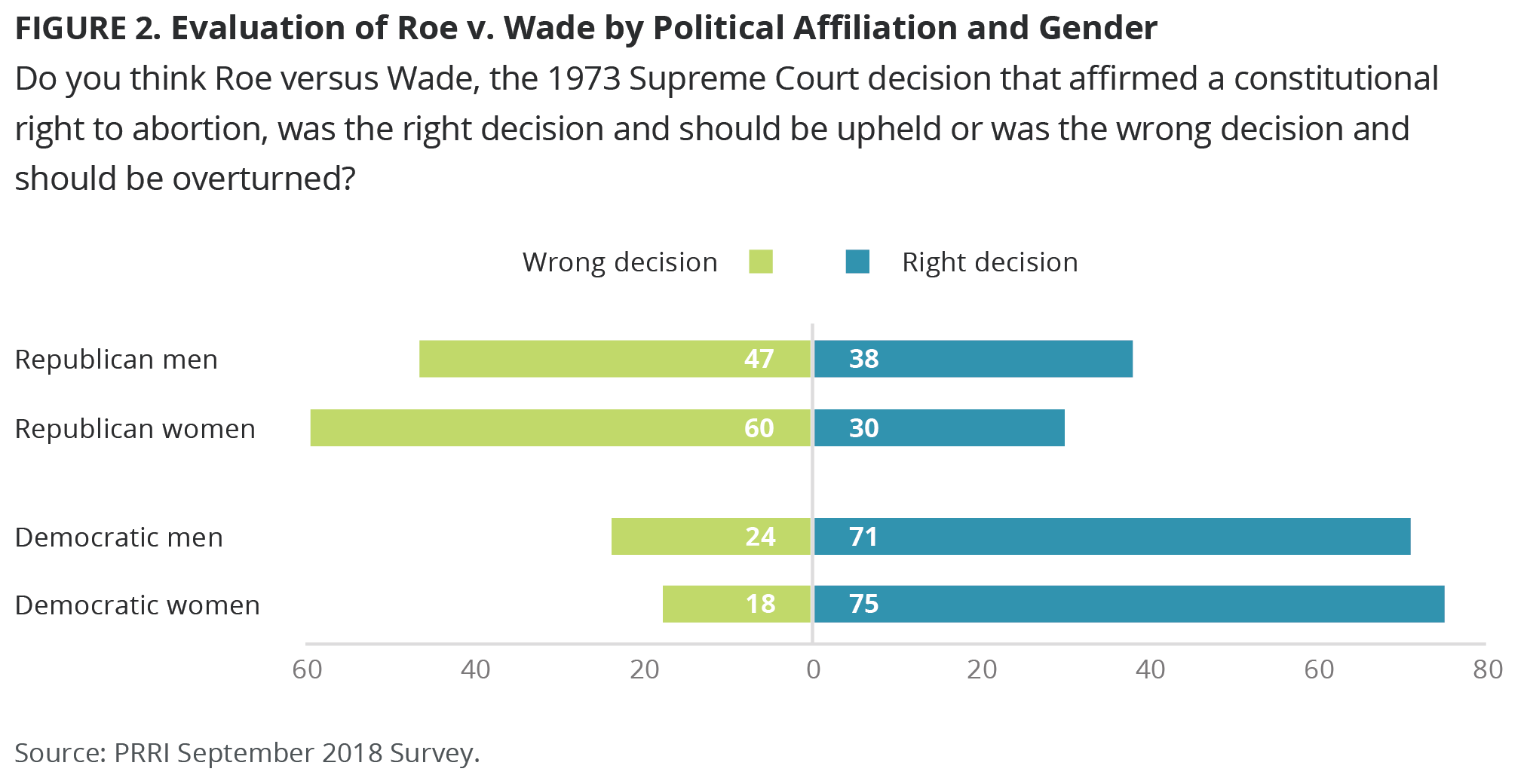
And while you're correct that most women, nationally, oppose the most extreme restrictions, most women also support restrictions that Roe didn't allow: https://harvardharrispoll.com/wp-content/uploads/2022/07/HHP.... For example, 75% of women and 69% of men said abortions should not be available after 15 weeks (see p. 41).
What you're seeing with extreme abortion restrictions in deep red states is actually the product of women's political power. Anti-abortion women are among the most reliable voting blocs. While Roe was in effect, Republicans ran hard-line candidates to get those voters to turn out. More moderate Republicans, folks who say supported bans after 6 weeks or 12 weeks, could get on the same side of opposing Roe. When Roe was overturned, you had these hard-line candidates in office, who were significantly to the right on the abortion issue of even most voters in those states.
Coalition politics can often result in elected officials who are more extreme on certain issues than the electorate as a whole. For example, elected Democrats in California overwhelmingly supported Prop 16. But Prop 16 was defeated 60-40 in the referendum: https://newsroom.ucla.edu/stories/prop-16-failed-in-californ....
Even if those women consistently think men are better in power: How come? Isn't that part of inequality just as well.
Just change it to literally any other medical procedure and we can see it for what it really is. 'Kentucky bans women from having kidney stones removed'.
Of course, its all in bad faith on the conservative side. The minute the federal government has the opportunity to ban abortion nationwide, these "states rights" and "local control" folks will either shut right up or they will come out and spin some nonsense about how its okay for the federal government to exert control over the states in this case.
There’s an argument that by prematurely removing a controversial social issue from the democratic process, rather than letting that process run its natural course, Roe turned abortion into a much bigger “political hot potato” in the US than it is in most other countries. I think some version of that argument is probably right-in a timeline in which Roe had gone the other way, probably more US states would have legal abortion today than they do in this one. Roe motivated opponents of legal abortion to fight back in a way that a bunch of state-by-state legislative defeats probably never would have.
Over half of GenZ and alpha think women's rights and LGBT has gone too far.
Generations aren't magic,we have to give them incentives to care.
That thinking is exactly why the left wing isn't going anywhere with its identity politics. There is that thinking that all women will vote one way, old white men that way, all hispanics will vote one way, black people vote one way and so on.
You should have learned in 2016 that things don't work that way. Clinton thought that women would vote for here because she is a woman and lost.
For example, let's say that in fact roughly 30% of women are support a particular candidate, and that this number will not vary by much more than 5% in either direction. Given that women are more or less 50% of the population, that means that this candidate will need to make up a fairly significant vote deficit by over-appealing to some male demographic.
So yes, not all women or Latinos or African-Americans vote the same way, but if, statistically, enough of them do, then you can make some broad observations about candidate strategy that are likely consequential (and true).
The GOP won the 2022 House popular vote by over 3 million votes. There was no net effect from “gerrymandering.” The GOP won 51% of seats with 50.6% of the popular vote. Indeed, if we decided the executive based on who gets the most votes in the legislative election, like most countries, the GOP would have had two more years in charge of the executive branch since 2000.
As to Gen Z—they don’t vote and by the time they do, plenty will vote Republican. Millennials voted overwhelmingly for Obama. But in 2022, Democrats won the 30-44 demographic by just 4 points. The GOP also had their best year in decades among Latinos and Asians—losing Latino men by single digits.
And all that is with a national GOP that’s in the middle of a civil war. Look to Florida to see what could happen if they get their shit together. In Florida, a state Obama won twice, DeSantis won 56% of Hispanics and women overall. He even tied (at 47%) among women aged 18-29!
Cohen really got a raw deal from the prosecutor and basically got threatened with more charges, and his wife getting charged, unless he pleads guilty within a day or so. That's why the quality of the individual charges in that plea deal can't be taken for granted.
No, he hasn't. He pled guilty to seven unrelated financial charges and to one charge related to the payment to Stormy Daniels: making an excessive campaign contribution.
That last charge doesn't apply to Trump, who is allowed to contribute as much as he wants to his own campaign.
And Cohen's plea tells us nothing about whether recording the payment as "legal expenses" is a crime.
In my view, the only reason to jail anybody is because they violated the law. If somebody that violated the law is subsequently jailed, it feels pretty dishonest to say that it was done “just to take them off the ballot”. Not only that, it is inaccurate. Jailing somebody does not take them off the ballot. However, not prosecuting them DOES put them above the law.
Perhaps we have different ideas about the real problems described above.
Assuming the charges are limited to the Daniels payment, you're correct. It's a weak case. They have to prove the misdemeanor accounting charge, then to elevate to a felony, the DA must prove that crime was used to cover-up some other more serious crime (likely campaign finance related).
The last time a similar case was brought, it was against John Edwards (who took money to pay for housing for his mistress, or something like that). He was acquitted.
But, it appears the indictment has 34(?) charges. If they're counting each check to Cohen as a charge, that's 11(?), so there's something else there. Some of that could be conspiracy charges, but we don't know.
Say my firm's database gets ransomewared. If I pay the ransom directly, that may be a particular way of accounting. But say, I pay McCohen Computer Associates to fix the problem. Why do I not book it as a computer expense? I am not an accountant but am curious how this works.
The two-step payment through Cohen is only illegal if it's done to cover up other illegal activities or it's in violation of some other law.
In this case, it's likely the hush money was funneled through Cohen to keep it off the campaign books - that's what makes it illegal.
So, regardless of what you think of the case. Leaving out that somebody was already successfully convicted of this exact crime is a significant omission.
We do not know the charges yet of course. The most significant are likely to be campaign finance related with details of falsified records and hush money payments providing supporting evidence of those crimes as much as they are crimes themselves.
The fact that Cohen is a lawyer would seem to indicate that the case was solid enough that he was concerned he would lose on merit. However, a friend of mine who is managing partner in a legal firm says that "Once a trial goes to a jury, it's approximately a coin flip as to who will win, and the odds only go down from there." That's mainly because if the case is black-and-white, then there will be some settlement/plea deal prior to a trial.
However, Trump has put himself into a corner where he probably cannot accept any plea deal other than one that would drop the criminal charges but keep any misdemeanor charges. I'm not sure that the NY DA, Alvin Bragg, would be willing to do that unless the case starts falling apart. But in the case Trump will push for an aquial rather than a plea deal so that he can use it to rile up his base.
Misdemeanor charges are criminal charges.
CNN, at least, is reporting that he's facing 30 charges. If that's the case, it's probably charges related to the Trump Org's shenanigans that the corp was found guilty of. The organization's indictment had a lot of shady stuff and a lot of stuff that looked like flat out fraud. Lots of criminal looking behavior that plausibly can be directly tied to Trump himself.
There is no restriction on a candidate for the US presidency vis-a-vis current or former incarceration. Anyone could constitutionally run a presidential campaign or even serve while in jail. This is because the Supreme Court has held that only the Constitution can set qualification requirements. [0]
The sole, debatable exclusion seems to be the 25th Amendment, which allows the vice president and cabinet (or the president themselves) to shift presidential powers to the vice president when "the President is unable to discharge the powers and duties of his office." [1]
[0] https://fortune.com/2023/03/30/donald-trump-can-still-run-fo...
https://www.zinnedproject.org/news/tdih/debs-received-millio...
Maybe it'll be an impetus to create a clearer path for convicted felons who served their time and don't reoffend to regain their voting rights. Probably not, but it would be nice.
https://www.ncsl.org/elections-and-campaigns/felon-voting-ri...
Like many things, it ties back to the failure of Reconstruction. Many felony disenfranchisement laws were passed alongside Black Codes. 7.4 percent of African American adults are disenfranchised compared to 1.8 percent of those who are not African American.
In practice, I think most states with laws that suspend voting rights, do so as a form of punishment. That certainly seems to be the case with states that permanently suspend voting rights even after a convicted felon has served their time.
I personally think felons currently serving time shouldn't be allowed to vote. Suspending that right temporarily seems reasonable. That's not a strong conviction I hold though. I could be convinced that voting is a right as fundamental as the other rights we still extend felons while incarcerated.
Once a felon has completed their sentence I think they should have full voting rights restored. I also think they should no longer be considered a felon, to the point where their records are sealed once they've served their sentence. The idea of "once a felon, always a felon" seems counter productive towards rehabilitation and reengaging someone in society, and simply vindictive. In most states, being convicted of a felony comes with an automatic, unspoken life sentence of always being a felon, where the ostracization continues until they die. That doesn't seem healthy for anyone, let alone the person who served their time.
So if you lose all your money because of poor decisions, you should also lose your ability to vote right? If you get take in by an obvious scam or cult, you should lose your right to vote too, no?
I agree with a lot of what you’ve said in the rest of the post, but this reasoning seems critically flawed because there are lots of people with fatally poor judgement and we don’t take away their voting rights. Singling out people who have ended up on the wrong side of the criminal justice system for this punitive take is flawed. They’re already being punished and removed from society. If anything, giving criminals a right to participate in government makes the government accountable to how they treat prisoners (it’s truly a dire situation here in the US) and how they choose to apply laws. Maybe we would have learned how bad the drug laws were much earlier if the government didn’t have the power to strip voting rights from citizens.
Additionally, the government makes a non trivial amount of mistakes in terms of incarcerating innocent people. So there’s a large number of people who are disenfranchised without demonstrating “bad judgement”.
Having had more time to think about it, I really can't get behind any reason for suspending voting rights.
What's the actual risk of letting those serving time vote? That they'll vote for their interests? That they might use poor judgement? If that's the concern, we have a lot more people who aren't in prison who vote for their interests and demonstrate poor judgement already.
I think that those in favor of suspending voting rights have one motivation: it's just another injustice on a pile of injustices meant to separate people in the "prison system" from "normal society," causing more harm than good for actual society.
* Prisoners can't vote; however, a court decided under the Human Rights Act that they should be allowed to, but so far the government has ignored this
* Once released, ex-prisoners can vote as usual
* Many convictions are "spent" after a certain amount of time [1], meaning that after that you don't need to disclose them when applying for a job etc (but nothing resulting in a prison sentence of four years or more, and there are some cases where you still have to disclose them)
As far as i know, nobody thinks any of this is a problem.
This is why we can't have nice things. None of the charges have been disclosed so why even opine on this yet? It's all speculation at this point.
Isn't it fine if this just hits Trump with a small fine or 3 days in jail or something? A fair punishment for a misdemeanor would be fine with me for this case. That's like the whole point of justice, that even the former president should have to follow the fine details.
In my state, our Democrat governor was accused of being a tyrant because of some minor paperwork she didn't do during emergency covid meetings. She still paid the fine because she committed the "crime" (procedural violation?) and that's how it should be. Politicians should not be immune to the little stuff. If they are speeding, they should get a ticket. If they shoplift, they should face a fine. If they forget to report a W2 to the IRS, they should get a pleasant letter telling them their mistake and they owe a few hundred dollars.
I consider that a GOOD thing
This i the crux I think - It's clearly a crime, but should he be held accountable or not due to notoriety? personally, I think public figures (especially politicians) should be held to a higher standard than mere-mortals; but many seem to believe the opposite.
You don't want your <insert political candidate> arrested/prosecuted? Don't elect a morally ambiguous one then. Higher standards, not lower.
What, exactly, is "clearly a crime"?
The accounting issue is at worst a misdemeanor, unless the DA can show that the payment to SD was a campaign finance violation.
But if it was "clearly" a campaign finance violation, why haven't federal prosecutors charged him with that?
Bragg is a motivated prosecutor trying to find a way to prosecute Trump for a charge he has no jurisdiction over, while the prosecutors who do have jurisdiction don't think it's worth prosecuting.
I think people should be seen as equals before the law. Having one set of standards[law] for one group and a different set for another group is antithetical to rule of law which is purportedly a common American value FWIW.
Would that include running your family as a syndicate so that your offspring makes shady deals with the US's primary geo-strategic competitor and then distributes the proceeds amongst the family?
Or what about opening a border to record numbers of illegal immigrants in order to sway voter demographics in your favor? Is that morally ambiguous?
Or what about putting out a fake Russian collusion dossier full of lies about your opponent that ran in the media for years? Could this be seen as morally ambiguous?
What's your definition of the term?
Evidence? And offspring doing something on their own doesn't count.
> illegal immigrants in order to sway voter demographics
That's not how voting works.
> dossier full of lies about your opponent
Sure that one counts. Sometimes both choices are bad. But one candidate doing something bad doesn't mean you increase what the other candidate can get away with.
https://oversight.house.gov/release/comer-reveals-biden-fami...
Hunter Biden's business partner outlines Joe Biden's involvement
https://nypost.com/2020/10/22/hunter-ex-partner-tony-bobulin...
Monthly encounters with migrants at U.S.-Mexico border remain near record highs
https://www.pewresearch.org/fact-tank/2023/01/13/monthly-enc...
You'd have to be pretty naive not to acknowledge the long-term benefits to the Democratic party of increasing the Hispanic demographic. An incredible betrayal of democracy.
And as we know the Russian collusion dossier ran for years in the media. All complete lies.
And I haven't mentioned the pressure on social media companies to censor the Hunter Biden laptop story priority to an election (the facts of which were all true).
You'll note that at no point has anybody been held to account for any of the above.
But if you (alledgedly) paid some hush money to a woman 7 years ago (years past the statute of limitations) well, you're gonna be held to account then of course.
"The evidence sits on these three phones, I don’t want to go into anything any further. This will all be discussed with Senator Johnson and his committee and the American people can decide what’s fact"
That's pretty weak.
> You'd have to be pretty naive not to acknowledge the long-term benefits to the Democratic party of increasing the Hispanic demographic. An incredible betrayal of democracy.
Children that are born here, voting decades from now? They're not just going to blindly follow one party. That's not a betrayal of democracy.
> You'll note that at no point has anybody been held to account for any of the above.
You can't hold someone to account for making a bad dossier any more than you can hold candidates to account for saying random awful things about people. I don't know what you expect to see beyond voter dissatisfaction, which happened in droves.
And strictness of border enforcement is something the president legitimately gets to decide.
I don't know about pressure related to the laptop story and don't really want to get deeper into tangents right now.
> But if you (alledgedly) paid some hush money to a woman 7 years ago (years past the statute of limitations) well, you're gonna be held to account then of course.
The accusation is (probably) based on hiding campaign fund spending.
"They're not just going to blindly follow one party." Of course not, of course there will be exceptions but in the whole Hispanics tend to vote Democrat.
https://www.pewresearch.org/race-ethnicity/2022/09/29/most-l...
"And strictness of border enforcement is something the president legitimately gets to decide." Lol...either laws are enforced or they are not. And in this case it's obvious why they choose not to enforce and I'II say again, an incredible betrayal of democracy.
"I don't know about pressure related to the laptop story and don't really want to get deeper into tangents right now...". Of course not, it's too damning, clear and obvious of the ridiculous double-standards at play. Are you more informed on the Trump hush money thing? I'm guessing almost certainly not.
Are you seriously going to suggest this charge would have been brought against any other person than Trump?
Strong evidence is whatever is supposedly on those phones. Which he didn't share.
> Hispanics tend to vote Democrat.
Still not undermining democracy.
> Lol...either laws are enforced or they are not.
Choosing how to implement laws is half the point of the executive.
> Of course not, it's too damning, clear and obvious of the ridiculous double-standards at play.
Hunter is not a politician. I only care so much about him being corrupt.
> Are you seriously going to suggest this charge would have been brought against any other person than Trump?
We don't know what the charges are but it seems like similar charges have been brought against other politicians.
https://www.usnews.com/news/articles/2013/01/07/obama-campai...
I’m all for accountability and rule of law. But I’d hope the grand jury has something a little bit better than just this.
The interesting bit is that Hillary Clinton also violated campaign finance law in a similar way for funding the Steele dossier. She was fined $8000. People are really going to have a field day with this.
If this was actually Trump paying his own hush money via his lawyer, then it makes Michael Cohen a liar (when he said that he paid it out of his own pocket, thus admitting to violating campaign finance law), but Trump seems to not be implicated at all.
The allegation is that Trump reimbursed Cohen for what had (provably) been paid to Daniels. So, as usual, in the real world things get a bit more complicated. Is that still "paying his own hush money" ? Does using an intermediate make it not so? Does using an intermediate who first uses their own funds and you later reimburse them make it not so?
Another commenter suggested that the real crime was that the expense was named incorrectly on the campaign's books, which makes more sense to me but also seems kind of tenuous.
isn't this a bit of a stretch? lots of things that could "make trump look bad" (TM) might have a political consequence, but does that make them all defacto campaign related? Aren't there plenty other (personal) reasons he would pay her off unrelated to the campaign (he's done/said things unrepentantly that could equally impact his campaign, so it's not clear Trump is even motivated to pay her off for this reason).
However:
1 iirc Grand Jury's are the ones that get to do everything behind closed doors. So we wouldnt know if they had a smoking gun until after trial possibly.
2 The US has a history of pursuing people it doesn't like through financial crimes. Rico etc.
I think its easy to see this in the lens of "oh its another attack on trump that will go away again" and if you experience your entire life through the highs and lows of the media cycle thats quite possibly going to be the case. But I think each prong of attack opens up a little more of Trumps weakness and eventually, either through weight of legal cost or dumb luck they will find something to hang him with.
The thing that surprised me yesterday was learning that being convicted of a felony doesn't prevent you from running for public office or the office of President of the United States! So it seems like a pretty impotent "hanging". I had assumed that barring him from running for re-election was the major motivation behind pursing these indictments, but I guess that's not the case. So that suggests that these moves are mainly about public opinion? If that's what it is, then this particular indictment seems like the weakest of the possible ones that have been talked about. Taking all this into account, I can't help but think that this kind of plays into Trump's desire to be the center of attention.
This depends on the state. Being convicted of a felony in Florida bars you from running for public office or voting in the state (until granted clemency). A conviction in Georgia would similarly bar Trump from voting in Florida, but not one in New York (which does not disenfranchise felons).
But yes, it doesn't affect his ability to run for federal office, even if it would make it hard for him to campaign from jail.
The vast majority of american democracy relies on "norms" and "the public will do the right thing" and "surely they will only elect people who deserve it"
For the vast majority of elected offices, one of the most important qualifications is "registered to vote in the district you are going to represent". Most offices have some age requirement (which might be as simple as "old enough to register to vote") and extremely few had some occupational requirement (like District Attorney has a law degree/license requirement, but Sheriff has no such requirement). When I ran for office in Colorado, failing to be registered to vote in the district you represent was the fastest and most automatic way of getting thrown out of office: no trial, no impeachment, just out you go.
The requirements for President are listed in the Constitution. Getting on the ballot in each state is harder as each state has different requirements.
You know, we also have this thing in the Western world called "the rule of law". It's this really weird idea that when someone breaks the law, they should be punished for it, no matter how powerful or well-liked they are.
Bragg wouldn't have brought this case if he wasn't sure he can get a conviction. And that's actually unfair treatment: With any other defendant he may take bigger chances, be less hesitant, less careful. And the case wouldn't have been derailed that long. Do you even know the whole history how this got deferred during the Trump presidency and even after?
"Show me the man, I will find you a crime"
In order for it to be a felony, you need to connect the two together. Otherwise it's a misdemeanour.
In terms of it being a "weak case", I would just say let's wait to see what the prosecutors' argument is - this will be released when the indictment is unsealed on Thursday. It's a document-heavy case. There is a witness who carried out the crime (Michael Cohen), and other witnesses as well. I would also posit that the prosecutors, and a grand jury (who unanimously voted to indict) would not take the unprecedented step to charge a former President unless they thought there was a strong case.
So, let's just wait and see.
This seems to be a very popular way to label questionable payments during presidential campaigns, given that both major candidates did it in 2016.
The Economist, no fan of Trump, made much the same point [1], archived at [2]
> Prosecuting Mr Trump for the campaign-finance violation relies on a convoluted argument. In 2016 Michael Cohen, the president’s personal lawyer (who later went to prison himself), paid $130,000 to Ms Daniels out of his own pocket. Mr Trump allegedly reimbursed Mr Cohen with payments disguised as routine legal expenses. Falsifying business records can be a misdemeanour under New York law. The felony indictment would indicate that prosecutors are going to argue that the minor crime facilitated a more serious one: failing to declare the payment, which was made a few weeks before the election, as a de facto campaign expense.
> The payment probably did benefit the campaign and it was indeed undeclared. Mr Cohen, the lawyer, pleaded guilty to breaking campaign-finance law. But legal theory for prosecuting Mr Trump in Manhattan is untested. The campaign-finance rules that he may have broken are federal. The accounting rule is a state one. Linking the two in this way is unusual, and a judge may decide it is unwarranted.
And today it has a leader [3], archived at [4] which goes into greater detail, and concludes
> If Mr Trump is to be prosecuted, it should be for something that cannot be dismissed as a technicality, and where the law is clearer. The Manhattan DA’s case looks like a mistake.
[1] https://www.economist.com/united-states/2023/03/23/the-cases... [2] https://web.archive.org/web/20230329221711/https://www.econo... [3] https://www.economist.com/leaders/2023/03/30/prosecuting-don... [4] https://web.archive.org/web/20230331115631/https://www.econo...
I've recently served on a jury for a criminal trial, so I've learned some things about the process that courtroom dramas did not teach me.
One: stacked charges (in this case, 30+) can indicate repeat offenses of the same crime / crimes on separate occasions (usually denoted as separate dates). I do not think this is simply a matter of a single hush money payout (or two, as has been reported in the news). I would not be surprised if there are 10 or more distinct events in play. edit: Note that the jury can render separate verdicts for each charge if desired.
Two: the grand jury merely decides whether there's enough evidence to bring this to trial. The standard of evidence for a grand jury is much lower than the actual trial jury.
Three: this is more theoretical because I'd be surprised if this happens, but the defendant in any criminal proceeding is more than entitled to neither testify on his own behalf, and the defense is not required to call any witnesses to the stand, as the presumption is that Trump is innocent until proven guilty. The burden of proof lies with the prosecution.
Four: I'm going to paraphrase the judge in my case slightly, but "beyond an unreasonable doubt does not mean beyond any possible doubt. There is always going to be some shred of doubt. Beyond an unreasonable doubt means that you have a moral conviction that the defendant committed the alleged crimes."
> it sounds very technical
That's totally expected, as is the case for even the most mundane-seeming laws. The jury is not expected to have a legal background. The judge will instruct them regarding the points of the law (along with definitions of legal terms), and in particular provide criteria that must be met (sometimes with alternatives, e.g. direct vs constructive possession) in order to find the defendant guilty of a crime. https://nycourts.gov/judges/cji/2-PenalLaw/175/175.10.pdf is probably pretty similar to what the jury might expect to see.
As for intent being hard to prove: you are approximately never going to have direct evidence regarding intent. The prosecution can try to establish intent through circumstantial evidence from which the jury can make a reasonable inference. Again, paraphrasing the judge: if you see someone come into the courtroom with wet clothes and shaking water off an umbrella, you can infer that it was raining. Similarly, if the prosecution establishes that Trump took specific actions that could not be reasonably interpreted in a different way other than being made intentionally, or that there were too many of these unlikely occurrences for it to be coincidental, then the jury may use that to establish intent. Further, note that ignorance of the law is not a defense.
You can bet that the prosecution's case is going to center around providing evidence to directly prove those points, regardless of any narrative the lawyers on either side want to spin. At least in our case, we were instructed only to use evidence as presented in exhibits and per witness testimony. Any of the words of the lawyers (questioning, or even opening statements / closing arguments) were not allowed to be considered. The closing arguments are essentially suggestions re: how to view the evidence.
One last note: you cited that a class E felony in NY has a mandatory minimum of 1 year. Even if Trump is convicted of 30 class E felonies, those can be served concurrently, so theoretically the judge could hand down a sentence of 1 year prison time if he so desired. I think that's highly unlikely, but it is possible.
That is not the legal burden of proof in a criminal case. It’s beyond a reasonable doubt.
Interesting items:
- This is from the NY State courts so it is NY State laws in play (likely campaign finance laws), not Federal. If it were Federal it would be prosecuted by Federal attorney's in a Federal court.
- A Grand Jury (for those that don't know) is composed of citizens, about 16-20 or something, that proceed like a court case understanding laws and evidence presented, including witness interviews, and the result here is that they chose to indict. This means that 12 (or more) citizens decided there was enough evidence that specific laws might have been broken to bring charges against him.
- I believe (common sense here) that campaign finance funds have to be kept separate from personal or business funds, as in different accounts. Depending on the laws in various states the laws may require disclosure forms of funds into/out of the accounts, etc.
Its likely that this is technical and could be traceable - if the funds for hush money came from a campaign finance account through his attorney and noted as such its probably not a case that is worth trying. That doesn't appear to be illegal, its a (morally questionable) campaign line item. If the source of the funds was from a personal/business account then that could violate campaign finance laws by using the wrong account. This kinda sounds like how they got Al Capone on tax evasion and not the myriad of other potential crimes. I'm not comparing the people, just my layman knowledge of the cases.
My understanding is that there is no limit to the amount of a candidate's own money they are permitted to spend on their campaign. So what legitimate state interest could be advanced by laws that nitpick the exact boundary between what is and isn't campaign funding when it comes to the candidate's own money?
Do candidates have to report all their food expenditures as campaign funding-- since they obviously couldn't campaign if they don't eat? :)
I read a headline just a bit ago that there were 34 counts in the indictment so I'm guessing what they found spans more than a single transaction.
There's also a famous saying, though, that any prosecutor could get a grand jury to indict a ham sandwich (interestingly, I never knew the original author of that quote was a judge who subsequently served 13 months in prison, https://en.m.wikipedia.org/wiki/Sol_Wachtler).
But, the overall point is that the bar for grand jury indictment is intentionally low. I'm not going to speculate on aspects of the indictment because I don't know what they are yet (and it always amazes me how so many folks always dig in to be part of "their team" even before they know what the game is), but before the indictments I did see some legal experts who were definitely not Trump fans argue that it was not a case they would've brought.
Legal experts or not, unless they have seen the evidence (incl witness testimony) and charges their speculation is as good as any internet commenter. I read a headline that there are 34 charges in the indictment, could be many unique ones or it could be one of those things like 34 wire fraud charges because there were 34 transactions from 34 accounts or whatever.
But yes, 100%, folks should calm down until the contents of the indictment are made public.
It's important to hear from politicians, former prosecutors, scholars, historians, and also to get input from people in other countries as well. How would it impact world perception? How would it impact US soft power?
It's also important to think about the civil implications. Could there be riots? Targeted domestic terror attacks against law enforcement (which has happened)? How is law enforcement prepared to handle it?
I think when robust conversations like these happen, it's easier for the public to understand when a prosecutor makes a move. Because it's not the prosecutor's job to explain this to anyone. Some people (even in this thread) really need a civics lesson. Like, people expecting the defense to have a crack at the grand jury, and if they don't then it's somehow a biased process or that due process has been violated. That's just how it works, and Bragg doesn't have to explain that to people. But because we have no other mechanism to do this, it's really the media's role at this point, which is sad, but that's where the conversation happens.
Because, to me it sounds like you are disparaging an entire court district as a means to an end.
In which way is the entire Southern NY and DC court districts corrupt as a general label? (meaning, you would have to show more than a single anecdotal case you don't happen to like, or more than merely disliking the politics of a specific prosecutor etc.)
"Everyone knows" is not a legit anything, as you would probably know. From which perch are you observing this? Does politics play a role in your statement?
That being said I don’t know if the NY statute that elevates the misdemeanor into a felony requires the predicate crime to be specifically prohibited by NY statute.
https://www.cnn.com/2022/03/30/politics/clinton-dnc-steele-d...
Obama: Charged with $375,000 for breaking campaign finance law.
Regardless of how you vote, this is a political stunt and witch hunt. Next Biden will be indicted when he leaves office, then the next opponent, and so on…
This is an extremely dangerous precedence that will do nothing but fuel both sides.
I hope it fuels both sides.
If we want to hold people accountable, then the same charges should have been brought against Clinton and Obama.
This is a stunt. Nothing more, nothing less.
[0] https://www.justsecurity.org/85745/survey-of-prosecutions-fo...
Said another commenter who, like everyone else outside of the DA's office, has literally no data on what is in the now-reported to be 34 indictments.
>> hard to parse the above, but it sounds very technical So, "I don't know what I'm talking about, generally don't like it, so I'll just call it weak.", is itself a very weak statement.
It is extremely unlikely that this reluctant prosecutor would go to the mat with a weak case around one event such as a payoff to one woman, even if it was done in a way to violate tax and campaign finance laws.
We know no details, but there are clues in the public domain. The same DA office already convicted the Trump Organization on 17 counts and got the maximum fines [0]. There were witnisses called before the Grand Jury who would have spoken to much more than a single payoff scheme. There were multiple women, and David Pecker, former publisher of the National Enquirer, who was known to have paid for and killed multiple scandalous stories on Trump's behalf, and Allen Weisselberg, the former chief financial officer of the Trump Organization, who plead guilty in a 15-year Trump Org Tax Scheme.
Based on this, it is a reasonable inference to expect charges of a years-long conspiracy to commit tax, business, and campaign fraud.
I suppose if you consider white-collar crime "technical" and therefore weak, any such indictments would be weak.
But in terms of the actual strength of the case, based both on that DA's record of convictions, and the historic profile of this case (and the career-terminating consequences of losing it), they would not be bringing charges unless they thought they were extremely strong and they were extremely confident of winning.
[0]https://abcnews.go.com/Politics/trump-organization-sentenced...
His attorney already went to jail over this and if he wasn't president, he'd have been charged years ago.
The entire impossibility of prosecuting Trump is weird to me. There's a host of crimes to pick from, from using/withholding already approved support for Ukraine to bribe/blackmail Zelensky for personal gain (dirt on a political opponent), to pressuring people to violate election laws, to instigating the January 6 attack on the Capitol, to keeping hundreds of highly classified documents in his basement and lying about it when he's requested to return them.
Lots of people have gone to prison much quicker for a fraction of this. So why is it so hard to prosecute a president or former president? It really feels like he is above the law, and lots of people want presidents to be above the law, apparently.
The only reasonable conclusion to draw here is that the evidence of those crimes is even weaker than this (already pretty weak) charge.
Are (ex-)presidents above the law?
There is speculation that many of the charges are related to falsifying business records to cover up the payment, which would explain the number of charges involved. If true, then this case has parallels with what happened with Bill Clinton in the Monica Lewinski case: it wasn't the affair that was criminal act, it was the coverup after the fact.
Based on one article that quoted an anonymous source from one of Trump's advisors or confidants, said that they are working toward an arraignment on Tuesday. But it's a high profile case with exceptional circumstances--namely the involvement of the Secret Service--so we should probably take that date with a grain of salt.
I always thought this was bullshit, despite being otherwise happy with bill Clinton’s presidential leadership. To me it seemed bill was in a position of power over Monica and it’s a clear case of statutory rape.
To me (as a personal opinion).
It’s funny how so many people think less of this crime because the misappropriated campaign funds where used for something so redúceles than if it had been just plainly stolen it used to buy a luxury car or something like that.
The charges relate to hush money payments to Stormy Daniels, but hush money is not a crime. It's also not a crime to have an affair with Stormy Daniels. So the most salacious parts of the story are not what the crime is.
My understanding is that the crime is around how the money was delivered. I'm having trouble finding a good description, but CNN has this to say:
> Hush money payments aren't illegal. Prosecutors are weighing whether to charge Trump with falsifying the business records of the Trump Organization for how they reflected the reimbursement of the payment to Michael Cohen. Falsifying business records is a misdemeanor in New York.
> Prosecutors are also weighing whether to charge Trump with falsifying business records in the first degree for allegedly falsifying a record with the intent to commit another crime or to aid or conceal another crime, which in this case could be a violation of campaign finance laws. That is a Class E felony, with a sentence minimum of one year and as much as four years.
I'm not a lawyer and it's hard to parse the above, but it sounds very technical. It sounds like they have to prove two separate crimes, and connect them with intention. Intent of course is always hard to prove in court.
Overall this seems like a weak case to me.