mbesto
You're confusing the original article and the parent comment I replied to. I think the Apollo article is way off, BUT I have very intimate knowledge with very concrete numbers of a use case where AI has a very clear and definable ROI.
> Could. But again, are they?
YES. That's what I'm telling you. They just implemented the system. The contractors spend less time on each project which means they have more time to do another project. How is that so hard to understand?
> You're extrapolating a 3x increase in throughput from the optimization of a single process that exists in a whole business system.
Are you deliberately being obtuse? The company very clearly drives ~$5k additional profit per project. They do hundreds of similar projects.
> Also, do we think the S&P 493 is so incompetent that they'd miss these optimizations? Or is it more likely that this firm you're referencing is a small inefficient player, and the S&P 493 already realized these efficiencies decades prior without AI?
I never made any of these claims, why are you saying I did?
They also kind of ("kind of" being the important clarifier here) can't optimize. See this is the trend with agentifying companies and the achilles heel for the frontier LLMs. We're starting to see diminishing returns on their capabilities, which means the rational enterprise is going to simply use the cheapest most efficient model for the task at hand. In turn we can just use an agent broker to decide which model is best and cost the least. Anthropic (today) has no incentive to do that other than to just use their own, best model for its own work.
If the outcome is the same then the fees shouldn't matter to the client in the long run. Said differently, if the client who pays the management consulting fee gets the same return out of the service, why do they care?
Now, what may end up happening is that some other management consultant vendor in the market comes in an says "ya know what we're willing to do the same work for less" (which means their margin goes down). This could indeed drag their pricing down.
> Interesting times on vendor contract negotiations these days.
For sure.
You seem hellbent on disproving me. Why?
That's about as hard of data as you can get.
Point is, the number of tokens is a silly metric to proxy these companies' growth.
For the record I use OpenClaw but it has its own services (gmail address, phone number, etc.) and I don't give it any of mine, which inherently limits its capabilities.
Wait until you are forced onto an enterprise plan...
Also, it's entirely plausible that an previously open model (that then became closed) will be much easier to distill than having a bunch of closed models.
It's very possible given the current environment that LLMs go the way of airlines. Low margin businesses that are essential to world economics with heavy price competition.
Or it's classic modern journalism that gets clicks. LLMs are just mimic'n human behavior.
Oh please, do tell.
You people realize businesses used to have rooms full of humans who clacked away at typewriters right?
https://blogger.googleusercontent.com/img/b/R29vZ2xl/AVvXsEg...

Yes, this literally happens all of the time today. Proof point - software development organizations hire to fill operating budget voids, not on what work needs to be done.*
*Source - I've seen 900+ software team's P&Ls and interviewed their CTOs.
1. Profit margins from the mag 7 are on an upward trend starting in 2020. This is pretty consistent with the insane topline growth had by covid and the most recent layoffs occurring over the last 6 years. To unilaterally attribute this to AI implementation is lazy.
2. Most non-tech firms are only implementing AI just now because we finally have better enterprise tooling required. We won't see the effects for another 12-24 months at least.
3. As a former management consultant, this might be the worst use of a stacked bar chart I've ever seen: https://www.apollo.com/content/dam/apolloaem/images/daily-sp...
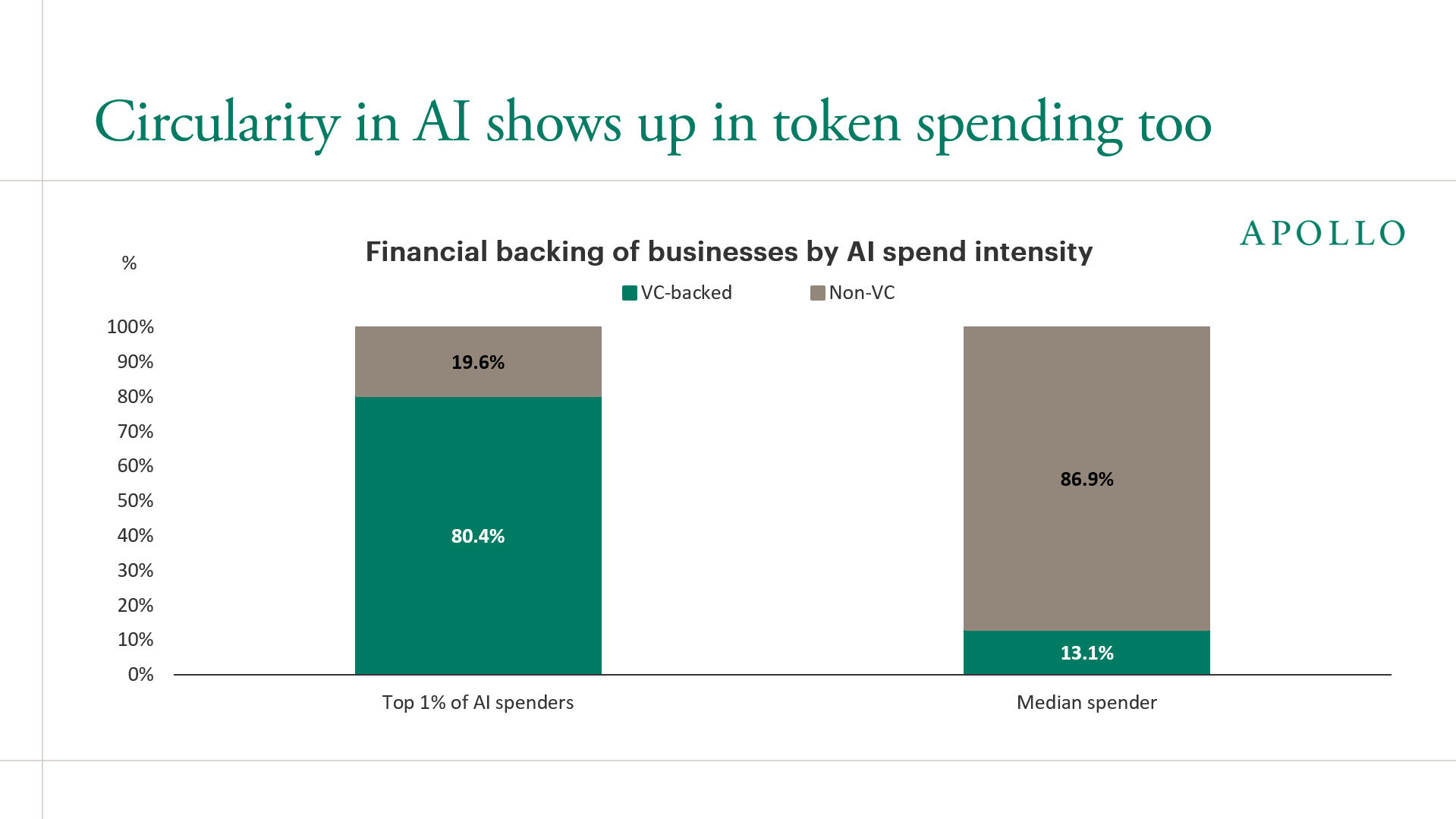
4. I don't know how you actually isolate AI productivity gains on a macro level. It seems pretty much impossible.
This whole thing is laughable.
For general purpose LLM, you can't beat Gemini AI Pro. It's $200/year and you can add your whole household.
You mean Masayoshi Son, the founder and CEO of SoftBank? lol wut.
https://economictimes.indiatimes.com/news/international/us/s...
> Softbank Vision Fund is one of the most heavily ridiculed and mocked international VC funds anywhere in the world.
Y'all need to stop reading TechCrunch headlines.
How does this explain a $20M bet on Alibaba that netted $60B?
> if you look at the ratio of good bets to bad bets then SoftBank is terrible.
So does a16z, Sequioa, etc...
This is venture investing 101 - they have power law returns. Don't let your survivorship bias cloud your vision.
Does SoftBank have some absolute blunders on large bets? Totally. Do they make some super weird billion dollar bets? Absolutely. Can you scrutinize them for making some terribly and laughably large bets go to complete zero returns? Sure. But this would be like saying Michael Jordan had a "bad track record" for scoring points because he had games playing for the Wizards where he had like 5 or 10 pts in a game.
This seems incongruent with what we're witnessing. Right now we're witnessing vulnerabilities that are 6 years old be exposed. That code wasn't generated by AI slop.
Security has always been about attacker/defender symmetry. So if the attacker has an LLM so does the defender. Reality is, the tax is getting higher as security tooling extracts more perceived value.
Sure but also there has to be some sort of deterrent and an executive who's worth is $100M+ who can't touch their $100M because their in jail is far more of a deterrent than META missing its earnings for a quarter because they owe the government a one-time slap on the wrist.
I'm all ears on what a different penalty could be that ultimately stops this behavior.
PS - META's stock is currently up 2% in after hours trading, so