I think this is a case where legislation is a clear win. It should be illegal for manufacturers to gate core functionality of stationary appliances behind an internet connection. Appliances already have a legal definition in the U.S. so it's not a far fetched idea.
2. Yes, manufacturers making deals with builders is one reason people end up with Internet Of Shit devices, but not the only one. Sometimes people buy them because they weren't properly informed, or locks are added in a software update, or it's simply the best all-round product so the person makes a compromise, or the local shops don't even sell anything without these anti-features.
Either way, the existence of such an anti-feature is unacceptable. Why should we have to fix every single situation where people end up with these, when it's far more effective to just outlaw them?
(And please don't mention any freedom of the manufacturer, corporations don't have rights. They should serve the people and people alone.)
Oh for sure. To fight climate change(and dependence on russian oil and gas), we all have to get a smart oven, to make sure we are all using our energy in the most efficient way. And not too often. Let's say a budget of 1 moderate use per day per adult user. And if the grid gets too unstable, your oven might smartly switches off and on during baking, to help stabilize the grid.
I think you're being needlessly pessimistic. Consider a few points:
1. By the time any "smart" oven is mandated by law technology has probably moved ahead so far of where we are today that all the asinine intricacies people are complaining about have been remedied. Just look at how far wifi has come, only 15 years ago you couldn't imagine an office that could connect to the internet reliably without anything but RJ45 cables.
2. Read the comments on the internet from the 90s or early 2000s about almost anything and see how pessimistic everyone was about the future of new technologies. This is probably even more true of nerds who live on the cutting edge and see things at a closer range but also at a slightly skewed angle.
3. So what? Seatbelt laws induced the same type of reaction initially, but over time people adjusted, and no one even notices the annoying chime every car makes if you start it without putting on your seatbelt first and not to mention giving away your freedom not to wear them because we decided for you it would be in society's best interest to lower the cost of auto insurance. And now not just because it would be illegal not to but also because the societal norms dictate that you wear your seatbelt every single time.
I still can't. When I'm at work, I plug in to wired Ethernet whenever possible. Otherwise, I get weird slowdown and dropouts all the time. I've done contract work at a number of business ranging from you've-definitely-heard-of-them Fortune 500 enterprises to local small businesses, and it's always the same. When I want a connection that's going to be reliable and consistent, (for example, when I'm taking a video call) I plug in a physical wire.
Read the comments on the internet from the 90s or early 2000s about almost anything and see how pessimistic everyone was about the future of new technologies. This is probably even more true of nerds who live on the cutting edge and see things at a closer range but also at a slightly skewed angle.
Many of those criticisms were absolutely correct. Stallman's worries about DRM have largely come to pass. We're living in a world where farmers can't repair their own tractors without taking out a service contract with John Deere. We're living in a new dark age where a large proportion of our visual cultural output, be it music, film or video games will be lost, simply because it isn't profitable for the original creating entity to preserve them, and copyright law prevents anyone else from doing so.
So what? Seatbelt laws induced the same type of reaction initially, but over time people adjusted, and no one even notices the annoying chime every car makes if you start it without putting on your seatbelt first
I do notice, and I find it annoying when my car insists that I put on my seatbelt, even when I'm just backing it out into the driveway so that I can wash it. I've noticed that newer cars detect when you've been driving for more than a certain amount of time (I think two hours is the threshold) and "advise" that you stop and take a break, regardless of your actual fatigue level. How long before this "advice" becomes more coercive?
1) Oven or any other appliance can just list current price of electricity.
2) High power appliances can tell network to book energy (how much/how long) so usage is more predictable.
It is more likely we end up with camera taking photos of our food and sending it to mothership - but one can still wish it will go other way.
Is (s)he, though? electric cars stopping to load because of grid instabilities is a build-in mandatory feature in electric chargers in Europe. Which is a major part of why I got another petrol-powered car last month - it gives me the security that the car will be fuelled sufficiently for operations when I get to it in the morning.
2 - I'd say these comments were overly optimistic - had I told my 30 year younger me about how we were essentially dependant on large megacorps for our integrated mail/calendar/telephone needs, megacorps who can - and often do - kick users out randomly for no apparent reason, making them lose access to their digital identity not only with them, but with potentially hundreds of other organisations, how the idea of ownership would erode into perpetual renting which can be stopped by the media controller at any point with no prior warning, that he would 'buy' a digital book, but would be unable to read it because he happened to be abroad, how state governments were using hacking skills to eavesdrop on everyone and to plant evidence on computers... he would have thought I was reading too many cypherpunk novels.
The last 30 years in tech have made me utterly pessimistic about the sci-fi tech future. The only things that ever become true are the worst ones. A stove dictating me when to cook and for how long sounds like the least problem we will have in our future, even more boring dystopia.
I have begin to understand the folks who start to live off-grid in a cabin somewhere in Montana...
We live in a time, where allways on devices track and spy everything by default about everyone and secret algorithms decide what posts get viral and what gets blocked or banned automatically, with no chance for the ordinary person to contest these decisions.
And all of this gets used, to manipulate peoples attention to sell them shiny crap, or influence them politically, without them noticing.
But yeah, people adopted to that total surveillance and algorithm control and starting the day with tailored advertisement. Why resist the change of the glorious new age?
But apart from that, I absolutely would buy a wifi controlled smart oven, where I can check on food and maybe adjust temperature without going to the kitchen - but only if I control it and not some server in china or wherever.
Haha, tell me you're from the US without telling me from the US. Government regulation in this sector is exactly what it needs. Hell, it's one of the main reasons we managed to standardize on micro-USB for mobile devices; it was a flexible enough standardization that the industry has been able to switch to USB-C as a whole without running foul of it.
Right now there's clearly an incentive for companies to push these shitty features, whereas many consumers would consider that a downside. Regulations don't mean the complete removal of the free market, but rather the incorporation of that kind of externality into the market.
God no please stop with the anti-regulation BS.
> The answer is don't buy the damn house it's that simple.
If you're already several months into building, with partial payments having been made, when the builder tells you that this is the only option allowed, they have you over the barrel. They've violated the social contract of providing options, and expect you to pay the cost of it. That cost is either a reduction of your choices, or needing to forgo incremental design altogether while maintaining an antagonistic relationship with your builder.
> Pay more build what you want and be happy.
The parent post already tried to pay more to build what you want. The general contractor did not allow for any other options. The free market does not work with this sort of bundling.
> People want cheap houses and this is that.
First, nowhere did the poster state that they were unwilling to pay a higher price for a functional oven. They stated that there was no other option available. Second, the term you're alluding to is "revealed preference" [0], which is a load of economic bollocks. It implies that you can entirely ignore what people state they want, the circumstances in which choices have been made, or forms of market failure (e.g. [1]).
Overall, the appropriate response to market failure, including anti-competitive deals between builders and appliance manufacturers, is to change the environment in which that market exists. Introducing regulation in order to avoid unfavorable Nash Equilibria is the role of government, in order to fix these market failures.
[0] https://en.wikipedia.org/wiki/Revealed_preference
[1] https://en.wikipedia.org/wiki/Tyranny_of_small_decisions
"Simply fix the government" is useless advice.
Here are some starting patches...
First we have to make political donations anonymous and capped. Also, no money from companies, only people.
Then we need to fix the fake news problem. Make sure nobody is living in a bubble and we are all living in the same reality. (The fix is to make news the forth estate officially)
Then we need to fix the size and shape of our electorates. Much smaller. No Gerrymandering.
Also need to ditch the two party system and allow our elected representatives to vote as desired by the electorate they represent.
Also push as much power as we can down to state and city level governments. Allow states and cities to be more different to one another so that we can all learn from the successes and failures of the choices of other states. Move power closer to the people.
> The fix is to make news the forth estate officially
It's difficult for me to see how formally establishing the main-stream media as a branch of government would do anything to improve the credibility of the news.
And just to mention, we also have problems in our society with the centralization and expanding powers of law and order in our government. Maybe that isn't the best example of "we centralized that, and now everything is OK!".
I didn't have it in my list above, but one thing capitalism did get right is that humans are self interested and motivated by competition. We need some of that competition in our public services so that the individuals who run them can be rewarded for doing a god job (whatever that might mean.)
For instance if I think scrapping the department of energy would make things work better, how can I get that done?
I can't. It's impossible. If HP doesn't make a laptop I like however, I can buy a Dell.
https://www.bestbuy.com/site/searchpage.jsp?st=Dumb+tv&_dync...
If you have specific problems with my suggestion as proposed I'd be happy to discuss the details, but "I don't like Biden" is not a convincing argument against the concept of regulations.
In my view, an oven that needs wifi to operate correctly crosses a line from creative business strategy into corporate abuse, nobody wants to live in a world where you need to login to a corporate website to cook your meals, but this is a completely plausible reality that we have the power to avoid if we agree that we don't have to live that way. I think regulation works well here too because the undesirable behavior is clear and easy to target legally without much possibility for unintended consequences. Further, this is a new trend that hasn't become widespread (yet), so getting rid of it now won't be disruptive to existing businesses.
For microwaves and toasters this kind of thing isn't a big deal because they're small and cheap, but stationary appliances like stoves and ovens are appliances that can't simply be replaced on a dime, they are investments meant to last many years and in practice they often operate as part of the home itself and can see multiple owners throughout their lifetimes. Not to mention, the rental and housing market is absolutely insane right now and for the foreseeable future, the vast majority of people do not have the luxury to quibble over the type of oven installed in their home assuming it is otherwise functional and sanitary. Or, more likely, they won't have any idea about this detail until its too late.
It's pretty close to 222 years.
Maybe in some alternative universe where the government never mandated social security numbers, driver's license numbers, birth certificates, or laws against "fraud" for using narrowly-scoped nyms. Where the economic treadmill wasn't run so hard, so people had time to practice good digital hygiene like installing Adblock and the advertising industry never developed. But that's not the world we're staring down, and we only get one.
As part of the technocratic agenda, it is integral that all energy usage, water usage, etc is managed. For this to work, there needs to be 'kill switches'. Like the one's Biden has required new cars to have by 2025.
Technocrats want to (micro) manage everyone's usage of everything. The green agenda is the main sales pitch given for this, but also look out for needing to log on to go online because of ... terrorists, Russian internet attacks, child abuse, etc.
We are coding ourselves into dystopia.
they repealed it soon after (I think), but the door is open for them or any other government to do it again.
To be clear, I'm not saying ots not a problem - it absolutely is[1]. However, it is not new.
1. It gives undue leverage for plea deals, and leaves suspect unable to pay for legal representation.
It might not be obviously illegal, but those bank accounts are frozen because the owners of the bank accounts are being investigated just as if they had been sending money to Al-Qaeda.
At least legally it all boils down to how the groups that received these donations are classified. Of course politically things are more complicated, but applying the same rules in different situations is why people where so concerned about this type of legislation in the first place.
Yes, and? That's not a reason to freeze the account.
We shouldn't do that for people that aren't much of a flight risk.
Many frozen accounts may similarly be unfrozen before trial, but determining if that’s reasonable takes time.
The power of the state is large. It is reined in by some of its own components, but it is foolish to imagine that in a society that is not explicitly anarchist that it would somehow be limited in the way you seem to imagine.
They are being told to do it (or heavily implied that they will be told to do it very soon if they don't do it beforehand).
It's not that I don't see the risk of companies "doing the same thing to anyone they want", it's just that this is not the same as is happening w.r.t the Russian attack on Ukraine.
These machines were over $1000 and they changed the terms on the app a week after we bought it. Not that we'd ever connect it to our phones anyway.
I, for instance, cannot tell it to dry on low heat for a long time until it's actually dry. It is impossible to configure it manually, it beggars belief.
And of course they know full well how much of a nightmare it is to return appliances that heavy and expensive, so it's always a surprise. Why would I even think to look for such a ridiculous anti-feature? I'm not creative enough to think of these regressions since the 90s, what's next, I can't turn it on at all without a face id? The features have barely even changed in that time...
Same with my new television that wanted me to agree to terms and conditions after spending over an hour mounting it on a wall. They seriously weaponize the inconvenience of returning these things... thankfully I had an extra computer to connect to it instead but most people don't.
I think a regulation on appliances saying they must have all features that are standard or advertised available with no extra steps is a good start. Yeah, this person has an issue with builder kickbacks too, but the core issue is hardly limited to new construction or contractors.
Of course, there's no notice at time of sale, and by the time you see the sticker, you're looking at redoing brand new kitchen cabinetry if you return the stove.
I suspect it is not a legal contract (post sale, well after returns become infeasible). If it is somehow binding, when companies pull crap like that, I think the "I reject" path should involve them reimbursing you for your time and any sunk cost you incurred before being informed of the contract.
In your words, it beggars belief. So if you don't connect your phones to it, how do you operate it? Do you have some dedicated throwaway device?
For the case I mentioned I have to run it on delicates, change the dry level to maximum, and then run it three times.
   * if a person replaces a solar powered drying technology like a clothes line or rack with a fuel-powered dryer, the GDP and/or other similar measures of economic health improve

   * if a person replaces a fuel-powered dryer with a solar powered dryer like a clothes line or rack, the same measures apparently get worse
In the summer I sometimes put the rack out on the deck. The fresh smell of sun-dried clothes can't be beat.
I grew up in Phoenix. Drying the clothes consisted of:
1. taking them out of the washer
2. putting them on the line
3. going back to to the beginning of the line, and taking them off, as they are now dry
I'm not joking.
I see your sun dried clothes and raise you one fresh cut lawn.
other than for moments when you plan on wearing something as soon as it comes out of the dryer, what prevents one from using the normal dry cycle, and then letting whatever garments that don't get completely 100% dried-air dry in the closet or up on hangers on a shower pole or something?
Just something my mom taught me. In typical tech nerd fashion, I don't iron.
I never put things through the dryer and then hang them though; my dryer works, and I don't even use the highest setting.
19 states prohibit prohibitions by municipalities, but most states leave it up to the municipality to decide.
Are you sure you don't have that backwards? From what I can find these are "right to dry" states which have banned clothesline bans (eg your HOA can try to ban it, and the state overrides it)
> Now, amidst growing concern about wasteful energy use, clothesline proponents argue that the traditional method of drying laundry is not only cheaper but better for the environment. Lawmakers in some 19 states have agreed, enacting “right to dry” laws that prohibit clothesline bans,
> The exact nature of “right to dry” laws varies from state to state—while some prohibit clothesline bans directly, others recognize a right to use solar power that implicitly may preclude those in authority from preventing a homeowner from drying laundry in the sun.
https://www.abajournal.com/news/article/20_right_to_dry_stat...
I've rescued Dyson hand held vacuums where the only problem is that the previous owner forgot to give the removable filter a rinse. I see people shove plates in a dishwasher with food solids that end up caking on, or placing bowls upright so they rerun the cycle.
It's a similar phenomenon to "low flush" toilets that clog and/or have to be flushed multiple times, using roughly the same or even more water than what they replaced.
However, their quality control is kind of terrible (2/2 had defects in the porcelain causing them to run indefinitely out of the box). I patched both up, and now they're OK.
In fairness, Niagara offered to ship replacements for both free of charge.
Also, they cost a tiny fraction of the other (worse specced) water conserving options, and, thanks to covid we bought them from sketchyplumbingoutlet.com or some such site (they could have been returns for all I know).
Anyway, they flush better than any other residential toilet I've encountered (including high flow and low flow ones), and use 0.8 gallons per flush.
https://www.govtrack.us/congress/bills/117/hr3684/text
https://www.congress.gov/bill/117th-congress/house-bill/3684...
From Collins English dictionary: "A technocrat is a scientist, engineer, or other expert who is one of a group of similar people who have political power as well as technical knowledge."
I think you're conflating 'technocrats' with 'greedy people'.
I'm not saying people with technical knowledge and political power cannot be evil. What I'm saying is it doesn't require any special skill to be really greedy.
I don't see technocrats as having the same biases, ethical and moral failings as everybody else, I think they're rather unique on all those points, and this is at the very core of what is good and bad about technocracy. When I think of a classic technocratic decision, I think of Margaret Thatcher closing down coal mines while crushing any union resistance, a technocrat-approved decision, and it significantly aided the economic success of Britain under Thatcher. Yet it exacerbated inequality and divisions within Britain that persist to this day. The severity of this fallout was blindingly obvious to the average northerner but it caught the average technocrat off-guard (decades of political ill-will tends not to be part of models), whom still lack effective solutions to resolve the issue, and the issue will drag down Britain for quite some time.
It is absolutely not a resolved matter that Thatcher's assault on the NUM significantly aided "the economic success of Britain".
Britain under Thatcher was a dismal and glum place. I left in 1989 and it only by revisiting various documentaries that I have come to realize what a shithole she helped make many parts of the country during her tenure. The fact that the City of London (the UK's Wall St.) did very well during this time in no way lets her off the hook for what her leadership did to most of the UK.
Smart = spy. Eg, 'spy phones'.
The only thing I would suggest, is that you consider that when they are talking about stakeholders etc, you need to realise that they are not talking about the people - they are talking from the perspective of companies. (You are the steak, they are the steakholders, lol.)
The same companies that pay lobbyists to write legislation etc, for the governments that purport to serve the people.
These companies are owned by someone - who they are, we can't know. Unfortunately for us, a lot of the ownership details are hidden by offshore tax-exempt vehicles, etc.
And in some cases instead of pot they found crypto mining rigs.
https://www.technocracy.news/shock-elon-musks-grandfather-wa...
[0]: https://www.snopes.com/fact-check/infrastructure-bill-track-...
Especially stating that this is an eco-agenda is imho either misinformation or willfully partisan.
Seriously I've not read such a round about stretch of a justification in a long time.
I guess one way you could implement that is a remote kill switch, but at least when I first read the text I thought it would just be something like a built-in breathalyzer you had to pass before the car would let you drive.
People claiming this is evidence of a kill switch are hard extrapolating with (as far as I've seen) no evidence that gets you from the bill's text to a kill switch.
"equipped with advanced drunk and impaired driving prevention technology"
Is indistinguishable from
"equipped with driving prevention technology"
is distinguishable from
"equipped with a mechanism that prevents driving".
Doesn't the reason you can't drive actually matter?
On the books, the lock is there to allow only the owner to operate the car.
Yet here you are, without the key, but still the owner, and yet you still can't operate the car.
The ignition is not preventing you from operating the car because you are not the owner.
The original claim was a bill mandating a remote kill switch and we've now backpedalled to "words might have a different meaning tomorrow".
The way Snopes presents it sounds like there is enough wiggle room in the requirements for it to be a kill switch:
> Passively monitor the performance of a driver to accurately identify whether they are impaired.
> Prevent or limit operation if impairment is detected.
> “Passively” detect whether the BAC of a driver is equal to or higher than the legal limit. In such cases, the system could “prevent or limit motor vehicle operation if an impairment is detected.”
Cars already have this! The base model Corolla has had this for half a decade! Hyundai, MB, Nissan, all have this across the board.
If you're impaired for any reason (but mainly assured to be drowsiness), it detects your behavior and gives you a warning:
https://www.autoguide.com/blog/wp-content/uploads/2014/05/ti...

https://di-uploads-pod5.s3.amazonaws.com/sorgnissan/uploads/...

https://www.autotrader.com/wp-content/uploads/2020/08/RT_Dri...
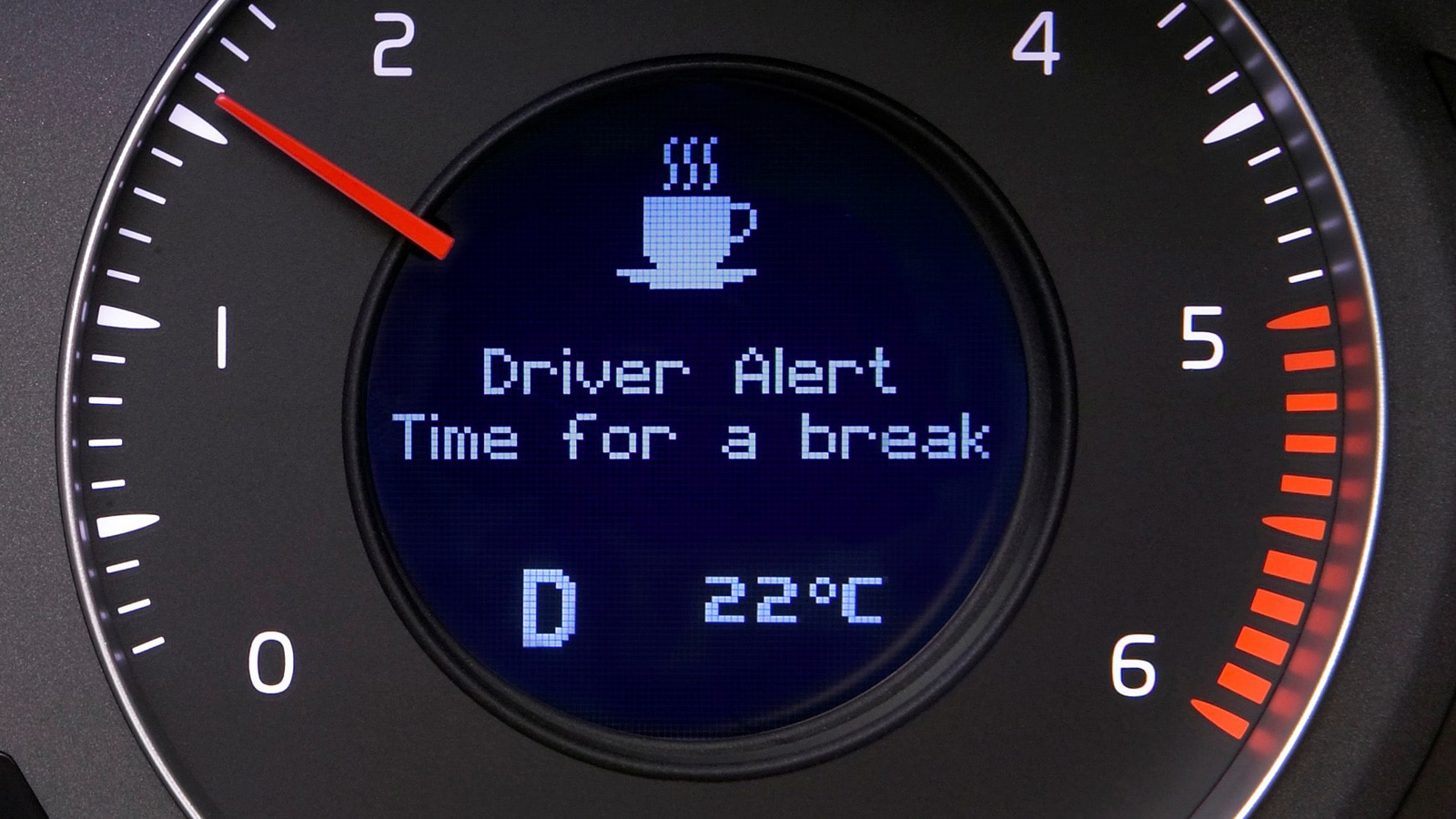
All the bill does is say now those systems should escalate beyond a warning and be able to stop the vehicle.
These cars already have all the info they need, if you "accidentally" drive like an intoxicated person, it's going to be for a reason you need to be stopped over!
Like a medical episode, dangerous lack of sleep, texting and driving.
It has literally nothing to do with being a remote kill switch.
Saying it's a remote kill switch is like saying the mandatory backup camera system is as a mandatory surveillance tool...
It's such a huge leap you can't possibly make it in good faith...
(Yes, a friend of mine told me how he had to do just that. His friend died anyway, but it wasn't because the car quit.)
There are lots of cases where I might need to get the most out of the car.
Or maybe I just want to practice parallel parking. Erratic back and forth driving and turning.
So the car according to some algorithm decides to shut down the car and strand me. The worst part is, I have no idea what criteria that algorithm is using, so I have no idea what line to not cross.
Not recommending this or proud/bragging/endorsing this, but I drive fast. Too fast. 100 MPH for me is what most people feel doing 5 over.
I have *never* triggered these alerts unless I was genuinely tired.
-
You're talking about a system you don't have the faintest clue about, instead of whipping out irrelevant fantasy situations, ask how it works???
It will *not* react to intentional aggressive movement, it reacts to clearly unintentionally movement that are consistently late and low steering torque.
This is not stuff you can replicate "practicing parallel parking", or driving like you're re-enacting fast and furious!
I expect better of HN, you're jumping from a misleading interpretation to FUD without taking a moment to learn.
Which I explicitly stated:
"The worst part is, I have no idea what criteria that algorithm is using"
> clearly unintentionally movement
How does a machine know I didn't intend it?
But you do you.
These systems don't trigger for "potentially bad" behavior like speeding, they trigger when you drive like an intoxicated or impaired driver.
Intentionally acting like an impaired drive is like intentionally walking like you're drunk... gravity doesn't care if you were pretending to stumble, you're still coming down.
So it doesn't matter if you intended to veer in and out if your in your lane with barely any steering torque being applied... that's how you cause an accident.
If you were dodging obstacles you'd be applying sharper input than a drunk person. You can't "fake" drunk without being a danger to yourself and others.
What do you think is going to happen, ADAS is going to have a tracking error that makes you look like an impaired driver?
These systems are even starting to take in eyesight and
-
You're like a person going in front of a judge trying to argue:
"Well the officer heard gunshots and watched me, the only person in the room, run away with a smoking gun as the guy fell..."
"But maybe I didn't shoot him!! Maybe I was shooting out the window and felt like going for a run!!"
You're not really going to fool anyone... if it drives like it's impaired, it's impaired. Doesn't matter if it's alcohol, sleep, texting, etc.
"if it drives like it's impaired, it's impaired"
It's just magic I'm supposed to trust.
No thanks.
P.S. I worked on the 757 stabilizer trim design. While I didn't work on the avionics boxes that fitted to it, I know was designed to never allow the software to have the last word. Because software has bugs in it. It always does.
Yes, I know about the 737MAX. There's a switch to turn physically off the stab trim. All the electronics that drive the trim, including MCAS, are upstream of that switch, and that switch rules. Another switch that overrides all the software is the column trim switch. The 3rd crew that experienced MCAS failure that you never hear about used these switches to override MCAS and land safely.
P.P.S. I let my car drift out of the lane if there's no oncoming traffic to give a crazy cyclist / kid on a skateboard more room, or to give that mom with kids more room, or to avoid an icy patch, or to avoid a pothole, or to get my wheels on a drier stretch of pavement to avoid hydroplaning. Heck, if it's safe to do so, I'll move over a full lane to avoid kids.
I'm not saying that I condone that particular answer being applied to this particular case, but it's well without the bounds of moral philosophy to say "you should not be able to make this choice".
Proof? It already happened: driver licenses already went through every one of those steps, getting hijacked way beyond the original purpose of denoting that you had the training to drive a car, into government-imposed threats against all sorts of "bad" behavior.
I don't trust any expansion of government power in good faith.
There is literally no reason for automakers to do this, and yes I know now the FUD comes in "well they will cuz reasons! cuz gubbmint!"
But just like the rear view camera... you're imagining that they'll spend significant time and money to do something with no use other than incriminating themselves...
So sure maybe your rear view camera can be rigged to stream to their servers 24/7, some already record and upload incidents anyways right?
But it's a massive jump from the happy path.
This is 100000x easier to do on the car without looping in a remote server and opens them up to 100000000000x more liability if the interface is hacked.
They wouldn't do it.
That might be the best example of a straw-man that I've ever seen.
>That might be the best example of a straw-man that I've ever seen.
I think that was the point.
Replace "rear view cameras" with "onboard tools to detect and deter/prevent impaired driving" and you have the same straw man.
The eco-agenda is the provided pretext that will mean we willingly accept what is offered, in the name of saving the planet.
You mean like smartphones, proprietary operating systems, streaming devices, many (most?) IOT devices, digital books/music/movies and a host of other things?
Sorry, until there's some law/regulation (e.g., broadly confirming the First Sale doctrine[0] and/or similar stuff) that ship has sailed, my friend.
In fact I would say barring some very strong laws that make de facto locked down devices outright illegal, there will always be more proprietary devices than libre ones. One of the chief goals of locking down computers is decommodification, meaning taking what could be a general purpose device and restricting it to one specific purpose. Even caring heavily about software freedom - I've got two librebooted desktops, two me_cleaned laptops, one microG phone, but still countless purpose-tailored devices that perform some proprietary function. If those proprietary functions (eg Google Voice SIP integration) could be straightforwardly done with libre software, then I could just consolidate those functions into the libre infrastructure.
strongly agree here!
You've spelt "Totalitarians" wrong. This is totalitarianism.
This isn't just micromanagement. This is about total control. There's signs of totalitarianism all over the place, including US-culture itself. How kids are being raised. What they're being taught in school. How people behave towards each other.
[1] https://www.bmvi.de/SharedDocs/EN/Articles/StV/Roadtraffic/n...
There are numerous safety interlocks in gas furnaces ranging from flame presence sensors to (usually) several heat limit switches, often which are wired directly in line between the gas solenoid and the furnace controller. The controller's logic has a lot of "expect this condition by this amount of time" rules, too.
The furnace's controller is usually separate from the system controller (the box that talks to thermostats, valves/dampers, pumps, etc.)
On forced hot air systems that are new enough, the furnace and system controller monitor outlet air temperature and shut down if it's too hot.
Gas furnaces are incredibly safe.
Also, the quote to install the system specified what thermostats they were going to install. It's on you to read the quote, not to get uppity at service personnel and lecture them people haxx0ring your furnace.
Unless you observe Shabbat.
https://en.wikipedia.org/wiki/Electricity_on_Shabbat
>Nobel Prize-winning physicist Richard Feynman recounts that he was approached by young rabbis in a seminary who asked him "is electricity fire?". He replied, "no", but asked why they wanted to know, and was shocked that they weren't interested in science at all, but just wanted to interpret the Talmud. Feynman said that electricity was not a chemical process, as fire is, and pointed out that there is electricity in atoms and thus every phenomenon that occurs in the world. Feynman proposed a simple way to eliminate the spark: '"If that's what's bothering you, you can put a condenser across the switch, so the electricity will go on and off without any spark whatsoever—anywhere.' But for some reason, they didn't like that idea either".
Feynman was SHOCKED I say SHOCKED they weren't interested in science at all! ;)
https://en.wikipedia.org/wiki/KosherSwitch
I believe thermostats are okay, as long as you don't adjust it. Many observant Jews use timers on Shabbos.
Not only is your comment pedantic, it's not even correct.
Homeowners typically use this setting because the overwhelming majority do not understand the mechanical systems in their homes.
The typical configuration for a steam boiler or hydronic heating is a single pair of wires. They are either closed (heat on) or open (heat off). That's it.
I worked in the HVAC industry. My comment is pedantic because it is correct.
You're completely ignoring the difference between an unattended vs. attended fire. The former has a much higher risk of being destructive and spreading to the structure.
The "off" setting explicitly won't trigger in response to temperature change unattended, which is a similar concern to internet-connected thermostats; unattended operation. For those living in freezing climates they obviously must weigh the relative risks. That first use of the furnace in winter was always a monitored event back when I lived with parents in the midwest, and it was often accompanied by a burning smell we'd investigate and verify was just some dust and nothing serious.
Even if you refuse to acknowledge there's a difference in unattended vs. attended fire risks WRT the furnace, unexpected energy costs from continuously heating an unoccupied home can break the bank for some.
Even my Harman/Kardon amplifier's manual advises unplugging it when going on vacation because of the risk of it spuriously turning on wasting electricity and being a noise problem. Its capacity to waste energy (~1kw) is nowhere near that of a gas furnace, and it clearly doesn't utilize combustion as part of its normal operation.
Fortunately I no longer live anywhere burst pipes are a concern, and I'd never leave a heater setup to automatically run in my absence. It makes zero sense for my situation.
I find it amusing that you're qualifying statements with "well-maintained", which amounts to a tacit recognition of the risks. Well-maintained isn't the default, ignored and neglected is, especially for systems out of sight and out of mind.
https://totalph.ca/should-i-turn-my-furnace-off-before-i-go-...
It is not "totally safe" for your furnace to start in an unoccupied home, particularly after it's been off for an extended period. It's not impossible for critters to have setup shop in the warm space near a pilot light, and in an unoccupied home there's nobody to even smell what would be an obvious problem before it becomes a crisis.
Thermocouple-based gas valves immediately extinguish the flow of gas when a pilot goes out in e.g. a pilot fed hot water heater. This has been standard for decades.
Pilot lights have not been used in gas furnaces in decades. Everything has been electronic ignition since the 80s at the latest. In fact they have been outlawed in some locales for close to 40 years.
Who said the pilot light was out?
> Pilot lights have not been used in gas furnaces in decades. Everything has been electronic ignition since the 80s at the latest. In fact they have been outlawed in some locales for close to 40 years.
And the baby-boom produced how many homes with pilot lights? Thermostats are often upgraded on existing homes without touching anything else, and every single home I've lived in was built decades ago still having original HVAC.
Also this https://www.wired.com/story/water-heaters-power-grid-hack-bl...
I live in a city that has a centralised heating infrastructure (every building gets a hot water connection), and my apartment came equipped with a heat exchanger that connects to said heating system. I have to _lease_ this heat exchanger from the energy company, and I cannot opt out. The lease is like 50 euros per month, though the MSRP on the unit is only 400 euros or so. Then I still need to pay for actual heat consumption, which is also 3 times more expensive than a gas powered heater that is commonly found in my country.
We don't do per-apartment heat exchangers, but rather one per building, typically with shared hot water radiators across all units in the building. Heat consumption is either estimated by a air/radiator temperature difference integrator on the radiator, or an electronic flow meter+temperature differential sensors on the unit's connection to the central hot water loop.
Always look into buyout terms. Though replacement heaters these days are lot more expensive than pre-covid :(
If so, I suggest installing a water softener with an anti-backflow device but not installing a bladder pressure relief tank between it and the water heater. Also buy a whole house leak detector / shutoff valve.
If the resulting water heater tank rupture doesn't lead them to breach the maintenance side of the contract, look into over-softening the water so the sacrificial anode fails every 6-12 months.
(Edit: In case it wasn't clear, this is a great way to do unbounded amounts of damage to your house, so don't actually do this.)
Tell the builder not install a stove, just the build the location and socket. They say no, then go with a different builder.
My house had a glass top stove (it was a foreclosure with certain things done to it by the bank). I sold it on Craigslist. Since it was basically new, it covered the replacement.
Everywhere i've been, you're happy if you get a kitchen, and the oven is just like a washing machine... a standard-sized piece of equipment that fits in a standard-sized hole in your kitchen, that you buy in an electronics store.
Usually you buy a house/apartment here, and then you buy a kitchen separately, and they ask you if you want a standard oven or a built-in one, and they leave a hole for either... I guess you can buy an oven with them too, and they install it, but you can definitely buy any standard sized one, and just screw it in, eg:
https://www.mimovrste.com/pecice
https://www.mimovrste.com/i/17170441/550/550 <- example diagram
You also need a separate cooktop for the builtin variant, but they can cut out a hole for that too (sizes are pretty much all standardized)
A lot of people still use standalone ovens+cooktops, eg: https://www.mimovrste.com/stedilniki/gorenje-kombinirani-ste...
We current had induction and didn’t want to go back to radiant
Between all the appliance stores in my area we found a single unit that was in stock. Everything else was two months out.
Unfortunately it is a smart oven. Good thing is that it just nags is about adding it to WiFi but doesn’t force it.
But either way, we had no damn choice on a new oven due to supply chain issues.
As has been said in other threads about connected TVs, if a few companies would just make dependable, serviceable, not-effing-internet-connected appliances, i for one, would buy all their products.
Anti-trust against intel, ms, and amd, aka the trusted computing group is behind the "internet of things that spies on you"
https://trustedcomputinggroup.org/
They want to turn the internet into a giant perosanl computer only corporations own and control and they are doing that by putting a secret processor inside our cpu's we don't have access to that polices and enforces copyright law.
AKA you got a digital dictator in side your phone and PC.
The last 23+ years theres been a war on general computing devices so that they obey hardware and software companies and not their users.
So the best thing you can do is call the FTC and we sick anti-trust on intel, amd, and the trusted computing group, they are behind all this internet of things bs.
Refuse to have any oven and hire someone else to install one afterwards.
Sounds like a bad deal, because it is. But... what are you going to do? Let them install the one they planned to, then rip it out and install the one you want later? Okay, maybe you can get enough for the original one to come out ahead financially, but mostly you won't, once labor is factored in. It's a wonderful racket for builders, they know exactly how to price it so you pay far more than the difference for every upgrade.
If you can afford to build your own home, you can afford it too!
Like I said, it's a really great strategy for the builder. I was quite impressed with how my builder played the game, even though it was infuriating. I couldn't find a way to get around it and be financially ahead.
Even if it's slightly more, in every remodel that you're actually going to live in it makes sense to pony up an extra grand where it matters, like your appliances. "Builder grade" is only acceptable for people who don't have to live in it, and if you're hiring the builders then you need to make that clear...
I did not mean to imply that you should settle, or that I did. I paid for lots of upgrades. But they were expensive, a wash for me financially, and very lucrative for the builder. But short of being my own general contractor and building the house myself, I had no leverage to change that.
If I were building the house, I could say "I want dishwasher B instead of dishwasher A" and the price difference would be B-A. A typical homebuilder, on the other hand, can say "we include A with the build, and if you want B, it will cost $B". So maybe the better dishwasher is $600 instead of $500, but instead of paying $100 extra for my upgraded dishwasher, I pay more like $600 extra.
The only way to "win" financially is take the builder grade stuff, use it until it dies a natural death, and replace with better things as you go. Any other path to dishwasher B costs just as much as paying the price the builder demands for it.
Dishwashers aren't the best example, I agree, because they're easy to remove and install for any DIYer. But we ran into it on lots of things. Toto toilets instead of build grade? Full price. Better garage door opener? Full price. Etc. Things that are not nearly as easy for a DIYer to do (or, even if they are, like toilets, they have zero resale value).
The whole experience made me want to become a homebuilder :). Partly because I love houses, partly because it's such a lucrative business.
so, are you not getting an itemised bill? You agree to a number for a house and stuff inside is assumed?
I wouldn't deal with a builder who wouldn't install the oven I bought.
During the build process you can elect to upgrade things if you want. That's where the gouging happens.
You could theoretically pre-negotiate the whole thing in advance with exactly the appliances you want, and then try to get the price to be reasonable. But remember that you're negotiating for a house in a hot market with other buyers ready to pull the trigger too. Good luck, if you want to play games, buyers do not have the position of power in negotiations right now.
Or you can just be your own general contractor. Or you could get a piece of land and hire a homebuilder to build to your specs exactly. What I'm talking about is more the typical neighborhood of homes built by one builder, where if you get in early enough in the process you can make customizations for surfaces, colors, flooring materials, windows, roofing, stuff like that. The basic architecture has already been decided (you can sometimes change the house plan to a different one, as long as it's one they already build, it fits the property footprint, and isn't a copy of another house nearby). Maybe you can adjust some walls or doors, but not much structural changes beyond that. You're paying for convenience, and 6 month build times instead of 2 years.
We need to have laws in place to prevent such trend going further. It's super easy for vendors to put BS in but extremely hard if not totally impossible for ordinary users to disable or circumvent.
I know there are builders that place a lot more restrictions on your choices so that they're always dealing with something familiar. I don't know how prevalent this is compared to my own experience, nor do I know how it has changed over the years.
Also you often don't get to choose features from an a la carte menu. "Smart" features are often bundled with the other features you actually want, so there's no easy choice as a consumer.
I would think that the solution would be the same as with any time you buy a house and are not happy with some small part of it: rip that shit out, sell it if you can and put the proceeds towards buying one you like.
People seem very defeatist towards smart devices, and I know they are becoming more prevalent (especially TVs) but I think we still have options
The list of options on the menu is finite.
Collectively, through market leveling regulation. "Selling" a device where the manufacturer retains control after the transaction is straightforwardly in the category of fraud. But unfortunately we seem to need new laws rather than relying on straightforward torts.
Furthermore, reigning in the surveillance industry with a US GDPR would go a long way towards removing the incentives for this bullshit.
That doesn't explain why he doesn't sell this (likely very expensive) oven at cost, and then use the proceeds to buy a (likely much cheaper) regular oven.
Maybe because that sounds like a lot of trouble that might actually lead to a worse result from his perspective?
He says he actually loves the oven otherwise.
I purchased a built house, six months after my neighbour. I was in 2 days after close. I took the stove and dishwasher the builder picked.
My neighbour has been waiting for 2 years now. Still not able to move in. Many of the places near me broke ground a year ago, and some still have no walls.
Then obviously he's powerless and the corporates have won.
Or, yano just like tell them you want it changed or you'll get someone else to take your hundreds of thousands of dollars to build your house.
Negotiating details is perfectly reasonable at this price point. Swap out the oven or I don't buy the house. This is a case of accepting no and then paying for the privilege.
That's actually the perfect analogy.
>Negotiating details is perfectly reasonable at this price point.
There is no negotiation possible. It's take it or leave it. Toll Brothers don't care if you walk away; they'll turn around and sell it to someone else.
>Swap out the oven or I don't buy the house.
Right, exactly. Except if you insist on this then the result is you don't buy the house 100% of the time. There's no negotiation.
pointless excuses.
it was a stupid purchase just the same.
before someone say blaming victims: buying an extremely overpriced appliance just so you can have it included in your expensive custom home is not a even slightly difficult thing to avoid in life. cmon. just say no and buy it later on, for cheaper no less!
this is even more sily than being forced to buy a phone with data plan just to have access to public services or apply to a job. those things should be talked about. not freaking overpriced appliances sold for custom homes because your architect didn't have other options.
Voting with your wallet didn't work so far, but stay the course! Any moment now it'll start working, I'm certain.
If you reject them, it cuts off access to all of the smart tv stuff (including the App Store, apps, etc). Seems like telemetry also stops.
I was pretty delighted to discover this.
Never buy anything Samsung branded. No phones, no consumer SSDs, no TVs, no monitors, no laptops, no phones and tablets, no fridges and wash machines and driers. Nothing. The entire brand is toxic.
Hell, don't even do business with their fab, ask Nvidia about how that turned out for them.
I see your problem.
I just buy from somewhere with easy returns.
Affirmation: I got a Spectre non-smart piece-of-shit TV before they sold out at Walmart. It's such a piece of shit it only lets you play mp3s from a directory on flash drive.
Trust me, there's a piece of shit out there somewhere with your name on it. It's just a matter of whether you're going to put in the effort required to find it.
"It's the question that drives us, Neo." -The Matrix
That's doesn't seem a big problem if you use an external Kodi box. I'll be relocating in months and will likely buy a signage display if I can't find a new bigger enough non smart TV. I only use my current non smart TV for RF channels while everything else comes through a unlocked chromebox with Kodi. It plays everything and doesn't contain spyware or ads.
side note: I've previously stated that I refuse to buy from Amazon but in this case I had to bite the bullet and take them up on their free month of Prime so that I'd get it by the Super Bowl. They also had other brands with various levels of dumbness.
Like, I bought a 42” for the cabin for $40, and got a replacement remote for $8 off Aliexpress. I could sell the stand and power supply for about $100 because they’re shared with more “modern”/bigger units.
Everyone is buying the latest 4K smart junk. And losing the stand when they wall-mount it.
(Cabin doesn’t have internet, so I was actually worried about a smart tv disabling itself)
(though, yes, it phenomenally sucks that you can't buy one new anymore)
What would you pay for it?
A lot of garbage that no reasonable person would ever buy ends up being weaseled in to new home sales because of deals the companies cut with the builders, knowing nobody buys a house based on whether they could have a user-scamming smart appliance as the default. This kind of thing is insidious- I have no idea what the solution is.
Though as a afterthought, it reminds me a bit of the microsoft antitrust stuff from 20+ years ago where they bundled IE as part of destroying Netscape (im sure there is more subtlety than that, that's the gist of what I remember)