Also, in-state tuition for state schools is much less than $50k/yr so try going to Cal and/or your best local public school and supplement with self teaching (e.g. via public/free lectures from MIT)? The self directed learning/motivation is the hard part for many people of that age, but few have said living frugally should or would be easy.
If I were college-age and I were planning on going to college I would certainly do one of two things. I would postpone college until the COVID issues died down -or- I would use the fewer applicants to get into a more prestigious school banking on a better 3 year experience (out of 4) starting in the fall of 2022 and more impressive degree going forward. Either way, I can imagine admittance numbers falling off.
For me it's been a drastically different experience compared to my in-person undergrad. Whereas my Bachelor's degree was full of camaraderie and formative life experiences, my Master's has been more or less bereft of social or personal growth and focused entirely on course material. This is okay for me since my primary goal is to develop a deeper technical background, but I would not recommend such an experience for your average 18 year old kid who is about to start their first university experience.
Apart from the labs, I do not see a reason to go to college to learn.
You just described a campus.
And my online classes were explicitly taken online, with professors who had done online stuff before, not hastily moved online in the midst of a pandemic. Knowing how computer-averse some of my professors were, I can only imagine the transition to online was rough, and I bet I'd be scared away from online classes in college if I had to go through high school like that, even if I got a full ride.
And, as others have said, going to college isn't just for the degree. Yes, that's a big part of it (the expensive piece of paper at the end), but just being able to be away from your parents really helps you grow up and become independent.
Universities are moving into a new space by taking so much online, and people will realize that some institutions are better at this than others. MOOCs can be done well, but it is largely not those traditional institutions that will be doing that.
I'm very interested to see if some education disruptors come out of this time.
https://thetech.com/2021/03/18/regular-admissions-2025
Tuition has doubled since I went there, but at least they can afford good financial aid for those who can get in.
Education is primarily a prestige product. Secondarily, the social and alumni effects of the network around you when you attend. Thirdly, it is the college campus experience. Fourthly, it is what you actually learn.
If you just price the value of each of these four pieces, the dynamic in the market is completely explained. Community college still provides learning, but not much on the other three factors. That is, it has become poor value for the fees it charges despite them being lower in absolute terms than prestige schools.
But if you’re going to a second-tier state university I really wonder if any of those students are getting a positive payback.
Couldnt it just be wanting to waive fees for those it would help? How are they supposed to only waive fees for those who have a shot at getting in?
The problem is, the pandemic has been in full swing for the past two application seasons, and you can only take so many gap years.
There is a large backlog of very talented students. It's not a good time to be an applicant.
What would you do instead?
Where the hell is the money _going_?
Are Colleges and Universities pocketing the money? Are they publicly traded and distributing dividends? Are they building rockets?
I know some of it goes back to financial aid, and some goes to football coaches...
But we're talking about so much freaking money, and I just can't visualize where it's going.
1970-71: $81,798
2018-19: $88,703
Mean salary of American college and university presidents in 1983: $160,640 (2018 dollars).
Median compensation of private college and university presidents in 2018: $668,000.
Median compensation of public college and university presidents in 2019: $495,808
More, and primary source links:
https://www.lawyersgunsmoneyblog.com/2021/03/university-admi...
"ALL FIGURES ARE INFLATION-ADJUSTED INTO CONSTANT 2018 OR 2019 DOLLARS."
Much of the growth in administration is driven by a significant rise in the costs to comply with federal regulation. Those regulations are not bad--it's the cost of complying with things like disability laws, Title IX, etc--but they require collecting and reporting significant amounts of data, and that isn't free.
There's other stuff too; some colleges do have the lazy rivers and fancy dorms, many colleges lose money on their football program, etc. But those aren't the fundamental drivers.
By the way, in case anyone is wondering, the money is definitely NOT going to faculty salaries. Salaries for full-time faculty have been stagnant for decades even though an increasing percentage of classes are taught by poorly-paid adjuncts.
Similar things happen in healthcare. My SO works in pharma and the amount of red tape they are required to navigate significantly increases the complexity of their administrative work and decreases the cost-efficiency of their business, partially passing on the costs to the price of drugs.
Again, like you said, the regulations are not bad (like regulating the types of communication they can have with doctors), but there is a price to pay to keep them.
Also, medical profession trade unions/cartels (aka AMA) constricting the labor market for medical work.
These things probably could actually be resolved by governmental regulation.
They could, but I wonder if it would actually improve the state of things. We would then need to increase the size of the bureaucracy (in the government and in each institution that does any of these things) to meet these regulations, and given that a bureaucracy becomes less efficient with size it may not actually make things any cheaper.
Then there are other leaks, like $50k/yr hosting bills for a CMS serving under 200k pageviews per day, or other ancillary a11y compliance tools that cost nearly as much. If there is budget, it has to be spent.
At this point, my feeling is that the local maximumizations that have driven us to this point are irrecoverable. There is no “fixing” this system. It will carry on for a while yet out of momentum, but something disruptive will dethrone it eventually.
The one place is almost certainly not going its faculty salaries. The industry's shift to adjuncts has been great for university endowments but terrible for those who got their PhD in the last couple decades
My point is I don’t think the money is going to university teaching staff at least…
There is so many overspending problems its not even funny - and yet the people actually teaching the classes are TA's, probably getting $20K/year, while the professors work on their 'research' and are rarely available to students.
Starting to think the whole higher-education model is hopelessly broken.
The vast majority of college sports programs in the U.S. are losing a lot of money for the school. They are operating at a detriment to the school's main goal of learning.
Also a Universities goal of learning is research, not teaching, especially not undergrad teaching.
Maintaining physical health is huge, but the demographic that needs to be targeted is lower performance level that club sports. Even THOSE are quite competitive. Even the (very fit) people who participate often cease physical activity and healthy eating soon after graduation.
On the other hand, subsidizing college gym facilities does tend to reach most of the student body. Required athletics classes is even more effective and pays long-term dividends (if they haven't been canceled due to COVID by now). But even more-so than that, consistent physical activity for grade school and high school would be even better from a whole society perspective.
When I was an undergrad in the mid 1990s, the dorms were square rooms with cinderblock walls, concrete floors, metal frame beds, and a simple desk, the cafeteria was like an oversized high school cafeteria, and the gym was a basic weight room. A couple of years ago I received a brochure from my alma mater asking for donations and showing the modernized campus - the dorms were now luxury apartments, the cafeteria was a gourmet eatery, and the gym looked like a Lifetime.
I'd bet a lot of it comes down to how modern values are implemented.
Being kind and embracing meritocracy should be completely free.
But adding a department of "Diversity, Equity, and Inclusion" isn't.
Where football coaches have very large salaries (EDIT: compared to peer schools), those salaries are paid by athletic department revenue and boosters.
They are. Why wouldn't they? Kids and parents can get massive loans from the government, it would be silly for universities and all their admin staff to pass up the opportunity to enrich themselves.
Universities have started to compete on which ones have more gyms, clubs, luxury dorms, various interest groups. Well, the basket weaving club needs an instructor, a secretary, a janitor, a new facility, a maintenance person for it etc. Some of them may be friends and cousins of the existing administrators, but you're not supposed to notice that too much.
I couldn't stop laughing when I visited my alma mater, a decade later and seeing how they had build a brand new gym with a huge lazy river around it. In my head I could hear the enthusiastic tour guide "Your child can type their homework while floating around in a lazy river, isn't that great!". But then, of course, I realized that it was my tuition that has paid for the lazy river.
On one hand, I am not sure I agree. My son is going to the same state university I went to, and it's substantial more expensive, but they 've also built a ton of infrastructure that I find questionable.
On the other hand, I don't really have data and when I look for it I find articles like https://www.cbpp.org/research/state-budget-and-tax/state-hig... :
"Deep state cuts in funding for higher education over the last decade have contributed to rapid, significant tuition increases and pushed more of the costs of college to students, making it harder for them to enroll and graduate."
I’d take that with a big grain of salt. They love to play up this angle but I just don’t see where funding has been cut at the same rate as tuition has increased.
I remember back when I was in school, one year the state government asked for some belt-tightening, to the tune of a 2% budget cut. Y’know, asking the school to go back to the budget they had like two years prior. The admin started going nuclear, “there’s no fat in our budget, these cuts will go straight to the bone!”, saying they’d have to cut the entire music department, 10% of all class sections, etc. Even got the students riled up enough to march on the capitol building. Even at the time, being significantly less jaded than I am now, I knew this was complete BS. Ever since I’ve been very wary of this narrative that colleges are driving up tuition because of state budget cuts. And it didn’t help shake my belief when I went back to campus a few years later and saw that they did a complete renovation of the library to include multiple gaming kiosks (!) and other such creature comforts.
Simply put, the schools can basically charge whatever they want and students will pay because any 18 year old with a pulse will get approved for unlimited money so long as it goes toward college. Put limits on student loans and you’ll see the situation change quickly.
TL;DR it's like a shiny name plaque for billionaires.
Also such donations kind of guarantee your kids will get into the university, so some additional perks are there too
https://247sports.com/LongFormArticle/Ranking-college-footba...
As far as where it goes, I think a ton goes into new buildings and amenities. I went to Auburn a decade ago and the campus looks completely different. Everything is new and shiny. I assume there are also a ton of administrators.
I remember when my public college was banned from starting new building projects due to state wide budget restrictions. The year the ban was lifted, half a dozen projects immediately kicked off.
Sports team boondoggles are a popular way to spend tuition money.
Administrative salary and staffing bloat.
To be fair, this kind of means that universities should be completely public. And although they are for all intents and purposes, in theory they are still non-governmental entities. And that's strange as well.
Most public state schools keep their pricing in line with these caps ($35k in loans + ~$5k in grants). I just picked on Iowa because, and here's a list I found:
https://www.universityreview.org/iowa-colleges/
You'll notice that in-state tuition for all public state schools is around $8k a year. Here's the same for Tennessee:
I believe this only applies to the subsidized federal student loans that don't collect interest while you're in school. The limit on unsubsidized federal loans that start collecting interest right away is much higher.
When I started college in 2009, I got $9,000 in federal student loans for my freshman year.
Perhaps you were classified as a independent student?
And no, they do NOT make good money.
Giving out loans with no cap on how much schools can charge and with no ability-to-repay check is a recipe for catastrophe.
I think option 2 is the best equitable outcome but is probably politically unsavory given the heterogeneity in public school costs/quality across states (which typically aligns with political divides).
Either society puts their money where their mouth is and actually pays for people to be educated, or they can choose to keep taxes lower and let people fend for themselves. Either of these options is fine, but the bullshit blank check taxpayer funded loans non dischargeable in bankruptcy is only good for politicians and taxpayers today at the expense of taxpayers and members of society tomorrow.
We know college can be cheaper, Brigham young goes for 5k/yr, European and Canadian schools still charge less than 10k/yr.
This is partly true. The US also DID use to subsidize more University tuition.
However: Agreed. The loans are dumb. They feed into the issue in exactly the way you describe. They should be interest free as long as you are making regular payments.[1]
> Also, in-state tuition for state schools is much less...
This is so thorny... I have a younger cousin, and what he ended up doing was going to a community college for two years, then transferring. It worked out well for him! But it was a gamble.
When I was in school my parents were very obsessed with me "having the college experience" even though we were much less well-off than they were in uni and were not able to support me financially[0]. I say this to point out: I am not advocating for this. College should not be fun! If it is: Great! Glad you had a good time. But that is not necessarily the reality you should expect.
However: I have noticed a lot of people made a lot of friends in Uni, and those develop into professional relationships later in life.
Additionally, if you are an ambitious person, going to community college has the risk of failing to prepare you for higher level university teaching.
Finally: I am an extremely extroverted person. I found the community aspect of going to class, studying with friends, etc. extremely helpful in my motivation and understanding of the material. I've tried to do the MIT classes and such, but it rarely sticks.
0: Not their fault, not whining. Shit happens!
EDIT:
1: AS A VERY MODERATE ACCOMMODATION. I'm not advocating for this policy as the end-all-be-all, but I feel like this is a very reasonable suggestion.
If you wonder why Democrats get so hesitant to do anything about the situation there is one of your reasons why. (there are alot more reasons but thats a decent reason)
I’m not American, but there are lots of stories on here I’ve seen of people being able to dual enroll in a local community college or university in grades 11/12 and shorten the time spent in college.
The fact student loads have special bankruptcy treatment is bad. But absent Sallie Mae (or Navient, whatever it is now) students would be paying whatever Harvard or Stanford asked, and that would determine pricing for the next tier of schools.
Of course students prefer newer dorms, amenities, programs and research opportunities. But asking someone who might have been getting $5/week allowance to figure out how much a newer dorm is worth when the prices are in the 10s of thousands is an impossible task. They don't know how much money is worth.
And then to tell them that they can't discharge it in bankrupcy because they knew what they were getting into is very much bullshit.
And I don't say all this because I have student loans. I was very lucky, I went to a state college with a full tuition scholarship. But I've seen a lot of my peers struggle with student loans because teenagers don't understand fiscal policy, and shouldn't be expected too.
I have a vested interest in this problem. But saying popular things for upvotes isn't going to change the underlying problem of how to allocate scarce resources.
I disagree with you on "teenagers don't understand fiscal policy, and shouldn't be expected too.". This isn't fiscal policy. This is a pretty straightforward introduction to being an adult and budgeting. I went through it, too. A mortagage was harder and more daunting. Rental terms on apartments were more predatory. The fact that people even discuss bankruptcy to discharge student loan debt is a horrible sign, given how much of ones' life potential one i throwing away to recover prime loan eligibility.
Also, "And then to tell them that they can't discharge it in bankrupcy because they knew what they were getting into is very much bullshit." - what part of where I wrote, "The fact student loads have special bankruptcy treatment is bad" is unclear?
If I give you two loan options with bad terms and you have to choose one, then that is a fiscal policy thing and your choice is ultimately pretty inconsequential. You may be slightly better off than the person who made the other choice but the bad policy is affecting both of you.
Ultimately it's both a policy and a personal choice thing, but as with most society-wide issues the personal choice aspect falls away pretty quickly and we need to get realistic and figure out what a solution is instead of just blaming individuals.
It doesn't really matter what students "prefer", if a bank doesn't do their due diligence and a student isn't able to repay their loan, then the bank should be losing that money as a bad investment. They won't give a $1M mortgage loan to buy a 50k lot, and likewise won't give it to someone that doesn't seem like they could pay it back. I do think there's value in people getting degrees that don't pay well - but then you shouldn't be getting a loan to do so.
> students would be paying whatever Harvard or Stanford asked
I don't think this is true - people simply can't go to a school they can't afford and people don't have infinite money. We gave the banks the freedom to tell children that they will indeed be able to pay back loans that they often cannot, so it's the bad actions of one organization(banks) enabling another(school). Ivy league schools may be like Veblen goods where increased prices also increase demand - but that can't be true for all schools and we've seen tuition increases across the board.
The solution that seems best to me is to first fix the bankruptcy issue - if someone can't pay back a loan that is a risk the bank is accepting by giving the loan, just like any other loan. I think that alone would probably have enough of a chilling effect that way less people would be able to attend colleges at first and they would be forced to lower tuition rates. That would correct the market going forward, but it doesn't really help people that already fell victim to this system. That seems like it could be remedied by either making interest rates 0 or capping total interest to some amount relative to the principal (e.g. the total amount can never grow to more than 110% of the principal).
Similar to healthcare, I don't think education shouldn't be profitable in the short term - it's a long term investment a society has to make in itself so you can't really track it as an individual investment in any one person. If someone else becomes a doctor I'm still benefitting from that so it makes sense that I'd pay into some of the cost to educate that person. Unfortunately in the US at least we seem to be totally unable to do anything without a short-term and concrete path to profit regardless of the amount of good it would do.
I wonder what groups of people might be harmed by such a policy, but I would bet it won’t be middle and upper class families who are willing to co-sign for loans.
Changing that in isolation would almost definitely have an effect where low income families can't afford college. I see that as a gap the govt should be filling either through public colleges or directly funding people to go to school, probably both. The core issue I see here is we're letting private companies make bad investments without liability, into something that probably shouldn't be profit-driven to start with
Research is usually grant funded.
Research may be funded. But research salaries are high as are facility costs and upkeep. There are numerous costs to support a top tier research program and maintain it that are not covered by grants.
Unrelated question: does "Cal" mean Berkeley here? Do you really need to "supplement it with self-teaching"? I don't really understand why state schools are viewed that way, since Berkeley consistently ranks world top-10.
That’s very true for mortgages, but in my experience this isn’t how student loans work. Nobody I knew before college had any idea what their loans would cost on a monthly basis once they went into repayment, and I don’t think it was disclosed to me (or I forgot).
Also unlike my mortgage, my loans have trivially changed repayment plans. I changed some of them several times based on my economic circumstances without refinancing, which makes nailing down a single payment kind of hard, even if the interest rate hasn’t changed.
I would not want to be on the team that does a risk assessment with these facts as inputs, because the results would be politically untenable.
I was simply pointing out the most politically hot topic that such a risk assessment would run into, but if you prefer to put class first that is your prerogative. Of course, with even a small amount of research you might find that these issues tend to collide and ethnicity is what gets talked about the most. You might also find out that the disparate rate of repayments between ethnicities is perhaps the leading issue for those who favor debt forgiveness, many of whom frame it as a civil rights issue [0][1][2][3].
That said, it's perhaps a moot point because Biden's not forgiving anything, and the way things are looking I don't imagine Congress will any time soon either.
[0] https://www.cnn.com/2021/10/20/us/black-borrowers-debt-study...
[1] https://www.cnn.com/2021/10/06/us/black-student-loan-crisis/...
[2] https://www.bloomberg.com/news/articles/2021-12-20/calls-for...
[3] https://www.cnbc.com/2021/11/04/66percent-of-black-borrowers...
Millennials have been out there for nearly a decade yelling on social media about how ridiculous their student loans are. Kids on the precipice of college have started paying attention. Combine that with the restrictions for Covid, and you have a lot of kids who don't think that taking on tens of thousands (if not hundreds of thousands) of dollars in debt is worth it for some Zoom classes.
It's a single anecdote, but between online resources and alternative training programs, it seems harder to justify spending tens of thousands of dollars on college.
I learned more practical skills from free online classes and tutorials than I did from my entire university program, and I can think of maybe a handful of times I've thought about complexity analysis. But I've also entirely avoided whiteboard interviews, so perhaps myself and prospective employers have selected for my weakness in academic computer science concepts.
Out of interest, what are other fields besides IT?
The evidence suggests that bootcamp grads struggle at finding good jobs, and also bootcamps charge a lot up-front, whereas collages have more aid and other programs to defer payment.
It’s not a panacea, but it’s a decent option when compared to going to college for 4 years, going tens of thousands of dollars into debt, all to get an education with a lot of material that is fairly irrelevant to a career, while not having much better job prospects, particularly after getting the first job in the field.
While I agree with your core sentiment, my opinion is that this is a symptom of a cultural/societal problem and not one of the schools. Modern Universities are certainly ripe with problems (largely driven by adopting business structures), including generally poor quality courses and curriculum within them, but I think you've identified a larger societal problem we have.
Why is it that broad education which is generally, at the very least in my opinion, clearly valuable yet so lowly valued in society? It's my opinion that we have institutional structures that, given a lack of opportunities, value specialized and specific knowledge over general knowledge.
Meanwhile, if you have the capability to escape these institutional shackles, general knowledge becomes far more valuable. On the labor side, labor markets are all about jobs and specialized roles with efficient production from that role. On the capital side, you need more general knowledge to see, connect, and sieze opportunities. It seems to me that most lack enough genuine realizable opportunity where general knowledge becomes valuable (say, seeking entrepreneurship) and in such a set of constraints, it makes complete sense why people specialize and chase demand of specialization because it's their most optimal strategy for financial success.
I work in R&D in startup-esk environments and my general knowledge is fairly well valued, however even here leadership sometimes fail to see how some book or article I read years ago, course I took, project I worked on years ago, etc. was critical to making the connection that made this research thing possible.
They value the general subset of knowledge I have that made their thing possible (oh boy you know A, B, and C and those saved us!!!), never mind the hydrology work I've done, it's irrelevant (D, or so they think, even though I may draw on concepts from such domains opaquely) or perhaps hours of video gaming (E, which lead to a game theoretic intuition about approaching an underlying problem). That knowledge was only appreciated after the fact because it made someone a pile of money or positioned a large contract.
I remember hating taking geology in college because "I'd never use it," then I did a lot of applied science and R&D in the fossil fuels industry and suddenly a lot of "silly" things I did in geology gave me a foundation to jump from and to build upon. That silly geology course made me boatloads of money in retrospect. Throughout my career I always like to look back when I have a problem and say "ah ha, I sure am glad I studied or read about X years ago, that's one less thing I need to internalize now to do this thing." I'm always surprised how much old general knowledge I draw upon for new problems and how valuable they truly are.
When I was in high school and applying to colleges around 2011, the advice given to us was to not take cost too seriously. Many authority figures (like high school counselors) told my peers and I to, "follow your heart" or "go where you think you'll fit in best".
On top of that, student loans and interest rates where not explained to us very well. Very few of us understood that borrowing 160k-200k to go to an out-of-state/private school could very well mean you were signing up for a lifelong debt.
Looking back, its insane we could make such a life altering/hindering decision with so little oversight from the "adults".
85% of graduates have less than $50,000 in student loans. Paid off over 20 years, that’s really not much. https://www.rclco.com/wp-content/uploads/advisory-student-de...
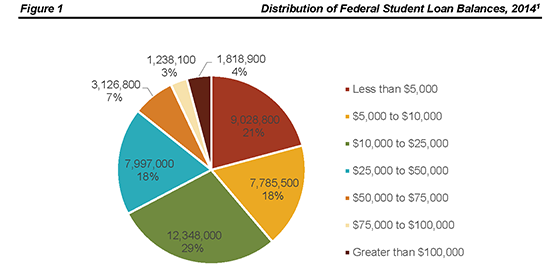
Additionally, those that have much higher loans are usually medical students who make $200,000/year at the entry level.
Meanwhile my wife only makes an appreciable dent in hers whenever she gets a gift from family members, and she's still paying $900 a month to not do much more than tread water. She did get it paid down a bit more thanks to the past two years of deferrals, but she still owes a lot more than I ever borrowed (two years of my school were paid for by a scholarship).
It's been a steady drag on our income since we've been together. At least mine is just about to go away, mine was $400/month as well... that $1300/month is almost as much as our mortgage payment.
I have multiple friends that have just given up on ever paying off their student loan debt in their lifetime and only pay enough to keep it where it is (or slowly increasing even). You wonder why people aren't buying homes and having children, there it is. I guess the solution to overpopulation is just saddle everyone with a bunch of debt, then.
That seems rather small for such a huge debating point?
> 85% of graduates have less than $50,000 in student loans. Paid off over 20 years, that’s really not much.
It is pretty terrifying that you manage to mentally justify going in debt for 20 years over your college education. I understand that given a good job it's easy to pay it back, but I never even borrowed even a tenth of that to complete my engineering degree and I've probably paid my education back several time in taxes to the government.
1. Efficiency. Canadian universities deliver similar/better products at much lower cost. Not just cost at point of use, but actual "amount of money spend annually to deliver education".
2. Financing model. Taxation allows you to fund things without paying interest to a middle man. If you pay off a set of loans whose principle is 50K, but with 5%-7% interest rates, then you're paying a lot more than 50K. So even if the products were equal in price, the taxation model might work out ahead.
2. I haven't looked at the data, but I'm going to go out on a VERY short branch here and assert that the entire delta between US and CA tax rates is not consumed by higher education.
Right, I figured. This is entirely orthogonal to the discussion about the problems with higher ed in the us...
Yes taxation is higher, but I still feel like we get a lot more bang for our bucks here.
One of those people can pay that loan off in two years. One of them is likely never going to pay it off without a career change.
Of course, we probably don't want loan officers picking what poor people can major in either.
I would not say that people should be denied based on their chosen major, but prospective students should be shown statistics on the average salaries, unemployment, and usage rates of the major they're interested in and compare it to the projected costs and resulting loan debt.
Plus, you're right that the interest rate is insane when banks are paying 1%.
The interest rate especially shocking when you consider that interest is supposed to pay for the creditor taking on the risk of default, which is almost impossible with student loans.
They're pushing these onto kids who are barely adults because its FREE MONEY to them.
Yeah, but you are assuming people only go to college for its educational value , ignoring that college grads tend to have much higher wages and lower unemployment compared to high school grads. If you look at FIRE subs for example, almost everyone who attains early retirement has a degree. The college wage premium is amplified by both higher wages and higher returns from investments by investing said wages in rapidly appreciating stocks and real estate (the post-2009 bull market in real estate and stocks, on an real basis, exceeds even the '80s and '90s).
It could be that people who are driven or passionate, on average, want to pursue higher education, or that they take on risks, exercise their brains in learning endeavors, and it’s their effort and drive that leads to success.
It’s entirely possible that high earners have college degrees because they were told that to be successful, they had to go to college. It’s a belief they were raised with.
I think it’s highly misguided that we give college so much credit. And we also demonstrate survivorship bias where those who went to college but didn’t get the pay off are blamed for having made some wrong decision.
We treat higher education as a silver bullet and put it on a pedestal when it’s not.
Also if companies gain a substantial advantage using other signals outside of degrees, you can be guaranteed that their competitors in their industry will follow. In media and marketing, degrees have long been abandoned for other signals such as portfolios and social media engagement
> Yeah, but you are assuming people only go to college for its educational value , ...
But that's exactly the point, a huge expectation of going to college is the whole college experience: building independence, lifelong friendships, extracurriculars, etc. 50k for Zoom? Fuck that.
Children literally taking out 5 and 6 figure loans for a glorified multi-year vacation with some half arsed “education” strapped to it.
I finally paid mine and my wife’s off in 2020 and when I did the math, combined we paid $216k over 7 years post college. We were both lucky enough to have well paying jobs, but so so many people don’t. Some of these people even with decent jobs will be paying $500-$1000/m for nearly the rest of their lives.
I have a senior in high school right now and although I think you're right - he's concerned about a potential quarter-million dollar tuition bill before this whole thing is over - he's also concerned about the whole selectivity of it all. From the outside looking in, you never know what's important and what's not. He has this feeling (and I'm not sure I can dispute it) that the only degrees that matter are degrees from hyper-selective ivy league schools and if the only school he can get into is Texas Tech, he might as well just give up and go into a trade. I remind him that I went to a no-name school and I'm doing fine but he says "things are different than when you were young", and I'm not 100% sure he's wrong.
Exactly this, without the "give up" part. Why is going into a trade giving up? It's choosing a different path than the one that has been shoved down all our throats like it is the only respectable option. University is not for everyone, and not everyone can go there. There's simply not enough room.
I think going into trades is what I want my son to do. I love Mike Rowe's thoughts on this - you can make excellent money, get started fast and be working for yourself by the time you would get a precious 4-year degree. And trades are in serious need of new people; seems like a great opportunity.
If you have a very specific career in mind then sure go for it, but just telling people to "go into the trades" is probably harmful.
Pharmacy: If you get a doctorate and work in a hospital (e.g. in ER), you'll get good pay. The average pharmacist in the pharmacy: Not as much in the future. And there's been a lot of wage pressure due to:
1. Amount pharmacies have to pay to obtain the drugs (i.e. what drug manufacturers charge).
2. Amount insurers will pay for medicine. These are contractual. So if you have insurance and go in, there's an upper bar on what the pharmacy can get from you.
The profit a pharmacy makes is between these two numbers, and that margin has shrunk a lot in the last decade. The upshot? Pharmacies are cutting staff, and cutting hours. In my state, there are towns with no pharmacies at all - they had to shut down as they were losing money.
I went to college and dropped out, so the value of my non-existent degree is literally zero. But I got a ton of value out of my time there. I met a lot of friends, grew significantly as a person, and found a job opportunity that started me on my career path.
I still think college is way too expensive these days, but if you think of it as only purchasing a degree, you're missing a lot.
My general impression is "has a degree with min GPA x.y" is a HR check-box that is necessary to get past an initial screen for a lot of large company roles. After you've got a couple of years experience no-one on the interview panel likely cares about the school you went to (and if they do, maybe give that firm a miss) compared to what you've done in the past 3 years.
Barely scraping through an engineering degree or getting a degree in architecture at texas tech is certainly a bad idea, but the average engineering graduate is doing better than the trades.
More of this data is public now on graduate outcomes, e.g. https://www.collegesimply.com/colleges/texas/texas-tech-univ...
There are some paths where the university choice does matter, others that don't.
Going into the trades is not a bad idea I think, but again it needs to be a conscious decision for the pros and the cons.
I think the key bit is do some research, try and get a week long internship in the job that he is looking for and/or try to speak with seniors/grads.
Problem is we always keep hearing about these selective schools in the media and that colours out perception a lot. Of course try as much as possible to get into a selective school, but if one is unable to, there are still opportunities.
Much more than that. The ivy league admits ~20k a year. That number jumps to a few hundreds of thousands if you extend to flagship state schools & the Dukes, Northwesterns, and Stanfords of the world.
I did this and through I resented it at the time, I existed college with around $30k in student debt versus my friends that all has something in range of ($40k to $80k). IMO 30k in student debt is very manageable, currently have the thing paid down to like $12k and I like knowing I can reach into savings at any time and wipe out this debt if need be.
For the truly frugal student, I would probably recommend something like what I did: take community college or AP classes aplenty in your senior year. Go straight to a college that has the best program for your interests (keeping in mind your interests may change). Graduating in three years is easy enough if you have a semester’s worth of transfer credits for gen eds, and classes like calculus and linear algebra in particular are really easy to cover before you go to college. Administration will probably try to make graduating early as hard as possible, but they really won’t be able to stop you if you have the credits already.
This was the case for me, though I wouldn't classify as being "screwed."
I attended a private tech school, and they were upfront they would not accept credits for any engineering program pre-reqs (Math, Chem, CS, Tech Comm, etc). However, they would accept "humanities" credits an apply them to any electives required for our chosen degree.
Luckily, I had participated in our schools "running start" so I earned those credits while in high school, and my only intention of taking math at the time was to fulfill my highschool math requirements. I did also take 2-years of mandarin, which my school gladly accepted and counted towards my electives.
All that being said, in Washington state, all publicly funded schools must accept all credits from Community Colleges, AND guarantee admission, so if you are a student looking to attend a state school in Washington state, community college is a very attractive route.
Absolutely - $30K in debt is completely reasonable imo; if after 4 years in college you have not improved your job prospects enough to cover that payment, then you probably didn't work very hard, or didn't pick a marketable major.
Most of these 'college debt is out of control' stories being pushed in the press, are usually focusing on outliers - i.e. people that borrowed $250K for multiple useless majors and now work at Starbucks because they chose badly. Public policy shouldn't be based on edge cases like this; not do we want to reward people for making bad decisions.
Last I read, the median college debt that people owe is less than $20K, and should be more than manageable for most people.
If we want to fix the college debt problem, focus on getting the college costs down - anything that tries to make it easier to pay for, without controlling the cost side of the equation, will almost certainly cause the cost to go up even faster then before.
The OP said he could just "reach into savings" and whip out 12k. That is an INCREDIBLY privileged position to be in and I would urge you both to re-evaluate your perspective.
People taking care of their sick mother, or paying for expensive medication for chronic illnesses, or living in a poor job market area, or have poor credit due to narcissistic parents taking out loans in their name, battling mental illness, or are paying child support, etc; are not "edge cases". They make up a considerable number of people who are struggling with the compounded failures of the system layered over of them.
It was Margaret Mead who said something to the effect that "The earliest sign of true civilization, was that of a healed femur." This was said because a femur is not something that can be healed without assistance from someone else to bandage you, care for you, and fetch food for you.
What is the point of civilized society and public policy if not to ensure that "edge cases" are treated as equitably as the general public? Why do you not have the same mentality when somebody breaks a leg? Why should society care for the outcomes of poor decision making: for example, such as playing contact sports, that results in a broken leg?
Also please quit spewing the nonsense of "didn't choose a marketable major". I see this a lot with STEM grads, shitting on the arts, and then turning around and watching DUNE on HBOMax. Everybody enjoys the work of "non-marketable" majors, but nobody wants to pay for it.
That's quite the story you've created for yourself. I'm sure it makes it easy to dismiss the issue out of hand.
Pushing these $250K horror stories, is self serving to people who want all loans forgiven - even for those people who owe much less, and who can easily afford to make payments; of course people who owe money, would prefer to get let off the hook, who wouldn't.
The quality of teaching at the community college often exceeded that at UCLA. Researchers are not necessarily the best teachers.
In my department there were a number of community college transfer students. They were almost always the most ambitious, and ended up going the furthest. YMMV.
But certainly, not all community colleges are alike. If you want to transfer to a bachelor's program, you want to find a community college with a competent transfer program that is hopefully aligned with your destination and at least has a track record of transfering students who go on to get their bachelors. Some community colleges aren't great at that.
Also, California community colleges are very affordable, but some states don't have that. If community college has costs in line with 4 year schools, then it might not be a great choice.
https://studentaid.gov/understand-aid/types/loans/interest-r...
Any loan that is charging 6.28% interest and also cant be discharged by bankruptcy is just usury with current interest rates.
The chair of NYU's Board of Trustees at the time was William Berkley. Perhaps coincidentally, he also headed the board of First Marblehead. I'm sure there was no conflict of interest, though.
The interest rates are high because so few loans can be discharged by bankruptcy. You can refinance your mortgage with anyone. Far few companies will refinance your student loans.
Meanwhile, it makes prefect sense that bankruptcy cannot discharge student loans. Otherwise, every single student would have crappy credit from 21-28 and no student loans ever.
It's time to start funding these schools adequately so that they do not immiserate everyone except those with wealthy parents. It's the opposite of a meritocracy.
The one thing we can't do is stop funding because we have pre-decided that it won't lower tuition. It's easy to attach strings to money, let's do that.
I'm not sure there is evidence of that at all. Do you have some statistics?
Here's a high level report showing some of the state funding changes. https://www.cbpp.org/sites/default/files/atoms/files/10-24-1...
That’s why they’re not discharged in bankruptcy: to make them possible to be made en masse.
So the answer to your question is as much as I think they could reasonably repay based on their earning potential after graduation. Which is a reasonable answer to the whole problem except that it hands a huge advantage to rich kids who's parents can write that tuition check.
If we disallow lending, that would tend to limit the attendance at “away from home” colleges and universities to the upper middle and upper classes. I don’t know that outcome is obviously “better”. It would be a massive boon to the wealthier families as compared to today.
I benefited massively from student loans and Army ROTC scholarship; I don’t want to see that taken away from future generations (even if removing that would benefit my family).
What's predatory about public loans. They all qualify for income based repayment, which means you'll never pay more than 10% of your disposable income (any income over 1.5x the federal poverty level). If you make below that amount, you'll never be required to pay back anything. And they are cancelled after 20 years.
Theoretically you'd owe tax on cancelled debt, but only up to the point of solvency. And a borrower who hasn't made enough income to pay back a student loan after 20 years probably isn't solvent, so won't pay anything. This also assumes that as more and more people reach this point, there isn't demand for congress to change the tax code.
Public loans make up about 92% of all student loan debt as well, so the vast majority of loans are going to qualify.
It distorts prices and results in a suboptimal allocation of society’s resources, and results in people complaining about having a “degree” and having to sling coffee cups as their career.
Politician A says they want to help students by paying for their education, or at least some of it. This requires cash flow, which results in more taxes, or at the least, entries into the government’s debt figures. Either way it shows up on the balance sheet and can affect tax liabilities today.
Politician B says they want to help students, but they will instead have the government lend money to them, with zero under writing other than the “school” needing to be credentialed by some entity. The cash is spent, but an even bigger asset in the form of the debt is recorded, actually improving the balance sheet. Then you can whittle down whatever taxpayer subsidy is being given to the schools as is, and they can make up for it with tuition increases. Either way, government finances look good, and taxes can even be reduced.
The probability of that person digging themself out of that hole and being able to achieve the common expectations of a family, house, vacations, retirement, weekends, etc is pretty low.
And someone with $60k in public loans most certainly can dig themselves out of that hole, because repayment is capped at 10% of disposable income, and it is cancelled after 20 years.
The government under the Obama administration changed things so that "Federal" loans instead of being made by private organizations and backed by the government, were directly distributed from the treasury.
However even before this, there were separate Federal and private loans, and the only way to get to $200k (for undergrad) was to get unsubsidized private loans that weren't backed by the government.
To some folks, having to pay off their loan, is considered predatory.
I've passed on a traditional uni for this because I want to avoid debt, and still get "why don't you go to uni?"'d every so often by family and acquaintance's.
And if the argument is "well, if you don't make enough to pay it, just don't!", as GP appears to be, I don't like spending other people's tax dollars dishonestly - especially not on textbook companies [0] and an expanding administrative staff.
[0] Which bribe and cut-throat their way into forcing $100+ payments per student per class per semester. Pirating or buying second hand doesn't even work half the time now - you need the "online access", aka DRM.
There's literally lectures and a quiz you have to pass before you can take the loans that explains how repayment and interest rates work.
For public loans the actual amount doesn't really matter because payment is income based. And the cap on lending is around $60k for 4 years, so I'd hardly use the word massive.
>"why don't you go to uni?"'
Of course all this only applies assuming you're American, which I'd guess your not since your friends call it uni.
Yes, but they are told their whole life "after college, you'll make enough to pay it off easy, no problem!"
> For public loans the actual amount doesn't really matter because payment is income based. And the cap on lending is around $60k for 4 years, so I'd hardly say it's predatory.
60k, with an extremely high interest is most definitely a problem.
> Of course all this only applies assuming your American, which I'd guess your not since your friends call it uni.
Nope, I live in Texas. Anecdotally, my group of friends all flip between "school name"/School/Uni in conversation. In this case, I picked uni because I'm on mobile and typing is hard.
If anything, the predominant messaging today is the exact opposite of that. It also doesn't matter because public loans qualify for income based repayment, so it doesn't matter. If you end up stuck working at McDonalds for the rest of your life, you'll never pay back a dime.
>60k, with an extremely high interest is most definitely a problem.
Current undergrad rates are fixed at 3.73%.
>Anecdotally, my group of friends all flip between "school name"/School/Uni in conversation.
Interesting, (as an American myself) I've never heard an American use uni outside of conversation with Europeans.
Unless you do get a job in your field, with enough income that you're supposed to pay it back, but can't. This probably will be less common with the current rates, but as recently as 2012 the interest rates were at 6.8% .
> Current undergrad rates are fixed at 3.73%.
Indeed. I was operating off of the rates from those who took loans in 2012 or before, the current rate is much more reasonable.
> Interesting, (as an American myself) I've never heard an American use uni outside of conversation with Europeans.
I probably picked it up from the internet and spread it to the group, I like saying less syllables :P
There's also the fact that now (even for someone who took out loans before 2012) you'll never pay more than 10% of your disposable income, for more than 20 years. Up to a max of about $500 a month (which is the 20 year payoff rate for a $60k loan at 6.8%).
There are ways you could end up paying more. Say if you spent 10 years unemployed running up interest and suddenly got a job paying $100k, but even then you're talking $700 a month for 10 years before it gets cancelled.
For all of human history, there's been a chance that a child will die in a car-accident or be abducted by a child predator on his way to school every day. We haven't said that kids should stop going to school because of this, have we?
There's a non-zero chance people will die traveling to and from work today. We haven't said that people should stop working to save lives, have we?
I think that most people being bad at understanding risk-management is at the core of why there's there's such big divide with how to react to Covid.
So when it comes to cars, what you're saying is that "some of you will die, but that's a sacrifice I'm willing to make". Am I reading that correctly?
PS: The above is obvious sarcasm. See how ridiculous bad risk-management calculations sound?
> Additionally society cannot live with hospitals operating at reduced capacity because of COVID overflow.
Color me skeptical about the severity of this risk for 2 big reasons.
1) Look at actions, not words. Think about how governors and hospitals are acting. If there was a genuine fear of the hospitals collapsing, they'd be putting out daily public service announcements begging for retired doctors, people with any medical training whatsoever, or even random nuns to come and volunteer to tend to the sick and dying. Instead they're mass-firing healthy "health care heroes" who refuse to get a vaccine. Is that the act of people who are genuinely concerned about overwhelming the health care system?
2) This sensationalism has been happening every cold and flu season: see pic-related. Hospitals are designed to perpetually run at close to full capacity for financial reasons. https://i.imgur.com/50eqkXq.jpg

Point #1 government is doing everything they can to prevent that collapse scenario. I'd need to understand more about the machinations of the hospital policies you mentioned. No link to your sources, but I imagine it's not as black and white as you are suggesting.
I find it interesting that some people are like "it's not that bad, why do we need these restrictions? Everything is functioning, what's the problem?"
The thing is "it's not that bad" because of all the restrictions and vaccines. If we did nothing hospitals would absolutely be fucked and people would be dying in the halls.
Model me a world where we didn't bother with masks and other measures, then let's talk.
Here's a few American, Canadian, and European news stories detailing similar sentiments from well before the Covid mass hysteria programming.
https://www.westernjournal.com/2018-flu-bad-hospitals-treati...
https://www.texastribune.org/2018/01/11/flu-levels-rise-texa...
https://www.reuters.com/article/us-usa-flu-idUSBRE9080WD2013...
https://www.beckershospitalreview.com/patient-flow/2-healthc...
https://www.nytimes.com/2004/01/18/nyregion/full-emergency-r...
https://www.latimes.com/archives/la-xpm-2000-jan-09-mn-52273...
https://www.ctvnews.ca/health/health-headlines/hospitals-ove...
https://www.france24.com/en/20170111-french-hospitals-cancel...
> government is doing everything they can to prevent that collapse scenario.
Deeds show intent better than empty words.
If they were genuinely concerned about the healthcare system collapsing due to a flood of sick people, they would be screaming daily begging for more health care workers: not firing healthy workers to have Covid positive health-care workers work.
Citations:
https://abc7.com/asymptomatic-california-health-care-workers...
https://afn.net/medical-health/2022/01/12/jab-or-job-califor...
Society has been sold a false bill of goods.
None of your sources talk about hospitals being "designed" to run at full capacity for profit. Canadian, UK, and most other EU hospitals don't run for profit, so that leaves the US. I doubt you'll find a medical director that claims the way to maximize profit is to design a hospital that is on the edge of meltdown every flu season.
"they would be screaming daily begging for more health care workers"
Ahem:
https://www.webmd.com/lung/news/20210812/hospitals-struggle-...
https://www.bloomberg.com/news/articles/2022-01-07/hospitals...
https://www.aamc.org/news-insights/hospitals-innovate-amid-d...
https://www.washingtonpost.com/health/staff-shortages-hospit...
There are many more sources citing hospitals struggling to find nurses, your last two citations demonstrate how desperate hospitals are by re-hiring folk who refuse to get vaccinated or are asymptomatic. How desperate do you have to be to put patients at risk of getting infected from their health care worker? I mean talk about rock and a hard place, that's a fucked up position to have to be in and shows that there are very few other avenues to go down.
There's 2 movies on 1 screen when it comes to the actual stats surrounding Covid-19, so I'm not going to argue that with you.
I'll just ask you about what's serving as the "control groups". How are, say, Amish Country PA and Florida doing? Forget any stats about "cases" you can come up with for a moment: how are normal peoples' actual lives going in places where masks and most preventative measures are less common? Are people living their lives more or less normally, or are these regions wastelands of disease and death with survivors roaming the streets begging for medical attention?
Forget stats about cases in order to understand stats on cases in areas with fewer preventative measures? What kind of crazy is that?
If you do care to look at stats on the Amish community there is this paper: https://pubmed.ncbi.nlm.nih.gov/34117598/
And I think we all know how Florida is doing: https://www.miamiherald.com/news/coronavirus/article25729082...
I don't know how else to understand COVID impact without data and factual, meaningful statistics.
Life in these places is more or less the same as it always has been, other than it passing the peak of cold season. People go out without forced masks and having to show their medical histories to enter buildings. Yet these places haven't collapsed. Why not?
If the Covid narrative that we had to mask up everywhere and check your papers to ensure safety or society would collapse is accurate, why is this "control group" (for lack of a better term) not collapsing?
We're fucked.
We've had very high rates of death, and we've destroyed our economy.
Please correct me if I'm wrong, but hasn't the UK implemented vaccine and mask mandates?
I also was very concerned about cost when going college, so I went with the cheapest route possible and also worked a job during college. I went to community college for 2 years while living at my parent's house, which was very cheap, it cost about $1000 per year for that. Then I transferred to a cheaper in-state school, in my case it was one in the California State University system (CSU) which is way cheaper though not quite as well known as the UC system (UC Berkeley is part of that system), which cost me about 10k per year for the final 2 years.
In all I was able to get through college with no debt and a degree in Computer Science for a total cost of 22k. I think there is a mindset that students should always attend the best possible school that they are admitted to, but this seems pretty dumb to me as they are usually expensive for big brand names and in the end you receive the same degree and learn the same things.
What I did also happened in California, I think some states have even cheaper paths through college if you go with the community college + in-state university route.
I can do the first two years of undergrad, through a community colleges while still working, and grad school can be figure out later if I decide on it, but I’m still concerned about how much I need to save for those last two years of undergrad.
Tuition is one thing, while generally expensive, I’m in a state that’s not too bad if you can get in-state tuition. It’s still probably expensive, but nothing unmanageable (doesn’t seem much worse than financing a new car). The main concern is living expenses.
The financial aid system is a bureaucratic joke as far as I’m aware, and “estimated family contribution” seems like a delusion in the case of most people. I half-joked with some friends about living in a car for the last couple years, and one thought I was crazy, responding with an anecdote about how “you don’t have to do that, I worked 3 jobs to pay for my education” which to me almost seems more miserable at this point.
Barely anyone pays full tuition.
Look up the statistics for any of the big colleges that share numbers. It’s usually less than 10% of students paying full tuition. Significant numbers of students pay under $10K and many pay basically nothing at all.
It’s still too expensive, but the myth that everybody is paying $50K/year at these colleges needs to die. It ends up convincing a lot of people who shouldn’t be paying that much that everyone else is doing it and therefore they should too.
Here's mine [1] -- at UIUC, full tuition is 35-50k depending on residency. 30% get free tuition (given their family's net worth <50k/gross income < 67k) and 40% got some form of a loan averaging 20k.
Assuming very generous loans (unlikely), 30% of people paid full price, or about 10,000 students (undergrad class size is 30-35k). That's not trivial, but definitely off your 10% claim.
(Here [2] it is more succinctly, and not in a large picturesque landing page advertisement fashion)
Now some anecdata-- I paid 35k. Every college friend I knew also paid full, except one, who had crazy interest rates on her loan. I recognize my friend group may be a bubble, so I preface this with "anecdata" and gave you some sources on my own.
Enrollment was at record numbers immediately preceding the pandemic, and this was a trend that held for several years prior as well. Lots of colleges had been expanding their campuses like crazy in the Before Times.
I don't think the pandemic will result in a long-term shift away from this trend. By-and-large, college education remains is a worthwhile expenditure, despite the costs. You even agree, hence why you have three kids in college!
I can appreciate not going to college right now. Classes have been randomly cancelled, there have been lockdowns/classes going remote, professors aren't grading/lecturing at the levels they should be, students are doing the work, etc, etc. But once society reaches some level of normalcy again, I believe enrollment numbers will explode back to record levels.
Plus, cost-conscious students have more options than ever. A lot of community colleges are starting to offer 4 year degrees.
It's worth noting that the vast majority of students don't pay the sticker price because financial aid is provided early and often (beyond just loans). Very few students are actually paying $50k.* [0]
The average net price at a public college last year is $19,230 and the average net price at a private college is $33,720. Note that this doesn't just include tuition, but also room and board. So if you're going to public college you're probably paying $20k to eat, sleep, and learn. Plus you generally get some kind of health insurance too.
These averages can be significantly lower still for in-state public colleges and community colleges.
No doubt the massive inflation in college prices is driven by the government loans, and the federal government's policy around them should be modified at best. But we should speak in reality instead of the hyperbolic articles that often just look at tuition which is what most people are familiar with. Colleges below the top tier compete on their "discount rate" which is what percentage of the sticker price does the average student actually pay because almost no students pay the sticker price.
* "The average grant aid awarded per student was $8,100 at public colleges and $23,080 at private schools."
0: https://www.collegedata.com/resources/pay-your-way/whats-the...
It was about 15 years ago, I was 19. At the time, I was attending community college because I had no idea what I wanted to major in, or what I wanted to do with my life as far as careers go, but I had so much societal pressure telling me that I had to go to college in order to be successful. I'd tried steering myself towards a few subjects that were hobbies/passions of mine, but every time I dipped my toes into doing something with them professionally, I quickly became concerned about money/profit/work/bosses bastardizing my love for them and opted to keep them as hobbies/passions. 15 years later, I am still enamored by some of those same hobbies and am happy I kept them as such.
While the "goal" was to transfer to a university from the community college, I consistently found myself thinking, "I'm seeing a ton of my friends, and people who graduated HS a few years before me, taking out these massive loans. Why am I going to go into debt if I don't even know what I want to do?". It just made no sense to me, so I stopped. I've been incredibly lucky that I found a career path in an area that I'm good at, and have risen to a level in my career that I'm happy with, but I absolutely did have to work really hard to get here.
All that is to say, not only do I think we put far too much pressure on people to know what they want to do when they're still too young to truly have that figured out, but I also completely agree with you that cost is the primary concern here. If I didn't have to go into so much debt in order to have continued my college education, I have a feeling I would've opted to keep at it and figure out what I wanted to do along the way.
[1] http://irpe-reports.colostate.edu/pdf/tuition/Tuition_Fees_H...
[2] https://financialaid.colostate.edu/media/sites/38/2018/05/Un...
Housing and supplies are still expensive, and _yes_ it’s still very expensive to go to college, but there are affordable options out there for college.
[1] https://www.universityofcalifornia.edu/uc-system [2] https://www.calstate.edu/attend/paying-for-college/Documents... [3] https://www.calstate.edu/apply/transfer/pages/ccc-associate-...
You need to be pretty lucky in your final years or actually going for masters or PHD to really be exposed to the research side of things.
It's a steal alright, but I cant say I agree with who is coming out ahead.
My own experience was that professors who were not currently research oriented tended to have a much more personal interest in actually teaching- not just the material, but in the practice of pedagogy overall.
Compare that to researching professors (or worse, their grad student substitutes) and it is often a night and day difference. All you're really paying more for is often the name on your diploma at the end of the day.
"Overall state funding for public two- and four-year colleges in the school year ending in 2018 was more than $6.6 billion below what it was in 2008 just before the Great Recession fully took hold, after adjusting for inflation."
"Between school years 2008 to 2018, after adjusting for inflation:
    * 41 states spent less per student.
    * On average, states spent $1,220, or 13 percent, less per student.
    * Per-student funding fell by more than 30 percent in six states: Alabama, Arizona, Louisiana, Mississippi, Oklahoma, and Pennsylvania."
That seems low to me. Are you only counting the cost of tuition (and not books, room and board, etc)?
I just grabbed some numbers for NH, one site says the average for tuition alone is $10k, with another $1.5k for books/etc, and another $15k for room/board. So, unless you are able to commute from your parents, looking at closer to 25k+ in loans, per year.
I also checked UNH specifically, where the numbers are roughly $20k for tuition/fees and $33k all in.
Where is that? At my school (Oregon State University) in-state tuition is $13k, and room & board is an additional $13k (which is way overpriced -- more than double what you'd pay in rent & groceries living off-campus, but all first-year students are required to live in the dorms). And out-of-state tuition is triple the in-state rate. So that $25k-50k estimate is exactly on-point here.
Most state schools are easily $20k for in state students once you add in the room and board. Then they try to get $50k from the out-of-staters. Top flight state schools like Michigan, Cal Berkeley and Cornell start at $75k+ for out-of-staters. Of course financial aid does enter the picture for many students.
Further, I think it's disingenuous to only consider tuition. Cost of living in e.g. Berkeley is ridiculous, literally more than tuition. [1]
(I understand that living is not something Berkeley can fix, but it's very much their problem and a concern on students' minds, regardless of whose "fault" it is)
To only consider tuition is a cost-shifting marketing tactic that these schools use so you don't focus on the bottom line. Their goal is to get you to attend. Period.
Let's look at a less prestigious school-- UCSB tuition is about 12k, but total cost might be 24k (official estimate says 32k [2], but I have the random fees they have to not be applicable, e.g. "campus fees" or "books")
https://www.wsj.com/articles/stop-feeding-college-bureaucrat...
When I hire now, I always look for kids who are willing to teach themselves and learn from all of the good sources on the Internet. Places like Coursera, Udemy or even YouTube. They're reasonably priced.
The best lessons I learned in college were off campus and developing my social skills (which is important).
We can't just look at tuition, but housing costs. The cost of housing sometimes rivals tuition. A fun fact is they make freshmen have to buy $2200 meal plans for their first year. They also prevent freshmen from better housing where they can cook for themselves and save money through food stamps.
Ontop of this part of those grants are work study, you have to work to receive that money. This is again even if you're dirt poor with nothing. You will have to take a second job if you need to buy personal items like deodorant.
The vast majority of students don't fit into this, they come from middle class parents and have to take out private loans. Students have to pay on private loans, so, again, more and more work. I know students working 30 hours a week just to meet living costs and pay what they owe to the University so they are not barred from signing up for classes. These students are not learning what they should be, even though they are very bright hard workers it's wasted because we let universities charge these ridiculous amounts.
It's not as if the unis are using it responsibly, either. They're not funding extracurriculars or programs students can learn more by being involved in. I recall one of our programs having to be funded by professors themselves to go anywhere. There are many different administrative workers that simply don't need to exist. The system has become lazy and inefficient. I recall in HS teachers spent hours grading. In uni - it's largely automatic. Yet we continue to have multiple teachers per subject and give professors just 1 or 2 classes.
If we defund universities they will shape up quickly. Defund, regulate, start firing people.
Private loans only make up about 8% of total student loan debt
https://www.nerdwallet.com/article/loans/student-loans/stude... https://educationdata.org/student-loan-debt-statistics
College tuitions and housing prices vary wildly, many students live with family, many students have merit based scholarships. Many states have copied Georgia and have lottery funded scholarships that covers the majority of in state tuition for students with a B average in high school.
>Or, more likely, the stats are collected poorly as they typically are.
The stats are widely available along with the data collection methodology. If you want to stick with your confirmation bias that's fine I suppose.
There's no context that changes this. Private loans make up less than 8% of all student debt. There are numerous sources available. This isn't in dispute by anyone (except maybe yourself).
Given that fact, the only way your premise, that the vast majority of students take private loans, can be true is if most students take very very small private loans of less than a few thousand dollars.
And even that is demonstrably false. Because we have data that clearly shows that the vast majority of students don't take private loans.
https://research.collegeboard.org/pdf/trends-student-aid-201...
>...that scholarships are rare...
More than 75% of full time students receive at least 1 scholarship or grant. Most of them aren't enough to cover the full tuition much less room and board, but they aren't rare.
And in many states have large scholarship programs as I've mentioned where tens of thousands of students in the state get that scholarship.
>The evidence I have readily available concludes...
Confirmation bias is something to watch out for. There's no evidence outside of your personal experience to support the conclusion that "the vast majority of students take private loans."
I don't know a full answer, but I believe we can start with administrators and work our way through the system. Something has got to give. This system cannot stay as it currently exists.
I understand that commuting to schools is not available to everyone but State schools are affordable. Entertaining the idea to go away for school either leads to higher costs or more debt. A 4 year degree from UT Dallas landed my oldest a 110k + first job in DFW. His entire degree cost approx 45-50k and that included gas, books, etc.
But central bank and government policies starting in the 70's gutted US manufacturing and took away most of the non-information worker jobs - so there was little else for the middle class to go for a career except first to college.
Hence today.
However, today it's easier than ever to live off the nanny state WITHOUT a career.
What should the role of college be today?
In what way?
That figure has risen to about 36% today, a 3.5x increase.
Chart: http://www.mygovcost.org/wp-content/uploads/2011/03/governme...
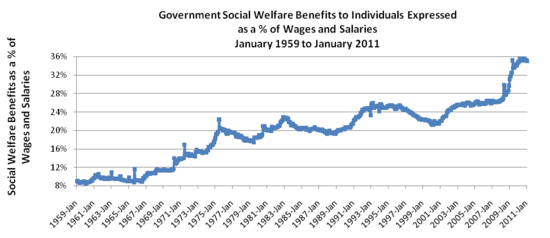
Source: http://www.mygovcost.org/2011/03/14/the-u-s-as-welfare-state... (the first random example I found on Google)
Anyway, do you have some alternate data to consider?
PPP was a boon - 'Here is a loan that converts to freebie money for millions of companies'. Where'd the money go? Buying Lambo's and the like.
Or, when can I get a tax abatement for 10 years? COmpanies can because of this mythical 'they create jobs' tripe.
Just look up corporate welfare. And if I was permitted to, I would.
Colleges assumed the trend of charging $25k to $50k per year would be sustainable. They were dead wrong, especially given the horrendously predatory loans backed by the government and barred from bankruptcy.
If we fix the college financial system, enrollment would likely skyrocket.