The real problem as always is zoning. Houses cost roughly the same on a $/sqft basis, adjusted for inflation, as they did in the 1970s. They're more expensive now because outside of town they're twice as big on average [1] - in part due to zoning rules. In town, zoning rules preclude densification necessary for supply to meet demand [2]. And, families are smaller.
Check out Japan housing CPI - a market where supply meets demand thanks to federal zoning rules, and is also centrally banked. Dead ass flat. [3] This chart alone basically debunks the theory the Fed is solely responsible for lower housing affordability.
Zoning is the issue, not the Fed.
[edit] Yes, the fed contributes a little - monthly affordability of a more expensive house is the same when interest rates are lower, but down payments are not. However, if you want to solve the affordability crisis build more houses. Any houses. Now. Compare the Japan housing CPI in [3] to the US housing CPI in [4] and weep. Housing in the US is driving inflation, not responding to it.
[1] https://fee.org/articles/new-homes-today-have-twice-the-squa...
[2] https://en.wikipedia.org/wiki/San_Francisco_housing_shortage
> Houses cost roughly the same on a $/sqft basis, adjusted for inflation, as they did in the 1970s.
Sorry, but no. My parents bought their first home for $72/sq ft. real¹. They sold it for $99/sq ft. The same house last sold for $208 sq ft., and is Zestimated today at $302/sq ft. The value of the home has averaged >7% gains YoY, well outpacing published inflation.
Their current home, built significantly later, and like you say, significantly larger, was $149/sq ft. at purchase, and is $182/sq ft. today.
Every house I look at sings this same tune. Accounting for inflation, where my parents got a large house ready to move into, for the same amount to day I'm looking at what I call a "contractor's paradise", and that will require significantly more than the sticker price to make it habitable.
¹all dollar figures in this comment will be in 2021 real dollars, not nominal ones. I.e., adjusted for inflation.
One caveat is it does reflect only new construction.
[1] https://infogram.com/1pqdpn20vkmlelcq6qx7jzwz9pf00g9xnq5
I am not sure what a blended average is but averaging new constructions makes your stats utterly useless?
Where are people living mostly and how does the real estate market go there.
at least where i am looking (european country), cities have roughly seen a 100% price increase since 2010. income hasn't kept up with inflation or the housing prices.
And in cities, the lot cost is very prohibitive too, before even getting into building a very basic house.
This is like saying that Toyota would rather sell Lexuses than Camrys.
Yes, it's true, but they sell Camrys anyway. Why? Because the market for luxury is only so big. They can make more money total addressing other parts of the market.
So why doesn't this apply to housing? Land + zoning. Imagine if Toyota was only allowed to produce 10,000 cars a year. What kind of models would they choose to make?
Doesn’t surprise me but this zoning explanation ain’t it.
Seattle's population growth has outpaced its housing growth for multiple decades. There's a huge amount of "catching up" to do, and SFH zoning is blocking that from happening.
Once enough there's enough housing to hold all the rich people that want to live here, of which there are many, you will see some downmarket construction happening. But we're a long way away from that.
Zoning for MFHs won’t change that. It’ll maybe bring more skepticism to luxury developments. But people buying million dollar units with no lot will know they’re buying the same thing.
And mixed use luxury apartments are the only development otherwise. No one is building anything more affordable in zoning more favorable for it. At best this is trickle down economics where everyone who needs somewhere affordable to live might be able to get scraps at the most dangerous furthest flung place in Lake City.
https://www.seattle.gov/opcd/population-and-demographics/abo...
> As of 2019, there were 367,806 housing units in Seattle, representing a 19 percent increase since 2010 (according to Washington State Office of Financial Management). The growth in the number of housing units in Seattle from 2010 to 2019 surpassed the 14 percent growth seen between 2000 and 2010. However, even with the rapid increase this decade, expansion of our housing stock has not kept up with Seattle's population growth of 22 percent between 2010 and 2019.
And here's Seattle's land zoning ("Land Use" tab on the same website):
https://www.seattle.gov/Images/Departments/OPCD/Demographics...
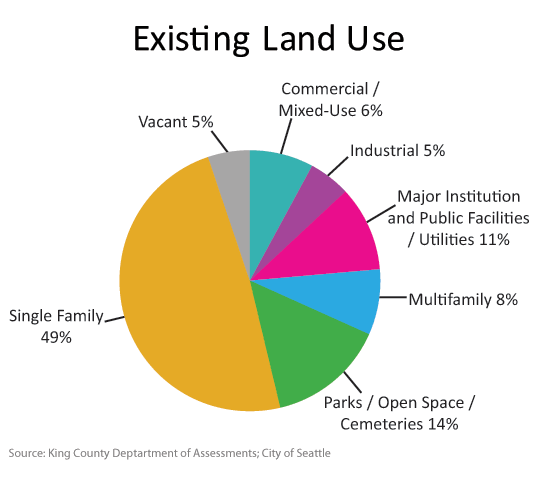
50% is zoned SFH. Only 14% is zoned for any kind of (residential) density.
I'm in the Seattle metro. Building higher density housing is still illegal in most of the city, because attitudes there are still fundamentally NIMBY, even if it's not as bad as SF.
The city has generally upzoned little slices at a time around 'urban villages', and while that's certainly better than nothing, it's a lot less effective than largest scale upzones, and streamlining building processes.
Housing doesn’t give you this option. If you don’t want to be homeless you may be able to rent, but that is pretty expensive too.
Because selling a Camry doesn't reduce the selling price of Lexuses built in proximity to it by more, in aggregate, than the profit from the Camry. Which is why developer-founded and controlled HOAs have much more restrictive rules than public zoning rules.
We don't seem to have an issue with Hertz coming in and scoping up all the camrys.
In the US, there's always more land - it's just further away! The cheap "Camry" houses still get built, but never as infill. It just gets pushed further and further out to the exurbs.
Unless you take money (or cheap debt) out of the hands of the yuppies, nothing changes here.
[1] https://alastairparvin.medium.com/if-the-uk-built-1-million-...
[edit] and btw, I think builders aren't tripping over their shoelaces to service the low end of the market because they know the city is so aggressively capping how much they can build. This means they will only build the most profitable units, the high end today. But once the high end is saturated, the low end ones will be the profitable ones anyways.
Only if the old housing stock isn't torn down to make room for the new housing stock. Thankfully property taxes aren't driven in the potential value of land (rather, they are tied to actual value), but most small scale landlords of affordable housing right in it are in it for property appreciation, not rents. Their exit plans are often to sell to a developer as tear downs.
> This means they will only build the most profitable units, the high end today.
There are costs are too high (to acquire property and build) to justify anything but going after the highest end of the market. Once the high end is say satisfied, money (investment) could simply move away from housing if it can't make any money there. Money chases the highest returns between all of the markets, not just one market.
That's not a thankful thing at all, it incentivises using the limited land in wasteful (low-value) ways.
> Once the high end is say satisfied, money (investment) could simply move away from housing if it can't make any money there. Money chases the highest returns between all of the markets, not just one market.
Available capital is practically unlimited these days, anything that's profitable and legal to build will get built.
And it's mostly chasing monopolies like location.
This is about zoning too. Normally, if the demand is there for it a smart land owner would build more housing on the same plot, e.g. turning a single family into a two family, but of course that is illegal in many places.
So poor people are still getting screwed. My daily walk to the grocery store passes by a few places that are pretty shabby (so low income) and right across the street they are building a bunch of luxury town homes. It doesn't take a rocket scientist to figure out what will happen to those shabby places in a year or so.
This is an uncomfortably extremist position, should maximizing revenue per investment be the one and only consideration society takes into account?
I do many things that provide joy in life in other ways, even if I know they don't maximize revenue or savings. I wouldn't want to go through life thinking about nothing else than ROI for every action.
That means multifamily properties have higher tax bills for absolutely no reason. Expensive locations need to provide more housing per area so charging a fixed fee based on the value of the land is a much better approach. You get to build a single family home and pay through the nose or split the bill with a multi family home.
Not true: most localities use a significant portion of property taxes to fund public schools, and more families = more kids.
Maybe we're saying the same thing, but instead of gradually reaching a equilibrium like you're describing I see a dramatic boom bust cycle--both are held back by lack of building.
I could definitely see that being how it works in a lot of cases, but it seems like a stretch to assume that's some sort of natural law of prices. If I have a market of ten potential buyers, the first who has $1, the second who has $2, and so forth until the tenth buyer has $10, I could put an infinite number of goods for $10 for sale, and none beyond the first would be able to be purchased. Sure, you could argue that it would be silly of me to price in that way, and you would be right, but in reality you don't know the exact financial details of every potential buyer of your whole market. GP is hypothesizing that basically this exact scenario is happening with housing, and I don't know if they're right or not, but your rebuttal doesn't seem very convincing that this is an impossibility.
This might not be that far off from what’s happening.
They do sell vehicles at that price which get around all of those standards, but they lose two wheels in the process.
Try buying a half-decent used home for 25% of its initial sticker price.
Tons of perfectly good used cars for under 5K on CL. And this is SF Bay area where prices tend to higher.
https://sfbay.craigslist.org/search/cto?purveyor-input=owner...
The cost of construction in America is $150/sqft. We’re not even close in cities. Off by an order of magnitude.
Watching the Detroit product roadmaps, I'm inclined to agree with that analysis at this time.
If the real problem was always zoning, wouldn't dense cities like NYC and Shanghai be cheaper than average, not way over average?
> Check out Japan housing CPI - a market where supply meets demand thanks to federal zoning rules, and is also centrally banked.
Japan went through a huge bubble in the 1980s. Also, housing (the structures at least) rapidly depreciates in Japan, which prevents them from being used a speculative asset as in countries (even then they still went through a huge bubble in the 80s). It is definitely an alternative model to our own, but I'm not sure how many people will want to experiment with that. Japan also much more strictly restricts immigration than other countries, which makes it, for example, a bad place for Wenzhou house wife real estate speculation.
It's not about supply by itself, it's supply vs demand.
Big cities have big populations and economies, which means a lot of demand.
But as far as zoning goes, note that like other metros, NYC has actually effectively downzoned areas over time; in fact, a huge proportion of buildings there would now be illegal due to different types of density restrictions: https://www.nytimes.com/interactive/2016/05/19/upshot/forty-...
A lot of NIMBY's tend to go, "well, there's still some areas where it's possible to build more, so there's no real issue there". This is approximately like restricting car manufacturing to one state, and then when car prices go through the roof, saying "well, there's still more land to build car factories there, so I don't see the problem, it couldn't possibly be this rule".
> A lot of NIMBY's tend to go, "well, there's still some areas where it's possible to build more, so there's no real issue there". This is approximately like restricting car manufacturing to one state, and then when car prices go through the roof, saying "well, there's still more land to build car factories there, so I don't see the problem, it couldn't possibly be this rule".
My only point was that making cities more dense seems to make them more desirable, causing more people to want to live there. Yes density is a great thing! But it doesn't solve affordability problems on its own. Can you imagine if San Francisco (6.2k/sqm) had NYC-level density (27k/sqm), would it be more or less affordable? I'm going to go with the less.
What is really holding us back are the American libertarians who are afraid of a public housing system like the one in Singapore.
Increasing housing in this manner would probably boost land prices, but over a greater number of units, so result in overall decrease in housing cost.
NYC is a bit of a weird spot in real estate, in that having a Manhattan address (and probably a Williamsburg or Bushwick address to a lesser degree these days) is a status symbol for foreigners, in the same way that London or Paris might be. Most American cities do not have this kind of cachet and so at some point prices will fall if you build enough.
The problem is really that housing production would have to increase by an incredible amount to get to affordable. To use the example of Tokyo as affordable, let's look at comparative housing production statistics.
* The 23 special wards of Tokyo, 8.9M people, built 110,000 new homes that year.
* The entire country of England, population 53M, built 115,000 homes a year.
* The metropolitan area of NY, population 20.3M, approved 27,000 units in 2012, but approvals != actual construction.
https://nextcity.org/urbanist-news/entry/tokyo-housing-high-...
Since housing is refreshed in Japan on a 20-30 year basis, you can't quote the number of housing built without comparing it to the number of housing torn down (since, as mentioned before, housing depreciates).
> * The metropolitan area of NY, population 20.3M, approved 27,000 units in 2012, but approvals != actual construction.
Do you mean no housing was built in 2012?
NYC does not track construction starts like that, or at least not when that article was written
The problem is that it isn't just those on the right opposed to density -- the left is little better. Sure, progressives are largely okay with what density already exists, but propose upzoning and they flip out. Just look at the California state legislature, or major west coast cities.
Of course not everyone wants to live in New York, indeed there are many cities that each have their own unique circumstances drawing vast numbers of people, and all of them experience great demand. But there's a reason you can't just through up a bunch of skyscrapers in South Dakota and get everyone to move there.
You have it backwards, it is making the spot desirable that leads to them becoming dense. More people keep moving in, you build denser to accommodate them. Can you imagine how expensive NYC would become if 77% of current residences suddenly stopped being unavailable?
Yes, you will have some non-linear effects, people do want to live in big cities where the action is, but the reason those cities exist in the first place is because the action's already there. New York is a massive hub of commerce and culture which is ultimately a consequence of it's position as a major port. You won't make it undesirable by decreasing density so long as its still the center of the financial world.
I'm pretty sure this is wrong. Yes, it's the first answer that comes up if you Google this stat, but this is off by a factor of 3 or so. Before the pandemic San Francisco had a density of around 18K/sqm. Although a lot of people left SF during the pandemic, 6.2k/sqm is still way to low.
Now, that we have that out of the way. In general, I agree with you. Most cities that have a high population density are expensive places to live. It's a good thing to allow cities to accommodate more people, but those places will still have a high cost of living, because many people still want to live there.
However, the place with the lack of Zoning rules that appeals most to Libertarians, Houston, is doing pretty well.
Houston has seen an increase in population from 3.8M in 2000 to 6.4 M in 2020 and has a median house price of $285K.
The Republican party is inundated with Libertarian philosophy. Even the Democratic party is often forced to go along.
> Houston has seen an increase in population from 3.8M in 2000 to 6.4 M in 2020 and has a median house price of $285K.
Yes, Houston is probably the best example of a libertarian city in the world. Most of us don't want to live there, but someone obviously does.
The irony is that Singapore has a public housing fix to their problem, but is also often touted as being a very economic libertarian city state.
People think Manhattan is mostly skyscrapers, but the reality is very different. Only a small portion of the land has high rises on it, just glance at Google Maps with 3D view on.
I wonder how NYC would do with cheap 30 story Chinese concrete apartment blocks? (30 stories, because any taller requires steel, at least with construction practices that use cheap migrant labor).
* multigenerational to nuclear households
* decline in number of kids
This pattern of living is still common to a lesser degree in outer-borough immigrant neighborhoods, which is why they were so hard hit during NYC's massive COVID wave.
Have you looked at Japan's population, its "dead ass flat" while US population keeps going up.
https://datacommons.org/tools/timeline#place=country%2FJPN%2...
[0]: https://lh3.googleusercontent.com/-xDrQEcMyF5Y/YWDyNh-3TiI/A...

Yes, SF has the second-highest construction costs in the US. $330/sqft. [1] Average home prices are $900-1200/sqft.
[1] https://www.investsf.com/why-san-francisco-has-the-second-hi...
Investors have too much access to property. It's a system of greed that benefits those who entered the market early (typically boomers).
Just stop blaming zoning already.
> Zoning issues/lack of supply would imply that there are lots of homeless people without a roof over their head.
The price of housing only matters to people who don't already have homes they own. 65% of Americans own homes, so that cuts down your working set dramatically.
There are a lot of homeless people, yes - 0.2% of the population - but lack of affordable housing tends to be roughly equivalent to "perma-renting" as renting has a lower barrier to entry.
To buy a home you have to come up with a lump sum of money to make a down payment. If you can't do that, you're forced to rent or split accommodation or live with your parents. Lack of affordable housing doesn't mean homelessness. There's a lot of elasticity there.
> Investors have too much access to property. It's a system of greed that benefits those who entered the market early (typically boomers).
Investors buy property to rent because home ownership is unaffordable. Blackrock buying up property is a symptom of the market, not a cause. They don't see houses becoming cheaper because they don't see zoning reform on the horizon, so they believe there will be long-standing demand for their rental units.
If housing were to become affordable, due to a large increase in supply, these investors would get bowled over twice - once due to lower real property value and once more due to lack of demand for rental units as folks buy instead.
Even foreigners parking capital abroad, more supply makes that (a) a bad idea and (b) kind of irrelevant. I'm not saying that shouldn't be tackled too, but once again, zoning would solve the problem.
i don't believe anything of what youre arguing simply because more supply will continue to be purchased by investors to further drive up prices.
> i don't believe anything of what youre arguing simply because more supply will continue to be purchased by investors to further drive up prices.
I think Japan shows us there are limits to this.
Anyways, I appreciate your thoughts!
Half the economy is based on real estate… people building buildings to avoid taxation (if you have $) and borrowing against equity (joe homeowner). You cannot break equity values without breaking the economy.
The people who are getting screwed are the same people who have been getting screwed since the Vietnam era. Go watch “clerks” and read early 90s op/ed pieces - it’s the same cycle.
It's actually funny how the efficient market hypothesis makes no sense once you consider the role that land has played in human history. It's the biggest unsolved problem in economics that no politician really acknowledges.
Even anti government or extreme free market ideologues still insisted that land should be heavily taxed or regulated in the name of efficiency.
They definitely did not. [1]
The bailouts were largely loans, ones that were repaid to the US government for a pretty substantial profit, not less. And assets the Fed took on were literally that, assets, which the Fed was profitably unwinding before COVID hit.
[1] https://en.wikipedia.org/wiki/Federal_Reserve_responses_to_t...
You can see the Fed unwinding its balance sheet here [2], up until 2020, and in the link you provided.
[1] https://projects.propublica.org/bailout/
[2] https://www.federalreserve.gov/monetarypolicy/bst_recenttren...
They both filled different roles - one was meant to manage inflation and the other to secure the stability and function of the markets. The Fed's dual mandate is to maintain maximum employment and low, predictable inflation rates over medium term. Spotting Ford in a rough patch doesn't fit the mandate.
It seems to me that tripling the monetary base and investing two parts of it in MBS is going to have an inflationary effect on house prices. Am I being obtuse here?
Fractional reserve lending means that an increase in the monetary base is a result of lower interest rates - money supply operates on a pull model not a push model. Lower interest rates mean a more expensive house costs the same per month when mortgaged, which in turn increased the outstanding supply and balance of mortgages, hence new money. Lower interest rates increase the price of houses, but to a much lower extent the affordability of those houses - which is more likely to be measured on the monthly cost of a 30 year fixed loan. It will move the goalposts on down payments, however, but down payments are only 2-20% of the cost of the house.
In my opinion, however, I believe zoning to be a much bigger contributor to overall affordability.
And yeah, the real enemy is zoning. It’s fun to blame Blackrock, and they deserve it, but it’s regular homeowners trying to restrict more housing that is the cause.
I think graduating into the 2008 mess gives us peculiar point of view. Two years older, we might have already had burgeoning careers. Two years younger, we might have avoided it altogether.
I remember so much impending doom from those years. Pretty different than the current sentiment.
But yeah, it was rough for everyone. Even now, young careers are shaped by what happened in 2008.
I can’t think of a year where I didn’t have $5K of crap that needed fixing/replacement/improvements*, the year with the fence was 6x that, and I’ve got a boiler coming due that will be a $15K project in all likelihood, $25K if I go higher-end and improve the piping configuration for more even heat on the far end of the piping runs.
* not making improvements is a major saving point in favor of renting. Improvements are a money and time pit and most return less than $0.50 per $1.00 spent on them. It means you live without the improvement, but it’s wildly less expensive over time.
Therefore its better to use taxis.
My mortgage cost are half the rent for same property I dont see myself loosing money anytime soon on my deal. Plus nobody will kick me out on the whim of truing rental into AirBNB like my parents got few months back.
For a contrary anecdote, I've been living in my current house for well over 20 years and not once have I spent 5K in a year in maintenance. Rarely have I spent even over 1K.
I can't think how I could even spend that kind of money in maintenance every year. What's there to fix that costs you so much?
To the younger generations out there mortgaging themselves into housing: the closer you are to median income, the more you should make damn sure you're computing PITI+Maintenance when crunching your numbers (there are a couple good calculators out there now, discussed in the past on HN), staying below a 33% post-tax DTI, and taking on as much of the fix/replace/improve work yourself as possible.
With increased US income precarity due to the medical debt adverse lottery selection pressure (major source of bankruptcy), conventional housing is a bigger gamble for median income earners, and conservative personal financial planning around housing mortgaging decisions is completely absent from mainstream American discourse. The field is entirely tilted against the common folk, and young generations in particular are specifically preyed upon.
With the high cost basis of housing today, try to avoid transaction churn and look to stay in one property for as long as the numbers make sense to you, and crunch the numbers for any moves to include round-trip realtor fees. At 2-3X gross pre-tax annual income for a house, while moving around and buying each time you move wasn't optimal, carrying the cost for big career income increases was justifiable. At today's ratios, with today's decreased class/income mobility, the round-trip realtor fees to sell-then-buy are tone-deaf by the industry to the reality on the ground for young customers.
The US real estate industry is tremendously out of alignment with serving the majority of the US population and especially the younger cohorts, and their extractive orientation only eats their seed corn to set up an asset bust down the road. The demographic time bomb that is now unfolding even in the US will be challenging to reverse/slow/halt, and has likely already indelibly written the secular asset bust into the real estate industry's future. No doubt the central bank will bail out the private underwriters again by making the quasi-public underwriting facilities take on the overleveraged valuations at their lows and unload as the private balance sheets can pick them up again to profit off them in the up cycle.
The real estate industry in general thrives upon a population who generally cannot get along with each other living in close quarters with each other as individuals, and that is also a hackable vector (among many others). If you can find extremely close (forged over 7-10 years) friends who you can thrive together even when living with each other under the same roof, then you've found a de-leveraging function against the industry's imposed costs instead of going at it yourself.
While all the efforts at YIMBY and related legislation are great, people need to get on with their lives and fund their retirements today. Hack your own solutions at your own level now instead of waiting for those efforts to bear fruit, because for damn sure the politician meat puppets of the real estate industry and the industry itself aren't ever going to do anything for us.
Forcing young people to take more and more debts to buy assets at now over-inflated prices has no happy ending.
Sure, you can win from that. But, in % terms, you win less than people already richer than you. Inequality is only increasing.
Jerome Powell has already made it clear through his actions that everything is now 'Too Big To Fail'. Capital is at an all-time low in terms of actual real cost to the borrower.
You'd be an idiot not to borrow right now. If we keep seeing dramatic inflation, there will be some increase in wages, and it'll be enough to offset whatever interest rate you get, unless you're just an utterly unqualified borrower.
There's a reason /r/wallstreetbets exploded in popularity right around the time COVID-19 hit and money was being printed nonstop and assets were dramatically increasing in value... the hoi polloi know the playbook that the wealthy elite have been using, and now they're using it too.
But the bigger problem is that in an inflationary environment, real assets get bid up high to compensate. This has already happened in housing (clearly) so you're late to the party. If you knew for certain that inflation was going to get to this level before everyone else, maybe it would have been a good idea to do what you're describing.
Meanwhile capital is at an all time high in terms of price to earnings. There's no reason to think you know what the future holds.
Prior behavior is the best predictor of future behavior. The world has become complacent and dependent upon cheap capital, and no one - and I mean no one - is ready or willing to turn off the faucet yet.
No expert recommends dwelling on only the most recent behavior.
You realize the amount of young people who have this option is very low and getting lower by the year? So ... what?
And nothing will save you if your salary doesn't keep up with inflation
Housing is also not a great comparison metric because it was so perturbed by 2008. New unit starts dropped precipitously and still have not fully recovered: https://fred.stlouisfed.org/series/HOUST
We know how to build housing quickly and now it's clear there is demand. If the current trend continues it looks like we will again have a housing surplus within the decade.
Cite?
Also who died and made Adam Smith's word synonymous with fact?
Last I checked the true price of anything is the price I have to pay to acquire it, which is incidentally more in line with Adam Smith's actual quote which was: "The real price of everything, what everything really costs to the man who wants to acquire it, is the toil and trouble of acquiring it.". The price I have to pay to acquire something translates to money, that I gained through "toil and trouble" so to speak. Quite far from the true price of everything being human labour.
though Smith really didn't make much use of the labour theory of value, as he thought it would be less relevant in an advanced economy. Riccardo and especially Marx developed and used it much more. (For Marx see the first part of Capital)
You are free to interpret it any way you like, but then taking your interpretation and saying that is what Adam smith was trying to say, when it is quite literally not what he said, nor even close to what he said, is called lying, and that is not really okay.
> The value of any commodity, therefore, to the person who possesses it, and who means not to use or consume it himself, but to exchange it for other commodities, is equal to the quantity of labour which it enables him to purchase or command. Labour therefore, is the real measure of the exchangeable value of all commodities.
> It was not by gold or by silver, but by labour, that all the wealth of the world was originally purchased; and its value, to those who possess it, and who want to exchange it for some new productions, is precisely equal to the quantity of labour which it can enable them to purchase or command.
> But though labour be the real measure of the exchangeable value of all commodities, it is not that by which their value is commonly estimated.
https://www.gutenberg.org/cache/epub/3300/pg3300-images.html...
Adam Smith explored the labor theory of value in the context of primitive societies with fixed capital. In that case, you do get prices scaled to labor inputs, as capital is constant.
Ricardo tried to develop more sophisticated models than those with fixed capital, but did not have the tools to determine price setting, and finally admitted "I am not satisfied with the explanation I have given of the principles which regulate value.".
It wasn't until economists started using math more seriously and included production functions and utility functions that they were able to formulate a more general theory of price setting involving marginal costs and benefits. This allowed the creation of numerical estimates for things like price elasticity that provided useful information for price setting and allowed (in some cases) for falsifiability and even laboratory experimentation. See the famous experiments of Vernon Smith, for which he won a Nobel Prize. https://www.econlib.org/library/Enc/bios/SmithV.html
Thus standard economics was able to go bit beyond the thought experiments of Ricardo and Smith whereas Marx continued the process of philosophically musing about value in a normative sense, now removed from any actually observed prices, and far off into the world of political economy rather than economics per se.
Price of land is determined when looking at the world as a whole (margin of production), so it can't be measured in a simple microeconomic laboratory experiment.
It can actually be studied using models, but one would have to go back to Smith and Ricardo and add the third factor of production (land) back into the equation. Which was removed by marginalists for simplification to study simple markets of bananas and yogurts.
The modern economic foundations simply don't have the tools to study land markets, so they will always fall into the trap of a drunk man looking for keys under the lamppost only.
It seems to me many bubbles are the result of speculation with easy credit and I’m not sure 2008 can be considered a “perturbation” instead of a correction.
Your link shows the "owner-occupied" housing was relatively flat during the housing crises. The link below shows new housing units were still increasing during that time.[1] Does that imply most of the new builds were investment properties (i.e. not owner occupied) during this time period?
https://fred.stlouisfed.org/series/ESALEUSQ176N
I think this is what matters most. It's good to have some vacancies so that people have options but too many likely indicates there's some speculation/over-building going on that the market doesn't support.
The foreclosured realty has been selling pretty quickly.
In the case of asset inflation, it is literally the opposite.
You gotta look at the derivative.
Rising interest rates are really, really bad. Anyone who relies on revolving business debt, credit card debt, or other non-fixed-rate debt goes bankrupt.
I kinda wish I entered the economy when we still had 12% interest rates. Each time a recession hits, we level it off by lowering them a bit, and we've kinda hit the floor.
I don't think we can get back to 12% interest within my lifetime without some kind of economic collapse or cataclysmic event.
This is hyperbole. Rising interest rates aren't fun, but they aren't cataclysmic. Rates have gone up and down for decades. Further, if you signal that you're taking the option to raise rates off the table, risk tolerance and asset prices will explode (some would say this has already happened due to Fed signaling).
...the problem is people think: interest rates go up, economy slows down, we can never raise interest rates. This logic takes on a life of its own.
The US economy was in this position in the late 60s: the Fed was under pressure to accommodate govt financing, they raised rates in 1959 and were blamed for causing a recession that influenced the outcome of the 1960 election, in 1967 they attempted to raise rates briefly but did so at the wrong time...eventual result (combined with some unfortunate timing with oil price changes) is rates never rise, inflation does, serious problems.
When the discussion moves to this point, and we have been moving this way for years, I think it is a sign that something has gone quite wrong. And that expectations around interest rates and Fed behaviour are actually adding volatility and uncertainty, not reducing it.
You are quite correct though. Rising interest rates are not bad. It is just the price of money. Falling interest rates can be just as bad too, but the problems are usually subtle (i.e. financial repression, which is what is happening now, no-one will realise what has happened until they try to retire in 20/30 years and realise they can't). Public policy has moved to this risky stage where people blame everything on politicians...the result is, unfortunately, inevitable.
The Federal Reserve is supposed to have independence from the government. It will develop its own monetary policy which doesn't need government approval. In reality, the President appoints all the Governors, so people get selected based on doing what the President wants done.
The Fed's monetary policy is typically an inflation target - keep the money supply growing to encourage growth, but keep inflation in check as well.
The problem is the political influence starts to impact the pure decisions about what's best for the economy. Election coming up? Well, hold off on increasing rates since we need good employment numbers for the next few months.
If the economy gets unstable the Fed ends up riding the razor's edge trying to stick to policy but not piss off the President. Problem is that the economy can go off the rails faster than the Fed can response.
The issue highlighted after 2008 was that "yeah, printing new dollars and buying distressed assets worked pretty well! and no massive inflation so far. But there will be incredible pressure to not raise rates later and if the Fed waits too long to apply the brakes, they won't be able to get ahead of it and inflation will skyrocket."
I don't think the impact is necessarily elections anymore, if it ever was. But the Fed was supporting bond auctions through 2020. I don't think it will stop them raising rates but it has stopped them raising rates fast enough imo.
Interest rates merely balance the supply and demand of/for labor.
Growth usually happens when there is high demand for labor and that means interest rates are high during periods of growth. When you think about it, interest is just the risk adjusted yield of a labor saving investment plus minus bank fees and profit share of the borrower. That means the existence of high yielding investments is what drives interest rates up as lots of borrowers got to the bank and present their fantastic business ideas and the bank picks the highest yielding ones.
Well, I also have to say something. Growth didn't really stop with lower interest rates. The economy is much bigger than 30 years ago.
Also about negative interest rates, it's a fallacy to think they are supposed to stimulate borrowing. They are supposed to balance people's desire to be in debt with people's desire to hold onto credit (equivalent to demand/supply of labor). That means negative interest rates exist as a disincentive to save money because nobody wants to borrow money.
The extent to which you might be right or wrong depends to some extent on how much debt there is in the system (or how leveraged/wound up the economy is).
A debt-based economy is much more vulnerable. Last time we raised interest rates rapidly, in the eighties, household debt was less than half of what it is today, adjusted for GDP.
Also, I think rates need to be looked at in comparison to GDP growth. High rates are fine when GDP growth is greater. If rates shoot higher because the fed is trying to stop runaway supply-side driven inflation while GDP growth is low it could easily kick off a depression.
There is a reason major religions regulated debt in general, because that is how societal slavery develops. Of course we, the modern people of technology, 'know better' than our primitive ancient ancestors.
Charging 0% interest is absolutely fantastic. The only problem is that we don't do the debt forgiveness. We bail out banks and then expect tax payers to shoulder some or all of the losses. It was especially bad with Germany vs Greece. German banks were bailed out and public healthcare was basically eliminated in Greece.
The only reason why anyone would be against low interest rates is that they noticed that those interest rates eat into economic rents and therefore the owner of money benefited from the economic rents rather than the owner of the monopoly. In that sense, the only difference is that the money goes to the land owner instead of going to the bank. People don't realize that if they buy a $600k house with 0% interest that they would still have to pay $600k at 5% interest except most of the money goes to the bank instead of the seller who only gets $250k (made up number).
This sounded so strange that I had to look it up and found this article https://www.federalreservehistory.org/essays/anti-inflation-...
The people who bought in the 80s and 90s refinanced as rates fell and saw massive appreciation in the value of their homes.
People buying today will see the opposite
Also, there's quite a bit of cash in savings accounts now, and rates are still low by historical standards. We'll see what happens when mortgages are above 5% again.
If you buy a house 10x your income and put 20% down, your monthly payments are 40-45% of your income before tax. That's a lot
[1] https://www.reddit.com/r/investing/comments/oawyqu/is_there_...
With taxes and insurance, those numbers change to 3x = 17% of gross and 30% of gross = 5.4x, assuming California tax rates. Things like emergency funds, retirement savings, etc. are included in the "housing should cost no more than 30% of gross" rule of thumb.
Quoting investopedia "Lenders prefer the front-end ratio to be no more than 28% for most loans and no more than 31% for FHA loans."
The 3x income housing advise in not related to the front end ratio. 3x income is the max you should borrow (according to the advise givers, you are of course free to disagree), the front end ratio is what you can borrow.
And even if by some miracle you save 2x for a 20% deposit, what bank will lend you 8x income for the rest ?
Complete fantasy
If FIRE followers scale the strategy of investing and renting multiple homes, are they not limiting housing supply for other potential homeowners or exacerbating homelessness?
It is not just that houses are not being built, but that a shortage of supply is caused by the FIRE generation: buying houses as investments rather places to live, with the goal of living off on other people's rents or Airbnb, not paying taxes and leeching on society for the rest of their lives.
https://www.youtube.com/watch?v=j5zndjPZ2Is
Does anyone see the potential problem of this movement or are we just equally blinded by social media?
Would these houses even be built if someone is not paying for them. They are not leeching but investing. May be we could call it leeching when they form a cartel and start raising rent prices in unison (which only biggies like black rock can do).
"No sane person would voluntarily refrain from exploiting tax loopholes" is the same kind of argument as "no sane person would voluntarily spend money to avoid damaging the environment". In fact there are plenty of people with a decent moral compass who do exactly that.
Rarely are they exclusively the second, but landlords get to deduct the economic costs of doing business. Loan interest and property taxes cost money, buildings and fixtures wear out (but the land does not). Maintenance costs money. Landlords have the ability to deduct these costs of doing business against rental income just like every other profit-seeking business does.
Can you name a tax loophole for small-time landlords that you think is improper in the context of a tax system which taxes profits?
In many countries (including the two I've lived in as an adult) regular people get to make deductions for stuff like the cost of commuting to work, work clothes or equipment (to the extent that's not supplied by their employer), etc. By "deductions" here I mean, subtracting this money[1] from their pre-tax income and have their income tax calculated on what's left. In effect, getting taxed only on "the profits from work".
Surely even the USA must have some similar thing?
___
[1]: Often implemented as a default deduction anyone can make without proof; if your outlies are larger, save the receipts and deduct the actual amount. This general-deduction-amount at least used to be high enough that most people benefited from just checking the box to use it.
Whether it goes down in a gradient to common people like FIRE folks, or is strictly restricted to the higher classes, someone will position themselves to profit from the Fed policies. I don't see how they can be blamed. Blame the people that create these economic conditions, because they and their friends certainly aren't benevolently leaving profits on the table, they're grabbing everything they can.
Buying additional houses and then not renting them out would contribute to homelessness as that unit would be housing 0 people.
He might be referring to the problem that the landlord has a subsidized mortgage whereas the renter is paying by earning money from the circulating economy.
No, it doesn't. Congress has a lot more control than the Fed (in fact, a strict superset of the Fed’s powers), and definitely much finer, more targetable control, but they have a little more problems coordinating on action.
> and they have two options
They have a near infinite spectrum of options between two poles.
> Raise interest rates and stop printing
Well, the first. “Printing” is just metaphor.
> Crazy inflation stops, but asset prices crash and we enter a major recession or depression.
There is no real reason (though its a popular unsupported idea from some quarters) to believe that there is no distance between the tight monetary policy sufficient to acheive the first effect and that which will cause the second effect.
> Do nothing, keep printing. Inflation picks up massively. The economy keeps humming along but young people, including myself, are permanently priced out of home ownership and many other things
Again, very little reason to thibk the last thing is at all true. We had high inflation with a weak economy with stagflation in the 70s, and young people then weren't permanently priced out of hone ownership. More normal, strong-economy inflation isn't going to do that.
> It seems like they are going with option 2.
Tapering QE is not “doing nothing”, its taking the foot off the accelerator.
If the growth stops being exponential, it moves away from the target in an exponential way. If the growth just becomes an exponential with a smaller exponent, it moves away from the target in an exponential way.
In theory you could have an exponential that grows in a very slow, controlled way. On practice, it will get out of control, because nobody has any idea what the target actually is, so you either always correct towards it, or deviate.
This is why I think inflation is not as big a deal as it historically once was. It’s never been easier to convert cash to inflation-sensitive assets and back again. We could very well transition to a world where cash simply becomes a short-term medium of exchange and loses all purpose as a store of value. All your wealth could kept in hard assets until the very moment you need to spend it.
If a large enough percentage of people rented from property management companies, there would be more impetus to have strong tenant's rights laws to protect residents, and people would have more flexibility to move around. Moreover everyone would have an interest in increasing supply to keep their own rent down, pushing prices down toward cost-of-materials and upkeep.
As it is people willingly submit to homeowners associations that are in many ways worse than the laziest landlord. I don't see what gets worse by just becoming a nation of renters.
Not to mention the freedom to do whatever you want to your home / house without having to ask for permission, or being in a position of putting money into an asset that you don't own.
Sure, you can make the argument that I can hopefully expect some capital gains down the road if/when I sell the place. But that's not guaranteed (consider all the people underwater on their mortgages, for example, after the 2008 financial crisis; I wouldn't be at all surprised if something like that happens again during my lifetime), and it may well be that putting that money in the stock market would net me better returns over time.
But it really just depends on your local housing market. In some places it makes more financial sense to rent (rent < interest+taxes+upkeep), and in some places to buy (rent > interest+taxes+upkeep). And sometimes the financials aren't the #1 driver of the decision, anyway.
If you sell your house 2 years after buying it, unless the prices really skyrocketted during that time you should have rented instead.
If you stay 30 years in your house however it's financially much better to buy rather than renting.
Of course there are non-financial aspects (freedom of modification for homeowner, easier to move out for renters) but the financial equation boils down to how long you stay in the same house. Exactly where is the cut-off depends where and when you live.
If your wages keep up with inflation (say 3% for example), in 10 years you'll be making about 35% more dollars but your housing payment stays the same. If your home value tracks inflation, it will also be up 35% after a decade, but your payment stays the same. And if you're lucky, there may have also been appreciation above inflation. Inflation melts your fixed rate debt and grows the nominal value of your asset, speeding the rate at which you build wealth in the form of home equity.
Over that same period, a renter is certain to have experienced significant increases in their housing costs. They may have saved and invested more than the homeowner over the first few years of homeownership, but as you know this is a long-term game.
I guess it comes down to what form of risk/investing you are most comfortable with and whether you value the intangible lifestyle things like getting to customize things to your liking. Getting to purchase an asset with between 5-33x leverage in the form of low fixed rate debt seems like a pretty unique opportunity for most people who would not be comfortable borrowing for other forms of investment.
Rent is part of the value of a property. If you live in it, you're essentially paying its opportunity cost. That in itself has nothing to do if you borrowed money against it or not.
The only way to not pay rent is to make someone else pay for you (eg live with someone else that doesn't charge you)
It's the bigger part of your "housing costs" in both cases.
If you can pay a mortgage most likely you can pay a rent, and it's going to be way cheaper if you factor everything in. And in both cases you can be evicted if you don't pay anyway.
As a lifelong renter, I’ve done quite well by keeping my rent low (my preference is studio/1-bedrooms in relatively dense urban areas) and putting extra money into the market.
30 years from when I started renting, I’ll have quite a lot to show for it!
Housing is an expense to me, not an investment.
I honestly don't understand this line of thinking. "Why do people even want [tangible good]?"
If an explanation is really needed: it's nice to have a large, private space. People like cars in garages, a room for their work, a room to cook, a room to relax, a room to sleep, a room to store stuff, etc. Why do people bother with any of these things? Why isn't everyone a minimalist? Why do people even bother living?
It's bizarre and alien to me. It also misses the point that people are supposedly free to pursue happiness.
Owning land and a house is a huge step in status and financial security. Owning a house is also a huge luxury. It's strange to deny either of these realities. Some people don't want luxuries, okay, but it should be clear that nearly everyone does.
Part of the problem is that homes being the largest asset that a person owns because they’re chasing the status of that American Dream. Can you think of any other illiquid asset that people would suggest piling a majority of your net worth into?
* opportunity cost
* property taxes
* interest
I understand where you're coming from though. You wouldn't want social mobility to become the norm.
With that aside, I absolutely do want to foster social mobility. I actually think it’s still possible but probably not in the dream-world way many people think where it comes completely on their own terms. In most cases, it involves avoiding a few basic things like substance abuse, onerous debt, living outside ones means, and having kids before one is financially stable.
But that often flies in the face of what people emotionally want or are told to pursue, so sometimes people want to go into massive debt for depreciating assets or to go to college because that’s what “everyone” does, or to live in an expensive, trendy area because it’s cool or they think that’s where they need to be to chase status. Barring those types of mistakes, social mobility (towards the upper middle class level at least) is generally available. I’m willing to bet many people on HN are already close to that status even if it doesn’t feel like it because they’re comparing themselves to economic outliers rather than the average citizen.
I'll happily deny this reality. Owning a home is a huge luxury to some, but it is also a huge burden to some.
Maybe it shouldn’t be.
It's factored in your net worth (i.e. your wealth) but it's not something you can leverage like the rest of your wealth.
Note that if you're a homeowner, and the overall market goes up, you don't benefit from it at all. Your wealth goes up on paper, but it doesn't change anything in your life except it will be more expensive if you want to move.
And many people do downsize as they get older, meaning it’s less expensive to move events if their home value increased. Unfortunately, many people (just skim this thread) assume home values always go up so they consider them an investment.
- up to $500,000 in tax-free capital gains for couples
- cheap leverage via low interest rates courtesy of the Fed and further subsidized by renters via mortgage interest deduction
- SALT deduction (albeit reduced as of 2017)
Just a broader comment: the main financial argument against home ownership is really the size of the deposit. If you are paying 25% down (this is now standard where I am in the UK, we went from 120% mortgages to 75% mortgages in the last ten years...and house prices kept rising, so the upfront cost of housing is way way way up) then it may be close for some people. But you add in the security, the potential for capital growth...it is attractive financially (and I wouldn't say this is true in the UK, downpayments are too high, mortgage rates are too expensive and come with massive interest rate risk...it isn't worth it on a pure financial basis).
I can't see myself every buying a house because I just don't like having a lot of stuff, it tends to worry/distract me. But I think it is unfortunate that housing has become associated with this "I got mine" mentality. Germany is a nation of renters, it has led to levels of wealth inequality higher than the US because all that value from rising property prices has gone into the pockets of a few large corporations (the median net financial wealth of a German citizen is EUR20k, about the same as Greece...and they have one of the highest per capita rates of billionaires). Maybe we can tax rising property values more efficiently but the US model (essentially, publicly guaranteed mortgages) works quite well too.
For 20% down:
21–25 years: 3.84%
26–30 years: 3.94%
But yes, I agree that at current house prices (8-10x median local income) both the deposit size and the rates at prohibitive
But again, each situation varies. Before living with my now wife just like you I lived in a small apartment, because that was all I really needed at the time ( and it was very budget friendly ).
Mistakes people make: starting with too big a house where they are in trouble immediately if they miss a paycheck. Refinancing and taking equity out to spend on other "things" that depreciate or are consumables like boats, new cars, extravagant vacations, expensive furniture, etc.
I don’t even use half the rooms in my house and it’s still a way better deal. And no less convenient as I still have everything I really need within a 3-4 block radius. And my mortgage will only get cheaper over time — especially if we get a ton of inflation.
Rest of the population have family's, and have to care where and how their children grow up.
You need to include everything like: 1) mortgage interest, 2) property taxes, 3) insurance, 4) maintenance, 5) opportunity cost of down payment, 6) transaction costs buying and selling.
Clearly if you see major appreciation in the value of your house you'll clearly come out ahead of renting, but I've been in two situations (one while renting, one while owning) where I would have come out ahead renting. In one case the home values went up 20%, but the stock market went up 50% and adjusting for transaction costs, I made more money continuing to rent than buy.
Factor 1 to 4 are all included (with additional profit margin on top) in rent so you're always paying for those regardless. As an owner at least you don't pay the extra profit margin on it to the landlord.
On #6, if you're moving very frequently then yes, you're better off renting. If you want to settle down, buy.
So realistically that only leaves #5 as a consideration. In the short haul it favors the renter but over a lifetime, not so much.
Buying and renting are separate markets. Just because housing prices go up doesn’t mean rent does as well.
People just believe that this is impossible in the property market
I wish more people (in the US, especially) would think of housing in this way. I think we'd have much more sane housing markets just with that change, even without fixing a lot of the other structural problems we have around housing.
And greater housing security in old age is very appealing. That people will need a place to live even after they stop working is something even the financially illiterate can understand and plan for with home ownership. For my parents who are retired on a fixed income, having a paid off home is the difference between a comfortable enough retirement lifestyle and being stressed a landlord is going to claim an even greater share of their meager income with every passing year. As owners they still have exposure to property tax increases, but that's modest compared to escalating market rents.
This can't be overstated. It's one thing to keep up with ever-rising rents as a young professional, but do you want to compete in that market as an older retired person on a fixed income? Or have a paid-off house?
I can't tell you how nice it is to not have to worry about rent. How nice it is to feel like if I want to change something about my home, I can and I'm not just improving someone else's capex. How nice it feels to know that I can travel and leave the place empty for a year without worrying about subletting it.
You seem jaded.
It makes you more money than you earn. Imagine if when you paid rent you got a cheque for twice what you paid in rent. I’m $12,000 in “rent” on my current place and it’s returned $123K, I moved in in May didn’t start paying rent til July.
When you’re done with it you can rent it and have someone else buy it for you.
The market might return slightly higher but with leverage (mortgages) the returns are unbeatable.
In Canada selling your primary residence is exempt from cap gains.
When you combine all of these factors with modern zoning and rent control laws you basically can’t lose money.
If you buy presale by the time the unit is built it rents for more than the mortgage.
2) Home owners are more likely to maintain homes well (and efficiently).
3) We have a nesting instinct. I'm more likely to customize my own home. One I rent is a throw-away.
That property owners aren’t willing to maintain property well if they don’t live there is not an indictment of the renters, but of the property owners. The renters pay the property owners to do this very job.
This is evil predatory landlord behavior. Plz don’t do this.
And the difference between rent and mortgage as a monthly payment isn’t that far for same-lifestyle, assuming you can put up the standard up-front capital requirements.
As far as I can tell, it’s quite reasonable.
That doesn't seem to be true in the Bay Area which has a very high buy/rent ratio because everyone expects housing here to be a great investment. The property tax alone on a townhouse can be higher than the rent on a similar apartment.
And property tax, mortgage interest, HOA fees/utilities like garbage and water, are pure expenses like rent, not investments.
You're paying for all of that when renting as well, so not a differentiator.
> assuming you can put up the standard up-front capital requirements.
which is also a cost - just more difficult to imagine as a cost. This cost is called the cost of capital, and is non-zero. If you take the minimum return, which is the risk-free rate from buying treasuries, this can be considered your cost of capital for this upfront deposit. More, if you consider this capital could be invested in the markets for some risk.
It isn't always clear cut which wins out, mortgage or renting. For the past few decades, mortgages have been winning out due to declining interest rates, but that might not last.
You keep saying this but my mortgage payment for the past six years has been 0. And when I had a mortgage the payment always was comparable with the rent I was paying on a 2 bedroom apartment before buying the house. That apartment would never accommodate my family of four.
If renting works for you that's great, keep renting. But don't pretend it's because it is somehow cheaper than owning - it's not.
Or, maybe you're right and everyone but you is dumb.
If you're ok with living in a homeless encampment and putting the money into ETFs, sure.
Otherwise, you still need to rent so might as well buy.
Meanwhile rents in the area increased 10% while my monthly went down due to refinancing. Taxes are only a small amount monthly overall so even if that doubled (it won't at least anytime soon) it wouldn't be as much of a change as the rental market.
- I lose the ability to quickly scale down my life if something bad happens to me financially before my 30 years are up.
- I’m not really tied to a specific location and right now my career prospects are better if I’m mobile.
- I’m not excited to have to basically stop putting money into the market and into a single asset.
I can pay less for a mortgage but for worse living arrangements. If that was an acceptable trade I could just find a cheaper place to rent.
Long time ago when I was renting, my rent (Silicon Valley) was $1200. I bought a very similarly-sized house and my monthly costs went up to ~$3000. So it hurt for a little while.
In just a couple years I had refinanced down to a sub-$2000 mortgage and the rent on my previous place was up to $1500. Getting close to even already.
Couple decades later, rent over there is up around $5000 and my mortgage has been refinanced down to $800.
By the time I'm retired my mortgage will be $0 and rents might be $8000 or more, let's see what future inflations brings.
My advice to anyone early in their career, just buy a home as soon as you can. It'll hurt initially for a few years but you'll set yourself up for a lifetime of being better off than renting.
All of HN is really happy for you. You're the man! So smart, and handsome too!
Home ownership is a sensible part of retirement planning
Also moving sucks, when your landlord wants to sell you have zero say and a timeline.
Homeownership gives you way more control over your life. Control comes with responsibilities, sure.
It’s completely no code, just post your place on Craigslist.
Besides, when you live in a place, you don’t want it falling to shit. A landlord is never going to care about your quality of life the way you do.
Plenty of people own EVs without owning a house. I own a house, but still almost always charged at work before COVID. As in “I’d plug in at home maybe 2x per year in total, because we mostly use street parking.”
Likewise, there are portable/countertop RO systems that can usually be installed with no permanent mods to the building.
Given a strong desire for those two things, they seem achievable.
My work doesn't have EV chargers and I'd need 20 hours of slow charging a day to make up for my commute. Relying on superchargers is reasonable though.
I had not heard of portable RO systems before. I'm definitely hopping on that. Cheers.
Have you approached them with an offer to increase the rent you pay by $25/month if the landlord is willing to fit an outlet that you can plug a charger into? Or by $40/mo if they’re willing to put a 40A capable fast charger in so you don’t have to buy anything but can just use the service you want?
Just as you don’t want to spend money for something that you care about using for a couple years but someone else might also later get benefit from, the landlord doesn’t want to spend that same amount of money for something that they don’t even care about at all.
There's zero historical indication that this would happen based on interest rates from the past. In '74 the interest rate was 12%, in '81 it was 19.8%, in 1990 it was 9%. Even going as high as 6% nobody is getting out their seats. If you want to incite violence you need to race bait and then dress it up as "economic anxiety".
Here I'll save you the search https://fred.stlouisfed.org/series/GFDEBTN
And the last relevant number is the WAM (Weighted-Average Maturity) and it's around 5 years for that.
Now imagine how the numbers change when you go back to 12% interest rates and that debt gets rolled over at the new rate? Starting to see why no one thinks rates are going back there?
Whatever the Fed is doing is just a side effect of things that happen in the global economy. It has more to go with globalization and China than the US economy.
You can say a dollar is worth whatever you want, but unless people believe you, it doesn't matter.
Treasury auctions are kabuki theater[1]. Thanks to the Primary Dealer system it's impossible for an auction to fail. While the nominal rate may bounce around a few basis points, at the end of the day the Fed absolutely controls rates. They will literally create reserves and lend them to primary dealers at whatever rate is necessary to assure Treasury sells as many securities as it needs to at something near the target rate.
[1] Yes, that does imply artfulness.
But for things like mortgages, personal loans, corporate bonds, those are not control by the fed and rates are set through auctions.
Of course, the fed controls the money supply so can signal whether they will increase or decrease it, so the rates set at auctions are influenced by what people think the feds will do.
The way I see it (and the way you put it) the free market has failed to provide housing to people, to an extend that there is no free market solution going forward. If the government (federal/state/county/municipal/etc.) provides and alternative to free market housing, they will directly be competing with private housing speculators. Prices on the free market will likely go down as a result (why pay $1,000,000 for a house from a speculator when you can buy a better house from the county for $400,000). These speculators will get angry, (and some bootlickers/sympathetic middle class) but they will not have the masses behind them to generate blood on the street.
This is not an alien solution, it is battle tested as it has been done multiple times in most countries several times in history, as recently as the 1960s. The only reason not to go for it (given your two other scenarios) would be that the government is so sympathetic to the few rich that it is willing to let everything else crash and burn in just to cater to the interests of the rich.
Is it really a free market in places like the Bay Area where zoning is so restrictive and NIMBYs can show up to planning meetings to basically block any new construction?
It's been pointed out elsewhere in this thread that Japan also had a free market but less restrictive zoning and housing is much more affordable there.
The main argument for government efficiency would be if the government could override the NIMBYs more easily than private developers can.
Are you sure zoning is the only thing that sets apart the Bay Area from Japan?
If public housing was done on a mass scales (like it has been in the past/other countries) you wouldn’t need a lottery process, just a wait period. A lot of people are renting and can afford to wait a year or two. In the status quo we simply can’t buy at all, we forsee renting for the rest of our lives, and are at risk of not even affording that as rent goes up exponentially.
Was there way less gov debt in the early 80s when they massively raised rates?
We no longer have a surplus there, and the issues around it were kicked down the road 39 years, when we had a Senate run by adults instead of the current pack of dull knives.
The military stuff will just get cut. We separately run 4 of the top ten air forces.
One of my favorite quotes about how massive and redundant our military is:
"Your Navy possesses its own Army, which possesses its own Air Force....which is larger than the Air Forces of most countries."
https://en.wikipedia.org/wiki/United_States_Marine_Corps_Avi... ^close to 350 fixed-wing combat aircraft!
I’m going to start calling this “generational red-lining”.
no, blood and unrest is an unlikely end result of this scenario, though vested interests would really like us to think that. the more likely outcome is a redistribution of wealth toward the lower 99% (concomitantly with a shrunken pie), since the wealthy and powerful have the most, and the most inflated, assets in the first place. that's what they're protecting as if our lives depended on it. that's what the infrastructure+extra spending bills are about, not us little folks. this is why the deflation approach is so threateningly disfavored, because it would flatten the wealth curve.
Remember 2008 when a bunch of houses were underwater, cash strapped poor families could neither make payments nor sell to get out, and the whole thing was awful? Yeah that didn't really help wealth inequality.
If you have "enough" for retirement and then we have a depression where your retirement significantly drops.. that sort of seems like you may no longer have enough. That money needs to last you 20 some years.
Also your claim that most retirees have "an average net worth over a million" appears to be flatly untrue [1]. Please provide a citation.
Significant amounts of retirees are still paying on their mortgage [2] and are affected by changes in the housing market. This especially is important for reverse mortgages.
Social security income does adjust for inflation, but it does so infrequently and is not always a major part of many peoples retirement plans.
A depression or recession would be worse for the common person than any 1%er.
[1] - https://www.investopedia.com/articles/personal-finance/01061...
[2] - https://www.aarp.org/money/credit-loans-debt/info-2018/retir...
Yes, I understand the implications and entailment, but don't care about the risks. The cure has side-effects, yes... we get it, but low interest rates is cancer that cannot be allowed to become systemic new-normal nonsense. 10 or 20 years from now is when we see the lagging effects, and of course the problem we have now is short-term thinking.
That said, your generation is digital native, you don't need to live in an expensive city, you can collectively decide to work remote from cheaper (and perhaps more beautiful locations). Our generation will eventually start dying. You need to be creative. I'm sorry. Tell me what to do...
I'm in the top 1.4% of income in the country, yet I cannot buy a house, because I don't have the savings required to overbid by 100k. There's a lot of things causing this overbidding, my parents for example sold their house because they wanted something smaller, but because they now had 475k in the bank, they were able to overbid by 80k on a house listed at 250k which ruins any chances for younger people to buy them. There's no way I can match this, let alone less fortunate people of my generation. I'm currently renting for 1600 a month, my landlord rented the place out to pay for his new house's mortgage. They're unwilling to sell it to me, because they plan to retire here in the next 10 years. The house is worth 300k in the current market, it's a very small starter home, but I literally had no other option because there's absolutely nothing available. And this is in a small town in the east of the country, my commute is over an hour as I work in the west.
There's nothing your generation can do, apart from just owning one home. It's not your fault, it's horrible policy making (such as getting rid of the VROM ministry) among other things.
Recently we finally got to view a nice property with some land (more rural, 545k) and someone overbid by 105k without and further reservations on the contract. So we are also pretty stuck.
Still it baffled me that when I talked to my bank I can probably sell my 2012 bought house (195k, modernized for 50k) for 330k! And then, I can repurpose my old mortgage to make it repayment-free ("overgangsregeling"), bla bla bla, and I can move to a 600k property with an increase of only 250 euro net per month. It's crazy!!! Yeah your generation doesn't pay transfer-tax but that's a drop in the bucket. Add to that that increasing a bid by 20k only costs you about 60 euro net per month (low rent, 30 years mortgage) and you get into a crazy bidding race really easily.
I feel like we need to build many more affordable houses ("starterswoningen", 200-300k). But I guess that 400-700k properties are where the money is at.
I'm now thinking about buying land and putting a prefab or standard house on it. Still, land is also not easy to find.
Edit: Oh a nice fact about my house: The woman living in it before us bought it for 19500 Guilders (~9k euro's) in the sixties...
Fortunately, people of my generation tend to earn better than their parents, so maybe in 10-20 years we'll see a situation it's completely turned around? Parents living with their children?
There's definitely enough houses if we take ageing into account (when people born in the 30s and 40s are starting to die off) but since COVID isn't the grim reaper my generation was silently hoping for, there's nowhere for us to go apart from staying with our parents or renting for insane prices.
I think most people were simply owning 1 house and doesn't benefit much from this housing crisis. Like you said, people who want to go out can't get in to a new house either. We're at the lowest point in NL history with fewest vacant properties available. So taxing all the property owner wouldn't do justice. However, I hope the government start to impose a progressive tax on entities owning multiple properties (hello Chinese/Prince/BlackRock investors?). They're the ones who benefitted the most from this situation. Though realistically, seeing how the current government track records, I kinda feel helpless that they'll help the younger generation. I even feel bad for Gen Z whose racking up student debt on top of it.
Which is what gets said almost routinely, yet companies are still calling employees back to the office and we're not centralized enough to fight this without some heavy repercussions. Or worse, the majority just doesn't care enough to fight it and continues to invest into this ratrace.
This is even worse considering half these companies love to market their environmental campaigns, social responsibility and whatever, and then they conveniently forget or sidestep the obvious solution.
Now my house is worth nearly 2x what I bought it, I pay less in mortgage than I would in rent for an equivalent house.
I imagine we'll have the same discussion again in 10 years.
This sort of idea is often posted but rarely do anyone explain why. Asset prices do not have this effect on the brick-and-mortar economy that most people live in.
Also, housing-to-income ratio in the USA is (used to be?) one of the lowest in the developed world. Housing is relatively cheap, including in many non-depressing places with jobs (e.g. Chicago, SLC or San Antonio, of the ones I know thru someone who lives/moved there)
Those systems then keep to one extreme until things break, and as you say, blood on the streets.
But it's worth bearing in mind that there are solutions that'll work for everyone, just that history shows you don't (usually) get to have nice things until things have gone catastrophically wrong and the old system been swept away.
That should be a strong signal that the supply of housing is not increasing according to demand and that money is not the problem.
This is the one in which the rich lose out. I welcome it. I hope ANZ pray for it.
I hope fervently didn’t very high inflation to smash the real estate market to nothing.
Compared to two years ago, it’s much more likely that you can get paid a coastal tech salary yet live in an affordable city. These still exist in America. Here’s one that I just pulled out of a hat: Ames, Iowa. College town. Median house price $265k, which you can have for less than $1k/month with a 30 year mortgage at todays ridiculously low rates. There are hundreds of places like this across the country. You don’t need to live in the Bay Area, Seattle, NYC or Austin anymore.
Just the asset price rise could rival a full wage in certain areas/times.
So the cities were actively pulling people into them because of their stupidly high property prices and so worsening the problem in a bubble like spiral.
On the other hand, if this bubble does pop, it'll be the people who just recently bought in that will carry the brunt of it, so maybe now is a good time to not relocate and wait for the pop. Could have said that 10 years ago though.
Unfortunately for you 24 year olds have no power.

The baby boomers will all die off during your lifetime. There aren’t enough people left to absorb all of their houses. I assume at some point there will be a tremendous glut of empty houses on the market which should dramatically lower prices.
Predicting future demographics is hard through, because there are so many variables. Current birthrates in America are down but immigration is compensating. However, if the economy starts faltering we could see the desire to move to America go down as well.
https://notoriousrob.com/2021/11/ivy-zelman-demographics-and...
If there are no shocks in the housing market, there will be more than enough investor funds to soak up all boomer housing stock. Rentals and AirBnB will be dominant in a self-perpetuating way, as far as I can tell.
Just don't store your savings in cash ever. Ideally, get paid in one of the tools I listed.
You can try to fight the market, complain about the market, or position yourself to take advantage of it (using the best info available at the time). When everyone was doom-saying the Fed in 2009 and complaining that everything was fake valuation, a new crash was coming soon, etc. I got fed up and ignored them. Piled my retirement account into stocks. That has paid off quite well.
Also if you find an opportunity you believe in make a bet. I bet $7k on Tesla's IPO. Last week I sold less than half my holdings for $100,000 and plan to keep the remainder. Lots of people had negative things to say but I took a closer look and put my nickel down. Years ago after Apple hit me 700 it fell by around half. I bought the dips at 450, 400, 350, etc. That also did extremely well for me.
Find opportunities and make moves. Fighting the fed and the market means you'll miss huge upside - often so much upside that even when your negative prediction eventually comes true you'd have been better off holding through the downturn when all is said and done.
> All I can do at this point is raise my fist to the sky and say fuck the fed, fuck the financial system, fuck the greedy rich, fuck BlackRock, and fuck you.
Polish your resume, practice stupid useless whiteboard problems, move to the Bay Area, and work for a FAANG company. Keep the same lifestyle you have now. If you work moderately harder than average you can easily have $2m cash in the bank within 10 years or less - even after paying Bay Area cost of living.
Then start writing $20k checks to your house rep's re-election campaign. Guess what? They'll take your calls. Write $50-100k checks and your senator will too. It is surprisingly cheap (in the grand scheme of things) to buy access to political power. That's how the current system got where it is: those hedge fund managers have been writing campaign checks since they were junior associates at a big bank. As a result Congress hears from them and cares about their concerns more than the average rabble.
Anyone in Congress who doesn't do that and isn't independently wealthy either fails to get re-elected (no money to spend on events, travel, ads, ground game) or has no actual power because the party won't give them committee assignments since they aren't bringing any money in for the party's own election efforts (this is how parties enforce discipline).
Unlike most working Americans it is within the grasp of many HN readers to do this sort of thing and make an actual difference. Do you care enough to move? To change jobs?
Full disclosure: I'm just now in a position to start writing checks so I'll let you know how it works out in 10 years.
Which is to say, if you're on this site, chances are you'll be able to afford a house, just not at the price you like. Your income will track inflation much better than that of Joe Autoworker or Jim Farmer.
The big downside for you is going to be that most tax brackets aren't revised upward with inflation, so you might find yourself paying nutty effective tax rates that you're voting for right now. :-)
1. Raise interest rates and stop printing. Crazy inflation stops, but asset prices crash and we enter a major recession or depression. The end result will likely be unrest and blood in the streets.
2. Do nothing, keep printing. Inflation picks up massively. The economy keeps humming along but young people, including myself, are permanently priced out of home ownership and many other things. We enter a new era of cyberfeudalism, which probably involves some blood in the streets.
It seems like they are going with option 2. I am 24 years old and I can't say I'm particularly excited. It doesn't even really seem like any of the high paying jobs are enough to keep up with this insane market. All I can do at this point is raise my fist to the sky and say fuck the fed, fuck the financial system, fuck the greedy rich, fuck BlackRock, and fuck you.