> Houses cost roughly the same on a $/sqft basis, adjusted for inflation, as they did in the 1970s.
Sorry, but no. My parents bought their first home for $72/sq ft. real¹. They sold it for $99/sq ft. The same house last sold for $208 sq ft., and is Zestimated today at $302/sq ft. The value of the home has averaged >7% gains YoY, well outpacing published inflation.
Their current home, built significantly later, and like you say, significantly larger, was $149/sq ft. at purchase, and is $182/sq ft. today.
Every house I look at sings this same tune. Accounting for inflation, where my parents got a large house ready to move into, for the same amount to day I'm looking at what I call a "contractor's paradise", and that will require significantly more than the sticker price to make it habitable.
¹all dollar figures in this comment will be in 2021 real dollars, not nominal ones. I.e., adjusted for inflation.
One caveat is it does reflect only new construction.
[1] https://infogram.com/1pqdpn20vkmlelcq6qx7jzwz9pf00g9xnq5
I am not sure what a blended average is but averaging new constructions makes your stats utterly useless?
Where are people living mostly and how does the real estate market go there.
at least where i am looking (european country), cities have roughly seen a 100% price increase since 2010. income hasn't kept up with inflation or the housing prices.
And in cities, the lot cost is very prohibitive too, before even getting into building a very basic house.
This is like saying that Toyota would rather sell Lexuses than Camrys.
Yes, it's true, but they sell Camrys anyway. Why? Because the market for luxury is only so big. They can make more money total addressing other parts of the market.
So why doesn't this apply to housing? Land + zoning. Imagine if Toyota was only allowed to produce 10,000 cars a year. What kind of models would they choose to make?
Doesn’t surprise me but this zoning explanation ain’t it.
Seattle's population growth has outpaced its housing growth for multiple decades. There's a huge amount of "catching up" to do, and SFH zoning is blocking that from happening.
Once enough there's enough housing to hold all the rich people that want to live here, of which there are many, you will see some downmarket construction happening. But we're a long way away from that.
Zoning for MFHs won’t change that. It’ll maybe bring more skepticism to luxury developments. But people buying million dollar units with no lot will know they’re buying the same thing.
And mixed use luxury apartments are the only development otherwise. No one is building anything more affordable in zoning more favorable for it. At best this is trickle down economics where everyone who needs somewhere affordable to live might be able to get scraps at the most dangerous furthest flung place in Lake City.
https://www.seattle.gov/opcd/population-and-demographics/abo...
> As of 2019, there were 367,806 housing units in Seattle, representing a 19 percent increase since 2010 (according to Washington State Office of Financial Management). The growth in the number of housing units in Seattle from 2010 to 2019 surpassed the 14 percent growth seen between 2000 and 2010. However, even with the rapid increase this decade, expansion of our housing stock has not kept up with Seattle's population growth of 22 percent between 2010 and 2019.
And here's Seattle's land zoning ("Land Use" tab on the same website):
https://www.seattle.gov/Images/Departments/OPCD/Demographics...
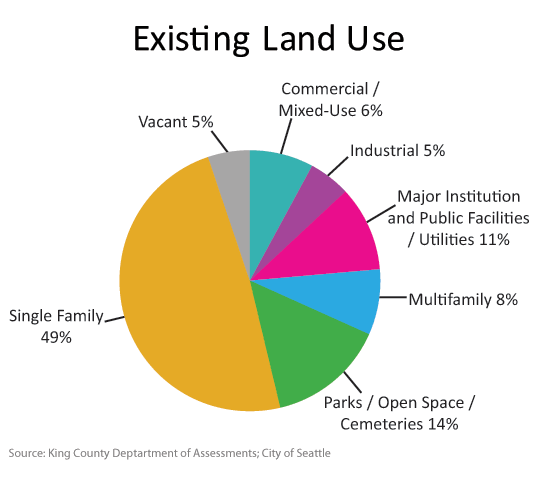
50% is zoned SFH. Only 14% is zoned for any kind of (residential) density.
I'm in the Seattle metro. Building higher density housing is still illegal in most of the city, because attitudes there are still fundamentally NIMBY, even if it's not as bad as SF.
The city has generally upzoned little slices at a time around 'urban villages', and while that's certainly better than nothing, it's a lot less effective than largest scale upzones, and streamlining building processes.
Housing doesn’t give you this option. If you don’t want to be homeless you may be able to rent, but that is pretty expensive too.
Because selling a Camry doesn't reduce the selling price of Lexuses built in proximity to it by more, in aggregate, than the profit from the Camry. Which is why developer-founded and controlled HOAs have much more restrictive rules than public zoning rules.
We don't seem to have an issue with Hertz coming in and scoping up all the camrys.
In the US, there's always more land - it's just further away! The cheap "Camry" houses still get built, but never as infill. It just gets pushed further and further out to the exurbs.
Unless you take money (or cheap debt) out of the hands of the yuppies, nothing changes here.
[1] https://alastairparvin.medium.com/if-the-uk-built-1-million-...
[edit] and btw, I think builders aren't tripping over their shoelaces to service the low end of the market because they know the city is so aggressively capping how much they can build. This means they will only build the most profitable units, the high end today. But once the high end is saturated, the low end ones will be the profitable ones anyways.
Only if the old housing stock isn't torn down to make room for the new housing stock. Thankfully property taxes aren't driven in the potential value of land (rather, they are tied to actual value), but most small scale landlords of affordable housing right in it are in it for property appreciation, not rents. Their exit plans are often to sell to a developer as tear downs.
> This means they will only build the most profitable units, the high end today.
There are costs are too high (to acquire property and build) to justify anything but going after the highest end of the market. Once the high end is say satisfied, money (investment) could simply move away from housing if it can't make any money there. Money chases the highest returns between all of the markets, not just one market.
That's not a thankful thing at all, it incentivises using the limited land in wasteful (low-value) ways.
> Once the high end is say satisfied, money (investment) could simply move away from housing if it can't make any money there. Money chases the highest returns between all of the markets, not just one market.
Available capital is practically unlimited these days, anything that's profitable and legal to build will get built.
And it's mostly chasing monopolies like location.
This is about zoning too. Normally, if the demand is there for it a smart land owner would build more housing on the same plot, e.g. turning a single family into a two family, but of course that is illegal in many places.
So poor people are still getting screwed. My daily walk to the grocery store passes by a few places that are pretty shabby (so low income) and right across the street they are building a bunch of luxury town homes. It doesn't take a rocket scientist to figure out what will happen to those shabby places in a year or so.
This is an uncomfortably extremist position, should maximizing revenue per investment be the one and only consideration society takes into account?
I do many things that provide joy in life in other ways, even if I know they don't maximize revenue or savings. I wouldn't want to go through life thinking about nothing else than ROI for every action.
That means multifamily properties have higher tax bills for absolutely no reason. Expensive locations need to provide more housing per area so charging a fixed fee based on the value of the land is a much better approach. You get to build a single family home and pay through the nose or split the bill with a multi family home.
Not true: most localities use a significant portion of property taxes to fund public schools, and more families = more kids.
Maybe we're saying the same thing, but instead of gradually reaching a equilibrium like you're describing I see a dramatic boom bust cycle--both are held back by lack of building.
I could definitely see that being how it works in a lot of cases, but it seems like a stretch to assume that's some sort of natural law of prices. If I have a market of ten potential buyers, the first who has $1, the second who has $2, and so forth until the tenth buyer has $10, I could put an infinite number of goods for $10 for sale, and none beyond the first would be able to be purchased. Sure, you could argue that it would be silly of me to price in that way, and you would be right, but in reality you don't know the exact financial details of every potential buyer of your whole market. GP is hypothesizing that basically this exact scenario is happening with housing, and I don't know if they're right or not, but your rebuttal doesn't seem very convincing that this is an impossibility.
This might not be that far off from what’s happening.
They do sell vehicles at that price which get around all of those standards, but they lose two wheels in the process.
Try buying a half-decent used home for 25% of its initial sticker price.
Tons of perfectly good used cars for under 5K on CL. And this is SF Bay area where prices tend to higher.
https://sfbay.craigslist.org/search/cto?purveyor-input=owner...
The cost of construction in America is $150/sqft. We’re not even close in cities. Off by an order of magnitude.
Watching the Detroit product roadmaps, I'm inclined to agree with that analysis at this time.
If the real problem was always zoning, wouldn't dense cities like NYC and Shanghai be cheaper than average, not way over average?
> Check out Japan housing CPI - a market where supply meets demand thanks to federal zoning rules, and is also centrally banked.
Japan went through a huge bubble in the 1980s. Also, housing (the structures at least) rapidly depreciates in Japan, which prevents them from being used a speculative asset as in countries (even then they still went through a huge bubble in the 80s). It is definitely an alternative model to our own, but I'm not sure how many people will want to experiment with that. Japan also much more strictly restricts immigration than other countries, which makes it, for example, a bad place for Wenzhou house wife real estate speculation.
It's not about supply by itself, it's supply vs demand.
Big cities have big populations and economies, which means a lot of demand.
But as far as zoning goes, note that like other metros, NYC has actually effectively downzoned areas over time; in fact, a huge proportion of buildings there would now be illegal due to different types of density restrictions: https://www.nytimes.com/interactive/2016/05/19/upshot/forty-...
A lot of NIMBY's tend to go, "well, there's still some areas where it's possible to build more, so there's no real issue there". This is approximately like restricting car manufacturing to one state, and then when car prices go through the roof, saying "well, there's still more land to build car factories there, so I don't see the problem, it couldn't possibly be this rule".
> A lot of NIMBY's tend to go, "well, there's still some areas where it's possible to build more, so there's no real issue there". This is approximately like restricting car manufacturing to one state, and then when car prices go through the roof, saying "well, there's still more land to build car factories there, so I don't see the problem, it couldn't possibly be this rule".
My only point was that making cities more dense seems to make them more desirable, causing more people to want to live there. Yes density is a great thing! But it doesn't solve affordability problems on its own. Can you imagine if San Francisco (6.2k/sqm) had NYC-level density (27k/sqm), would it be more or less affordable? I'm going to go with the less.
What is really holding us back are the American libertarians who are afraid of a public housing system like the one in Singapore.
Increasing housing in this manner would probably boost land prices, but over a greater number of units, so result in overall decrease in housing cost.
NYC is a bit of a weird spot in real estate, in that having a Manhattan address (and probably a Williamsburg or Bushwick address to a lesser degree these days) is a status symbol for foreigners, in the same way that London or Paris might be. Most American cities do not have this kind of cachet and so at some point prices will fall if you build enough.
The problem is really that housing production would have to increase by an incredible amount to get to affordable. To use the example of Tokyo as affordable, let's look at comparative housing production statistics.
* The 23 special wards of Tokyo, 8.9M people, built 110,000 new homes that year.
* The entire country of England, population 53M, built 115,000 homes a year.
* The metropolitan area of NY, population 20.3M, approved 27,000 units in 2012, but approvals != actual construction.
https://nextcity.org/urbanist-news/entry/tokyo-housing-high-...
Since housing is refreshed in Japan on a 20-30 year basis, you can't quote the number of housing built without comparing it to the number of housing torn down (since, as mentioned before, housing depreciates).
> * The metropolitan area of NY, population 20.3M, approved 27,000 units in 2012, but approvals != actual construction.
Do you mean no housing was built in 2012?
NYC does not track construction starts like that, or at least not when that article was written
The problem is that it isn't just those on the right opposed to density -- the left is little better. Sure, progressives are largely okay with what density already exists, but propose upzoning and they flip out. Just look at the California state legislature, or major west coast cities.
Of course not everyone wants to live in New York, indeed there are many cities that each have their own unique circumstances drawing vast numbers of people, and all of them experience great demand. But there's a reason you can't just through up a bunch of skyscrapers in South Dakota and get everyone to move there.
You have it backwards, it is making the spot desirable that leads to them becoming dense. More people keep moving in, you build denser to accommodate them. Can you imagine how expensive NYC would become if 77% of current residences suddenly stopped being unavailable?
Yes, you will have some non-linear effects, people do want to live in big cities where the action is, but the reason those cities exist in the first place is because the action's already there. New York is a massive hub of commerce and culture which is ultimately a consequence of it's position as a major port. You won't make it undesirable by decreasing density so long as its still the center of the financial world.
I'm pretty sure this is wrong. Yes, it's the first answer that comes up if you Google this stat, but this is off by a factor of 3 or so. Before the pandemic San Francisco had a density of around 18K/sqm. Although a lot of people left SF during the pandemic, 6.2k/sqm is still way to low.
Now, that we have that out of the way. In general, I agree with you. Most cities that have a high population density are expensive places to live. It's a good thing to allow cities to accommodate more people, but those places will still have a high cost of living, because many people still want to live there.
However, the place with the lack of Zoning rules that appeals most to Libertarians, Houston, is doing pretty well.
Houston has seen an increase in population from 3.8M in 2000 to 6.4 M in 2020 and has a median house price of $285K.
The Republican party is inundated with Libertarian philosophy. Even the Democratic party is often forced to go along.
> Houston has seen an increase in population from 3.8M in 2000 to 6.4 M in 2020 and has a median house price of $285K.
Yes, Houston is probably the best example of a libertarian city in the world. Most of us don't want to live there, but someone obviously does.
The irony is that Singapore has a public housing fix to their problem, but is also often touted as being a very economic libertarian city state.
People think Manhattan is mostly skyscrapers, but the reality is very different. Only a small portion of the land has high rises on it, just glance at Google Maps with 3D view on.
I wonder how NYC would do with cheap 30 story Chinese concrete apartment blocks? (30 stories, because any taller requires steel, at least with construction practices that use cheap migrant labor).
* multigenerational to nuclear households
* decline in number of kids
This pattern of living is still common to a lesser degree in outer-borough immigrant neighborhoods, which is why they were so hard hit during NYC's massive COVID wave.
Have you looked at Japan's population, its "dead ass flat" while US population keeps going up.
https://datacommons.org/tools/timeline#place=country%2FJPN%2...
[0]: https://lh3.googleusercontent.com/-xDrQEcMyF5Y/YWDyNh-3TiI/A...

Yes, SF has the second-highest construction costs in the US. $330/sqft. [1] Average home prices are $900-1200/sqft.
[1] https://www.investsf.com/why-san-francisco-has-the-second-hi...
Investors have too much access to property. It's a system of greed that benefits those who entered the market early (typically boomers).
Just stop blaming zoning already.
> Zoning issues/lack of supply would imply that there are lots of homeless people without a roof over their head.
The price of housing only matters to people who don't already have homes they own. 65% of Americans own homes, so that cuts down your working set dramatically.
There are a lot of homeless people, yes - 0.2% of the population - but lack of affordable housing tends to be roughly equivalent to "perma-renting" as renting has a lower barrier to entry.
To buy a home you have to come up with a lump sum of money to make a down payment. If you can't do that, you're forced to rent or split accommodation or live with your parents. Lack of affordable housing doesn't mean homelessness. There's a lot of elasticity there.
> Investors have too much access to property. It's a system of greed that benefits those who entered the market early (typically boomers).
Investors buy property to rent because home ownership is unaffordable. Blackrock buying up property is a symptom of the market, not a cause. They don't see houses becoming cheaper because they don't see zoning reform on the horizon, so they believe there will be long-standing demand for their rental units.
If housing were to become affordable, due to a large increase in supply, these investors would get bowled over twice - once due to lower real property value and once more due to lack of demand for rental units as folks buy instead.
Even foreigners parking capital abroad, more supply makes that (a) a bad idea and (b) kind of irrelevant. I'm not saying that shouldn't be tackled too, but once again, zoning would solve the problem.
i don't believe anything of what youre arguing simply because more supply will continue to be purchased by investors to further drive up prices.
> i don't believe anything of what youre arguing simply because more supply will continue to be purchased by investors to further drive up prices.
I think Japan shows us there are limits to this.
Anyways, I appreciate your thoughts!
The real problem as always is zoning. Houses cost roughly the same on a $/sqft basis, adjusted for inflation, as they did in the 1970s. They're more expensive now because outside of town they're twice as big on average [1] - in part due to zoning rules. In town, zoning rules preclude densification necessary for supply to meet demand [2]. And, families are smaller.
Check out Japan housing CPI - a market where supply meets demand thanks to federal zoning rules, and is also centrally banked. Dead ass flat. [3] This chart alone basically debunks the theory the Fed is solely responsible for lower housing affordability.
Zoning is the issue, not the Fed.
[edit] Yes, the fed contributes a little - monthly affordability of a more expensive house is the same when interest rates are lower, but down payments are not. However, if you want to solve the affordability crisis build more houses. Any houses. Now. Compare the Japan housing CPI in [3] to the US housing CPI in [4] and weep. Housing in the US is driving inflation, not responding to it.
[1] https://fee.org/articles/new-homes-today-have-twice-the-squa...
[2] https://en.wikipedia.org/wiki/San_Francisco_housing_shortage
[3] https://fred.stlouisfed.org/series/JPNCPIHOUMINMEI
[4] https://fred.stlouisfed.org/series/CPIHOSNS