Doesn’t surprise me but this zoning explanation ain’t it.
Seattle's population growth has outpaced its housing growth for multiple decades. There's a huge amount of "catching up" to do, and SFH zoning is blocking that from happening.
Once enough there's enough housing to hold all the rich people that want to live here, of which there are many, you will see some downmarket construction happening. But we're a long way away from that.
Zoning for MFHs won’t change that. It’ll maybe bring more skepticism to luxury developments. But people buying million dollar units with no lot will know they’re buying the same thing.
And mixed use luxury apartments are the only development otherwise. No one is building anything more affordable in zoning more favorable for it. At best this is trickle down economics where everyone who needs somewhere affordable to live might be able to get scraps at the most dangerous furthest flung place in Lake City.
https://www.seattle.gov/opcd/population-and-demographics/abo...
> As of 2019, there were 367,806 housing units in Seattle, representing a 19 percent increase since 2010 (according to Washington State Office of Financial Management). The growth in the number of housing units in Seattle from 2010 to 2019 surpassed the 14 percent growth seen between 2000 and 2010. However, even with the rapid increase this decade, expansion of our housing stock has not kept up with Seattle's population growth of 22 percent between 2010 and 2019.
And here's Seattle's land zoning ("Land Use" tab on the same website):
https://www.seattle.gov/Images/Departments/OPCD/Demographics...
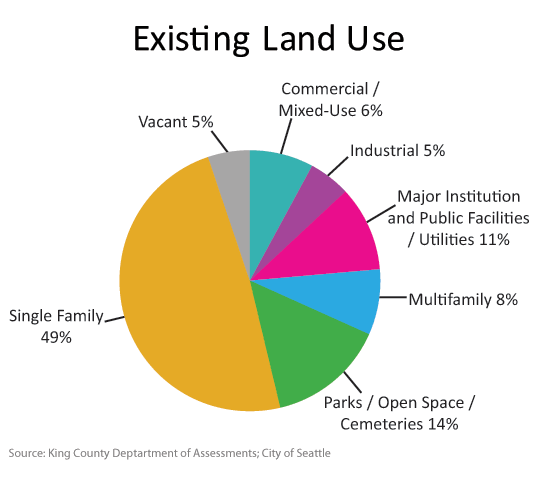
50% is zoned SFH. Only 14% is zoned for any kind of (residential) density.
I'm in the Seattle metro. Building higher density housing is still illegal in most of the city, because attitudes there are still fundamentally NIMBY, even if it's not as bad as SF.
The city has generally upzoned little slices at a time around 'urban villages', and while that's certainly better than nothing, it's a lot less effective than largest scale upzones, and streamlining building processes.
Housing doesn’t give you this option. If you don’t want to be homeless you may be able to rent, but that is pretty expensive too.
Because selling a Camry doesn't reduce the selling price of Lexuses built in proximity to it by more, in aggregate, than the profit from the Camry. Which is why developer-founded and controlled HOAs have much more restrictive rules than public zoning rules.
We don't seem to have an issue with Hertz coming in and scoping up all the camrys.
In the US, there's always more land - it's just further away! The cheap "Camry" houses still get built, but never as infill. It just gets pushed further and further out to the exurbs.
Unless you take money (or cheap debt) out of the hands of the yuppies, nothing changes here.
[1] https://alastairparvin.medium.com/if-the-uk-built-1-million-...
This is like saying that Toyota would rather sell Lexuses than Camrys.
Yes, it's true, but they sell Camrys anyway. Why? Because the market for luxury is only so big. They can make more money total addressing other parts of the market.
So why doesn't this apply to housing? Land + zoning. Imagine if Toyota was only allowed to produce 10,000 cars a year. What kind of models would they choose to make?