I never knew American supermarkets were so terrible. I mean, you read about the Amazon grocery stores and get the picture of Europe being far behind.
When I was younger there was no difference between olé’s chocolate and Leo with the exception of the package. It was the same taste and factory producing them.
Aldi Süd seems to be more preffered, however I personally prefer Lidl which is based on similar efficiency concepts.
At least in Germany, where there exist both Aldi and Aldi Süd, quality is not a trait that people would claim that these two differ (they would rather say that the difference lies in assortment).
> Internationally, Aldi Nord operates in Denmark, France, the Benelux countries, Portugal, Spain and Poland, while Aldi Süd operates in Ireland, Great Britain, Hungary, Switzerland, Australia, China, Italy, Austria and Slovenia. Both Aldi Nord and Aldi Süd also operate in the United States with 1,600 stores as of 2017.
One thing I do find funny though is the Lidl (and Aldi) practice of selling loads of random items in one or two of there aisles. Many is the funny story I or friends have of going into the shop for milk and bread and coming out with a unicycle, power welder and night vision goggles instead :)
At least here in Houston my Aldi is in the middle of an economically depressed area, so despite the poor selection they're still better than the small convenience stores which have little to no fresh food of any kind. Everything is prepackaged.
Seasonal gardening and local farmers help, but it's not cheap at all. I grew with up with seasonal farmer's market having higher quality at the same or even slightly lower price than the grocery store, but not in the US, higher quality but at fancy price, although they receive the same subsidies and it does cost them that much more.
I really dislike going there. They have 8 cash registers and open only on or two. The reason being that they are understaffed and employees have a gazillion of tasks: baking, unloading, stock, cash register,...
I usually keep one in my pockets, not really out of laziness, I just don't use coins for much these days.
And honestly, if there was two euros going for simply moving a trolley back to its parking zone, I suspect you would have shoppers who found it worth doing that for all of the free carts, let alone people with less money coming in to collect.
This is the only thing that fails about Aldi. Let's say you want their Chicken Tikka sauce. The mixed boxes mean good chance you won't see it as Tikka always goes first. You go through the whole 6 boxes of inventory, and yep, all sold - the three spaces in every box. Same for pizza - one always goes first. They don't restock until there's space for another combined box.
Background:
- Safeway rotates every product through "sale" and "full price" periods. It's a strictly calendar-based thing; every sale price is going to recur if you wait, and every product will spend a lot of time at "full price" and a lot of other time at two or three different "sale" prices.
- Triscuits come in a variety of special flavors.
All triscuit varieties go on sale together. If triscuits aren't on sale that week, you can get whatever flavor you want. But if a sale has happened, the Parmesan Garlic flavor is probably sold out. This happens, reliably, every time triscuits go on sale, and affects only the Parmesan Garlic flavor. To get that flavor at a sale price, you need to be in the store near the beginning of the sale period.
To me, the diagnosis is obvious: Parmesan Garlic is more popular than every other flavor, and Safeway should stock more of that flavor than they do of other flavors. But though I've observed this for years, they don't. All flavors get the same shelf space, Parmesan Garlic always sells out quickly, and Safeway appears to be happy to forgo the lost sales of Parmesan Garlic triscuits that they could have made if they'd just had them in stock.
I still deeply want to know this mystery. It's obvious to anyone who works at a grocery store that certain items are way more popular than others, but grocery stores buy way more variety than makes sense. Maybe it's for appearance in some cases, but no one can see how much American cheese we have stocked at the deli counter, and it's true for the stuff stored in the back of the warehouse, too.
So I think it's absolutely possible you could have done your boss' job better. :-)
You might also find the white is partly a byproduct that needs to be made no matter what.
And this brings me to what also is truly good at, they own the full chain and leverage it.
There are certain products I notice that only come in stock some years and it seems like they're made out of excess produce.
I.e. a cereal I like is made entirely out of these chunky things that usually go in as additives to other cereals. It looks like they only stock it when they have a cheap wheat price.
Another one is the nut bars and what kind of fruits they have mixed in.
White is literally the color of the cheese. The "yellow" has food coloring and "flavor" added.
The yolks are a by product no matter what.
There was an interview on the Daily show or last week tonight where they made fun of a guy eating a plate of fried eggs that looked like 5 yolks and 2 egg whites. My guess, the dinner sells a lot of eggwhite omelettes and makes use of the extra yolks as another option for other people to buy.
In the supermarket scenario, the supplier only has one customer and has to somehow make them buy both no matter what.
Both are terrible. If there is one thing I really missed on the other side of the Atlantic it was the European quality and variety of cheese.
Since 2010 or so, I've been signed up for their Just4U special discounts, based on what they know about my shopping habits, as a California dad. Recently they offered me a bonus coupon for Pampers diapers.
Not a match! Our kids have been out of diapers since the days when BlackBerry was the coolest phone in town. Maybe longer. I'm not impulse-buying diapers for anyone else's kids.
They let a week go by and then offered me a special deal on Depends, the old-people's diapers. Not in my current need list either.
Another week goes by, and they come up with a third idea. This time it's a discount coupon for Kotex sanitary napkins.
Hello? They've got about nine years of regular shopping data on me. If they still make multi-decade errors in identifying my age -- and can't get my gender right -- their data department hasn't even made it into the abacus era.
Target noticed she was pregnant before her father noticed.
https://www.forbes.com/sites/kashmirhill/2012/02/16/how-targ...
OK, that's not what happened, but I don't see why you're calling the claim absurd. It is unusual-but-routine for women to present with health complaints that are caused by their own pregnancy, without necessarily having realized they were pregnant. Sometimes that health complaint is "I'm in labor". (To get to that point, you have to be really fat, but it does happen.)
The main intent of my anecdote is to show how retail companies are already analyzing data. And I think it's foolish to assume that we (i.e. people working directly in tech) know better than the people who are working in tech + retail. (Many retail stores are on the technical bleeding edge - Target spins up K8 clusters in each store [1]!)
[0] https://www.webmd.com/baby/features/can-you-be-pregnant-not-... [1] https://tech.target.com/infrastructure/2018/06/20/enter-unim...
Every time someone talks about how grocery stores are these highly-optimized retail juggernauts that know everything about what they're selling, how much to order, where to place it on the shelf, and so on, I just wish I could take them on a tour of my local stores and ask them to explain various seemingly-nonsensical practices. IMHO, there is a lot of room for efficiency improvements in the retail grocery business.
If they can get you to come into the store and not buy the soda, that's a great outcome. Of course, if that happens too often, you'll stop going, so it's a balance. They've probably figured out how much to stock to maximize profits -- which might seem nonsensical if you were thinking they were trying to maximize soda sales.
Americans tend to drive to the grocery store in my experience. To me, this means most people committed to shopping at the store long before they got there and saw the soda display.
No, that's a terrible outcome, because they have taught me to check the soda aisle first (and they have kindly put it near the front of the store where it's convenient to do so). If the shelf is empty, I just turn around and head for the competing grocery store down the street....
... which, of course, is owned by the same conglomerate. Grrr.
It's not just junk food, either -- they will cheerfully leave half their organic cereal aisle empty, waiting for restocked product that either never arrives or sells out instantly. This phenomenon is observable on timescales measured in weeks or even months.
It's possible that the cereal distributor is actually leasing that shelf space, of course... in which case the annoying situation is still caused by morons with money who aren't taking care of business.
Same story at the vending machines at the office building that my company used to have an office in. The vending company stocked the drink machine with 2 rows of Pepsi and something like 8 rows of Coke. The Pepsi was consistently sold out by the middle of the week after the machine was filled. The Coke? Maybe 10% of it was sold by the time they came around to restock. But they never figured out that they should add more rows of Pepsi and reduce the number of Coke rows.
Every time, without fail, the Diet Coke column is nearly empty while the Coke, Sprite, and Coke Zero ones are full. Not only that, but Diet Coke gets the smallest portion of the endcap.
My only rationale for this is that these are loss leaders, and the Diet Coke is too popular to allow too much room? I don’t know.
1) they don't want to take more of a loss than they have to go get you in the door, 2) the people who buy diet coke or diet Dr pepper are statistically more likely to shop sales than the people who buy non-diet, 3) the relative allotted shelf space and display area aren't just a store manager decision, but actually a product the grocery store sells to the manufacturers, 4) (2) & (3) imply that stores in different class areas of town might have very different which product sells quickly and utterly fail to optimize stocking of the thing you noticed when it literally never sells out at the Kroger a mile away, for example.
Just look at the pricing between different serving sizes. Their price differs often less than 30%, even if you compare 0.5l to 2l.
Me, I like cans. They’re about 35¢ apiece. That’s cheap enough to not worry about, and way better than getting a fountain soda at a fast food restaurant.
Market segmentation at its finest!
My ideal is soda fountain machines, but of course I'm not gonna have one of those in my apartment, so the next best is cans.
[1] https://www.thedailymeal.com/eat/triscuit-flavors-how-many-a...
If a potential new customer doesn't like popular Triscuits flavors, but sees a newer but a less popular flavor, the availability and visibility of the less popular but still desirable flavors might convert them into a customer.
...this is exactly the situation I'm complaining about, except that the customer prefers Popular Flavor #3, which the store doesn't stock, to Unpopular Flavor #5, which it does.
Imho this is probably due to the fact that they make more than enough money during the sales periods.
If somebody shows up during the sales period, with the intention of getting Parmesan Garlic, they very likely will still end up buying another flavor even if Parmesan Garlic ain't in stock anymore.
This is easily justified if somebody went to the store just for the Triscuit sale.
In Germany, most grocers have little leaflets where the majority of sales are announced a bit ahead of time.
Aldi makes a lot of consumer goods business with that, when they sold their first desktop in the mid-90s, all of them built by Medion in the UK, it was a huge deal with long waiting lines even before the stores opened and them running out of stock in a matter of hours.
OK, it's possible that there's a low-profile outlet for releasing news of upcoming discount periods, and I just don't know about it. However, I can list several effects of the sale that occur whether or not shoppers know about it in advance of coming to the store:
- You might choose to buy more of something than otherwise, since it's cheaper right now.
- As a special case, you might have planned to buy zero of something, only to increase that amount when you notice it's on sale.
- You might choose to buy a discounted item in preference to the non-discounted item you were originally planning to buy.
The fact that one $3 thing you bought was unexpectedly on sale but every time you go to the store you spend $200 on other stuff is a thing that the store is aware of.
Or they should increase the sale price relative to other flavors, so that it still sells out, but near the end of the sale period, maximizing profits.
Or, they are doing the right thing, and you aren't the only person who has noticed it, and the sales drive people to the store at the early part of the sale, which is why the Garlic Parmesan sells out, and Safeway has other means of taking advantage of that, like merchandising high margin complementary products in conjunction with it.
Safeway's job is to maximize profit, not maximize number of units sold at sale price.
Sometimes there isn't great communication between sales reps and grocery/store management because of how little involvement is necessary on the store's end. As a manager at a full assortment grocer, unless you have a very specific interest in Nabisco, you may not even notice a SKU is out of stock. Reps will hide shelf tags, and increase other product facings to make it seem like they're fully stocked. Unless a customer brings it up to you, you may have no idea. From a data perspective, an out of stock issue is virtually indistinguishable from a slow-moving SKU as the granularity of sales data is usually only at the "day" level (and due to shrinkage, generated inventory counts are unreliable). So a large demand for parmesan garlic triscuits may not be evident for whoever is reviewing the data.
Also, your reasoning is a little flawed. Parmesan Garlic being out of stock does not necessarily indicate it is more popular than other flavors. It indicates simply that they ran out of their allotment, which (for big sales) is usually centrally planned according to production and previous sales figures. Your store could be in the midst of a negative feedback loop, where previous out-of-stock situations deflate sales figures and affect future allotments, which simply makes the parmesan garlic SKU go out of stock before other "more popular on-paper" flavors.
Another way to look at it is that the margin on triscuits is so low (and even lower when on sale), that caring too much about the extension SKUs is not worth the time/effort. As a rep, you'd mostly be worried about keeping the primary SKU in stock, occasionally juggling other stock from store to store when management gives you a hard time (if they even notice). As a grocery manager, you're probably oblivious if the vendor is actively trying to hide the problem.
Some brands that have an owner-operator type DSD model (where the reps actually work for themselves and own their own routes) are usually more conscientious and concerned with maintaining a full assortment. Ironically, they tend to not have as much frontline support as the corporate DSD behemoths (like Nabisco) so they have to work much harder to cover more stores (but at least they reap more of the benefits of their hard work, potentially). These are usually more regional or local products.
TL;DR Safeway probably doesn't care or doesn't know, Nabisco also probably doesn't care. Best way to deal with something like this is to submit something to Safeway corporate that a specific SKU (include the UPC) is always out during a sales period at a specific store (if you can find out the store number, even better). The most direct approach would be to find the Safeway snack category manager on LinkedIn and shoot him a message.
Source: Was a Grocery Manager for Wegmans for several years
I have almost nothing more to add, but I'll mention that I recall reading about Wal-mart's practice of making shelf stockers responsible for deciding which products get how much shelf space, and even for ordering the appropriate products -- the theory being that the shelf stocker is the guy in the best position to notice which products are or aren't flying off the shelves. (Whereas, according to what I read, at a standard grocery store, the shelf space itself is sold to a supplier, and they get to dictate what goes on it.) And when I read that, it made me think of the triscuits issue, and imagine that what was happening was that triscuit varieties were being stocked without bothering to look into whether they were popular.
If you have further things to say in this area, I will certainly read them with interest.
The inner aisles are usually planogrammed (the retail nomenclature for the diagram of where stuff should be, height of the shelves, how many facings, etc.) according to the priorities of the category manager i.e. the person in store corporate offices responsible for that particular product group. You'll notice that categories and subcategories inside of a grocery store are organized into shelfing sections of multiples of 4 feet (most commonly). Each of these sections is assigned to a category manager, and managers usually have multiple categories. So Category Manager A might be responsible for 16' of soup in one aisle and 20' of canned vegetables in another aisle. (The layout of the aisles and which categories go where is a separate discipline referred to as "Space Planning").
So this space isn't necessarily "sold" per se, but the category managers usually work with what's called a "category captain", an individual or team that represents a dominant brand in the category, and they influence the planogramming process. They are supposedly unbiased and are merely providing expertise and insight on their respective industries, but that's a pretty naive view as they clearly get to advocate for their products directly. However, the strategy of the grocer will determine how much influence they actually have. Wegmans, for instance, has a strong focus on private label so Wegmans brand products tend to get the most shelf space no matter what.
There are a lot of local businesses that I love but have one gripe with, like a great restaurant with an awkward wait procedure (Gaucho if anyone's familiar), or my favorite barbershop that's only open late one night a week, but I've accepted that they know more than me about how to run, and maybe it just has to be like this to be great overall.
Not that we have Aldi where I live, but we do have Trader Joe’s, and I simply choose Safeway or QFC because I really really like self checkout.
1) It's faster for self checkout because the line moves faster (one line for multiple checkout stations) and because I can scan my items faster than they can. However, Aldi checkout lines move ridiculously fast, so this ends up not mattering much.
2) I get to pack my own stuff, most cashier employees don't pack things to my liking (eg cold items should all go in the same bag so they help keep each other cold, but they don't always do this). At Aldi, you pack your own bags anyway, so this is not an issue.
3) Talkative cashiers. I don't care to talk to a random person I'm never going to see again, but at Aldi you don't have to because you'll be so busy trying to load your items on the conveyor belt trying to keep up with the cashier that they won't have time to talk to you (see #1, and no I'm not joking, it can be hard to load up the belt fast enough to keep up with them if you don't have a significant head start).
Maybe, people return to get the Tikka, resulting in more sales??
Eg. the 30% of the box thats the flavour that no-one (at this shop) buys, goes off and is dumped, for every box.
Maybe the ratios are determined by their global sales, who knows. You would think that it would be advantageous for each shop to tweak its own ratios.
Mostly this averages well enough. Yet for a few things - like tikka where ratios seem consistently wrong. As Britain's favourite curry, you'd expect a few extra jars of that in every box. Or Cumberland sausages up here in former Cumberland - just forget about whatever the other things in the box are. :)
Probably means going the other way that when they drop something there's a chance 1 of the 2 or 3 actually sold well.
Also, packaged food like this typically last at least several months, if not a year or two.
They aren't stupid, if a product flavor regularly doesn't sell 30% of its inventory, they drop it and add more packets with the other flavors...
The quarter in the cart thing is very common in Germany even at high end supermarkets. The higher overhead compared to the US makes it very hard to higher people for this kind of job -- the minimal gain in customer acquisition doesn't pay for it.
The increased variation in inventory and the scanners came at about the same time, and they only did that when they figured out how to keep their famous checkout speed. (and it's still slightly slower than it was back then)
When the queue was full the best cashiers would really stress you by observing you putting stuff onto the belt and already starting to enter prices ahead of them reaching their area (where now the scanner is). Half way through loading the stuff into the cart again the cashier would urge you to pay and the next customer's items started bumping into yours. It was very efficient and stressy, best you were two guys to share loading/unloading and paying (back then payment was only possible in cash).
The scanners eased that a bit :)
Side-effect: I would have cleaned up on "The Price is Right" if they'd let a kid on the show, since I knew what everything cost.
But I remember putting coins into slots for a trolley (and reclaiming them!) when I was young enough to be sitting in the child seat nearly 30 years ago, long before Aldi was a factor in the UK market. Is this really an innovative concept in the US? Are Americans going to be even more impressed when somebody over there invents the magnetic wheel clamps which discouraged taking trolleys back to our university campus? (even when comparatively poor we'd have happily sacrificed the coin...)
I wonder why it hasn't taken off. My son used to work at Walmart after school making around $15/hour to do little more than round up carts in the parking lot and bring them back into the building. Considering how cost conscious Walmart is, I'm surprised.
However, Aldi is putting up a building across the street from my local Walmart, so we'll see what happens :-)
(We do have wheel clamps, though ;)
(I mean, seriously, Tarzana is neither urban nor a bad neighborhood. It does however have an entitlement surplus at the local Whole Foods)
But making customers do the work, Aldi can make more profit and/or customers can save money by doing their own elbow grease
Maybe that's not so much a problem in the US, where I imagine supermarkets may not be in the city center but mostly reachable by car and thus less foot traffic to take the carts?
But maybe the deposit here in Europe is just silly? I do know many supermarkets lock their carts up for 1st of May for example and anyway, one euro or one of those plastic discs is not hard to come by, so it is not much of a detriment.
I'm sure the deposit is just to encourage people to put the carts back where they belong, reducing the amount of work staff need to do outside the store.
If you're going to steal a shopping cart, the quarter won't factor in.
The exits are narrow with soft soil and low hedges bordering the paths. You can lift a trolley over, but you need some muscle, especially if your trolley is full of shopping.
Dunno if that still works, but I enjoyed defeating the locking mechanism at Safeway when I was a kid even though I didn’t even want the shopping cart.
And in supermarkets with large car parks there are return stations all over the car park. Which means you still need to pay trolley herders...
In denser cities where it's just not practical to put your supermarkets impractically far away from literally anyone who might sometimes want to buy some food, what you typically see is some sort of system where the wheels automatically lock up if you try to take the cart outside the parking lot. Which, compared to the Aldi system, always seemed to me like a $10 solution to a $0.10 problem.
https://www.thomas-clemens-photography.de/blog/es-gibt-eine-...
They are not especially demanding or well-paying jobs, but the shift to service-driven economies isn't a new thing nor particularly exclusive to the US.
It's actually becoming relevant here, because of our recent influx of largely unqualified people/immigrants. There aren't enough simple jobs that can be done without any education, and so politicians are discussing what to do about it. Personally I think it's a big step backwards to have people do extremely basic stuff as busy work. Most stores are removing manned checkouts and replacing them with self checkouts.
Well, not full time.
Some German grocers have started to employ very young people during Fridays and Saturdays as packers. They look young enough to be still in school, also collect tips with little boxes, but they are not full-time employees but rather "mini-jobbers".
Which is just such a weird transition considering that many of the jobs I did in my youth have now been turned into their own weird job sectors like that.
While delivering papers is now something exclusively done by adults in cars, as an extra income stream for unemployed on social security. I don't know how that can be economic but I see it happening all the time.
> Personally I think it's a big step backwards to have people do extremely basic stuff as busy work.
Some would argue that's been happening on a rather massive scale for a while already. Our productivity constantly increases, so do our numbers, as such it's only a matter of time before we end up with a whole lot of "surplus" humans in terms of labor demand for keeping everything going.
The more expensive shops employ more youths, I think the budget stores don't use enough staff to have an older person nearby if the teen is stuck somehow.
Another example: when you have road works here and a lane is closed and only one lane remains, temporary traffic lights are put in place.
In America you'll see a half dozen people managing traffic, where "managing" means "holding up a sign".
The latter. The US has an army of unskilled workers that work two jobs, live on food stamps and have no health insurance.
Anecdotally I think it’s not as much of a problem with Aldi today because
1. The Aldi parking lots in USA are all pretty tiny
2. People generally know what they are signing up for when they go to an Aldi
Generally I think that there would still be a backlash today if Walmart implemented coin carts, for instance. Which I really despise because as someone who worked as a cart pusher as a kid it’s unnecessarily infuriating for me to see the pure laziness of shoppers who can’t be arsed to walk 5 meters to drop their cart into the return location and instead push it onto the median next to their car.
Side note I want to take this chance to say that I absolutely love Aldi. There’s one that’s just far enough away from where I live to make it not worth the drive and the second they build one closer I will immediately do all of my grocery shopping there :)
The system makes more sense for markets the size of a Lidl or Aldi.
As a person that has been a cart pusher, carts suck. The wheels, especially at the front where they put the wheel locks are the first thing that break. They barely touch the ground and spin in circles all the time. Stores rarely ever invest in fixing or buying new carts.
I firmly believe that many places in the US simply gave up on it, because what happens instead is people still try to steal them, drag them a great distance damaging them, and they have to go get it anyways. I think we had maybe 3 good carts at the Sam's Club I worked at our of like 200 or 300 carts.
Besides, the US is inflation adjusted wealthier today than it has ever been at any other point in its history.
On the poverty front, US poverty is dramatically lower than it was in 1960, and homelessness is near record lows. If you go back to ~1960-1973, the falsely perceived peak of US wealth, it was much worse to be poor in the US. In every possible regard a poor person was worse off in the US prior to 1980, than they are today. That's due to a massive expansion of the US welfare state over that time, which has led to many improvements. That includes healthcare (universal healthcare for the bottom 25% didn't exist; even in the 1980s far fewer people were covered), housing, food security, disability programs, et al.
It took them four years, then they changed to the same ones everyone else uses.
[0] http://2.bp.blogspot.com/_7YpjO_OmPKo/S3GjfqKcjOI/AAAAAAAAEU...
[1] https://www.ica.se//assets.icanet.se/q_auto,f_auto/imagevaul...


[0] https://static.az-cdn.ch/__ip/r-ymFggeoyzNSXf6FkMQRwePLN0/57...
Sorry, before you say "you haven't tried x regional chain in the US", spend some time in Europe. French chains (Auchan especially) have raised the bar for everyone else, it just hasn't happened in the US yet but I suspect someone at Amazon will look very closely at that model and repeat it here.
- The packing area (after the till) is quite small. This means that if you're not packing quickly and putting items back into the trolley then the till operator will have to stop scanning because of the backlog. They will often make subtle eye-contact (with a smile) when they have to stop, this puts the shopper under pressure to pack quicker. I'm a fast packer so it doesn't affect me but I've seen it with other people.
- The till operator will ask you "Cash or Card" before you have finished packing. Another nudge to hurry you on to the next stage.
- They will open a new till the second the queue goes beyond the edge of the conveyor belt. Often they will open up the till for just one customer and then close it again as the queues have subsided. I've seen a large variance in this though, some Aldi's are lazer-like, others are more laid-back.
I don't know about Ireland, but in the UK there's been obviously some backlash from the customers who aren't used to this model. I've seen arguments break out.
Yeah but if you pack fast enough and have your bags already open on the trolley then you can it done at the till.
I spent a lot of time in Germany in the 90s. Aldi (and Lidl) hadn't switched to barcode scanners and the chashiers were still typing in product numbers by hand.
I was always super impressed with the speed with which they typed and it certainly felt faster than the cumbersome bar code scanners found in the UK at the time.
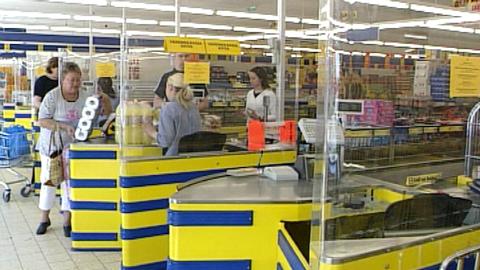
That's what I noticed the most in German grocery stores. American cashiers stand, German cashiers sit.
What's the alternative? Growing up in Germany I've literally never seen it any other way.
I really hate trying to turn into a spot that's flanked by two SUVs only to find a cart in the way. People are incredibly lazy. I love the ALDI's quarter scheme… it's just enough of a nudge to get people to do the decent thing.
What you were told sounds like one of those slightly tongue-in-cheek excuses people sometimes use to justify behavior, though that doesn't necessarily make it insincere. For most of high school I worked dishwashing jobs. A typical task for a dishwasher includes picking up trash in the parking lot. People throwing trash in the parking lot weren't doing me or anyone else any favors.
Do you do that consistently now that you're an adult? Do you bus your own tables at local restaurants (small business owner) but not at franchise restaurants?
But then, I also don't shop at Aldi or need a trolley.
I also don’t carry things in my pockets.
The fees associated with debit card transactions don’t land on me, so...
Here in the UK, shopping carts used to take a £1 coin, which incidentally had very similar geometry to the Indian 5 rupee coin (worth about 5 pence) - that was a great little find for our family, who always had a few 5 rupee coins lying around from our time visiting family in India. Sadly they updated the design of the £1 coin, so this trick no longer works.
Honestly, having to put a coin in to get a cart would mean I would likely never get a cart. I never pay with cash, and thus I never have coins with me, so I would be limited to whatever I could carry. This is obviously bad for business, so I think businesses just eat the cost of having an employee round up the carts.
Then again, I hate seeing carts everywhere, and sometimes find myself returning a few because they're such a nuisance. If this solves the problem, I might consider leaving a coin in my wallet to shop at Aldi instead of my cart-ridden local grocery store.
This thing was introduced in France, because the French customers had another attitude to it and that got extrapolated by the huge French hipermarché concept.
With that kind of throughput and the involved logistics of bigger pieces handed out on a trolley at the order counter, introducing the money deposit for the trolleys would massively slow down everything, possibly creating waiting lines at trolley stations as they sometimes happen during busy times at grocers.
At least the employes collecting the carts have electrical little pushing cars, enabling them to push impressively long "snakes" of trolleys.
https://upload.wikimedia.org/wikipedia/commons/thumb/b/b1/Pf...

Put a coin in the drawer and close it, the chain of the next cart pops out the back and you can take it. On return, you push the chain back in, the drawer pops open and you get your coin back.
Store employees just occasionally balance cart numbers between the corrals, if there's multiple.
Put a coin(or any coin shaped object) in and a simple mechanic latch releases the chain, plug it back in and you get your coin back.
To get one, you insert a coin (or a plastic token - these are usually given away as freebies by many companies if not the stores themselves) and that unlocks the chain.
It's not about the money, no one earns anything from this. It's about putting something that you own (can be worthless, the emotion counts) in the cart which you can only possibly get back if you return the cart to any number of bays on the parking lot or next to the entrance.
https://en.wikipedia.org/wiki/Smarte_Carte looks like it might be the airport system you have in mind.
The usual European shopping cart system works with a coin deposit, chains and mechanical locks on each cart, as described in several other comments.
Often this results in them being left all over the place or stolen though.
I don't feel like that amount of labor is a tremendous cost for the supermarket.
And that's when the cart collectors were being quick and not just out there fooling around.
In addition, if things got busy inside and we forgot to collect carts for a while, we'd run out and customers would get upset that they didn't have a cart to use. This was especially likely during rain when no customers would return carts or bring carts on their way in.
Walmart as one example has a motorized cart mover. The employee collects and stacks the carts into a line, backed by the motorized unit, and then can just gently guide the whole flock of carts and it moves along with little human effort. It enables the employee to move dozens of carts at a time across the parking lot without very much physical risk of injury.
On a historical note (I am old enough to have shopped before bar codes existed):
Generally stores had little price tags attached to every single item. Which was labour intensive twice: First someone has to attach the tag to each item and at the checkout it needs to be found somewhere on the product, read and the price to be entered into the cash register.
With only 1000 products (back then, IIRC) and no weekly offers at all it took only 2-3 days for a new cashier to learn all prices by heart and easy for the store to skip the stickers altogether and just mark the price at the shelf. Typing prices without having to search for a tiny little sticker somewhere on the product was super fast and efficient compared to the competitors. Cashiers just dropped the product into the cart with one hand and typed with the other.
Aldi introduced bar code scanners several years after the "full assortment" competition. At some point probably the better inventory book-keeping started to outweigh the costs.
(Edit: clarified that Aldi had no price stickers at all)
I don't know how they tell the difference between all the generic powders that look the same, like white flour and rice flour, but they do. And if they don't, I suppose they just ask the customer.
Not in the 1970s and early 80s. Do you know what computers costed back then? 1 KB of memory was as expensive as the whole cash register used by Aldi/Lidl. And there was no computer networking whatsoever, not even between multi-million super computers. When the German railways introduced computers at the ticket windows in the 80s all ticketing data was stored on 8 inch diskettes. And if you bought a not so common ticket the agent had to swap the diskette first.
I don't think Aldi/Lidl used diskettes at their cash registers. Maybe when scanning started in the mid/late eighties, but they certainly didn't have to swap during the day.
Maybe floppies was the more common term. Obviously that part of my memory hasn't been refreshed for a couple of years...
I will however still occasionally run in because although they run out quick almost every day, when they have grass-fed meat and some organic veggies, they are about twice as cheap as any other retailer around here has them for.
I think it's just part of the philosophy: you come because it's cheap and the quality is good for the price point, you buy, you leave.
You don't get a experience, you get a utilitarian transaction. And that is reflected by the interior.
I’ve observed that this effect can last for decades if your formative years didn’t involve enough food.
https://ny.eater.com/2019/1/18/18183973/authenticity-yelp-re...
I don't understand how this reduces shelf space, but there are no Aldi stores anywhere near here (nearest is 804.18 miles away, according to their store locator) so maybe I'm not understanding what they are doing. All I've got for comparison are the variety packs that manufactures often sell at the stores we have here (Walmart, Safeway, etc).
For example, if a bar comes in 3 flavors, and is sold in boxes of 6, a box takes up the same space if it has 2 of each flavor or 6 of one flavor.
If they needed one for each flavour, then they would need three boxes, side by side taking up three times as much space.
With products that are in high demand, you can even get stuff reserved.
I'm not even American, and I've done both of these.
If the store is clever they will leave a pre-recorded message announcing holiday hours.
Walmart always lists under 6 inventory counts as « low stock » with no guarantee.
Since I was looking for a particular auto battery that never has more than a few units in stock, I had to call for them to check.
This whole thread is just a constant TIL/am-I-taking-crazy-pills moment :)
Speaking for myself, it's the part that annoys me most when I shop at one. I get why they designed their POS it, but it's just obnoxious for the elderly and for parents with by small children.
It would seem simple enough to solve, too: just add two such areas.
I've noticed everybody does this in Germany but most haven't grasped it in the UK yet.
Many (most?) Australian Aldis have that -- each cashier has two 'lanes' they can run groceries down after scanning, and customers alternate between the two.
It works pretty well and I actually prefer to reload myself, as opposed to other stores that have someone there to bag for you.
U.S. checkout shape: https://www.trbimg.com/img-589b8178/turbine/ct-aldi-expansio...
Non-U.S. checkouts: https://www.lebensmittelzeitung.net/gallery/media/852/15994-... http://www.wochenanzeiger-muenchen.de/media/archive/wsp/5634...


> depositing a quarter for a cart eliminates the need to pay people to collect carts
I've seen Americans remark specifically about shopping cart deposits a couple of times on Hacker News; I never thought there was anything special about it.
I think the vast majority of retailers and grocers who offer shopping carts, in the three Canadian provinces I've lived in, use coin deposits for shopping carts.
They still end up in rivers and alleyways on occasion, usually stolen by vagrants and hooligans, but the customers at least tend to comply.
Unfortunately for them/me, if I’m coming by chance by bicycle, I usually don’t have a coin and reduce my shopping to the necessities without a cart.
When you feel the weight of each item, you think more about every item you buy.
Requiring a coin is a hardship, especially in a plastic-oriented culture.
[0] https://www.jmpromotions.nl/images/winkelwagen-muntjes/plast...

Years ago when I read the bit in Freakonomics about the daycare that instituted an additional charge for picking kids up late to discourage the practice but found that the rate of late pickups increased instead because parents felt like they were paying for the service of extra daycare thus alleviating the guilt, I immediately thought of Aldi carts. Do Aldi carts get stolen more per use than Price Cutter carts because people have to pay a quarter for them? I know that's both not what the quarter is for and not what it is attempting to discourage, and I'm not claiming it necessarily does have this effect... I just wonder if people can somehow rationalise taking carts easier when they have to pay something for it.
Efit: s/anf/and
Though not all stores have a deposit for carts, Colruyt in Belgium doesn't for example, and I don't see carts lying around.
Scan speed is never a bottleneck of a checkout process. Packing and payment are. They might be saving millisecond on scan time, but the paper and printing of a label cost money too. Not sure if it’s the best showcase of efficiency here
> depositing a quarter for a cart eliminates the need to pay people to collect carts
It also makes people not want to go there if they don’t have spare change. And if they go without a cart, they will definitely spend less
Aldi doesn't have a membership fee, but it has a culture and following akin to Costco or Trader Joe's. It works for some people, but not for others. The barrier to entry isn't that big, it's just a bit different.
>Scan speed is never a bottleneck of a checkout process. Packing and payment are. They might be saving millisecond on scan time, but the paper and printing of a label cost money too. Not sure if it’s the best showcase of efficiency here
I entirely disagree with this point in the context of grocery stores. Convenience stores I'm likely to agree because people typically buy a couple items and the payment time is effectively identical to that of a grocery store.
I should look up metrics to see if it's tracked, but the scan speed makes a huge difference! They don't bag at Aldi at all, when they're checking out, the employee is pulling a cart around, scanning, or waiting for payment to process. I can pretty much guarantee they process more customers per hour and can complete more scans per minute than any other grocer in the US.
The marginal cost of printing barcode is effectively 0. They are already printing the packaging and black and white are always on the color palette for the single barcode.
One more item I forgot to list above is that they print their receipts one line at a time, so you never wait to have your 3 ft receipt printed after your payment is processed. They do a great job at eliminating the non-value added tasks in the entire store, cross training employees, and reducing overhead.
I think it fits the philosophy. They aim at customers that have a mindset to go out and save. They are prepared. They're willing to work a bit to save money, but hope to compromise a bit less on quality.
Cameras are cheap, and recognition software scales well.
I was really impressed. I did some prototyping with RFID a few years back and reading multiple cards in unpredictable positions (e.g. overlapping, side-on) was quite challenging but looks like decathlon have worked it out.
I personally can't see myself switching from my local store even if it takes like 3 more minutes to check out. Maybe I'm just lucky though to think it's 3 minutes extra at most?...
If checkout lines are supply constrained (eg. there are always lines) then increasing speed increases throughput which increases revenues.
If checkout lines aren't supply constrained (eg. there are empty checkout lines) then you can reduce the number of open lines without increasing wait times, reducing your headcount and driving down your labor costs. If you lower your labor costs you reduce your semi-variable costs and you can keep the same contribution margin and lower prices.
Have ever been inside a walmart? There's only ever like 2 checkouts open and massive lines, that's a long time to stand there.
Waiting in line at the grocery store I thought was one of the most common annoyances people have?
Perhaps I am an impatient outlier, but whatever the profitable wait threshold is, it could be maintained with fewer cashiers if checkout were faster.
As others have pointed out, this isn't particularly innovative: this is the norm in large European supermarkets, regardless of brand.
I can't imagine how much less productive I'd be if I could never sit down at work.
The only reason I can think that Coles\Woolworths\etc\other supermarkets don't do this is that they straight up enjoy being cruel.
This is the rule for FC employees at Amazon - you can squat, or kneel, but never sit.
They say it's a safety issue, but I suspect they really just consider pain to be a more effective motivator than comfort.
The thing I do see at HEB is they'll scan the same item n times when they see I have n of the same thing, so they do effect roughly the same efficiency. They might not as intelligently differentiate the packaging, though.
Seems like they might have quite a lot of variation on locality.
Ive noticed this in the small too, some suburbs have much better Aldi's than others when it comes to selection.
aldi was also selling products for less than what they paid for. this is common practice in some places but in germany it's actually illegal, and they had to stop that.
https://www.independent.co.uk/life-style/food-and-drink/aldi...
On the other hand my wife goes there somewhat frequently and is able to buy things in a reasonable amount of time so maybe it's just me.
One thing I've admired about Grocery Outlet is the lack of them.
* Analog spring-based scales in the produce section, for customers to check weights before they buy
* Precise scales at checkout, built into the scanner / register.
However, most things are sold by package — only a few are sold by weight.
All fruit/vegetables/meat are sold by the item or in fixed price bags and packages.
1. Plastic bags often don’t really get destroyed, but get shipped to poor countries and land in the ocean. 2. Paper bags or boxes do the job as well, unless you are driving home your stuff through a long walk under rain or bike. But pedestrians and bikers usually have enough bag capacity with them.
I’m only using plastic bags every couple months, because I know keep bags and boxes in my car trunk. Easy, 0 impact for me.
-they have barcode on 5 or 6 sides of their products, and they're typically huge! They nearly never need to orient a product to scan it. Their scan speed is far faster than any other supermarket I've been at.
-if two products are very similar, they'll change the packaging in an obvious way. Blueberry and blackberry yogurt typically look very similar, but the lids are obviously dark and light purple at Aldi. They can glance down and count how many of each, scan one, then hit the number pad for the quantity. I haven't seen the number pad used extensively at any other grocer.
-they combine varieties (like flavors of granola bars) of product in the same box. This greatly reduces the shelf space required.
-depositing a quarter for a cart eliminates the need to pay people to collect carts
-they keep product the box from the manufacturer. This eliminates labor from unboxing and facing product.
-they don't have plastic bags. You can grab boxes (normally a waste stream) and take them home with you.
-they don't list a phone number for their stores. With as few as 2 people on site during the slow times, they can't afford to have anyone on the phone.
-their conveyor belt is far longer than most stores. You should be able to get your entire cart worth of groceries on the conveyor at once. This minimizes the slowness of people handing one item at a time to the next checker.
-They're big on turning inventory over. If they trial a product and it doesn't sell well enough, they have no problem simply not carrying it anymore. You can't always get everything set Aldi, but you can get 85-95% of items you need there.
-they wanted to avoid vendor lock-in, so they had two POS vendors develop solutions simultaneously, awarding the contract to the one which provided the best solution.