They grew up relatively poor, and still have the habit of eating at home from a rotating menu of relatively straightforward recipes. Stews, soups, that kind of thing. They've gone to restaurants maybe a few dozen times in their lives, if that.
I've been to so many Sushi restaurants in so many cities that I have a nice smooth gradient of ratings along which I can place them. I can recognise and appreciate the small touches like real wasabi or expensive sake. The fancy places in Japan extended that experience just past the upper end of what I've experienced before. I could place them in context.
My parents tried a Sushi train... once. A $300 sushi set would be wasted on them, because they would be just as happy with a $50 sushi set. The difference would be completely lost on them.
I've definitely heard the life advice to avoid trying this kind of thing in case you do like it, then everything less is permanently tainted with the knowledge that it's not as good.
However, western super-high-price dining tends to be one or both of "demoscene for food" or "NFTs for food"
- demoscene: a series of increasingly elaborate and labor-intensive techniques for showcasing skill in a constrained environment. The Heston Blumenthal/molecular gastronomy approach.
- NFTs: the process entirely about conspicuous consumption; the value of the food is determined by how many resources were expended in the process, not what it actually tastes like. Wines in particular have a value determined by rarity and the secondary market.
The best compromise is probably found around the "twice as much as a chain restaurant" price point; enough to find quality ingredients and staff who aren't too rushed off their feet, not enough that you start getting weird stunts.
(a fun read: Jay Rayner's negative review of the Polo Lounge https://www.theguardian.com/food/2021/aug/15/the-polo-lounge... )
Does that actually happen though? I know a thing or two about wine and sometimes buy bottles in the 50-100 euro range, which I feel are totally worth it, but I'm still happy to drink cheap plonk with friends most of the time. This works because (1) you forget about what the high end experience was like quite quickly and/or (2) you drink it in a very specific setting so you're not likely to conclude "I now always need/want this" and (3) a lot of what makes high end cuisine / wine / spirits so fun to try is not just that they're better but that they're different from what you're used to, the scale is not just worst-best but also ordinary-extraordinary, and you're not always in the mood for extraordinary.
My guess would be that the phenomenon of permanently hankering for the good stuff after having tried it once is probably more likely to happen with everyday luxuries: good bread, slightly-above-average wine, etc. And in that case, you get a little bit more enjoyment out of your food for a little bit more money, which seems like a fair deal. But even in that case, I don't know anyone who, after trying craft beer, has vowed to never drink a cheap pilsner again.
It definitely also happened to me with coffee. I used to be able to drink almost any coffee straight, but over time my taste drifted towards more expensive stuff and I started adding cream and sugar to hide the taste of cheap coffee. That’s mostly thanks to all of the trendy coffee shops in San Francisco where I did meetings. So one of my small projects during covid was actually finding the cheapest bulk coffee I could drink straight. As proof that my tastes had drifted, what I settled on turned out to be a step above the cheapest cohort, but thankfully still several times cheaper than making a daily habit of single origin coffee.
Thankfully, it never happened to me with restaurants. Despite having paid hundreds of dollars for a meal on a few occasions, I haven’t lost the ability to enjoy stuff across the whole price spectrum.
That's why I choose to listen to music on my cheap $100 speakers that can still give me goosebumps and not listen to my friend's $5000 speakers. All that would happen is that I'd lose the goosebumps because I'd notice how shitty mine are.
I'm guessing your reply is motivated by the 2001 blind tasting where oenology students couldn't even differentiate between red and white wine [1], which is certainly an interesting bit of research, but not the kind of slam dunk you would think when you read third-hand reports about it in the media or rationalist circles.
I’d add on: anything that’s difficult/time-consuming/etc. to make at home even if you could, but scale makes it a lot easier.
I know a Ukrainian guy that, without fail, orders borscht if it’s on the menu. He could make it himself, but his wife forbids him from stinking up the house with beets and cabbage for the afternoon it takes to prepare.
True of restaurant food in general and even street food; what makes these things great is often lots of little bits and pieces of topping or flavoring that would be too time-consuming and wasteful to make at home.
But it's not limited to high end. "Indian" food is cheap but benefits from the scaling of cooking a lot of different spices in a large pot for a decent amount of time. Your borscht is another example.
(What the UK calls Indian food is often cooked by Bangladeshis and Pakistanis, the name is kind of a historical accident)
I maintain that this is a good reason why no one should eat placenta. What if you find out it's the best thing you've ever had?
You'd have to go into a fake business processing them into pills for people, that's what.
sorry
I don't know whether mothers think of the placenta as their own body part or part of the baby, but personally I think it is in poor poor taste to eat baby parts.
I think you're missing the point on the compromise. It's not simply about the price.
Look for ethnic restaurants whose primary clientele is their fellow countrymen. (Easy to find in a large city. Less so in the suburbs.) This is where you will find the intersection of low price and high quality product.
Mexican and Asian places abound in this category. But you can find just about anything in a large city - Middle Eastern, South American, even European (especially eastern)
Having taste makes you require more dollars to get the same level of satisfaction from a meal or a drink.
I have carefully avoided trying excessively high quality things because once I've experienced something truly luxury then it becomes an ongoing expense to keep up that level of experience. The irritating part is that before I was perfectly happy in my ignorance of something better being available out there, but aftewards I feel like I'm "ruined" because I'm constantly disappointed and frustrated if I can't keep up the level of quality.
I have had headphones ruined for me because I tried the Sennheiser HD 800 once and then there was no going back to cheap plastic cans.
I've had monitors ruined for me a long time ago because I got Dell PremierColor 4K display.
Food as per my previous post. I've had such great food in so many fantastic restaurants that I'm upset with mere "pub food" that used to make me perfectly happy before. I am now incapable of eating certain fast food unless literally starving to death.
Etc...
Thankfully, I'm still okay for wine. I believe it comes in two or is it three colours? Whatever, I'm still happy with a random $10 bottle. My boss for comparison now has to buy the $250 bottles at company dinners. Ouch.
It's not really the same as being unable to appreciate anything but a glass of Petrus or DRC. For a one time payment of $1k the HD800s will easily serve you for the rest of your life. If you prefer fine food and wine that $1k might not even get you a single meal.
I've easily spent over $2K so far. When I replace it, I'll have difficulty resisting the temptation to upgrade to the "next level". Planar magnetic or planar electrostatic headphones are the next logical step. Those start at $2K and go up from there.
I'll be lucky to escape this with less than $10K spent...
Sure, you _could_ rip an MP3 with near-undetectable quality loss for most types of music (The Wall, yes. The Downward Spiral, no). But nobody does that, as apparently it was not the default on anything back then and today Youtube and Spotify and all others still use those horrible quality settings as people have gotten used to them.
For reference, I listen to mostly Pantera, Beethoven, Pink Floyd, early Nine Inch Nails, Led Zep. It's not too diverse, but there is a short period from about 1990 to 2005 where music recorded in that period does not transfer to MP3 well. Maybe because the digital artifacts that we cannot hear in the published recordings are amplified in the compressed MP3 - but after that period producers began to optimize their recordings to account for that.
Though I'm sure that the encoders got better, really, the quality of the common rip has not.
By the way, I once made a GUI for abcde called abcdefg (A Better CD Encoder For Gnome) but never did anything with it - it was really just an exercise to learn the GTK libraries because Zim Wiki used them too. But I now regret not publishing it just because it had such a cool name.
I don't know. It's not really the same level of satisfaction. Eating well is very enjoyable.
I think food is one of the product categories in which spending just a bit more raise the quality drastically. Buying fresh vegetables from the market and butcher meats from time to time rather than everything from a grocery store was transformative for me and it's not actually that much more expensive. I guess I could sustain myself on canned peas and frozen chicken but it wouldn't bring me much joy.
We try to swap in one or two new recipes a week and the rest are the standards. You get an occasional hit new recipe and then it becomes a standard.
$ - counter/fast-food/food truck/sketchy
$$ - regular
$$$ - regular, but very small servings and artfully arranged
$$$$ - fancy
The key is to avoid the $$$ places ;)
https://trulyexperiences.com/blog/the-asian-apathy-to-the-mi...
As a consequence, most people prefer “easily digestible” music such as pop music rather than highly refined classical music.
I know a lot about food/cooking, and think McDonald's makes a great burger.
If you don't appreciate the art form then it might not matter what dollar level or Michelin stars a place has.
I've never been to a Michelin star restaurant but do watch cooking shows where they make food like that and I don't know if I'd appreciate it.
That's the documentary that inspired me to try Michelin starred Sushi restaurants in Japan. I went to Jiro's son's restaurant, which is by all accounts better, but nobody will say so because they don't want to disrespect Jiro while he's still alive. It's a Japanese culture thing.
My father asked me why I spend so much money on raw fish and rice.
I tried to explain to him that the high-end sushi restaurant experience is really a magic show that also includes food.
Have you heard of the placebo effect? Shamans "treat" their patients with practised rituals that make people feel better. Sure, nothing has ever been cured through such methods, but it sure does feel nice!
I have a personal pet theory that this is a side-effect of our evolution: little kids that sat quietly mesmerised watching the elders perform their arts and crafts would pick up the skills and eventually master them themselves. Kids that didn't sit quietly didn't get to be as skilful and would in turn fail to be good parents and hence had fewer children.
Some people call it ASMR, which is a fun term to search for on Youtube if you can't sleep at 11pm.
Watch any magician, or master craftsman at work, and you get the same tingly feeling on your scalp. You sit still, quietly mesmerised as you follow the swift and sure movement of their hands.
THAT is what good sushi is about. You sit at the table with the sushi master in front of you and observe as he slices the fish with rhythm and precision. You're entranced as he picks up the rice, moulds it, applies the wasabi, places the fish, and coats the assembly with sauce. It's like watching a magician dealing cards!
People pay hundreds of dollars for a magic show in Vegas. In Japan, you get the same experience except you also get fed in the process...
First there is almost no way to get the rice to consistently taste anything close to how they do it in restaurants.
Second, it’s unlikely you will buy dozens of different high end top quality fish, prepare the fish, and then just make a few slices for your meal.
Finally, sushi is made to be eaten immediately. So if you want to make your own meal of 20 to 30 different types of sushi, you will have to either make and eat as you go, or make them all then eat them after they have sat for too long.
At least for many Western dishes, I can replicate maybe 80 percent of the taste. Sushi is a completely different level.
The biggest disappointment was the michelin-starred stall in Singapore. The food was just... bad.
If quadratic, then the Cheesecake Factory experience gives you 9 "utils" and Poppy gives you 100 utils. You'd rather eat at Poppy once a month than Cheesecake Factory 11 times a month, but you'd rather eat at Cheesecake factory 12 times a month than either. (If 12 times a month is too much, swap these for per-year numbers.)
If linear, then Cheesecake Factory gives you 3 utils and Poppy gives you 10. You'd rather eat at Poppy once a month than Cheesecake Factory 3 times a month, but you'd rather eat at Cheesecake Factory 4 times a month than either.
If logarithmic, it doesn't really matter what the base of the logarithm is. Suppose it's 10. Then Cheesecake Factory gives you 0.477 utils and Poppy gives you 1 util. You'd rather eat at Poppy once a month than Cheesecake Factory twice a month, but you'd rather eat at Cheesecake Factory three times a month. I think this is roughly how my restaurant scale works.
If exponential, it does matter what the base of the exponential is. Suppose it's 10. Then Cheesecake Factory gives you 1000 utils and Poppy gives you 10 billion utils. You'd rather eat at Poppy once in your life than Cheesecake Factory an unlimited number of times (once a week for 200,000 years). But if the base of the exponential is 2, then we're talking about 8 Cheesecake Factory utils versus 1024 Poppy utils. In that case you'd rather eat at Poppy once every 4 years than at Cheesecake Factory once a week, but you'd rather eat at Cheesecake Factory (or an equivalently good restaurant) once a week than at Poppy every 5 years.
So, how does that 1-10 scale map to your preferences?
Any restaurant with a 20-page menu of every possible cuisine on the planet, you should stay away from.
runs
Never again.
(if you know what I mean)
I do like Cheesecake Factory chicken and biscuits though.
If you make it to Buenos Aires I'll take you up on that!
Why does your analysis assume fixed utility for sites? I expect it is strongly conditioned on recent days, at minimum?
As for frequency, I think that might have more to do with variety and familiarity than quality. Surely, even if you agree that Tim Horton and McDonalds have equally terrible food and you hate it, you'd be more willing to be condemned to eat, each day at your choice that day of either of the two, than to be condemned to eat every day at just one of them, chosen today for all time. But that clearly doesn't mean that the union of Tim Horton and McDonalds has food that is less terrible than either of the two, which would be contradictory.
(You could of course have a scale of restaurant variety rather than quality, and in that case surely a PizzaHutTacoBell would rate higher than either a PizzaHut or a Taco Bell. But that's surely not the kind of rating we're talking about here—is it?)
> (You could of course have a scale of restaurant variety rather than quality, and in that case surely a PizzaHutTacoBell would rate higher than either a PizzaHut or a Taco Bell. But that's surely not the kind of rating we're talking about here—is it?)
You seem to be making a fairly strong argument and then confidently drawing a conclusion that is the opposite of the one the argument suggests. The value of food is determined at the most fundamental, objective level by what else you've eaten recently. If you are short on something, your perception of taste will change so that the nutrient you are short on tastes better. What's the argument for variety not being a part of food quality?
I was attempting to separate out the "variety" aspect, which as you say cannot be evaluated in isolation and thus makes no sense to print in a guide, by proposing long time scales. Would you really argue that nothing is left once you factor out variety?
> [Do you really think t]hat the whole idea of Michelin stars is entirely nonsense?
I think the perspective some other comments have taken, that there's more to food quality than whether you like it, is entirely nonsense. I don't think the concept of rating is nonsense; everyone likes some things more than other things. But I think your attempt to interpret restaurant ratings doesn't look very good.
> That food quality reduces entirely to variety?
No. But I'm happy to state that the union of Tim Horton's menu with McDonalds' is superior to either alone.
Well, it's too bad it doesn't suit your purposes. I hope you find an interpretation you like better!
> There's nothing about a 1-10 scale that implies that every visit to the restaurant will be equally pleasurable.
You might have to stretch out the time scale a bit to reach stability, as I suggested in my initial comment: would you rather eat at the Cheesecake Factory once a month than Poppy once every two years, but rather eat at Poppy once a year than at the Cheesecake Factory once a month? (I never went to Poppy; maybe you didn't either.)
Maybe there's no time scale at which those numbers stabilize for you, though, so maybe whether you'd rate Tim Horton higher or lower than the Cheesecake Factory depends on how often you've suffered through their ham and cheese croissants in the last month or year. In that case maybe we have doomed the entire project of rating restaurants on a scalar scale, even a purely ordinal scale like the Mohs scale.
But over time I found that when I develop sophistication in things, the 'so-called experts' suddenly become very smart and were invaluable (at least many of them). Now when I don't understand the expert, I see it as a signal: here is an opportunity to learn a lot, to make a big leap. (Of course, I'll never have time to become sophisticated in everything.)
However, I'll point out one exception. I ate at CORE by Clare Smyth* in London a couple years ago and it is my favorite meal I've ever had. It was too new to be in the Michelin Guide, but now has 3 stars. What made this experience different was that the food was accessible. It was impeccable, the service was amazing, but I think that anyone can go there and appreciate how good the food is.
First, the marginal returns are diminishing once you get past a certain point. I lived in SF for several years and the enjoyment I had at $50 plate restaurants was pretty equivalent to $150 places.
Second, the "top" restaurants are incredibly inaccessible. Sometimes it comes down to the ingredients being very hard to work with, and they have the talent and the time to wrangle them. If you don't know that, it's underwhelming. If you do know that and you're honest with yourself, it's still often underwhelming.
* Clare Smyth was the head chef at Restaurant Gordon Ramsay, a 3 Michelin star restaurant, from 2012-2016. Among other awards, she was Good Food Guide's 2013 National Chef of the Year, World's Best Female Chef 2018 by the World's 50 Best Restaurants, and in 2018 CORE was named Best Restaurant at the GQ Food and Drink Awards.
I find a lot of reviews don't do a good job making this distinction, especially for less familiar cuisines.
So I'm happy to hear your review of Core, if I am ever in the area I'll have to check it out.
I like to think I'm someone who "gets" the "culinary language" (insofar as that is meaningful; food/cooking/taste being so subjective I'm not sure how useful the comparison to a "tightly-written C program" can be). Have cooked since I was 12, payed way too much for a fancy french culinary school, worked in various styles of restaurant.
I think Michelin-star-type restaurants are repulsive, masturbatory, hubris infested dumps. Le Cinq's 140 EUR "Spaghetti Gratin" is only marginally less absurd than a "contemporary artist" selling a plain white canvas for 7+ figures. Give me a big plate of grandma's spag bol over that any day.
Correct. I don't know why this is a revelation that seems especially hard for HN audiences to grasp, or why it's a revelation at all.
Every single domain has its own expertise. It is absurdly arrogant and deeply condescending to think that only computer science or engineering or related fields have specialty expertise.
There is also the aspect of science and engineering leading to objective an hopefully reproducible results. There is less subjective matter to it and there are objective criteria to measure quality. It is possible to leave personal taste out of the equation. Imagine a michelin star tester eating and having to throw up, because of taste, even though the kitchen is clean and all ingredients were of superb quality and the cook is really good. Would they still approve objectively?
I don't think this is an apt comparison. Tasting is consuming something, coding is creating something. An apt comparison would be tasting to using apps, or coding to cooking. And now sure, you could say that most people have cooked before, much like most people have performed rudimentary medical procedures before; but most people have not performed complex medical procedures, or successfully made complex Michelin-starred dishes, or coded high-quality apps.
This is not too true for frontend. Everyone and their mother has an opinion on what needs to be pixel pushed, or something that "should be easy."
And conversely, poor craftsmanship is often not noticed either, if it's not something that someone is trained to spot. An example of this would be when buying a house, you hire a house inspector because you don't have the requisite training to spot all the potential faults.
Good taste is not so subjective as you think it is. Your personal preferences, yeah, I don't care about them. But every professional taster keep their personal preferences out of the game and look for more objective criterias, like complexity, balance, off-flavors, aftertaste, typicity, presentation etc. For example if I order chicken and it does not taste like chicken, it's flawed, regardless if I like it or not.
It's the same with wine and whisky. It's not about your or their individual taste, it's about quality. It's okay that you like very sour, oxidized red wine. It's just not good wine.
Those... simply aren't objective criteria. One persons off-flavor is another persons desired flavor (cilantro/coriander for an obvious example). What is the quantitative measure of "complexity" or "balance" in a dish?
Cilantro is not an off-flavor per se, it's just a flavor you like or don't. A cork tainted wine is an off-flavor. But if you don't like cilantro, it is indeed an off-flavor for you, but that is uninteresting. If I like burned meat, is a medium rare steak flawed for you?
> What is the quantitative measure of "complexity" or "balance" in a dish?
It's not measured with technology, it's measured with the tongue (+ nose) and experience of the taster. Interestingly, if you give the same dish or wine to real experts, you will probably get identical answers. So there is something there, but you have to get the experience and vocabulary to really judge a dish (or wine, or whatever).
That isn't true at all. The flavor the cork adds is another flavor you like or don't like. People choose their preparation methods for flavor impact just like they choose ingredients for flavor impact. Look at smoked meat!
Yes, but I still think, this corner case is much better handled at the service level than the dish level. I do know they ask for food allergies before, I do not know if they ask for your cilantro preferences.
You can't say (as a critic) "this dish was flawed, because it had cilantro in it", but you can say "I didn't enjoyed it, because it had cilantro in it".
Probably, but people burn meat on purpose.
People also sometimes write poor code on purpose.
Cilantro tasting like cilantro -> great. Cilantro tasting like it is old/thawed/burnt -> not great.
Taste being "off" is about unintentional deviation.
If you don't actually think a food inspector can find objective flaws in good-tasting food, you probably shouldn't have made the analogy, nor depended on objective, not-obvious-to-users flaws as part of your argument.
In any case, don't criticize me for agreeing with your premise!
Now I'm a snowboard instructor I can teach someone in a week what took me months and months to learn on my own, and I can teach them the right way from the beginning.
Same story for mountain biking, lifting at the gym and even writing books. Of course the story is the same for programming, technical writing and everything else.
If you want to get good at something, take courses from a professional instructor of that thing (NOT just someone who is good at it!)
To go from nothing to something, a specialized instructor is the best. To go from something to the top tier, only then does following the best / doing something surpass that.
What I mean is if you want to get better (and actually professionally good at something) you need to get training (lessons, classes, courses, whatever you want to call it) from a professional teacher in that field - you won't get to pro level of good simply by doing, and you won't get to pro level taking lessons from someone else who is just good at it. They need to be a professional teacher in that field.
- inventiveness & craft: these are chefs that are pushing the boundaries in terms of techniques, finding new ingredients, or trying to find new ways to turn a dish into essentially an art form. Noma, El Bulli, etc. would belong here. There’s every chance you will actually get a dish or two here that you don’t like. But that’s kinda ok, it’s about pushing boundaries and perspectives. Often the kind of places you’d be happy to only go to once.
- all about the flavour & execution: the kind of restaurant where everything is perfect and everything is delicious. Where you finish your meal, are stuffed, but would come back and order the exact same things again tomorrow if you had the chance because it was that good. Petrus in London was one of my all time faves in this category.
- about the experience: it’s not all about the food, this is more like a form of entertainment. You’ll also need to embrace one of the previous two categories to be successful though. The Fat Duck in the UK and Lazy Bear in SF fit this for me. Entertaining enough to do more than once, unlikely to ever become a regular haunt though.
- the rest: I’ve never understood. Expensive for the sake of being expensive. Popular because they’re popular. Probably latching on to some current food trend. The food is always quite good at these places. It’s just never obvious why it’s the best.
Spend enough time in any city and you can usually find amazing restaurants in each of these categories that aren’t anywhere near popular enough to make a Michelin list. I’ve also found if I’m asking a local for a recommendation that framing the question into one of the first 3 categories helps, e.g., “if you had to eat at only 1 restaurant in this city every week for the rest of the year, which restaurant would you want it to be?”
That got me wondering:
Third Michelin Star for Blockchain Chef https://medium.com/@aaron.lipeles/third-michelin-star-for-bl...
"For Soltys, a third star is the ultimate accolade in an accidental profession. Trained as a computer scientist, he originally became interested in cooking as a way to recycle the heat produced by his compute servers’ CPUs."
> “Within 3 years,” predicts Soltys, “everyone will use Blockchain.” Referring to the graphical processing units used to run Blockchain technology, he added, “You will not be able to make a sauce bordelaise or pate a choux without a GPU,” he asserts, “And what a wonderful world it will be! So many culinary disasters could have been averted. We never would have had cronuts or rumaki or pizza with shrimp on it!”
What does a Michelin star really mean? Is there a secret criteria (beyond "use local ingredients")? The guy in the article contradicts himself!
For one star, definitely should use local products, care, good depth of flavour in the sauces, careful presentation and service that matches.
Of course, over the years Michelin has spoken more and more about the fact that the stars are a reflection of the cuisine, not the service, it’s all about what is on the plate.
Does service matter or not?
So maybe trust your gut more?
I've only ever eaten at one restaurant with one star (Hisop in Barcelona) and it was wonderful, but I don't think there's any reason to think the Michelin ratings are a perfect system.
I think this is the correct one: https://www.theguardian.com/lifeandstyle/2017/apr/09/le-cinq...
Having lived in Italy and experienced real Italian food, I'd move the Olive Garden lower than McDonalds. McDonalds is not trying to pretend it's something else. It is what it is, and everyone knows what it is.
The restaurants appear to be trying to look fancy, with their extravagant yet tastelessly cheesy interior design. I wasn't sure if it was some kind of ironic inside joke that everyone from the USA is in on?
Despite the OTT design, the food was unremarkable. Not too surprising given that the menu has so many items, and it comes in such giant portions - but hard to reconcile with the decor and reputation.
And indeed, despite the name, the cheesecakes were easily the worst part of the meal.
Massive portions of trucked in microwaveable meals.
It's the fanciest restaurant in your local strip mall and its fans look just as you'd expect.
https://www.google.com/amp/s/mashable.com/article/cheesecake...
And I feel like Olive Garden is the definition of naive Italian cuisine
I've found that most starred restaurants I've been to are more like participating in some performance art rather than an effort just to not be hungry. Three stars is a blockbuster movie. One star is a good short story or a clever photograph.
It's like sitting down and asking Thomas Keller or April Bloomfield to tell you what's up using just their vision and talent and the contents of their pantry.
I also really appreciate nerds. People who just go all out on something and dive deep or wide or both. Out of curiosity or passion or just good old plain obsession.
https://www.youtube.com/watch?v=6s2YQZg-pmI
While there are whole genres of art I don't get, I find food is a pretty approachable for me.
As an aside, your comment reminded me of a scene from Star Trek. First minute or so of this clip:
It's amazing that some people do and many of the better chefs out there probably are among these people, but it's also perfectly fine not to be that way. Some people (myself included) are just satisfied by simpler food!
I guess your analogy of well written C code is also very apt, since some people would optimize their programs for every bit of performance and efficient memory utilization that they can, but other times people just want something good enough and thus would use Java/.NET to get 80% of the way there.
(It is about ten and three years since I've been to one, respectively, but I doubt that much has changed!)
In my usage, you can eat just a hamburger, but McDonalds won't sell you one; they'll insist on putting it between slices of bread, thus making a hamburger sandwich of it. If you want to eat just the hamburger, you'll have to peel off the bread and throw it away. They also sell fried-fish sandwiches and, in an absurd attempt to seem "healthy", chicken sandwiches.
Around here Starbucks serves mostly desserts, but that might be a regional thing.
Wait until you start asking "is a hotdog a sandwich?". (Seriously, Google it.)
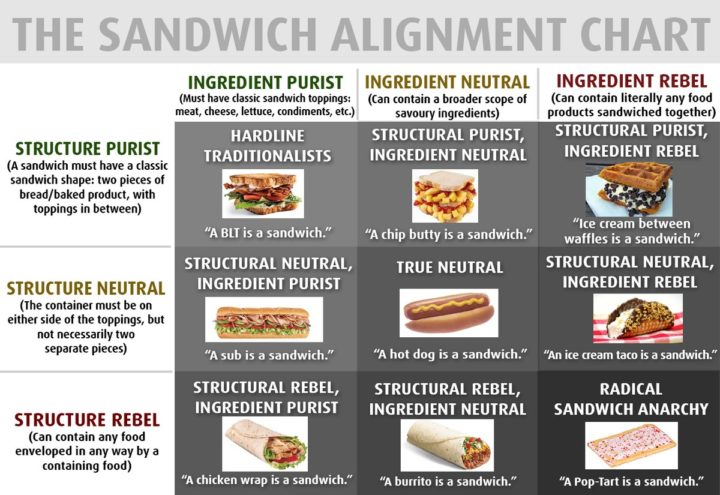
Clearly there's an entire missing dimension to the graphic, because it totally denies the existence of the Hamburger Irredentist Youth League to which OJFord belongs!
But I think temperature is a better indicator than ingredients: 'a sandwich' is not cooked (it's ingredients might be, like meat obviously, but then cooled) or hot.
Of course you can have a 'toasted sandwich', but the qualifier's important, it's basically a different thing that happens to share a word - if you ordered a 'cheese sandwich' and it came out toasted you'd be surprised.
Which makes a hotdog trivially not a sandwich, but you could slice up some sausages the next day and have them between slices of buttered bread for a 'sausage sandwich' (which likewise is not a term anyone would use for a hotdog!)
I'm curious if these "foods" exist in the UK, and if so, what they're called!
That's why you'll hear the term chicken sandwiches (because they don't contain patties), but you'll never hear burgers ever being called "beef" sandwiches. (Beef sandwiches exist -- like roast beef sandwiches, beef-on-weck, Italian beef, pastrami sandwiches, etc. -- these contain forms of beef that are not burger patties). Beef burgers and beef sandwiches are different things.
Similarly, chicken sandwiches ≠ chicken burgers. They're different things. The latter always has a (chicken) patty. The former almost always doesn't.
McDonald's and most other fast-food places are actually pretty consistent with their burger vs sandwich terminology and don't really mix them up.
https://www.mcdonalds.com/us/en-us/full-menu/burgers.html
https://www.chick-fil-a.com/menu
Source: paid my dues and eaten too many burgers and sandwiches to gain this useless knowledge.
Such ontologically incoherent definitions are obstacles to clear reasoning (though less seriously than eargrayish definitions like defining "murder" to mean either one person killing another or stepping on the shadow of the King). Is there a reason your proposed definition of "sandwich" is not among them?
A curry is "just" a soup with spices. But if you walked into a restaurant and ordered "soup of the day" and got a vindaloo, you might feel deceived. If the waiter assured you that a vindaloo is ontologically a soup, I doubt that would be much consolation.
Sometimes in language, if you use a general term (A), when a more specific term exists (B subset A), then using that general term A carries the meaning A\B, because if you had meant B you would have said B instead.
My concern with ontological coherence is perhaps better explained by Goodman's "new riddle of induction": https://plato.stanford.edu/entries/epistemology-bayesian/#Ob...
> In the past all observed emeralds have been green. Do those observations provide any more support for the generalization that all emeralds are green than they do for the generalization that all emeralds are grue (green if observed before now; blue if observed later); or do they provide any more support for the prediction that the next emerald observed will be green than for the prediction that the next emerald observed will be grue (i.e., blue)? Almost everyone agrees that it would be irrational to have prior probabilities that were indifferent between green and grue, and thus made predictions of greenness no more probable than predictions of grueness. But there is no generally agreed upon explanation of this constraint.
(This is somewhat mineralogically naive, because emeralds are just green beryls; a beryl that was blue would be called an "aquamarine" or "maxixe," not an "emerald," because greenness is part of the mineralogical definition of "emerald." But it's straightforward to change the riddle to refer to, for example, grass. The grass has always been grue; should we expect it to still be grue tomorrow?)
Burger is a subclass of sandwich, but it's a distinct subclass that has a different name, and the superclass name is excluded.
(...please God don't let him ask me about hotdogs...)
Or sometimes it's not, and that can be interesting too. I went to Schwa in Chicago once and the service was good, but very barebones. They didn't have a liquor license, so it was all bring your own drinks unless you wanted water. I didn't have anything I'd brought, so the waiter kept bringing out cans of beer people had brought and left behind that he thought would pair with my next course and just cracking open a can and leaving it on the table for me. Completely wild dinner experience that I think back on to this day.
I give McDonald's and Starbucks a 1 - it doesn't qualify as a meal with any sense of taste whatsoever in my book (I assume restaurant food is edible,and doesn't taste bad, so 1 means 'very bland and uninteresting' ).
There, that balances things out a bit.
(I’m only mildly joking… I absolutely love McDonald’s, I can — and have — eaten there every day for months. But I rank convenience, speediness, and a hassle-free experience above almost anything else at a restaurant, including food quality.)
Edit: oh a bit more casual but Kamonegi is a great Japanese/soba place.
My family agrees with me, but I think your taste is much more in line with most people.
[0] in the old days when I consumed meat
To calibrate, on a scale of 1-10 I would rate Cheesecake Factory and Starbucks food at a 3, Tim Horton and McDonald's at 4, and Olive Garden at 6. I'd put LeCinq at 8 and Poppy at 10.
My wife has more sophisticated taste. She though 3 stars for LeCinq made sense. I have double-blind tested her a number of times and her taste is unerring, including one trial where she correctly guessed Osetra, Beluga, and Sevruga caviar back when they were all legal, and 4 different kinds of Wagyu beef at a steakhouse.