I'd argue this shouldn't be a top-down decision - you can just let teams and individuals decide what works best for them, then that can be communicated upwards so the company can plan office space/resource allocation
I worked at way too many startups where the CEO was far too involved with day to day minutiae.
Finding this many self-motivated conscientious employees is uncommon. Consider yourself lucky. This has never been a winning strategy that I've seen anywhere.
As you stated, this is variable.
If you have a short commute, or you like it, or you get some exercise - office is great.
If you hate your commute, if its 3 hours in pollution and traffic - not so much.
Earlier the position was that WFH was not possible. Now we know it is, and I hazard that this change isn't factored in job postings.
Considering what an hour of time means in this era, its not a trivial cost. This means an hour which could be spent just unwinding, studying, on hobbies, procrastinating, whatever.
If you have any drive, or strong interests, thats time you would want to spend on something other than a commute.
(And when they're not being loud, they're being cute, and it's a tempting and easy distraction to go spend some time with them in the middle of a work day.)
In this sort of dynamic, I see working at an office as a fairly healthy option. I know it's a bit of an outlier (SAH mother + WFH father), but I'm definitely more productive and less stressed out working from an office.
A reply to you mentioned noise-canceling headphones. That doesn’t work for me, because the kids want to engage and play with the parents when they’re at home. It’s not just a matter of noise.
That said! I still agree with OP’s sentiment. I find that I’m much more relaxed without having to worry about the commute. More time to help the kids get ready and just enjoy the moment. More time to walk them to school.
Before, I would be a ball of stress trying to get people out the door in the morning so I could catch one of only two buses that could take me across the bay to work.
Same thing in the evenings. More time to pick them up, walk home, take serendipitous side adventures and help foster their curiosity. I love it.
I would still not accept working from office jobs though.
Not much of an outlier.
57% have both parents working full time
28% have one parent working full time and the other not working at all.
The remaining 16% is one full time, one part time.
As another commenter pointed out - while not the majority, it's definitely not an outlier.
[1] https://www.bls.gov/opub/mlr/2020/article/comparing-characte...
So, less common, but not an incredible outlier.
At no income level is it lower than 20% stay at home parent though, so not too much of an outlier in any case.
Personally, I don't believe I must either be working or spending time with my children every moment they are awake. I'm a person too, not just a worker and parent, and need to have my own time.
>98% of workers want to work remote at least some of the time 65% report wanting to work remote all of the time.
https://www.forbes.com/advisor/business/remote-work-statisti...
If 1/3 of your workforce meets 2 days a week your average utilization is about 14%. The logical conclusion is a ghost town that goes away as soon as your employer cuts the building off like a diseased hand.
That's a good point. All that fancy real estate and coffee machines start to look like a wasted investment when they're used 14% of the time.
An ideal situation would be different companies with different philosophies in proportion to preference but this isn't really what's happening. You had a plethora of options during covid now you have a bunch of old people trying to force everyone back into the office.
If part of your people are there and part are not then you must necessarily adopt patterns and communication techniques fit for remote work. Your remote people wont be happy because they have to come in and your in office people wont be happy because many days less than half the staff will be there.
If you want to have enough space for most people to be there on some days you need almost as much space as full in office. You can't realistically hire anyone who lives more than a 30-60 minute commute and because you want to have access to a large desirable workforce your building is probably located somewhere expensive as well. A large chunk of the most desirable workers who want to work remote are forever off limits or if you do make exceptions you now have jealousy and drama.
Hybrid work is the answer to how can I have all the disadvantages of both styles and none of the advantages while not being shitty enough that all of either group leaves.
> I think this is a remarkably dysfunctional policy that only serves to placate mostly irrelevant middle managers who now look as useless as they are and has literally no other virtues.
I know people with 1.5 hour commutes at my office. They come in twice a week. I ask them about it. They like coming in twice a week because everyone is really nice and friendly to be around. It's refreshing and fun. The only person management reprimanded about how often he came in was a young guy who lives less than 30 minutes away and didn't come in for 4 months. He doesn't really have an excuse. But everyone is allowed to skip a few weeks. It's not a punitive policy.
Let me also point out I'm not in the US. Living more than 1.5 hours away from your office is rare as hell and nobody is driving that distance. They're reading on the train. People leave early to miss rush hour. That's totally acceptable in our office. Because we're not micromanaging people. We just like people being in the office for culture. I know you can't fathom any reason to talk to other humans other than to control them, but some of us can.
And the people coming into the office are happy. We like seeing people, so we come in on similar days. Some people Mon-weds, some tues-thurs, some tues and thurs. Everyone knows noone comes in on friday and very few on monday. Most people come in on tues and thurs. So we coordinate. Because we are human beings with social skills.
Even the guy who avoided coming in for 4 months, when he came back said that he actually liked being in the office and would like to come in more he was just being lazy. I asked a girl who takes a 1.5 hour train and sometimes crashes at my house. She says she doesn't mind it at all she likes to have an excuse to come to the city and she still saves money over living here.
Not everyone is a miserable sod like you.
https://www.census.gov/newsroom/press-releases/2021/one-way-...
Most workplaces aren't social clubs much less families. It doesn't make one a sod to pick their friends and family and their work for different reasons and be jealous with their free time. You should celebrate your great fortune and I'm certain work put in to have your life figured out so well.
Most of us settle if we are lucky for something that pays enough to live with a reasonable work life balance and would do well to guard our time to spend with real friends and family we pick rather than the folks who happen to work in the same profession.
What I'm confused about with the hatred for office work amongst people who are mainly working in tech is that most tech companies pride themselves on good work culture. Even in non tech specific companies there are a lot who want to emulate that in their tech departments because it's famous and revered. So yes, I put in some effort and found a good company. I've never worked at FAANG or even a startup but I found companies that value tech culture enough to not micromanage their tech department. So of all the demographics of people to be moaning so much about their work culture I don't understand why it's tech people.
I would also point out that you should perhaps get more agitated about your labour laws because in other countries we have twice or thrice as much anual leave and live in less siloed communities and both of those are proven to increase longevity. Both having more holiday and going to the office when you aren't on holiday will probably make you healthier and happier. At the end of the day, I'm advocating for working practices that align with human nature and are good for our mental and physical health. The fact that you don't have that is a whole other legal and cultural problem that comes from having no labour movement in your country. Which is really sad. But that's the problem at the end of the day.
Anyyway, where-ever i've been though that encourages a few days a week in the office, everyone says the big days where everyone comes in and we catch up are fun. The wfh days give us balance. only a handful of people attempt to avoid coming in like the plague. Most people don't like having to commute all the time, but very few people hate going outside and seeing people at work like the wierdos that argue for 100% wfh online.
I have a colleague that takes like a 1.5 hour train to get in and we just went to the pub together after work yesterday, sometimes i let her stay over at mine so she can be in office for an extra day. I love seeing this person. If there was no mandatory office, we would not be friends. Last year I worked 99% remote and I barely ever spoke to human beings and I wanted to die. We are not made to exist like that. And I think the wfh crowd is way too skewed towards middle aged people with spouses and children. If you don't have that wfh ruins your life.
If you need mentorship, your employer may offer that as a formal program. You also might be able to reach out directly to more senior people. Frankly, I find more and better opportunities to provide mentorship over Zoom than I did in the office.
Good luck with your career and mental health, my guy.
In the end I ended up working remote, which is what I preferred, which wasn't surprising given how much the commuting time was worth to me.
>Company A is 2.5 hours of drive time
>Company B is remote
Pay is the same.
lol I imagine that Company A will find some sucker, but instead of getting A+ workers that can realize company B> company A, they are going to get the leftover workers, their second choice. To be fair, leftover workers seem to stick around at a company for 10-20 years.
> To be fair, leftover workers seem to stick around at a company for 10-20 years.
Even if they were "leftovers", their value to the company they know in and out after 10 to 20 years and their productivity skyrockets compared to the A+ rock stars that left the company after one year.
If anything it’s people failing to consider commute times when looking for work that’s the issue not company’s requirements. Going they will pay me 10k more per year but I’ll spend X more hours a week commuting is effectively being paid to commute.
At some point I got a week more holiday than every other employee in the UK at my employer at the time because I was the only hire who had questioned a contract clause and gotten them to confirm my preferred interpretation of a woefully misleading clause in writing before signing, and when they later wanted to stick to the technicalities of how it was written I was able to just forward them an email from the COO confirming that in my case they'd agreed to my interpretation.
Most people seem to only pay attention to the headline amount, and then grumble about the consequences after the fact.
If I’m feeling up to it, I get another 30-40 minute walk in once it cools off in the evening.
I don’t mind driving in during the winter though, because then I don’t have to pay to heat my house (beyond 15C for the cat) for the day.
I love to go to the park with my kids. I love going to parties.
I don't like sitting in my car unpaid to do work that doesnt require sitting in the car unpaid.
On the contrary, not being forced into the office let's you choose your journeys.
I find this very unintuitive and even mentally rebel at the idea when I think about it, but I still think it's true.
But for example, consider three scenarios:
1. Work from home, with a consistent habit of going on a ten minute walk and reading for half an hour before and after work. 2. Commute with a ten minute walk and half hour train ride, with a consistent habit of reading on the train. 3. Same as (1), but family responsibilities and other distractions end the moment work begins and begin the moment work ends. 4. Same as (2), but spend the train ride doom scrolling.
For me (1) is best but also unlikely because there are too many other "choices" of what to do before and after work, so in practice I end up doing (3).
But option (2) of commuting by train would actually be better than (3) despite having less optionality! I would have more wind-up and -down time each day, and get more reading done.
But the risk of option (2) is that there is still too much optionality; instead of reading, I could scroll crap on my phone. Removing that optionality somehow - by getting a dumb phone or some other solution to keep myself from this bad habit - would be another improvement.
Clearly it would be better to make better choices without limiting options, but human nature being what it is, it often turns out better in practice to not have the other options at all.
In what other things is 1.4% considered "significant?"
What about the top of the crop who live around the corner and prefer office over WFH for a clear separation between work and personal life?
Also, my profession is being a Software Engineer, not a train passenger.
I made a calculator for this a while ago: https://flat.social/blog/get-a-remote-team-back-in-the-offic... (scroll a bit down for the inputs).
Kind of wish I hadn't looked... :(
... but not even close to enough to car-commute more than about 10 minutes to it, given the option. That's roughly the cut-off. Under 1.5 bikeable miles (that's ideal!) or maybe 5 miles by car.
And to get that short a commute, I'd need all kinds of other compromises in most cities. Worse schools, more expensive and smaller housing.
Is my preference for the office worth hundreds of hours a year lost commuting, thousands of dollars a year in transportation costs, and all the extra micromorts from the commute? LOL. LMFAO. God no, it's not even close. No typical commute is a low enough cost that I'd pay it to be in the office. It's way off.
So, though I do in fact prefer working in the office... nah.
E.g. my yearly cost of commuting when I did added equivalent to about $2.5k/year in after tax transport costs.
I've typically told recruiters about 20%, from a high base, and frankly that is lower than it ought to be when accounting for both the time and costs, but given I already live where I live, I feel I could justify it in terms putting extra cash straight into my pension pot and retiring earlier. But not enough to lower it further to find a point where someone is more likely to take me up on it.
The problem becomes now my home is tied to my work place. If the company moves or I change companies, I have move or stress at a new commute. I did move once during a job change, and it didn't last long.
Another compounding issue is that I like to stay at companies for a long time, 10 years. This is frequently becoming difficult for a number of reasons not entirely in my control.
I wonder if others are in the same situation.
It’s waking time, not sleeping time, which is out of a 16 hour waking day.
5 hours a week makes about 20 hours a month roughly, which is about half an extra work week to live that you miss out on.
Multiply that 30 minute commute each way by 12 months and it’s close to 260 hours a year.
160 hours a month of work so you get back about 1.6 working months to put into something else.
I had a few minute commute for 10 years. It was an unfair advantage.
I too prefer a voluntary 20 minute walk over a mandatory one. Then my brain can be aimed at what I value, not work.
Edit: Subcontractor at bp. Opec crunch. entire floor fired. Hardware startup, unexpected giant bill overnight. Layoffs. Fullstack webshop, sales didnt land. Crypto finance gig, asset prices crashed, clients all went broke instantly.
Sometimes thats just how it is.
That said, time is important to me and I have a 5min commute, 20min if I walk. For that reason I do prefer the office. Better meals and better coffee and nice colleagues.
If employers want to force people into offices, maybe pay them a bonus.
There is a meme, or some "motivational" thing that floats around. "Exercise for an hour a day. It's less than 5% of your day - what's your excuse?"
Uhh... because, if I factor in: - 8 hours for sleeping
- 8 hours for working
- 1.5-2 hours for commuting
- 0.5-1 hour to get ready for work
- 1 hour to prepare and eat dinner
All of a sudden we are at 19-20 hours, and it's not less than 5% of my day, it's actually 25% of my day.
I'm moving out to a town 3 hours away, which is not really commutable into London. It's a better quality of life, and the housing options are much better. Selfishly, I don't much care about the housing pressure in London, but I do care about whether I can spend my downtime going places and doing things I enjoy, and remote working makes that MUCH easier.
Employers reimbursing your travel expenses if they need you to travel to a conference on the other side of the country is already the norm so why shouldn't they reimburse your travel expenses if they want you to travel somewhere in the same geographic area?
We actually deal with this nonsense in our household; my wife is hourly and between the commute, parking, and walking to/from her workplace she loses about 20-25% compared to the time she actually gets paid for. We also spend a lot on gas, and have been putting ridiculous miles on her daily driver. Not to mention physical fatigue and emotional stress; she talks about quitting at least once a week. All for a mediocre wage (I would have said it’s garbage if she was our sole earner - my compensation is about double hers and I WFH).
Edit: also, I remember company cars being a thing not too long ago. I don’t hear about them as much as I used to.
Previously I’d see them during holidays only, and now I see them once a month and actually am able to spend quality time with them.
And while I respect the idea and value of non-remote, I don’t think any amount of “in-person whiteboarding sessions and relationship building” would be worth sacrificing for the flexibility of spending quality time with my family and seeing them more often.
This means that I couldn't read anything. Shaking of the bus also gives me time to time a mild headache. Now if the ride was smoother (like a train or a tram) and I still could sit and read then indeed I would agree with you.
Fortunately I don't have to commute very often so I can tolerate this to a degree but if I had to commute every day then it would add considerable extra strain into my life.
Normally the day should be divided into 3 equal parts: 1 sleep time, 2 work time, 3 personal time.
Commute time effectively steals from either personal time or from sleep time and this comes on top of getting ready for work that is also a major waste of time in the mornings.
But I also self-selected roles closer to the end station in London so the commute at the other end was short-ish.
Whenever I had to do any other commute: by car, bus, multiple changes, etc it was always a grind and shortlived.
However, I was able to stop even the not-so-bad commute long before COVID as I wanted to be at home when the kids came back from school as they are only young once and briefly so. Though I miss the "me-time".
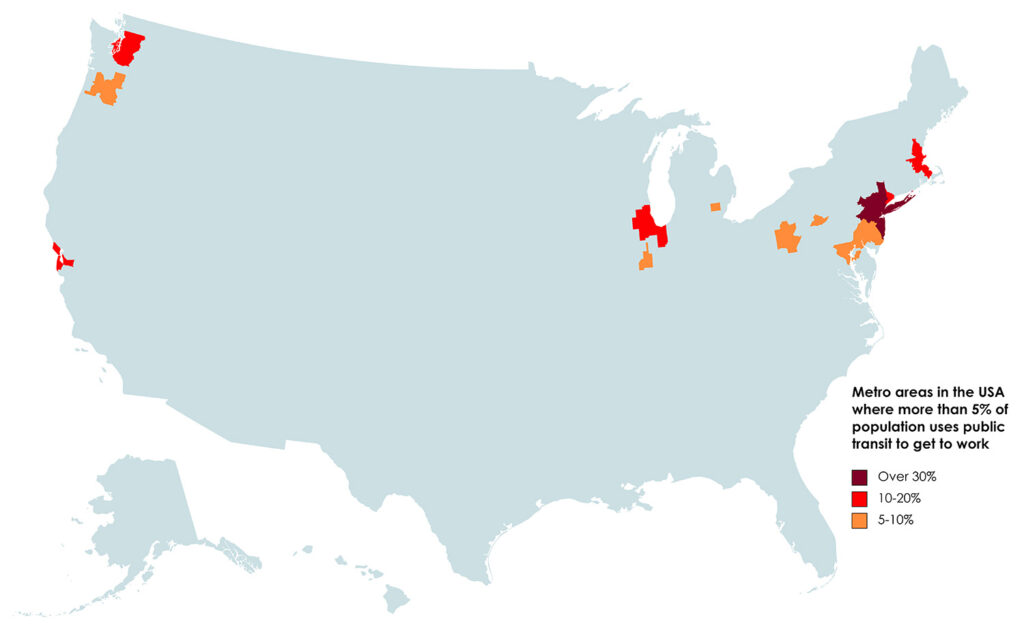
Public transit use:
https://vividmaps.com/public-transportation-in-the-united-st...
https://vividmaps.com/wp-content/uploads/2023/09/public-tran...
Population density:
https://www.axios.com/2023/10/28/americans-moving-map-2022-f...
https://www.axios.com/2023/01/31/cities-pandemic-moving-tren...
Just as an example, right now I am in an Indian city where there is some minimal public transport but a majority of people need their own vehicle to commute for most of their journeys. And it is not an unusual scenario for India, which contains more population than Europe and North America combined.
I don't think OP understands the meaning of the word globally
We can compare US to Japan, to Europe, perhaps to some parts of China but certainly not to India - it would be too much apples to cucumbers comparison.
Imagine that we but every country and their development index and their public transportation development index on a XY graph? Would US still stand out?
Let's assume that it does. Then we can say that US is a global outlier.
When comparing similarly wealthy countries the US is absolutely an outlier in this.
Because you said - "Thankfully the US is a major outlier in this aspect globally." "Globally" implies the entire world. Now why are you moving the goalposts? If you wanted to confine the discussion to the developed world, just call out US being an outlier in the developed world.
This is very subjective, as well as personal and irrational, but I find it to be true. I benefit from having a reason to go out into the world in the morning. WFH and the freedom to go to the coffeeshop or take a walk didn't match up.
That depends on the public transport. When I lived in London (inside what is known as the zones 1-6), I had a walk, a wait for space on a train, then stand for 40 minutes on that completely packed train, then a change at a crowded station, then another wait for space on an underground train, then stand on a completely packed underground train. All of this while dealing with angry and rude other people trying to push on each step before you. I would get to work completely stressed and in a bad mood already. That is on a good day. On a bad day the trains would just be cancelled, or the underground halted, or something and it would take hours to just get to the office.
The only way I would consider going back to something like that is for a huge, huge amount of money.
Unfortunately a lot of things conflate over time as you become more senior to generally make your commute worse.
For me - my last 2 roles have earlier required start time, with a hard start (morning meeting / standup / L3 support presence), company office locations got a little further, and trains got a little less reliable.
Fortunately I am remote since COVID, but when I was going in / or have to go in now.. I need to bake in 45-60min depending on how much I'm willing to risk being late that day.
For me I'd rather work 11-12 hours/day at home then go into office for 10 hours & spend 1.5-2 hours on the commute. Company is getting 10-20% more time out of me, and I at least save the money & "commute prep time".
In some cases, it was getting brought into more senior manager meetings I previously wasn't privy to, that had always been too early (7-8am).
In other cases, it was moving those same managers goal posts because they'd always been online early and hey if you want access to them, the only place to find time on their calendar was like 8am or 5pm.
I know A LOT of senior IC / team lead people who fell into this trap during COVID.
How sustainable is to work 11-12 hours a day though? If we do 5 hours of intense work and the rest is spent in meetings or other overhead activities make 8 hours just enough to make it sustainable over long periods of time…
How I spend the time in between in terms of doing research/reading/etc is up to me. If I had to do this in an office setting it would suck to be stuck there when stuff does come up.
Why? Are you contracted for 45-50 hours per week? Or if contracted less, are you compensated for the additional hours?
I'm contracted for 38.5 hours per week. That's 8.125 hours Monday to Thursday and 6.00 on Friday. If I work longer than this I am compensated with time off in lieu. I do have to log my time daily. Overall works great. I'm fairly paid and have a good lifestyle.
I actually find it hard to imagine working 9-10 hours every day for any extended time period.
The transition time of arrival and departure is easily 30-45m daily, on my employers dime.
I do 50% and it works for me. End of the day most of the problems associated with this issue are workplace and cultural issues that come to a head with remote/hybrid. The only novel dysfunctions with employees that I see (and I’m an exec with about 900) are people doing things like secretly moving away and abusing medical accommodation. There’s also an issue where people build their life around remote and are disappointed when they miss opportunities, but are unwilling to meet in the middle.
End of the day. The lazy idiots are just as lazy, grinders grind, and smart people continue to be smart.
So basically, waste of time.
Come to think of it, I'm wondering if that's where the split comes in. Upper management sees their productivity go down -- on what's fundamentally an interpersonal endeavour -- while individual contributors see theirs go up -- on what's primarily solitary ones. As a result, there is friction with top-down work-from-office mandates.
Getting your head down and coding on your personal goal is easy remotely.
I think some ICs like that it's harder for people to say to them that they are driving in the wrong direction, even if it's still true.
If you've played MMOs, been parts of raids, or been active in a guild - you figure out how to solve these problems.
I've been in a community management and moderation role entirely online - those interactions and issues were, by far, the most subjective and complex project discussions I have had to conduct.
I believe that there is an entire generation of workers AND managers, who will be entering the workforce with highly effective remote working habits.
The caveat is, that this applies to work that can be done online, where your product can be examined and verified online.
You are right, however I would say that raids and coordinated e-sports were on the periphery when I was playing. I had to set up my own teams and lan tournaments.
Nice distinction to highlight though, thank you! The skill set would require specific coordination skills, not just being able to play team matches occasionally.
I suppose its proof that the skill exists, just not its distribution in the workforce.
As a manager, with both WFH and in-office employees, the difference is very clear on my end: In-office employees do undeniably better. In my personal experience, of course.
I think this is extremely cynical. Feedback makes for good organizations, and when I built teams, anyone who doesn't value, actively solicit, and provide good feedback doesn't have a very long tenure.
There are many things which go into building this culture, but I think I've only had one or two cases where this led to negative career impact for individuals. Most people adopt to this very quickly, very well, and work well in high-feedback settings.
I've absolutely never had, nor could imagine having, this problem on teams I've led.
Much more, I find the limitation is on my end. Going for a walk-and-talk is relaxing. A Zoom meeting is tiring. 1-2 Zoom meetings per day is not a problem, but a day of Zoom meetings basically leaves me a zombie. Group meetings are also much more tiring online than 1:1s.
I'm a good in-person manager. I'm also a good remote IC. I not nearly as good with those flipped around.
I also don't find any of these to be the case for me:
> keeping people on target is difficult remotely. Consensus is difficult remotely. Feedback is difficult remotely
I can do all of those individually -- quite well -- remotely. I just can't do those for anywhere close to 8 hours per day.
To be very clear: That's me. I'm not speaking for you or for anyone else, and YMMV. I'd be genuinely interested in hearing other stories or contradictory opinions, and how things work for others.
Most offices I’ve been in have had deficient conference room setups and open floor plans, and I’ve come to enjoy the ease with which private conversations, pairing, and ad hoc meetings can happen without being disruptive to others or booking a room way in advance.
I do think that conversations have higher bandwidth in person, and I’ve really missed having a proper big whiteboard to gather around, but I’ve come to realize that this restriction can be a positive forcing function for organizations to write things out and maintain more organized planning documents, which is a desirable outcome.
It also adds an extra hurdle for those who aren't particularly skilled at management.
Managing people is really really hard, but we seem to have a managerial class who seem to be getting away with doing it very poorly.
I like your reply, but for different reasons. I am a middle school teacher, and my day to day is managing people. It is tiring, decidedly so, and yet at the end of the day, management is rewarding for me for because it is relationship building through gaining individual understanding and building classroom consensus.
I love my job and am good at my job. But if I’m to step outside of my classroom your latter quote becomes far too truthful for me:
“we seem to have a managerial class who seem to be getting away with doing it very poorly”
Your quote applies directly to my supposed superiors; assistant principals, principals, and higher ups in the school board. Most of the managerial class outside of a classroom is trash at their jobs. Their management style seems mostly morale busting and ego inflation at day’s end.
I agree with you, just from a different occupational domain.
I hypothesize, however, that a lot of these decisions at a c-suite level have more to do with other considerations, like property investments, headcount, salaries, or (worst of all) egos.
Aside from having an actual assistant, is this just hypothetical or do you know someone that prefers being micromanaged?
I think in such cases it might be better to get rid of such staff, for your own sake and theirs.
I had to do something like this. Not every hour, but several times a day was needed to keep this person on track and productive. And no, I did not want to check on an otherwise-functional adult that frequently. Nor did anyone else, but circumstances led to them working on my team.
> I think in such cases it might be better to get rid of such staff, for your own sake and theirs.
Yes, that was the best option and is ultimately what happened. Going through the required HR hoops was just as much effort as micromanaging, which is why no one bothered to do it for several years. It was easier to shuffle them off to another project and tell the lead "they're alright, they just need to work on communication".
This isn't an "oh it's 4:30 and I'm not going to start something new", it's "It's 11am, and everyone else is busy, I will play solitaire until my manager explicitly tells me which of the 45 tasks they want me to complete".
If you say "go into room X and fetch the Y to do Z", if Y isn't in the right place they will await further instruction. If challenged, they will say they need training on how to handle the situation, or that it's the managers job to ensure the process is right. If you give them the explicit instruciton to tell you when their task is complete, they will come to you and stand next to you until you give them something else to do.
However, if you give them a task like do X at 9:30 every Tuesday, Wednesday and Friday, it will be done, to spec, every time. People like me will occasionally miss it due to other asks, prioritisation,a perceived lack of value of the task, or an "I-know-that-this-isn't-important" mindset.
Part of management is identifying these behavioural differences, and utilising them effectively.
If you have a full team of people who need explicit instruction, your job will be shuffling tickets around. If you have a full team of people who look for improvements, and are constantly thinking ahead, your job will be trying to reign them in and keep them working on the right things. Neither is good, you want a mix of both.
The only real problem are the people who I can only describe as maliciously incompetent. They do the bare minimum that is asked of them, take advantage of all of the freedom and lack of definitions (no core hours meaning I don't work 10-4 Monday through Friday, that sort of thing), and when you try to reason through it together they jump to the most hostile action possible and weaponise your flexibility and grace against you.
The only solution for these people is for them to be part of large companies with rigid policies that they are guardrailed into and have no way to test the boundaries of. If you have one of these people on your team you need to get rid of them. My experience is that there's usually one in every 40-50 people. If you get one early on your team, you're in big trouble.
I could probably fit the description of the malicious person you described, but only because it wouldn't map to what my manager knows exactly how to work with, almost always defaulting to a doubling down of otherwise unnecessary tests of my competence, as defined by their uncommunicated expectations in terms of how they differ from what I'm doing and why. More specifically this seems to manifest as micromanagement. It's quite shocking to watch, it doesn't take much to set things on a bad course, and it's very difficult to recover from.
In the case of my last job, I was working remotely from the the PST timezone with people in Vietnam, Spain, and Germany where the manager was. At first I was waking up for a 6am morning meeting every day to have a little overlap with the rest of the team, but later I'd discuss it with my manager and change it to 3 days a week. I made it clear that despite being in a wildly different timezone, I'd do my best to be in attendance at the most important of the new meetings that were accumulating as the result of org change and boilerplate agile, and be available for a few hours in the morning and a few hours later at night that overlapped with other developers who needed to chat in real time with me, so I could get a block of relatively uninterrupted focus time in the evening or late afternoon. This actually worked pretty well, I kept up with responses on Jira, code reviews on Github, and delivering the features and bugfixes I committed to. I was originally hired as a contractor and then moved reluctantly to employment, which is when my boss started asking I keep core hours, which I agreed to. Things kind of kept moving along fine, but he seemed to be accumulating resentment about something, which impacted his ability to communicate respectfully. He started "checking in" during strange hours for no tangible reason, and when I didn't respond immediately, he would just keep sending more messages. Whenever I did respond, he'd seem to come up with an excuse for why he needed my attention, such as for a status update on something I'd already visibly commented on. My response was always to try and be more communicative, but surprisingly he kept getting more toxic, and more passive-aggresive, in what seemed to be an effort to remove what agency I had to get work done.
> when you try to reason through it together they jump to the most hostile action possible and weaponise your flexibility and grace against you.
All 1on1s concluded with him seemingly re-affirming his belief that frequent supervision is what he should do, ignoring anything I had to say, and this just kept compounding what almost resulted in burnout and depression.
At one point for example I had added and finished a ticket for a simple typo fix in a route, but noted that there was another ancillary issue worth looking at, not specifically related to this ticket and should be looked at independently at another time. He commented and said the ticket was incomplete until the ancillary issue was looked at, even though there were much higher priorities. So it sat paused or in-progress for some time while I finished my priority work, meanwhile he continues DMing me almost daily asking for status updates on this and other ongoing work. I eventually get around to investigating it, conclude that there's a good but undocumented and unbroken reason things were like that, and it's not something to pursue at this time, ensuring that I documented my findings thoroughly and visibly. He then assigned it to himself, realized he didn't have time to work on it, and then asked in the general slack channel if anyone would look into this, "because ___ refuses to", subsequently backing off only after I called him out on it and he wasted his time concluding exactly what I did, almost as if I'm a capable software dev
After that, he'd proceed to start moving meetings around to hours I couldn't possibly attend, cancelling 1-on-1s, and eventually I'd get laid off. Honestly it was insane and I hope he gets his head checked. The only reason I didn't burn out was because I mentally denounced his behaviour as laughably petulant and I shouldn't do anything beyond what I'm doing to appease it.
I've had other instances at other companies, and I do believe I'm the problem, but me as the problem wouldn't exist if people who had good communication skills and empathy were promoted to management. I've had 1 on 1s with spineless people approximately my age who spent the entire meeting prodding me with vague questions to try and get me to admit some pet wrongdoing, only to deny it upon being asked what they're looking for, when just stating it clearly could have helped work through the issue. Managers often avoid confrontation and resort to passive-aggresion.
Forgive the typos here, wrote it on my phone and it's a bit to review.
Edit: from his perspective, I understand that he was probably faced with home life problems and an issue of someone not conforming. So my point is that things appear wildly different depending on what your sense pf normal compliance is, especially if you have no apparent difficulties with shifting focus for example
This sounds more like it could occur at least temporarily when most people get some categorically new task that's potentially costly to screw up, and I could imagine it being voluntarily requested rather than overbearingly applied.
> Other thing I've seen is people without supervision producing less/lower quality results.
I feel like managers identify a risk and apply their toolkit to it, which often ends up being increased oversight regardless of whether or not it's a good idea. It may or may not be I suppose, but it seems like only a niche person would respond with greater effectiveness in response to more frequent and perhaps intrusive scrutiny.
It made me a bad manager to not have that in my tool kit. There are a lot of people who just want you to tell them exactly what to do.
It’s a preference to not execute two different skill sets when you lack one of them. That’s stressful.
You might be a good developer, but not great at talking to users and figuring out the priority and the solution and executing on that independently.
Or you might not be good at delivering eloquent speeches. Or whatever. Everyone lacks some skillset which they’d prefer someone more qualified handle for them.
Seems like poorly considered delegation, or a system problem. Good managers should be able to identify or discover through conversation if someone will benefit from more specific and frequent interaction, and bad ones decide it'll be a good choice and work backwards from that.
In other cases, or if established up-front, one should expect a certain range of regular capabilities be within some agreed upon parameters; you probably wouldn't ask your system administrator to get on the sales floor, but you might ask your sales people to be able to work the cash register and lock the doors.
So offering people remote work for a 20% TC reduction?
Most companies do this by using a cost of labor index for areas. NYC/SF/Seattle being the highest, and then smaller reductions outside.
Basically you don't want to be in a HCOL (High Cost of Living) remote area with a LCOL (Low cost of Labor)
Or in some specific countries and company cultures...
Office mandates are dumb and it should be left up to individual team leaders.
It’s unfortunate that there’s now very little nuance in American discourse especially, whether that’s in business, politics, economics, or society. Everything is an ideological “cause” worth fighting for, with an inverted bell curve showing lots of people at the extremes, and precious few in the middle.
It doesn’t bode well. I fear America is devolving toward a 1980s Lebanon-style civil war, with everyone fighting against everyone at least at one point or another. The military could step in, but then we’d essentially have martial law which isn’t much better. It may seem silly to bring this up in a thread about remote work, but it’s really a microcosm for how polarized we’ve become.
Unfortunately, it's really difficult to run HR for any company of significant size, that accounts for individual differences.
My personal management style was about treating each employee as an individual, but I was also fortunate to have a small team of high-performing, mature, dedicated professionals. My technique would not work on many of the teams that I see out there, these days.
> workload splitting where syncing isn't very important
I'm not convinced that remote means syncing is harder. There is a case to be made that: it's easier because it compels teams to have a structure for syncing, and structured syncing may be more efficient than ad hoc. Put another way, you potentially lose the crutch and end up stronger as a result.
This isn't a whimsical theory either- structured business processes are often missing and causing hidden costs and inefficiencies.
Work requires effective communication. Global teams place a premium on that and nurture it if they're successful. The remote work dilemma is non-global teams discovering this well-trodden ground and attempting to reinvent the wheel, with a sprinkling of terrible commercial real estate decisions on top.
(Nothing in this response addresses specific team types that benefit from in person work or the entirely valid in-office preferences of individual workers.)
> The fundamental issue I see in this debate is a lack of sensibility and nuance in human nature.
> The whole matter is debated (understandably in a way) on big numbers and averages.
If statistics is invalid, then how do you propose companies decide, based on a reasonable and empirical estimate of reality, on what work arrangement to implement? Do you believe that it is not expensive and disruptive to introduce as many variations of work setups as there are people in a company? What if the people deciding company policy simply prefer and believe in the advantages of onsite, which they have the freedom and right to believe---so why do people who prefer remote force themselves in such places?
As Einstein said, you should make every problem as simple as possible, but no more simple.
The problem we're describing cannot be reduced to few simple statistics, it's exactly making the problem simpler than it is.
Not only just the task of measuring productivity of knowledge workers is extremely difficult if not impossible, but getting any statistic across a wide variety of different factors makes it even more pointless.
In fact, the problem shouldn't be approached from a macro, but microscopic level. Start from the basics.
There's knowledge workers that don't do anything from home. There's knowledge workers that won't achieve anything at the office. There's gargantuan projects like operating systems or databases developed fully remotely and asynchronously. There's projects that barely move without lots of synchronous, meaningful in-person interactions and there's environments like early stage startups that desperately need this kind of situation (albeit I'm sure there's many exceptions).
In professional sports it is very well understood that slightly different formulas work differently for different teams and players. Some needs to be fast and lean to be effective. Some need to put up muscle and weight. Many need both. Some need lots of cardio, some need more skills training. And all of that has to interact and mesh together and face different challenges.
Yet you want to complex systems like business projects/teams built around few statistics? Ignoring the wide variety of factors and humans that will end up there?
I'm not saying that building teams like that is an easy task, sometimes you just need to make work whatever team you're given, and you will have to decide a setup and give the right structure incentives to everyone to make it work.
But even if tomorrow a stat told us that there's proof that statistically remote is better for 60% of the teams (or the opposite) that really won't help much.
The friction we're seeing now is that we're still recovering from a pandemic that forced everyone remote whether it works for them or not. So this idea of remote vs. office being a core strategic decision as a company grows is fairly new. We are all still learning how to navigate the options.
If your team level management org cannot organically work out the right mix on a team/role basis, then you probably should look at what else they are doing poorly.
I've worked for 20 years in global teams, and written communication is very important. Having US/UK/Ireland/HK/Singapore split team isn't much different from remote. Over the years I've worked in smaller orgs with a higher % of local people.
What I can tell you is that the amount of chatter grew exponentially. One place I used to call it "bilateral communication" because A-B would side-talk then A-C, then A-D, then B-C, then B-D.. all in-person. Tremendous games of telephone constantly.
Remote is a forcing function on better written communication.
It's funny that half this site is people working on various SaaS tools that are supposed to make work collaboration better, but somehow we need to sit next to each other to be productive?
How important is that stuff, I have no idea, but if half the team are friends at work and the rest can only be reached over slack, that doesn’t sound like much of a team
Places that are very focussed on "culture fit" or if they'd "have a beer" with the person they are interviewing.. leaves a lot of people behind. Women / non native speakers / older folks generally fail these types of implicit or explicit screens.
Building a development team is something like building a baseball team. A bunch of specialists, a few generalists, and the ability to get along. Whether they'd grab a pint after a game isn't really important.
I certainly have and maintain friendships at work, some of them from before remote, some of them from after. Some of them are people whom I've never lived in the same continent or city as.
I have plenty of friends outside of work. I work for a living and I'm a professional doing a job, not a kid on a play date.
The cynic in me always felt that people who emphasize this benefit of office work just can't make friends unless people are forced to hang out with them every day.
That being said, there's lots of meetups, clubs, organized sports etc etc for people looking for a structured way to continuously hang out with a group of people sharing their interests. The key thing there is that it's voluntary association though.
Being forced to hang out with coworkers who you might not even like just because they happen to have the same employer shouldn't be a substitute for putting in an effort to make friends.
There are some social spaces I try to go to regularly but the people who turn up are not always the same. A lot of the time I'll manage to connect with one person, which is hard for me, and then I will never see them again even if I keep going to the same event. Or I see them about once every couple of months at the event. Or on the one day I'm going to the event my energy levels are low and I feel overstimulated by the novel environment and I don't manage to really speak to people. Putting myself out there a lot to new people in new places is something that I find stressful because I have been rejected and made fun of for trying to connect with people for the majority of my life. Honestly, i always had an issue with this, but I became better at being sociable in uni. Being in my house most of my time has brought my XP down and I find that the more I am stuck inside the more I regress in my abilities. I find it really hard to leave the house once I become unaccustomed to it. My brain just starts to break down.
I think a sports team might be the most consistent spaces but I'm pretty dyspraxic and when I do team sports I end up getting anxious and like hitting my team members in the face. I can't do that sort of thing.
What works for me is having a consistent space where I can slowly build up relationships with people over time. This is sort of how things have worked for the whole of human history. Work, school, uni, sports teams. This is where people make most of their friends. Always has been, always will be. And again, if I have to be working for most of my waking hours, I don't want to do it alone in my little box. It's not enjoyable. And saying that I must meet all of my social needs from concerted effort outside of work on top of all the other responsibilities I have is insane to me.
When I have a workplace that i know i can go into and see people a couple times a week, my mental health and energy levels are better and my social XP is stronger and I can actually enjoy socialising. Last year i was mostly remote, this year I've found a company with compulsory 2-3 days a week and lots of other young people. Its amazing. I finally feel okay. And yeah if I was working somewhere where I hated everyone and I didn't get any benefits other than money I would LEAVE. Don't stay at a place like that. Your mental health is too valuable and work should enhance your life otherwise you're literally ruining 80% of your waking moments.
Edit: on the point of leaving, yes i know some people have kids and can't move around like that. but this is why i'm pro mandatory hybrid not 100% in office. workplaces should be okay with you needing to stay home when your kids need sth or you coming 2 days if you live past a certain distance instead of 3 days. My office accomodates this. I come in 3, others come in 2 because they have long commutes. Everyone is fine with it. 100% wfh just punishes anyone who doesn't have kids.
I work at a 100% remote company, and most of us are married (no kids) or single. We, or at least my specific r&d team have social lives outside of work and live in urban areas. Some of us even do a weekend dnd session online.
Hybrid mostly doesn't work from an economic pov. If the company employees can do their work 2-3 days from home, it's likely they could do their entire job from home, and a company just can't afford to spend money on expensive commercial real estate if it can avoid it.
Edit: Also I now work at a company that has a 3 day office policy, which is one of the top reasons I chose the job. I think they're doing fine and they have no intention fo changing. It's not impossible.
The obvious solution is to fix your very-noticeably fucked up communication culture, since that would also improve in-person work.
Some orgs and managers seem to have decided, comically incorrectly, that WFH is the problem element in the above scenario, however.
Or having the universe revolve around Jira, berating devs for lack of story progress in standup, and shouting about velocity in sprint ceremonies.. while also doing the above said verbal drive-bys? Who is causing all this churn?? Where is our focus? Where are people spending their time??
It's unknowable.
The cost of doing all this measuring and evaluating and preparing-to-measure certainly isn't being measured, though, so we'll never know.
It's entirely possible to construct beautiful metrics, amazing velocity charts, etc and have a terrible product with miserable users. Many such cases.
Some of this metrics stuff is like "expressed vs revealed preferences". Users who complain about your product and demand new features more quickly don't want a beautiful burndown chart. They want you to improve your product. You may actually need to slowdown to speedup. It's likely you need to do some R&D, and lots of experiments that will look bad on metrics.
You see this a lot when you quantize teams into little buckets like operations vs new features vs customer success vs core engineering teams. It's possible for a team run by a bad actor to have nice metrics while being a net drag on the other parts of the org.
It can't be an everyone gets a gold star situation. Encouragement/reward is good when warranted, and encouraging everyone to recognize their strengths and weaknesses is required.
You can't justify the environmental destruction of working in an office just because you like the aesthetic or it makes you feel better. These are not apples and oranges that can be compared like two sides of an equally unproblematic coin, and it makes me sick that people equivocate and make it seem otherwise.
Is it though? My last employer (a FAANG) did publish (questionable) numbers suggesting WFH being more efficient when the lockdowns started. When RTO started they flatly refused to back it up with any numbers whatsoever.
> At the end of the day the decision C-suite have to make when planning projects is not remote vs non-remote and apply blindly rather in forming teams with people that by their own nature or preferences will thrive in the setup that's decided.
I think at the end of the day the C-suite has no idea whether WFH is better or worse. Middle management will come out and blame any lack of progress/productivity on literally anything that's not directly related to their own performance, so WFH is a natural scapegoat for incompetent management.
What the comments also show is that people willingly bring themselves in a situation of 3h of commute and then complain. That's not something you'd ever widely see in Europe imho. 3h is insane. I have < 20 minutes and love the reading time, as I travel by public transport. If I'd have a farther commute I would just move. Baffles me that someone would accept this. Maybe your public transport/zoning is fucked up, not your remote/not remote thing?
I work VERY remote (my employer is in Austin, I live in Michigan), so public transit isn't really an option for that arrangement, but if I'm honest the only real reason I'm doing it is because of Austin housing prices -- I'd much rather live in an urban core within walking distance of work, but that lifestyle is unimaginably expensive in all the places where jobs exist. Instead, I have an aging 1940s tract home in a city 2k miles from work.
The housing crisis is also a transit crisis. We built most of our homes and businesses around the cheap automobile and infinite petro-energy, with the predictable result that we can barely afford to live near the places we work.
Texas -> Michigan is a very long way. Afaict this trend really got started with covid, where people fled to their home towns, right?
> I'd much rather live in an urban core within walking distance of work The best. I have 14 minutes by tram from door to door.
In my experience these people don't thrive in the office either. For software engineering in particular, these people are not useful employees.
It is not realistic to fire people who don't align with someone's preferred management style.
Taking an average view isn't useful at all, apart from maybe insinuating more people carry out jobs that are suitable for remote working.
As a new grad, hell yeah I want to be in the office to interrupt and be interrupted for the learning, interact to know other, hope for serendipitous encounters, have a good time after work, meet a potential partner, yada yada.
As a family person with decade of work history, I see it as losing my balance, a hindrance the interruptions, the banter, the random assignments because you ran into someone in the cafe, having to deny after hours stuff again and again for the kids or appointments, having to take the whole day off for a 2 hour appointment at lunch, blah blah blah.
Not all new grads are the same, neither all seniors. Let people pick. The illusion of loss of productivity has been shattered and there's no going back.
There was a point in time when all you could buy was a black ford model-T. Ford would love to do that. But it can't anymore. Times have changed. Took Ford a long time and many executive shifts to move on and get along with reality.
So will this.
The whole matter is debated (understandably in a way) on big numbers and averages.
I could write a long post but I'll cut it short to this paragraph stating that humans differ.
For some commuting is stressful, the offices are noisy and full of distractions and those individuals may thrive in a remote setup. There's people that work in the opposite way. Their house offer many distractions from laundry to videogames. Some people require micro management and constant oversight some tilt in such environments.
Some teams require a lot of meaningful in-person interactions, brainstorming sessions or work chats around the coffee machine. Some teams thrive with good central top/down planning and workload splitting where syncing isn't very important.
At the end of the day the decision C-suite have to make when planning projects is not remote vs non-remote and apply blindly rather in forming teams with people that by their own nature or preferences will thrive in the setup that's decided.