A ton of the prominent VCs were writing out checks from their personal bank accounts so that founders could meet payroll.
> For some silly reason I had some respect for the startup industry before this, now I see it as a joke
Wait seriously? You somehow lost more faith from this than you did from
- crypto - Adam Neumann - $100m seed rounds
and like 30 other things???
> But it's important to remember that they no longer automatically deserve any credit for taking risks and doing something new.
What are you even talking about?
Having your bank account randomly disappear isn't one of the risks that anyone should have to take.
But that is the risk founders chose when they put their money in (a) any bank and (b) specifically SVB.
Your money is only insured to $250k. And SVB had no CRO, lobbied against regulation, made no efforts to comply with Basel 3 and was engaging in risky bets that many had previously warned about.
CEOs have a fudiciary responsibility to understand and mitigate risks. And expecting taxpayers to bail you out (either directly or indirectly) when your incompetence causes harm is simply not fair.
This is an impossible standard to hold founders of 10-100 person startups to. Might as well say "CEOs should be omniscient"
No, people with deposits in SVB never faced having it all disappear. SVB was insolvent which meant that its liabilities were larger than its assets. That doesn't mean the assets were worthless. The FDIC process is like a bankruptcy. First, everyone gets restored up to the $250K insurance limit. Next, the remaining assets are sold off and the proceeds are divvied up among the uninsured depositors. So the depositors take a haircut: some fraction goes poof and they get back the rest. They don't end up empty handed. Figures like 90% (i.e. they lose 10%) were being thrown around this morning, before the bailout.
Worse, according to others in the thread they had it in the contract that they must use SVB exclusively.
But not the CEO of a 100 person startup.
100 people is large enough to have a substantial amount of human time available for use, and likely budget as well.
Next you should tell me they should worry about "the big one" hitting Silicon Valley which we know the actual odds for and people still seem to live there.
Geez. Let’s hope you’re wrong. Financial illiteracy is bad news in a society built on markets.
I can’t speak for “most people” and especially not people in Gen Z, but otherwise, as a matter of fact, many people do think about that and manage their money accordingly.
Ironically, it kind of seems it may more likely for a consumer to protect against bank risk than for these startups and VCs that, despite all their resources and CFOs, apparently had collectively decided bank risk isn't a think for them.
Of those who do, I wonder what the percentage of people is, who would be worried about that risk?
Maybe more than 50%? 75%? 80%?
Yes. Not specifically a bank run, but bank failure. Cash is the lifeblood of a company. Let's not worry about our cash becoming unavailable, in a bank that buys risky assets with our cash, in a perilous interest rates environment, "cuz it's not 1920."
Admittedly, picking a startup as a bank increases that risk somewhat, but so does picking a startup to provide your CRM system or web platform or other mission critical stuff that's a lot more likely to be shut down with minimal warning, or indeed choosing to raise funding from a VC that wants you to 20x or bust...
But then again it doesn't really surprise me that an SV CEO would have no concept of deposit insurance. They live in a different world.
A startup CEO isn’t going to be an expert in everything, no matter how much some people worship them.
The $250k FDIC account limit was really well known, so I'd expect someone in the CxO ranks to have it properly managed in a 100 person startup. CFO maybe?
Several people have mentioned over the last few days that spreading $$$ across a bunch of ($250k limit) accounts at banks is a service offered by third parties, to address this very risk.
Wonder what the cost of using such a service would have been, and how many SVB customers were using it?
Anyway, with the current US regulatory approach of "oh shit, lets cover all deposits anyway" I wonder if those services have a future...
> It's not the 1920s.
Is that a good thing or bad thing? :)
You think the CEO of a 100 person startup should be worried about something like a bank run happening?
The big one as well as this banking debacle should both be on your radar, yes. You are in this for the money. You have money but you want to increase the amount by orders of magnitudes. So you gamble.
You gamble on lots of things so that you spread the risk. Gamble gamble gamble.
Hey, you know what? I sat on three different poker tables this evening. Lost all. I'd like my money back. Now, please.
If you are not planning for "the big one," you are, again, accepting risk. My parents did not have earthquake insurance in SoCal in 1992 and had to start thinking about how they were going to repair the collapsed chimney on our house. I also didn't carry earthquake insurance on my SoCal house, knowing full well it is a risk. My mitigation being stocking up on food and water and having alternative sources of heat.
Founders are often coming into new levels of financial responsibility when they get funded and as their business draws in later rounds of investment and customer revenue. You can’t assume $4M works the same way as $40k or your liable to lose a big chunk of it. Thankfully, there are professionals whose role is to help with that.
Oddly though, a thing I've heard repeated over and over is "it was in our covenant to use only SVC."
If you can't live up to that responsibility don't run a company.
If they are not, then it's 250k left from every account and all else is lost. And someone could be sued for that. Who should it be if not CEOs?
Your job is to understand and mitigate financial risk as is required by law.
And in this case there are many options for managing this risk other than splitting it up manually into multiple bank accounts. Speaking with a financial advisor would help with this.
CEOs who should have known better are not victims.
Anybody, including corporations and partnerships, can safely park excess cash at treasurydirect.gov. Buy short term treasuries and time the redemptions to coincide with next month's payrolls. The shortest bills are 4 weeks and they're paying like 4% right now.
I honestly don't understand why more people don't do it.
More generally the approach of using a cash sweep account in conjunction with t-bills held with a custodian bank seems like pretty sane advice. I don't think I'd emphasize "one bank," but otherwise, sure.
You pay for AWS because you don’t feel like managing hardware, why just assume you can manage 10s of millions of dollars?
Should they buy the T-Bills and hold the actual certificates under their mattress?
I don't think that's the case, though I may be wrong and would appreciate correction if so. Anyone who held T-Bills at SVB as a broker should have been able to transfer them to another broker at no loss (but at a small delay), and the remaining $250k in their checking account should have been available within one business day.
> suddenly it's a CEOs fiduciary incompetence that a seed round isn't distributed amongst 16 banks
Yes. There's no "suddenly" to it - you're describing well-established fiduciary responsibilities. A CEO's responsibility is to delegate those tasks to someone like a CFO, who _absolutely should_ incorporate a strategy that balances liquidity with stability. The CFO also has a responsibility to see just what, exactly, a bank is doing with their deposits and make a determination about the associated risk. And yes, it is very normal to park money in various accounts and instruments as part of that strategy.
It is deeply distressing that half the comments here and abroad think this is some absurd, unattainable standard instead of the operative norm for the other 90% of the economy that doesn't get treated like a miracle baby for simply existing. You're not running a lemonade stand, and witnessing self-anointed "innovators" screech for a bailout because they somehow accrued millions of dollars in investments without ever learning about private deposit insurance or Cash Sweep or T-bills goes a long way to explaining why the majority of these goofs fashioned their Twitter bios into graveyards for failed ventures.
Sub-20 person startup CEOs didn't cause this problem. Saying "this is YOUR fault, person who just got their first seed round" seems to gloss over the large(r) issues.
Especially a regional bank like SVB that fought hard against regulation, caters specifically to herd-thinking VCs and startups, offered 4.5% APY, and went all in on mortgage backed securities shortly before the Fed hiked rates way up.
That's not your only option and this is nothing new. Even I - arguably a very small business owner - spread my risk. Just in case...
They're gonna want to try to rebuild their reputations. What's coming is a lot of "who are you gonna trust me or your lying eyes?". Starting soon you're gonna hear all the sob stories about how the VCs all this wonderful all did X and Y and Z. And nothing we just saw really mattered. And downplaying how as soon as the going got tough they abandoned all of their SV ethos and immediately went begging to the government to be bailed out.
Be prepared because there will be a huge PR push soon like you haven't seen.
Hurry I’m sure they are deleting as we speak.
https://twitter.com/BillAckman/status/1634564398919368704
https://twitter.com/DavidSacks/status/1634382260433719298
https://twitter.com/Jason/status/1634792355294515200
> @Jason
>YOU SHOULD BE ABSOLUTELY TERRIFIED RIGHT NOW — THAT IS THE PROPER REACTION TO A BANK RUN & CONTAGION
>@POTUS & @SecYellen MUST GET ON TV TOMORROW AND GUARANTEE ALL DEPOSITS UP TO $10M OR THIS WILL SPIRAL INTO CHAOS
This is one of the most irresponsible things I’ve ever seen tweeted. It’s the equivalent of screaming fire in a crowded theater.
Seems the equivalent of screaming fire in a crowded theater, when there is an actual fire.
If you're looking at a bunch of companies you're invested in taking a 5, 10, whatever percent haircut on their deposits, it might be to your interest to take to the media and encourage everyone to panic, helping to create the very risk of contagion that you're talking about, to try to force the government's hand.
Is this true? I've been following this story pretty closely and haven't heard anything about that.
Then you put your funds in less risky banks who did not lobby to get an exemption from the regulations that protect against precisely this kind of thing. Even, spread it around safer banks.
Putting all of one's money in a bank because they have better returns or other investment opportunities is business. Not something that someone can be safe at the public's expense.
The public, because the public will pay for this one way or the other - if this is paid from the insurance that insures all banks like how the statement says, then it will cause all the banks who pay into this insurance pool to reflect it on their customers with fees. So every single person with a bank account in the US will pay. Its still public money, but it doesnt come directly from the US govt.'s pocked, so its 'okay'.
And if that isn't adequate for a given company, it sounds like it's time for them to hire a finance professional who has experience with cash management.
Because they have duty to do so, as (part) owners of those companies. They could face personal liability for being negligent enough. You'd think any company with non-trivial payroll should've known better than not to hedge on all the things, including their banking partner.
I mean, having all your data randomly disappear isn't one of the risks that anyone should have to take. But if a company suffered systems failure without backups, what would we be saying? If a company had a breach and all their data got release or encrypted by ransomware attackers, would people seriously be arguing for a taxpayer-funded government bailout?
Source? Who specifically, how much and can you independently verify that they actually did it?
These people played a zero-sum game, purposefully generating as much panic as possible to force the fed to act.
> Having your bank account randomly disappear isn't one of the risks that anyone should have to take.
The fed has sat on its hands for decades and done nothing to mandate better protection for ACH transactions, done nothing to mandate phasing ou magstripe transactions (Europe has been on chip and pin for decades), our check cashing system is a complete mess in ways scammers take advantage of, and debit cards have a fraction of the protection credit cards do despite "real money" being involved instead of credit.
But then a bunch of billionaires force hundreds of companies to do business with just one bank, that bank is outright incompetent in how it manages its funds and employed people who were central in the last financial crisis, and suddenly it's "well, we must act to protect confidence in the banking system"?
I have zero confidence in the banking system. My money doesn't feel remotely safe from being stolen. I can't even find a bank that will do hardware 2FA instead of SMS 2FA, which is worse than not having it at all.
What is jpow doing about that?
Not only is it a risk many take, but many end up losing a significant amount. The FDIC actually has a list of the numerous failed banks they've helped depositors recover assets from here[1]. You can see that depositors often lose a lot when banks fail.
Now I don't think this is a good thing, and I think it would be worthwhile to have a conversation about a systemic way to avoid this. But it was eye-opening to see so many not advocating any systemic approach, and instead just saying "the government should do whatever it can to cover all SVB loses because people like us are special."
Absurd take.
This bank choose to _avoid_ safety regulations from the 2008 financial crisis, which is completely open information. They used this avoidance to pursue greater risk.
What is "randomly disappear" about putting your money into such a bank?
But what we've seen in the last few days is utterly despicable behaviour by many of the leading figures driven solely by greed and self-interest.
I think increasingly startups will look to bootstrap in the coming years.
Some founders/investors believe their own BS because that's what a good salesman does.
Being practical and sugar coating words has been the way to do business forever. The startup speak is just a specific flavor of words that's popular in a region/culture now, is representative of the business culture to some degree, but is just as hollow as any pleasantry.
blanket statement, also bullshit. Of course money is a driver, but if that's your only driver as an entrepreneur then you're likely not going to be very successful. In fact, this is the primary difference between VCs and builders.
> The "changing the world" talk is just as hollow as corporate business talk.
I think given his influence and hypocrisy this is despicable. But pathetic is another word that comes to mind.
I have not seen one human being that didn't turn around because of greed.
We are all vulnerable
Nobody is changing their stripes.
Still pissed about that. It was the proximate cause of the bank run.
I'm sure a lot of mortgage originators in 2006 thought they were doing the right thing by getting risky people into houses before prices rocketed into the stratosphere, because, you know, home values never go down.
It's convenient for tech companies that VC investment strategy involves giving seed money to some startups, but it comes at a price of the VCs having some say over company decisions and a high percentage of ownership (and therefore eventual value).
Fawning media startup profiles and hagiographies are one of the reasons why Theranos, WeWork, and many smaller companies are able to thrive and even attract new investment and customers.
There was a post a couple of months ago asking what's the secret behind Sam Altman's excellent aptitude when it comes to grifting. Those weren't the exact words, but that was the general attitude of the post. But that post was part of the few exceptions that confirm the rule.
Found the post [1]
Naive, eh?
That being said HN is one of the last great (mostly-)unmoderated forums on the internet. I personally think U.S. media has been almost unfairly negative about the whole thing.
https://github.com/Qbix/Platform
I believe in gift economies (science, wikipedia, open source) being superior to capitalism and private ownership of platforms.
Instead of Zuck, Elon and Bezos we could use more Linus, TimBernereLee and Vitalik.
It is difficult to be charitable when you have to worry where your next meal comes from.
https://community.intercoin.app/t/new-ubi-movement-mayors-ci...
The whole crypto fiasco plus a few other things (these SV people going from worshipping Musk to hating him in a very short period, for example) have convinced me that I was a holding a view that was not based on anything of substance.
Which begs the question: where does real innovation come from in the US (and the West more generally)? The SV start-ups are not providing it, ditto for the FAANGs, what's left?
In other words, the plot of MGS2.
Yeah, now that you mention it the one thing at which AI is really good at is image recognition.
There was this drone video [1] of a busy intersection posted on my country's sub-reddit recently, and from second 0:11 or so the way that the software is able to "recognise" and assign an unique ID to each and every car from that intersection is very Minority Report-y. What's scarier is that this looks like consumer-level stuff, not some fancy state-run surveillance thingie.
I assume the drone is Chinese-made, most probably also the software that made that identification possible.
[1] https://old.reddit.com/r/Romania/comments/11p9o7w/intersec%C...
For every one company that genuinely is working out of the goodness of their hearts, there are 10 serial founders seeking to inveigle their way into something as a middleman, sorry "disruptor", then cash out and go round again before anyone notices the cracks.
Well said.
Some VCs were definitely better than others: the very worse was probably the All In Crew who were trying to spread a bank run to tie the government's hand. Truly despicable.
Mr Libertarian himself David Sacks crying for govt intervention was hilarious. What a clown.
If nobody is rushing, SVB could probably find ways to sell something before it's too late.
Such extreme exposure to interest rate risk would've blown up in some other ways - say, a large client processing a routine payroll, executing stock buyback, or investing in an entity that banks elsewhere.
That's not their fault. Would you keep your money in an insolvent bank?
1. If they had more short dated treasuries, they could have used them to fund drawdowns, and would not have had to sell their long dated treasuries, that went underwater as interest rates rise.
2. If they had not been overly exposed to one sector, a sector that largely existed due to 'free money' of zero interest rates, then large scale draw downs would not have happened as interest rates rise.
The point is that these VC's didn't act to support their investments, they flailed around begging for bailout (that they probably didn't need but they didn't understand banking well enough to know that or bother to consult any experts before making public statements).
They behaved badly and should be embarrassed and everyone should remember it.
I'm not even convinced that the depositors made whole here were innocent--they accepted a known risk by exceeding the risk-free FDIC limit. The sad part is that in our society, we have no qualms about literally turning working people out into the street when they make financial missteps, but the already-wealthy receive prompt intervention from the highest levels to protect them and other wealthy people from the consequences of their investment decisions.
What argument is really left for this kind of intervention, besides appeals to the trickle-down system where the rich must be vigilantly protected since the rest of our society is set up to be disrupted when they fail. The whole system is morally and politically bankrupt.
They are the innocent party here though (well, except for maybe Peter Thiel). The depositors didn't cause this problem.
Because they preached for years that regulation is bad, and the government shouldn't be involved in their financial affairs.
Then when something went wrong, they begged for a bailout from the very regulators they disdained: https://www.ycombinator.com/blog/urgent-sign-the-petition-no...
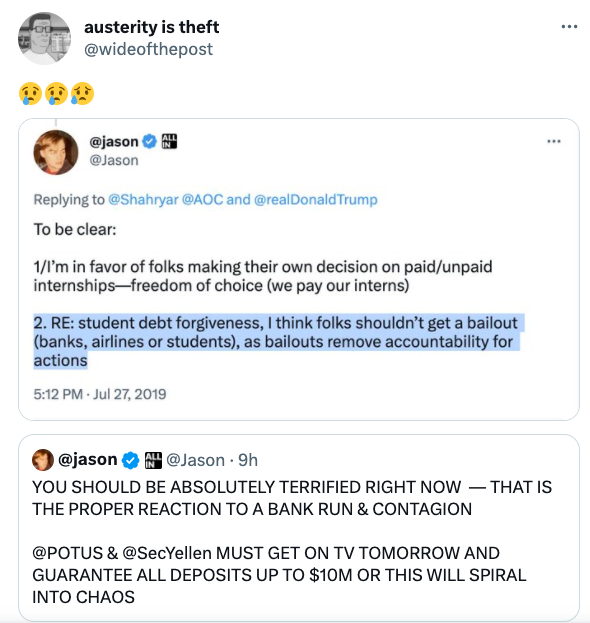
Being against student loan forgiveness or any sort of help to anyone, ever, but then running to mommy Yellen the second you get in trouble is just too hypocritical to believe.
If that's where you (philosophical you, not you personally) landed on those two issues, you can get fucked.
I think this is very much in question. Silicon Valley Bank was absolutely part of a cohesive microeconomy. There's no other explanation for the absolutely uniformity with which all those startups were using it for what should have been 100% commodity banking services. Those startups all banked with SVB because their VCs told them to.
And the VCs told their startups to bank with SVB because... we don't know yet. But any time you have a signal this strong, there's a driver.
Add to that the fact that the moment all those startups seemed likely to lose banking services, however temporarily, those same VCs freaked the fuck out of their minds on twitter and started shrieking in all caps about the end of western capitalism. That's not mere concern for their poor startups (most of whom were going to fail anyway, after all -- they're startups!). These VCs were exposed to the SVB failure. They were leveraged somehow and about to get caught holding the bag.
There was some kind of insider dealing going on with SVB. It wasn't just a bank. We for sure know that much. Whether we have criminal fraud or not is an open question.
Big wire in from a fundraising round? Account frozen. Big wire out for an acquisition? Account frozen. Bank learns your customers include cryptocurrency companies? Account frozen. Bank account balance huge relative to your business' cashflow? Account frozen. Random bank staff doesn't understand what you're doing? Account frozen.
In that kind of climate its almost inevitable that VC's would recommend a single bank known to not behave erratically for the activities that are usual for their investments.
In other words, SVB used these companies to produce new money that they could earn interest on.
SVB regularly provides credit to risky startups, which is why they existed in the first place (because other banks wouldn't lend at those rates). So, yes, they sorta did place risky bets on startups.
https://www.linkedin.com/posts/rich-falk-wallace_silicon-val...
#1: Mortgage backed securities: $82B (83% residential) #2: Direct loans: $74B (55% short term loans to VCs & PE) #3: Liquid assets: $55B
Mm hmm. Yes, after all is said and done, the main take away from this is that startup employees and founders no longer deserve credit for taking risks and doing something new. Glad our priorities are straight here on hackernews.
If you don't understand the basics of the US banking system then not sure you should be running a business.
Unless you are fully bootstrapped with no major cashflow issues, there are not right answers to this.
The burden is not on small businesses. Most small businesses don't just have well over a quarter million dollars in cash just lying around collecting dust. And the few that do can open an account at second bank. It's not rocket surgery.
Beyond that, if they have the kind of cash flow where they need millions in cash sitting around, they should hire a finance professional. For many, many reasons, bank failure risk being a very small part of it.
Then the CEOs/business owners going that way should fully ascertain and support the associated risks.
1. silly reason
2. It's a joke
It looks like you just found your silly reason.
The greed of startups have evolved to become bigger and bigger as years pass by.
The romanticizing of startups came from propaganda. It's just that some of us were too young and naive to understand the puppetmaster while others had seen the puppeteer before...
VCs Group-B to Z were too late so they asked Govt to help them.
It's not just founders who put their money there, VC funds are there as well and they are probably close to 100% uninsured (cause it's the Fund Series I - XXX).
If you get your hands on the list of depositors, you'll see the list of Funds Series from VCs.
(At least, that’s as I understand it from the VCs that I know it)
- the crisis was at the most caused and at the least exacerbated to the point of no return by the advice that some firms gave
- the general zeitgeist amongst certain firms and from particular individuals in firms leaned towards libertarian ideology, which seemed to go out the window when ish hit the fan. I can really only find one prominent example of this, so I don’t know if it’s fair to paint all of VC-land with the same brush
- it is probably the case that there are members of firms in both group one and group two, which looks bad, because panicking at the last second looks bad, especially when your panic screws (for your own benefit) a business partner of decades who was essentially only in a risk zone because they chose to do business with you. That’s an oversimplification of course, but it all is
No bank could survive this kind of run. See https://en.wikipedia.org/wiki/Bank_run
It seems like SVB took a risk and lost.
If the majority of Americans voted for SVB taking higher risks it would be understandable but now who comes up with the missing money ? The government, which is tax payers who are already probably getting the raw end of the stick financially compare to silicon valleys.
I think this bailout will see a lot of political backlash.
I won't reshare anecdotes here, but I heard stories over the weekend about intense and direct conversations between the largest VCs and the Fed.
How did they behave? Try to pull their money out of a failing bank?
I would too ...
All because he wanted the government to bail out his startups.
The idea that regional banks were going to collapse en masse because of the actions of one ineptly managed, highly unusual (in terms of customer and deposit mix) bank is ridiculous.
And trying to deliberately create a scare campaign so you can put political pressure on the FDIC to cover uninsured amounts is insidious and frankly evil.
I don't think ETFs are a good sign. One of my favorite bank ETFs, PGF is only down 6% on sentiment which isn't much.
And guess what, the FDIC and the administration actually do believe there was a clear risk of regional banks going under. That's literally the topic of the article you're commenting under.
I feel this solution is too strong handed and I don't think the world would have ended if there wasn't a solution tomorrow and a hundred startups would have to take a 20-30% haircut on their raised funds by selling their claims, so I don't agree with Jason, but calling him evil for his standpoint and voicing it is what's ridiculous.
Everyone would want their money back ...
If the 18th-largest bank in the country were to be allowed to collapse, with depositors losing money, why would any non-insane depositor keep their money in the 17th, or the 19th largest bank?
You could follow this line of reasoning to conclude that the only safe place to deposit your money would be a too-big-to-fail bank. And nobody wants to see that.
https://twitter.com/Jason/status/1561902763478396930 https://twitter.com/Jason/status/1561899007256866816
But sure, these guys are so concerned with the posibility of ordinary people getting hurt.
These depositors knew that and still acted irresponsibly, yet they are going to be made whole. It’s not that much different from taking out a loan you don’t understand.
So meat is back on the menu. No need for Ramen gents.
There’s clearly some political motivation for many, but it looks like it’s coming deeper psychological issues. Whatever the reasons, the forum is full of people who have very little understanding of or experience with startups or venture capital but deep hatred for them and even deeper, misinformed beliefs about them.
I’d estimate somewhere between a third and half the comments on the giant post yesterday violated the site guidelines.
> Be kind. Don't be snarky. Converse curiously; don't cross-examine. Edit out swipes.
> Please don't fulminate. Please don't sneer, including at the rest of the community.
The comment you're replying to was my honest assessment of the situation, given the many dozens of comments hoping for people to lose their bank deposits and for their businesses (or those that employ them) to fail.
Why? It should be other way round. They worked hard to make sure that payrolls are met and jobs are secure, that is my most important expectation from my management and investors.
The stereotypical SV playbook is to enter a market, don't give a crap about the local regulation or laws, try to get big by using your cheap money to outstrip to competition and do rent-seeking when you are the largest.
Also, a lot of startups are solving non fundemental problems.
We should be spending all that engineering effort fixing things like climate change, food security for the global south and a way to deal with the aging population in the western world instead of thinking about algorithms to get more clicks on ads.
Also, there are many startups building stupid junk to capture a piece of the pie but also many startups working on real problems.
This whole comment is a reductive cliche at this point.
Please start a company to work on fixing climate change, food security, aging, etc.
I'm genuinely very curious. I've always considered them a bunch of smarmy opportunistic cutthroats, but that shift must be jarring right? Again I don't mean this negatively, genuinely interested in how it changes your understanding of the "startup era," pandemic, etc.
Why is that tech workers, many of whom easily have earned over a million dollars in salary over the past few years can't be told to "live within their means"?
Why is it that the same VCs that rallied against student debt relief think their poorly run bank should be bailed out?
I know why, this thread is chalk full of it. "We were smart, we were playing the game with the advantage we were told made us untouchable, we can't fathom gasp 'negative consequences' whatever those are".
I'm sick of it and thankful to see people seeing through this a bit more than usual. Downvoting isnt going to change a damn thing, click your hearts out and enjoy the dissonance. See ya in the next too-big-to-fail-as-a-result-of-unchecked-corporate-greed thread. lmao
The bank is not bailed out, it's out of business, its shareholders get nothing, and its execs just lost their jobs. The bank's customers got bailed out.
no offense this comment shows lack of even basic understanding of situation.
SVB collapse a zero impact on big tech workers earning $300k. this problem effect small business, maybe 50-75 employee who did not risk they money. they literally put in bank to do thing like pay employees and other bills.
start up employee is not earning $300k USD per year. start up hardly compete with big tech on any compensation. these people working hardest.. not rest and vest like big tech.
Now taxpayers are going to be footing the bill... It's a government-ordained transfer of wealth from good, honest taxpayers to whatever (possibly malicious) entities got that money.
It's theft. It's straight theft. Not even complicated. Theft is now legal depending on who you are.
There was no theft. The bank bought bonds that decreased in value rapidly due to rising interest rates. Pure mismanagement, but not theft.
They could have kept deposits as cash and watched the value erode like a dumb retail consumer has an option to do. But that’d look bad for bank investors.
So now the Fed and Treasury are responsible for negative yield on bad bets if that account crosses 100B. Cool. I only have about 100B to go before the US government cares about my negative position. 401K takes an L because interest rate rises and the SP500 being a stock buyback circus. That’s on me I guess.
Anyone saying well it’s not using taxpayer dollars. Whatever, it is using our feds time. This whole thing is now J Powell and Yellen focusing on a cottage industry serving billionaire interests instead of using their time and agency to work for that dumb aforementioned retail consumer undergoing inflation and a pending recession.
In an agency where any intervention sets a precedent this is now telling regional banks to go ahead and yolo your balance sheet. We got you.
I want the startups to get their money through liquidation of the bank at whatever discount that comes to. 80c on the dollar, whatever it isn’t your money anyway it’s VC money. All savings accounts come with 250k FDIC insured. So play by those rules.
Carried interest needs to be next
It's taking money from citizens who had nothing at all to do with SVB to people who were doing business with it and may in fact have benefited from it.
This may have been the most prudent decision by the government, though it'll be hard to say what would've happened otherwise. But in the end, it sounds like the average person will still be negatively affected, by having small accounts under the $250k limit subsidize insurance for larger accounts.
I want to hear those reasons from others, not from a bunch of rich people who would be personally profiting at the ordinary person's expense.
* If the bank collapses then many startups shut down. This is bad, but okay, maybe you think startups are net negative. In addition to that thousands of people will lose jobs — please explain how this is a good thing. Plus there's a potential for ripple effects from people not trusting banks anymore.
* You say it's a bunch of rich people profiting. Who are these rich people you're talking about? Bank management? They went to zero overnight. Shareholders? zero. Who's left? Garry Tan? He has the same incentives as millions of Americans whose retirement savings are parked in VC funds.
I want to say I'm one of those people who's not personally profiting from this, but I acknowledge that's not true — the economy is connected and stable economy is good for everyone and we should celebrate people who push for it.
No, the equity gets wiped out, and if it's a good idea/good business it persists and gets funding elsewhere.
"You say it's a bunch of rich people profiting. Who are these rich people you're talking about? Bank management? They went to zero overnight. Shareholders? zero. Who's left? Garry Tan? He has the same incentives as millions of Americans whose retirement savings are parked in VC funds."
The VCs and other equity holders of the SVB depositors. Financial markets work: they could have sold their uninsured deposits at a discount, made payroll, with equity eating the loss.
Let's say my house gets burglarized. Everyone agrees this is a bad thing and unfair to me. However, my insurance only covers $2k, and I lost $20k of stuff. Can I expect the government to "backstop" me?
It's bad that the bank got shut down and depositors might have lost some of their money, but it's not fair to expect the government (and the average person indirectly) to reimburse for this, particularly when that's not how the FDIC policy is written.
Garry Tan and all the people I listed have a lot of their value in YC and startups which have direct losses and direct benefit from getting reimbursed for losses. If it weren't for reimbursement, the effective valuation of the startups would go down, and they'd have to invest more money to keep them afloat. So he has much stronger incentives than ordinary Americans.
The stable economy might be good for everyone, but I certainly will not celebrate rich people that push for their own wealth.
That's why the US government steps in for one case and not the other.
There is also precident for the government to pay damages above insurance limits after natural disasters, which from the depositor's point of view this basically is.
You buy favorable rates on loans with the increased risk of putting more than the insured amount into the account.
When your house gets damaged in a flood and you've selected to insure it for $250k because that's cheaper, and you've knowingly built it in a floodplain, is the government still going to cover 100% of the cost of building it?
Why is that odd or bad? I don't see people in here discussing issues about Syria or Congo. I saw dozens of threads about Trump and relatively none about Bolsonaaro. Why are you discussing about Fed and Biden and not thinking of economy of Pakistan? People will be more vocal and active about issues in their proximity.
However, the fundamental problem here is that SVB lost $X billion dollars of depositors' money, and Garry et al. wanted the government i.e. taxpayers to pay for those billions instead of the depositors, hurting us for the benefit of him and his community.
This is ordinary human nature and I don't care about Peter Thiel doing that because everyone already knows he's selfish, but some others want to act like they're selfless and be celebrated for it, and I don't accept that hypocrisy. Rich people should be assumed selfish until very strongly proven otherwise.
If you want to reap the benefits of capitalism, you should also get punishment for not doing the job well. Getting a haircut above the insured amount was the sensible thing here.
I.e. you have a bank run on every bank under the largest 10.
>There are just under 5,000 banks in America ... the right answer for the number of banks to fail in a year is greater than zero. If you have no bank failing, then you probably have bigger problems in the economy. Look, the first time in American history you went a year without a bank failure was 2005. 2006 was the second year and the regulators told us at the time, that they'd won, that this was great regulation, see, no one was failing, the system couldn't be safer. Kablooey.
Rest of your comment, I mostly agree with though.
But by default, I assume everyone, rich or poor, acts in a selfish manner. They'll help others only when it helps themselves, often by taking an insignificant financial hit for a substantial reputational bonus. Many rich people like the ones I listed try to act like their overall goal is to help others, but their actions seem to always align with furthering their own interests. If Mark Cuban did something that did substantial damage to his own overall value (financially or reputationally) in order to help someone unrelated, I'd be pleasantly surprised to hear it.
Note: cutting a check is easy. What’s hard, is to give someone non-monetary help. Because it means you have to actually be involved if it’s non-monetary. This was that type of help he gave.
It's not like rich people need to care about what I think, but I just argue that people should avoid glorifying them and believing claims that they want to help the world, as I've seen too many times that they are only interested in helping themselves. And the things I've seen Mark Cuban push for on Twitter are often pretty awful.
it’s the fact that the lender most willing to work with non traditional borrowers eg tech startups is now gone, and there’s no bank or lender that will replace them. if anything this will mean lending standards will tighten, and it will be very difficult for any customer with a SVB credit line to find another bank willing to lend to them on the same terms.
this is also coming at a time when more startups relied on debt to fund their companies because the equity raising environment is so tough, so now many founders might be forced to attempt to raise equity in a tech bear market on very bad terms if they can at all
Which, as an investee, is exactly what I want.
You have some serious disillusion.
What on earth. Putting money money in the bank was never a risk founders were lauded for, nor should it be on the titanic list of things they have to worry about.
We can brawl in the peanut gallery over FDIC limits and precedents and moral hazard (which lies with the banks, btw) but at the end of the day there can only be one “best country to start a startup” and whatever that is, it’s definitionally one where you don’t have to worry about getting rugged by the bank because someone you wouldn’t know from Adam made a bad bond trade.
The final decision was eminently reasonable.
The bank's shareholders are getting wiped out. The depositors are protected. Banks -- who depend on the continued faith of the public -- chip in a little more in insurance. The taxpayer pays nothing.
A bunch of software companies get to succeed or fail now on the basis of whether their business models and execution make any sense, as opposed to whether their bank bought enough interest-rate swaps.
Small regional banks can continue to exist. This will not necessitate even more consolidation in American capitalism. And there will be no follow-on bank runs to jeopardize grandma's CDs.
Seriously, what is there to complain about? The government did its job here. It governed. Fairly and competently.
Money to cover deposits that didn't previously didn't exist, suddenly exists, and there are people like you trying to tell everyone else that everything is rosy and that it's not going to cost the taxpayers anything.
It sounds like a revolutionary system that you're working with and if it truly costs "nothing", may I ask where I can sign up to have my bad financial investments refunded for free?
"The taxpayer will pay for it" only in the sense that maybe member banks will try to pass this on in the form of fees.
"Bad financial investments" are almost 100% not being "refunded" to the bank shareholders. Their shares are, I assume, going to zero. The only way in which they are being protected -- the "almost" -- is in the fact that their shares go only to zero, and do not become liabilities.
Let us also consider what the investments were that went bad: Government bonds. So you could say that value flowed from the bank to "the taxpayer" (or to "the government") the minute those bonds lost value, i.e., the minute the Fed devalued them by hiking rates on newly-issued bonds. In that sense, the bank was already the bagholder for the Fed ("the taxpayer").
It's great at a personal level that "founders" and startup employees didn't have to do without. But it's important to remember that they no longer automatically deserve any credit for taking risks and doing something new. It might as well be a bunch of FAANG employees