News for hackers. Stuff that matters.
Re:Austin's Surge of New Housing Construction Drove Down Rents by estearum on Wednesday March 18, 2026 @10:21PM (#47434029)
New construction has already decelerated in Austin due to falling prices, which compresses already-near-zero margin on real estate development.

So yes, it really is "just build more housing." The problem is: why would you build more housing as prices fall?

Re:Austin's Surge of New Housing Construction Drove Down Rents by pinkmuffinere on Thursday March 19, 2026 @12:10AM (#47434844)
I'm confused by this objection, if you draw a stereotypical supply and demand curve, you can see how prices settle to an equilibrium point. Of course reality has more complications, but I think your objection is 95% answered by a supply and demand curve. You keep building houses when it is profitable. You stop when it is not. This naturally keeps everything in balance.
Re:Austin's Surge of New Housing Construction Drove Down Rents by idiotsecant on Thursday March 19, 2026 @12:33AM (#47434976)
What do you do when that equilibrium point is hopelessly above what the average person can afford?
Re:Austin's Surge of New Housing Construction Drove Down Rents by mchusma on Thursday March 19, 2026 @02:48AM (#47435784)
Not sure I buy the premise. Austin has a household $133k median income with a $435k median home price. It’s very affordable.

But, to make Austin more affordable still, you make it less expensive to build so that it’s profitable to build. Typical regulations that do this are: - Lower minimum sizing requirements - open zoning - raise height limits - make sure you don’t have unwarranted restricted fire codes (some places have elevator stairwell requirements that are insane) - make permitting easier or not required at all for some cases - no min parking requirements

Pretty sure as good as Austin is, they could easily reduce the costs by up to 30% (there are parts of the country with 50% the cost per sq ft for new construction).

Re:Austin's Surge of New Housing Construction Drove Down Rents by tirant on Thursday March 19, 2026 @01:26AM (#47435305)
That means there’s an invisible hand keeping prices up, or basically that the market is not free enough. That’s caused most of the time due to excessive regulation.

Another reason is high demand in locations where offer is limited due to physical limitations. There’s always demand to live in Broadway, and offer can never catch up due to its physical limitations.

Re:Austin's Surge of New Housing Construction Drove Down Rents by laserlight on Thursday March 19, 2026 @01:57AM (#47435481)
> That means there’s an invisible hand keeping prices up, or basically that the market is not free enough.

Nowhere in the economic theory there is a proposition stating that prices should fall below affordable levels, given enough competition.

Re:Austin's Surge of New Housing Construction Drove Down Rents by Sankozi on Thursday March 19, 2026 @03:16AM (#47435949)
We are not talking about economic theory. We are talking about house prices. Time after time it has been seen that free-enough market can lower the prices to affordable levels.
Re:Austin's Surge of New Housing Construction Drove Down Rents by laserlight on Thursday March 19, 2026 @03:30AM (#47436047)
Fair, but the thread has evolved into a discussion on the theory. We are definitely in the territory of theory when the invisible hand is mentioned.
Re:Austin's Surge of New Housing Construction Drove Down Rents by Sankozi on Thursday March 19, 2026 @04:59AM (#47436620)
I took "invisible hand" as a joke. The one with pattern : either (fairies/magic/invisible hand) or (sensible argument/observation here).
Re:Austin's Surge of New Housing Construction Drove Down Rents by sophrosyne42 on Thursday March 19, 2026 @03:29AM (#47436041)
The relative abundance of land compared to other factors of production is, in fact, such a proposition. But when land is restricted through zoning laws this stops holding true. In other words, we must eliminate restrictions on production for the benefit of all people, but particularly the poorest.
Re:Austin's Surge of New Housing Construction Drove Down Rents by FuriouslyAdrift on Thursday March 19, 2026 @02:05PM (#47443410)
I mean I would love to bulldoze that strip of forest next to Beverly Hills and put in a hog farm. It would provide tons of jobs.
Re:Austin's Surge of New Housing Construction Drove Down Rents by fc417fc802 on Thursday March 19, 2026 @02:50AM (#47435807)
We don't need economic theory for that it's just common sense. Humanity has been erecting structures to live in for approximately our entire existence. The modern economy is mechanized. How could a wood frame structure or a small high rise possibly be unaffordable if the market is functional?

Stop and think for a second. Someone in good health with a willingness to DIY and a sufficiently flexible schedule can literally build their own house from the ground up. It's a substantial time investment but not actually as much as you might think. Housing isn't very resource intensive compared to the rest of the modern economy.

The only possibilities I can imagine to explain unaffordable housing are broken regulations, critical levels of resource exhaustion, natural or man made disaster, and gross economic dysfunction.

Re:Austin's Surge of New Housing Construction Drove Down Rents by foxglacier on Thursday March 19, 2026 @03:13AM (#47435936)
It's regulations. But before you call them broken, some of it is safety. Safety standards keep rising with technology and the economy as people can afford more. Same with cars. There's also zoning restrictions in some places designed to prevent slums by requiring large residences. I guess that's happening here too.
Re:Austin's Surge of New Housing Construction Drove Down Rents by cylemons on Thursday March 19, 2026 @06:27AM (#47437151)
Also living standards, ancients houses are dead simple and today could probably be built with usd 5k-10k in a couple months. But most people wont accept a home with no electrity, no lights, no AC, no indoor plumming, etc.
Re:Austin's Surge of New Housing Construction Drove Down Rents by foxglacier on Friday March 20, 2026 @02:03PM (#47458309)
Yes that too. We're a bunch of spoiled brats complaining how much we have to work but it's only because lifestyle creep keeps pace with wealth.
Re:Austin's Surge of New Housing Construction Drove Down Rents by michaelmrose on Thursday March 19, 2026 @03:11AM (#47435919)
The average person would need a MASSIVE investment in time to learn all the skills required in addition to investment in tools. Furthermore people won't lend joe random the funds required in the same fashion as they would for an actual finished house OR constructing a house via a contractor.
Re:Austin's Surge of New Housing Construction Drove Down Rents by lumost on Thursday March 19, 2026 @02:56AM (#47435836)
The invisible Hand may be monetary policy. The median household may simply no longer be able to afford the median home due to the continued wealth distribution shift brought on by interest rate targeting.
Re:Austin's Surge of New Housing Construction Drove Down Rents by KellyCriterion on Thursday March 19, 2026 @01:51AM (#47435444)
This is theoretical MBA101 speech:

In reality, those ideas do not apply to the housing market, esp. as there is no real competition; and because the demand is absolutely inelastic (if we are already applying in MBA-wording universe)

Also, that this is true you can see if you compare to housing markets which "are more free than the Australian"

Re:Austin's Surge of New Housing Construction Drove Down Rents by jjmarr on Thursday March 19, 2026 @02:24AM (#47435649)
The regulation is single family zoning. Zoning makes it impossible to stack high rise apartment buildings in the areas that people want to live in.
Re:Austin's Surge of New Housing Construction Drove Down Rents by bpt3 on Thursday March 19, 2026 @07:25AM (#47437592)
People want to live in those areas because of the lower density. Remove that and they become much less desirable.
Re:Austin's Surge of New Housing Construction Drove Down Rents by Sankozi on Thursday March 19, 2026 @03:20AM (#47435969)
Of course demand is elastic.

Do you think, people will migrate to a city with an unaffordable housing (unaffordable for them)?

Unless you are living in North Korea, the competition is also there.

Re:Austin's Surge of New Housing Construction Drove Down Rents by KellyCriterion on Thursday March 19, 2026 @06:52AM (#47437341)
No, it is inelastic:

- inelastic means the demand is more or less independet of the price; you can't "just stop renting & living" if prices are going up, your options to bypass are highly limited -> therefore its called >inelastic<

Re:Austin's Surge of New Housing Construction Drove Down Rents by Sankozi on Thursday March 19, 2026 @07:56AM (#47437837)
You can "just stop renting" and move somewhere else.

Housing demand is less elastic than, let's say, potato demand, but it's not "absolutely inelastic" as you have said.

Re:Austin's Surge of New Housing Construction Drove Down Rents by AlexandrB on Thursday March 19, 2026 @08:20AM (#47438100)
Good transit and road infrastructure also both make demand more elastic because the choice of where you can live without changing jobs expands.
Re:Austin's Surge of New Housing Construction Drove Down Rents by KellyCriterion on Thursday March 19, 2026 @11:00AM (#47440646)
In MBA101-bobos world this is true in theroy, in practice its not. (let me guess: You do not have children, yet, right?)

Thats always the biggest difference:

In theory, there is no difference between practive and theory - but in practice, there is ;-)

Re:Austin's Surge of New Housing Construction Drove Down Rents by Sl1mb0 on Thursday March 19, 2026 @02:10AM (#47435565)
The good ol' invisible hand;

Literally an appeal to ignorance.

"What else could it be?"

Re:Austin's Surge of New Housing Construction Drove Down Rents by sophrosyne42 on Thursday March 19, 2026 @03:26AM (#47436018)
OP used the term incorrectly. The term was used by Smith to refer to the fact that in the market, order occurs by the alignment of incentives of different people without any central planner.
Re:Austin's Surge of New Housing Construction Drove Down Rents by locknitpicker on Thursday March 19, 2026 @01:39AM (#47435373)
> That means there’s an invisible hand keeping prices up, or basically that the market is not free enough. That’s caused most of the time due to excessive regulation.

No. Why do you guys fall so easily for the "regulation" cliche?

The answer is far easier: unwillingness to invest.

Why are there investment funds willing to burn through tens of millions in stupid stuff like NFTs or pets.com, but investing $10m on a 5 story apartment building that can get you a solid RoI of 20% is frowned upon?

Re:Austin's Surge of New Housing Construction Drove Down Rents by fc417fc802 on Thursday March 19, 2026 @02:52AM (#47435814)
The invisible hand is zoning. There's plenty of investment available but you literally aren't allowed to build what would be useful in most cases.

Sure you're free to go out into the middle of nowhere and build all sorts of wild stuff but there's no market for that because that isn't actually what anyone wants. You can't blame the investors when what people actually want to pay for has effectively been outlawed.

Re:Austin's Surge of New Housing Construction Drove Down Rents by otherme123 on Thursday March 19, 2026 @02:24AM (#47435651)
Why the investment funds have to build the houses? Houses has been built/funded from zero by the future owners since forever, either individually or through cooperatives. That way, "investors" don't need a positive ROI, and they happily lose money overall if they get a home.

I know some people that are currently "willing to invest" in buying a ship container or two and transform it into a house to get costs down. The problem? Regulations don't allow them to put the container in their own property.

Re:Austin's Surge of New Housing Construction Drove Down Rents by Dylan16807 on Thursday March 19, 2026 @03:13AM (#47435931)
Using a shipping container is almost always a stupid plan compared to just putting up some wood. As much as I want to make zoning more flexible, I'm not in a rush to change that particular regulation.
Re:Austin's Surge of New Housing Construction Drove Down Rents by otherme123 on Friday March 20, 2026 @04:10AM (#47451814)
Sounds arrogant to block someone else plan to have a home, just because you don't like it. And then claim regulations are not the problem, but lack of willing to invest.

If you think containers are a bad idea, don't buy one.

Re:Austin's Surge of New Housing Construction Drove Down Rents by Dylan16807 on Sunday March 22, 2026 @07:33AM (#47476443)
The demand for containers is rare and they don't really save money over building small out of reasonable materials. That specific regulation isn't blocking anyone from having a home.
Re:Austin's Surge of New Housing Construction Drove Down Rents by jjav on Thursday March 19, 2026 @04:34AM (#47436465)
> That means there’s an invisible hand keeping prices up

Construction labor is quite expensive and so are the raw materials (and going up). Means there is a hard lower bound on cost and unfortunately it's not that cheap even if they built at zero profit (which nobody will).

Re:Austin's Surge of New Housing Construction Drove Down Rents by pinkmuffinere on Thursday March 19, 2026 @12:43AM (#47435040)
there are many things you can do, but essentially you want to make it profitable for builders to make houses at a lower price point, or give the average person more money. Some approaches (not all of which I'm endorsing):

- reduce restrictions around planning / construction / etc (because it takes time and expertise to comply, both of which cost money)

- find a way to bring in cheaper labor, or make it possible for construction companies to hire the same labor at a lower price. Maybe a subsidy, maybe reduced taxes, maybe relaxed labor laws

- add a subsidy for homes

- make your citizens more wealthy, so the price is no longer above their means

- outsource construction to a place that can build it more cheaply (eg, prefab homes)

Re:Austin's Surge of New Housing Construction Drove Down Rents by locknitpicker on Thursday March 19, 2026 @01:42AM (#47435394)
> - find a way to bring in cheaper labor, or make it possible for construction companies to hire the same labor at a lower price. Maybe a subsidy, maybe reduced taxes, maybe relaxed labor laws

It's far easier than that: just have your regional/local government finance urban renewal projects that increase occupation density. You can even tie the project to the expansion of a public transportation system.

Re:Austin's Surge of New Housing Construction Drove Down Rents by wiradikusuma on Thursday March 19, 2026 @12:39AM (#47435016)
Won't the market fill the gap? For example, in Indonesia, "standard size" houses are mostly out of reach for new buyers (young generations), so they build houses farther away and/or smaller.
Re:Austin's Surge of New Housing Construction Drove Down Rents by CalRobert on Thursday March 19, 2026 @01:40AM (#47435380)
Remove parking minimums and work to address inequality? If that the case in Austin though?
Re:Austin's Surge of New Housing Construction Drove Down Rents by dnautics on Thursday March 19, 2026 @09:41AM (#47439272)
it isn't
Re:Austin's Surge of New Housing Construction Drove Down Rents by inglor_cz on Thursday March 19, 2026 @03:42AM (#47436123)
Where does this happen, in presence of a reasonably free market?

I can only think of extremely land-limited places like Monaco and Gibraltar. Where the answer is "not everybody should live in Gibraltar".

But the US has a lot of land. So much land that it can afford wasting it on endless sprawl of single family homes, which is the least efficient way of providing housing. Most Asian megacities would not be able to exist if they had as strict zoning principles as the US has.

Maybe you should also think about barriers such as "bans on boarding houses". This is what messes with poor people the most. A room in a house full of rowdy individuals sucks, but it is still a room. Possibly you may spend just a year there, then find something better. A tent in an encampment of rowdy individuals is strictly worse on all accounts except cost, and bouncing back from that is harder.

Re:Austin's Surge of New Housing Construction Drove Down Rents by throwaway27448 on Thursday March 19, 2026 @12:53AM (#47435105)
Sure, so long as the balance involves not housing people which is pretty sick and twisted
Re:Austin's Surge of New Housing Construction Drove Down Rents by pinkmuffinere on Thursday March 19, 2026 @01:04AM (#47435176)
I never claimed the balance will occur at a point that I like. This is just math, it’s not a political stance. If you want more homes, go build homes.
Re:Austin's Surge of New Housing Construction Drove Down Rents by estearum on Thursday March 19, 2026 @06:44AM (#47437283)
Then your point is meaningless. I (GP) was also pointing out the same equilibrium mechanic. The specific point I was making is that all evidence points to the equilibrium (in the US and elsewhere) being at a point that does not make housing easily attainable, and so becomes a political liability.

"Go build homes [beyond equilibrium]" is not a solution

Re:Austin's Surge of New Housing Construction Drove Down Rents by rayiner on Thursday March 19, 2026 @01:00AM (#47435154)
I don’t understand your sentence. What’s the subject of the verb “housing.”
Re:Austin's Surge of New Housing Construction Drove Down Rents by pinkmuffinere on Thursday March 19, 2026 @03:19AM (#47435966)
I think the subject is perhaps an implied "you", "us", or "society". Here's how I read it:

Sure, so long as involves (you / us / society) not housing people which is pretty sick and twisted

Re:Austin's Surge of New Housing Construction Drove Down Rents by mwilliaams on Thursday March 19, 2026 @01:15AM (#47435248)
The subject is “people”. Parent is suggesting that the equilibrium point of housing supply and demand naturally leaves some people unhoused.
Re:Austin's Surge of New Housing Construction Drove Down Rents by Retric on Thursday March 19, 2026 @01:33AM (#47435341)
Which isn’t quite accurate as for example people prefer to move out of their parent’s homes while young adults but aren’t necessarily homeless if they don’t.

Basic housing is a necessity, but people also huge homes and 2nd homes etc. So housing policy should therefore be more complicated than simply subsidizing anything you can call housing. Capping the home mortgage tax deduction at ~median home prices for example is probably a better use of government funds.

Re:Austin's Surge of New Housing Construction Drove Down Rents by ekkeke on Thursday March 19, 2026 @01:32AM (#47435337)
That is the object of the sentence. He is asking who the subject is, in other words the thing or person that is doing the housing of the people. Is it the government? Is it you? I'm currently responsible for housing myself, which is annoying so I would prefer someone else take on this responsibility.
Re:Austin's Surge of New Housing Construction Drove Down Rents by michaelmrose on Thursday March 19, 2026 @03:09AM (#47435909)
If a minority has most of the wealth then the equilibrium supply may include a lot of supply of second homes, very large homes on large plots for the rich, properties sold at a premium based on how much they can extract from renters, and even investment properties occupied by nobody whilst still having insufficient small basic homes and dense housing.

Capital that could be invested in better serving the bottom half has to compete not only with the use of those resources to further enrich the rich but other investment opportunities.

Re:Austin's Surge of New Housing Construction Drove Down Rents by roenxi on Thursday March 19, 2026 @04:18AM (#47436364)
There's a couple of "ifs" there and the scenario seems implausible. If I look at the prime real estate in a city it tends to be a lot of skyscrapers rather than very large homes (with occasional exceptions like say a Buckingham Palace). But it looks like the economic equilibrium is lots of cheaper apartments rather than large homes for rich people.

> ... and even investment properties occupied by nobody ...

Not much of an investment. Something is wrong if that is happening, probably manifesting as a lack of supply. Otherwise what is the point of an "asset" that doesn't generate income, degrades over time and could easily be rented out at a profit rather than sitting unused?

Whatever scenario there is where it makes sense to have an empty property, assuming a sane policy backdrop, it'd always be better for the owner do what they were going to do anyway but also rent it out.

Re:Austin's Surge of New Housing Construction Drove Down Rents by zozbot234 on Thursday March 19, 2026 @04:30AM (#47436438)
People don't want to rent those homes out because once you're doing so it's difficult to evict a long-term tenant. You just lose out a lot on flexibility - even if you try and manage that risk by leasing out housing e.g. on a yearly basis, landlord-tenant law often overrides that since there are strong ethical reasons for not evicting someone who has since come to treat that rental space as their home.

Short term rentals are better on that score: no one sensible forms a long-term expectation that they're going to live in an Airbnb that they've rented for a few days. (If you think short-term rentals are "bad" for the long-term market or have negative side-effects on the neighborhood, then tax them to manage that tradeoff. But banning them altogether is unconscionable and just leads to houses sitting empty and unused.)

Re:Austin's Surge of New Housing Construction Drove Down Rents by graemep on Thursday March 19, 2026 @07:30AM (#47437631)
There are some places in the UK (mostly new developments in London) that have a significant number of deliberately empty investment properties despite the law here making it easy to evict tenants. They are not being used for short term rentals either.

Although the easiest route (no-fault eviction) is being abolished soon, wanting to sell a property remains a valid reason to evict.

Some people just buy property as a speculative investment.

I do not think it is the main cause of shortages in London - that is people buying holiday homes, which are often large and centrally located. London provides a lot (restaurants, nightclubs, gambling, prostitution, financial services...) that attracts people with a lot of money to spend from all over the world.

Re:Austin's Surge of New Housing Construction Drove Down Rents by zozbot234 on Thursday March 19, 2026 @07:46AM (#47437763)
> despite the law here making it easy to evict tenants

"Easy" is relative. "Evicting" an airbnb'er once the term is up will always be orders of magnitude easier than kicking out a long-term tenant who regards that as their actual home. There's not even anything necessarily wrong with this! The easiest way to address the issue is literally to slash any remaining red-tape that's making things difficult for those who would want to AirBnb these properties out, while managing the resulting side-effects (including the plausible effect on the long-term rentals market) by levying a special fee if necessary.

As a bonus, easy AirBnb rental provides an alternative for some who might otherwise want a permanent holiday home.

Re:Austin's Surge of New Housing Construction Drove Down Rents by michaelmrose on Thursday March 19, 2026 @01:11PM (#47442637)
If we don't have an excess of housing why should we allow ANYONE even one single property to serve as an unlicensed hotel. If we tax un-lived in property extremely punitively nobody will hold them at all and it should soon be sold or rented out.
Re:Austin's Surge of New Housing Construction Drove Down Rents by zozbot234 on Thursday March 19, 2026 @01:18PM (#47442728)
I'm fine with taxing both long-term vacant properties and AirBnb at fairly high rates, since both have negative effects on the surrounding neighborhood - the latter to a markedly less extent than the former, of course.
Re:Austin's Surge of New Housing Construction Drove Down Rents by michaelmrose on Thursday March 19, 2026 @01:08PM (#47442606)
The purpose of housing is not to provide an investment vehicle nor should we optimize for this. Airbnb should just regulated out of existence in most urban markets because we are chronically low on housing and the city doesn't need short term rentals at all.
Re:Austin's Surge of New Housing Construction Drove Down Rents by zozbot234 on Thursday March 19, 2026 @01:13PM (#47442653)
The purpose of most real estate is to provide shelter for people, not to sit empty and unused. That's exactly what AirBnb allows to those who are only willing to rent short term (because it's their vacation home and they want to be able to use it).
Re:Austin's Surge of New Housing Construction Drove Down Rents by FuriouslyAdrift on Thursday March 19, 2026 @02:02PM (#47443366)
You are referring to properties held by the already rich (only the rich can afford 'vacation homes').

If they can't afford a 'vacation home' without short term rentals then it should be sold and provide housing year-round and build equity for a new homeowner.

Re:Austin's Surge of New Housing Construction Drove Down Rents by michaelmrose on Thursday March 19, 2026 @05:07PM (#47446109)
Housing someone provides a fundamentally different kind of value than offering a second home or short-term stay. A home meets an essential social need, while vacation homes and similar uses provide far less public benefit. On that scale, the social value of housing a person is vastly greater than the value of adding another short-term rental bed.

That does not mean hotels would stop being built, because developers and hotel operators are optimizing for a different kind of value. But it is more than enough reason to oppose turning even a single home into a de facto short-term hotel.

The reality is not simply that people are monetizing unused space. The ability to rent homes short term encourages people to buy more second homes than they otherwise would, because the income offsets the cost. It also encourages investment in housing that would otherwise remain in the long-term market, since owners know unused time can be monetized. Some buyers purchase properties specifically to operate them as Airbnbs, and many landlords convert homes that once served monthly or yearly tenants into short-term rentals because they can charge more, adjust rates freely, and often earn more overall.

Re:Austin's Surge of New Housing Construction Drove Down Rents by sophrosyne42 on Thursday March 19, 2026 @03:25AM (#47435995)
There is more than enough land for everyone, and rich people aren't really competing for the kind of housing that poor people are competing for, e.g. smaller plots with smaller homes. The demand of the rich does not eliminate demand of the poor, so the market produces different kinds of housing for different clientele.

Think about it this way: assume you supply all the housing to all the rich people. Then there still remains untapped demand of others that can be fulfilled by further production of homes for those specific people.

This story fails when land becomes restricted, which is exactly what zoning laws cause. Zoning is a big harm to the poor.

Re:Austin's Surge of New Housing Construction Drove Down Rents by baq on Thursday March 19, 2026 @04:04AM (#47436278)
But zoning is required to maintain order. Nobody wants anybody to live in favelas.

As with everything the regulator needs to strike a balance to make the market work.

Re:Austin's Surge of New Housing Construction Drove Down Rents by btilly on Thursday March 19, 2026 @04:27AM (#47436433)
Given the choice between being homeless and living in favelas, millions in Brazil have chosen to live in favelas.

The reality of zoning laws in Western countries is to provide a target for regulatory capture by the NIMBY crowd. With the result that we're systemically underbuilding housing, then wonder why we wound up with homelessness.

Re:Austin's Surge of New Housing Construction Drove Down Rents by baq on Thursday March 19, 2026 @06:31AM (#47437184)
Favelas are a local optimum which systemically is very difficult to get out of and is a sign that the regulator is powerless. It's a great example of a market failure.
Re:Austin's Surge of New Housing Construction Drove Down Rents by michaelmrose on Thursday March 19, 2026 @04:27AM (#47436434)
Rich and poor alike are competing for scarce land near where people actually live and work.
Re:Austin's Surge of New Housing Construction Drove Down Rents by tsimionescu on Thursday March 19, 2026 @06:32AM (#47437188)
> rich people aren't really competing for the kind of housing that poor people are competing for, e.g. smaller plots with smaller homes.

This disregards basic geometry. Sure, in some rare situations you only have one small plot of land surrounded by existing construction or natural boundaries. But, in the majority of cases, you have one large plot of land, and you can either construct one big house on it, 5 smaller houses, 10 small houses, or 200 apartments in a block. The rich are absolutely competing for this lot with the poor.

And as inequality goes up, the rich can even start contemplating buying up surrounding properties, tearing down construction, and transforming a small plot into a much larger one.

Re:Austin's Surge of New Housing Construction Drove Down Rents by zozbot234 on Thursday March 19, 2026 @03:24AM (#47435990)
If you want second homes to be used productively, just allow folks to list them on AirBnb for planned short-term rental. Long-term rentals are a total non-starter politically for second homes, since you obviously can't ethically throw out someone who regards that rental space as their home. But short-term is actually fine.

As for larger homes, people should be allowed to live in there as larger, extended family groups - a common pattern in non-Anglo cultures. Ban "single family" restrictions since they amount to unconscionable discrimination against such reasonable living arrangements.

Re:Austin's Surge of New Housing Construction Drove Down Rents by unethical_ban on Thursday March 19, 2026 @04:22AM (#47436398)
Some would say that housing is a right (while acknowledging the need for housing construction and its workers and supplies to be paid for) and that it should be funded somehow, even if the free marker profit becomes negative during certain periods. Like any market manipulation, the question then would be how to intervene to keep housing construction going when construction isn't profitable, while not fomenting corruption in the industry.
Re:Austin's Surge of New Housing Construction Drove Down Rents by scoofy on Thursday March 19, 2026 @04:52AM (#47436586)
Housing where? Is housing for me in Malibu a human right? There's plenty of places to live in Texas for basically nothing.

I'm honestly trying to take this seriously, but I really can't square the problem of location and utility. On of the reasons why West Virginia has such a low homeless rate is just that mobile homes and manufactured housing is pretty much legal in many areas around the state. One of the reasons why California is so expensive is that those types of inexpensive housing options are effectively illegal statewide.

Re:Austin's Surge of New Housing Construction Drove Down Rents by watwut on Thursday March 19, 2026 @05:22AM (#47436774)
> There's plenty of places to live in Texas for basically nothing.

What are the employment options there? If I move to a cheap house somewhere where there are no jobs for me, I just moved somewhere where I cant afford.

Re:Austin's Surge of New Housing Construction Drove Down Rents by scoofy on Thursday March 19, 2026 @05:36AM (#47436862)
>If I move to a cheap house somewhere

Again, I'm not trying to be difficult here, but "where" is "somewhere." There are jobs in Austin, San Antonio, Kerrville, Marfa, and El Paso. They might not all be for me, but they exist in all these places. Where you live and what your commute is, again, is not exactly something that's particularly trivial to define. At what point should I start looking in San Antonio rather than Austin?

These are hard questions. This is what I mean when I ask whether I have a right to housing in Malibu? At what point should I be expected to just move to East LA?

At the end of the day, housing in Austin is relatively inexpensive. There are real options below $300K. Living in SF, it's pretty astounding that that's even possible within the city limits, much less at reasonable commuting distances.

I certainly think incentivizing subsidized low income housing is worthwhile, and I think even incentivizing builders to just target the low income price points is also worthwhile. I just think that focusing on subsidizing the lowest income folks, rather than letting markets actually work for most people has been shown to trivially fail in CA where I live at actually accomplishing anything. A lot of "ugly" 5-over-1's have been built in Austin, and it's working to keep the place affordable for working class people. I'm absolutely fine with that.

Re:Austin's Surge of New Housing Construction Drove Down Rents by miyoji on Thursday March 19, 2026 @01:07PM (#47442585)
> At the end of the day, housing in Austin is relatively inexpensive. There are real options below $300K.

This is so insanely out of touch. Most people will never be able to afford a house over $200k, even in Austin. I live here, you apparently live in California. As a resident, let me tell you that Austin is not affordable, and definitely not "inexpensive". Housing here is relatively inexpensive compared to the most expensive metros in the world, it's not relatively inexpensive compared to the US housing market, or more relevantly, the Texas housing market. This isn't the Bay Area, it's the middle of Texas.

> A lot of "ugly" 5-over-1's have been built in Austin, and it's working to keep the place affordable for working class people.

Austin isn't affordable for working class people and it hasn't been for a long time, so no, those new constructions aren't keeping it affordable, they've just stopped the insane rent increases that were coming every year for more than a decade. A living wage in Austin for a single person is $100,000, for a family it's $200,000, and that is well above the median household income of ~$90,000. Working class people are well below the median and aren't making $90,000 per year. These numbers are from an article in our local newspaper from this week. [0]

[0] https://www.statesman.com/news/local/article/austin-cost-of-...

Re:Austin's Surge of New Housing Construction Drove Down Rents by scoofy on Thursday March 19, 2026 @02:55PM (#47444142)
I literally grew up in Austin. I understand the Austin housing market. I understand is not cheap. That doesn’t mean it’s not affordable.

According to your article:

> Based on those costs, MIT estimates the living wage for a family of four in the Austin metro area is $112,866 a year, or $49,322 for an individual.

That’s well below median household income.

> The organization created a “Household Survival Budget,” which includes housing, child care, food, transportation, health care, technology, taxes and miscellaneous expenses. According to the group’s estimates, the living wage for a family of four in Travis County is $102,096 with two kids in child care and $85,356 with no kids in child care. For a single adult, the survival budget is $39,924.

Again. When we are talking about the housing crisis in the Bay Area, we are talking about small condos costing $1M. Just forget having anything be closer to median income affordable for a family of four. In Austin that’s still possible. It’s not Milwaukee, but it’s a functioning housing market.

Re:Austin's Surge of New Housing Construction Drove Down Rents by zozbot234 on Thursday March 19, 2026 @05:23AM (#47436782)
You can always work full remote. Or maybe you're an elderly retiree.
Re:Austin's Surge of New Housing Construction Drove Down Rents by TimPC on Thursday March 19, 2026 @08:44AM (#47438416)
Elderly retirees seldom move. They’ve long paid off their mortgage and we keep property taxes extremely low so they are pretty much immune to the cost of housing. Once you put down roots in a community it’s hard to leave.
Re:Austin's Surge of New Housing Construction Drove Down Rents by angmarsbane on Thursday March 19, 2026 @03:58PM (#47445011)
They also usually don't want to leave their established doctors. This is actually one of the reasons why we need mixed-housing options within neighborhoods so that elderly people can downsize into more manageable one and two bedroom apartments, condos, or duplexes etc without having to leave the neighborhood. Downsize into housing stock without stairs, without a large yard to upkeep, downsize into something smaller that would be more affordable to adapt for someone aging in place.
Re:Austin's Surge of New Housing Construction Drove Down Rents by vel0city on Thursday March 19, 2026 @10:18AM (#47439944)
> Texas led the nation in job creation in 2025, adding more nonfarm jobs than any other state and setting multiple employment records

https://www.wfaa.com/article/money/business/everything-bigge...

As someone who has lived here for a long while, it seems like there are lots of jobs in a lot of industries here. We're not all oil riggers and cowboys.

Re:Austin's Surge of New Housing Construction Drove Down Rents by FuriouslyAdrift on Thursday March 19, 2026 @01:40PM (#47443055)
Yeah seriously... when I was dirt poor and hurting, I moved to Shreveport and was able to get by on minimum wage. There's plenty of places in the Deep South where one may live a decent life for moderate wages. Not everyone gets to live the life of Riley.
Re:Austin's Surge of New Housing Construction Drove Down Rents by kakacik on Thursday March 19, 2026 @04:39AM (#47436496)
... but your own housing isn't any form of basic human right, its a luxury all around the world and always has been. Now I completely understand folks who come out of uni and see the salaries (sans faangs and generally devs and few other lucky positions), the prices and the emotions of missing out come easily.

But it isn't a right, just because you would like it. Same as I don't have a right to a car at price I would like, just because I live, by my choice, in rural environment close to nature. I desperately need one though for work commute, shopping, taking kids to school etc so thats as non-optional as accommodation to existence of my family. I can either suck up car's actual prices, move whole family so I don't need it or do similar choices in life to tackle that.

But car ain't a right. Same as your own accommodation, of course not a modest small apartment but a house, ideally close to work, amenities, schools, and costing peanuts. Literally what everyone else wants. Or am I incorrect in your expectations? Because if yes, its easy to accept cheap remote small old properties, those aren't expensive for above-average earners at all, anywhere.

Re:Austin's Surge of New Housing Construction Drove Down Rents by RobotToaster on Thursday March 19, 2026 @07:24AM (#47437587)
> its a luxury all around the world

China has a 96% homeownership rate.

Kazakhstan 98%

Laos, Romania, and Albania 95%

Slovakia 93%

Russia 92%

Re:Austin's Surge of New Housing Construction Drove Down Rents by bo0tzz on Thursday March 19, 2026 @05:24AM (#47436790)
The Universal Declaration of Human Rights, Article 25.1:

> Everyone has the right to a standard of living adequate for the health and well-being of himself and of his family, including food, clothing, housing and medical care and necessary social services, and the right to security in the event of unemployment, sickness, disability, widowhood, old age or other lack of livelihood in circumstances beyond his control.

Re:Austin's Surge of New Housing Construction Drove Down Rents by bpt3 on Thursday March 19, 2026 @06:51AM (#47437336)
So if I declare a right to immortality, then no one dies?

It's almost like those words are the product of useless bureaucrats, rather than an actual right.

Re:Austin's Surge of New Housing Construction Drove Down Rents by unethical_ban on Thursday March 19, 2026 @07:00AM (#47437390)
That is a disingenuous counterexample.
Re:Austin's Surge of New Housing Construction Drove Down Rents by bpt3 on Thursday March 19, 2026 @10:37AM (#47440281)
It's really not.

What happens if everyone takes this declaration at face value and decides to be unemployed? Who pays for all the services that every person is entitled to?

Re:Austin's Surge of New Housing Construction Drove Down Rents by unethical_ban on Thursday March 19, 2026 @06:27AM (#47437146)
Positive rights and negative rights. Societies can and often do guarantee rights that place an obligation on society and others to fulfill. In the US, we have a right to emergency medical care regardless of ability to pay. We have a right to a fair trial and representation. In NYC, the city is obligated to provide shelter for the homeless. Some thing that should be more universal. Not all questions can be answered by me right now.
Re:Austin's Surge of New Housing Construction Drove Down Rents by taffronaut on Thursday March 19, 2026 @04:52AM (#47436583)
I have struggled to understand why houses don't get built and land sits idle for years. I can only assume that it's significantly more complicated. I'm not trying to excuse the complications. I guess if the house prices are forecast to go up, you build some houses, but not all that you can because the longer you wait, the higher the profit will be on the ones you start later. If house prices are going down, even if it's profitable when you start, you're not likely to build houses because you might be left holding houses that will sell at a lower margin. If there was a tax on unused land, that might skew things towards building more even if prices are declining, but I'm sure there are lots of views on that.
Re:Austin's Surge of New Housing Construction Drove Down Rents by jaapz on Thursday March 19, 2026 @06:06AM (#47437036)
Why would you build on a plot of land when the plot of land itself is already appreciating in value with you doing nothing to it

Building is risky and costly

Having an asset that appreciates on its own regardless of what you do with it is not

Re:Austin's Surge of New Housing Construction Drove Down Rents by bpt3 on Thursday March 19, 2026 @06:45AM (#47437286)
Holding costs of land are far from $0 in any major metropolitan area. Sitting on it involves its own form of risk.

Vacant land that's desirable is often held back from development due to zoning or infrastructure issues.

Re:Austin's Surge of New Housing Construction Drove Down Rents by estearum on Thursday March 19, 2026 @07:13AM (#47437498)
> Vacant land that's desirable is often held back from development due to zoning or infrastructure issues.

Nah, it's mostly speculation. Zoning/infrastructure issues get baked into the price. If you cannot build anything on a plot of land, its price falls.

Re:Austin's Surge of New Housing Construction Drove Down Rents by philipallstar on Thursday March 19, 2026 @07:23AM (#47437577)
Only at point of buying. If you buy some land and the mayor suddenly implements rent control then the value goes down.
Re:Austin's Surge of New Housing Construction Drove Down Rents by bpt3 on Thursday March 19, 2026 @01:35PM (#47442946)
Until someone gets the zoning board to wave a magic wand and change the allowable uses of the property, and then it's a lot more valuable.

This happens all the time, and is a major reason why people will sit on land for extended periods of time.

Re:Austin's Surge of New Housing Construction Drove Down Rents by soco on Thursday March 19, 2026 @07:17AM (#47437533)
Sitting on it is a predictable cost, while building means a costly chaos which may or may not turn out the wished profitability. So when you are used to "old profits" you maybe rather wait on the predicted do-nothing-cost, and hope for the tide to turn again in your direction.
Re:Austin's Surge of New Housing Construction Drove Down Rents by juleiie on Thursday March 19, 2026 @08:45AM (#47438422)
Guys you have no idea about these things and what you are talking about. source: I am a city plot owner.

No land owner will suddenly become a developer to build an apartment block.

A plot owner can sell land to a developer or form a joint venture with developer putting in their land as starting capital (much more risky) most people either keep land as gold or sell it when they need money.

I hope it is clearer now.

The very idea that everyone who owns land should build an apartment block is laughable, it is very complicated endeavour best not to get into it if you know nothing about it. Hell building a single family house is complex, let alone five story building.

So you either keep it if you don’t need money or you sell it if you want to buy something else or need to have liquidity. And you don’t even sell it to buy other investment vehicle because land is already better than gold.

My plot increased 3 times in price in 10 years. Try to beat that with SP500. It’s virtually immune to inflation no matter how the broader economy fares it will always shield from inflation because you cannot make more land hah.

Even in utopia of automation and post scarcity society good location land will be truly lucrative and unimaginably expensive if not outright prohibited to own by private individuals. The question is what will be a “good location” in 30 years.

Re:Austin's Surge of New Housing Construction Drove Down Rents by oblio on Thursday March 19, 2026 @10:06AM (#47439722)
> My plot increased 3 times in price in 10 years. Try to beat that with SP500. It’s virtually immune to inflation no matter how the broader economy fares it will always shield from inflation because you cannot make more land hah.

The GFC says hi :-)

Re:Austin's Surge of New Housing Construction Drove Down Rents by bpt3 on Thursday March 19, 2026 @10:11AM (#47439806)
> No land owner will suddenly become a developer to build an apartment block.

No one is suggesting this.

> A plot owner can sell land to a developer or form a joint venture with developer putting in their land as starting capital (much more risky) most people either keep land as gold or sell it when they need money.

Most people don't own vacant lots, but some who do hold onto it as an investment. It's a pretty poor one on average over time, just like gold (which is a good analogy).

> The very idea that everyone who owns land should build an apartment block is laughable, it is very complicated endeavour best not to get into it if you know nothing about it. Hell building a single family house is complex, let alone five story building.

Again, no one is suggesting this. The assumption is that a developer would buy a lot to build on, because that's what happens in practice.

> So you either keep it if you don’t need money or you sell it if you want to buy something else or need to have liquidity. And you don’t even sell it to buy other investment vehicle because land is already better than gold.

Land and gold are not better than the stock market over time.

> My plot increased 3 times in price in 10 years. Try to beat that with SP500. It’s virtually immune to inflation no matter how the broader economy fares it will always shield from inflation because you cannot make more land hah.

The S&P 500 beats real estate over time. Congratulations on getting lucky with your plot of land. Land is a good inflation hedge, assuming you are in a growing area. Ask rust belt land owners how things worked out for them.

> Even in utopia of automation and post scarcity society good location land will be truly lucrative and unimaginably expensive if not outright prohibited to own by private individuals. The question is what will be a “good location” in 30 years.

Thanks for highlighting one of the many issues with communism, but we will never reach a post-scarcity society for many reasons, including this one.

Re:Austin's Surge of New Housing Construction Drove Down Rents by juleiie on Thursday March 19, 2026 @11:07AM (#47440773)
You have no idea what you are talking about…
Re:Austin's Surge of New Housing Construction Drove Down Rents by ApolloFortyNine on Thursday March 19, 2026 @12:02PM (#47441646)
If you think you do know what you are talking about, do you think you could back it up with a source?
Re:Austin's Surge of New Housing Construction Drove Down Rents by bpt3 on Thursday March 19, 2026 @01:31PM (#47442908)
What on earth are you talking about?

You know what increased more than 3x in the last 10 years? The S&P 500 index (it went from $203.87 at the start of 2016 to $681.92 at the start of 2026). And your plot of land is a massive outlier to the upside in the US overall during that time.

Historically, undeveloped land basically tracks inflation. Obviously, there are specific plots of land that dramatically exceed that, and there are specific plots of land that don't keep up with inflation.

That's the only thing you got right: raw land is an inflation hedge.

Re:Austin's Surge of New Housing Construction Drove Down Rents by salawat on Thursday March 19, 2026 @10:35AM (#47440249)
In Texas, at least, the lack of income tax is made up for in property taxes. Just owning that plot with nothing on it is still going to be a sizable liability.
Re:Austin's Surge of New Housing Construction Drove Down Rents by chmod775 on Thursday March 19, 2026 @07:12AM (#47437491)
Free markets for housing are likely to settle into an "optimum" where some percentage of people cannot afford housing at all, because while construction/rental of housing for them would net a return, it's not worth the opportunity cost. Plus you should not wait for the market to respond to a lack of housing: people will be homeless in the meantime. Supply/demand is mostly reactive, because building for anticipated future demand years down the line is very risky, so most investors don't like that.

Markets don't optimize for "everyone gets some", yet that's precisely what you need for housing. You'll always need the government to come in at some point to provide for those left behind by the free market.

Re:Austin's Surge of New Housing Construction Drove Down Rents by dan-robertson on Thursday March 19, 2026 @08:17AM (#47438060)
Isn’t the initial response to a lack of housing that people consume less housing than they would like, rather than homelessness, eg families with children sharing rooms more than they might like, adults living with roommates, or just people having to live further away from where they would like to be (or moving out of a city altogether)?

I don’t dispute that there are levels of affordability that are bad enough that they start to lead to various forms of homelessness, but it doesn’t seem to me like a fundamental rule that, if some people can’t afford to live alone in a large amount of housing, they also can’t afford to live with roommates sharing a smaller amount of housing, and that the right level of housing prices should also price some people out of those arrangements (ie it demands a pretty high level of inequality if you assume that the market allows typical people to afford to live alone and that sharing can typically reduce per-person rents by half or more)

Re:Austin's Surge of New Housing Construction Drove Down Rents by polothesecond on Thursday March 19, 2026 @09:52AM (#47439457)
It’s all fun and games games until you’re municipality starts banning adult co-living situations.

You underestimate how intrusive these people will be to protect the value of the single largest asset most of them will ever own

Re:Austin's Surge of New Housing Construction Drove Down Rents by chmod775 on Thursday March 19, 2026 @10:58AM (#47440620)
Individual landlords also dislike those and may not allow it, because the ability of the household to make rent now depends on all adults in that household. 3-4 broke adults who may only loosely know each other and with their own individual plans are a lot less stable than, for example, married couples. It's basically 3x the risk and hassle. Chances are you'd have to evict them after just a couple months.

They'd rather just leave the apartment empty and hope to find a better tenant.

Re:Austin's Surge of New Housing Construction Drove Down Rents by rootusrootus on Thursday March 19, 2026 @12:36PM (#47442131)
> municipality starts banning adult co-living situations

Is that not typically happening only for more egregious situations? E.g. the ban is on more than 3 or 4 unrelated adults living together. There are plausible reasons why that should be regulated, it is not clearly a conspiracy by homeowners to prop up the value of their own homes.

Re:Austin's Surge of New Housing Construction Drove Down Rents by BobbyJo on Thursday March 19, 2026 @11:34AM (#47441228)
> Free markets for housing are likely to settle into an "optimum" where some percentage of people cannot afford housing at all, because while construction/rental of housing for them would net a return, it's not worth the opportunity cost

You provide no basis for the idea that the returns on housing have to drop below the point at which its financially viable to build before housing becomes affordable. You just say "because" then restate your premise.

> Markets don't optimize for "everyone gets some", yet that's precisely what you need for housing.

Just because markets don't optimize for it, doesn't mean it doesn't achieve it.

> You'll always need the government to come in at some point to provide for those left behind by the free market.

Disagree.

Re:Austin's Surge of New Housing Construction Drove Down Rents by chmod775 on Friday March 20, 2026 @12:18PM (#47456791)
"Not worth the opportunity cost" is not the same as "not financially viable". It means that there are lower risk/higher return investment opportunities than creating that housing. More simply stated "Why would I want to turn my $100 into $110 +/- 20% if I could turn them into $130 +/- 20% instead?"
Re:Austin's Surge of New Housing Construction Drove Down Rents by BobbyJo on Saturday March 21, 2026 @05:09PM (#47471390)
"I lost a foot" is not the same as "diabetes caused me to need my left leg amputated below the knee", but if you're talking about whether or not you can make it to the store a few blocks away without assistance the distinction isn't really important.
Re:Austin's Surge of New Housing Construction Drove Down Rents by chmod775 on Tuesday March 24, 2026 @05:59AM (#47500487)
Absolute gibberish.
Re:Austin's Surge of New Housing Construction Drove Down Rents by graeme on Thursday March 19, 2026 @12:39PM (#47442172)
The thing about arguments like this is they're usually used in service of blocking housing. As in we shouldn't do what Austin did because it won't fully solve the problem. We should instead stick with the status quo, which gets much worse than Austin.
Re:Austin's Surge of New Housing Construction Drove Down Rents by marcusverus on Thursday March 19, 2026 @04:20PM (#47445371)
The trick is to acknowledge the market as the main mechanism at play, and have the sense to work around the margins. When the tinkerers get too enthusiastic, they tend to do more harm than good.
Re:Austin's Surge of New Housing Construction Drove Down Rents by Hammershaft on Thursday March 19, 2026 @07:36PM (#47448034)
Is that necessarily true or just incidentally true in certain metros given the regulatory restrictions we have now?

Our food is supplied via markets and yet with just subsidies almost nobody starves across western countries.

Re:Austin's Surge of New Housing Construction Drove Down Rents by terminalshort on Wednesday March 18, 2026 @10:23PM (#47434051)
Because home builders don't make money by buying and selling houses, they make money by building them and selling them.
Re:Austin's Surge of New Housing Construction Drove Down Rents by mrcode007 on Wednesday March 18, 2026 @10:30PM (#47434120)
This 1000x. Folks don’t get that the primary market != secondary market. Same as pre-IPO stock holder != IPO time buyer.
Re:Austin's Surge of New Housing Construction Drove Down Rents by nsnzjznzbx on Wednesday March 18, 2026 @11:22PM (#47434514)
But building cost > sale value is possible.

Or land ends up better value left as suburban house than developing up.

Or they build where sale cost - build cost is maximized. I.e. different city.

Governments need to build more housing. Make it bland so snobs can price discrimnate themselves to buy builders' homes. Why thrifts by the government home for value for money (and quality).

Re:Austin's Surge of New Housing Construction Drove Down Rents by vasco on Wednesday March 18, 2026 @11:52PM (#47434709)
You think the government knows better how to identify land that is profitable than private builders? Why? Or is this one of those opinions based on "is OK for the state to pay for it because there's infinite money for my pet project"?
Re:Austin's Surge of New Housing Construction Drove Down Rents by Spivak on Thursday March 19, 2026 @12:02AM (#47434792)
Because government has a unique pricing advantage, they get additional value from the houses they build in the form of all the positive externalities and property tax revenue. So projects that wouldn't be profitable for private builders might still be worth it to the government. So it should be both.

They're just gonna pay builders a sum anyway so it's not like they need to shoulder the full upfront cost anyway.

Re:Austin's Surge of New Housing Construction Drove Down Rents by vasco on Thursday March 19, 2026 @12:05AM (#47434815)
Do you have example of another area the government has higher profit margins than private industry? I can't. And if I was going to think a government would build housing, it would be in places that are cheap and I could mass house a bunch of people, not in hip expensive cities which is what people want when they talk about this.

But surely soviet style huge blocks of tiny t0 apartments all stuck together is a dream...

Re:Austin's Surge of New Housing Construction Drove Down Rents by wongarsu on Thursday March 19, 2026 @12:16AM (#47434875)
> Do you have example of another area the government has higher profit margins than private industry?

Public transit. Capturing enough money from fares is difficult, maybe impossible, but it's quite profitable if you can capture the value generated by the enabled economic activity and raised property values.

The same really goes for most infrastructure. There's a reason the government operates nearly all the roads. Also the fire departments and police stations

Re:Austin's Surge of New Housing Construction Drove Down Rents by raybb on Thursday March 19, 2026 @12:51AM (#47435090)
Likely the same for public schools and maybe universities. Having educated folks in your city increases productivity and revenues and incomes.
Re:Austin's Surge of New Housing Construction Drove Down Rents by vasco on Thursday March 19, 2026 @12:54AM (#47435110)
Yes and that reason is not because they are better at doing it profitably it's because they are commons that are wildly unprofitable to do well. If you let private industry build roads you'd have nice roads in cities and dirt in the rest of the country.

In this case what people want is the reverse. They want the government to build in Austin.

The government should be involved when market forces won't solve an issue, ie no market will make it profitable to send an ambulance to a town 3h away in the mountains. You don't need affordable housing in the center of Austin just because it's trendy though.

Re:Austin's Surge of New Housing Construction Drove Down Rents by neom on Thursday March 19, 2026 @12:24AM (#47434915)
Re:Austin's Surge of New Housing Construction Drove Down Rents by vasco on Thursday March 19, 2026 @01:04AM (#47435175)
This is a government literally putting their money in private companies instead of using it themselves (for idk schools or infrastructure for their people instead of giving it to nvidia and tesla). It's the most literal illustration of "private" beats "public" investment. Not sure what point you tried to make.
Re:Austin's Surge of New Housing Construction Drove Down Rents by hnaccount_rng on Thursday March 19, 2026 @06:38AM (#47437237)
Isn't the US example: Medicare/Medicaid? It has far less costs (i.e. more of the money spend ends up with patient care) and has a reasonably good reputation?
Re:Austin's Surge of New Housing Construction Drove Down Rents by nsnzjznzbx on Thursday March 19, 2026 @12:30AM (#47434948)
Because I grew up in the UK and there is a fuckton of government housing from 60s and 70s. It is ugly but it is housing people.

Government doesn't need to make a profit due to taxation.

Re:Austin's Surge of New Housing Construction Drove Down Rents by vasco on Thursday March 19, 2026 @01:02AM (#47435163)
Hello https://cep.lse.ac.uk/_new/publications/abstract.asp?index=1...

UK public housing is widely known for being shit. Unsafe, puts all the poor people together in a block. There's bunch of crime, and your kids will be likely to stay stuck there or go to jail due to bad influences.

Social housing should be sprinkled around it has been found. So nice example of what I was saying.

Re:Austin's Surge of New Housing Construction Drove Down Rents by nsnzjznzbx on Thursday March 19, 2026 @05:39AM (#47436879)
I would rather have more housing than less though. Government can build it at scale without worrying about profit.

And privately built appartment blocks are awful. One cracked in Sydney had to be evacuated. Concrete cancer and water ingress issues. It is concrete enshittification.

Re:Austin's Surge of New Housing Construction Drove Down Rents by vasco on Thursday March 19, 2026 @10:00AM (#47439606)
The question is not if, but who and how.
Re:Austin's Surge of New Housing Construction Drove Down Rents by ghufran_syed on Thursday March 19, 2026 @12:57AM (#47435138)
like the fine example of Grenfell tower, a government housing project where 72 people died: https://en.wikipedia.org/wiki/Grenfell_Tower_fire
Re:Austin's Surge of New Housing Construction Drove Down Rents by locknitpicker on Thursday March 19, 2026 @01:54AM (#47435460)
> like the fine example of Grenfell tower

The Grenfell tower fire was caused by a renovation intended to improve thermal insulation.

The renovation project used an external thermal insulation system that failed to meet both the manufacturer's recommendation and building regulation requirements. The particular system was actually banned in the UK while it was installed.

Tell me why you believe this has anything to do with public housing.

Re:Austin's Surge of New Housing Construction Drove Down Rents by tomhow on Thursday March 19, 2026 @04:41AM (#47436510)
Please don't introduce an isolated tragedy to engage in ideological battle.

Comments should get more thoughtful and substantive, not less, as a topic gets more divisive.

https://news.ycombinator.com/newsguidelines.html

Re:Austin's Surge of New Housing Construction Drove Down Rents by estearum on Wednesday March 18, 2026 @10:31PM (#47434122)
And... how is this relevant?

I'm not sure what you're trying to imply here. You should spell it out explicitly.

Re:Austin's Surge of New Housing Construction Drove Down Rents by epistasis on Wednesday March 18, 2026 @10:40PM (#47434211)
The difference is between buying and asset and producing an asset. Even if RAM costs are falling, it can still be profitable to produce more RAM, as long as the costs are far enough below the eventual sales price.

It's entirely different if you're buying the housing already built; there's no productive activity, you're just a rentier and do not benefit at all from falling housing prices.

The differences in interests between an asset holder and a productive builder are night and day.

Re:Austin's Surge of New Housing Construction Drove Down Rents by estearum on Wednesday March 18, 2026 @10:44PM (#47434244)
> it can still be profitable to produce more RAM, as long as the costs are far enough below the eventual sales price.

Right... my point is that the costs are not far below the eventual sales price. That's why construction is slowing down.

And as mentioned several other times, it's actually not as simple as cost > sale price. It's margin > margin of alternative investments of similar scale and risk profile.

Re:Austin's Surge of New Housing Construction Drove Down Rents by gnopgnip on Wednesday March 18, 2026 @11:09PM (#47434425)
Dr Horton is the largest builder in the US. In q3 2025 they had a 21.8% gross margin.
Re:Austin's Surge of New Housing Construction Drove Down Rents by eks391 on Wednesday March 18, 2026 @11:24PM (#47434525)
As someone who is not versed in real estate, I don't see why your comment and parent couldn't both be true. Is Dr Horton building homes in Austin? Are the margins in Austin pulling down their average margin? That could explain high profit while dissuading new construction in Austin. *I don't know the answers to either of these questions, but of you do, that could provide some "proof" for either side of the argument, depending on what the answers are.
Re:Austin's Surge of New Housing Construction Drove Down Rents by vel0city on Thursday March 19, 2026 @10:35AM (#47440252)
> Is Dr Horton building homes in Austin?

Yes, a ton.

https://www.drhorton.com/texas/austin

> That could explain high profit while dissuading new construction in Austin.

Given they're still building a ton in Austin, there doesn't seem to be a dissuasion for building there. I do not have any idea about their average margin in the Austin market versus other markets though, but if that was a major decider on whether to build or not the answer is they're still choosing to build.

Re:Austin's Surge of New Housing Construction Drove Down Rents by estearum on Thursday March 19, 2026 @10:41AM (#47440353)
You can look at new housing starts to see there is indeed a dissuasion to building there. That's literally the very first observation in this thread: construction rates are already falling significantly.
Re:Austin's Surge of New Housing Construction Drove Down Rents by vel0city on Thursday March 19, 2026 @11:15AM (#47440912)
Dropping a bit from being one of the highest rates in the country still puts it at one of the highest rates in the country.

Looking at this data:

https://constructioncoverage.com/research/cities-investing-m...

If housing starts in Austin drop 15% for 2026, as some places are estimating, that puts Austin from 32,294 to 27,453 new homes added. It changes its national rank in this dataset from #6 to...#6.

Re:Austin's Surge of New Housing Construction Drove Down Rents by estearum on Thursday March 19, 2026 @11:20AM (#47441005)
… why would the relative ranking matter?

Your claim is that falling prices aren’t leading to less development.

That is both logically and empirically false.

The observation is simply that supply chases demand. As demand is satisfied, prices go down and supply creation slows down or even stops. It’s befuddling that you’re acting like this doesn’t apply here.

Re:Austin's Surge of New Housing Construction Drove Down Rents by vel0city on Thursday March 19, 2026 @11:25AM (#47441091)
> why would the relative ranking matter?

Trying to compare competitiveness of various markets on where builders are going to invest their money building?

> It's margin > margin of alternative investments of similar scale and risk profile.

Homebuilders want to build homes. They'll build where its profitable for them to build. Lots of markets are facing downturns in new construction, but home builders are still choosing markets like Austin more than tons of other markets.

> Your claim is that falling prices aren’t leading to less development.

I never said such a thing, although I do think you're potentially thinking in too black and white on it. In fact, I think it was quite clear I was talking about comparing the Austin homebuilding market to other markets with my statement "Austin market versus other markets though".

> As demand is satisfied, prices go down and supply creation slows down or even stops

I think we're still far from demand actually being satiated in the Austin area. Its still the 6th most growing metro in the US, even with housing construction dropping an estimated 15% for 2026.

If builders were really heavily dissuaded from building in Austin, if margins were really that terrible compared to the rest of the country, why would it be the 6th largest spot of housing growth in the US? Shouldn't all those builders decide to invest elsewhere?

I agree, margins are probably less than they were or were projected to be compared to just a few years ago. And I agree that's probably one of the biggest drivers of new construction cooling a bit. But the questions I was answering were:

Is Dr Horton building homes in Austin?

Are the margins in Austin pulling down their average margin?

The answer to the first is obvious and easy. The answer to the second is more complicated, but if it was truly dragging down their average margin in any significant way wouldn't they have just stopped and invested in building in the higher margin areas?

Re:Austin's Surge of New Housing Construction Drove Down Rents by smcin on Wednesday March 18, 2026 @11:55PM (#47434731)
Their gross margin is a lagging metric on houses they built 2/3 quarters ago, and applied for development permits ~4 quarters ago.

US homebuilder gross margins have been declining since 2023.

Re:Austin's Surge of New Housing Construction Drove Down Rents by epistasis on Wednesday March 18, 2026 @10:50PM (#47434293)
It was not clear that it was your point at all! Yes of course, gotta get your return on capital invested or the money goes elsewhere, probably into a REIT that invests in the existing assets and drives up prices even further. Because the demand for housing goes somewhere: either existing owners profit or the people building and alleviating the shortage profit.

Every single municipality in the US I'm familiar with has done everything they can to make it expensive to build and try to remove any profit margin from building. Which leads to capital moving towards piggybacking on the rentierism of the average homeowner, the people who control the policies that make it unaffordable to build.

Re:Austin's Surge of New Housing Construction Drove Down Rents by estearum on Wednesday March 18, 2026 @11:01PM (#47434375)
How do you interpret "which compresses already-near-zero margin on real estate development" if not "the costs are already near the sale price?"
Re:Austin's Surge of New Housing Construction Drove Down Rents by smcin on Thursday March 19, 2026 @12:03AM (#47434803)
Not all new houses sell. Some become shadow inventory, some take 5+ years to sell. If you drive around new developments you can measure the fraction.

IIRC, Mountain House (near Tracy, CA) in the 2008-2010 crash was an example of a large new development that did not initially sell and was in serious danger of going zombie, and not having the new schools that had been promised to people moving in.

Re:Austin's Surge of New Housing Construction Drove Down Rents by pandaman on Wednesday March 18, 2026 @11:05PM (#47434396)
There is a difference but not in the way you think. Producing an asset is just buying other assets and labor. The difference with buying an asset is that a part of the assets you bought for production is illiquid for a term of the production. Generally you can only sell unfinished construction at a huge discount during most of the stages. So producing an asset is as same as buying an asset but with a lockout period, when you cannot sell.
Re:Austin's Surge of New Housing Construction Drove Down Rents by adrianN on Wednesday March 18, 2026 @11:18PM (#47434484)
There is the possibility that the government builds housing, since the government doesn't have to care about direct profits and can include the overall economic effects of affordable housing in its calculations. We don't expect much direct profits from roads either, but we keep building more and more of them.
Re:Austin's Surge of New Housing Construction Drove Down Rents by sgc on Wednesday March 18, 2026 @11:22PM (#47434513)
That is a good idea that requires careful attention to make sure it has near-perfect execution. Because we do that, and they are called 'the projects'.
Re:Austin's Surge of New Housing Construction Drove Down Rents by adrianN on Wednesday March 18, 2026 @11:28PM (#47434543)
I'm under the impression that more supply=lower rents, even if execution is not perfect, but I'm not an economist.
Re:Austin's Surge of New Housing Construction Drove Down Rents by sgc on Wednesday March 18, 2026 @11:46PM (#47434671)
Sure if that's all you care about, it will do that. At the price of making people's lives miserable due to substandard housing if it's done wrong. I said it's a good idea, let's just make sure we do it right.
Re:Austin's Surge of New Housing Construction Drove Down Rents by autoexec on Thursday March 19, 2026 @12:15AM (#47434869)
> At the price of making people's lives miserable due to substandard housing if it's done wrong.

I'm curious to see how Austin will do in the near future by that same metric. More people can afford a place that will let them pay rent, although now at least some of those people will be living in someone else's basement or garage. These may not be very nice places to live, but they may be all some people can afford.

They've also removed the regulation requiring a second way out of a burning 5 story building. Austin faces an increasing number of red flag warnings. It remains to be seen what the cost of that will be in the charred corpses of families.

Austin is also cutting corners on permitting too which is great news if that's all needless red tape, but if new apartments built today are (or soon become) deathtraps due to lax code enforcement that could be a major problem down the road.

Austin has clearly lowered rents which is great, but hopefully it was also done right and it doesn't result in more people being forced into substandard housing or increased deaths. If it doesn't, other cities should try some of the same things Austin has done.

Re:Austin's Surge of New Housing Construction Drove Down Rents by orangecat on Thursday March 19, 2026 @01:07PM (#47442594)
They've also removed the regulation requiring a second way out of a burning 5 story building.

This has been well studied. Requiring two stairways significantly increases costs, constrains layouts, and is not actually safer: https://www.pew.org/-/media/assets/2025/05/single-stair_repo...

Re:Austin's Surge of New Housing Construction Drove Down Rents by autoexec on Thursday March 19, 2026 @06:35PM (#47447346)
The Center for Building in North America has been aggressively pushing for these single stairwell reforms all over the country. Stephen Smith, writer of that report, is the founder of that group as well as the founder of Quantierra a real estate tech company.

The real estate industry is in huge support of this particular reform, and they stand to massively profit from it, but the people who are strongly against it include The International Association of Fire Fighters, the National Association of State Fire Marshals, The International Association of Fire Chiefs, and The National Fallen Firefighters Foundation. These are the people who are most informed about the dangers and risks involved and in what safety measures are required to save lives and fight building fires effectively.

The report itself does make some very good arguments like how much safer modern construction has become, and also some rather weak ones (for example it ignores the poor quality of data on fire and smoke related fatalities in the US, as well as important differences between the US and Europe) and I'm not even saying that single stairwell buildings can't ever be made safely, but if safety really wasn't a problem we wouldn't see a lack of support from firefighters who are the actual experts in this space. Until they are convinced of the safety of these reforms real estate developers are going to have a hard time convincing me.

Here are a couple of their objections:

https://www.iaff.org/wp-content/uploads/2024/06/JointStateme...

https://cityclerk.lacity.org/onlinedocs/2025/25-0247_pc_IAFF...

Re:Austin's Surge of New Housing Construction Drove Down Rents by sgc on Saturday March 21, 2026 @11:32PM (#47474208)
Sounds like a horrible attempt they rightly resist 100%. Hopefully they prevail.
Re:Austin's Surge of New Housing Construction Drove Down Rents by CalRobert on Thursday March 19, 2026 @01:45AM (#47435406)
Is substandard housing worse than no housing?
Re:Austin's Surge of New Housing Construction Drove Down Rents by OneDeuxTriSeiGo on Wednesday March 18, 2026 @11:39PM (#47434621)
Not really? "The projects" are a consequence of a very specific approach to government housing construction.

There's an alternative approach which mirrors the public healthcare concept of "public option". Instead of restricting government housing to means tested individuals or specific low income populations, you develop a public competitor to drive prices down and to eat costs in regions where housing is needed but the economics just don't make sense yet.

i.e. the US Postal Service model. It works extraordinarily well as long as you don't repeatedly capture and handicap the org/agency (like has been done to the USPS). And even with the USPS despite being severely handicapped it still provides immense value by driving prices down while maintaining the essential service of last mile delivery.

A similar approach could be envisioned for a public construction agency.

Re:Austin's Surge of New Housing Construction Drove Down Rents by 7speter on Thursday March 19, 2026 @12:20AM (#47434897)
Any program created by the US government can be captured and handicapped, like has been done to the USPS.

Also, the Postmaster General was on Capitol Hill today saying how this time next year the service won’t be able to afford delivering to all addresses in the US.

Re:Austin's Surge of New Housing Construction Drove Down Rents by OneDeuxTriSeiGo on Thursday March 19, 2026 @07:23PM (#47447886)
> Any program created by the US government can be captured and handicapped, like has been done to the USPS.

Agreed but even despite that they generally are a net positive.

> Also, the Postmaster General was on Capitol Hill today saying how this time next year the service won’t be able to afford delivering to all addresses in the US.

The same postmaster general who is a longstanding board member at FedEx.

And the US Post was still an extremely effective agency for well over 150 years, only truly beginning to become shackled when Nixon transformed it into the USPS in the 70s, and even then it retained most of its efficacy until the 2000s and 2010s when it truly began to fall onto its last legs.

But also despite being shackled the way it currently is, it's not exactly nontrivial to reform it provided there was any political momentum towards doing so. So it may get its legs back in the days following this administration.

Re:Austin's Surge of New Housing Construction Drove Down Rents by naravara on Wednesday March 18, 2026 @11:47PM (#47434681)
I’ve seen some housing projects around my city that are actually quite nice. They didn’t end up being shabby because they were built poorly. They were shabby because they were reserved for the very poor and, consequently, became extreme concentrations of poverty and crime. This makes people unwilling to invest in maintenance and continued improvement of their homes.

If the government just went on a building binge of housing to be sold at market rate, or even set an upper bound before qualifying to buy them at a middle class income, it’d work out fine. That’s basically how Singapore does it only they couple it with somewhat aggressive policies to encourage people to downsize their living situations once they’re empty nesting to free up family dwellings for people with families. We probably wouldn’t need to do that second part since we’re not a claustrophobic island, and could just count on natural turnover.

Re:Austin's Surge of New Housing Construction Drove Down Rents by idiotsecant on Thursday March 19, 2026 @12:37AM (#47435004)
There are multiple city and state housing facilities in my area that are perfectly fine. They are not huge or luxurious but they're safe, clean, and well maintained.

When the options ar homelessness or subsidized housing, subsidized housing is absolutely the best option, which is backed up by decades of data.

Re:Austin's Surge of New Housing Construction Drove Down Rents by hunterpayne on Thursday March 19, 2026 @01:07AM (#47435196)
"When the options ar homelessness or subsidized housing, subsidized housing is absolutely the best option, which is backed up by decades of data."

Not quite. That's only true if you are housing people who ended up homeless due to bankruptcy or similar reasons (lost jobs, medical issues, etc). If you have people who are homeless due to sever addiction, you just end up with more OD deaths. You have similar issues with people with sever mental illness.

The homeless are not a monolith and different parts of the population need different solution unless you really really don't give a f*ck about them.

Re:Austin's Surge of New Housing Construction Drove Down Rents by rayiner on Thursday March 19, 2026 @01:02AM (#47435167)
That only makes sense if there is a positive externality from housing. Is there?
Re:Austin's Surge of New Housing Construction Drove Down Rents by donkeybeer on Thursday March 19, 2026 @03:41AM (#47436116)
Why shouldn't housing, like any other goods, be as cheap as possible for as high quality as possible?
Re:Austin's Surge of New Housing Construction Drove Down Rents by pembrook on Thursday March 19, 2026 @05:19AM (#47436765)
Because "cheap" government housing has never been "high quality" in the history of the world. Those two properties are antithetical.

Humans don't have a ton of preferences for the electricity they consume or the water they drink, just that it exists. It's a commodity, so a good task for government. Housing is not an undifferentiated commodity and is subject to extreme variances in preference. Markets do differentiation and preference matching infinitely better.

Hence why Government housing always takes the form of a utilitarian blight on the community with giant towers of tiny apartments with tiny windows...doesn't matter if its communist Russia or the richest capitalist city on earth (NYC), all government housing results in the same outcome.

Assuming someone will chime in with some "halo" government housing project in the nordics that represents like 0.01% of the government stock there but socialists will use as propaganda. However, it's important to remember these are not cherry picked examples, they are median examples:

[1] NYC government housing: https://www.brickunderground.com/sites/default/files/styles/...
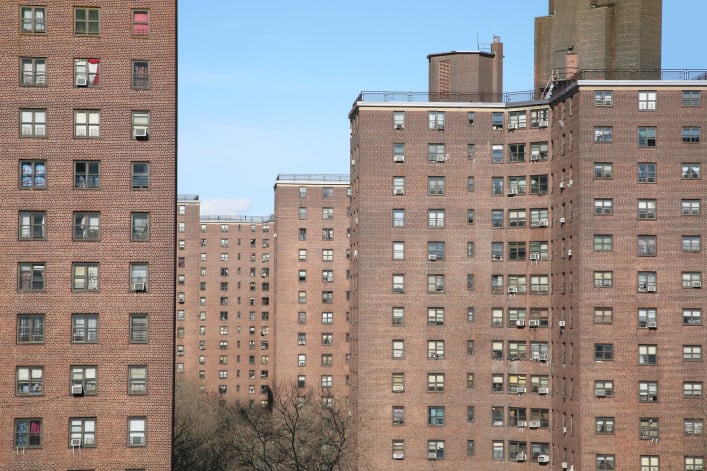
[2] Russian government housing: https://i.redd.it/twz37r739xse1.jpeg

Re:Austin's Surge of New Housing Construction Drove Down Rents by estearum on Thursday March 19, 2026 @07:03AM (#47437414)
Pretty sure France and Singapore both have quite successful and high quality public housing projects.
Re:Austin's Surge of New Housing Construction Drove Down Rents by pembrook on Thursday March 19, 2026 @07:48AM (#47437776)
France has similar issues as the US housing projects from the 70s (creating ghettos), these are not places that people choose to live. And yes, all governments put up halo projects that you see in the press that do not represent the average, please link me to them claiming I'm wrong, and I will say yes, this halo project designed by a famous architecture firm does look nice! Now show me the median late-1970s constructed French public apartment.

Singapore is different because they eliminated the "cheap" part. Singaporean HDB flats are expensive, have extremely long wait times (you're stuck for life when one comes up), while still being super tiny. Fertility rates are 0.87 there (replacement rate is 2.1). The domestic population is literally disappearing itself. I'm sure highly regulated tiny housing stock and development policy has no influence on family size though...

Re:Austin's Surge of New Housing Construction Drove Down Rents by donkeybeer on Thursday March 19, 2026 @09:07AM (#47438743)
The floor space and the proximity to neighbors are perfectly valid reasons to not prefer apartments. Calling them a "blight" is bs, unless you had in mind as your ideal something like historic parts of London because rows of identical mansions in a suburb looks to me no different than rows of vertically stacked apartment blocks. They are both clean, geometric and "industrial" looks.
Re:Austin's Surge of New Housing Construction Drove Down Rents by donkeybeer on Thursday March 19, 2026 @05:34AM (#47436847)
Not just government made housing but any housing. Housing market needs don't seem to have as much wide fragmentation as eg most of the Western world seems quite happy with suburb style housing and most asia seems content with apartment though aspiring to owning houses.

I am saying just like any other capitalist endeavour, where things that barely existed or were quite expensive many years ago eventually reached a point where both the price became so low and quality so good that it became a mindlesss thing eg sawblades. And housing for whatever reason has been an extremely anticapitalist market. Even if we take the exact same houses people want today, their execution seems far from optimized. Think of something like precutting all the timber and sheets at a factory and doing some light adjustment and fitting on site, developing new materials that are cheaper or easier to work with tools, etc there are countless angles of attack.

In optics for example, it was mostly this rather bespoke work by a few artisans and people back then might have said this needs a fine touch that can't be done on mass scale. And then Carl Zeiss emerged. I feel housing is in the pre Carl Zeiss era.

EDIT: Neither example looks bad to me. The russian looks denser but both look clean and well organized. It doesn't at all look like blight to me, any more than a grid of houses in a suburb does. It's clean and geometric just like rows of houses in suburbs. If you like one but have a problem with another, I think you are trying to get offended deliberately.

Re:Austin's Surge of New Housing Construction Drove Down Rents by def_true_false on Thursday March 19, 2026 @09:42AM (#47439302)
The government housing in communist countries didn't actually have tiny windows, compared to the housing stock available at the time.
Re:Austin's Surge of New Housing Construction Drove Down Rents by dctoedt on Thursday March 19, 2026 @06:12PM (#47447044)
> Because "cheap" government housing has never been "high quality" in the history of the world. Those two properties are antithetical.

I've lived in military on-base housing. It can be just fine ... or sometimes not.

Re:Austin's Surge of New Housing Construction Drove Down Rents by rayiner on Thursday March 19, 2026 @08:35AM (#47438296)
Do you think that’s what government produced goods gets you? If so, shouldn’t the government make everything?
Re:Austin's Surge of New Housing Construction Drove Down Rents by donkeybeer on Thursday March 19, 2026 @09:04AM (#47438709)
I was saying in general, privately or government built housing, not that government in particular should be making housing. I meant that housing market seems to be highly anticapitalist in many ways valuing the opposite of what a good should be.
Re:Austin's Surge of New Housing Construction Drove Down Rents by ImPostingOnHN on Thursday March 19, 2026 @01:16AM (#47435254)
Of course, many.

To be sure, are you asking if society does better when its people are homed vs. homeless? Because that seems like a question with an obviously-yes answer.

Re:Austin's Surge of New Housing Construction Drove Down Rents by rayiner on Thursday March 19, 2026 @08:36AM (#47438307)
The concept of externality has a specific definition and you’re not addressing housing in those terms.
Re:Austin's Surge of New Housing Construction Drove Down Rents by ImPostingOnHN on Thursday March 19, 2026 @08:45AM (#47438432)
I'm not sure "externality" means what you think it means.

Society being better off in many ways (more productive society, happier society, less crime-ridden society) is an example of multiple positive externalities resulting from its people being homed vs. homeless.

Re:Austin's Surge of New Housing Construction Drove Down Rents by malfist on Thursday March 19, 2026 @09:55AM (#47439510)
Yeah, there's no positive benefit to making sure people have housing. That's why every day when I walk home from work, I have to think really hard about if I'm going to go home today, or just hang out under the overpass and panhandle.
Re:Austin's Surge of New Housing Construction Drove Down Rents by tirant on Thursday March 19, 2026 @02:39AM (#47435726)
Because they don’t care about profits, they always end up overpaying and taking way longer time than necessary.

And who pays for that? The whole society: Either the government raises taxes, gets more in debt, or they print more money driving inflation up.

The most basic commodity, food, is a great example. The moment the government has ever step into controlling production of food, we’ve only seen subpar performance and starving people as a consequence. Ultimately killing millions (USRR, China, Korea…)

Re:Austin's Surge of New Housing Construction Drove Down Rents by jjav on Thursday March 19, 2026 @04:55AM (#47436600)
> The moment the government has ever step into controlling production of food, we’ve only seen subpar performance and starving people as a consequence.

You might be surprised to hear how heavily government directed and subsidized food production is in the USA.

Re:Austin's Surge of New Housing Construction Drove Down Rents by circlefavshape on Thursday March 19, 2026 @06:08AM (#47437049)
This is nonsense. Agricultural subsidies are the largest item in the EU budget. Nobody is starving in Europe
Re:Austin's Surge of New Housing Construction Drove Down Rents by creato on Wednesday March 18, 2026 @10:23PM (#47434046)
It doesn't matter whether prices are going up or down, it matters if the price is more than the cost to build.
Re:Austin's Surge of New Housing Construction Drove Down Rents by estearum on Wednesday March 18, 2026 @10:28PM (#47434092)
No, not really.

It matters whether the margin is higher than other investment opportunities of similar scale and risk profile.

Already, the answer is very often no. In Austin, the answer will increasingly be no. That means people will not finance new construction, so if demand continues to grow it will outstrip supply and prices will go back up until the margin on new construction exceeds that of alternative investment opportunities of similar scale and risk profile.

Re:Austin's Surge of New Housing Construction Drove Down Rents by epistasis on Wednesday March 18, 2026 @10:56PM (#47434331)
Yes really, that deeper understanding is exactly what is meant when somebody says "the cost to build is lower than the price." If we're going to be pedantic, you're ignoring the huge amounts of uncertainty on costs that are inherent to any project, the amount of risk versus the expected profit.

And indeed that amount of uncertainty: will I be allowed to build eventually? How long will I have to pay interests on assets before I'm allowed to build? Can I actually build what's specified in code or will discretionary processes arbitrarily change what I'm allowed to do, 18 months into the project?

Re:Austin's Surge of New Housing Construction Drove Down Rents by estearum on Wednesday March 18, 2026 @11:00PM (#47434367)
> Yes really, that deeper understanding is exactly what is meant when somebody says "the cost to build is lower than the price.

It demonstrably is not what people understand it to mean to "the cost to build is lower than the price." The cost to build can be well below the sale price and development still be a totally uninvestable activity.

Re:Austin's Surge of New Housing Construction Drove Down Rents by pclowes on Wednesday March 18, 2026 @11:06PM (#47434407)
I would expect the development of Austin to continue until market equilibrium and then pause. Decreasing margin does not mean equilibrium. Obviously austin is not at equilibrium because we still have price data on developer activity and that would be near zero if developers couldn’t make returns given risk etc.

I guess I don’t see where we disagree?

Re:Austin's Surge of New Housing Construction Drove Down Rents by estearum on Thursday March 19, 2026 @07:02AM (#47437408)
I mean... that is pretty much what we're seeing:

Austin new housing starts (approx per month):

2019: 1416

2020: 1504

2021: 1495

2022: 2083

2023: 1415

2024: 916

2025: 900

2026: 481

The problem here is that the market obviously does not have perfect information, limited mechanisms to coordinate, and significant lead time. It seems pretty much baked in at this point that many of the projects currently underway will complete into a negative market and (assuming Austin remains somewhat desirable) a whole lot of developers will be wiped out. This will stop development until prices rise again, probably back to a level where housing is quite expensive again relative to local wages.

Re:Austin's Surge of New Housing Construction Drove Down Rents by lotsofpulp on Wednesday March 18, 2026 @10:54PM (#47434315)
Your explanation of fluctuations in supply and demand are not very revelatory. Everything being in flux at all times is kind of an elementary fact of life.
Re:Austin's Surge of New Housing Construction Drove Down Rents by estearum on Wednesday March 18, 2026 @10:57PM (#47434347)
It's clearly not elementary if people here believe that you can just keep building until prices collapse, and people will still keep building.

The question is whether the market achieves equilibrium at a point where 1) developers can get financing to build profitably, and 2) units can be sold at a broadly attainable price to the local market.

The answer appears to be no because the cost of inputs is so high. No one here is talking about directly reducing the cost of inputs. They believe that instead developers will just continue to build units that they sell at a loss, or at least investors will continue to invest in construction that returns less than the S&P 500 or 10 Year Treasuries (they won't).

Re:Austin's Surge of New Housing Construction Drove Down Rents by cuuupid on Wednesday March 18, 2026 @10:40PM (#47434197)
It's not necessarily prices falling here but the profitability of [demand] at [price]. Like if prices fall 10% but demand rises 20%, you would want to build more housing.

This is the beauty of the free market because it guarantees three things:

[1] Real estate is generally a good investment and will hold value or appreciate in the long term, because supply will adjust to demand shocks to rescue values

[2] If people want to live somewhere, houses will be built for them to live there

[3] Real estate developers and construction are solid, safe businesses with great unit economics because building may decrease prices, but may still increase demand

It's when you constrain and restrict a market that players have to adjust and then you get crazy scenarios

Re:Austin's Surge of New Housing Construction Drove Down Rents by estearum on Wednesday March 18, 2026 @10:42PM (#47434221)
> Like if prices fall 10% but demand rises 20%

Not as a developer you wouldn't...

You already have razor thin margins. Prices going down 10% means you cannot get financing for your project.

Holding real estate is generally a good investment. Developing real estate actually is not.

> Real estate developers and construction are solid, safe businesses with great unit economics

No they are not lol

Re:Austin's Surge of New Housing Construction Drove Down Rents by cuuupid on Wednesday March 18, 2026 @11:23PM (#47434515)
If you live in a magical fairy world where supply and demand are fixed, sure. In the real world, prices going down 10% leads to a surge in demand, and so you can fill more of your units. This leads to either equal or increased revenue, for the same construction (flat cost), which actually yields higher margins. This is why developers are usually concerned with occupancy rates, and prices are more a concern for homeowners.

There are only really 3 scenarios where prices are low and demand is low:

[1] There is a dramatic surplus of supply, in which case if a developer is trying to build they've not done research and probably should not get financing

[2] There is some other factor (usually high crime) in which case again, developer should do their research, and the market is operating fine

[3] You are developing super early and operating within incentives offered by the city, usually tax abatements, which drive down the carrying cost and make it a better investment.

Also important to note that in scenario [3] a smart developer will slowly release inventory to restrict supply to meet demand, and as demand grows, release more inventory at the newly raised price, continuing to do so as long as the tax abatements advantage the strategy. This is common in successfully developed areas e.g. Jersey City, and is fine as long as broad scale collusion doesn't occur

Re:Austin's Surge of New Housing Construction Drove Down Rents by bpt3 on Wednesday March 18, 2026 @10:47PM (#47434265)
Can you define razor thin? Grocery stores have very small margins, as little as 1%.

Homebuilders make at least an order of magnitude more on a very expensive item.

Re:Austin's Surge of New Housing Construction Drove Down Rents by estearum on Wednesday March 18, 2026 @10:56PM (#47434333)
Grocery stores don't require millions to billions of dollars of capital to execute each new transaction.

So it's not the margin itself but actually the spread between the margin and what investors could get by investing in alternatives. Real estate investment opportunities are often measured by their advantage (measured in fractions of a percentage, .2% advantage being considered solid) over 10 Year Treasuries or S&P 500 returns.

Real estate developers do often actually lose money, but the more salient boundary condition is whether they can get financing for a project, where they have to clear a bar well above the "just make >$0" bar.

Re:Austin's Surge of New Housing Construction Drove Down Rents by bpt3 on Thursday March 19, 2026 @06:41AM (#47437261)
> Grocery stores don't require millions to billions of dollars of capital to execute each new transaction.

Neither do homebuilders, because homes don't cost millions to billions to build (high end custom homes can cost millions, but that's not what we're talking about here).

> So it's not the margin itself but actually the spread between the margin and what investors could get by investing in alternatives. Real estate investment opportunities are often measured by their advantage (measured in fractions of a percentage, .2% advantage being considered solid) over 10 Year Treasuries or S&P 500 returns.

Okay? So they have an advantage over alternatives, which means higher profits. And a .2% advantage is not considered solid, or meaningful in any way without a lot of missing context.

> Real estate developers do often actually lose money, but the more salient boundary condition is whether they can get financing for a project, where they have to clear a bar well above the "just make >$0" bar.

Many companies often lose money, due to incompetence or bad luck. The industry as a whole has very healthy margins.

Re:Austin's Surge of New Housing Construction Drove Down Rents by estearum on Thursday March 19, 2026 @06:52AM (#47437342)
Even a small (~10 home) development, of which we need hundreds of thousands, will require millions in financing. And as the development gets smaller and requires less financing, the economics get a bit worse due to ~fixed cost of land acquisition, development, and infrastructure/utilities.

> Many companies often lose money, due to incompetence or bad luck

One of those signs of incompetence or bad luck is building a bunch of new supply into a market with falling prices, in which case you will find yourself not among those with healthy margins ;)

Re:Austin's Surge of New Housing Construction Drove Down Rents by eigen on Wednesday March 18, 2026 @11:47PM (#47434676)
> Grocery stores have very small margins, as little as 1%.

Looking at the Kroger 2024 Annual report shows that they have 22.3% gross margin . they pay dividends, had a stock buy back, etc so its entirely possible that they had a very low margin but gross margin seems to be similar to a home builder.

Sales $ 147,123

Merchandise costs $113,720

Rent, Depreciation, Amortization $655

Gross profit $32,748

for a gross margin of 32.7/147 = 22%

Re:Austin's Surge of New Housing Construction Drove Down Rents by ghufran_syed on Thursday March 19, 2026 @01:07AM (#47435194)
The net margin of around 1.5% seems more relevant: the gross margin is just the revenue minus the cost of good sold plus cost of transportation. The net margin is the money you have left after paying things like Rent, employee wages, electricity, taxes, interest on debt.
Re:Austin's Surge of New Housing Construction Drove Down Rents by komali2 on Wednesday March 18, 2026 @10:52PM (#47434306)
It seems to me that the market will select for urban sprawl though which is a negative for society but has the highest margin. E.g. Houston suburbs, miles and miles of cheap to fab single family homes that turn it into a suburban hell scape where you have to drive everywhere.

I don't think the free market is giving the promises you say it is - supply isn't elastic for real estate if nobody's building because there's no margins. Demand can be anywhere really.

I like to look to Tokyo for an example. Small lots, extremely predictable regulations (that are still strict enough to ensure a safe living situation), fast approvals, mean it's much faster and easier to throw up an 8-10 story apartment than say downtown Austin, and so even today they keep doing it despite land in Tokyo being very expensive. And, no sprawl.

Re:Austin's Surge of New Housing Construction Drove Down Rents by austhrow743 on Wednesday March 18, 2026 @11:39PM (#47434619)
Why are you accrediting Houston to the free market rather than Tokyo?
Re:Austin's Surge of New Housing Construction Drove Down Rents by komali2 on Wednesday March 18, 2026 @11:56PM (#47434744)
Houston doesn't have zoning laws, Tokyo does.

Generally speaking, freer markets seem to lead to worse outcomes overall.

Re:Austin's Surge of New Housing Construction Drove Down Rents by taormina on Thursday March 19, 2026 @12:20AM (#47434899)
Have you seen Tokyo?
Re:Austin's Surge of New Housing Construction Drove Down Rents by komali2 on Thursday March 19, 2026 @12:44AM (#47435047)
I've lived in Tokyo and Houston. Tokyo is infinitely more livable and the housing is still relatively affordable. In Houston even if you can get a new place it'll be clapboard garbage that's a one and a half hour drive from work.
Re:Austin's Surge of New Housing Construction Drove Down Rents by hunterpayne on Thursday March 19, 2026 @01:22AM (#47435278)
Average home price in Tokyo is 1.5x that of Houston. Average wage in Houston is 1.5x that of Tokyo. So the data doesn't support your post unless you really really love sushi and arcades.
Re:Austin's Surge of New Housing Construction Drove Down Rents by seanmcdirmid on Thursday March 19, 2026 @12:24AM (#47434916)
They can throw up 8-10 story apartments in Tokyo despite land being very expensive because they tear them down and rebuild them after 20-30 years. Also, Tokyo outside of a few areas isn't that tall, it is definitely dense, but 3-4 story tall building dense (those homes are also torn down and built anew ever 20-30 years, so construction buzzes in Tokyo).

It would be better if you considered new actual living capacity in Tokyo rather than just new constructions.

Re:Austin's Surge of New Housing Construction Drove Down Rents by bandofthehawk on Thursday March 19, 2026 @10:08AM (#47439750)
I believe the market in the US selects for urban sprawl because it's usually subsidized by the dense urban core. Suburban areas often don't generate enough tax revenue to support their own infrastructure and services.
Re:Austin's Surge of New Housing Construction Drove Down Rents by bsder on Wednesday March 18, 2026 @10:49PM (#47434287)
> [1] Real estate is generally a good investment and will hold value or appreciate in the long term, because supply will adjust to demand shocks to rescue values

Real estate is NOT supposed to be a good "investment" and only became so because the government started propping it up with bank bankstops, zoning, NIMBY, redlining, etc. If your pricing is working correctly, real-estate should be close to zero-sum.

Austin, in particular, had several nasty bust cycles where real estate prices tanked after overbuilding which is precisely what kept the cost of living under control. Alas, that is a thing of the past after 2008 when everybody realized that the federal government will backstop the banks "Real estate number must always go up! Brrrrr!"

Re:Austin's Surge of New Housing Construction Drove Down Rents by cuuupid on Wednesday March 18, 2026 @11:39PM (#47434627)
For nearly every homebuyer, a home is the largest purchase they will ever make and the bulk of their net worth. It needs to be a good long term investment that at least reasonably paces with inflation, otherwise you are losing money by buying a home and everyone has to rent and then you have feudalism with extra steps.

The good news is this is totally fine with keeping cost of living under control and overbuilding, because prices will go back up over time. Most people aren't going to own their home until the 30 year mark so it really is a much, much longer term investment than anything like overbuilding or other factors can reasonably affect.

The problem is really that people started seeing 2x-10x returns on homes and started treating that like the norm. That is not a 'good investment' that is a 'money printer,' and in most cases the government does not want to safeguard that behavior, but it's hard not to when those same people panic like crazy if their home only goes up 2% in value in a year or, god forbid, decreases in value for a year.

There is really no good solution to that mentality, if there really was one then Wall Street would have uncovered it ages ago to get more people into long term ETFs.

Re:Austin's Surge of New Housing Construction Drove Down Rents by marcuskane2 on Thursday March 19, 2026 @12:46AM (#47435060)
> a home is the largest purchase they will ever make and the bulk of their net worth

That's bad and a central part of the problem.

I accept that my car is depreciating in value every year I own it, and but I need a car so I buy one. I don't need it to be a good long term investment, despite it being a major purchase.

The entire mindset of treating a family's home as being an investment class rival to bonds and equities is a relatively new phenomenon, and one that's clearly been detrimental to many.

Re:Austin's Surge of New Housing Construction Drove Down Rents by jjav on Thursday March 19, 2026 @04:51AM (#47436579)
> > a home is the largest purchase they will ever make and the bulk of their net worth

> That's bad and a central part of the problem.

Why? Or to ask in a different way, how could it not be?

For nearly all regular working people, there is nothing they will ever buy that costs more in labor and materials than a home. So of course it will be the most expensive purchase most people ever make. How could it not be?

Re:Austin's Surge of New Housing Construction Drove Down Rents by cuuupid on Thursday March 19, 2026 @12:30PM (#47442036)
A home costs 10-20x more than a car, you are being incredibly disingenuous by boiling them both down to “major purchase.”
Re:Austin's Surge of New Housing Construction Drove Down Rents by bsder on Friday March 20, 2026 @04:37AM (#47451998)
> It needs to be a good long term investment

No, it needs to be roughly zero sum but only over very long timescales. Anything else is a disaster.

If housing is a "good investment", it attracts rampant speculation and concentration of ownership to the capital class. You need regular wipeouts to force the speculators out of the market (doubly so if they are buying on leverage).

If housing is a "bad investment", people abandon the real estate and you get blight which becomes a self-perpetuating cycle downward.

Things need to be kept balanced in housing so that people can use it to be a place to live. We are currently in the middle of seeing the dysfunction that happens when being "shelter" is overshadowed by being an "investment".

Re:Austin's Surge of New Housing Construction Drove Down Rents by SocialGradients on Wednesday March 18, 2026 @11:58PM (#47434762)
This is an empirical claim. It looks like new monthly permits are down from ~4k a month in 2021-2022 to ~3k a month. They're still up significantly from before 2020. The building boom has slowed but it's still elevated. Not particularly close to zeroing out.

The data is here: https://fred.stlouisfed.org/series/AUST448BPPRIVSA.

Re:Austin's Surge of New Housing Construction Drove Down Rents by SocialGradients on Thursday March 19, 2026 @12:03AM (#47434796)
Not to mention, Austin could just make it cheaper to build to offset lower sell prices. Gruber et al estimate permits are 50% of an LA home's price. Fix permitting and rent goes down 50% by your assumptions that developers build until margins are 0.

Assume austin is only half as bad as LA, a 25% rent decrease would be incredible

Gruber's paper: https://evansoltas.com/papers/Permitting_SoltasGruber2026.pd...

Re:Austin's Surge of New Housing Construction Drove Down Rents by estearum on Thursday March 19, 2026 @07:10AM (#47437469)
> Gruber et al estimate permits are 50% of an LA home's price

That is not what Gruber shows. The 50% figure is that there's a permit adds a 50% premium on the value of raw land. In other words, the permit cost is "only" 33% of the cost of the permitted raw land. That's significant and a big problem, but very very far from "50% of on LA home's price."

But yeah structurally the solution is indeed to reduce the cost of production. Which if your 50% figure was correct, would be huge. But it's not correct.

Re:Austin's Surge of New Housing Construction Drove Down Rents by spongebobstoes on Wednesday March 18, 2026 @10:37PM (#47434176)
it doesn't matter if prices are falling or rising, it only matters how the ROI of building compares to other investment opportunities

we can also make it cheaper to build. easing taxes on imported materials, bringing in more skilled labor, expediting permits, and even direct subsidies like tax breaks

Re:Austin's Surge of New Housing Construction Drove Down Rents by estearum on Wednesday March 18, 2026 @10:39PM (#47434188)
> it doesn't matter if prices are falling or rising, it only matters how the ROI of building compares to other investment opportunities

Correct, which it basically doesn't in Austin, which is why construction is decelerating.

> we can also make it cheaper to build

Yep, this is the only structural solution. The "just add supply" runs into the problem of price equilibriums. The reality is the input costs of building housing basically guarantees that housing is hard-to-attain for any local market. We need to address the cost of inputs. Temporary reductions in price are temporary and the market will self-correct back to restrict supply (as we're seeing in Austin) until prices go back up to being hard-to-attain.

Re:Austin's Surge of New Housing Construction Drove Down Rents by pfdietz on Wednesday March 18, 2026 @11:30PM (#47434566)
The problem is it can't drive prices below what the free market would dictate?

Talk about praising with faint damns.

Re:Austin's Surge of New Housing Construction Drove Down Rents by estearum on Thursday March 19, 2026 @07:04AM (#47437428)
No, the problem is that the free market in advanced economies appears to dictate a price point for housing that is unattainable for broad swaths of society.

Classic case of Baumol's disease, which is not solved by "well duh we just gotta build more." People will not "just build" enough to solve the problem because they won't "just build" beyond equilibrium (for long).

Re:Austin's Surge of New Housing Construction Drove Down Rents by pfdietz on Thursday March 19, 2026 @10:06AM (#47439708)
No, the problem is the government has artificially restricted housing supply and this has driven up prices. It's not a market failure, it's a government failure.
Re:Austin's Surge of New Housing Construction Drove Down Rents by myrmidon on Thursday March 19, 2026 @11:06AM (#47440742)
I think it's not helpful to talk of "government failure" as long as democratic principles are upheld.

You could call it "voter failure" instead. But I'd argue that many of those voters are just acting in their own best interest, because they already own a home and more construction/housing supply does not help them at all.

Some part you might be able to blame on the system, because I'm pretty confident that owners of at least one home are politically overrepresented literally everywhere (just look at home ownership percentages of politicians compared to citizens).

I personally think a lot of this is just the natural consequence of an aging population, where young-people-concerns are basically "underrepresented" by design.

Re:Austin's Surge of New Housing Construction Drove Down Rents by pfdietz on Thursday March 19, 2026 @02:04PM (#47443394)
Of course it's helpful, unless one has the ridiculous idea that democracies can't make mistakes.

Yes, voters are acting in their own interests, or at least what they perceive to be their interests at the time. This can lead to bad outcomes. It's why we have things like the Bill of Rights, which restricts what even a majority can impose.

The idea that voters are always right would also seem to eliminate the possibility of arguing for change. Voters are responsible for current policy therefore it must be right, so how could change be good?

Re:Austin's Surge of New Housing Construction Drove Down Rents by myrmidon on Friday March 20, 2026 @10:33AM (#47455142)
> The idea that voters are always right would also seem to eliminate the possibility of arguing for change. Voters are responsible for current policy therefore it must be right, so how could change be good?

I'd argue the exact opposite. If voters are wrong, and cause bad outcomes, why would you blame "the government", when it's clearly voters being stupid? And I'm not arguing for "no change"-- the fix is to vote better next time. I think it is only fair to directly blame "the government" in a democracy if it either acts against its voters, or is otherwise incompetent, hypocritical or corrupt.

I'd argue that the largest "problems" government causes with housing are institutionalized NIMBYism and more generally policies to prop up housing values.

This happens (mostly) because (many) voters want it.

To fix this, we need more votes from people that suffer most (i.e. young voters, which notoriously don't) and more awareness/priority/empathy from all voters (ideally even the ones not directly affected).

I strongly dislike blanket blaming "the government" for issues like this, because I feel it kinda disenfranchises people.

I'd argue that any policy problem that wouldn't be solved via re-election is never really a "government problem", it's a "people problem" (voters being stupid) or an "incentives" problem ("vote cost" being compensated indirectly by political donations, media attention or similar).

Re:Austin's Surge of New Housing Construction Drove Down Rents by adrianN on Sunday March 22, 2026 @02:30AM (#47474997)
IMO shaping public opinion is part of the government’s job description.
Re:Austin's Surge of New Housing Construction Drove Down Rents by FireBeyond on Wednesday March 18, 2026 @10:27PM (#47434081)
In my state, or in my capital city, you say this, but the real estate developers are generally the top 1% in town. If they're running on razor-thin margins, I'm not seeing it - I am seeing them on my Facebook (being friends with the wife of the mayor) doing things like taking their kids on vacation to the French Riviera, Switzerland, Tokyo, the Maldives... well, alongside the City's Planning Committee commisioners and their families...
Re:Austin's Surge of New Housing Construction Drove Down Rents by epistasis on Wednesday March 18, 2026 @11:04PM (#47434392)
Highly restrictive development rules, often sold as ways to stick it to those very rich developers, are precisely what make them so rich. Only those with huge amounts of capital to spend can make it through the gauntlet of the rules and have big enough asset portfolios to stay in the game. They can bank land for decades, speculating on the best time to take their profits, all while others live through shortages of housing and do not have access to that land.

Those very processes that make it hard to develop keep out the scrappy up-start competition, the contractors that could be building houses all over if they had enough lawyers/planners/specialists to help them get through the system.

Look, for example, at LA, which has super super restrictive rules on what can be developed where, and has huge amounts of discretion at the political level, so that NIMBYs can block what they want. The only people who can build housing are developers who bribe the politicians (there was a somewhat recent arrest in LA on this, involving literal bags of cash, by the FBI).

Having simple, straightforward rules that are completely objective is the only way to try to flatten out the playing field. However such rules get shot down by NIMBYs precisely because they don't want the shady developers profiting off apartments! It's all highly ironic.

Re:Austin's Surge of New Housing Construction Drove Down Rents by estearum on Wednesday March 18, 2026 @10:29PM (#47434103)
Well you see, we clearly need to armor the parts of the planes that have bullet holes in them upon return!
Re:Austin's Surge of New Housing Construction Drove Down Rents by maest on Wednesday March 18, 2026 @10:39PM (#47434189)
I get what you mean, but I doubt corruption is good for building good housing
Re:Austin's Surge of New Housing Construction Drove Down Rents by hunterpayne on Thursday March 19, 2026 @01:29AM (#47435317)
Corruption isn't prevented by regulations; its enabled by regulations. That's the flaw in your thinking. If a market's only players are really rich, there are 2 possible reasons for that: 1) the market is really good and more players should be entering or 2) the market is highly regulated which prevents more players. Guess which happens a lot more than the other in RE development?

PS Most of the people who build houses aren't very rich, just the CEO/big boss who owns the entire company is. The other 99.9% of people are middle class/blue collar.

Re:Austin's Surge of New Housing Construction Drove Down Rents by FireBeyond on Thursday March 19, 2026 @01:33AM (#47435343)
> just the CEO/big boss who owns the entire company is. The other 99.9% of people are middle class/blue collar

Yup. I did some IT integration work for a man who owned a local construction company and was very effectively vertically integrating it. In addition to their other work he'd buy land, personally, his company would build at cost prices, and his office staff first informally and then more formally became property managers.

Re:Austin's Surge of New Housing Construction Drove Down Rents by pembrook on Wednesday March 18, 2026 @10:25PM (#47434066)
Construction costs don't scale linearly with rent prices, it's a different market altogether that depends on regulation/worker supply/material costs/equipment/etc.

As long as construction costs remain below the value of the units all-in, there's profit motive for developers to build.

Re:Austin's Surge of New Housing Construction Drove Down Rents by estearum on Wednesday March 18, 2026 @10:30PM (#47434121)
> As long as construction costs remain below the value of the units all-in, there's profit motive for developers to build.

Not true

Real estate development is extremely capital intensive and therefore it's a question of all-in cost of capital compared to other investment opportunities.

Re:Austin's Surge of New Housing Construction Drove Down Rents by 9rx on Wednesday March 18, 2026 @11:32PM (#47434576)
The opportunity cost has already factored that in. Unless you think cost calculations are arbitrarily forgetting to include certain costs for no reason?
Re:Austin's Surge of New Housing Construction Drove Down Rents by estearum on Thursday March 19, 2026 @07:11AM (#47437478)
Well for sure in the actual financial models yes, but it's demonstrably true that most HN commenters here do not know this is how to think about the question of returns.

And FWIW "opportunity cost" doesn't really show up as "a cost" in the traditional sense.

Re:Austin's Surge of New Housing Construction Drove Down Rents by 9rx on Thursday March 19, 2026 @09:54AM (#47439494)
> And FWIW "opportunity cost" doesn't really show up as "a cost" in the traditional sense.

I cannot think of any forward-looking situation where opportunity cost doesn't show up. What case are you thinking of? The discussion, of course, is about a forward-looking situation.

In hindsight often one becomes more interested in seeing if the opportunity cost was paid. A common way to calculate that is to forget about cost and only look at expenses. More specifically, income minus expenses. The result of that calculation gives the opportunity realized. This may be what you are thinking of, but the opportunity cost is still there, it's just that the way of looking at it has changed.

Re:Austin's Surge of New Housing Construction Drove Down Rents by komali2 on Wednesday March 18, 2026 @10:40PM (#47434209)
Maybe other real estate savvy people can help me understand this plus two other things I'm confused about in the housing crisis:

1. Houses are unaffordable for many Americans. To get houses to prices where they'd be affordable again would require a housing prices drop that would likely be, market-wide, significantly low enough to put a ton of people underwater on their mortgages. What is society/the government meant to do about that? Is it an insurmountable floor on how low we can get housing prices? That floor feels very close if so.

2. We've been promising the last five generations (or more) of Americans that a house is an Investment, capital I, an excellent place to keep your money. How do we overcome the political pressure to turn a house into a depreciating investment for the length of time required to get housing to be affordable again? What kind of politician would put their neck on the line to piss off every boomer and 75% of gen X and 30% of millennials, or whatever the house ownership distribution is?

Re:Austin's Surge of New Housing Construction Drove Down Rents by zugi on Wednesday March 18, 2026 @11:47PM (#47434680)
#1 is the symptom, #2 is the problem.

High levels of home ownership combined with "local control" and "democracy" enables the "haves" who already own homes to weaponize government to keep supply low and home values high. Zoning restrictions, building codes, taxes, and other government tools are brought to bear to support this. The "have nots" don't have a chance.

Austin seems to be a counter-example when they "instituted an array of policy reforms" in 2015 that showed great results. Sadly the key may be appealing to the greed of existing homeowners. Changing zoning to allow tall apartment buildings where single family dwellings once stood lets existing home owners make even more money by selling than they'd make by continuing to restrict supply. While it's sad if that's the only path to success, we'll have to take small successes where we can find them.

Re:Austin's Surge of New Housing Construction Drove Down Rents by epistasis on Wednesday March 18, 2026 @10:46PM (#47434256)
There's a big difference between land prices and the building prices. When costs rise 5% per year for a house that's untouched, that's almost entirely the land price going up.

You can make housing cheaper by putting more houses on the same amount of land. In high cost areas, the price of land dominates the cost of housing.

Political pressure to change the investment nature of housing can come from various directions, for example establishing a land value tax, which eliminates the financial incentive to speculate on rising land prices by keeping people out of your area, redistributes all those unearned land rents to the population equally, as is only fair, and also results in a lot of people selling land to be redeveloped taht are otherwise hoarding it when the rest of society would be using it a lot better. Of course, in societies with high levels of land ownership, the voting public usually tries to vote away such extremely fair taxes.

Politically, we must stop prioritizing the views of homeowners at the local level. They already got their reward, massive unearned capital gains on their residence, there's no need to give them priority on land use over the general needs of society.

Re:Austin's Surge of New Housing Construction Drove Down Rents by bpt3 on Wednesday March 18, 2026 @10:51PM (#47434302)
> Politically, we must stop prioritizing the views of homeowners at the local level. They already got their reward, massive unearned capital gains on their residence, there's no need to give them priority on land use over the general needs of society.

They are the majority of people in most areas, so it does make sense that they would be given priority in some ways.

The rest of your post is unsubstantiated vitriol, which isn't exactly convincing.

Re:Austin's Surge of New Housing Construction Drove Down Rents by epistasis on Wednesday March 18, 2026 @11:10PM (#47434430)
You quoted my vitriol to the homeowners, the rest is not vitriol, it's basic land economics.

> They are the majority of people in most areas, so it does make sense that they would be given priority in some ways.

In some ways sure. But in the ways that they are? Absolutely not, it's basic unfairness. The entire tax system is tilted in favor of home owners. We don't need to do that, we could make it more equal so that people with less wealth are not penalized.

Re:Austin's Surge of New Housing Construction Drove Down Rents by bpt3 on Thursday March 19, 2026 @06:29AM (#47437167)
It's not "basic land economics", it's your personal opinion about how things should be and whether you think current policies are fair.

The tax code does favor home ownership, because people want to support it. Less people will be able to afford their own home without that support, which seems to be the opposite of what you want.

Re:Austin's Surge of New Housing Construction Drove Down Rents by kxrm on Thursday March 19, 2026 @04:27AM (#47436430)
I'd also rethink these questions under the assumption that incomes rise over time as the dollar reduces in purchasing power. The original premise was that due to inflation the cost you paid for a home would reduce your economic burden for housing. The slow and steady rise of inflation along with income would guarantee your loan to income ratio would improve.

The last few years have distorted this promise and I think some people have taken a more extreme view of the time window in the name of increased short-term profits.

All said the price you pay today being less of a burden over time was never meant to be a short-term profit motive in the discussion of homes as a economic safe haven.

Re:Austin's Surge of New Housing Construction Drove Down Rents by lmm on Thursday March 19, 2026 @12:31AM (#47434955)
> already-near-zero margin on real estate development

Why is the margin so low when the prices are so high? Is it because the value of housing is already priced into the value of land?

> The problem is: why would you build more housing as prices fall?

Why would you want to? When you stop being able to sell more houses, that's the sign that you've built enough.

Re:Austin's Surge of New Housing Construction Drove Down Rents by estearum on Thursday March 19, 2026 @07:06AM (#47437435)
Yes, the prices of inputs are very high and rising. Mainly land and labor, but materials aren't cheap either. Housing is also one of the few thing we need at massive scale but which has diseconomies of scale. The more you develop an area, the more expensive it gets to develop it further.
Re:Austin's Surge of New Housing Construction Drove Down Rents by rconti on Thursday March 19, 2026 @12:38AM (#47435005)
As long as the cost to build housing is less than the revenue from selling it, why wouldn't you?

It's not like homebuilders in Austin flee for North Carolina when the margins shift slightly.

Re:Austin's Surge of New Housing Construction Drove Down Rents by eru on Thursday March 19, 2026 @12:42AM (#47435037)
Huh? In Silicon Valley the objection is usually: even if we build more housing, prices won't fall.

So which way is it now?

Re:Austin's Surge of New Housing Construction Drove Down Rents by estearum on Thursday March 19, 2026 @07:10AM (#47437473)
I don't know what those people say, why are you asking me?
Re:Austin's Surge of New Housing Construction Drove Down Rents by throwaway27448 on Thursday March 19, 2026 @12:53AM (#47435099)
Why let private developers build at all? The market provides perverse incentive to not house everyone.
Re:Austin's Surge of New Housing Construction Drove Down Rents by RuslanL on Thursday March 19, 2026 @01:09AM (#47435204)
To create artificial scarcity on a free market, it should be either a direct monopoly, or a giant cartel that includes every single developer and has mechanisms of punishing the outliers.
Re:Austin's Surge of New Housing Construction Drove Down Rents by CalRobert on Thursday March 19, 2026 @01:48AM (#47435425)
How so?
Re:Austin's Surge of New Housing Construction Drove Down Rents by whattheheckheck on Friday March 20, 2026 @06:28PM (#47461563)
Because central planners do not have the information processing feedback loops necessary to distribute all of the complex network of component commodities.

Truly there is some scarcity of resources in any given place that takes energy to extract, transform, and transport to the desired location.

Because everything cannot be everywhere, there will be unmet needs in a society.

The "free" market economy allows for a natural price discovery of everything which is more likely to not have shortages or overages in any given spot.

Granted this is pure basic economics. It does not imply when for a toy example, there are 10 people thirsty and a baby and there is a scarcity of milk, 1 cup, the milk should go to the highest bidder. obviously it should go to the baby.

Same thing with housing. There is a scarcity of all of the components that go into housing and administering the amenities that houses need in a city. Central planners do not have a good track record but with careful tracking and modulating feedback loops we might be able to meet more people's needs that an otherwise regulatory captured monopoly of vertically integrated home builders so that everyone has a better chance at a home.

But again not everyone can live everywhere logistically so how do you fairly distribute it? Obviously hunger gaming it in a cut throat capitalist world isn't working out too well but we do have the largest number of people ever on the planet so its a pretty decent system so far

Re:Austin's Surge of New Housing Construction Drove Down Rents by locknitpicker on Thursday March 19, 2026 @01:27AM (#47435312)
> The problem is: why would you build more housing as prices fall?

Profitability is not black-and-white. Real estate investments can still be profitable if prices fall.

There are different types of real estate markets too. Working class homes in suburbs are not the same market as upper middle class apartments in an urban center.

A very interesting type of investment is high-density housing in catchment areas of new public transportation hubs. Those tend to be so profitable that they can even finance the investment in the public transportation service.

All you need is willingness to invest.

Re:Austin's Surge of New Housing Construction Drove Down Rents by throwaway2037 on Thursday March 19, 2026 @02:16AM (#47435599)

    > already-near-zero margin on real estate development
I did a little bit of research. I looks like 15-20% is a normal target margin for the United States. Is this really "already-near-zero"? I disagree.
Re:Austin's Surge of New Housing Construction Drove Down Rents by estearum on Thursday March 19, 2026 @09:27AM (#47439045)
https://www.nahb.org/news-and-economics/press-releases/2025/...

8.7% net profit during a period of explosive appreciation across the nation.

Normal net profit is about 7%.

S&P 500 has been returning more than twice that annually over the past 10 years.

That is how real estate financing decisions get made.

Re:Austin's Surge of New Housing Construction Drove Down Rents by modriano on Thursday March 19, 2026 @02:49AM (#47435794)
The prices may be falling, but if you can still make more profit (per unit time) building in Austin than elsewhere (due to less red tape or more local builders or whatever), building will occur.
Re:Austin's Surge of New Housing Construction Drove Down Rents by estearum on Thursday March 19, 2026 @06:24PM (#47447210)
No, it's absolutely possible that building as a whole is not a good use of capital. There is not some fixed quantity of people-who-must-build and dollars-that-must-be-spent-building.

If the incentive disappears, the people and dollars disappear. And they have to clear a much higher bar than merely being profitable. Because it's a capex heavy industry, development must compete against other ways to invest capital (like S&P 500 or the US 10-Year).

Re:Austin's Surge of New Housing Construction Drove Down Rents by energy123 on Thursday March 19, 2026 @02:52AM (#47435816)
That gets automatically decided by the market. That's the beauty of markets. They automatically solve the local knowledge problem. It takes a government to create a lack of housing.
Re:Austin's Surge of New Housing Construction Drove Down Rents by sophrosyne42 on Thursday March 19, 2026 @03:15AM (#47435945)
Supply increases until the market reaches saturation. The question is why build more housing if the current supply is sufficient?
Re:Austin's Surge of New Housing Construction Drove Down Rents by estearum on Thursday March 19, 2026 @06:25PM (#47447224)
Saturation == until it's not longer a comparatively strong use of capital, not "until a significant portion of people are comfortably housed."
Re:Austin's Surge of New Housing Construction Drove Down Rents by 21asdffdsa12 on Thursday March 19, 2026 @05:11AM (#47436706)
Why would you produce more bread, milk, eggs as prices fall? You would of course wait for the next-pig cycle - when the starving masses pay any price to you.

The answer- essentials can never be a non-government interferring market. This can be by creating artifical oversupply by buying up oversupply for foreign aid or bio fuels(food production). In the case of housing, this is by having the goverment continually construct housing.

Re:Austin's Surge of New Housing Construction Drove Down Rents by dan-robertson on Thursday March 19, 2026 @08:06AM (#47437928)
The government intervention in the markets for agricultural products is because farmers are often an important political base, not to keep prices low for consumers. Without the intervention, prices would fall and supply would have to fall too, which would be good for consumers and bad for producers.
Re:Austin's Surge of New Housing Construction Drove Down Rents by harrall on Thursday March 19, 2026 @10:17AM (#47439912)
And the biggest reason is, learning from history, the instability of food prices destabilizes nations.

There have been many “bread riots.”

Re:Austin's Surge of New Housing Construction Drove Down Rents by dan-robertson on Thursday March 19, 2026 @11:43AM (#47441361)
Bread is much cheaper today (at least relative to incomes) than in the days of bread riots.
Re:Austin's Surge of New Housing Construction Drove Down Rents by FuriouslyAdrift on Thursday March 19, 2026 @02:06PM (#47443430)
Wheat is HEAVILY subsidized.
Re:Austin's Surge of New Housing Construction Drove Down Rents by 21asdffdsa12 on Friday March 20, 2026 @04:29AM (#47451953)
Re:Austin's Surge of New Housing Construction Drove Down Rents by myrmidon on Thursday March 19, 2026 @10:25AM (#47440074)
I'd argue that government intervenes in agriculture for supply-chain safety first and foremost.

Governments are concerned with this because no meat (or rice) on supermarket shelves during a supply-shock of any kind leads to rapid unplanned regimechange very consistently.

So basically every western government throws a few billions a year at local farmers so they stay (and this is not a US phenomenon, EU does the exact same thing). This is also less necessary for countries where labor is cheap.

This is arguably good for most consumers because essential calories being more affordable "on average" is not good enough, you'd typically rather pay (partially indirectly) a higher average to guarantee availability and avoid starving.

Re:Austin's Surge of New Housing Construction Drove Down Rents by estearum on Thursday March 19, 2026 @06:41AM (#47437265)
Sure, which is a different intervention than what's being discussed here.
Re:Austin's Surge of New Housing Construction Drove Down Rents by philipallstar on Thursday March 19, 2026 @07:14AM (#47437506)
One of the main housing issues is government interference. People want to do things to get money from other people, including building houses for them to buy.
Re:Austin's Surge of New Housing Construction Drove Down Rents by somenameforme on Thursday March 19, 2026 @08:29AM (#47438222)
You're probably being downvoted because you're just assuming everybody knows what you mean. For somebody who doesn't it's going to be a nonsensical statement. The issue is that the government mandated banks enable easier access to loans for housing, as a means of resolving prior housing issues.

But what happens when you suddenly start giving a bunch of people the ability to go arbitrarily far into debt to buy something that they perceive as priceless (because housing, and most any other 'thing' tends to endlessly appreciate in value in an inflationary economic system)? Obviously prices skyrocket. The exact same thing happened with education for the exact same reason.

Re:Austin's Surge of New Housing Construction Drove Down Rents by crystaln on Thursday March 19, 2026 @05:28AM (#47436811)
This is how markets balance. When there is under supply prices go up and incentivize production. When there is oversupply production goes down. Prices converge on a small premium to the price of production.
Re:Austin's Surge of New Housing Construction Drove Down Rents by estearum on Thursday March 19, 2026 @09:23AM (#47438994)
Correct, and the argument being made here is that the convergence point on "small premium to price of production" actually sits at "unattainable for an increasing proportion of Americans."

Similar to how the convergence point on price for a platinum-bodied iPhone converges at "unattainable for enough people to support its production" and it therefore doesn't exist.

The difference being, obviously, that society can hum along just fine without platinum-bodied iPhones and it cannot hum along without housing.

Re:Austin's Surge of New Housing Construction Drove Down Rents by wnc3141 on Thursday March 19, 2026 @05:30AM (#47436825)
Of its still profitable to do so, considering opportunity costs for the capital, firms will continue to build. However, it's so expensive to build that these project wind up not becoming bankable very quickly. I think that's the underlying issue that needs to be addressed.
Re:Austin's Surge of New Housing Construction Drove Down Rents by estearum on Thursday March 19, 2026 @06:54AM (#47437351)
Correct -- this is what I'm pointing to.

The problem is the cost of inputs. Classic Baumol's disease. We cannot escape Baumol's disease by just saying "hurrr durr just gotta get people to finance projects into a market with falling prices!"

Re:Austin's Surge of New Housing Construction Drove Down Rents by PowerElectronix on Thursday March 19, 2026 @05:40AM (#47436889)
That sounds like they could use some deregulation to keep margins healthy.
Re:Austin's Surge of New Housing Construction Drove Down Rents by inglor_cz on Thursday March 19, 2026 @05:55AM (#47436976)
The point is that housing would be cheaper, not that it would become dirt cheap.

There are some inherent costs to new housing. Work of professionals involved, cost of materials, compliance with all technical regulations, some profit for the developer, connection to infrastructure. Let us mark this unavoidable cost by C. It is a component of the current prices.

Then there is the component N, which is deadweight cost caused by zoning and non-technical regulations. I am not saying that it should be 0, but it is in our interest that it is kept in check, maybe 20 per cent of C. As of now, in some places, it well may be 120 per cent of C, even though it is really hard to calculate.

This component of the final price directly enriches no one, it is pure friction caused by special interests of various parties that don't want to see any new housing either near them, or anywhere (landlord cartels that hate competition - indirect enrichment).

Even C is now a formidable figure. Modern homes are basically industrial robots, they are much more complicated from the inside than they were 100 years ago. But there isn't really a reason why they should be horribly expensive.

If as a regular office person you can buy a home for, say, 5x your annual income, it is not unaffordable. That is well, just normal. Not completely everyone is expected to own their home.

The problem is that nowadays, the multiplier in many places isn't 5x, but 10x or 12x. That is just way too much. And given that C cannot be easily massively reduced (unless some sort of massive robotization of construction work happens), you really need to attack N.

Re:Austin's Surge of New Housing Construction Drove Down Rents by samrus on Thursday March 19, 2026 @06:12AM (#47437072)
Thats how supply demand works right? Its a stable equilibrium. When supply is low, prices rises to entice supply, supply increases to match demand, prices fall, the rate of increase of supply falls as well until supply approaches to meet demand. It prevents oversupply. If supply slips below demand again prices will rise to pull it back up

Theres no problem here. Thats how the system should work

Re:Austin's Surge of New Housing Construction Drove Down Rents by estearum on Thursday March 19, 2026 @06:48AM (#47437302)
To some degree yes. However, the problem I'm pointing to is that the equilibrium in several developed economies (esp US) seems to be at a level that makes housing unattainable for a huge number of people.

I.e. Probably due to Baumol's disease, there is no price at which it is both 1) profitable to invest in constructing new housing and 2) makes housing broadly attainable to people.

This is a problem. There are a lot of goods (like a platinum-bodied iPhone) that cannot achieve both (1) and (2). However, unlike all of these other goods, housing is a necessity with an extremely high floor on demand.

Re:Austin's Surge of New Housing Construction Drove Down Rents by pbhjpbhj on Thursday March 19, 2026 @07:50AM (#47437789)
To house people. Shelter is a basic need.
Re:Austin's Surge of New Housing Construction Drove Down Rents by Saline9515 on Thursday March 19, 2026 @07:51AM (#47437793)
Building codes also push prices higher. In the EU, the recent regulations force developers to build luxury buildings as a baseline, at a high cost.

Not all buildings require elevators, intelligent thermostats, triple-panel windows or electric car plugs. Especially when you are experiencing a housing crisis.

Re:Austin's Surge of New Housing Construction Drove Down Rents by torginus on Thursday March 19, 2026 @08:45AM (#47438424)
How can real estate have zero margin when housing rises exponentially in price?

No other good behaves like this. A midsize sedan didn't increase in price (in real term) over time, while new cars improved.

New houses don't really improve that much over time, yet are getting more more and more expensive.

Why is that?

Re:Austin's Surge of New Housing Construction Drove Down Rents by estearum on Thursday March 19, 2026 @09:20AM (#47438947)
> How can real estate have zero margin when housing rises exponentially in price?

Well let's think about it...

It would suggest that costs are going up, correct?

What are the main costs? Land: Goes up alongside housing prices. Labor: Also goes up alongside housing prices.

Unlike cars, there are very few economies of scale in real estate development. In fact, due to the dynamic above, there are actually diseconomies of scale in housing development. The more you develop an area, the more expensive it gets to continue development.

We normally don't scale goods that have diseconomies of scale because, like we see in housing, they become unaffordable and cease to exist. Unfortunately, housing is a necessity, and so we must build it against increasingly disfavorable economics.

Same is true of healthcare and education. Other goods/services that have diseconomies of scale simply don't scale. That is not an option for housing, education, and healthcare.

Re:Austin's Surge of New Housing Construction Drove Down Rents by whattheheckheck on Friday March 20, 2026 @06:31PM (#47461598)
The stock market has greater returns than housing by a lot
Re:Austin's Surge of New Housing Construction Drove Down Rents by thinkingtoilet on Thursday March 19, 2026 @08:59AM (#47438646)
>The problem is: why would you build more housing as prices fall?

So human beings with thoughts and feelings can live indoors. It's not hard.

Re:Austin's Surge of New Housing Construction Drove Down Rents by balderdash on Thursday March 19, 2026 @10:18AM (#47439940)
lower prices != unprofitable, it might, it may also mean lower, similar, higher margins / ROI
Re:Austin's Surge of New Housing Construction Drove Down Rents by foobiekr on Thursday March 19, 2026 @04:23PM (#47445424)
Why would you build more cars as prices fall?

What do you think homebuilders do? Just close up shop when the market dips?

The answer is there are companies in the business of building homes. If there is profit to be made, they will keep building. Most of the issues we have today are caused by extreme and dysfunctional regulatory regimes that destroy the return on investment by extending the process out. More time sitting on the property before building = lower investment return, and other investments end up making more sense.

Re:Austin's Surge of New Housing Construction Drove Down Rents by estearum on Thursday March 19, 2026 @04:34PM (#47445619)
> What do you think homebuilders do? Just close up shop when the market dips?

Uhh yes. Downward price pressure is a business-destroying event in real estate development. The amount of risk developers take on with each project is pretty incredible actually.

> Why would you build more cars as prices fall?

For one, there are advantages to scale. That is hardly true (and in many cases the opposite is true -- diseconomies of scale) in real estate development.

> The answer is there are companies in the business of building homes. If there is profit to be made,

No. The question is whether there is more profit to be made from building homes than from investing e.g. in the S&P500 or US 10yr Treasuries. Otherwise investors don't finance new home construction. We are already in an environment where real estate financing is simply not a great option compared to other ways to invest money, and so construction will slow as prices go down (which is, as stated, already happening in ATX).

Re:Austin's Surge of New Housing Construction Drove Down Rents by foobiekr on Friday March 20, 2026 @08:33PM (#47462772)
That is exactly what the rest of my message said, had you read it.