Named your small bike shop after a famous bicycle race and French town (roubaix)? Specialized will try and sue you because they have a model of bike with the same name (and don't even own the trademark). https://capovelo.com/Specialized-Threatening-to-Sue-Bike-Sho...
Exactly the same as trek and giant will do. There's a whole other game involved when dealing with the top 5 consumer brands of $1000+ bike, as a local bike shop.
As someone who has worked in multiple bike shops, and also broken their own Specialized bike and had to deal with their warranty department, I'm never giving them any of my money again.
Admittedly this was 15 years ago but still, never had a bad experience with them.
This seems a very strange observation to make about London. It actually has the lowest rate of car ownership of the cities in the UK.
In my experience the primary mode of travel is public transport (or it was before Covid-19 at any rate), with people occasionally using their cars for trips outside London and perhaps larger shopping trips. Though this clearly varies by Burrough, with those on the outskirts of Greater London being more car focused than those near the centre.
It was an observation about the UK.
Modern bikes, with all their bells and whistles, which are light years better than their counterparts from 20 years ago, simply wouldn’t exist had this R&D not occurred.
Also their triathlon bikes have multiple unique features
It's been an interesting observation to see how all the big brands have been massively increasing their margins through cheap manufacturing in China (a frame that costs >$4000 retail is less than $300 for those guys to get to the US) while the margins are incredibly low for the actual shops (<10% often) especially on high end bikes. I know many shops now make their primary income on bike servicing.
I think specialized avoiding amazon is more a case that they don't want to stay the big guy that can push the small shops around, instead having to deal with the 500lb gorilla that amazon is.
Bikelanes also are mostly just there (in practice) for rideshare services and delivery services to drop off goods. This isn't necessarily a bad thing, given the problems with right turns and doorings mentioned earlier. It is problematic in name however, but because new cyclists treat them as actual bike lanes and are just gambling with the probability of eventionally getting hit.
We should have more bike infrastructure, but putting money into this garbage is a mistake.
I've also biked on streets that became "super sharrow" streets: one lane striped with a giant green stripe that supposedly provides a big visual indicator that a bike can use the full lane. This was terrible.
> We should have more bike infrastructure, but putting money into this garbage is a mistake.
What bike infrastructure would you like to see, if not bike lanes?
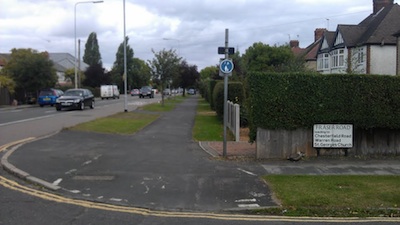
That sounds pretty great. Unfortunately in my area the bike lanes are straight into the door zone (see for example https://goo.gl/maps/nMnKZEVZduEfkups8) and this seems to be the general design for bike lanes in the South Bay.
In fact, the city of Sunnyvale's own bike map [0] says to avoid the four feet door zone, yet the bike lane is less than 4 feet wide and straight in the door zone.
It's frustrating. You'd think they'd favor the safety of the unprotected squishy humans over the ones in two ton metal boxes, but it seems like the opposite most of the time.
[0] https://sunnyvale.ca.gov/civicax/filebank/blobdload.aspx?Blo...
In my experience, the more in the way of cars you are as a cyclist the safer you are. You still need to have clear markings, but you should always be in sight of drivers IMO, as an active participant in traffic.
- Gives cyclist false sense of security, since they need to yield to vehicles turning across "their lane"
- Little notice given to drivers that they need to take care, since they have right of way
- Cyclists have to stop at every side road, which can make taking the bike path as slow as walking
Experience cyclists won't use them and novice cyclists are given an unsafe and slow route; they will drive instead. What a waste of public funds.
A better solution, as seen in NL and some parts of London, is to make the motorist give way or even remove the vehicle entrance entirely. The transport mix you get is the transport mix you build for.
I definitely agree with you that people on bikes should be in the way of cars because that's what gives them the most visibility, but I'd disagree with the marking parts. See the commute post I have a little bit below, the only markings on that commute on streets are a few sharrows, no bike lanes at all.
What needs to happen is for bikes to be perceived as slow moving vehicles, not unlike tractors in rural areas. People overtake the tractors as soon as it's safe to do so and don't honk at them. That happens as soon as there is enough of a critical mass of people on bikes on streets.
Junctions are where drivers tend to kill cyclists, so junction improvements are far more effective than anything along the "normal" road. Bike boxes and, ideally, dedicated light phases for bikes help far more than lanes.
We have that in SF and in the year before COVID I basically spent every morning commute berating at least one person that tried to cross in front of me on a bike-only light. It's really hard for Americans to give up the right-turn-on-red.
In NYC they just hand out tickets like candy to people who don't know that right-turn-on-red is illegal through essentially the whole city. In 2019 though I didn't see any enforcement at all of bike-protection lights and lanes.
Actually, let me show you my commute when I was a student several years ago. This is in North America.
1. Walk to the local park (https://goo.gl/maps/CdCinYAp24MgCBBm7)
2. Grab a bicycle from the local bike sharing system (https://goo.gl/maps/46vzmXzx5CPSPFRE9)
3. Bike a minute to the bike path (https://goo.gl/maps/gpkXGcXxMHYH4epn7)
4. Hop on a bike path, wave to the other cyclists (https://goo.gl/maps/JiRSC6yhwqanRn1K7)
5. Bike some more (https://goo.gl/maps/jvSoQQ2rmB1F2NNo8)
6. And then some more (https://goo.gl/maps/u2WyLVGvJBfNL5718)
7. And then even more (https://goo.gl/maps/LcxSoUZ9BzgsovU97)
8. Exit the bike path (https://goo.gl/maps/AyqzZUuo89osSEPf6)
9. Bike on surface streets, sharing the street (https://goo.gl/maps/NNyhCU9gZEXVxk5D8)
10. Arrive at destination, drop off bike at the bike sharing system dock (https://goo.gl/maps/qCy5GESLL4AxHuL99)
That's an example of good bike infrastructure. For the parts where bikes interact with cars on low speed streets, the streets are either narrow so that cars drive slowly, or there is another lane for cars to pass bikes easily.
Note the lack of painted lanes; bikes and cars share the street, and cars pass bikes whenever it's safe to do so. Also note that in most of these street views perspectives, you can pan the camera and see other people biking.
I don't think there's really a solution to the turning problem, unless you're proposing tunnels at every intersection for cars/bikes. I'm hopeful that newer cars' safety features help to fight this back (I would also like people to, yknow, pay attention when driving).
My principle (especially after getting a drivers license and realizing how little visibility one actually has while driving) is to not listen to music (so I can actually hear cars etc) and to basically slow down at every interesection that has even a bit of doubt. It's annoying but at least I'm not rolling the dice on every intersection (or at least not as much)
Personally I’d argue that it’s extremely odd that we dedicate so much public space for people to leave their private property laying around.
And like for deliveries... what do you want people to do? Not stop in front of the place they are delivering?
If there's an argument for it being a public space, it's also a public space for things like deliveries, dropping people off, etc. "People should be more careful" is a glib thing to say for this stuff, and I think we should make improvements to things, but if we're talking about public space, cyclists are _also_ not the only thing on the road and accomodations can be made for stuff like delivery
When you make a delivery, do you just stop dead in the middle of the lane you were driving on?
If yes, please proceed.
If not, why not? Don't you want to stop in front of the place you are delivering to? Why do you think that it is ok to completely block bicycle lane for the same purpose, but it's not ok to block a car lane? For an extra point, assume the car lane is a single-lane one-way road, and the delivery takes 5 minutes.
So, yes, you stop "in the car lane" and it affects people.
There are also times where you change lanes because of obstructions. Just like intersections, stop lights, so many things that prevent the "just speed right ahead without any concern in the world" use case.
There are safety reasons for isolating bike/pedestrian traffic. But acting like it's uniquely unfair to bikes to have any form of obstruction... this is what roads are. Shared area for movement.
And while I do agree that it isn't uniquely unfair for bicycles, it seemes that when there is no isolation between a car lane and a bicycle lane, during the busy hours there is a random car, van, taxi parked every 30-50 meters. (Well, used to be, 2 years ago)
Where do you live where the parallel parking spots in front of businesses are always open? Where I’ve lived things like UPS will just stop in the road if necessary, and other cars will go around.
Deliveries in areas without lots of parallel parking is a solved problem; we don’t need to pretend like reducing or eliminating street level parking will have unknown impacts on things like delivery vehicles.
It establishes the wrong principle - it makes drivers feel entitled to exclude cyclists from the main road lanes. A bike lane that isn't wide enough, isn't adequately maintained (sweeping, filling potholes...), leads to blind corners, or just dumps you out into the main lanes at junctions, is worse than useless - it actively makes cycling more dangerous, because drivers feel no need to share the main road lanes.
> I don't think there's really a solution to the turning problem, unless you're proposing tunnels at every intersection for cars/bikes.
The solution is to have bikes be part of the main traffic stream at that point. If you have a bike box at the front of the queueing area, and ideally a bike phase on the lights, that can help a lot.
In the Netherlands, for example (well, much of the Netherlands, I haven't been everywhere), the bikes are on the bike lanes, the cars are on the car lanes, and that's that. You have no motivation to go on the car lanes (except on small alleys with no lanes), since the bike lanes just get you wherever you want to go.
These are some of the fist ones through the CBD - https://www.brisbane.qld.gov.au/traffic-and-transport/roads-... - As part of this they closed a major bridge in the middle of the city (Victoria Bridge over to South Bank) to road traffic. Before it was two bus-only lanes and two car lanes, but now it's three bus lanes and a separated bikeway.
They're also building four bridges over the river dedicated to cycle and pedestrian to link up different bike routes, and the State Government has been doing some good work with their 'Veloway' next to the M3 highway. A lot of intersection and road upgrades (and new roads) are starting to add separated bike paths too, like the overhauled Kingsford Smith Drive that finished recently.
I'd be especially curious to know what the good alternatives are.
IIRC physical dividers like reflector poles actually do make bike lanes safer, and sharrows are mixed on whether or not they make lanes more effective.
Open Streets: https://openstreetsproject.org/
From my experience (in the UK) how usable those lanes are depends hugely on pedestrian discipline. There's one of those running alongside the seafront in Brighton that in my experience works well. The same style of lane that I've seen in and around London generally doesn't work as well: there are often pedestrians on the wrong side, not infrequently looking into their phones and/or wearing headphones.
What makes matters worse is that in the UK the rules are asymmetric: while it's an offence for a cyclists to go on the pedestrian side, there are no rules preventing pedestrians from walking on the cycle path (source: [1]).
Not to mention that, in my jurisdiction, if this sort of behaviour led to injury or damage to property, the cyclist would almost certainly be found to be at fault, at least partially.
Except now every street crossing becomes a death trap because you're outside the cone of visual awareness of drivers.
Traffic travels too fast in the US, and I do not want to share roads with cars going 40+ mph
Watching subdivisions going in with utterly unfriendly approaches to people who want to get around with anything but a car is horrific to me.
As a motorcyclist and former electric skateboard rider, welcome! Everyone is trying to kill you and it's always your fault.
Cemeteries are full of people who had right of way.
¹IANAL; in the jurisdiction I'm in, but my understanding is that this is common
Yeah, I perhaps should have made it clear that occupying a full lane is something I do probably <2% of the time. Not very often, and for similar reasons to the rest of the comment: I don't really want to have to deal with cars, and if I can stay right and let them by, I will.
I'm in America, so it depends on the road; where we have unprotected bike lanes, then I'm in that & there's passing room, but too often there are "sharrows" where there really isn't a good deal of room for passing. Then it's very situational. (Usually the car taking up part of an oncoming lane as they pass.)
https://www.britishcycling.org.uk/cycletraining/article/ct20...
He eventually did a half lane change, buzzing me as he went by, then got stuck at the next red light while I caught up. Ridiculous.
(Of course my area also has reckless motorists who don't respect the rules of the road, but they seem to believe they are above the law whether they are interacting with cyclists or other motorists.)
Unfortunately not, that's basically my strategy.
If I keep to the edge of the lane folks pass by me really close. If I'm going back and forth a bit and taking a whole lane up, cars give me the entire lane. It's wonderful
The exception is on left bends. There it's best to stay on the right, for three reasons: better visibility, you can have a straighter trajectory with a higher speed and if there is only one lane in each direction, cars going too fast in the opposite direction may cross into your lane.
A good example is a Bubb Rd, the part north of McClellan, in Cupertino (which has a bunch of Apple offices): much improved signalization and there’s now a bumper divider between the car and bike lane, making it very safe.
They also added much improved commuter bus access islands.
This is just one example. There are others. I don’t know if it’s because of COVID or because these things were already planned, but the lack of usual commuter and school traffic definitely made it easier to do the work.
Yeah, sadly a kid died on that stretch a few years back — likely why they added the new improved bike lane.
This has been done in places in Cambridge UK (a reasonably bicycle friendly city). If your cycle lane is part of the road you can act like a car does - you get to ignore turnings because anyone joining the road has to give way as per normal. If you're on the pavement though, you're like a pedestrian - every turn off is a road you have to cross. Even if there isn't any traffic you have to slow down enough to look and as a cyclist what you want is constant speed.
If you can't quite see what I'm talking about aee this example from Milton Road: http://www.rtaylor.co.uk/images/milton-road-1.jpg The 'main' road is the one going into and out of the picture with cars on, and the image pictures a junction. You can see where the cycle lane 'crosses' the joining road and how you'd have to look for traffic (even ignoring the bump down and up that messes with a nice cadence).
(from this blog post I found via Google: http://www.rtaylor.co.uk/anti-social-cycling-north-cambridge...).
Unless you meant something like [1] or [2] where there is a raised bicycle lane effectively on the sidewalk.
But even if they're part of the road that's not necessarily a problem [3], but in that case you'll want to have a reasonable speed limit (that sign on the road is 30 km/h, not 30mph) and you'll have to teach cars they're supposed to just be patient and slow down if they can't overtake.
[1]: https://en.wikipedia.org/wiki/File:Ciclovia_Povoa_Varzim.jpg [2]: https://commons.wikimedia.org/wiki/File:Gonzaga_ciclovia.jpg [3]: https://en.wikipedia.org/wiki/File:Fietsstrook_Herenweg_Oudo...


On the other hand, if there are enough pedestrians, they will spill on the bike lane thinking it's a sidewalk. Or in some places, people really don't pay any attention and don't have a single care in the world, and will be totally oblivious to the fact that they are on a bike lane, even after ringing a very loud bike bell a few times right behind them.
My commute happens to have both of those configurations, and the second one is hell, to the point I'll rather ride on the bus lane (which is forbidden to cyclists) than risk a collision with a pedestrian.
Edit: I almost forgot, but since it tends to be between the road and the sidewalk, cars turning right will always check for pedestrians, but often fail to give way to cyclists, depending on how used they are to see cyclists coming. Some intersections have high change of T-bone because of that.
1. How often do pedestrians wander into those bike lane?
2. What are the rules at intersections? Specifically, does a bike lane along a major road have priority over minor roads at intersections, or are bikes required to give way to all traffic from both the major and the minor roads?
3. How obvious is it to drivers turning right from the rightmost lane that they might, in fact, be crossing a bike lane?
1. Depends on where. In busy areas it happens a lot. You just have to be careful when there are people around.
2. The bike lanes have their own traffic lights, which are on the same cycle as the cross walks to the right of them, and the main road/lights to the left.
3. It's obvious since these bike lanes are everywhere; it's just apart of driving. I will say it's a little worse in the West of the city though!
2. The sidewalks and bike paths run together, and road crossings are dual marked. Everyone needs to exercise extra caution, of course.
3. Riders for the most parts have the same traffic flow as pedestrians. If you're turning right, you'll most likely cross both the sidewalk and the bike path at the same time.
The online model is also amazing for consumers as well (not to mention small indie bike manufacturers). Instead of choosing between maybe 2-5 bikes that might match my basic preferences and be in stock at my local bike shop, I have dozens if not hundreds of models to choose from made by any manufacturer around the world.
Sure, shops that do bike maintenance are important, but none of what you're saying here explains why any special interventions are needed for them. Won't the demand of more people using bicycles, and needing them fixed, be enough to keep these maintenance businesses healthy? I think bicycle advocates are much better off focusing on getting bikes to more people, and then improving cycling infrastructure to make it safer and more accessible to average people in everyday situations. The number of bike mechanics available is certainly not a major bottleneck that is keeping anybody from taking up cycling today.
The best i could do to verify is this article about fake knockoffs from 2015: https://www.bicycling.com/bikes-gear/a20045553/to-catch-a-co...
I'm shocked that i can't find an old article about when they announced the change. Maybe my memory is wrong, and it could be, but I remember the local bike shop as being one of the main reasons for the change, even if that was just marketing.
The good news is that bicycle fashion has tended towards more "city bikes" in the last decade or so. These have fewer frills and thus are simpler (== more durable) and also more maintainable by someone who is willing to learn the basics. The "basics" would be lube, fixing flats, brake maintenance and simple shifter adjustments. I think that's better than the earlier trends of "mountain bikes" with too many parts and stuff that's too hard to adjust for people without enough tools.
You look at the towns that still have quality book stores. You have a few cities that have thriving bookstores: Boston (likely because of students) and SF (likely because of cultural nostalgia and real estate laws, but these are now failing). You then have the consolidation model, where cities have one good bookstore that can compete against amazon: NYC (The Strand), Austin (Bookpeople), Portland (Powell's).
My point is that i would rather the cities follow this consolidation model than fail. You have one, trusted brand within the town, whose entire business model is built on quality and trust, because all parties know there's a cheaper alternative. This is where performance bikes failed, as they sacrificed quality service for price competitiveness. I was actively advising my friends to avoid their mechanics like the plague. The Trek shop seems to be moving in the other direction, as a boutique, with reasonably trusted service, so long as your using their products and, like apple, the added cost premium they charge.
This is not idealism, this is a practical model based on what is honestly a sense of fatalism. The automobile system we have is a path-dependent clusterfuck, and we have to be, not just willing, but be happy to take less than ideal outcomes to fight for real alternatives.
I used to be a bike tech. Somebody ordering a $5000 mountain bike might take a full day to put together. But if you gave me $5000 in cruiser bikes, I could have them all put together well and get some maintenance done. I really loathe how cruisers look, but goddamn they're some of the sturdiest pieces of junk I've ever worked on
I was actually thinking more of crappy $800 50lb "mountain bikes" with those cheap-ass all-plastic grip shifters and shitty "suspension" forks VERSUS an $800 basic city bike with low-end Shimano internal gear hub (or even single-speed).
I think many folks have developed a taste for actual practicality in their cycling needs and this is a good thing.
It's an excellent design ergonomically speaking
To be honest this is not an unreasonable bottom-end price. If your budget for a bicycle is lower than this you are better off looking at buying second-hand.
I agree with you that used is a better value, but Walmart will sell you a kid’a bike for a quarter of that price that is perfectly fit for many use cases. It will weigh more, be less durable and serviceable but if you’re looking for something that will be used to go around your 1/5 of a mile street a few times a week (a common kids bike use case) it’s fine.
For a long time I was a student (yes, I did a PhD). I didn't have the cash for local bike shops.
Buying and supporting local is a luxury for the rich. I could not afford the $600 bikes they were selling. I bought $150 used bikes on Craigslist and repaired them myself. And no, not with parts from the bike shop. I could get the same parts at half price online, including from Amazon. Usually I could tune up a $150 bike for another $25 in parts and that's a lot cheaper than $600.
If local bike shops want my business, and pretty much the business of students in general, they need to get with the beat and be cheaper than Amazon.
Oh btw -- last week I changed my bike pedals for one that I got on Amazon for $20. I have never seen a bike shop sell such good pedals at this price point. I have never even seen a bike shop sell this brand ("ROCKBROS"). They usually sell some super expensive brand like Shimano only. They also seem to have politics against selling competing brands sometimes, and Amazon has none of that bullcrap, you see all the brands and you buy the best.
Commuters who want to spend less than $200 on just something to get them moving, parents riding with their kids are also here.
Cyclists who spent 10-20-40 hours per week on a bike. For a hobby that you spend 60hr/mo on it's reasonable to spend $1300 on an entry level road bike and much more as you progress. Especially because it's good for your health.
Obviously there's money to be made with cyclists, but commuters would be so cheap and budget concerned that there's no money to be made from it.
Amazon is perfect because you're not looking for quality. I use a rockbros sweat catcher for my indoor training bike setup and it's great because it's just fabric.
You want LBS to stock $20 pedals? Who is going to buy them? What would the margins on that be? I wouldn't trust $20 clipless pedals (because if they fail you will get hurt/injured) and if they're flat pedals then bmx people would buy flat, but they're going to be so heavy that it'll be bad performance wise. There's only broke students who would buy it, and at that point just get it from Amazon.
I spend a lot of time on a bike. I don't spend $1300 on bikes.
There are people who want the latest carbon fiber blah blah just because they are using it for sport. I have no problem with them. But I have my current $200 Craigslist bike, it would have been $900 MSRP, but it rides fine, it's a little heavier than those carbon fiber things but so what? I get more exercise, and worry slightly less about theft, which buys me a LOT of freedom because I can just lock it up in downtown San Francisco and enjoy my day. If it gets stolen I just buy another bike, no biggie. If my landlord confiscates it, I just buy another bike, no biggie.*
Yeah, I agree, it's reasonable to spend $1300. If you have $1300. But it's also okay to NOT want to spend $1300 and still want to take it up as a serious hobby. I for one am pretty happy with my $200 bike.
I don't use clip pedals, I just use flat pedals, and these $20 aluminum flat pedals are nice and solid. I tried SPD clips before and hated that stuff. To each is own.
I have done many long distance trips, and I avoid proprietary or hard-to-find components because it's awesome that I can find replacement components in some random village in rural China or rural Myanmar or rural anywhere I go.
*Saves me on rent anyway because apartments in my area with proper bike storage OR enough apartment sqftage to store bikes inside have rent rates higher than my current rent plus the cost of a new bike per month. It still saves me money to stay at my current cheap apartment, lock bike to the pool fence (because property manager refuses to install bike racks on the premises), get it confiscated every now and then, and keep buying new bikes.
You don't need carbon to workout or bikepack, but your comfort level increases.
I love SPD, but that's because I have had my feet slip on flat pedals and seen how close I was to getting injured because of it
If you're going bikepacking in a place where there's not going to be any high end mechanics then I agree that using the most common components makes sense because then anybody can help you. Although I've heard that to go bikepacking in China you need a local handler in a car following you, so I would probably just have them carry spare components there.
And yeah, I don't lock my bike outside, only in groups where we can maintain eye contact with the bikes while sitting down. If I commuted by bike I would use something much much cheaper.
I mean, I don't go to LBS, that's how I get carbon fiber at insanely cheap prices. People who are brainwashed into supporting LBS will get their carbon bikes for $3000.
Used that bike for a while, even checked it in on a plane to Taiwan, no insurance or anything, rode around for a couple weeks, didn't worry too much about handling by the airline since for $150 I could replace it if it got damaged. Worry-free is freedom at its best.
The bike got confiscated in California later on, then I bought a $200 used bike to replace it.
Interesting events
Working on actually interesting things
Availability of tech jobs
Good scenery
Lots of places to exercise
Somewhat decent medical specialists which don't exist outside of a couple of major metro areas in the US
Startup investment which is hard to get if you don't live here, but if you do take it they also expect you to pay yourself barely enough to live
Good Asian supermarkets and overall decent food
There is some basic disfunctional public transit here which doesn't exist in most of the US; US cities with good transit are equally expensive
how is using lighter expensive bike using fancy 0.5% less friction gearboxes better for your health? If you wanted health benefits you would be using the heaviest shittiest bike possible for more resistance.
Aside from that, the joy of riding is what gets me out. Many cyclists choose tough hill climbs for added fitness gains and challenge. There is a good kind of difficulty (steep grade somewhere picturesque) and a bad kind (unresponsive bike that doesn't roll well)
I don't usually go to the middle of nowhere, most often I'm going through a bunch of towns. In the worst case I can shove the bus on a bike to get to the next town.
Time and time again I have found that failure happens even with the best of components, and having standard components means you can find replacements more easily. Having a steel bike means the village welding expert in a random town in rural China can fix the frame, or fix your broken rack. Having standard spokes, tire, etc. means the LBS in Burmese village (who unlike American LBS, are actually reasonably priced) will have parts that work with your bike. Having standard brake pads and cables means you can get them anywhere when they wear down.
Additional point: shitty bikes usually have really terrible geometries and will fuck up your health if you decide to use them for sport. If your shitty bike calls itself an 'MTB' and you take it onto a trail, it is very likely for it to actually break if you catch even a tiny jump (let's say 20-30 cm root) because the welds are terrible, and the metal is brittle.
But also, a higher performance bike will help you go further & faster. It doesn't mean you will end up exerting less effort, it just means that you will go faster and you'll keep putting in the same effort. With this time saving you can try new routes, feel more comfortable going further or bike packing with higher quality gear. It wouldn't change how long I ride for, but it increases the options for where to go.
Yes there are diminishing gains as with anything, but an entry level bike is still going to be below the Shimano 105 point of performance vs cost.
Guess they're just a chinese integrator/reseller and quality may vary a lot among different products but I have to say I'm really happy with my backpacking bags (waterproof top-tube and frame bags) I got from them on amazon. I wouldn't trust them with anything "mechanical" though.
Pedals, especially flats (which btw are used by plenty of MTBers), are a breed of their own... they usually come from the same few factories and final price depends on who puts their logo on them. For a good while you could find the very same pedals from HT and from plenty of other minor brands for prices varying from 30 to ~150 euros.
Sometimes if it is just poor assembly quality you can patch it up yourself easily. If screws are unscrewing themselves out all that's needed is a little Loctite or lock nuts. The metal is still perfectly fine.
Sometimes it's just patents that drive up prices in the US, for some stupidly simple thing like a bike pedal patents shouldn't exist, and for practical purposes it would be laughable to have a patent on some low tech stuff like that in China.
Sure you can get various decent accessories from china, but for most of the basic maintainance you need to source proper components (drivetrain, brakes, tyres, suspensions) from respected brands. You can go to the LBS, let them do the work and pay a premium or you can do it yourself sourcing components online for half the price. You could also source the components to the LBS and do the work yourself but that's usually the more expensive solution. As it often happens the most ethical choice of willingly financing LBSs is only accessible to the rich.
Oh and trying to find one in stock is a nightmare in the UK most be even worse else where.
Pedals are a good example, ridiculously overpriced at the shops. Luckily we have a non-profit called "The Bike Collective" that strips donated bikes and sells parts super cheap, they also help with repairs.
RockBros is a Chinese brand. I have a few of their parts and in my experience they're pretty well made.
This is extremely myopic. The entire point of cycling-as-transit, is that, as an investment, it's by far the most inexpensive alternative. If you're under the assumption that you'll already have a car, or free access to transit, or live on campus, then I see your argument. However, cycling as an alternative to these things is wildly, wildly inexpensive, even factoring in bikes that cost thousands of dollars.
The cost of luxuriously maintaining a bicycle is about $100-$200 annually. The cost of maintaining an automobile is about $8000 annually, it's just that the costs are broken up into micropayments on things like fuel or hiding in the depreciation.
> The cost of luxuriously maintaining a bicycle is about $100-$200 annually
That's if you fix it yourself. I spent <$100/year on maintaining my bike.
Changing brake pads at a bike shop cost upwards of $60. Wheel truing, probably >$200. Attempting to buy brake pads and refusing brake pad changing service usually involved a stupid long conversation with them to convince them you didn't need service, and they would price gouge you on the brake pads. With Amazon it cost me a grand total of $8 for the new pads, shipping included, and not having to convince anyone that I'm competent at fixing my own bicycle.
I once had a pedal stuck in my crank and just needed a longer wrench with more leverage to get it out. Damn bike shop wouldn't sell me the wrench. They wanted to do it themselves and charged me fucking $40 for TWO MINUTES of work. WTF. Needless to say I never visited that shop again.
This is tragic but this is current state of western civilization. Bring Shop back to school.
On the other hand I've lived in places where truing wheels, servicing suspension fork and other regular servicing was really worth it. Prices were good, wait (1-2 weeks in the summer) decent and you were sure that they did a good job. No screwing around just to have the customer get wheel out of true 1-2 weeks later, they'd rather tell me to replace the spokes when needed instead of doing a crappy job. Whatever needed to be replaced (rotor, brake pads etc.) during the service was sold at online-like prices.
I completely understand that plenty of local bike stores offer no value to anyone who can do basic maintenance. I hope they go bankrupt as early as possible. I'm not scared I'll run out of good bike stores. There's plenty of complicated tech that requires good technician. E-bikes and other trend also help.
If they want my business, they need to match what I can afford somehow.
I'm talking about cost in relation to alternatives. If the cost in relation to alternatives is low, then you can easily afford luxurious maintenance, as you'd be spending the same money, and lots more, paying for any alternative.
Heck, that last one is true even if you aren't doing luxurious maintenance.
For someone on grad student income, owning a car is largely not viable, it's not even an alternative that is remotely in sight.
I wouldn’t be too optimistic. We have one in Toronto. When I brought in my trek that I bought from them to fix it, it cost a fortune and they didn’t actually fix it properly.
Similar to servicing your car at the dealer. It’s super expensive. Difference being the quality of work is questionable (no doubt varies quite a bit).
Lesson: learn to fix your own bike or settle for crappy big box bikes instead.
I don’t agree with this reasoning. Why wouldn’t maintenance be priced at the true rate? In what way is it better for consumers to overpay for their equipment in order to underpay for maintenance?
I went to get a replacement inner tube--nothing special, just a 26x1.95 with a Schrader valve--and all they had was some Chinese brand (Hilong or something like that?) for $35. I want to support local businesses, but come on. The only thing they offered over Amazon is that they would install it for you for a modest $50 in labor.
They also basically don't stock anything under $800 if you are looking to buy a bike, and even those are Giant brand mountain bikes with trash tier hardware. I went looking for something I could commute to work on every day and they were trying to sell so much fragile carbon fiber stuff that was miles outside of my budget range. I don't need to shave 5/10ths off of my commute, I want low maintenance, comfort, and ruggedness. Apparently that's totally uncool and biking is all about ultralight and ultrahard--feel every crack in the pavement through the hard plastic saddle! I wasn't impressed with the line about "it's more comfortable because you use less energy to get there".
There are commuter bikes for $100 but it's just not worth servicing them because telling someone it'll be 40% of the original bike price in labor + parts to fix something not major is hard for them to accept.
> low maintenance, comfort, and ruggedness. Apparently that's totally uncool and biking is all about ultralight and ultrahard--feel every crack in the pavement through the hard plastic saddle!
Carbon is more comfortable by reducing the vibrations that you'll feel compared to aluminum.
The reason why they stock shitty parts is because they appear to service really cheap bikes and for people who buy cheap bikes, that's what they want. I know many shops who wouldn't service cheap bikes and I know many shops where they would but I wouldn't trust them with my more expensive Trek road bike. So it's strange that they also stock carbon frames.
You don't seem to respond to those things.
If you ask a skilled professional to do menial trivia, expect to pay for their skill level.
Yeah an inner tube for $35? And it's not even those fancy orange ones?
Well it's not hard to change it yourself, as long as they're not charging more than $4 for a basic ones. If they are actually selling it for $35 that's pretty yikes. I'd just buy it online given that it doesn't benefit from retail (you don't need to see a tube in person, just need to know the dimensions)
Bike shops need to charge for labor because most people don't buy bikes from bike shops anymore, so labor is where they make their money. $100/hr for labor is on the higher end but doesn't seem crazy in expensive locations. Not to mention that the prevailing way people treat bike shops (as places you can walk in at any time, get your bike fixed, and walk out) is incredibly antithetical to bike mechanics actually being able to take the uninterrupted time to focus and do good work.
Is it actually noticeable for an average cyclist? I don't doubt it, but I wouldn't be surprised if it was a marketing slogan from carbon frame producers and people went with it, and since their bicycles were more expensive, they "felt" better.
So you approve of my steel frame bike? ;-)
This is self-awareness issue. At what point did you realise you'd wandered into the wrong shop for your target segment? Judging by the misrepresentation of the genuine preferences of folks like me, as being somehow nonsensical or antithetical, I suspect, "not yet".
I'm reminded of the vegetarian who visits a steakhouse and complains there's nothing for them on the menu but salad.
> all they had was some Chinese brand
Place of origin indicates nothing about the item manufactured, and product labeling even less so. Most bicycle tube & tyre production is in E/SE Asia.
I wonder if these people are internally consistent enough to eschew the use of ramps or pulleys.
In London there a few mechanics/coffee shops that stayed profitable that way.
If more people cycled I'm sure you would see more 'just mechanics' but in most places they can't afford to be that.
If e-bikes take off they could help. There are a lot more moving parts to break and especially electrical issues to track down. Electrical issues are real moneymakers in diagnostic fees on cars.
Parts are often higher priced than what lots of people pay for complete bikes (e.g. a set of disc brakes 400$, a MTB fork 1000$, a groupset 1000$, a wheelset 800$, a dropper post 300$, etc). And the associated repairs like a brake bleed, a shock service or a wheel rebuild might take time and will have a high cost too.
You don't have to look into ebikes. On Mountainbikes that are used as intended parts break often enough to keep mechanics busy.
Ebikes might however indeed bring the higher priced bikes to a higher amount of people.
(We're talking repairs rather than upgrades.)
And if you are into mountainbiking - there is also a fair amount of chance you might break something like a derailleur and spend a few hundred to fix that.
$1000 groupsets simply don't deteriorate in the manner you describe. Source: I rode many thousands of kilometers on my gravel/adventure bike, including a 1000km ride around Kenya (very dusty, rocky roads where there are roads). The only two groupset components I needed to replace on this 2016 bike so far were the derailleur hanger and a jockey wheel. The former got bent due to carelessness on my part and could have been straightened, but I chose to replace it for structural reasons. The bearing in the latter got a little sticky and so I replaced the jockey wheel.
Each of the two parts cost the equivalent of US$15 here in the UK.
I think this is a very long way from replacing the entire $1000 groupset, which was what the post I was replying to suggested.
I am talking about the groupset (the shifters, brake levers, brake calipers, derailleurs, crankset, bottom bracket, chain and cassette).
There are indeed some wear items (chain; cassette, especially if the chain isn't replaced when worn; brake pads; brake rotors) but, apart from those, a looked-after quality groupset can last decades.
Most forks and rear shocks require full service yearly or more frequently (typically every 100 to 200 hours). It is not that simple and requires experience and tools. Tubeless tires are messy. Bleeding breaks is another thing I would rather not do at home. And frankly, I can never setup my derailleur as well as my mechanic.
> the parts are cheap
Shocks, forks, transmission components, performance wheels are easily in the iPhone category and beyond.
Clothing, protection, accessories, smaller components like handlebar stems or seatposts are still usually in the three digit range.
You would be surprised to know how much consumables like chains and tires can cost per year.
> low volume service
I might be living in a place where both MTB and road cycling are very popular, but bike mechanics have so much work that they redirect clients to each other.
> If a bike is really damaged it usually makes more sense to just replace it wholesale
Full suspension bikes can easily have a $2K frame and $2K worth of components. Unless it was hit by a freight train, the bike is almost never completely destroyed by a crash. So it makes sense to replace what's broken. If the frame is solid, everything else is replaceable.
As long as bikes are ridden hard, there is always work for mechanics, and it can be pretty expensive.
Maybe that was the problem there?
Basically just saying that some combination of floor space, rent and other fixed costs, etc etc led to pursuing a higher-end business model and it didn't work out. There may be lots of reasons for that, but one of the principles here is that you need to be able to bike to your bike store— it's not fulfilling its purpose if it's in a power center plaza that you need to drive to.
I know someone who operated a Velofix van for a few years, and I used it a few times, but the minimum cost was basically $100+. For that much coin, I would just walk my bike home or take it on the bus. Particularly if it was something like a flat tire where I know I can fix it myself at home for a few dollars.
Cheap bicycles plus good mid-priced service is where it's at. Of course, that's hard, dirty, skilled work.
So if the "true" rate ends up being more than the market will bear, and you dont have alternate income, you close down.
So it isn't really a situation where one thing had an artificially inflated price and the other an artificially deflated price, more like the way bike shops as we know them work is to have diverse income streams, and removing an important one means that the business model as we understand it ceases to function.
I truly believe that cycling, as an activity, can just fail and cease to exist. It has ceased to exist in many areas in America. Many, many, many novice cyclists would rather abandon cycling than pay a large premium on bicycle maintenance. Perhaps there is a different business model that would work, but I see the large manufacturers as having in interest in creating an environment where maintenance service can be delivered at-cost.
The only way I would operate a shopfront business of any kind is if I owned the building. But I'd need to build a business first that could pay for the building. If I can build such a business, then I likely wouldn't bother with the shopfront until you get "Apple" big.
Big companies and churches play this right. They buy more land then they need, and when the market is down they buy more, and when they have too much they rent it out a few years at a time so they never have to wait long to expand.
And you don’t want to deal with counterfeit items either.
If you ask a store, the answer will always be replace. They don't want to deal with liability questions ("but that store told me it would be good to ride"), so they will pick the safe answer.
This will be especially true for components like a carbon frame, where even the best equipped stores will lack the equipment to perform a proper check - like an x-ray device.
However the store might help you getting a discount on the replacement or get it warrantied.
There are plenty of other things that need work beyond frames.
Yes and no. I think what most people think of when they think bicycle is the throw away kind that you buy at you local big box retailer or sporting goods store. These are toys in the sense the they were likely meant for casual recreation and at most might get a tire patched or some other simple repair.
But yeah, I think the GP is speaking aspirationally. We need to get to a place where bikes are considered infrastructure the way a vehicle is, that everyone has one, and has a selection of shops around them to service it, same as everyone currently has lots of garages, dealers, and gas stations around to meet the needs of their automobile.
I buy almost all of my parts to service our cars online. Amazon, RockAuto, and brand-specific parts suppliers (PeachParts, HandA/Bernardi, Ricambi, etc.) I can recall going to a physical dealer 3 times in the last 20 years and each time it was for a “I need it exactly this afternoon and I’m willing to pay for it in dollars and inconvenience”.
Moreover, i'm not convinced online shopping is better for society at large. From an ecological perspective, from an anti-monopoly perspective..
Packaging is the only issue that needs to be solved more efficiently but there are potential solutions to that.
I would generally order nothing online because I didn't have the education or interest to know what I was buying or what needed done. Part of the value of a good, physical shop is the relationship you form with people and being able to trust their expertise. I definitely needed some one I could look in the eye, explain my problem, and ask them to solve it for me.
I don't say this to contradict you necessarily, especially in your primary point, just to offer a very different perspective.
In the context of this article, those people are already buying these parts at bike shops. Removing them from Amazon doesn’t change this group’s buying habits.
I certainly can only handle the basics and the family rides a decent amount of miles/wk.
I buy local - many times it's even cheaper than Amazon - and I live in an expensive metro.
I doubt many people are buying parts on Amazon (or previously from Nashbar) and asking a bike shop to install them.
Additionally, most places I've lived didn't have bike racks (small to medium sized towns in Indiana), nor did a lot of workplaces put much money into employee break rooms. You can change out of those wet clothes in the public restroom, but it would be unacceptable to show up wet with sweat.
Cars just require parking spaces, and employers don't have to provide those.
Sure it's not a race bike, or mountain bike, but they still work just fine for transportation.
(Speaking as someone who personally would be highly unlikely to buy the type of bike you're describing.)
But yeah, the majority of the US population probably thinks recreational bikes for their kids and maybe the ones they own to ride with their kids.. Also toys.
This is true. Although, I'm afraid the business model of a local bike shop is not sustainable at the moment, at least in Europe where the markups on components and service are just outrageous. It almost seems like the industry is following the footsteps of car industry which is based on franchised D2C sales points and incredibly high margins on servicing.
Unfortunately, for folks who want to save money the only option is to learn how to maintain and fix your own bike using components sourced from online stores.
I do most of my own maintenance, but for basic things and low cost parts (chains, tires, wheels) my experience is that bike shops lie about the necessity of replacements and bill 2-3x markup for parts, in addition to billing for labor.
That is the issue with Amazon, it’s easy to get things from and cheaper, which also increases our want to buy more crap we don’t need, and fuelling a business capable of potentially doing serious harm to the competitive landscape.
My partner recently purchased some specialist cake toppers, from a one woman shop, they where super expensive but they looked really high quality, and she was so happy we was happy with the product, and I think that should be part of the purchase experience, that we can get a sense of satisfaction that we have helped a small business stay open.
I think Jeremy Clarkson said it best (surprisingly), and it was something alone the lines of the following. Stop haggling, a dollar is a lot of money to these people, it’s nothing to you, just pay them the price asked.
Wait, wasn’t this always the case? I recall multiple Trek stores in the Toronto area at least a decade ago. I always though this was part of their model (vertically integrated retail), although other stores did sell their bikes also (exactly like Apple).
I just bought a Trek bike at a local Trek store a couple months ago and it definitely wasn’t a new store. Looking now, there are six (!) Trek stores all over the San Diego area. That’s actually more than the number of Apple stores IFAICT.
Maybe they are just expanding this model to some other part of the world?
I do my own maintenance and choose to use local bike shops to source parts. I'm not really a bike nerd. I service my own bike since it's more convenient to pull out my spare bike to buy some easily transportable parts than it is to transport a bike to the shop. I can also fix my bike in an evening and have it ready for the next day, while it may take a shop a couple of days to get around to it.
I’m finding this to less true these days. As bikes become more ‘integrated’ with components specific to the model they’re becoming harder to fix. It’s particularly bad with aero bikes that have aero handlebars, weird stems and internal routing.
Even if you’re a bike nerd, what you know won’t really apply on another bike anymore.
Sheldon Brown had some good articles about their versatility.
Bicycles are not toys. They are vehicles that need maintenance. You can do much of that maintenance yourself if you're a nerd, but the vast majority of cyclists are dependent on local bike shops to sustain the cycling community.
The bicycle/parts manufacturers need a large cycling community to sell products to. The large cycling community will have novice and intermediate cyclists that will abandon cycling if their bikes break down. The novice and intermediate cyclist need local bike shops to do maintenance on their bikes at affordable rates. The local bike shops need a revenue stream beyond labor for maintenance to be affordable. Thus, the major bicycle manufacturers need to give a oligopoly status to the local bike shops in order to keep their user base large.
As a life long cyclist, I've seen the industry grow and wane, and throughout it all, I've seen the vast majority of people think bicycles are some type of sports-equipment. Decisions like this are one of only a few business models that I can see sustaining the community. I'm actually surprised and optimistic to see the major manufacturer Trek start building their own brick and mortar shops in certain major cities, though I'd prefer to see this happen through a major cooperative between the various brands. If you care about making cycling a serious, sustainable transit alternative, we need to maintain the entire ecosystem of ridership, which means the race to the bottom on amazon must be stopped.