News for hackers. Stuff that matters.
Re:Lithium battery costs have fallen by 98% in three decades by hristov on Saturday April 03, 2021 @02:31PM (#26683459)
This is important to keep in mind when you read articles and/or studies about how electric cars or wind or solar power is impractical. A lot of the data these studies use is just obsolete.

Say you have an opinion piece in a news paper that says that electric cars will always be expensive toys for the rich. It relies on a scientific paper published in a technical journal 2 years ago. The scientific paper does not perform original research but relies on a study published 2 years ago, which study relies on official data reported by companies six months before publication.

Perhaps nobody in this propagation chain meant to mislead. But in the end they are using old data that assumes that battery costs are five times what they are in reality and twenty times what they will be in the near future (for example) and draws all the wrong conclusions.

Similar things are happening with articles and public comments about renewable energy. There are numerous arguments about how we will always need coal power or nuclear power, or natural gas and they all base it on old studies with obsolete high costs of batteries. These articles commit a further error by also neglecting the every decreasing costs of solar and wind power. These articles are even more egregious because while a car lasts only 10-15 years a power plant is supposed to last at least 30 (for coal or gas) and up to 60 (for nuclear). Furthermore, nuclear plants take 5 to 10 years to even build. In those years the costs of batteries and renewables will only go down further.

In the financial press there were many articles about how Tesla will never be profitable, how it is an extravagant way for shareholders to subsidize luxury car buyers, how it will always rely on government subsidies and will need more of them, etc. Well, guess what the federal tax credit expired and lo and behold tesla is profitable.

They weren't necessarily lying. But they were using automotive industry assumptions, and the auto industry with their internal combustion engines is a mature industry with few opportunities for cost reductions. But as far as batteries and electric motors and power semiconductors go ... well we are just getting started on them and hopefully we will have many opportunities for cost reductions.

Re:Lithium battery costs have fallen by 98% in three decades by throwaway0a5e on Saturday April 03, 2021 @02:38PM (#26683514)
Yes, using obsolete data from when tech was bleeding edge in 1999 to imply things about cost going forward is misleading.

On the other hand using improvement over the same timeline, drawing a line on a graph and saying "look how X Y is gonna be in Z years" is the same exact type of stupid but pointed in a different direction.

In 1991 lithium was highly immature technology and would take about a decade to make it into fragile electronics. It took another decade to make it into power tools. Now it's viable in high end commuter vehicles. If it was easy to predict the future a decade out with any reliability we wouldn't be having this discussion.

Re:Lithium battery costs have fallen by 98% in three decades by nardi on Saturday April 03, 2021 @05:17PM (#26684829)
These are not the same kind of stupid. One makes the assumption that costs will always be the same, and the other makes the assumption that cost decreases are linear, or predictable. The former is much stupider.
Re:Lithium battery costs have fallen by 98% in three decades by wpietri on Saturday April 03, 2021 @05:45PM (#26685016)
They are exactly the same kind of error in that both assume stability over time. One assume prices are stable; the other assumes the rate of change is stable.
Re:Lithium battery costs have fallen by 98% in three decades by rtpg on Saturday April 03, 2021 @10:24PM (#26686425)
To be honest this whole debate is a bit academic. In one situation someone is saying "this thing costs a lot of money and so is a toy for the rich". At the time of the statement it's probably true! You might get into an error by saying "it will always be like that because it's expensive now".

But the issue is that, _even at the time of the statement_, the price has been decreasing over time! It's falsifiable at the time of the statement! You don't need to see the future to dismantle that argument.

Inversely, costs have gone down over time for a long time. You could make the inference that there's a floor, of course, and it's reasonable to do so! But it's hard to disprove the claim that prices will keep on going down.

The former is just on its face wrong based on the current facts, the latter is a judgement call about the future. Totally different beasts, and driven from different things.

Re:Lithium battery costs have fallen by 98% in three decades by wpietri on Sunday April 04, 2021 @09:19AM (#26689192)
Both are assumptions about the future. Neither is falsifiable at the moment of speaking. What would be falsifiable is a statement about the historic rate of change.

I agree that it's generally more likely that a 15-year trend will continue than change. If we're talking about a year, that is. But 5 years? 15 years? 100 years? 1000 years? At some point, the general assumption changes.

But without trend data, I also agree that assuming price stability a better general assumption than assuming a major price drop. Historically, very few things keep getting cheaper. It requires a) large society willing to keep making R&D investments, and b) a technological domain with a lot of possible ways to keep lowering costs.

And what I mostly agree with is the proverb, "It is difficult to make predictions, especially about the future."

Re:Lithium battery costs have fallen by 98% in three decades by Brakenshire on Saturday April 03, 2021 @07:19PM (#26685608)
The rate of change has been stable over the last 15 years, do you bet it continues for a 16th year or that it stops this year?
Re:Lithium battery costs have fallen by 98% in three decades by zdragnar on Saturday April 03, 2021 @08:30PM (#26685964)
They'll never be free. They'll never be cheaper than the raw materials that go into them, or the copper to wire them together and into the car.

At some point, there's going to be a price floor that the research, materials supply and competition simply won't break through.

Guessing when that is going to happen is more luck than anything. I do not see it continuing to get exponentially cheaper for long, though.

LiFePho has removed most of the precious metals out of the equation, and the demand for electric cars will continue to compete against the growth in demand for battery storage for renewables. For an analogy, lumber prices have shot through the roof over the past few years where I live due to construction booms. Nothing about the technology has changed, and supply hasn't fluctuated greatly. These same pressures are going to be pushing against lithium batteries getting exponentially cheaper over the next few years. I don't doubt that they will find room to bring prices down, but there is a floor out there somewhere close by.

Re:Lithium battery costs have fallen by 98% in three decades by Brakenshire on Saturday April 03, 2021 @08:58PM (#26686093)
I wouldn’t anticipate suddenly hitting a price floor, but instead the rate of reduction tapering off, which we’re not seeing yet in a clear way. There’s still a long way to go before we hit the limits from resource costs. And the current rate doesn’t need to continue for long before we start hitting price parity. In some cases we’re already there.
Re:Lithium battery costs have fallen by 98% in three decades by gfxgirl on Sunday April 04, 2021 @02:53AM (#26687446)
There's a floor but it's not just price of raw materials. It includes performance of same raw materials just used better. So a battery today with X amount of raw materials puts out Y power. A battery in 10 years with the same amount of X raw materials puts out Y^4 power. At least according to E=MC^2 it's a long way before we reach the floor.
Re:Lithium battery costs have fallen by 98% in three decades by fpoling on Sunday April 04, 2021 @04:32AM (#26687822)
Well, the theoretical floor is much further if one goes beyond Lithium. There are various prototypes that oxides aluminum potentially reaching energy densities greater than gasoline. Now, those are currently only reversible in the sense of using aluminum smelter to restore aluminum from the oxidized form. Still we do not know if reversible process is not possible at all in a compact device and the supply of aluminum is vast.
Re:Lithium battery costs have fallen by 98% in three decades by mrfusion on Sunday April 04, 2021 @09:37AM (#26689277)
Even as a single use battery it would be amazing. Carry around a 20 lb battery in your EV as a backup to get you to a charger.

Electric airplanes could carry these for takeoff and maybe jettison at a preplanned location for recycling.

Re:Lithium battery costs have fallen by 98% in three decades by wpietri on Saturday April 03, 2021 @09:01PM (#26686102)
The paper says "We estimate that between 1992 and 2016, real price per energy capacity declined 13% per year". Where do you get your data for the last 5 years?

Regardless, 1 year isn't the correct duration for a bet. People average owning a car for ~6 years, and the average lifespan is something like 12 years.

But depending on terms, I might take a year-over-year bet for battery prices. Demand is high and the pandemic has caused significant supply chain problems. They could well have gone up this year. And indeed, a quick look at news reports suggests key components, including lithium and cobalt, are surging in price. Fine examples of why assuming a historical average has future meaning can get you into trouble.

Re:Lithium battery costs have fallen by 98% in three decades by Tade0 on Saturday April 03, 2021 @09:31PM (#26686230)
One kWh of batteries generally requires around 200g of lithium. Both by weight and price it's a crucial, but small component, so unless it suffered a 10x hike, its price isn't relevant.

Meanwhile LiFePO4 batteries, which are currently the most popular chemistry(at least in China), contain no cobalt whatsoever.

Re:Lithium battery costs have fallen by 98% in three decades by wpietri on Sunday April 04, 2021 @12:21PM (#26690723)
Other analysts differ on whether these things will impact the retail price. But you make my point for me: this is an extremely complex problem, and making any simple assumption about future price is a mistake.
Re:Lithium battery costs have fallen by 98% in three decades by AtlasBarfed on Sunday April 04, 2021 @10:16PM (#26694665)
Or Nickel, the other limiting factor to top-end batteries.
Re:Lithium battery costs have fallen by 98% in three decades by Brakenshire on Saturday April 03, 2021 @09:06PM (#26686127)
BNEF do a price survey, prices have continued to decline at the same rate. The decline was exactly 13% again last year.

Lithium prices have gone down in the last few years, and Cobalt isn’t a necessary component.

Re:Lithium battery costs have fallen by 98% in three decades by nswest23 on Sunday April 04, 2021 @09:38AM (#26689282)
No, the first error is that costs are fixed (stupidest), the second is that they are easily forecast (just kinda stupid).
Re:Lithium battery costs have fallen by 98% in three decades by AlchemistCamp on Saturday April 03, 2021 @06:34PM (#26685350)
Agreed.

A first-order approximation leaves a lot to be desired, but it's better than a zeroth-order approximation.

Re:Lithium battery costs have fallen by 98% in three decades by superluserdo on Saturday April 03, 2021 @09:13PM (#26686153)
Not necessarily.

If you're coming up to the end of a logistic ("S") curve, then assuming a linear growth (or worse, a fixed rate of increase each year, ie exponential growth) is much worse of an assumption than assuming zero change, if you extrapolate too far.

Re:Lithium battery costs have fallen by 98% in three decades by rsj_hn on Sunday April 04, 2021 @01:34PM (#26691324)
A first order approximation is always less accurate than a zeroth order approximation for bounded functions, as the first order approximation will have unbounded error whereas the zeroth order approximation will not -- unless you are in the degenerate case of the first order itself being exactly zero. The first order approximation is infinitely worse. Most (all?) things in the world are bounded. Hence if you must choose between just a first and zero-th order approximation, the zero-th order is the way to go for long run predictions. Cue the XKCD comic about the expected number of weddings.

On the other hand, if you are not interested in making long run predictions but only short run predictions, then first order approximations will tend to be more accurate in a small region around the base, but that region might be quite small.

Re:Lithium battery costs have fallen by 98% in three decades by will4274 on Saturday April 03, 2021 @09:47PM (#26686299)
It's about mature and immature technologies. 20 years ago, photovoltaic cells had efficiency ranges in the single digits, but rising. When efficiency rises from 5% to 10%, it makes sense to assume that it keeps rising. But electric heaters had efficiency ranges around 95%, even when my parents were kids. Now they have even better efficiency - 99.8% in my newest apartment - which is only 5% better than 50 years ago - because there is a physical limit.

Technology follows an S curve. First it increases slowly, then faster, then more slowly again. It's silly to assume mature technologies will keep getting better at the same rate and silly to assume immature technologies won't get better. Without specifying the technology, one assumption isn't really sillier than the other - physical limits are unintuitive.

Re:Lithium battery costs have fallen by 98% in three decades by sandworm101 on Sunday April 04, 2021 @02:40AM (#26687399)
Any electric heater, even those decades ago, was 100% efficient. They turn electricity watts into heat watts. Where is the energy loss? Light? That also becomes heat. Air movement? Also heat. Loss due to heat allong the cord to the heater? Thats heat too. Unless they are emitting large numbers of neutrinos, all electric heaters are simply resistors that perfectly turn electricity into heat.

Put nearly any electrical device in a box, anything from a television to a cement mixer, and it will raise the temperature of the air in that box by exactly the same amount as the watts it draws from the power source. A 500w television puts out exactly as much heat as a 500w heater.

Re:Lithium battery costs have fallen by 98% in three decades by jodrellblank on Monday April 05, 2021 @02:44PM (#26702887)
You can't have a wind turbine which extracts 100% of the kinetic energy from wind, because after it there would be a wall of unmoving air, and the incoming air wouldn't be able to get through the turbine.

Analogously, if electricity is carried with the flow of charge - electrons - around a circuit[1], when you extract 100% of the energy as heat, the electrons stop moving and build up in the heater. So you can take the rest of the wiring away because it's doing nothing and save 50% of your costs. Then, a buildup of charge makes a voltage, and a voltage potential difference can drive a current. Therefore you can get 100% of the power out as heat, save half your money on wiring, and use the growing potential difference to power something else. Electricity makes no sense whatsoever.

OK, so that's troll-physics nonsense, but does extracting all the "energy" stop the electrons moving? If not, why not, what energy isn't being extracted? If so, why doesn't that stop current flowing - isn't "free electrons" part of what makes something a conductor of electricity?

[1] though the energy is carried in the e/m field around the surface, somehow

Re:Lithium battery costs have fallen by 98% in three decades by will4274 on Sunday April 04, 2021 @10:37AM (#26689746)
I was actually referring to electric water heaters, so the loss is to the air.
Re:Lithium battery costs have fallen by 98% in three decades by jacobolus on Saturday April 03, 2021 @11:05PM (#26686575)
On the other hand, a heat pump bumps the efficiency of your electric heater to like 300%, because it works around the physical constraint. My understanding is that air-source heat pumps are continuing to noticeably improve decade-over-decade.
Re:Lithium battery costs have fallen by 98% in three decades by nolok on Saturday April 03, 2021 @05:57PM (#26685111)
These are the exact same kind of stupid: they assume everything data set will always be constant or linear.
Re:Lithium battery costs have fallen by 98% in three decades by toomanybeersies on Sunday April 04, 2021 @02:07PM (#26691559)
Broadly speaking, after inflation, costs are more likely to stay the same than change significantly one way or the other.
Re:Lithium battery costs have fallen by 98% in three decades by refulgentis on Saturday April 03, 2021 @10:41PM (#26686490)
If we're being pedantic, it's worth flagging the former is not necessarily stupider
Re:Lithium battery costs have fallen by 98% in three decades by ekianjo on Saturday April 03, 2021 @05:39PM (#26684968)
Nope, it's the same thing: excess of confidence in predicting the future.
Re:Lithium battery costs have fallen by 98% in three decades by LMYahooTFY on Saturday April 03, 2021 @05:44PM (#26685013)
The commenter was point out the nuance between the two, it's obviously about confidence in an assertion. You just re-reduced it to what was already obvious?
Re:Lithium battery costs have fallen by 98% in three decades by Qwertious on Sunday April 04, 2021 @06:25AM (#26688249)
Investing in government bonds vs investing in penny stocks: both are the same thing, as they are both an excess of confidence in predicting the future.
Re:Lithium battery costs have fallen by 98% in three decades by clomond on Saturday April 03, 2021 @03:38PM (#26684040)
Except when you consider where each technology fits within its own S-curve of adoption (X axis over time, Y axis is % of the technology adopted by the market).

When factoring in the shape of the exponential decreases in costs, and that penetration of most of these technologies is at or before the inflection point (between 5%-15% market penetration), it is more likely that the cost declines will ACCELERATE moving forward rather than slow down.

Why has it felt that laptops and PCs haven’t progressed as much in the 2010s as in the 1990s or 2000s? Because in 1995, there was not a computer on every desk in every home. But now not only is the market saturated with laptops and PCs, people are walking around with mini internet connected “super computers” everywhere they go.

Re:Lithium battery costs have fallen by 98% in three decades by ben_w on Saturday April 03, 2021 @03:51PM (#26684152)
> Except when you consider where each technology fits within its own S-curve of adoption (X axis over time, Y axis is % of the technology adopted by the market).

Unfortunately, even a very small amount of noise in the data makes is basically impossible to know where you are in an S-curve.

Much safer to make predictions based on the far more limited good news that PV+battery is already cheaper than coal for electricity or ICE for cars.

Hmm… question for anyone who knows: with current tech, how much would it cost to develop a significant PV-powered electrolysis-and-Sabatier-process plant in any of the big coastal deserts, for exporting methane?

Re:Lithium battery costs have fallen by 98% in three decades by semi-extrinsic on Saturday April 03, 2021 @07:05PM (#26685534)
> how much would it cost to develop significant PV-powered electrolysis-and-Sabatier-process plant in any of the big coastal deserts, for exporting methane?

What are you thinking about as the carbon source? If coal, then this has been commercially viable for decades. In North Dakota there is a 1.5 gigawatt installation running since 1984. That one uses electricity from coal power IIUC, but today PV is cheaper than coal for electricity.

If you are talking about CO2 from direct air capture, the optimistic cost estimates of your CO2 feedstock are around $600/tonne. 1 tonne of CO2 gives ~137 kg of methane at 100% reaction yield, due to the molar weight ratio of CO2 to CH4.

So per tonne of methane produced, the CO2 cost alone is above $4000. For comparison a tonne of natural gas in the US today costs between $500 and $1000 for the end user.

This means that CO2 capture from air needs to become two orders of magnitude cheaper than today before this scheme works out.

I would say hydrogen electrolysis and then liquefaction for large scale distribution/export is way more realistic. This is what the EU seems to be going for together with Northern Africa.

Re:Lithium battery costs have fallen by 98% in three decades by ben_w on Sunday April 04, 2021 @07:19AM (#26688534)
Thanks! While this does not fully change your conclusion for air-capture CO₂, I am confused by this:

> 1 tonne of CO2 gives ~137 kg of methane at 100% reaction yield, due to the molar weight ratio of CO2 to CH4.

I think it’s more like 363 kg given the ratio of molar weights: http://www.wolframalpha.com/input/?i=co2%20molar%20weight%2F...

(Looks like an extra factor of two, but I can’t figure out why, everything I play with in WolframAlpha is a factor of two in the wrong direction)

Re:Lithium battery costs have fallen by 98% in three decades by Qwertious on Saturday April 03, 2021 @08:50PM (#26686049)
To add to that: I'm not convinced that exporting even renewably-sourced methane is particularly renewable - methane has fugitive emissions when piped etc that are far worse pound-for-pound than CO2.
Re:Lithium battery costs have fallen by 98% in three decades by clomond on Saturday April 03, 2021 @04:19PM (#26684382)
> Unfortunately, even a very small amount of noise in the data makes is basically impossible to know where you are in an S-curve.

While true, my point is that when combined with the fact that we are pre-inflection point, and the economics now stand on their own (renewables, Electric Vehcile TCO and various Energy Storage applications being already cheapest, competitive or very close too) it is not unreasonable when mapping out the 5-15 year future to bet on an acceleration of cost declines over a deceleration. Particularly because the actual driver of unit cost declines (Wrights Law/Moore's Law) is the doubling / magnitude of units manufactured and put through the system, for which with all the factories being ramped up and planned - point to the positive in my view on it.

Regarding your PV-powered and electrolysis-Sabatier (electrofuel) methane, I think there are two important considerations. In order for methane (or other e-fuels like hydrogen or longer chain hydrocarbons) to be made economically, the capital cost of the equipment needs to be utilized as close to 100% of the time as possible. We already know that PV excess will be centered around the daytime peak (5-7 hours per day) meaning that there would also need to be plenty of excess wind to balance this out to get anywhere close to 100% utilization of the excess energy. Until the electricity grids get sufficiently saturated with renewables broadly, most e-fuel applications will continue to not be competitive, particularly as things like energy storage applications (possibly run off an e-fuel) are likely to be economical prior there being an opportunity for the export of excess e-fuels. That's more at the a end of the S-Curve as far as I can tell.

Re:Lithium battery costs have fallen by 98% in three decades by simonh on Saturday April 03, 2021 @06:56PM (#26685478)
Build enough PV to generate 24 hours worth of power for the reactor in daylight hours, and store the excess in batteries to power the reactor overnight.
Re:Lithium battery costs have fallen by 98% in three decades by taneq on Saturday April 03, 2021 @08:05PM (#26685857)
At that point, just use battery storage and bypass the reactor entirely.
Re:Lithium battery costs have fallen by 98% in three decades by Qwertious on Saturday April 03, 2021 @09:01PM (#26686103)
For domestic day-to-day consumption, absolutely.

The main argument for hydrogen AFAICT is that it can be exported overseas or stored for inter-seasonal use.

Batteries can't do that, as 1) when compared to literal rocket fuel, they're impractically heavy to put on a cargo ship for bulk transport, and 2) batteries trickle-discharge so after a month or two the battery will be flat.

Re:Lithium battery costs have fallen by 98% in three decades by ben_w on Sunday April 04, 2021 @07:28AM (#26688585)
In fairness, pure hydrogen is also leaky and hard to work with. That’s why I was asking about the economics of turning it into methane… and yet, one of the other replies I got pointed out that methane is also a bit leaky, so we might want to reform it (or whatever the word for “opposite of cracking” is) all the way up to a room temperature liquid.

I barely remember the process from school, something like this rings a bell: https://en.wikipedia.org/wiki/Catalytic_reforming

Re:Lithium battery costs have fallen by 98% in three decades by pfdietz on Saturday April 03, 2021 @08:54PM (#26686072)
The largest energy draw is making the hydrogen. Store that and operate the reactor 24/7.
Re:Lithium battery costs have fallen by 98% in three decades by rini17 on Saturday April 03, 2021 @04:11PM (#26684326)
For example there isn't agreement where on the S-curve fits hydrogen as automotive fuel. Or if it has a future at all. Same with other alternative technologies. The S-curve is only a hindsight device.
Re:Lithium battery costs have fallen by 98% in three decades by ksec on Sunday April 04, 2021 @06:34AM (#26688291)
S curve only starts to plot itself once it hits an inflation or deflation point. For hydrogen it is so far from that.
Re:Lithium battery costs have fallen by 98% in three decades by bsder on Saturday April 03, 2021 @06:37PM (#26685374)
> Why has it felt that laptops and PCs haven’t progressed as much in the 2010s as in the 1990s or 2000s?

Because computer development is driven by network upload bandwidth. And maximum network upload bandwidth has been stagnant for almost 15 years.

And vast network upload bandwidth increases are quite technically possible--but has been politically damped rather than adoption curve damped.

Re:Lithium battery costs have fallen by 98% in three decades by blake1 on Saturday April 03, 2021 @07:14PM (#26685586)
It actually is pretty easy to predict the future, in a limited sense, a decade out: the cost of new technologies generally follows an exponentially declining “learning” curve. This has been extremely well studied in the case of the aircraft and semiconductor industries, and is the subject of hundreds/thousands of articles. Of course, some conditions must be met—hence the articles—like plentiful inputs, lack of monopoly power, and government (dis)incentives, but we’d see evidence of these constraining battery tech by now.

The input variable is the cumulative number of units, and of course we can’t be exact about the trajectory of that number, but we can infer from X MWh manufactured -> $/MWh.

Re:Lithium battery costs have fallen by 98% in three decades by ip26 on Saturday April 03, 2021 @03:30PM (#26683969)
drawing a line on a graph and saying "look how X Y is gonna be in Z years" is the same exact type of stupid

And yet we do it every ~18 months with semiconductors.

Imperfect to be sure, but if you don’t skate to where the puck is headed, you will miss opportunity.

Re:Lithium battery costs have fallen by 98% in three decades by dmoy on Saturday April 03, 2021 @03:40PM (#26684057)
> And yet we do it every ~18 months with semiconductors.

So, this is about to stop. Very soon. Quantum tunneling, yield rates, etc are all starting to be cost prohibitive.

<10nm stuff was already delayed. There's plans for 3nm. It's unclear yet whether 2nm will work.

Even if hypothetically it does, there's a very real limit - an atom is only 10x smaller than 2nm.

Re:Lithium battery costs have fallen by 98% in three decades by ip26 on Saturday April 03, 2021 @04:08PM (#26684302)
Sure. But there’s been questions about the viability of the next node for at least twenty years. If you played it safe and stuck with the current node, you’d have been wrong & at a process disadvantage 14 times out of 14.

No improvement trend goes on forever. But why is this the moment lithium ion hits the wall? It’s like trying to call the end of a bull market.

Re:Lithium battery costs have fallen by 98% in three decades by fpoling on Sunday April 04, 2021 @04:53AM (#26687898)
2nm is just a commercial name. The real features are much bigger, see, for example, https://en.m.wikipedia.org/wiki/10_nm_process. So we are quite far from 10 atoms per transistor.

The biggest problem is lithography. ASML managed unexpectedly for many in the industry including Intel to solve technological problems with extreme ultraviolet sources, but shrinking transistors significantly further requires soft x-rays and the perspectives of that now for mass lithography are much more uncertain than for EUV ten years ago.

Re:Lithium battery costs have fallen by 98% in three decades by cbozeman on Saturday April 03, 2021 @05:56PM (#26685107)
Not according to Jim Keller. He believes we still have plenty of room, and no offense to you, but I'll take his word before yours.
Re:Lithium battery costs have fallen by 98% in three decades by ksec on Sunday April 04, 2021 @06:37AM (#26688314)
And Jim Keller is not a Fab / Processing guy. And if you actually listen to what he said, he is predicting plenty of room to improve, not it will improve every 24 months, which arguably has already stopped happening since ~2017
Re:Lithium battery costs have fallen by 98% in three decades by mlindner on Saturday April 03, 2021 @05:03PM (#26684714)
> So, this is about to stop. Very soon. Quantum tunneling, yield rates, etc are all starting to be cost prohibitive.

People have been saying that for over 10 years though. "Very soon" keeps being punted off by another 5 years every 5 years.

Re:Lithium battery costs have fallen by 98% in three decades by vkou on Sunday April 04, 2021 @03:14AM (#26687523)
It has stopped, though. Single-threaded performance, either in absolute value, or per dollar has not been following Moore's law for more than a decade.

And outside of data centers, single-thread performance is still king.

Performance per watt has improved, but that's not a metric the typical end user cares much about.

Re:Lithium battery costs have fallen by 98% in three decades by mlindner on Sunday April 04, 2021 @10:42PM (#26694781)
Single-thread performance is not king though. Software nowadays is extensively multi-threaded. If you're still writing single threaded code for a desktop program people are going to look at you like you have antenna growing out of your head.

And performance per watt absolutely is important. People care a lot about battery life of their laptops and phones and that's strongly dependent on performance per watt.

Re:Lithium battery costs have fallen by 98% in three decades by jononor on Sunday April 04, 2021 @06:30AM (#26688272)
Performance per watt is key for all portable devices, ie the laptops and phones that many do almost all of their end-user computing on.
Re:Lithium battery costs have fallen by 98% in three decades by imtringued on Sunday April 04, 2021 @09:41AM (#26689300)
We'll get to 256 core server chips and that will be the end of the line. You are forgetting that the advertised version number denoted by nm is about what size a theoretical planar transistor would need to have to be equivalent to the advertised process.

Since that number is purely theoretical, we can construct a theoretical scenario in which its theoretical nature would become absolutely obvious. Take a 7nm process node transistor and stack it 100 times. Such a process would be called a 0.07nm process.

Re:Lithium battery costs have fallen by 98% in three decades by thaumasiotes on Saturday April 03, 2021 @08:06PM (#26685860)
> Even if hypothetically it does, there's a very real limit - an atom is only 10x smaller than 2nm.

That's certainly a real limit, but what is it a limit on? It is not obvious from first principles that it takes n atoms to implement n transistors.

Re:Lithium battery costs have fallen by 98% in three decades by ben_w on Saturday April 03, 2021 @04:03PM (#26684265)
On the one hand, I remember people saying the same about nodes much larger than those we currently use.

On the other, yes: continue current trends and single atom transistors become standard in 10-32 years.

Re:Lithium battery costs have fallen by 98% in three decades by usrusr on Saturday April 03, 2021 @04:36PM (#26684504)
I think it boils down to we will hit a wall, but we don't know exactly when we'll hit it. (and how hard, chances are that higher-hanging-fruit refinements will make the transition to stagnancy so gradual that we may not notice at all)

A jump from "all past predictions failed" to "and so will all future predictions" seems rather bold to me. In the end it's like a somewhat upended variation of the "x decades to practical fusion" thing where we all hope that the old joke that x might be a natural constant is eventually proven wrong.

Re:Lithium battery costs have fallen by 98% in three decades by ghaff on Saturday April 03, 2021 @04:45PM (#26684573)
Well, the main direction of refinements at this point seem to be around composable/heterogeneous computing where we basically have a lot of hardware optimized for specific workloads and throw the complexity at the software people. i.e. now deal with GPUs, DPUs, FPGAs, xCPUs, etc. instead of (largely) just a standardized set of CPU instructions.
Re:Lithium battery costs have fallen by 98% in three decades by sir_bearington on Saturday April 03, 2021 @06:52PM (#26685455)
Except we don't. Where's my single-core 100GHz processor?

Improvements still happen, but not always in the same way. If you implemented an application in 2003 assuming we'd have such a processor you'd be very disappointed. Counting on exponential improvements to continue is risky bet.

Re:Lithium battery costs have fallen by 98% in three decades by rictic on Saturday April 03, 2021 @08:44PM (#26686023)
Scaling may take us to some strange places, but it's worth noting that an Apple M1 chip has >100x the transistors of a 2004-era Pentium 4, and achieves ~500x the FLOPs at a fraction of the power draw.

Yes this isn't single-threaded performance, but I think we should keep in mind that exponential improvement in price/performance over many decades is possible, if never certain.

Sources - https://www.alternatewars.com/BBOW/Computing/Computing_Power... - https://en.wikipedia.org/wiki/Apple_M1

Re:Lithium battery costs have fallen by 98% in three decades by clairity on Sunday April 04, 2021 @04:21PM (#26692535)
that's a learning or experience curve[0]. related is the technology adoption curve, characterized for instance by the bass diffusion model[1].

[0]: https://en.wikipedia.org/wiki/Experience_curve_effects

[1]: https://en.wikipedia.org/wiki/Bass_diffusion_model

Re:Lithium battery costs have fallen by 98% in three decades by aidenn0 on Saturday April 03, 2021 @03:13PM (#26683825)
There were similar things at the dawn of the jet age. Someone wrote a paper demonstrating that jet power could not improve over propeller power because radial-flow compressors generated too much drag and axial-flow compressors were too inefficient. What the author of the paper didn't know is that, contemporary to him, it was discovered that shaping each blade of an axial-flow compressor like an airfoil significantly improved efficiency. Thus a "physics problem" became a "manufacturing problem"
Re:Lithium battery costs have fallen by 98% in three decades by MomoXenosaga on Sunday April 04, 2021 @06:11AM (#26688187)
You can't predict a breakthrough but they tend to change everything.
Re:Lithium battery costs have fallen by 98% in three decades by m463 on Sunday April 04, 2021 @12:15PM (#26690680)
What's fascinating is that moores law was successful far longer than people imagined.
Re:Lithium battery costs have fallen by 98% in three decades by sokoloff on Saturday April 03, 2021 @03:02PM (#26683729)
> while a car lasts only 10-15 years

While it might be the case that today’s EVs will not be economically longer-lived than 15 years, the overall average age of a car in the US is 12 years, and most of my cars have been bought with 10 or more years on them as it makes for very inexpensive motoring (no need for collision or comprehensive insurance, no financing interest, and nearly no depreciation).

I bought my 2015 LEAF new and suspect it will not be economically viable in 2030 while our 2005 Honda CR-V is 16 years old now, still going strong, and most likely will still be in service in 2030.

Re:Lithium battery costs have fallen by 98% in three decades by turtlebits on Saturday April 03, 2021 @04:09PM (#26684315)
The 2015 Leaf has the worst battery degradation of any EV. That's Nissan's fault.

However, battery prices are going drop further. Your Leaf has a 24kWh pack. At the current $100/kwh price, thats $2400 for a completely new battery. In the future I'm sure you could get an even higher capacity replacement.

Re:Lithium battery costs have fallen by 98% in three decades by bratcomplex on Sunday April 04, 2021 @01:52AM (#26687211)
In the future? Talk about the present http://www.dalasevrepair.fi/
Re:Lithium battery costs have fallen by 98% in three decades by dehrmann on Saturday April 03, 2021 @04:36PM (#26684500)
That might have been an intentional choice if they knew either they'd sell to suckers and leave them on the hook for the new battery, or have to subsidize a new battery in 5 years, knowing it would be cheaper, like writing a call on batteries.
Re:Lithium battery costs have fallen by 98% in three decades by theshrike79 on Saturday April 03, 2021 @05:02PM (#26684705)
The battery had literally zero temperature management, no heating or cooling. They literally could've added a 12 volt chassis fan to make it not suck so bad.

Rapidgate was a thing, the battery heated up when driving, you stop to recharge -> battery heats up even more -> overheat -> limiters engage and you're charging at hand crank levels of power.

Re:Lithium battery costs have fallen by 98% in three decades by sokoloff on Saturday April 03, 2021 @05:16PM (#26684820)
The LEAF has a battery heater. It does suck for having only passive cooling.
Re:Lithium battery costs have fallen by 98% in three decades by tonyedgecombe on Saturday April 03, 2021 @05:18PM (#26684834)
The funny thing is their electric vans do have thermal battery management.
Re:Lithium battery costs have fallen by 98% in three decades by manmal on Saturday April 03, 2021 @07:14PM (#26685582)
The Leaf was built with Japanese climate in mind, where peak temperatures are usually not as high. I always found that strange, given that automotive components are usually tested for outlier conditions.
Re:Lithium battery costs have fallen by 98% in three decades by jsight on Sunday April 04, 2021 @09:56AM (#26689414)
AFAIK, it also overheats under CHAdeMO charging in very cold temperatures. I don't think it was the climate, just saving $$.
Re:Lithium battery costs have fallen by 98% in three decades by astrange on Saturday April 03, 2021 @08:43PM (#26686015)
Is that historical or recent Japanese climate? It's gotten worse lately - Tokyo at 35C 100% humidity is still not Death Valley but it's unpleasant for humans and presumably batteries too.
Re:Lithium battery costs have fallen by 98% in three decades by kybishop on Saturday April 03, 2021 @07:53PM (#26685797)
A Korean car company made a car with the Japanese climate in mind? Perhaps you meant the Korean climate?
Re:Lithium battery costs have fallen by 98% in three decades by sokoloff on Saturday April 03, 2021 @07:55PM (#26685809)
Are you under the mistaken impression that Nissan, maker of the LEAF, is a Korean car company? (They are a Japanese company.)
Re:Lithium battery costs have fallen by 98% in three decades by m463 on Sunday April 04, 2021 @12:20PM (#26690721)
The main reason the leaf had bad degradation was the 24kwh battery size. People charged them to 100%, drove a good portion of their capacity each day, and cycled the battery often.

In comparison, a tesla could charge to 80%, never drain to below 20%, and charge weekly instead of daily.

Re:Lithium battery costs have fallen by 98% in three decades by chrisseaton on Saturday April 03, 2021 @03:08PM (#26683782)
> no need for collision or comprehensive insurance, no financing interest, and nearly no depreciation

But you need to maintain it and have it inspected instead!

And you're also paying with your safety - ten years is a very long time in safety technology these days!

Re:Lithium battery costs have fallen by 98% in three decades by sokoloff on Saturday April 03, 2021 @03:36PM (#26684026)
Maintenance beyond consumables (brakes, wipers, and tires) costs less than the difference in excise tax ($25 tax per $1000 of imputed value every year). All cars are inspected annually here.

At 4K miles per year (my average pre-COVID), if my risk is average, I’d expect to be in a fatal accident slightly less than once every 22K years. I’m OK without the latest driver aids at that low level of risk.

Re:Lithium battery costs have fallen by 98% in three decades by theshrike79 on Saturday April 03, 2021 @05:11PM (#26684786)
4k miles per year isn't really anything, no point in getting anything more than the bare minimum.

According to most studies EVs are more eco-friendly after around 50-100k miles depending on each individual country's energy production profile.

At 4k miles per year you'd need to drive a brand new EV for over 12 years to break even CO2 wise.

Re:Lithium battery costs have fallen by 98% in three decades by oblio on Saturday April 03, 2021 @04:06PM (#26684285)
> I’m OK without the latest driver aids at that low level of risk.

Driver aid, ok. But passive safety?

Re:Lithium battery costs have fallen by 98% in three decades by ghaff on Saturday April 03, 2021 @04:16PM (#26684361)
I have a 10 year old vehicle. The current model has the basic advanced safety features (auto-braking, adaptive cruise control). But, no, I wouldn't get a new vehicle just to get those features. And this is coming from someone who does generally buy new cars.
Re:Lithium battery costs have fallen by 98% in three decades by sokoloff on Saturday April 03, 2021 @04:21PM (#26684398)
I expect I’d get more passive safety improvement from buying a 5000# 2011 car/SUV than a 3500# 2021 car/SUV, but if I move my risk from once every 22K (or even 20K) years to once every 25K or 30K years, it’s not clear that’s meaningfully different.

I’d probably be much better off to take less stress at work over car payments and/or lose 5 pounds on an all-risks basis.

Re:Lithium battery costs have fallen by 98% in three decades by dzhiurgis on Saturday April 03, 2021 @05:10PM (#26684776)
If you look at some people dedicated to testing EV’s - Tesla’s phantom braking has become huge driving factor away from their cars.
Re:Lithium battery costs have fallen by 98% in three decades by r00fus on Saturday April 03, 2021 @03:33PM (#26683995)
Surely you jest. What safety features on standard vehicles became indispensable in the past 10 years?

Note: things like collision avoidance and adaptive cruise are still luxury features and the OG poster wouldn’t have bought those anyway.

Re:Lithium battery costs have fallen by 98% in three decades by chrisseaton on Saturday April 03, 2021 @04:27PM (#26684432)
Collision avoidance, speed limiting, adaptive speed limiting, adaptive headlights, lane keeping, blind-spot warning, ISO-FIX anchors, far stronger pillars, reversing cameras, lane exit monitors, SOS buttons and GPS reporting, far more air bags, door-cyclist collision warnings, seat-belt pre-tensioning, some have pre-collision suspension raising, etc, etc, etc.

I just went from a 2009 Land Rover to a 2020 Land Rover, so almost exactly 10 years, and one of the the main reasons I did it was safety features. They weren't standard on my model before and they are now. It's night and day.

Re:Lithium battery costs have fallen by 98% in three decades by mattlondon on Saturday April 03, 2021 @05:35PM (#26684939)
Also things like eCall (1) that became mandatory a couple of years ago without much fanfare: Fully automatic call/report to emergency services in a serious accident.

I think passive safety of modern cars has significantly improved too - they periodically up the ante on what it takes to get full scores in EuroNCAP for instance (2). A "top rating" car from 10 years ago would probably now be scarily-bad compared to the latest requirements that new models ace.

1 - https://en.m.wikipedia.org/wiki/ECall

2 - https://en.m.wikipedia.org/wiki/Euro_NCAP

Re:Lithium battery costs have fallen by 98% in three decades by dzhiurgis on Saturday April 03, 2021 @05:14PM (#26684804)
How do you people leave out ESC - it saved my life at least once or twice and it’s obvious how well they work.

What leaves me even more fumbled is how easily RWD Tesla’s spin out and crash with regen and snow. Take the gas pedal of and you’re going off roading. With normal car you’d struggle to even trigger ESC, let alone loose it.

Re:Lithium battery costs have fallen by 98% in three decades by xedeon on Sunday April 04, 2021 @03:45AM (#26687627)
> What leaves me even more fumbled is how easily RWD Tesla’s spin out and crash with regen and snow.

Where did you get this info from? This is contrary from everything that I've heard from my local Tesla owners group. To the point that they don't even have to swap to snow tires during winter.

Some video examples:

[1] https://youtu.be/v_bfRm5hGN4?t=203

[2] https://youtu.be/v_bfRm5hGN4?t=272

[3] https://www.youtube.com/watch?v=aSokMC3fncs

Re:Lithium battery costs have fallen by 98% in three decades by dzhiurgis on Monday April 05, 2021 @03:16AM (#26696171)
Have a look this guy videos - collected from crashed Teslas - https://mobile.twitter.com/greentheonly/status/1359639313424...

There’s more than one and obviously we don’t know the state of tyres, but even with bald ones seems any car with ESC should handle such manoeuvre...

Re:Lithium battery costs have fallen by 98% in three decades by sokoloff on Saturday April 03, 2021 @05:28PM (#26684897)
My 2005 Honda has ESC (Honda calls it VSA-Vehicle Stability Assist) so it’s probably similar to ABS in these conversations: widely present and not a last 10-years’ addition. I think Toyota had it on all passenger models since 2004.
Re:Lithium battery costs have fallen by 98% in three decades by waiseristy on Saturday April 03, 2021 @04:41PM (#26684535)
Don't forget TPMS! Probably one of the best safety-to-dollar-spent advancements in the last *13 years
Re:Lithium battery costs have fallen by 98% in three decades by sokoloff on Saturday April 03, 2021 @05:18PM (#26684839)
That was federally mandated in fall of 2007.
Re:Lithium battery costs have fallen by 98% in three decades by mrfusion on Saturday April 03, 2021 @05:00PM (#26684684)
Interesting. What makes you say that?
Re:Lithium battery costs have fallen by 98% in three decades by chrisseaton on Saturday April 03, 2021 @05:01PM (#26684695)
https://en.wikipedia.org/wiki/Firestone_and_Ford_tire_contro...

"271 fatalities and over eight hundred injuries in the United States with more injuries and fatalities occurring internationally" and would have been detected by a TPMS which costs a few dollars.

Re:Lithium battery costs have fallen by 98% in three decades by alisonkisk on Saturday April 03, 2021 @07:11PM (#26685568)
A few dollars times tens of millions of cars.
Re:Lithium battery costs have fallen by 98% in three decades by throwawayboise on Saturday April 03, 2021 @05:13PM (#26684795)
Blowing out an underinflated tire at high speed is probably a reasonably common cause of accidents.
Re:Lithium battery costs have fallen by 98% in three decades by mrfusion on Saturday April 03, 2021 @05:16PM (#26684821)
Does being under inflated increase the risk? I always figured it was debris or just worn out tires?
Re:Lithium battery costs have fallen by 98% in three decades by sokoloff on Saturday April 03, 2021 @05:21PM (#26684854)
Underinflation adds to sidewall flexing which increases the heating and wear on the tire, which increases the risk. A few psi isn’t the issue, but seriously under-inflated tires are a safety issue for traction and blowout risks.
Re:Lithium battery costs have fallen by 98% in three decades by hellbannedguy on Saturday April 03, 2021 @05:51PM (#26685066)
I have heard horror stories about the mechanical/electrical reliability of Range Rovers.

The number one complain has been the powertrain. I know the automatic transmission is the weak spot in most vehicles, but I have heard of complete failures before 100k.

Could you give your evaluation of the vehicle?

Re:Lithium battery costs have fallen by 98% in three decades by cbozeman on Saturday April 03, 2021 @06:00PM (#26685125)
There's an Australian expression, "If you want to go into the bush, take a Land Rover. If you want to get out of the bush, take a Land Cruiser."
Re:Lithium battery costs have fallen by 98% in three decades by chrisseaton on Saturday April 03, 2021 @06:16PM (#26685230)
Your special forces still use Land Rovers on operations!

https://en.wikipedia.org/wiki/File:Australian_SOTG_patrol_Oc...

Re:Lithium battery costs have fallen by 98% in three decades by cbozeman on Saturday April 03, 2021 @06:21PM (#26685268)
Negative, Ghost Rider. American spec ops prefer, and often use, Toyota Land Cruisers and HILUXs, for the very reason behind the Australian proverb! :)
Re:Lithium battery costs have fallen by 98% in three decades by chrisseaton on Saturday April 03, 2021 @06:24PM (#26685285)
> Negative, Ghost Rider

Australian, not American.

And I've literally seen it for myself, and I just also linked a photo of them doing it!

Re:Lithium battery costs have fallen by 98% in three decades by cbozeman on Saturday April 03, 2021 @06:56PM (#26685475)
> Your special forces still use Land Rovers on operations!

I'm not Australian!

Re:Lithium battery costs have fallen by 98% in three decades by chrisseaton on Saturday April 03, 2021 @07:32PM (#26685680)
The context was their use in Australia though.
Re:Lithium battery costs have fallen by 98% in three decades by chrisseaton on Saturday April 03, 2021 @06:08PM (#26685172)
Not a Range Rover, sorry, a Defender.

I wouldn't own anything else to be honest. I've always driven one, and I also work professionally with a fleet of them and I don't have any problems at all. My last personal one never needed any work at all over ten years. Even if they were unreliable, if it's the kind of form factor you're after I don't think anything really challenges them on the market.

I think they're also a uniquely egalitarian vehicle - if you see someone driving a Land Rover it could be a farmer, a teenager in their first car, a parent doing the school run, an Army unit on exercise, a professional footballer, literally the Queen, or anything in between. You can drive the same car to the rubbish dump and to Royal Ascot and it looks completely appropriate in both cases! I don't think there's any other vehicle even remotely like that.

Re:Lithium battery costs have fallen by 98% in three decades by lumost on Saturday April 03, 2021 @04:18PM (#26684375)
Collision avoidance is now standard tech. Subaru has been making automatic breaking/adaptive cruise control a standard feature of all new model designs. Legacies MSRP at 22k, and the 18k impreza is due for a redesign in 2022. A quick google shows that the 2021 versa may be the cheapest car with automatic breaking at $16600 MSRP.

https://www.subaru.com/engineering/safety.html https://www.nissanusa.com/shopping-tools/build-price?models=...
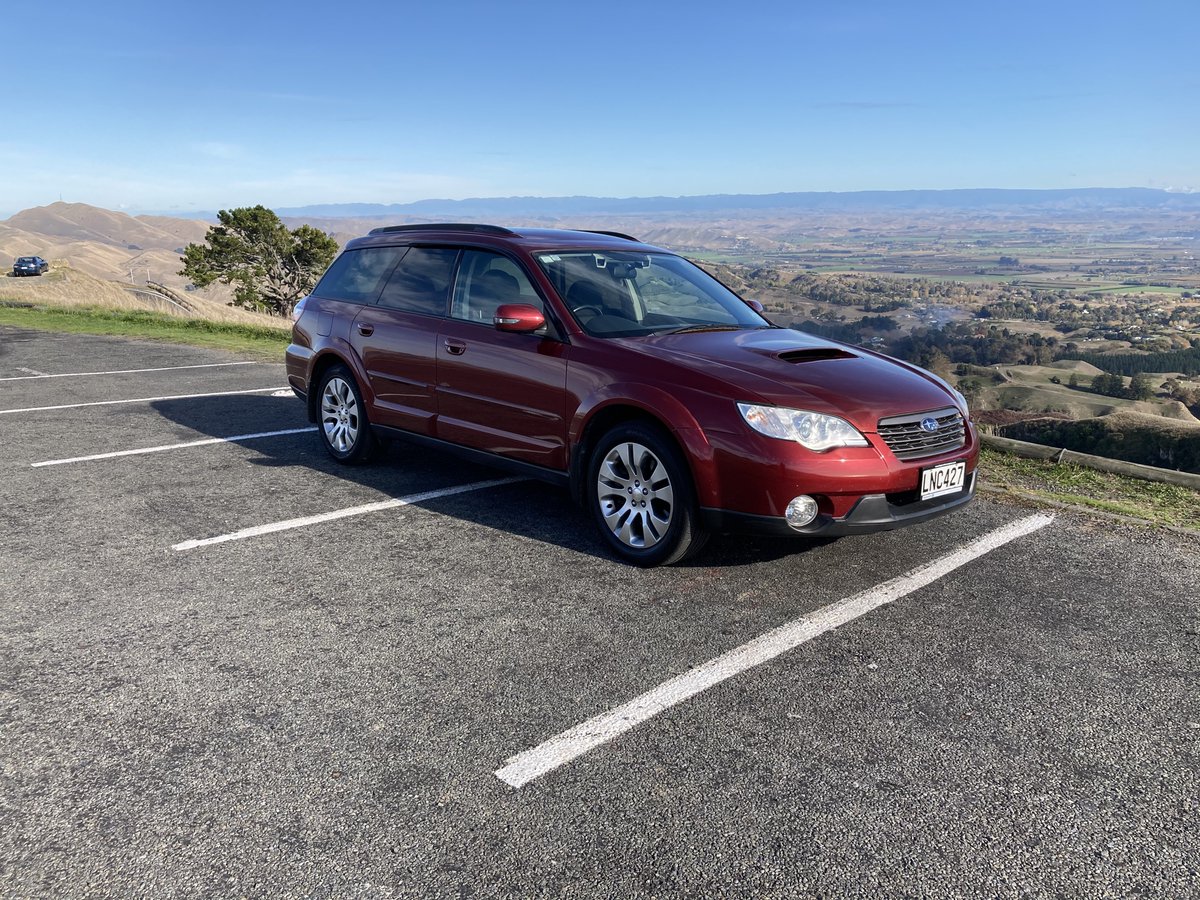
Re:Lithium battery costs have fallen by 98% in three decades by brucehoult on Saturday April 03, 2021 @06:55PM (#26685471)
My 2008 Outback 2.5XT has Eyesight adaptive cruise control including automatic breaking! Cost me US$6k a year ago with 55000 miles. Thirteen years old!
Re:Lithium battery costs have fallen by 98% in three decades by brucehoult on Saturday April 03, 2021 @06:50PM (#26685445)
My 2008 Subaru Outback 2.5XT (JDM model) has camera-based adaptive cruise control, lane departure warning, lead vehicle start warning ("stop looking at your phone"), and pre-collision braking. Also AWD, 265 HP turbo engine. I bought it for NZ$10k (US$6000) in May last year, with 87000 km. https://pbs.twimg.com/media/EnuwXA6VcAAH9MJ.jpg
Re:Lithium battery costs have fallen by 98% in three decades by VBprogrammer on Saturday April 03, 2021 @04:02PM (#26684250)
Time will tell but I've got my fingers crossed that in 15 years time any backstreet garage will exchange your battery on a car of that age for a cost proportionate to the fact that you could reasonably expect another 10 years of trouble free motoring. With luck with a 50% increase on its original capacity.
Re:Lithium battery costs have fallen by 98% in three decades by theshrike79 on Saturday April 03, 2021 @05:05PM (#26684731)
They already do. A battery swap/refresh/replacement for a Leaf is 5-10k€ over here, depending on how bad shape the original is and whether you want a larger battery in there.

It's kinda sorta doable by yourself, but it's a HVDC circuit so you _really_ need to know what you're doing.

Actual brand-name shops are slowly able to replace individual failed cell packs instead of just swapping the whole battery.

The big problem is that batteries aren't really failing and because of that the manufacturers don't really have a process in place for replacements, each operation is a custom job.

Re:Lithium battery costs have fallen by 98% in three decades by VBprogrammer on Sunday April 04, 2021 @02:47AM (#26687427)
> Leaf is 5-10k€

Those are pretty wide error bars, last time I looked at used Leaf's they were selling for somewhere in that range. Admittedly first gen leafs with the 24KWh battery.

Re:Lithium battery costs have fallen by 98% in three decades by wazoox on Saturday April 03, 2021 @04:40PM (#26684528)
The new Dacia Spring has a 27kWh battery and costs only 12k€. In the electric car market, the situation is evolving extremely rapidly.
Re:Lithium battery costs have fallen by 98% in three decades by Reason077 on Saturday April 03, 2021 @08:12PM (#26685895)
> "I bought my 2015 LEAF new and suspect it will not be economically viable in 2030"

Why not? There are already companies who specialize in replacing early-model LEAF batteries with new, higher-capacity ones. By 2030, I imagine this could be a pretty widespread industry - perhaps even rebuilding/remanufacturing OEM battery packs with new cells.

And so long as the battery still works, that LEAF will always be "economically viable" because unlike combustion vehicles, there are practically no ongoing maintenance costs.

Re:Lithium battery costs have fallen by 98% in three decades by sokoloff on Saturday April 03, 2021 @08:31PM (#26685974)
Because it will cost around $2-3K for the battery replacement on a car chassis that’ll be worth around $2K to get back to a range and set of features that won’t be competitive with the then-current (no pun intended) EVs or other $5K cars.

If you want to spend $5K on a car in 2030, you’ll have way better options than a 75 mile range, 6kW charging (20-24 miles per hour) 2015 LEAF (CHAdeMO will be fully dead by then and most 2015 LEAFs don't even have it.)

Re:Lithium battery costs have fallen by 98% in three decades by Reason077 on Sunday April 04, 2021 @12:40AM (#26686934)
A $5k, 75-mile used EV still offers a lot of utility and value because it will cost almost nothing to run and maintain.

No doubt you’ll be able to buy great $5k combustion cars in 2030, but ongoing fuel and maintenance means their true cost is a lot more than that! And in some parts of the world, increasingly stringent emissions controls mean that combustion cars become more expensive, or even illegal, to drive in cities.

You’re right about CHAdeMO, but anyone buying a 75 mile EV isn’t going to care too much about fast charging anyway. And by 2030, someone may have come up with a retrofit and/or adapter to make old LEAFs compatible with CCS?

Re:Lithium battery costs have fallen by 98% in three decades by sokoloff on Sunday April 04, 2021 @08:01AM (#26688774)
A 2018 model 3 or X might be a sub-$5K (in 2021 dollars) car by 2030. If they are, very few batteries will be replaced in old LEAFs. The faster that new EVs mature/evolve, the less comparative value older ones have meaning they will be getting scrapped when the next battery replacement is needed.

I do all the maintenance on our cars (ex- tires, body, and warranty/recalls). The LEAF has already had one battery repair under warranty (at around 17K miles, out of service for several weeks and likely a $2K+ repair at future independent rates-was 2 techs for most of a day plus pages of special sealants and consumables)

Other than that it has needed wipers and windshield fluid and that’s it. If that pattern keeps up, they’re still headed to the scrapyard en masse, I think.

Re:Lithium battery costs have fallen by 98% in three decades by theshrike79 on Sunday April 04, 2021 @10:29AM (#26689675)
I think there will be a secondhand market offering battery upgrades for older EVs. So they just won't install the exact same battery, but a bigger one or a smaller one (lighter, but same capacity).

10 years of R&D on batteries by some of the biggest corporations in the world should provide some new innovations.

Re:Lithium battery costs have fallen by 98% in three decades by deelowe on Saturday April 03, 2021 @10:15PM (#26686396)
I wish a battery replacement was 2 grand. Try like 8 if you can find one.
Re:Lithium battery costs have fallen by 98% in three decades by cookiengineer on Sunday April 04, 2021 @12:59AM (#26687003)
In general I agree with the renewable energy movement, and also with the ideas that come with modern approaches to electric mobility (like car sharing etc).

The only point I have left that I have to agree with, and that's a huge one, is recycling.

Our governments across the planet have failed to enforce sustainable recycling pipelines in the plastics industry, how would this be any different?

Why is my laptop battery useless after a year and has only 60% power capacity?

How is this even legal that warranty for batteries is 6 months?

I think that in order to make more sustainable battery tech, we need better recycling pipelines for it. And more important: all the plastics, chips, and pcbs needed around it need to be 100% recycled, not upcycled. And manufacturs reusing only 10% of their materials aren't worth a shit.

The ironic thing today is that a simple plumbum/acid based battery is more sustainable than a lithium ion one. It's energy density, however, is a joke. But it never gets useless, and is maintainable, and, more importantly, doesn't lose energy density over time so it's ideal for buildings that have a longer lifetime than a car.

Re:Lithium battery costs have fallen by 98% in three decades by richardw on Sunday April 04, 2021 @01:09AM (#26687043)
Checkout Ambri. Lots of videos on YouTube. I’d love to invest.

https://ambri.com/technology/

Anyone got any cons?

Re:Lithium battery costs have fallen by 98% in three decades by AnthonyMouse on Sunday April 04, 2021 @12:54AM (#26686990)
> Furthermore, nuclear plants take 5 to 10 years to even build.

But that's the problem.

The cost of solar and batteries is declining rapidly. For how long? We don't know. Exponential curves eventually flatten out. We had Dennard scaling until we didn't.

So the question is, do they get cheap enough before they hit the wall?

We have two choices. Choice one, build new nuclear plants, and then if alternatives are even cheaper, we pay the current/historical price for electricity for a while instead of some lower price (or the investors in the nuclear plants lose money, take your pick). This also gives us new nuclear plants to use to destroy all the stupid plutonium created by old nuclear plants, even if it costs more, and we really do have to get rid of that stuff.

Choice two, we don't, and bet everything that the alternatives get cheap enough before we hit the wall. In which case we're completely screwed if we bet wrong, because it takes a long time to build new nuclear plants, so if we don't start now by then it'll be too late.

Re:Lithium battery costs have fallen by 98% in three decades by adrianN on Sunday April 04, 2021 @01:05AM (#26687028)
They are already cheap enough. Renewables are much cheaper than nuclear and competitive with fossil fuels. We don't need another factor 10 cost improvement. All we need is political will to implement the change. We could be running 70% renewable in a couple of years if we wanted to. To get to 100% we might need to improve the cost effectiveness of power-to-gas facilities, but there is zero reason today not to replace the majority of our energy consumption with renewables.
Re:Lithium battery costs have fallen by 98% in three decades by AnthonyMouse on Sunday April 04, 2021 @01:19AM (#26687088)
They're cheap enough when they're not being used as baseload. To get to 100% renewable you would need to pay for storage and then have enough over-supply to deal with extended periods of overcast. That's a lot more expensive.

This is another reason to do both. Use nuclear for baseload and you remove all the storage you would need for solar to work overnight. Meanwhile demand is higher during the day when solar is generating, so still use that there. It reduces the amount of storage you need from the entire night to just the high demand period between sunset and when people go to bed.

> All we need is political will to implement the change.

You only need political will for subsidies.[1] You only need subsidies if it's not actually cheaper.

[1] Or regulatory approval, but let's not bind everything in red tape all around, shall we?

If it is cheaper then people just do it on their own without any government involvement.

Re:Lithium battery costs have fallen by 98% in three decades by adrianN on Sunday April 04, 2021 @01:49AM (#26687192)
Using nuclear for baseload doesn't work economically. Nuclear plant economics are such that you want to run them 100% all the time. Renewables sometimes produce pretty close to 0 energy. If you don't want to invest into storage you need nuclear capacity to cover close to all demand. If you have that capacity you don't need renewables. I don't think we can build nuclear plants quickly enough to prevent catastrophic warming.

If you instead use renewables, batteries, and power-to-gas you can also reach net-zero emissions without waiting twenty years until you have enough nuclear plants. Renewables and batteries are already cheap enough to compete with fossil fuels, and provide enough stability to reach a high percentage of the energy demand. 50% renewables is doable with hardly any storage at all. Power-to-gas can provide the storage needed for seasonal variations, but there are still cost problems with that.

Imo the lack of political will for the energy transformation mostly takes the form of unpriced externalities for fossil fuels. There still is no carbon price that is even close to the actual damages. Damages from the extraction of fossil fuels are not paid for by the companies either. Coal plants still emit tons of Mercury without paying for it. Aviation fuel is essentially untaxed. The list goes on and on.

Re:Lithium battery costs have fallen by 98% in three decades by AnthonyMouse on Sunday April 04, 2021 @02:53AM (#26687449)
> Using nuclear for baseload doesn't work economically. Nuclear plant economics are such that you want to run them 100% all the time.

That's what baseload is.

> Renewables sometimes produce pretty close to 0 energy.

Which is why they need storage, and storage is expensive. If you do half nuclear and half renewables, you only need half as much storage.

Less than half, because you can use pricing to shift demand.

Suppose you have 50 GW of nominal demand, but solar generation is at 10% of normal because it's overcast. You can get demand down to 40GW through price incentives. If you had 50 GW of solar which is down to 5 GW, you would need to cover 35 GW from storage. If you had 25 GW of solar which is down to 2.5 GW, and 25 GW of nuclear, you only have to cover 12.5 GW from storage. Less than half as much.

Re:Lithium battery costs have fallen by 98% in three decades by jerven on Sunday April 04, 2021 @09:45AM (#26689331)
Baseload tends to be about 40% of max load in most grids. i.e. having base production doesn't really change the economics of storage or over-provisioning etc. On the other hand because there is always, in this theoretical grid 60% overproduction potential your base load has real difficulty making money about 1/3rd of the time.

Baseload, is really minimal load in the grid. There are many ways to produce the minimal amount. Real difficult part is to provide the max load demand on the grid.

Basically current nuclear technology is inflexible in economic terms (also quite a bit in practical terms), shown historically by most grid storage being deployed when nuclear was being built out.

Re:Lithium battery costs have fallen by 98% in three decades by HeadsUpHigh on Sunday April 04, 2021 @03:40AM (#26687611)
Real engineering reviewed a paper that claimed we have cheap enough renewables to do ~80% of electricity from them right now. For the rest 20% we would need massive price drops on the battery side but just that 80% alone would cause a pretty massive decrease in price due to economies of scale.
Re:Lithium battery costs have fallen by 98% in three decades by ComodoHacker on Sunday April 04, 2021 @12:59AM (#26687004)
So, diversify and do both?
Re:Lithium battery costs have fallen by 98% in three decades by AnthonyMouse on Sunday April 04, 2021 @01:01AM (#26687013)
Exactly.

And for extra points, this phases out oil and coal faster. 1TWh of solar replaces 1TWh of coal, but 1TWh of solar and 1TWh of nuclear replaces 2TWh of coal.

Re:Lithium battery costs have fallen by 98% in three decades by markdown on Saturday April 03, 2021 @04:27PM (#26684435)
> a car lasts only 10-15 years

Is this normal where you live (presumably the US)? I find that really wasteful. Cars last twice that in my country, and we have tropical, seaside (salt = rust) weather to deal with.

Re:Lithium battery costs have fallen by 98% in three decades by mlindner on Saturday April 03, 2021 @05:09PM (#26684768)
There's a lot of variation in the US depending on where you live. In California the car can be so old the paint has all come off but there's hardly any rust on the car because the air is very dry, it doesn't rain much, temperature variation is low and salt isn't used on roads. On the other hand you can be places like Canada or the northern midwest where Temperature swings by 100F between summer and winter, salt is used heavily on roads to melt snow, rain is common during the warmer months, and humidity levels in the summer are high. This causes cars, especially those not in covered garages to quickly rust and not last more than 15 years or so before too many components and body frame have rusted away.
Re:Lithium battery costs have fallen by 98% in three decades by yellowapple on Sunday April 04, 2021 @06:19AM (#26688221)
And meanwhile, my Highlander will be old enough to drink in a couple years, has lived everywhere from the East Coast to the Bay Area to (currently) the Great Basin, has been taken offroad on multiple occasions, has handled dozens of blizzards like a champ, and (knock on wood) is still hanging in there, even with my rather inconsistent maintenance.

So I'd say a lot of this depends on the model, and possibly the make.

Re:Lithium battery costs have fallen by 98% in three decades by bdcravens on Saturday April 03, 2021 @04:43PM (#26684555)
25% of cars are 16+ years, and the longevity of cars is increasing

https://www.cnbc.com/2020/07/28/25percent-of-cars-in-us-are-...

Re:Lithium battery costs have fallen by 98% in three decades by Tagbert on Saturday April 03, 2021 @05:10PM (#26684780)
In the US, the average age of all cars is 12 years, so a 10-15 year lifespan is pessimistic.
Re:Lithium battery costs have fallen by 98% in three decades by vmception on Saturday April 03, 2021 @04:36PM (#26684503)
Is there a good way to quickly understand this for any topic?

Like, take something you might not be interested in and just "don't get". Your conclusions will be very quick but based on the current state of things.

The people that "do get it" might be crazy, or they might be seeing a longer trend that they've been following so long that they never articulated it, and aren't even capable of articulating it.

How is one supposed to form opinions on new topics where the state rapidly changes?

Re:Lithium battery costs have fallen by 98% in three decades by philipkglass on Saturday April 03, 2021 @05:03PM (#26684717)
There is no easy shortcut. There are some people who have kept up with academic research, commercial developments, and trend lines over enough time to filter out short term noise. Some of them blog or write long comments on HN. But unless you are one of those people yourself, you won't be able to tell which writers are trustworthy.

You can rapidly filter a lot of noise out of energy news with knowledge of physics and chemistry from 100-level university courses (or equivalent) [1]. But most people never acquired this knowledge and a lot of those who have only retained it long enough to pass tests in school. 10 years later they don't remember the difference between power and energy or why some chemical reactions are exothermic and others endothermic.

[1] This knowledge is actually helpful to filter news in general when it makes assertions about the physical world.

Re:Lithium battery costs have fallen by 98% in three decades by baybal2 on Saturday April 03, 2021 @02:44PM (#26683575)
> Say you have an opinion piece in a news paper that says that electric cars will always be expensive toys for the rich.

Well, you don't see poor people buying EVs that much. That's car manufacturer statistics, which I believe deserves a good degree of trust.

In the market for new cars, poor people buy cheapest IC cars, but not cheapest EVs.

I will take the point that middle class is now buying budget EVs, but you don't have real economy class EVs selling that well in the West, and in China as well.

Wuling Mini EV will classify as a true economy class EV, but what people lauding it don't say it that Chinese IC vehicles in the same price range outsell Mini EV many, many times over.

Re:Lithium battery costs have fallen by 98% in three decades by audunw on Saturday April 03, 2021 @03:26PM (#26683944)
> Well, you don't see poor people buying EVs that much.

You don't see poor people buying new cars that much. Which for now is pretty much the same thing as not buying EVs, since almost all EVs on the road are relatively new.

That's starting to change here in Norway. There's a decent amount of used EVs entering the second-hand market. And if you can deal with the short range it's definitely preferable to buy one, since they're way more reliable than on older used ICE.

The other things helping people buy cheaper EVs here is that it's easier to deal with the shorter range since you have fast charging stations everywhere now.

So what needs to improve is: - More used EVs (just have to get middle class people to buy more EVs and wait 5-10 years) - Better charging infrastructure (again, get the middle class to buy EVs to help fund the build-out) - Cheaper EV batteries (again, just get whoever can to buy more EVs, to fund R&D and drive economies of scale)

That's why it's so damaging when countries make EV incentives with caps. Just make it a percentage of the price (or cut all taxes) and don't worry about the benefits going to rich people buying luxury EVs. Increase income taxes on the rich instead if that's a problem. This is like the one case where trickle-down economics kind of work, since buying expensive EVs now makes future EVs and charging stations cheaper.

And I think cheap BEVs will be a HUGE benefit to poor people in the future, since it saves on gas and maintenance costs in the long term.

Re:Lithium battery costs have fallen by 98% in three decades by elihu on Sunday April 04, 2021 @02:34AM (#26687372)
The other way that EVs enter the market is that someone takes a gas-powered car and converts it to electric. It's not a particularly common thing to do, for multiple reasons. It's time consuming, expensive, and requires tools and space, and a certain amount of expertise or willingness to learn.

The may be a lot of people who have the time, inclination, space, and access to tools to do a conversion but are blocked by the cost barrier. That probably includes at least some poor people. Mostly I'm thinking of young college-age people who might not necessarily be experiencing poverty but also don't have any significant wealth either. Maybe they live with their parents and are having trouble finding work.

I'd like to see EV conversions have the same level of subsidy as OEM cars; that could make it a worthwhile and cost-effective endeavor for a lot of people. It could also provide jobs for local mechanics, for customers who don't want to do the work of converting the vehicle themselves. There are a lot of gas-powered cars on the road. They aren't all worth converting, but some of them are. It seems a waste to replace them all rather than convert the ones worth converting.

Re:Lithium battery costs have fallen by 98% in three decades by yellowapple on Sunday April 04, 2021 @06:08AM (#26688175)
There's also a bit of an annoyance w/ EV conversions, at least here in the US: automatic transmissions being pretty much ubiquitous. They're basically dead weight for an EV (which doesn't need to switch gears), and they further tend to have a lot of mechanical and electrical complexity.

I suspect that if I ever convert my Highlander to an EV (which is something I'd like to investigate should its current drivetrain eventually give up the ghost), it'll likely entail needing to remove the transmission entirely (and maybe replace it with a fixed gearbox of some sort?). And given that it's AWD, that complicates things further, since there are very few AWD/4WD EV conversions.

That said, if there are solutions to this problem, and said solutions prove viable, then this makes EV conversion a lucrative business, and opens it up to most cars on American roads.

Re:Lithium battery costs have fallen by 98% in three decades by elihu on Monday April 05, 2021 @12:17AM (#26695306)
Transmissions aren't entirely dead weight; being able to switch gears means you can get away with using a smaller motor than you otherwise would. You also don't need to worry quite so much about getting a motor rated for super high RPM.

Converting something with a manual is probably easier than an automatic (especially if there's some software controlling when to shift the automatic based on some engine sensors which aren't there anymore), but there's no fundamental reason why you couldn't just keep the transmission even in an automatic. Especially if bolting a motor on where the engine was is far simpler than re-engineering half the drive train. (You might be able to get rid of or disable the torque converter, though.)

At this point I think the biggest roadblocks to EV conversion are cost and availability of parts so you don't have to design and build everything from scratch. And I think subsidizing conversions would help with both of these. If there's a big enough market, you might even get reasonably priced kits (possibly from the original vehicle manufacturer) that has everything you need including battery boxes and can be installed by someone who's done it before in less than a week.

(Battery boxes are usually the most difficult and time consuming part of a conversion, since they're usually constructed in an ad-hoc way to fit whatever battery you're using into wherever they would fit. Having something that's actually engineered and possibly even crash tested would be great.)

Re:Lithium battery costs have fallen by 98% in three decades by tonyedgecombe on Saturday April 03, 2021 @05:26PM (#26684884)
> And I think cheap BEVs will be a HUGE benefit to poor people in the future, since it saves on gas and maintenance costs in the long term.

I’ve been wondering whether the opposite is true. We might find the cost of replacing the battery puts a floor on the price of old EV’s. I wouldn’t be surprised if we are coming to the end of bangernomics.

Re:Lithium battery costs have fallen by 98% in three decades by Qwertious on Saturday April 03, 2021 @09:53PM (#26686332)
We already have million-KM batteries, and we're headed toward million-mile batteries.

Even if the battery does die, I wouldn't be surprised to see a lot of secondhand batteries with half a million Ks of mileage put up relatively cheap. You don't need to go straight to brand-new.

Re:Lithium battery costs have fallen by 98% in three decades by baybal2 on Saturday April 03, 2021 @03:36PM (#26684019)
> And I think cheap BEVs will be a HUGE benefit to poor people in the future, since it saves on gas and maintenance costs in the long term.

I believe the same, if you race for the lowest cost possible, eventually an EV will be cheaper than the cheapest IC powered car for those exact reasons.

... But as I said above. Wuling MiniEV costs like $5500, which is cheaper than low-end Chinese petrol, or diesel engined sedans priced at $7000-$8000, but is still massively, massively outsold by IC cars in its price bracket despite China's massive subsidies for EVs, and quite draconian curbs on IC powered cars.

Re:Lithium battery costs have fallen by 98% in three decades by Robotbeat on Saturday April 03, 2021 @05:33PM (#26684928)
In part because the MiniEV has really low range (think first generation Leaf) whereas any IC car is gonna be like a Model 3 at least.

200 miles (on the EPA cycle) really is the minimum for a pure electric car IMHO. 250 miles, really. Otherwise it looks like less of a value than an IC car.

Re:Lithium battery costs have fallen by 98% in three decades by yellowapple on Sunday April 04, 2021 @06:11AM (#26688193)
It seems like there should be a removable gasoline or diesel generator purely for range extension. For day-to-day commutes and errands near home, leave the generator at home and save on weight. For long-distance trips, bring the generator with you.
Re:Lithium battery costs have fallen by 98% in three decades by baybal2 on Saturday April 03, 2021 @05:55PM (#26685095)
Depends who you ask. For most people in the world, even 60km-80km will be more than enough.
Re:Lithium battery costs have fallen by 98% in three decades by WebDanube on Saturday April 03, 2021 @02:54PM (#26683663)
I'm not a free market apologist by any means, but we also didn't see "poor people" or folks in the lower economic strata buy mobile devices and smartphones when they became first available, at least not the scale we're seeing now (without mentioning the fact that the devices were crazy expensive when first launched, adjusting for inflation).

Economy of scale is a thing, and imo it's OK to use the rich and the wealthy as 'guinea pigs' of sorts (which mostly is voluntary as the wealthy are more likely to make riskier bets on new tech than people living paycheck-to-paycheck).

As EV market extends downwards on the economic 'pecking order,' I'm really hoping even more drastic cost reduction and lower barriers of entry into the EV market for folks that are not rich.

Re:Lithium battery costs have fallen by 98% in three decades by iagovar on Saturday April 03, 2021 @03:13PM (#26683828)
An expensive phone is about 500-1000€. A cheap EV is in the 20K neighborhood, and the functionality is pretty bad compared to a cheap second-hand utility car (pretty hard to travel outside your city). Even when regulations push prices up, it's still far more economical to buy a cheap gas car than a cheap EV.

Even in Europe there are plenty of countries where many people can't afford an EV. They can afford second-hand ICE cars. So unless there can be a second-hand market of EVs for about 6K without worrying about the battery, and with a similar functionality of a second-hand ICE car, then yes, EVs will be for upper income brackets.

And I'm not even mentioning that most people lives in apartment buildings, and it's very likely that your car sleeps in the street.

I've seen this discussions around here. People won't buy EVs in the near future because they are expensive, have very low range, you have to have a house, or own a flat (because nobody will pay for a charger installation in a rented flat) with garage, etc.

What people is buying is little electric Scooters. Most of them are <500€ and you can charge em everywhere. It makes sense for travelling inside a city. Spending 20K for not being able to go from Santiago to Madrid, doesn't make any sense.

Re:Lithium battery costs have fallen by 98% in three decades by the8472 on Saturday April 03, 2021 @04:12PM (#26684332)
Nissan leafs are get into the price range and they're basically first-generation mass-market EVs. Yes people do buy these. And in some european cities street-side/lamppost chargers already are a thing. Multiple conditions are only going to get better, not worse.
Re:Lithium battery costs have fallen by 98% in three decades by iagovar on Saturday April 03, 2021 @04:34PM (#26684481)
Nissan Leafs are ~20k for Km0 offers in Spain. They are very limited cars in range, functionality is behind than a 10K Km0 Fiat Panda. Street chargers are scarce, and usually expensive, and I have a hard time picturing a charger in every parking space in my city.
Re:Lithium battery costs have fallen by 98% in three decades by the8472 on Saturday April 03, 2021 @05:42PM (#26684993)
> Km0 offers

That hardly qualifies as a second-hand market car.

> Street chargers are scarce, and usually expensive

In the past they didn't exist. Today they're scarce. In the future it'll look different. This thread is about trends after all.

> And I have a hard time picturing a charger in every parking space in my city.

We can start smaller of course, it only needs to be scaled up with EV adaoption, not reach 100% penetration immediately. The electric scooters you mentioned would benefit too.

Re:Lithium battery costs have fallen by 98% in three decades by iagovar on Sunday April 04, 2021 @02:52AM (#26687445)
I used Km0 for giving the electric a chance.
Re:Lithium battery costs have fallen by 98% in three decades by ClumsyPilot on Sunday April 04, 2021 @08:05PM (#26693970)
"because nobody will pay for a charger installation in a rented flat"

Where did you get this idea? People pay for an AC, a conciege, a cycle room, a roof terrace, a fucking gardener but they wont pay for a charging point? Also why does it have to be rented?

Re:Lithium battery costs have fallen by 98% in three decades by iagovar on Wednesday April 07, 2021 @09:45AM (#26724834)
Most people in Europe lives in rented flats. A charger installation is rather expensive for most of us outside of a few selected countries.

People in Switzerland, Norway, or maybe some part of Germany may have no problem. For me it's a rather heavy price.

Not to mention dumping capital on an asset which isn't even yours. No thanks.

Re:Lithium battery costs have fallen by 98% in three decades by noahtallen on Saturday April 03, 2021 @02:55PM (#26683677)
There’s still a large difference between upper-middle class and upper class. I think many middle class jobs can support owning a Tesla Model 3 or other mid-range new car but not a Porsche.

When I hear “expensive toy for the rich”, I think of a millionaire’s 3rd lambo, not Bill’s Silverado lease. Initial Teslas were sports cars, and now it’s squarely in middle class territory. Still a big improvement and a big market, and in several years, that leads to a good second-hand market and even cheaper EVs.

I think for many (not all, of course) people the problem is not price as much as practicality. I could probably be convinced to spend more for an EV, but without chargers in most apartment buildings and with limited charging networks where I might go, it’s not justifiable yet.

Re:Lithium battery costs have fallen by 98% in three decades by xyzzy21 on Saturday April 03, 2021 @03:07PM (#26683776)
Not when I can buy an ICE and operate for cheaper - note the nearest "charge station" to me is 30+ miles away and then the next nearest is 100+ miles beyond that.

The drop in diesel and gasoline prices recently only cements the value of an ICE vehicle.

Re:Lithium battery costs have fallen by 98% in three decades by turtlebits on Saturday April 03, 2021 @04:14PM (#26684348)
Unless you drive a lot, you can charge at home?

It costs me about $6.00 to charge my 60kwh EV, which has a range of 238 miles.

Re:Lithium battery costs have fallen by 98% in three decades by toast0 on Saturday April 03, 2021 @04:33PM (#26684472)
It's been a while since I rented a place to live, but charging infrastructure for rentals is a big issue.

You can't buy an EV if you can't charge at home. And you won't buy an EV if you can charge at home if you're not sure you can charge it if you move. (Not to mention if you think you might move to another state, not being able to drive your car there is a question mark)

Re:Lithium battery costs have fallen by 98% in three decades by noahtallen on Saturday April 03, 2021 @04:17PM (#26684372)
That’s why I mention practicality! I think yes, for people who strictly buy the cheapest car that’s not bad, it will be some time before EVs are viable.

But many people, including myself, think that EVs are better in general. If I was comparing a $15k car to a $20k car, I could be convinced to spend more on an EV if I was just comparing the vehicles themselves in an ideal environment. But that decision doesn’t make sense until the “practicality” problem is solved.

Re:Lithium battery costs have fallen by 98% in three decades by ClumsyPilot on Sunday April 04, 2021 @08:10PM (#26694009)
Thats not how people buy cars.

People buy BMW but they are not the most cost-efficient cars. People buy cars in London , using public transport is cheaper. Cars are prestiege, a point of pride, 'Freedom', an obsession, a place to have sex, and more to all kinds of people.

Re:Lithium battery costs have fallen by 98% in three decades by iagovar on Saturday April 03, 2021 @03:20PM (#26683895)
> I think many middle class jobs can support owning a Tesla Model 3

In a handful of countries.

Re:Lithium battery costs have fallen by 98% in three decades by noahtallen on Saturday April 03, 2021 @04:20PM (#26684392)
I can’t disagree with that. I feel like the EV conversation is centered on “richer” countries anyways because of infrastructure and tech. I’d be curious to learn how EVs are being approached in countries which are still developing infrastructure
Re:Lithium battery costs have fallen by 98% in three decades by baybal2 on Saturday April 03, 2021 @06:01PM (#26685136)
> I feel like the EV conversation is centered on “richer” countries anyways because of infrastructure and tech.

I'd say EV are making inroads there exactly because of no infrastructure, and tech.

In Vietnam, people choose electric scooters over petrol largely because their maintainance free nature, and no need for fluids, or waiting at petrol pumps.

People like that they don't risk expensive, and lengthy breadown of their scooter when their job depend on it.

Re:Lithium battery costs have fallen by 98% in three decades by lanstin on Saturday April 03, 2021 @05:47PM (#26685039)
They have electric tuk-tuks already. I think batteries / electric motor are inherently simpler to operate, if not fabricate, than ICE so likely to be cheaper at the mass scale. Even solar + batteries + electric motor. And they scale up and down - you can tiny electric things and giant electric things.
Re:Lithium battery costs have fallen by 98% in three decades by Animats on Saturday April 03, 2021 @03:43PM (#26684080)
US manufacturers still see EVs as a premium option. Batteries are getting cheap, but it's not showing up in vehicle prices.

Jeep has backed off, yet again, from producing an all-electric Jeep Wrangler. They originally announced one for 2020. Then 2021. Then 2022. They shipped some "mild hybrid" things. They just showed an all-electric Jeep Wrangler, but it's a "concept car" only. And, for some reason, has a 6-speed manual transmission.

Even when Jeep was still talking about a 2022 Wrangler EV, it was announced as being available only at the highest "trim level", priced 2X over the base product.

Ford just slipped the electric Ford F-150 to the 2023 model year. "The estimation for the base price is $100,000" says one source. For a pickup truck whose current base price is $28,940. Ford's electric Mustang starts at $61,000. The base gas-powered Mustang is $27,155.

This seems to be a pattern with US manufacturers. Electrics cost 2x the price of the gas model.

Re:Lithium battery costs have fallen by 98% in three decades by reitzensteinm on Sunday April 04, 2021 @06:51PM (#26693520)
The Mach-E starts at $43k.
Re:Lithium battery costs have fallen by 98% in three decades by JumpCrisscross on Saturday April 03, 2021 @02:48PM (#26683606)
> you don't see poor people buying EVs that much

You do, however, see upper middle class people buying them. Which wasn't the case a decade ago, when the Leaf came out [1].

[1] https://en.wikipedia.org/wiki/Nissan_Leaf

Re:Lithium battery costs have fallen by 98% in three decades by Gibbon1 on Saturday April 03, 2021 @03:19PM (#26683885)
> you don't see poor people buying EVs that much

Poor people buy 5 to 15 year old used cars. There aren't that many 5-15 year old used EV's.

Yet.

Re:Lithium battery costs have fallen by 98% in three decades by nickik on Saturday April 03, 2021 @03:54PM (#26684173)
Well, this is the argument against EV from the beginning. Literally people were shitting on Tesla because they started with a the Roadster.

Now they have a much, much better car for significantly lower price produced at much, much higher volume.

This is just gone continue, each generation produced will move down market.

Poor people will never buy new cars, but 2nd hand Bolt EV are already a bargain considering what you save on fuel cost.

As more EV are produced, more EV are gone be sold second hand. And at the same time new cheaper EV are gone be interceded in the market.

There is no inherent reason why an EV should be more expensive then a gas car, but there is a 100 year technology and infrastructure gap, this gap needs to be filled by the rich, upper middle class and now the middle class.

This is basically the same with every new mass technology.

Re:Lithium battery costs have fallen by 98% in three decades by cbozeman on Saturday April 03, 2021 @06:18PM (#26685252)
Bolts are a bargain right now because of a safety issue so serious it has a STOP-SELL RECALL order, meaning dealerships aren't allowed to sell them until its fixed, which happens sometime this month.

https://electrek.co/2021/02/18/bolt-ev-recall-chevy-software...

Re:Lithium battery costs have fallen by 98% in three decades by 908B64B197 on Saturday April 03, 2021 @02:49PM (#26683619)
How about hybrids like Priuses?
Re:Lithium battery costs have fallen by 98% in three decades by godelski on Saturday April 03, 2021 @11:44PM (#26686735)
> This is important to keep in mind when you read articles and/or studies about how electric cars or wind or solar power is impractical. A lot of the data these studies use is just obsolete.

My understanding is that phone batteries are extremely different from batteries for large storage. They have vastly different cycle and draw requirements (you can't quick draw on your phone battery). I don't think these studies are being nefarious, but looking at different batteries, where this article is averaging. Reading the article it doesn't give any inclination that they are differentiating these types of batteries.

Re:Lithium battery costs have fallen by 98% in three decades by danans on Sunday April 04, 2021 @11:37AM (#26690278)
IIRC, Tesla's first car batteries were made from laptop cells.
Re:Lithium battery costs have fallen by 98% in three decades by minitoar on Saturday April 03, 2021 @02:39PM (#26683524)
Are there many gains to be had on electric motors? I guess I sort of assumed those had seen quite a bit of optimization already.
Re:Lithium battery costs have fallen by 98% in three decades by Robotbeat on Saturday April 03, 2021 @05:23PM (#26684869)
Yes. A big improvement over the last few decades is rare earth magnets, which have reduced the mass, increased the power and efficiency. (Rare earth magnets in car motors can be and are recycled, FWIW.)

Additionally, the power electronics have improved a lot, too, and continue improving.

As others have noted, Tesla went from their induction motors (which use no rare earths) to a somewhat more efficient combination of switched reluctance and brushless DC motor using some rare earth magnets.

There are also various improvements to rare earth magnets. Magnetic energy density improves somewhat. Cooling schemes improve. Even alternatives to rare earth magnets (certain phases of iron or nickel, for instance) have been and are studied.

I think improvements in cooling schemes is a big part of future improvements. As well as reduction in eddy current losses through better litz wire, maybe playing with the grain structure of the conductor, etc.

Longer term, there's also the possibility of superconducting motors. Although that's mostly for larger scale applications, (near-)room temperature superconductors also have been demonstrated and folks are searching for methods to allow them to work at lower pressures.

So I think there's actually lot of room for improvements beyond low effort prototypes from big automakers. Tesla is doing really well with high efficiency powertrains. There's also the added dimension of integration with reduction gearing (as electric motors like to spin fast).

Re:Lithium battery costs have fallen by 98% in three decades by iknowstuff on Saturday April 03, 2021 @02:56PM (#26683686)
> The engineers of Tesla motor's shocked everyone when they abandoned the versatile induction motor in Model 3 cars. They used a totally different motor called IPM-SynRM. Let's understand why the Tesla engineers made this crucial design change.

https://www.youtube.com/watch?v=esUb7Zy5Oio

Re:Lithium battery costs have fallen by 98% in three decades by ninjinxo on Saturday April 03, 2021 @03:12PM (#26683818)
Hrmm, so the cost and performance is much the same, but it adds value by creating a new talking point for Tesla owners to harangue others with.
Re:Lithium battery costs have fallen by 98% in three decades by callmeal on Saturday April 03, 2021 @03:53PM (#26684170)
>Hrmm, so the cost and performance is much the same, but it adds value by creating a new talking point for Tesla owners to harangue others with.

I know that hating on Tesla is a thing, but don't forget the higher torque, better efficiency, lower heat generation in the stator windings. And the fact that this type of motor first showed up in the Prius and Tesla made a better version of it. Yeah they're getting away with saying they invented it Prius were touting their continuously variable transmission instead of thier motors.

Re:Lithium battery costs have fallen by 98% in three decades by Robotbeat on Saturday April 03, 2021 @05:31PM (#26684913)
I'm as big of a Tesla fan as any, but I'm both continuously impressed with how ahead-of-its-time the Prius was and continuously disappointed how lack-luster Toyota has been in pure electric cars. Toyota had like a decade lead on everyone else and just.... sat on it. Only invested in hybrids and hydrogen (which was and is a dead end).

Toyota could've gone all-in on pure electric cars (and better plug-in hybrids than they had at the time) a good decade ago but instead they continue to waste money on hydrogen.... Only now finally announcing pure-electric cars in the US: https://www.theverge.com/2021/2/10/22187113/toyota-electric-...

It's really sad. It's really bad for the climate that they just sat on the Prius drivetrain, which is 95% of the way to a pure electric car, for over two decades (it was released in 1997... it's 2021 right now!).

Literally, people have modded (i.e. added extra battery capacity) Priuses from 2003 to be pure electric even at highway speeds with the same motor and controller. They had everything sitting right there. It's incredibly frustrating.

Re:Lithium battery costs have fallen by 98% in three decades by simpleguitar on Saturday April 03, 2021 @07:35PM (#26685690)
For Toyota, it wasn't the engineering, design, nor the manufacturing that was the bottleneck. It was sourcing of the batteries.

Toyota sold 100k Priuses it's first year (2005), and peaked at 237k Priuses in 2012. At that time, nobody had the capacity (nor the materials), to produce that many battery packs for full EV use. In hind sight, they could have committed fully to LiIon batteries for the future, but in early 2000s, it wasn't clear at all what technology would actually win. The contenders were, as I recall, hydrogen, rechargeable batteries, and bio-fuels. Toyota had concept vehicles for each of those, and the hybrid-electric was the practical compromise at the time. Toyota, being a large scale manufacturer, could not design a car around a critical component which were in short supply, like LiIon batteries.

Tesla decided to go the rechargeable route, invested heavily in battery manufacturing, and bet on LiIon analog of Moore's Law. Since they weren't going to sell 100k vehicles any time soon, they could scale along the way. Tesla didn't deliver 200k vehicles until 2018. (On a side note, Tesla also had Elon leading it. All of his 'crazy ventures' lead to colonizing Mars. What kind of a vehicle would be most practical on Mars? Not gasoline. Not hydrogen. Yep, EV. And what internet technology is the most practical on Mars? Yep, satellite constellations. What transport technology is the most practical on Mars? Underground tunnels. And so on.)

Currently, all the automakers except Tesla are scrambling to secure battery capacity. Tesla is in a very nice position right now.

Re:Lithium battery costs have fallen by 98% in three decades by Tuna-Fish on Sunday April 04, 2021 @03:52AM (#26687655)
Not just that, but Toyota also made the bet that solid-state batteries will be better than aqueous electrolyte li-ion ones, and that they will be available soon. With that assumption, it would be foolish to invest a lot into li-ion battery manufacturing.

Turned out, solid state batteries are much harder to mass-produce than they thought. Supposedly they will have prototype this year.

Re:Lithium battery costs have fallen by 98% in three decades by yellowapple on Sunday April 04, 2021 @05:59AM (#26688146)
> All of his 'crazy ventures' lead to colonizing Mars

Counterpoint: that flamethrower, which probably won't be of much use in a thin atmosphere lacking oxygen.

Re:Lithium battery costs have fallen by 98% in three decades by RhodoGSA on Saturday April 03, 2021 @10:59PM (#26686559)
best currency for mars? Crypto.
Re:Lithium battery costs have fallen by 98% in three decades by minitoar on Sunday April 04, 2021 @10:38AM (#26689757)
Haha, I wonder if there is some sort of coin protocol that could be compatible with the deep space network. That latency seems like it could really mess things up.
Re:Lithium battery costs have fallen by 98% in three decades by simpleguitar on Sunday April 04, 2021 @01:43AM (#26687167)
Hahaha, didn't think of that one!

DogeCoin FTW!

Re:Lithium battery costs have fallen by 98% in three decades by theshrike79 on Sunday April 04, 2021 @10:43AM (#26689799)
> how lack-luster Toyota has been in pure electric cars

It's not Toyota's fault, it's a government mandate in Japan. That's why the CEO of Toyota has bashed full EVs in public and why Toyota is the only manufacturer actually pushing fuel cell vehicles instead of going all-in on EVs like everyone else.

From Japan: Strategic Hydrogen Roadmap [0]

> Japan’s Prime Minister, Yoshihide Suga, recently announced that Japan will aim to achieve net zero greenhouse gas emissions by 2050. To decarbonise its economy, Japan is increasingly looking to future fuels such as hydrogen and innovative technology.

> Japan’s Hydrogen Roadmap has an ambitious goal of: > 40,000 fuel cell vehicles by 2020; 200,000 fuel cell vehicles by 2025; and 800,000 by 2030; > 320 hydrogen refuelling stations by 2025; and 900 by 2030; and > 1,200 fuel cell buses by 2030.

> In Japan there are currently: > 3,800 fuel cell vehicles; > 135 hydrogen refuelling stations; > 91 fuel cell buses; and > 250 fuel cell forklifts.

Basically Japan's problem is two-fold. Their electric network is a 100V system, split to 50Hz and 60Hz sections because of historical reasons. There's no realistic way to build a charging network for electric cars in Japan.

The second part of the problem is that Japan is also heavily reliant on imported coal and natural gas for its electricity production[1] (around 60-70%).

They're betting on Hydrogen fuel cells, because that is the one thing they can produce themselves and not rely on other countries so heavily.

[0] https://www.mfat.govt.nz/en/trade/mfat-market-reports/market... [1] https://en.wikipedia.org/wiki/Electricity_sector_in_Japan

Re:Lithium battery costs have fallen by 98% in three decades by jdofaz on Monday April 05, 2021 @08:01PM (#26706280)
In the early 2000s Chevron bought up the patent rights for NiMH batteries and refused to grant licenses for large batteries. Toyota was sued for patent infringement for their 90s RAV4EV and settled with Chevron.

Supposedly Tesla's early cars used off the shelf lithium ion laptop battery cells to get around these patent issues.

https://en.wikipedia.org/wiki/Patent_encumbrance_of_large_au...

Re:Lithium battery costs have fallen by 98% in three decades by elihu on Sunday April 04, 2021 @01:26AM (#26687109)
There's some gain to be had in terms of efficiency, but not much. Induction motors are I think generally approaching 90%, and SRIPM-type motors are in the mid 90's.

Probably the biggest gains going forward will be around improving the ratio of power output to weight, and reducing manufacturing costs (of both the motor and the controller). Maybe also increasing maximum RPM and improving durability, for whatever application where current motors aren't good enough.

It might also be nice to have more standardization and modularity. In the EV conversion world, there's kind of a defacto standard of motors made specifically for conversion mostly using a B-face with a 1 1/8th inch shaft with a quarter inch key slot. That helps a lot, as you can buy a motor from one company and a transmission adapter plate and coupler from another company and have pretty good odds it'll work. There are apparently ways to get almost any motor to work with almost any transmission, but that usually requires custom fabrication. (Obviously you can also ditch the transmission and just connect the motor directly to the drive shaft or transaxle or whatever. I don't know much about that route.)

Re:Lithium battery costs have fallen by 98% in three decades by dzhiurgis on Saturday April 03, 2021 @05:19PM (#26684847)
Heat scavenging is probably biggest efficiency gain you can get. Tesla was relatively late to add heat pumps, but did innovate with octovalve (which has like 8 modes of heat distribution, one of which is storing something like 2kwh of heat in battery volume itself).
Re:Lithium battery costs have fallen by 98% in three decades by fulafel on Saturday April 03, 2021 @03:14PM (#26683843)
They are so close to 100% efficiency that the possible gains are modest.
Re:Lithium battery costs have fallen by 98% in three decades by sbeller on Saturday April 03, 2021 @06:02PM (#26685143)
Look at it the other way round: they could reduce losses from 6% to 4%, which lead further savings in needing less cooling tech.
Re:Lithium battery costs have fallen by 98% in three decades by pappn on Sunday April 04, 2021 @03:10AM (#26687507)
Note that the impressing 9x% efficiency rates that we hear about are peak efficiency rates. There is something to gain in widening the operating ranges of this efficiency also. See for instance https://www.researchgate.net/figure/Efficiency-maps-of-sever...
Re:Lithium battery costs have fallen by 98% in three decades by aaronblohowiak on Saturday April 03, 2021 @03:25PM (#26683937)
what is the cost of the motor vs the cost of the input materials? what % of the cost of a vehicle is the cost of the electric motor? My understanding (however limited here) is that car-worthy motors are still priced at a bit of a premium to their input materials, but it doesnt really matter because overall they are still not that expensive compared to batteries.
Re:Lithium battery costs have fallen by 98% in three decades by elihu on Sunday April 04, 2021 @01:43AM (#26687169)
Yeah, some motors have rare-earth permanent magnets which are expensive. Induction motors don't, they just have a weird squirrel-cage structure made of (I guess) copper. Probably the manufacturing inputs for an induction motor are cheap, but the motors are a bit inefficient.

I'm currently doing a conversion that uses a Netgain Hyper9 [1]. They cost about four and a half thousand dollars (including controller) and they're pretty bulky and heavy. They're really efficient though. An OEM manufacturer I'm sure could have a motor made much more cheaply and design it to run at a much higher voltage and produce correspondingly more power. I think the Hyper9 just uses magnetized iron or something like that for the permanent magnets. No rare-earths, so it might be pretty cheap to make something like that in volume. They serve the conversion market though, so it's kind of niche product. I have no idea what Nissan spends to make something like a Leaf motor.

[1] https://www.go-ev.com/motors-warp.html#HyPer_9HV

Re:Lithium battery costs have fallen by 98% in three decades by iamgopal on Saturday April 03, 2021 @10:29PM (#26686446)
In the world where data is new oil, no body is going to give it for free or even for money as they themselves could use it for much higher profits. I assume all news assumptions or data to be wrong and look for after effect evidence that prove that it could be true.
Re:Lithium battery costs have fallen by 98% in three decades by max_ on Sunday April 04, 2021 @06:37AM (#26688316)
It doesn't matter how much the price falls.

The real question to answer is the efficiency compared to existing energy sources.

Re:Lithium battery costs have fallen by 98% in three decades by waheoo on Saturday April 03, 2021 @06:37PM (#26685369)
This same problem has plagued climate science as well, giving munition for deniers and otherwise just confusing the public.

You want to see the real writing on the wall?

The IPCC report takes 10 year old settled science and makes models using it.

The real, more recent data is much, much worse.

Re:Lithium battery costs have fallen by 98% in three decades by terafo on Saturday April 03, 2021 @08:29PM (#26685963)
> The real, more recent data is much, much worse.

Where can I read anything on this?

Re:Lithium battery costs have fallen by 98% in three decades by Qwertious on Saturday April 03, 2021 @09:45PM (#26686291)
There's a video on YouTube, Gwynne Dyer -- Geopolitics in a Hotter World (2010) ( https://www.youtube.com/watch?v=Mc_4Z1oiXhY ), which very briefly touches on it IIRC. I'm talking about the bit that starts at 8m30s on the video, but I highly recommend watching the whole thing (or at leas the 1-hour talk part - the Q&A is practically inaudible for me).

Basically, the IPCC doesn't publish studies - they study compilations of studies, every 4-5 years. And when they start compiling, they have a cut-off date at the very start and only use studies that have been both completed and have passed peer review from before that date.

Meanwhile, the studies themselves have the same problem - they obviously can't start the study with incomplete data and update the data as they go. The studies need to start with data that finished before they started the study.

And on top of that, they're necessarily a reserved body (Icd say "conservative" but that's ambiguous in politics) - IPCC is run by a bunch of governments trying to figure out the bare minimum of emissions reduction they need to commit to, to not be negligent - they don't want to hear bad news unless it's certain.

The end result is that the data in the report is 10+ years out of date.

Re:Lithium battery costs have fallen by 98% in three decades by waheoo on Tuesday April 06, 2021 @07:17PM (#26718552)
The (non political) conservatism is the major issue. They select for conservative non alarmist studies leaving more alarmist ones as outliers, the studies themselves do the same thing.

The compounding effect of this along with the time lag is just so damn disturbing.

Re:Lithium battery costs have fallen by 98% in three decades by agumonkey on Saturday April 03, 2021 @09:48PM (#26686308)
I have a similar issue with climate change strategies. The people behind are surely more educated and mentally skilled than I, but I have a feeling they couldn't avoid ignoring false assumptions in the current model, which leads to bad policies and wasted time (and also anxiety).
Re:Lithium battery costs have fallen by 98% in three decades by u320 on Saturday April 03, 2021 @04:51PM (#26684616)
> There are numerous arguments about how we will always need coal power or nuclear power, or natural gas and they all base it on old studies with obsolete high costs of batteries.

This is simply not true. I'm sure there are some bad articles out there but that's true for anything.

See e.g. https://www.cell.com/joule/pdf/S2542-4351(18)30386-6.pdf where they authors find non-intermittent power production to be necessary even under an assumption of a further 75% drop (from 2018 levels) in battery prices.

Re:Lithium battery costs have fallen by 98% in three decades by pfdietz on Sunday April 04, 2021 @11:33AM (#26690239)
No, they find "firming power" is needed. That could be hydrogen burned in turbines. Firming is not non-intermittent, it's dispatchable
Re:Lithium battery costs have fallen by 98% in three decades by cbmuser on Sunday April 04, 2021 @02:37AM (#26687382)
> This is important to keep in mind when you read articles and/or studies about how electric cars or wind or solar power is impractical. A lot of the data these studies use is just obsolete.

Solar power and electric cars aren’t impractical because of the price tag of the technology but because of their fundamental properties.

Solar power cannot produce electricity on demand which is why solar (and wind parks) can never compete in a free electricity market where prices are formed based on supply and demand.

A product such as electricity is worthless if it’s all produced during peak hours even if demand is low to moderate at the time or extremely expensive when it’s hardly produced while demand is high. Even if solar and wind parks would cost nothing to build, this problem wouldn’t go away simply because prices are formed by supply and demand which have to be in balance for prices no to fall or jump extremely.

This is the reason why Germany’s electricity costs twice as much to the end user as compared to France and still causes up to ten times as much of greenhouse gas emissions per kWh as compared to France.

As for electric cars: The fundamental problem is refueling time and its geographical flexibility. A car with a combustion engine can be refueled within minutes anywhere on the planet. An electric car has to be refueled for at least an hour and needs to be recharged at a station while an ICE car can be refueled on the right-most lane of a highway if you run out of fuel and someone with a jerry can comes to your rescue.

The fundamental problem with battery electric cars is that energy is changing its form during refueling (electricity => chemical form) which is why there is an upper limit to how fast such a car can be refueled.

For ICE cars, the energy is put into your tank without changing its form which is why ICE cars can be refueled within seconds if necessary (see Formula 1 cars).

This limitation is the main problem with battery electric cars and the reason why you won’t see any large numbers of police or emergency vehicles which are battery powered in the foreseeable future.

There is a reason why solar/wind and electric cars remain highly subsidized in many countries despite of the fact that the technology is becoming cheaper. Both products wouldn’t be able to compete in a free market due to their fundamental shortcomings.

Re:Lithium battery costs have fallen by 98% in three decades by mtmmtm on Sunday April 04, 2021 @04:18PM (#26692516)
Solar and wind-power can compete very efficiently in a free market. They actually outperform all other forms of energy-production (it is the cheapest way to produce energy). Also every year they get much cheaper. I would recommend this video: https://www.youtube.com/watch?v=PM2RxWtF4Ds
Re:Lithium battery costs have fallen by 98% in three decades by HeadsUpHigh on Sunday April 04, 2021 @03:43AM (#26687619)
A bad implementation of something doesn't mean the fundamental idea doesn't work. Germany phased out nuclear not coal for political reasons. There are plenty of examples of grid tier battery projects that have worked wonders with reducing peak demands.
Re:Lithium battery costs have fallen by 98% in three decades by an_opabinia on Saturday April 03, 2021 @05:56PM (#26685099)
While I agree with you broadly, Tesla loses money on its car business. It was profitable for a full year because of the money it makes from selling carbon credits. That’s not exactly a federal subsidy but it’s not making cars either. So I feel like going at this all angry complaining about imprecision or a lack of focus on details comes off ironic.
Re:Lithium battery costs have fallen by 98% in three decades by minhazm on Saturday April 03, 2021 @06:13PM (#26685203)
This is a common misconception that keeps getting repeated for some reason. It's silly to exclude the regulatory credit income but then also count things like stock based compensation and capitol expenditures for new factory builds.

Tesla did $1.6 billion in regulatory credits in 2020. Tesla stock based compensation in 2020 was $1.7 billion due to Elon Musk's performance based compensation plan and TSLA skyrocketing. So the car business is clearly profitable.

Then there's the capitol expenditure on building out new factories and expanding their production capacity. From Tesla's 2020 Q3 10Q filing:

> we currently expect our capital expenditures to be at the high end of our range of $2.5 to $3.5 billion in 2020 and increase to $4.5 to $6 billion in each of the next two fiscal years.

They're planning on spending up to $12 billion between 2021-2022 to build out new factories and expanding their capacity. Their car business is clearly profitable, they're just spending all of the money to grow.

Re:Lithium battery costs have fallen by 98% in three decades by an_opabinia on Saturday April 03, 2021 @06:16PM (#26685242)
Is it a misconception? If the credit didn’t exist they would not be profitable. They lose money on the cars. They sell more cars, they lose more money. I like the company and I like electric cars, but I’m not stupid, I’m not misconceiving anything.
Re:Lithium battery costs have fallen by 98% in three decades by JeffL on Saturday April 03, 2021 @11:37PM (#26686712)
Yes it's a misconception. Their profit margin on cars is consistently over 20%. They have large overhead costs that are more or less fixed like R&D that get amortized more and more as sales go up. They have massive net free cash flow every quarter even while building out new factories that will increase production capacity by 50% every year for the next several years, further increasing economies of scale and operating margins.
Re:Lithium battery costs have fallen by 98% in three decades by benzor on Sunday April 04, 2021 @01:56AM (#26687234)
You and GP are arguing two different things and are both right.

GP's claim is that Tesla would not be profitable without regulatory credit sales: this is true. Tesla's profit for 2020 is $721M and its credit sales for 2020 are $1.58B, just over double. It's fair to say that, were those credit sales to fall to zero, Tesla risks losing its profitable status. Here we're effectively discussing net profit margin for the company as a whole.

Your claim is that Tesla's automotive gross margin on car sales is 20%. This is also true, but only includes COGS (Cost of Goods Sold), so car parts and assembly costs. It does not include other expenditures such as CapEx or R&D. 20% sounds great (and it is), but when we look at the net profit margin, $721M of profit on $31.54B of revenue gives only a 2.2% net profit margin which is not as impressive.

It's therefore rather unfair to say that GP's claim is a misconception, it's actually perfectly true.

Re:Lithium battery costs have fallen by 98% in three decades by JeffL on Sunday April 04, 2021 @05:07PM (#26692846)
He said the more cars they sell, the more money they would lose without credits, which is a misconception.