The key is to diversify where you buy and how you buy it so you're not dependent on any one company.
Oh and for completeness' sake: if paypal (and libra for that matter) are not regulated according to all the rules that other financial services have to obey, something needs to change. But then I don't know enough about the specifics of that to say if that is a hypothetical or not.
AFAIK US is a monopoly for international money transfer. You just cannot bypass a US intermediary bank and US Dollar conversion.
Most countries have central banks that settle and controls its own currency. Bigger banks have accounts at the central banks and can settle cross border without a problem. The US has nothing to with it unless you are buying/selling USD (which, by the way, you can do outside of the US banking system, if you like) or you are buying selling some obscure currency which needs to be exchanged via the USD (or any other liquid currency for that matter).
Many of my non-mediated transactions go through American institutions (e.g. Mastercard, Visa) but not all.
And if anything does go via USD I don't notice it, even in price; it's clearly cheaper to go AUD->IDR than to go AUD->USD->IDR.
Thanks, as I thought, most international money transfers involve USD and, because of USD, have to use US based intermediaries.
Just think about it - how would that even work?
..The transaction was automatically routed through the US, possibly because of the USD currency used in the transaction, which is how the United States was able to seize the funds.." [0]
Also: "The U.S. Office of Foreign Asset Control (OFAC) enforces U.S. economic sanctions programs ... and any person or entity physically located in the United States (including branches of foreign corporations)" [2]. And most foreign banks do have US branches. And if transaction is in US Dollars, OFAC applies too [1]. I can dig deeper, down the rabbit hole :)
All right. Seems like if a transaction involves USD, it must pass US based correspondent bank.
[0] https://en.wikipedia.org/wiki/Society_for_Worldwide_Interban...
[1] https://nacm.org/pdfs/webinars/FCIBWebinar_Compliance_OFAC_U...
[2] https://www.riskscreen.com/kyc360/of-counsel/ofac-compliance...
Governments are not angels which seems to be an assumption in your and sibling replies. They're a bully who doesn't want someone else to get power.
I'm not being extreme, humor me. If the govt didn't want a monopoly, isn't it a hypocrisy that they themselves are one?
The proper thing to would've been to get closer to anarcho-capitalism, ie let there be govt currency and FB's libra. Let people decide what they want to use.
Libra = inventing a new fiat currency and then replacing a significant portion of other fiat currencies around the world through a cloak of "we're just here doing the next big thing, also App, p2p payments, online crypto AI blockchain social network Facebook innocent whistling of a song". As a little bonus, they would be selling the Libra nodes (that handle all the payment traffic) to third parties. Initially for 10 million USD per node. That way they can shift the blame of selling payment data to third parties away from Facebook, while still making money by giving third parties the right to do whatever they want with that payment data.
Having a banking license doesn't allow you to replace a countries' fiat currency by some new invented token. The value of Libra in Europe would depend on a promise by an American tech company (led by 1 man). A promise to keep the value of the Libra tied to a predetermined basket of fiat currencies. Assuming that Libra would become popular, this would yield pretty much infinite international political and economical power to Mark Zuckerberg based on the mere perception of the possibility that this promise could be broken by him. This is also why Libra is not comparable to an actual crypto currency like Bitcoin. The value and existence of Bitcoin and the Bitcoin network is not dependent on 1 man and the contracts he has with Bitcoin nodes.
Germany and France aren't stupid. I guess.
Those are my thoughts on what's actually going on.
I would be very very wary of a social media giant issuing crypto. Lots of inherit dangers there.
it's such a small distinction I can see how you choose to overlook it ...
there's not a snowflake's chance in hell that a megacorporation like Facebook is going to provide strong customer protections on a long-term basis, compared to what a EU country can provide its citizens.
how can you even begin to trust something that big, that has been around for such a short time (~2 decades?).
remember 15 years ago when people thought Google was cool and "one of us / the good guys" and way more trustworthy than most things on the Internet?
it's a long time on the Internet, but it's a blip in history when it comes to trust in state regulations and consumer protection.
They can.
In Euros.
Thanks.
p.s.: they are already applying for it, PSD2 regulation allows them to emit cards or be intermediaries for payments.
No foreign fake, unregulated, privately conrolled currencies here in Europe, thank you.
The idea of a privately controlled currency needs to die quickly. Never been a fan of crypto currency in general but Bitcoin, and the like, are accepted because they are not centralized. Your Bitcoin won't change in value or disappear because your country and another get in a fight.
A currency used worldwide, controlled by a corporation, and under the influence of the US government would be the exact opposite, and is not a thing I want to see succeed.
AKA only the really powerful entities can
AKA "dictatorship"
* Alter the monetary policy significantly
* Prevent a specific person, organization, or country from using the currency
* Prevent the use of the currency for specific goods or services
That doesn't make using Bitcoin a magic bullet to be free from the influence of the US government even if its popularity and monetary policy were appropriate for widespread use as a currency, but it raises the difficulty level versus influencing someone who's doing business in USD.
Precisely what Satoshi Nakamoto cited as his motivations when introducing bitcoin on the p2pfoundation forums.
>A currency used worldwide, controlled by a corporation, and under the influence of the US government would be the exact opposite, and is not a thing I want to see succeed.
Completely agreed. The U.S. has been using any reach it has into other countries to push its very peculiar cultural viewpoints into countries that don't want them but need fair access to finance capital.
> Your Bitcoin won't change in value or disappear because your country and another get in a fight
If one of them decides that banning bitcoin would serve their interests - it will get banned. You, of course, could work around it - as people do for centuries with drugs, guns and ideas proscribed by governments - but then you'd have to suffer the consequences when you're caught. Yes, when, because if you live in government's jurisdiction and they have interest in getting to you, they will.
Not much difference except it is controlled by one of the most powerful, and richest companies on the planet, with the most data on everyone, ever compiled. That if you are a member, knows you likes, dislikes, politics, sexual preferences, entire social network, where you live, when you get home, where you go, whether or not your like your friends. That has a bigger market cap than the annual GDP of small countries, that competes in local marketplaces, could easily take on and possibly wipe out craigslist, ebay, and more, and could conceivably beat entire national currencies in capitalization, reserves, convenience, and ease of use, thus supplanting the currency of entire small nations.
Yeah, pretty much the same thing as airline miles.
Yes but these other currencies don’t have the possibility to be the most used and powerful currency for everything you do, and who knows what shape, direction and impact Libra will take/have over time once that Pandora’s box is opened!
Why not? There's possibility that everybody would start flying around so much that United airlines miles would be so valuable that people would volunteer to be beaten up just to get a chance for getting some. This is a very remote possibility, but nothing in the laws of nature or laws of men preclude it, so it's a possibility. Facebook currency, which doesn't even exist, has roughly the same chance to match this description as United miles. But somehow United miles is fine but Facebook currency is Pandora's box. Note that Bitcoin is not pandora's box, Ethereum is not, Monero is not, 9000 cryptos that nobody can even count, let alone track, is not, but most white collar, buttoned down, corporate vanilla safe cryptocurrency that have ever been proposed, the most soft target, which would be the easiest thing in the world to track and regulate ever in crypto history - that one is the Pandora box! How does it even make a little bit of sense to you?
I mean there is the tiny difference that one of these is the biggest social network megacorporation on the planet with the power and will to heavily influence a user base larger than France and Germany combined, but otherwise, yeah.
Nobody wants Facebook to have that power, even if they hadn't screwed over their users multiple times and seem to be devoid of scruples, they haven't even existed long enough to demonstrate deserving that kind of trust.
If I could transfer them to other player, become a certified shop that accept payment with them, or do any of the many other thing you can do with money that would be probably a legally grey area.
(moreover I am not sure how you would tax such a currency)
That'd be a big surprise for me when I'll try to book my next flight with miles. I certainly thought they'd replace money.
> In Pokemon Go there are coins and they are nothing but points to spend in store.
That's literally definition of money - abstract points that you can spend in the store. Well, the definition of fiat money, to be precise, but we're not going back to gold doubloons anytime soon.
> that would be probably a legally grey area.
Transferring money to other person can certainly land you in legal gray area if it against the laws (money laundering, tax avoidance, fraud, etc.) So what's new here?
> (moreover I am not sure how you would tax such a currency)
The same way you tax any other goods. If you receive income, you are taxed on its value. You think if non-USD payments weren't taxed, nobody would have a bright idea to be paid is silver bullion? IRS is not stupid, you owe taxes on any income, and better believe it, if they don't know the exact value proving it to them will very soon become your problem, not theirs.
>That's literally definition of money - abstract points that you can spend in the store.
Better move all my savings to pokécoins then, I am sure they can then be used for money replacement.
Jokes aside there are innumerable difference between real money and an in-game credit both from practical and legal viewpoint.
> That'd be a big surprise for me when I'll try to book my next flight with miles. I certainly thought they'd replace money.
Again credit with a company of a consortium is incomparable to money with a legal standing.
What libra tries to do here is to create a new worldwide concurrency that can in principle subsume most national currencies in the world (maybe except the dollar for technical reasons).
You win cookware sets.
The best you can do to convert them in money is to trade them, but to obtain them you still have to buy them or flight for real (proof of work IRL)
But there's no largest marketplace on earth, controlled by a single company, where you can spend them.
If you want a currency to be spent, it can't increase in value. That's the kind of thing you hold onto -- a store of value.
I think Monsieur Macron has put this onto the agenda when Libra was announced. I'm not disagreeing with the decision and have similar concerns as you, but I'm still uncertain whether the state should even have the ability to block these and other things in general. Most of all, I miss a British voice here (as, sadly, not very much longer an EU member), and see this as a preview for where things are going with France getting more weight as the UK is leaving.
Who said anything about a primary medium of exchange? Should dollars be disallowed as well? How about bitcoin? Starbucks gift cards?
It's not going to be a very amicable discussion.
Doesn't mean its (always) sensible to accuse people you disagree with of course.
2. No. I don't think its available yet. Its not really meant to be a speculative investment since it's backed by a basket of stable currencies. Although it may be like a closed-end mutual fund where the investment could trade below or above net asset value. But I wouldn't recommend speculating on some price increase even if it takes off
3. No, I'm just interest in cryptocurrencies read the white paper [0]. I suggest you do the same. It's pretty interesting. I do have a fair bit of free time though
Their blockchain neither has block nor chain as I seem to recall. If the company is already lying in their whitepaper, what exactly are you expecting from the real thing?
Monetary policy is entirely about currency control for inflation, etc.
There are also small countries that are pegged to the US dollar.
When you are a small-potatoes nation-state, and have a non-diversified or small economy, it is a great idea to use a larger, better established, currency.
* It's more stable * Trade is easier * More than 3 banks accept your currency!
The incentives of the nations controlling the euro are well known to Montenegro, and they trust that those countries will keep the euro stable.
Libra is a whole different ball of wax. It's not just a currency. When you use it, you are tied to Facebook's terms of services, Facebook's desires, and Facebook's fate. Your individual citizens could be locked out of the economy for reasons that have nothing to do with your nation's laws.
If Google and Apple wouldn't agree to use Facebook-dollars for all their transactions, I don't see why a company would agree to.
There's a big difference between having a currency pegged to another, and not actually having a currency at all, and using physical foreign currency for everyday transactions.
Pegs can be broken and may be hedged with FX futures.
The second situation is a much stronger existential commitment, which makes it more reliable and predictable. Reinventing a new national currency is a high barrier, which cannot be hedged directly in the FX markets (although sovereign CDS might be close enough).
Not sure what you’re trying to get at.
My reading of ECB publications makes me believe that they don’t want to block these.
Ultimately, governments are mandated to protect the wealth of their electorate. A system in which they have no recourse, even indirectly, against volatility (the preservation of wealth) and stability (the preservation of payment services) is one that they must supersede.
SWIFT was forced to block transfers to Iran. Libra is like SWIFT, but with more control, as they also act as the RTGS (real-time gross settlement system).
Imagine if your country’s currency stopped working because it was added to sanctions lists. Or got increased fees.
A private company is ultimately subdued by the government of the countries it is incorporated in. They apply laws and executive orders against them. This kind of power asymmetry between countries is dangerous.
People may decide against that.
I don't think there is much chance of Brexit this year, and a pretty good chance that it will never happen.
Mind you - always a chance that we'll simply get thrown out for being incompetent at running a country...
Please see https://news.ycombinator.com/item?id=21003570 and https://news.ycombinator.com/item?id=21003591 for more.
HN mods are not here for justice, they'll never admit they are wrong.
Is the polite and free discussion of ideas not justice?
You go after Jewish people as a class, rather than specific institutions controlled by Jewish people, which I think is bad faith argumentation. If you criticized Israel, for example, or some specific set of banks I would be ok with that.
I admit I would not have the same reaction against another person criticizing “white people” as a class. But I believe I am justified in that because whiteness is not an ethnicity, it is the practice of denial of ethnicity. That makes it a specific institution not a group of people.
I am vulnerable also to accusations of hypocrisy because I sometimes criticize men as a class. Maybe that should be out of bounds, (probably is out of bounds on HN) as men are clearly a real biological group and not a concept.
However, masculinity (as opposed to manhood) is not a biological reality, it is a system of identity constructed to hold childbearing women in a sex class (i.e. submitting to control of their bodies). So to the extent that men identify with masculinity as opposed to just having a penis and some hormones, I would say we are also open to being attacked as a class, and lose our protected status as an actual “tribe” of people.
Although as a side note, I do suspect that when masculinity was originally invented it was quite possibly an identity constructed for the protection of men as an actual ethnographic class of underserved people. Pregnancy does confer actual power and patriarchy I suspect was invented to counterbalance that. However I don’t believe it functions that way today.
I suppose you could argue that Jewishness has crossed that rubicon but I don’t see how you could credibly do without getting into holocaust denial which I would also put in the bad faith category.
Serious apologies to any Jewish people reading this who may feel by engaging these questions I am being blasé about the threat of antisemitism. I really don’t want to do that, but I also want to hold a hand out for people who are having a hard time understanding the reasoning behind the rules of liberal discourse.
> But I believe I am justified in that because whiteness is not an ethnicity, it is the practice of denial of ethnicity.
I fundamentally do not understand what that means. Surely I don't have a choice but to be white? What am I denying? It's true that whiteness is not an ethnicity, since Russians and white Americans are surely ethnically distinct - more so, I think, than white and Asian Americans or white and Asian Russians. But beyond that I can't make sense of your sentence. I wonder if it depends on a particular national interpretation of "white" that cannot be accessed by all people who might want to describe someone as "white". But it seems opaque to me.
Are you an anthroplogist?
I bet not.
Many white Americans have slavic blood just like russians.
Is whiteness a social construct or a genetic one?
Just to revisit my original comment you are referring to:
>Yeah it is very peculiar how the British elites was able to establish the Mandate for Palestine to give Jewish people their own state but haven't been able to establish something giving British people their own state even after it was explicitly requested.
I am referring to the state of Israel here, though I don't have a disagreement with Israel's existence nor with the Jewish people themselves in whole or in part, instead I am criticizing that the British elites do seem to have the ability to give a people their own state (as they did in the example of Israel here) however they are reluctant to extend that same work towards the British people. So here my discussion of Israel and Jewish people is not an objection to them in whole or part, but rather an example of what can be accomplished, so as to acknowledge but stave off some arguments that throw Brexit up as if it were somehow not possible. In hindsight, I see how the explanation I gave here would have more effectively prevented any interpretation of animosity, so thank you for making that thought clear.
>I admit I would not have the same reaction against another person criticizing “white people” as a class. But I believe I am justified in that because whiteness is not an ethnicity, it is the practice of denial of ethnicity. That makes it a specific institution not a group of people.
I think I agree about what whiteness is but for different reasons, mainly because the only concrete definition of "whiteness" that I can surmise from how "white people" are treated is "white people are the only unprotected class in law and are the only ethnic group of people ineligible for any race or ethnic protections or ethnic/racially based government programs, academic opportunities, or civil rights protections". Whiteness is imposed on to "white people" by society who say that they can not apply for any protection or benefit based on their white status while all other race or ethnic groups can.
>I am vulnerable also to accusations of hypocrisy because I sometimes criticize men as a class. Maybe that should be out of bounds, (probably is out of bounds on HN) as men are clearly a real biological group and not a concept.
>However, masculinity (as opposed to manhood) is not a biological reality, it is a system of identity constructed to hold childbearing women in a sex class (i.e. submitting to control of their bodies). So to the extent that men identify with masculinity as opposed to just having a penis and some hormones, I would say we are also open to being attacked as a class, and lose our protected status as an actual “tribe” of people.
I think you've brought this up as an example of talking about people in groups and how some groups can lose protected status even if membership in that group is determined biologically. While I agree that there are biological reasons that women and men sometimes need different accommodations in both private and public institutions, if some group is being declared unworthy of "protected status" then I am weary of what you mean by that.
>Although as a side note, I do suspect that when masculinity was originally invented it was quite possibly an identity constructed for the protection of men as an actual ethnographic class of underserved people. Pregnancy does confer actual power and patriarchy I suspect was invented to counterbalance that. However I don’t believe it functions that way today.
That's an interesting analysis, clearly a Marxian perspective in how you tally up what attributes give who power and how social institutions can be counterweights to that power. However if you historically look at the founding of major institutions the fundamental units are the families/communities counterbalancing the power of other families/communities, not sexes counterbalancing each other. Democrats vs Republicans, Labor Union vs Management, Army vs Army, State vs State, Religious institution vs Vice, Religious Institution vs State, Religious Institution vs rival Religious Institution, Academy vs Ignorance, Media viewpoint vs Media viewpoint, etc. etc. etc. The logistics to even support the idea of men and women wandering freely such as stable and safe states plus enough economic opportunity for men and women to wander around freely independently from the families and communities they grew up in is a fairly recent and I think still tenuous phenomenon.
>I suppose you could argue that Jewishness has crossed that rubicon but I don’t see how you could credibly do without getting into holocaust denial which I would also put in the bad faith category.
I don't think Jews should lose any "protected status", instead I am usually point out that Jews are showing us what is possible for a community to accomplish and other groups should be able to follow the same roadmap.
>Serious apologies to any Jewish people reading this who may feel by engaging these questions I am being blasé about the threat of antisemitism. I really don’t want to do that, but I also want to hold a hand out for people who are having a hard time understanding the reasoning behind the rules of liberal discourse.
Why do you feel you should apologize to the Jews for engaging in the free discourse of your ideas? Do you feel they may enact retribution on you? Do you feel the same about other groups like the men you discussed before?
They were never fully in on the EU as France and Germany are ( i'm Belgian).
So i'm not sure if a agree as much with your opinion as you want :)
it could have been a better, less irrational, EU partner (it was never a full member)
This is a gross mischaracterization of what Libra is. Libra is a token that's backed 1 to 1 on some basket of currencies and mostly government bonds. The Libra foundation makes money by taking a portion of the investment return to fund themselves, much like a brokerage takes a bit of the return when they invest your cash account. Thats it.
[edit] The idea of a bank holding 1 to 1 reserves is called narrow banking.
> It’s a “narrow banking” model that would back its deposits with 100 percent reserves, located at what is deemed by nearly everyone as the safest of safe locations —the U.S. central bank
Ironically the US Federal Reserve tried to stop the creation of a narrow bank because it would undermine fractional reserve banks.
[0] https://www.brookings.edu/research/the-fed-wants-to-veto-sta...
> By fully backing each coin with a set of stable and liquid assets (described later) and by working with a competitive group of exchanges and other liquidity providers, users can have confidence that they will be able to sell any Libra coin at or close to the value of the reserve at any time. [0]
They'll fund expenses from the return of the investments.
> How will the reserve be invested? Users of Libra do not receive a return from the reserve. The reserve will be invested in low-risk assets that will yield interest over time. The revenue from this interest will first go to support the operating expenses of the association — to fund investments in the growth and development of the ecosystem, grants to nonprofit and multilateral organizations, engineering research, etc. [0]
Brokerages do this as well and earn most of their money this way (people keep cash in brokerage account and brokerage invests and earns interest).
> 57% of Schwab’s revenues are from net interest. The firm could literally give away every other service; discount the mutual fund fees to zero, do away with commissions, etc etc, and they would still be profitable. [1]
[0] https://libra.org/en-US/about-currency-reserve/#the_reserve
[1] https://www.kalzumeus.com/2019/6/26/how-brokerages-make-mone...
But even assuming it was a full reserve, I don't think its fundamentally different enough to be allowed to skirt the existing laws.
It's different enough from banks because its matched one for one with some asset. It's essentially a passthrough investment. The reason banks are so highly regulated is that they participate in fractional reserve banking where they take in deposits and invest in highly risky assets. That and deposits are guaranteed by FDIC or similar agencies.
Should Starbucks be regulated as a bank because they let you prepay for a cup of coffee?
Except it's not. Well, maybe it is "generally", but fractional reserves in particular are, by definition, central bank money, and only central bank money. So, strictly speaking, cash or central bank deposits. Not bonds, not loans, not equity. Only central bank money.
> It's different enough from banks because its matched one for one with some asset.
In other words: It is exactly like a bank. Every loan any bank ever makes is matched with some asset, if it weren't, they'd be called gifts and not loans.
> The reason banks are so highly regulated is that they participate in fractional reserve banking where they take in deposits and invest in highly risky assets.
That doesn't even make sense. How would the fact that a bank has (supposedly) lower reserve requirements mean that "regulation" is required more? The whole point of regulation and oversight is to make sure that the minimum reserve is there, not that there isn't too much reserve, and if a bank supposedly had a 100% reserve requirement (because that is what they promise their customers, say), that would , if anything, make it even more important to check that that is actually true.
The whole reason why all of that regulation and oversight exists is not because banks have promised their customers too little, but because banks over and over and over told their customers one thing, but actually did something completely different, and ususally that means something a lot more risky.
The fact that Facebook promises to do something really good is exactly zero reason to do away with mechanisms that exist to make sure that promises are held.
This was true 200 years ago not anymore. https://en.m.wikipedia.org/wiki/Money_creation#Credit_theory...
Only 3% need to be matched IIRC
> When a bank issues a loan of $1000 to a customer, they debit the customer's loan account with $1000 and at the same time they credit the customer's deposit account with $1000, ready for using. The bank now has a new asset of $1000 and a new liability of $1000.
So ... do you have a source that supports your claim rather than mine?
Well this might just be where we simply disagree but I would say yes. Those Starbucks cards are often used as a way to launder money from country to country. You can't transfer balances from one individual to another as far as I'm aware so it's not nearly as problematic, though.
In Germany, you might actually need a permit from the financial regulation (BaFin) if you offer gift or prepaid cards, at least if you store the value online (and maybe some other conditions).
Yes. Including how the funds in the pre-paid card are managed and invested, and certainly including all the rules about when the user is allowed to reclaim their money.
If I were a country's finance minister, this single paragraph would be enough to get me to say "no".
This currency generates returns, which we don't see, and we don't control the allocation of. basically, it's slowly bleeding money out of the countries that use it, though accumulation of capital and capital investing.
That's... misleading? When you put 1 Euro into the bank, it allows them to hand out credits (promises) of 20 Euro. They don't just loan out what you paid in. They create their own money.
Let's say I'm a country, say, not the U.S. Could you see me having a problem with having my currency backed by a U.S. corporation, who's reserves are held in the U.S. central bank?
Yet in its short lifetime, Facebook has been able to prove itself very untrustworthy towards consumers.
It's not too big to trust, it's just untrustworthy. The fact that it's also big, makes trusting it an even worse idea.
no, they don't.
still need an internet connection and two person with a libra account.
Anyway, you can do the same thing with paypal...
And that architecture is decided by the Libra foundation, therefore they control currency.
The relevant law (art. 3 WZG[0]) requires persons to accept all banknotes (and up to 100 coins per transaction) as payment, but this only applies after a contract has been formed. It's perfectly legal for any store to indicate to customers that it will not accept large-denomination notes or cards[1]. If the customer is not willing or capable to pay using the accepted means of payment, no contract is formed, and the chewing gum remains with the store.
[0] https://www.admin.ch/opc/de/classified-compilation/19994336/...
[1] https://www.srf.ch/sendungen/kassensturz-espresso/geschaefte...
My personal legal asessment: If you were to form a contravt for purchase of goods and stipulated ahead of time that payment will be made in small bills (or electronic payments only), receiving payment with 1000.- bills would give the right to demand compensation related to handling large bills (security, verification etc.) due to the contractual breach, but it would not allow you to deny the money and demand payment as contracted.
They will break this promise to maximise profits, and there is sod-all you can do about it.
I'm not super on top of a lot of the details here, but I thought Libra was like a currency. What investment return?
The users do not.
If the user gets no additional returns, then it's just a fee, no?
The users get the stablecoin and are resigned to only possibly trying to speculate on foreign exchange rate changes, which are entirely inferior to the other opportunities such that it shouldn't even be considered. Users only have the opportunity to be users.
Probably time to read the white paper again if you really want to have a more nuanced discussion.
Large multinationals have more power than those governments. It does not matter how their electorate votes.
Capital controls have historically been associated with despotic governments.
Why shouldn’t I be able to put my wealth where I want ?
Yes, it's a small individual loss (not being to invest in Libra) but probably a big collective gain.
Anybody who creates a product tries to persuade people to use their product. You can be a cynic and just attribute ill intent of basically everything but it's not really productive
Facebook doesn't control Libra. They have a non-controlling stake in the Libra Foundation, a non-profit.
That's fundamentally anti free market.
What you’re advocating for is a market with very clear boundaries, where everyone has equal access to the market but no one is allowed to do the things outside the market.
So it’s a “free market” in that no one has special powers. But it doesn’t make my American “freedom hairs” tingle because there’s a ton of stuff the government is telling you not to do.
I won’t make any argument as to which kind of freedom is more important in this case. But I do want to suggest that the more stuff you put in the “not allowed because the market can’t be administered fairly” bucket, the more of your GDP you cede to criminal organizations.
Because once it’s illegal, that’s just a big monopoly you handed to organized crime. And yes, organized crime does exist in Europe, and does control money supply.
So you have to be careful, there’s a devil’s bargain in both directions.
1. Since when is a currency a "product"? Did I miss a macroeconomics memo? — This statement is antithetic to the structure of modern economies, or to Facebook's claims about Libra for that matter.
2. As for cynicism, if you look at Facebook's history and mindset, their decisions and policy... I feel like "cynicism" qualifies as an appropriate response. — for reference: an inclination to believe that people are motivated purely by self-interest; skepticism.
That part sounds good to me - tying together the international money and trade system has reduced the threat of war.
But that argument doesn't imply the need for a foreign (or domestic) corporation to administrate your currency.
Once Godwin's law became a meme it outlived its usefulness. Yes, people tend to hyperbolically compare things to the Nazis. But the Nazis were a real thing that happened in the real world, not some platonic ideal of evil to which nothing compares. Shutting down any comparison to Nazism is absurd, doubly so when discussing German policy.
not because of inflation though.
if you wanna be historically accurate.
No single event in history causes dramatic changes, everything is connected.
There was a process that brought nazis in power, and it wasn't the hyperinflation alone, there were a lot of different factors acting together, not last the example of Italian fascism from Mussolini and the idea of governing the masses by eliminating the opposition through violence and obtaining absolute power, while maintaining the illusion of a democracy.
The Night of the Long Knives is more important than the hyperinflation to understand the rise of nazism in Germany.
Germans don't want uncontrolled groups accumulating power precisely because it could lead to a situation like Nazi Germany
Uh huh. Really. Germans totally hate uncontrollable groups trying to take over Europe?
Please spare me sanctimonious Germans claiming some sort of moral high ground they don't have. In fact from a British perspective it appears Germany has learned nothing from its experiences at all. It's actually quite amazing how desperate they seem to repeat history over and over.
Germany is by far the biggest and staunchest supporter of the EU, which is literally an uncontrollable group accumulating power as fast as possible. It is partly because of hardline EU supporters like Merkel and Macron that both Switzerland and the UK are hurtling towards all out trade war with the rest of Europe, and why UK/EU talks have gone nowhere. The EU is building its own army, its democracy is a sham and it treats its own citizens with contempt, as can be seen in this remarkable blog post by the Commission (it has to be quoted now because the backlash was so huge it got taken down)
https://www.techdirt.com/articles/20190215/18005841607/eu-co...
The reason the French and German governments hate Libra is threefold:
1. They are very easily manipulated by their local press barons who perceive Facebook and Google as business threats. See the old link taxes that became Article 13 at the EU level.
2. They are institutionally cynical about their own citizens, who they see deep down as basically being stupid sheep. This shines through in their writings (see the link above) but has the more insidious effect that nobody in EU power structures really believes their own country could ever create a Google or a Facebook. So from their perspective, constantly attacking these firms is pure win: it creates an external enemy in a world without many, and these firms are usable as cash machines to keep the EU budget afloat.
3. One way the EU controls its southern member states is by letting pro-EU governments effectively buy votes by running huge deficits, financed by money printing by the ECB. If a country elects an anti-EU government, the ECB threatens to turn off the money supply until they do (this is very visible in Italy).
In other words the EU's power comes at least partly from manipulating the currency supply. This is bad for the typical German citizen who tries to save money, but good for the project of uniting Europe under a dictatorship:
https://www.theguardian.com/business/2019/sep/08/europe-cent...
Germany has recent experience with governments that try to take over Europe and governments that manipulate the money supply for political purposes. Indeed ECB policy is very unpopular with the Bundesbank and German government. But they can't do anything about it because their ideological commitment to EU domination overrules everything else, and the head of the EU Commission controls the ECB.
Ultimately, Germany's experience with hyperinflation, Naziism and the DDR has apparently left it convinced the moral thing to do is support a power structure that's taking over Europe as fast as possible, printing huge sums of money to do so, which is engaged in a power struggle with Britain, and which is run entirely by people who aren't elected.
It's tragic really, since the EU cannot move because it's bound to the will of the member states and their people - and the UK cannot move because it's bound to the will of its people (by which I mean the people of Northern Ireland, not the referendum).
Now the UK press seemingly wants people to believe that the "the EU" can just decide on a deal, independent of the interests of its member states. And that sadly will burn itself into the minds of many Brits (at least the leavers) as a story that the EU bullied the UK without any reason, just to be mean.
And by the way, none of the things the UK is being asked to agree to have been presented as requirements to other countries. The only thing the UK really wants is a free trade deal. That is explicitly not on offer from the EU: ruled out immediately. That's available to countries not geographically near Brussels, but not to the UK.
And that sadly will burn itself into the minds of many Brits (at least the leavers) as a story that the EU bullied the UK without any reason, just to be mean.
The British press, despite what you may believe, is mostly pro-EU. Many Brits have concluded that about the EU all by themselves, based on the actual actions it's taken.
How are you measuring that, exactly? Here is a reasonably quantitative analysis:
https://rightsinfo.org/app/uploads/2016/06/Screen-Shot-2016-...
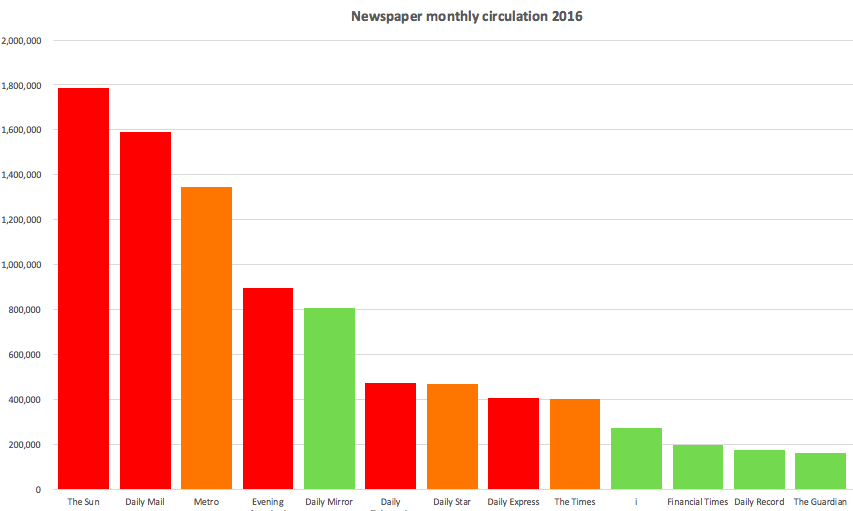
from this article:
https://rightsinfo.org/brexit-five-lessons/
> Many Brits have concluded that about the EU all by themselves, based on the actual actions it's taken.
I don't know how many Brits have reached their conclusions about the EU "all by themselves", without basing their information at all on what the media and UK politicians have told them.
It's also worth remembering that broadcast media is largely pro EU, even though it's theoretically meant to be neutral. I don't know many who really believe it is though.
At any rate, it's very easy to get news very slanted towards the EU in the UK if you want it. The fact that there's alternatives is different to in most of Europe, I've noticed, where the media is near universally pro EU and anti-member state. At most in Germany the ECB gets criticised.
As someone living in smaller country, we now have our voice heard more than before, and other benefits of EU far outweigh the downsides.
> They are institutionally cynical about their own citizens, who they see deep down as basically being stupid sheep
Yeah Trump and Johnson are so much better \s. Every country has politicians like that.
And yes I know lots of people living in the EU think it's great. Lots of people living in the USSR thought it was great too, as can be seen from the opinion polls showing how many Russian think Stalin was their greatest leader. That doesn't change the nature of what these systems are.
And Boris (among many others), more or less engineered the whole brexit so he could gain power, if that fails he is done. He is doing it because he bet his whole career on it, and has nothing to loose.
And as someone who lived (although only for about 12 years of my life) behind iron curtain. I can assure you most people didn't think it was ok, and we are paying attention so we don't end up in the same situation again.
Part of what we usually want from our politicians is to filter what people want a little bit and remove some of the evil and stupid. I know, then we don't get exactly what we want. But if you ask exactly what people want, about 90% of it ends up being "people not like me to suffer more", and if you run everything based on that, all you get is everyone suffering more.
that you brits are wrong.
300 millions EU citizens know that.
https://www.kuechenstud.io/lagedernation/2019/07/26/ldn150-p...
Of particular concern is the scale to which this can be bootstrapped by having the tech giants involved.
You mean, besides about 100 or so banks and trans-national corporations, including Facebook itself, that already exist? But yes, surely banning one more cryptocurrency out of over 9000 already existing makes huge difference. Not.
> Given the power cooperations already yield this is a _good thing_ in my view.
You view seems to be "corporations have too much power, so any action that hurts any corporation, even if it doesn't change anything and does not improve situation in any way, is good". This is not a very sane approach to anything.
Comparing it to the toy money that existing crypto currencies are is likewise entirely irrelevant. It's structurally different for one, as Facebook et.al. would back Libras exchange rate. It's also backed by enormous economic power:
The entire idea of anti-trust (and frankly, the premise of most western democracies) is to prevent the over-concentration of power.
Facebook is the most powerful private entity on the earth right now, far more powerful than most nation states. I'm not sure that we as a society have ever dealt with a non-state actor this powerful before.
Germany's response of essentially "yeah no, we're not letting Facebook make money here," seems prudent to me.
“Facebook is the most powerful private entity on the earth right now, far more powerful than most nation states”
Op did not clarify his reasoning. Though I have thought about this and here are mine.
If strip down a “nation state” to its bare essence, it is an idea. Lines drawn on a map, and symbols(flags, anthems etc). Add in the government directing education, and we end up with masses that can be influenced to behave in specific ways. i.e socialisation and sense of identity.
Now, we know that government plays a significant part in the country and in the world.
Now let’s consider FB. FB has by far the largest network of people that are connected in one massive network. I suspect Information (memes) could spread much faster on Fb, Whatsapp and insta than they could prior to these. Even email was never as fast. Since FB has control of the network without over sight on the algorithms and filtering, they wield significant power to shape global conversations. Shaping global conversations fundamentally can lead to over throwing of leaders with out ever a bullet being shot, it could lead to genocide, nationalism etc etc.
It’s no surprise that the EU is on high alert.
Edit: I think this requires more exploring. This is fundamentally a war against a new form of influence & control of masses of people.
See previous wars: religion vs state, state vs monarchy etc etc.
Has anyone considered this perspective before? Would appreciate any links
The east India trading company and the hudson's bay company as well as I'm sure some others were as large as or larger than some state actors of their time.
This is hyperbole at best. Facebook does not have an army, weapons, or literally anyone that would be willing to die or even be physically put out to defend it.
I’m no Facebook fan, but let’s not let Facebook hysteria overrun these comments.
“This is hyperbole at best. Facebook does not have an army”
Op was pointing out that power != war with guns
“Facebook is the most powerful private entity on the earth right now”
The comment was how power could be achieved via other methods of warfare-including the ability to shape conversations.
Another word for this would be competition. He has a point.
The ability to shape conversations or to compete is not the same as making war (or you are relying on an idiosyncratic definition of "war").
War (Noun) " - a state of hostility, conflict, or antagonism
  - a struggle or competition between opposing forces or for a particular end

- a struggle to achieve a goal: War (Verb): " - to be in active or vigorous conflict
- to carry on active hostility or contention
"
The point still stands. War is an isomorphism for competition, conflict and tension between parties. One could probably use something like category theory and prove it.
References:
> Data has surpassed oil as the world’s most valuable asset. It’s being weaponized to wage cultural and political warfare. People everywhere are in a battle for control of our most intimate personal details. From award-winning filmmakers Karim Amer and Jehane Noujaim, THE GREAT HACK uncovers the dark world of data exploitation with astounding access to the personal journeys of key players on different sides of the explosive Cambridge Analytica/Facebook data scandal.
http://content.time.com/time/covers/0,16641,19960715,00.html
Was that an act of war against democratic Russia?
https://en.wikipedia.org/wiki/Facebook–Cambridge_Analytica_d...
"The governments of India[30][31] and Brazil[32][33] demanded that Cambridge Analytica report how anyone used data from the breach in political campaigning, and various regional governments in the United States have lawsuits in their court systems from citizens affected by the data breach.[34] On April 25, 2018, Facebook released their first earnings report since the scandal was reported. Revenue fell since the last quarter, but this is usual as it followed the holiday season quote. The quarter revenue was the highest for a first quarter, and the second overall.[35] In early July 2018, the United Kingdom's Information Commissioner's Office announced it intended to fine Facebook £500,000 ($663,000) over the data scandal, this being the maximum fine allowed at the time of the breach, saying Facebook "contravened the law by failing to safeguard people's information".[36] In March 2019, a court filing by the U.S. Attorney General for the District of Columbia alleged that Facebook knew of Cambridge Analytica's "improper data-gathering practices" months before they were first publicly reported in December 2015.[37] In July 2019, the Federal Trade Commission voted to approve fining Facebook around $5 billion to finally settle the investigation to the scandal, with a 3-2 vote.[38] Facebook established Social Science One as a response to the event."
[1] https://www.washingtonpost.com/news/monkey-cage/wp/2018/03/2...
How could anyone besides them prove effectiveness or ineffectiveness of this campaign? I don't think it's possible. At the very least, the side they supported won (Brexit) and they should not be trusted.
Leave.UK was accused of violating electoral law. I believe the Electoral Commission has now dropped its investigation.
Incidentally, to break UK law, you usually have to perform the violating act in the UK (we have a few laws that involve extraterritoriality, but they are far and few).
Faceache barely does anything in the UK. They apparently make no money here; they don't sell stuff (not even advertising - that would be the Republic of Ireland). CA collected data on US citizens; that's legal here (and would have been of very little interest to Brexit campaigners). As far as I know, nothing CA did violated UK or EU law.
You say "the side they supported won (Brexit)". Do you mean that Faceache supported Brexit? I don't think they had a dog in the race at all. Or do you mean CA? It's been argued that CA took money to provide services to Leave.UK, but that's not the same as saying they supported Brexit.
Trying to "swing elections" is legal in the UK. In fact it is encouraged; people who successfully swing elections often get appointed to important positions such as Prime Minister. It's completely legal to hire polling companies to help you better understand the voters. It's completely legal to hire advertising companies to promote the electoral outcome you want promoted.
Now you are speaking of trust; of course, I trust neither CA (now defunct) nor Faceache. But Faceache did not drag my country into wars in Iraq, Libya and Syria. Faceache did not have that much power. The UK joined those wars largely because of diplomatic pressure from the USA - a much more powerful entity than this rather tedious online advertising company.
From what I have read, and despite their bragging, CA wasn't even helpful to the Leave.UK campaign. Their data wasn't relevant, and anyway Leave.UK didn't have the organisational capacity to make use of whatever data they could offer.
https://www.theguardian.com/politics/2018/may/11/leaveeu-fin...
You are correct that they haven't (been charged with having) broken electoral law in the UK, but they have broken data protection laws in relation to the information which was then used by Cambridge Analytica:
https://www.theguardian.com/technology/2018/jul/11/facebook-...
Whether that information was then used by Cambridge Analytica as part of a Brexit campaign is open to more questions.
Facebook is an echo chamber. People don’t go there to be informed; they go there to validate their already held beliefs. Given the large ideological chasm between the two candidates in the 2016 election, it defies logic that even a single voter was swayed or chose not to vote at all based on ads they saw on Facebook.
https://www.washingtonexaminer.com/weekly-standard/the-elect...
Of course it's impossible to say whether Trump would have won even if he hadn't spent any money on Facebook ads, but we're talking about a campaign that spent hundreds of millions of dollars in total. If this amount of money doesn't include enough to influence 78k people to go out and vote for a specific candidate, then we might as well give up on the very concept of advertising.
Now whether things should be this way am not sure, but a nation simply paying its debt off without significant changes to the role debt plays is not the answer.
Western democracies historically have been party to increasing the power of private companies through government protection from competition (corporate welfare). The first example that popped in my head was the provision of prison labor for U.S. Steel through convict leasing.
There are numerous examples though, link below from Mises (admittedly a source with a conservative bias, but theres still good info there).
https://mises.org/wire/government-created-monopolies-are-eve...
It would seem to me that governments provide preferential treatment to private companies when it is beneficial for the government and they provide roadblocks and difficulties to companies who would be detrimental to the government. This is of course a generalization and not a hard-and-fast rule that explains every instance of government behavior when viewed in respect to a private company.
No it isn't, not even close. At most it's the third most powerful tech company, after Alphabet and Amazon.
Certainly purchase data is very powerful (ask supermarkets!), but I think it pales in comparison to the breadth of data Facebook and Google collect.
I might also be biased towards underestimating Facebook since nobody in my social circle actually uses Facebook or Instagram. I guess Facebook is more powerful than I gave it credit for, though it still pales in comparison to Alphabet.
> I'm not sure that we as a society have ever dealt with a non-state actor this powerful before.
Amazon and Google being of somewhat similar or greater power at least tempers down that statement. And unlike Facebook they have really good reputations outside specific parts of circles like the tech circle.
There are benefits and drawbacks to social media/everyone has a voice. On a benign level, the NYTimes released a story misinforming its readership that Apple was proactively promoting its own apps. This was cleared up on Twitter by @drbarnard whose view was promoted via Stratechary.
I realize there is a lot more complexity to nation-states creating false narratives around China or Hong Kong protests, but on a basic level, I believe social media allows a quicker iteration cycle to correct misinformed views with the drawback of initial misinformation traveling at a greater velocity.
In many ways, you can get a more informed and accurate view of the situation in Hong Kong today if you have the propensity to avoid overreacting to the first piece of information and developing a skillset for finding the right person to listen to.
To me that signals they have less 'control' of the distribution of information on their own platform. It's debatable who could wield more social influence, Google or Facebook. On me, it'd certainly be Google, since I use about a dozen google products (Chrome, Gmail, Search, Mesh, Calendar, Analytics, Voice, Android, Scholar, Cloud, Maps, etc.), and zero Facebook products.
Europe as a market has higher taxes, more regulation, and has more cultural barriers giving us a huge disadvantage when trying to compete in the global market with the big US (or increasingly Chinese) tech companies.
Unfortunately I think we may need protectionist policies like this if we want to develop our own tech companies and products. It's the same situation the US is in with manufacturing. The US simply can't compete with countries like China, so if the US is passionate about preserving its manufacturing sector the only answer is protectionism.
I don't think it's an "anti-US-big-tech attitude" so much as an aversion to companies that have repeatedly been found to break the law (be it tax, competition, privacy or otherwise).
You don't (at least I don't) really see much hostility towards Apple, Netflix or Microsoft, despite them being large US tech companies.
The only examples I can come up with for companies Europeans might be hostile towards are companies that have given Europeans reason to be hostile: Facebook (tax, privacy), Google (tax, privacy, competition), Amazon (workers' rights) or Uber (workers' rights, flagrant disregard of the law).
If European companies behaved the same way, they'd face the same consequences (feel free to give counter-examples). I think the reason you hear about American companies so much more often is because:
- They're big, so violations are big and fines are big, making them big targets and big news
- They often break the law (perhaps because they're used to operating in America, which is relatively lawless when it comes to competition and privacy), making them easy targets
- You're reading English-speaking media, so you're less likely to hear about say a mid-sized German or French company being fined
I'm not sure whose fault that is: https://www.theguardian.com/technology/2017/dec/05/ireland-r...
This amounts to "our country is bad at [thing], so let's restrict trade for [thing] to protect our industries."
Of course it sounds great until other countries counter by restricting the thing you are good at, and then everyone loses.
In the case of Libra, a validator needs to be brought into the Libra foundation, subject to approval of current members and a membership fee of 10 million USD.
So you can see Bitcoin (permissionless PoW) and Ethereum 2.0 (permissionless PoS) as anonymous, permissionless cooperatives where everyone is playing on the same field, whereas Libra consists of a small consortium of large corporates who can set the rules as they wish.
It's very different when there's a company with its own financial interests manning the door, regardless of what company that is.
A ban make most things commercially unviable. If botcoin had widespread use a ban would make it an underground payment system.
Digital services ppl ban child porn and gambling.
Sucks you are downvoted because you are right
Just because Bitcoin is decentralized doesn't mean that a country can't ban it within its own borders. To do that, all a country would need to do is pass a law making it a crime to own or use Bitcoin, while also prosecuting people who didn't report profits from illicit Bitcoin transactions with tax evasion. At that point, no legitimate business in the country would be able to accept Bitcoin or convert it to cash, and the vast majority of citizens wouldn't risk fines or imprisonment to use it.
Since, at this time, a very small fraction of the population uses crytocurrencies (or even knows what they are), enacting such a law probably wouldn't face a lot of resistance, especially if it were presented as a measure to fight crime or terrorism.
* - Intentional typo, for a double entendre.
If, for example, Goldman Sachs did the same thing, that might not go over smoothly, but I don't think it would see such a negative reaction. I'd assume that feels more in line with the status-quo, whereas tech companies getting involved in financial instruments is not as familiar.
I more so wonder what would happen if a company like Stripe did this. They are sort of a "financial" company, but I'd say also undoubtedly a "tech" company too.
All the media coverage on Libra is incredibly dishonest and ill-informed.
Distrusting them is the only logical conclusion given their track record and power.
Libra isn't a decentralized crypto currency, it's a new fiat currency minted by a private corporation with a very questionable track record and an uncomfortable amount of concentrated power. It's also seated in a country with a very weak track record enforcing rules on giant corporation misbehaving.
Users choosing to use something they collectively create and control is very different than this type of centralized power moves. They are in essence trying to bring billions (trillions?) of dollars worth of the worlds savings into US jurisdiction (and likely invested in the US economy via bonds and stocks)
Good decision on the part of Germany and France IMO. I hope more countries follow their example and protect their sovereignty.
That's not true:
> What are the actual assets that will be backing each Libra coin? The actual assets will be a collection of low-volatility assets, including bank deposits and government securities in currencies from stable and reputable central banks.[0]
[0] https://libra.org/en-US/about-currency-reserve/#the_reserve
> bank deposits and government securities
Your point doesn't contradict mine. It actually re-enforces it.
What percentage will be in US deposits and government securities? US bank deposits get invested into the market, so yes, this would take the money from someone in France, who would currently hold savings in a French bank involved in the local economy and move it to Facebook's vault.
The very link you provided lacks transparency and is exactly the type of reason I distrust Facebook. In fact it doesn't have a single #, percentage or actual thing I could verify/which they are committing to, the language is vague... I'm guessing intentionally so.
But you're right that the token is backed by something, mainly one to one reserves of currencies and government bonds. So you're okay with bitcoin, that has a market cap of over $100bn that's backed by nothing, but someone creates a cryptocurrency that's backed by one to one reserves of the safest investments in the world and that's somehow extremely questionable.
This is factually wrong. Facebook controls a very small portion of Libra (<1/10): https://libra.org/en-US/partners/
Let's just use Bitcoin vs. Libra, because bitcoin is much easier to type than cryptocurrency.
You know, instead of typing up a list of the pros and cons of allowing your citizens to use bitcoin vs. libra, I'll just talk about the underlying premise.
I think that as a government, you don't want to lose control of the money supply. That includes:
* How the money is used * Inflation * (And unfortunately, nowadays) tracking the money.
Looking at this from the point of view of a government, it seems pretty dangerous to put all those controls in the hands of a company.
Personally, I would be against this decision for any company, not matter how well liked.
Situations change, and then the powerful can change the rules.
How many cypto providers have > 2 billion users? FB should be regulated.
That said, the governance of Libra is setup with distributism in mind. Facebook has set it up explicitly so they don't control the currency, a founding group of 100 corporations will control the reserve (one vote each) and they are explicit about accepting new qualifying members.
If it takes off, it will attract a lot more corporations/institutional investors leading to free market control.
However, I don't see the point why governments are afraid of it because the monetary policy mechanisms requires a fractional reserve banking system to enact its effects.
Libra is fully asset-backed and wouldn't have an impact on any monetary policy.
I think what most people don't understand is that monetary policy doesn't work by devaluing cash, it works by making debt cheaper leading to companies end individuals to take out more debt to invest and as a consequence push up aggregate demand.
I'd also like to mention that certain entities operating outside of the state are precisely the sort of thing that can prevent the sort of tyranny that Germany enacted during the 20th century. Sometimes, and often, the entity capable of "regulating" is the tyranny. Imagine if Germany had had the capability to prevent payments to Jews, or track which households were spending more on food than they should and were likely harboring enemies of the state. I'm not saying Facebook needs to be the entity that does it, but monetary systems operating outside of the state could be argued to be one of the strongest weapons against tyranny.
I actually think this highlights one of the fundamental differences between Western liberalism and German schools of thought. Germany tends to fall back on the central authority, whereas liberalism thinks that the central authority is the single most corruptible attack vector.
I'm not sure a union with a democratically elected parliament is comparable to a social media corporation which answers to its shareholders?
A has a democratically elected parliament
B answers to its shareholders
The original comparison read very much as whataboutism to me.
This is in direct contradiction to your previous paragraph, unless such a system is inherently decentralized, and not controlled by a single entity (such as FB).
Also, i think it shows a major difference in the way of doing bussiness and between the economic models most used in european countries vs the USA. Most notably the idea of a much more cooperative economy vs the highly competitive american model.
things like the rhineland model[1] are common across most western european countries for a reason, especially outside of the anglo-american sphere.
1: https://en.wikipedia.org/wiki/Social_market_economy#Rhine_ca...
I understand why the governments do this, because they fear losing control.
What are you talking about? Germany is 25% immigrants, the US is close to 100% immigrants.
If you want the real figures you need to ask the German Statistische Bundesamt. Which put the number at 22,5% in 2016 [0], at 23,4% in 2017 [1] and at 25,5% in 2018 [2].
Keep in mind that those numbers are averages for the whole country and thus can be very misleading in their individual effects on each region. Because a whole lot of regions that previously had barely people with a migration background, at least from the MENA regions, have now seen a surge of MENA refugees.
This has visibly changed the landscape in some cities in the East, in the West not so much because Western Germany already had a lot of Muslim migration for decades, tracing back to literally mail ordering Turkish guest workers from Istanbul. That's why in many bigger Western cities you will find very "diverse" districts often referred to as "little Istanbuls" and Döner shops are abundant everywhere.
Thus in West Germany MENA refugees usually have an easier time integrating and finding contact trough the established Muslim sub-culture there.
The same does not hold true for East Germany, it doesn't have such a history of Muslim immigration, what is there in migration background is mostly from Eastern Europe, a bit of Vietnamese, due to the GDR times. But what the East did and still does have: Lot's of cheap and affordable housing, room for the federal government to cheaply "store" migrants.
By now many Eastern German cities kinda look like their Western counterparts but in a way sinister way: Large groups of young men just hanging out around the Plattenbauten they were put in, with everything from families to pensioners living right next to them, and yes crimes have increased because those guys also can't work (wouldn't want to steal a German the job), so they have nothing to do but hang out and get bad ideas.
[0] https://www.zeit.de/gesellschaft/zeitgeschehen/2017-08/stati...
[1] https://www.zeit.de/gesellschaft/2018-08/migration-deutschla...
[2] https://www.welt.de/politik/deutschland/article198890559/Sta...
Ironic that aforementioned foobar in the last century was a governmental entity that existed entirely within the limits of regulation. Not to mention the completely reckless monetary policy of the Weimar Republic with respect to the Papiermark that arguably caused the rise of Nazi Germany.
Not to mention the fact that the German government around the second world war was completely different from the current German government in terms of the actual people making it up.
Is it 'ironic' when governments try to improve equal rights for men and women just because there is oppression of either of the two in their past? What nonsense.
This false equivalence borders on Godwin's law. Combine that with the 9/11 rhetoric in the US hearings and it's really quite telling how they get SO scared. Idk how far it's going to go, and it might not be Libra at all, but there is so so clearly big role for crypto currencies to play.
And, of course, the Ministry of Truth https://en.wikipedia.org/wiki/Netzwerkdurchsetzungsgesetz
(Indeed, the German Constitutional Court generally rules on the constitutionality of power transfers to Brussels based on the degree to which the control of said powers is democratic.)
Germany's outsized influence came 25 years ago, when it had the dominant part in writing up the rules and powers of the ECB.
Buboard suggests that Germany exerts coercive monetary pressure over some other Eurozone countries. That crosses the line for you?
If Ireland had independent monetary policy maybe it could have lanced the bubble earlier and not been hit with 14% unemployment after the end of the Celtic tiger era. If Greece didn't have Merkel on the other side of every table, it could have attempted something similar to the Plano Real, rebasing its currency completely and restructuring its society through default.
Or maybe they would be way worse off without Germany. Who knows? A claim that Germany has an outsized impact on monetary policy, at times to the disadvantage of other negotiators, is certainly debatable! But it's not the sort of thing you can brush aside ad lapidem. Especially not in the context of this farcically hyperbolic thread.
There are good reasons why the UK declined to join the Euro.
Same happened for other countries accessions. And of coures France and Germany bent the EU budget rules all the time too. Then when things started going poorly in Greece, the gang kicking the fallen guy promptly forgot about this.
(To be clear, many of the rules reflected a irrationally strict anti-debt anti-inflation puritanism to begin with, and the problem was more in the rules than their lack of enforcement)
You mean like the EU?
More than having to worry about my kids getting shot at school by some other angry kid.
You might mean that some Germans don't like CC and prefer cash for privacy reasons. But that is a personal decision.
Not in my experience in the least bit. Germany was the only place that I’ve been where there were so many non-credit card restaurants etc. I was traveling for work in Bavaria and baden-württemberg. It was an issue and we had to make sure I selected the right place to use my work cc.
I took some personal time in Munich and most of the places I went were cash only. 2 students, one from Finland another from the Netherlands complained about the cash issue and forgetting it multiple times. Leading to interesting situations.
Sure, the ice cream stand at the swimming pool only accepts cash, as does the local discotheque, but restaurants? Never a problem.
Even the cab to the Munch airport would only accept cash. I had to walk across the airport to get it. His payment app was “not working”.
In Stuttgart it was only the smaller places. Although we made sure find places that took corporate Amex using a website.
By contrast, in New Zealand even most farmer’s market stalls and pop-up espresso carts presume that contactless will be the main means of payment.
This is just my personal observation. Among the western European countries, German has the smallest level of adoption of credit cards. The French, the Dutch, the Swedes etc love their cashless nature of credit cards, the Germans not so much.
Furthermore most of the credit cards offered by the German banks are actually debit cards.
It boggles my mind, but "majority" of the German population has a preference to Currywurst ( https://en.wikipedia.org/wiki/Currywurst ) - is this also "beyond a personal decision" ?
If you have a reference to German government pursuing an anti credit cards policy - please provide it here.
This paper (0) is a good write-up on how the card systems works in Germany.
(0) - https://refubium.fu-berlin.de/bitstream/handle/fub188/22957/...
edit:updated the link
Hotels or car rentals which want to block a certain amount on my card as guarantee are one. Other than that I never needed a credit card.
In case of an emergency most bank accounts in Germany can go into the negatives, I guess making minimum payments on a credit card is cheaper but that style of life isn't at all common in Germany.
But let me just say that, when I was at Square this was common knowledge and why that wasn't the first market we looked at.
With a Girocard, you have to go to a specific brand of bank or hope they are in your "cash group" or else you will pay a hefty fee.
But some banks offer to withdraw from any ATM using their VISA CC with no fees at all.
For years I've been using this to get cash without much of a hassle and pay for stuff I'd otherwise probably pay for with my Girocard.
Makes me wonder if my cash withdrawals are counted as CC transactions?
If you watched the news some time during the last 30 years you get quite a different impression. The German government parties, particularly CDU, CSU and SPD, are _constantly_ trying to grab power and erode our civil liberties; They barely do anything else. If I had a euro for every law that those three passed that was obviously unconstitutional I'd have enough money to bribe my own CSU congressman. The only problem the German government has with Facebook Libra is that they themselves don't control it.
I don’t see why this is hypocritical, a problem, or even an argument. The CDU, etc... are elected by the German people and hence are designated by the people to control state power. It’s their job to control these kinds of things.
Facebook is elected by no one, represents only Mark Zuckerberg’s interests, and is accountable only to him.
No, that’s not a given. Many people don’t agree that it’s the government’s job to decide what kind of currencies you’re allowed to hold and trade.
There is something incredibly shady about it, because inflationary monetary policy is inherently a regressionary redistribution of purchasing power and wealth due to Cantillon effects whereby those relatively closer to the printing press (governments, banks, and asset holders in roughly that order) gain a higher purchasing power than those at the very end of the chain which has traditionally been wage-earners and average workers.
There is no need to print money in a growing economy, it's purely ideology from the Keynesian economic establishment where they've somehow convinced the general public that it is crucial to have a steady inflation in an economy because otherwise people won't spend money or invest (which is a priori false, as time preference is a thing in both humans and firms). For thousands of years gold has been used as a monetary backing (which is deflationary by definition), and some of the highest recorded levels of economic growth in history has generally been slightly deflationary (the United States during the 1800s is a prime example).
There is, for a number of reasons, but not least of which is fairness. If I get a dollar, then the size of the economy doubles, my purchasing power as a fraction of the total amount of economic activity doubles. This creates wealth inequality over time, too. Likely to the benefit of the same people.
I hear you re: Cantillion effect, though I'm sure that could be solved with a targeted tax.
Most importantly, philosophically, nobody owes you a risk-free return over time on your idle, un-invested capital. I can think of no justification for why your dollar should be worth more in the future than it is today. At best, I could see an argument for the same amount, though I think a little bit less to encourage investment is a totally reasonable place to draw the line.
> ...some of the highest recorded levels of economic growth in history has generally been slightly deflationary (the United States during the 1800s is a prime example).
You mean the industrial revolution? I'd say there were externalities that affected that. Counter-point, the great depression.
You assume that as an economy doubles prices won't decrease. The natural tendency of a free market is a decrease in prices due to competition, technological innovation, and other factors. If anything, holding the same dollar will lead you to purchase more goods at a higher quality than before as the market develops and expands - a higher purchasing power.
Wealth inequality is exactly what is caused when you print money to match the growth of the economy due to the aforementioned Cantillon effects.
>Most importantly, philosophically, nobody owes you a risk-free return over time on your idle, un-invested capital.
There is nobody that is giving you that return. The so-called "return" is the tendency of a free market to lead to cheaper prices and higher quality goods and services. If anything, I can't see a justification to allow the public's money to decrease in value over time.
>You mean the industrial revolution? I'd say there were externalities that affected that. Counter-point, the great depression.
Yes, there were externalities that affected it, but the core point remains the same. Competition and rapid technological innovation lead to a decrease in prices over time. The Great Depression was not a consequence of a natural deflationary regime rather it was the consequence of extremely lose monetary policy during the 1920s ("The Roaring Twenties") and it would have resolved itself quite quickly but as letting people be unemployed is usually politically unpopular Roosevelt enacted price controls that extended the market correction process that would have otherwise taken a much shorter time than it did.
AKA, a risk-free return on your uninvested, idle, capital that nobody owes you. The poor tend not to have much savings, by definition, which means that all this win goes to the already wealthy. Your argument is simply that your dollars should be worth more later because you got your dollar first. That's not a good reason, IMO.
> If anything, I can't see a justification to allow the public's money to decrease in value over time.
Let's say you decide it should be worth the same amount forever. Fine, that still requires printing new money. All you're arguing now is the magnitude.
This is not true - saving rates were higher in the past before irresponsible monetary policy took over after the erosion of the gold standard.
>Your argument is simply that your dollars should be worth more later because you got your dollar first.
This is exactly what happens in an inflationary monetary regime, althought the difference is that the distribution of purchasing power increases is not homogenous in an economy rather it is concentrated on those who are either politically or economically well-connected, usually asset holders.
>Your argument is simply that your dollars should be worth more later because you got your dollar first.
How about not controlling the value of money and instead letting it reflect the general purchasing power in an economy?
This is a candidate for most tired meme on the internet and I really don't understand what it even has to do with this discussion as I've never met a household with a printing press (running the press is exactly what GP was referring to).
Germany is not perfect, neither in ideology nor in execution. Neither is the EZB or the EU, for that matter. But this is just bad faith arguing.
"Wait and see" is a good approach to see whether your new electric city bus line is working or whether people prefer your website logo in red.
You can never, ever take back what became basic necessities on a nation level while being even remotely democratic. Once people have it, they won't give it back.
And you seriously think Facebook is to be given any such power, even after Cambridge Analytica? We're talking about currency, and billions of people. Lifes are very much at stake.
But sure, let's wait until Facebook uses Big financial data to get some populist party manipulated into power and a mere few thousand people die from the consequences, than be all enraged on reddit for a week and unable to change anything? I'll keep my typical German mindset, thanks
If Libra is going to be more economically than a typical bank, that will take many years and give plenty of time to react in case of problems. Also, it should first be up to the people for themselves to decide what means of payment they are using. The government should only intervene when the market fails.
In the beginning, it will be optional. But if/when everyone starts using it, most people won’t have a choice.
Well, at least Germany can get a jump on banning automated driving development. Hopefully BMW, MB, and VW are all banned from working on it since it's still early enough to prevent bad things from happening.
Crypto currencies are not going away and both Getmany and France are hurting their own entrepreneurs.
Protesters in Honk Kong did that too, to not be identified and tracked.
Protesters is US did that too to buy subway tickets, again, to avoid being tracked.
It's ok to pay in cash.
It's not that we go around with leather suitcases full of cash to buy tons of cocaine...
Germany is very, very keen on preventing powerful entities from acting outside of regulation and similarly, if not more, on preventing a single entity to get in control of everything. This is largely due to some foobar in the last century, which I'm sure everyone is aware of.
So if Facebook, 10x of Germany's population comes around the corner with a proposal akin to "Hey do you mind if we just skip the paperwork part and just control currency, while actually being a social media tech giant" there going to be up against every trick in the book. This is not hypocrite behavior because Germany allowed some fun regional currency project no one is aware of some time ago. This is much more protecting the idea of the German society.
And personally, as a German, I'm really glad about it. You remember the hundreds of cases of worked with a scummy developer on an app once, now I'm blocked out of my email and all my files stories? Now imagine that, but with money and with a company who never even bothered to pretend it isn't evil - this is gonna be a no, thank you!