I think it depends on how we define mediocrity. Is it mediocre to spend as much time it requires to get a PhD becoming a good pastry chef or carpenter? In the west very likely yes, unless you're an "entrepreneur".
> Is it mediocre to spend as much time it requires to get a PhD becoming a good pastry chef or carpenter? In the west very likely yes, unless you're an "entrepreneur".
Or, unless you apply your skill into pursuing a bakery career, or a celebrity career (e.g. by running a baking channel on YouTube). Being good at something alone doesn't get you past being perceived as mediocre at best - you have to have an external institution attest for it. PhD, that's easy - the title is itself an attestation. Baking? Proof is in running a successful bakery[0], or in being called a great baker in mass media articles, or in running a popular baking show, etc.
I guess that's implicit in the whole philosophy of "self-improvement" being conditioned on how others see you.
--
[0] - However little sense this makes these days; "running business doing X" is 99% about "running business" and 1% about "doing X", and if you want money and control, you have to let other people to "do" X for you.
To be honest, I'm rather surprised how good we have it those days, when good skills and hard work at least have a quite good chance to lead to a decent life
I think you live in some weird startup-obsessed bubble or something because that is quite unlike my experience living in "the west"
TeMPOraL nailed what I was trying to convey.
What is your experience like? Do you live in a place where high quality work alone is unanimously recognised as success?
I think we can do much better than “if you work hard and believe in your dreams you’ll make it”. There are many techniques people can learn than can amplify the impacts of their efforts and make them much better companions. They’re just not widely known/accepted as yet.
You aren't "made to feel anything", it's a two way street. You have someone who says something negative, and you have the choice to listen to it or disregard it. That's a choice
> I think a lot about how the world would be better if more people were encouraged and empowered to go on long-term journeys of deep personal growth
I think if you're motivated enough to do this, you're already motivated enough to go out and get the career success or love life or whatever you're after. Frankly doing that is probably simpler and more straightforward than "self discovery" or whatever. There's a Carlin bit for this https://youtube.com/watch?v=4s3bJYHQXYg
Right, this is why we can choose not to feel the pain of being punched in the face.
No.
Here's a personal example: having abusive family members tell me I won't be successful or independent, being hurt by it but knowing in the back of my head that I would get out of there. It's hope
And I get it: not all trauma is equal here, but if I have to choose one extreme I'd prefer the one that gives people some shred of agency
There was a time I was cycling at night down a half-finished cycle route, the kerb separating it from the guided busway had been placed but not the tarmac, but I couldn't see that at night (I had a light but it still wasn't visible).
I tried to leave the cycle path, bounced off the surprise rise of the kerb, and it hurt before I hit the ground. Picked myself up, stopped thinking about it, went on to the cinema, watched the film, when the lights came up I realised quite how badly I'd been grazed.
Sometimes I can switch the pain off on purpose, sometimes I can't. The dichotomy isn't even just with regards to physical pain, it's also a sometimes-yes-sometimes-no with emotional distress, so I can go into a "public performance" mode on a stage and goof about no trouble, but I can't seem to shake my deep dislike of mere phone calls.
People are weird, I'm a person therefore I'm weird. :)
How about minus one second and plus 169 minutes? (It was the first of the Hobbit trilogy).
Sounds like a form of phantom pain. I don't know the exact term but it is a well studied phenomenon. one that, AFAIK, isn't fully understood.
But yes, your brain can very much lie to you. Just look up how much post processing your brain will do to help you see the way you see.
>Sometimes I can switch the pain off on purpose, sometimes I can't.
yeah, we have chemicals in our body to do that. It doesn't turn off pain automatically because it is in fact a good thing to realize when you're bleeding out of your leg. It only turns that off for you semi-voluntarily if your brain involuntarily determines (again based on other chemicals) that GTFO is more beneficial to survival than tending to your wound. I'm not going to say it's impossible to train these excretions of chemicals. I will argue that this is probably something you can train for years to do and fail, though.
There's so much about our bodies that still eludes the brightest minds. Even a function as basic as sleeping and why and how it benefits us is still not fully in our understanding.
But it assumes we’re all hardwired to be a certain way, which is the very assumption I’m arguing needs to change.
It’s true most self-help is ineffective, and it’s because you can’t change much in your life just by consciously making an effort to change, or just “trying harder”. There is a lot you can change by undoing subconscious self-sabotage patterns and undertaking “letting go” practices, over a long enough period of time. This kind of stuff is fringe now but is growing in popularity because people are finding it far more effective than mainstream self-help and therapy (I sure have).
Can you please recommend further reading?
I've gone to therapy with the CBT method and it's total garbage meant to keep you meek and accepting of the bullshit people pile on you in life.
The correct solution to abuse is a punch to the face. Civil actions and words have no effect.
What I’m referring to is nothing like that whatsoever, and I’m not talking about/advocating CBT, or anything that involves adopting meekness.
if you can afford it, sure. But that civil lawsuit you dismiss will suddenly crush you if you punch the wrong person in the face.
Maybe there is a bit too much soft footed training these days, but there's also a very good reason, financially and legally, to know when to hold your punches. At least be smart enough to get an explicit reason on record before you start swinging fists.
Oh wait.
It may be ugly but people tend to leave someone alone after getting knocked out. Words are a warning, a substitute for violence. We use words because violence is ugly. When words don't work, you don't use more words. That's insanity.
Really? I've never done it but have heard some negative stuff, like what do they teach you?
It's led to reduced trust in psychology and psychiatry. Maybe in another hundred years we'll have a clue or two.
> There is a lot you can change by undoing subconscious self-sabotage patterns and undertaking “letting go” practices,
What do you mean by this, like buddhism or something like it? Is there some kind of literature on this?
This is just not true about human psychology. Like it is not true at all.
People are affected by what is said about them. And those few unaffected generally tend to have much bigger issues in relationships, because their lack of caring usually makes them into very uncomfortable to be around.
To @mvncleaninst, not everyone has the same emotional strength and tools to cope with these sort of situations, and trust me, I am not apologizing for mediocrity and lack of courage, I absolutely loathe when people try to excuse what's under their control with made-up stories, disorders and whatnot.
Depression is a real thing, some people have gone through real shit. An example, many people grow up in completely dysfunctional households, you have no idea how that can absolutely destroy someone's perception of it's own value. Same thing with poverty, a lot of people had dealt with both of these things and most likely many more. The wounds inflicted by these circumstances stay with people their whole lives, one cannot just "shrug off these things and carry on" as they have become imbued with them.
Life can break absolutely anybody; if you don't believe this is true, congrats. you've had it easy, so far.
From (George) Carlin's wikipedia entry:
"Because of my abuse of drugs, I neglected my business affairs and had large arrears with the IRS, and that took me eighteen to twenty years to dig out of."
It seems that your motivation expert actually does much worse than the average person on things that require planning and self-control. Colour me surprised. Is this part of his comedy act?
That's like saying "You have someone punching you in the face, and you have the choice to be hurt by it or not. Being hurt by being punched in the face is a choice."
You don't choose to be hurt and you don't choose the consequences of being hurt.
Only the first part is true. We don't get to choose our emotional responses, but we absolutely can determine how we react to all manner of discomforts and challenges. For instance, you can discover and put in the work of practicing healthy and sustainable coping mechanisms for the inevitable fear, rejection, and hurt you will feel in life when other people treat you in ways that don't suit you. You can also choose to put in work towards changing your outlook and core beliefs, so you are much more resilient to being hurt by the words and actions of other people. Emotional resilience is a skill (but it is not at all the same as being emotionally repressed, which is a maladaptive defense mechanism).
Being physically or emotionally hurt is not the same as being harmed. People can be punched in the face and yet recover with grace and equanimity. Indeed, even if that graceful recovery involves running the fuck away from a pointless fight. This isn't easy stuff, but it is possible.
Thats a skill and like sports, there are certain affinities to having and tailloring that skill. It's why we call it "emotional intelligence". There will be some absolute saints that can manage their emotions to an almost sociopathic level, and 90+% of people can train their lives and never truly obtain such skill. We are shaped by early experiences, memories, and traumas too much to truly say "anyone can do this".
Likewise, being punched in the face is a skill. But not necessarily one that is "mastered", just mitigated. the best boxers in the world will get punched enough to have permanent damage, even with modern safety regulations. That's just a fact. Meanwhile, most people who don't spend time fighting will have different biology that determines how well they can take a face punch. Someone more muscular will take it better than a meek lad. You may not even realize the former got punched the next day wihle the latter has a scar that never heals. You can't fully control that without a major lifestyle change.
Yes you do. You totally do.
I won't even entertain "you choose the consequences of being hurt". Mike Tyson says it best: "everyone's got a plan until they are punched in the face"
Not really. A century ago people in many parts of the USA were dirt poor. I mean no savings, no electricity, no indoor plumbing. But they ate well—real food they grew, raised, and hunted themselves. They had deep communal bonds, spiritual fulfillment, and a sense of meaning in their lives that is increasingly absent. I wouldn’t be surprised if your average sharecropper’s wife would blow away your average urban girl boss in self reported happiness.
Filtering your sense of happiness through some quality of life lens is absurd if you think about it.
But that’s observably false. There are persons who don’t feel pain, and they are considerably more likely to seriously injure or even maim themselves than normal persons. That’s hardly “objectively better.”
Furthermore, the existence of masochism shows that some people prefer pain to its absence at least some of the time. Thus “Pain is real, and the absence of pain is objectively better” is just your subjective opinion.
Since we’re talking about subjective reports regardless, we may as well rely on the subjective reports of the people having the experiences rather than the subjective opinions of others who aren’t having the experiences.
If you are arguing for #1, I disagree. If you are arguing for #2, you should be more clear about why/how you keep using the word "objectively".
I would guess that each person has a different ideal level and variety of suffering (or responsibility, or challenge, or whatever you want to call it), for which their personality is best suited. We are so far removed from the challenges of the past that we don't know what the subjective experience would be like.
In a good year they might eat well. In a drought year, maybe not at all.
Did some people eat well, some of the time in the 1900s? Absolutely. But ending hunger is maybe the greatest conquest of our time and it's barely recognised. That's exactly the sort of expectation gap I was referring to in my original comment.
I'm sorry, but perhaps it wasn't clear from context that I'm talking about the USA. There has never been a wide scale famine in the United States even in its poorest communities. Even during the Great Depression there were virtually no deaths due to starvation[1].
> But ending hunger is maybe the greatest conquest of our time and it's barely recognised. That's exactly the sort of expectation gap I was referring to in my original comment.
Your goalpost-moving notwithstanding, I'm reminded of that famous Sufi tale with the refrain "Good thing, bad thing, who knows?" After all the environmental impacts of the population explosion that it kicked off are still just barely beginning to be felt. But for what it's worth the Green Revolution was part of the standard curriculum when I was in middle and secondary school, so I wouldn't say it's unrecognized.
[1] https://history.stackexchange.com/questions/12297/how-many-p...
[1] https://encyclopediaofarkansas.net/media/sharecropper-family...
We take obviously mostly-genetically-determined traits like height, eye/hair/skin colour, facial features etc, then extrapolate to argue/assume that all kinds of other things must also be genetically determined, like cognition, behavioral patterns, emotional patterns, for which there is far less evidence of them being hard-coded in DNA. This will be confounded by the fact that we can often see commonalities in these factors from parents to children and between siblings, and assume these commonalities exist due to genetic coding, not recognizing that there are other forms of inheritance/conditioning that can explain these commonalities, but that even if these inherited patterns are deeply ingrained, they can be altered via the right practices (emotional “letting go” being the most important in my experience).
Here's a random study on criminality I was looking at a bit ago: https://www.sakkyndig.com/psykologi/artvit/frisell2010.pdf
(Identical twins are close to a natural experiment but not a very good one as even they don't have the same genetics.)
If you have to limit it to "humans only", the claim falls apart anyways, because genetics isn't human-specific
Simply put, you haven't made a convincing case that genetics, a science affecting all life, not just humans, is "not a credible science", despite indeed involving experiments all the time.
Below is where you can make that case.
This is a far stronger claim than I think you mean. We have a ton of evidence that those bits of DNA in our cells govern cell expression and even know in some cases that bit X being malformed causes bad condition Y (sure, you could hypothesize that they both have a common cause, but how the heck would that work? Correlation being causation works if both common cause and backwards causation are implausible, as they are often in genetics).
> but not a very good one as even they don't have the same genetics
Uhhh... they have almost exactly the same genetics. To a similar extent that two random cells from your body will have the same genetics. Yes, there will be a handful of mutations, but that's very unlikely to have an effect on any particular trait.
DNA just encodes proteins. It can’t explain/predict detailed behavioral patterns. A prominent example of how genetics can influence aggressive/criminal behavior is due to variations in the MAOA (“Warrior”) gene, but the promotion/suppression of this gene is still strongly influenced by environmental factors [1].
Twin studies (particularly separated twin studies) claim to prove that all kinds of things are genetically encoded, because “they must be”, without considering how much is caused/influenced by other factors - the gestational environment and the experience of being separated from the birth family being the most obvious.
[1] https://www.ncbi.nlm.nih.gov/pmc/articles/PMC3469457/#:~:tex....
(Also, did you check out the paper I linked?)
I’m fine to have a discussion if your intention is to achieve a shared understanding of the topic, which is what healthy debating is about and what this site seeks to cultivate (even if it rarely achieves it). It does seem a little like you’re more interested in “winning” an argument for a position you’re already invested in, but I’m happy to be shown otherwise and to engage in a discussion if you bring a spirit of shared learning to it.
Edit: rather than doing it here (in a thread that is already very long and stale) you can email me if you like (address in bio).
Height is not genetically determined unless you add "in an environment where nothing else that affects it happens". Like, say, someone cutting off your legs.
And the same goes for every other trait.
And puberty blockers, pituitary gland diseases, and lack of sleep.
…and cutting your legs off.
> Assuming the same nutrition, certain ethnicities will trend taller than others.
See, one thing about statistics is they're not necessarily valid for individuals, because eg not all statistical distributions have any values at their averages.
But you should be clearer than that about what your theory of causation is.
Or maybe it was always mostly BS and the information age where the message is less controlled/manipulated by a few elite owned sources is making that obvious.
Maybe I am mistaken, but this has a subtext of "I want to be recognized, but I don’t want to deal with disadvantaged people myself".
But I see what life is like for friends who are trying to find serious relationships/life partnerships via the apps, and how much it’s all geared towards being/seeming “the best” and finding “the right person”, and how brutal it is for their self esteem and life outlook (a good friend is at the age where she’s probably missed the chance to have children, having tried to find the right guy via the apps for many years).
I often wonder how it could be better for her and other friends if there were apps/communities more geared towards finding people to grow with rather than finding someone who ticks the boxes now.
I agree with you that many guys today struggle with dating because they haven't done the necessary work to be good partners, but the problem isn't that "contemporary life doesn't encourage self-improvement". The "problem", if you even want to call it that, is that women prefer being single over a bad relationship with a crummy guy. For the first time in history, women have the economic independence to walk away from a bad deal, and guys have up their game as a consequence.
There's no free lunch, just tyranny of too many choices, endless analysis paralyses and FOMO.
That's the definition of the ideal boyfriend for most younger women.
So the hot tall confident rich guys play the field, because they can. Worse, some of the hottest and most confident guys are narcissists - because narcissists and sociopaths are very good at seducing people with love bombing and future faking.
Inexperienced women get their hearts broken and decide that all men are jerks - partly because at this stage the kind funny not-so-hot guys don't register as realistic prospects on their dating radar.
There are subcultures within this, and there's certainly a niche of women who find clever, funny, and kind men more attractive than rich and tall etc men. But it's relatively small compared to most of the population.
At the same time there's a strongly gender-polarised and adversarial (actually hate-filled) culture in the US where wannabe manly men who hate everything woke etc are in a permanent war with feminists who are convinced that all masculinity is toxic.
It's not so much that "guys have to up their game" but that the entire culture is emotionally dysfunctional, and dating is stuck in a kind of permanent adolescence where healthy give-and-take relationships aren't modelled at all.
Can you think of one movie or TV show which models a realistically happy working adult marriage which isn't either sentimental and idealised, or doesn't end in drama, tragedy, and betrayal?
Oh man this is such a big one. There's so much media out there that depicts total loser guys winding up with incredible women & vice versa. If you're a young man & didn't have dad or older brother guide you through your end of the responsibilities in a relationship, there's almost nowhere to get the correct information, and tons of 'malware' information out there. One might be inclined to point to feminist literature on the subject, but that will just make you a doormat.
The first thing that comes to mind is the relationship between Holden and Naomi in The Expanse. (Okay, so it's not a marriage. Does that really matter?)
I'm sure there are others, but they are difficult to recall precisely because they just are, without calling too much attention to themselves. So there's a selection bias in what we remember.
Star Trek and parodies are really coming in clutch for good examples of married life.
Holden is no peach of a partner either. Don’t play the “Holden does something the hardest way possible because he can’t ask for help” drinking game, you’ll be unconscious in a few hours.
Bruh.
The parents in "That '70s show" perhaps? I see the irony in this title tho.
Sentimental and idealized are very vague, but there are a ton of US sitcoms that have this premise. But also, watching a couple just go about their day to day life that 90% of people go through seems boring as hell, who would watch that?
Before Sunrise trilogy comes to mind
They were both hot in high school. They peaked in high school and married/created a family with their high school sweetheart. That's the entire point of the show.
> They had kids. They took care of them.
They were also neglectful and callous.
> They didn't exactly love each other, but they didn't hated one another also.
Did you watch the show? They most certainly verged on hating each other, and were never as ambivalent as you make out.
> The most realistically portrayed family on TV in decades.
The Middle. Malcom in the Middle. That 70's Show. Any of a dozen "prestige" television shows that aren't sitcoms.
Come on. This entire argument is ridiculous.
TV shows are about drama. If you have "this relationship is too good" and "this relationship is too bad" as exit clauses here, of course you are going to have trouble.
Does Ben and Leslie from Parks and Rec count for you? Or is that "too idealized"?
Pro-tip: if someone says that you should just do what they say because they know better than you, run as fast as you can because they’re a demon.
I have witnessed some truly weird conversations in hypereducated blue-state America. I never say anything, but I always take mental notes.
One example:
So I go out to lunch with this friend, and they invite a friend of theirs. A woman, in her 20s, from an Ivy League school. I'm not sure why we were all having lunch together actually, in retrospect.
Anyway, she's talking about how she has this boyfriend. I think he's in the Air Force or something (which at some level is icky to these people). And she has some time off from her career for some reason, so she has some time. And she's spending a lot of it just being with him, to the point that, she'll cook dinner and stuff. And she implies that she's having a lot of sex with him, and that she's being very giving in all this, and you can tell that at some level she just finds him very attractive and takes pleasure in delighting him (as he, I assume, does likewise in making her happy). Which is basically the description of a good relationship, right?
But she also has to justify this feeling to herself -- that she likes making her boyfriend happy. And she has to justify to herself that she's doing things like cooking dinner that, on the one hand, she's voluntarily chosen to do, but that, on the other hand, she clearly also thinks are somehow "beneath her". So she explains it to us at the table like this: She's intentionally ruining her boyfriend, so that when they eventually break up -- because that's what you do, right? -- then he will not be satisfied in any of his subsequent relationships. She has to frame her natural impulse to be kind and giving, as a political act that is actually a kind of cruelty -- because that's what she assumes we will approve of.
None of us ask for this justification, this is just a monologue that she volunteers. I don't say anything, but -- what the fuck? I think this has become a normal (if unnatural) trained attitude.
I could give other examples too, but that's enough for now.
Something is just very broken.
Friday Night Lights
https://docs.iza.org/dp4200.pdf
Some people argue with the ‘no true woman’ fallacy, or don’t trust them to know how to self reflect properly, but clearly something is dying in society.
That is, if there’s less expectation to lie and say everything is fine, you could get declining life satisfaction numbers with no actual decline in satisfaction.
Anecdotally people I know from my grandparent’s generation are much less likely to admit to being unhappy.
> ...answers to subjective well-being questions have been shown to be correlated with physical evidence of affect such as smiling, laughing, heart rate measures, sociability, and electrical activity in the brain (Diener, 1984)
1) Society has changed in a way that has made people less happy. 2) Society has changed in a way that has made people less likely to lie about being happy.
If you stop to think it through for a second, you’ll quickly understand how the statement “we have some data from somewhere in the middle of the time period in question that self reported satisfaction and a actual satisfaction are correlated” isn’t evidence to support either side. That statement can easily fit either hypothesis.
I have not (yet) seen any relatively modern stable society where 80% of men don’t have children. Having that many men with not much to lose would, presumably, be a destabilizing force.
Also: Just because you are married, and your wife gives birth to a child does not necessarily mean that it's your child :) Nowadays, with contraception and paternity tests available, the number of guys unknowingly raising another man's child is around 2-3%, but it was much higher in the past.
https://www.pewresearch.org/short-reads/2020/12/07/polygamy-...
It's basically just Afghanistan, Iraq, Yemen and sub-Saharan west African countries that have >1% rate of polygamy and only the African countries that have more than 5%. Not exactly the most stable countries.
- The patriarchy is still here, but we now expect women to have a career while simultaneously taking care of children.
- Decades of hypersexualized media put the emphasis on sex during dating over caring relationships.
If she wants a doctorate she has to be married before she enters the workforce.
She has time for maybe 1-3 long term relationships before she ages out of childbearing age.
So yes women have more options but they also have less time to pick the right one.
"I am eighteen years old, have a good set of teeth, and believe in Andy Johnson, the Star-Spangled Banner, and the 4th of July. I have taken up a State lot, cleared up eighteen acres last year, and seeded ten of it down.
My buckwheat looks first rate, and the oats and potatoes are bully. I have got nine sheep, a two year old bull, and two heifers, besides a house and a barn.
I want to get married. I want to buy bread and butter, hoop skirts, and waterfalls for some person of the female persuasion during life. That’s what’s the matter with me. But I don’t know how to do it."
Still did better than most in the dating pool today.
I don't see this as a "biology is destiny" issue, I see this as a women are still facing pressures from the past and facing pressures of the present.
I don’t think biology is deterministic, but it is a factor, for both sexes. (Note that surveys show little to no difference between men and women when it comes to the question of whether they want children and how many.) My suggestion is instead that we have a market failure. People have choices, but not necessarily the ones that will make them happy. The solution to market failure is, of course, regulation of the market, but western individualists don’t want to hear that.
That doesn't follow from what they said. Men never had to do the child raising. Men probably do more childraising and housework than they used to do in the past, because they've been sharing domestic labor more as a result of the spread of feminism. OP is saying that the amount of work between a heterosexual couple has risen: before, it was the man doing a full-time salaried job, and the woman doing housework, cooking, shopping, and childraising as her full-time, unpaid job; and now they're both working full-time, and they have to split the domestic labor between them somehow, or, it's all on the woman and the man does no more than he used to do.
This is a bit oversimplified, though. There were always working-class women who worked as maids or in shops, or, in the 20th century, as teachers and secretaries. Those lower-class women just weren't paid that much. They always had a "second shift" [1], but since the 60s, it's spread to all women.
However, with the rise of living costs, now both partners need a full-time job, and the domestic labor is still there; more work needs to be done than before, despite technology making the individual worker more productive. It's not a surprise that fewer people are able to have children; they have more work and are still just barely paying the bills.
In the 70s, there was a movement called the "International Wages for Housework Campaign," which argued that women should be paid a salary for domestic labor, which is essential to society, and that this is an essential component of Women's Liberation [2]. It's interestingly contrary to the view that feminists are all liberal individualists who don't believe in men and women being different.
This sentiment is all over & is very demoralizing to guys who got an education, have a decent job, go to the gym and still get rejected by women who seem to be their peers. I'm not a fan of incel ideology, but there is something to the 'she'll have her fun with bad boys then settle down with you in her 30s when she's looking for someone with a stable income' sentiment that goes around. 20s dating is hugely depressing for men and it shows with all the stats of young men 'dropping out' of life. I got lucky and met someone sweet a couple years ago, but it was extremely rocky for a long time, and it still is for most of my friends.
But men just have to 'step it up'. Six feet, six figures, bare minimum right?
But otherwise, even if I'd found your analysis to be correct, I think a few decades of society adjusting to this freedom is well deserved after a millenia of patriarchy.
The Sultan having a harem of 40,000 = not patriarchy.
That really seems to be the attitude. Women haven't changed at all and want the same thing they always have. It was a brief bit of egalitarianism in history that gave us a "tradition" that was in fact an anomaly.
As a side note, I laugh at the 6-6-6 thing. It doesn't help. They want something else.
No, there isn't. The reality here is there's a bunch of men who have "here's my list of positive traits" and are leaving something out, because everyone is the angel of their own story.
Sure. Average men have flaws. But so do women. When I was dating around I met a bunch of girls who had a wild drugs & partying phase in college. A couple still had cocaine habits. I smoked some weed in high school then stopped. I’ve had sex with 7 women in my entire life, 5 of which were one or two night stands because we didn’t get on. I’m told I’m judgemental & picky because I’m not attracted to women with twice or more my sexual experience.
It’s true that a person’s sexual history does not define their worth as a person, just as height or weight doesn’t. But, what is ignored these days, every person absolutely has a right to their own preferences of attraction. But we insist that young men are terrible people if they don’t accept a history of promiscuity with anything less than enthusiasm.
I mean, it's kind of natural that you learn it as you get to know them. I don't ask 'what's your tally of sexual partners' out of any context on a first date. But someone describes their life and you pick up on it one way or another and then it comes up in conversation naturally. You can sometimes tell in the bedroom when exciting new things for you are old hat and boring to her. Sometimes they get dodgy about discussing it. And why? Are they ashamed? Or is it because they suspect I would prefer a partner who is more like me and they feel the need to conceal their decisions?
>Could be one, could be one hundred, I don't care.
Good for you! I wish I had such a lack of feeling on the subject, it would certainly make dating easier.
>find it both weird and concerning if my current partner wanted to know.
Why? This statement seems quite a bit like you're passing a harsh judgement on people like me for preferring partners with a similar amount of sexual experience. I see a similar sentiment on the internet all the time, that we're weird and concerning for anything less than unquestioningly embracing partners who may have had sex with 100 people.
I think exactly because the question of experience seems so easily to carry judgment (in either direction, too few / too many). I don't see how my or their experience should change anything in our current relationship, so if they asked, I would assume some judgment such as you have. And sexual judgment would be incompatible with my values.
I don't even know if my partner had long term relationships before me -- I suspect yes, and I assume they haven't been married. But I don't care about those facts either.
Huh, well I guess different strokes for different folks. The idea of dating someone & not picking up, as a matter of course, on whether or not they've ever had a previous relationship is baffling.
Who doesn’t like to believe they are on an upward path so maybe they will be able to do better?
Fairy tales are fiction, dating marketplaces are just as ruthless as capital markets. Get sophisticated fast and first. It doesn’t guarantee success (never assured!), but it will improve your odds.
The question is, what are you willing to accept, both of yourself and the other person. The big wrench here is when a significant portion of the market accepts being single and pulls out of the market. Now you have a fundamental mismatch in the number of buyers/sellers, which is a nearly unsolvable problem, without getting into things like restricting people’s freedoms.
There are 8 billion people in the world. With enough resources, you should be able to find someone somewhere to enjoy a time window of partnership or closeness. Accumulate resources, which gives you options, which leads to freedom (including freedom to find love [or your idea of healthy companionship]).
Expect attempts to regulate out this industry led by mostly women’s groups.
No, AI waifus are going to mostly impact incels meeting the strict etymology of the term, which, who knows, might make them somewhat less socially dangerous if not any less socially maladjusted.
Sure, other people might toy with them, but no one who was having any success in the dating world is going to be taken out of it by them.
> Expect attempts to regulate out this industry led by mostly women’s groups.
Literally no one cares that the worst and least desirable men are going to entertain themselves with yet another form of fantasy of having a girlfriend, and other than where it involves using imagery of real people in a way that intersects with the kind of behavior addressed by revenge porn laws or otherwise involves material prohibited for reasons unrelated to the specific use in AI companions (simulated CSAM, for instance), I wouldn't expect any eftorts to regulate it on its own.
Yeah, right. It’s too late. None of them did, and if they did, it would be at great risk to them and child.
35 + courtship period + marriage + 9 months = no kids.
https://www.ncbi.nlm.nih.gov/pmc/articles/PMC4418963/
And “risky” here means potential of death or serious defect in child, or death for the mother. It’s irresponsible, unethical, and I don’t understand any parent that would risk the health of their child.
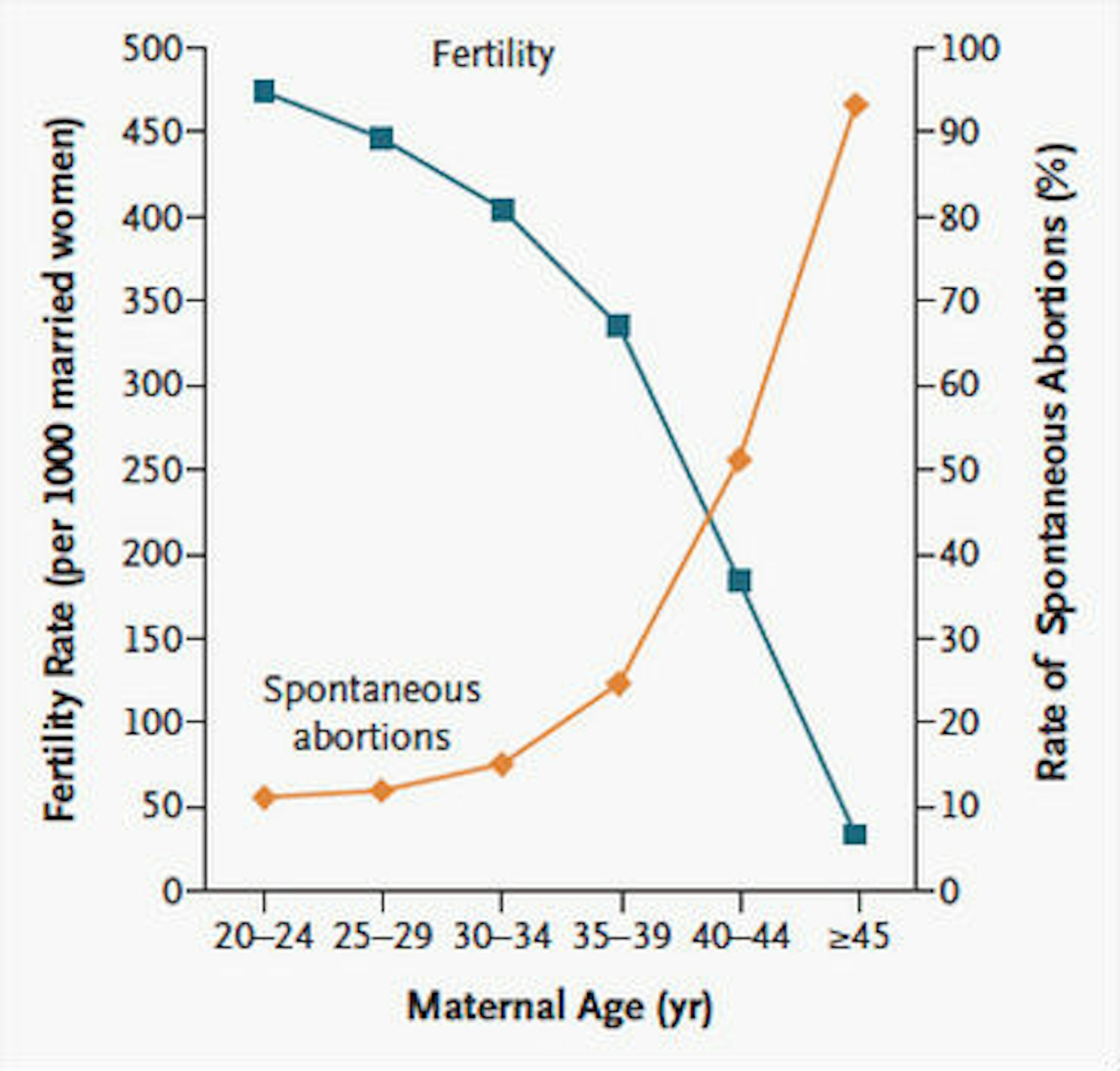
>If you only want one or two kids
This is nuts. Remember, the minimum birth rate is 2.1. Every single woman you've ever met must have 2.1 children just to keep population constant. I'm sure you've met some women who wouldn't be great mothers... which just increases the burden on everyone else!
Just think about the timeline here. Start having children at 35, have your third kid at 38? By the time your youngest is 18 you'll be 56! This is supposed to be the standard life plan, the thing everybody does?
"What about immigration?"
Mexico, Brazil and India already have below-replacement fertility. Where are all these immigrants supposed to come from?
I would like to address the emotion you describe.
Firstly, I doubt it’s just men. I don’t know the simplest adjective, but I’d call the dating scene as “optimized” and “casino like”. Persistence and luck are not small components here.
If anyone’s self worth ends up getting linked to the outcome of such a system, dropping out isnt unsurprising.
It is also quite pointless, to tell someone who is lonely or young, to not treat the process personally.
Got married at 28 to someone who was physically attractive. But had nothing much going for her and divorced at 32.
Dating was somewhat better then. But didn’t really want anything serious and had close female friends who I travelled with and really gave me the emotional support and no drama.
I got remarried at 36 and have been happily married for 13 years.
That being said, short men do have what I call the “two strikes rule”. You can’t be short and anything. Meaning short and fat, broke, ugly, bad personality, etc. I fought the and part
Geez.
Also 200k is the new 6 figures, 100k doesn’t cut it anymore
It's always about how men need to change to appease women's desires, and never about how women need to change in any way.
That said, the problem with these apps is that their business model depends on long term user value. (If you register for free, quickly find someone, then you paid nothing to them. Maybe they were able to show you a few ads.) And those who are on it for long tend to have problems. And especially big issue are those who don't give up, but are ruining the mood for others. (Which leads to even fewer women on the platforms.)
Is this a commonly held opinion? I’d be curious to read any material on this, because nothing (to me at least) suggests one gender wants it more than the other. Is it simply because there are more men than women on the popular dating apps?
Women are objectified. The attention a woman receives is related to what she is, not what she does. It's very straightforward to apply this to dating: just look good and confident.
Men are subjectified. The attention a man gets receives is related to what he does, not what he is. It's very tricky to navigate this in dating. How does someone present their interests in a way that is attractive?
This is further complicated by the most common narratives we hear about men's behavior. Masculine behavior is a looming threat. Every man must prove himself not a predator. But how?
in fact you can do this in your 40s, 50s, 60s
as long as you don't fall on hard times
I guess 80% in 2009 is better than 95% that I remembered.
So sure one woman could pick x number of guys and another could pick a completely different set y. If x+y is only 20% then it means nothing. If anything, it just makes things worse for any individual guy.
In real life, you're way overstating the variance anyway. I think you kind of see that yourself when you use qualifiers like "overwhelmingly attractive".
I know these sort of tastes are subjective, but I've talked to a lot of guys who feel the same way. The women in media are mid, most women who are young and physically fit can match if not greatly exceed the looks of women in media. However I acknowledge that women themselves often do not feel this way; they compare themselves to the female celebrities and feel bad about themselves even though most men would rate them higher than the celebrities. They rate themselves lower than men would rate them because media is toxic and purposely makes women feel insecure to sell more beauty products, lifestyles, etc.
It's why the article linked in the root of this thread was even written.
Human attraction happens best in person because there is more to it than just looks.
(Don't even start me on the whole Christian Grey character, which will forever go down as one of the most over-the-top 'perfect male'. Let's see: 33 year old man is deca-billionaire in telco after coming from foster home. And it was so effortless to become said deca-billionaire that he also found time to become a commercial helicopter pilot, a concert pianist, someone who doesn't break a sweat cranking out Michelin-tier meals for idle snacks and brunches... and looks like an underwear model.
I see variations of this statement all the time. This weird, almost gleeful misandry masquerading as a historical perspective. It needs to stop. It has poisoned all our interactions and it is hurting people.
For me, I dated a lot of men. Sometimes we're not a match, but a lot of the time these guys seemed angry I didn't need them. One guy actually became physically abusive when he came over to my house and saw how much nicer I lived than him. We'd been dating for weeks. Another guy, dumped me for paying for a whole date. Another guy, withdrew his interest upon learning my profession and considering I'd definitely make more than him whatever I made.
You know the advice female relatives give me? Hide how much I make. That is the state of heterosexual dating. It's where my friend who is a self made millionaire gets asked by her boyfriend when she's going to become a housewife so he can marry her. Women aren't perfect, but there's definitely got to be some kind of change for men as a collective. I know some great male partners, but I also know that they're out weighed by so many men I know personally.
> Women aren't perfect, but there's definitely got to be some kind of change for men as a collective. I know some great male partners, but I also know that they're out weighed by so many men I know personally.
This is a bit like saying: “White people aren’t perfect, but there's definitely got to be some kind of change for black people as a collective. I know some great black folks, but I also know that they’re outweighed by so many blacks I know personally.”
(I suspect that this is the reason your comment has been downvoted.)
I think guys who are intimidated by successful women have a ton of growing up to do, clearly. Surely it would be amazing to be with someone ambitious and intelligent?
I don't know anybody that complains that their wife/gf makes more than them. It's pretty rare, but those in that position are very grateful for the freedom to work lower paying jobs with higher satisfaction.
The social construct of marriage tries to even this out - that ‘crummy’ man stays around and provides in many ways (social, financial, physical) even after she’s no longer hot and ‘marketable’. And who will help support and protect her while she has kids. The things that make them ‘crummy’ is exactly what is needed to support all that.
It’s the social/relationship equivalent of a retirement fund/pension. It’s not exciting up front.
Pay in now, (and keep him around) so you’re not eating dogfood in 20 years and have kids who can help you too. Instead of being terribly lonely, mentally ill, and then dying alone and getting eaten by your cats.
Which society has also been nuking social safety net wise, much to everyone’s likely long term regret frankly.
It’s folks losing the plot society wide. It’s how we end up with a lot of very sad stories later.
If you mean "marriage with no possible divorce is a social safety net", then I have to protest that "safety" is pretty relative here. It's a system with absolutely no safeguards against the husband (or wife) becoming abusive or violent, especially if your society is patriarchal enough to encourage honor killings.
Nothing is perfect of course. Lots of pensions destroyed/raided, and retirements screwed up by greed too.
And going crazy in the other direction marriage wise definitely has very real downsides too!
I’d be curious to see how the majority of cases went though, overall.
We’re discovering the downsides of going too far in our current direction now, and I suspect this winter is going to be a doozy.
We currently are getting the worst of both worlds near as I can tell on both fronts (men and women), but it often gets worse before it gets better!
Wow there’s so much to unpack here. We live in a world that is largely heterosexual and monogamous, meaning it takes two to tango. If there’s a bunch of women ending up single, then that necessitates about an equal amount of single men too. The “bitterness” will be bourne by both fronts equally, and the “hot and marketable” comment cuts both ways.
Rather than play the blame game and make gross uber analogies, It’s worth pointing out why some people would rather be single. Is it because they’d rather not be in unhappy marriages? If so, the focus should be on how to improve marriage for both parties.
Is it because on top of needing to have a career, they’re also expected to shoulder much of the burden of raising kids? Let’s think of how we can make it more fair to everyone, or work on supporting parenthood as a society.
Is it really?
The world may be largely monogamous and heterosexual, but is that the case for Westernized societies? I remember reading stats on how native Western EU cultures rank highest in terms of infidelity and divorce rates, with Luxembourg enjoying a massive 40% divorce rate. The world may be monogamous, but I doubt that's only because repressive Old World societies are propping it up.
Costs became unmanageable and out of reach for the average folks once women entered the workforce, essentially doubling the supply of labor overnight. This could have been balanced out with men not being looked down upon for staying at home with the kids (although that raises more questions, considering men weren't really biologically wired for the task).
There's a reason most rich families have mostly stay-at-home wives/moms even today. The man earns the dough, while the woman stays home or works a very chill job, while her primary focus remains the house and the family (including its finances, social standing, kids - which tends to be a very high amount btw, etc). And in my experience, the ones that aren't structured this way tend to fall apart quickly.
The entire country of Luxembourg has a smaller population than most big cities, with only slightly more than half of that population having the Luxembourgish nationality. It’s hardly representative for “native Western EU cultures”.
It seems Portugal and Spain rank at the top for divorces (80%+!), followed by Luxembourg, then Russia and Ukraine. The EU average is 45%,just like the US average.
I’ve personally seen women get really distressed when they see an actual good male parent (better than them, it appeared) with kids.
And I’ve seen the same with men (to the point of aggressive harassment) with a women who were better than them at ‘manly’ stuff, like welding/fabricating, or car repair.
All of them denied it, but for anyone paying even a little attention it was pretty blatant.
Anyone who has ever spent any time in a gay club can report that many/most of the other patrons were heterosexual/monogamous too. At least until they entered the club.
Society doesn’t exist for long without a supply of children, and has very strong incentives to enforce certain behaviors.
What you’re pointing out, IMO, is that expectations and roles aren’t realistic. People keep stepping on each others toes, fighting to justify themselves, burning out, etc.
But then, there have always been the ‘confirmed bachelors’ and ‘old maids’ no? It would be interesting to see the percentages over time however.
One thing that is easily confirmed by data and just by looking around - older, established men have no shortage of ‘market value’, as do young pretty women.
Also, there has never been a time where raising kids or stable long term relationships was easy, or when there was no abuse somewhere.
It’s actually remarkably easy to measure ‘market value’ in these situations.
What market are you referring to that you think I’m not?
Look, I’ll reiterate it one more time: For every person who is single, statistically there should be another single counterpart of the opposite sex. That some people choose to stay single rather than get into a bad relationship/marriage says a lot about what it’s like to be in one for one or both parties. It’s worth having some introspection on why this is happening, instead of making gross comparisons and assumptions.
Plenty of people are in relationships (formal) that don’t have sex with each other anymore. A few never had sex, but are in relationships where the social assumption is they did/are.
Plenty of people (including women) have multiple partners, some long term, some transitory. (Many to one). Sometimes they know of each other. Usually they do not.
Plenty of people have one or more partners of different ages (sex or relationship wise).
Plenty of people have no meaningful relationships (sex or formal) of any kind for long periods of time or ‘anymore’. Often by choice, sometimes involuntarily. I know several men who flat out ‘noped out’ in their 40’s because they got tired of what they perceived as predatory behavior. And at least one woman who did the same. All of them had been married for long periods of time.
Hell, one female sex worker can have anywhere from 20 to 100 clients (monthly) last I read on a regular basis.
It’s not that uncommon for some edge case men to sleep with that many women every couple months.
Many people consider things like this to be some kind of dating. All of it interplays with relationships.
So what are you trying to say exactly besides ‘that’s all gross so I don’t want to believe it’?
If you think that’s bad, don’t get into the medical field! You won’t necessarily get the truth, but if you have even a decent idea of the STD transmission odds, it’s clear what the lies are!
https://www.pewresearch.org/social-trends/2020/08/20/a-profi...
Young men, and old women tend to be single more.
Seems like past 30, very few men stay/are single. Women > 50 start getting single dramatically faster, though I've noticed it often really starts kicking off ~ 40. (Some of this due to men dying sooner than women, and a lot of it later, but if you don't think menopause has something to do with it - you've never had a partner with menopause).
But also notably, women are not often single - unlike young men - until they're really old. Weird eh? Even though there are more women than men in the population by a measurable %.
My observation is that if not stably paired, women have it pretty rough past 30, and end up dating older and older men or 'settling' for folks they never would have given the time of day when younger. Women are also more likely to do 'Mistress' type arrangements.
Men have it really rough when young, until they figure themselves out, and then most of them have it easier (the more money, fame, popularity, infamy, etc. the better) unless they're actively driving women away.
Most homosexual relationships I've seen often end up playing out this same dynamic, but with members of the same gender. The notable exception being 'twins' [https://inmagazine.ca/2021/01/doubling-down-on-boyfriend-twi...], which was always interesting to watch. It wasn't just men either.
Trans, same but with one partner trans (of course).
A minority of those single men have numerous (sometimes >hundreds) short-term relationships. But far more of those single men have very few or even no relationships at all. I think this disparity is far more extreme for men than for women.
If that upper echelon of single and promiscuous men were socially pressured to stop man-whoring and settle into healthy long-term relationships, then the rest would have better odds. Of course those men will never voluntarily change their ways unless there exists a strong social pressure to change. In the past, this pressure existed in the form of men without partners [wives, but it doesn't have to be wives] being viewed with suspicion if they wanted to attain social standing at work or in their community. This pressure has all-but evaporated into nothingness.
I never cheated, but I was very shocked at how much attention I got as a married man.
Take the ring off? Complete 180.
So average women with average men, I don't see the issue. The problem is now a lot of women aims very high, even out of their league, when they don't have much to put on the table.
I don't see many men, old or young, doing much to improve their standing as a bachelor, given what is in their control. I've had to do a lot of listening and learning to be a man women would be interested in. Modern male culture in the US typically does NOT do that.
At the same time, I think you're right that women have more power over their life decisions more than ever. This is great and I want that for the women of earth.
---
What if there actually are plenty of men who have 'stepped their game up' and are perfectly qualified peers to women and would make suitable partners, but the women just have wildly unrealistic expectations?
Or the women just aren't that interested in men in general?
Could those be factors, rather than men just being so beneath women?
No one owes you any love, except your family.
If you want to find love or a partner out there, you’ve gotta find it and earn it. It could take a long time, or not happen - but if you aren’t in good shape, don’t have any money saved up and aren’t interesting, don’t be surprised if you end up alone or with someone below your standards.
I'm saying perhaps a major part of the reason so many men are single is not necessarily because they are lazy losers who refuse to level up like you suggest, but because they can't meet modern women's unrealistic standards or women just aren't that interested in them even after they've leveled up.
Many men can 'level up' to the maximum realistic extent, and still have few women interested in them. That doesn't make these men lazy losers who refuse to put in the work.
I'm not suggesting they are owed a woman for leveling up to the maximum realistic extent, I'm just saying it's very unfair of you to call them lazy losers for their effort not bearing fruit.
Honestly, the ability to tell “the best bachelor” in with experience together of the type that used to be frowned on before marriage was always weak; what has changed is that the social and economic compulsion/incentive (on both sides) to marry has become a lot weaker and the volume of exposure much greater, and norms limiting the kind of experience that reveals fundamental incompatibility before marriage have weakened.
Then time comes to settle down and those guys don't settle with those girls. Cue "Where have all the good men gone?" and "Why are men so scared to settle?". It's the same problem the average male faces, just in reverse.
These are average women too.
Also, early pressure to marry "the best bachelor" often meant "the guy on the football team", "the guy that peaked in high school" (you just didn't know it yet).
Often they were the ones who became the angry alcoholics.
what you describing is human nature, the reality of it that people won't tell you directly.
i don't think it's just something modern, most people have always been superficial, judgemental, tribal and so on.
It was shown that certain national ice hockey teams were comprised mainly of players who were born at the beginning of the year. It is theorized that this is because the date that cuts one class for another is at the beginning of the year. If you're born in January, and you start playing hockey at 5, you're gonna be significantly older than a child that's born in december. As a result, you'll be recognized and helped more by your coach, which improves your chances of becoming better, and drags into adulthood, up until you're in the national team. The same applies for academic and professional careers and I'm sure dating as sell.
So you find yourself in this situation where everyone is so nice and polite, so sophisticated and accepting, so inclusive, but for some reason nobody gives a single ** about having a romantic relationship with you. How’s that possible? Well it’s possible because it’s all fake. Deep inside, in our intimacy and our inner circles, we’re the same as we were a thousand years ago. The apps simply make it obvious and pull it to the surface.
The apps completely change how we perceive ourselves and our potential sexual partners. I can't believe I have to say this, but the biggest things that have changed with regards to dating in the past 10 years vs the past 1,000 are social patterns and technology.
>It’s completely asymmetric gender-wise and failing on it is basically failing on being.
This kind of attitude is so harmful. If your life's purpose is 100% dependent on some idealized stranger granting you validation you are in for a bad time. Sex is great, biological imperatives are powerful, but you wont find animals falling into existential dread and despair because they haven't gotten laid yet (or recently). That is a particularly human trait, and it comes from obsessive and self-defeating beliefs about the world rather than reality itself. You might feel like this belief is out of your hands, but it very much is not. Your beliefs are one of the few things in this world that are entirely up to you to change and improve upon (or not).
Your comment about the harmful attitude is correct, I 100% agree. But again, if you listen to what is implicitly conveyed in social media (where every human being is basically reduced to a single one-dimensional score), you would have a hard time reaching that conclusion. Nobody really “says” that, but as a human being you read between the lines. I guess it sounded like I was saying “date apps are fine, it’s us who are the problem” but I didn’t mean it, I think social media is very harmful.
Speaking for myself, I'm not really interested in being around loud, raucous places where I have to spend money just to exist and socialize there. Those are businesses, not communities.
Third places and real communities don't really exist anymore.
I legitimately can't remember the last time I went to a public event and enjoyed myself.
A public event you didn't pay for? Really depends. I can still enjoy a decent meetup here and there. But meetup issues come from the meetup itself or the people being inconsistent. Hard to build relationships when it's a revolving door that claims to meet "every 2 weeks" but ends up averaging 4-8 weeks.
I joined a book club last year, and it was great for a few months, but I noticed that most people, unless truly dedicated, petered off, or would only come and 'taste' for a month then ghost. I'm not saying I'm any better. When you've gone to 5 book clubs that have fallen apart, why would you risk committing and being sad when it falls apart again?
I believe our ability to commit is deteriorating; the how and why is a whole nother topic.
why take a risk on a book club when you can shitpost online? and watch netflix at the same time?
I personally find it weird when people talk shit about someone being unwilling to commit, as if one should jump straight into serious obligations without any forethought. You didn't do that of course, but I see it come up in discussions sometimes, mostly concerning relationships. Commitment is more complicated than most people see it imo.
I don't think I've heard of any animal falling into existential dread or despair, for any reason. But quality of life is absolutely impacted by ability to breed.
My pets certainly seem to appreciate companionship.
At the same time, part of this is because there's been a lot of change in how and where we interact. There isn't really a "poker night" in a lot of modern 30's life with neighbors you chat with every day. young adults can't afford (in time nor money) to get out to a night life more than a few times a month, and even those night life places feel more like people come with established groups. Modern society doesn't pay enough and gets more and more expensive. It's no surprise it can feel soul crushing.
What makes you think so?
Also, you wrote your post (I assume) from the perspective of a man. Even the most unattractive women on dating apps get far more attention than the most attractive men. This has been shown time and time again. Also, most men are invisible to women, but the reverse is not true. (Do not read this post as disparaging towards women.)
What is really happening is that visual-only dating apps are refining the purest biological imperatives: women only seek the best physical mates (top 20%), where as men pursue whatever they can. As a result, most men get zero attention on dating apps. The craziest irony to me: I grew up before the Internet and dating apps became a thing. RARELY did I hear women talk about finding an attractive mate. They wanted to find someone compatible and supportive with good long term intentions. These visual-only dating apps have weirdly inverted the world as most women chase the very best men... who treat them terribly, but are very good looking and have a lot of practice seducing women. Rinse and repeat; almost everyone on dating apps except for the very top are much less satisfied than life before dating apps.
So, if you get off to a good start in your dating life and career from your late teens and early 20s, you get plenty of approval and validation and compounding success as you progress through life, and acceptance that you deserve the success you're having ("they were always a high achiever, ever since school days").
Whereas if you're not in the top tier of "chosen" people and experience a few painful rejections and setbacks, you're made to feel that's just what you deserve and what you're stuck with, and there's not much you can do to improve your lot. I suspect this has become more of an entrenched belief since the discovery of evolution/DNA, and the generally accepted belief that most of our life outcomes are predetermined by our inheritance.
I think the dating apps (and employment recruitment platforms/techniques) intensify this further, by filtering based on a few simple characteristics, some of which really are genetically predetermined (height) and others that are downstream consequences of having had a blessed start in life (income/education level/job seniority/state of health).
Society generally, including/especially the dating/employment spheres, don't seem to offer much support for people who really sincerely trying to undertake a journey of personal improvement (outside of mainstream accepted practices like conventional fitness training and education). You're just expected to be "good to go". Someone who may have been dealt a rough hand in life but is trying very hard to improve themselves, including their social skills, their emotions, their health/fitness, their career prospects - all of which will lead them to becoming better romantic partners over time - can find themselves getting little support and encouragement along the way, and indeed can get a lot of discouragement from some quarters (including friends and family members).
I think a lot about how the world would be better if more people were encouraged and empowered to go on long-term journeys of deep personal growth, and what kinds of social platforms, including dating and employment platforms, could emerge out of that and bring much more opportunity and satisfaction to people who currently feel the despair of being left behind.