Aw, that was one of the fun moments when getting my current job. I moved from private sector to public sector and they're like "You understand that the previous pay you listed is more than our boss's boss, the director of our entire org unit gets paid right?". Yes, yes I do. Which is why when you asked at interview "Why do you want this role?" I didn't say "Because I would like to get rich".
But overall this seems like a good idea. Pay transparency is a known good strategy. I remember years ago working for a huge international corporation I asked about pay transparency at one of those bogus "Ask us anything" board events and the CEO answered and he's like, "My pay is a matter of public record because that's the law here" and I'm like "Yes, and it's fine, you can see that now so why not the same for everybody else?" and of course he just deflected.
How "inability to give a straight answer on anything" and "refusal to make any meaningful decisions" came to be considered good leadership traits is a mystery to me, but I do know how much it pays so that's nice.
Personally, I would just forge one with a much higher pay level - but most people who play by the rules get screwed royally.
That's some universal truth right there.
A man was recently sentenced to 4 months of jail time because he lied about his salary to rent an apartment. [0]
[0]: https://www.capital.fr/economie-politique/un-locataire-conda...
Also he only got caught because he wasn't paying the rent.

I would prefer this system to the Equifax's panopticon to be honest.
The best system would be to have a third party insure your rent. So you would only communicate these kind of information to the third party of your choice with which you would have a legal contract including a privacy clause.
You have to legislate that away or legislate heavy property tax for real estate that is not used for personal living. Which might be sensible and necessary anyway if you look at price developments.
Closest I've had is current job, a global company, asking me first and last payslip of my previous employment, from which I was allowed/encouraged to retract information. I figure all they really wanted to check was employment and job title.
I've also almost always lied about my previous pay when asked (which recently has been less than before for some reason) to better match what I was seeking.
I toyed at the idea of some Federal government IT jobs. An agency was trying their best to pay well and the level was similar to a civilian who has a PhD or MD doing federal work but still only a little more than the median software dev salary.
Most government jobs aren't attractive anymore. I think the COLA was like net -2% last year. Pensions are mostly gone. Politics are raging lately.
The FBI postings I saw were way low. I'm already paid pretty lowly, so they are definitely not competitive ($75k was what I was seeing).
My limited/indirect experience on both sides of the "overqualified" thing is that it's usually a result of the employer feeling threatened this person will supplant them, or the prospective employee coming off as entitled or non-serious. Having a doctorate doesn't impinge on your ability to mow lawns, but if you're making sure everyone knows you're meant for better things, that's a problem.
Nobody has ever been able to define what equal pay for equal work means because every human being is different (skills, work ethic, ease of working with them, timeliness, negotiation skills, assertiveness, leadership ability etc. etc). So I can understand businesses playing it safe and just paying everybody less than trying to keep people who are good but more demanding of higher salaries.
Then wouldn't you see businesses fighting for it instead of against it?
A trend I noticed from all the EU regulation concerning business: you can be certain it will look like it's doing good for people and bad for business but it will just end up screwing common people and small businesses in favour of big businesses.
Think about VATMOSS: great, now Amazon can't charge Luxembourg VAT to customers in France BUT small businesses need to keep track of every EU country VAT, apply it and retain 3 pieces of evidence of the customer location. In practice, small business killed their eCommerces and moved to Amazon or just swapped their payment processors for Paddle (which charges way more but handles VAT for you).
Think about GDPR: it was a money transfer from people to lawyers and businesses are still doing whatever data transfer they need just by adding more text to their EULA which nobody reads.
We'll see how this one goes - but it makes sense that more transparency will have a chilling effect on the cost of high performers who know how to negotiate.
My response to this comment/question is always "it's not my problem you're underpaying everyone else."
It's true that it's also necessary to confirm that the job pays enough that it doesn't actually cause me hardship to work there, but of course the advertised range for the position was comfortably more than that. My operating costs are in fact slightly lower than the calculated "Cost of living" in this country.
From your entirely selfish point of view I'm sure being paid less than half as much as before would be totally unacceptable, but it wasn't a big concern for me. It's just a number. Good luck achieving happiness by making your number go up more.
"Performance management isn't an exact science and if everyone knew everyone else's pay, it would be total chaos and nothing would get done."
How's that work for the GS structure then? Or for union jobs in various sectors?
The only reason chaos would ensure is if there were extensive unexplainable and unfair practices.
In plenty of companies I have worked for, you pay quite a lot more than you want for a particular hire not necessarily because they are worth it but because you are desperate and they are nearly good enough. You generally don't get away with putting people's salaries down if they don't perform and if you did, they might leave ending with you being back in the mess.
This might be magnified in smaller companies but it could easily squew salary figures and depending on their sex, it could also make the figures look really wrong.
This might be "unfair" by one definition but it definitely happens and is one reason why it is hard to be transparent about wages. It can also create resentment if others knew that someone was overpaid.
In the US at least, employees are explicitly allowed by federal labor law to discuss compensation with each other. Employers generally can't retaliate against them for doing so (although like all labor laws that one is occasionally broken).
Can it be explained on the basis of value? If so, then good. If not, then it's likely unfair.
"It can also create resentment if others knew that someone was overpaid."
How can they be overpaid? The salary was set by the market. If the others are underpaid due to lagging the market, then they might just leave anyways. Their value has changed during their tenure and the company has not adequately adjusted for that to stay competitive in the market.
This should really end. Job hopping should not be necessary to get a decent wage.
It's rather suspicious that any company I've seen that was this evasive, the pay levels did leak eventually (and the speculations about who is paid what for what reason did bring total chaos) - and surprise! It turned out that performance management is not an exact science, but rather a game of "who's friends with the boss", completely regardless of performance.
Such a system will encourage rigid pay schedules (ie. all engineers with 5 years experience get X, non-negotiable). Rigid pay like that advantages poor performers, and good people leave.
The end result is a company giving pay transparency ends up either with a much bigger labor bill, or staffed by poor performers.
Governments requiring pay transparency though is a weaker effect - since it affects all businesses equally, and then there won't be anywhere for those good performers to jump to - although they may just leave the country.
Besides, salary is not the only thing that keeps people or makes them leave. High quality management, pleasant work environment, office location and many other things are also part of the decision making.
In fact, hiding salaries is a welfare scheme for low performing businesses. It will eventually degrade the quality of the society since it's not meritocratic and only sustainable due to information disparity between employer and employees.
The margins of a company shouldn't be coming from the employees tricked into working for less than they can get.
I think that a system based on secrecy and/or asymmetry of information won't last long, and in fact I think the current "chaos" happening in the labor market suggests that a majority caught on to what their "true" market value is despite salary secrecy and companies will have to deal with a bigger labor bill no matter what.
When it comes to salary pricing. Companies respond to "We need employees but can't find any" much more quickly than "Our compensations seems off market averages."
If such transparency is mandated throughout a region, the best talent can react in a number of ways: 1) They can leave the region. 2) They can all work in the same few companies, either those requireing top talent or consulting companies. (Or go solo.) 3) Employers can find alternative ways to compensate them. (Generous benefits, plenty of approved overtime, generes travel refunds or any other compensation that does not require reporting) 4) Top employees can scale back their effort, and either have more free time or do side hustles. Employers may even encourage this, as it may be preferrable to those people leaving.
Most of the above will make it harder to run highly innovative companies (presumably those that require top talent), and in the end, I suppose this will drag the economy of the entire region down.
I mean, it's fairly obvious that those are traits which contribute to building the social capital for obtaining a leadership position (which, from everything I've heard, tends to be more important than actually being a good fit for a given leadership role)
See also the Peter principle.
Those companies then run off to government saying "we can't employ anyone"
Fortunately more and more job listings on linked in are listing ballpark salaries so it's easy to ignore them, there's a few coming up which are reasonable salaries for what they want too IMO, so that's good.
They report a median of $116k.
study these 3 for 6 months and you will easily get over 200k.
PS I hate how people say 'easily' for salaries that are basically double the median for devs. If it was easy, everyone would have it.
For an interesting job I could be happy with £75k. In fact in the last 20 minutes I've had contact on linkedin for a pre-sales network architect, which sounds like it could be varied and relatively interesting.
However they only list "competitive" as the salary, which I would assume means £35k ($50k)
But the actual cost of labor (your compensation) is dictated by market forces just like any other commodity. Why would anyone hire you at $100k/year if they have someone else, just as good as you, that they can hire at $50k/year?
Your ability to negotiate is tied to your leverage, which more often than not is competing offers (including your current job). That has absolutely nothing to do with value, other than the upper bound I mentioned above.
I agree. But that's not incompatible with transparent pay. If this other person is producing more value and getting paid more, great. But show me how that value is twice my own. Those measurements should be going on in performance reviews. Largely, nobody cares to do this in a just way. It's basically just opinions, which are easily biased.
You could always make things easier with min wage regs etc by giving a low living base wage and then a generous bonus based on what you ship.
For large companies, that distinguish between "role" and "level", sure. But a LOT of companies aren't big enough to do that.
My dissatisfaction has nothing to do with that person's performance. In fact, I was glad they gave him a distinguished rating when we worked together - he deserved it. What I do have a problem with is that the department breaks enterprise policy by mandating a manager pick someone for a bad rating to balance out the high rating. They picked me. My dissatisfaction is solely with the broken policies and not with someone being justly rewarded.
This is not true in general.
Bullet 4 could end up with bad consequences because there's so many ways to fudge the data. And justification is in the eye of the beholder.
For instance, in digital marketing, direct response advertising roles tend to be higher paid than marketing roles without strict KPIs (brand, organic social, etc.) Direct response advertising, for whatever reason, is split 80% men/20% women, with men and women making the same (high) salaries.
The softer marketing roles make significantly less on average, and are 80% women/20% men.
Can this law distinguish between a direct response marketer and a brand marketer, both of whom may be running Facebook and Youtube ads? Would a giant bureaucracy know or care about these nitty gritty differences in 1000s of industries? I foresee a lot of headache.
Yes that's not equal work. You have to compare two brand marketers.
The devil's in the details here though, as the debate can come under work of "equal value."
This is literally impossible in anything other than rote manual labour. Even then, I'm not convinced this is possible.
There are thousands and thousands of ways in which an L3 is not the same as another L3, and I promise you, no two L3s generate exactly the same value to Google.
Where you as the business owner / operator can both reward the above and beyond efforts and try to incentivise more of it in the future.
I'm glad you related it to my industry because I can assure you that not every L3 in Google contributes the same value to the company. They have vastly different backgrounds, education, experience, and aptitudes. Some are willing to work 80 hour weeks. Some aren't. Some are very skilled in technologies which aren't in-demand and don't currently generate a lot of value for Google. Some work on projects which generate a lot of value for Google. Some have excellent qualifications but little experience. Some have lots of experience but no qualifications. Some are extroverts and some are introverts. Some are great at communicating their thoughts and ideas. Some aren't. Some are grumpy and surly. Some are super friendly.
There are thousands and thousands of ways in which an L3 is not the same as another L3, and I promise you, no two L3s generate exactly the same value to Google. This is why pay at each level is in a range, so that these individual factors can be considered. This is compounded by the fact that there are L3s with more experience and/or qualifications than L5s. This is far from an objective comparison of an employees value generation.
"we give people and extra $24k per year if they do oncall rotation" and we give "x% more to those who work more and contribute more"
otherwise once it becomes public it turns into infighting of "we're both L3s, why do they get more?" (ignoring that one of them leaves early 2-3x a week to care for their child, or is a single worker with nothing better to do than contribute and thus does more than others) ...
They're simple concepts, but hard to get people to be grown ups about.
https://www.youtube.com/watch?v=-KSryJXDpZo
Also people psychologically overestimate their contributions and underestimate others... Has a lot of application in both the workplace and in intimate relationships.
This is more or less what I've observed in practice in Colorado. The range is quite high, and it excludes nearly 50% of real total comp due to equity, benefits, etc that are variably applied.
Jobs should have clear defined goals and workaholics should not be able to ruin it for everyone else.
They do? I'd love to see that if you have a link.
Of course, pay varies by location, and compensation includes more than just base salary, but it will give you a starting point.
if it isn't public, then it isn't published.
I'm a fan of Levels.FYI, but you notice the rather large standard deviations for a number of pay grades, and it is self-reported which means the sample may not be representative.
and I haven't found anything better than levels.fyi
Under the latter the range for SWE could be 40-80K and so a new employer could possibly find that job posting from around the time you say you were hired but still shouldn't have any idea if you were making the 40k or closer to the 80k. I believe this is intended to curb the market behavior of offering someone a pay you think they will accept rather than offering to pay based on the value of a role.
Turning the difference between those two numbers into cream for upper management to butter their bread is the status quo in America at the very least and likely in all of the western world, but leads to systemic discrimination amongst protected groups with weaker negotiating power.
Several states have implemented similar rules (CO and CA, IIRC). A job listing would typically list either a minimum salary or range for a position. "Senior Developer, $120,000-$150,000" or whatever.
Two upsides to this approach... First, an employee is not limited by their current salary - they can negotiate on their value. Second, it's widely accepted that women and minorities tend to be less aggressive salary negotiators. Those two things together, applied over a career, can make a massive reduction in lifetime earnings for employees.
* Government jobs are the big exception - you can search for most university salaries because most receive government funding. Same for local government offices.
(Note : I don't really agree with this as it's relying on salary secrecy but I think that's the logic.)
Anyway it doesn't really matter; you apply for a job, if you don't meet the criteria, that's fine. But if you DO meet the criteria but pay you a little more than your previous job, but less than others with the same job, that's going to be tackled by this legislation.
The best they can do is that instead of underpaying you, they will say "You did not pass the interview process for this job".
At my current company, everyone is simply a software engineer and you are paid based on your value. Everyone seems happy with the arrangement.
I also work in a flat company. Actually some weeks ago, one of my colleagues was applying to a new credit card. So the bank called our HR team to very a colleague's salary. I ended up taking the call due to a mishap on the phone system. So they needed to double check her salary, because she had mentioned 50% raise but no change in her job title. So I had to explain that's the way our company is.
I would expect them to push for a Marxist view on "value" of work, basically each hour is of equal value, but where you adjust for number of years of formal education, again where the type of eduction is not important. A developer with a MSc from a top college may be compared to someone with an MSc/MA in Sociology, working in the HR department, for instance.
The key alternative is to gauge value based on market demand, but where I live (Northern Europe), those who advocate "equal pay for work of equal value" don't seem to go for that. Instead, they claim that nurses and engineers should have the same salary, as the length of their education is different, at least for people employed by the public.
Maybe full transparency would solve all those problems (eg. all paychecks are public), but i know people who prefer their paychecks private, because of otherwise modest lifestyle, their landlords would increase their rent, and random family members would come begging for money.
Would they be able to contact previous employer for this information. One of the thing I really hate is the amount of leverage your previous employer has over you.
Ideal would be outlawing non-competes.
How many people can survive for 2 years on 50% lower salary? In addition, the biggest impediment of non-competes is actually the inflexibility (“your job offer sounds amazing, I’ll start working in 18-24 months!”).
And if they ARE willing to do it, then you probably held a very high status job there and so 50% will still be a lot.
EDIT: I did some googling around and almost every resource referencing them talks about C-level executives and senior managers. So that should give you a rough idea of their prevalence.
Good salary? Sure! Able to live comfortably with 50% salary (when rent is 30-50% of take-home pay)? Zero chance.
In practice the biggest impediment to even longer non-competes is legal risk; the tiny chance of an employee challenging the non-compete in court and the court ruling unreasonable or overly broad, would result in all other employees knowing their non-competes are effectively void.
You mean 50% of their previous salary plus a full salary working in a related field?
Also I find it hard to believe there's a significant pay gap for the same position when the workers have the same experience and the same education. Or that that gap is gendered, meaning that weaker negotiatiors get lower salaries.
See p77 (PDF p59): https://www.macfound.org/media/files/unesco-world-atlas-gend...
We are definitely and very clearly moving in the right direction, there's no question about that, but we're not quite there yet.
Here in Germany, the SPD (social democrats) candidate for chancellor in 2018, Schulz, tried to make the gender pay gap into one of the core issues of his campaign with posters saying women "make 21% less while working 100%"[0].
While this wasn't outright wrong, it used what the Statisches Bundesamt (official state office of statistics) called the "unadjusted" gender gap value (which I saw some people refer to as the "earnings gap"), meaning it calculated the average pay per hour for all women and compared that to the average for men (per sector, region, age group), but it specifically did not try to consider professions, different contracts (e.g. full time vs part time), but does include overtime pay (but not bonuses). It comes with a note that this number cannot be used to compare earnings for women and men in the same or equivalent profession[1].
While this of courses raises questions about why women apparently work more in professions that get paid less on average, and what to do about that (like getting more women in higher paying professions, or adjusting the pay in low paying, undervalued professions that are "typical female" such as child- and elder care or retail), Schulz however ran around suggesting that number shows women get paid a lot less for the same job.
There also is an "adjusted" number (which I think people often mean to refer to when they talk about the "pay gap") that tries to consider things like (equivalent) professions as well, making it a lot closer to "same pay for the same job" metric. That value is then given as the "upper bound" as it still cannot consider some factors such as employment/career breaks[2]. That value was about 6% in Germany in 2018. However, only looking at value alone is misleading as well, as it hides that women on average get paid less for their time (which the unadjusted value points out), among other things. Both numbers furthermore do not consider at all any unpaid work a person may perform (such as raising children), and differences between genders when it comes to participation in the paid labor market.
To bring it back to your post specifically, I found this dw infographic[3] showing that in Romania the gap was a mere 1% to Germany's 21% when using the unadjusted value (2014), but both were around 6% when using the adjusted value.
As far as I know the way to calculate the unadjusted and adjusted numbers is mandated by the EU, so these numbers should be calculated the same and comparable. So Germany and Romania seem to be doing about the same in the "same pay for the same job" metric. But I wonder why there is such a large difference in the unadjusted value? Is it because Romania did away with connotations of typically "female" and "male" professions early (maybe even as a result of past communism), are there huge differences in labor participation rates between both countries, is there less difference in what different professions get paid in Romania, etc, or a combination in some form of all of that?
[0] https://correctiv.org/media/thumbnails/filer_public_thumbnai...

[1] "Aussagen zum Unterschied in den Verdiensten von weiblichen und männlichen Beschäftigten mit gleichem Beruf, vergleichbarer Tätigkeit und äquivalentem Bildungsabschluss sind damit nicht möglich." https://www.destatis.de/DE/Themen/Arbeit/Arbeitsmarkt/Qualit...
[2] "Es muss berücksichtigt werden, dass der ermittelte Wert eine Obergrenze ist. Er wäre geringer ausgefallen, wenn weitere Informationen über lohnrelevante Einflussfaktoren für die Analysen zur Verfügung gestanden hätten, wie vor allem Angaben zu Erwerbsunterbrechungen. " https://www.destatis.de/DE/Themen/Arbeit/Verdienste/FAQ/gend...
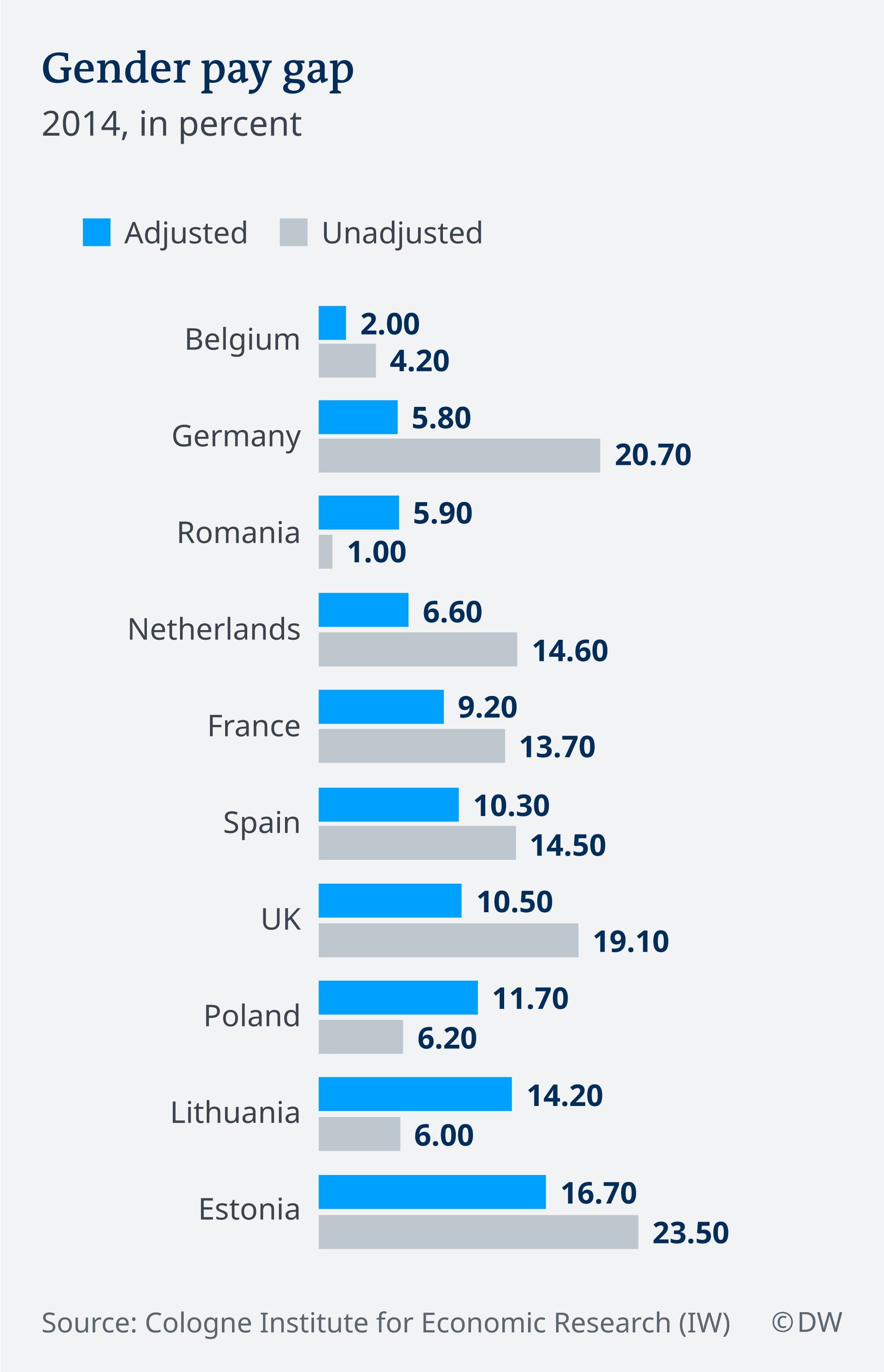
Pay gaps exist throughout the EU, some countries may surprise you in a good or bad way: https://ec.europa.eu/eurostat/statistics-explained/index.php...
FYI I had to read your comment a few times to try to pick out what you're trying to say without getting distracted by the gratuitous vitriol. It might make you feel better but it's not an effective means of actual communication.
[0]: ?
[1]: ?
Nevertheless even controlling for all this there is a remaining gap of a few percent at least, which varies greatly depending on the industrial sector and also by region. Since this thread is about the EU, it's reverent to point out that the gap is particularly high in some EU countries.
https://www.epi.org/publication/what-is-the-gender-pay-gap-a...
It is also not the idea that is frequently paraded around when talking about a pay gap, since it can actually be argued against in sensible terms, for example, if women simply ask for raises less often than men, is that really unfair?
What more often than not happens is that the idea of a pay gap is presented as if women were earning less solely because they are women and their employers simply decided to pay them less for that reason. That is fiction and a whole bunch of us are tired of it, exhausted even.
It's also completely real that many women in their 20s and 30s, biologically, tend to not be available for work for maternity reasons. As an employer you have to include that opportunity cost of in the equation. Also, a woman in her late 30s - early 40s with two kids probably has a 2 or 3 year-hiatus when it comes to work experience compared to her male-colleagues.
I mean, all of those are heavily related to gender. And while you can frame them as "personal choice", that's only useful when analyzing an individual. When a significant part of the women make these choices that hurt their salaries and work prospects, one maybe should think about how society is influencing those choices, and turns out the vector is gender.
The defining quality is sex. Having children is simply more burdensome and time-consuming for women, no way around it (except artificial wombs in the distant future). I've advocated "child-bonus" before (i.e. paying companies extra when their employees get pregnant and on maternity leave), but I doubt that idea will gain any popularity.
When even in the most equal societies the sex-interest gap (which is upstream of career choice) not only persists, but increases, that is additional heavy evidence that it's influenced mainly by biology, not by society.
It's not unreasonable social calculus to just say "We the government are going to pay you your potential lost earnings, if you decide to have a child."
In the US at least, existing policy is mostly targeted at family units (via tax credits), which doesn't really bear on an individual's opportunity cost and decision to have children or not.
As for the results, I guess it's still early to tell: https://data.worldbank.org/indicator/SP.DYN.TFRT.IN?location...
Pregnancy is 9 months, the children live for many years. For that second part, men and women could take responsibilities in an equal way (save for breastfeeding, but pumps exists), but usually the burden tends to fall on the women and that hurts careers more than pregnancy.
This is the point of contention.
My point being that sure, ideally it wouldn't be like that, but any implementation I can possibly think of is not viable at all. Jobs are fairly unique things.
"What the market pays" is the objective value.
I'm not making a value judgement of your premise. Just pointing out that your argument works as well against you as it does for you.
It is and always was, every day on the marked where you had to haggle for the price you think it's worth for you.
I mean once this legislation passes, it'll be impossible (hopefully) for a pay gap to exist for the same job - assuming equal hours worked.
Here is one saying women (25-34) earn 93% -- apparently not controlling for the actual job at all.
https://www.pewresearch.org/fact-tank/2021/05/25/gender-pay-...
Time after time it seems "pay gap between men and women" is conflated with "pay gap between men and women in the same job". Then there are the made up numbers that are the talking points.
And there you go, they can just list $1 - $999999, but you won't be offered the higher end of that range.
"OH, that's for really special candidates who know Javascript and speak Korean and Farsi"
* Job-seekers would have a right to information about the pay range of posts they apply for
* Employers would be prohibited from asking about an applicant's pay history
* Employees would have a right to ask their employer for sex-disaggregated information on the average pay of other workers doing the same work or work of equal value.
* Employers with at least 250 employees would have to report on their gender pay gap and carry out a pay assessment if the gap exceeds 5 % and cannot be justified.
* Compensation would be available to victims of pay discrimination, with the burden of proof placed on the employer and sanctions for infringements of the equal pay rule.