News for hackers. Stuff that matters.
Re:EU to mandate public salary information for all job posti... by 0xedd on Wednesday February 23, 2022 @08:20AM (#30440646)
despite pay gap shown time and time again to be fiction, government monkeys are still dancing to that out of key tune.
Re:EU to mandate public salary information for all job posti... by simonh on Wednesday February 23, 2022 @08:31AM (#30440750)
Overall in developed countries the pay gap has largely been closed over the last few decades, but remaining gaps are not fiction. There are still real and unjustifiable gaps in some employment sectors, especially in a region as diverse as the EU. Pay gaps in some Eastern European countries for example still persist.
Re:EU to mandate public salary information for all job posti... by darebak on Wednesday February 23, 2022 @09:30AM (#30441320)
Isn't Eastern Europe more progressive when it comes to female participation in the workforce?

Also I find it hard to believe there's a significant pay gap for the same position when the workers have the same experience and the same education. Or that that gap is gendered, meaning that weaker negotiatiors get lower salaries.

Re:EU to mandate public salary information for all job posti... by ethbr0 on Wednesday February 23, 2022 @09:47AM (#30441547)
Unsure about participation, but I know there's been a decades-long trend (since the 60s) where women were outpacing men in tertiary education enrollment growth in many regions, overtaking them in absolute terms sometime in the 70s/80s.

See p77 (PDF p59): https://www.macfound.org/media/files/unesco-world-atlas-gend...

Re:EU to mandate public salary information for all job posti... by simonh on Wednesday February 23, 2022 @10:14AM (#30441888)
For workers with the same experience, personality traits (there's a big overlap between female and male personality traits), employment history, etc in the most progressive nations the remaining pay gap is just a few percent. Small enough that it's on the edge of the error bars. It's bigger in the US. A lot of the claims that there's no pay gap are based on countries like Sweden, and then misapplied to the US which does have a persistent unjustified pay gap, albeit a much, much smaller one than even a few decades ago.

We are definitely and very clearly moving in the right direction, there's no question about that, but we're not quite there yet.

Re:EU to mandate public salary information for all job posti... by ipatec on Wednesday February 23, 2022 @09:36AM (#30441408)
last time I checked countries like Romania (E Europe) had the smallest pay gap in Europe. the issue is usually in countries like Germany, Switzerland or Netherlands.
Re:EU to mandate public salary information for all job posti... by rndgermandude on Wednesday February 23, 2022 @12:15PM (#30443483)
It's also important to consider what people mean exactly when they talk about the "pay gap".

Here in Germany, the SPD (social democrats) candidate for chancellor in 2018, Schulz, tried to make the gender pay gap into one of the core issues of his campaign with posters saying women "make 21% less while working 100%"[0].

While this wasn't outright wrong, it used what the Statisches Bundesamt (official state office of statistics) called the "unadjusted" gender gap value (which I saw some people refer to as the "earnings gap"), meaning it calculated the average pay per hour for all women and compared that to the average for men (per sector, region, age group), but it specifically did not try to consider professions, different contracts (e.g. full time vs part time), but does include overtime pay (but not bonuses). It comes with a note that this number cannot be used to compare earnings for women and men in the same or equivalent profession[1].

While this of courses raises questions about why women apparently work more in professions that get paid less on average, and what to do about that (like getting more women in higher paying professions, or adjusting the pay in low paying, undervalued professions that are "typical female" such as child- and elder care or retail), Schulz however ran around suggesting that number shows women get paid a lot less for the same job.

There also is an "adjusted" number (which I think people often mean to refer to when they talk about the "pay gap") that tries to consider things like (equivalent) professions as well, making it a lot closer to "same pay for the same job" metric. That value is then given as the "upper bound" as it still cannot consider some factors such as employment/career breaks[2]. That value was about 6% in Germany in 2018. However, only looking at value alone is misleading as well, as it hides that women on average get paid less for their time (which the unadjusted value points out), among other things. Both numbers furthermore do not consider at all any unpaid work a person may perform (such as raising children), and differences between genders when it comes to participation in the paid labor market.

To bring it back to your post specifically, I found this dw infographic[3] showing that in Romania the gap was a mere 1% to Germany's 21% when using the unadjusted value (2014), but both were around 6% when using the adjusted value.

As far as I know the way to calculate the unadjusted and adjusted numbers is mandated by the EU, so these numbers should be calculated the same and comparable. So Germany and Romania seem to be doing about the same in the "same pay for the same job" metric. But I wonder why there is such a large difference in the unadjusted value? Is it because Romania did away with connotations of typically "female" and "male" professions early (maybe even as a result of past communism), are there huge differences in labor participation rates between both countries, is there less difference in what different professions get paid in Romania, etc, or a combination in some form of all of that?

[0] https://correctiv.org/media/thumbnails/filer_public_thumbnai...
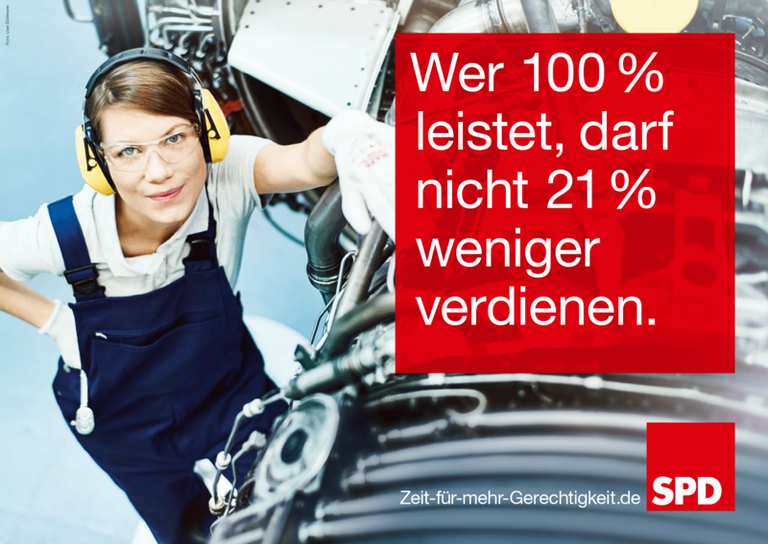
[1] "Aussagen zum Un­ter­schied in den Ver­diens­ten von weiblichen und männlichen Be­schäf­tig­ten mit glei­chem Beruf, ver­gleich­ba­rer Tätigkeit und äquivalentem Bildungsabschluss sind damit nicht möglich." https://www.destatis.de/DE/Themen/Arbeit/Arbeitsmarkt/Qualit...

[2] "Es muss berücksichtigt werden, dass der ermittelte Wert eine Obergrenze ist. Er wäre geringer ausgefallen, wenn weitere Informationen über lohnrelevante Einflussfaktoren für die Analysen zur Verfügung gestanden hätten, wie vor allem Angaben zu Erwerbs­unterbrechungen. " https://www.destatis.de/DE/Themen/Arbeit/Verdienste/FAQ/gend...
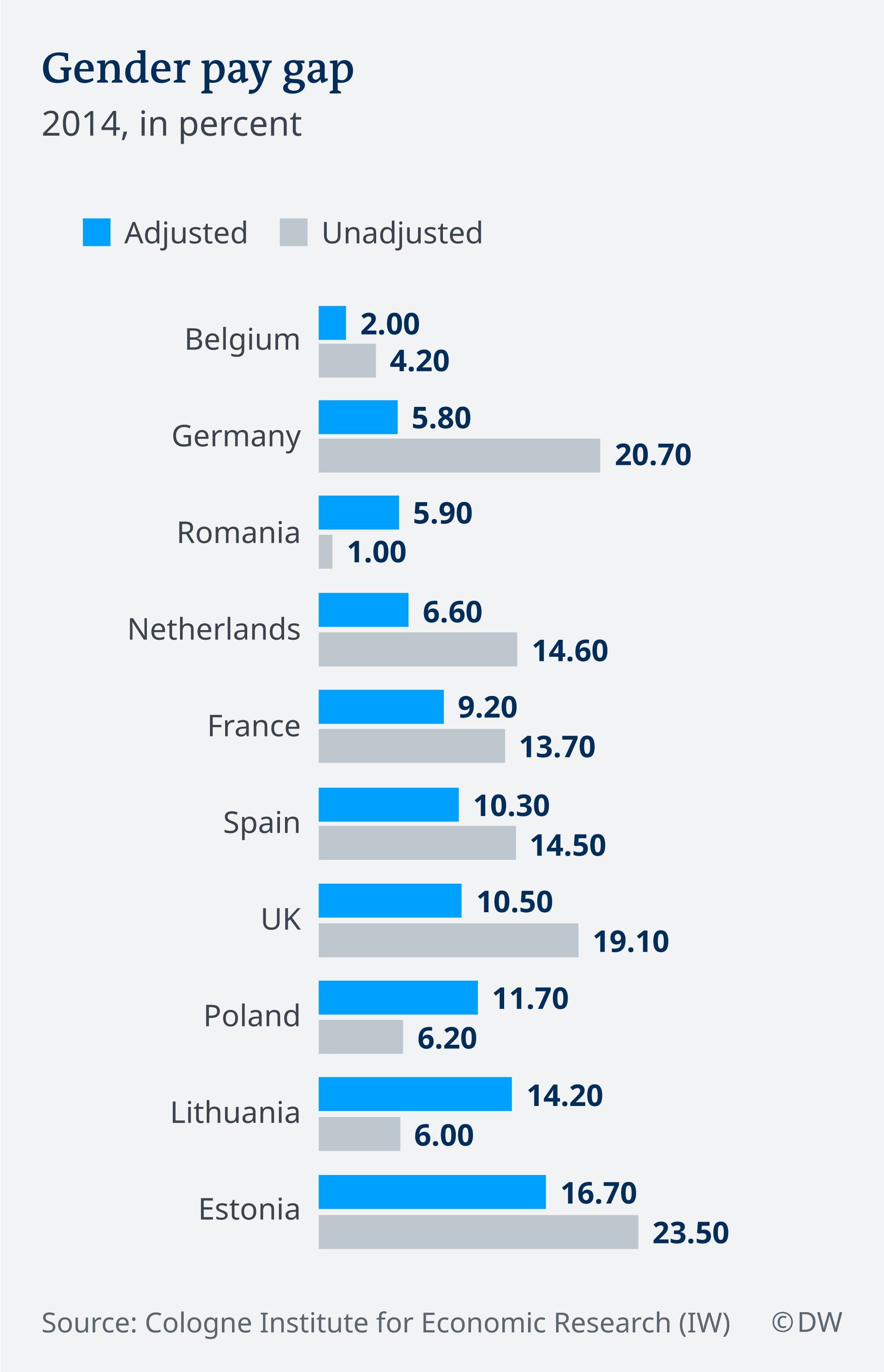
[3] https://static.dw.com/image/47827459_7.png

Re:EU to mandate public salary information for all job posti... by ajsnigrutin on Wednesday February 23, 2022 @12:47PM (#30443944)
In slovenia, they just said women earned less (94.1% of the mens pay), but ignored even the hours worked, with the data in the same database.
Re:EU to mandate public salary information for all job posti... by cbg0 on Wednesday February 23, 2022 @11:37AM (#30442926)
> Pay gaps in some Eastern European countries for example still persist.

Pay gaps exist throughout the EU, some countries may surprise you in a good or bad way: https://ec.europa.eu/eurostat/statistics-explained/index.php...

Re:EU to mandate public salary information for all job posti... by boomskats on Wednesday February 23, 2022 @08:29AM (#30440733)
Any external references to back up your 'pay gap shown time[0] and time again[1] to be fiction' claim?

FYI I had to read your comment a few times to try to pick out what you're trying to say without getting distracted by the gratuitous vitriol. It might make you feel better but it's not an effective means of actual communication.

[0]: ?

[1]: ?

Re:EU to mandate public salary information for all job posti... by simonh on Wednesday February 23, 2022 @08:44AM (#30440854)
It's not fiction, that's hyperbole, but there are factors other than gender by itself that accounts for a lot of the remaining disparity between men and women's pay. Taking a career break to have children, historical 'steering' of women away from STEM subjects in education, some apparent natural tendency for many women to avoid such subjects even when they have a free choice, a tendency for women to not challenge their compensation or push for raises compared to men, women's tendency to avoid overtime compared to men which can affect their advancement prospects. There are a lot of factors that come down to personal choice, and women often make different choices from men.

Nevertheless even controlling for all this there is a remaining gap of a few percent at least, which varies greatly depending on the industrial sector and also by region. Since this thread is about the EU, it's reverent to point out that the gap is particularly high in some EU countries.

https://www.epi.org/publication/what-is-the-gender-pay-gap-a...

Re:EU to mandate public salary information for all job posti... by Levitz on Wednesday February 23, 2022 @09:00AM (#30440985)
The idea that the average income for men and women isn't the same is not fiction at all, it's completely real.

It is also not the idea that is frequently paraded around when talking about a pay gap, since it can actually be argued against in sensible terms, for example, if women simply ask for raises less often than men, is that really unfair?

What more often than not happens is that the idea of a pay gap is presented as if women were earning less solely because they are women and their employers simply decided to pay them less for that reason. That is fiction and a whole bunch of us are tired of it, exhausted even.

Re:EU to mandate public salary information for all job posti... by simonh on Wednesday February 23, 2022 @10:03AM (#30441751)
It depends on where you are talking about and what the jobs are. As I pointed out there are some countries and employment sectors in the EU that do have persistent pay gaps that can't be explained away by life choices, and so it still makes sense for the EU to work on this issue, no matter how tired you might be of haring about it.
Re:EU to mandate public salary information for all job posti... by paganel on Wednesday February 23, 2022 @10:20AM (#30441961)
> it's completely real.

It's also completely real that many women in their 20s and 30s, biologically, tend to not be available for work for maternity reasons. As an employer you have to include that opportunity cost of in the equation. Also, a woman in her late 30s - early 40s with two kids probably has a 2 or 3 year-hiatus when it comes to work experience compared to her male-colleagues.

Re:EU to mandate public salary information for all job posti... by gjulianm on Wednesday February 23, 2022 @08:53AM (#30440918)
> Taking a career break to have children, historical 'steering' of women away from STEM subjects in education, some apparent natural tendency for many women to avoid such subjects even when they have a free choice, a tendency for women to not challenge their compensation or push for raises compared to men, women's tendency to avoid overtime compared to men which can affect their advancement prospects.

I mean, all of those are heavily related to gender. And while you can frame them as "personal choice", that's only useful when analyzing an individual. When a significant part of the women make these choices that hurt their salaries and work prospects, one maybe should think about how society is influencing those choices, and turns out the vector is gender.

Re:EU to mandate public salary information for all job posti... by tomp on Wednesday February 23, 2022 @09:10AM (#30441090)
Gender is a made-up concept with no sensible definition.

The defining quality is sex. Having children is simply more burdensome and time-consuming for women, no way around it (except artificial wombs in the distant future). I've advocated "child-bonus" before (i.e. paying companies extra when their employees get pregnant and on maternity leave), but I doubt that idea will gain any popularity.

When even in the most equal societies the sex-interest gap (which is upstream of career choice) not only persists, but increases, that is additional heavy evidence that it's influenced mainly by biology, not by society.

Re:EU to mandate public salary information for all job posti... by ethbr0 on Wednesday February 23, 2022 @09:57AM (#30441673)
I've always thought it's insane that many developed countries' governments fret about their birth rates, then do absolutely nothing to incentivize having children from an individual's career perspective.

It's not unreasonable social calculus to just say "We the government are going to pay you your potential lost earnings, if you decide to have a child."

In the US at least, existing policy is mostly targeted at family units (via tax credits), which doesn't really bear on an individual's opportunity cost and decision to have children or not.

Re:EU to mandate public salary information for all job posti... by darebak on Wednesday February 23, 2022 @10:06AM (#30441792)
AFAIK Hungary is trying something like that, I am not sure about the specifics but I think that for every child you have the government lowers your income tax and after your third child you don't pay any income tax. There are some other measures too, all of them were implemented relatively recently, let's say 2015 although I am not sure.

As for the results, I guess it's still early to tell: https://data.worldbank.org/indicator/SP.DYN.TFRT.IN?location...

Re:EU to mandate public salary information for all job posti... by gjulianm on Wednesday February 23, 2022 @10:43AM (#30442258)
> Having children is simply more burdensome and time-consuming for women, no way around it

Pregnancy is 9 months, the children live for many years. For that second part, men and women could take responsibilities in an equal way (save for breastfeeding, but pumps exists), but usually the burden tends to fall on the women and that hurts careers more than pregnancy.

Re:EU to mandate public salary information for all job posti... by craigie on Wednesday February 23, 2022 @12:17PM (#30443519)
In most places maternity leave is a lot longer than paternity leave so that's society influence.
Re:EU to mandate public salary information for all job posti... by simonh on Wednesday February 23, 2022 @10:07AM (#30441797)
Yes that's fair enough, it's a bigger issue than just a pay gap. That's a symptom.
Re:EU to mandate public salary information for all job posti... by bloqs on Wednesday February 23, 2022 @08:50AM (#30440902)
The pay gap exists. The cause of the pay gap is not due to oppression, but due to tempermental difference between different types of people, and the impact that has on salary negotiation. (Including, male-female temperamental differences).

This is the point of contention.

Re:EU to mandate public salary information for all job posti... by JanSt on Wednesday February 23, 2022 @08:57AM (#30440951)
Maybe pay shouldn't be based on the personal ability to negotiate, which is not a core competency for most jobs, but on a equal compensation for equal work then...
Re:EU to mandate public salary information for all job posti... by Levitz on Wednesday February 23, 2022 @09:04AM (#30441023)
While we are at it, the cost of a product should depend on its objective value, not what the market pays.

My point being that sure, ideally it wouldn't be like that, but any implementation I can possibly think of is not viable at all. Jobs are fairly unique things.

Re:EU to mandate public salary information for all job posti... by gruez on Wednesday February 23, 2022 @09:23AM (#30441245)
> While we are at it, the cost of a product should depend on its objective value, not what the market pays.

"What the market pays" is the objective value.

Re:EU to mandate public salary information for all job posti... by Gareth321 on Wednesday February 23, 2022 @10:12AM (#30441864)
The job market is a market, and if the job market dictates that the wage is set in part by one's ability to sell themselves to potential employers, then the (job) market is currently setting objective value (wages).

I'm not making a value judgement of your premise. Just pointing out that your argument works as well against you as it does for you.

Re:EU to mandate public salary information for all job posti... by selfhoster11 on Wednesday February 23, 2022 @01:35PM (#30444575)
From a pedantic economist perspective, yes. From a common sense perspective, if a £40 jacket was sold for £200 to someone, then it's still worth £40 even if this person overpaid for it.
Re:EU to mandate public salary information for all job posti... by bloqs on Friday March 04, 2022 @11:44AM (#30557102)
Are people with bad information objectively correct? (Everyone overpays illogically for product because of deliberate misinformation, or whatever)
Re:EU to mandate public salary information for all job posti... by nix23 on Wednesday February 23, 2022 @09:35AM (#30441396)
>Maybe pay shouldn't be based on the personal ability to negotiate, which is not a core competency for most jobs

It is and always was, every day on the marked where you had to haggle for the price you think it's worth for you.

Re:EU to mandate public salary information for all job posti... by Cthulhu_ on Wednesday February 23, 2022 @10:38AM (#30442184)
Can you cite some sources for your statement please?

I mean once this legislation passes, it'll be impossible (hopefully) for a pay gap to exist for the same job - assuming equal hours worked.

Re:EU to mandate public salary information for all job posti... by moss2 on Wednesday February 23, 2022 @08:52AM (#30440909)
Sources please
Re:EU to mandate public salary information for all job posti... by LanceH on Wednesday February 23, 2022 @09:17AM (#30441162)
Ideally the people writing the policy could provide the sources that we could scrutinize. I just keep hearing politicians and advocacy groups saying 77% for literally decades now. I'm willing to accept there is a gap. I'm not willing to accept that this number hasn't moved for years.

Here is one saying women (25-34) earn 93% -- apparently not controlling for the actual job at all.

https://www.pewresearch.org/fact-tank/2021/05/25/gender-pay-...

Time after time it seems "pay gap between men and women" is conflated with "pay gap between men and women in the same job". Then there are the made up numbers that are the talking points.