Also I find it hard to believe there's a significant pay gap for the same position when the workers have the same experience and the same education. Or that that gap is gendered, meaning that weaker negotiatiors get lower salaries.
See p77 (PDF p59): https://www.macfound.org/media/files/unesco-world-atlas-gend...
We are definitely and very clearly moving in the right direction, there's no question about that, but we're not quite there yet.
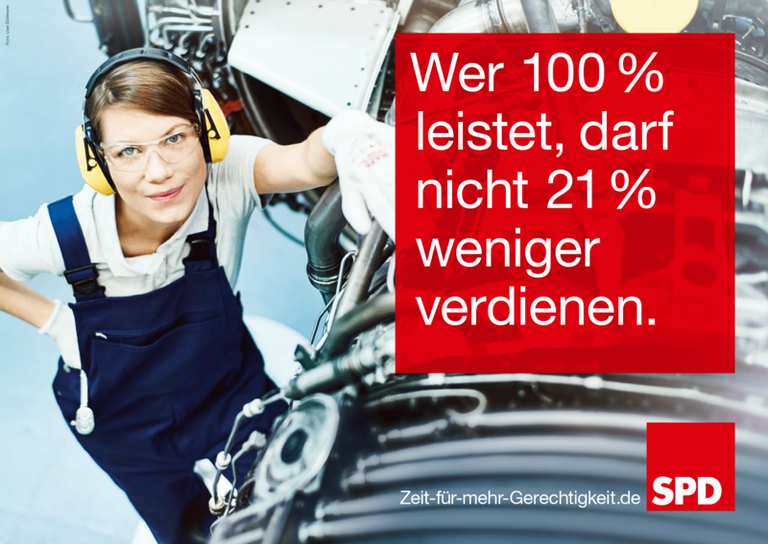
Here in Germany, the SPD (social democrats) candidate for chancellor in 2018, Schulz, tried to make the gender pay gap into one of the core issues of his campaign with posters saying women "make 21% less while working 100%"[0].
While this wasn't outright wrong, it used what the Statisches Bundesamt (official state office of statistics) called the "unadjusted" gender gap value (which I saw some people refer to as the "earnings gap"), meaning it calculated the average pay per hour for all women and compared that to the average for men (per sector, region, age group), but it specifically did not try to consider professions, different contracts (e.g. full time vs part time), but does include overtime pay (but not bonuses). It comes with a note that this number cannot be used to compare earnings for women and men in the same or equivalent profession[1].
While this of courses raises questions about why women apparently work more in professions that get paid less on average, and what to do about that (like getting more women in higher paying professions, or adjusting the pay in low paying, undervalued professions that are "typical female" such as child- and elder care or retail), Schulz however ran around suggesting that number shows women get paid a lot less for the same job.
There also is an "adjusted" number (which I think people often mean to refer to when they talk about the "pay gap") that tries to consider things like (equivalent) professions as well, making it a lot closer to "same pay for the same job" metric. That value is then given as the "upper bound" as it still cannot consider some factors such as employment/career breaks[2]. That value was about 6% in Germany in 2018. However, only looking at value alone is misleading as well, as it hides that women on average get paid less for their time (which the unadjusted value points out), among other things. Both numbers furthermore do not consider at all any unpaid work a person may perform (such as raising children), and differences between genders when it comes to participation in the paid labor market.
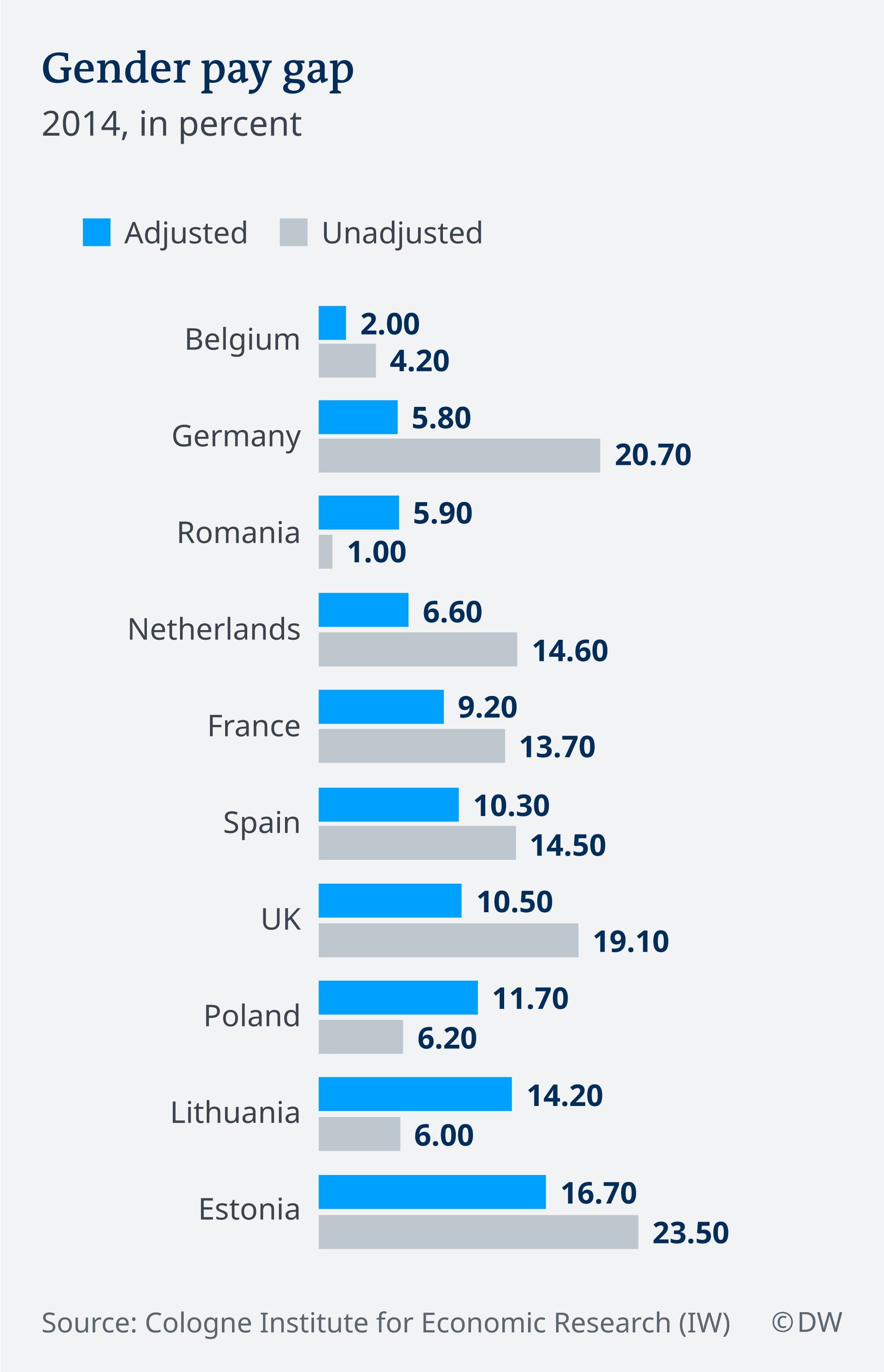
To bring it back to your post specifically, I found this dw infographic[3] showing that in Romania the gap was a mere 1% to Germany's 21% when using the unadjusted value (2014), but both were around 6% when using the adjusted value.
As far as I know the way to calculate the unadjusted and adjusted numbers is mandated by the EU, so these numbers should be calculated the same and comparable. So Germany and Romania seem to be doing about the same in the "same pay for the same job" metric. But I wonder why there is such a large difference in the unadjusted value? Is it because Romania did away with connotations of typically "female" and "male" professions early (maybe even as a result of past communism), are there huge differences in labor participation rates between both countries, is there less difference in what different professions get paid in Romania, etc, or a combination in some form of all of that?
[0] https://correctiv.org/media/thumbnails/filer_public_thumbnai...
[1] "Aussagen zum Unterschied in den Verdiensten von weiblichen und männlichen Beschäftigten mit gleichem Beruf, vergleichbarer Tätigkeit und äquivalentem Bildungsabschluss sind damit nicht möglich." https://www.destatis.de/DE/Themen/Arbeit/Arbeitsmarkt/Qualit...
[2] "Es muss berücksichtigt werden, dass der ermittelte Wert eine Obergrenze ist. Er wäre geringer ausgefallen, wenn weitere Informationen über lohnrelevante Einflussfaktoren für die Analysen zur Verfügung gestanden hätten, wie vor allem Angaben zu Erwerbsunterbrechungen. " https://www.destatis.de/DE/Themen/Arbeit/Verdienste/FAQ/gend...
Pay gaps exist throughout the EU, some countries may surprise you in a good or bad way: https://ec.europa.eu/eurostat/statistics-explained/index.php...