Not really. For some reason the actually quite simple problem is needlessly complicated in the discussions.
Stop digging up ANY carbon from below ground where it was safely buried.
Any carbon above ground is part of the cycle that includes atmospheric CO2. You need huge effort to change how much of it is in CO2 form at any time while still having no certainty that it won't change very quickly (into CO2 atmospheric form), e.g. through fires (like the many burning forests just now).
The earth's solution to removing the CO2 from the atmosphere was to bury it deep underground. Getting it back out from there is the BIG problem. The details of the above-ground carbon cycle are a small problem with very little impact compared to the big issue of getting more and more of the ancient carbon back up into the cycle.
Of course, it's no use discussing the stop of all coal, gas, and oil digging, because there is zero chance of it happening. Coal at most and not even that looks likely, globally.
It's like not caring about the huge hole in the hull of the ship while arguing about how to "safely" store all the water coming in.
We need to do what you suggest as quickly as possible. That means some things that depend on that carbon downstream should be stopped, replaced with alternatives or at the very least heavily discouraged while a market for substitutes created. But how do we decide which ones to do first? Ideally the cheapest and biggest impact. Our best tool for doing so is probably a well regulated market with a carbon fee.
Unfortunately, the same groups that caused the problem, then tried to cover up the problem, then attacked all the solutions continues to talk about how great a carbon tax will be, while also funding the politicians who will never let it happen.
But, if you want to know what the most sensible answer is then just look at what vaguely sensible countries are doing. What they're doing today is probably what we should all have been doing 20 years ago.
This usually involves putting some kind of financial incentive on electricity producers to move to low carbon alternatives (gas is fine as a short term substitute, but if we'd started 20 years ago we'd no longer need it today) and other CO2 emitters to use electricity rather than fossil fuels (e.g. cars).
Other basic elements are carbon tariffs to stop other countries undercutting your efforts.
It's not rocket science. The whole "this is impossible" stuff is just bullshit from the people who don't want to do it. EVs, Solar and Wind Turbines were all impossible according to the same people. Most of the moonshot stuff is trying to come up with a technical solution to the political issues, and that's hard.
> It's not rocket science. The whole "this is impossible" stuff is just bullshit from the people who don't want to do it. Most of the moonshot stuff is trying to come up with a technical solution to the political issues, and that's hard.
If all recorded history is anything to go by, the moonshots are probably our best realistic hope, because technology is easier than politics. The "people who don't want to" use existing solutions have all the power and it's going to be very hard to convince them to change their minds; they're protected by the common folk because they have the "high ground" of having their interests be aligned with short-term interests of regular people, while the required changes will necessarily inconvenience everyone in the short term.
No, we shouldn't be counting on new technologies to get us out of this, but it's still by far the most likely outcome out of possible futures where we do get out of this.
As I said, look at what the more sensible countries are doing today and you'll see what we all should have been doing 20 years ago. No magical technology required:
https://www.reuters.com/business/sustainable-business/eu-pro...
Not simple, but still politics rather than technical in nature.
The UN projects that the global population increases from a population of 7.7 billion in 2019 to 11.2 billion by the end of the century. [1]
> but stopping it faster either requires severely authoritarian measures or increasing economic safety, which counters the benefits.
Sounds like you really don't want to consider this solution at all, because you feel it can only be accomplished by a decree that would be constraining people's liberty?
Have you considered the possibility that some people might want to contribute more to sustainability of their own free will?
For each American couple who reads this post and decides to have one less baby, over the next 79 years the world will be spared from 1,562 metric tonnes (1,722 tons) of C02 emissions. [2, 3]
> And reducing birth rates too fast sets us up for disaster too.
Are you saying humans aren't capable of living with zero population growth? If that's what you are saying, could you explain the nature of the difficulties you project?
[1] https://ourworldindata.org/future-population-growth
[2] https://slightlyunconventional.com/much-co2-average-person-c...
[3] https://www.macrotrends.net/countries/USA/united-states/life...
UN projections puts the end of population growth at some point within the next century, but accelerating that change fast enough to have an impact on climate change would require dramatic interventions, and also will not happen because it would be absolutely politically untenable for most politicians to stunt growth that way (you'll note, politicians many places are encouraging more children, and China has kept loosening up their own policies because current birth rates are causing concerns - politicians would in general rather encourage more children than open up for more immigration, and opening up for more immigration is in any case a stopgap).
So, while reducing growth is absolutely part of it, we're already doing that pretty much at the rate we can expect to be politically tenable. There are parts of Africa we could encourage a faster reduction in (e.g. some of the absolute worst, like Niger, would likely fall off a lot faster with more economic development assistance), but it's not going to do enough to speed up population reversal in time.
Remember that changes in birth rates has a trailing effect of a couple of decades, typically. So even if we could make changes now to education for example that will drastically cut birth rates eventually, it'd not affect population size enough in time.
Also, the problem countries for CO2 emissions aren't those with the high birth rates.
It's not rocket science. Too many interest groups are convoluting the issue.
But, I think to clearest, easiest way is to just ban "coal, gas, oil". Then let the lack of it "tickle" through the economy.
Not by tomorrow, mind you, have it gradually reduce. Where there are problems, help with tax money.
We've done it before, with asbestos, lead in gas, ..
With pathogens that jump between species, as SARS-CoV-2 has with several populations, including white-tailed deer[1] in the US, you potentially need to isolate all reservoir species from each other as well.
If there was really that big of a risk where we'd need mammals to isolate as well, then veterinarian services the world over would have collapsed under the weight of house pets contracting the virus.
edit: curious about the downvotes. Perhaps you have proof that has eluded the virologists researching SARS-CoV-2. Please do speak up ;)
You probably wrote this half-jokingly, but actually… this is exactly what Australia tried last year and … well it’s still trying.
This isn't going to be easy not because it's technically difficult but because you're going to end up asking humanity to give up much the lifestyle it's grown accustomed to over the last 150 years.
This is an unusual POV unique to the US when compared with the rest of the world. When I lived in San Francisco, I didn't drive a car for ten years, and didn't miss it for one minute. There's also an incredible amount of recaptured freedom available when you stop driving, as most commuters are aware. This equates to having more time to walk and enjoy the world, more time to listen to podcasts and music and read, and less stress rushing and worrying about getting into an accident.
% of world emissions, emissions per capita [t/person/annum]:
  China          29.34%    7.7
  United States  13.77%   15.7
  European Union  9.57%    7.0
  India           6.62%    1.8
  Russia          4.76%   12.3
  Japan           3.56%   10.4
https://ourworldindata.org/grapher/cumulative-co2-emissions-...
The US is supposed to do more given the damage it has done, but has been and still is dragging its feet. Same applies to the EU.
It is not "only" the West that is a problem here. The biggest current polluter is China. If you look at per capita data, you have among the biggest polluters the US, definitely, but also Russia, Japan, South Korea, Saudi Arabia, Canada. That's not "the West". Per capita, China emits more than the EU.
Sure, "the West" needs to clean up its act (the US in particular), but this is without doubt a global problem.
https://ourworldindata.org/grapher/annual-co-emissions-by-re...
Wtf? Nearly every human has personal transportation built in. It's called having legs.
>you're going to end up asking humanity to give up much the lifestyle it's grown accustomed to over the last 150 years.
Which is a totally reasonable ask considering the climate.
Which has already happened for every generation for the past few centuries. Peoples lifestyles change all the time. There's no need to ask, it is an inevitable thing that happens, you can't freeze time.
Quite often in human history the hard problems are only hard because people profit from those problems not being solved.
Do you mean easy as in "technically possible" or easy as in "the people with the current political power and wealth will benefit from this change and will suffer the consequences if they dont?"
Climate change is the second type of hard.
As was, for example, "freeing the slaves", "giving people the vote" and other such problems that often needed bloody wars and revolutions to be settled.
On the other hand, alternatives to oil and gas are much more expensive and require significant sacrifices compared to just using oil.
Electric cars are more expensive than ICE. They have less range and there is a lack of equivalent charging infrastructure. Those are being solved but it’s taken 30 years or more of working on battery technology and efficiency to match ICE cars for convenience.
Solar panels and wind has been similar. Years of development and billions of dollars to optimize it and still has downsides compared to oil and gas.
Things like airplane fuel and plastics there are no easy solutions to still.
Even the things that have solutions like electric cars, solar panels, etc require tons of new infrastructure to switch which is expensive both in dollars and carbon cost.
Just look at the total dollar amount of replacing all oil-using cars/trains/planes/power plants/factories/etc and compare to all CFC-generating devices it’s a lot more.
When you say something is "much more expensive" you're mostly talking politics since basically everyone agrees it's cheaper to deal with climate change.
The fact that there are CFC replacements but not oil replacements for all use-cases indicates that it's more difficult, no?
> basically everyone agrees it's cheaper to deal with climate change
I'm not sure that's the case. Seems like a lot of people are either hoping that it's not going to affect them that much, or that some miracle technology will be developed which will fix the problem more cheaply and not require any change in behavior on their part.
My thesis is that the reason there are not sufficent oil alternatives, is that the people who benefit from oil being burned for fuel have made sure that is the case.
The quick and simple way to a) make use of all existing alternatives where feasible and desireable and b) ensure a market exists for people to develop new alternatives is to introduce a carbon tax that accounts for the externalities.
That has been a hard task (though we've made some limited headway) and it was not technical challenges that held us back but political.
Your argument is the equivalent of a King saying, "Well, that sounds great in theory but democracy is too technically difficult", "No it's not" "Well if it's so easy why hasn't it already happened yet" "Because you murdered anyone who suggested it" "Oh yes, so I did".
On the other hand, it's ridiculous to say that the solution is "just stop bro". It's anything but technically simple. If you outright ban all fossil fuels, how do you make electricity? How do you stock supermarkets? How do all goods get transported? How do people move about? Obviously it's not so simple as that. You need a plan to transition to sustainable energy and a sustainable economy in general. For instance, you need a massive Green New Deal to fund this transition, you need carbon price+cap schemes to force the transition, etc.
I can't really think of anything related to this that anyone has ever said "even if the entire human race worked together on this for 3 decades we dont know how to achieve it" (actually, I've seen people say that a lot e.g. modern civilization isn't possible without fossil fuels because of EROEI, but those people are wrong and/or lying)
Doing this would result in mass deaths. Food transportation would collapse within hours. And mechanized farming would be unfeasible anyway. Death toll would be in billions.
That is nonstarter.
And that is without part "people would freeze to death in unheated homes" applying in many places.
If you mean "reduce dependency on them slowly over years/decades" then it would more reasonable but it is not "just ban".
It’s interesting in that I can’t think of any political or cultural conflict it ties into? They just enjoy their daily cadmium, it appears.
Anyway, give me a better explanation why people don't look like they did only a few decades ago.
In the case of lead, it seems to be necessary for glucose transport, and seems to have effects similar to Rapamycin. It seems that Rapamycin basically only works by compensating for lead deficiency to some degree.
https://www.sciencedirect.com/science/article/abs/pii/S03784...
Take an individual that bikes everywhere. What other changes can he make in his life that would reduce the demand of "digging out carbon"?
As it turns out, he's relying on rubber wheels for his bicycle, he's relying on synthetic clothing for comfort, and numerous in his life products are made with plastic. What are the highest impact changes he can make?
In our market economy designed to get people to consume cars, your foregoing car ownership actually just makes it a little more comfortable for all the car owners out there sharing the road with you. You reduce traffic for them, reduce the wear on the infrastructure, you drive down the price of cars and gas, and you free up a parking space.
Of course this is all on the infinitesimal scale of your own individual influence on the world, its ecosystem, and the economy you live in, but so is your actual reduction in fossil fuel consumption if you give up driving.
Point is, there needs to be something a lot bigger than your individual choice as a consumer. We need an economy that prices in the environmental impact of cars, and I’m pretty sure we need the state for that.
Rubber, synthetic clothing, plastics, do not get used up and ejected directly into the atmosphere. There is some energy use in manufacture, probably some chemistry that may emit some CO2. But it is absolutely dwarfed by the massive amount of gasoline fuel ejected directly into the atmosphere by driving.
The store in a bike frame is probably the most carbon intensive part of a bike. For every pound of steel, two pounds of CO2 is currently emitted in manufacture (but this will probably go to zero in the future).
For a 20-60 pound bike frame, that's the equivalent of only three gallons of gasoline. Three gallons. Because as a gallon of gasoline combusts, it picks up extra oxygen atoms and ends up being 20 pounds of CO2.
Think of a 20 pound plate for weight lifting, and that's a gallon of gasoline once it's burned.
All the other stuff in life--rubber, clothing, plastics--are almost a rounding error compared to the daily commutes we make in cars in the US.
Lesson: get on that bike as soon as possible, and if you can't, at least get an EV.
But be mindful that not all plant calories are equal, especially those that are air freighted (more of a problem in NW Europe which airfreights a lot of fresh fruit and veg in from African countries than the US).
Take trains not planes wherever possible, and avoid long haul flights entirely if you can: one return long-haul flight can undo all the good of a year's worth of biking.
If a country does this today, they will be at a severe economic disadvantage compared to a neighbouring country which continues using coal. All their manufactured goods will end up more expensive, nobody will buy their exports, and their population and economy will suffer.
Only a few countries have done this to any extent, and they are countries who either don't have many fossil fuels, or whose main exports don't involve energy.
The only real solution is for all countries to agree to limit/stop digging up coal/oil/gas at the same time, and to apply punitive sanctions to countries who do not adhere to the agreement.
There isn't really any other way. OPEC could do it if it had a few more members. The US could do it if they were prepared to threaten sanctions or millitary force. Nobody else can really do it.
We have a clear tech path that leads to cheaper and more abundant energy, we just need to choose it and stop listening to the fossil fuel interests that don't want the transition to happen.
Technology development accelerates the more we produce it. Accelerate the purchase of storage and renewable tech, and the quicker we will get to a future of abundant clean energy.
I think that depends on where you are. Certainly in the US I’ve seen articles claiming that new wind is cheaper than running already built coal plants, and fully believe it. That seems unlikely to be true everywhere, though. Why would China be building expensive coal burners if renewables are so cheap?
Even the IEA, a huge skeptic of renewables, that consistently makes ridiculous claims limiting the potential for solar and wind, acknowledged that solar is cheapest:
https://www.carbonbrief.org/solar-is-now-cheapest-electricit...
Decision makers often have huge biases from past data and cultural influences. The bias against renewables and storage in the energy industry is absolutely oppressive. And in most infrastructure decisions, decision makers don't have to answer to shareholders about getting outcompeted by a smarter decision maker that made a better choice.
But it certainly isn't the cheapest way to heat houses, run cars, or make steel & concrete.
We don't yet have electrically driven steel or concrete production methods, but this is a great opportunity for startups and new technology.
Steel will be more straightforward to decarbonize, but even if decarbonized steel is 50% more expensive, it will have negligible impact on the cost of downstream projects. And the industry can then apply their profit margins to a higher base cost. It's likely that either electrolyzed hydrogen, or with more direct electrical application with new methods that are more like aluminum refinement.
For concrete, it will be far more difficult, as a base chemical reaction to produce concrete releases carbon. However, there's significant room for improvement and new chemistries other than Portland cement, but worst case we will need to do carbon capture and sequestration. This will be more expensive, but it remains to be seen by what factor.
In any case, the extra expense of these most difficult to decarbonize areas will be offset by new opportunities from abundant, cheaper electricity.
A country can sign up to the carbon pricing scheme, but then subsidise disadvantaged industries by almost the same amount as the carbon taxes they pay. See the EU carbon trading scheme for example - companies are given (for free) credits representing the carbon they emitted in past years.
A multi-country carbon taxation scheme gives every country a strong incentive to either collect the tax badly on their own companies, or make policies to effectively reimburse companies the tax collected.
It's probably still the best approach despite this shortcoming.
… in the 1990s, not today. Doing that today would just hand the world to China.
The Iraq disaster and electing a humiliating clown and con man as president have taken quite a toll on US power.
Meanwhile the rest of the world has grown.
The US is just no longer what it was, and doesn’t have nearly the “soft” power it once did. The huge military is of little help on this issue.
Point being: people’s habits need to change across the board, but yet they argue that policy makers have no right dictating what they can/can’t do…
If you ask a big business owner to halt production in the name of climate change, will they? Hell no.
The government can squeeze people financially though so it literally is up to them to force businesses to comply lest they will exhaust their finances for non compliance.
I dunno it’s a pretty interesting dilemma though…
Unlike digging up carbon from below ground any activity involving only the carbon already above ground does not make the problem nearly as much worse, if at all.
Unless you mean the energy cost for that farming, which is mostly based on using fossil fuels? Which I don't think is a problem specific to animal farming (which of course should be reformed for ethical and health reasons alone) but to almost all farming all over the world. "Plant farming" is not carbon neutral either because it too requires a lot of fossil fuel input. So I don't think mixing problems and targeting only and specifically animal farming, which should be targeted for different reasons, is not helpful because it misdiagnoses the hearth of the problem of current farming techniques relying on ancient deeply buried sun energy instead of only using current sun energy (like the plants themselves do, but our processes don't).
McDonald's process is likely also one of the most energy-efficient ways of producing these foods - they have incentives set right for that.
This is where things get a bit tricky: people like to paint a dichotomy between factory farming and small family operations, and God knows factory farms are indeed strip-mining the soil. But if we were to suddenly replace them with family operations, how much would we need to still feed everyone? I suspect the answer is, "way too much", and thus any working solution will have to be somewhere in the middle between the two extremes.
There are extreme efficiencies coming from the methods and the scales at which industry operates - we can't, and shouldn't, throw that all away. This conversation begs for being zoomed into, details cry out for consideration. Is industrial farming energy-efficient? Yes. Emissions-efficient? No. Can the former be improved without sacrificing the latter? Probably. Can large-scale farming be done sustainably with respect to soil use, without destroying efficiency? It's possible. Definitely worth looking into.
> Point being: people’s habits need to change across the board, but yet they argue that policy makers have no right dictating what they can/can’t do…
Yeah, that's part of why we are in this mess. I don't see a democratic way out of this; people won't vote for the right things until we're already all falling off the cliff, and marketers can no longer confuse regular people with disinformation.
Currently, I think our options boil down to one or more of:
- Governments getting more authoritarian and forcing businesses and consumers alike to adopt a much less carbon-intensive lifestyle;
- New technologies pop up that allow politicians and/or businesses to have their cake and eat it too - offer less carbon-intensive way of doing the things that are already being done. Renewables and electric vehicles are two examples of this - despite initial troubles and active resistance, they crossed the threshold after which the market wants them, and it's politically safe to mandate them.
That's why I'm very much bullish on all technological projects in climate space, and very angry at the "you can't solve social problems with technology" bullshit - new technology is a tried and true method of solving problems which are economically or politically untenable. New inventions offer new options to politicians and shareholders - which is what we need to have when our combined incentives paint the social process into a stalemate.
You'd have to get this done globally, though. It doesn't matter if one country stops if others double down. It would be best to be done in concert with the other oil extracting countries so that prices wouldn't destabilize. This is probably what climate agreements should target rather than reducing consumption.
Oil isn't extracted from the ground because people like it's color or something, it's what runs our industrial civilization presently. And I don't want to start looking for a piece of land in the mountains tomorrow that I can defend and start ammo-ing up because we suddenly decided oil wasn't going to be extracted anymore :)
I do like the idea of looking at the problem at it's source, quite literally. Turn that tap off in a way that doesn't cause massive instability and the carbon in the atmosphere will eventually take care of itself. It's a perspective I never thought to look at the problem from. Not sure why, it seems obvious in retrospect.
Or is the medicine still better than the disease? I don't know anymore.
Emergency generators is not where the demand comes from.
The medicine is still likely better than the disease, but it really entirely depends on how much you choose to downweight the worth of the lives of future generations.
But yes, it is very likely that a solution will have to render formerly inhabited, far-flung areas as uninhabitable or at least much more expensive.
We need to wean off fossil fuels but governments need to subsidize and support alternatives which they are doing bare minimum today.
Things we like? Sorry? I like living. I like this planet. Things we like very seriously need to take a back seat to needs right now.
I've heard the same thing from a family member when I ask why they eat certain items while they are morbidly obese. Because they like them. Come on now, we're literally killing the planet with likes.
99% of all the products you take for granted are using fossile fuels.
Medicin, contact lenses, paint, textiles, electronics, windmills, solar cells, concrete, asphalt, heavy machinery, most industrial manufactoring, all types of lubricants, plastic, mining, food production and I could go on.
If you like living you are going to need most of the above. In fact if it wasn't for fossil fuel usage the likely hoood of you being alive let alone as rich as you are today would be very small.
Energy is the industry that powers all other industries. You make that more expensive you make everything more expensive which means more people go hungry, less people can afford medicine, food production becomes more expensive and more people will die. It's really that simple.
If you really believe we can do without all these things I would urge you to live without anything that has been made possible by fossil fuel industry for a month. Then you will realize just how live giving fossile fuel actually is.
Also, it's important to realize that just because something uses fossil energy now, it doesn't have to in the future.
On the other hand, I'm also 100% confident that if fossil fuels are banned tomorrow, my life will be much worse.
The choice seems pretty easy.
Use carbon capture to generate fuel from the air. Yes it's expensive compared to regular diesel, but for use-cases with low consumption like emergency generators that really shouldn't be a huge issue.
Using fossil fuels is saving more lives, in fact it's making it possible for billions of people to live today. That wouldn't be possible without fossil fuels. In fact most of us wouldn't be here.
There's pretty clear scientific consensus that climate change will result in more hurricanes, wildfires, heat waves, cold spells, floods, droughts and especially that there will be shortages of clean water and land suitable for agriculture. All of those things kill humans.
And everyone, everything would be better off.
Besides, the cost could be born by others similar to how we have duty-free fuel here for farm equipment and similar.
Also see my reply here: https://news.ycombinator.com/item?id=28127454
For emergency generators, that would be enough. For everything else we use oil for, not so much.
Just because the problem is practically unsolvable does not equal it cannot be said out loud. Carbon above ground is going to increase and at most we can lower the speed of extraction, and until we have (sun-based energy) methods at scale to bring carbon back underground we will have to live with ever increasing CO2 levels.
A change in trend to more getting buried than brought up (full stop first is impractical, plus methods will have to be developed and tested step by step) is not even on the horizon of the most optimistic scenarios.
There are lots of people equating making the statement with "you say we should just do nothing" (I did not tell anyone about what they should/can/cannot do?) or with comments like yours, which is strange but very human.
[sarcasm] so, why transfer this "high cost" to grandchildren, let THEM solve whole problem of "habitability of this moist rock" [/sarcasm]
The evidence is not there to suggest fatalism yet, and even if it were, the impacts occur on a spectrum.
There is evidence, which the various papers on the issue point to. It is not irrefutable evidence, but the nature of the question is such that there cannot be irrefutable evidence. For some reason, confusing “not irrefutable evidence” with “no evidence” is common on HN in both scientific and legal discussions.
> We have not accounted for all of them
Which ones, specifically, are not accounted for?
We have pretty much squandered the time for anything but a drastic 180 degree turn.
The best thing you can do as an individual is to be vocal about those concerns and put pressure on your political representatives to take action, CCL[2] being one example of that.
I'm not a big proponent of the individual carbon footprint thing, it's mostly an attempt to shift responsibility to the individual when the ones that can actually get meaningful action on the way are corporations and governments. Despite that, avoiding meat (if you can't avoid all, focus on beef), buying local produce and avoiding flights where possible are still beneficial things to do and the biggest contributions you can make. I would add not driving a 20 year old car, but a lot of time you not driving it just means someone else will be driving that car instead.
Could you imagine how much more damage cheap air travel, coal fired power generation etc has done compared to people eating food ?
Do you know who eats all the beef they like ? Oil company executives.
https://citizensclimatelobby.org/senate/
It only takes about 10 minutes! Right now we have the best chance we've had in a long time to get meaningful climate legislation passed.
No car > skipping flight > buy green energy > Get a electric car > diet.
https://www.lunduniversity.lu.se/article/four-lifestyle-choi...
Telling consumers to cut back on X is essentially passing the back and making consumers feel bad without actually addressing the bulk of emissions.
You are the customer of the transports industry, you live in a concrete and steel building, you buy the devices made with extracted lithium or gold, power generators are running for every one of those … and for heating your house.
The problem is difficult because no one is responsible, but our entire civilization as such is responsible.
Yeah, we could probably make marketing people accountable for over consumerism. But they are just materialization of the ugly side of our civilization.
[1] I'm not saying that organic food helps climate, but it captures a similar idea. People complain that industrial food production is bad because of pesticides/hormones, organic mostly solves these problems, but people strangely aren't taking up on it.
That's not quite true. Individual action leads to societal change. Climate change will never be treated as an emergency until we believe that it is, and until it makes us change our individual behavior to show that it is. The other problem is that this behavior change needs to start at the top. We need to see that our elected leaders are treating this like an emergency. Unfortunately that will never happen because of a certain political party in the US that ignores science and delights in human misery.
https://slate.com/technology/2018/10/carbon-footprint-climat...
Psychologists Bibb Latane and John Darley tested this exact scenario in a now-classic study. Participants filled out a survey in a quiet room, which suddenly began to fill with smoke (from a vent set up by the experimenters). When alone, participants left the room and reported the apparent fire. But in the presence of others who ignored the smoke, participants carried on as though nothing were wrong.The leverage over this, and all other conveniences, rests squarely with the companies offering them. People choose out of what's available on the market, not from the space of possible offerings.
Although I am not certain it would be a good thing. It is my understanding that delivery services like USPS, UPS, Amazon, etc. are better for emissions than making little trips to the store. Its dozens or hundreds of deliveries aggregated into a single highly optimized trip that keeps many other people off the road. If you give people the convenience of having it within a day or two, it may actually save entire round trips to the store. Without it, I think you have more cars on the road with more emissions.
There could be some good in more incentives around Amazon Day deliveries. Where all your goods show up on the same day each week. Reduced packaging and potentially reduced emissions. It would actually be cool of they did something and produced routes, where each neighborhood gets the same day, rather than individuals get to pick and change their own. That might make some decent impact. But you still have to convince people to wait a week.
Although that is not getting into the consumerism that Amazon fuels, and the extra plastics and trash that are produced because of it. Which are bad. But that I don't think you can put that entirely on Amazon, that's a society problem.
My comment was less about the particulars of 2-day delivery, and more about the general problem of punting the responsibility to consumers for things they're structurally unable to affect. The concept of "voting with your wallet" is one of the biggest modern-day scams.
That's the point of legislation: when the free market doesn't solve something, you add rules and enforce them. That's why food products must be edible and you wouldn't ask consumers to research and pick the right ones.
Politicians write legislation, and are elected by the people. If the people are unwilling to sacrifice any amount of their comfort then they won't elect politicians who will make them. And let's not kid ourselves, forcing industry to be more green will come at a cost to everyone: things will be more expensive, less readily available, and possibly of lower quality.
Amazon knows this, and thus won't stop offering it. Consumer Responsibility isn't the whole picture, but it is part of it.
Pollution-based taxes is the only realistic solution to the problem IMO, but they seem far away from being implemented anywhere.
Again, the things you mention are putting the onus on the consumer and are relatively small.
Everything consumers and non-industrial businesses do accounts for only 13% of global emissions. The entire global agriculture system accounts for only 10% of emissions and of that, 80% occurs during the production stage.
By contrast, concrete alone is 8% of global emissions. Forestry is 10%. Steel production alone is 9% of all emissions. Simply producing these base products creates more emissions than absolutely everything consumers do. Energy production is 25% and of that, industrial producers use most of it.
Right, but reducing consumption has knock-on effects across the board. Less need for ocean shipping when we demand fewer non-local goods, less need for concrete and steel when we build less stuff with it, etc.
> Everything consumers and non-industrial businesses do accounts for only 13% of global emissions.
Until you account for how many industries would exist if there were no consumers for their products. This whole argument stinks of trying to push the blame away from ourselves, just like the corporations are doing. We are all responsible for this, but we're all too self-centered to ever do anything about it because our comfort is much more important to us than the future of the world.
but all these things... serve consumers. Container chips contain goods that people buy, that required resource extraction and transport.
Can industry exists without consumers? If you don't buy any cars then you have an impact. If you don't buy a new laptop/phone each year you have an impact on electronic industry. If you don't order online a 1$ gadget daily you have an effect.
On the other side of the table, the choices made by the industrial players have immediate, large scale impact. A single board can decide to shut off some of the operations - stop making a gadget, stop making 100 different models of the same thing to try and segment the market, etc. - and, while they will have to convince dozens of other influential people to approve, if they succeed, the effect will be immediate and greater than a million consumers voluntarily changing their purchasing patterns.
No raindrop is responsible for the flood eh? This is why the problem will never be dealt with.
Indeed. Have you ever seen meteorologists appealing to raindrops? Have you ever seen a hydrologist counting water in fraction of CCs? A flood management system where individual droplets mattered?
No, a flood is a bulk event. It's managed like a system, using means with leverage over whole flows. Measurement starts with cubic meters. Nobody gives a damn about single raindrops, they're immaterial.
Same applies here. Focusing on regular individuals, and trying to get them to change their life style one by one, against the gradient of economic incentives controlling all of our lives, is like trying to pluck individual raindrops from rushing flood water. It's insane to even try. The answer is in redirecting the water stream; the droplets sort themselves out.
> This is why the problem will never be dealt with.
No, the problem will never be dealt with for as long as we focus on attempts to brow-beat everyone into self-sacrifice - to which people naturally react by ignoring the beating and resenting the beaters.
Similar, don't buy shit you don't need, do a bit of effort to research if maybe you can "sacrifice" a bit of money to buy a greener product or that will be shipped from a closer location etc. The industry is burning fuel to give you the shit you want, for you whims , you can't just blame them.
And if people are unwilling to make sacrifices, and people elect their government, then who will make the changes?
Correct, but now imagine you have a large number of individuals not only 1 .
Have you seen just this last week the Blizard/Activision responding to just individual action??? If just a random dude would have protested they would have done nothing, but when "influencers" and communities got involved shit happened, those bastards lost money and they had to do something.
Industrial is the largest energy consumer by sector, but doesn't pale in comparison to transportation, commercial and residential. If anything C19 has brought residential up to industrial levels.
And the category of buying shiny new stuff is missing. It's a big part of consumer-influencable emissions, though it's admittedly even harder to make a significant impact on than ditching cars after you bought your essentials second-hand (where possible/reasonable of course). Pushing for products to be produced in a climate-neutral fashion (voting with your wallet) would definitely be something though.
Edit: wait, Sweden. How is space heating not on that list? Surely where the majority of the Swedes live is not too cold for heat pumps with perhaps a bit of aid from pure electrical heat creation for a few days per year, is it?
[0] https://www.lunduniversity.lu.se/drimage/1120/630/4832/fourc...

I really don't see the problem here? It's not like having a large population is in itself a noble goal that makes life better for people.
We don’t know how to run economies without young people. Look at the demographic issues in Japan, and lesser extent now in China.
"Cumulative emissions from descendants, decreases substantially if national emissions decrease."
So doing all the other ones actually lowers that one.
And even then it only makes sense if no-one else has more kids to compensate, so it's a personal action that will cut your personal carbon, but like most things in this area not something that works unless we all do it (globally)
Why would we have to reduce the population below a number which is sustainable? Nobody is advocating that.
The actual number could be fine tuned through tax breaks. Give childless couples an X% tax break. Single child families a Y% tax break. 2 child families no tax break. 3 child families a tax penalty. 4 child families a larger penalty.
Only if you assume the average is two children per couple and a replacement reproduction rate, which doesn't fit the reality I know. We have a huge population in the billions precisely because that's not what is going on.
If we drop to something below exponential growth rates, this is not a tragedy.
Your second sentence is an overreach. The natural death rate in the United States is about 0.9% of the population. [1]
[1]. https://www.macrotrends.net/countries/USA/united-states/deat...
If the natural death rate is 0.9%, the population would decline by about 9% each decade.
The drop doesn’t have to go to 50% - just down to whatever the sustainable limit is.
> how do you stop all people on earth from having children without a world war?
I’m not sure that even a world war would achieve that. And again, it’s not necessary or desirable to go to that extreme. If the goal is sustainability, we just need to rightsize the population for sustainability. The actual population depends on the prevailing per capita emissions from whatever energy technologies we are using at any given time. The more carbon neutral the technology, the higher the population can be sustained, at least with respect to greenhouse gases.
To reduce the birth rate, rather than force everyone to stop, we could just reward those who are willing with tax breaks. X% tax break for zero children. Y% tax break for 1 child. 0% tax break for 2 children. And extra taxes for >2 children.
Humans tend to be on their own barring social pressures carbon neutral. The biggest expenses being food and water, if these aforementioned practices are applied. It gets even better if these young can work to reduce the impact of the warming.
We'll need a lot of manpower to pull off the necessary changes. Just due to the scale of it. Well educated people too. We're on at least one to two generations of lag in education related to physics, chemistry, agriculture, material science, civil engineering, process engineering, general ecology, social engineering... And the old will start to wear down and think in old patterns.
Additionally further down the list is "live together in higher density" and "buy locally made things" bits.
I'd disagree on the facts though. There's already such a wild difference in carbon intensity between two humans, that it would be ridiculous to suggest that the first step would be to remove humans rather than the activities that make that difference (and are sometimes wasteful, inefficient or counterproductive)
Coal electricity is 60% of emissions. Aviation is less than 5%. How is skipping a flight that highly ranked of you are burning a ton of carbon just being at home (if you have coal fired power).
Actual rankings have to be energy mix dependent.
So even though aviation is a small part of it all, it is one of the individual actions able to have outsized impact, usually for leisure or at least often for non-essential reasons.
I live in Southwestern Ohio and get probably 75% of my power from coal. My pot of coffee emits far more CO2 than someone in Portland, who gets 0% from coal and most of their power from hydro. It's the same pot of coffee. Our cost of energy is similar and our standard of living is similar.
Where you get your power greatly affects how much CO2 you emit doing the exact same things. All energy is not created equal.
There are two huge barriers to doing anything about this problem. The first is denialists and those with vested interests in fossil fuels promoting denialism. The second is well-intentioned people who understand that there is a problem over-complicating the issue, promoting misunderstandings, or promoting the idea that this can't be solved without massive decreases in standard of living.
The latter, which I term "abstinence based environmentalism" by analogy with abstinence-based sex ed, will work about as well as politely telling teenagers not to have sex. If you tell people they need to become poorer to save the planet, they'll ignore you... especially if they are already poorer than you in which case you look like a hypocrite.
This problem is actually pretty simple. The following steps won't solve it 100% but they'll go pretty far.
(1) Phase out coal for electricity generation in favor of... almost anything else except maybe oil shale.
(2) Push electric vehicles, not because all EVs categorically emit less carbon than gasoline cars but because it's a hell of a lot easier to replace a few point source power plants than it is to replace a vast fleet of millions of internal combustion engines. (That and your typical EV is indeed better... even if your electricity is 100% coal an EV is generally no worse than an ICE car due to the superior efficiency of large power plants and the high embodied energy of gasoline.)
(3) Continue to subsidize renewable energy and grid-scale storage.
(4) At least stop shutting down perfectly good nuclear power plants before renewables are in place to replace them, and at best put some serious funding behind next-generation nuclear efforts. Fusion is also grossly under-funded. Ignore the "it'll always be N years away" idiots. There has been substantial progress even with very limited funding available.
There is no point in quibbling about small contributors like aviation (<5%) while we are still burning shitloads of coal and coal is far easier to replace than jet fuel. You don't solve a problem like this by making the solution maximally inconvenient.
The biggest gains to be had are obviously systemic, and what I do as a consumer is far more limited in its scope and impact. I still limit my flights, no longer attend in-person conferences, try to travel more local, because what else am I going to do? I'm aware this is like putting out a cigarette when the whole town's already on fire, but I can't deal with the dissonance otherwise. It's still an individual luxury that can have an oversized impact compared to everything else I do.
Advocating for it is not going to be sufficient at all, but it's still the most impact I can have when all the big stakeholders who have to fix their powergrid are not even in countries I live in.
> It's still an individual luxury that can have an oversized impact compared to everything else I do.
ive ridden on many long intercontinental flights where a huge amount (almost half) of seats were unfilled..
So no, your decision does not immediately affect the number of planes flying, but if many people fly less the net effect will be fewer planes in the air after some time delay.
Even China has just recently established a national CO2 trading scheme.
Who do you think absorbs the 50€ / ton and rising shock better, a German making 4000€ / month or an East European making 300€ / month?
We either go at this together, in a thought out way, or we don’t go at all. The EU distrusts nuclear energy; we’ve been advised against nuclear energy projects. The EU dislikes coal; we’ve been advised against coal. So what can we do? We can’t build nuclear, we can’t work with coal. What do our workers do? Do we just continue to be meat for the betterment of the west?
I can’t even imagine the difference between the American standard of living and someone in Africa barely hanging on by a thread.
I don’t have a point, I’m sick and tired of being late to the western party (industry? services? startups?) and then we can’t even catch up because the persons in the high castle know better… and now, after burning the world for tens of years, the west is still the saving grace swooping down and imposing global restrictions in order to further protect their lifestyles. Sickening…
The money raised from the CO2 tax does not leave your country, but is gathered in a climate fund, that the EU member country generally uses to grant subsidies for energy efficiency and renewable transition. So, more tax should mean more grants for renewables, but that depends how your country sets up the conditions to grant the subsidies.
The biggest emmiters also generally get a certain amount of CO2 emission coupons for free. If they go over their allotment, then they need to buy coupons on market, which is where the money can leave your country.
That the EU dislikes nuclear is IMHO a poor decision. Generating electricity from nuclear fission is one of energy miracles. No fuel gets such energy density.
Yes. And their lifestyle should absorb more of these taxes then just part of the money they produce at present time. We have dozens of nations each with their contribution scheme, it’s not so easy to measure opportunity and lifestyle. My Danish friend pays 60% of his salary in taxes and enjoys a great life, like most of his conationals. In other EU countries, taxes are more lax and personal wealth is maybe higher but the infrastructure holding it together less consuming…
> Sure but how does imposing CO2 tax "protect their lifestyles"? The tax is based on how much CO2 you produce so rich people who consume more also end up paying more.
EVERYONE needs a home. When the EU increases tarrifs on coal and steel without encouraging local production, they are in fact reducing the housing availability for low income people… such as in Eastern Europe. Economically forcing some of us to move westward so we can produce more money so we can afford certain lifestyle options thus building the great pyramid of western economies.
> Furthermore the tax aligns incentives to actually decrease CO2 production by finding greener alternatives.
We have insanely lucrative European Projects that could be used to encourage this. We don’t need taxes to innovate, we need oportunities… which are not as evenly spread out as one might expect.
> Last but not least pointing fingers at each other for past transgressions does very little to actually help the do or die situation that climate change is rapidly turning into.
Neither is imposing taxes on my great grandma that has the CO2 imprint less than my cat. And I wholeheartedly disagree that pointing fingers does not help. Are we supposed to just forget that countries have built their whole wealth on exploiting others and now SHOULD work harder and reduce their lifestyle in order to compensate for the hundreds of years of global resource extraction? A new clean pass? It’s exactly what I find horrendous about this approach.
At the current rate of brain drain, and innovation investment, my children will either find it very hard to build here, but realistically, as 3 / 4 people I’ve met in my life, they will have to move to the west and start a new life there.
I’m not sure why I come of as past oriented, I don’t think I’m that kind of person, but I’ve certainly passed a point in life where I can’t look through rose-tinted goggles anymore.
The poor in their own countries struggle, it will come to a point where they've had enough. We can already see it with electing more and more authoritarian leadership that doesn't care about "woke" stuff.
They will rely on the police for protection, but there's only so many pigs around.
So, to be clear, what are said western fuckers supposed to do? Go "oh well, guess we're too detached from reality, may as well give up" and 100 years from now humanity has been driven to near-extinction by climate change?
I know that's not quite what you meant, but I think it's probably more feasible to have multiple specific things like that than an overall tax somehow?
Even for companies, forcing them to account for their carbon footprint, auditing it, etc. just seems like it'd be more 'busywork' and open to loopholes to me than 'just' taxing specific purchases or activities.
If you have make a carbon emission high product, you rather change the production country (to a less controlled country, where you even can trow your waste water into a river) then to research the next 20 years on new technology.
And the income from the tax goes to insurance company's and Rent rather then to green projects..it's just another tax without any meaning:
https://www.bafu.admin.ch/bafu/en/home/topics/climate/info-s...
AFAICT, 1/3 is used for renovations and renewables. 2/3 is redistributed to residents and companies. Residents get their share via health insurance companies, though that shouldn't make a difference.
>via health insurance companies, though that shouldn't make a difference.
The difference is huge, in the time between income and give it to the citizens you can make huge amounts of money with it.
"in proportion to the settled AHV payroll of their employees"
I'm not sure how you equate AHV with rent, as it seems to be a social security / retirement system, and furthermore I'm under the impression that it's only used for the payroll data, with the money going to employers.
As for making huge amounts of money while holding money (around 87CHF * 8M for <1 year?) - is it really that huge and aren't they already holding orders of magnitude more money?
Canada implemented it at the federal level in 2018.
It is probably the closest implementation to the bill proposed to the congress this fall:
https://www.congress.gov/bill/117th-congress/house-bill/2307...
Until you look at per capita consumption.
However, the natural phenomena governing the planet's weather does not care about anything other than absolute CO2.
Fair or not, absolute CO2 is the number that matters for the planet.
We can come up with a mitigation or fairness mechanism, but in the end the planet works just like a virus or a script, it's a complex mechanism that you cannot negotiate or reason with.
From the perspective of humanity, particularly on this topic, the planet (and reality itself) runs on the human mind (a collection of them), and the human mind to some currently small degree, can be negotiated and reasoned with.
By all means do those things. But if you want to make a real difference you need to look beyond your own activities.
Change your community, your company, your industry. What can you do that changes the defaults for everyone else? Try and find low-hanging fruit.
Join your local climate activist group e.g. 350.org — they'll be full of people with solutions.
It's the old 'you cannot improve what you cannot measure'.
I think the GP was that many things happen outside the normal consumer flow and the choices of impeach individual have a minimum direct impact.
Also, I’m not sure just forwarding the CO2 tax to the consumer is the best way to go, it still puts to responsibilities with the consumers instead of everyone.
In the UK we had a sugar tax. Soft drinks were taxed by the amount of sugar inside. Practically overnight it became impossible to buy drinks containing more sugar than the tax minimum limit. It wasn't illegal to sell them, but no corporation would waste money on a silly thing like taste.
The point is that the profit motive that has got us into this mess, can get us out of it too. Price in the externalities.
Oh yes. Poland introduced a sugar tax recently, and I've never seen so many low-sugar offerings in the shops in my life. Marketing people of course got to work spinning this; a well-known brand of fruity beverages that advertises to children suddenly started highlighting how their products are healthy for children because they're sugar free. That's despite the fact that until few months earlier, they were the symbol of sugar-full beverages for children.
This is to say, profit motive is reality and sanity-bending, it should definitely be put to use through carbon taxation.
There are many products on which society depend where the alternatives will have a similar CO2 footprint. Taxing these products will only serve to increase the base price.
Edit: I suppose what I mean to say is that adding a co2 tax shouldn’t become an issue for the lower incomes by raising prices while more well off persons can circumvent it somehow, further increasing the gap between poor and rich.
I'm not against changing personal consumption - for example, I went vegan. But this is not where the majority of my impact on the world lies, as even a small donation vastly outweighs the effect that my veganism has.
[1] https://founderspledge.com/stories/climate-and-lifestyle-rep...
Frankly until the shouting and arguing stops and someone who can make a difference comes to the table I'm out. There is was too much posturing which makes no difference and is bad on both sides from plastic signs complaining about pollution to politicians who travel from ecological disaster to ecological disaster via private jet, and that's even before you realise just how in the pocket mainstream politicians of both sides are to the current status quo.
Of course they are a political lobbying group! No shame in that, if they weren't they would be stupid.
Shouting and arguing is how human beings deliberate since the beginning of our species - and it's how plenty of things have gotten done historically.
Waiting until your age of enlightened and reasoned debate around climate issues comes ensures that you never have to take action at all, which, I suspect, might be your point.
Take public transport. Repair rather than discard. Take up a new skill and improve a thing rather than buying a new one.
Reduce you own energy footprint (frankly given how at turns into more money in your pocket this should be common sense not a talking point among midwits).
I'm not talking about going off the grid and living off turnips. Make 90% changes and then share these with others to enable and empower them to do the same.
What if humanity has run into a problem where that is not enough to solve the problem? What if the true (but unknowable) state of affairs is that our traditional ways of communicating, even at their best, are not enough?
What if it's even worse, what if our traditional ways of collective decision making are also not enough? Or even more worse, what if the very way we traditionally think must be improved adequately in order to adequately address this problem?
As a thought experiment, imagine that these premises are literally true...what shall we do? What are some plausibly adequate responses to this set of problems?
If you want to make a difference, do something local. That's where the biggest shifts are happening — and you're unlikely to encounter any real arguments. People tend to only have those arguments when they have an audience, e.g. Twitter, TV
Recycle and reduce your energy use at home.
Reuse, repurpose and repair everything that just requires some effort or to learn a new skill.
Buy less plastics and vote with your wallet.
Use public transport (big one here which America seems reluctant to adopt)
Focus your effort on 90% changes that make the 90% impact for the 10% time, rather than wasting time searching for the 10% that costs the 90% of time and effort.
Be the change you want to see. Back groups who aren't being controversial and getting famous for shouting at idiots and back the companies developing new useful tech to turn a profit based on the above.
Nothing changes people's minds better than clear action and benefit. It's louder and better than hundreds of hours of arguing.
So. Yes. My principles are intact. My money and foot are behind them. And yes, with popularists in charge who will avoid talking about China except to cover their own failings yes, we're all doomed.
Just look for me, I'll be one of the last ones with the light still on making soup in the end.
It's so disheartening to see others not pay these taxes, to not restructure and restrict their lifestyles.
It seems that unless things change globally, why are we even considering making changes? 1000 people in Quatar generate over seven times as much CO2 as 1000 people in the UK. Luxembourg, the US, Canada, Australia (and more) all generate three times as much CO2 as the UK per 1000 residents. The US has no carbon taxes. They've long been able to buy fuel and fly domestically for ridiculously low prices. Yeah, I'm having a whinge, but this is my point. If we're not all in this together, what's the point?
The point is that while we are squabbling over the most fair division of the burden, we are screwing future generations.
Qatar has 0.03% of the worlds population. We can't let climate renegade states preclude us from taking action, and we can't sit around until we have a world government.
Another reply talks about sanctions and I think I broadly agree that tariffs and levies could be applied but I'm not sure how this amounts to much more than "normal" protectionism. It makes everything more expensive locally, and local sacrifice increases.
To ignore public buy-in will only breed another generation of malcontents. I don't want an "ecological Brexit" where half the populations gets swayed into giving up... Sorry. "Taking back control" [from an unelected environment].
But maybe there are enough countries to form a pact, with enough alternative producers available to make this effective.
Yes, it requires sacrifice, but it would also require sacrifice if the other unilaterally switched to more carbon neutral production methods without a tariff.
Additionally, the US is built on the foundation of personal freedom and autonomy. We would be the last country where people would willingly restructure and restrict their lives for someone’s agenda.
You've have thought stopping the country from burning, sinking under the sea and being ruined by drought might be higher on the US populations agenda but perhaps they all want to go the way of the dinosaurs…
What's the name for the epistemic dark arts practice of attaching an ominous-sounding label to an argument, so it can be dismissed without consideration?
If we wait to act until the eventual result is in our face, then we are no different than animals that try to outrun a flood, if so then what is the purpose being self aware? Freedom eh?
The issue is that the impacts (lots of death) will be for generations down the line and will not really affect us today at all.
Personal choice effectively means screwing the future generations, because most people don't actually care about them. But those future generations are never given any choice at all.
Climate deniers aren't new, but I suspect once people start experiencing what carbon tariffs actually mean, there will be a surge.
People like this are lost. I'm sure there's a way back, but seeing the recent damage of Brexit, Trump, QAnon, seeing how far people can disassociate from simple logic, it's probably a better use of resource to stop more people following them than try to convert them back.
What a… onesided view of the world. Do you think other countries are built on the foundation of being under the boot and up for restructuring themselves for someone’s agenda?
Should we stop calling out Saudi Arabia and China because they are built in a certain way? Are we Europeans not allowed to say no to a tax, because we were built on serfdoms?
MURICA!
Most personal energy use is for heating living spaces and transportation. EVs are great for transportation, e-bikes are even better. Heat pumps are great for heating and cooling living spaces. Using these one can drastically reduce direct personal CO2 emissions. Sure, you're then buying electricity and part of electricity is produced by burning stuff. If possible, you should then get solar panels, to at least offset the amount of electricity used.
With regard to purchasing one should regard objects that have been over temperature of boiling water as things that took a significat amount of energy to be created: food is cooked, metals and glass are melted, and so on. Is there a way to reuse them, or at least recycle?
1400 degree to make the cement part of concrete.
You could may be reach this by solar concentration, but currently we do burn stuff to make concrete.
With meat the important thing is to know the turnaround time, eg. how much time does it take for an animal to reach adult size. Bigger animals tend to have longer lives. More lifetime means more food, water, energy.
Beef has really long turnaround time, pork is not much better, poultry is quite good, insects are really hard to beat. Eggs are also a great source of protein. Having your own chicken coop is not a bad idea, if you have the space for it.
Cement is problematic because the CO2 comes from the process even if you use non-CO2 emitting fuels for heating up the raw materials, which eventually become cement. Alternative to cement is to use wood for construction, which I think is quite popular in the US.
To a first approximation, every time you pull out your wallet, you're emitting carbon. The bigger the $ sign, the more carbon you're emitting.
New car > used car
New furniture > used furniture
High energy bill > low energy bill
High grocery bill > low grocery bill
Big house > small house
Long commute > short commute
Expensive vacation > cheap vacation
After you've gotten past the big stuff, there are nuances. Burning your trash is cheaper than paying for trash removal but obviously worse for the environment (better yet; generate less trash). A diet of Twinkies is cheaper than a diet of leafy greens but it'll cost you on healthcare in the long run, so likely worse carbon emissions.
Try to run your household budget as lean as you can, and vote for politicians who support collective action against climate change. I think that's as much as any individual can do.
That'll help (the oil companies).
https://citizensclimatelobby.org/senate/
Right now we have the best chance in a long time to actually get a carbon tax passed, but it depends on lots of us calling and writing our senators to make sure they know we want one! If you support this, please do it as soon as you have a chance.
And I very much agree -- even for people who are willing to take individual action, without including environmental impact into the price of things, it's very hard to figure out where you can best make a difference.
> Carbon tax is a scam.
Why give even more money to the people that lead the world here
There is this link from other comments, which I am not sure how good it is: https://drawdown.org/solutions/table-of-solutions
But in general if you create regulation for companies to produce less trash, explore all natural resources responsibly. Invest all public money and outsource contracts to the most environmentally friendly companies...
You don't need to punish the market If you just keep the current public investment in environmental R&D and eventually you'll have the better product, and who invested will be rich... just standard stuff really
Also people in general were always in favour of clean and green. The only issue has been and will be corporate greed
A Corporate carbon tax would be interesting if all profits went local first. And people decided where it should go
> But in general if you create regulation for companies to produce less trash, explore all natural resources responsibly. Invest all public money and outsource contracts to the most environmentally friendly companies...
my pipe dream is, companies to be taxed base on all the pollution they generate in general (everything from how much excess plastic, cardboard they use in boxing/packaging to the sources of electricity they use (renewable or coal etc) to how much chemical waste they may make... no pollution, no tax!
(yes i know its unfeasible, but its a nice pipe dream)
An example from the US:
During discussions for the recent bipartisan infrastructure deals, Republicans wanted to raise the gas tax to help pay for the bill. Progressives felt it would affect the middle class too much so they pushed it out.
Gas tax isn't exactly a carbon tax. But it is close. So here's a case where the party on the Right wanted a "CO2 tax" but the party on the Left scuttled it. (https://www.nytimes.com/2021/06/24/us/politics/what-is-in-th...)
I think France saw something similar with the "Yellow Vest" movement. I'm definitely not knowledgeable about French politics, but I think a lot of that protest was around an increase in gas tax.
However all that delay just makes the problem harder to fix.
So the choice really is simple.
Find a way to make your government representatives take the issue seriously, or accept the 'catastrophic train wreck' that is just some decades away.
Right now, here's a very straightforward way to do that for climate change: https://citizensclimatelobby.org/senate/
I don’t know if it exists in USA (since those things are highly country-dependent) but I suppose it may exists. Those are interesting tools to get actionable feedback.
If you're here there's a good chance you have the ability to help engineer these techs. That's going have way, way more impact than riding your bicycle.
I wonder how they could get something like that adopted quickly?
From the top of my head, most cited ones are
Concrete production
Heating / cooling (unless designed to be physically smart)
Beef production
Worldwide transportation (fruits all year long)
Cars
If you eat a Mediterranean die, move by foot or bike and have a well insulated house with no AC you're good
http://www.kimnicholas.com/uploads/2/5/7/6/25766487/fig1full...
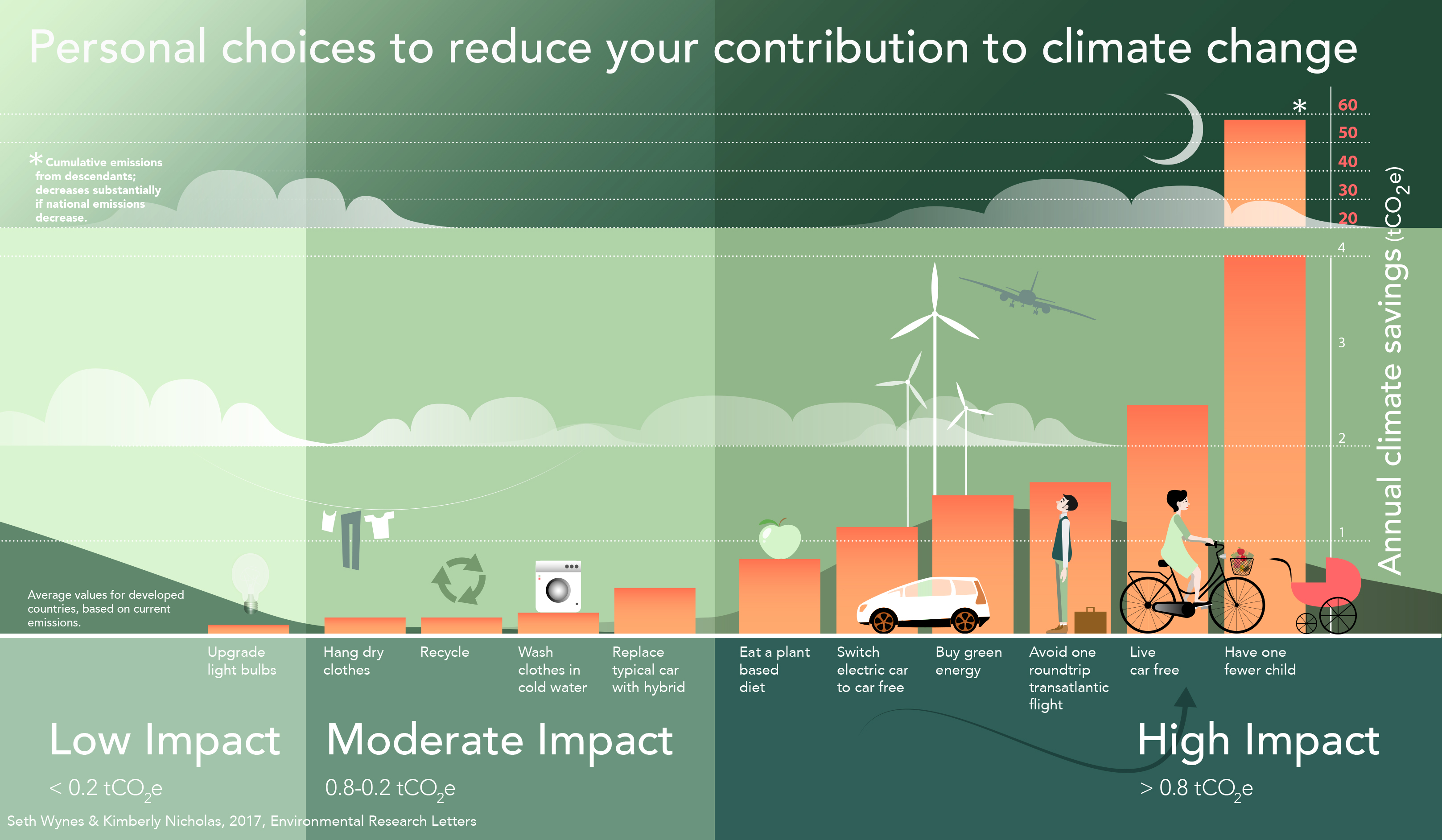
But the tax is probably more important still. Also, political action.
Depending on how your power is generated, that energy use may be carbon neutral.
It's a good thing we don't live in a real democracy, because hopefully elites will wake up faster than that.
But I think what's hard about this is not understanding what causes CO2 production, but understanding what it means to stop burning buried carbon fuel. It means no more computer, cel phone, cars, no flying, no 2-day shipping for [ANY PRODUCT!], no container ships and planes shipping food and products all over the world. It might mean abandoning air-conditioning and having to hand-wash your clothes. It means abandoning modern comforts (not necessities). It means abandoning a hyper-consoomer lifestyle and becoming more localist, which most of us simply cannot fathom doing.
I think at this point we need an international coalition that slams the breaks and sets a strict deadline for ceasing CO2 emission. If there are not severe shortages, it means we are not strict enough and can go faster. And then let the market work. If a steak costs $100 or you have to wait 3 years for a car, that's sucks, but so be it.
Perhaps there should be a high CO2 tax on having children, which one needs to continue to pay, while the children live?
The wealthy people with one child lavished with entertainment, travel, and resource expenditure learn to be wasteful and buy every new fashion and gadget.
Of course, I believe we should generally leave people alone and let them go about their business instead of imposing arbitrary government requirements; but if we go down that road, then the poorer families with lots of children should just get a free pass since they are more efficient by nature.
I think even families with only a few children _can_ be more efficient, but it is not the natural thing to do, and people with fewer children often do so because they prioritize higher resource consumption from a perception of quality of life or other factors.
I guess the main point is that these things aren't clear cut, there are reasons for both depending on a person's perception of life and pursuit of happiness. That's the tricky thing, even when we believe a problem is simple from out perspective, it usually isn't.
If you follow your logic to the extreme, the most beneficial actions would be things like euthanasia or just plain suicide.
Absolutely. Any logic followed to the extreme will yield extreme results. It could, however, be argued without much difficulty that people that exist have more rights than people that never will exist, so expecting someone to commit suicide (an extremely angst filled action that is also likely to cause an incredible amount of suffering within the person's close social circles) is not really at all comparable to asking them to not procreate - something that may not happen anyway for a number of reasons, and which does not inflict any particular amount of extra suffering.
It could also be argued that we don't really need to be eight billion, so some/most of us not procreating does not imply that there will be no future generations.
And, it could also be argued that all other life forms on earth are not worthless, and their well being alone - sans humans - could be worth preserving a reasonable climate for.
In either case, this "right" doesn't change the fact that the most significant (non) action you can do to lessen environmental impact is to refrain from procreating. No matter how much you argue that this is everybody's "right" (which is ethically questionable other reasons anyway), assuming that your children won't miraculously have a significantly smaller environmental footprint than you do, it is the single action you are likely to perform that will have the largest impact.
Of course, you can say "screw the environment, I want kids". I didn't say you can't. I do suggest, though, that producing more people until we've figured out how to lessen the environmental footprint of each one is incompatible with caring significantly about the environment (including climate). You can lie to yourself and say "but I do other things...", but in the end, those other things will not add up to a fraction of the impact a single (let alone multiple) child has.
There are many ways in between reproducing ever more humans and not reproducing at all. For example if people really want to have children, they can adopt children instead of making even more ones. There are sooo many children in the world, who do not have a bright future, whom one could adopt. If one really loves children for the reason of seeing them grow up, develop, learn, become good human beings, then adopting one should not be a big problem compared to making one.
Then there could be a rule similar to the following: First child is OK to make, second child needs to be adopted. If the second child is not adopted, but instead made, then there are financial penalties for that.
In any case, how do you propose to get back to perhaps half of current population?
The group was attacked for being heartless. Not to mention that they did mention family size and population growth in the same report without suggesting that be tackled. (They tries to be taken as not a doomsayer)
Then again British policy over the last 2 years has been based on a promise from a liar that 20M+ people will die in Britain alone. So if someone goes to the British govt promising the climate will kill 40M+ over all time maybe they'll listen...
Can you kill them if you no longer afford the tax?
(any answer to this question should suggest how ridiculous a tax like this would be)
Is this supposed to be any kind of counter argument? "Parents could simply kill their children."? Seriously?
If you think that there are circumstances that justify slavery (they should've thought about it before having that many children!! It's a reasonable punishment for their deeds!) then, sure, I guess.
And yes, people should think before putting a child into this world. I don't know how that is even debatable.
I agree on "people should think before putting a child into this world". Will you agree also on the following:
* Despite the should, some people will not think before doing X. So the punishment you propose will not just be an abstract thing that convinces people to "not do X", it will be something you actively inflict on people (otherwise it's completely meaningless, if not enforced).
So let's go back to the tax. Statistically speaking, who are the people who have lots of kids? Those who are rich (and might be deterred by an additional tax) or those who are poor and can barely feed said kids? Now, if you enforce an additional "kid tax" (and not just as a temporary thing, but as a perpetual lifetime punishment), what exactly is the effect that you think it'll have? Won't you de facto withdraw or limit "social security" exactly from the people who need it the most?
Just look at the data. Population doesn't increase when people become wealthy, on the contrary, it decreases. Rich people just don't have that many kids. Your tax could only serve the opposite purpose, while making the poor even more miserable.
The population in the first world is dropping. Immigration from less wealthy countries is the reason for the growth.
As long as the elites, including the goddamn political elites, are living in opulence and emitting immensely more CO2 than my family could ever hope to save with even a barebones existence, I will choose to be damned to hell with the rest of humanity before I make one more sacrifice of my family.
Carbon needs to be taxed and it needs to be fair. There will be no future for us if we continue down this opt in path. That much is crystal clear.
There was a study that came out a while ago that showed the majority of pollution in Los Angeles came from commercial trucks, likely involved in shipping and delivery. I think I also read that those trucks and the type involved in construction have extremely loose pollution controls and requirements. Many of them might be exempt or grandfathered in to current regulations.
https://www.tourismdashboard.org/explore-the-data/cruise-shi...
High pain to me is no more transport, overheat, empty shelves.
Reducing devices seems like a freebie
It opens up new niches for food production. Especially more capital intensive ways (eg vertical farming).
The trend of less and less people being employed in food production continues.
For that if for no other reason, I’d rather if consumer prices included an explicit CO2 tax. The here can be a rebate for poorer people, or personal allowance, whatever, but there would be a fixed yardstick for measuring your personal impact.
Off the top of my head, I have no idea which if my activities generates the most CO2. My car? Energy use? Diet? Going skiing once a year? No idea.
Newspaper articles only help a little, they usually present an incomplete picture, and optimising against an incorrect utility function is often counterproductive.
I’m imagining something like VAT, where “value added/carbon” adds up over the lifetime of product/service production.