News for hackers. Stuff that matters.
Re:The Francis Scott Key Bridge in Baltimore, Maryland Has C... by TaylorAlexander on Tuesday March 26, 2024 @04:53AM (#39825560)
Somehow I find it surprising how completely the bridge collapsed after the damage. I understand that a container ship collision is serious, but you could imagine a scenarios where the bridge slumps or buckles but doesn’t just disintegrate like that. It’s surprising that ships capable of doing this damage were probably regularly driving past it, and its safety as a thoroughfare depended entirely on those collisions not happening.

Does anyone know if modern construction standards would require more stability after a ship collision, or is this still how we build bridges?

Re:The Francis Scott Key Bridge in Baltimore, Maryland Has C... by dathinab on Tuesday March 26, 2024 @07:25AM (#39826511)
At least in the links with the video now you can see that the container ship directly hits one of the two main (and in the central area only) pillars completely collapsing it.

No matter(1) the engineering there is no pretty much way to not lose the whole large middle area and left area leading to the destroyed pillar in that situation.

Such a collapse crates so much force (tension vibrations etc.) so that the collapse of the section right of the right pillar is not unreasonable.

The only question is if the impact should have made the pillar collapse.

But a loaded container ship is ... absurdly massive I mean they are like multiple high raise building (but not sky scrapers) standing squished together side by side. So the force it can apply is huge and if cargo moving in it there will be force applied to whatever it crashes into even after the initial impact.

And looking at the waves caused by impact with the base it was at least 8m high I think (depending on the container ship). So that wasn't a "slow moving" impact. And even slow moving impacts with container ships can tear apart a solid jetty.

So while the US has issues with infrastructure maintenance idk. if anything but building a many pillar bridge would have made any difference. And building a many pillar bridge might not be very viable depending on the under water landscape and water use under the main area.

EDIT: Looking at pictures with daylight where you can try to estimate the high of the ship using containers I would say the waves where handwavingly 4 containers high so ~9.5m and it also looks like the ship might have embedded half of the pillars fundament into/under itself (but it's a bit hard to tell to the angle of the picture). I think if that's the case probably the huge majority of bridge pillars of past and presence would have collapsed.

Re:The Francis Scott Key Bridge in Baltimore, Maryland Has C... by JohnBooty on Tuesday March 26, 2024 @08:08AM (#39826828)
It certainly does not seem reasonable to design a bridge pillar to withstand a direct impact from a massive cargo ship.

But I guess I thought that maybe there was... typically some kind of earthen buffer around the pillar to prevent such an impact?

That's probably impractical too, I guess.

I guess I just didn't realize ~$1bn bridges were one fluky ship accident away from total collapse at any given time. I think maybe I prefer my previous state of ignorance, to be quite honest....

Re:The Francis Scott Key Bridge in Baltimore, Maryland Has C... by kamaal on Tuesday March 26, 2024 @08:20AM (#39826933)
>>But I guess I thought that maybe there was... typically some kind of earthen buffer around the pillar to prevent such an impact?

It does look reasonable to have such a buffer. But any preventive measure will have limits as what and how serious an impact it can deal with.

In this case the ship this massive is something that is carrying ridiculous inertia, and its highly unlikely even a buffer could stop such an impact.

I think at some point you are better off solving these issues with more regulation(smaller ships)? Instead of treating this as a engineering problem.

Re:The Francis Scott Key Bridge in Baltimore, Maryland Has C... by mannykannot on Tuesday March 26, 2024 @08:41AM (#39827124)
> But any preventive measure will have limits as what and how serious an impact it can deal with.

The recent grounding of a large container ship in Baltimore's harbor channel demonstrates that a sufficiently massive berm will stop any ship. What's needed is the will to do something about low-probability but catastrophic events (though large-ship collisions, groundings and fortuitously harmless steering failures are frequent enough that this should not have been dismissed as a low-probability event.)

https://www.cnn.com/2022/03/16/business/evergreen-container-...

In this case, the nearby towers supporting transmission lines across the channel seem to be better-protected against ship collisions than the piers of the bridge.

https://images.app.goo.gl/J6vTeDW5xjysbdjr9

Re:The Francis Scott Key Bridge in Baltimore, Maryland Has C... by bmelton on Tuesday March 26, 2024 @10:21AM (#39828184)
Starting from xoa's calculations above, assuming you can pack a berm with well-compacted soil enough that it can absorb 1,000 joules per cubic meter, you'd need a buffer of something like 10 meters surrounding each piling with 3 meters of depth to keep it safe from this kind of impact. That's 10 meters in every direction from the center of the support -- let's assume the support has a thickness of 0 meters for the sake of the math, and acknowledging that the gaps between structural supports on the bridge is approximately 30 meters -- the only way to protect it with earth is to make the bridge impassable by water. Of course, this would protect it from ship strikes.
Re:The Francis Scott Key Bridge in Baltimore, Maryland Has C... by SiempreViernes on Tuesday March 26, 2024 @10:59AM (#39828761)
You needn't stop the ship completely with the berm: just taking up enough energy that the bridge lives for 20 minutes after the impact would be useful.
Re:The Francis Scott Key Bridge in Baltimore, Maryland Has C... by mannykannot on Tuesday March 26, 2024 @12:56PM (#39830105)
Even if it takes 10 meters to get the job done (in practice, ships will not be coming at the piers perpendicularly to the channel), that is far from rendering the channel impassable.

Secondly, I believe riprap would be preferred to compacted soil (though compacted soil did a pretty good job stopping the Ever Given three years ago.)

Thirdly (and rendering the above moot), what's been done around the replacement Sunshine Skyway bridge in Tampa bay (mentioned in other posts here) shows that protection is, in fact, practical.

In view of these considerations, I'm not even going to check if, for example, xoa considered the energy absorbed by the ship (Update: in fairness, I did take a look at what xoa wrote, and I see that it is you who has introduced the figure of 1000 J/M^3.)

For an introduction to a serious engineering approach to this problem, look here:

https://onlinelibrary.wiley.com/doi/epdf/10.1002/stco.200910...

Re:The Francis Scott Key Bridge in Baltimore, Maryland Has C... by bmelton on Tuesday March 26, 2024 @03:29PM (#39831862)
There are other issues with my work, namely that the central span is over 300m in width, not 30, as I had wrongly discovered, ergo the channel is passable even with my extremely half-baked solution.

That said, the dolphin-bulwarks around the Tampa Skyway are interesting. I've sailed through similar and not known their purpose other than to observe that local waterfowl like to line up at them ahead of tidal shifts to catch the fish as they're encouraged by the currents through them.

Re:The Francis Scott Key Bridge in Baltimore, Maryland Has C... by bilbo0s on Tuesday March 26, 2024 @03:32PM (#39831889)
I have to say, you guys are all calculating things without any sort of deference to the nature of the soil underneath any of these piers or abutments. Also, you're both off on your other points as well. Sunshine Skyway has in no way been tested, and there are ways to "reinforce" earthen works so that they can handle more force so that you don't necessarily need 10 m.

You guys are doing amateur engineering. Firstly we don't even know what happened here yet. Secondly we don't know the nature of the problem we'd have to solve in protecting any span that would have been at that position. (How deep is the water? How far down to bedrock? Geological nature of the soil? etc etc etc)

It seems almost impossible for us as humans to just give the professionals some time and space to work so we can see what happened. I get that. I even engage in it at times. But you guys are stating things with certainty and almost indignation? Come on fellas.

Just say your peace and admit it's just a wild ass guess that's likely to be wrong in the end like the rest of our comments.

ETA: Thank you bmelton for owning that.

Re:The Francis Scott Key Bridge in Baltimore, Maryland Has C... by mannykannot on Tuesday March 26, 2024 @03:38PM (#39831951)
I'm not calculating anything; instead, I pointed to an article by someone who is involved in the real engineering of protecting bridges from ships.
Re:The Francis Scott Key Bridge in Baltimore, Maryland Has C... by bmelton on Wednesday March 27, 2024 @09:15AM (#39838626)
FWIW, I think there are even more errors in my figures. That said, I wasn't trying to bunk or debunk, as much as the grandparent's comment intrigued me enough to wonder "What if earthen barrier?" -- how much earth would that take. My guess was that it would be prohibitive, and that 116,000 tonnes traveling 8.5 knots is just too much to stop. Earth obviously can, as whomever alluded to the Ever Given points out, but a lot would be required. How much? I don't know, but I was just trying to get an idea.

You're right that it's amateur. This isn't remotely what I do. To your point though, I don't have that much confidence that the Skyway bulwarks would do -- I'm sure they're more than adequate in preventing strikes from my 40' sailboat. Probably much more than that. My gut tells me they are inadequate to stop the momentum of 100k tonnes at speed, but if they did SOMEthing, perhaps that would be enough to differentiate between bridge damage and bridge collapse. I can't find any details on how it's reinforced, with what, or how deeply those reinforcements are buried, so this too is wild speculation... but I wonder if it isn't somewhat security theater. My wife is already scared of bridges, and we're Marylanders who frequent that bridge and the (much longer) bay bridge -- putting something down there to calm her nerves enough that she isn't panicking for the duration of every crossing is almost certainly worthwhile, but doesn't leave the nerds much to ponder.

Re:The Francis Scott Key Bridge in Baltimore, Maryland Has C... by michaelt on Tuesday March 26, 2024 @01:56PM (#39830771)
> acknowledging that the gaps between structural supports on the bridge is approximately 30 meters

Measuring a satellite image in Google Maps [1] tells me the bridge's central span is more than 300 meters.

[1] https://maps.app.goo.gl/SzAzuzQRUwW7s2gN8

Re:The Francis Scott Key Bridge in Baltimore, Maryland Has C... by bmelton on Tuesday March 26, 2024 @03:22PM (#39831776)
Yes, and that's an important correction.

I Googled the distances before the post but apparently got the wrong value. Danke!

Re:The Francis Scott Key Bridge in Baltimore, Maryland Has C... by flavius29663 on Tuesday March 26, 2024 @05:03PM (#39832835)
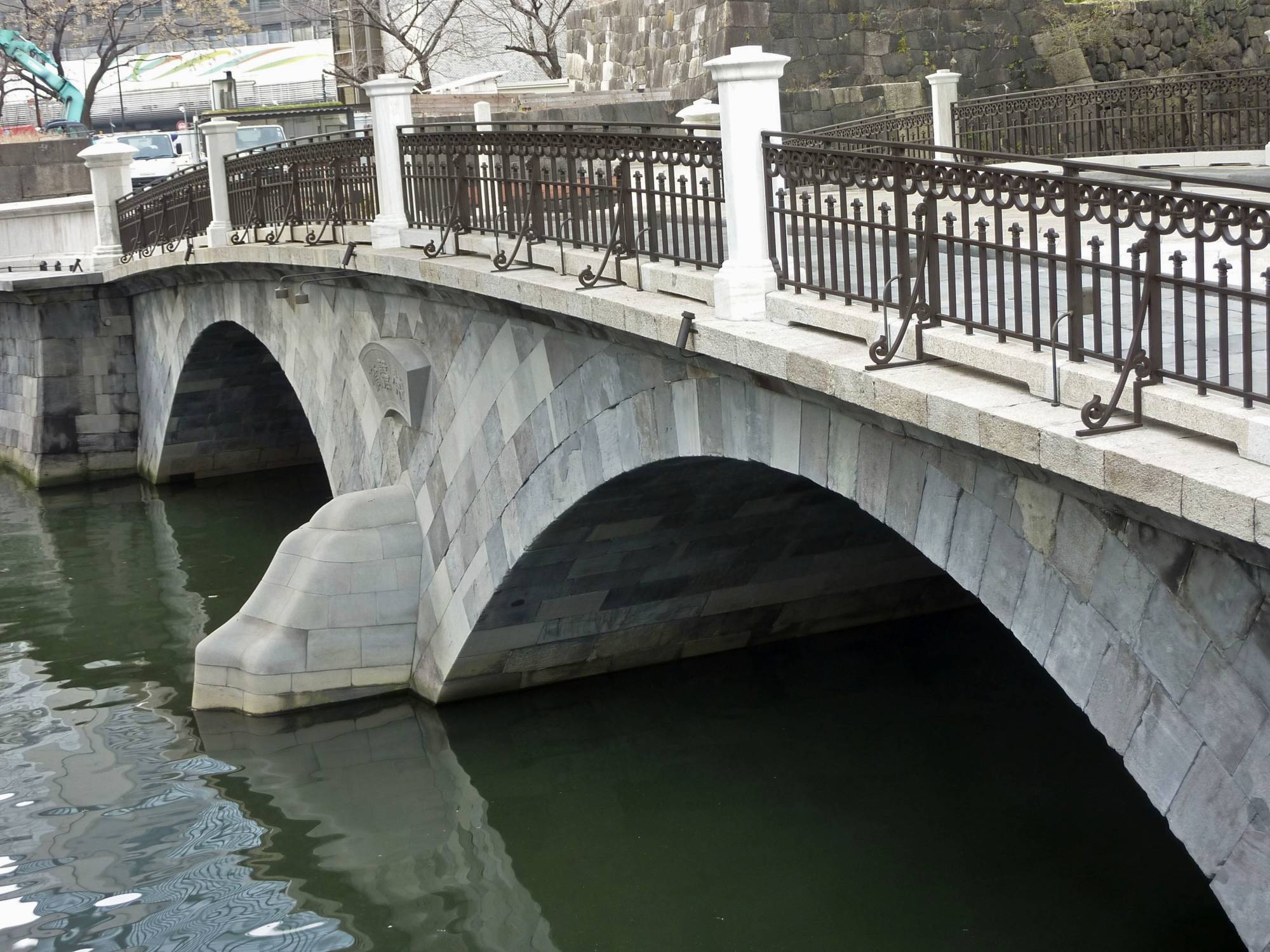
You should look at the deisgn of old stone bridges. Their side facing up ( so towards the floods and ice) is like a wedge pointed upwards. So it's not like he bridge needs a buffer to fully stop all the forward energy. It can lift the object out of the water and maroon it there.

e.g. https://www.japantimes.co.jp/uploads/imported_images/uploads...
Re:The Francis Scott Key Bridge in Baltimore, Maryland Has C... by throwaway48476 on Tuesday March 26, 2024 @09:13AM (#39827400)
The "berm" in this case happens to be the seabed of the earth. There's nothing bigger.
Re:The Francis Scott Key Bridge in Baltimore, Maryland Has C... by mannykannot on Tuesday March 26, 2024 @09:20AM (#39827476)
Of course - but it doesn't take all of it...
Re:The Francis Scott Key Bridge in Baltimore, Maryland Has C... by rkagerer on Friday March 29, 2024 @03:08PM (#39867797)
What's needed is the will to do something about low-probability but catastrophic events

In general I share your sentiment society could do more to insure itself against lower-probability catastrophes. But overbuilding every bridge would probably cost more than rebuilding the occasional one that's taken out when an unusual event like this occurs. Maybe in a different environment that would make sense, like a warzone (although I think even then there's more tendency to rely on redundant infrastructure and mobile, power-at-a-point defense).

Re:The Francis Scott Key Bridge in Baltimore, Maryland Has C... by unsupp0rted on Tuesday March 26, 2024 @08:41AM (#39827118)
It wouldn't take as much of a buffer to redirect the ship at an angle away from the pillar, would it?
Re:The Francis Scott Key Bridge in Baltimore, Maryland Has C... by kergonath on Tuesday March 26, 2024 @12:17PM (#39829588)
I think this would be even harder. Whilst the ship has a lot of kinetic energy that needs to get dissipated, it also has a huge momentum that needs to be partly overcome to redirect it. You’d also need a material with enough structural strength to turn the ship. Materials that can crumple or deform (like huge concrete blocks or earthworks) are great at dissipating energy, but they aren’t great at deflecting things.
Re:The Francis Scott Key Bridge in Baltimore, Maryland Has C... by hgomersall on Tuesday March 26, 2024 @08:15AM (#39826881)
An earth buffer is just a bigger pier.
Re:The Francis Scott Key Bridge in Baltimore, Maryland Has C... by Reason077 on Tuesday March 26, 2024 @08:35AM (#39827069)
When Florida's Sunshine Skyway bridge was partly collapsed by a similar incident in 1980, the replacement bridge was built with a series of "structural dolphins" and concrete barriers to protect against ship strikes. You can see them in the image linked below:

https://en.wikipedia.org/wiki/Sunshine_Skyway_Bridge#/media/...

Re:The Francis Scott Key Bridge in Baltimore, Maryland Has C... by WarOnPrivacy on Tuesday March 26, 2024 @09:39AM (#39827678)
> the replacement bridge was built with a series of "structural dolphins" and concrete barriers to protect against ship strikes.

Given how the Skyway collapse is burned into the local consciousness, I suspect some of the benefit comes from their visibility.

I truly don't know how the dolphins would fair against a massive ship strike but I can imagine them doing their job.

(ship passing): https://pbs.twimg.com/media/FPgQhy2X0AE8yw1.jpg

Re:The Francis Scott Key Bridge in Baltimore, Maryland Has C... by tomatotomato37 on Tuesday March 26, 2024 @10:19AM (#39828161)
I would also add those barriers seem to depend on the ship staying intact during collision. Given the immense inertia involved on the bigger ships I could just as easily see a scenario where the barrier ends up ripping through the lower hull while the rest of the ship continues forward.
Re:The Francis Scott Key Bridge in Baltimore, Maryland Has C... by krisoft on Tuesday March 26, 2024 @02:58PM (#39831509)
> easily see a scenario where the barrier ends up ripping through the lower hull while the rest of the ship continues forward

I don’t think that is likely? My intuition is that in order to stay seaworthy ships are constructed with more integrity than that.

I don’t have any hard evidence though, just that I have looked at many ship collision/allision aftermath photos and what you describe is not a failure mode I have seen so far.

Re:The Francis Scott Key Bridge in Baltimore, Maryland Has C... by semireg on Tuesday March 26, 2024 @04:07PM (#39832247)
See also: Titanic vs Ice
Re:The Francis Scott Key Bridge in Baltimore, Maryland Has C... by dathinab on Tuesday March 26, 2024 @07:05PM (#39833843)
interestingly the bridge has such dolphins

but only on per-pillar per-direction and with quite a bit of distance between it and the pillar

one some pictures you can see that the ship barley missed one of them due to the angle it was going at

Re:The Francis Scott Key Bridge in Baltimore, Maryland Has C... by dathinab on Tuesday March 26, 2024 @07:03PM (#39833817)
In smaller channels and similar it's not that uncommon to have crash barriers. For example in many Berlin channels and rivers.

And while I'm not quite sure what it is for the bridge had concrete pillars orthogonal in front of the pillars (this picture shows them well, to be clear I do NOT mean the power line isles: https://www.upi.com/News_Photos/view/upi/7191ba50f17c5a68307...). They would have stopped the ship if it would have went orthogonal to the bridge (i.e. if they mistook where the pillar where in a otherwise normal situation). Through not sure if that was the purpose of them.

Re:The Francis Scott Key Bridge in Baltimore, Maryland Has C... by onetimeuse92304 on Tuesday March 26, 2024 @08:11AM (#39826850)
> So that wasn't a "slow moving" impact

Exactly. It is only the scale and the viewing angle that makes it seem slow moving.

Re:The Francis Scott Key Bridge in Baltimore, Maryland Has C... by xoa on Tuesday March 26, 2024 @08:50AM (#39827203)
Just to put some numbers on this:

The MV Dali (IMO#9697428) is a little over 95000 GT, or ballpark-ish probably around 114000 tons loaded (and it seems to have been loaded, which would make sense on departure). If it was going even 5kn (2.6 m/s) that'd be about 300 million newton-seconds, or about 3.3 times the momentum of a large jumbo jet like a 747 shortly at cruising speed (around 560 mph). It'd still have the same momentum as said jet if it was going just 1.5kn. The ship of course is enormously more stoutly built and the force is going to be transmitted far more directly into whatever it hits vs into explosions driving mass elsewhere.

I've read that both on water and in space for that matter enormously massive objects moving very slowly messes with human perception and "common sense", it "feels like" something moving along smoothly and slowly should be stoppable or come to a stop. Enormous momentum and forces can be terrifying things.

Re:The Francis Scott Key Bridge in Baltimore, Maryland Has C... by litenboll on Tuesday March 26, 2024 @09:40AM (#39827695)
I had a summer job once, filling trains with sugar. They weighed about 15kkg per wagon (usually 5-10 wagons per train IIRC).

One time the pulling cart broke down and we had to switch it for another, but when we took it off the rails we forgot about the "shoe" that is supposed to go between the rail and one of the wheels so it can't move downhill (it was like 1degree of slope so barely recognizable as a slope).

It started moving extremely slowly, and all of us except one tried to hold back the force of the train, which of course was imossible and dangerous. The one who did not try to push it very quickly found the "shoe" and put in place. Initially it did not seem to help at all, the train just continued moving at the same pace, tearing up asphalt with the shoe. It finally came to a stop after about 3-5m(?) which takes a fair bit of time with such low speed, and felt like forever given the situation.

The train tracks headed out into an open road, so it could have been so much worse if it were not for the only person thinking clearly in the situation (he was one of the more experienced in our group).

Re:The Francis Scott Key Bridge in Baltimore, Maryland Has C... by master_crab on Tuesday March 26, 2024 @09:55AM (#39827860)
Also want to highlight this for another reason. At slow speeds rail and boats suffer from far less “moving” friction than road vehicles. So once off there is very little slowing them down vs cars and trucks that suffer from high rolling friction.
Re:The Francis Scott Key Bridge in Baltimore, Maryland Has C... by theluketaylor on Tuesday March 26, 2024 @10:41AM (#39828529)
Grady Hillhouse of Practical Engineering recently did a great demo of this. He was able to pull his car in neutral and an empty train car on rails with roughly the same force.

https://www.youtube.com/watch?v=nGhBHrr5CYQ

Re:The Francis Scott Key Bridge in Baltimore, Maryland Has C... by kamaal on Tuesday March 26, 2024 @12:02PM (#39829424)
One wonders how braking works on a train.
Re:The Francis Scott Key Bridge in Baltimore, Maryland Has C... by master_crab on Tuesday March 26, 2024 @12:07PM (#39829482)
Mostly the same as it would work on a car with a brake shoe applied to the steel wheel.

The only major difference is that they often use a safety air brake system shared across an entire consist (train) that requires “charged” pressure (above atmosphere) to disengage the brake (although I think they have moved to an electronic system that now monitors air pressure in each car individually).

Re:The Francis Scott Key Bridge in Baltimore, Maryland Has C... by singleshot_ on Tuesday March 26, 2024 @01:20PM (#39830400)
Semi trucks have air brakes that function very similarly. One air source for all brakes, pressure releases, brakes lock on failure.
Re:The Francis Scott Key Bridge in Baltimore, Maryland Has C... by phyzome on Tuesday March 26, 2024 @03:51PM (#39832101)
I think it's actually in an earlier video, and he wasn't able to actually pull the train car due to track irregularity -- but according to calculations he should have been able to if there was a safe way to give it a bit of a nudge.
Re:The Francis Scott Key Bridge in Baltimore, Maryland Has C... by theluketaylor on Tuesday March 26, 2024 @04:51PM (#39832697)
You're absolutely right; I posted the wrong link.

https://www.youtube.com/watch?v=tfA0ftgWI7U

Re:The Francis Scott Key Bridge in Baltimore, Maryland Has C... by mckn1ght on Tuesday March 26, 2024 @06:56PM (#39833760)
> all of us except one tried to hold back the force of the train

This reminds me of a vivid memory I have. I’d just finished a shift cooking, and out back of our restaurant there were railroad tracks. I had a beer and smoke out there with my shift mate, and a train was rolling by. I thought it would be fun to practice jumping on the train. So I do a few passes jogging alongside it, hopping on and off. Then my buddy, standing still, reached out and grabs a rung of a ladder on one of the cars. It immediately picked him up, but he gripped harder due to being startled. He got ragdolled through the air about 10 feet from where he was initially standing.

Kids, don’t play with trains (trespassing issues aside).

Re:The Francis Scott Key Bridge in Baltimore, Maryland Has C... by jasonwatkinspdx on Tuesday March 26, 2024 @10:36PM (#39835159)
A friend of mine was on the light rail here downtown when it stopped unexpectedly. He was confused and walked outside only to see the train had hit a fire truck and pushed it nearly a block before it stopped. He had no idea there was even a collision inside the train.

Trains are very scary stuff even when moving at a crawl.

A 110,000 ton ship collision is something the human brain is just not going to understand intuitively.

Re:The Francis Scott Key Bridge in Baltimore, Maryland Has C... by KineticLensman on Tuesday March 26, 2024 @09:14AM (#39827404)
> enormously massive objects moving very slowly messes with human perception and "common sense"

Yes, hence warnings to amateur boat users (e.g. on a canal boat) not to try to stop a collision with the bank using your arms or legs.

[Edit] Boats can also do things that are unintuitive if you are used to driving a car. E.g. turning round the centre of gravity when you steer rather than following the front wheels.

Re:The Francis Scott Key Bridge in Baltimore, Maryland Has C... by smogcutter on Tuesday March 26, 2024 @09:49AM (#39827794)
In the black powder era of warfare, soldiers were given similar warnings about “slowly” rolling cannonballs.

People would think they could stop them like soccer balls, and lose a foot.

Re:The Francis Scott Key Bridge in Baltimore, Maryland Has C... by bmelton on Tuesday March 26, 2024 @09:50AM (#39827814)
There are similar warnings for sailing vessels, but because the standing rigging of the ship is usually kept in high enough tension that putting your hands on a pilon to stop a collision might leave your hands vulnerable to being cut off by a mainsail's shrouds.
Re:The Francis Scott Key Bridge in Baltimore, Maryland Has C... by KineticLensman on Tuesday March 26, 2024 @09:58AM (#39827895)
Ouch! That reminded me of seeing someone get a rope burn from a line on a yacht. I always wear gloves when handling lines on a boat nowadays.
Re:The Francis Scott Key Bridge in Baltimore, Maryland Has C... by acdha on Tuesday March 26, 2024 @11:23AM (#39829082)
According to https://gcaptain.com/ship-lost-control-before-hitting-baltim... they were going 7.6kn so your figures are “optimistic” by a factor of two. I really don’t know how much an engineer could have done to stop 600M N/s - that’s just an enormous amount of energy.
Re:The Francis Scott Key Bridge in Baltimore, Maryland Has C... by mannykannot on Tuesday March 26, 2024 @10:05AM (#39827979)
> If it was going even 5kn...

I don't know what sort of speed ships travel in harbors (though I know that they are faster than they appear.) In this case, it was an ebb tide (though within an hour of the low) which might have added something to the ship's speed.

https://tides.willyweather.com/md/baltimore-city/patapsco-ri...

Re:The Francis Scott Key Bridge in Baltimore, Maryland Has C... by apaprocki on Tuesday March 26, 2024 @11:26AM (#39829106)
<checks terminal> "current draft is 12.2m with 116851 t DWT" and last reported speed was 6.7kt.

Good estimation! :)

Re:The Francis Scott Key Bridge in Baltimore, Maryland Has C... by db0255 on Tuesday March 26, 2024 @02:54PM (#39831458)
I saw radar that showed the ship was going 8.7 knots. And 7.6 knots before colliding.
Re:The Francis Scott Key Bridge in Baltimore, Maryland Has C... by G0dchi1d on Tuesday March 26, 2024 @10:18AM (#39828134)
Thank you, I've been trying to get a ballpark on the weight, appreciated.
Re:The Francis Scott Key Bridge in Baltimore, Maryland Has C... by a_e_k on Tuesday March 26, 2024 @02:07PM (#39830918)
Crazy! Going by the higher 7.6 kn figure mentioned elsewhere in this thread, that'd be closer to 450 million N s.

For another comparison, Wikipedia gives an estimate of "Apollo 11 launched from Earth to orbit" at 495 million N s [1]. So this is a momentum that's order-of-magnitude comparable to space launches.

[1] https://en.wikipedia.org/wiki/Newton-second

Re:The Francis Scott Key Bridge in Baltimore, Maryland Has C... by 1letterunixname on Tuesday March 26, 2024 @04:47PM (#39832657)
Your math appears off by an order of magnitude. KE = ½mv^2. [J]

Ship KE = 0.5 * (114000 short tons) * (7.5 knots)^2 = ~7.7e8 J.

747 KE = 0.5 * (510,000 lbs) * (560 mph)^2 = ~7.25e9 J.

747 avg weight = (MTOW + OEW) / 2 = ~510,000 lbs

Re:The Francis Scott Key Bridge in Baltimore, Maryland Has C... by zeteo on Tuesday March 26, 2024 @09:34AM (#39827620)
You don't need to build the bridge to an absurd strength, but it may have been insufficiently marked as a navigational hazard. Something like a few well-lit pillars 500 feet upstream in the water would have given the ship plenty of warning to change course, since a vessel travelling at 5 knots takes about a minute to go 500 feet. The total bridge length is on the order of 10,000 feet, so widening the safe area around the pillars to 500 feet would not be a significant impediment to navigation.
Re:The Francis Scott Key Bridge in Baltimore, Maryland Has C... by ToucanLoucan on Tuesday March 26, 2024 @09:40AM (#39827690)
I've seen close-up video where you can see the ship losing electrical power twice for not-insubstantial times as it approaches the column. I suspect that was a much larger factor in the collision than anything the crew may or may not have done. Warning time doesn't mean shit if you can't steer.
Re:The Francis Scott Key Bridge in Baltimore, Maryland Has C... by nytesky on Tuesday March 26, 2024 @10:42AM (#39828544)
https://twitter.com/ChaudharyParvez/status/17725385394958090...

Posted video of power loss. Also black smoke coming out rear — is that normal? Any clue of what onboard crisis they were dealing with?

Re:The Francis Scott Key Bridge in Baltimore, Maryland Has C... by Domenic_S on Tuesday March 26, 2024 @11:21AM (#39829053)
seems like they should have turned left and tried to go under the middle section there instead of cranking all the way around right. I imagine they were under task saturation with the power outages though.
Re:The Francis Scott Key Bridge in Baltimore, Maryland Has C... by jasonwatkinspdx on Tuesday March 26, 2024 @10:46PM (#39835209)
I think we should restrain ourselves from armchair judgements when basically no one here is a harbor pilot, let alone someone informed with what was happening in the moment in this event.

What happened will be meticulously reconstructed and everyone involved in this is going to have their lives put under a microscope for years worth of legal battles. I don't think we should rush to judgement or second guess from a position of ignorance.

Re:The Francis Scott Key Bridge in Baltimore, Maryland Has C... by kossTKR on Tuesday March 26, 2024 @11:15AM (#39828953)
It seems traffic has stopped in the last moments before the hit?

Also looks like it's emergency vehicles in standstill that are falling, i can't discern any moving cars at collapse?

Re:The Francis Scott Key Bridge in Baltimore, Maryland Has C... by vcg3rd on Tuesday March 26, 2024 @11:45AM (#39829310)
The ship's mayday gave them enough time to stop most, but not all, traffic, according to the MD Governor.
Re:The Francis Scott Key Bridge in Baltimore, Maryland Has C... by ToucanLoucan on Tuesday March 26, 2024 @11:44AM (#39829299)
I heard through the grape vine they were able to halt traffic across the bridge at the last minute. Only people actually on it when it fell were construction workers who were filling potholes at the time.
Re:The Francis Scott Key Bridge in Baltimore, Maryland Has C... by jasonwatkinspdx on Tuesday March 26, 2024 @10:43PM (#39835193)
The black smoke is most likely them running the engine in full reverse in an attempt to avoid the collision.
Re:The Francis Scott Key Bridge in Baltimore, Maryland Has C... by bmitc on Tuesday March 26, 2024 @03:34PM (#39831905)
I mean, yes, everybody is pointing out about the mass of the container ship, but that's actually to the point of the above question and my question. Because the ship's size and weight are obvious. Were ships this size regularly passing by or under this bridge such that this scenario was effectively bound to happen given a ship failure and/or pilot error? That's my question. I'm not familiar with port activities, so it seems weird to have basically no secondary protection for that bridge with container ships of that size operating so close that they can hit it mere minutes after some failure.

Watching this video (https://www.youtube.com/watch?v=qJNRRdha1Xk) shows that the ship was incredibly close to the bridge in the first place, even prior to the supposed failure. It's a bit bewildering to me, with my current knowledge, that this scenario wasn't envisioned prior.

Re:The Francis Scott Key Bridge in Baltimore, Maryland Has C... by shaboinkin on Tuesday March 26, 2024 @03:55PM (#39832135)
That was my thought. The supports look like toothpicks relative to the ships that routinely pass through. I don't know enough about the forces involved here, but I'd like to think when they rebuild, they will add some sort of deflection capabilities around the supports that ships must past in between. But again, I don't know what that would take to deflect a massive ship like this. In hindsight, the bridge looks terribly exposed given the persistent risk of ships passing through.
Re:The Francis Scott Key Bridge in Baltimore, Maryland Has C... by onetimeuse92304 on Tuesday March 26, 2024 @05:45AM (#39825874)
Most bridges nowadays (say last century) depend on a careful balance of forces that are transferred through a chain of members in tension and compression.

When any piece in the chain of those forces breaks, the entire structure loses ability to transfer forces and breaks.

This arrangement is what allows us to build these structures in the first place. There is careful calculations of forces and risks and allowance for margin for error and unexpected events. But, unfortunately, in many cases those do not include ramming things with a large container ship...

Re:The Francis Scott Key Bridge in Baltimore, Maryland Has C... by OscarTheGrinch on Tuesday March 26, 2024 @06:49AM (#39826268)
On a long enough timeline we all get rammed by a container ship.

I would be interested to know some calculations with factors like: expected bridge lifetime, chance of being rammed per year, cost of making supports strong enough plus an extra safety margin to survive maximum ramming force, cost of having major commercial shipping route unusable for an extended period.

Re:The Francis Scott Key Bridge in Baltimore, Maryland Has C... by Retric on Tuesday March 26, 2024 @07:13AM (#39826417)
Bridges only last for roughly 50 years. Considering such collisions are rare enough to make the news as a memorable event you can workout for yourself that the odds are quite low over a bridges lifespan.

They are designed to withstand smaller boat impacts because they occur relatively frequently, but cost vs benefit on rare events that are difficult to mitigate is quite different.

Re:The Francis Scott Key Bridge in Baltimore, Maryland Has C... by SECProto on Tuesday March 26, 2024 @08:27AM (#39826997)
> Bridges only last for roughly 50 years.

The bridge projects I've been on spec 75 or 100 years. Main difference is better protection/sacrificial depth on ferrous members.

Re:The Francis Scott Key Bridge in Baltimore, Maryland Has C... by LeonB on Tuesday March 26, 2024 @09:14AM (#39827407)
I remember one of my engineering lecturers giving a good rule of thumb as “your retirement date, plus 10 years”
Re:The Francis Scott Key Bridge in Baltimore, Maryland Has C... by yosame on Tuesday March 26, 2024 @07:20AM (#39826468)
Do you mean 50 years without maintenance? I would be shocked if major bridges weren't designed to last indefinitely.
Re:The Francis Scott Key Bridge in Baltimore, Maryland Has C... by 0xbadcafebee on Tuesday March 26, 2024 @07:43AM (#39826640)
Depends on the bridge. Steel and concrete bridges can last for at least 100 years. But it depends on the environment, its expected use, the construction, design. Some famous major bridges failed early due to poor design or poor construction, but many still fail due to lack of maintenance.

The average age of a bridge in the USA is 43 years. But we also have an epidemic of unmaintained bridges.

No bridge made today is designed to last indefinitely. Many different forces will degrade the bridge over time, even with maintenance. Steel stresses weaken it over time. Concrete weathers over time due to salt, chemicals, water, wind, and the steel reinforcements tend to corrode eventually.

Stone bridges may last for an exceptionally long time, but their weight and expense makes them only useful in limited applications, typically as small rail overpasses. Ones that were designed for horse and buggy end up slowly failing as heavier trucks and cars in traffic weaken them.

The same fate lies for timber bridges. When well maintained they can last for 75 years, but it's expensive and requires certain skills. They were also mostly designed before heavier cars and trucks, and for less traffic. Most famous covered bridges today are being closed to traffic due to increased wear.

Re:The Francis Scott Key Bridge in Baltimore, Maryland Has C... by btilly on Tuesday March 26, 2024 @11:08AM (#39828889)
According to https://www.fhwa.dot.gov/bridge/, the federal government oversees more than 610,000 bridges in the USA. There are a lot of unmaintained small bridges. But I'd hope that the major ones get more attention.
Re:The Francis Scott Key Bridge in Baltimore, Maryland Has C... by 0xbadcafebee on Tuesday March 26, 2024 @01:10PM (#39830286)
Here's a list of major bridges that need attention (& aren't getting it): https://artbabridgereport.org/state/ranking/top-bridges

FHWA provides up to $7 Billion in assistance in maintaining bridges. But it would take at least $125 Billion to begin dealing with the structurally deficient bridges in the USA, according to the ASCE Infrastructure Report Card[1].

Add to this the fact that many bridges in the US are privately owned, and it's the responsibility of the bridge owner to maintain them. But guess what's not profitable for a private enterprise? Maintaining bridges. Despite this, train derailments and property damage continue every year due to unmaintained bridge and train infrastructure.

The executive has proposed funding for repairs, but as usual, it's not enough[2]. So far they've gotten almost half that number of bridges repaired, and pledged another $300M,[3] which is still just a drop in the bucket of what's needed of the backlog; it doesn't address all the new maintenance that will be needed each year.

According to the American Road & Transportation Builders Association, there are 167 million crossings on 42,400 bridges rated in poor condition. [4]

[1] https://infrastructurereportcard.org/cat-item/bridges-infras... [2] https://www.nbcnews.com/news/us-news/biden-has-plan-fix-amer... [3] https://www.whitehouse.gov/briefing-room/statements-releases... [4] https://artbabridgereport.org/congressional/map

Re:The Francis Scott Key Bridge in Baltimore, Maryland Has C... by ajb on Tuesday March 26, 2024 @02:13PM (#39830996)
Personally I'm in favour of government maintaining stuff, but https://en.m.wikipedia.org/wiki/City_Bridge_Foundation has maintained most of London's bridges privately for nearly three quarters of a millennia so I wouldn't say it can't be done.
Re:The Francis Scott Key Bridge in Baltimore, Maryland Has C... by 0xbadcafebee on Tuesday March 26, 2024 @05:08PM (#39832885)
I'm not saying it can't be done, I'm saying we specifically fail to hold private industry accountable in the US. So we get things like poisonous runoff from agriculture and industrial production, insanely slow and outdated train lines, privately owned bridges that fail and cause injury, property damage and traffic jams, massive wildfires causing property damage and loss of life from unmaintained utility infrastructure, and worldwide banking crises, among other things.

Is it impossible for these things to stop happening? No, not at all. But it's probably not going to stop, in this country, because we let private industry get away with whatever they want. If this were the UK the story would be very different.

Re:The Francis Scott Key Bridge in Baltimore, Maryland Has C... by ajb on Tuesday March 26, 2024 @07:57PM (#39834212)
Fair. I can't claim to know how to make it work better in the US. We have also other private infrastructure in the UK that's not working so well (like the water companies, which are not providing enough sewage processing capacity and so allow the extra to overflow into rivers)

I mainly made that comment because it still blows my mind the the City Bridge Foundation has been going for 740 years

Re:The Francis Scott Key Bridge in Baltimore, Maryland Has C... by mango7283 on Tuesday March 26, 2024 @07:37AM (#39826601)
I can think of at least 5 famous bridges that are way older than 50 years...
Re:The Francis Scott Key Bridge in Baltimore, Maryland Has C... by Retric on Tuesday March 26, 2024 @07:41AM (#39826631)
Sure, and there's 100's of thousands of replaced bridges that don't immediately spring to mind.

Though to be clear designed to last 50 years isn't the same as saying it will only last exactly 50 years, or that theirs nothing you can do to extend a bridges lifespan if it's replacement is running a little late.

Re:The Francis Scott Key Bridge in Baltimore, Maryland Has C... by bee_rider on Tuesday March 26, 2024 @08:43AM (#39827139)
If it is a famous bridge, it seems possible that they’ve done some special extra maintenance, replace more wear-and-tear bits that would normally fail. Eventually you probably get the tourist attraction of Theseus.
Re:The Francis Scott Key Bridge in Baltimore, Maryland Has C... by onlyrealcuzzo on Tuesday March 26, 2024 @07:34AM (#39826573)
Nothing lasts indefinitely...
Re:The Francis Scott Key Bridge in Baltimore, Maryland Has C... by b33j0r on Tuesday March 26, 2024 @07:34AM (#39826571)
Interested in this claim, because it sounds about right, except that I can’t name a bridge constructed in the past 50 years.

The bridges we can all name are pushing 100+ right?

Re:The Francis Scott Key Bridge in Baltimore, Maryland Has C... by maxerickson on Tuesday March 26, 2024 @08:12AM (#39826860)
Mackinac Bridge is somewhat famous, built in the 1950s.

They more or less do continuous maintenance during the warmer months of the year.

(So older than 50, but younger than 100)

Re:The Francis Scott Key Bridge in Baltimore, Maryland Has C... by bluedino on Tuesday March 26, 2024 @08:32AM (#39827049)
Michiganders will also know the "Z Bridge", completed in 1988

https://en.wikipedia.org/wiki/Zilwaukee_Bridge

Sticking with the mid-western therme, the Chicago Skyway was built in 1958

Re:The Francis Scott Key Bridge in Baltimore, Maryland Has C... by colomon on Tuesday March 26, 2024 @06:31PM (#39833583)
First span of the Blue Water Bridge (Port Huron to Sarnia) built 1938, doing just fine as far as I know. (Drove over it a couple of weekends ago.) Second span was 1997.
Re:The Francis Scott Key Bridge in Baltimore, Maryland Has C... by rrdharan on Tuesday March 26, 2024 @07:50AM (#39826693)
New York City has had two major recent new bridge replacements that probably about 20M people can name: the Mario Cuomo (formerly Tappan Zee) and the Kosciuszko bridge.

I’d argue the Bayonne Bridge raising kinda counts since it was almost a rebuild and more impressive in many ways since it stayed open the whole time.

Meanwhile in the San Francisco Bay Area they replaced the Bay Bridge…

Re:The Francis Scott Key Bridge in Baltimore, Maryland Has C... by mannykannot on Tuesday March 26, 2024 @08:46AM (#39827160)
The Tappan Zee bridge certainly wasn't built with the intention of replacing it after 65 years. Nor, fortunately, was the George Washington bridge.
Re:The Francis Scott Key Bridge in Baltimore, Maryland Has C... by colatkinson on Tuesday March 26, 2024 @11:02AM (#39828813)
The old Tappan Zee was basically a perfect encapsulation of "dumb midcentury infrastructure decisions."

1. Built to last only 50 years to save on materials (as the other commenter noted).

2. Built over literally the widest possible part of the Hudson because the governor got in a pissing contest with the Port Authority and wanted all the tolls to go to the state, which wouldn't have been the case had it been built like 2 miles south where the river is narrower.

3. Designed with zero redundancy, such that a "critical fracture could make the bridge fail completely because its supports couldn’t transfer the structure’s load to other supports." [0]

So yeah if we're being real, 50 years was quite optimistic.

The new Tappan Zee is apparently supposed to last 100 years, though given the incidents with substandard materials being used, as well as ever-increasing traffic, who knows.

That said, driving over a bridge 10 years past its planned EOL and being able to look down directly to the water through gaps in the concrete was always a nice feature though -- who needs coffee when you've got that to get your heart rate up!

[0]: https://en.wikipedia.org/wiki/Tappan_Zee_Bridge_(1955%E2%80%...

Re:The Francis Scott Key Bridge in Baltimore, Maryland Has C... by njarboe on Tuesday March 26, 2024 @12:34PM (#39829816)
"dumb midcentury infrastructure decisions."

Keeping in mind that mid-century Japan and Germany were in ruins and the possibility of nuclear annihilation of urban centers very much at the top of many people minds. 50 years may have seemed an optimistic survival rate of built structures at the time.

Re:The Francis Scott Key Bridge in Baltimore, Maryland Has C... by 0110101001 on Tuesday March 26, 2024 @10:37AM (#39828463)
> Started on the cheap during the Korean War, the Tappan Zee was deliberately built to last just 50 years.

https://www.nytimes.com/2006/01/17/nyregion/a-bridge-that-ha...

Re:The Francis Scott Key Bridge in Baltimore, Maryland Has C... by mannykannot on Tuesday March 26, 2024 @01:17PM (#39830372)
I can't argue with that!
Re:The Francis Scott Key Bridge in Baltimore, Maryland Has C... by rrdharan on Tuesday March 26, 2024 @09:09AM (#39827357)
Agreed I was just addressing the parent poster question of whether anyone can name a major bridge built in the last fifty years…
Re:The Francis Scott Key Bridge in Baltimore, Maryland Has C... by dredmorbius on Tuesday March 26, 2024 @09:15AM (#39827418)
The eastern span of the Bay Bridge, which had previously been a cantilever bridge, which was damaged during the 1989 Loma Prieta Earthquake, and shown to have quite obvious seismic deficiencies.

Its replacement is a self-anchored suspension bridge.

The original western span, actually a double suspension bridge, remains standing, as constructed in 1933, 91 years ago.

Re:The Francis Scott Key Bridge in Baltimore, Maryland Has C... by b33j0r on Tuesday March 26, 2024 @10:39AM (#39828502)
So this detail… that is where my misconception arose. Thanks!
Re:The Francis Scott Key Bridge in Baltimore, Maryland Has C... by kijiki on Tuesday March 26, 2024 @01:51PM (#39830727)
The western span had substantial seismic remediation applied in 2000-2001.
Re:The Francis Scott Key Bridge in Baltimore, Maryland Has C... by lowercased on Tuesday March 26, 2024 @08:02AM (#39826794)
The Francis Scott Key bridge - the subject of this story - was finished in 1977, and took about 5 years, so... much of it was constructed in the last 50 years. ???
Re:The Francis Scott Key Bridge in Baltimore, Maryland Has C... by Retric on Tuesday March 26, 2024 @08:03AM (#39826800)
How many bridges, such as highway overpasses, that you use regularly can you name?

Here's an interesting list of major bridges with dates, most of the newer ones being replacements: https://www.carolinadesigns.com/obx-guide/fun-info/bridges/

They even note a rare exception designed to last 100 years with maintenance.

Re:The Francis Scott Key Bridge in Baltimore, Maryland Has C... by Reason077 on Tuesday March 26, 2024 @08:42AM (#39827129)
The Crimean bridge is quite (in)famous, and it was built quite recently.

The Millau Viaduct also comes to mind when thinking of famous, iconic modern bridges.

Re:The Francis Scott Key Bridge in Baltimore, Maryland Has C... by kergonath on Tuesday March 26, 2024 @12:29PM (#39829721)
The Øresund Bridge as well (opened in 2000).
Re:The Francis Scott Key Bridge in Baltimore, Maryland Has C... by philwelch on Tuesday March 26, 2024 @08:52AM (#39827226)
Most of the bridges I can think of in the state of Washington are much newer than that.

There are now two Tacoma Narrows Bridges. The oldest was built in 1950. The one that infamously collapsed was built in 1940. The newer bridge is from 2007. The West Seattle Bridge was closed due to damage in 2020 and reopened after repairs in 2022. It was originally built in the 1980’s after the previous bridge was hit by a ship. There are two floating bridges on I-90 east of Seattle. One of them sunk during reconstruction work in 1990 and was replaced. Theres also a new 520 floating bridge that opened in 2016. The Hood Canal Bridge (also a floating bridge) originally opened in 1961, sunk in 1979, was reopened in the 1980’s, and large parts of it were replaced in the 00’s.

The Ballard Bridge actually is over a century old! It was opened in 1917. However there was a lot of reconstruction done during the 1930’s. The Fremont Bridge is also from 1917. Both of these bridges span a ship canal that was built between 1911 and 1934. The Aurora Bridge was also built in the 1930’s.

Re:The Francis Scott Key Bridge in Baltimore, Maryland Has C... by tekla on Tuesday March 26, 2024 @09:39AM (#39827680)
I can't imagine how it is to be so insulated from the world to not be able to name a single major bridge construction in the past 50 years.
Re:The Francis Scott Key Bridge in Baltimore, Maryland Has C... by vundercind on Tuesday March 26, 2024 @04:56PM (#39832755)
If you don’t live somewhere with famous/major bridges it’s really easy. I doubt I could name ten bridges period that aren’t in my mid-sized city (and I can only give the correct name for two of the ones here, neither of which is famous). I can only identify maybe four by sight from outside my city—I can name a few that I couldn’t pick out of a lineup of photos.
Re:The Francis Scott Key Bridge in Baltimore, Maryland Has C... by serf on Tuesday March 26, 2024 @09:40AM (#39827688)
vincent thomas bridge in LA is from 1960 -- old but not 100+
Re:The Francis Scott Key Bridge in Baltimore, Maryland Has C... by apocalyptic0n3 on Tuesday March 26, 2024 @10:34AM (#39828410)
There's a massive one being constructed right now - the Gordie Howe International Bridge. It'll be the second bridge (and fourth crossing) between Detroit and Windsor when it opens next year. Although maybe I only know of that one because I grew up in metro Detroit.
Re:The Francis Scott Key Bridge in Baltimore, Maryland Has C... by jcranmer on Tuesday March 26, 2024 @04:21PM (#39832394)
Depends on the "we" you're talking about, I guess.

In the DC/MD/VA area, almost all the bridges I can name are less than 100 years old. Woodrow Wilson, American Legion, Chesapeake Bay Bridge, Chesapeake Bay Bridge-Tunnel, Key Bridge, Key Bridge, Nice Bridge, Memorial Bridge, Chain Bridge, 14th street bridges... Some of those were even built after 2000! Also the New River Gorge Bridge in WV is pretty famous and not even 50.

Well, actually, the Key Bridge (in DC) apparently turned 100 years old last year. And I guess the Long Bridge (though not a road bridge) is also over 100...

Re:The Francis Scott Key Bridge in Baltimore, Maryland Has C... by HeyLaughingBoy on Tuesday March 26, 2024 @04:29PM (#39832475)
Living not too far outside Minneapolis, we rebuilt a bridge that rather famously came down a bit over 15 years ago.

https://en.wikipedia.org/wiki/I-35W_Mississippi_River_bridge

Re:The Francis Scott Key Bridge in Baltimore, Maryland Has C... by Hamuko on Tuesday March 26, 2024 @07:35AM (#39826580)
Doesn't the US have a problem with bridges exceeding their expected service lives?
Re:The Francis Scott Key Bridge in Baltimore, Maryland Has C... by _heimdall on Tuesday March 26, 2024 @08:13AM (#39826869)
That's a common topic here, yes, though honestly I rarely hear about a bridge collapse. I don't actually remember the last time I saw news of a bridge or overpass collapse that wasn't causes by damage like this.

Makes me want to find the data now. I don't actually known if our bridges are too old, poorly maintained and falling apart early, or if the whole topic is just herd mentality and politics.

Re:The Francis Scott Key Bridge in Baltimore, Maryland Has C... by Hamuko on Tuesday March 26, 2024 @08:18AM (#39826902)
>I don't actually remember the last time I saw news of a bridge or overpass collapse that wasn't causes by damage like this.

Fern Hollow Bridge Mk. II?

Re:The Francis Scott Key Bridge in Baltimore, Maryland Has C... by themaninthedark on Tuesday March 26, 2024 @04:01PM (#39832194)
If we count pedestrian overpasses as part of overpass; FIU pedestrian overpass.
Re:The Francis Scott Key Bridge in Baltimore, Maryland Has C... by dredmorbius on Tuesday March 26, 2024 @09:20AM (#39827475)
Among the more spectacular recent US bridge failures was the I-35W bridge in Minneapolis, which failed during rush hour with bumper-to-bumper traffic with a loss of 13 lives on 1 August 2007: <https://en.wikipedia.org/wiki/I-35W_Mississippi_River_bridge>

There's a list of many more failures at Wikpedia, though international in scope:

<https://en.wikipedia.org/wiki/List_of_bridge_failures>

There are a number of ship-bridge collisions listed, as well as fuel-tanker explosions, which seems to be a surprisingly common failure mode.

Also numerous failures in China, though how much of that is simply a scale effect I can't say.

Re:The Francis Scott Key Bridge in Baltimore, Maryland Has C... by Retric on Tuesday March 26, 2024 @08:11AM (#39826851)
The boom of bridges after automobiles became common are all running out of time. Yet, paying for a replacement early is also wasteful.

So it's an issue, but those bridges where also constructed by a far poorer nation so it's not that big a deal.

Re:The Francis Scott Key Bridge in Baltimore, Maryland Has C... by _heimdall on Tuesday March 26, 2024 @08:19AM (#39826926)
> but those bridges where also constructed by a far poorer nation

That's a must more interesting question when discussing the topic of infrastructure.

Sure we've created a lot more money in the last 50 years, but we've also lost a lot of domestic manufacturing. When it comes to something as vital as roads and bridges are we poorer when we have less paper money or when we are less independent in the manufacturing and maintenance of them?

Re:The Francis Scott Key Bridge in Baltimore, Maryland Has C... by Retric on Tuesday March 26, 2024 @09:34AM (#39827618)
Money is a side issue people are generally a lot more productive than we where 50 years ago and the US population is 50% larger. That means the government has a lot more resources to work with though how it spends them is another question.

I think people feel poorer because income inequality increased so much. New homes are huge because new home buyers are the upper end of the wealth curve. Same deal with cars etc. Stuff that targets everyone like normal sized TV's ends up being extremely cheap because revealed preferences show people buy cheap when it's an option.

Re:The Francis Scott Key Bridge in Baltimore, Maryland Has C... by _heimdall on Tuesday March 26, 2024 @10:26AM (#39828261)
> Money is a side issue people are generally a lot more productive than we where 50 years ago and the US population is 50% larger

Production per capita may have gone up, but that's (a) likely measuring productivity in financial terms and (b) heavily correlated with an increase in natural resource consumption, especially fossil fuels.

If we want to consider ourselves richer because we are able and willing to use more natural resources today could lead down a dark (and very hot) road.

Re:The Francis Scott Key Bridge in Baltimore, Maryland Has C... by Retric on Tuesday March 26, 2024 @10:51AM (#39828661)
Fossil fuel consumption in the US is down way down especially on a per person basis because of improved efficiency and cheaper alternatives. There's more Americans today, but in many ways we are consuming fewer resources while still being better off.

Compare a modern jet with one from the 1974 and sure many passengers have less leg room but it's hauling both people and 3rd party cargo while still using far less than 1/2 the fuel per passenger mile. Such improvements really add up and include things like engineered lumber using fast growth pines.

Look at the most popular car 50 years ago and you'll see the Ford Pinto. It's slow, unsafe, tiny, time consuming to maintain, fuel inefficient, and missing modern amenities but it was affordable. Inflation adjusted it's roughly the cost of a Mitsubishi Mirage which while better in just about every way is a rough equivalent the reason people are buying crossovers rather than the Mirage today is because people just have more wealth in real terms.

Re:The Francis Scott Key Bridge in Baltimore, Maryland Has C... by _heimdall on Tuesday March 26, 2024 @11:07AM (#39828882)
When you say it is "down way down", how much is that exactly?

The data I found only goes back to 1965 [1], but from the absolute peak in the 70s to today we've reduced per capita use by around 30%. Over the last 20 years we've reduced it by around 15%, going back 10 years and the reduction is only around 5%. Time scale matters a lot here, as does a definition of what "way downdowm" would mean in real % reductions.

I totally agree we've made use of oil more efficient in things like engine efficiency. We've also found more uses for oil byproducts, which can be good or bad depending on your opinion (and again, on your time scale). If we've improved fuel efficiency by 50% and at best reduced fossil fuel per capita by 30%, we've squandered some of those gains by using more oil for other things.

Whether that's a good or bad thing is really up to opinion, goals one has in mind, and how one weighs the trade offs.

[1] https://ourworldindata.org/grapher/fossil-fuels-per-capita

Re:The Francis Scott Key Bridge in Baltimore, Maryland Has C... by Retric on Tuesday March 26, 2024 @01:40PM (#39830601)
At this scale even 10% is a big drop, down by 1/3 is IMO down way down.

That chart gives 31% in 49 years 63,836 in 2022 vs 92,635 in 1973, but the numbers are dropping faster each year.

Re:The Francis Scott Key Bridge in Baltimore, Maryland Has C... by gooseyman on Tuesday March 26, 2024 @10:11PM (#39835019)
Re:The Francis Scott Key Bridge in Baltimore, Maryland Has C... by serf on Tuesday March 26, 2024 @09:46AM (#39827759)
>That means the government has a lot more resources to work with though how it spends them is another question.

it's not that clear-cut. regulations regarding construction are many times more strict, as well employment restrictions and safety code.

I mean, the things like the transcontinental railroad were built with what would largely be considered inhumanely treated human slaves by today standards -- that kind of 'advantageous hiring condition' thankfully no longer exists.

Stuff like that plus millions of other regulatory nuances that drive the cost of development to be many times more expensive than during the bad old 'wild west' make these kind of value analysis gapped by many years near impossible.

Re:The Francis Scott Key Bridge in Baltimore, Maryland Has C... by Retric on Tuesday March 26, 2024 @10:17AM (#39828115)
The transcontinental railroad was built without modern heavy equipment. Today fewer people can get a lot more work done even with humane working conditions and modern safety code. Which helps explain humane working conditions and modern safety code.

As to regulations, in 2023 an I-95 bridge failed after a gasoline tanker truck fire. They took 12 days to get a temporary replacement that got traffic flowing again. You occasionally see such projects where we need a fix now and then it happens. However, it was a temporary replacement and they needed an actual long term solution.

The difference between such rapid projects and more typical ones include time consuming steps to preventing dirt from settling and causing problems in the future etc. Regulations are filled with such tradeoffs, but that doesn't mean we're unable to move more quickly just that we can afford to do something else.

Re:The Francis Scott Key Bridge in Baltimore, Maryland Has C... by lotsofpulp on Tuesday March 26, 2024 @09:32AM (#39827597)
Money is just a proxy for power, so “poorer” means not able to do something. Note that you are referring to “we” being poorer, and a country’s ability to do (or get) something is not the same as an individual within the country’s ability to do something.
Re:The Francis Scott Key Bridge in Baltimore, Maryland Has C... by denton-scratch on Tuesday March 26, 2024 @08:49AM (#39827190)
> Bridges only last for roughly 50 years.

https://en.wikipedia.org/wiki/The_Iron_Bridge

Opened in 1781, still in service and perfectly safe. Of course, there are no container ships nearby. But I reckon you could sail a container ship under it, given enough water; and to damage the bridge supports, the container ship would need climbing equipment.

1781 isn't many years after the Declaration of Independence.

Re:The Francis Scott Key Bridge in Baltimore, Maryland Has C... by Retric on Tuesday March 26, 2024 @09:57AM (#39827878)
I'll raise you: https://en.wikipedia.org/wiki/Arkadiko_Bridge

But that's talking about the tail end of the bell curve not it's center.

Re:The Francis Scott Key Bridge in Baltimore, Maryland Has C... by vikingerik on Tuesday March 26, 2024 @01:45PM (#39830658)
That's also a much smaller scale. 22 ft long, 13 ft high, and carries only foot traffic or maybe horses. Much less is demanded of that structure than of a river-spanning mile-long truck-carrying bridge.
Re:The Francis Scott Key Bridge in Baltimore, Maryland Has C... by notahacker on Tuesday March 26, 2024 @09:52AM (#39827834)
If there was enough water for the 48m beam, 24m airdraft container ship that just collapsed the Baltimore bridge to attempt to navigate under the 30m span, 16m high Iron Bridge I don't think the bridge would stand a chance...
Re:The Francis Scott Key Bridge in Baltimore, Maryland Has C... by denton-scratch on Tuesday March 26, 2024 @12:36PM (#39829844)
Heh! OK, so I'm wrong about being able to sail a container ship under the Iron Bridge.

It didn't take motor traffic, because when it was built, there was no motor traffic. But the claim I replied to was about all bridges. But it used to take vehicle traffic: the WP article says "In 1934 it was designated a scheduled monument and closed to vehicular traffic."

Re:The Francis Scott Key Bridge in Baltimore, Maryland Has C... by Retric on Tuesday March 26, 2024 @01:27PM (#39830482)
And all bridges do last roughly 50 years. Look at all bridges and figure out the average, median, or mode lifespan is reasonably close to 50 years +/- depends on where you draw the lines.

A tiny fraction reach 500 and so far none that we know of have hit 5,000 though there’s a few possibilities.

Re:The Francis Scott Key Bridge in Baltimore, Maryland Has C... by ClumsyPilot on Tuesday March 26, 2024 @02:36PM (#39831257)
This is really bad math, your calculation is not about bridge strength / longevity but about how many bridges we built recently.

For example, if tomorrow we decided to build a new bridge next to every old bridge, average lifespan would half.

Re:The Francis Scott Key Bridge in Baltimore, Maryland Has C... by Retric on Tuesday March 26, 2024 @03:13PM (#39831684)
current age != lifespan https://en.wikipedia.org/wiki/Life_expectancy

> if tomorrow we decided to build a new bridge next to every old bridge, average lifespan would half.

The only way building a bunch of new bridges changes lifespan is if we changed how they where built.

Figuring out lifespan rather than age is at best an approximation after looking at the bridges that didn't survive and the condition of bridges that do, but the uncertainty is low.

Re:The Francis Scott Key Bridge in Baltimore, Maryland Has C... by throwaway48476 on Tuesday March 26, 2024 @09:17AM (#39827430)
Notice it's a pedestrian and not a vehicle bridge as well.
Re:The Francis Scott Key Bridge in Baltimore, Maryland Has C... by mannykannot on Tuesday March 26, 2024 @01:35PM (#39830563)
An obsolete or worn-out bridge is likely to be replaced by another, and in such cases, a risk analysis which potentially comes to different conclusions depending on how often such a replacement occurs is missing the point.
Re:The Francis Scott Key Bridge in Baltimore, Maryland Has C... by ithkuil on Tuesday March 26, 2024 @06:58AM (#39826332)
“Any idiot can build a bridge that stands, but it takes an engineer to build a bridge that barely stands.”

And in practice only bridges that "barely" stand are economically viable

Re:The Francis Scott Key Bridge in Baltimore, Maryland Has C... by kwhitefoot on Tuesday March 26, 2024 @07:07AM (#39826380)
> only bridges that "barely" stand are economically viable

That really depends on what is counted as part of the economy and who is doing the valuing.

Re:The Francis Scott Key Bridge in Baltimore, Maryland Has C... by ithkuil on Tuesday March 26, 2024 @07:39AM (#39826619)
well, "economically viable" doesn't necessarily mean scraping the bottom.

For example the great pyramids of giza are very solidly built. You certainly don't expect that level of build for every commercial or residential building out there.

Now, on the other end of the spectrum you can have buildings that can collapse on minor earthquakes.

There is a balance somewhere in the middle.

Re:The Francis Scott Key Bridge in Baltimore, Maryland Has C... by bbor on Tuesday March 26, 2024 @07:18AM (#39826456)
I’m a huge “it’s capitalism’s fault” person, but this one feels mostly inevitable. Bridges are wonders of engineering that require this delicate balance, and I don’t think “just build em the old way” is an option. It’s not just price, it’s strength (for non-container-ship events…), span, height, construction time, etc. Obviously I’m in no place to evaluate the specifics of this bridge, and as someone from the SF Bay Area I know allll about corporate corruption fucking up expensive brand new bridges, but I feel like you’re yelling at the moon a bit here. Apologies if I misunderstood though!
Re:The Francis Scott Key Bridge in Baltimore, Maryland Has C... by roenxi on Tuesday March 26, 2024 @05:56AM (#39825940)
It is worth observing that this bridge seems to have 2 pylons and one of them collapsed. The failure seems comprehensible after that - you can see in the video how the balances came apart, there is nothing to hold the left side up so it falls and then remainder of the bridge tried to rotate around the remaining pylon and failed.
Re:The Francis Scott Key Bridge in Baltimore, Maryland Has C... by mcv on Tuesday March 26, 2024 @06:30AM (#39826140)
It's no surprise that the entire bridge collapses after a pylon collapses. What surprises me is that the pylon collapses. I'd expect those to be extremely solid, with tons of padding. But with ships getting bigger and bigger, I guess there's a limit to what you can account for.
Re:The Francis Scott Key Bridge in Baltimore, Maryland Has C... by xienze on Tuesday March 26, 2024 @06:52AM (#39826290)
Ships are hundreds of thousands of tons in weight and the momentum acts as a force multiplier. Plus it hit the pylon dead center, which is the worst case scenario. It’s not terribly surprising.

I think there’s also an underlying expectation that any competent ship captain would at least be able to see that they’re on a collision course with the pylon well ahead of time and be able to compensate. Which obviously didn’t happen in this case.

Re:The Francis Scott Key Bridge in Baltimore, Maryland Has C... by ponector on Tuesday March 26, 2024 @07:07AM (#39826381)
There is another video where we can see two power outage occurred. Ship was uncontrollable but with enormous amount of inertia.

I'm sure captain tried to do anything he can to avoid collision.

Re:The Francis Scott Key Bridge in Baltimore, Maryland Has C... by TheHypnotist on Tuesday March 26, 2024 @09:16AM (#39827427)
The trajectory of the ship seemed near perfect right up until just before the bridge where I suspect it experience it's mechanical issue.
Re:The Francis Scott Key Bridge in Baltimore, Maryland Has C... by KineticLensman on Tuesday March 26, 2024 @09:49AM (#39827788)
Interestingly, a surprising number of ship-ship collisions occur due to an unnecessary last minute evasive-action manoeuvre between ships that weren't actually on a collision course in the first place. There's a whole section devoted to this in the outstanding book 'Normal Accidents' by Charles Perrow.
Re:The Francis Scott Key Bridge in Baltimore, Maryland Has C... by FrustratedMonky on Tuesday March 26, 2024 @07:23AM (#39826491)
Case of, they are built strong, but not that strong.

A container ship has huge inertia, I don't think any bridge could be built to take a direct hit like that.

Re:The Francis Scott Key Bridge in Baltimore, Maryland Has C... by delfinom on Tuesday March 26, 2024 @07:59AM (#39826764)
Container ships of yesteryear are also many times smaller than modern ships.
Re:The Francis Scott Key Bridge in Baltimore, Maryland Has C... by armchairdweller on Tuesday March 26, 2024 @05:55AM (#39825931)
Thanks! So why are huge—ass container ships allowed to navigate underneath fragile public bridges with single points of failure? The not unlikely worst case is that the ship is out of control for some reason…
Re:The Francis Scott Key Bridge in Baltimore, Maryland Has C... by oliviabenson on Tuesday March 26, 2024 @06:01AM (#39825969)
We notice these type of accidents because they’re so rare. 5k+ people die each year because of large trucks on the road, by comparison, boats and bridges are very safe — that’s why it’s allowed.
Re:The Francis Scott Key Bridge in Baltimore, Maryland Has C... by rpeden on Tuesday March 26, 2024 @06:28AM (#39826122)
Because the Port of Baltimore is a very major port, and not allowing ships under it really isn't an option.

Vertical clearance for ship traffic might have been the reason this kind of bridge was built in the first place. Otherwise, something lower and more causeway-like might have been sufficient.

Re:The Francis Scott Key Bridge in Baltimore, Maryland Has C... by mcv on Tuesday March 26, 2024 @06:44AM (#39826223)
If it's a very major port, they can afford to make it a tunnel.
Re:The Francis Scott Key Bridge in Baltimore, Maryland Has C... by _heimdall on Tuesday March 26, 2024 @08:17AM (#39826893)
This works fine until there's a story of issues with a tunnel, then we say we should have built a bridge.
Re:The Francis Scott Key Bridge in Baltimore, Maryland Has C... by acdha on Tuesday March 26, 2024 @07:44AM (#39826648)
Tunnels are far more expensive - the Fort McHenry tunnel was like $750M vs. $140M for the Key bridge, and carried less traffic.

The underlying problem here is that automobiles are inherently inefficient so you either get epic traffic jams or have to massively overbuild capacity, forcing the engineers to deliver as many lanes as they can for the budget.

Re:The Francis Scott Key Bridge in Baltimore, Maryland Has C... by yunwal on Tuesday March 26, 2024 @11:48AM (#39829339)
How expensive is this accident to the city? Likely billions, right?
Re:The Francis Scott Key Bridge in Baltimore, Maryland Has C... by ImPostingOnHN on Tuesday March 26, 2024 @01:19PM (#39830392)
Your point is correct: if they knew the accident was going to happen today, they might have changed their behavior.

Unfortunately, nobody who knew it would happen today warned anybody.

Re:The Francis Scott Key Bridge in Baltimore, Maryland Has C... by acdha on Tuesday March 26, 2024 @01:28PM (#39830497)
Yes, but there’s a difference between what people will pay in advance to prevent one of many low probability catastrophic failures and what they’ll think was worthwhile for someone else to have paid to prevent the one which actually happened.

Those calculations are really hard: say they had built a tunnel, what are the odds of the same number of people dying in a fire after someone crashes into another car? Would we have needed to spend any money at all if more people had used railroad alternatives to driving and such an expensive bridge or tunnel was not justified on traffic grounds?

Re:The Francis Scott Key Bridge in Baltimore, Maryland Has C... by adestefan on Tuesday March 26, 2024 @06:54AM (#39826304)
There already are two tunnels for I-95 and I-895 under the port.
Re:The Francis Scott Key Bridge in Baltimore, Maryland Has C... by mcv on Tuesday March 26, 2024 @07:32AM (#39826555)
Then why is this one a bridge? Why not go all the way and make this a tunnel too?
Re:The Francis Scott Key Bridge in Baltimore, Maryland Has C... by etempleton on Tuesday March 26, 2024 @08:23AM (#39826966)
The tunnel and the bridge run parallel. Tunnels are not suitable for all types of traffic.
Re:The Francis Scott Key Bridge in Baltimore, Maryland Has C... by _bohm on Tuesday March 26, 2024 @07:44AM (#39826644)
> Bids for construction of the proposed Outer Harbor Tunnel were opened in July 1970, but price proposals were substantially higher than the engineering estimates.[11] Officials drafted alternative plans, including a four-lane bridge, which was approved by the General Assembly in April 1971.[12][13]

https://en.wikipedia.org/wiki/Francis_Scott_Key_Bridge_(Balt...

Re:The Francis Scott Key Bridge in Baltimore, Maryland Has C... by Kye on Tuesday March 26, 2024 @07:50AM (#39826694)
Why does anyone use fragile asphalt (20 years) for busy roads when engineered concrete lasts 50 or more? Because the better option costs more.

This was a big point of contention when a local town announced it was replacing the failing asphalt on the section with the most traffic with slabs of concrete. [0] People complained about the price. Meanwhile, over a decade on, nearby asphalt laid with the same renewal project is already cracking while the busy main thoroughfare remains undisrupted by road work.

It's hard to persuade people that long-term investment is worthwhile.

[0] PDF page 10 (print 17): https://www.dot.ga.gov/PartnerSmart/Public/Documents/publica...

Re:The Francis Scott Key Bridge in Baltimore, Maryland Has C... by xav0989 on Tuesday March 26, 2024 @07:42AM (#39826635)
Mostly to have a hazmat route around the city (HAZMAT trucks aren’t allowed in the tunnels) and because bridges are cheaper than tunnels. They needed a third crossing because the traffic warranted it.
Re:The Francis Scott Key Bridge in Baltimore, Maryland Has C... by mcv on Tuesday March 26, 2024 @08:48AM (#39827179)
> Mostly to have a hazmat route around the city (HAZMAT trucks aren’t allowed in the tunnels)

That is a very interesting point I hadn't considered at all. Price is an obvious point, but I hadn't considered hazmat.

It does make me wonder how hazmat traffic is handled around Amsterdam. I think they are allowed in some tunnels here.

Re:The Francis Scott Key Bridge in Baltimore, Maryland Has C... by tremon on Tuesday March 26, 2024 @02:22PM (#39831106)
Most highway tunnels (including the Coentunnel and Zeeburgertunnel on the A10 ring road around Amsterdam) are category C tunnels, which means some hazmat allowed depending on the nature of the materials, the quality of the containment, and the volume transported. Notable exceptions are the Schipholtunnel (category A, fewer restrictions) near the airport and the Arenatunnel (category E, severely restricted) under the stadium.
Re:The Francis Scott Key Bridge in Baltimore, Maryland Has C... by snowwrestler on Tuesday March 26, 2024 @09:22AM (#39827493)
HAZMAT can go the other way around the city on 695. My understanding is that the main issue was cost.
Re:The Francis Scott Key Bridge in Baltimore, Maryland Has C... by mezzman on Tuesday March 26, 2024 @07:39AM (#39826617)
However hazardous cargo is not allowed in tunnels so bridges like this one are the only way hazmat can be transported over water crossings.
Re:The Francis Scott Key Bridge in Baltimore, Maryland Has C... by maxerickson on Tuesday March 26, 2024 @08:22AM (#39826953)
On the news this morning a commentator made it sound like that rule was imposed after 9/11.

It makes sense to me that cargo would be restricted, and it's bizarre that it would be related to terrorism (an additional rule isn't going to prevent an attack...).

Re:The Francis Scott Key Bridge in Baltimore, Maryland Has C... by throwaway48476 on Tuesday March 26, 2024 @09:23AM (#39827518)
It's still a sensible rule. As we see with this incident rare events do happen.
Re:The Francis Scott Key Bridge in Baltimore, Maryland Has C... by c5karl on Tuesday March 26, 2024 @08:32AM (#39827039)
The Patapsco is much wider here than at the locations of the two tunnels. It would have been a much bigger and more expensive project to build a tunnel that long.
Re:The Francis Scott Key Bridge in Baltimore, Maryland Has C... by KineticLensman on Tuesday March 26, 2024 @09:55AM (#39827861)
In addition to the Hazmat issue mentioned below, tunnels have a bad record when fires break out inside them. E.g. the Kaprun disaster [0] which killed 150 people, and the Gotthard Road Tunnel [1] fire, after which the use of large vehicles was constrained.

[0] https://en.wikipedia.org/wiki/Kaprun_disaster

[1] https://en.wikipedia.org/wiki/Gotthard_Road_Tunnel#2001_coll...

Re:The Francis Scott Key Bridge in Baltimore, Maryland Has C... by FrustratedMonky on Tuesday March 26, 2024 @07:25AM (#39826505)
Vertical Clearance for bridges around ports is the method used around the world. Of course, also tunnels. But building tall bridges for access is very common.
Re:The Francis Scott Key Bridge in Baltimore, Maryland Has C... by toss1 on Tuesday March 26, 2024 @10:22AM (#39828196)
>>Because the Port of Baltimore is a very major port, and not allowing ships under it really isn't an option.

It is now a very large port that is completely closed off from the sea.

And two sides of the city no longer linked

The damage from this accident is only beginning.

Even if loss of control of a large container ship was considered in the design of the city, port, and that particular bridge, ships were not even close to the order of magnitude of mass of today's ships.

And, it lost power at almost exactly the worst moment. What are the odds?

Re:The Francis Scott Key Bridge in Baltimore, Maryland Has C... by Diederich on Tuesday March 26, 2024 @11:22AM (#39829058)
> And, it lost power at almost exactly the worst moment. What are the odds?

I don't know, but I suspect we don't hear much about all the times power is lost at moments that are less than the worst.

Re:The Francis Scott Key Bridge in Baltimore, Maryland Has C... by toss1 on Tuesday March 26, 2024 @01:35PM (#39830566)
EXACTLY!! If it happens often, and they just restart because it's no big deal in the ocean, we wouldn't hear about it.

Of course, it seems that a high(er) frequency of failures should be taken into account for zones where it is critical, such as in port. I just saw a few days ago that a ship docking took out a couple of cargo cranes (sadly, badly injuring a crane operator); didn't seem like a power outage, more of a misjudged steering.

Re:The Francis Scott Key Bridge in Baltimore, Maryland Has C... by shiroiushi on Wednesday March 27, 2024 @04:09AM (#39836629)
>And two sides of the city no longer linked

Have you looked at a map of Baltimore? They're very much linked, you just have to drive a little farther. The only issue will be that all the traffic this bridge previously carried now has to reroute to the bridge farther north, so now traffic will be much heavier.

Re:The Francis Scott Key Bridge in Baltimore, Maryland Has C... by toss1 on Wednesday March 27, 2024 @10:30AM (#39839652)
Yes, of course; I made the comment after looking at a map.

The direct or short link is now broken. Everyone must now go around the entire harbor, on roads that will now have 40k more cars every day, instead of directly across it. I wasn't saying that some area was a disconnected island, but that many trips will become more costly or non-viable for years until the bridge is rebuilt.

Perhaps I should have said "no longer directly linked", but thanks for the picked nit.

Re:The Francis Scott Key Bridge in Baltimore, Maryland Has C... by shiroiushi on Wednesday March 27, 2024 @09:17PM (#39846706)
It's not a nit-pick, you said "no longer linked". They are absolutely linked, you just have to drive around a few more kilometers. You said nothing about the traffic load, you wrote that it was absolutely impossible to cross! ("no longer linked")
Re:The Francis Scott Key Bridge in Baltimore, Maryland Has C... by toss1 on Thursday March 28, 2024 @11:17AM (#39852639)
Perhaps English is not your first language, or you are not recognizing the difference between casual conversation and formal scientific papers.

This is casual conversation. Writing quickly and colloquially, with the assumption that "no longer directly linked" or "no longer linked as they were 10min before" is inferred, certainly to anyone who has seen a map of the area. It should also be inferred from the sentence alone, as if the link had been to an island, then most writers would have made the much stronger point, saying "completely cutoff from the mainland" instead of the much weaker "no longer linked" (just because one link is broken does not imply that there are no others).

If you want to comment that "I was confused by your meaning and it could have been more clear if you said X" is a perfectly fair statement.

But deliberately taking absolutist definitions in a casual conversation where meanings can be implied / inferred, is an unfriendly, oppositional, if not hostile stance.

In any case, I apologize if you were offended that I didn't include all the qualifiers and assumed they would be apparent to the reader. Have a nice day.

Re:The Francis Scott Key Bridge in Baltimore, Maryland Has C... by shiroiushi on Thursday March 28, 2024 @09:35PM (#39859620)
English is my first language, but you obviously speak it much worse than most ESL people I know. I even used to live close to Baltimore, so I know the area. You said "no longer linked", not "no longer directly linked". There's a world of difference, and now you're trying to paint your comment as something it was not.
Re:The Francis Scott Key Bridge in Baltimore, Maryland Has C... by toss1 on Monday April 01, 2024 @10:31AM (#39894535)
Yes, I've already acknowledged the ambiguity in the original sentence, and I apologize again to you for any confusion it caused you.

However, please learn that ambiguity in informal speech/writing is substantially different from errors in formal edited speech/writing, and different responses are appropriate.

In the context of formal writing (e.g., an academic or industry paper, book, etc.) we should expect almost all ambiguity to be edited out, and not allow for inferences in either direction; i.e., your complaint would be valid.

However, in casual speech/writing (e.g., SMS, social media comments, non-formal emails, etc.) it is common and not serious to leave IMPLIED components in the conversation. It is certainly acceptable to ask for clarification such as "did you mean to imply that some area was made entirely inaccessible by that event?". But it is inappropriate to accuse someone of being dead wrong by leaving out the implication.

The request for clarification should result in the speaker/writer saying "ya, I did mean to imply XYZ, not PDQ, thx for pointing that out." — mutually and efficiently finding the truth. The accusation, especially continued insistence on the accusation being the one true correct way, is the way to start an argument trying to establish dominance.

It might also be worth noting that your class of people — those familiar with the Baltimore area — should have been MOST able to recognize that "not directly" was the inferred meaning, since you know it's not linking an island to the mainland. That you chose the hostile "j'accuse — you are wrong!" form of discussion rather than the collaborative friendly "btw, you did not mean to imply that the bridge linked to an island" (and continued to insist on the hostile approach) tells us all that this is more about your emotional state and/or approach to human interactions than about the ambiguity itself.

Have a great week

Re:The Francis Scott Key Bridge in Baltimore, Maryland Has C... by bombcar on Tuesday March 26, 2024 @06:02AM (#39825980)
Because bridges over harbors are quite common an incidents like this are rare.
Re:The Francis Scott Key Bridge in Baltimore, Maryland Has C... by mcv on Tuesday March 26, 2024 @06:45AM (#39826234)
The Dutch ports of both Amsterdam and Rotterdam have no bridges at all. It's all tunnels. I think that's the best way to go; the least chance of conflict between road and water traffic.
Re:The Francis Scott Key Bridge in Baltimore, Maryland Has C... by bombcar on Tuesday March 26, 2024 @08:03AM (#39826798)
Tunnels can have other issues: https://en.m.wikipedia.org/wiki/Category:Tunnel_fires and given American drivers I think I’ll take my chances with the big old boats.
Re:The Francis Scott Key Bridge in Baltimore, Maryland Has C... by keenmaster on Tuesday March 26, 2024 @06:58AM (#39826329)
Often in America the government waits for something to fail miserably before engaging in a high effort high cost activity that requires a lot of coordination and public buy-in.
Re:The Francis Scott Key Bridge in Baltimore, Maryland Has C... by FrustratedMonky on Tuesday March 26, 2024 @07:27AM (#39826522)
Wow.

Random ship hits a bridge.

Shakes fist at sky "the government".

Re:The Francis Scott Key Bridge in Baltimore, Maryland Has C... by Muromec on Tuesday March 26, 2024 @07:55AM (#39826731)
But that's what you do with random events -- create policies to prevent them from happening, lowering the incidence rate and minimizing damage once it occurs. Which is exactly what government and laws are all about.
Re:The Francis Scott Key Bridge in Baltimore, Maryland Has C... by FrustratedMonky on Tuesday March 26, 2024 @03:46PM (#39832033)
That is a generous reading of the parent comment.

It sounded much more like a common trope, "the do-nothing government just lets things fail, doesn't take action until something fails".

Re:The Francis Scott Key Bridge in Baltimore, Maryland Has C... by etempleton on Tuesday March 26, 2024 @08:32AM (#39827037)
The amount of arm chair quarterbacking here is astounding. Reddit has a more nuanced conversation than HN right now.

A bridge got hit by a container ship at speed and folks here are talking about this like the bridge was not up to standard, or why there was a bridge there at all when they know nothing about the locale. I am not a structural engineer, but I am going to go ahead and guess that not much would still be standing from a direct hit from a container ship. And from observation bridges like this exist all over the world and don’t regularly get struck by container ships.

It was a freak accident.

If we want to point fingers or question things, perhaps if anything the question is why the container ship lost power repeatedly? Was this a known issue before leaving port?

Re:The Francis Scott Key Bridge in Baltimore, Maryland Has C... by HarryHirsch on Tuesday March 26, 2024 @09:41AM (#39827698)
German Wikipedia has an article on ship deflectors. What is says there is that ship collisions were viewed an an inevitable hazard until the 1980 collapse of the Sunshine Skyway Bridge in Tampa. That was 45 years ago.
Re:The Francis Scott Key Bridge in Baltimore, Maryland Has C... by bombcar on Tuesday March 26, 2024 @01:56PM (#39830784)
Trying to search for "ship deflectors" or whatever just brings up pages and pages of Star Wars shields and such in English.

I know they exist, and perhaps after this they'll exist a bit more.

Re:The Francis Scott Key Bridge in Baltimore, Maryland Has C... by mcv on Tuesday March 26, 2024 @08:41AM (#39827119)
> A bridge got hit by a container ship at speed and folks here are talking about this like the bridge was not up to standard, or why there was a bridge there at all when they know nothing about the locale.

You're right, I don't. But I do know there are other locales where they seem to explicitly avoid bridges crossing heavy ocean traffic.

Re:The Francis Scott Key Bridge in Baltimore, Maryland Has C... by mopenstein on Tuesday March 26, 2024 @07:39AM (#39826622)
All roads should be underground! What if a plane crashes into a surface road? Or a meteor? Somebody think of the children!
Re:The Francis Scott Key Bridge in Baltimore, Maryland Has C... by astrodust on Tuesday March 26, 2024 @10:14AM (#39828087)
After making all roads underground: "Tunnel collapses are killing all our children! Let's make all roads above ground!"
Re:The Francis Scott Key Bridge in Baltimore, Maryland Has C... by LargoLasskhyfv on Tuesday March 26, 2024 @06:46AM (#39826246)
> out of control for some reason...

I think the whole ship went dark for a moment. That may have had an impact on the rudder, and then some strong current and/or wind, pushing it sideways.

Couldn't see tug-boats.

Re:The Francis Scott Key Bridge in Baltimore, Maryland Has C... by dgritsko on Tuesday March 26, 2024 @09:25AM (#39827537)
Was watching CNN around 6AM EDT, they had a reporter on scene who mentioned wind "whipping across" the harbor. This was in reference to the potential survivability of the freezing cold water, but it seems likely it could have been a factor in pushing the ship off course as well.
Re:The Francis Scott Key Bridge in Baltimore, Maryland Has C... by mvdtnz on Tuesday March 26, 2024 @06:24AM (#39826092)
Not unlikely? Can you point us to all the other times this has happened? You must know of several given your knowledge of how obviously likely this is.
Re:The Francis Scott Key Bridge in Baltimore, Maryland Has C... by rpeden on Tuesday March 26, 2024 @06:31AM (#39826142)
It's not especially common, but the Sunshine Skyway Bridge in Tampa Bay is a famous example. Similar circumstances - it collapsed after being hit by a ship.
Re:The Francis Scott Key Bridge in Baltimore, Maryland Has C... by pirate787 on Tuesday March 26, 2024 @07:44AM (#39826646)
The replacement bridge in Tampa famously added "dolphins" which are bumpers in the water to protect the bridge pylons.
Re:The Francis Scott Key Bridge in Baltimore, Maryland Has C... by ZanyProgrammer on Tuesday March 26, 2024 @11:21AM (#39829044)
that collapsed almost 40 years ago, which really emphasizes it's flat out uncommon, no "buts" needed.
Re:The Francis Scott Key Bridge in Baltimore, Maryland Has C... by SonOfLilit on Tuesday March 26, 2024 @07:39AM (#39826618)
Downvoted for unkindness towards internet stranger.
Re:The Francis Scott Key Bridge in Baltimore, Maryland Has C... by armchairdweller on Tuesday March 26, 2024 @10:31AM (#39828355)
When has "nothing will happen as long as we can carefully navigate our massive vessels around these critical pillars" ever been a trustable safety measure? Over the long term shit like this will happen if it the possibility that it happens is not excluded by other measures.

This is a public bridge 5 years in the making and who knows how long in planning, and people have been extremely lucky that it collapsed at 3am and not in the middle of the day. It doesn't matter at all how unlikely this is in a given time frame if the impact if it happens at any point in time is catastrophic.

Re:The Francis Scott Key Bridge in Baltimore, Maryland Has C... by 317070 on Tuesday March 26, 2024 @06:30AM (#39826133)
If bridges and container ships indeed do not go together (something I don't necessarily agree with), you probably want to take away the public bridge and continue to let ships go by. This is economically speaking for the area. Car traffic is just not very efficient in the comparison between the two.

Edit: of course there are a ton of other solutions here as well. I am disagreeing with the parent that it is the cars which should get to stay and the container ships which have to move.

Re:The Francis Scott Key Bridge in Baltimore, Maryland Has C... by mcv on Tuesday March 26, 2024 @06:41AM (#39826206)
You can have smaller container ships. Or have the port outside the bridge. Or indeed replace the bridge with a tunnel, or a better bridge.

Amsterdam has no bridges at all crossing the IJ on the west side (where sea-going ships come from) and only a single bridge on the east side (though there's often talk of adding another). Everything is tunnels.

Rotterdam has bridges (including the famous Erasmusbrug), but only east of the port area. To the west, everything is tunnels. And the largest ships don't even come close to the city center, but dock at the Maasvlakte out at sea.

For both cities, ports have constantly moved closer to the sea.

Re:The Francis Scott Key Bridge in Baltimore, Maryland Has C... by ThrustVectoring on Tuesday March 26, 2024 @06:51AM (#39826279)
You don't even need to run it as a tunnel the entire way through - Chesapeake Bay has vehicular traffic routed through a combination bridge/tunnel, using tunnels to span the two major shipping channels crossed by the complex.
Re:The Francis Scott Key Bridge in Baltimore, Maryland Has C... by mcv on Tuesday March 26, 2024 @07:34AM (#39826569)
The A10 ring in Amsterdam does the same on the east side. The west is all tunnel, the east is half tunnel half bridge.
Re:The Francis Scott Key Bridge in Baltimore, Maryland Has C... by palmfacehn on Tuesday March 26, 2024 @07:19AM (#39826458)
Baltimore has been in a steady state of decline as long as I can recall. Industry has constantly moved away.

https://foxbaltimore.com/news/local/as-residents-leave-balti...

>“There’s a lot of people staying [in those cities] and we want to be sure they’re not left with an excess of infrastructure that’s impossible to maintain,” he said. “So what do we do about it?”

Re:The Francis Scott Key Bridge in Baltimore, Maryland Has C... by robswc on Tuesday March 26, 2024 @11:01AM (#39828800)
Don't know why this is controversial.

I lived in the NOVA area for more than a decade and each visit to Baltimore (every few years) was more depressing. Of course, that's anecdotal but I'll stand by it.

Re:The Francis Scott Key Bridge in Baltimore, Maryland Has C... by palmfacehn on Tuesday March 26, 2024 @11:29AM (#39829142)
Maybe they felt it was off-topic? Industry has been moving away since the 1950s. Today I read that container traffic has increased over the past couple of years.

It is hard not to feel a sense of tragedy if you know something about the place. It is written all over the city. The blocks and blocks of boarded up row houses speak for themselves. Now they are tearing them down. Maybe that is for the best, but it doesn't seem like a win.

Re:The Francis Scott Key Bridge in Baltimore, Maryland Has C... by robswc on Thursday March 28, 2024 @12:35PM (#39853933)
I get the same impressions.
Re:The Francis Scott Key Bridge in Baltimore, Maryland Has C... by layer8 on Tuesday March 26, 2024 @09:32AM (#39827603)
To be able to reach the port. You could argue that such bridges shouldn’t be built in front of ports, but the public also doesn’t like having to drive long detours, and the likelihood of an incident like this one is very low.
Re:The Francis Scott Key Bridge in Baltimore, Maryland Has C... by jalk on Tuesday March 26, 2024 @08:11AM (#39826856)
Which is why many bridges have stuctures around the pillars to avoid the direct collisions
Re:The Francis Scott Key Bridge in Baltimore, Maryland Has C... by FrustratedMonky on Tuesday March 26, 2024 @07:22AM (#39826481)
Yes, and it looks like it did take out an entire section. So it isn't like the ship just 'nicked' it and bent a few members. An entire support was taken out.
Re:The Francis Scott Key Bridge in Baltimore, Maryland Has C... by rkagerer on Friday March 29, 2024 @03:12PM (#39867840)
Many homes also incorporate lightweight trusses that can fail in a similar fashion. They pose a unique risk for firefighters, which is why New York went so far as to require warnings be posted outside such structures: https://www.finehomebuilding.com/2015/01/28/new-york-now-req...
Re:The Francis Scott Key Bridge in Baltimore, Maryland Has C... by archi42 on Tuesday March 26, 2024 @05:35AM (#39825812)
You could try to avoid collisions with barriers, or make the bridge fail differently (only a few spans), or make it tolerant to a single support failing. But you need a pretty beefy steel beam to survive a direct hit by... Uh... 200,000t(??) traveling even at a slow jogging pace. (And then it transfers the energy into the rest of the bridge, which will very much not like it).

I guess we can be happy failure like this is rare, and that the bridge was not busy: reports indicate 13 cars, and about 7 persons still missing. This could be so much worse.

The best way to think about measures is after we know the full chain of events that have lead to this.

Re:The Francis Scott Key Bridge in Baltimore, Maryland Has C... by bagels on Tuesday March 26, 2024 @06:33AM (#39826153)
Some other bridges have barriers around, but not connecting to the pylons.
Re:The Francis Scott Key Bridge in Baltimore, Maryland Has C... by Kye on Tuesday March 26, 2024 @08:32AM (#39827036)
Those are great for little boats like one of those superyachts. They become dominoes that hit before a boat like this: https://www.vesselfinder.com/?imo=9697428
Re:The Francis Scott Key Bridge in Baltimore, Maryland Has C... by archi42 on Tuesday March 26, 2024 @09:03AM (#39827305)
Absolutely. 116851 long tons deadweight, which the Google info box says includes everything (busy now, so can't check in detail). That's 120,000,000 kg, so a little bit less than I guessed. Now looking at 10km/h or 6.2mi/h or 2.78m/s, that's enough to come up with a big E for E = 1/2 * m * v². The momentum p = m * v is also rather unpleasant. If the momentum was suddenly transferred into my 2,000 kg car (e.g. if the ship hit my car), I could do my work trip in about 1s, though that's only a few times times faster than the ISS (which travels at 7660 m/s).

[I'm very busy, so hopefully I didn't forget/add a few 0s by accident. Anyone feel free to correct me if I did.]

Re:The Francis Scott Key Bridge in Baltimore, Maryland Has C... by doer1984 on Tuesday March 26, 2024 @04:11PM (#39832300)
You were on point. Separately, I also used that rounded figure of 200k tons. The Deadweight plus the ship and fuel should easily get at least very close to that.
Re:The Francis Scott Key Bridge in Baltimore, Maryland Has C... by TaylorAlexander on Wednesday March 27, 2024 @04:12AM (#39836641)
Right. I am not really thinking of designing pillars that are impossible to knock over. I am thinking of alternative bridge designs where a higher percentage of the total bridge stays up when one pillar is taken out.

On this bridge, the main section of the bridge is supported by four spaced pillars, making three main spans there. One of the middle two towers was hit, so this should affect two of the three spans. But it took down all three of them. A span that was supported on both sides by intact towers still came down. That is what I find most surprising here.

Re:The Francis Scott Key Bridge in Baltimore, Maryland Has C... by mkl on Tuesday March 26, 2024 @05:03AM (#39825625)
Not all bridges are this vulnerable to a single impact. This one, opened 12 years earlier, has a different style and mostly survived a cargo ship impact: https://en.wikipedia.org/wiki/Tasman_Bridge_disaster
Re:The Francis Scott Key Bridge in Baltimore, Maryland Has C... by somat on Tuesday March 26, 2024 @05:19AM (#39825711)
I would say the damage is about the same, The ship knocked down a pier and all spans connected to the pier went down. The difference is, on the baltimore bridge is that the spans are a lot longer. But all other spans(the ones nearly out of frame) are still standing.
Re:The Francis Scott Key Bridge in Baltimore, Maryland Has C... by mkl on Tuesday March 26, 2024 @05:25AM (#39825759)
Parts of the Francis Scott Key Bridge not connected to the hit pylon went down too. The beam structure above the road that supports the whole thing collapsed and took down other spans.
Re:The Francis Scott Key Bridge in Baltimore, Maryland Has C... by whizzter on Tuesday March 26, 2024 @05:41AM (#39825845)
And that structure probably existed because the bridge has fewer longer spans, probably since the seabed below the bridge is deeper (and needs to be deeper to support container ships passing below).

The Öresundsbron (connecting Sweden and Denmark) features both short segments but also with an overhand section in the middle for larger ships to pass through. (1) The great belt bridge (inside Denmark) is slightly higher but has the same kind of profile, one of the largest cruise ships barely making it under it is shown passing in the video below (2).

I think the simple truth is that we're vulnerable to these kinds of accidents unless we build far far sturdier bridges, but at these scales to allow passage of ships of these sizes the cost would just make many bridge projects prohibitably expensive.

1: https://www.norden.org/sites/default/files/styles/content_si...
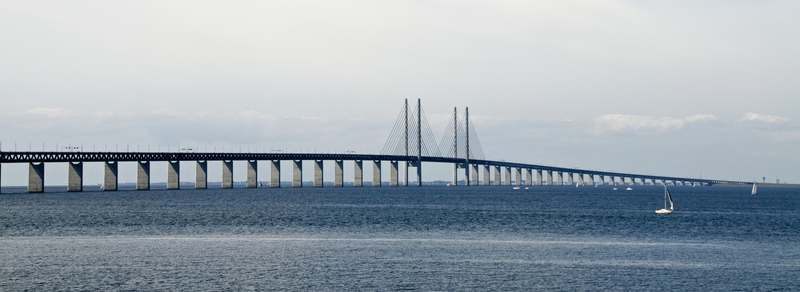
2: https://www.youtube.com/watch?app=desktop&v=j1Cs0C8LkeU

Re:The Francis Scott Key Bridge in Baltimore, Maryland Has C... by Symbiote on Tuesday March 26, 2024 @05:57AM (#39825943)
The Øresundsbron is a bridge and a tunnel, and although it's not required most ships choose to cross over the tunnel rather than under the bridge.

I was curious about Zealand's other connection, the Great Belt Fixed Link:

> The West Bridge has been struck by sea traffic twice. While the link was still under construction on 14 September 1993, the ferry M/F Romsø drifted off course in bad weather and hit the West Bridge. At 19:17 on 3 March 2005, the 3,500-ton freighter MV Karen Danielsen crashed into the West Bridge 800 metres from Funen. All traffic across the bridge was halted, effectively cutting Denmark in two. The bridge was re-opened shortly after midnight, after the freighter was pulled free and inspectors had found no structural damage to the bridge.

> The East Bridge has so far been in the clear, although on 16 May 2001, the bridge was closed for 10 minutes as the Cambodian 27,000-ton bulk carrier Bella was heading straight for one of the anchorage structures. The ship was deflected by a swift response from the navy.

In Danish [2], but it looks like there's someone always monitoring the sea traffic, and able to close the bridge at very short notice — I assume with the red flashing lights which are used to close motorways in emergencies.

> The eastern end through the Great Belt is international water, and therefore even the largest ships must be able to sail under the bridge. The 254 meter high pylons are therefore dimensioned so that they should be able to withstand the approach of tankers of 250,000 tonnes dead weight (DWT) at a speed of 10 knots. Artificial islands protect the anchor blocks as well as the three outermost piers on the Zealand side and the two outermost ones on the Sprogø side.

[1] https://en.wikipedia.org/wiki/Great_Belt_Bridge

[2] https://web.archive.org/web/20090116051425/http://ing.dk/art...

Re:The Francis Scott Key Bridge in Baltimore, Maryland Has C... by fl7305 on Tuesday March 26, 2024 @06:40AM (#39826197)
Öresundsbron is claimed to be designed to be resistant against ships hitting it. They have placed artificial underwater reefs around the pylons. The pylons themselves can also take quite a beating.
Re:The Francis Scott Key Bridge in Baltimore, Maryland Has C... by Kye on Tuesday March 26, 2024 @08:47AM (#39827168)
The twin towers were designed to take a hit from an airliner and survive[0]. Sometimes even the best design fails when reality crashes into it.

[0] They expected fuel leaking to cause a devastating fire, but not that the fire would weaken the structure enough to cause the cascade failure that brought the towers down. https://archive.seattletimes.com/archive/?date=19930227&slug...

Re:The Francis Scott Key Bridge in Baltimore, Maryland Has C... by fl7305 on Tuesday March 26, 2024 @09:37AM (#39827662)
Sure, precautions might not work as well as intended.

But my comment was in regards to having to build a really expensive bridge to make it crash resistant. I pointed out that you can instead build a cheap flimsy bridge and put the protection in the water around the pylons.

My impression is that the Baltimore bridge had no such extra protection (?) In that case, it's not really "the best design", right?

Re:The Francis Scott Key Bridge in Baltimore, Maryland Has C... by AnimalMuppet on Tuesday March 26, 2024 @08:54AM (#39827233)
They survived for roughly an hour after the airliners hit. That hour let roughly 40,000 people make it out.

The towers failed, in the end, but withstanding the initial hit mattered a lot.

Re:The Francis Scott Key Bridge in Baltimore, Maryland Has C... by Kye on Tuesday March 26, 2024 @09:00AM (#39827278)
That's great, but the topic is engineering things to survive serious damage, period. Not just long enough for people to escape before it succumbs. A failed structure is still a failed structure with all the socioeconomic trouble that entails.
Re:The Francis Scott Key Bridge in Baltimore, Maryland Has C... by fl7305 on Tuesday March 26, 2024 @09:45AM (#39827742)
You're mixing up two different things.

If the design requirement for the twin towers was "be fire resistant enough to let most people out of the building", then I'd say they met that requirement, right?

If the design requirement for a bridge is "continue operating at normal capacity", then that is a very different requirement.

Re:The Francis Scott Key Bridge in Baltimore, Maryland Has C... by AnimalMuppet on Tuesday March 26, 2024 @10:23AM (#39828209)
"Failed" isn't the binary you're trying to make it.

Yes, the towers failed to survive serious damage. But the 40,000 more deaths would have been "socioeconomic trouble", in spades. Even by your own chosen measure, the survival for an hour was a partial success.

Re:The Francis Scott Key Bridge in Baltimore, Maryland Has C... by xeonmc on Tuesday March 26, 2024 @05:37AM (#39825822)
Maybe it's the extra momentum that took it over the edge, which if it were built in the 70s probably were designed with static loading in mind without the benefit of dynamical simulation?
Re:The Francis Scott Key Bridge in Baltimore, Maryland Has C... by somat on Tuesday March 26, 2024 @05:36AM (#39825820)
Yes the entire truss section dropped. However the bridge is quite a few times longer than it's trussed section. and none of those spans dropped.
Re:The Francis Scott Key Bridge in Baltimore, Maryland Has C... by gonzo41 on Tuesday March 26, 2024 @05:46AM (#39825879)
Hobart learned its lesson. You can't drive over the bridge when heavy ships sail under it.
Re:The Francis Scott Key Bridge in Baltimore, Maryland Has C... by vertis on Tuesday March 26, 2024 @06:26AM (#39826110)
I fell down reading about all the ships that have hit bridges, and this is probably the most practical solution for a lot of scenarios.
Re:The Francis Scott Key Bridge in Baltimore, Maryland Has C... by zztop44 on Tuesday March 26, 2024 @09:04AM (#39827319)
Yes, but Hobart is tiny so this rarely happens and relatively few people are impacted when it does.
Re:The Francis Scott Key Bridge in Baltimore, Maryland Has C... by gonzo41 on Tuesday March 26, 2024 @09:19AM (#39827456)
Seems like a fair few people are going to be impacted permanently in Baltimore because of this.
Re:The Francis Scott Key Bridge in Baltimore, Maryland Has C... by ZanyProgrammer on Tuesday March 26, 2024 @11:23AM (#39829076)
"Permanently" what? the harbor will be cleared, probably sooner than later, and there will be a new bridge/tunnel built in a few years. Like that's not permanent.
Re:The Francis Scott Key Bridge in Baltimore, Maryland Has C... by odyssey7 on Tuesday March 26, 2024 @01:04PM (#39830207)
The deceased and their community.
Re:The Francis Scott Key Bridge in Baltimore, Maryland Has C... by exodust on Tuesday March 26, 2024 @10:00PM (#39834965)
Wikipedia is missing the iconic photo of the two cars hanging over the edge of the Tasman bridge.

> "the only thing that stopped the car from tipping over the edge was the casing of the automatic transmission, which grinded and gripped into the surface of the bridge."

https://www.carsguide.com.au/oversteer/this-hq-monaros-auto-...

Re:The Francis Scott Key Bridge in Baltimore, Maryland Has C... by plastic3169 on Tuesday March 26, 2024 @07:08AM (#39826388)
There is this often in HN featured article about bridge engineer analysing bridge collapses in film [1]. It’s about suspension bridges though but the takeaway for me was that when they go they go completely.

[1] https://hackaday.com/2015/11/18/suspension-bridges-of-disbel...

Re:The Francis Scott Key Bridge in Baltimore, Maryland Has C... by tyingq on Tuesday March 26, 2024 @08:11AM (#39826846)
I did hear one expert on the news say that a better, low-tech defense some bridges have is sacrificial piers in front of the actual ones. I don't know if this bridge had none, or if they didn't get the job done.
Re:The Francis Scott Key Bridge in Baltimore, Maryland Has C... by gnfargbl on Tuesday March 26, 2024 @05:34AM (#39825811)
Why would slumping or buckling but not-quite-collapsing be a functionally better outcome than complete failure? In both cases, the sheer size of the physical changes is going to lead to forces that humans won't survive, so there's no benefit there. In both cases, the bridge is going to have to be completely demolished before rebuilding, so there's no benefit there.

A bridge that could stand the loss of a single support pier without any significant collapse would obviously be preferable -- but that's a big ask. I'm not a structural engineer, but I am aware of scaling laws [1] and it feels to me that those scaling laws are going to mean that increasing the margin of safety by x is going to increase costs by x^n. For a project like this one, where cost was apparently the deciding factor over a tunnel, that matters.

[1] https://galileo.phys.virginia.edu/classes/609.ral5q.fall04/L...

Re:The Francis Scott Key Bridge in Baltimore, Maryland Has C... by Dalewyn on Tuesday March 26, 2024 @05:40AM (#39825835)
>Why would slumping or buckling but not-quite-collapsing be a functionally better outcome than complete failure?

Well for starters, there's a better chance of less (or ideally no) people forced to get their feet wet and go missing or die from drowning or hypothermia.

Re:The Francis Scott Key Bridge in Baltimore, Maryland Has C... by gnfargbl on Tuesday March 26, 2024 @05:47AM (#39825885)
The specific point I'm making (in the sentence following the one you quoted) is that no, there is not a better chance of those things. If a bridge of this size is going to fail in any significant way, it is going to lead to loss of life.

The broader point is that attempts to blame the bridge designers here are misplaced. It really isn't reasonable to have hoped that they could design a structure that could cope with this kind of failure, within the cost constraints that they had. And cost constraints were a real thing for the designers of this particular bridge.

Re:The Francis Scott Key Bridge in Baltimore, Maryland Has C... by irjustin on Tuesday March 26, 2024 @05:14AM (#39825688)
This situation is terrible, but to your specific question:

Anyone can build a bridge, but it takes an engineer to barely make it stand.

Re:The Francis Scott Key Bridge in Baltimore, Maryland Has C... by jack_riminton on Tuesday March 26, 2024 @05:22AM (#39825736)
I like this quote. We have a medieval bridge near to our house (1000 years old perhaps), it's incredibly solidly built, but could you call it well-engineered?

It's a subtle distinction that I don't think many in the digital realm quite grasp either i.e. far too many over-engineered technical solutions for features and products that aren't even desired

Re:The Francis Scott Key Bridge in Baltimore, Maryland Has C... by lukan on Tuesday March 26, 2024 @05:28AM (#39825774)
"but could you call it well-engineered"

If it is still standing after 1000 years, I would say yes. You cannot build a bridge out of stones with bad engineering - it would collapse under its own weight.

edit: does "well engineered" now means over engineered to some?

Re:The Francis Scott Key Bridge in Baltimore, Maryland Has C... by onetimeuse92304 on Tuesday March 26, 2024 @08:17AM (#39826898)
I like to tell people that all engineering is about tradeoffs.

People who engineered bridges during Roman Empire had different tradeoffs to consider than people who were building bridges in 20th century.

Standing for a thousand years is rarely an ultimate goal when engineering a bridge although it is possible that Romans planned for longer timescales than us.

If we decided to build like Romans did, there would likely be very little infrastructure and many structures would simply be impossible to construct.

Re:The Francis Scott Key Bridge in Baltimore, Maryland Has C... by jack_riminton on Tuesday March 26, 2024 @10:06AM (#39827996)
This is an excellent point, the tradeoffs are specific to the time, place and needs of the builders
Re:The Francis Scott Key Bridge in Baltimore, Maryland Has C... by lukan on Tuesday March 26, 2024 @08:47AM (#39827175)
"If we decided to build like Romans did, there would likely be very little infrastructure"

Why? The romans build lots of infrastructure. Roads, sewage, irrigation, .. and they used the materials and technics of their time.

Can't we really do better today, with all our advanced technology?

Or can't we, because everything has to be cheap, cheap, cheap?

I mean, the romans used slaves. That is cheap. But we have machines.

Re:The Francis Scott Key Bridge in Baltimore, Maryland Has C... by lotsofpulp on Tuesday March 26, 2024 @09:38AM (#39827666)
How much population did the Romans build for? How much weight were the Romans subjecting their structures to, and at what acceleration/deceleration?

Do you know the movements of the supply and demand curves of the materials required since Roman times?

These types of hypotheticals are a waste of time, and only serve to illustrate hubris, as if something as complicated as comparing Roman construction and resources to modern day construction and resources could be possible.

Re:The Francis Scott Key Bridge in Baltimore, Maryland Has C... by lukan on Tuesday March 26, 2024 @09:49AM (#39827800)
"as if something as complicated as comparing Roman construction and resources to modern day construction and resources could be possible."

Well, one can compare the results.

Personally I like things that are build solid and can last a 1000 years.

But I don't think I said the romans build better. They just had a different intention: long lasting.

Re:The Francis Scott Key Bridge in Baltimore, Maryland Has C... by lotsofpulp on Tuesday March 26, 2024 @09:52AM (#39827837)
> Can't we really do better today, with all our advanced technology?

You implied a whole host of things with this statement, and considering the topic of this thread, also ramming a Roman bridge with a fully loaded modern day cargo ship.

The point is there are so many moving parameters, it is nonsensical to take 1 result of 1 technique from 1 point of time and use that as a basis for what one can expect at other points in time.

Re:The Francis Scott Key Bridge in Baltimore, Maryland Has C... by lukan on Tuesday March 26, 2024 @09:57AM (#39827879)
Erm, that was just directed at this point, which I quoted:

"If we decided to build like Romans did, there would likely be very little infrastructure"

Re:The Francis Scott Key Bridge in Baltimore, Maryland Has C... by stonogo on Tuesday March 26, 2024 @02:33PM (#39831221)
The bridge has lasted a thousand years because nobody is driving 18-wheelers over it. It has nothing to do with the intentions of the builder.
Re:The Francis Scott Key Bridge in Baltimore, Maryland Has C... by lukan on Tuesday March 26, 2024 @03:37PM (#39831935)
"It has nothing to do with the intentions of the builder"

Why not? They did not have the intention to make the bridge resistant to such heavy loads, as that was not a use case at that time.

They had the intention to make a bridge to last as long as possible for the traffic at their time. And they surely succeded with this.

Now whether they also could have made a bridge that resists 18 wheelers for 1000 years, well, I don't know.

Re:The Francis Scott Key Bridge in Baltimore, Maryland Has C... by stonogo on Tuesday March 26, 2024 @03:47PM (#39832044)
This is survivorship bias in action. They intended to build a bridge. That is all we can infer from the fact that a bridge exists. That they used available materials and the bridge was not abused by subsequent usage outside its design spec is not proof of any specific intention on the part of the builder. That exists only in your head. It's like assuming dinosaurs died in specific spots with the intent that their bones petrify and fossilize. You're reading too much into not enough facts.
Re:The Francis Scott Key Bridge in Baltimore, Maryland Has C... by lukan on Tuesday March 26, 2024 @03:52PM (#39832112)
Maybe, but lots of roman buildings endured the time in much better shape, than many buildings that were build after them. Have you seen some of them in front of you? I have and I am impressed. (I am in italy right now to go look at some more).

Also we know a bit more about the romans than just their bridges.

Re:The Francis Scott Key Bridge in Baltimore, Maryland Has C... by shiroiushi on Wednesday March 27, 2024 @04:16AM (#39836657)
You can't use Roman techniques to build a bridge over a river that's a couple of kilometers wide that can carry heavy trucks, unless you're thinking of building a dam.
Re:The Francis Scott Key Bridge in Baltimore, Maryland Has C... by onetimeuse92304 on Wednesday March 27, 2024 @10:38AM (#39839770)
It is the same type of person that says Romans were more ecological because we have cars and they had carriages drawn by hand or by horse.

Which is to say "let's just pretend that all of those pesky details do not exist".

Re:The Francis Scott Key Bridge in Baltimore, Maryland Has C... by jack_riminton on Tuesday March 26, 2024 @06:10AM (#39826017)
"If it is still standing after 1000 years, I would say yes" but what if they included far more material in areas where it wasn't needed, skimped on other areas and it fell down tomorrow? It's almost a philosophical question, and it's true that the bridge builders happened across a solid design by accident.

But I think the true definition of engineering has to encompass a level of efficiency through design, calculation and rationalization. In other words, echoing what the original commenter said, including only what is barely necessary.

Re:The Francis Scott Key Bridge in Baltimore, Maryland Has C... by lukan on Tuesday March 26, 2024 @06:21AM (#39826072)
"and it's true that the bridge builders happened across a solid design by accident"

Or by experience and learning from other sucessful bridges? Stone bridges were not new in the year 1000.

There is a roman bridge that was allmost completely surviving all this time, till it was blown up in WW2:

https://en.m.wikipedia.org/wiki/Ponte_Pietra_(Verona)

If they wanted a cheap solution, they would have used wood. But wood does not last a 1000 years.

Personally I salute anyone, who can build something that lasts that long.

"including only what is barely necessary."

And "barely necessary" in solid engineering includes lots of safety margins. Not barely standing.

And yes, that includes not using more than you need, because the more material you use, the heavier your bridge is -> the greater are the forces on the structure itself even with no one passing over it.

There are some fun games out there on various plattforms, google "bridge builder"

Not a scientific simulation of course, but they do show the concept.

Re:The Francis Scott Key Bridge in Baltimore, Maryland Has C... by throw0101c on Tuesday March 26, 2024 @07:16AM (#39826432)
> But I think the true definition of engineering has to encompass a level of efficiency through design, calculation and rationalization.

The 1000 year medieval bridge we're talking about could have been an efficient design for its time.

Re:The Francis Scott Key Bridge in Baltimore, Maryland Has C... by salawat on Tuesday March 26, 2024 @10:31PM (#39835127)
When you'd be expected to stand under it while the local army/militia marched over it, incentives tended to align quite handily.
Re:The Francis Scott Key Bridge in Baltimore, Maryland Has C... by kwhitefoot on Tuesday March 26, 2024 @07:17AM (#39826440)
> only what is barely necessary.

But then one must make clear: necessary for what.

Re:The Francis Scott Key Bridge in Baltimore, Maryland Has C... by rightbyte on Wednesday March 27, 2024 @04:58AM (#39836868)
> and it's true that the bridge builders happened across a solid design by accident.

I think there is a great overlap between "holds for whatever scheme the prefecture will do to test it while I stand under" and "holds for a thousand years".

There is like a limit where fatigue stress stops being a thing in a cycle graph. Many failure modes is due to penny wise cost cutting.

Re:The Francis Scott Key Bridge in Baltimore, Maryland Has C... by kwhitefoot on Tuesday March 26, 2024 @07:15AM (#39826430)
> could you call it well-engineered?

What is well engineered depends on the goals and the limitations of the state of the art at the time. I would say that a thousand year old bridge might count as well engineered if the goal was a bridge that had a low total lifetime cost.

Re:The Francis Scott Key Bridge in Baltimore, Maryland Has C... by boringg on Tuesday March 26, 2024 @09:55AM (#39827866)
Why are you throwing shade at civil structural engineering?

Do all bridges we build need to be able to withstand the force of an entire shipping container bridge hitting it at high speed? What planet should an engineer think that a shipping container has managed to veer off course so badly that they hit a bridge at full speed, fully loaded? That is a sad and significant outlier event.

Re:The Francis Scott Key Bridge in Baltimore, Maryland Has C... by dghlsakjg on Tuesday March 26, 2024 @12:41PM (#39829925)
This is a common joke in engineering.

It’s not meant to be an insult, but a compliment noting that engineers know what the essential parts of the bridge are

Re:The Francis Scott Key Bridge in Baltimore, Maryland Has C... by boringg on Tuesday March 26, 2024 @05:05PM (#39832854)
I suspected it might be but I couldn't tell from the post. There is a lot of self deprecating humor amongst engineers / engineering programs.
Re:The Francis Scott Key Bridge in Baltimore, Maryland Has C... by loeg on Tuesday March 26, 2024 @05:46AM (#39825880)
Check out Brick Immortar (it’s a pun) on YouTube for some in depth videos on past container ship collisions with bridges and how newer bridges are engineered.
Re:The Francis Scott Key Bridge in Baltimore, Maryland Has C... by rpeden on Tuesday March 26, 2024 @06:36AM (#39826170)
Here's the one about the Sunshine Skyway Bridge collapse in Tampa Bay: https://youtu.be/3htwtaJI2nM?si=7SKMY2qxQEQpaf-O

It's pretty similar to this one.

Re:The Francis Scott Key Bridge in Baltimore, Maryland Has C... by cool_dude85 on Tuesday March 26, 2024 @06:44AM (#39826224)
The Mathews Bridge in Jacksonville was clipped by a container ship a few years back and did not collapse. Despite being almost 75 years old, they fixed it up and it opened back up after a year or two. The difference is that the boat did not hit a pylon.
Re:The Francis Scott Key Bridge in Baltimore, Maryland Has C... by _giorgio_ on Tuesday March 26, 2024 @05:02AM (#39825624)
The problem is the static scheme of the bridge.

Most modern bridges are hyperstatic: if you remove one support, it still stands.

Or at least isostatic: you remove one support or one span, and nothing happens to the nearest ones.

This bridge was ill conceived: you remove one support or span, and it brings down everything like a chain that pulls down everything it's linked to.

It's bad because the "engineer" just wanted to show off.

Re:The Francis Scott Key Bridge in Baltimore, Maryland Has C... by 4gotunameagain on Tuesday March 26, 2024 @05:22AM (#39825737)
You cannot put the entire weight of the 70's safety culture to an engineer "showing off"

I bet there was a much more complex and nuanced analysis which included crossing ship dimensions, budget, time to completion, available technology, composition of the local seabed etc..

Designing a bridge is proper engineering and not that easy.

Re:The Francis Scott Key Bridge in Baltimore, Maryland Has C... by Tanoc on Tuesday March 26, 2024 @06:52AM (#39826288)
The '70s were also a transitional period in bridge design where truss bridges were being phased out in favour of newer types of hybrid suspension bridge. Many of the iron and steel bridges of the 1890s through the 1970s were later replaced with suspension bridges or arch span bridges because they used less material and could be architecturally adapted to the area better. So some truss bridges were made as much for appearance as function in order to compete with the futuristic hybrid suspension bridges like the 1967 Ponte Morandi or the 1987 replacement Sunshine Skyway.
Re:The Francis Scott Key Bridge in Baltimore, Maryland Has C... by _giorgio_ on Tuesday March 26, 2024 @06:37AM (#39826174)
Believe me, an engineering student that sees that, immediately understands the problems after taking the first science of construction lessons.

You do need need the truss at all. If the truss fails (in any of the three spans), it brings down two adjacents spans.

It's just a show off.

Re:The Francis Scott Key Bridge in Baltimore, Maryland Has C... by bigbillheck on Tuesday March 26, 2024 @09:04AM (#39827314)
There's been at least 50 years, probably more like 60 or 70, of advances in the art (much less pedagogy) that those students have and the bridge engineer did not.
Re:The Francis Scott Key Bridge in Baltimore, Maryland Has C... by baq on Tuesday March 26, 2024 @05:29AM (#39825776)
> Any idiot can build a bridge that stands, but it takes an engineer to build a bridge that barely stands.

...in other words.

Re:The Francis Scott Key Bridge in Baltimore, Maryland Has C... by somat on Tuesday March 26, 2024 @05:31AM (#39825790)
I would guess none. No bridge span could survive complete loss of it's supporting abutment. Some bridges are engineered to survive partial loss. For example if the left side goes the right side will hold it up. But from the video the ship looks like it took out the entire supporting structure.
Re:The Francis Scott Key Bridge in Baltimore, Maryland Has C... by IG_Semmelweiss on Tuesday March 26, 2024 @07:36AM (#39826589)
Also important to note.

The logistic company running this ship was Maersk. That is the same shipping company that had the ever given stuck in the suez canal a few years ago.

Is Maersk now officially the "Boeing" of shipping?

Re:The Francis Scott Key Bridge in Baltimore, Maryland Has C... by SonOfLilit on Tuesday March 26, 2024 @07:41AM (#39826634)
They are in terms of "most large planes are Boeing so you'll hear about their accidents most often", no idea if also in terms of "terrible safety culture so there'll be an unacceptable rate of accidents".
Re:The Francis Scott Key Bridge in Baltimore, Maryland Has C... by resolutebat on Tuesday March 26, 2024 @08:04AM (#39826807)
Re:The Francis Scott Key Bridge in Baltimore, Maryland Has C... by Symbiote on Tuesday March 26, 2024 @08:19AM (#39826919)
Mærsk chartered the ship, according to the Guardian.
Re:The Francis Scott Key Bridge in Baltimore, Maryland Has C... by pedermoeller on Tuesday March 26, 2024 @10:50AM (#39828644)
No, Ever Given was not a Maersk ship https://en.wikipedia.org/wiki/Ever_Given
Re:The Francis Scott Key Bridge in Baltimore, Maryland Has C... by reliablereason on Wednesday March 27, 2024 @03:38AM (#39836480)
No, with the top reason as to why not being that Maersk did not construct the ship.

Saying that Maersk is at blame is like blaming the airline instead of Boeing.. if you want to make that parallel.

Re:The Francis Scott Key Bridge in Baltimore, Maryland Has C... by makach on Tuesday March 26, 2024 @04:56AM (#39825579)
Modern bridges are required to endure a collision. This bridge might be very old and not sufficiently maintained against current requirements.
Re:The Francis Scott Key Bridge in Baltimore, Maryland Has C... by Reason077 on Tuesday March 26, 2024 @05:03AM (#39825626)
It opened in 1977. So, oldish, but not that old. Plenty of far older bridges around than that.

https://en.wikipedia.org/wiki/Francis_Scott_Key_Bridge_(Balt...

Re:The Francis Scott Key Bridge in Baltimore, Maryland Has C... by loeg on Tuesday March 26, 2024 @05:49AM (#39825889)
Notably predating the 1980 collapse of the Sunshine Skyway after a ship hit.
Re:The Francis Scott Key Bridge in Baltimore, Maryland Has C... by Reason077 on Tuesday March 26, 2024 @08:26AM (#39826993)
Neat how they made what was left of the old bridge into a giant fishing pier!
Re:The Francis Scott Key Bridge in Baltimore, Maryland Has C... by guenthert on Tuesday March 26, 2024 @05:31AM (#39825795)
Collision with what? I'm pretty sure that with a sufficiently massive ship sailing fast enough, one could take down any bridge. Hence I'd think there are limits which ship may approach at a given speed. Was one of those limits perhaps exceeded?
Re:The Francis Scott Key Bridge in Baltimore, Maryland Has C... by hgomersall on Tuesday March 26, 2024 @05:05AM (#39825642)
I'm not sure how many brand new bridges would stay up after having one of the piers on the main span removed.
Re:The Francis Scott Key Bridge in Baltimore, Maryland Has C... by rob74 on Tuesday March 26, 2024 @05:14AM (#39825687)
The trick is to make sure the piers are not removed. For example, the new Tampa Bay Sunshine Skyway Bridge (rebuilt after a similar disaster):

> In addition to a wider shipping lane, the channel would be marked by a 1⁄4 mi (400 m)-long series of large concrete barriers, and the support piers would be protected by massive concrete "dolphins".

https://en.wikipedia.org/wiki/Sunshine_Skyway_Bridge#/media/...

Re:The Francis Scott Key Bridge in Baltimore, Maryland Has C... by gregors on Tuesday March 26, 2024 @10:46AM (#39828602)
Re:The Francis Scott Key Bridge in Baltimore, Maryland Has C... by boringg on Tuesday March 26, 2024 @10:03AM (#39827957)
Collision means nothing without magnitude of force.

A glancing blow is completely different from a direct hit. And the amount of Newtons behind the blow completely changes the outcomes. A small ship versus a loaded container ship is a completely different force.

I doubt many bridges would take a full speed, fully loaded container ship directly to one of their supports and survive it. Certainly the most celebrated bridges have a better chance of surviving but I doubt any second tier, lower traveled routes would.

Re:The Francis Scott Key Bridge in Baltimore, Maryland Has C... by bmitc on Tuesday March 26, 2024 @03:36PM (#39831932)
Apparently this container ship was only half loaded to capacity. And it seems likely that a container ship would hit it given the vicinity of such container ships. I'm generally confused on this matter.
Re:The Francis Scott Key Bridge in Baltimore, Maryland Has C... by boringg on Tuesday March 26, 2024 @05:03PM (#39832832)
It hit the support completely dead on and stopped. All of that momentum and force went directly into the bridge. The pulse from that impact would have been enormous.

Why would you anticipate that a container ship would have to hit the bridge? What about the flip side to that... How many bridges have never been hit by a container ship or alternatively how many times have an almost fully loaded container ship come to a dead stop after hitting a bridge?

Re:The Francis Scott Key Bridge in Baltimore, Maryland Has C... by bmitc on Tuesday March 26, 2024 @06:41PM (#39833662)
According to a quick search and reporting due to this event, apparently a quick number is a few dozen full collapses in the past 55 years, which doesn't seem to account for impacts and collisions that didn't result in full collapses. So that seems like a lot of bridges indeed, along with a lot of deaths and economic impact.

The reason why I would anticipate a container ship hitting that bridge is because of the video we've all seen. It's a huge ship that is going the slowest it can while still retaining control over the vehicle, unattended, through a tight spot, close to a bridge with zero protection from ship collisions, and all with a ship design that is apparently (according to other comments) effectively impossible to correctly maintain and keep running at all times. So I think the better question is, why wouldn't you anticipate a collision?

Re:The Francis Scott Key Bridge in Baltimore, Maryland Has C... by dist-epoch on Tuesday March 26, 2024 @06:18AM (#39826054)
People love bridges which look sleek, thin and like air. They are also cheaper (less materials). But this means there is no redundancy left.
Re:The Francis Scott Key Bridge in Baltimore, Maryland Has C... by bluedino on Tuesday March 26, 2024 @08:28AM (#39827006)
The Bay Bridge in SF has been hit by numerous ships (as large as tankers)
Re:The Francis Scott Key Bridge in Baltimore, Maryland Has C... by sf_rob on Tuesday March 26, 2024 @09:04AM (#39827316)
The 2007 Cosco Busan incident appears to be a glancing blow. I can't find any information suggesting an analogous impact at any point.
Re:The Francis Scott Key Bridge in Baltimore, Maryland Has C... by bluedino on Tuesday March 26, 2024 @08:34AM (#39827062)
> It’s surprising that ships capable of doing this damage were probably regularly driving past it, and its safety as a thoroughfare depended entirely on those collisions not happening.

There are cities with skyscrapers near airports, which depend on the airplanes not hitting the skyscrapers.

Re:The Francis Scott Key Bridge in Baltimore, Maryland Has C... by chasd00 on Tuesday March 26, 2024 @09:10AM (#39827361)
I don’t drive boats or around water much but I’ve seen “bumpers” on bridge pylons before that make a collision more of a glancing blow and guide the boat to the side. I guess there wasn’t any installed on this bridge? Also, someone on Imgur pointed out that when this bridge was built boats that large weren’t a risk. That may or may not be true but sounds plausible.
Re:The Francis Scott Key Bridge in Baltimore, Maryland Has C... by hnburnsy on Tuesday March 26, 2024 @12:08PM (#39829491)
There were tiny bumpers, two for each pylon, one on each side, but looks like they were place too far out, you can see them here...

https://i.pinimg.com/736x/1c/6e/f8/1c6ef8db981c77b1bd7809827...

Ironically there are power lines running in parallel that have much more substantial protection, here you can see the powerline protection and the tiny bumpers...

https://patabook.com/news/wp-content/uploads/2024/03/cbsn-fu...

Re:The Francis Scott Key Bridge in Baltimore, Maryland Has C... by fl7305 on Tuesday March 26, 2024 @09:48AM (#39827782)
> when this bridge was built boats that large weren’t a risk

Doesn't sound plausible to me. Very large Panamax ships were used in the 1970's when the bridge was built.

Re:The Francis Scott Key Bridge in Baltimore, Maryland Has C... by 1letterunixname on Tuesday March 26, 2024 @04:52PM (#39832709)
Sorry, but you're very wrong. A civil engineer on Sky News even raised this issue.

https://www.container-transportation.com/worlds-largest-cont...

Re:The Francis Scott Key Bridge in Baltimore, Maryland Has C... by fl7305 on Wednesday March 27, 2024 @06:36AM (#39837426)
Panamax specifications (320 m length, 32 m width) have been in effect since the opening of the canal in 1914. Some ships were already larger than that back then. The Titanic was about that size.

The ship that knocked down the bridge could weigh ("DWT") up to 115 000 tons.

Some ships from the 1960s and 1970s:

Universe Ireland: Launched in 1968, it had a DWT of over 300 000 tons.

Esso Atlantic (1977): DWT of over 500 000 tons.

But these were tankers. You're right that container ships were not as big back then.

One of the larger container ships when the bridge was built in 1977 was MV Hamburg Express. It was 280 meters long, 32 meters wide, and had a DWT of 50 000 tons.

Do you really think a 280 meter long ship weighing 50 000 tons would not have knocked down the bridge in exactly the same way?

https://de.wikipedia.org/wiki/Hamburg-Express-Klasse_(1972)

Re:The Francis Scott Key Bridge in Baltimore, Maryland Has C... by 1letterunixname on Tuesday March 26, 2024 @04:51PM (#39832699)
Fenders and such. A major problem is this bridge was designed and built in an era where ships were substantially smaller (3000 TEU) than they are today (20000 TEU).
Re:The Francis Scott Key Bridge in Baltimore, Maryland Has C... by fl7305 on Wednesday March 27, 2024 @06:43AM (#39837451)
The ship that brought down the bridge had a capacity of 10 000 TEU. It's max weight (DWT) was 115 000 tons.

There were container ships with a DWT of 50 000 tons when the bridge was built.

There were also tankers with 10x that (500 000 tons), so large and heavy ships shouldn't be a Pikachu-face surprise to the bridge designers. If nothing else, the trend in increasing ship sizes was clear to anyone looking at it.

Do you think the bridge steel pylons would have resisted a 50 000 tons ship plowing into them?

Re:The Francis Scott Key Bridge in Baltimore, Maryland Has C... by Lance_ET_Compte on Tuesday March 26, 2024 @09:27AM (#39827557)
In 2013, a tanker ship hit the Bay Bridge (Oakland <--> SF) but didn't do much damage. In 2007, another tanker (Cosco Busan) hit the same bridge dumping oil into the bay: https://www.youtube.com/watch?v=upfjxfl2nRM. We have a new bridge there now because that one was also damaged in the Loma Prieta earthquake.

When the Golden Gate needs replacement, the Marin NIMBY's that didn't extend BART to the north bay are going to be sad (more likely, their children will be).

Re:The Francis Scott Key Bridge in Baltimore, Maryland Has C... by ak_111 on Tuesday March 26, 2024 @09:49AM (#39827795)
This brings back to memory 911 conspiracy theories.

Many revolved around the unlikelihood that a building would collapse the way the towers collapsed just due to knocking out a few floors at the top. But the truth is all these mega structures are quite fragile and can instantly collapse in unintuitive ways.

Re:The Francis Scott Key Bridge in Baltimore, Maryland Has C... by G0dchi1d on Tuesday March 26, 2024 @10:16AM (#39828107)
The ongoing construction work likely creaty some type of structural integrity issue...
Re:The Francis Scott Key Bridge in Baltimore, Maryland Has C... by patrickwalton on Tuesday March 26, 2024 @10:20AM (#39828163)
In many structures, catastrophic failures are far more likely than graceful failures.
Re:The Francis Scott Key Bridge in Baltimore, Maryland Has C... by foxhop on Tuesday March 26, 2024 @11:00AM (#39828778)
these ships have to be boarded by special port captians to make this maneuver.
Re:The Francis Scott Key Bridge in Baltimore, Maryland Has C... by CydeWeys on Tuesday March 26, 2024 @02:36PM (#39831267)
One factor that a lot of people in this discussion are missing is that buildings are primarily built to resist vertical forces, because gravity is by far the largest force any building (or bridge) ever experiences.

Having a large force strike perpendicular to gravity is just not something it's designed for at all. All it ever has to handle in the form of force from that direction is wind, and that's absolutely nothing compared to a fully laden container ship hitting it.

Re:The Francis Scott Key Bridge in Baltimore, Maryland Has C... by pdntspa on Tuesday March 26, 2024 @02:41PM (#39831325)
That bridge looks like its almost entirely made of just trusses. It's hard to imagine how one might expect it not to collapse when everything holding it together is so thin.
Re:The Francis Scott Key Bridge in Baltimore, Maryland Has C... by doer1984 on Tuesday March 26, 2024 @03:56PM (#39832145)
Ironically, simply bulking up the ground around the piers would have had the ship run aground; at 8 knots the ship would have slowed to a stop within several yards, and suffered minor damage, maybe would have required being tugged back into clear waters. Running aground puts the majority of impact into a downward force absorbed by the earth. It's hard to build a bridge pier that will withstand 200,000 tons of direct impact, no matter how slowly that's moving.
Re:The Francis Scott Key Bridge in Baltimore, Maryland Has C... by adrianmonk on Tuesday March 26, 2024 @04:11PM (#39832290)
That's what makes sense to me. Ships are designed to minimize drag going through the water. But the friction of the entire hull scraping across the bottom should be MUCH larger and thus able to exert lots more stopping force.

Also, if the ground is sloped, it will act like a ramp, lifting the ship out of the water. The loss of buoyancy means its weight will push downward on the ground below it. An increased normal force means more friction, thus more stopping ability.

Re:The Francis Scott Key Bridge in Baltimore, Maryland Has C... by fl7305 on Wednesday March 27, 2024 @06:44AM (#39837456)
> simply bulking up the ground around the piers

That is exactly what they did around the pylons of the large Öresundsbridge between Denmark and Sweden.

Re:The Francis Scott Key Bridge in Baltimore, Maryland Has C... by doer1984 on Tuesday March 26, 2024 @03:58PM (#39832165)
Simply bulking up the ground around the piers with loose fill or monolithic concrete would have had the ship run aground; at 9mph (the recorded impact speed) the ship would have slowed to a stop within several yards, and suffered minor damage, maybe would have required being tugged back into clear waters. Running aground puts the majority of impact into a downward force absorbed by the earth. It's hard to build a bridge pier that will withstand 200,000 tons of direct impact, no matter how slowly that's moving.
Re:The Francis Scott Key Bridge in Baltimore, Maryland Has C... by hwh47 on Tuesday March 26, 2024 @04:33PM (#39832507)
separate but pertinent question: what was the mv dali's air draft? (FSK bridge's clearance is 185'/56m) was the container ship going to fit under the bridge, i.e., perhaps the incident was an aborted attempt to crossing under the bridge?
Re:The Francis Scott Key Bridge in Baltimore, Maryland Has C... by lolc on Wednesday March 27, 2024 @05:58AM (#39837191)
I'd assume the procedure of how the ship will enter and leave was clear to all involved before it even got close to Baltimore.
Re:The Francis Scott Key Bridge in Baltimore, Maryland Has C... by hwh47 on Tuesday March 26, 2024 @04:36PM (#39832545)
separate but pertinent question: what was the mv dali's air draft? (FSK bridge's clearance is 185'/56m) ...perhaps the incident was an aborted attempt to crossing under the bridge?
Re:The Francis Scott Key Bridge in Baltimore, Maryland Has C... by doer1984 on Tuesday March 26, 2024 @04:58PM (#39832776)
Anyone know about backup steering power on these vessels? I know they typically keep emergency generators, but does this provide adequate steering power?
Re:The Francis Scott Key Bridge in Baltimore, Maryland Has C... by frankfrank13 on Tuesday March 26, 2024 @05:03PM (#39832833)
Someone hasn't played enough polybridge
Re:The Francis Scott Key Bridge in Baltimore, Maryland Has C... by snarf21 on Tuesday March 26, 2024 @05:32PM (#39833118)
Is there a reason we don't force ships above a certain side to always approach a bridge like this perpendicular in the main channels? Seems like a trivial thing to implement immediately and makes this never happen again.
Re:The Francis Scott Key Bridge in Baltimore, Maryland Has C... by EasyMark on Wednesday March 27, 2024 @11:48AM (#39840811)
If you watch it in slow motion and how it breaks apart, you won't really find it surprising how things snap and bend considering how big the container ship is compared to the bridge. It makes a lot of sense.