But I guess I thought that maybe there was... typically some kind of earthen buffer around the pillar to prevent such an impact?
That's probably impractical too, I guess.
I guess I just didn't realize ~$1bn bridges were one fluky ship accident away from total collapse at any given time. I think maybe I prefer my previous state of ignorance, to be quite honest....
It does look reasonable to have such a buffer. But any preventive measure will have limits as what and how serious an impact it can deal with.
In this case the ship this massive is something that is carrying ridiculous inertia, and its highly unlikely even a buffer could stop such an impact.
I think at some point you are better off solving these issues with more regulation(smaller ships)? Instead of treating this as a engineering problem.
The recent grounding of a large container ship in Baltimore's harbor channel demonstrates that a sufficiently massive berm will stop any ship. What's needed is the will to do something about low-probability but catastrophic events (though large-ship collisions, groundings and fortuitously harmless steering failures are frequent enough that this should not have been dismissed as a low-probability event.)
https://www.cnn.com/2022/03/16/business/evergreen-container-...
In this case, the nearby towers supporting transmission lines across the channel seem to be better-protected against ship collisions than the piers of the bridge.
Secondly, I believe riprap would be preferred to compacted soil (though compacted soil did a pretty good job stopping the Ever Given three years ago.)
Thirdly (and rendering the above moot), what's been done around the replacement Sunshine Skyway bridge in Tampa bay (mentioned in other posts here) shows that protection is, in fact, practical.
In view of these considerations, I'm not even going to check if, for example, xoa considered the energy absorbed by the ship (Update: in fairness, I did take a look at what xoa wrote, and I see that it is you who has introduced the figure of 1000 J/M^3.)
For an introduction to a serious engineering approach to this problem, look here:
https://onlinelibrary.wiley.com/doi/epdf/10.1002/stco.200910...
That said, the dolphin-bulwarks around the Tampa Skyway are interesting. I've sailed through similar and not known their purpose other than to observe that local waterfowl like to line up at them ahead of tidal shifts to catch the fish as they're encouraged by the currents through them.
You guys are doing amateur engineering. Firstly we don't even know what happened here yet. Secondly we don't know the nature of the problem we'd have to solve in protecting any span that would have been at that position. (How deep is the water? How far down to bedrock? Geological nature of the soil? etc etc etc)
It seems almost impossible for us as humans to just give the professionals some time and space to work so we can see what happened. I get that. I even engage in it at times. But you guys are stating things with certainty and almost indignation? Come on fellas.
Just say your peace and admit it's just a wild ass guess that's likely to be wrong in the end like the rest of our comments.
ETA: Thank you bmelton for owning that.
You're right that it's amateur. This isn't remotely what I do. To your point though, I don't have that much confidence that the Skyway bulwarks would do -- I'm sure they're more than adequate in preventing strikes from my 40' sailboat. Probably much more than that. My gut tells me they are inadequate to stop the momentum of 100k tonnes at speed, but if they did SOMEthing, perhaps that would be enough to differentiate between bridge damage and bridge collapse. I can't find any details on how it's reinforced, with what, or how deeply those reinforcements are buried, so this too is wild speculation... but I wonder if it isn't somewhat security theater. My wife is already scared of bridges, and we're Marylanders who frequent that bridge and the (much longer) bay bridge -- putting something down there to calm her nerves enough that she isn't panicking for the duration of every crossing is almost certainly worthwhile, but doesn't leave the nerds much to ponder.
Measuring a satellite image in Google Maps [1] tells me the bridge's central span is more than 300 meters.
I Googled the distances before the post but apparently got the wrong value. Danke!
e.g. https://www.japantimes.co.jp/uploads/imported_images/uploads...
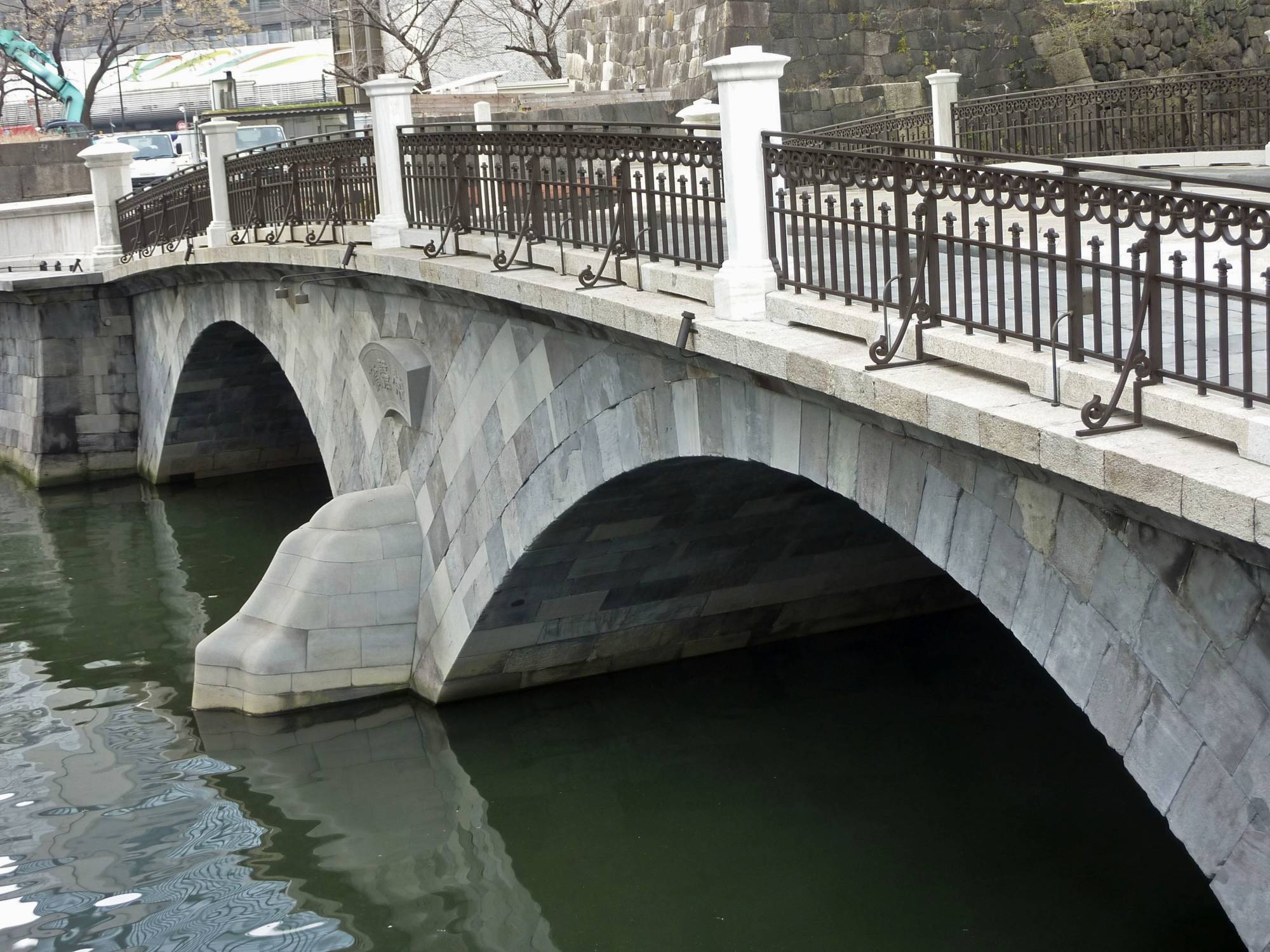
In general I share your sentiment society could do more to insure itself against lower-probability catastrophes. But overbuilding every bridge would probably cost more than rebuilding the occasional one that's taken out when an unusual event like this occurs. Maybe in a different environment that would make sense, like a warzone (although I think even then there's more tendency to rely on redundant infrastructure and mobile, power-at-a-point defense).
https://en.wikipedia.org/wiki/Sunshine_Skyway_Bridge#/media/...

Given how the Skyway collapse is burned into the local consciousness, I suspect some of the benefit comes from their visibility.
I truly don't know how the dolphins would fair against a massive ship strike but I can imagine them doing their job.
(ship passing): https://pbs.twimg.com/media/FPgQhy2X0AE8yw1.jpg

I don’t think that is likely? My intuition is that in order to stay seaworthy ships are constructed with more integrity than that.
I don’t have any hard evidence though, just that I have looked at many ship collision/allision aftermath photos and what you describe is not a failure mode I have seen so far.
but only on per-pillar per-direction and with quite a bit of distance between it and the pillar
one some pictures you can see that the ship barley missed one of them due to the angle it was going at
And while I'm not quite sure what it is for the bridge had concrete pillars orthogonal in front of the pillars (this picture shows them well, to be clear I do NOT mean the power line isles: https://www.upi.com/News_Photos/view/upi/7191ba50f17c5a68307...). They would have stopped the ship if it would have went orthogonal to the bridge (i.e. if they mistook where the pillar where in a otherwise normal situation). Through not sure if that was the purpose of them.
Exactly. It is only the scale and the viewing angle that makes it seem slow moving.
The MV Dali (IMO#9697428) is a little over 95000 GT, or ballpark-ish probably around 114000 tons loaded (and it seems to have been loaded, which would make sense on departure). If it was going even 5kn (2.6 m/s) that'd be about 300 million newton-seconds, or about 3.3 times the momentum of a large jumbo jet like a 747 shortly at cruising speed (around 560 mph). It'd still have the same momentum as said jet if it was going just 1.5kn. The ship of course is enormously more stoutly built and the force is going to be transmitted far more directly into whatever it hits vs into explosions driving mass elsewhere.
I've read that both on water and in space for that matter enormously massive objects moving very slowly messes with human perception and "common sense", it "feels like" something moving along smoothly and slowly should be stoppable or come to a stop. Enormous momentum and forces can be terrifying things.
One time the pulling cart broke down and we had to switch it for another, but when we took it off the rails we forgot about the "shoe" that is supposed to go between the rail and one of the wheels so it can't move downhill (it was like 1degree of slope so barely recognizable as a slope).
It started moving extremely slowly, and all of us except one tried to hold back the force of the train, which of course was imossible and dangerous. The one who did not try to push it very quickly found the "shoe" and put in place. Initially it did not seem to help at all, the train just continued moving at the same pace, tearing up asphalt with the shoe. It finally came to a stop after about 3-5m(?) which takes a fair bit of time with such low speed, and felt like forever given the situation.
The train tracks headed out into an open road, so it could have been so much worse if it were not for the only person thinking clearly in the situation (he was one of the more experienced in our group).
The only major difference is that they often use a safety air brake system shared across an entire consist (train) that requires “charged” pressure (above atmosphere) to disengage the brake (although I think they have moved to an electronic system that now monitors air pressure in each car individually).
This reminds me of a vivid memory I have. I’d just finished a shift cooking, and out back of our restaurant there were railroad tracks. I had a beer and smoke out there with my shift mate, and a train was rolling by. I thought it would be fun to practice jumping on the train. So I do a few passes jogging alongside it, hopping on and off. Then my buddy, standing still, reached out and grabs a rung of a ladder on one of the cars. It immediately picked him up, but he gripped harder due to being startled. He got ragdolled through the air about 10 feet from where he was initially standing.
Kids, don’t play with trains (trespassing issues aside).
Trains are very scary stuff even when moving at a crawl.
A 110,000 ton ship collision is something the human brain is just not going to understand intuitively.
Yes, hence warnings to amateur boat users (e.g. on a canal boat) not to try to stop a collision with the bank using your arms or legs.
[Edit] Boats can also do things that are unintuitive if you are used to driving a car. E.g. turning round the centre of gravity when you steer rather than following the front wheels.
People would think they could stop them like soccer balls, and lose a foot.
I don't know what sort of speed ships travel in harbors (though I know that they are faster than they appear.) In this case, it was an ebb tide (though within an hour of the low) which might have added something to the ship's speed.
https://tides.willyweather.com/md/baltimore-city/patapsco-ri...
Good estimation! :)
For another comparison, Wikipedia gives an estimate of "Apollo 11 launched from Earth to orbit" at 495 million N s [1]. So this is a momentum that's order-of-magnitude comparable to space launches.
Ship KE = 0.5 * (114000 short tons) * (7.5 knots)^2 = ~7.7e8 J.
747 KE = 0.5 * (510,000 lbs) * (560 mph)^2 = ~7.25e9 J.
747 avg weight = (MTOW + OEW) / 2 = ~510,000 lbs
Posted video of power loss. Also black smoke coming out rear — is that normal? Any clue of what onboard crisis they were dealing with?
What happened will be meticulously reconstructed and everyone involved in this is going to have their lives put under a microscope for years worth of legal battles. I don't think we should rush to judgement or second guess from a position of ignorance.
Also looks like it's emergency vehicles in standstill that are falling, i can't discern any moving cars at collapse?
Watching this video (https://www.youtube.com/watch?v=qJNRRdha1Xk) shows that the ship was incredibly close to the bridge in the first place, even prior to the supposed failure. It's a bit bewildering to me, with my current knowledge, that this scenario wasn't envisioned prior.
No matter(1) the engineering there is no pretty much way to not lose the whole large middle area and left area leading to the destroyed pillar in that situation.
Such a collapse crates so much force (tension vibrations etc.) so that the collapse of the section right of the right pillar is not unreasonable.
The only question is if the impact should have made the pillar collapse.
But a loaded container ship is ... absurdly massive I mean they are like multiple high raise building (but not sky scrapers) standing squished together side by side. So the force it can apply is huge and if cargo moving in it there will be force applied to whatever it crashes into even after the initial impact.
And looking at the waves caused by impact with the base it was at least 8m high I think (depending on the container ship). So that wasn't a "slow moving" impact. And even slow moving impacts with container ships can tear apart a solid jetty.
So while the US has issues with infrastructure maintenance idk. if anything but building a many pillar bridge would have made any difference. And building a many pillar bridge might not be very viable depending on the under water landscape and water use under the main area.
EDIT: Looking at pictures with daylight where you can try to estimate the high of the ship using containers I would say the waves where handwavingly 4 containers high so ~9.5m and it also looks like the ship might have embedded half of the pillars fundament into/under itself (but it's a bit hard to tell to the angle of the picture). I think if that's the case probably the huge majority of bridge pillars of past and presence would have collapsed.