News for hackers. Stuff that matters.
Re:The case for expanding rather than eliminating gifted edu... by jmyeet on Wednesday June 08, 2022 @01:05PM (#31670437)
There are so many topics that are hard to talk about nowadays without getting into politics but politics and structural inequality are at the core of this.

For the benefit of non-US readers, know that how the US funds public education (K-12) is rather unique. It's done through property taxes essentially. Depending on your state and city your property taxes can vary a lot with the same value property.

But what this means is the wealthier localities have more tax revenue and thus better schools. This can be a vicious cycle of improving property values by having better schools and thus generating more tax revenue and so on. I say "vicious" because it is absolutely exclusionary to lower-income people who cannot possibly afford to live in these areas. And that's by design.

Twenty years ago Bush (43) passed the No Child Left Behind Act, which many dubbed the No Child Gets Ahead Act. A lot of this was also in the name of "equity".

I know people who send their children to public schools in NYC. NYC seems to be in the mood to eliminate these "gifted" programs because of "equity" too. The result? Those who can afford to send their children to private schools will. For those who are left, there are no more gifted programs.

How does that help anyone?

Re:The case for expanding rather than eliminating gifted edu... by car_analogy on Wednesday June 08, 2022 @01:23PM (#31670787)
> how the US funds public education (K-12) is rather unique. It's done through property taxes essentially. Depending on your state and city your property taxes can vary a lot with the same value property. But what this means is the wealthier localities have more tax revenue and thus better schools.

This is an oft repeated myth. In addition to property taxes, school funding is supplemented by state and federal budgets, in inverse proportion to property taxes, so that racial differences in per-pupil funding are negligible:

on average, both Black and Latinx total per pupil expenditures exceed White total per pupil expenditures by $229.53 and $126.15, respectively - https://journals.sagepub.com/doi/full/10.1177/23328584198724...

That's a ~$200 difference compared to $6000 per pupil, the 4th highest in the world: https://www.nationmaster.com/country-info/stats/Education/Sp...

Re:The case for expanding rather than eliminating gifted edu... by jmyeet on Wednesday June 08, 2022 @01:43PM (#31671207)
From the abstract of the paper you cited:

> Yet race remains related to funding disparities and schooling experiences in ways that raise concerns about the role of school finance in perpetuating racial opportunity gaps.

What you are pulling out seems to be narrowly-focused and highly-contextualized.

Consider [1]:

> Property taxation and school funding are closely linked in the United States. In 2018–2019, public education revenue totaled $771 billion. Nearly half (47 percent) came from state governments, slightly less than half (45 percent) from local government sources, and a modest share (8 percent) from the federal government. Of the local revenue, about 36 percent came from property taxes. The remaining 8.9 percent was generated from other taxes; fees and charges for things like school lunches and athletic events; and contributions from individuals, organizations, or businesses.

[1]: https://www.lincolninst.edu/publications/articles/2022-04-pu...

Re:The case for expanding rather than eliminating gifted edu... by car_analogy on Wednesday June 08, 2022 @01:56PM (#31671426)
> What you are pulling out seems to be narrowly-focused and highly-contextualized.

It's the most straight-forward and objective measure. That the main result of a paper would be omitted from the abstract and "highly-contextualized" is not surprising, given social science's bias. If a study gets the 'wrong' findings, it tends to be rejected:

The authors also submitted different test studies to different peer-review boards. The methodology was identical, and the variable was that the purported findings either went for, or against, the liberal worldview (for example, one found evidence of discrimination against minority groups, and another found evidence of "reverse discrimination" against straight white males). Despite equal methodological strengths, the studies that went against the liberal worldview were criticized and rejected, and those that went with it were not. - https://theweek.com/articles/441474/how-academias-liberal-bi...

Re:The case for expanding rather than eliminating gifted edu... by jakelazaroff on Wednesday June 08, 2022 @02:22PM (#31671845)
Suggesting that the authors intentionally omitted the main result of their study from the abstract and hid it under layers of obfuscating details for sharp-eyed readers to uncover is basically a conspiracy theory. The far more straightforward explanation is that the authors saw it as one fact among many that contributed to their overall conclusion stated in the abstract.
Re:The case for expanding rather than eliminating gifted edu... by car_analogy on Wednesday June 08, 2022 @02:33PM (#31671998)
It's not a conspiracy theory, but an empirically validated fact, as the study in my link showed. It is not the only one with such findings:

Ceci et al. (1985) found a similar pattern. Research proposals hypothesizing either "reverse discrimination" (i.e., against White males) or conventional discrimination (i.e., against ethnic minorities) were submitted to 150 Internal Review Boards. Everything else about the proposals was held constant. The "reverse discrimination" proposals were approved less often than the conventional discrimination proposals. - https://jsis.washington.edu/global/wp-content/uploads/sites/...
Re:The case for expanding rather than eliminating gifted edu... by jakelazaroff on Wednesday June 08, 2022 @02:50PM (#31672225)
This quote has to do with research proposals, not study results.
Re:The case for expanding rather than eliminating gifted edu... by abeyer on Wednesday June 08, 2022 @02:56PM (#31672304)
But study results are only published if the study is done, and the study is often only done if it gets institutional approval for the proposal.
Re:The case for expanding rather than eliminating gifted edu... by jakelazaroff on Wednesday June 08, 2022 @03:07PM (#31672438)
Yes, but a study's conclusion isn't preordained. It's entirely possible for authors to end up disproving their hypothesis. So it doesn't follow that, because more research proposals about "reverse discrimination" were rejected, then more studies concluding "reverse racism" (holding all else constant) would be rejected.
Re:The case for expanding rather than eliminating gifted edu... by car_analogy on Wednesday June 08, 2022 @03:39PM (#31672897)
Yes, both are covered. Studies that specifically look for inconvenient facts don't get funded, and studies that accidentally find them don't get published.
Re:The case for expanding rather than eliminating gifted edu... by zozbot234 on Wednesday June 08, 2022 @02:33PM (#31671999)
It's suggesting a disagreement as to what counts as "main result". That's quite normal and need not imply any conspiracy.
Re:The case for expanding rather than eliminating gifted edu... by jakelazaroff on Wednesday June 08, 2022 @03:17PM (#31672582)
OP confirmed in a reply that they meant the authors were doing this intentionally.
Re:The case for expanding rather than eliminating gifted edu... by retrac on Wednesday June 08, 2022 @02:03PM (#31671567)
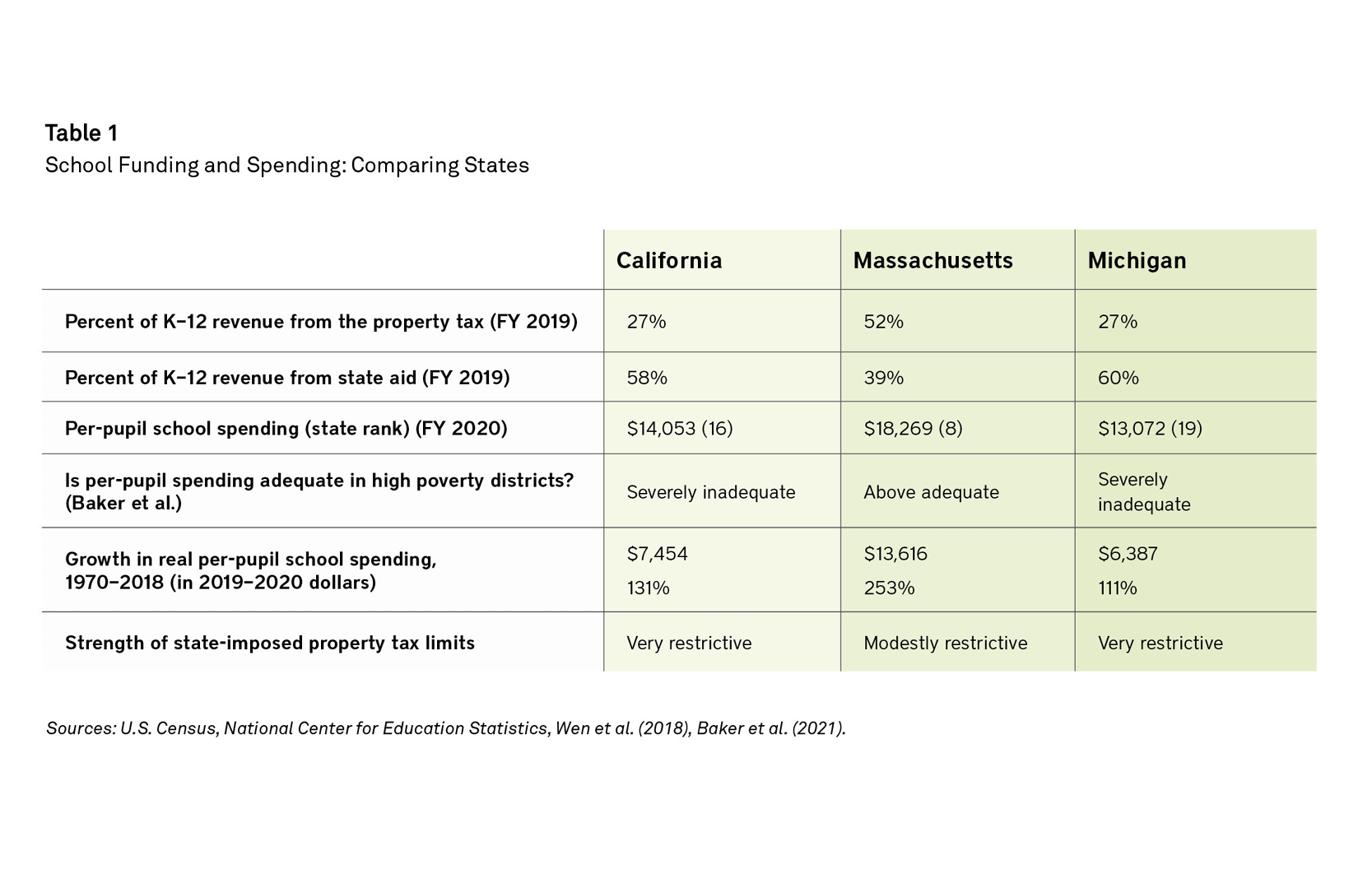
From the article you linked: https://www.lincolninst.edu/sites/default/files/content/04.2...

Compare California and Massachusetts. It seems to demonstrate the point of the poster you replied to. Despite MA relying nearly twice as much on property tax, as state revenue versus California, it seems to have better outcomes. Mostly because as the article discusses, MA appears to use targeted transfers from state revenue to poor districts.

Re:The case for expanding rather than eliminating gifted edu... by ghaff on Wednesday June 08, 2022 @02:56PM (#31672303)
And, as is often the case, there's a very loose relationship in Massachusetts between per-student spend and educational outcomes as measured by tests. It's common for urban districts in particular to have high spend and generally poor outcomes.
Re:The case for expanding rather than eliminating gifted edu... by shagie on Wednesday June 08, 2022 @02:09PM (#31671666)
Property tax in California has its own history and complications that makes it difficult to compare California's funding of things based on property tax to anywhere else in the US.
Re:The case for expanding rather than eliminating gifted edu... by rats on Wednesday June 08, 2022 @03:24PM (#31672688)
can you link to an article detailing this issue? i'd love to dig deeper on this topic
Re:The case for expanding rather than eliminating gifted edu... by shagie on Wednesday June 08, 2022 @03:30PM (#31672768)
Re:The case for expanding rather than eliminating gifted edu... by willcipriano on Wednesday June 08, 2022 @01:26PM (#31670860)
I've taken a close look at the numbers for individual schools in my tri-state area, (NY, NJ, PA) and from my estimate it seems that lower performing schools far and away have the highest per student budgets.
Re:The case for expanding rather than eliminating gifted edu... by danans on Wednesday June 08, 2022 @01:30PM (#31670956)
It is much more expensive to teach and support the children at lower performing schools than it is at higher performing schools. Lower performing schools are also providing significant front line social support services for the communities they serve, including food, trauma counseling, sometimes medical intervention, extreme behavior management. None of that is cheap.

Students/families at higher performing schools have far lower need for support systems.

Re:The case for expanding rather than eliminating gifted edu... by 6502nerdface on Wednesday June 08, 2022 @02:10PM (#31671680)
I wonder if another factor could be:

- in higher performing schools, parents fund a number expenses directly through a very active PTA, so those expenses don't show up in the school's official spending per pupil, while

- at lower performing schools with less active and more impoverished PTAs, those same expenses must be funded by school budgets, driving up their official per-pupil spending.

Re:The case for expanding rather than eliminating gifted edu... by mturmon on Wednesday June 08, 2022 @02:34PM (#31672025)
Absolutely. Case in point, the La Canada (LA area) Educational Foundation -- https://lcfef.org/endowment/our-story/
Re:The case for expanding rather than eliminating gifted edu... by danans on Wednesday June 08, 2022 @04:10PM (#31673311)
Absolutely, but the PTA at the higher performing (higher income) school pays for additional educational programs, like art, second language, science, etc. This amount is referred to in the PTA language as "the gap" in public funding for basics.

At the low performing school, the extra public funds received are often paying for support staff for serious social issues. There is little budget for the "nice to haves", and even when there is, the school staff has it's hands full managing the basics, so it's not always effectively utilized.

Re:The case for expanding rather than eliminating gifted edu... by brewdad on Wednesday June 08, 2022 @01:37PM (#31671071)
The lower performing schools also tend to be older and require more maintenance and repairs than newer schools in wealthier areas. Not all of that additional per-pupil funding makes it to the classroom.
Re:The case for expanding rather than eliminating gifted edu... by car_analogy on Wednesday June 08, 2022 @02:04PM (#31671592)
The study I linked (https://journals.sagepub.com/doi/full/10.1177/23328584198724...) addresses this in table 1, page 8. Surprisingly, Black pupils get on average $10 less "infrastructure" expenditures, and $150 more "instructional" expenditures compared to White. The table breaks the spending down into 5 different categories, but in all of them, the differences are negligible. The $150 instructional expenditure difference is the largest.
Re:The case for expanding rather than eliminating gifted edu... by danans on Wednesday June 08, 2022 @01:47PM (#31671272)
> The lower performing schools also tend to be older and require more maintenance and repairs than newer schools in wealthier areas.

Sure, that's a factor too, but I'd still call it a social service issue since it ultimately results from the historical disinvestment in the communities that today have low performing schools.

There are reasons that the roofs didn't get repaired and the lead pipes didn't get replaced in those schools: because middle income people took their lives, businesses, and tax dollars out of those communities starting in the late 1960s, both by migrating to newly built suburbs, and also by ensuring their tax dollars never went toward the communities they left.

Look up the opposition to "Robin Hood" school funding from the 80s and 90s. Where I grew up it was largely about keeping suburban tax dollars out of inner-city school districts.

Re:The case for expanding rather than eliminating gifted edu... by 6502nerdface on Wednesday June 08, 2022 @02:18PM (#31671798)
A difference in maintenance costs is not necessarily a consequence of disinvestment... it could simply be that lower performing schools are more likely to be urban, and in urban areas everything related to the construction and maintenance of buildings, whether old or new, is more expensive (not to mention admin salaries, etc.). Or it could be that plus what you say for a double wammy at some schools. I'm just brainstorming reasonable seeming hypotheses that you could imagine trying to rule out with the right dataset.
Re:The case for expanding rather than eliminating gifted edu... by zozbot234 on Wednesday June 08, 2022 @01:54PM (#31671398)
Except that this whole movement is now reversing. These communities are starting to gentrify and grow rich - to the horror of progressive activists everywhere! Damned if you do, damned if you don't. You just can't win!
Re:The case for expanding rather than eliminating gifted edu... by zozbot234 on Wednesday June 08, 2022 @01:34PM (#31671029)
> It is much more expensive to teach and support the children at lower performing schools

Blame education schools and their failing "every student can simply learn their math on their own!" approach. Total self-serving garbage, devised to cater to the ego of naïve prospective teachers and their expectation of not doing any real teaching work.

Re:The case for expanding rather than eliminating gifted edu... by ModernMech on Wednesday June 08, 2022 @01:50PM (#31671319)
Also you tend to find daycare programs for teenage mothers at poorer schools. Rich parents get their children abortions, while poor children give birth to their babies.
Re:The case for expanding rather than eliminating gifted edu... by honkdaddy on Wednesday June 08, 2022 @02:03PM (#31671572)
This is an oft-repeated myth, and in fact the opposite is true.

"there are substantial disparities in abortion rates in the United States, with low-income women and women of color having higher rates than affluent and White women"

https://www.ncbi.nlm.nih.gov/pmc/articles/PMC3780732/

Re:The case for expanding rather than eliminating gifted edu... by SgtBastard on Wednesday June 08, 2022 @02:39PM (#31672086)
If the incidence rate of teenage pregnancy amongst low-income women is significantly higher, then women amongst this group can simultaneously have more abortions AND be teenaged mothers completing schooling vs other groups.
Re:The case for expanding rather than eliminating gifted edu... by corrral on Wednesday June 08, 2022 @01:32PM (#31670980)
In my city, the worst schools tend to pay a good 20% better than the best ones, for teachers. They get lots of federal and state aid.

People still usually prefer not to work at them, if they have options, because the work environment is terrible.

Re:The case for expanding rather than eliminating gifted edu... by kube-system on Wednesday June 08, 2022 @01:52PM (#31671357)
You have to pay more to hire people to do harder jobs.
Re:The case for expanding rather than eliminating gifted edu... by corrral on Wednesday June 08, 2022 @02:21PM (#31671832)
Absolutely—my point is that these schools aren't behind the "good" ones, funding-wise, and even pay better.

Past a certain not-that-high point, giving schools more money doesn't help them much.

There's probably some astronomically-high level of funding that would help, past some tipping point, by enabling things like single-digit class sizes, tons of social workers and counselors, extensive home-outreach programs, et c., to the point that the staff-to-student ratio is 1:5 or better, but AFAIK no-one's tried that in public schools (that's not too far off from how lots of elite private schools, operate, though, except that they don't need the army of social workers or home-outreach or any of that)

Re:The case for expanding rather than eliminating gifted edu... by bsuvc on Wednesday June 08, 2022 @01:40PM (#31671126)
Why is the work environment terrible?
Re:The case for expanding rather than eliminating gifted edu... by corrral on Wednesday June 08, 2022 @01:45PM (#31671239)
Ever had a 3rd grader threaten to stab you, and look like they really mean it? A second grader call you the c-word? That kind of thing happening basically every day, often multiple times a day?

Credible threats of gang violence on a regular basis. School-wide lockdowns with some regularity due to threats of violence, or violence that has actually occurred. Admin with extremely limited options to deal with any of this, and having to triage their discipline pretty hard, plus having little to no support from home to back any of it up (this is why the stuff in the first paragraph happens constantly—no time or community/parental willpower to deal with it, given the rest of what's going on). Watching the kids suffering from the same shit day after day, plus all the usually-awful stuff they have going on at home, and not being able to do much about it. Seeing kids die or end up in the hospital with alarming regularity. Distressingly young kids plainly high or drunk in class.

Not many people can do that without burning out or giving up and half-assing everything, very quickly.

Re:The case for expanding rather than eliminating gifted edu... by bsuvc on Wednesday June 08, 2022 @01:47PM (#31671280)
Hmm, I can't imagine having to deal with those things. People don't act like that where I live.
Re:The case for expanding rather than eliminating gifted edu... by corrral on Wednesday June 08, 2022 @02:15PM (#31671752)
Me neither, because I don't live in the part of town ~10 miles away where this is the case.

Why don't I live there, even though the location would be more convenient and has far more nearby parks and businesses, the housing is dirt-cheap, they have better access to public transit than we do, the area's more walkable/bike-able, et c? The schools are bad.

Why are the schools bad? Because people like me (that is, people whose kids have a low-stress life outside of school) won't move there. Digging out of that hole is nearly impossible. It amounts to "gentrify things all to hell" (which just shifts the problem around rather than actually solving it) or "fix huge social and economic problems the US has".

In either case, you can't do much about it by focusing on the schools themselves.

Re:The case for expanding rather than eliminating gifted edu... by DougN7 on Wednesday June 08, 2022 @02:10PM (#31671683)
I’ve recently become friends with someone from the inner city “hood”. It’s just unbelievable. Like someone below said, it’s not about race as much as poverty. The sad thing from what I’ve seen is the culture is self-destructive. Instead of trying to help each other up and out, many pull others back down (economically, socially, etc). I used to naively think I had answers, but after seeing the breath and depth of the problem I have no idea what would help.
Re:The case for expanding rather than eliminating gifted edu... by cupofpython on Wednesday June 08, 2022 @03:34PM (#31672832)
Lowkey I think the current education system has evolved from communities that allowed teachers to beat their kids to teach obedience. that obedience was passed down through generations in those communities establishing a culture of obedience for teachers. The current system, although non-violent, is still heavily leveraging the culture of obedience from students. when a kid is disobedient, usually the above mentioned communities threaten to move the kid into an environment where the obedience culture is even more strict as a result of even more violent punishment historically. Early days Public school teachers might lightly smack you with a ruler, early catholic school teachers might spank you, and early military school teachers might straight up beat the shit out of you.

So I think by extending the current system to areas in poverty that do not have an established culture of obedience means we have to either change the system or start beating kids again imo. I vote for the former, obviously.

Re:The case for expanding rather than eliminating gifted edu... by zozbot234 on Wednesday June 08, 2022 @02:37PM (#31672059)
The crab mentality goes hand-in-hand with widespread poverty and lack of community development. In schooling it shows up as bullying those who are most academically successful, for being "nerds" or "acting white".
Re:The case for expanding rather than eliminating gifted edu... by hyperhopper on Wednesday June 08, 2022 @02:57PM (#31672306)
Consider yourself lucky.

Even worse, imagine being a child growing up in that environment. Actual fistfights were happening every few hours in school where I grew up.

Re:The case for expanding rather than eliminating gifted edu... by lazide on Wednesday June 08, 2022 @02:01PM (#31671533)
Sounds like you’re enabling some structural inequality, or something.
Re:The case for expanding rather than eliminating gifted edu... by ModernMech on Wednesday June 08, 2022 @01:53PM (#31671376)
You didn't even get to the covid restrictions, and parents calling teachers anti-American and traitors and Nazis for supporting mask and vaccine mandates. Teachers were getting death threats after being told they were "essential workers" for a year. Meanwhile they have to use their own funds to buy their own body armor, because they have to buy that along with pencils and paper now.
Re:The case for expanding rather than eliminating gifted edu... by nsxwolf on Wednesday June 08, 2022 @02:45PM (#31672167)
Teachers are not always 100% sympathetic. When courts in Illinois shot down school mask mandates, teachers at a high school near me retaliated by sequestering unmasked students in a room and not teaching them.
Re:The case for expanding rather than eliminating gifted edu... by corrral on Wednesday June 08, 2022 @02:04PM (#31671580)
Heh, I omitted that because most of that stuff happens often-enough in our good districts.

And yeah, it's a red state. Even the blue areas are red enough to get plenty of obnoxious assholes harassing teachers.

[EDIT] Downvoters: go talk to some teachers about this topic. I'll wait. It may be a while, because they'll have a lot to say.

Re:The case for expanding rather than eliminating gifted edu... by zdragnar on Wednesday June 08, 2022 @01:51PM (#31671334)
This is correlated with poverty, not race, per se- it's all about the culture of the students. A relative of a friend is a teacher in rural Iowa, an almost all white school. She teaches young students who have no concept of respect for authority or value in learning- getting cussed out by a kindergartener (ages 4-5) is not exactly an unusual thing she has to deal with.

As kids get older, they fall into drugs and / or have kids of their own and / or are told they'll never get into higher education and / or they don't need higher education, they'll just get a low skill job like everyone else in town.

Education for the sake of education really isn't strongly valued by a lot of parents, who have their own struggles and can't really help with homework much past middle school.

Compare all of this with teaching in an area that is more middle or upper class- kids are usually more eager to learn, have fewer discipline problems, and as they get older many know they need to try so they can get into a community college or university.

Re:The case for expanding rather than eliminating gifted edu... by eggy on Wednesday June 08, 2022 @03:04PM (#31672396)
Yes, poverty not race. I grew up below the poverty line in a bad neighborhood in Brooklyn. My neighborhood was the background in Hubert Selby Jr.'s, "Last Exit to Brooklyn". My friends were Irish, Italian, Dominican, and Puerto Rican mainly. There were gangs, drugs, violence, throughout my whole childhood in and outside of my family. My parents never finished high school. All of my inner core of friends did OK, because their parents instilled values in them regardless of all the crap around. BTW, without a phone, a TV in the early years, and of course decades before the internet, we were happy in our bubble. I didn't realize how bad it was until I started hopping on trains with my friends to NYC on the subway at 10 and 11 without our parents, and then the world popped open when I went to high school in NYC. Even my friend Junior's sister, who got pregnant at age 14, managed to finish high school there, and go on to college because of a two-parent household and grandma upstairs. I became an honor student, got accepted to major universities, and have been successful considering where I started. To me a lot is the negativity found everywhere. I still have friends from the baby carriage, and it just seems a lot of excuses are made when kids should be encouraged to rise up and try their best given the circumstances. I look at the preface of a book I still have, "The Boy Engineer: The Study of Engineering from Prehistoric Times to the Present (A Popular Mechanics Book Series)" (no gender wars please - the book is from the 50s!), and knowledge is seen as the key to the universe and doing anything you can imagine. I looked at my daughter's high school chemistry text and there is so much about the doomed earth, planet, life, which is OK to an extent given some real world issues, however, it dominates the narrative. Science is seen as limited and a point of view, not the wondrous thing that brought awe to me when I looked at the stars on my rooftop with binoculars with my Mom when I was 8 or 9. I shouldn't mention hearing gunshots one night with her on the roof, but I will for a bit of darkness for the doom-and-gloom types!

PS: I think putting education on such a high pedestal has demeaned the integrity and honor of working with your hands. I also believe it was a panacea given to the poor as a carrot, and is not the only way out of poverty. Hard work counts!

Re:The case for expanding rather than eliminating gifted edu... by _-david-_ on Wednesday June 08, 2022 @01:53PM (#31671374)
Not who you were replying to, but my grandmother was a teacher and specifically wanted to work in one of these schools to try to help the students in bad situations. She stopped teaching a while ago, but much of this likely still applies.

Basically, the students frequently don't do their homework, students would just not show up to class or outright just drop out, students misbehave more frequently (including violent behavior), parents care less (or at least act like it). The schools also tend to be in more dangerous areas. They had to lock the teachers' cars in a special lot to prevent vandalism and theft.

Basically it was demoralizing and dangerous.

Re:The case for expanding rather than eliminating gifted edu... by corrral on Wednesday June 08, 2022 @02:01PM (#31671514)
IMO the central problem with US schools isn't the schools. It's our broken policing and justice system, our bad social safety net, and our poor worker protection, among other things like the ongoing consequences of racist city planning. We will never move the needle very much, on school quality, by focusing on schools.
Re:The case for expanding rather than eliminating gifted edu... by thegrimmest on Wednesday June 08, 2022 @02:44PM (#31672163)
I'm not sure the broken policing and justice system account for a culture which glorifies violence, rejects education, promotes drug use, and encourages irresponsible procreation. In fact these things are relatively recent changes in poor urban culture, this isn't the mindset poor people had in the 50's (when policing and justice were much, much worse).

I'm not saying that these things are inherently "wrong" (save the violence), only that they can't be expected to produce the same outcomes as cultures which highly value education, nuclear family, sobriety, and hard work. This holds true no matter how much money you add. Any attempt to equalize outcomes without confronting this core reason is doomed.

Re:The case for expanding rather than eliminating gifted edu... by corrral on Wednesday June 08, 2022 @03:09PM (#31672476)
It doesn't create a poor educational culture on its own, but excessive incarceration leads to more single-parent (even zero-parent, in a sense—think: living with aunts/uncles, grandparents, et c.) families, worse job opportunities, et c, while ineffectiveness at actually curbing crime (despite our high incarceration rate) leaves lots of these kinds of areas wracked with criminality and violence on top of the damage that our policing and punishment approaches do.

That and the school-to-prison pipeline are contributing to the overall problem of—at the heart of this issue—multi-generational, persistent slums. The justice system is far from the only problem, which is why I listed others and left things open-ended to account for the huge list of other things that contribute, but it's part of it. However, I don't think much can be done about it by addressing only issues with the justice system, absent broader social reforms.

Re:The case for expanding rather than eliminating gifted edu... by thegrimmest on Wednesday June 08, 2022 @04:07PM (#31673269)
Single parent households are perfectly capable of raising children who value education, cooperation, sobriety and non-violence. I would know, I grew up in one, as did many of my peers. The key difference was and continues to be culture. The question is who is accountable for culture? Is it "society", or the individuals who perpetuate that culture in their own households?
Re:The case for expanding rather than eliminating gifted edu... by corrral on Wednesday June 08, 2022 @04:11PM (#31673319)
It can both be true that a particular single-parent household is very successful, and that if you study an entire population and control other variables, single-parent households are less successful than two-parent households.
Re:The case for expanding rather than eliminating gifted edu... by thegrimmest on Wednesday June 08, 2022 @04:19PM (#31673408)
Yes it can, but it doesn't follow that these studies are justification for removing accountability from individuals, their households, culture, and practices. Nor does it follow that the solutions are not found in changes to individual behaviour.
Re:The case for expanding rather than eliminating gifted edu... by corrral on Wednesday June 08, 2022 @04:36PM (#31673670)
> but it doesn't follow that these studies are justification for removing accountability from individuals, their households, culture, and practices.

Cool. I never called for that, so we're not disagreeing.

> Nor does it follow that the solutions are not found in changes to individual behaviour.

This is one of those things that's both true and useless.

Re:The case for expanding rather than eliminating gifted edu... by thegrimmest on Thursday June 09, 2022 @12:42PM (#31683454)
> true and useless.

I'm not sure it is useless. If the problems are individual, not systemic, then the solutions lie with individual accountability, not systemic change, right?

Re:The case for expanding rather than eliminating gifted edu... by dgfitz on Wednesday June 08, 2022 @02:24PM (#31671892)
My pet theory that 2-parent homes make a world of difference. Maybe if there was reliable male birth control there wouldn’t be so many single moms working 3 jobs because dad left and the children don’t have a second parental role model, or even a first because they never see mom.
Re:The case for expanding rather than eliminating gifted edu... by googlryas on Wednesday June 08, 2022 @02:42PM (#31672133)
Condoms are a very reliable form of male birth control. And, it may be hard to understand, but there are certain fairly popular subcultures where men brag about how many different kids they have with different women.
Re:The case for expanding rather than eliminating gifted edu... by dgfitz on Wednesday June 08, 2022 @04:10PM (#31673307)
Why would that be hard to understand?
Re:The case for expanding rather than eliminating gifted edu... by googlryas on Wednesday June 08, 2022 @04:45PM (#31673813)
Because mainstream culture generally looks down upon "deadbeat dads" and doesn't celebrate impregnating multiple women?

Certainly, the first time someone told me they had 12 kids through 8 women, with more kids on the way, I was completely shocked. Even more shocked when I realized he was bragging about his masculinity, not lamenting "What have I done?!"

Re:The case for expanding rather than eliminating gifted edu... by dgfitz on Wednesday June 08, 2022 @05:09PM (#31674219)
Oh, I guess it’s me then, I wasn’t surprised at all when I encountered this.
Re:The case for expanding rather than eliminating gifted edu... by zozbot234 on Wednesday June 08, 2022 @02:31PM (#31671970)
It's a factor among many. The other POV is that single parenthood matters less than you might expect, because others in the broader family or community can contribute to raising those kids. Which might actually work if you had that community orientation in the first place!
Re:The case for expanding rather than eliminating gifted edu... by dgfitz on Wednesday June 08, 2022 @04:11PM (#31673317)
At least one resource disagrees [1]

> According to Amato’s research, sociologists warn that many children of single parents are born into undesirable circumstances. These children have a higher likelihood of being poor, committing crimes or using drugs. Many sociologists agree that childhood’s adverse effects outlive youth.

[1] https://www.everydayhealth.com/kids-health/what-are-effects-...

Re:The case for expanding rather than eliminating gifted edu... by _-david-_ on Wednesday June 08, 2022 @05:02PM (#31674110)
I don't think you are correct. Parents not caring is probably one of the biggest issues.

My grandmother would call a student's parents on their home and work numbers multiple times over multiple weeks. She would even provide her home number and say they could call anytime, day or night.

Do you think she frequently got calls back? If you can't even take 20 minutes to call your kid's teacher then you don't care about getting your kid out of an area with bad policing and justice system, racism and bad jobs.

Re:The case for expanding rather than eliminating gifted edu... by raincom on Wednesday June 08, 2022 @02:14PM (#31671734)
Good teachers prefer to work at schools where students are more responsive. Usually, this happens when parents of students involve in kids' education.
Re:The case for expanding rather than eliminating gifted edu... by panda88888 on Wednesday June 08, 2022 @01:45PM (#31671241)
From what I’ve heard one of the biggest reason is students and parents who don’t care about education at all, who would actively disrupt others from learning and the teacher from teaching.
Re:The case for expanding rather than eliminating gifted edu... by TheMagicHorsey on Wednesday June 08, 2022 @02:24PM (#31671888)
Yeah this is a fact. I moved from SF to a suburb of Sacramento. Our SF school was absolutely horrible (and the main reason we moved). Our suburban school has a much smaller per-student budget but the student body is mainly from families where the parents are skilled tradesmen, white collar workers (mainly Asian or Indian), and state government workers. These families instill very different values in their kids than we saw in San Francisco. Although the suburb is highly diverse, 35% White, 30% Asian, 20% Hispanic, 15% Black, the student body is excellent. The high school here regularly sends a couple dozen seniors to Ivy League schools, and another 30-40 students to the UC System.

And though they have few resources and a bad football team, the students have a chess club, robotics club, various study groups and college prep groups.

There is also a big difference in what the kids here are focused on. In SF there was so much chatter about politics, protests, gender identity, and sexuality. Out here kids just seem to be focused on studying and after school activities.

I much prefer this environment

Re:The case for expanding rather than eliminating gifted edu... by zozbot234 on Wednesday June 08, 2022 @02:45PM (#31672165)
This comment is such peak HN. Maybe the people in SF don't care about these decadent bourgeois values that are so easily espoused, and would rather do their rightful part in fighting structures of oppression and injustice!
Re:The case for expanding rather than eliminating gifted edu... by tristor on Wednesday June 08, 2022 @03:07PM (#31672441)
Let me translate:

> decadent bourgeois values

Values that produce measurably better life outcomes for participants.

> would rather do their rightful part

Refusing to participate thereby harming their own future and the community surrounding them. Or worse, actively encouraging others to reject values aligned with success.

> fighting structures of oppression and injustice

Fighting the most meritocratic system of governance we’ve had thus far in human history, whereby following values of success leads to success, whether you’re born here or elsewhere, and whatever your color, creed, or gender.

I am not sure if you’re being serious, but if you are, you should know advocating for crab bucket mentality does nothing to help the impoverished.

Re:The case for expanding rather than eliminating gifted edu... by TheMagicHorsey on Friday June 10, 2022 @10:51AM (#31695024)
If that is what you believe, please continue to enjoy the wonderful and beautiful city of SF.

One of the great things about America is that we can separate ourselves into different communities and run our experiments. If your way is better you will have a better life.

I've just decided to choose a different path for my family. I truly wish you the best without sarcasm. I do hope the SF experiment succeeds, but after 20 years living there I feel, at least for me, its a total failure.

Re:The case for expanding rather than eliminating gifted edu... by eli on Wednesday June 08, 2022 @01:35PM (#31671037)
Sure. Title 1 schools, for example, get extra federal funding. They also have 40+% of students living in poverty. Some of that money goes to buy breakfast for kids who otherwise wouldn't have food to eat in the morning.
Re:The case for expanding rather than eliminating gifted edu... by mikeho1999 on Wednesday June 08, 2022 @02:02PM (#31671540)
No, this is not a myth at all.

At least not in California...

"State-Provided" funds are calculated by the LCFF (Local Control Funding Formula), which is a combination of both State and Local funds.

Depending on the district, if local funds is not enough to fund the district, then yes, state tax revenue steps in to provide the rest.

However, for districts where local funds is enough or exceeds the district need, then these these districts (referred to as "Basic Aid" or "Excess Revenue" districts) aren't provided state revenue, and they are able to keep the excess local revenue for their needs. (https://www.cde.ca.gov/fg/aa/lc/ and https://www.saratogausd.org/Page/519)

For a more specific example, one of the top school districts in Silicon Valley is the Fremont Union High School District (https://resources.finalsite.net/images/v1626711559/fuhsdorg/...)

In 2021, their total revenue was $169M, where $156M (92%) came from property taxes. This resulted in spending per pupil of $23,491, far exceeding the state medium of $16,042.

Re:The case for expanding rather than eliminating gifted edu... by abirch on Wednesday June 08, 2022 @01:40PM (#31671134)
> This is an oft repeated myth. In addition to property taxes, school funding is supplemented by state and federal budgets, in inverse proportion to property taxes, so that racial differences in per-pupil funding are negligible:

This is not my experience. I chose a more expensive house with higher taxes because the schools are better. They are better funded than those in the surrounding areas. Sure the Federal Government gives free meals but my kids' books and chromebooks are always nice and new.

Re:The case for expanding rather than eliminating gifted edu... by logifail on Wednesday June 08, 2022 @01:52PM (#31671366)
> my kids' books and chromebooks are always nice and new

There's plenty of evidence that parental attitudes are a big factor:

"Middle-class pupils do better because parents and schools put more effort into their education, according to a study [..] factors studied were the parents' interest in their children's education, measured by, for example, whether they read to their children or attended meetings with teachers"[0]

(Full disclosure: my wife and I read - and have read - to our kids almost every single night)

[0] https://www.theguardian.com/education/2010/oct/29/middle-cla...

Re:The case for expanding rather than eliminating gifted edu... by abirch on Wednesday June 08, 2022 @02:00PM (#31671513)
Check out Numberblocks from the BBC. My kindergartner found it while she was in Pre-K and learned multiplication and division on her own.

Much of our intelligence is from our parents. https://en.wikipedia.org/wiki/Heritability_of_IQ

I'm just stating that my kids' elementary school is nicer than those in our county and definitely from my hometown. They do receive a lot more money than what my hometown spent.

Re:The case for expanding rather than eliminating gifted edu... by logifail on Wednesday June 08, 2022 @02:05PM (#31671609)
> Check out Numberblocks from the BBC

Heh, our daughter (who doesn't start school until September) knows all the Numberblocks and Alphablocks episodes...

Re:The case for expanding rather than eliminating gifted edu... by rootusrootus on Wednesday June 08, 2022 @01:55PM (#31671419)
We no longer read to our kids, and it makes me both happy and sad. Happy because they are voracious readers on their own, but sad because damn, childhood goes by quick...
Re:The case for expanding rather than eliminating gifted edu... by rybosome on Wednesday June 08, 2022 @02:39PM (#31672087)
Reading to my two-year-old every naptime/bedtime is one of my favorite parts of parenting. Appreciate this comment reminding me to really enjoy these precious moments!
Re:The case for expanding rather than eliminating gifted edu... by rootusrootus on Wednesday June 08, 2022 @01:54PM (#31671386)
Having done a similar analysis myself, here is what I found. Schools in wealthier areas have better results primarily because the support system at home is much stronger. I.e. A wealthy family's kids do better in school no matter where they go. Another factor, mostly in elementary school, is that wealthier areas get noticeably more volunteer activity from parents.

State & local funding is less important, by far.

Re:The case for expanding rather than eliminating gifted edu... by lazide on Wednesday June 08, 2022 @02:05PM (#31671603)
Many of the higher end schools in the area here (Bay Area) require volunteer fundraising, bake sales, volunteer time contribution, etc. precisely because property taxes aren’t enough and they get less than the other schools.

And the parents do it because they can (they have the ability to get the time off), and because they know it’s important in many ways.

Re:The case for expanding rather than eliminating gifted edu... by jeffy90 on Wednesday June 08, 2022 @01:51PM (#31671333)
I think sometimes we are quick to discount the affect that home life has on children's school performance. Part of the reason school's are better in wealthy areas is because children in wealthy areas tend to have better home life than children in poor areas.
Re:The case for expanding rather than eliminating gifted edu... by abirch on Wednesday June 08, 2022 @01:54PM (#31671385)
What about differences in teacher salary? All of my kids' teachers have been superb. I agree with you that the outcomes of wealthy areas would be better due to many reasons outside of schools.
Re:The case for expanding rather than eliminating gifted edu... by readams on Wednesday June 08, 2022 @01:44PM (#31671216)
You can conclude from this that the schools are not better because of funding differences. You can try to come up with other reasons why this might be so, but don't point to funding.
Re:The case for expanding rather than eliminating gifted edu... by abirch on Wednesday June 08, 2022 @01:48PM (#31671291)
The fact that my school provides chromebooks (while other schools in the same county do not) seems to be from a funding perspective. I'm not focusing on outcomes because I would expect people who can afford homes in my town can afford tutors and other resources.

Teachers in my town make ~10% more than in the schools that are two towns over in a predominantly minority town.

Re:The case for expanding rather than eliminating gifted edu... by thepasswordis on Wednesday June 08, 2022 @02:54PM (#31672274)
>my kids' books and chromebooks are always nice and new.

It's interesting to me that you are using this as a proxy for funding.

Schools in low income areas are going to have crappier books and laptops because they're spending their money on things other than books and laptops.

Low income brings with it all sorts of problems. That's why it sucks to be poor.

Re:The case for expanding rather than eliminating gifted edu... by yucky on Wednesday June 08, 2022 @02:13PM (#31671724)
>I chose a more expensive house with higher taxes because the schools are better.

The schools are better, but if you look at per pupil spending I'm willing to bet it's not due to spending. Typically the worst schools get the most most money from federal and state sources, far outstripping any differences in property taxes.

Better schools are a function of better parental involvement, everything else is a distant second.

Re:The case for expanding rather than eliminating gifted edu... by travisgriggs on Wednesday June 08, 2022 @03:08PM (#31672459)
Myth or not, it’s not all about money. But as Americans we love to always reduce it to this axis.

My father was a very successful/loved elementary school teacher for 40+ years. For many of those he worked for the same school in the same district. In 25+ years he watched the demographics drift from the wealthier families in the districts to one of the backwaters. They got as much money as the other schools in the district. But financially stressed families provide a lot less support for their kids’ education. They don’t have stay at home parents who improve the room experience. They’re not as able to provide the volunteer support to participate in extracurricular activities like field trips and competitions and after school enrichment things. Parents who are in “just survive” mode will telegraph that approach to their kids’ schooling efforts. Parents who have discretionary bandwidth and appreciate that more education got them there, telegraph that to their kids.

Re:The case for expanding rather than eliminating gifted edu... by hn_version_0023 on Wednesday June 08, 2022 @01:33PM (#31671007)
Knowing nothing about this topic other than hearsay and the opinions of my elderly parents… both of them teachers in public high schools…

Do these per-pupil funding numbers have any meaning when your home and community are broken and one or both of your parents is an addict or incarcerated? Because it seems to me we’ve been acting with intent as a society to keep the families, homes, and communities of everyone not white and already wealthy a complete and utter shambles.

How can we expect decent, equitable outcomes given that the home life of significant percentages of students is essentially a path right to prison?

Re:The case for expanding rather than eliminating gifted edu... by calculatte on Wednesday June 08, 2022 @01:53PM (#31671373)
Every group claims the same targeting. "Everyone not white" is just being divisive. Go to a poor white area and you'll see the same drug addiction, broken home, incarceration problems. Is this your job to fix? Do you think the government has the inclination or the possibility of success in addressing these issues?

All that shows is the natural tendency toward persecution complexes and blaming failure on factors out of your control. Finding ways to make society promote personal responsibility, atomic families, etc would actually help. But that is the opposite of current culture of hedonism and "smashing traditional family structure" that gets complete entertainment and political backing.

Re:The case for expanding rather than eliminating gifted edu... by social_quotient on Wednesday June 08, 2022 @02:25PM (#31671898)
I agree and it seems we are learning the cost and complexity of the state trying to fill the vacuum of parent/family responsibilities.
Re:The case for expanding rather than eliminating gifted edu... by swearwolf on Wednesday June 08, 2022 @05:05PM (#31674159)
You see the same things in both places because people are poor in both places. Often due to structural issues that the government could absolutely influence. For example, they could not sign a deal like NAFTA and keep manufacturing jobs within their borders. The could also provide social housing, subsidize medical care and education, set a reasonable minimum wage, etc. The government has enormous potential to positively impact people’s lives, but it doesn’t. It used to, but not anymore, because we’ve all been infected with Reagan’s “The nine most terrifying words in the English language are: I'm from the Government, and I'm here to help.” brain worm. This mythology is bone deep in our national consciousness, to the point that we can’t even imagine an alternative anymore, even though examples of other countries doing it are scattered around the world. Government intervention can absolutely address the nihilistic tendencies you’ll often find amongst the multi-generational poor! It can do so by actually giving them an opportunity (en masse, not as the one person who made it out) to be participants in a world where they have dignity and inherent value, which is not the world they live in today. They won’t be fixed overnight, but they didn’t get that way overnight either! It took decades of disinvestment and neglect, and it will probably take a generation to make a meaningful impact. But it can and should be done.
Re:The case for expanding rather than eliminating gifted edu... by zozbot234 on Wednesday June 08, 2022 @01:45PM (#31671237)
> Do these per-pupil funding numbers have any meaning when your home and community are broken and one or both of your parents is an addict or incarcerated?

It's a vicious cycle, which can only be broken by building strong communities in those places. And we've mostly forgotten how to do this, because "lifestyle anarchism" has been way more popular than a genuine community orientation among intellectuals and influencers, since the 1960s or so. School funding is a band-aid.

Re:The case for expanding rather than eliminating gifted edu... by dec0dedab0de on Wednesday June 08, 2022 @01:45PM (#31671235)
Do these per-pupil funding numbers have any meaning when your home and community are broken and one or both of your parents is an addict or incarcerated?

No, school budgets only help the schools, they don't solve any other problems.

it seems to me we’ve been acting with intent as a society to keep the families, homes, and communities of everyone not white and already wealthy a complete and utter shambles.

Maybe I'm older, but it seems to me the exact opposite is happening. Over the last 40 years there has been an increasing number of minority families that have moved to wealthier, historically white neighborhoods. I think this is because of education, affirmative action, and a general shift of society to be less racist.

How can we expect decent, equitable outcomes given that the home life of significant percentages of students is essentially a path right to prison?

nobody has ever expected that.

There is still a lot of work to be done, but things have been moving in the right direction for a while now. It took a few hundred years to get here, don't expect it to be fixed in just over half a century.

Re:The case for expanding rather than eliminating gifted edu... by ryandrake on Wednesday June 08, 2022 @03:00PM (#31672344)
My parents (and one step-parent) were also public school teachers, and after the first round of parent-teacher conferences, they could usually easily tell which students would sail through and excel, which ones would try but struggle, and which ones were going to actively harm the classroom environment--simply by meeting the parents (or for the latter group, observe that the parents never even showed up). This heuristic had nothing to do with school funding or the race of the student or parent.
Re:The case for expanding rather than eliminating gifted edu... by smachiz on Wednesday June 08, 2022 @02:18PM (#31671786)
You're excluding the fundraising capacity and ancillary services funded and paid for by the PTA.

Wealthy neighborhoods have PTA budgets that are in the hundreds of thousands/millions. They pay for after school activities, language immersion programs, music, sports, you name it.

It is shocking the discrepancy between neighborhoods in NYC. Average donation per pupil might be $20 in a poor neighborhood and $5,000 in a wealthy one.

Re:The case for expanding rather than eliminating gifted edu... by MattGrommes on Wednesday June 08, 2022 @02:38PM (#31672078)
We saw this first-hand in San Diego. We luckily found a place to rent in a pretty well-off area (Point Loma) and our kids elementary school regularly raised >$250,000 a year for the school (1st through 4th grades). When we moved to a more "normal" school in another state, we found their stretch goal was more like $30,000 and it took all year to get there. The first school paid for multiple extra teachers and aides, as well as lots of other benefits.
Re:The case for expanding rather than eliminating gifted edu... by The-Bus on Wednesday June 08, 2022 @02:57PM (#31672312)
A single school in a rich district may have more funding than five or six entire districts in other parts of the city.
Re:The case for expanding rather than eliminating gifted edu... by twistedpair on Wednesday June 08, 2022 @03:02PM (#31672375)
I'm not sure where the difference comes from, but it's there.

When I visit some public high schools in suburban CT, they look nicer than my college campus.

When I visit public schools in rural VA, they're a cluster of trailers and dilapidated structures that don't even have air conditioning, let less modern amenities.

So, maybe it's the taxes, or the highly active parents, or donations, but there's a visible difference, more than "$200" per student. Of course, how far and effective each dollar is WRT to outcomes is a different matter.

Re:The case for expanding rather than eliminating gifted edu... by condercet on Wednesday June 08, 2022 @02:01PM (#31671517)
The conclusion of the study you linked seems to paint a slightly more complicated picture:

"We found evidence that between-district racial segregation is associated with racial disparities in school district spending, while between-district racial socioeconomic segregation is not. We find that as Black–White racial segregation increases over time, total per pupil expenditures and other per pupil expenditures shift in ways that disfavor the typical Black student’s district relative to the typical White student’s district."

Re:The case for expanding rather than eliminating gifted edu... by raybb on Wednesday June 08, 2022 @02:05PM (#31671606)
I don't have time to do it now. But it would be great to incorporate this info into the related wikipedia page https://en.wikipedia.org/wiki/Public_school_funding_in_the_U...
Re:The case for expanding rather than eliminating gifted edu... by scythe on Wednesday June 08, 2022 @03:00PM (#31672340)
In order to determine how school funding affects student outcomes, you probably want to consider the funding per pupil at equivalent CPI. $5k goes a lot further in Elko, Nevada than it does in San Francisco.
Re:The case for expanding rather than eliminating gifted edu... by uneekname on Wednesday June 08, 2022 @02:13PM (#31671723)
In my county, the all white schools have extremely well-funded PTAs, parents willing to volunteer in the classroom, and students who receive at-home tutoring from an early age. A couple of miles away, Title I schools that serve predominantly underprivileged families do not have the same luxuries. The actual resources available to these schools remains significantly lower. Even in a county that ranks among the best-funded school systems in the country, federal funding does not bridge the gap between the north and south.
Re:The case for expanding rather than eliminating gifted edu... by 300bps on Wednesday June 08, 2022 @01:26PM (#31670869)
That $6,000 per student figure is from 1998 according to the link you provided.

Today, the crappy school district near me pays $15,900 per student and the good school district near me pays $19,800 per student.

Re:The case for expanding rather than eliminating gifted edu... by temp8964 on Wednesday June 08, 2022 @01:30PM (#31670947)
If you give a business $15,900 per student ($1.59million per 100 students), they can run much better than most public schools, especially than those public schools in crappy school districts.
Re:The case for expanding rather than eliminating gifted edu... by arcticbull on Wednesday June 08, 2022 @01:31PM (#31670974)
If that's true why do private prisons have such higher recidivism rates? This is simply false.

> Mamun et al. (2020) report on studies that demonstrate that recidivism rates in private prisons are between 16.7% (Spivak & Sharp, 2008) and 22% (Duwe & Clark, 2013) higher when compared to public prisons. [1]

When providing services, private companies do worse because their charter is not to provide services per se, it's to make money. These are antithetical in the world of social services.

Private enterprise isn't a solution to every problem. It's a solution to a lot problems. However police, fire, healthcare, education, regulation and so on are services in the public interest and should be provided therefore be provided by the public.

[1] https://www.frontiersin.org/articles/10.3389/fcomm.2021.6721...

Re:The case for expanding rather than eliminating gifted edu... by atestu on Wednesday June 08, 2022 @01:35PM (#31671052)
The incentives are misaligned. Private prisons make more money if people go back to prison…!
Re:The case for expanding rather than eliminating gifted edu... by arcticbull on Wednesday June 08, 2022 @01:59PM (#31671489)
This is true with all social services. The goal of a school is to educate. The incentive of a private school is to make money.
Re:The case for expanding rather than eliminating gifted edu... by scythe on Wednesday June 08, 2022 @03:04PM (#31672405)
Private schools (assuming consolidation, which is common) make more money if students need continuing adult education.
Re:The case for expanding rather than eliminating gifted edu... by temp8964 on Wednesday June 08, 2022 @01:42PM (#31671178)
I am not sure how you can generalize from prisons to schools. Because private prisons are bad, so private schools are bad?
Re:The case for expanding rather than eliminating gifted edu... by arcticbull on Wednesday June 08, 2022 @01:52PM (#31671358)
All sorts of past failed experiments:

- Private fire departments that used to show up at your house and demand payment in order to put the fire out, otherwise they'd just let your house burn to the ground. In Rome, they'd literally show up at your house, and buy it from you for pennies on the dollar before putting it out.

- Private prisons fail the people in the way I've described.

- Private healthcare fails Americans each and every day. 45,000 Americans die each year due to lack of access to care. One person dies every 12 minutes. Their goal is to deny you cover because each treatment they avoid paying for pads their bottom line and benefits their shareholders. It costs twice as much per capita as Canada, 60% as much as Norway - and yet fails to cover everyone and yields worse outcomes.

The generalization is simple: when your task is to provide services to the public, then profit must be secondary. In private enterprise, profit is primary. You fail the people when you provide core social services via private enterprise because you have fundamentally failed to align incentives.

Private social services are designed to fail the people.

Re:The case for expanding rather than eliminating gifted edu... by rootusrootus on Wednesday June 08, 2022 @01:59PM (#31671486)
> Private fire departments

These are still definitely a thing. Though I expect they must be regulated so we don't end up in a Rome-style situation.

Edit: Found it. If you're in an area with something like Rural Metro, they put out the fire either way. If you don't have an annual membership with them, then they will invoice you. Nobody offering to buy your home for pennies on the dollar or standing around waiting for your credit card to clear before hosing down the flames.

Re:The case for expanding rather than eliminating gifted edu... by arcticbull on Wednesday June 08, 2022 @02:02PM (#31671541)
My understanding is there are very few, and each dollar profiteered off this basic service is not spent improving the fire department. Do you have statistics on this?
Re:The case for expanding rather than eliminating gifted edu... by nkrisc on Wednesday June 08, 2022 @01:41PM (#31671150)
Why? The point of a public school is that they serve the public good, not shareholder value. The issue isn't that public schools are a money pit, the issue is whether they're educating students.

A business will seek a profit. That should not be a factor at all in public education. The costs of public education should certainly be considered, especially the question of how much is spent and the quality of the education. That should always be under careful review. However the purpose of public education is to spend our collective money educating the populace. It should be a cost, it shouldn't make money. It's not meant to, it's meant to educate.

Re:The case for expanding rather than eliminating gifted edu... by temp8964 on Thursday June 09, 2022 @09:43AM (#31681039)
I understand you have a strong believe that public good is not for profit, but this simplistic view is patently wrong. Public good and profit are not two things contradictory to each other. It is just very common in the market that businesses serve both profit goal and public good. It is 90% about how the world improves in a market dominant system. There is something fundamentally wrong in your worldview of the society and the market. But hay, I don't think I can change your mind.
Re:The case for expanding rather than eliminating gifted edu... by nkrisc on Thursday June 09, 2022 @11:27AM (#31682441)
Profit is not a goal of public education. Education is the goal of public education. It should be the singular goal.

Yes, my belief is that public education is a cost borne collectively by a society. We take some of our profit and spend it on public education, it does not produce profit.

Yes, we should care how our money is spent in pursuit of public education. I'm not advocating waste. But the question we should ask is whether the money we spend results in a worthwhile education for students.

It is my experience that public good typically loses to profit when contradicts the other.

Re:The case for expanding rather than eliminating gifted edu... by lazide on Wednesday June 08, 2022 @02:08PM (#31671650)
Many public schools are run as an administrative jobs program, not as a public good.

Well, they do if public good is as a daycare to let the parents work. Which is something.

Re:The case for expanding rather than eliminating gifted edu... by nkrisc on Wednesday June 08, 2022 @03:30PM (#31672772)
That's a separate problem, one that is not solved by making public education private.
Re:The case for expanding rather than eliminating gifted edu... by bluescrn on Wednesday June 08, 2022 @01:37PM (#31671070)
Maybe in a competitive environment a private business could do better. But if you're creating a local private monopoly, you're just pouring a large chunk of the funding into the pockets of overpaid bosses or shareholders
Re:The case for expanding rather than eliminating gifted edu... by corrral on Wednesday June 08, 2022 @01:34PM (#31671016)
Difficulty: lots of private schools still manage to be pretty bad, while charging those kinds of rates.
Re:The case for expanding rather than eliminating gifted edu... by temp8964 on Wednesday June 08, 2022 @01:38PM (#31671091)
Private school tuitions are much lower than public school funding.
Re:The case for expanding rather than eliminating gifted edu... by corrral on Wednesday June 08, 2022 @01:50PM (#31671318)
Your survey of private schools is sorely lacking.

Schools that charge under $15k/yr are mostly low-quality religious schools, with a few rare gems (mostly from the Catholics)

Full tuition at schools that people mean when they talk about how good private schools are, starts around $40k on the coasts (day rates, not boarding), and $18-20k at lesser-but-still-sometimes-decent schools in less-affluent areas.

[EDIT] Of course, per-pupil spending and tuition aren't entirely connected—on the one hand, many students don't pay the full rate (much like with private colleges) but on the other, the better private schools usually have other sources of funding of various sorts. Endowments, scholarship funds, lots of supplemental and sometimes quite-large donations from parents and alumni for various purposes.

Re:The case for expanding rather than eliminating gifted edu... by swatcoder on Wednesday June 08, 2022 @01:43PM (#31671194)
How big is the business and how is it structured? How much administration is local and how much transparency into operations is given to the community?

Does it have profit responsibilities that need to be extracted from the funding, or is it a non-profit? In either case, does it receive funding from other sources besides the school's own community? What do those sources of funding expect for their contributions?

How big is the moat that allows or prevents competion from forming, and how healthy are the current forces of competition? Are there regulations that ensure market efficiency? Who's responsible for those regulations?

Does it have a formal responsibility to operate a school even when it can no longer do so profitably? Or might communities just be abandoned without any school at all until a new vision is capitalized?

Re:The case for expanding rather than eliminating gifted edu... by Retric on Wednesday June 08, 2022 @01:37PM (#31671085)
Private schools don’t significantly outperform public schools in the US when adjusted for the differences in student populations.

There are some world class private schools in the US and some terrible private schools it’s really a mixed bag, just like public schools.

Re:The case for expanding rather than eliminating gifted edu... by wolfgangK on Wednesday June 08, 2022 @02:57PM (#31672310)
The dirty secret of education is that no school outperform nor underperform much other schools when adjusting for differences in student populations :

https://freddiedeboer.substack.com/p/why-selection-bias-is-t...

Re:The case for expanding rather than eliminating gifted edu... by temp8964 on Wednesday June 08, 2022 @01:40PM (#31671136)
There’s simply no private schools in poor districts to serve poor families. I am not sure how do you run the comparison.
Re:The case for expanding rather than eliminating gifted edu... by Retric on Wednesday June 08, 2022 @01:53PM (#31671371)
Boarding schools exist, as do affluent areas next to poor ones.

Anyway, there are several ways to compare systems, some private schools operate in whole or in part on a lottery system so you can track students who do or don’t get in. But the most common method is to model parent education and income as a predictor of performance and then compare outcomes.

As you suggest poor students are underrepresented in private schools, but some do get in. The important thing to remember is a student who received a scholarship isn’t representative of the general population.

Re:The case for expanding rather than eliminating gifted edu... by lazide on Wednesday June 08, 2022 @02:09PM (#31671678)
Eh, private schools right now have the parents as the customers. The parents generally have their incentives oriented towards well educated, well behaving kids and want it for not be too expensive. And can judge quality and make individual purchasing decisions, and have no incentive to waste funds.

If the public starts paying (blindly!) for it, the incentives change. Private schools would become more like private prisons probably, and we’d be back where we started.

Re:The case for expanding rather than eliminating gifted edu... by kube-system on Wednesday June 08, 2022 @01:58PM (#31671474)
They achieve this primarily because they often exclude low performing students... either directly or indirectly.
Re:The case for expanding rather than eliminating gifted edu... by bobkazamakis on Wednesday June 08, 2022 @01:27PM (#31670893)
>This is an oft repeated myth. In addition to property taxes, school funding is supplemented by state and federal budgets, in inverse proportion to property taxes, so that racial differences in per-pupil funding are negligible:

>on average, both Black and Latinx total per pupil expenditures exceed White total per pupil expenditures by $229.53 and $126.15, respectively - https://journals.sagepub.com/doi/full/10.1177/23328584198724...

Difference in expenditure per is a particularly shit way to measure this.

Re:The case for expanding rather than eliminating gifted edu... by robonerd on Wednesday June 08, 2022 @01:31PM (#31670967)
How would you measure "racial differences in per-pupil funding" if not with difference in expenditure per-pupil?
Re:The case for expanding rather than eliminating gifted edu... by rajup on Wednesday June 08, 2022 @01:33PM (#31671012)
Well how should it be measured then?
Re:The case for expanding rather than eliminating gifted edu... by brian_cloutier on Wednesday June 08, 2022 @01:30PM (#31670950)
What makes it so bad, and what would be a better way?
Re:The case for expanding rather than eliminating gifted edu... by iso1631 on Wednesday June 08, 2022 @02:08PM (#31671645)
If funding was

$6k for white pupil in NY $5k for black pupil in NY

$3k for white pupil in Ohio $2k for black pupil in Ohio

Clearly that's more money for white pupils regardless of location

Now imagine that there's 60 black students in NY and 10 in Ohio, but 10 white students in NY and 60 in Ohio

That means total funding is 320k for 70 black pupils and 240k for 70 white students

So you can spin the figures to say that black pupils get more funding, but the truth is the opposite.

Re:The case for expanding rather than eliminating gifted edu... by actually_a_dog on Wednesday June 08, 2022 @01:42PM (#31671192)
I don't have a great alternative in mind, but here is why it's not a good measure: suppose I take any school, then give the teachers a pay raise or a pay cut of X%. Nothing has fundamentally changed about the school, but per student expenditure has gone up or down, respectively, depending on which direction the salary adjustment was.
Re:The case for expanding rather than eliminating gifted edu... by InitialBP on Wednesday June 08, 2022 @02:04PM (#31671595)
If you increase or decrease the pay of the teachers, I would expect to see an outcome on student educations over the long term.

For example, if District X pays better than neighboring district Z, District X will most likely have greater chance of hiring teachers in both districts, letting them choose the most qualified. Resulting in the school with higher salaries naturally getting more teacher candidates to choose from.

While some expenditures might not have a direct impact on student educations, they still have some effect. Another one would be - a school investing in a new Air conditioning and filtration system, students are probably going to have an easier time learning when they don't have to worry about being too hot or too cold in their classrooms.

Re:The case for expanding rather than eliminating gifted edu... by rajup on Wednesday June 08, 2022 @01:58PM (#31671471)
I mean hypothetically all the money given to a school could be used to build a giant statue but does that actually happen? In your example, are we sure giving teachers a pay rise does not make them more motivated and hence leading to better outcomes?
Re:The case for expanding rather than eliminating gifted edu... by actually_a_dog on Wednesday June 08, 2022 @02:02PM (#31671552)
Okay, that's a fair point. Give the lunch room staff a pay raise instead, or build that statue lol :)
Re:The case for expanding rather than eliminating gifted edu... by sokoloff on Wednesday June 08, 2022 @02:11PM (#31671698)
Or allow that school to recruit better teachers over time or have fewer students per teacher.
Re:The case for expanding rather than eliminating gifted edu... by brianwawok on Wednesday June 08, 2022 @01:29PM (#31670918)
The property tax leading to funding differences is part of the puzzle, but not all of the puzzle. In my random neck of the world we have roughly 4 school districts.

1) Public school 1. Covers most of the black and brown students of the area.

2) Public school 2. Covers most of the lower to middle class white students of the area.

3) Public school 3. Covers most of the higher class white students, especially families of a local high ranking private college.

4) Various private schools.

Options 1-2-3 have pretty much open enrollment, you can send your kid to any of them even if they are out of district, it just means you need to drive them (they won't qualify for bussing service).

If you look at public school 1, 2, and 3 - they have near identical spending per pupil. yes property taxes differ a little, but at the end of the day they are spending the same $ per pupil. However the test scores are vastly different. Test scores highly corelate with the % of students receiving free lunch, a fairly accurate proxy for poverty. The more kids in poverty, the worse test scores.

But because of this, many high achieving students that have money, are sent to option 4. Since this is the best education, if you can choose anything - you do this.

The next bucket of high achieving but wanting to save money send their kids to public school 3. It's reguarded as a "very good" free education. But this means the best kids are pulled out of the disticts for schools 1 and 2.

Schools 1 and 2 mostly just the people who are "left" in the district, without the inclination or money to go to choise 3 or 4.

Re:The case for expanding rather than eliminating gifted edu... by brewdad on Wednesday June 08, 2022 @01:47PM (#31671277)
Even when you have poorer families who value the better education their children could receive at option 3, the transportation hurdle can be huge. Often they may lack reliable transportation of their own or work at a job or jobs that don't offer the kind of flexibility in the workday that white-collar workers tend to have.
Re:The case for expanding rather than eliminating gifted edu... by brianwawok on Wednesday June 08, 2022 @01:51PM (#31671341)
Yes for sure.

You know who can easily transport their kids 30 mins to another school? Rich, stay at home moms.

You know who can't transport their kids 30 mins to another school? A single mom working 2 jobs.

Re:The case for expanding rather than eliminating gifted edu... by UnpossibleJim on Wednesday June 08, 2022 @02:04PM (#31671591)
It isn't just the flexibility that accounts for the differences in education. Time spent by parents, with children, on education helps account for test scores and grades. Lower income parents often have to work more hours to meet the basic needs and have a lower educational background to help their children with schoolwork.

A study showed that even having a home library would be beneficial to children in a myriad of ways, which isn't as feasible to a low income family who isn't rent stable.

https://www.jcfs.org/blog/importance-having-books-your-home#....

Re:The case for expanding rather than eliminating gifted edu... by skyde on Wednesday June 08, 2022 @01:51PM (#31671338)
you are saying school (1,2,3) get same funding per pupil. but test score for 1 is worse than 3.

So why send you kid to school 4 instead of school 3 ? Is the test score at school 4 significantly better?

I am a parent of a 4 years old, and we recently moved from Canada to USA. Option (4) in Canada is almost non-existent so this is new to me!

I have been trying to compare test-score between private schools and public school to decide if private school is worth it.

But found that most private school do not publish their test score and it's extremely hard to compare them side-by-side.

Any idea how they could be compared in a data-drive way?

Re:The case for expanding rather than eliminating gifted edu... by brianwawok on Wednesday June 08, 2022 @01:57PM (#31671453)
> you are saying school (1,2,3) get same funding per pupil. but test score for 1 is worse than 3.

Yes, and in fact its petty big jumps. 3 >> 2 >> 1. We are talking like 95th, 50th, and 10th percentiles statewide (percentiles picked for effect, did not pull up the data)

> Any idea how they could be compared in a data-drive way?

Right, and that is the hard part. If they don't do the same tests, you cannot have this data.

However, the more you look at layers of this data, you will find that the most important thing you care. Parents looking at school rankings have kids that perform much better than kids that have parent's who do not look at this data.

For me, I knew that 3 or 4 would give my kids a fine education. So I toured both (and actually had an older kid already in #3). The reason I sprang for #4 was

1) Smaller class size. Something like 15 kids per class, vs 30. All else being equal, you get way more chances for success the closer you are to the teacher.

2) Likeminded parents. People send kids there because they want the best. They are the high achievers. The college profressors and doctors of the area. #3 wasn't too far off, but you still got to see stuff like parents smoking in the carline with their windows up and the kids locked inside (grrrr).

3) More opportunities. #3 school starts music class at like 6th grade. #4 starts like 2nd or 3rd grade. It is something not reflected in test scores, so not important to public schools. But something shown to be good, so it's available for parents.

Re:The case for expanding rather than eliminating gifted edu... by annoyingnoob on Wednesday June 08, 2022 @03:41PM (#31672925)
There are lots of reasons to choose a private school beyond test scores. Things like smaller class sizes, expectations about how students treat each other and staff.

My kids started at private school. A new public school with a STEM/STEAM concept opened near our house. At the public school, the goal of the administration is to fill seats (they get paid based on attendance) and to provide a safe environment - education was at least 3rd on their list if not lower. When covid hit the public school pretty much failed my kids. So we went back to the private school where the kids could actually get an education. My kids were ahead when they transitioned from private to public, they were behind when they transitioned back from public to private. The kids are much happier and tell me that 'everyone at public school is a bully'.

The private school uses different tests than the public school, so its hard to compare. A school where education is important and students are expected to be respectful seems like a great place to start from.

Re:The case for expanding rather than eliminating gifted edu... by bcrosby95 on Wednesday June 08, 2022 @02:40PM (#31672105)
> 3) Public school 3. Covers most of the higher class white students, especially families of a local high ranking private college.

I live in a place like this, except its a mix of middle and higher class students. The secret is simple: the rich parents pay for tutors for their kids. I know many families who have paid for tutors for their kids since kindergarten.

Be very wary of pursuing good school districts in rich neighborhoods. If you can't afford the price of admission into that neighborhood your kid is going to have problems keeping up.

Re:The case for expanding rather than eliminating gifted edu... by brianwawok on Thursday June 09, 2022 @08:17AM (#31680245)
Perhaps that is your experience, but that is not mine. Tutors are only used in my areas for kids that are falling behind, not for the tip of the spear.
Re:The case for expanding rather than eliminating gifted edu... by hyperhopper on Wednesday June 08, 2022 @03:04PM (#31672400)
> Test scores highly corelate with the % of students receiving free lunch

Nit: They don't highly correlate, they inversely correlate

Re:The case for expanding rather than eliminating gifted edu... by _dark_matter_ on Wednesday June 08, 2022 @03:16PM (#31672564)
I mean, they do highly correlate. It's an inverse correlation. Correlation tracks from -1 to 1.

https://simple.wikipedia.org/wiki/Correlation

Re:The case for expanding rather than eliminating gifted edu... by cyberlurker on Wednesday June 08, 2022 @01:15PM (#31670639)
In NYC they also flatten all Asians into one group and say the “gifted” programs aren't diverse enough because a high percentage are Asian. As if implying Chinese, Japanese, Vietnamese, Korean, etc. all have the same life experience, cultures, advantages, disadvantages…

Also you nailed it on the property tax point. Often overlooked as the biggest issue with education. A similar sized home in a good school district can be 2 or 3x as expensive as one in a mediocre school district.

Edit: when talking about property tax, I am referring to most suburbs, not NYC.

Seems like a lot of people are posting evidence that the property tax point is correlated with better schools but the funding difference is made up for by the stare and federal government. Interesting.

Re:The case for expanding rather than eliminating gifted edu... by kingnothing on Wednesday June 08, 2022 @01:34PM (#31671027)
By that same logic, they also flatten all Whites, Blacks, and Latinos into their own groups as well, even though all are comprised of people from many different countries and cultures.
Re:The case for expanding rather than eliminating gifted edu... by yieldcrv on Wednesday June 08, 2022 @01:55PM (#31671405)
I think the Asian and Pacific Islander one is interesting because it lacks a shared history of strife to support the amorphous grouping. (Latino should also be treated very differently, this post is about Asian-American and Asians in America)

Asian-American, especially in New York City (but somewhat replicated across the nation), is kind of a burgeoning identity which has now somewhat of a shared distinctly American culture, but is only kind of a self-fulfilling identity because everyone pigeonholes them, domestically and wherever their heritage was from. This makes individuals forced to attempt a shared representation. But it makes less sense compared to "white", "black" and pre-colonial civilizations here, given the lower population and the large time gaps in migration waves, and the large difference in why people migrated to the US at all during those migration waves.

Re:The case for expanding rather than eliminating gifted edu... by andrewla on Wednesday June 08, 2022 @02:09PM (#31671670)
NYC schools are not funded by property taxes.

The city and state fund the DoE and that money is disbursed to schools throughout the district without relationship to the geographic source of the funds. PTAs (especially in wealth neighborhoods) also contribute huge amounts of money to their local schools, often even paying for the salary of extra teachers or classroom assistants.

NYC schools are terrible for any number other reasons, but the property tax argument does not apply.

Re:The case for expanding rather than eliminating gifted edu... by cyberlurker on Wednesday June 08, 2022 @02:15PM (#31671755)
Sorry, the two comments in my one post were not related. You are right, I was referring to most suburb public schools.
Re:The case for expanding rather than eliminating gifted edu... by jb12 on Wednesday June 08, 2022 @01:21PM (#31670748)
More than that, they also lump "Pacific Islanders" into the same category as "Asian", as if the Pacific Islands aren't on an entirely different continent.
Re:The case for expanding rather than eliminating gifted edu... by BurningFrog on Wednesday June 08, 2022 @02:25PM (#31671907)
Call me a radical, but to me "our race laws don't have the best categories" is the wrong level to deal with this.

The US has never been without race laws, so I see how it's hard to imagine not having them, but that is what I think is needed.

Re:The case for expanding rather than eliminating gifted edu... by lazide on Wednesday June 08, 2022 @03:01PM (#31672363)
I think it’s pointing out how absurd the system is for the people actually in it. If you dig deeper though, it’s just another way of trying to define blocs of power (or no power), and draw arbitrary lines to get benefits or avoid being singled out.

There is no objective definition for race or ethnicity I’ve ever found for instance, but to quote a controversial Supreme Court justice, everyone goes ‘I know it when I see it’.

Re:The case for expanding rather than eliminating gifted edu... by masklinn on Wednesday June 08, 2022 @02:14PM (#31671727)
> In NYC they also flatten all Asians into one group and say the “gifted” programs aren't diverse enough because a high percentage are Asian. As if implying Chinese, Japanese, Vietnamese, Korean, etc. all have the same life experience, cultures, advantages, disadvantages…

TBF that was originally something deployed by asian-american populations so they had enough of a cooperative block to make an impact: individual cultural groups were too small to be represented, but a pan-asian block had sufficient power to achieve representation and make political progress.

Re:The case for expanding rather than eliminating gifted edu... by mrtranscendence on Wednesday June 08, 2022 @01:47PM (#31671274)
> As if implying Chinese, Japanese, Vietnamese, Korean, etc. all have the same life experience, cultures, advantages, disadvantages…

Though it's not as if Asian students are a perfect mixture of Chinese, Japanese, Vietnamese, Korean, Filipino, etc. Given demographic trends most of them are going to be Chinese, with a smaller amount Korean.

Re:The case for expanding rather than eliminating gifted edu... by kazinator on Wednesday June 08, 2022 @01:42PM (#31671190)
> "all have the same life experience, cultures, advantages, disadvantages…"

Not to mention: 4th generation versus new immigrant.

Re:The case for expanding rather than eliminating gifted edu... by 62951413 on Wednesday June 08, 2022 @09:24PM (#31676577)
They do it to White people throughout the country. They make no difference between White Americans and European-Americans. They ignore the differences among people from a huge continent spanning Western, Central, Eastern Europe, and the Slavic people from the ex-USSR.
Re:The case for expanding rather than eliminating gifted edu... by jdminhbg on Wednesday June 08, 2022 @01:25PM (#31670836)
> For the benefit of non-US readers, know that how the US funds public education (K-12) is rather unique. It's done through property taxes essentially. Depending on your state and city your property taxes can vary a lot with the same value property.

This is widely believed but no longer true. Federal and state funding have eclipsed local funding[0], and those funds are highly progressive. As a result, the highest-spending per capita schools are a mix of wealthy suburbs and failing urban districts. See this map[1] for examples, like the Philadelphia suburb of Lower Merion and the NJ city of Camden.

0: https://www.publicschoolreview.com/blog/an-overview-of-the-f... 1: https://www.aaastateofplay.com/school-districts-ranked-by-th...

Re:The case for expanding rather than eliminating gifted edu... by WalterBright on Wednesday June 08, 2022 @01:16PM (#31670666)
I've never been convinced that more money for schools produces better results. Sure, that means nicer buildings, but how does that improve education? In Washington State, the teachers finally got their "fully funding" proposal enacted, which was supposed to solve all the funding problems, including big raises for teachers.

There's been zero change in results.

Re:The case for expanding rather than eliminating gifted edu... by citizenkeen on Wednesday June 08, 2022 @01:26PM (#31670854)
My MIL is a teacher, and she's taught at wealthy schools and poor schools.

Wealthy schools have more money, but they actually often have less - if a school's average socio-economic class drops below a certain point, there's a slew of federal funding available and she often had more resources in a poor school than a wealthy one. The poorest schools are often the middle-class - those too wealthy to qualify for the funding but not wealthy enough to be rich.

The real benefit to wealthy schools, in her mind (anecdata) was the number of single income households. Students and classrooms do a lot better when there are a bunch of volunteers.

Schools used to have Teaching Assistants. Dedicated, low-pay non-teachers who could help in classrooms. We don't have these (in my state) any more.

But the wealthy schools do. Because there are a lot of volunteer parents (mostly moms) who don't work and are happy to come in one day a week. When my MIL taught at wealthy schools, she often had 2 parents in her classroom every day of the week helping prep. In the poor schools she had Chromebooks for every kid (before that was the norm), but no help so she didn't bother breaking them out.

Re:The case for expanding rather than eliminating gifted edu... by somethoughts on Wednesday June 08, 2022 @01:46PM (#31671262)
Anec-datally this rings true to me. I think in wealthier neighborhoods there is also a lot more competitiveness for PTA and school board seats from parents who are very highly credentialed (i.e. MBA, former product managers, lawyers) that have electively taken time off/early retirement to have more quality time with their kids. There's some sort of institutional knowledge coming from the business world on how to run effective meetings, run a fundraiser, etc.
Re:The case for expanding rather than eliminating gifted edu... by rootusrootus on Wednesday June 08, 2022 @02:17PM (#31671772)
On the flip side, I have yet to see a really well-functioning PTA. Usually because it's a bunch of hyper competitive MBAs, CEOs, and lawyers who adore parliamentarian ceremony and only secondarily have any interest in marshaling resources in support of students.

I think it might actually work better if it were just properly educated average people running that show.

Re:The case for expanding rather than eliminating gifted edu... by somethoughts on Wednesday June 08, 2022 @03:56PM (#31673129)
Agree! It can become a but political. It should be noted though that while that is less than perfect...

What I've observed in less well off neighborhoods is that in particular the school board becomes populated with professional administrators. Then the administrators get familiar with the process for procurement for supplies, facilities and contracted work and start getting cozy with the local providers of those services. And things start going down hill and there is little in the way of oversight since most parents/voters are too busy juggling multiple jobs, etc.

Re:The case for expanding rather than eliminating gifted edu... by rsync on Wednesday June 08, 2022 @01:49PM (#31671305)
"The poorest schools are often the middle-class - those too wealthy to qualify for the funding but not wealthy enough to be rich."

That is a very interesting anecdote and conclusion - thank you.

Re:The case for expanding rather than eliminating gifted edu... by dixie_land on Wednesday June 08, 2022 @03:08PM (#31672447)
This is also true in general, middle class gets squeezed.

All of the lefts “tax the rich” and welfare state initiatives end up hurting the middle class.

Re:The case for expanding rather than eliminating gifted edu... by oneoff786 on Wednesday June 08, 2022 @02:13PM (#31671718)
I grew up in a pretty wealthy area. The public school was good. The private school had this vibe of prestige but in practice performed a lot worse on things like AP tests

A weird state. I don’t think parents knew how to navigate it or even interpret the state of things. The marketing and formal dress code made it seem like the better choice. Suckers…

Re:The case for expanding rather than eliminating gifted edu... by WalterBright on Wednesday June 08, 2022 @10:23PM (#31676945)
Makes me wonder how I survived public school - I never saw a volunteer in the classroom ever. They weren't poor schools, either, and this was back when moms didn't work.
Re:The case for expanding rather than eliminating gifted edu... by HWR_14 on Wednesday June 08, 2022 @01:24PM (#31670806)
> In Washington State, the teachers finally got their "fully funding" proposal enacted, which was supposed to solve all the funding problems, including big raises for teachers.

Are you referring to when the state finally complied with court orders that they were illegally and unconstitutionally underfunding public schools? (A lawsuit started over a decade before and decided over a half a decade before action was taken). Where the governor announced victory as "Today’s Supreme Court decision affirms that, at long last, our Legislature is providing the funding necessary to cover the basic costs of our K-12 schools. Reversing decades of underfunding..."

That basic level of funding? Or has something happened more recently.

> There's been zero change in results.

You mean the funding that impacted one year before COVID? Education funding isn't like spinning up a new instance in AWS. It takes time. And, given that educational results have slipped nationwide since COVID, I would say that "zero changes" should be interpreted as a victory.

Re:The case for expanding rather than eliminating gifted edu... by HardlyCurious on Wednesday June 08, 2022 @01:43PM (#31671208)
To make a compelling case that funding matters to outcome you really need to detail how a lack of funding hurts the learning process.

Are the teachers bad teachers, and more pay will recruit better teachers? I'm not sure how many teachers enter the profession for the money to be honest. I'm sure they would like pay, but I'm not really of the mind that the curre nt crop of teachers are on average bad.

Do kids not have a suitable learning environment? Are they distracted by rodents, roaches, noisy equipment, uncomfortable temperatures, lack of seating or desks?

Do the kids not have educational material? Books, marker boards and markers for them, paper, etc?

If any of those things were lacking I would totally agree that learning could be impacted and change was needed. And I would be really curious how at current funding levels, which are not low compared to other countries, those deficits are occuring.

Re:The case for expanding rather than eliminating gifted edu... by HWR_14 on Wednesday June 08, 2022 @02:58PM (#31672328)
> are the teachers bad teachers, and more pay will recruit better teachers?

Quality of the teachers aside, there are insufficient teachers. The number of teachers required to effectively teach K-12 would benefit from increasing between 50-75% of current levels before reaching diminishing returns according to test studies. So more pay will recruit more teachers, which, makes them better.

Since you wanted to compare us to other countries, the US has the worst average classroom size in the western world. A decade ago we were closer to the middle of the pack. And it was the US classroom size that primarily changed, not a sudden drive in other countries.

> Do kids not have a suitable learning environment? Are they distracted by rodents, roaches, noisy equipment, uncomfortable temperatures, lack of seating or desks?

Beyond that, you should concern yourself with things like asbestos in the walls.

Certainly, a lot of US schools use trailers. Those are noisier and have less comfortable temperatures, require going outside to change classes, etc. Half of the classrooms in some areas are trailers. Moving those to a real building seems obviously better.

> Do the kids not have educational material? Books, marker boards and markers for them, paper, etc?

What about chem labs, frogs to dissect, computers to program, etc? Not everyone is a kindergartner. But a surprising number of schoolchildren have trouble with internet access, which I would argue is a basic requirement for education.

Further, the number of teachers required to spend their meager salaries on classroom supplies and the number of different nonprofits that popup if you search for "donate school supplies" indicates that even at a base level they lack educational material.

Re:The case for expanding rather than eliminating gifted edu... by WalterBright on Wednesday June 08, 2022 @02:09PM (#31671667)
The only resources needed are books and chalkboards, pencil and paper. These are cheap.

My public high school installed a competition diving pool. Did that improve education there? Not a whit. It was nice for the diving team, though, which was 6 girls.

Re:The case for expanding rather than eliminating gifted edu... by rootusrootus on Wednesday June 08, 2022 @02:20PM (#31671821)
I wouldn't overlook people as resources. In addition to teachers, it's really valuable to have more adults around to help out. Otherwise keeping a room of 25 kids corralled is enough work on its own that it meaningfully reduces the time left to teach.
Re:The case for expanding rather than eliminating gifted edu... by phamilton on Wednesday June 08, 2022 @02:04PM (#31671586)
> I'm not sure how many teachers enter the profession for the money to be honest

Few enter for money, but many leave because of it.

Re:The case for expanding rather than eliminating gifted edu... by germinalphrase on Wednesday June 08, 2022 @03:35PM (#31672842)
I have been teaching high school English for about ten years. My total comp (including pension matching, cost of employer healthcare contributions, etc) is about 52k.

Money isn’t the reason I will be transitioning into a different career after this school year, but I have friends and contacts floating opportunities that would offer me an immediate 50-80 percent bump.

My wife and I have been saving aggressively to allow for a patient, intentional transition. I don’t expect my next career to feed my values to the same extent, but I am excited to open a new door.

Edit: if you work in Product and would be willing to do a brief informational interview, please reach out. My email is in profile.

Re:The case for expanding rather than eliminating gifted edu... by colinmhayes on Wednesday June 08, 2022 @01:28PM (#31670913)
The most important thing money can buy is more teachers. I went to chicago public schools. In my elementary school each class had 32+ students and 1 teacher. I was accepted to a gifted high school which had very successful fundraising campaigns. That allowed the school to hire extra teachers, lowering the class sizes to ~25. Meanwhile private schools have class sizes < 20. It makes a huge difference. When there are 32 kids in a class there is 0 individual attention.
Re:The case for expanding rather than eliminating gifted edu... by aetherson on Wednesday June 08, 2022 @01:40PM (#31671128)
https://wol.iza.org/uploads/articles/190/pdfs/class-size-doe...

The idea that class size reduction is a highly effective educational intervention is at best ambiguously supported by the (many) studies of it. And it's a super expensive intervention.

Re:The case for expanding rather than eliminating gifted edu... by mymllnthaccount on Wednesday June 08, 2022 @01:21PM (#31670749)
It's so funny to me that people treat businesses and government so differently.

Want results from your start up? Find someone to invest in it.

Want results from a government program? Well, we need to cut out all the wasteful spending.

Re:The case for expanding rather than eliminating gifted edu... by xvedejas on Wednesday June 08, 2022 @01:29PM (#31670921)
We can treat them the same: hold someone accountable when their project over-spends and under-delivers. Maybe even fire them. It would happen naturally in successful companies, but (at least in the US) there's often no accountability in government for setting money on fire.

https://pedestrianobservations.com/2021/08/07/why-its-import...

Re:The case for expanding rather than eliminating gifted edu... by mulmen on Wednesday June 08, 2022 @01:25PM (#31670838)
It alarms me that anyone treats them the same. Government programs are a last resort to correct market failures. They’re completely different entities with different goals and structures.
Re:The case for expanding rather than eliminating gifted edu... by ouid on Wednesday June 08, 2022 @01:24PM (#31670821)
Cutting out wasteful spending may make your shitty schools cheaper, but it will not make them better.
Re:The case for expanding rather than eliminating gifted edu... by bluGill on Wednesday June 08, 2022 @01:41PM (#31671164)
But it may free up money for things that will make the schools better. Maybe, it is easy to see a problem, hard to fix it.

If nothing else a tax break (even if it is only a few cents per resident) is a better use than some programs

Re:The case for expanding rather than eliminating gifted edu... by ouid on Wednesday June 08, 2022 @03:16PM (#31672571)
Identifying wasteful spending is expensive and inaccurate. An auditor will produce some number of false negatives (remaining wasteful spending) and false positives (useful spending that was cut). Both of these cannot be zero, and the closer you would like to get to zero, the more expensive the audit will be.

Additionally, the relative value of false negatives and positives, in something with as high a force multiplier as education, seems like it will probably fall on the side of false negatives.

Re:The case for expanding rather than eliminating gifted edu... by jfk13 on Wednesday June 08, 2022 @02:07PM (#31671635)
> a tax break (even if it is only a few cents per resident) is a better use than some programs

Very likely so, but which programs exactly? (Are you uniquely well-qualified to make that determination? If not, who is, and how can we know that?)

Re:The case for expanding rather than eliminating gifted edu... by bluGill on Wednesday June 08, 2022 @03:44PM (#31672957)
That is an excellent question. I carefully did not answer it because as soon as I do, no matter how wasteful and useless the program someone will come to defend it and I don't want to get in that fight.
Re:The case for expanding rather than eliminating gifted edu... by chipsa on Wednesday June 08, 2022 @01:49PM (#31671312)
Yes, but if you cut out the wasteful spending, you can redirect that funding to not wasteful things. What spending is wasteful is another question entirely.
Re:The case for expanding rather than eliminating gifted edu... by temp8964 on Wednesday June 08, 2022 @01:25PM (#31670831)
Of course businesses and government programs are different.

If a business is not doing well, it will be defeated and shut down. If a government program is not doing well, it usually asks for more money.

Re:The case for expanding rather than eliminating gifted edu... by scarmig on Wednesday June 08, 2022 @01:29PM (#31670926)
Well, take something like Google: considering its size and amount of money it invests into R&D, you'd expect it to generate more product and technological innovation than it has. It's a version of the resource curse: when you have so much money you don't know what to do with it all, there are no real competitive pressures and corporate politics and bureaucracy take over.

Schools need more funding, but less on faddish well-paid DEI officers who focus their time on axing algebra because it's too hard, and more on providing healthy school lunches, well ventilated and comfortable environments to work in, and a variety of classes tailored to students' individual needs.

Re:The case for expanding rather than eliminating gifted edu... by aetherson on Wednesday June 08, 2022 @01:42PM (#31671176)
You're about to see a bunch more interest in cutting wasteful spending at startups. The macro environment in the last 10 years basically let people (both startups and government) get a lot of money for free. That's no longer true, and cost-cutting is important now.
Re:The case for expanding rather than eliminating gifted edu... by rootusrootus on Wednesday June 08, 2022 @02:23PM (#31671875)
> It's so funny to me that people treat businesses and government so differently.

As we should. Businesses are rewarded for efficiency. Government is judged on effectiveness. It is a huge mistake to conflate the two and judge them on the same metrics.

Re:The case for expanding rather than eliminating gifted edu... by WalterBright on Wednesday June 08, 2022 @02:10PM (#31671686)
business: when it doesn't get results, budget gets cut

government: when it doesn't get results, budget gets increased

Re:The case for expanding rather than eliminating gifted edu... by Invictus0 on Wednesday June 08, 2022 @01:27PM (#31670897)
So lets take your argument to the extreme and fund a 1000 person school with 1 dollar. Would adding some more dollars to the budget help? Yes, because at some point you can afford to turn on the lights, and if you keep adding money you can afford to hire a teacher. More realistically, more money can do things like fund free meals for needy kids so they don't have to go to class hungry. It can reduce class sizes, replace textbooks, put more books in the library, and add gifted/special ed programs. There are certainly useful things the money can be spent on.

At the other extreme, if we gave schools unlimited funding, you could afford to hire a teacher for every student in the school. Would that help learning outcomes? Probably. There is a huge space in the middle where admins eat up cash, sports teams eat up cash, for sure. But to say that "more money doesn't get better results" doesn't make any sense.

Re:The case for expanding rather than eliminating gifted edu... by thorncorona on Wednesday June 08, 2022 @01:23PM (#31670785)
It’s because wealthier parents more importantly spend more time on their kids education and put them in an environment where it’s easier to learn.

Can’t solve behavioral issues with money, but you can solve behavioral issues of other kids by moving them out of the school.

Re:The case for expanding rather than eliminating gifted edu... by bluGill on Wednesday June 08, 2022 @01:36PM (#31671058)
No surprise, in des moines all schools in the area get the same funding per student. This includes inner city schools, suburbs, and rural schools. Yet there is still a large difference in results with the inner city schools doing worse than the suburbs by far.

Either it is cities elect different people to school boards (seems unlikely but I can't prove it), or family background makes the biggest difference. Many others have pointed out family background as the key, I tentend to believe it.

Re:The case for expanding rather than eliminating gifted edu... by brewdad on Wednesday June 08, 2022 @02:02PM (#31671550)
My kid's HS has teetered on the edge of Title 1 status over the years but lately has trended better. The top 10% of kids have upper middle class backgrounds and a stable home life. They tend to have exceptional outcomes. The bottom 40% of kids come from families living near the poverty line. They tend to get shuffled along until they barely graduate or dropout.

The middle 50% have outcomes that are all over the place but tend to correlate with parental involvement and who the kids pair off with in their friends groups. Some get pulled upward to exceed expected outcomes and some get pulled towards the bottom. It's been fascinating to see how different two kids from very similar backgrounds can end up based on the randomness of who they sat with at lunch one day 4 years ago or who was assigned to be their lab partner in 10th grade.

Re:The case for expanding rather than eliminating gifted edu... by kadabra9 on Wednesday June 08, 2022 @02:22PM (#31671855)
Careful, we're not allowed to point out that family background is the root cause.

The answer is always more money!

Re:The case for expanding rather than eliminating gifted edu... by wongarsu on Wednesday June 08, 2022 @01:29PM (#31670937)
One thing that clearly provides better results are smaller class sizes. That requires having enough teachers and enough rooms, both of which cost money.

Just spending a lot of money doesn't guarantee good results, just like some companies manage to spend a lot of money doing very little. But not having enough money is a great way to make it very difficult to achieve good results.

Re:The case for expanding rather than eliminating gifted edu... by deeviant on Wednesday June 08, 2022 @01:25PM (#31670832)
It's fair to say more money doesn't necessarily result in better results, but it would be absolutely incorrect to think that endemic budgetary shortfalls don't drastically impact results.

It's like money and happiness. Money doesn't make you happy but it damn sure does eliminate a lot of barriers on the way there.

Re:The case for expanding rather than eliminating gifted edu... by bee_rider on Wednesday June 08, 2022 @01:30PM (#31670958)
I mean, even assuming they spend all the money on better buildings -- if the building is so poorly made that the heat or air conditioning don't work, then that will be distracting, resulting in worse education.

The public school in the town I grew up in had lectures in these shitty trailers that were supposed to be temporary (spoiler: they became permanent). They couldn't afford to hire enough teachers to do small classes, but if they had the money for that, there wouldn't be enough rooms put them in.

Re:The case for expanding rather than eliminating gifted edu... by WalterBright on Wednesday June 08, 2022 @02:13PM (#31671722)
I went to public school for a couple years in those trailers. It didn't make any difference. Went to public schools with and without A/C (in Arizona). Didn't make any difference.
Re:The case for expanding rather than eliminating gifted edu... by dimitrios1 on Wednesday June 08, 2022 @01:58PM (#31671475)
Re:The case for expanding rather than eliminating gifted edu... by bluedino on Wednesday June 08, 2022 @03:20PM (#31672631)
We spent $25 million on a new middle school (the existing buildings were 60+ years old). Still at the bottom of the rankings.
Re:The case for expanding rather than eliminating gifted edu... by oliveshell on Wednesday June 08, 2022 @01:22PM (#31670771)
How are you quantifying “results” here?
Re:The case for expanding rather than eliminating gifted edu... by WalterBright on Wednesday June 08, 2022 @02:13PM (#31671726)
Pick any measure you like.
Re:The case for expanding rather than eliminating gifted edu... by smsm42 on Wednesday June 08, 2022 @01:33PM (#31670999)
It's a hard topic, and it certainly is not made easier by repeating old cliches that has been proven false repeatedly. Throwing money at bad schools does not make them good. There are plenty of terrible schools spending as much money as the best ones, with no results. It's not a money question - at least not alone.

Yes, there are correlation between academic success and living in a rich neighborhood. Because yes, rich successful people often pass on their success to their children. But it's not solved by just dumping money on poor schools and hoping that would solve everything. It has been tried. Unions love it. Kids don't get any better. In fact, the whole "structural inequality" thing was roped in to explain this phenomenon - why tons of money are being spent with no observable result? Oh, it must be the invisible and immeasurable "structural inequality"! Which means we should shut down the gifted programs (so rare students that manage to overcome the awfulness of their schools have no recourse now), introduce race-based school policies and let students that barely can (and sometimes can't) read graduate. That surely will make them successful.

Re:The case for expanding rather than eliminating gifted edu... by scarmig on Wednesday June 08, 2022 @02:23PM (#31671876)
And, perhaps most unfortunately, it's schools in poor and disproportionately minority communities that are axing algebra and gifted programs in the name of equity, while schools serving children from more privileged backgrounds continue to offer them.
Re:The case for expanding rather than eliminating gifted edu... by blatherard on Wednesday June 08, 2022 @01:37PM (#31671083)
I'll add some additional color to the funding "uniqueness". At least in NYC, there are Parent-Teacher Associations that are private organizations that raise money for specific schools. These PTAs are, themselves, a great source of inequality within the public schools.

For extreme examples the PTA at PS 87, an elementary school in the Upper West Side raised 2 million dollars in 2019 (the last number I could find numbers for) [1]; our son's school (also in the UWS, where we live) raised a little shy of 1 million that same year, via an annual campaign, auction fund-raiser, and a few other events.

This money is used for many things, like capital improvements and enhanced services. At our son's school this was used to upgrade air conditioning in the building, pay for extra teaching assistants, and fund a library and librarian, amongst other things.

Numerous schools have no PTA fund-raising at all or raise a few thousand dollars, because they serve less-affluent areas. This kind of inequality is vexing because there isn't any taxing going on, just very active parent bases with money to give.

--

[1] https://ny.chalkbeat.org/2019/12/2/21113658/find-out-how-muc...

Re:The case for expanding rather than eliminating gifted edu... by skyde on Wednesday June 08, 2022 @01:56PM (#31671435)
is "PS 87 elementary school" a public school of private school ?
Re:The case for expanding rather than eliminating gifted edu... by yig on Wednesday June 08, 2022 @02:08PM (#31671655)
Public School
Re:The case for expanding rather than eliminating gifted edu... by hash07e on Wednesday June 08, 2022 @02:19PM (#31671804)
There is a darker Truth.

Intelligence as tested by IQ by several govts and organizations is mostly genetic[1].

It means that the "nurture" part is not so much important as people think.

Heck you can even see with brothers / cousins the differences.

When we say "gifted" it means we are selecting and optimizing for IQ. Thus the "inequality". You will always see more Asians.

To make more equal we need to remove/disqualify asians.

If a profession/skill is very related to a characteristic/feature as IQ then I want the best there.

Not everyone is equal and not everyone has the same skills. If you check [1] you will see they studied TWINS adopted in families. There is no better "social intervention" than adopting someone, provide the same food/structure that all on family have.

Then you can see here the confirmation in a soft way [2] and [3].

"and we consistently find that considering performance on the SAT/ACT, particularly the math section, substantially improves the predictive validity of our decisions with respect to subsequent student success at the Institute."

I am not gifted but I do benefit from gifted people work.

[1] - https://www.sciencedirect.com/science/article/pii/S016028962...

[2] - https://mitadmissions.org/blogs/entry/we-are-suspending-our-...

[3] - https://mitadmissions.org/blogs/entry/we-are-reinstating-our...

Re:The case for expanding rather than eliminating gifted edu... by jylam on Wednesday June 08, 2022 @01:17PM (#31670692)
"There are so many topics that are hard to talk about nowadays without getting into politics"

I suppose everyone says that since politics exist. Life in a society is politics, that's the very definition of the word. Politics is not a bad word or something to avoid, stop being afraid talking politics. The less you talk about politics, the more others do it for you.

Re:The case for expanding rather than eliminating gifted edu... by adam_arthur on Wednesday June 08, 2022 @02:05PM (#31671600)
Education funding has very little to do with outcomes. Your peers and culture of their family matters most, which will also correlate with wealth/income levels.

But it's correlation, not causation.

There was a complete test case of this in NJ a few years ago where a poorly funded school got a huge amount of extra funding as a result of a lawsuit, and it made 0 statistical difference to outcomes years down the line. They did a study on it. https://edlawcenter.org/litigation/abbott-v-burke/abbott-his...

If you're surrounded by people who care and aim to excel, you'll probably care. And vice versa.

In that sense, forced integration is an unethical but probably effective way of homogenizing educational results. I think Singapore actually forces some cultural integration like this with demographic requirements per neighborhood block/district.

New York somewhat achieves this incidentally via their "affordable housing" being attached to expensive unit buildings, but most wealthy new yorkers send to private, so doesn't fix the cultural balance in public system.

Re:The case for expanding rather than eliminating gifted edu... by macspoofing on Wednesday June 08, 2022 @02:21PM (#31671829)
>But what this means is the wealthier localities have more tax revenue and thus better schools. This can be a vicious cycle of improving property values by having better schools and thus generating more tax revenue and so on.

No. This is a complete red-herring. Every school in the US is good enough to provide quality education. Every school in the US is staffed by good, well-trained teachers. Every child gets free textbooks, notebooks, pens, pencils, paper, etc (which isn't as common in the world as you'd think). Sometimes free breakfast or lunch is provided as well.

That some school district provides high-end iPads and another doesn't makes no material difference to a quality education. That some parents want to optimize their child's education by sending them to another district, makes no material difference to a quality education. Put another way, we're dealing with kids graduating being functionally illiterate - and that problem does not stem from school or teacher quality. That's a parent problem (as in, what kind of a parent allows their child to not be able to read by the time they are ready to graduate).

Re:The case for expanding rather than eliminating gifted edu... by scarmig on Wednesday June 08, 2022 @02:43PM (#31672147)
> Every school in the US is staffed by good, well-trained teachers

Unfortunately, this really isn't the case. There are many good teachers, and most teachers are genuinely passionate, hard workers. But many teachers get into teaching not because of a mastery of their subject matter or even teaching but because they want to be paid babysitters, more or less.

E.g. in Canada, which has similar issues, Ontario recently axed its math certification test for public school teachers because too many teachers were failing it and because it had "a disproportionate adverse impact on entry to the teaching profession for racialized teacher candidates." And, for demonstrative purposes, a sample test that prospective teachers were failing:

https://www.mathproficiencytest.ca/#/en/sample-questions/1

But there's not an easy solution. ~25% of test takers were failing it (and more for "racialized" candidates), and most people don't want to become teachers because it's a terrible work environment.

Re:The case for expanding rather than eliminating gifted edu... by macspoofing on Wednesday June 08, 2022 @03:58PM (#31673159)
>But many teachers get into teaching not because of a mastery of their subject matter or even teaching but because they want to be paid babysitters, more or less.

You're missing the forest for the trees. We're graduating kids who are functionally illiterate. That isn't a teacher problem. That isn't a school problem.

Re:The case for expanding rather than eliminating gifted edu... by eric_b on Wednesday June 08, 2022 @02:23PM (#31671870)
In Minnesota anyways, the schools in lower-income areas get more money per pupil than the "good area" schools. In some cases dramatically more. For example, the high school in north Minneapolis (a not-good part of town) get's $20k per student. Whereas the southwest Minneapolis high school (nice area) gets 13k. This is common across all grades.

So the disadvantaged area schools get 35%+ more money per pupil, and the outcomes keep getting worse. And the politicians keep doubling down on the same policies and wonder why things aren't changing. Money isn't everything, or apparently even most things. What a mess.

Re:The case for expanding rather than eliminating gifted edu... by tzs on Wednesday June 08, 2022 @02:03PM (#31671556)
> Twenty years ago Bush (43) passed the No Child Left Behind Act, which many dubbed the No Child Gets Ahead Act. A lot of this was also in the name of "equity".

That was a very bipartisan bill. It was coauthored by Ted Kennedy, passed in the House 381-41, and passed in the Senate 87-10.

Re:The case for expanding rather than eliminating gifted edu... by Alex3917 on Wednesday June 08, 2022 @01:59PM (#31671497)
> But what this means is the wealthier localities have more tax revenue and thus better schools.

Poorer districts tend to have more industrial properties, so they are often better funded than wealthier districts. Especially since most state funding is distributed based on pupil units rather than pupils, and a low-SES student might count as something like 1.5 pupil units. (And a disabled student might count as 2.0 pupil units, etc.)

Re:The case for expanding rather than eliminating gifted edu... by bnralt on Wednesday June 08, 2022 @02:40PM (#31672103)
> But what this means is the wealthier localities have more tax revenue and thus better schools. This can be a vicious cycle of improving property values by having better schools and thus generating more tax revenue and so on. I say "vicious" because it is absolutely exclusionary to lower-income people who cannot possibly afford to live in these areas. And that's by design.

That's not really true. You can look at the per pupil spending in places like Washington, D.C. or Baltimore and they're well above the U.S. average (D.C. is one of the top spenders in the nation). A city's public school system sometimes largely serves lower income students even if it has a number of high earners in its tax base (urban yuppies with no kids, wealthy people who send their kids to private schools, etc. all paying into the system without adding to the load).

If we look at funding levels vs. outcomes, we can see many of the best funded school systems struggling. That's because school is a complex problem that doesn't simply get solved by more funding.

Re:The case for expanding rather than eliminating gifted edu... by tootie on Wednesday June 08, 2022 @02:05PM (#31671596)
This is closer to the core of the problem and honestly it goes even deeper. We very frequently look at poor outcomes when it comes to things like education and employment and then scream at schools or companies for not supporting equity. And not to let them all completely off the hook because they have absolutely been part of the problem, but the roots of this stuff go way deeper. Trying to find diverse candidates for knowledge jobs is made harder when there are fewer diverse candidates graduating from good colleges because fewer diverse students are getting into gifted programs because diverse children are raised in neighborhoods with fewer resources and on and on.

We still have so much culturally ingrained bias that we can't update policy to set the stage for even the next few generations to close these gaps. And it's compounded by the current generation being asked to pay an unreasonable price (ie disappearing gifted classes) to put a band-aid on this gunshot wound of a problem which breeds resentment which sets progress back even further.

Re:The case for expanding rather than eliminating gifted edu... by robocat on Wednesday June 08, 2022 @03:34PM (#31672821)
The same thing occurs in New Zealand, even though most schools are funded by the government (property taxes don’t pay for schools).

The government also tries to help poor students by boosting funding for schools that have poor parents. Schools are ranked into 10 deciles[3] depending on the income of the parents, with an equal number of schools in each decile. The government gives out more funding to schools with poor parents (decile 1), and less funding to schools with rich parents (decile 10).

The academic results of students are strongly correlated with how well-off their parents are[1]. Attendance and other factors are correlated as well[2].

[1] https://keithwoodford.wordpress.com/2012/09/24/socio-economi...

[2] https://figure.nz/search/?query=Deciles

[3] https://www.education.govt.nz/school/funding-and-financials/...

Re:The case for expanding rather than eliminating gifted edu... by mrexroad on Wednesday June 08, 2022 @01:13PM (#31670602)
I’ve always quipped that the idea that the highest property taxes fund the poorest areas, and vice-versa. While not feasible, the current situation is absurd.
Re:The case for expanding rather than eliminating gifted edu... by toyg on Wednesday June 08, 2022 @01:19PM (#31670714)
> While not feasible

Well, that's effectively what happens in European systems, where schooling is basically run entirely by the State and funding is mostly distributed on a per-pupil basis - higher-income taxpayers effectively subsidize poorer areas. So it is, in fact, feasible.

But Americans would probably call that illiberal or something.

Re:The case for expanding rather than eliminating gifted edu... by singlow on Wednesday June 08, 2022 @01:28PM (#31670902)
That is what Texas does. Not 100 percent, but a majority of tax dollars for schools are paid to the state and redistributed to the districts based on attendance/enrollment. Rich areas might be able to use extra funds/donations for capital expenditures like fancier buildings or stadiums, but the tax money at largely redistributed.
Re:The case for expanding rather than eliminating gifted edu... by rootusrootus on Wednesday June 08, 2022 @02:39PM (#31672085)
> But Americans would probably call that illiberal or something.

Most Americans would call that pretty much how things actually happen here, too.

Re:The case for expanding rather than eliminating gifted edu... by genedan on Wednesday June 08, 2022 @01:29PM (#31670917)
Where I grew up in Texas, this was called the Robinhood Plan where rich districts sent money to poor ones:

https://en.wikipedia.org/wiki/Robin_Hood_plan

Re:The case for expanding rather than eliminating gifted edu... by mrexroad on Friday June 10, 2022 @08:43PM (#31700893)
Fascinating, I had no idea.
Re:The case for expanding rather than eliminating gifted edu... by cglong on Wednesday June 08, 2022 @01:17PM (#31670690)
As an American, how is this problem avoided in other countries?
Re:The case for expanding rather than eliminating gifted edu... by tremon on Wednesday June 08, 2022 @02:15PM (#31671754)
I don't really know many details as I've only ever interacted with the school system here as a pupil, but I think the three major differences between here (NL) and the USA are:

Firstly, by not having extreme poverty. You can't solve at school the problems that exist at home. We have adequate housing and benefits systems, and a minimum wage that people can actually live on. In addition, we have local intervention teams (and budgets) that try to fix problems that children encounter in their home situations (such as violence, substance abuse, etc).

Secondly, by banning private schools: all schools are funded directly by the government based on number of pupils. This makes sure that the rich don't withdraw their children from society, and thus makes sure they have a stake in public education.

Thirdly, by investing heavily in teachers' education. Many teachers here have two degrees: one in their teaching subject, and one in pedagogy or psychology.

That said, I've heard many people say that our education system isn't what it used to be either, mainly because of two changes:

- a decade or so ago the government closed all special-needs schools (or at least the majority) and moved those children into the general school population. This put a lot of strain on the teachers, because they now had to deal not just with slow learners, but also children with learning disabilities and often behavioural problems. This put a lot of stress especially on the lower end of the spectrum.

- the recent appearance of many after-school tutoring programs. Since these are privately funded and operated, they bring a touch of the US' problems: since the rich now have a way to focus their money on only their own offspring, inequality in school achievements is rising.

Re:The case for expanding rather than eliminating gifted edu... by yodsanklai on Wednesday June 08, 2022 @01:36PM (#31671060)
In France, the problem isn't avoided. Public schools are roughly the same everywhere in term of resources and quality of teacher. But for the most part, kids go to a school near their home, and if they live in a rich area, they'll have better studying conditions than if they live in a poor area. It seems the government is always trying to improve this situation with very little success.
Re:The case for expanding rather than eliminating gifted edu... by anthonyshort on Wednesday June 08, 2022 @01:27PM (#31670880)
Australian public schools are funded by state and federal governments, not local. So all public schools tend to be pretty similar. On the flip side the government also partially funds private schools, which is an issue at the moment.

https://www.dese.gov.au/quality-schools-package/fact-sheets/...

Re:The case for expanding rather than eliminating gifted edu... by Aardwolf on Wednesday June 08, 2022 @01:24PM (#31670810)
School funding isn't as much determined by local property taxes, but larger scale
Re:The case for expanding rather than eliminating gifted edu... by jmyeet on Wednesday June 08, 2022 @03:12PM (#31672524)
Even asking that question is a positive step.

One polarizing topic at the moment is critical-race theory ("CRT"). There are a lot of false claims about what this is. Ultimately, CRT was something taught in law schools. Now CRT has become a catch-all for teaching the true (rather than whitewashed) history of the United States.

A lot of people are opposed to this because they're mistaken about what the goals are or are opposed to people being educated about historical and current inequality. A common argument is that CRT makes children "feel bad". But take slavery as one example. Did you directly participate in slavery? Of course not. No one is asking you to feel personally responsible for this.

But you can be taught the ramifications of slavery that continue to this day. Take something as simple as the GI Bill. This contributed to the White Flight. It allowed white Americans to build up generational wealth. In a system where property values are so entangled with educational outcomes, you should be able to recognize that slavery and segregation aren't just historical artifacts.

You can recognize how you benefit from generational privilege without feeling personally responsible for its origins. An awful lot of people don't want that to happen however.

So how did other countries avoid this? There are many factors here but ultimately the US founding is deeply tied to white supremacy. That continues to thi say. The language may have changed (eg propagandists might now use terms like "legacy Americans") but this belief has never gone away. We as a country have never had a serious reckoning with this past.

50+ years ago towns were racially segregated openly. The term "sunset town" came about for a reason. While those direct segregation laws might be gone they've been replaced with laws and institutions that have the same effect. For example: making housing expensive is exclusionary by design.

I say all this to point out that local funding of education is part of a deliberately exclusionary system. It may not be the reason other countries fund things at a national or state level. But our inequality in outcomes through local funding is deliberate for those reasons.

Re:The case for expanding rather than eliminating gifted edu... by pvg on Wednesday June 08, 2022 @01:29PM (#31670922)
Not necessarily a universal recipe for avoiding this problem but public education standards, curricula, funding, etc tends to be more centralized at a national level in many countries. It's much more decentralized in the US with many more points of friction for competing interests.
Re:The case for expanding rather than eliminating gifted edu... by mynegation on Wednesday June 08, 2022 @01:25PM (#31670833)
Schools are funded by a State or Federation member (eg provinces and territories in Canada). Gifted programs just exist. In that sense - yes - rich areas subsidize less fortunate areas.
Re:The case for expanding rather than eliminating gifted edu... by killjoywashere on Wednesday June 08, 2022 @02:53PM (#31672247)
> wealthier localities have more tax revenue and thus better schools

This is not the issue. The real issue is that some wealthier localities defund their public school system through anti-taxation measures and the wealthy send their kids to thriving (well funded, large student population) private schools and those who can't afford the private school tuition (rivals private college tuition) are stuck with either parochial schools (middle class families, associated with their church) or public schools (poor kids, who graduate functionally illiterate if at all).

Tier 1: private school kids, whose parents control the local government and economy

Tier 2: middle class sending their kids to Christian schools where they can learn why the order of things is the way it is through divine writ

Tier 3: public schools, radically underfunded, basically holding cells.

Re:The case for expanding rather than eliminating gifted edu... by thepasswordis on Wednesday June 08, 2022 @02:59PM (#31672331)
Well why do you think those rich people are sending their kids to private schools?

Getting rid of gifted programs obviously makes the public school worse. Do people think that the wealthy are simply going to throw their hands up and say "Welp, guess my kid is getting a shitty education!"?

Make the public schools good again.

Re:The case for expanding rather than eliminating gifted edu... by masklinn on Wednesday June 08, 2022 @02:16PM (#31671767)
> How does that help anyone?

It doesn't, in ways which are eerily reminiscent of America's falling out of love with public parks and pools. Which completely coincidentally followed their desegregation.

Re:The case for expanding rather than eliminating gifted edu... by giantg2 on Wednesday June 08, 2022 @02:42PM (#31672126)
"But what this means is the wealthier localities have more tax revenue and thus better schools."

This is largely a lie. It works like this in some states but not most. Most states, and the federal government allocate their funds in a way that balances that out by allocating more money to the poorer districts. In my state, the various quartiles recieve essentially the same overall funding (19k-20k per student).

Re:The case for expanding rather than eliminating gifted edu... by paulcole on Wednesday June 08, 2022 @03:08PM (#31672450)
> which many dubbed the No Child Gets Ahead Act.

This is a good example of why Wikipedia doesn't allow this kind of statement.

If you google this phrase, "No Child Gets Ahead Act", you get 4 pages of results ("About 84 results", which I don't know if I would call "many" in a country of 300 million plus people.

Re:The case for expanding rather than eliminating gifted edu... by ge96 on Wednesday June 08, 2022 @02:35PM (#31672034)
Didn't think about this much until later. The town I went to high school in they had two high schools about 2 miles apart and one had more minorities than the other (as in 80% vs. 20%) and yeah the former was poorer than the latter.
Re:The case for expanding rather than eliminating gifted edu... by jayd16 on Wednesday June 08, 2022 @01:14PM (#31670635)
In California a large percentage is state income tax not property taxes.
Re:The case for expanding rather than eliminating gifted edu... by abfan1127 on Wednesday June 08, 2022 @01:21PM (#31670761)
In Arizona, all school funding is from the state. Then local school districts can pass school overrides via voting which then can be additional property tax in their district. Richer areas tend to have more parent involvement (both time and financially). AZ also has open enrollment which means you can enroll your child in any public school, not just your district assignment.
Re:The case for expanding rather than eliminating gifted edu... by onlyrealcuzzo on Wednesday June 08, 2022 @02:02PM (#31671544)
I can't help being reminded of Harrison Bergeron.
Re:The case for expanding rather than eliminating gifted edu... by 0xBombadilo on Wednesday June 08, 2022 @03:00PM (#31672342)
Except most of the money gets taken by robinhood.