> Yet race remains related to funding disparities and schooling experiences in ways that raise concerns about the role of school finance in perpetuating racial opportunity gaps.
What you are pulling out seems to be narrowly-focused and highly-contextualized.
Consider [1]:
> Property taxation and school funding are closely linked in the United States. In 2018–2019, public education revenue totaled $771 billion. Nearly half (47 percent) came from state governments, slightly less than half (45 percent) from local government sources, and a modest share (8 percent) from the federal government. Of the local revenue, about 36 percent came from property taxes. The remaining 8.9 percent was generated from other taxes; fees and charges for things like school lunches and athletic events; and contributions from individuals, organizations, or businesses.
[1]: https://www.lincolninst.edu/publications/articles/2022-04-pu...
It's the most straight-forward and objective measure. That the main result of a paper would be omitted from the abstract and "highly-contextualized" is not surprising, given social science's bias. If a study gets the 'wrong' findings, it tends to be rejected:
The authors also submitted different test studies to different peer-review boards. The methodology was identical, and the variable was that the purported findings either went for, or against, the liberal worldview (for example, one found evidence of discrimination against minority groups, and another found evidence of "reverse discrimination" against straight white males). Despite equal methodological strengths, the studies that went against the liberal worldview were criticized and rejected, and those that went with it were not. - https://theweek.com/articles/441474/how-academias-liberal-bi...
Ceci et al. (1985) found a similar pattern. Research proposals hypothesizing either "reverse discrimination" (i.e., against White males) or conventional discrimination (i.e., against ethnic minorities) were submitted to 150 Internal Review Boards. Everything else about the proposals was held constant. The "reverse discrimination" proposals were approved less often than the conventional discrimination proposals. - https://jsis.washington.edu/global/wp-content/uploads/sites/...
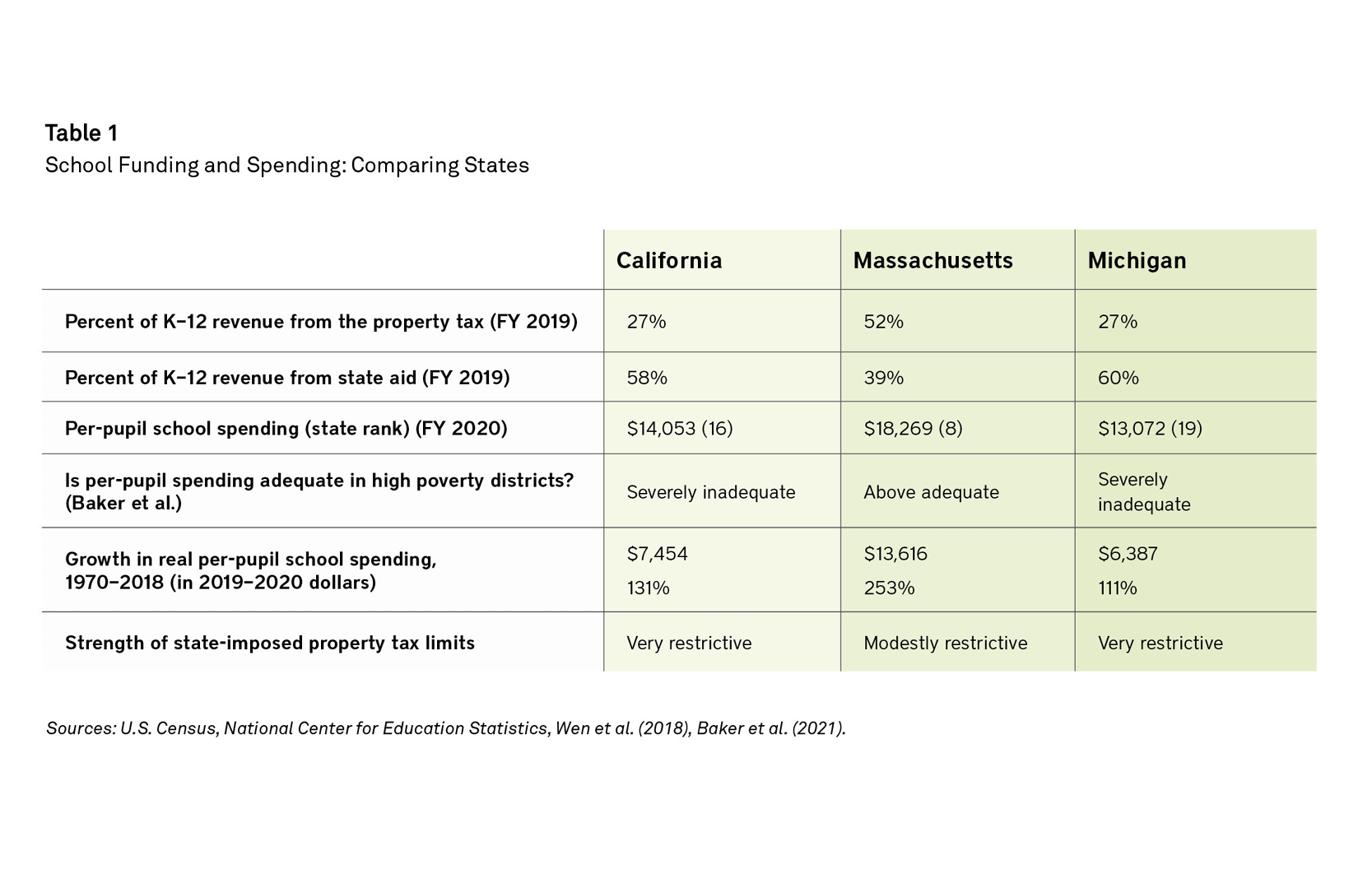
Compare California and Massachusetts. It seems to demonstrate the point of the poster you replied to. Despite MA relying nearly twice as much on property tax, as state revenue versus California, it seems to have better outcomes. Mostly because as the article discusses, MA appears to use targeted transfers from state revenue to poor districts.
https://www.kcrw.com/news/shows/greater-la/california-props-...
Late edit: the Wikipedia article would also be something to read up on - https://en.wikipedia.org/wiki/1978_California_Proposition_13
Students/families at higher performing schools have far lower need for support systems.
- in higher performing schools, parents fund a number expenses directly through a very active PTA, so those expenses don't show up in the school's official spending per pupil, while
- at lower performing schools with less active and more impoverished PTAs, those same expenses must be funded by school budgets, driving up their official per-pupil spending.
At the low performing school, the extra public funds received are often paying for support staff for serious social issues. There is little budget for the "nice to haves", and even when there is, the school staff has it's hands full managing the basics, so it's not always effectively utilized.
Sure, that's a factor too, but I'd still call it a social service issue since it ultimately results from the historical disinvestment in the communities that today have low performing schools.
There are reasons that the roofs didn't get repaired and the lead pipes didn't get replaced in those schools: because middle income people took their lives, businesses, and tax dollars out of those communities starting in the late 1960s, both by migrating to newly built suburbs, and also by ensuring their tax dollars never went toward the communities they left.
Look up the opposition to "Robin Hood" school funding from the 80s and 90s. Where I grew up it was largely about keeping suburban tax dollars out of inner-city school districts.
Blame education schools and their failing "every student can simply learn their math on their own!" approach. Total self-serving garbage, devised to cater to the ego of naïve prospective teachers and their expectation of not doing any real teaching work.
"there are substantial disparities in abortion rates in the United States, with low-income women and women of color having higher rates than affluent and White women"
People still usually prefer not to work at them, if they have options, because the work environment is terrible.
Past a certain not-that-high point, giving schools more money doesn't help them much.
There's probably some astronomically-high level of funding that would help, past some tipping point, by enabling things like single-digit class sizes, tons of social workers and counselors, extensive home-outreach programs, et c., to the point that the staff-to-student ratio is 1:5 or better, but AFAIK no-one's tried that in public schools (that's not too far off from how lots of elite private schools, operate, though, except that they don't need the army of social workers or home-outreach or any of that)
Credible threats of gang violence on a regular basis. School-wide lockdowns with some regularity due to threats of violence, or violence that has actually occurred. Admin with extremely limited options to deal with any of this, and having to triage their discipline pretty hard, plus having little to no support from home to back any of it up (this is why the stuff in the first paragraph happens constantly—no time or community/parental willpower to deal with it, given the rest of what's going on). Watching the kids suffering from the same shit day after day, plus all the usually-awful stuff they have going on at home, and not being able to do much about it. Seeing kids die or end up in the hospital with alarming regularity. Distressingly young kids plainly high or drunk in class.
Not many people can do that without burning out or giving up and half-assing everything, very quickly.
Why don't I live there, even though the location would be more convenient and has far more nearby parks and businesses, the housing is dirt-cheap, they have better access to public transit than we do, the area's more walkable/bike-able, et c? The schools are bad.
Why are the schools bad? Because people like me (that is, people whose kids have a low-stress life outside of school) won't move there. Digging out of that hole is nearly impossible. It amounts to "gentrify things all to hell" (which just shifts the problem around rather than actually solving it) or "fix huge social and economic problems the US has".
In either case, you can't do much about it by focusing on the schools themselves.
So I think by extending the current system to areas in poverty that do not have an established culture of obedience means we have to either change the system or start beating kids again imo. I vote for the former, obviously.
Even worse, imagine being a child growing up in that environment. Actual fistfights were happening every few hours in school where I grew up.
And yeah, it's a red state. Even the blue areas are red enough to get plenty of obnoxious assholes harassing teachers.
[EDIT] Downvoters: go talk to some teachers about this topic. I'll wait. It may be a while, because they'll have a lot to say.
As kids get older, they fall into drugs and / or have kids of their own and / or are told they'll never get into higher education and / or they don't need higher education, they'll just get a low skill job like everyone else in town.
Education for the sake of education really isn't strongly valued by a lot of parents, who have their own struggles and can't really help with homework much past middle school.
Compare all of this with teaching in an area that is more middle or upper class- kids are usually more eager to learn, have fewer discipline problems, and as they get older many know they need to try so they can get into a community college or university.
PS: I think putting education on such a high pedestal has demeaned the integrity and honor of working with your hands. I also believe it was a panacea given to the poor as a carrot, and is not the only way out of poverty. Hard work counts!
Basically, the students frequently don't do their homework, students would just not show up to class or outright just drop out, students misbehave more frequently (including violent behavior), parents care less (or at least act like it). The schools also tend to be in more dangerous areas. They had to lock the teachers' cars in a special lot to prevent vandalism and theft.
Basically it was demoralizing and dangerous.
I'm not saying that these things are inherently "wrong" (save the violence), only that they can't be expected to produce the same outcomes as cultures which highly value education, nuclear family, sobriety, and hard work. This holds true no matter how much money you add. Any attempt to equalize outcomes without confronting this core reason is doomed.
That and the school-to-prison pipeline are contributing to the overall problem of—at the heart of this issue—multi-generational, persistent slums. The justice system is far from the only problem, which is why I listed others and left things open-ended to account for the huge list of other things that contribute, but it's part of it. However, I don't think much can be done about it by addressing only issues with the justice system, absent broader social reforms.
Cool. I never called for that, so we're not disagreeing.
> Nor does it follow that the solutions are not found in changes to individual behaviour.
This is one of those things that's both true and useless.
I'm not sure it is useless. If the problems are individual, not systemic, then the solutions lie with individual accountability, not systemic change, right?
Certainly, the first time someone told me they had 12 kids through 8 women, with more kids on the way, I was completely shocked. Even more shocked when I realized he was bragging about his masculinity, not lamenting "What have I done?!"
> According to Amato’s research, sociologists warn that many children of single parents are born into undesirable circumstances. These children have a higher likelihood of being poor, committing crimes or using drugs. Many sociologists agree that childhood’s adverse effects outlive youth.
[1] https://www.everydayhealth.com/kids-health/what-are-effects-...
My grandmother would call a student's parents on their home and work numbers multiple times over multiple weeks. She would even provide her home number and say they could call anytime, day or night.
Do you think she frequently got calls back? If you can't even take 20 minutes to call your kid's teacher then you don't care about getting your kid out of an area with bad policing and justice system, racism and bad jobs.
And though they have few resources and a bad football team, the students have a chess club, robotics club, various study groups and college prep groups.
There is also a big difference in what the kids here are focused on. In SF there was so much chatter about politics, protests, gender identity, and sexuality. Out here kids just seem to be focused on studying and after school activities.
I much prefer this environment
> decadent bourgeois values
Values that produce measurably better life outcomes for participants.
> would rather do their rightful part
Refusing to participate thereby harming their own future and the community surrounding them. Or worse, actively encouraging others to reject values aligned with success.
> fighting structures of oppression and injustice
Fighting the most meritocratic system of governance we’ve had thus far in human history, whereby following values of success leads to success, whether you’re born here or elsewhere, and whatever your color, creed, or gender.
I am not sure if you’re being serious, but if you are, you should know advocating for crab bucket mentality does nothing to help the impoverished.
One of the great things about America is that we can separate ourselves into different communities and run our experiments. If your way is better you will have a better life.
I've just decided to choose a different path for my family. I truly wish you the best without sarcasm. I do hope the SF experiment succeeds, but after 20 years living there I feel, at least for me, its a total failure.
At least not in California...
"State-Provided" funds are calculated by the LCFF (Local Control Funding Formula), which is a combination of both State and Local funds.
Depending on the district, if local funds is not enough to fund the district, then yes, state tax revenue steps in to provide the rest.
However, for districts where local funds is enough or exceeds the district need, then these these districts (referred to as "Basic Aid" or "Excess Revenue" districts) aren't provided state revenue, and they are able to keep the excess local revenue for their needs. (https://www.cde.ca.gov/fg/aa/lc/ and https://www.saratogausd.org/Page/519)
For a more specific example, one of the top school districts in Silicon Valley is the Fremont Union High School District (https://resources.finalsite.net/images/v1626711559/fuhsdorg/...)
In 2021, their total revenue was $169M, where $156M (92%) came from property taxes. This resulted in spending per pupil of $23,491, far exceeding the state medium of $16,042.
This is not my experience. I chose a more expensive house with higher taxes because the schools are better. They are better funded than those in the surrounding areas. Sure the Federal Government gives free meals but my kids' books and chromebooks are always nice and new.
There's plenty of evidence that parental attitudes are a big factor:
"Middle-class pupils do better because parents and schools put more effort into their education, according to a study [..] factors studied were the parents' interest in their children's education, measured by, for example, whether they read to their children or attended meetings with teachers"[0]
(Full disclosure: my wife and I read - and have read - to our kids almost every single night)
[0] https://www.theguardian.com/education/2010/oct/29/middle-cla...
Much of our intelligence is from our parents. https://en.wikipedia.org/wiki/Heritability_of_IQ
I'm just stating that my kids' elementary school is nicer than those in our county and definitely from my hometown. They do receive a lot more money than what my hometown spent.
Heh, our daughter (who doesn't start school until September) knows all the Numberblocks and Alphablocks episodes...
State & local funding is less important, by far.
And the parents do it because they can (they have the ability to get the time off), and because they know it’s important in many ways.
Teachers in my town make ~10% more than in the schools that are two towns over in a predominantly minority town.
It's interesting to me that you are using this as a proxy for funding.
Schools in low income areas are going to have crappier books and laptops because they're spending their money on things other than books and laptops.
Low income brings with it all sorts of problems. That's why it sucks to be poor.
The schools are better, but if you look at per pupil spending I'm willing to bet it's not due to spending. Typically the worst schools get the most most money from federal and state sources, far outstripping any differences in property taxes.
Better schools are a function of better parental involvement, everything else is a distant second.
My father was a very successful/loved elementary school teacher for 40+ years. For many of those he worked for the same school in the same district. In 25+ years he watched the demographics drift from the wealthier families in the districts to one of the backwaters. They got as much money as the other schools in the district. But financially stressed families provide a lot less support for their kids’ education. They don’t have stay at home parents who improve the room experience. They’re not as able to provide the volunteer support to participate in extracurricular activities like field trips and competitions and after school enrichment things. Parents who are in “just survive” mode will telegraph that approach to their kids’ schooling efforts. Parents who have discretionary bandwidth and appreciate that more education got them there, telegraph that to their kids.
Do these per-pupil funding numbers have any meaning when your home and community are broken and one or both of your parents is an addict or incarcerated? Because it seems to me we’ve been acting with intent as a society to keep the families, homes, and communities of everyone not white and already wealthy a complete and utter shambles.
How can we expect decent, equitable outcomes given that the home life of significant percentages of students is essentially a path right to prison?
All that shows is the natural tendency toward persecution complexes and blaming failure on factors out of your control. Finding ways to make society promote personal responsibility, atomic families, etc would actually help. But that is the opposite of current culture of hedonism and "smashing traditional family structure" that gets complete entertainment and political backing.
It's a vicious cycle, which can only be broken by building strong communities in those places. And we've mostly forgotten how to do this, because "lifestyle anarchism" has been way more popular than a genuine community orientation among intellectuals and influencers, since the 1960s or so. School funding is a band-aid.
No, school budgets only help the schools, they don't solve any other problems.
it seems to me we’ve been acting with intent as a society to keep the families, homes, and communities of everyone not white and already wealthy a complete and utter shambles.
Maybe I'm older, but it seems to me the exact opposite is happening. Over the last 40 years there has been an increasing number of minority families that have moved to wealthier, historically white neighborhoods. I think this is because of education, affirmative action, and a general shift of society to be less racist.
How can we expect decent, equitable outcomes given that the home life of significant percentages of students is essentially a path right to prison?
nobody has ever expected that.
There is still a lot of work to be done, but things have been moving in the right direction for a while now. It took a few hundred years to get here, don't expect it to be fixed in just over half a century.
Wealthy neighborhoods have PTA budgets that are in the hundreds of thousands/millions. They pay for after school activities, language immersion programs, music, sports, you name it.
It is shocking the discrepancy between neighborhoods in NYC. Average donation per pupil might be $20 in a poor neighborhood and $5,000 in a wealthy one.
When I visit some public high schools in suburban CT, they look nicer than my college campus.
When I visit public schools in rural VA, they're a cluster of trailers and dilapidated structures that don't even have air conditioning, let less modern amenities.
So, maybe it's the taxes, or the highly active parents, or donations, but there's a visible difference, more than "$200" per student. Of course, how far and effective each dollar is WRT to outcomes is a different matter.
"We found evidence that between-district racial segregation is associated with racial disparities in school district spending, while between-district racial socioeconomic segregation is not. We find that as Black–White racial segregation increases over time, total per pupil expenditures and other per pupil expenditures shift in ways that disfavor the typical Black student’s district relative to the typical White student’s district."
Today, the crappy school district near me pays $15,900 per student and the good school district near me pays $19,800 per student.
> Mamun et al. (2020) report on studies that demonstrate that recidivism rates in private prisons are between 16.7% (Spivak & Sharp, 2008) and 22% (Duwe & Clark, 2013) higher when compared to public prisons. [1]
When providing services, private companies do worse because their charter is not to provide services per se, it's to make money. These are antithetical in the world of social services.
Private enterprise isn't a solution to every problem. It's a solution to a lot problems. However police, fire, healthcare, education, regulation and so on are services in the public interest and should be provided therefore be provided by the public.
[1] https://www.frontiersin.org/articles/10.3389/fcomm.2021.6721...
- Private fire departments that used to show up at your house and demand payment in order to put the fire out, otherwise they'd just let your house burn to the ground. In Rome, they'd literally show up at your house, and buy it from you for pennies on the dollar before putting it out.
- Private prisons fail the people in the way I've described.
- Private healthcare fails Americans each and every day. 45,000 Americans die each year due to lack of access to care. One person dies every 12 minutes. Their goal is to deny you cover because each treatment they avoid paying for pads their bottom line and benefits their shareholders. It costs twice as much per capita as Canada, 60% as much as Norway - and yet fails to cover everyone and yields worse outcomes.
The generalization is simple: when your task is to provide services to the public, then profit must be secondary. In private enterprise, profit is primary. You fail the people when you provide core social services via private enterprise because you have fundamentally failed to align incentives.
Private social services are designed to fail the people.
These are still definitely a thing. Though I expect they must be regulated so we don't end up in a Rome-style situation.
Edit: Found it. If you're in an area with something like Rural Metro, they put out the fire either way. If you don't have an annual membership with them, then they will invoice you. Nobody offering to buy your home for pennies on the dollar or standing around waiting for your credit card to clear before hosing down the flames.
A business will seek a profit. That should not be a factor at all in public education. The costs of public education should certainly be considered, especially the question of how much is spent and the quality of the education. That should always be under careful review. However the purpose of public education is to spend our collective money educating the populace. It should be a cost, it shouldn't make money. It's not meant to, it's meant to educate.
Yes, my belief is that public education is a cost borne collectively by a society. We take some of our profit and spend it on public education, it does not produce profit.
Yes, we should care how our money is spent in pursuit of public education. I'm not advocating waste. But the question we should ask is whether the money we spend results in a worthwhile education for students.
It is my experience that public good typically loses to profit when contradicts the other.
Well, they do if public good is as a daycare to let the parents work. Which is something.
Schools that charge under $15k/yr are mostly low-quality religious schools, with a few rare gems (mostly from the Catholics)
Full tuition at schools that people mean when they talk about how good private schools are, starts around $40k on the coasts (day rates, not boarding), and $18-20k at lesser-but-still-sometimes-decent schools in less-affluent areas.
[EDIT] Of course, per-pupil spending and tuition aren't entirely connected—on the one hand, many students don't pay the full rate (much like with private colleges) but on the other, the better private schools usually have other sources of funding of various sorts. Endowments, scholarship funds, lots of supplemental and sometimes quite-large donations from parents and alumni for various purposes.
Does it have profit responsibilities that need to be extracted from the funding, or is it a non-profit? In either case, does it receive funding from other sources besides the school's own community? What do those sources of funding expect for their contributions?
How big is the moat that allows or prevents competion from forming, and how healthy are the current forces of competition? Are there regulations that ensure market efficiency? Who's responsible for those regulations?
Does it have a formal responsibility to operate a school even when it can no longer do so profitably? Or might communities just be abandoned without any school at all until a new vision is capitalized?
There are some world class private schools in the US and some terrible private schools it’s really a mixed bag, just like public schools.
https://freddiedeboer.substack.com/p/why-selection-bias-is-t...
Anyway, there are several ways to compare systems, some private schools operate in whole or in part on a lottery system so you can track students who do or don’t get in. But the most common method is to model parent education and income as a predictor of performance and then compare outcomes.
As you suggest poor students are underrepresented in private schools, but some do get in. The important thing to remember is a student who received a scholarship isn’t representative of the general population.
If the public starts paying (blindly!) for it, the incentives change. Private schools would become more like private prisons probably, and we’d be back where we started.
>on average, both Black and Latinx total per pupil expenditures exceed White total per pupil expenditures by $229.53 and $126.15, respectively - https://journals.sagepub.com/doi/full/10.1177/23328584198724...
Difference in expenditure per is a particularly shit way to measure this.
$6k for white pupil in NY $5k for black pupil in NY
$3k for white pupil in Ohio $2k for black pupil in Ohio
Clearly that's more money for white pupils regardless of location
Now imagine that there's 60 black students in NY and 10 in Ohio, but 10 white students in NY and 60 in Ohio
That means total funding is 320k for 70 black pupils and 240k for 70 white students
So you can spin the figures to say that black pupils get more funding, but the truth is the opposite.
For example, if District X pays better than neighboring district Z, District X will most likely have greater chance of hiring teachers in both districts, letting them choose the most qualified. Resulting in the school with higher salaries naturally getting more teacher candidates to choose from.
While some expenditures might not have a direct impact on student educations, they still have some effect. Another one would be - a school investing in a new Air conditioning and filtration system, students are probably going to have an easier time learning when they don't have to worry about being too hot or too cold in their classrooms.
This is an oft repeated myth. In addition to property taxes, school funding is supplemented by state and federal budgets, in inverse proportion to property taxes, so that racial differences in per-pupil funding are negligible:
on average, both Black and Latinx total per pupil expenditures exceed White total per pupil expenditures by $229.53 and $126.15, respectively - https://journals.sagepub.com/doi/full/10.1177/23328584198724...
That's a ~$200 difference compared to $6000 per pupil, the 4th highest in the world: https://www.nationmaster.com/country-info/stats/Education/Sp...