It's the most straight-forward and objective measure. That the main result of a paper would be omitted from the abstract and "highly-contextualized" is not surprising, given social science's bias. If a study gets the 'wrong' findings, it tends to be rejected:
The authors also submitted different test studies to different peer-review boards. The methodology was identical, and the variable was that the purported findings either went for, or against, the liberal worldview (for example, one found evidence of discrimination against minority groups, and another found evidence of "reverse discrimination" against straight white males). Despite equal methodological strengths, the studies that went against the liberal worldview were criticized and rejected, and those that went with it were not. - https://theweek.com/articles/441474/how-academias-liberal-bi...
Ceci et al. (1985) found a similar pattern. Research proposals hypothesizing either "reverse discrimination" (i.e., against White males) or conventional discrimination (i.e., against ethnic minorities) were submitted to 150 Internal Review Boards. Everything else about the proposals was held constant. The "reverse discrimination" proposals were approved less often than the conventional discrimination proposals. - https://jsis.washington.edu/global/wp-content/uploads/sites/...
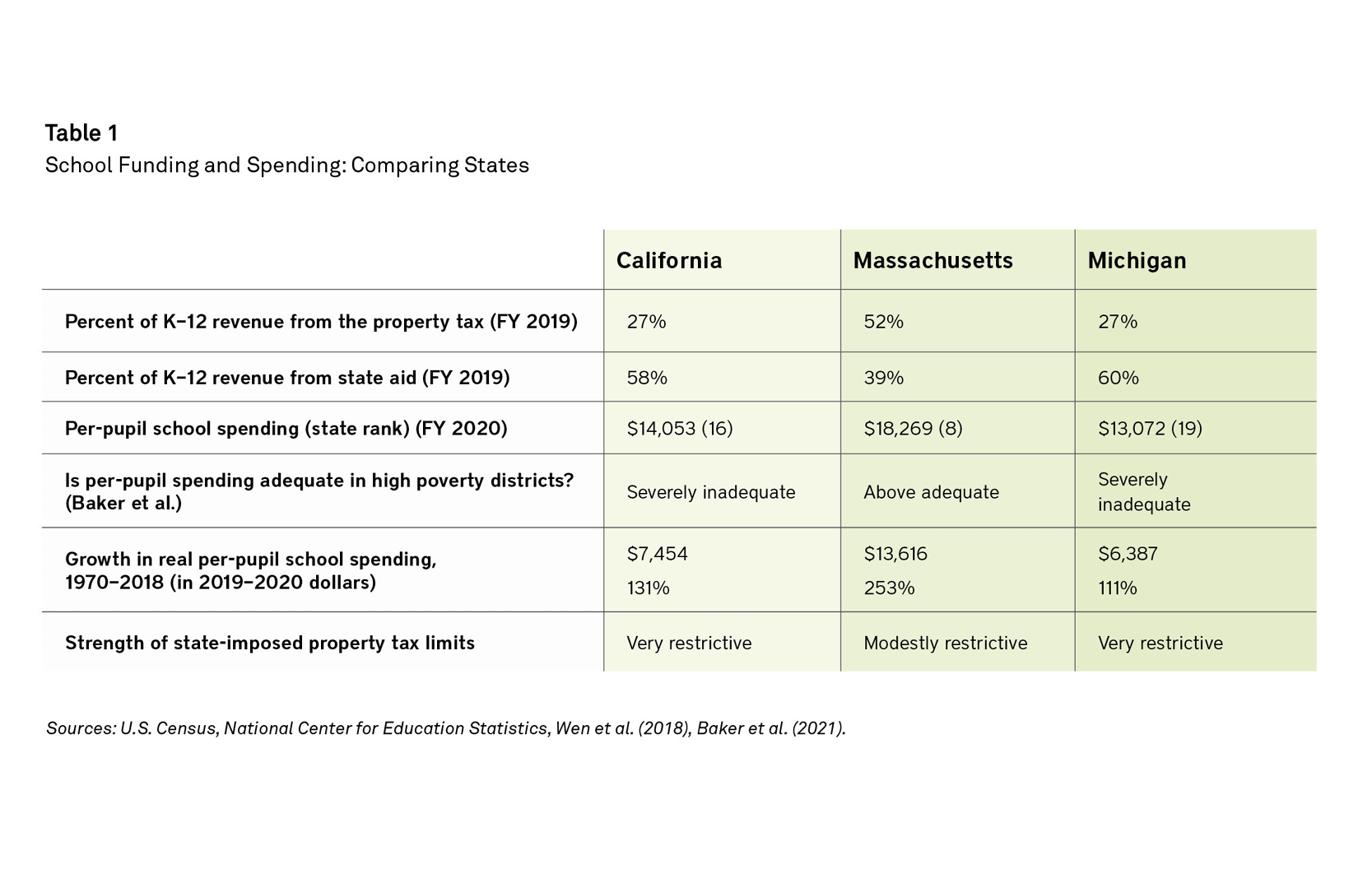
Compare California and Massachusetts. It seems to demonstrate the point of the poster you replied to. Despite MA relying nearly twice as much on property tax, as state revenue versus California, it seems to have better outcomes. Mostly because as the article discusses, MA appears to use targeted transfers from state revenue to poor districts.
https://www.kcrw.com/news/shows/greater-la/california-props-...
Late edit: the Wikipedia article would also be something to read up on - https://en.wikipedia.org/wiki/1978_California_Proposition_13
> Yet race remains related to funding disparities and schooling experiences in ways that raise concerns about the role of school finance in perpetuating racial opportunity gaps.
What you are pulling out seems to be narrowly-focused and highly-contextualized.
Consider [1]:
> Property taxation and school funding are closely linked in the United States. In 2018–2019, public education revenue totaled $771 billion. Nearly half (47 percent) came from state governments, slightly less than half (45 percent) from local government sources, and a modest share (8 percent) from the federal government. Of the local revenue, about 36 percent came from property taxes. The remaining 8.9 percent was generated from other taxes; fees and charges for things like school lunches and athletic events; and contributions from individuals, organizations, or businesses.
[1]: https://www.lincolninst.edu/publications/articles/2022-04-pu...