> A Four-Decade Secret: One Man’s Story of Sabotaging Carter’s Re-election
> A prominent Texas politician said he unwittingly took part in a 1980 tour of the Middle East with a clandestine agenda.
https://www.nytimes.com/2023/03/18/us/politics/jimmy-carter-...
Carter wanted to pass legislation to give every American catastrophic healthcare coverage, so that a major medical incident would no longer bankrupt families, as a stepping stone towards universal coverage.
Kennedy opposed this, despite being on record supporting universal coverage.
It would have been a major win for Carter, but Kennedy already knew he wanted to run against the sitting President.
US health insurance is a combination healthcare purchasing agent/second opinion/fraud detection/insurance/tax collector.
A large part of a premium is a tax due to the maximum age rating factor that limits the prices old people pay to 3x or less what young people pay. It is also a tax because the insurer cannot underwrite the insureds, except on the basis of age, tobacco use, and location.
Then no health insurance would make sense?
Well, as you suggest, the regulations that cap the premiums for old people at 3x those of young people seem to blame?
At some point the consumer makes a decision that the cost of insurance doesn’t justify the benefit.
Real catastrophic medical insurance caps how much you owe whereas the debt you accumulate from a doctor who was obligated to treat you is not capped. That debt follows you until you pay it off or declare bankruptcy like the 500,000 other Americans do each year.
To add insult to injury, we already spend $5000 per capita on our publicly funded healthcare system, which is enough to fund basic universal healthcare systems in other countries.
Let that sink in. We spend $11,000 per capita on healthcare per year. 45% is publicly funded with taxes and the other 55% is privately funded.
We’re already spending enough for TWO universal healthcare systems (for many countries), yet we have 500,000 filing for bankruptcy due to medical bills each year.
Based on what we’re spending, we can afford two systems: A socialist system that covers everyone and a private healthcare systems that provides world class treatments to anyone who can afford the insurance premiums.
Instead, we have two corrupt and dysfunctional systems, a lot of gaps, and a record number of people profiting off our dysfunction.
Well, you are spending approximately twice as much as the Brits in terms of percentage of GDP. (Comparing total healthcare expenditure, ie private plus public.)
But that doesn't mean that NHS-style healthcare is the best.
Singapore spends roughly health as much as Britain, and has no worse health outcomes. And we don't have a single payer system here.
if it's that catastropic, I imagine their income would fall drastically that year, or years. What taxes?
> None of that establishes whether Mr. Reagan knew about the trip, nor could Mr. Barnes say that Mr. Casey directed Mr. Connally to take the journey. Likewise, he does not know if the message transmitted to multiple Middle Eastern leaders got to the Iranians, much less whether it influenced their decision making.
"Historical fact" is a very strong way to say "one man's story recounted 40 years later and backed by modest circumstantial evidence", and even to the extent the story is true as told in that article, Reagan's backers didn't "conspire" with anyone—as recounted, they never spoke with the Iranians, they told other Arab leaders to let the Iranians know.
If true, this is still worth recounting, but you're not helping anything by overstating the degree to which we know this to be fact nor by overstating the crime.
Reagan was elected with 51% of the popular vote to Carter’s 41% and carried 44 states to Carter’s 6(+DC), tallying 489 electoral votes to Carter’s 49. This was not a close election.
Hamilton Jordan, his chief of staff, wrote a book about Carter's last year in office. A lot of people thought Reagan was a clown. He was not as popular as his worshippers in the GOP like to think. Reagan was usually ahead of Carter in polls before the election, but usually by a few points, not the same margin as the final count.
The hostage crisis started on Nov 4, 1979; the one year anniversary of the hostages being taken was right on election day. A lot of media was running stories on the hostages in the week leading up to the election, particularly over the weekend. Jordan says there was a shift that took them all by surprise in its speed and magnitude. When you spend months only a point or two behind, it is easy to think you might win.
When Reagan's own people said his economics were bullshit…
> Following Reagan's election, the "trickle-down" reached wide circulation with the publication of "The Education of David Stockman" a December 1981 interview of Reagan's incoming Office of Management and Budget director David Stockman, in the magazine Atlantic Monthly. In the interview, Stockman expressed doubts about supply side economics, telling journalist William Greider that the Kemp–Roth Tax Cut was a way to rebrand a tax cut for the top income bracket to make it easier to pass into law.[25] Stockman said that "It's kind of hard to sell 'trickle down,' so the supply-side formula was the only way to get a tax policy that was really 'trickle down.' Supply-side is 'trickle-down' theory."[25][26][27]
* https://en.wikipedia.org/wiki/Trickle-down_economics#Reagan_...
https://en.wikipedia.org/wiki/Scandals_of_the_Ronald_Reagan_...
Ronald "Small Government" Reagan ballooned the national debt by 160-180%, depending on who's counting. That's higher than any other president by a massive amount: https://www.data-z.org/library/imglib/National-debt-growth-b...
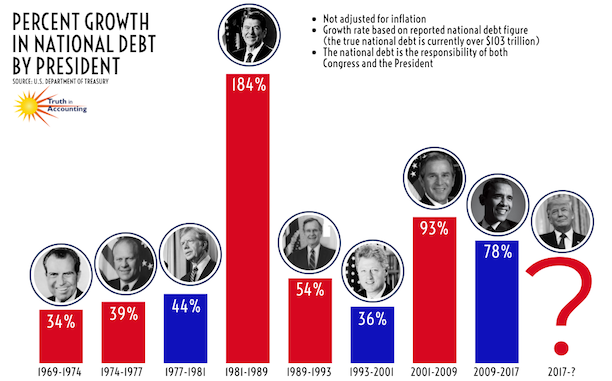
Then there was his disassembling the national mental healthcare system with no substitute, causing a national crisis - and in a real case of irony - getting shot by a mentally ill person who should have been committed.
Then there was him ignoring the AIDS epidemic because it only seemed to affect gay people.
Then there was him coming down with Alzheimer's with symptoms cropping up during his first term, according to his own son and video from his debate against Mondale. At some point the country was effectively being run by Nancy Reagan and her astrologist. Hell, there's hot mic footage of her telling him word for word what to say to the press...
Reagan tossed the whole thing and we were snapped back to feet, inches, ounces, pounds, Fahrenheit.
I have photos from road trips in the late 70's where Federal highway signs, like on mountain passes, have the elevation indicated in Meters. When I used Google street view I see we're back to regressive signage.
I know, a minor nit.
https://themetricmaven.com/terminating-metric-with-extreme-p...
He did sign the Omnibus Trade and Competitiveness Act of 1988 into law. The measure declared that the metric system of measurement to be the preferred measurement system for U.S. trade and commerce.
But he also defunded the US Metric Board.
I suspect he didn't care about metric enough to fight other conservatives over it.
When Reagan became president, he continued his efforts to dismantle the public education system, targeting federal aid to students. "
from: https://newuniversity.org/2023/02/13/ronald-reagans-legacy-t...
I think it was also retribution against college kids deferring the Vietnam war draft. The student deferment was supposed to be a rich-only loophole..
OTOH, Carter pardoned Vietnam war draft dodgers.
https://en.wikipedia.org/wiki/Proclamation_4483#:~:text=Jimm....
(I foresee a similar decision needing to be made in Russia soon..)
It was a broadly established take, and the reason why there's a superstition about sitting Presidents having opponents in primaries.
That's a common myth. 70s energy policy was a result of the oil crisis, not environment concerns.
Sometimes the result was conductive to the environment (e.g. efficiency increases), sometimes it was less so (various US gov research into more polluting alternatives like synthetic oil or shale oil), and sometimes it was just silly (like Carter banning nuclear waste reprocessing which set back that entire industry).
Quite - the environment was not much of a concern.
Bear in mind that lead in petrol was your anti-knock agent and the catalytic convertor didn't exist.
I remember really yellow coloured, sickly verges alongside roads and strawberry sellers in laybyes on the A303 ...
I doubt that Carter could have intervened in any case.
Not really. From your Wikipedia link:
> In the scientific papers which considered climate trends of the 21st century, fewer than 10% were inclined towards future cooling, while most papers predicted future warming.[1] […] By the time the idea of global cooling reached the public press in the mid-1970s temperatures had stopped falling, and there was concern in the climatological community about carbon dioxide's warming effects.[4] In response to such reports, the World Meteorological Organization issued a warning in June 1976 that "a very significant warming of global climate" was probable.[5]
It was a small minority in the scientific community. The concern got blown out of proportion by some cover stories.
This is a common trope but it’s mostly been promoted by fossil fuel lobbyists to pretend climate scientists weren’t right than reality. That alternate history is mostly promulgated by the likes of noted-creationist Duane Gish or general purpose denialists like Stephen Milloy, but it doesn’t hold up when you look at the record.
People had been concerned about global warming since 1896, and scientists had been increasingly concerned before World War II. There were a handful of papers in the early 1970s predicting cooling based on aerosol effects BUT those did not reflect widespread consensus and other researchers at the same time published papers predicting warming, and those papers were considered stronger.
What most of this hangs off of is that Time magazine “Another Ice Age?” article which sounded dramatic but was actually inconclusive about the future. It sold a lot of issues, but it wasn’t exactly a climate science journal.
By the end of the 1970s, consensus had been reached that the earth was warming and most climate science research was focused on how it would happen rather than whether.
http://dx.doi.org/10.1175/2008BAMS2370.1
https://arstechnica.com/science/2016/06/that-70s-myth-did-cl...
> "While neither scientists nor the public could be sure in the 1970s whether the world was warming or cooling, people were increasingly inclined to believe that global climate was on the move, and in no small way"
And it definitely wasn't in the scientific world:
> Concern peaked in the early 1970s, though "the possibility of anthropogenic warming dominated the peer-reviewed literature even then
Seems more likely that if Carter had an opinion it would be the scientific one, and even if he only read mass media on it he wouldn't necessarily think cooling was the dominant trend.
"That the climate, at least in the Northern Hemisphere, has been getting cooler since about 1950, is well estabt lished—if one ignores the last two winters."
If there was a mix of articles, then there will be a mix of people claiming that they personally saw all one side.
Several others in this thread claim they saw cooling articles in the 90s. I never saw a single cooling article but saw many many warming articles and knew even very conservative Republican families that got worked up about the dangers of global warming.
Anybody citing a single article or their personal experience is degrading the conversation. A single person's recollection is not even evidence when we can compare to an entire historical record.
5 minutes of checking found three issues of Time, one from 1994.
  * 24 Jun 1974 https://time.com/archive/6878023/another-ice-age/ (well-known)
  * 13 Nov 1972 https://time.com/archive/6844319/science-another-ice-age/ ("refuses to speculate")
  * 31 Jan 1994 https://time.com/archive/6724662/the-ice-age-cometh/ ("the greenhouse effect could heat up the planet for a while but then trigger changes that could plunge the earth into a sudden chill.")
  * “The Earth’s Cooling Climate,” Science News, November 15, 1969
  * “Colder Winters Held Dawn of New Ice Age,” Washington Post, January 11, 1970.
  * “Science:  Another Ice Age?”  Time Magazine, June 24, 1974.
  * “The Ice Age Cometh!”  Science News, March 1, 1975.
  * “The Cooling World,” Newsweek, April 28, 1975.
  * “Scientists Ask Why World Climate is Changing; Major Cooling May Be Ahead,” New York Times, May 21, 1975.
  * “In the Grip of a New Ice Age?” International Wildlife July-August, 1975.
  * “A Major Cooling Widely Considered to Be Inevitable,” New York Times, September 14, 1975.
* “Variations in the Earth’s Orbit, Pacemaker of the Ice Ages,” Science magazine, December 10, 1976.One can't search for this stuff without coming across lots of both warming and cooling articles. And one finds tons of intentional deception pushing cooling articles. Here's a Reuters article calling out one bit of misinformation pushing cooling articles that were not actually about cooling:
https://www.reuters.com/fact-check/time-magazine-front-cover...
My question is why there is such a modern push to decieve about cooling in the mass media? What purpose does it serve for people?
I posted several headlines and links in mass & scientific media promoting the global cooling belief, which corresponds to my recollection of the dominant media.
I recognize my recollection may be flawed. If you have evidence to that effect, please post a similar collection from the time period promoting global warming belief to support your assertion.
My personal belief is that the media over-hypes scientific findings and under-reports uncertainties. We see this today in global warming coverage, as we saw it (or at least, as I recall it) in the 1970s global cooling coverage.
https://en.wikipedia.org/wiki/Global_cooling - OK but do bear in mind that fags (cigarettes) were still being advertised as good for your health in the '70s.
Global cooling/warming was not really a feared effect back then - both were merely noted. What really concentrated the mind was the Cold War for the mainstream minded. For the usual bat shit loopy mob, there was the usual alien invasions and that!
I was a UK soldier's brat (my mum was a soldier too when she met dad but "retired" on advice when they married). We spent quite a lot of time in West Germany. I remember seeing Tupolev Bears and Badgers getting "lost" and being given directions by large fireworks with pilots strapped on top with a couple of side winder missiles and a cannon that fires rounds that they might fly into themselves.
OK it was the '70's. Dad's staff car was a Sioux or a Merc. 432s and 434s, Chieftains, Stalwarts, Saracens, Saladins and the rest would rumble around - that was just UK gear. West Germany had Leopards, Luchs (Lynx) and more. Phantoms, Starfighters, Buccaneers, Harriers and all the rest. I remember watching flights of Phantoms (four) lift off from say RAF Wildenrath, put their foot down (afterburner) and scoot off to whatever they had to do. It was quite deafening, and I was in a playground!
"Global cooling" - no, no idea!
I hope I have given you a mild flavour of just how unimportant the environment was generally considered back in the day by the general public. There was quite a lot of other things going on.
Nowadays, the weather rather speaks for itself.
The clean air act was in 1967.
https://www.nytimes.com/1979/07/17/archives/environmentalist...
* Aside: EPA and the Clean Air act weren't motivated by Climate Change but by particle pollution concerns.
I don’t think that’s incorrect even if you ascribe all of the era’s environmental decision making to energy scarcity.
Carter still set a goal of 20% renewable energy by 2020, and that still would have made a significant impact.
It seems obvious to me that environmental policy was in some part driven by concern for the environment itself, but that doesn’t change the simple statement that things would have been better if we’d followed it.
https://en.wikipedia.org/wiki/Synthetic_Fuels_Corporation
* Aside, significant global warming became scientific consensus only sometime between 1979 and 1989. The global cooling thing above is wrong in that most scientists expected some warming and that it expects too much from science. It does connect to the fact there was real scientific debate at the time and not just denialism, it wasn't clear warming would be that much a problem.
This should not be a point against climate science - scientists aren't born with the correct climate model! It took time to get the modeling right, but once they did the predictions were completely accurate.
* I wonder how much investing in solar would have been worth it. The tech was carried over by a huge investment in semiconductors that helped silicone tech on the side. If you go back early you probably end up replicating it and that costs a lot? Or I could be wrong here.
* Wind tech was probably doable. You could have iterated over designs, material science was behind but not that much I think. Nuclear was reasonable too.
* CFLs were developed in the late 70s. One could have done an early version of banning incandescent lighting. Blue LED lightening weren't invented yet and took a breakthrough.
* Probably even more stringent fuel mandates. Electrical vehicles were in the future, you could have brought them forward by a decade or two, but in the 1980s they weren't an alternative, and I don't think in the 90s either?
* Of course, the US could have mandated solar water heaters where the climate allows.
We can imagine an alternate past where green tech was wind + nuclear, and lightening was CFLs.
It's difficult to understand now, but natural gas was viewed as something in short supply back then that had to be price controlled. Of course the causation was in the other direction: price controls led to shortage, and once those were removed enormous new sources of gas began to be uncovered, eventually leading to the fracking revolution. Today in the US natural gas is a colossus, having beaten down coal and nuclear.
Btw Carter put solar panels on the white house.
P.S. These weren't solar panels (i.e. electricity generation), but solar water heaters. A very different tech, a useful tech, but not a global warming solution.
Solar electricity has become much, much, cheaper and more efficient since then, and heatpumps have made electric heating much more efficient, so solar hot water doesn't look like it's going to be the future (though new installations do still happen today, despite the advances in solar electric). It wasn't a bad bet at the time though.
I meant it's not a solution in the class of solar panels, where the electricity can be used for nearly anything. Also heater tech isn't very high tech and didn't need much gov support in developing it. Mandating it in law where climate allows may have been useful though.
How did this set back the whole industry? Experience since then, even in France, is that reprocessing is uneconomical. Understand that Carter's executive order was rescinded by Reagan, and yet reprocessing has gone nowhere since then in the US.
The world has converged on the most economical solution to spent fuel: dry cask storage. This is not an ultimate solution, but it forecloses no ultimate solution, and by delaying any such expensive step it minimizes the net present value of the cost of dealing with the waste. In the meantime, the spent fuel gradually cools off, rendering any future ultimate solution easier.
Reprocessing can be seen as a fossilized remnant of an earlier failed vision of where nuclear power was going to go. The vision was that nuclear power plants would be cheap, lots of them would be built, and then uranium would start to run out. Fuel would start getting expensive, so we'd have to move to breeder reactors. Fast breeders burn plutonium, so you want to start them with Pu separated from the earlier thermal reactors (and then continue to fuel them with Pu they themselves produce.)
But this vision never came to pass. Nuclear power plants turned out to be expensive and uranium remained cheap (and enrichment got cheap). Reprocessing ended up unneeded and unwanted. It really did serve as a cover for proliferation, too: Japan now has enough separated reactor grade Pu for about 1000 bombs. It's not as good as weapons grade but it can still serve for weapons if boosting is used to ameliorate premature initiation of the chain reaction.
There's an inversion of cause and effect here. Nuclear didn't fail because we didn't reprocess, we didn't reprocess because nuclear failed. To invert the actual causation is an example of cargo cult thinking.
Hey, so did I! ORHS class of '82. Maybe we met back in the day?
For his electoral loss it’s just that Carter was never interested in the political manoeuvring. He was never going to have a good chance.
The divergence of the Democrats and Republicans is twenty first century.
They were not identical back in the day, but they were broadly the same pro business pro money machines.
Not unusual, happens in most parts of the world.
I don't know how you think that stopped in the 21st century. They just hid it behind the blatant attack on the growing identity movements.
https://beerinfo.com/homebrewing-law-signed-by-jimmy-carter-...
In reality I think there is a lot of daylight between the parties on social issues that do not affect current power structures.
Abortion, trans rights, women's rights, gay marriage, religion in public schools, etc: Tons of difference.
Funding genocide, subsidising the fossil fuel industry, maintaining a for-profit healthcare system, opposing ranked choice or instant run-off voting, keeping third parties out, refusing to enforce anti-trust law, refusing to raise the minimum wage, no accountability for police brutality, etc: Broad bipartisan support.
QED.
Or
https://encrypted-tbn0.gstatic.com/images?q=tbn:ANd9GcSaFnDH...
What choices we have.
Replace the Israeli flag with the US one when we invade someone else again.
I think there's simply a difference between funds going towards foreign policy, and ones that basically deny you autonomy. America is highly individualistic, but that's also just human nature. Many will care more about their groceries increasing by $10 a month than a billion dollars going towards a war somewhere else.
Also helps that America hasn't experienced a war on its soil in almost 80 years now. Or technically 200 years since I don't think Hawaii was ratified yet. The idea barely registers as possible to happen.
Both parties are worse than the other on the issues they promise to be better on.
It's almost like it's a big club that you're not a member of.
Both these ignore a lot of context. Carter had to do something about stagflation. Deregulation that promotes competition and appointing Volkner to the Fed aren't directly eroding worker's rights like Reagan's solution of union busting. Reagan signed the machine gun ban as part of an amendment to pass the Firearms Owners' Protection Act that was endorsed by the NRA.
> It's almost like it's a big club that you're not a member of.
Agreed, but not in the way that you're thinking of. The "big club" is capable of understanding nuance and making dispassionate decisions (or at least their can hire people who can do that on their behalf). Regular voters react to emotional sound bites and outsource their critical thinking to those in the "big club" who superficially align with their worldview.
People forget this, Reagan literally started the charter and expectations for the modern gun control movement just because of Black Panther advancements and protests in the street with firearms.
"Just say no" to nihilism[0].
I replied to this comment:
  And yet people will mock you for saying that
  both parties are the same.
  In philosophy, nihilism (/ˈnaɪ(h)ɪlɪzəm, ˈniː-/; from Latin
  nihil 'nothing') is any viewpoint, or a family of views,
  that rejects generally accepted or fundamental aspects of
  human existence, namely knowledge, morality, or
  meaning.
What alternative to an electoral process do you have in mind? And please be specific so that I may understand.
more than one major political party would be a good start so that your “democracy” is more little more than “it is 2am at a bar and there are two of the ugliest people to ever roam the Earth but you are drunk and you are taking one of them home with ya…” :)
> more than one major political party would be a good start so that your “democracy” is more little more than “it is 2am at a bar and there are two of the ugliest people to ever roam the Earth but you are drunk and you are taking one of them home with ya…” :)
:-D
That's a funny, and sadly appropriate, metaphor.
Getting rid of "first past the post"[0] and the "Citizen United" SCOTUS decision[1] are key to achieve this IMHO. Both will be incredibly difficult to remediate as they combine to maximize the inertia of the status quo.
0 - https://en.wikipedia.org/wiki/First-past-the-post_voting
In doing that, they ceded rural America, which was devastated by NAFTA and other Clinton era policies. Giant agribusiness makes money, but the prosperous dairy operators really need regulation at the federal level to thrive. I grew up in a town that was solid rural democrat… that was gutted like a fish. 30 operating dairy farms to 1, which is a vertically integrated farm/dairy that delivers to consumers directly. The feed stores, gone. Tractor dealer, gone. The best job in town is truck driving and it’s solid trumper land.
The modern conservative narrative is really simple, and is mostly hot air. Those chicken processing plants and farms in nowhereville that need a steady supply of cheap, dumb labor with no workers comp aren’t run by democrats. Bread & circus, until the crowd demands more.
good thing we elected a party that loves nothing more than federal regulation… /s
I am neither democrat nor republican so I have no skin in the game here but I think this thinking here is very naive.
Ever wonder why thousands of Mexicans woke up one day and decided to walk across the desert, never to return? Well, we flooded the market with massive quantities of subsidized corn and put their farms out of business. We did the same thing domestically with other commodities in places like New Jersey and Pennsylvania.
With dairy, you had in-state production requirements and quotas that maintained a balance in price. A smallish dairy farm could support a household reasonably prosperously — there were thousands of farms in places like New York. Now you need thousands of cows to survive - that why milk is often cheaper than water in the supermarket.
But just like WalMart, it gutted a key price of the rural economy. Hell, I watched it happen on a farm I worked on, that operated since the 1600s under the Dutch. Since the early 2000s they board horses for rich people to pay their property taxes.
It has consistently been about illegal immigration.
You are calling people "low IQ" and "Idiots" and you, literally in this very post, show you are falling for the same thing they fell for.
Not Trump. He’s been opposed to immigration from the ‘wrong” countries, regardless of legality.
The way to eliminate illegal immigration is to go after the people who hire them. But Trump isn't going to put rich white people in jail.
If this was true, why for decades have they been so concerned about which countries immigrants were coming from and so unsupportive of attempts to provide legal means to get the workers businesses need while opposing penalties for the businesses which hire people who can’t work legally? This situation isn’t new, there have been so many discussions for decades, but we’re still locked in the situation where businesses depend on Spanish-speaking workers but too many Americans oppose legal ways for them to work here.
don’t fall for that - illegal immigration is strictly election issue - republican love nothing more than exploiting illegal immigrants for personal gain (especially most vocal states like texas)
A recent bill tighening on illegal immigration had bipartisan support in rejecting it.
Again, narrative vs. business reality. They love underpaying employees with no beneits or legal protections.
My idiot grandmother, in no uncertain terms, thinks Mexicans should be deported for racist reasons. She has let the curtain slip enough times to make that obvious. I don’t think it’s bad to call outright racist people “idiots”.
  ... for majority of people every single opinion and thought
  they have just magically lines up with one political party ...
>> This is simply not true.
> it simply is :)
People make choices for a multitude of reasons.
Sometimes those choices are knowingly to their detriment and can be confounding to others whom are not a part of their decision process. Many times the reasoning is "sacrifice for the greater good", where "the greater good" is defined by the very people who are the harbinger of their pain. Other times, it can be as simple as; "my life sucks so everyone else's should too!"
I am sure there are many more categories which could be provided as well.
But to say:
  .. for majority of people every single opinion and thought
  they have just magically lines up with one political party ...
I was about to edit mine to clarify that I am not judging you nor your comments, instead simply providing my perspective in the hope it helps.
To be more exact: in the end the RNC/DNC comes down to votes in maybe 10 small states before candidates decide to drop out and stop wasting money on a losing battle. Those 2 candidates are what's on our ballot.
I'm in california and I don't think I ever had any say in the DNC because it's already said and done by that time from a bunch of swing states that may collectively have less represenatives than my state. There are some very good liberals I fully side with, but they don't get to be on that ballent.
To paraphrase Cicero: were it not for the fact he had been president, Carter was the kind of man that everyone would say he would make an excellent president.
RIP Mr Carter
> Nevertheless, several individuals—most notably, former Iranian President Abulhassan Banisadr, former Lieutenant Governor of Texas Ben Barnes, former naval intelligence officer and U.S. National Security Council member Gary Sick, and Barbara Honegger, a former campaign staffer and White House analyst for Reagan and his successor, George H. W. Bush—have stood by the allegation.
[0] https://en.wikipedia.org/wiki/1980_October_Surprise_theory
France also has majority ownership of the nuclear plants, something that would never fly in the US (because Socialism!).
Even when I was an intern at a power company, the leaders there saw the nuclear power plant the company owned as an "albatross around their neck".
Even just trying to ship it elsewhere for processing gets blocked by other states and cities.
There is so much fear around this stuff, but it's usually based on the incorrect notion that radioactive wastes is both super dangerous, and lasts forever. But this is not true. The super dangerous stuff doesn't hang around that long, whilst the stuff that does isn't that dangerous.
The super-duper dangerous radioactive waste has a relatively short half-life, and volume. The vast amount of waste is fairly benign.
It's a solvable problem.
The fact that the problem still exists at all should cause optimists to pause and consider what factor they may have missed.
Wish I saved the quote, but I remember reading something to the tone of "Everybody across all lines wants healthcare. But 8 rich people disagree, so it's complicated".
Like with any risk, there should be appropriate and proportional risk mitigation strategies put in place. Current strategies are outsized compared to the risk.
The anti-nuclear environmental movement will go down in history as one of the biggest own goals. If nuclear power had have had continued investment into engineering improvements, the world would be in a much better place WRT climate change.
It's not the outsized risk of lead levels people are necessarily worried about. It's the outsized risk of some health risk that gets covered up, lied about, or dismissed by those in charge. There appears to be a high correlation between nuclear accidents and government and political coverups.
Nuclear has one of the lowest mortality rates per megawatt hour. It would be even better if only modern reactor designs were considered.
https://www.statista.com/statistics/494425/death-rate-worldw...
Thats the thing though, its already been the titanic. People have seen the ship sink, and the promised engineering improvements didn't make up for the fact that it was not only an engineering problem but a human one. Some human somewhere is going to fail the system catastrophically, inevitably. If not an operator, then perhaps some day in the future someone else will gain control of it, or damage it, or make something happen that is out of the range of possibility with even moderately responsible engineering. Maybe its all solved now, I heard nice things about thorium reactors properties, but thats the echo of the fear of nuclear power. Be interesting to see what the generational breakdown is there.
That is a strange statement.
There is no place in the world geologically stable for the required period (we have no way to know)
We have no way to communicate with people about the dangers for over 100_000 years.
Those are technical problems.
The political impetus is to get future generations to pay for our current consumption
> There is no place in the world geologically stable for the required period (we have no way to know)
This can be said of anything, which is IMO a defeatist attitude. Nothing we do is guaranteed to not cause harm. Likewise, our inaction could also cause harm.
For the specific question of stable geology, past performance can help predict future performance. We can make educated guesses. If it has been stable for the last million years, it's a good be it will be stable for the next 10,000.
> We have no way to communicate with people about the dangers for over 100_000 years.
The need to communicate the dangers over vast timeframes presupposes that society has fallen into ruin, and our record keeping has been destroyed. I will argue that if that has happened, it means countless billions will have perished, and people+or lizardmen) living primitive lifestyles will have far bigger worries than and increased cancer risk.
> The political impetus is to get future generations to pay for our current consumption
We are paying for our current consumption of fossil fuels right now. How many deaths from climate change over the next 200 years are appropriate to ensure the safety of an unknown number of people thousands of years from now?
No. It is a way of loosing it and leaving it around for someone to dig it up and become very sick
Remember, it is hundreds of thousands of years
Remember that I have already said I disagree with this as something we should be worried about.
And I said "making future generations pay for our current consumption"
Surely that is shameful?
That is shameful, and the anti-nuclear crowd can take responsibility for that.
I'd be more concerned about the next 100 years, than pretending we can predict what things we do today will be a positive or negative for 200 years from now, let alone 1000s.
And anyway. If you bury this stuff deep enough, encase it in glass, it's going to take a fairly advanced civilization to get at it. They'll quickly work out the risks involved after playing too much with their newly found treasure. Then they can decide whether to leave it be, or whether it's a boon.
I kinda want to get this Simpson's Jersey with a 3-eyed fish as the mascot that says Hanford or something on the back of it. I was thinking it should say maybe CESIUM 137 on the back.
https://en.wikipedia.org/wiki/Synthetic_Fuels_Corporation
* You start from coal which has more carbon than oil in any grade you choose, and then add the extra inefficiency of the process so you need more coal than had you burnt it directly. It's like burning coal in a super inefficient manner.
Socialism is a red herring. 3 mile island and Chernobyl showed that state owned and private owned can equally be fucked up.
France owning their plants is completely orthogonal to safety.
The problem with regulatory agencies in the US are, they're not directly voted in by the public and they can be corrupted by bribery or regulatory capture.
Further violating regulations results in monetary fines or maybe getting their license revoked, but not jail time for the bad actors.
With very good reason.
Nuclear power leaves a 200,000 year head ache.
Climate change is a mild problem in comparison, it will correct itself in centuries (taking most of civilisation with it, but mēh!)
https://en.wikipedia.org/wiki/Public_Utility_Regulatory_Poli...
This flooded the power markets in the US with new, non-utility sources, while at the same time it helped reduce growth in demand by encouraging efficiency. Together, these squeezed out any prospect for starting new nuclear construction projects.
But the press spun it as hate towards nuclear power. So that put a big black mark on the industry, maybe even more so because both Liberals and Right Wing people came out against it.
The problem is, that nobody really trusts nuclear, or more specifically nobody really trusts corporations with nuclear power. I will point out there's a high correlation between a given nuclear accident and a coverup of that nuclear accident.
In the summer the population of that area grows to hundreds of thousands. That area is by far the worse area for a plant. There are no evacuations signs there because there is only 1 way in and out.
This would have been the case with Gore (2000) and Clinton (2016) too.
https://www.youtube.com/watch?v=P6nW2Uow-zk&pp=ygUeQnVzaCBub...
In case you don't believe that.
It's just the same internal power play within the GOP for decades. Explicitly imperialist adventurism, or a sad attempt isolationist foreign policy that never actually happens. See the way they're incoherent on Ukraine, now.
This was during a period where there was hope for the former Soviet Union to become a free and open democracy with tremendous economic potential, not to mention the smaller, former Soviet states. Instead, we're right back where we were, with an imperialist Russia and puppet governments.
> We support the full implementation of the Iraq Liberation Act, which should be regarded as a starting point in a comprehensive plan for the removal of Saddam Hussein and the restoration of international inspections in collaboration with his successor. Republicans recognize that peace and stability in the Persian Gulf is impossible as long as Saddam Hussein rules Iraq.
https://web.archive.org/web/20060421063832/http://www.cnn.co...
While Bush tried to portray himself as more isolationist, his advisors and appointees were not inline with those campaign promises, and indeed the history confirms that impression:
> “From the very beginning, there was a conviction that Saddam Hussein was a bad person and that he needed to go,” O’Neill said in the interview with “60 Minutes.”
https://www.latimes.com/archives/la-xpm-2004-jan-11-fg-oneil...
Similarly, in March of 2001 they were trying to line up companies interested in taking over Iraq’s oil production.
> Despite oil industry denials to Congress and Cheney’s claims of executive privilege–which led to a lawsuit that ultimately reached the Supreme Court–White House visitor logs revealed that Cheney’s Energy Policy Task Force met with approximately 300 groups and individuals from February to April 2001. The vast majority of these meetings were with representatives of the fossil fuels industry.
https://nsarchive.gwu.edu/document/18216-national-security-a...
https://www.judicialwatch.org/oldsite/IraqOilFrgnSuitors.pdf
Having a president at the time who understood the science behind global warming would have been a game changer. (To say nothing of not invading Iraq)
If they were fractured into 200 different countries, no one would say boo about them.
Explain?
The centrist Dems always blame those further left, not themselves. They did it in 2016 and this year too.
well, unless there is an big untapped electorate even further left, that would make a lot of sense actually, wouldn't it?
You have to do that research yourself, that isn't a question answered within HN's character limit. But Bernie's popularity along the youth probably was not just some trend, to help you start.
> You have to do that research yourself
It's really on you or whoever is making the claim.
> that isn't a question answered within HN's character limit
It seems pretty straightforward to me. Who voted for what and why?
If you don't know, then these claims are fabrications.
Yes, thats the hard part. Lots of reach if varying quality and accuracy, before and after election analysis. Opinion pieces. So much to sift through.
>It's really on you or whoever is making the claim.
I didn't make the claim. But I want to emphasize that this isn't just a question you throw a link at.
>If you don't know, then these claims are fabrications.
If that's your approach to any social science, you're not getting far. Nro unless you have the money for a census with proper statisticians. Data will always be messy and debatable.
>It seems pretty straightforward to me. Who voted for what and why?
I hope the above at least sheds some light otherwise. At least if your goal is truly truth seeking and not randomly bashing heads on the internet.
I agree, but we have no data at all in this discussion. People are just making stuff up like they are self-evident truths.
we literally just had a referendum on that. moving further left from 2016-2020-2024 lost voters. how pissed off do people have to be to have that result? that implies, very strongly, to me that there is a huge segment in the center-left to center-right that is really irritated right now. not bernie's group for sure. although he seems more center compared to the "squad". you should thank them for that.
No, it continued the 30 year trend since Hw Bush. Right to left to right.
It only really hints that people only rile up after the other party leaves office. So I guess "pissed off enough to be mildly annoying but not so pissed off to overcome an incumbent". But yes, the center is riled up, a little. The right moreso. Someone on the fringes is never not going to vote to begin with, so that's a bad way to judge those groups.
>not bernie's group for sure. although he seems more center compared to the "squad". you should thank them for that.
Really depends on your lens. For the EU, US is basically center right even with liberals. So Bernie would be a proper left wing candidate.
But for US, that's about as liberal as we've been for decades. Decades of red scare narrative made many across the board hate the idea of "socialist ideals" like Universal healthcare and publicly owned utilities. It seems that's starting to crack,maybe.
Also, it's hard to imagine a centrist Dem voting for Trump in any circumstances.
you know, the existence of which just changed the course of the latest election...
whatever the relative left-ness of those choices where, it was obviously so much so too far left for about 2million+ people who, to be gracious, decided to hold their noses.
so i'm left completely flumoxed why it's not blindingly obvious. at least at this point in time, those candidates' platforms seriously missed the mark. if those folks that were centrist-ish enough to even consider "holding their noses" to vote for trump, i can't imagine how they'd be supportive of anything even further to the left of the choices they had available and fairly rejected.
how would moving further left capture those voters? (those willing to vote trump, perhaps marginally)
i know it's not just right vs. left, but in this case all the other things seem to either be trump disadvanges (personality) or about the same for both of the two poles. nobody in the whole election seemed to be able to string a coherent sentence together, for example.
> it was obviously so much so too far left for about 2million+ people
How do you know why they voted that way? For example, there is evidence that many people voted for Trump because they thought he would do more for the economy. Maybe it was crime, or charisma or corruption or a million other things.
Where is evidence to support your claim that it was a rejection of leftism? Why do you even believe it - assume it without question, afaict - if you have no evidence?
(I'm assuming, for the sake of this comment, that this 2+ million cohort exists and voted a certain way.)
https://en.wikipedia.org/wiki/1980_United_States_presidentia...
"a few days before the announcement went badly, however. Kennedy gave an "incoherent and repetitive"[9] answer to the question of why he was running, and the polls, which showed him leading Carter by 58–25 in August now had him ahead 49–39."
Who knows how this could have gone had that interview not bombed his ratings.
The people living through the 1970s knew how bad he was and chose to put him out. He had bad staff, bad relations with the overwhelmingly Democratic Congress, and we got the Mayaguez, iran hostage, stagflation, and other troubles too many to list.
He was a bad president, a good man, and a great ex-president.
Carter was a good man. But he seemed to have no answers for a people who were desperate for leadership like FDR’s during the Great Depression.
That gives me the impression that the 70's was simply a bad time with a good man in charge, when in those times people more or less want to be told "it's okay I'll fix it" with no plan in sight.
we're living through THAT in real time, so I guess history rhymes.
Nixon, though he caused the original shock, originally wanted to keep the Bretton Woods system intact, but that was impossible after what he did.
Neat. I'm born just in time for the sequel. I wonder how insulting it was back then to be told "we're doing fine" by the feds moments before disaster (that's where we are now).
wonder what we're moving to after the deficit economy. Can we do Coke bottle caps?
Carter wasn’t responsible for the Iran hostage crisis.
https://www.theguardian.com/world/2016/jun/10/ayatollah-khom...
> And it's a little far fetched to call an armies call to take over the unstable situation a coup when the current head of the state is incapable to take any action because of a serious illness.
That's exactly a coup. The people who conduct coups - and other crimes and violations - always have a smooth justification. Russia is protecting Russians in Ukraine! Hitler needed some 'breathing room', etc.
If the head of state is incapable, then the next civilian in line can take over. No advanced democracy has ever needed the military's help for such a situation.
At that moment a military takeover would have resulted in a smooth transition of power to the next actual civilian government.
Things are not always simple and straightforward.
Are you talking about 1979? I was talking about 1953.
> At that moment a military takeover would have resulted in a smooth transition of power to the next actual civilian government.
If you mean in 1979, that's quite a prediction when nobody knew what would happen, and nobody now can confidently predict paths untaken. it's hard to imagine how the military wouldn't have just furthered a civil war, being closely associated with the Shah. What was the military doing in 1979?
Also, why would the Iranian military make things any more 'smooth' than another power base?
> smooth transition of power to the next actual civilian government.
As of 1979, there hadn't been a democratic civilian government since ~1953; it was a foreign-backed, and IIRC military-backed dictatorship. Why would they install an actual civilian, democratic government if given the chance?
Iran was not a dictatorship but a constitutional monarchy. It was also like that before 1953. The only actual coup that really happened in 1953, was a coup by Mossadegh, who falsified the parliamentary elections to gain the power and then threatened Shah when he was not appointed as prime minister.
Now, perhaps he could have succeeded with his coup, but unfortunate for himself, he also made some very stupid moves, that removed the important support he needed.
- Someone who lived through his administration.
I still blame Carter for killing single-payer health care. Almost 50 years later, we're still stuffering from that. Consider the recent murder of the United executive, and the public glee over it. The public despises our current health care system.
Of course Obama had the chance to remedy the situation but instead chose to give government subsidies to the very health insurance companies that everyone hates.
First of all, the vast majority of Americans like their health insurance [1]. There were talks of a public option but it would be political suicide for anyone in a swing state to support "government death panels." Indeed even the moderate ACA caused Democrats to suffer one of the worst Congressional losses in history [2].
[1] https://www.nytimes.com/2024/12/13/us/elections/health-insur...
[2] https://en.m.wikipedia.org/wiki/2010_United_States_elections
A lot of people probably mean "I like having health insurance".
Yeah, we don't have government rationing or decisions based on outcome, we have publicly traded death panels.
I suspect a situation like this XKCD: https://xkcd.com/937/
if this is true, “the public” has a very funny way of showing that. you just mention a different health care system to 1/2 of this country and see where that takes you (will guess you will hear socialism during those rants…) :)
That’s why you get complaints about healthcare wait times in Canada and the UK when people propose adopting fully nationalized systems like those.
Those complaints come from people with decent to good insurance that have never been bitten by a denial, which unfortunately is the majority of the employed population. People are very bad at voting for something that hurts them directly (lack of abundance of immediate healthcare) to solve an issue that hasn’t directly impacted them.
We do have highest spending for healthcare among peers, having healthcare universal wouldn’t necessary mean long wait times.
How far were you willing to travel? In my local smaller city a skin cancer specialist was also unavailable for several weeks but I was able to take a two hour trip to the Mayo Clinic and got in there 2 days later with a referral.
In the UK it’s controlled at a a national level and you can’t travel two hours with an overnight stay to fix it like you can in the US.
Separately from specialists, urgent care facilities have a very high density here so immediate things can be addressed quite quickly.
>having healthcare universal wouldn’t necessary mean long wait times.
I have yet to see a system where that’s true. A friend got pneumonia in Canada and had to wait 14 hours in the ER before being diagnosed and given antibiotics.
I don’t think you can get all 3 of cheap, good, and fast. That adage applies to everything else in the world.
if we are talking about traveling 2 hours to get care UK people can hit the airplane and head on over to Serbia/Romania/... and get whatever care they want for 1/20th of the price (plus a little R&R time...)
I have yet to see a system where that’s true. A friend got pneumonia in Canada and had to wait 14 hours in the ER before being diagnosed and given antibiotics.
you are taking one example of one friend. I have both friends as well as family in Canada who basically say all the time that it is absolute BS what American's get fed via media what it is like to have universal healthcare in Canada.
This is similar to how everyone thinks that VA healthcare system is "broken" in the United States - same thing - have both friends and family who served in the Armed Forces that swear by VA and have never had a single issue getting care/medicine/...
The lobby for current health care system is stroooooong and is working hard to make you believe that a different system (where they are cut out completely) will just be very very bad for ya...
i don't like the curret system but it isn't as bad as you would think if you read he comnents on the internet.
I also have family in Canada that first-hand say that what we are reading here about Canada’s health care system is absolute garbage and lies… so there’s that…
Not sure what you mean by “at large” but it certainly reflects the reality for the majority of people. That’s why it fails to garner political support to disrupt.
This is 100% not why it "fails to garner political support to disrupt." there are things in the US (e.g. universal background checks on gun purchases) that are supported by majority of the population that will never happen. the reason there is no political support is that political support in the USA is bought by the very people that benefit from the current system which is entirely broken to the core - through and through. people that are making money from the current broken system have made you believe all kinds of things - it is understandable as we are talking about very powerful people :)
It did derail the Democratic agenda, but mostly because Republicans made it their mission to ensure that Obama was a one term President. That has been policy ever since, and effectively zero legislation has come out of Congress since.
Democrats did manage to finesse the sole legislative accomplishment of the last couple of decades, the Affordable Care Act. In a lot of ways it was a fairly trivial change to the health care system, but getting anything passed at all was, in the Vice President's words, "a big [effing] deal".
It feels that way, but let's remember that Republicans have held the governorship in Massachusetts for most of the past 30+ years. That's an interesting broader phenomenon, though. A number of other states have turned reliably blue in congressional and presidential elections while voting in Republican governors. New Hampshire is like that, and I was recently surprised to learn that Vermont is too.
Those Republican governors in blue states try to run as "old fashioned" conservatives, more about economic policy than culture war. It can work within the state but less well when the national platform is at stake.
The provisions for moving beyond paper was one of the biggest, and most relevant to people here. Examples are the use of electronic records, the incentives to actually use them (both for patents and for metrics), etc.
Due to the market power of Medicare, it also changed payments from per procedure to per outcome.
Many of these changes were quite deep. I would not use trivial to describe it.
Within that framework the changes can be seen as significant. But that framework is widely despised in the US and considered insane everywhere else.
"More people died at Chappaquiddick than at Three Mile Island."
On the "October Surprise" topic that other posters have asked for more information about -- it's a fascinating story that ultimately leads to the Iran-Contra scandal:
Here's a transcript of a 1987 broadcast by The Other American's Radio about the October Surprise:
https://www.donhopkins.com/home/catalog/text/october-suprise...
And a paper I wrote about it in 1988 for a university writing class, with lots citations to sources I looked up in newspaper microfilm archives (what researchers had to do before google and youtube and wikipedia were a thing), plus a couple links at the end I added later when I transcribed it to html, once the world wide web existed:
https://www.donhopkins.com/home/documents/OctoberSurprise.ht...
Here's my criticism of Carter's response to the hostage crisis, and a description of the failed hostage rescue mission that Oliver North, Richard Secord, and Albert Hakim sabotaged, years before they caused the Iran Contra Scandal by trading arms to Iran for money and hostages, then illegally channeling the money to the Contras:
>III. Carter's Response
>From the beginning, President Jimmy Carter gave the hostage crisis a high profile. It was the focus his and his country's attention, day after day. But that was exactly wrong approach to take if he wanted to get the hostages out, without making it seem like he conceded to terrorism. Not only did the Iranians benefit from the publicity, but the constant crisis took time away and attention from other important problems, like the Soviet invasion of Afghanistan, and the 1980 presidential election.
>What Carter should have recognized was that there were different factions in the Iranian government competing with each other for power, and the hostage situation would go on as long as the Iranians could use the situation to their political advantage. If there was not as much attention on the hostage crisis, it would have not been as useful a propaganda tool.
>The President threatened a military response if the hostages were harmed or put on trial. The threat was deterrent, not coercive. Such threats are most effective at keeping somebody from doing something they haven't already done. The threat worked. Iran stopped saying they were going to put the hostages on trial and execute them.
>Carter considered several courses of military action. He decided not to mine Iranian ports, as that would interfere with other countries, and might provoke the Iranians to harm the hostages. He did however order that a rescue plan be drawn up, but he hoped it wouldn't have to be used.
>The other effective measures he took were to freeze Iranian monetary assets, and to impose an arms embargo and economic sanctions. His goal was to get other countries to go along with the embargo and sanctions.
>IV. The Hostage Rescue Mission
>On April 23, 1980, an abortive Iranian hostage rescue mission took place, conducted under the utmost secrecy. The plan was to storm the American embassy in Tehran, and bring home the hostages.
>8 helicopters, 6 C-130 transport planes, and 93 Delta force commandoes secretly invaded Iran. They were to rendezvous at a place in Iran they called Desert One, move out to another point called Desert Two, and then go on to Tehran to rescue the hostages. But Delta force never made it to Desert Two or Tehran. The mission was aborted after three of the eight helicopters failed, on the way to Desert One. The operation was a miserable failure, resulting in an accident that caused the loss of 8 American lives. Later investigation revealed a surprising level of negligence. [4] [7] [13]
>Just before the rescue mission took place, several other countries had finally agreed to level economic sanctions on Iran. Some of them agreed to the sanctions because they thought that if they did, the U.S. would not take any military action. They were quite irate when they heard about the rescue mission after the fact.
>At least three central figures in the Iran-Contra Scandal were involved with the Iranian hostage rescue mission: Secord, Hakim, and North.
>General Richard Secord helped to organize the abortive rescue mission. After the first mission failed, he was the head of the planning group that eventually decided against another rescue attempt. Because the whereabouts of the hostages were unknown, the second rescue attempt (the October Surprise that the Reagan-Bush campaign was so worried about) never happened.
>Secord was later suspended from his Pentagon post because of the EATSCO probe. EATSCO is a company that belongs to Edwin Wilson, the CIA operative who is currently serving time in a federal maximum-security prison for, among other things, secretly supplying 43,000 pounds of plastic explosives to Kadaffi. [21]
>In 1981, he became Chief Middle East arms-sales adviser to Secretary of Defense Casper W. Weinberger. [21]
>Albert Hakim is a wealthy arms merchant, an Iranian exile, and CIA informant, who had a "sensitive intelligence" role in 1980 hostage rescue. He worked for the CIA near the Turkish boarder, handling the logistics of the rescue mission in Tehran. Hakim purchased trucks and vans, and rented a warehouse on the edge of Tehran to hide them in until they were needed for the operation. Unexpectedly however, he skipped town the day before the rescue mission. [2] [13] [25] Later on, in July, 1981, Hakim approached the CIA, with a plan to gain favor with the Iranian government by selling it arms. [22]
>Oliver North led a secret detachment to eastern Turkey. He was in the mother ship on the Turkish border awaiting the cue from Secord to fly into Teheran and rescue the hostages. [2] [25] After the first aborted rescue mission, he worked with Secord on a second rescue plan.
>According to the October Surprise theory, Secord, North and Hakim did not intend Desert One to carry through. The miserable failure of Carter's Desert One rescue attempt may have been deliberate.
[More intriguing details about the sabotage, election, Iran Contra Scandal, and citations in the full paper: https://www.donhopkins.com/home/documents/OctoberSurprise.ht... ]
As someone who remembers that era, I'm not entirely sure I agree with that. I don't think Carter himself made it high profile as much as the media did. The ABC News show Nightline started then as a nightly report on the latest in the hostage situation. Every night it would start with "Day XYZ: America Held Hostage!" (where XYX had been the number of days. The Right wanted Carter to bomb Iran "back into the stoneage".
As for the rescue attempt, there were significant problems including equipment failure - new helicopters that weren't really battle tested, for example (this led to a lot of soul searching as to whether there were problems with military procurement, for example). Yes, Carter probably shouldn't have agreed to it.
A former neighbor's dad was one of the hostages, and he has a photo from the reception that Reagan hosted at the White House for them.
[0] https://en.wikipedia.org/wiki/Operation_Eagle_Claw
[1] Yes, that Sullenberger. The Airbus A320 from the Hudson is on display there. https://en.wikipedia.org/wiki/Sullenberger_Aviation_Museum
That aside, when I read about downsides of universal healthcare in America, I still think the tradeoff is worth it. Even if it means wait lines and decades slower drug discovery, if it meant measurably less rage at the system, I would support it. I know this isn't the thread topic, but the public polled reactions to literal assassination being not particularly negative points to how unpopular the current system is, despite other measures showing it as popular.
Anyway, screw the (political) Kennedy family. Seriously.
The defeat was economic, not military.
It didn't fail. It just regrouped and waited for western hegemony to grow weaker and indecisive.
I'd say we're back to where we started with a much tougher set of adversaries.
It did. What came later, in the years after Yeltsin, is completely different than the communist regime of the USSR.
> much tougher set of adversaries.
It may seem so because of the media, but Russia is much weaker than the USSR is and has almost none of the global influence that the latter had.
China is now by far the more powerful adversary to the US, which went unnoticed for years because US foreign policy was so fixated on Russia, Iraq and Afghanistan. Idiots.
https://www.britannica.com/biography/Ronald-Reagan/Relations...
"We were all a little more skeptical than American politicians -- the significance and the chances of tearing down the wall, there we were skeptical," he recalled in an interview years later.
"It was not well-received within the foreign policy community or the pundit class," Brinkley said, in an interview with CBS. "Many people called foul."
As Brinkley notes, however, history has been kind to the president's speech.
"It's seen as a turning point in Cold War," he said. "I think Reagan's speech bolstered the morale of the pro-democracy movement in East Germany."
"There was a movement that was growing and building toward liberalization and this gave great impetus to it in the aftermath," added Duberstein. "Even though people in the Soviet Union thought the speech was provocative, it worked."
https://www.cbsnews.com/news/remembering-reagans-tear-down-t...
> In 2014, a declassified CIA paper stated that "In response to SDI, Moscow threatened a variety of military countermeasures in lieu of developing a parallel missile defense system".
The Soviets had very capable scientists who could figure out - like Bethe in the US - that SDI was not feasible, and the easy work-around is to launch more missiles, not build their own SDI.
Or for something more scholarly, from "Did Star Wars Help End the Cold War? Soviet Response to the SDI Program" at https://scienceandglobalsecurity.org/archive/sgs25podvig.pdf Science & Global Security, 2017, 25.1: 3-27.
> The evidence on the Soviet response to SDI that emerges from the internal documents largely corroborates the view that the Soviet Union eventually realized that this program did not present a danger to its security because it could be relatively easily countered with simple and effective countermeasures.
Since gadders' comment is flagged, I don't know the fuller context.
That is, as far as I can tell, it agrees with me ("responses to SDI were not a major factor in either the collapse of the Soviet Union, nor in the end of the Cold War"), including by citing the same source I gave, the paper by Pavel Podvig.
It would be hard to be worse
Carter was weak on US policy and horrible with economics and learned the hard way that the government needs to take a slight hand when it comes to economics.
Also, stop worrying about the climate change doomsday cult. You’ll be fine, we will all be fine. Worry about real problems.
Thats not even touching the corruption, lobbying scandals, the grant rigging, the EPA scandals, the 160 billion dollar in "charity" given to banks to bail them out, Operation Ill Wind etc... You could fill books with this mans horrific legacy and its lasting detrimental impact on society. If you can trace the root of our modern problems to one man it would be Reagan.
https://en.wikipedia.org/wiki/1980_United_States_presidentia...
https://www.federalreservehistory.org/essays/great-inflation
What single person do you think has greater power?
That's a part of why the Feds levy a lot of independence. In this case, what the people want isn't always the best for them.
Several of the powers I listed above for the President are absolute (well, up to impeachment, but I doubt any President would be impeached for trade war tanking of the economy.). There are many more powers a President can invoke, such as nationalizing industries, seizing production, halting trade, all under various War Powers Acts, which the President alone can invoke. Of course after the fact Congress has some oversight, but not much.
Last Trump term he declared all sorts of things were national security issues then applied tariffs, despite those powers never being used as ham handedly as he did. I suspect we’ll see more of these uses soon.
Tarrifs are a power of congress delegated to the president.
I believe if he got re-elected in 1980, the US would be in a much better place. One thing, it could be argued real work on Climate Change would have begun in 1981 as opposed to where we are now, which is just watching the average probably blowing past 3C in around 70 years from now.
For his loss in 1980, I still blame Kennedy.
RIP, he did a lot to help regular people through his life, far more than our current crop of politicians.