Nothing is so convenient that I'd ever pay an ongoing subscription. Those always feel like scams or ripoffs, and life in 2023 is so overfilled with subscriptions that they can't possibly be affordable to even you guys who make x3 what I do. Can they?
Which, if it were true, is to my way of thinking like telling me that you don't have indoor plumbing.
I'm worried about the potential for this to change. Netflix used to have a much larger catalogue, especially for movies. Nowadays the things I'm interested in may be spread across a dozen different services.
Currently it seems that Spotify, and Youtube music (probably Apple music too, though I've not tried it) have almost everything I can think of. But I can certainly see a possible future where these services get much more fragmented.
For instance, I know Apple is already pushing a classical only streaming service. Could/would they some day remove classical from their other streaming services and instead offer a higher priced bundle deal? I think it's possible.
My own music tastes change over time. I don't listen to the same things I listened to 25 years ago - at least, not often. I want new music from time to time, especially if I'm walking places often.
That's the thing with streaming. I'm OK with paying an amount that is less than a CD was 25 years ago just to have a bunch of music at my disposal. A bunch of new-to-me music from various genres and from various places in the world. It isn't like I'm going to purchase physical media any time soon.
Is the service forever? Nope, probably not, but that's an issue for later me.
Probably not, but given that I spent until the end of the CD age to collect music I do have enough to last me for several lifetimes. I'm a bit strange in that I will listen to music over and over again until I have it internalized, and even after that. I don't need something new every day.
Neither do I, but I'm also not going to spend decades - or even years - listening to the same thing week after week. Not to mention that my music tastes are much more varied than they were years ago.
Recently: Miriam Stockley, Perfect day (1999, sorry).
Which is incongruent with:
> the quality has absolutely cratered
You have no measure of music quality and everyone's views on quality are different, e.g. "not everybody is same in this respect".
I don’t want to fuck over later me, so I’m still buying music. Probably not saving money, but I also get some music not on streaming services.
Once you go "slightly less popular than one of the top bands in the country", stuff quickly becomes hard to find across the whole Internet, not just Spotify or YouTube, often even when CDs are still available to buy (which isn't a given either).
I like having new music when walking, or as a background when working. For this, the Spotify playlists are great. I wouldn't want to have to sift through hundreds of records, through multiple stores, multiple times a year, then rip those, all to set up a playlist with tracks that I'll listen to maybe a few times. This is music I do enjoy listening, don't get me wrong, but it doesn't have any "deep value" or whatever to me. If it disappeared tomorrow, I really wouldn't care. The "issue for later me" would be to find an equivalent service of "disposable / background music", not to get my hands on the exact same tracks again.
But then, there are many albums, or even standalone tracks or custom playlists, which I would absolutely hate to lose. For those, I'm fine with going through the trouble of buying them and figuring long-term storage.
Statistically, yes!
This was covered on a recent episode of 'Search Engine' (rising from the ashes of 'Reply All'): https://pjvogt.substack.com/p/how-am-i-supposed-to-find-new-...
It sounds like you want new music all the time. If you don't listen to "old" music often and only listen to new music from time to time, what do you listen to? So technically, 25+ years is considered classic. What is the definition of "new"? 1 year, 5 years, 10 years? What is newer than classic, but not new, modern? Is a song 15 years old modern? To me, good music is timeless. I enjoy stuff from the 1920s, 50s, 60s, 70s, the good stuff from the 80s, all the way through today.
My tastes have changed during adulthood - I've very much expanded tastes. Less rap, less grunge, more jazz and alternative metal. I like folks using traditional instruments in modern music (some metal is good for that) and I like folks mixing genres (electroswing, for instance). I try for more recent music (last 10 years or something), but I'll listen to whatever I find interesting. After all, there is a good deal of music that just wasn't available to me 15 to 25 years ago that is easy to find now.
What do I want to listen to today? Japanese garage rock? Phonk? Industrial Hip hop? This was so much harder to do even in the torrenting era. Music has such a low amount of time investment to listen to, why not just try everything if there's no additional cost?
There is one part of me that sorta misses the era when I'd get twenty albums and that was 3 months of music. I'd know them back to front, get excited at the ending notes of one song as I got hyped about the next one. The lack of commitment has made me more like a humming bird flitting from one flower to the next.
Wholehearted support for the efforts by the WGA, SAG, and the related unions, to stop “big corporate media” fucking over everyone in the arts even if it won’t help the average Spotify streamer today or tomorrow, but perhaps eventually it will further into the future…
Corporations aren’t inherently an evil concept… the rubicon was corporate personhood. The idea that corporations have equivalent rights to people unless we legislate that they don’t… that’s the mind poison… the rot that has slowly eaten into society and for more than a hundred years has been backing up capitalism and corporatism and all the greed and corruption with the subtle backstop of thought terminating cliches like “people have rights and corporations are people so they have rights” and normal people don’t want to learn a mountain of history to unpack the lies and bullshit…
And companies have the money to hire the best PR… so they have done a pretty good job convincing everyone on the sorts of subjects that are in the corporations best interests… sadly.
Agreed, big mistake there. And next to impossible to fix now.
It wasn't the record companies which ruined the music industry. It was us, the consumers. We ruined it with piracy.
https://i.insider.com/4d5ea2acccd1d54e7c030000
We always like to imagine big organizations as the "baddies", and us as the "goodies". But the reality doesn't always follow this convenient narrative. Sometimes it turns out we were the baddies all along.
https://www.digitalmusicnews.com/wp-content/uploads/2021/06/...
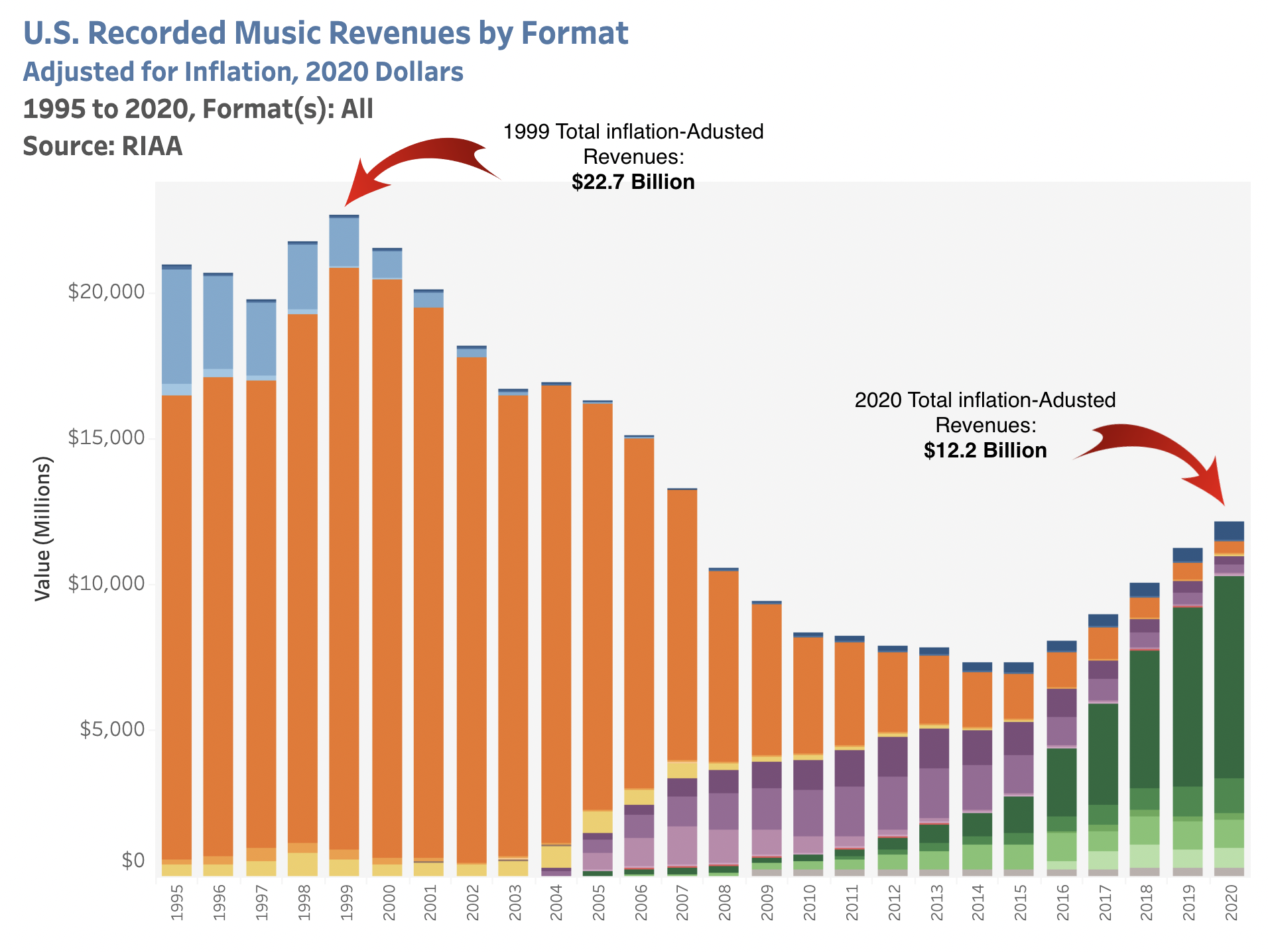
Also, showing a graph without the last 10 years is making the data lying: https://www.riaa.com/u-s-sales-database
The music industry earnings has never been that high than today.
Also, actual studies shows piracy helped sales, not hindered earnings: https://arstechnica.com/gaming/2017/09/eu-study-finds-piracy...
The only explanation for the complete collapse of CD sales starting in 1999 is piracy. Napster & Co. Anything else is dishonest.
> Also, showing a graph without the last 10 years is making the data lying: https://www.riaa.com/u-s-sales-database
No, this data is lying because it ignores inflation. Here is an inflation adjusted chart, which shows a massive drop in revenue:
https://www.digitalmusicnews.com/wp-content/uploads/2021/06/...
Moreover, even if revenue were on the same level today as it was more than 20 years ago, which it isn't, this would ignore the fact that in the meantime the global economy has increased substantially, such that the revenue without piracy would be much higher than back then.
> Also, actual studies shows piracy helped sales, not hindered earnings:
This is about video games and highly speculative. For music there is overwhelming evidence that piracy completely crushed the CD market.
So the site's shtick was to take Kazik's newest album and copy it. Then delete to make place for another copy. In a loop. The site then counted how much money has been already stolen from Kazik in the process, and you could also copy albums by yourself locally and report it on the site, incrementing the overall counter. I have to admit that I have participated in this highly unethical venture myself, and as far as I remember we have collectively managed to steal billions of dollars this way.
We were supposed to split our loot and all get super rich. However, the site isn't available anymore. I suspect its author simply took the money and ran away...
This is highly irrelevant. I didn't say anything about stealing. The actual music revenue collapsed starting from 1999. Due to pure magic apparently!
I ended up with a personal collection of CDs for other reasons anyway, but the music industry simply did nothing to meet the demand and gave up the playing field to Spotify and Apple on their own chord. Look at last.fm for what happened when someone wanted to step into the XXI century while respecting the music industry rules.
Before that CDs sold for twice the amount that the original records cost when they came out ('they will last forever, and they're as good as the original masters').
You seem to have a strong conviction that piracy killed the music industry but they didn't need our help to do so, the quality on offer went down, the back catalog is large enough to sustain you for a lifetime (or even longer) and given the choice between something modern and something old I find myself picking 'something old' more and more frequently. There are some exceptions, but these are happening with lower frequency every year. It's probably a function of getting older but I'd just as soon listen to an old record by Kate Bush, 10CC, or a classical recording from the 1950's or 60's than that I will listen to something new that doesn't register with me. I can't remember when I last had the radio on, the only one I have is in the car and I probably didn't even bother plugging in the antenna.
Piracy had absolutely nothing to do with it - for me. I spent a small fortune on music and would have been happy to continue to do so. But the innovators dilemma is harsh and the music industry was too caught up in combating piracy to see that installing root kits on people's computers (Sony) or suing your artists (everybody else) is bad policy for a middle man. And so they faded. A bit late, perhaps, but I think it was inevitable. The ones (labels, not artists) that survive into the streaming era are doing well enough financially, but the music they put out just isn't compelling to me.
To this day there is a levy on any storage medium that goes to the local equivalent of the RIAA.
That's not true. iTunes or Spotify did not nearly compensate for lost CD revenue.
https://www.digitalmusicnews.com/wp-content/uploads/2021/06/...
You are making the same mistake that software companies mad(k)e when talking about revenue and losses due to piracy: not every copy made is a lost sale and depending on the price points and other business model parameters you can find sustainability or lack thereof in many different places of the parameter space.
There is a pretty good chance that if the record companies had not sat on their hands lamenting all this online piracy and if they had provided a good alternative timely that those streaming revenues would be a lot higher today.
I simply stopped buying music around that time, and I don't have a feeling I missed out on anything. The very few things I love that you could call modern are by unsigned artists who are more than happy to put their art out there because they love making good stuff, not necessarily because they are going for a huge commercial success.
Record companies are very much like start-up accelerators: they are entirely optional.
No, because they had to compete against music piracy, which is hard, as pirated music is free.
You assertion (and that of record companies) conveniently ignores the fact that through the 90s long out of print albums were re-released on CD. For a great many artists it was the first time their work had been in print in decades. So CD sales in the 90s had an enormous boost of nostalgia sales.
Furthermore sales of new music through the 90s was further buoyed by new genres. Hip hop exploded was a footnote in the 80s and exploded in the 90s. Pop country (Garth Brooks etc) also exploded in popularity.
Every Boomer that wanted a copy of Sgt Pepper owned a copy. If they bought their top dozen albums or some compilations with chart toppers they were basically set for music. When they bought iPods they took that collection of CDs and loaded them onto their iPods.
The volume of music piracy was nothing compared to the size of the Boomer economic bloc.
The piracy assertion also hilariously ignores the changes in media. In the 90s most music buyers in the US didn't have an option to buy singles. Most acts no longer released singles. So a buyer wanting one or two songs had to pay $15+ for a whole album of filler. Much to the glee of record executives.
With the iTunes Music Store debut in 2003 buyers could suddenly buy just the one or two songs they liked for a dollar each. They might ultimately spend $15 but they got 15 songs they actually wanted. They also of course had their existing CD collection to source music from. This again led to saturation, most people don't buy tens of thousands of songs. If you have about 300 pop songs (~4min) you've got a playlist that can play all day without repeating.
After 1999 CD sales started to decline once the nostalgia market got saturated and dropped even more once buyers could buy only the tracks they actually wanted. Most bands are lucky to produce an album worth of good songs over a half dozen separate album releases. The sales left after the nostalgia market dropped off was largely just new music sales.
There absolutely is. If someone produces a thing through their own hard work, they own the rights to that thing, and you do not have the right to consume that thing without paying them for it. You do not own the rights to other peoples' work.
If you disagree, then prove it by going to your boss/company and telling them that they don't have to pay you unless they want to (and that you're not going to engage in any enforcement or legal action against them, because you don't think that it's wrong).
> Record companies are very much like start-up accelerators
Record companies are completely irrelevant to the issue of piracy.
Oh poor, poor Sony/BMG/EMI CEOs who absolutely couldn't buy another yacht while lowering their expenses by literally making money out of thin air by literally copying digital music. /me wets a handkerchief with the tears of compassion.
You are spamming that graph, but only because you think it supports your opinion.
Except it does not. Go to RIAA, select Adjusted for inflation and select all years.
You would see what by 2017 the revenue is on par with 1981.
What happened in 1990-1998 what skyrocketed the revenue levels to be twice of that period?
The compact discs.
What happened in 2001-2008 what returned the revenue to almost 1981 levels?
Nobody wanted the fucking compact discs anymore.
They are bulky, you need a good player with at least 40sec anti-shock, you can't run with it, you need a fanny pack or something to even have it with you if you don't want to clip it on your jeans belt (if you don't even have a belt, eg track suit or skirt/dress) and god forbid you wanted more then one album (ie CD) with you, now you need to bring the CD bag with you.
And why people didn't want CDs no more?
Flash and for some time - 1"/1.8" HDD players.
People tasted how it can be to have multiple albums (and with HDD players - your whole library) on a small, compact device which is immune or way more resistant to the shock, doesn't chew the batteries and hey! shows the artist and song title!
'Piracy killed music industry [revenue]' is the bullshit, it's just what by 2008 you could no longer sell a $0.10 piece of polycarbonate for $19.99, people didn't wanted them anymore. Of course your 200% profit margin doesn't exists anymore and it shouldn't had existed in the first place.
You are conveniently ignoring the musicians which are hardest hit by our piracy. They make hardly any money from Spotify.
> You would see what by 2017 the revenue is on par with 1981.
Apart from 1981 pretty much coinciding with the cassette piracy decline, you are also ignoring the fact that the world economy has grown massively since 1981. Saying there was no decline in revenue is like comparing car revenue from 1981 with car revenue today and claim the natural state of things for them is to be the same. The comparison is absurd.
> What happened in 2001-2008 what returned the revenue to almost 1981 levels?
Piracy. CDs initially prevented piracy. Then CD sales collapsed because of piracy. Napster & Co.
> People tasted how it can be to have multiple albums (and with HDD players - your whole library) on a small, compact device
That was possible with the iPod and other MP3 players together with legally acquired downloadable music. But the revenue never returned to CD levels because most people kept pirating. Then Spotify came with extremely low pricing and forced musicians to accept ruinous streaming revenues, because Spotify had to compete against piracy. That's why music revenue has collapsed.
Bullshit. You are conveniently ignoring the musicians were ripped by the labels way, way before mp3s and still are. Go, read this[0] from the musician itself, ffs.
> Apart from 1981 pretty much coinciding with the cassette piracy decline
LOLWUT?
> The comparison is absurd
The only absurd here is your stance on defending the poor labels from evil digital pirates, which stole all the profits. What are you? Sony Music CEO? Share owner?
Why do you have the urge to paint labels as innocent here?
> Then CD sales collapsed because of piracy. Napster & Co.
Are you fucking serious? Napster became defunct by 2001. iPod came out in late 2001, iRiver came out in 2002 and iPod 3 in 2003. By 2005 NOBODY used CDs as a means for portable music. Nobody needed CDs a primary means of listening music. That's why CD sales fell, not because some folks in Sovie^W Russia copied a bunch of mp3 of Kazaa.
What labels did provide the digital sales, except Apple with it's PoS iTunes? No. Fucking. One.
What they did instead? Whined and cried and lobbied bullshit laws and invented bullshit technology like DRM protected music files to be preloaded on SD cards to fully mimic physical mediums like cassettes and CDs because old fucks at the labels knew only one way to make money - to rip everything from everyone and the new world where you did not need the physical media didn't fit in their rip off scheme^W^W^W sorry, revenue model.
> But the revenue never returned to CD levels because most people kept pirating
Do you have troubles with comprehension? You could never return to 'CD levels' because those levels literally had profit margins anywhere from 200% to 3000%:
> In 1995, material costs were 30 cents for the jewel case and 10 to 15 cents for the CD. The wholesale cost of CDs was $0.75 to $1.15, while the typical retail price of a prerecorded music CD was $16.98
And also you conveniently ignore what the physical media declined past 2001 precisely because people no longer needed nor wanted the physical media. "but muh pirates! Arrgh!"
Oh, by the way:
> On average, the store received 35 percent of the retail price, the record company 27 percent, the artist 16 percent, the manufacturer 13 percent, and the distributor 9 percent
Can you explain how come the label receives 27% while the artist only 16%? What about 'hardly any money from Spotify'? That is from 1995, not 2005 nor 2015. Explain how greatly the labels cared about artists what gave them only 16%?
Piracy doesn't make this issue smaller, if anything, it makes it worse. Love wrote:
> There were a billion music downloads last year, but music sales are up. Where's the evidence that downloads hurt business?
This piece was published in 2000, and sales were not "up". Maybe he didn't have access to the latest figures. But they already started to go down. Over the next few years, CD sales would collapse completely, and digital music sales would not nearly make up for it. I posted the charts previously.
> > Apart from 1981 pretty much coinciding with the cassette piracy decline
> LOLWUT?
I posted the chart previously. Around that time vinyl records had declined substantially, without cassette sales compensating for it. The most likely explanation is that cassette piracy was the culprit. CDs fixed this problem for a while, as they were initially read only and couldn't be pirated.
> > Then CD sales collapsed because of piracy. Napster & Co.
> Are you fucking serious? Napster became defunct by 2001. iPod came out in late 2001, iRiver came out in 2002 and iPod 3 in 2003. By 2005 NOBODY used CDs as a means for portable music.
Yes, because Napster was replaced with countless other music piracy apps. Gnutella, eDonkey2000, Kazaa, Limewire etc. People could legally buy music for their iPods, but they were rather using filesharing. This was free after all, if illegal.
> > Do you have troubles with comprehension? You could never return to 'CD levels' because those levels literally had profit margins anywhere from 200% to 3000%:
> > In 1995, material costs were 30 cents for the jewel case and 10 to 15 cents for the CD. The wholesale cost of CDs was $0.75 to $1.15, while the typical retail price of a prerecorded music CD was $16.98
That's a nonsense comparison. Raw CD manufacturing costs have almost nothing to do with the price or value of music. With downloadable music, the "manufacturing cost" of transferring a few megabytes is likewise miniscule. But the fixed cost of making and advertising the music is not meaningfully different.
> And also you conveniently ignore what the physical media declined past 2001 precisely because people no longer needed nor wanted the physical media.
And you are conveniently ignoring the fact that legal CD music got replaced with illegally downloaded music. I posted the chart. Hardly anyone paid for downloaded music.
> Can you explain how come the label receives 27% while the artist only 16%?
Bad contracts have nothing to do with piracy, but the extremely low price of Spotify has. That Spotify and Apple Music are cheap doesn't mean that artists get a bigger share of the total revenue than in the past. But the total revenue itself got smaller.
It doesn't make it worse. Record companies along with group managers chose to rip the artists and musicians and this was way even before the cassettes[0]
> This piece was published in 2000, and sales were not "up".
The musician herself says what the sales were up, yet you insist what they were not. Are you really sane?
> This piece was published in 2000, and sales were not "up".
Because nobody wants to buy obsolete media with 2000% margin. You know, people aren't stupid if they see the blank CDs for $0.20 in retail they could do the math and find out how much the record company rips them off with a CD priced $19.99, manufactured with the best capitalistic methods.
> I posted the charts previously.
I already told you - the chart doesn't support your ideas. More so, it clearly shows what the minimal manufacturing costs of the CDs provided the ability for the record companies to have 100% more profits than they would had otherwise. You constantly cry about 'streaming didn't provided the same amount of revenue' yet you don't apply 'same amount of revenue' for CD sales, you are quite happy they gouged the prices and ripped everyone, bothe the artists and buyers.
> People could legally buy music for their iPods
Just like they could buy CDs, and rip them to their other than Apple players. Oh, iTunes TOO had (and probably still have, you just need to find Mac with an optical drive, lol) the option for CD ripping. But, you know, not everyone wanted to use iPods. And without iPod iTunes is useless piece of QuickTime shit.
Which takes us back to the simple question: which record company provided a service similar to iTunes?
Sony? BMG? EMI?
The answer the same: NO. ONE. They strictly wanted to sell physical media, because this is the only way to have 2000% profits on each sale. You can't sell a bunch of mp3s for $19.99, people would tell you to fuck off.
It's quite amusing what you are fine with record companies to gouge prices for the CDs[1]:
>> A market economy determines the value of goods by what people are willing to pay for it
yet you cry like it's the money taken from your wallet when people don't want to pay $19.99 for something which costs $0.00001 to distribute.
> Raw CD manufacturing costs have almost nothing to do with the price or value of music
Ha. Ha. Ha.
There is a direct relationship with the retail price of music - the cheaper the media the more profit you, as the record company, receive per the same $19.99.
> And you are conveniently ignoring the fact that legal CD music got replaced with illegally downloaded music. I posted the chart. Hardly anyone paid for downloaded music.
Because there were NO options to pay for 'downloaded' music, you record-company-shareholder freak. Bandcamp was opened in 2008 because till even then there was no good way for paying for digital media besides Apple and DRM shenanigans. You completely ignore this aspect because it doesn't fit in your '*sob* *sob* piracy killed music11 *sob**sob*'[2] narrative. There would be no market for Bandcamp if there were online shops without DRM from the record companies - yet they decided to do the bullshit like slotMusic.
> Bad contracts have nothing to do with piracy, but the extremely low price of Spotify has
Ahahahahahahaha.
It's amusing.
Okay, cards to the table: how much did you 'lost', ie didn't receive a cut from 2000% revenue from CD sales in 2000-2010?
[0] https://en.wikipedia.org/wiki/Death_on_Two_Legs_(Dedicated_t......)
[1] https://news.ycombinator.com/item?id=36875180
[2] it's actually 'piracy killed the way for recording companies to have astonishing 2000% revenue per sale' but of course you don't say it out loud.
You broke the site guidelines egregiously in this thread. We have to ban accounts that do that. Fortunately you've also posted quite a few good comments, so this shouldn't be hard to fix, but if you'd please review https://news.ycombinator.com/newsguidelines.html and stick to the rules from now on, we'd appreciate it.
ACKNOWLEDGEMENT AND ACCEPTENCE OF TERMS
They make hardly any money from the record companies.
(Personally I don't pay anything for spotify, I buy almost all my new music from bandcamp)
Lyrics are dumb in popular music.
I know the bar is pretty high lately, especially with US music... /S
European progressive metal is really fucking awesome, and it really sets the standard for modern eclectic music.
You just got old. It happens to everyone, and every generation says the same thing: The music I enjoyed when I was young and impressionable was great, but all the stuff they make nowadays is crap.
People were whining about how Beatles destroyed music, how rock’n’roll was just monkey noise, how crooners like Sinatra wasn’t real singing.
If you trawl around through youtube videos with 100 views, obscure bandcamp, audiophile forums, etc, niche discord and subreddits, you can find all sorts of absolutely fantastic music.
It obviously takes some work, but it's a lot of fun to discover as well!
My only complaint about bandcamp is the mobile app. As far as I can tell, there’s no way to change the sorting when you’re looking through a genre, so it’s usually filled with albums and artists I already heard years ago, but their website is much better.
If your only association with TikTok music culture is "TikTok charts" then you're just falling for the same Billboard top 40s but with a new coat of paint.
A publisher may wish to control distribution, but the cost to distribute any media (music, text, video, software) is nearly zero. The internet allows all of us to have a slush pile, to delve as deep for raw ore as we want. Some people want to go mining. Most don't and the traditional distribution networks ultimately market to such a person - and one way or another, we can't all delve through every slush pile. If you spend hours on SoundCloud or Bandcamp looking for music, you have less time to crawl for independent films or writing.
Any attempt to narrow the slush pile has the effect of marginalizing less mainstream efforts. If you read reviews or blogs to find things that seem worthy, then you are seeing what made it through someone else's slush pile. If you let the YouTube algorithm do it through recommendations, you are allowing Google to work through the slush pile.
There's more recorded music than ever, and I don't care what your tastes are there are - new and interesting artists are out there to discover.
... which is also, in its own way, a new difficulty. There's so much to sift through, finding what you think is "good" is going to be difficult. This is doubly so for people who grew up listening to the radio or watching MTV, where these decisions were made for them.
The best advice I could give anybody is to find an actual radio station that plays what they consider to be good new music. This probably doesn't look like a commercial station, and you may not even have any in broadcast range of you, but there are plenty out there that stream online. I'm partial to my local NPR music station, but maybe you'd have better luck with college radio or a local low powered station instead.
DJs may be a rare breed these days, but try to find some you like and just let them do the work for you. The algorithms aren't going to cut it.
Average artwork has always been garbage throughout human history. But I still found a few good paintings to hang on my walls. As long as you can get what you want it doesn't really matter what else is out there.
Is there a trick I'm missing to avoid this in {Ubers, grocery stores, bars, ...}? If so I'd love to know about it! Note: am blind, so can't constantly wear earplugs.
Or maybe, instead of devolving into absurdity we can just say that there are come qualities of being better or worse that most people can agree on.
Of course, you can simply bite the bullet and say "yep. The song with 1 note in it is subjectively just as good".
Maybe, but enough people like modern day pop music, so by that criteria it is good.
If people preferred more complicated music, then more complicated music would be popular and more of it would get made.
Modern music is less harmonically complex than even early Beatles, who used more chords (and more chord progressions) than are used today. Music today is highly repetitive.
Timbre is also less complex thanks in part to the use of virtual instruments and sample packs. Synthesized sounds and samples are intrinsically less complex than sounds recorded in a room. Any two hits of, say, a hi-hat will yield different waveforms and our brains pick up on these micro variations.
The most popular genre in America (the world?) isn’t sung and doesn’t focus on tone, so this is hardly surprising. I bet if you measured rhythmic complexity or lyrical complexity it’d show the opposite.
You should see how much time EDM producers spend tweaking the waveforms of individual percussion hits. The idea that timbre in modern music is _less_ complex than in the past is just mind boggling to me, given the level of control that people have in sculpting waveforms and samples. There are entire EDM tracks that are basically just atonal explorations of timbre.
You can also get the same thing looped 4x that has no variation. Hard to fault either side. Musicians have to get work out rapidly and then occasionally something gets legs.
I'm not the best at music theory but what I hear there, the subjective rhythm, what you want to sway to, arises from small permutations of the underlying repeating static phrase of each part. Which leads to a slowly constantly changing emotional/feel to the music. Sort of a rhythmic equivalent to counterpoint. Try and listen to any single part; it's almost impossible to follow without repeat listening. It produces an emergent effect. It's complicated.
I don't particularly enjoy it to be honest (Reich doesn't always compose for aesthetics -- intentionally experimental). I suppose it is musically and intellectually stimulating.
there's more than enough breakcore out there if you measure music quality like that. theree's definitely more than in the 20th century.
"Is this song good?"
"One sec, let me check how complex it is"
I hate how people decide something is an inevitable eternal cycle that started in the 20th century. Recorded music hasn't been around long enough to think that platitudes like this actually have any meaningful content.
I'm here whining about how you're using a Beatles example because your argument is literally a teenage Baby Boomer argument. I've got board games older than your eternal generational war over the consumption of recorded music.
Maybe, but doesn't the same complaint exist about other media, too? 'Kids these days and their [books|music|art|clothes|dance styles]'
People were complaining about the loudness war in _classical music_ in the early 19th century, unfavorably comparing Beethoven to his predecessors, and how his imitators were ruining music. Human nature doesn't change, and the phenomenon of people having their taste in music frozen in their teens and twenties is not something that was invented with the phonograph.
“It is not surprising that Beethoven should, occasionally, have entertained blasé notions of his art; that he should have mistaken noise for grandeur, extravagance for originality, and have supposed that the interest of his compositions would be in proportion to their duration. That he gave little time to reflection, is proved most clearly in the extraordinary length of some movements in his later symphonies… His great qualities are frequently alloyed by a morbid desire for novelty; by extravagance, and by a disdain of rule… The effect which the writings of Beethoven have had on the art must, I fear, be considered as injurious. Led away by the force of his genius and dazzled by his creations, a crowd of imitators has arisen, who have displayed as much harshness, as much extravagance, and as much obscurity, with little or none of his beauty and grandeur. Thus music is no longer intended to sooth, to delight, to ‘wrap the sense in Elysium’; it is absorbed in one principle—to astonish.” Letter to the Editor in the Quarterly Musical Magazine and Review, London, 1827
Do some coding where your words actually have meaning and impact. But stop assuming the real world works that way.
Thing is, there are objective metrics about quality. One aspect is "loudness war" aka compression, where subjective loudness gets increased at the cost of dynamic range [1], another (in)famous aspect is the increasing use of auto-tune (both the software itself as well as the general principle after which it was named). Artists and especially producers love that shit because similar to standardization in fast-food it provides a "consistent" performance even in live productions - which is seen as "cheating" in music by older people, and I think for good reason.
On top of that there's an increasing tendency of producers to push for "bland" personalities as well instead of also taking risks, and it's not just music - it's movies as well: most movies aren't original productions any more, a lot of them is based off of prior IP (Harry Potter, MCU) or endless continuations (Star Wars, Star Trek) to recoup ever growing production and marketing costs.
The interesting thing about streaming services is they really put a cap on this (often a hard one measured by LUFS) and we really don't have as much wall-of-sound compression like we did from the 90s through the mid 00s.
And nothing pushes for bland personalities near as much as people pining for the past.
The highly compressed versions for radio play/commoners
And
A 'hi-fi' version for audiophiles
They need to be the same except for levels etc, and neither more official than the other
If your song can't be enjoyed in both ways, then either your music is 'specialty' music catering to audiophiles and musicophiles (?) Or it's just garbage and shouldn't be released regardless.
But that opinion may be a major cause for myself never releasing anything....
The actual use cases for each form undermine consolidation into one file.
Music doesn't have ever-increasing production costs, and if anything it's easier than ever to get something out there on the primary distribution mechanisms used by the public to consume media.
It certainly has it's own business problems but I don't see any lack of interesting, risk-taking music out there. Even as a fan of genres largely far out of the mainstream I often feel like there's so much great new stuff that I can't keep up with it all.
It actually has. Venues are getting more and more expensive, and the effort to run shows has also increased - Rammstein is far from the only one requiring dozens of trucks to move their equipment around. On top of that you have Ticketmaster and their ilk on a brutal rent-seeking ride at the expense of both artists and fans.
> It certainly has it's own business problems but I don't see any lack of interesting, risk-taking music out there. Even as a fan of genres largely far out of the mainstream I often feel like there's so much great new stuff that I can't keep up with it all.
Yeah, indie stuff still works out fine these days, if not easier as Soundcloud has replaced physical tapes, but to achieve major recognition still takes an absurd amount of money, connections and luck. Or all three of them.
Not even talking about insane amounts of good educational material available online for free these days, the capable equipment required to produce a studio-quality track fell down in price significantly, and most older equipment is still fully functional and compatible with newer offerings (thanks, MIDI and XLR). And newer equipment is still significantly cheaper than almost anything comparable from 20 years ago (if it was even available back then).
Back then, you wouldn't be able to produce anything that could compete in quality with studios from your bedroom, and not on a reasonable budget. And even if you somehow were so rich you were able to finance a pro studio in your house, and you produced a decent track, now the question is how would you even distribute it to the public and get heard.
These days? Thanks to affordability of what it takes to produce a track and the ease of getting your material released to the public, you can go from a nobody to someone with a hit track overnight. All for the price of a laptop, some decent speakers/headphones, and a midi-controller. And even that list is optional, as there are people who produce great stuff with less than this or even something entirely different.
But how many actually manage to pull off that feat? You can probably count them on two hands. One-hit wonders yes, there have been a fair few of these that managed to hit the zeitgeist thanks to social media (Wellerman!), but a sustained career after that, from scratch and with no prior experience? I couldn't name one.
Everyone has the chance to strike a lottery jackpot, but only one person will.
Are they everywhere? Nah, music is a capitalist endeavor, and the market wouldn't support that. But there are a surprising number of artists that have gained success with their first endeavors produced out of their homes.
Quite a few, but that's not the point. Increasing opportunities for everyone does not mean that there will be the same levels of increase in top tier outlier outcomes. Just like if you suddenly gave access to MIT education to everyone, I think the success metric median (whether it is income or achievements) for MIT students will decrease, but the absolute number of successful people due to MIT education being available to everyone will increase.
Off the top of my head in terms of examples: Brockhampton, Skrillex, Billie Eilish, Porter Robinson, Steve Lacy (who produced hit tracks for artists like Mac Miller, J.Cole, and Kendrick Lamar), Flume, etc. The list can keep going on and on, and I listed only the very top tier artists in terms of popularity and lasting presence so far.
“How much does it cost to make a hit song”
https://www.npr.org/sections/money/2011/07/05/137530847/how-...
Secondly, more compressed (less dynamic range) doesn't mean worse, or better. It means more compressed. In some genres, tons of compression is desirable; in others, less so. Is an orchestral Hans Zimmer piece that maxes at -10 momentary LUFS better than a Skrillex song that hits -4 during a drop? You could argue either song is better, but I don't think your argument would have anything to do with its LUFS measurement.
Compression is similar to distortion. Too much distortion is generally seen as bad. But if distortion were always bad, people would use acoustic guitars and clean electrics and never run things through a distortion pedal. Same idea with compression. Too much compression will kill a mix, but not enough will reduce the impact the song has on the listener.
In other words, trying to say that LUFS is an "objective metric of quality" is complete nonsense. To me that's like saying that lines of code written is an objective metric of quality of a software developer.
This conversation isn't about file compression, it's about dynamic range compression. Very different.
https://www.izotope.com/en/learn/what-is-audio-compression.h...
All we do is listen. Often the goal is to get the record to feel as loud as it can be, but the moment our choices start to degrade the feel of the record we back off. We're doing very little in the way of actual limiting for loudness. We have ways of making the record feel louder, and they don't always involve dynamics processing.
Quite often no limiting is necessary because the mixes that we receive are mixed hot, which leads me to my next point:
Where I'll push back a little - for the sake of conversation - is the assertion that the loudness war died with streaming services. I consider their automatic level compensation features to be a big plus for audio fidelity. For artists and mixers who are sensitive to this issue it relieves them of the pressure of feeling that they need to deliver super hot mixes. The record can simply be what it needs to be and not conform to a certain loudness standard. It's a positive step.
Where my objection comes in is the reality that artists and mixers (who are well aware of the dilemma) nonetheless deliver us mixes that have been crafted for maximum perceived loudness. And they're really good at it. Even world class producers and mixers are sending us records that are squashed to hell, but very often they still sound good! The craft of mixing is evolving and people have become very adept at making an objectively loud record (-3 LUFS, etc) still work. HOW they do that is far too big of a topic to broach here.
I think most modern EDM-pop now is at about -7 or so. These are world-class engineers doing the mixing, they could absolutely push it to -5 or -3 if they wanted, there's just no need thanks to LUFS normalization.
Like when people think about the real victims of the loudness war, it's albums like Californication or What's the Story (Morning Glory), which really didn't need to be that loud except for sounding better (in the louder = better sense) on the radio. Something like Death Magnetic you could argue is both intentionally loud + a victim of the loudness war, but it's also just really poorly mixed/mastered in general.
I'm not sure if the high-res audio version on Apple Music has corrected this sin of the original CDs.
Nevertheless, for 70+ years producers, record executives, and artists have been using every sonic trick at their disposal to make their record "pop" and stand out from the competition. The advent of digital audio simply opened up more headroom with which to push the record.
At the risk of being reductive, dig a little bit deeper, beyond popular music, and you'll find large swathes of fantastic music where this isn't the case.
This is mostly subjective, not objective.
(Is it being used more? Objective. Is that relevant to quality? Subjective.)
Eeeeehhhhh. I've heard plenty of beautifully-mastered tracks that were otherwise just crap pieces of music, just as I've heard plenty of music that was so good I was willing to overlook the fact that it might be taking part in the loudness war.
Note I'm not making a point for or against either way, just pointing out that this argument taken to its logical end covers a pretty broad domain of the music industry.
For an actual semi-objective measure, think about how often you hear songs from the 60s and 70s, and from the 90s (and early 2000s for hip hop). And then think of all the crap that's gone by that has no staying power. I'm sure it's partially my bubble, but there were bands in the decades I mention that are going to be widely listened to for a long time, while in between there's a ton of throwaway. Basically you get original, defining music as new genres emerge then runs of derivative crap between them, it's not constant.
Face it, popular music exists for teenagers to claim their spot. Their unique identity from previous generations. The new and fresh - it’s about today and they are today.
But that's just the point. New music all sounds the same. Half-spoken, mumbled lyrics- check. Autotuned to death- check. Forgettable tunes- check.
Maybe whatever you're using to find new music just sucks? blink twice if it's a clearchannel playlist.
But we dont have revolutionary music such as led zepplin, pink floyd, etc in the current crop.
none of the above sought facade public images as much as every single 'influencing' pop-stars today.
Their influence was organic. Today's music trends are forced.
Aside from some EDM style folks, such as ZHU - great music but hes not out there trying to push 'lifestyle' bs, as much as others.
This is 100% purestrain revisionism.
but this doesnt map. So explain thyself ;;
" this involve a significant revision of fundamental Marxist theories and premises, and usually involve making an alliance with the bourgeois class "
-
uh... explain me... to me?
Let's start with this to set the context: > But we dont have revolutionary music such as led zepplin, pink floyd, etc in the current crop.
And then when it comes to Led Zeppelin and this: > none of the above sought facade public images as much as every single 'influencing' pop-stars today.
I'm not sure what 'facade' is doing there, maybe you meant to use a different word, but I'm also not sure how you can look at Led Zeppelin after the early 70s and say they weren't seeking a public image.
Then there's Pink Floyd and this: > Their influence was organic. Today's music trends are forced.
From which I'm going to guess that you've never actually listened to the lyrics to 'Have a Cigar'.
There are still tons of great musicians and bands making new music today, but the stuff that most people are familiar with is dreck compared to what most people were familiar with fifty years ago.
Among other things is that popular attention, once focused by a handful of local radio stations and three national broadcast networks (in the US), has been atomized by a billion channels. The stuff that gets shoved down the big expensive earball-rich pipes is pablum for broad but weak appeal, processed by self-affirming accountants and algorithms, to a degree it simply was not a generation or two ago. It's simply not the same.
Pop music or rock music in particular? Rock is a type of pop music and it's arguable that it is past its prime and was better when it was newer.
> the stuff that most people are familiar with is dreck compared to what most people were familiar with fifty years ago.
Likely some survival bias here. There was tons of awful music that was quickly forgotten about back in the day too. I will grant that the cost of recording and distributing music is much lower today so there very well is a lower barrier to entry which means there's probably more garbage than ever.
The place of music in society. Availability doesn't mean wide impact. It often created smaller sub cultures.
The place of music in people, there are more things capturing your mind now.
The place of the industry, in the past access was granted through a tree of labels and record companies, it also had a weight in the inertia of styles and art. You went through more skilled eyes, it gives you a different legitimity.
How much of that was influence from baby-boomer controlled music media?
Maybe you have just forgotten about all the dreck that was popular 50 years ago and only remember the classics?
It's not a matter of getting old per se. It's a matter of having more context, more perspective. Yes, there's a lot of good music today. However, so much of it relies on what we've heard before, it rarely qualifies as great. Or, at best, great is relative to the current, which often is average at best.
Do I want to listen to (e.g.) New Order, or a knock-off of New Order?
Agree.
Today, it's mostly true that everything is available. The music that reaches the masses, though, is defined by production over musical quality.
Would we even see or hear from Cass Elliot, Janis Joplin, or Patsy Cline today? Producers would choose someone other than Patsy Cline for Crazy and twist Willie Nelson's arm to make him a ghostwriter on the song so the hot, autotuned, woman could claim she wrote it herself.
There is more to it than just getting older.
Once artists became visible, this was inevitable. The pretty people were going to become popular regardless of whether the music industry got involved or not.
There's a reflex in crowds to seek for some traits and physical "beauty" seems one of them. The rest seems the exception (and those singers have either very special skills or a super solid persona)
On the other hand, the Beatles, The Stones, The Monkees, Stevie Nicks, Olivia Newton John - their looks were very much part of their appeal.
Same as it ever was. Face it - you’re old.
Nice ageism you have there, kid.
You've heard the phrase before right?
Why could you pick those names so readily? Because they're the exceptions...
“Where are the Elton Johns of today?”
“Here and here and here”
“Ah yes, but those are exceptions that prove the rule”
By that easy logic, I can say Elton John was also an exception.
How mainstream was someone like Janis Joplin? She was on the radio, but she was also somewhat counter culture. The women (who don't deserve to be written about as evidence of success without beauty) have hundreds of thousands of subscribers just on youtube, many millions of listens, and I hear their music in stores, commercials and coffee shops.
In addition to there being many more avenues for reaching a large audience outside of record labels, there are also quite a few mainstream performers who aren't conventionally attractive who became famous through pseudo-grassroot paths like television contests.
Really.... how have you not noticed?
Mac Demarco is not a handsome man. Lady Gaga isn't winning any pageants, Adele was mocked for her weight,and then her weight loss, Lizzo's whole thing is self love because she gets harassed for her weight.
There will always be beautiful people produced and controlled for sale, and there will always be the talented, the weird, the outrageous that rise to public conscious - and some from all camps that do not.
How does she look in her breakout hit? (Poker face)
Yea... that's right, she definitely looks "good".
A baby born the day The Monkees formed would be retiring now. That wildly popular band was literally created for a TV show.
This problem has been going on for a long time.
Objectively, it seems like less sophisticated music, in part because there isn't the same kind of money there once was in the system to pay for studio musicians, producers, etc.
Is it possible to create great songs despite that? Yes, but it involves a lot of "skating uphill".
You can see that older music is still getting a LOT of plays -- I think too many to make sense, unless we accept that the current industry is not healthy.
Here's an example: "The Ballad Of The Green Berets" by SSG Barry Sadler was number one for five weeks in 1966, tied with "California Dreamin'" by The Mamas And The Papas. That song is effectively gone now. It's no longer remembered. It didn't make the canon, because The Winnowing got to it, so now it isn't part of The Sixties as a consensus mass memory. "California Dreamin'" which was objectively just as popular by the metric of the charts, however, is pretty well remembered and is, therefore, part of the canon.
https://en.wikipedia.org/wiki/The_Ballad_of_the_Green_Berets
https://www.youtube.com/watch?v=8kj9qv6rmG8
Newer music hasn't gone through The Winnowing. More of the chaff is still remembered. Therefore, it all looks worse.
Another factor is that far more music is published or streamed now, which makes sorting through the mix much more challenging.
Popular taste and memory are both fickle, and one thing that makes going through back-catalogues and earlier periods so interesting is that the sounds of forgotten hits are often fresh to modern ears, while at the same time being tinged with nostalgia based on style, composition, performance characteristics, etc.
If you look at popular hits going back about 150--200 years (say to the 1820s -- 1870s onward), one characteristic that becomes overwhelmingly apparent is the role of technology in popular music. Earlier pieces are often meant to be played or sung by the masses themselves, and tend to instrumentation that would have been available (fiddle, flute, piano). The first recorded formats were player-piano pieces distributed on rolls (and with a distinctly mechanical sound). By the early 20th century, amplification starts to emerge, allowing smaller acts, then electrification (the 3--4 piece rock group emerges), synthesizers (1- and 2-person acts), rap DJs, and over the past decade or so the ability for either a single person to play multiple tracks or for artists in remote locations to be able to collaborate on a single piece.
This may give rise to either original pieces, or simply amazing covers of classics. Leonid & Friends cover of Chicago's "25 or 6 to 4", for example, seems to me better than and at the same time more faithful to the original. It is technically fantastic, while at the same time having its own honest spirit and vivaciousness:
<https://yewtu.be/watch?v=9_torOTK5qc>
Other notable covers:
- Pomplamoose, e.g., "In the Air Tonight": <https://pipe.kavin.rocks/watch?v=9_torOTK5qc>
- Disturbed's "Sounds of Silence": <https://piped.kavin.rocks/watch?v=u9Dg-g7t2l4>
I still think that songs such as "Gangnam Style" and "Someone That I Used to Know" are both truly good recent (post-2000, for me) songs. Both in originals and covers such as Walk Off the Earth's: <https://piped.kavin.rocks/watch?v=p4hIzgqA9io>. (Not to mention the parodies of the original and cover versions...).
That said ...
... I listen to very little contemporary music, largely preferring classical and jazz / blues / folk traditions. Terrestrial broadcast radio is all but completely dead to me. And I don't use streaming services, so that's not really there either.
With a few exceptions, modern music is autotuned-to-death, boring, indistinguishable crap.
After 1990 it drops right off a cliff for me with a few exceptions.
In the previous 10 years (2013-2022) years the songs that clearly fit your description are "Closer" (2016), "Sunflower" (2018), "Stay" (2021). I'd probably say "Old Town Road" (2019) is pretty bad also, with a very boring, repetitive bass track. And "Despacito" (2017) is catchy but has the same cliche beat as a million other songs in the genre.
"Happy" (2013) is a fun song that could be compared to Bobby McFerrin's 1988 hit, "Uptown Funk" (2014) is a 70s throwback, "Hello" (2015) is a vocal fireworks show, "Blinding Lights" (2020) and "As It Was" (2022) are 80s throwbacks.
On the other hand is "Never Gonna Give You Up" (1987) actually a good song? Is "U Can't Touch This" (1990)? Is "Wannabe" (1996)? No, they are fun but none of these are really good songs.
I'm not sure just comparing the most recognizable song of each year gets you very far.
There’s more amazing music being made than ever, and the stuff with big money behind it is worse than ever.
Juvenoia: "The fear or hostility directed by an older generation toward a younger one, or toward youth culture in general."
My teenage kid strongly feels that modern pop music is trash quality compared to previous decades, thinks that new “underground” music is poorly mimicking previous decades, and bemoans the lack of current scenes that she can participate in. It’s a bit sad watching her sift through 90s/00s music rather than dig into new music of her generation, but I can hear the problem when she plays me both the underground and pop stuff her friends are listening to. It’s tame.
There have been profound infrastructural changes to cultural production and distribution, lead by SV and VCs. These have served to massively boost stock valuations of centralising digital platforms. The music they produce is affected by these changes. The faux meta genre “hyperpop” even exploits this (boringly imo). It’s reassuring to believe the kids are alright but the problem is not the kids.
The endless march of optimizing profits by investors who control an ever lopsided share of wealth destroys everything.
I have a lot of friends in the music industry since I used to work there until recently, both back end eg A&Rs and agents as well as artists. The common sentiment is that nothing new has happened in the last decade, everyone’s wondering why, and increasingly exasperated.
So okay, hip hop.. US trap has been largely in stasis since 2008/2010 (lex lugar era). Uk drill has been in stasis since 2017. Does 2023 Kendrick really sound much different to 2012 kendrick? Compare 2002 rap to 1992 rap.
1. Use Napster 2. Use Limewire or Kazaa 3. Download from FTP trading sites 4. Torrent from Pirate Bay 5. Listen on YouTube 6. Listen on Spotify
Digital supply is effectively infinite so the price goes to zero. How to apply DRM to files ripped from a CD that can be compressed down to 3 MB?
There are other factors, like changes in youth culture and competition from other forms of entertainment, but digital audio + distribution completely transformed the music ecosystem. In the 1990s it was possible for talented, intelligent young people to start a band and pursue music as a career because the expected return was so much higher -- not only monetarily but in cultural cachet and the excitement of the local "scene". But all that has dried up. Labels aren't giving out big advances, nurturing unknown bands, or paying for million dollar albums any more, because they won't recoup the costs like they used to. Meanwhile potential talent got a job, went to college, or stayed home and played video games.
Once music lost its "goods-character", as Carl Menger would put it, all the upstream inputs -- like fancy, palatial recording studios -- withered away.
As someone that jumped on the Napster and, to a lesser extent, Limewire and Kazaa bandwagon, their value for me wasn't so much that I could get something for free that cost money at the local record store, but it was stuff that couldn't get at all at my local record store.
That said, and much later on, the ability to legitimately listen to music on-demand via Spotify and its ilk pretty much ended my trips to the store.
There is one thing i learned from Warez: If you like the game, buy it.
Digital audio from the listener end had its piece, but two other trends also converged:
- Digital audio from the producer end continued to advance and become cheaper. You can make pretty good recordings on a laptop with the appropriate sound interfaces now, if you have a decent soundproofed room. That is assuming your music isn't digital synth based. Studios are a thing of the past or what a person who likes to produce music calls their bedroom or basement.
- People started caring about the portability of music much more than the quality of it. That trend goes as far back as the Walkman. Regarding the quality, now no one cares if the SNR of your "recording studio" can accurately record all 20-20KHz band of a pindrop from 5 miles away at delta-sigma modulated 192Kbps. If it sounds good with headphones or a car stereo it's fine. This is why MP3 was successful despite its audio quality issues.
I was a teenager limited to summer job money, but I was happy to buy music on the iTunes store when it launched. I bought CDs as well, but my primary motivation for piracy was that record stores had a limited selection and often exorbitant prices (because the industry was engaged in price fixing^), and the record labels seemed to care more about stopping online music consumption and forcing people to buy CDs than actually providing a worthwhile paid service–their official channels were godawful, see PressPlay.
It’s actually a mistake of the goal, in nearly every field, because it’s intrinsically contradictory.
“I want to be at the top, but I don’t want to make the stuff that isn’t to my taste that the current people at the top make”
There will be very few winners as the participation increases, the “winners” don’t scale nearly as aggressively as the amount of people fighting to be one do.
OnlyFans, YouTube, Twitch, Music, Acting. They’re all headed to the same place. Look how intuitive it is when you apply it to something like Crypto then ask why the same logic doesn’t apply virtually everywhere.
That said mainstream music is forced to the lowest common denominator to appeal to the maximum number of people
To me, that doesn't look far from the "home taping is killing music" prediction.
It was another technology that did it, but with less money coming in, less great music did get created.
The record companies did a fantastic job of killing music all by themselves, the quality has absolutely cratered and the occasional great artist that has made it through the long slog to recognition has done so despite the music industry, not because of.
I spent a fortune on various formats and when streaming came along I simply refused to participate. I'm simply not going to pay a third time for music that I already legally own.
Note that the following was written well before streaming came along, but it is an excellent article on the realities of the music industry from the artists perspective written by Janis Ian:
https://web.archive.org/web/20070509181400/http://www.janisi...
There is a fair chance that if you're under 40 that you've never heard of her, but I suggest you give her music a try as well, it is at least as good as her writing.
And another one by Courtney Love:
https://www.salon.com/2000/06/14/love_7/