That's not true. iTunes or Spotify did not nearly compensate for lost CD revenue.
https://www.digitalmusicnews.com/wp-content/uploads/2021/06/...
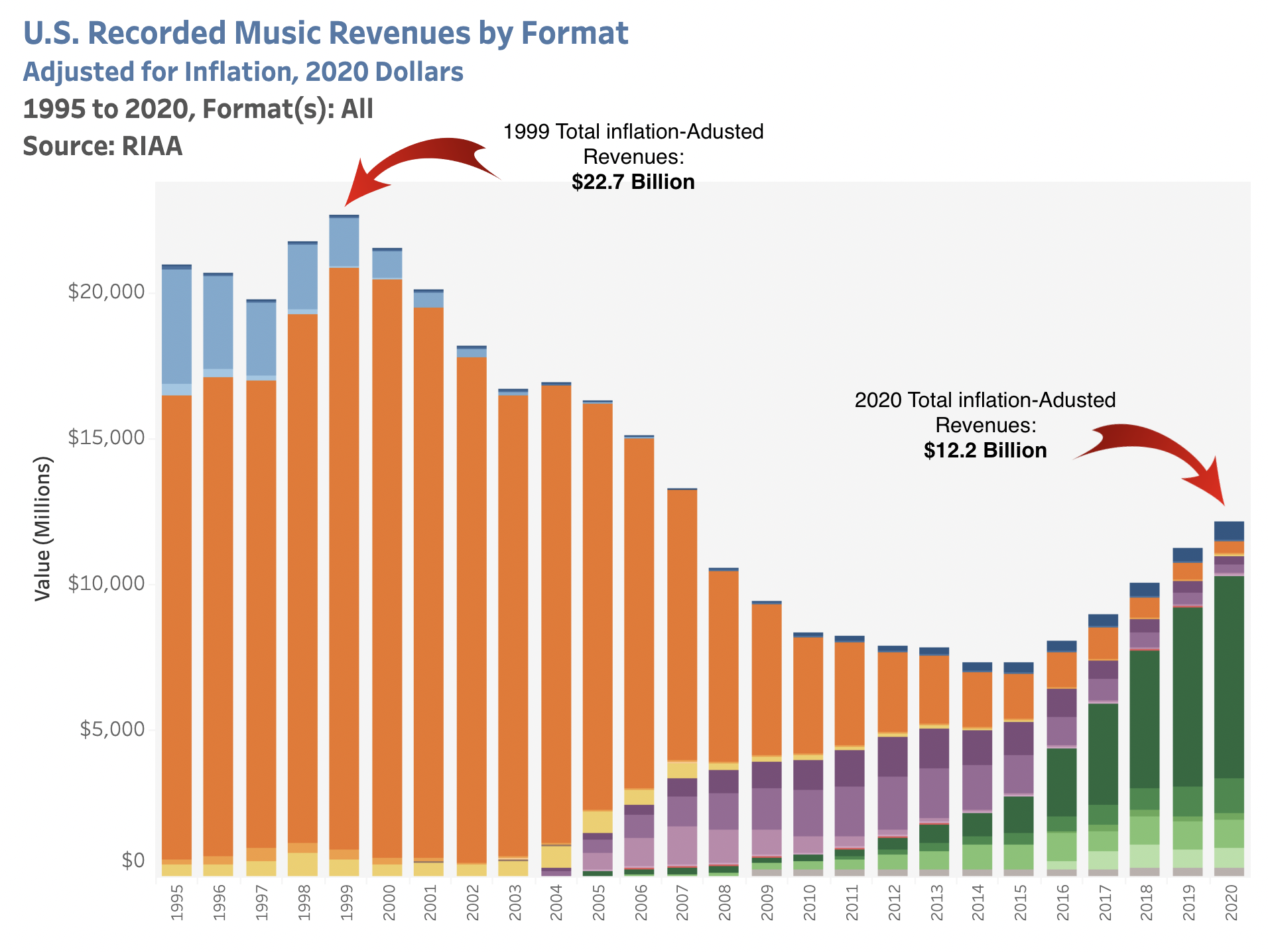
You are making the same mistake that software companies mad(k)e when talking about revenue and losses due to piracy: not every copy made is a lost sale and depending on the price points and other business model parameters you can find sustainability or lack thereof in many different places of the parameter space.
There is a pretty good chance that if the record companies had not sat on their hands lamenting all this online piracy and if they had provided a good alternative timely that those streaming revenues would be a lot higher today.
I simply stopped buying music around that time, and I don't have a feeling I missed out on anything. The very few things I love that you could call modern are by unsigned artists who are more than happy to put their art out there because they love making good stuff, not necessarily because they are going for a huge commercial success.
Record companies are very much like start-up accelerators: they are entirely optional.
No, because they had to compete against music piracy, which is hard, as pirated music is free.
You assertion (and that of record companies) conveniently ignores the fact that through the 90s long out of print albums were re-released on CD. For a great many artists it was the first time their work had been in print in decades. So CD sales in the 90s had an enormous boost of nostalgia sales.
Furthermore sales of new music through the 90s was further buoyed by new genres. Hip hop exploded was a footnote in the 80s and exploded in the 90s. Pop country (Garth Brooks etc) also exploded in popularity.
Every Boomer that wanted a copy of Sgt Pepper owned a copy. If they bought their top dozen albums or some compilations with chart toppers they were basically set for music. When they bought iPods they took that collection of CDs and loaded them onto their iPods.
The volume of music piracy was nothing compared to the size of the Boomer economic bloc.
The piracy assertion also hilariously ignores the changes in media. In the 90s most music buyers in the US didn't have an option to buy singles. Most acts no longer released singles. So a buyer wanting one or two songs had to pay $15+ for a whole album of filler. Much to the glee of record executives.
With the iTunes Music Store debut in 2003 buyers could suddenly buy just the one or two songs they liked for a dollar each. They might ultimately spend $15 but they got 15 songs they actually wanted. They also of course had their existing CD collection to source music from. This again led to saturation, most people don't buy tens of thousands of songs. If you have about 300 pop songs (~4min) you've got a playlist that can play all day without repeating.
After 1999 CD sales started to decline once the nostalgia market got saturated and dropped even more once buyers could buy only the tracks they actually wanted. Most bands are lucky to produce an album worth of good songs over a half dozen separate album releases. The sales left after the nostalgia market dropped off was largely just new music sales.
There absolutely is. If someone produces a thing through their own hard work, they own the rights to that thing, and you do not have the right to consume that thing without paying them for it. You do not own the rights to other peoples' work.
If you disagree, then prove it by going to your boss/company and telling them that they don't have to pay you unless they want to (and that you're not going to engage in any enforcement or legal action against them, because you don't think that it's wrong).
> Record companies are very much like start-up accelerators
Record companies are completely irrelevant to the issue of piracy.
Oh poor, poor Sony/BMG/EMI CEOs who absolutely couldn't buy another yacht while lowering their expenses by literally making money out of thin air by literally copying digital music. /me wets a handkerchief with the tears of compassion.
You are spamming that graph, but only because you think it supports your opinion.
Except it does not. Go to RIAA, select Adjusted for inflation and select all years.
You would see what by 2017 the revenue is on par with 1981.
What happened in 1990-1998 what skyrocketed the revenue levels to be twice of that period?
The compact discs.
What happened in 2001-2008 what returned the revenue to almost 1981 levels?
Nobody wanted the fucking compact discs anymore.
They are bulky, you need a good player with at least 40sec anti-shock, you can't run with it, you need a fanny pack or something to even have it with you if you don't want to clip it on your jeans belt (if you don't even have a belt, eg track suit or skirt/dress) and god forbid you wanted more then one album (ie CD) with you, now you need to bring the CD bag with you.
And why people didn't want CDs no more?
Flash and for some time - 1"/1.8" HDD players.
People tasted how it can be to have multiple albums (and with HDD players - your whole library) on a small, compact device which is immune or way more resistant to the shock, doesn't chew the batteries and hey! shows the artist and song title!
'Piracy killed music industry [revenue]' is the bullshit, it's just what by 2008 you could no longer sell a $0.10 piece of polycarbonate for $19.99, people didn't wanted them anymore. Of course your 200% profit margin doesn't exists anymore and it shouldn't had existed in the first place.
You are conveniently ignoring the musicians which are hardest hit by our piracy. They make hardly any money from Spotify.
> You would see what by 2017 the revenue is on par with 1981.
Apart from 1981 pretty much coinciding with the cassette piracy decline, you are also ignoring the fact that the world economy has grown massively since 1981. Saying there was no decline in revenue is like comparing car revenue from 1981 with car revenue today and claim the natural state of things for them is to be the same. The comparison is absurd.
> What happened in 2001-2008 what returned the revenue to almost 1981 levels?
Piracy. CDs initially prevented piracy. Then CD sales collapsed because of piracy. Napster & Co.
> People tasted how it can be to have multiple albums (and with HDD players - your whole library) on a small, compact device
That was possible with the iPod and other MP3 players together with legally acquired downloadable music. But the revenue never returned to CD levels because most people kept pirating. Then Spotify came with extremely low pricing and forced musicians to accept ruinous streaming revenues, because Spotify had to compete against piracy. That's why music revenue has collapsed.
Bullshit. You are conveniently ignoring the musicians were ripped by the labels way, way before mp3s and still are. Go, read this[0] from the musician itself, ffs.
> Apart from 1981 pretty much coinciding with the cassette piracy decline
LOLWUT?
> The comparison is absurd
The only absurd here is your stance on defending the poor labels from evil digital pirates, which stole all the profits. What are you? Sony Music CEO? Share owner?
Why do you have the urge to paint labels as innocent here?
> Then CD sales collapsed because of piracy. Napster & Co.
Are you fucking serious? Napster became defunct by 2001. iPod came out in late 2001, iRiver came out in 2002 and iPod 3 in 2003. By 2005 NOBODY used CDs as a means for portable music. Nobody needed CDs a primary means of listening music. That's why CD sales fell, not because some folks in Sovie^W Russia copied a bunch of mp3 of Kazaa.
What labels did provide the digital sales, except Apple with it's PoS iTunes? No. Fucking. One.
What they did instead? Whined and cried and lobbied bullshit laws and invented bullshit technology like DRM protected music files to be preloaded on SD cards to fully mimic physical mediums like cassettes and CDs because old fucks at the labels knew only one way to make money - to rip everything from everyone and the new world where you did not need the physical media didn't fit in their rip off scheme^W^W^W sorry, revenue model.
> But the revenue never returned to CD levels because most people kept pirating
Do you have troubles with comprehension? You could never return to 'CD levels' because those levels literally had profit margins anywhere from 200% to 3000%:
> In 1995, material costs were 30 cents for the jewel case and 10 to 15 cents for the CD. The wholesale cost of CDs was $0.75 to $1.15, while the typical retail price of a prerecorded music CD was $16.98
And also you conveniently ignore what the physical media declined past 2001 precisely because people no longer needed nor wanted the physical media. "but muh pirates! Arrgh!"
Oh, by the way:
> On average, the store received 35 percent of the retail price, the record company 27 percent, the artist 16 percent, the manufacturer 13 percent, and the distributor 9 percent
Can you explain how come the label receives 27% while the artist only 16%? What about 'hardly any money from Spotify'? That is from 1995, not 2005 nor 2015. Explain how greatly the labels cared about artists what gave them only 16%?
Piracy doesn't make this issue smaller, if anything, it makes it worse. Love wrote:
> There were a billion music downloads last year, but music sales are up. Where's the evidence that downloads hurt business?
This piece was published in 2000, and sales were not "up". Maybe he didn't have access to the latest figures. But they already started to go down. Over the next few years, CD sales would collapse completely, and digital music sales would not nearly make up for it. I posted the charts previously.
> > Apart from 1981 pretty much coinciding with the cassette piracy decline
> LOLWUT?
I posted the chart previously. Around that time vinyl records had declined substantially, without cassette sales compensating for it. The most likely explanation is that cassette piracy was the culprit. CDs fixed this problem for a while, as they were initially read only and couldn't be pirated.
> > Then CD sales collapsed because of piracy. Napster & Co.
> Are you fucking serious? Napster became defunct by 2001. iPod came out in late 2001, iRiver came out in 2002 and iPod 3 in 2003. By 2005 NOBODY used CDs as a means for portable music.
Yes, because Napster was replaced with countless other music piracy apps. Gnutella, eDonkey2000, Kazaa, Limewire etc. People could legally buy music for their iPods, but they were rather using filesharing. This was free after all, if illegal.
> > Do you have troubles with comprehension? You could never return to 'CD levels' because those levels literally had profit margins anywhere from 200% to 3000%:
> > In 1995, material costs were 30 cents for the jewel case and 10 to 15 cents for the CD. The wholesale cost of CDs was $0.75 to $1.15, while the typical retail price of a prerecorded music CD was $16.98
That's a nonsense comparison. Raw CD manufacturing costs have almost nothing to do with the price or value of music. With downloadable music, the "manufacturing cost" of transferring a few megabytes is likewise miniscule. But the fixed cost of making and advertising the music is not meaningfully different.
> And also you conveniently ignore what the physical media declined past 2001 precisely because people no longer needed nor wanted the physical media.
And you are conveniently ignoring the fact that legal CD music got replaced with illegally downloaded music. I posted the chart. Hardly anyone paid for downloaded music.
> Can you explain how come the label receives 27% while the artist only 16%?
Bad contracts have nothing to do with piracy, but the extremely low price of Spotify has. That Spotify and Apple Music are cheap doesn't mean that artists get a bigger share of the total revenue than in the past. But the total revenue itself got smaller.
It doesn't make it worse. Record companies along with group managers chose to rip the artists and musicians and this was way even before the cassettes[0]
> This piece was published in 2000, and sales were not "up".
The musician herself says what the sales were up, yet you insist what they were not. Are you really sane?
> This piece was published in 2000, and sales were not "up".
Because nobody wants to buy obsolete media with 2000% margin. You know, people aren't stupid if they see the blank CDs for $0.20 in retail they could do the math and find out how much the record company rips them off with a CD priced $19.99, manufactured with the best capitalistic methods.
> I posted the charts previously.
I already told you - the chart doesn't support your ideas. More so, it clearly shows what the minimal manufacturing costs of the CDs provided the ability for the record companies to have 100% more profits than they would had otherwise. You constantly cry about 'streaming didn't provided the same amount of revenue' yet you don't apply 'same amount of revenue' for CD sales, you are quite happy they gouged the prices and ripped everyone, bothe the artists and buyers.
> People could legally buy music for their iPods
Just like they could buy CDs, and rip them to their other than Apple players. Oh, iTunes TOO had (and probably still have, you just need to find Mac with an optical drive, lol) the option for CD ripping. But, you know, not everyone wanted to use iPods. And without iPod iTunes is useless piece of QuickTime shit.
Which takes us back to the simple question: which record company provided a service similar to iTunes?
Sony? BMG? EMI?
The answer the same: NO. ONE. They strictly wanted to sell physical media, because this is the only way to have 2000% profits on each sale. You can't sell a bunch of mp3s for $19.99, people would tell you to fuck off.
It's quite amusing what you are fine with record companies to gouge prices for the CDs[1]:
>> A market economy determines the value of goods by what people are willing to pay for it
yet you cry like it's the money taken from your wallet when people don't want to pay $19.99 for something which costs $0.00001 to distribute.
> Raw CD manufacturing costs have almost nothing to do with the price or value of music
Ha. Ha. Ha.
There is a direct relationship with the retail price of music - the cheaper the media the more profit you, as the record company, receive per the same $19.99.
> And you are conveniently ignoring the fact that legal CD music got replaced with illegally downloaded music. I posted the chart. Hardly anyone paid for downloaded music.
Because there were NO options to pay for 'downloaded' music, you record-company-shareholder freak. Bandcamp was opened in 2008 because till even then there was no good way for paying for digital media besides Apple and DRM shenanigans. You completely ignore this aspect because it doesn't fit in your '*sob* *sob* piracy killed music11 *sob**sob*'[2] narrative. There would be no market for Bandcamp if there were online shops without DRM from the record companies - yet they decided to do the bullshit like slotMusic.
> Bad contracts have nothing to do with piracy, but the extremely low price of Spotify has
Ahahahahahahaha.
It's amusing.
Okay, cards to the table: how much did you 'lost', ie didn't receive a cut from 2000% revenue from CD sales in 2000-2010?
[0] https://en.wikipedia.org/wiki/Death_on_Two_Legs_(Dedicated_t......)
[1] https://news.ycombinator.com/item?id=36875180
[2] it's actually 'piracy killed the way for recording companies to have astonishing 2000% revenue per sale' but of course you don't say it out loud.
You broke the site guidelines egregiously in this thread. We have to ban accounts that do that. Fortunately you've also posted quite a few good comments, so this shouldn't be hard to fix, but if you'd please review https://news.ycombinator.com/newsguidelines.html and stick to the rules from now on, we'd appreciate it.
ACKNOWLEDGEMENT AND ACCEPTENCE OF TERMS
They make hardly any money from the record companies.
(Personally I don't pay anything for spotify, I buy almost all my new music from bandcamp)
Before that CDs sold for twice the amount that the original records cost when they came out ('they will last forever, and they're as good as the original masters').
You seem to have a strong conviction that piracy killed the music industry but they didn't need our help to do so, the quality on offer went down, the back catalog is large enough to sustain you for a lifetime (or even longer) and given the choice between something modern and something old I find myself picking 'something old' more and more frequently. There are some exceptions, but these are happening with lower frequency every year. It's probably a function of getting older but I'd just as soon listen to an old record by Kate Bush, 10CC, or a classical recording from the 1950's or 60's than that I will listen to something new that doesn't register with me. I can't remember when I last had the radio on, the only one I have is in the car and I probably didn't even bother plugging in the antenna.
Piracy had absolutely nothing to do with it - for me. I spent a small fortune on music and would have been happy to continue to do so. But the innovators dilemma is harsh and the music industry was too caught up in combating piracy to see that installing root kits on people's computers (Sony) or suing your artists (everybody else) is bad policy for a middle man. And so they faded. A bit late, perhaps, but I think it was inevitable. The ones (labels, not artists) that survive into the streaming era are doing well enough financially, but the music they put out just isn't compelling to me.
To this day there is a levy on any storage medium that goes to the local equivalent of the RIAA.