China dropped the ball for a full 10 days back when the disease was nicely contained to a small part of Wuhan, and then largely to Wuhan itself and Hubei - they didn't let the population know about the danger, so for quite some time no one was thinking about protecting themselves by wearing masks, social distancing etc. But the trouble is, Italy then made the exact same mistake by being late with containment measures, and now the UK and US are doing the same. So there's nothing to roll one's eyes or raise eyebrows about.
Once the threat was clear, the government of China acted much more alacrity and decisiveness than any Western country, which have had months of advance notice.
They were correct in threatening a doctor who reported what he saw (facts) to retract his statements as being _false_?
The local government didn't want to believe in the threat and wanted very much to keep any negative news hushed out of fear of looking bad to the central government.
So there you have it, a country governed by fear where people prefer to hide issues instead of quickly seeking help.
They could have done it through internal channels, without the public knowing but no, they crushed the messengers and tried to hide the facts until it was too late.
The central government admitted it itself: https://news.rthk.hk/rthk/en/component/k2/1506445-20200203.h...
That's for sure but there's a useful middle ground between mindless panic and total complacency, and these Chinese officials were way too far on the complacency side for quite some time.
They wouldn't threaten and silence numerous doctors that tried to warn everyone.
They wouldn't blockade access to one of the world's largest cities, to prevent outside health inspectors from assessing what was really going on. It wasn't until the first week of February that they were willing to let a major contingent of outside experts in, including from the US. That was two months into the outbreak and a point where things had already gotten very bad.
If this had started in France and the US asked to send experts in to help, France would not deny that request, they wouldn't blockade Paris off from all foreign access to hide what was really happening (how bad it was, and what they were doing to people).
And the tech press mocked "no handshakes" until less than a month ago.
Stupid knows no political party.
Sure our president is really downplaying it, but how do you even fight something that makes some people sick, and not others. There could be 1000s of carriers of COVID-19 who don't even know it.
It's a spectrum of stupid. Moscow Mitch is holding up financial relief because it's a good opportunity to stick it to Planned Parenthood.
"Nationalism is an ideology and movement that promotes the interests of a particular nation (as in a group of people) especially with the aim of gaining and maintaining the nation's sovereignty (self-governance) over its homeland. Nationalism holds that each nation should govern itself, free from outside interference (self-determination), that a nation is a natural and ideal basis for a polity,[2] and that the nation is the only rightful source of political power (popular sovereignty)."
They did squash discussion of it.
Once the national government found out, they fired the local officials and lauded the doctor as a hero.
I'll admit, though, that I wouldn't trade my right to vote for a cure for the common cold, coronavirus, or anything else.
Look, this is a dangerous meme in more ways than one. Italy and Spain managed to lock down entire cities, and those are countries with a strong tradition of democracy. Emergency powers, martial law etc. are a thing, and there's even quite a bit of precedent for using them to deal w/ disease outbreaks. Even in the US.
In constitutional monarchy the monarch is Head of State, a figurehead role with no real personal power. Because monarchs are born not elected this figurehead has no semblance of democratic legitimacy, it's obvious to everyone that they shouldn't get any power, yet as a symbol they are long-lived and emphasise continuity even as political change happens around them.
Elected Politicians on the other hand actually run the legislature and executive government.
That is, the laws you obey are made by people you elected to make them, but at times of crisis the living symbol of your country isn't some politician roughly half the country doesn't like.
This works so much better than the US system that Americans charged with trying to make new countries or fix broken ones (after "regime change" for example) do not follow the US model for many decades. If you're an optimist, the US model worked once and maybe they got lucky. If you're a pessimist we're just waiting for the cracks to get bad enough that it falls apart.
You can't support that claim. Historically - all of recorded history - there are less than half a dozen examples that can be argued to be comparable to or to have systems that are more stable than the US over two centuries of time.
Go ahead and list all the constitutional + democratic systems that have lasted for more than two centuries. The European region barely had any democracies as recently as WW1. Here is what that looks like:
https://i.imgur.com/fnJNjIn.png

Now go back to 1850 or 1900. How many were there? So where do you plan to get your data from, to support your premise on stability?
There is long-term instability inherent in all functioning monarchy systems: the source of that instability is that people frequently don't like them, which is why nations have spent the last few hundred years gradually abandoning or neutering monarchy systems. Most of what remains is a cultural trinket. It's why the monarchy in the UK is little more than a facade, a figurehead; it has no real governing power or position, it is of relatively little political consequence and probably never will be again. Even including the UK in this, is a questionable data point because of that. What does the Queen do? Answer: not much, she is nothing more than a quaint cultural nod to the past at this point.
In fact the US has the opposite problem. Its system of government tends to produce too much stability and not enough dynamism (which is what the argument for many political parties is arguing in favor of). That stability often means the US moves slower on reforms and its system is highly resistant to change. Those are the trade-offs inherent in having greater stability.
Plenty of countries especially in Latin America copied this choice and it didn't work for them. I think the evidence supports the conclusion that's because it's a bad choice.
The danger was sufficiently known, sufficiently early.
Those sounding the alarm were silenced.
In the early stages in Wuhan the virus only existed in Wuhan. A severe lockdown that eliminated the virus there would have eliminated it completely. Full stop. It would have been gone forever.
A draconian lockdown right now in e.g. the UK, or even a few weeks ago, might have eliminated the virus in the UK, but then it would just come back in again. We can’t seal the entire country permanently.
Even in Wuhan, they are easing the lockdown so soon the virus will get back into Wuhan again. It’s just a matter of time before they have another outbreak. It’s simply impossible that it won’t happen.
Lockdowns are important tools to slow the spread of the virus, they are a vital part of our response, but they can only slow it down. They cannot stop it or eliminate it. Also lockdowns are most effective the first time you do them, and then they’re the most effective in the first few weeks.
Impose a heavy lockdown too soon, and it’s like using up your most powerful ammunition before the enemy is in effective range of your weapons. Letting the enemy get closer might mean accepting casualties early on, but fewer casualties overall and a better chance of victory. It’s a hard, painful choice to have to take.
Besides Italy did start to apply lockdown measures to specific towns, and closed schools when they had 20 cases. It was insufficient but at least it was an attempt. The US has had clusters out of control in Washington state for almost as long and the federal agencies were actually trying to silence them. And another in NYC, which is basically the economic powerhouse of the United States.
And it should've been clear with all the data we had that it would be. Don't get me wrong, I don't think any of the other western countries does it right. Italy got unlucky because it was the first country where shit hit the fan. Might as well have been Germany if they wouldn't have gotten lucky in stopping the spread from their Bavaria case. But I fully stand by my point anyways that no country in the west did a good job, and points like yours are weak excuses at best, since it basically boils down to "well we're delaying taking down our economy a bit and make sure the rest of Europe suffers too, so we're not as ducked in comparison to them." There's certainly some logic to that, but it shows how shallow our advanced civilized world really is.
FWIW I totally agree.
> Might as well have been Germany if they wouldn't have gotten lucky in stopping the spread from their Bavaria case.
Yes, that's what Italy was hoping to do. They didn't realize how contagious this thing is.
Uh, China dropped the ball for a full 3 months since the first reports of a novel respiratory disease started back in November. First denying it, then jailing the doctors who tried to raise the alarm. Not to mention not enforcing their own laws regarding food hygiene put in place after SARS which would have prevented the transmission in the first place.
Yeah, they're now showing containment measures that work. But they could have stopped this in its tracks before going global, or prevented it entirely.
Too little, too late.
The Doctor wasn't jailed ...
The virus was spread at the market. It didn't start at the market.
Until we know where it started we don't know if it would have stopped the virus or not.
Talking about the origin of this virus, this paper of 2015 is quite interesting: https://www.nature.com/articles/nm.3985 . In this paper, the wuhan P4 institute people basically described how they produced a prototype of the 2019 wuhan virus.
He is/was also a member of the CCP.
Without information about how this letter was prepared and signed among these people in detail, my hypothesis stands.
The virus came from bats. The "wildlife market" in question sold raw bat meat. How else would it have gotten there?
They eat lots of animals but bats are not one of them. (I'm sure there is a village in China where they do eat bats. It is a big country.)
The photos you see online of Chinese people eating bats are Tourist in the Pacific.
But this particular part of China does. It's more a subculture derived from one of the minority groups in that province, but it's there.
The original hypothesis was that some other animal sold at the market acted as an intermediate host between bat and human, just like the case in 2003 SARS, but this is also not proven.
Any delays by other 1st world countries after 31st Dec are largely their own fault.
If you have 3 people and one slips on a patch of ice and falls you could argue they should understand how ice works and should have been more careful, but if you have 2 other people see that person fall and they blithely walk across the ice and also fall, who should you judge more harshly?
For me personally, I'm going with the people who saw the result of the first event and then followed the same path.
Let’s put it this way, other countries have had a full 2 months of warning and preparation time and they are also dropping the ball.
Chinese Economy? Is the gain worth all the environmental damage and pollution everywhere?
If CCP gov is like the other political entity, would it when having a SARS outbreak in 2003, make an even bigger one like wuhan virus outbreak and do even worse cover up to spread it around the world?
It happened on the 31st of Jan. I think that was before Taiwan stop, but I'm not 100% sure.
You know what is MUCH more effective than an authoritarian response? An _earlier response_.
An earlier response, even if it weaker, is much more potent than a stronger later response.
The intensity of china's response would not be necessary where the response is faster.
> but following rules in place in an outbreak does not mean one should not question their principles.
The best way to preserve civil rights and not have to bend them to protect against loss of life is to respond as early as you can reasonable justify.
In the US the fact that our principles (and laws!) tie our hands somewhat is all the more reason that it's important that we act aggressively within the space that our society allows.
> Personally I'd like fast-tracking of anti-SARS-CoV-2 drugs instead
Responding earlier keeps people alive longer for those drugs to become available.
Absolutely. If this were Kerbal Space Program just about everybody would be able to tell you that the best moment to deflect an orbit is early on when you only need a little push for a giant effect later on. With exponential developments timing is everything.
There are legal and logistical challenges in preventing US residents from entering or imposing quarantine.
Would strong or (more importantly) earlier responses have been good? Absolutely! But a weak and late response is much better than an even later response (even if the later response is stronger).
By the numbers we should prefer a non-US-resident ban-- even without screening/quarantine-- on day 20 than a everyone-ban on day 40.
He was even called a dictator for that.
Correction: South Korea & Japan were "do not travel" not specific travel bans.
Japan: level 2 (exercise caution) https://travel.state.gov/content/travel/en/traveladvisories/...
Korea:level 3 (reconsider) https://travel.state.gov/content/travel/en/traveladvisories/...
Regardless, they're still a response which refutes your original point.
I don't understand this logic. Because China made a mess at the beginning of the pandemic, so we shouldn't copy the model they employed at later stage that is proven to be working?
Or because China is an authoritarian state, so everything it does is bad and nothing we can learn from them? Well China has been copying and learning from any countries for a while now and that's what makes it stronger by day. Just keep blaming China and do nothing. That will surely make China less powerful and less influential.
You know what's scary? All major democracies failed to manage the pandemic while China becomes the most powerful country after all this.
1. https://www.bangkokpost.com/world/1879190/us-germany-battle-...
Quarantining is the only thing that will help in this situation. There's no other solution we have as a society to slow down the pace of infections. People who normally wouldn't die will die because of the lack of medical care.
The problem we face in the US is lack of testing, which makes it impossible to do anything except a quarantine.
The question is, for how long? Until the infection curve goes down? Until there is not a single infected cases in the whole country?
While you can't know when this will happen (especially the former, most models are inaccurate because too little is still known about this virus), I don't believe it is sustainable to keep an extended lockdown on a whole country (as opposed to "just" Hubei, which however has almost the entire population of Italy) more than a few months.
A significant proportion of infected need hospitalization to survive. If we all get sick at once, there simply aren't enough hospital beds to go around, not to mention other supplies. If the hospitals go far beyond capacity, the fatality rate will be _far_ higher than otherwise.
As to how long, I haven't seen good models. In the US we don't have very good data either, because we're testing basically noone.
Some of these models are also different in nature, which adds to the uncertainty: some are epidemiological models, some are economical (used to evaluate the impact of the measures on the long term).
Lastly, a lot of qualified people speak and try to give estimates. I'd love if they don't, because currently the best answer is "we do not know yet".
That said, I think that going over two months of lockdown will be probably ruinous for the country as whole.
And I'm not sure if people can hold psychologically being locked up for one year.
Korea also hasn’t had any hospital breakdown related increase in the death rate.
Chloroquine may indeed work, but the Korean stats are misleading if you don’t adjust for ages.
Also very important to quantify side effect risks, even if it's a rough estimate. For example, if a 70 year old patient has already progressed to dyspena, they might have something like a 20% mortality rate from COVID. Even if there is a side effect profile for the treatment that normally would be considered very dangerous, it may be well worth it to administer it.
We see the same thing with chemotherapy or radiation treatment. The side effects are terrible and fairly often fatal, but they are safer than the disease. This is the situation in which we find ourselves.
https://www.sciencedirect.com/science/article/pii/S088394412...
What you're saying is true, but you're assuming that Chloroquine + Kaletra is better than Chloroquine by itself, and we don't have the data for that yet.
Do you have a source for the Chinese recommendations?
They state:
4. Antiviral therapies: Interferon-alpha (adult: 5 million units or equivalent can be added to 2ml sterile injection water and delivered with a nebulizer twice daily), lopinavir/ritonavir (adult: 200mg/50mg/tablet, 2 tablets twice daily; the length of treatment should not exceed 10 days), ribavirin (recommended in combination with interferon or lopinavir/ritonavir, adult: 500mg twice or three times daily via IV, the length of treatment should not exceed 10 days), chloroquine phosphate (adult 18-65 years old weighing more than 50kg: 500mg twice daily for 7 days; bodyweight less than 50kg: 500mg twice daily for day 1 and 2, 500mg once daily for day 3 through 7); umifenovir (adult: 200mg three times daily; the length of treatment should not exceed 10 days).
Pay attention to issues such as adverse drug reactions, contraindications (for example, chloroquine should not be given to patients with heart diseases), and drug interactions. Further evaluate the efficacy of current treatment regimens in clinical applications. Using 3 or more antiviral drugs is not recommended. Corresponding medication should be discontinued should intolerable side effects appear.
Source as I posted on other submissions
Chloroquine is mostly admitted as a valid treatment now
Chloroquine has a long history with many diseases of "sorta, but not really" working when subjected to actual test.
Please don't spread unsubstantiated info.
I haven’t found the source paper if there is one yet — I can’t read Chinese except with google translate
Chloroquines have a long history of this in viral studies.
That said, it’s an approved drug, so it will be applied and we’ll see how it goes. But don’t spread rumors about its effectiveness, because the truth is, we don’t know.
Relevant XKCD: https://www.xkcd.com/1217/
Chloroquines will be tried since they already pass the "safe" bar.
However, I suspect that if they worked "in vivo", we would have compelling data on that from China already. The fact that we don't have such data suggests that they don't.
We seem to have much better data about the effectiveness of standard anti-virals already.
Probably if they handed some out and told people to take a few as soon as they got a cough + some temperature it would help things. (http://news.southcn.com/nfplus/gdjktt/content/2020-03/09/con...)
Pretty much all countries have mechanisms for emergency powers. China being authoritarian has nothing to do with it. I'm not familiar with Italy's constitution or laws, but I assume it has similar provisions?
> Also, the Chinese Party is what caused this mess to begin with, by allowing this virus to spread all around the world.
Huh? On the one hand you're arguing China was too draconian (and Italy shouldn't copy), then a sentence later you're complaining it wasn't enough and this is all China's fault?
What exactly do you suggest China ought to have done to prevent it from spreading outside of China? I haven't heard any reputable source suggest there was any practical way of containing it perfectly.
Your comment comes across as knee-jerk anti-China rather than anything based in science or public policy.
Of course there was. If they somehow magically divined the true danger of the virus the day they identified it.
But they didn't, it took time and observation, and they shut down the affected areas as soon as the extent of danger was realized and processed by their bureaucracy. There's plenty of things here that could've been done better, but it's asinine to blame them for the virus taking hold everywhere else. Doubly so given that most of the world had a month+ warning before they registered their first cases.
That is the issue here. They completely ignored it until people were dying in the hallways of hospitals and then implemented a draconian policy.
And now they're locking up anyone who criticizes them. See this article about "Gratitude education", a term that tops Orwell in its dystopian implications:
https://www.theguardian.com/world/2020/mar/09/gratitude-educ...
And, look — I’m sitting here in the US where I’ve been horrified at our own response over the last month. But the question was, could it have been contained? Looking at that timeline, it certainly seems possible that it could have been. Of course, we’ll never know.
https://www.wsj.com/articles/how-it-all-started-chinas-early...
Well, at the very least, take it seriously when there were the first reports of "new viral pneumonia" in Wuhan, instead of locking up or censoring people who reported that.
Yes, this doesn't mean that other countries did not take it as seriously as they should have, and perhaps containment might have failed nevertheless. Still, it was a spectacular failure with long-lasting consequences on every other country in the world.
That, IMO, deserves blame, no matter if other governments are doing the same errors.
Why blame China for "allowing this virus to spread all around the world" when Italy allowed the same?
(Italy even had a warning that it was coming!)
But if we're looking for an example of how to solve the pandemic, when people point to China as an example, they aren't saying "we should spend a few weeks pretending the virus doesn't exist, threaten doctors who talk about it, order our labs not to study it, and THEN take decisive action". They're saying we should do the stuff that China did, starting from the decisive action part.
What China did is not something that other countries may want to replicate, but we should all be replicating the Korean and Japanese measures. Actually we should have been doing it weeks ago instead of pretending that if we didn't test then there would be no cases.
There's certainly lots of blame to assign to China and after all this comes back to a "normal" state again the international community should pressure China into eliminating the things that made all this possible: they should be draconic in not allowing things like the Wuhan wet-market be open ever again, all over China, for ever, they should be forthcoming in allowing international experts come and asses things as soon as a new disease manifests itself, they should allow their local medical experts have the upper hand over local Communist officials, at all times.
You do realize that some of their “decisive actions” included enforcing quarantine via welded-shut doors, right?[0] I don’t think you’re ready to handle the kind of “decisive action” that China took.
I don’t think you understand the significance of welding the doors shut... it means if they catch you outside you can’t claim you did it on accident. So, wink wink, they’ll cure you of the virus permanently after that.
Again, you’re not ready for Chinese-style “decisive actions.”
With the population it has, China could have been in a much much worse shape today were it not for the quarantine.
Not only that, refuse to acknowledge, or share any information to international communities. The amount of things they do just to saves faces.
That kind of not sharing information?
If you don't know the source (which is still unknown) then you cannot verify that it has spread human to human. (They should have assumed that it did)
Researches outside of China said there was no evidence of human to human transmission.
The first 2 weeks of January were handled rather poorly. But lack of information since then isn't really one of them.
What could China have done that would have made you personally happy?
People automatically distrust anything they say. What other information could they have provided?
When we had the first cases its only concern was whether a minority party would leave the coalition or not.
It wasn't fit for the emergency, any emergency. Unfortunately, that's what we will be stuck with until it's over.
Just like the spread of fire, the window of opportunity to put it out is right at the beginning.
Yes, Italy could put it out when it first came to Italy but they would have to do it many many more times to successfully contain it. China just had to do it once and they failed.
In his interview with Joe Rogan, Michael Osterholm called it "the perfect experiment that no university would let you do":
https://www.youtube.com/watch?v=E3URhJx0NSw
Their discussion of wet markets starts at around 1:01:00.
Africa and Asia have a lot of this and so are a recurring theme in these very unfortunate stories. But it could happen here, and viruses really don't care about location.
Wet markets and bushmeat is how we got SARS and HIV. We're not sure if COVID-19 was really transferred that way, maybe we'll never know. The Swine flu also jumped species in a regular farm. So there are lots of opportunities all over the world, some more dangerous than others.
And let's not forget about diseases like these: https://en.wikipedia.org/wiki/Bovine_spongiform_encephalopat...
Even though they do not involve viruses they are still part of a similar kind of interplay between species.
As a vegetarian, I'll happily acknowledge the barbarity and health hazards of factory meat production in the Western world. But this really is a tortured apples-to-oranges thing you're doing here. There is simply no valid comparison between a European meat grocer and a Chinese wet market, and I think you know it.
As for how much better the EU is:
https://en.wikipedia.org/wiki/2009_flu_pandemic_in_Europe
Is a good example of what can happen here.
> Also, this particular virus likely did not cross over in a wet market, there is no evidence for that.
If you're relying on a lack of absolute physical proof to support your argument, then I guess you win. Otherwise, there absolutely is evidence that this virus jumped from an animal reservoir local to Hubei, and that the wet markets are perfectly designed to facilitate that process. You're being a bit slippery on this point, but it really isn't the least bit controversial among virologists or epidemiologists.
American-style factory farming of cattle, swine, and poultry, where uncountable animals are crammed together and kept alive with antibiotics, is maybe a valid comparison. America is creating it's own epidemic of antibiotic resistance with the help of these farms (and so is China for that matter). But that does not -- or at least logically should not -- assuage anyone's discomfort with the health hazards of wet markets.
What are you suggesting exactly--that a slightly inattentive butcher wouldn't notice the difference between a leg of pork and a bat?
https://en.wikipedia.org/wiki/Natural_reservoir
For plenty of these events we do not know the reservoir animal (yet). So that butcher will know they are butchering a pig, not a bat. But that pig may have become infected and if the butcher isn't very careful he may infect himself and if the meat isn't prepared carefully it may infect those that consume it. And by the time we realize it has happened these important bits of data may have already been lost.
There is a very good book on the theme called 'Spillover', highly recommended and so far it seems to have been exactly on the money with how this whole thing unfolds. Uncanny actually, it is like having the spoiler for a movie that wasn't made yet.
Either one is true or the other is true.
People don't live with bats. The animals they farm live near bats.
https://www.npr.org/sections/itsallpolitics/2012/08/07/15822...
Because it worked. Millions of lives have been saved - 1% of 1.3B is 13M people. That's 1/5 of Italy.
Are there better models? Maybe. But there are also much worse models, as I suspect we might soon find out in the US [1]. Personally I'd much rather take the Chinese model for the next few months than risk me and my family dying or going bankrupt over the next few months.
And, instead of thinking that China could "afford to take the economical hit", consider the economic impact of 13M people suddenly dying. At this point, there's definitely going to be a hit to the economy. It's just going to be either A) from stricter lock downs and government aid, or B) from more people dying due to overrun hospitals. It might not be a wash in terms of the dollar amount, but it's clear which option will save more lives.
[1] Comparing China and US response:
- China has made treatment (not just testing) for coronavirus free for everyone. In the US...better hope you have good insurance.
- Tests performed per million people: China 2,800, US 5
- China is ordering banks to increase loans to SMBs rather than hoarding cash to protect themselves. It has rolled out a bunch of policies to support SMBs and employees. The US...well, not much so far.
Sources: https://www.sciencealert.com/here-s-how-many-coronavirus-tes... https://qz.com/1813181/china-is-taking-pleasure-in-us-mishan... https://www.scmp.com/economy/china-economy/article/3052474/c... https://www.china-briefing.com/news/chinas-latest-regional-m...
This is an inacurrate estimation. I guess your figure of 1% is from South Korea case fatality rate. The confirmed cases represent a biased sample of the population, and the mortality rate could be lower in reality (but not higher).
> consider the economic impact of 13M people suddenly dying.
The mortality is mainly for 70+ years old people, who are already not in the workforce anymore.
Those numbers cannot help us to evaluate or to compare one state's measure versus another state's decision
Sure, the actual number will likely be different for each country / state / city, but doesn't really matter for the sake of the argument. I was using 1% as a lowball number. Official mortality rate from the WHO is 3-4%; some studies say 2%, Italy is reporting 7%.
And for those 80+, current data suggests a mortality rate of 1/7 - not far off from a round of Russian roulette.
So if you have 4 grandparents who are 80+, there's a ~60% chance at least one will die if the disease spreads through our population in the next few months.
> The mortality is mainly for 70+ years old people, who are already not in the workforce anymore.
Firstly, if hospitals are overrun (which is the way we're headed), people of all ages will die preventable deaths. Hospitals in the US are already postponing elective surgeries.
Secondly, it's simply not true that older people don't contribute to the economy.
The elderly still consume food, housing, health care etc., and a negative demand shock is a recipe for recession. For example, think about what happens to nursing homes or physical therapists if a large percentage of older people die. Or what happens to local housing prices if lots of homes are suddenly put up for sale because elderly owners died en masse.
And many older people continue to work and volunteer (e.g. just look at our president, congressmen, and senators), and that some grandparents help with child care (like in my family right now).
Sources: - https://time.com/5798168/coronavirus-mortality-rate/ - https://www.buzzfeednews.com/article/lamvo/coronavirus-death... - https://nypost.com/2020/03/12/heres-why-the-coronavirus-deat... - https://www.economicshelp.org/macroeconomics/economic-growth...
"That means the total number of reported cases is very likely an underestimate—and by not counting many mild or asymptomatic cases, we’re likely overestimating the disease’s overall mortality rate."
It is not possible to know the mortality rate with the information we have. Extrapolating that dubious number into a prediction of deaths is not a meaningful exercise.
In general, with exponential growth the best time to act was yesterday.
The amount of infected is not and will not ever be known and it's a dark time for statistics when many are taking the non-randomly tested and dividing by fatalities and projecting deaths on large populations.
Exponential growth is how successful infections progress. There is nothing new to see here. This sort of aggressive strain was easily foreseeable years ago and we rely on strategic, planned measures to be executed by government.
Random, localized shutdowns only serve to exacerbate the unwarranted panic we are now seeing. The time to think was years in the coming, the actions now display an enormous failure in leadership.
Always makes me sad when Americans willing give up essential liberty to purchase perceived safety. Personally I would much rather look the situation rational, may the assessment of risk for myself, then choose on my own what course of action(s) I will take. Not have those actions dictated and imposed on me by an authoritarian government.
I would rather lose my health or my life than to lose my liberty
In other words, it's also your liberty vs other people's lives.
Are you going to be the grandson who kills his grandma? Or the employee who kills the CEO? Or the Trump supporter who ends up helping elect Biden?
What if they live with or are cared for by other family members?
How will they get health care for existing conditions? Hospitals have been shown to be a major vector for transmission [1]. And how do they even get to the hospital if they can't drive?
What about grocery shopping over the next few months? The National Guard is stepping in to help deliver food in New Rochelle now. Can that scale to the entire nation? For how long?
What if they live in a nursing home? Look what happened in the Seattle one [2].
[1] https://jamanetwork.com/journals/jama/fullarticle/2761044
[2] https://www.foxnews.com/health/washington-state-nursing-home...
Not sure how this is relevant to my post.
> What if they live in a nursing home in close proximity to other elderly people?
The nursing home could stock up and ban people from coming in or out of it.
Many older people cannot just stop getting medical care, and by doing so will be exposed to COVID-19. Especially because hospitals and clinics are overwhelmed by COVID-19 patients.
> The nursing home could stock up and ban people from coming in or out of it.
And all the nursing home staff will be locked inside and not leave for months? Where do they sleep / shower etc?None of the nursing home staff have families or children to care for?
My grandparents are long long dead
>>Or the employee who kills the CEO?
Maybe the CEO should have thought about that and given his employees a work from home, or other policies to allow themselves to self quarantine.
I also find it telling you talk about the employees giving it to the CEO and not the other way around... I am sure there is a Parable in there about unwashed masses
>Or the Trump supporter who ends up helping elect Biden?
Not a Trump supporter, but I do find it amusing you believe only Trump supporters support liberty, and only Biden supporters support authoritarianism
Though I dont think anything will help Biden win, he less electable than Clinton was in 2016
er...what are you trying to say? So other people's grandparents can go f* themselves?
> I do find it amusing you believe only Trump supporters support liberty
Nope, I mentioned Trump supporters because Trump was dragging his feet on cancelling his massive rallies [1]. Thankfully they've been cancelled now.
[1] https://www.vox.com/policy-and-politics/2020/3/11/21174945/b...
Government never roll back control they have ceased. Look at the after effects of 9/11, those provisions where to be "temporary" yet have been renewed endlessly and will always be renewed
https://www.nature.com/articles/d41586-020-00548-w
https://www.nytimes.com/2020/03/05/opinion/coronavirus-china...
Xi was aggressive shutting stuff down but then went on to praise Chinese medicine (basically Naturopathy) multiple times after the Coronavirus became apparent. Which is where the quack medicine that results in people grinding up Pangolin scales and taking them like medicine, then eating the meat. Not to mention having markets with live wildlife in unsanitary areas in the middle of major urban areas with high density.
I'm surprised the continued spread of woo by Chinese authorities isn't taking more of a beating. Not just doing nothing, but promoting it.
Even the recent wildlife market "ban" has a giant loophole:
> The coronavirus epidemic prompted China to permanently ban trade of wild animals as food, but not for medicinal use.
https://www.nytimes.com/2020/02/27/science/coronavirus-pango...
That said, I would take any numbers coming out of China with a very large grain of salt; Italy looks way worse than China going by the numbers but I'd trust the Italian numbers more.
Also: it is much better to go by deaths and critical cases than it is to go by the number of cases themselves. The deaths and the critical cases are a lot harder to hide.
I mean sure - they dropped the ball on a new virus emerging from a familiar situation and getting blindsided by incompetent and image obsessed party officials who silenced the alarms and it took a while for the highly concentrated power structure of blindly loyal party officials to pivot and move.
However ...
It was not an unknown anymore for Europe There was months of warning time There is no suppression of scientific at scale There was daily warnings from WHO and many countries There was precedent for effective measures from Asia
There is no no no reason this should happen in a western democracy right.
And lets not even look at the US where image obsessed national officials with highly concentrated power and blind loyal party following have been actively downplaying (flu), suppressing the national response and hampering testing and effective containment.
It's like China in reverse - the stupid version playing out right in front of our eyes.
We all here love to repeat the virtues of western democracy over the autocratic China but right now we need to take a really good look at how much the theoretical ideals have been replaced by practices that combine the worst of both systems to absolutely devastating results.
If we don't want a major collapse down the road from all the other wait-and-see known threats, from antibiotic resistance to resource exhaustion to broken pension systems to climate change, we better start thinking about how we get of the 'reality is what we want it to be as long as we vote for people who tell us what we want to hear and cast out people who tell us what we need to act upon' train.
Darwin is about survival of the most adaptable to an ever changing world, not necessarily the strongest and right now China looks a lot more adaptable than we do- so if we like our values and system we better start making sacrifices to the gods of science and reality again.
That however would require us to even admit there is a problem and it's not looking promising
That's not alarming.
What's alarming is that the Chinese regime admitted that the people who they placed in charge of the crisis response have been continuously lying and falsely reporting the real amount of victims and how far the disease has spread. They've done it jus prior of replacing them, but the Chinese regime just replaced them with loyalist party officials, which makes it sound like a desperate attempt to keep falsifying reports.
It's not but I guess it's the best they have right now.
Taiwan, Hong Kong, Japan and Singapore are still functioning and have "contained" the virus. The number of cases/deaths did not explode despite contracting the virus much earlier.
[0] https://www.ft.com/__origami/service/image/v2/images/raw/htt...
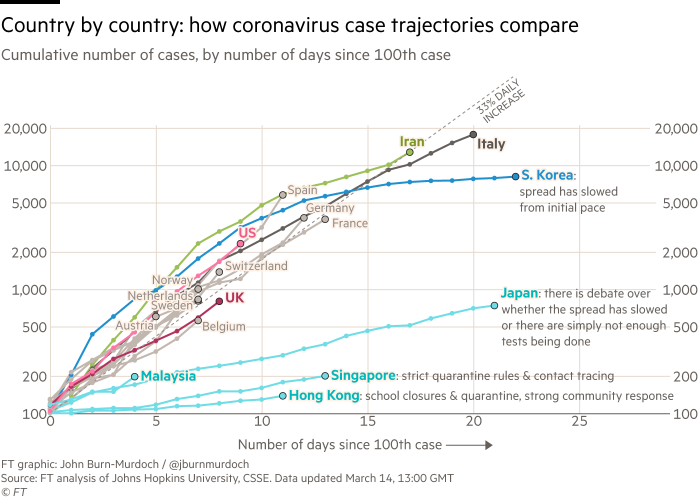
The faster and better that you deal with it, the smaller the economic hit is going to be. China is going to be the big winner here.
The economy is going to be hit either way, it's just a choice between A) a lock down but most people staying alive and healthy or B) lots of people dying or sick and an overrun health care system.
Maybe we don't know which one will have bigger impact on the economy, but we know for sure which one will lead to more human suffering.
China has more poor people than Italy, it stands to reason they are less well equipped to handle an economic down turn.
That said, we could just apply medical quarantine procedures used for animals to humans. Get a lab test 48 hours prior to international travel and have an additional test performed upon landing at the destination. The first test minimizes the likelihood of someone with viral shedding traveling and the lab test upon landing let’s you get the person and isolate them immediately before they’ve shed virally.
Can we stop using mode of government as an explanation for success and failure?
Clearly your country have its head screwed on better than mine. Meanwhile, my president is complacency in chief, more worried about the stock market than lives being lost. The local governments know what they're doing moreso than the feds, when it should be the other way around.
South Korea certainly seemed to have its head screwed most on head. They learned from previous lessons and are very successfully in applying them.
So did Italy, and they even got a head start in knowledge about the virus of about a month. Yet, the majority of cases here in Germany can be traced back to Italy, and not directly to China.
It's depressing how every country still tries their best to ignore their own failings and defaults to "well China should have stopped it right in the beginning"
I am absolutely sure that things would have been at least as bad if not worse, had this virus originated in Italy. Or Germany, or pretty much anywhere else.
China has implemented measures that have objectively worked: that have effectively contained an outbreak of this disease within their nation, despite having had the least knowledge and warning, and within a short amount of time. So, this is a good model to follow, in the absence of any other.
Certain Western governments appear to have decided to stretch the limits of that model to protect their economy in the short-term.
That will potentially result in everyone across the globe suffering further outbreaks.
Your assumption that drugs will save us is not safe. Novel drug development may be quick, or it may take decades.
While a state like China would be a bad idea, here in America we could perhaps learn the benefits of not heading too far in the opposite direction.
Any government or organization is problematic if it puts 'principles' over human lives.
So there is no need to equate the need for an authoritarian government to successfully contain the virus.
In the first few weeks of the virus transmission in China, nobody can anticipate the lethality of the coronavirus. People may think it is just another flu. Who knows? Yes, there were delays in the reporting and yes it could have been handled better. But the following actions of China were swift and determined. The fact is the coronavirus has been contained in China. The cases reported in China are single digit today. Fact shows China's model is effective, no?
You think the governments in EU or US could have done a better job if the coronavirus first appeared there? I'd say no. Why? Because the EU and USA have all the data and information about the coronavirus shared by China for months. You have witnessed all the mess caused by the virus in China for months and so what? Trump was down playing the danger of COVID-19 just a few days ago. The USA cannot even cover a fraction of its citizens for testing the virus.
We know it seemed to be a god sent opportunity to point fingers to the "authoritarian" system of China at this moment. But guess what? The coronavirus does not slow itself down regardless you are a democracy or not. Prove your system/model is better by saving the lives of your own citizens instead of bashing China, will you?
PS. we still don't know from where/what the coronavirus come from. I suggest wait for scientific proof before jumping to the conclusion that it started from China. last time I checked, the Spanish Flu did not originate from Spain.
https://www.straitstimes.com/asia/east-asia/wuhan-doctors-sa...
Everyone wants a drug and vaccine, but good science takes time to happen. Make no mistake, no one wants a lock down, but so far, it's the only option in the lack of a functional medical solution. If tons of scientists tell us lock down is the only option for now, we should'd listen rather than discredit them.
Now, if someone really wants to move on to talk about politics. It's about a nation as a whole can do the right thing, not about authoritarian vs. democracy.
A ideal democracy society works because we trust reasonable individuals can collectively make the right decision. In this COVID-19 case, lock the hell down and do the best practice to stop it from spreading. I don't see why a functional democracy nation can't do that. But it has to be a functional one.
Unfortunately, authoritarian was necessary when the general population (including local governments at various level) cannot function as well. China for example, has to reply on THE ONE in the center to make the right call and execute order top down to be functional. At least according to the CCP, the general population cannot be trusted. Thus the authoritarian regime. It's easy to see it's effectiveness when there is the right order in place. But it's also equally easy to neglect the fact that such an order takes really long (from Dec 2019 to end of Jan) to materialize.
IMHO, I think both Italy and China failed here, while we are all ignoring the one did really well, at least so far, Japan. (Or maybe Taiwan and Singapore, but they are small states which is easier to govern).
As I said elsewhere, a vaccine is likely less "important" in the immediate, especially because it can have far deeper side effects, and no test has been done on humans whatsoever, while most of the drugs are on Phase III (earliest data should arrive in April, at least for the studies I looked up).
Lock downs will help. But they will help in the future. They won't help the overloaded ICUs now, because they're getting now people who had been infected up to 14 days before. In case of no drugs, the alternative is getting makeshift hospitals in place to lessen the burden on the health system, and procure more equipment. However, just as the government was extremely fast in getting people locked in their homes, it was not for these things.
> It's about a nation as a whole can do the right thing, not about authoritarian vs. democracy.
It's hard to tell when the same government gives contradictory or confused statements. Some blamed "the ignorant masses" for the panic fleeing last Sunday, but in my view, people weren't just well equipped to understand (plus the early leak of the document) what was going on. The media also cherry picks the bad apples very well.
It ultimately means that these methods should have been used in the past.
It does not mean that they should be not used today because without using them the future will be orders of magnitude worse.
I compiled a small investigation http://www.savespain.eu/italy-vs-germany It might be interesting for you.
If you want your future to be better, start acting today.
Every Italian should have realized by now that you should hide your grandma and grandpa if you want to see them alive.
Trump said there is nothing to worry about. He even compared the numbers to flu numbers. This is similar to what the CCP did in the beginning.
Wuhan was locked down at 100 new cases a day. This is much faster response than countries who had seen Wuhan and even had better data.
The CCP did screw things up in the beginning, but made up for that by a very effective response. Countries are matching CCP on the initial response, but not ready to match the final response.
And also take a look at what safeguards we are willing to cut when every day of delay is thousands of deaths.
I'm well aware of how trials work (I happen to work in a scientific institution which does plenty). They may have been fast-tracked elsewhere, but not in my country.
So far there's just compassionate use, which means they're administered only to people who have truly severe sympthoms.
A vaccine can wait, to be honest, it's not as critical as a treatment to lessen the sympthoms. In fact, that's why Gilead is also testing their drug here (not sure when the actual protocols will start, though).
Note that I'm not advocating for "let's scrap all the trials stuff". But trials in phase III have, for obvious reasons, very lengthy time frames. And it's not the first time (I attended a talk a few years ago on the topic) where the system (which works, normally) shows its limits (not only emergencies, but for example orphan drugs).
It could do that because it could afford to take the economical hit and because it is an authoritarian state, which means you can get almost everyone to obey, in one way or another. Also, the Chinese Party is what caused this mess to begin with, by allowing this virus to spread all around the world.
Why on Earth is this a good model?
Undoubtedly for the safety of citizens, but even with all the people shouting about a "fascist revolution" going on with the previous government, it only took three orders to strip everyone of most of their freedoms without anyone batting an eye (especially since no one knows for how long, the April 3rd date is a joke).
Quarantining is probably inevitable (although it won't help the overloaded ICUs until two weeks from now, so more capacity will always be needed), but following rules in place in an outbreak does not mean one should not question their principles.
And this letter should be sent to the media and the government, since both can't even understand an exponential, or basic statistics (even with the so-called "peak" reached, cases will keep on increasing until recoveries are due).
Personally I'd like fast-tracking of anti-SARS-CoV-2 drugs instead (those are the ones which will get out of this mess, quarantining is just flattening the curve, although immensely beneficial), along with setting up place for non-intensive care COVID-19 patients. Every ICU bed freed is a victory.